
Category: Wildlife conservation

  • Bringing back birds from the brink of extinction

    Bringing back birds from the brink of extinction

    Bringing back birds

    Vallocchia’s work has also taken her to Malta and Mexico. She’s been with Maui Forest Bird Recovery for four years. As avian research field supervisor, she works on honeycreeper surveys, counting the relatively few remaining birds from what was once a thriving bird paradise with more than 50 species of honeycreeper.

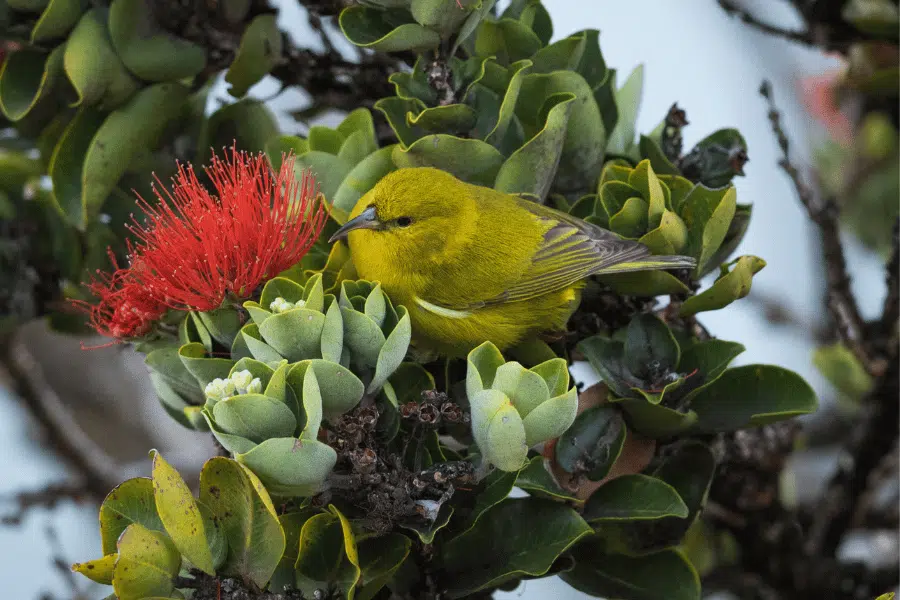
    On Maui, Vallocchia says, six species of honeycreeper remain. Three of these are endemic to Maui, found nowhere else. Vallocchia and her colleagues track populations of Kiwikiu (Maui parrotbill) and ʻĀkohekohe (crested honeycreeper).

    Vallocchia and her colleagues camp out in various locations on Maui, tracking birds and their activities at predetermined spots or transects on a specific line through a forest. This gives them a consistent scientific way to count the birds.

    Right now, fewer than 150 kiwikiu remain, Vallocchia says.

    “The native birds, you see how special they are here,” Hebebrand says. “When I saw a kiwikiu in the wild for the first time, I cried.”

    The soundscape of Hawaii

    Some native birds are spotted closer to the project’s home office. A Hawai’i ‘amakihi was spotted recently feeding on a hibiscus plant in the yard, delighting the staff.

    Program manager Hanna Mounce describes the work of Maui Forest Bird Recovery Project as an investment in ecosystems, cultural connections and the next generation.

    “I’m hopeful that our work today will help ensure these birds are still here for our children and grandchildren,” Mounce says. “Every day, I work alongside a team deeply committed to protecting something bigger than themselves.”

    Hawai’ian birds often make the sounds of their names. The kiwikiu might screech keee-eee-eee or tree-tree or kiwi-kiwi-kiwi-kiwi.

    “It’s so varied,” Vallocchia said.

    What tourists don’t see or hear

    These songs most likely won’t be heard by visitors coming to the islands on vacation. People relaxing at resorts may not know they’re missing the native wildlife and birds of the Hawai’ian islands.

    “Millions of people visit Hawaiʻi every year,” says Chris Warren, forest bird program coordinator at Haleakalā National Park, “and only a fraction of those get a chance to see an ʻiʻiwi or other fabulous native birds. People can grow up here and never experience a native forest.”

    Warren worked for MFBRP for more than a decade and continues to partner with the organization.

    “The project has always been driven by passion and a deep desire to save these species from extinction,” Warren says. His own understanding of extinction dates back to his work at the Joseph Moore Museum of Natural History in Indiana. He encountered specimens of extinct birds like passenger pigeons and Bachman’s warblers.

    “There is something profound about holding an animal in your hand that will never be seen alive again,” Warren says. “And to know that that extinction was preventable made a deep impact on me.”

    Protecting without disturbing

    Warren says one of the biggest challenges to forest bird recovery involves educating the public, who may not know these birds exist. People care more deeply about things that they’ve personally experienced, he says.

    Vallocchia agrees. She invites visitors to explore accessible areas of Maui, hiking into its fragile forests with awareness and care.

    “For people to want to protect something, they need to see it, experience it, understand the beauty of it,” Vallocchia says. “Being part of nature is not disturbing nature if it’s done in the right way.”

    Camping with permits is possible in places like Haleakalā National Park.

    “You could wake up to the song of the honeycreeper,” Vallocchia says.


    Recommended:

    The award-winning documentary “Vanishing Voices” combines interviews with bird recovery workers and animation to explain the science being used to save birds from extinction.


    Questions to consider:

    1. What are some threats to the honeycreepers on Maui?

    2. How are conservationists trying to restore the population of alalā?

    3. What birds can you spot where you live?


    Want to see and hear some honeycreepers? Check out the video below:

    Source link

  • Giving species the space they need

    Giving species the space they need

    In 1979, Patricia Majluf, then a biology student, started studying eared seals at San Juan. Two species coexist without competing for food on the peninsula: the South American fur seal (Arctocephalus australis) and sea lions (Otaria flavescens).

    A colony of South American fur seals resting at a beach. (Photo: Alfonso Silva-Santisteban)

    In Spanish, they are known as the “fine” and “common” sea lions (lobo fino y lobo chusco), because of their type of fur that led them to be hunted for clothing decades ago.

    Majluf is now one of the most respected marine biologists in the region, whose work led to the creation of a Punta San Juan Program. In 2009, the Peruvian government declared San Juan a natural protected area. Cárdenas arrived as Majluf’s student in 2004. Today, she is a professor at the Universidad Peruana Cayetano Heredia and directs the program.

    “You are the biologist behind the wall, you live and die there,” she said.

    A sea wall protects sea life.

    Kevin Farfán during a daily monitor round.

    Kevin Farfán during a daily monitor round. (Photo by Alfonso Silva-Santisteban)

    Kevin Farfán puts on his windbreaker, hangs up his binoculars and camera and begins his daily monitoring round at 6:30 a.m. He started as an intern seven years ago and now coordinates the station. He walks by San Juan’s 20 beaches, while Odeth Perez, who is on her way to an observation post, says hello from afar.

    All year round, at least two people at the station observe animal behavior, count species with drones and camera traps and monitor sea and air temperatures. Once a year, with the help of U.S. veterinarians, they capture and tag a sample of eared seals and penguins to attach transmitters and study their movements.

    “We have 40 years of data,” Cárdenas said.

    Since 2013, the team has crossed the wall separating the peninsula to connect with the residents of Marcona, a neighboring town founded in the 1950s after the discovery of an iron deposit.

    They began with guided tours. Since 2023, they have initiated a project called Natural Classrooms with students from local schools, serving a town with 15,000 inhabitants.

    Biologist Ximena Turcke is one of the guides. “It is important to reach the children, especially the younger ones,” Turcke said. On this day, she was leading a group of 30 students from Miguel Grau School to one of the viewpoints and later, to a neighboring beach for group work. “I’ve always liked people to identify with their place, wherever they go,” she said.

    Recovery and threats

    The most important thing to remember when walking in San Juan is not to disturb the animals. The eared seal breeding season starts in October and peaks between January and February.

    A group of 1,500 guanay cormorants arrived in October 2024. Before the avian flu in 2022, there were so many that they sometimes blocked the entrance to the team’s observation booth.

    Cárdenas said that there are few places where so many different animals with breeding colonies come together and that’s why the virus spread so quickly.

    Avian influenza AH5N1 is a subtype that affects birds and mammals, including humans in rare cases. The virus emerged in China in 1996 and has caused sporadic outbreaks. However, in 2020, a more transmissible variant of the virus passed from poultry to wild birds and began migrating worldwide. It reached North America in 2021 and South America in 2022. The flu spread from Peru to Chile, Argentina and Uruguay, affecting sea birds and mammals. There were no human cases.

    When Cárdenas arrived in San Juan, wildlife was recovering from the 1998 El Niño phenomenon and she saw how animals adapt to cycles when food is scarce. That’s why she remains optimistic about the repopulation of San Juan. But it will take several years and human activity must not alter the conditions for recovery.

    “There’s an incredible resilience,” she said.

    Limits on fishing

    One of the main threats is fishing. Industrial fishing takes almost 9 out of 10 anchovetas from the Peruvian sea to make fishmeal. Four tons of anchoveta produce one ton of fishmeal, which is mainly used to feed salmon, pigs or chickens in industrial farms around the world.

    Year after year, there are tensions between the fishing industry, the state and environmentalists over fishing quotas or minimum sizes of anchovies that can be caught. The Institute of the Peruvian Sea, the national scientific organization concerning the sustainability of marine resources, is part of the Ministry of Production.

    The conflict of interest is evident for Cárdenas, whose team has observed, by analyzing the feces of eared seals, that these are feeding more and more on smaller fish with less nutritional value. They are consuming what ecologists have called marine ecosystems’ junk food.

    In 2023, the state suspended the first industrial fishing season due to El Niño but reinstated the second one. It was too soon for Cárdenas and Farfán. They oppose the industry’s approach of expanding fishing almost indefinitely without consequences. “There have been no lessons learned from all this,” Cárdenas said. “It’s when these things happen that conservancy is most urgent.”


    Three questions to consider:

    1. How does fishing affect sea life?

    2. How are researchers working to help the sea life at Punta San Juan?

    3. What, if anything, can you do to help wildlife near you?


    Source link