Category: women in higher ed

  • CUPA-HR’s Equal Pay Day Data for Higher Education: Women in Higher Ed Are Paid Just 82 Cents on the Dollar, Most Women of Color Are Paid Even Less – CUPA-HR

    CUPA-HR’s Equal Pay Day Data for Higher Education: Women in Higher Ed Are Paid Just 82 Cents on the Dollar, Most Women of Color Are Paid Even Less – CUPA-HR

    by Julie Burrell | March 12, 2024

    Since 1996, the National Committee on Pay Equity has acknowledged Equal Pay Day to bring awareness to the gap between men’s and women’s wages. This year, Equal Pay Day is March 12 — symbolizing how far into the year women must work to be paid what men were paid in the previous year.

    To help higher ed leaders understand, communicate and address gender pay equity in higher education, CUPA-HR has analyzed its annual workforce data to establish Higher Education Equal Pay Days for 2024. Tailored to the higher ed workforce, these dates observe the gender pay gap by marking how long into 2024 women in higher ed must work to make what White men earned the previous year.

    Higher Education Equal Pay Day fell on March 5, 2024, for women overall, which means that women employees in higher education worked for more than two months into this year to gain parity with their White male colleagues. Women in the higher ed workforce make on average just 82 cents for every dollar a White male employed in higher ed makes.

    Highlighting some positive momentum during this Women’s History Month, some groups of women are closer to gaining pay equity. Asian American women in higher ed worked two weeks into this year to achieve parity on January 14 — not ideal, but by no means insignificant. In fact, during the academic year 2022-23, Asian American women administrators in particular saw better pay equity than most other groups, according to CUPA-HR’s analysis.

    But the gender pay gap remains for most women, and particularly for women of color. Here’s the breakdown of the gender pay gap in the higher ed workforce, and the Higher Education Equal Pay Day for each group.* These dates remind us of the work we have ahead.

    • March 5 — Women in Higher Education Equal Pay Day. On average, women employees in higher education are paid 82 cents on the dollar.
    • January 14 — Asian Women in Higher Education Equal Pay Day. Asian women in higher ed are paid 96 cents on the dollar.
    • March 1 — White Women in Higher Education Equal Pay Day. White women in higher ed are paid 83 cents on the dollar.
    • March 12 — Native Hawaiian/Pacific Islander Women in Higher Education Equal Pay Day. Native of Hawaii or Pacific Islander women in higher ed are paid 80 cents on the dollar.
    • March 28 — Black Women in Higher Education Equal Pay Day. Black women in higher ed are paid 76 cents on the dollar.
    • April 12 — Hispanic/Latina Women in Higher Education Equal Pay Day. Hispanic/Latina women in higher ed are paid 72 cents on the dollar.
    • April 22 — Native American/Alaska Native Women in Higher Education Equal Pay Day. Native American/Alaska Native women are paid just 69 cents on the dollar.

    CUPA-HR research shows that pay disparities exist across employment sectors in higher ed — administrators, faculty, professionals and staff — even as the representation of women and people of color has steadily increased. But with voluntary turnover rising, not addressing pay disparities could be costly.

    CUPA-HR Resources for Higher Education Equal Pay Days

    As we observe Women’s History Month and Higher Education Equal Pay Days for women, we’re reminded that the fight for equal pay is far from over. But data-driven analysis with the assistance of CUPA-HR research can empower your fight for a more equitable future.

    See our interactive graphics that track gender and racial composition, as well as pay, of administrative, faculty, professional, and staff roles, collected from CUPA-HR’s signature surveys:


    *Data Source: 2023-24 CUPA-HR Administrators, Faculty, Professionals, and Staff in Higher Education Surveys. Drawn from 633,020 men and women for whom race/ethnicity was known.



    Source link

  • National Women’s History Month: Past and Present Higher Ed HR Trailblazers – CUPA-HR

    National Women’s History Month: Past and Present Higher Ed HR Trailblazers – CUPA-HR

    by CUPA-HR | March 2, 2022

    National Women’s History Month celebrates the contributions and achievements women have made throughout U.S. history. CUPA-HR is fortunate to have had many smart and dedicated women serve on its national, regional and chapter boards and on various committees. In addition to providing leadership at work, they have volunteered their time and shared their know-how — lighting the way for other women in the field.

    To celebrate the month, we’re spotlighting some of the many leaders who have transformed higher ed HR and CUPA-HR. Sure to inspire, these articles and podcast episodes offer unique perspectives of higher ed HR, career journeys, struggles, successes and everything in between.

    Looking Back to Move Forward

    Blazing a Trail: Women Who Paved the Way in Higher Ed HR, from a 2014 issue of Higher Ed HR Magazine, features five CUPA-HR leaders who began their higher ed HR careers in a very different era — when HR was still “personnel,” men dominated the profession and the nature of the work was strictly focused on policies and procedures. These women rose to leadership positions, not only in their departments, but across their institutions. Read about their challenges, their regrets, their successes and a few war stories to boot.

    More Stories That Inspire

    CUPA-HR Conversations: Higher Ed HR Turns 75 Podcast features higher ed HR leaders and past CUPA-HR national board chairs who have left their mark on both the association and the profession.

    • In Episode 2: Growing Through Change, Allison Vaillancourt reflects on some professional advice she received from a CUPA-HR peer that changed her entire approach to HR and helped advance her career and secure several leadership positions.
    • Lynn Bynum shares how CUPA-HR helped her make the transition from the corporate world to higher ed HR, and Lauren Turner offers insights into how HR can become a recognized leader within the institution and help others become better leaders in Episode 4: Model Behavior.
    • Jane Federowicz reflects on her unexpected path to HR, starting out as her institution’s accountant and ending up being asked to create an HR department, in Episode 6: When Opportunity Knocks.
    • In Episode 7: Lifelong Learning, Barbara Carroll dives into some experiences she never thought she would have as an HR leader, including serving on CUPA-HR’s Public Policy Committee and providing a higher ed perspective to a room full of senators and congressional representatives, and Linda Lulli discusses the importance of being a lifelong learner in the HR profession and how to be adaptable and resilient.

    Time-Out With Tammi & Tyler is a podcast that explores how higher ed HR careers evolve by interviewing professionals at the top of their HR game, sharing advice they would give professionals climbing the higher ed HR ladder.

    • In Episode 1, Donna Popovich offers advice for early-career professionals.
    • Sheraine Gilliam walks through her story of persistence, networking and how to turn negative situations into opportunities for growth in Episode 3.
    • In Episode 5, Clarity White describes how her Wildfire program experience helped advance her HR career.

    Related resources:

    21-Day Challenge: Focus on Women (First two weeks of the challenge)


    Source link

  • New Report on the Representation of Women and Racial/Ethnic Minorities in the Workforce of Minority-Serving Institutions – CUPA-HR

    New Report on the Representation of Women and Racial/Ethnic Minorities in the Workforce of Minority-Serving Institutions – CUPA-HR

    by CUPA-HR | February 23, 2022

    Minority-serving institutions (MSIs) play an important role in ensuring students from underrepresented races and ethnicities receive a quality education.

    While there is an abundance of research on students who attend MSIs, little research has examined the MSI workforce, specifically, how the racial/ethnic representation of faculty, administrator, professional and staff reflects the student populations being served.

    The latest CUPA-HR report, The Representation of Women and Racial/Ethnic Minorities in the Workforce of Minority-Serving Higher Education Institutions targets this gap by providing an overview of MSI representation among all U.S. higher ed institutions and showing their geographic spread across the country; providing a closer examination of racial/ethnic and gender composition of faculty, administrators, professionals and non-exempt staff; and assessing how well the racial/ethnic composition of the higher ed workforce at MSIs reflects their student populations and matches the minority-serving mission of the institutions.

    Key findings from the report:

    • MSIs have higher racial/ethnic minority representation among their workforce than non-MSIs.
    • HBCUs have the highest representation of racial/ethnic minority employees.
    • Overall, the representation of racial/ethnic minority faculty at MSIs does not match the representation in students.
    • Overall, administrators, professionals, and staff at MSIs have similar racial/ethnic minority representation when compared to students.

    For more findings on the representation of women and racial/ethnic minorities in the workforce at MSIs, read the full report.


    Source link

  • New Research Shows Women in the Leadership Pipeline in Higher Education Have Better Representation and Pay in Institutions With Female Presidents and Provosts – CUPA-HR

    New Research Shows Women in the Leadership Pipeline in Higher Education Have Better Representation and Pay in Institutions With Female Presidents and Provosts – CUPA-HR

    by CUPA-HR | January 24, 2022

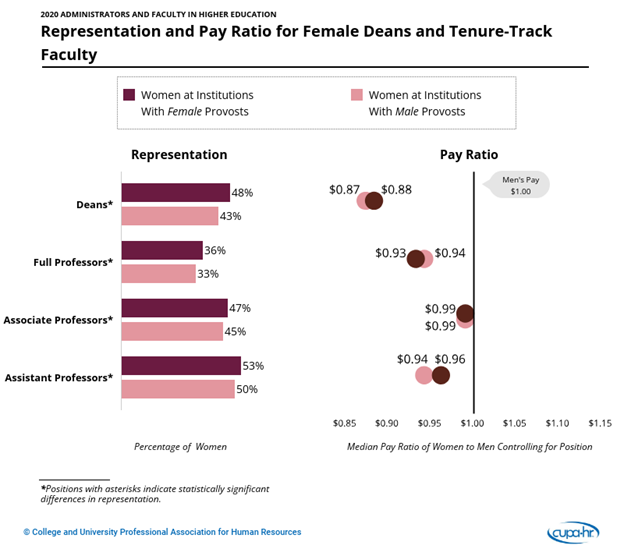
    New research by CUPA-HR has found that U.S. colleges and universities with women presidents or provosts have higher representation of women in administrative, dean and faculty positions than institutions led by men. The study also found that colleges and universities with women presidents have higher pay for women in administrative positions than institutions led by men. These positions tend to be pipelines for the senior-most executive positions in higher ed, which underscores the significance of the findings.

    Women Administrators Pay and Representation in Institutions With Female Presidents

    Findings show that institutions with female presidents have a higher percentage of women in all administrative categories — senior institutional officers, institutional administrators and heads of divisions. Although female administrators are generally paid less than male administrators in the same positions regardless of the sex of the president, female senior institutional officers, institutional administrators, and heads of divisions are paid more equitably at institutions with a female president than at institutions with a male president.

    Female Deans and Faculty Pay and Representation in Institutions With Female Provosts

    Institutions with female provosts have a significantly higher representation of women in dean positions and in all faculty ranks. Provost sex does not have a strong or consistent impact on pay equity for deans and faculty; however, it is worth noting that better representation at higher faculty ranks and in dean positions has an impact on pay, as these positions make higher salaries.

    The representation of women drops with successive faculty ranks (from assistant to associate to full professor). These promotions represent the few times in a faculty member’s career when appreciable salary increases are granted. If women are not being promoted, they are not receiving these pay raises. In addition, those in dean positions are generally promoted from senior faculty ranks. Therefore, if women are not adequately represented in senior faculty, they will not have the same likelihood as men of being considered for a higher-paying dean position.

    To sum up the findings, higher ed institutions with female executives have better representation of women throughout their institutions in positions that: a) are paid higher salaries and b) serve as key points in the executive leadership pipeline. Jackie Bichsel, CUPA-HR’s director of research and co-author of the new report, noted that, “In an era where institutions are adapting to shifting workforce expectations, adjusting to continuous decreases in budgets, contemplating changes in enrollment, addressing challenges of recruitment and retention, and rethinking their mission, more openness to change and less tolerance of risk may be just what is needed to navigate this new landscape. Providing more (and more equitable) opportunities for women to advance within higher education seems an obvious path forward in this navigation.”

    Read the full report, Women in the Leadership Pipeline in Higher Education Have Better Representation and Pay in Institutions With Female Presidents and Provosts.


    Source link