
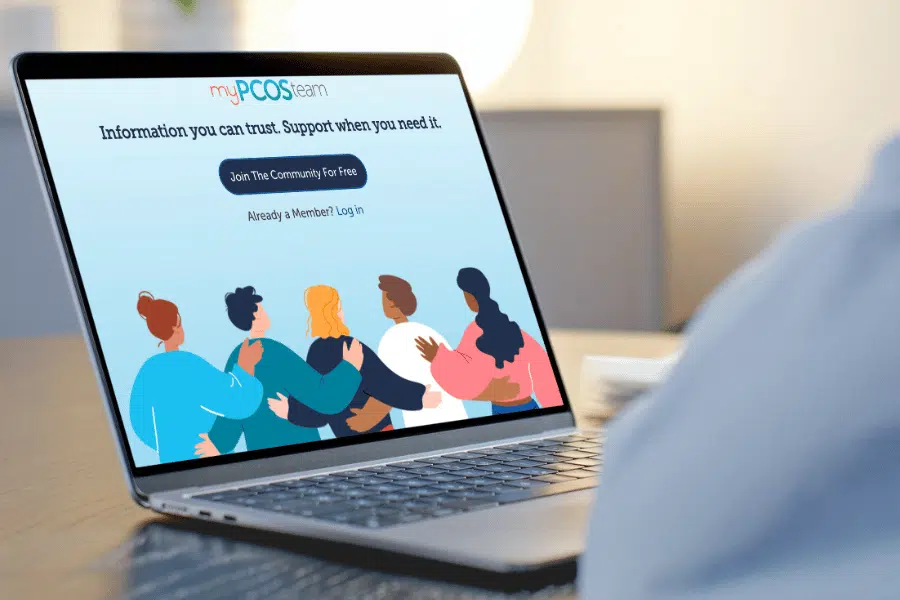
PCOS is a metabolic and reproductive condition. Although it’s the most common hormonal disorder in women of reproductive age, up to 70% of women affected by it never get diagnosed. Dr. Jamie Benham, an endocrinologist and principal investigatorat the EMBRACE Women’s Health Research Lab at the University of Calgary, said that because patients with PCOS can have a variety of experiences and symptoms, it can be challenging for doctors to diagnose.
For Joslin, it wasn’t until she began to struggle with infertility that she finally received a proper diagnosis. “When I saw the infertility doctor … he looks at me [and the] first thing he said to me was, ‘You are textbook PCOS’,” she said.
Joslin said that if it weren’t for the online community, PCOS wouldn’t have been on her radar at all. Through treatments from her fertility doctor and naturopath, she was able to start a family.
Taking symptoms seriously
Jade Broughton, a member of the PCOS Patient Advisory Council at the University of Calgary, said she initially downplayed her own symptoms for years. She assumed they were stress-related from her shift work as a nurse and she was told her symptoms were normal.
“I started noticing, quite a few years ago, my hair started falling [out] in clumps,” Broughton said. “I was just gaining weight so rapidly, I started having facial hair, all that stuff. I went to my doctor, and she was like, ‘You just turned 30, that’s just normal’ … So, I felt like I was just being gaslit for years and years.”
Through internet searches and the PCOS Reddit page, she was finally able to understand what her symptoms might mean. After about seven years of advocating for herself, she finally received a diagnosis from her family doctor.
“I feel like women’s health is still not taken seriously when it should be,” Broughton said. “Just stand up for yourself and trust your gut if you know something’s wrong.”
Lisa Minaker, a legal assistant student in Winnipeg, Canada said that her irregular periods were concerning to her family physician, who referred her to an endocrinologist. Through blood work, her endocrinologist diagnosed PCOS. Although she received a diagnosis relatively quickly, Minaker said she felt that her doctors were not always “overly helpful” when it came to managing her symptoms. She thinks that doctors lack sufficient training in women’s health.
“Not that it’s their fault,” she said. “Finding out how women don’t metabolize things like men, and how it’s dependant on where you are in your cycle … we’re still treated as basically a smaller version of men.”
Why expertise matters
Due to the complexity of PCOS and its diverse range of symptoms, a team of healthcare practitioners can be helpful. Joslin and Minaker both say that including other healthcare professionals, such as a naturopathic doctor and acupuncturist, helped with symptom management.
“The [naturopathic doctor] was that complement to the medical world,” Joslin said. “My fertility doctor would prescribe me medication, and the naturopath would talk to me about my blood work [and supplements] … It was the hand holding and just someone talking you through [your results] to make sure you know what’s going on.”
“I 100% credit the fact that I’m a mom to my naturopath,” Joslin said. “I would not be a mom without her.”
Minaker said that in her own health journey she learned more from social media than from any doctor. “The girls in the [Facebook] group are pretty helpful,” she said. “I had to do my own research because I wasn’t really given a choice.”
Although social media has played a big role in educating women about PCOS and other health problems, it can sometimes provide misinformation. A common misconception Broughton hears from patients is that they’re afraid to exercise, believing it’s bad for their health because of internet claims that it will raise cortisol levels — a hormone released in response to physical or emotional stress.
“This is not consistent with what we know about the condition and exercise is recommended for all people with PCOS,” said Benham. “Unfortunately, we’re limited in that PCOS is not well studied. It’s not well understood. It hasn’t been funded from a women’s health research perspective. So there’s a lot of people that are profiting off nutrition plans or exercise plans or giving different advice around supplements.”
Combatting misinformation
Minaker said she found it difficult in the beginning to distinguish which resources were helpful and which were targeted marketing scams.
“I wasn’t always that intuitive to be able to tell who was truthful,” Minaker said. “[I was] trying to find as many answers as possible.”
In some Facebook groups, women share their symptoms, medications and diagnostic test results. Chats in these groups often involve consultations, advice and, sometimes, bullying.
Joslin said that instead of lifting others up, some members of fertility groups for women with PCOS create guilt, embarrassment and shame around a vital aspect of life that PCOS can affect — being able to start a family.
“In some groups, like the PCOS groups that focus specifically on trying to get pregnant, I had to leave right away,” Joslin said. “It was very toxic … where, truthfully, in this journey you need support. I’ve found much more success with smaller localized groups.”
Information from medical organizations
To combat misinformation, some medical organizations have created their online forums and portals. Broughton pointed to Monash University in Australia, which released new PCOS guidelines and launched a phone application called Ask PCOS.
“They actually have an app that has tons of resources on weight management, food, insulin resistance, all of that stuff,” Broughton said. “And they’re actually one of the big players that’s trying to have it renamed as well.”
Since PCOS affects more than ovaries, a new name would reflect that and might make it less confusing for women with symptoms to get the help they need.
Other institutions are bringing women together in person to share experiences face-to-face.
The EMBRACE Lab at the University of Calgary, for example, formed a PCOS Patient Advisory Council to conduct patient-oriented research earlier this year. The council, which meets monthly, is a space for community.
“It’s such an amazing experience to sit in the room with all these women,” Joslin said. “Knowing all the struggles I’ve had … and sitting with people who are newly diagnosed or on their fertility journey … I’m able to share my advice and say, ‘You’re not alone.’”
Community, whether found online or through research, has been an important part of the journey for these patients.
Benham said that PCOS is a lifelong condition, whose symptoms can be managed although it cannot be cured. Joslin adds that it’s important to bring awareness to the condition. “Because there’s so many of us that have it, let’s make this more known.”
Questions to consider:
1. Why might someone trust a random person on an online forum over a doctor for medical advice?
2. How can medical information you find online leave you more confused?
3. If you felt unwell where would you turn for information about your condition?