Category: Worldwide PSE

  • The Governance of European Higher Education: Convergence or Divergence? with Michael Shattock

    The Governance of European Higher Education: Convergence or Divergence? with Michael Shattock

    Higher education is famously isomorphic. Around the world, knowledge is divided into disciplines in almost identical ways. Around the world, students go through a largely similar bachelor’s, master’s, doctorate sequence. And around the world, higher education institutions are heavily stratified, mainly according to their research outputs. Higher education institutions aren’t exactly homogenous. But the systems they live in, what they do, what they cover, et cetera, are substantially similar, except for one thing. Governance.

    Governance can mean a few things in higher education. At the system level, it’s about the relationship between institutions, both individually and collectively, and government. At the institutional level, it’s about the nature of public oversight, if any. These two different varieties of governance vary enormously from one country to another, and I would argue, are at the root of the glorious level of disharmony, individuality, and sheer quirkiness we see across national systems today, despite all the drivers towards isomorphism.

    The person who’s possibly written the most about this topic anywhere, ever, is Michael Shattock. He’s the former Registrar of Warwick University, a visiting professor at the University College of London’s Institute of Education, and an Honorary Research Professor in the Department of Education at Oxford University. He’s the author or co-author of a number of books about university governance around the world, and he joined us for this episode to talk about one of his more recent books, published by Bloomsbury, called The Governance of European Higher Education, Convergence or Divergence, co-authored with Aniko Horvath and Juergen Enders.

    Europe has some very old and deep-seated differences in the ways universities are governed. The French, German, and English systems, to take only three, have completely different ideas about what the relationship between the university and the state should be, not to mention some very contrasting notions about the role of the professoriate in institutional management. What practical impact do these differences have? Well, that’s what Michael and I sat down to chat about a few weeks ago. I hope you enjoy the conversation.


    The World of Higher Education Podcast
    Episode 3.17 | The Governance of European Higher Education: Convergence or Divergence? with Michael Shattock

    Transcript

    Alex Usher (AU): Michael, in your book, you talk about three grand traditions of European governance: the British or Anglosphere model, the French Napoleonic model, and the German Humboldtian model. How do those three styles or forms of governance vary when it comes to the relationship between universities and the state?

    Michael Shattock (MS): Well, I wouldn’t call them grand traditions. I think what they are now is more a set of underlying components of higher education policies.

    The Humboldtian tradition, which started in 1810, had an enormous influence across Europe because it brought research and teaching together into a single model. Around the same time, Napoleon established a single university for all of France, but it focused exclusively on teaching. This approach eventually led to the creation of the Grandes Écoles, which were also focused primarily on training.

    In the Anglosphere, universities were founded by local communities and had no initial relationship with the state. In the UK, for example, universities enjoyed considerable autonomy, which only began to change when they started seeking public funding. This relationship was formalized in 1919 and changed again after World War II in 1946, when the government decided to fully fund universities, which were struggling to recover financially.

    AU: One area where these traditions and these approaches to university-state relations have had a significant impact is in how countries have expanded their higher education systems since World War II. For example, some countries have introduced new universities or specialized institutions like the Fachhochschulen in Germany or the Institut Universitaire de Technologie in France. Does one system handle massification better than the others?

    MS: I think Germany has done particularly well in handling massification. Their success stems in part from the German constitution, which emphasizes homogeneity across the Länder. Another factor is that higher education in Germany is devolved to the Länder, so each of the 16 or 17 Länder has its own higher education system.

    These systems are interconnected and governed through collaboration between the Länder, the Conference of German Rectors, and, to some extent, the federal government through bodies like the Wissenschaftsrat. This framework ensures coordination without creating the competition you might see in more marketized systems.

    However, the German system isn’t without its issues. Following the Humboldtian model, Germany requires all universities to be both research- and teaching-oriented. The Fachhochschulen, which were established after the war, are not allowed to conduct research. As a result, three-quarters of students attend universities, while only one-quarter attend Fachhochschulen.

    Even so, the system is relatively equitable across the country and maintains strong principles of integrating research and teaching.

    AU: Governance isn’t just about university-state relations—it’s also about how institutions govern themselves. How do these three traditions differ in that regard?

    MS: Well, if we start with the Napoleonic tradition—which extends beyond France to Italy, Spain, and Portugal—you’ll see that universities are still under strong state control. In theory, the state is meant to act as a steering body, but in practice, these systems are highly regulated.

    The first issue when it comes to expansion in these systems is whether the state is willing to support growth and allocate resources accordingly. By contrast, in the UK, there’s a tacit belief that anyone with the appropriate qualifications should be able to access higher education. Theoretically, funding follows the students, but in reality, over the past five years, we’ve seen the students come while the funding often doesn’t follow.

    Secondly, there’s been a long-running debate—originating with the Lisbon declaration—about whether continental European universities should aim to match American universities. A series of reports, including excellent research by Professor Aguillon, highlighted a key difference: American universities often have lay-run governing bodies, whereas many European universities do not.

    This principle of having a governing body separate from purely academic leadership has been widely debated across Europe, with each country arriving at different solutions. In Hungary, for instance, the governing body consists of only five members, all from the ruling political party—a move that has faced objections in Brussels. Meanwhile, in Norway, the governing body includes two to five laypeople alongside academics, and they’ve even abolished the Senate, feeling it’s no longer necessary.

    So, there have been significant changes in the governance structures of universities, particularly in how these top-level committees are organized.

    AU:  Michael, you state in your book that European systems have faced three major challenges this century: the Lisbon declaration’s push to make Europe the most innovative society, the Bologna Process, and the rise of international rankings. How have European systems responded to these drivers? Have their responses been uniform, or have they diverged?

    MS: If you recall, my book has a secondary title, Convergence or Divergence. After the Lisbon Declaration, the expectation was that there would be significant convergence across European higher education systems. However, higher education wasn’t part of the Treaty of Rome, meaning the EU has no formal jurisdiction in this area.

    One might have assumed that the Bologna Process, with its establishment of the “3-2-3” model—three years for undergraduate degrees, two years for master’s degrees, and three years for PhDs—would lead to greater alignment in how universities are run. But that hasn’t been the case. In fact, the book strongly argues that divergence has overshadowed convergence, driven by national preconceptions and the varying resources available in different countries.

    Take Portugal, for example. In the book, we use it as a case study for universities in Southern Europe. Historically, Portugal’s universities were concentrated in coastal cities like Lisbon, Porto, and Coimbra, with no significant presence in rural areas. One of the country’s key higher education initiatives has been to establish institutions in the countryside. While not entirely successful, this effort has been an important part of their overall strategy to expand access.

    So, while divergence has often dominated, it’s worth noting that differing starting points can sometimes lead to similar endpoints. In some cases, divergent reactions to challenges may still result in convergence on a single model over time.

    AU: Divergence often happens because systems start from different points. For example, the relationship between research and teaching has been diverging in some systems, especially through institutional stratification. Are we seeing convergence in academic culture around this?

    MS: I wouldn’t describe it as a convergence, but if you think back to Lisbon, there was a strong emphasis on increasing the commitment to research within university systems. This focus has led to significant changes in how higher education systems are structured.

    For example, in the UK, research and teaching are managed by two entirely separate government departments. The Department of Education oversees teaching, while the Department of Industry and Innovation handles research. As a result, universities receive funding from two distinct sources.

    In Portugal, we encountered an unusual situation where the government felt it needed to invest more in research. To address this, they proposed—or perhaps it was the universities’ idea—to move research activities off the main university campuses and into smaller, independent research centers. These centers would allow polytechnic researchers to collaborate with those from established research universities. However, this approach has created unintended consequences. These research campuses have become increasingly autonomous, to the point where university rectors often have little understanding of what’s happening at these off-campus sites. Rather than strengthening the polytechnics, this model has effectively turned university campuses into teaching-only institutions, which I see as a step backward.

    The EU has also become more involved in this area, despite not having a formal role in higher education. Through the Horizon program, the EU has made substantial funding available for academics across member states to compete for. Interestingly, the UK has just negotiated its way back into Horizon following Brexit. This shift suggests that the EU, which had previously focused on undergraduate teaching through initiatives like the Bologna Process, is now channeling its higher education investments almost entirely into research via Horizon.

    As a result, universities across Europe are being pulled in different directions, and the ways these tensions manifest vary significantly from country to country.

    AU: One part of your book I enjoyed was your discussion of student participation in governance. In continental Europe, students often have significant roles in decision-making. How do these roles differ across countries?

    MS: I think the cultures around student participation differ significantly between countries. Let me start with Germany. The German higher education system went through a difficult period of intense student activism in the 1980s and 1990s. What has emerged from that is a system where students now play a significant role in university governance, particularly through their involvement in the Senate.

    This involvement is quite remarkable. For instance, when a candidate for a professorship is presented to the Senate for approval, student members have the same rights as academic members to challenge or endorse the appointment. Students are deeply integrated into the university’s internal negotiations, and rectors often leverage student opinions to balance or counteract the influence of academic groups. In this way, students have become a central element of university governance.

    In Norway and Portugal, the role of students is slightly different. National student organizations in these countries hold substantial influence within government decision-making. Additionally, they take on responsibilities that, in systems like those in Britain or Canada, would typically fall to the universities themselves. These include providing student accommodation, offering career advice, and managing other social services.

    While students in these systems may engage with certain academic issues, their role in the direct governance or operational management of the university is far less pronounced than what we see in Germany.

    AU: This isn’t your first book on university governance. With this new book on Europe, do you see European systems heading in the same direction as the rest of the world, or are they charting a different course?

    MS: The global trend is toward greater state involvement and oversight in higher education. Even in countries like Japan, there has been an attempt to shift from a traditional government-management relationship with universities to what is described as a “steering” relationship. However, in reality, governments still maintain a significant grip on university systems.

    Looking across Europe, you can observe different approaches to state control. Take Hungary, for example. In Hungary, the state has effectively taken over the management of the higher education system. Chancellors, often drawn from other public service sectors, are imposed by the state to sit on university governing bodies alongside rectors, with significant control over finances.

    In contrast, countries like Norway and Germany have a much lighter touch when it comes to state intervention. In these systems, there is a belief—particularly in Germany—that university autonomy is crucial for institutional success. This stands in stark contrast to Britain, where there is a rhetoric supporting university autonomy, but in practice, universities are heavily influenced by external pressures like league tables and global rankings.

    Another interesting shift in recent years has been the growing recognition of universities as “anchors” in their communities. This concept emphasizes the important role universities play, particularly in smaller towns, in contributing to local social and economic well-being. This idea of universities having a broader community impact is relatively new compared to 25 years ago, but it reflects an evolving understanding of the societal role of higher education.

    AU: Let’s look forward 25 years. If you were to write this book again in 2050, would you expect more convergence or divergence?

    MS: Well, I have to admit, I was afraid you would ask me this question, and I’ve given it some thought. To put it simply, I believe that in Europe, divergence will persist. The nation-state, as it currently operates in Europe, will continue to resist attempts by the EU to modernize and harmonize higher education systems. This resistance makes it difficult to achieve the kind of convergence the EU envisions.

    AU: Michael, thank you so much for joining us today.

    MS: Pleasure.

    AU: And thank you to our producers, Tiffany McLennan and Sam Pufek, and to you, our listeners and viewers. If you have any questions about today’s episode or suggestions for future ones, email us at [email protected]. Don’t forget to subscribe to our YouTube channel. Join us next week when our guest will be Javier Botero, discussing developments in Colombian higher education. Bye for now.

    *This podcast transcript was generated using an AI transcription service with limited editing. Please forgive any errors made through this service.

    Source link

  • HESA’s AI Observatory: What’s new in higher education (January 17, 2025)

    HESA’s AI Observatory: What’s new in higher education (January 17, 2025)

    Transformation of education

    The McDonaldisation of higher education in the age of AI

    Yoonil Auh, J. University World News. December 11th, 2024.

    Reflection on how AI’s impact on higher education aligns with the principles of McDonaldisation (efficiency, calculability, predictability and control), what opportunities and challenges it creates, and how institutions are responding

    Decolonization

    AI and digital neocolonialism: Unintended impacts on universities

    Yoonil Auh, J. University World News. July 12th, 2024. 

    The evolution of AI risks reinforcing neocolonial patterns, underscoring the complex ethical implications associated with their deployment and broader impact

    Workforce preparation

    As workers seek guidance on AI use, employers value skilled graduates

    Ascione, L. eCampusNews. December 9th, 2024.

    A new Wiley survey highlights that 40% of respondents struggle to understand how to integrate AI into their work and 75% lack confidence in AI use, while 34% of managers feel equipped to support AI integration

    California students want careers in AI. Here’s how colleges are meeting that demand

    Brumer, D. and Garza, J. Cal Matters. October 20th, 2024. 

    California’s governor announced the first statewide partnership with a tech firm, Nvidia, to bring AI curriculum, resources and opportunities to California’s public higher education institutions. The partnership will bring AI tools to community colleges first.

    Let’s equip the next generation of business leaders with an ethical compass

    Côrte-Real, A. Times Higher Education. October 22nd, 2024. 

    In a world driven by AI, focusing on human connections and understanding is essential for achieving success. While AI can standardize many processes, it is the unique human skills – such as empathy, creativity, and critical thinking – that will continue to set individuals and organizations apart.

    How employer demand trends across two countries demonstrate need for AI skills

    Stevens, K. EAB. October 10th, 2024. 

    Study reviewing employer demands in the US and in Ireland to better understand how demand for AI skills differ across countries, and examine if these differences are significant enough to require targeted curricular design by country

    Research

    We’re living in a world of artificial intelligence – it’s academic publishing that needs to change

    Moorhouse, B. Times Higher Education. December 13th, 2024.

    Suggestions to shift mindsets towards GenAI tools to restore trust in academic publishing

    Teaching and learning

    The AI-Generated Textbook That’s Making Academics Nervous

    Palmer, K. Inside Higher Ed. December 13th, 2024. 

    A comparative literature professor at UCLA used AI to generate the textbook for her medieval literature course notably with the aim to make course material more financially accessible to her students – but the academic community reacted strongly

    GenAI impedes student learning, hitting exam performance

    Sawahel, W. University World News. December 12th, 2024.

    A study conducted in Germany using GenAI detection systems showed that students who used GenAI scored significantly lower in essays

    The renaissance of the essay starts here

    Gordon, C. and Compton, M. Times Higher Education. December 9th, 2024. 

    A group of academics from King’s College London, the London School of Economics and Political Science, the University of Sydney and Richmond American University came together to draft a manifesto on the future of the essay in the age of AI, where they highlight problems and opportunities related to the use of essays, and propose ways to rejuvenate its use

    These AI tools can help prepare future programmers for the workplace

    Rao, R. Times Higher Education. December 9th, 2024.

    Reflection on how curricula should incorporate the use of AI tools, with a specific focus on programming courses

    The future is hybrid: Colleges begin to reimagine learning in an AI world

    McMurtrie, B. The Chronicle of Higher Education. October 3rd, 2024.

    Reflection on the state of AI integration in teaching and learning across the US

    Academic integrity

    Survey suggests students do not see use of AI as cheating

    Qiriazi, V. et al. University World News. December 11th, 2024. 

    Overview of topics discussed at the recent plenary of the Council of Europe Platform on Ethics, Transparency and Integrity in Education

    Focusing on GenAI detection is a no-win approach for instructors

    Berdahl, L. University Affairs. December 11th, 2024

    Reflection on potential equity, ethical, and workload implications of AI detection 

    The Goldilocks effect: finding ‘just right’ in the AI era

    MacCallum, K. Times Higher Education. October 28th, 2024. 

    Discussion on when AI use is ‘too much’ versus when it is ‘just right’, and how instructors can allow students to use GenAI tools while still maintaining ownership of their work

    Source link

  • Beyond the Rhetoric: Mexico’s Higher Education Reality with Alma Maldonado Maldonado

    Beyond the Rhetoric: Mexico’s Higher Education Reality with Alma Maldonado Maldonado

    Hi everyone. I’m Alex Usher, and this is the World of Higher Education podcast. If you’re a really faithful listener, you may remember that when the show was in beta and we were fooling around with formats and guests, we did an episode about Mexican higher education and its tribulations under the populist president Andres Manuel Lopez Obrador or AMLO for short.

    Our guest that day was my friend, Alma Maldonado Maldonado, an education researcher at Cinvestav, which is the Center for Research and Advanced Studies of the National Polytechnic Institute. That interview was so brilliant, we turned this podcast into a full-time investigation of higher education developments in various countries around the world.

    Today, Alma’s back with us again to talk about how things have and have not changed in Mexico over the past two years. The big story there is that there’s a new president in town. Last spring, Claudia Sheinbaum became the country’s first ever woman president. One who happens to have a PhD in engineering with a specialty in energy and sustainability.

    You’d think that might be an advantage to a higher education sector, but Scheinbaum comes from AMLO’s Morena party and her instincts seem to be to continue her predecessor’s tradition of attacking higher education as being a dissolute elite enterprise.

    So what does this mean for Mexican higher education? Well, in general, it’s not good. Alma takes us through the implications of Morena’s supermajority in Congress, as well as its early attempts to put fiscal pressure on universities, and its continued fascination with the experimental and kind of shambolic Benito Juarez universities.
    Spoiler alert, there are not a lot of silver linings in this story, either for public or private sector universities in Mexico. But enough from me, let’s hand things over to Alma to explain.


    The World of Higher Education Podcast
    Episode 3.16 | Beyond the Rhetoric: Mexico’s Higher Education Reality with Alma Maldonado Maldonado

    Transcript

    Alex Usher (AU): Alma, almost two years ago, then-President López Obrador had about a year and a half left in his mandate and was essentially at war with the university sector and the scientific community. How did his administration end with respect to higher education? Did anything change? Did things get better or worse in his final months? Were there any significant policy shifts we should know about?

    Alma Maldonado Maldonado (AMM): Hi Alex, thanks for inviting me. It’s a pleasure to be here. Well, I think most things didn’t change. Essentially, everything stayed the same. His rhetoric and narrative against higher education institutions, against graduates from abroad, and especially against UNAM, continued until the end of his term, unfortunately.

    There wasn’t anything that made him change that rhetoric. One reason for this is that he had political capital—he knew his base supported him fully. So, why change something that was working for him? On the contrary, the attacks on universities and the restriction of resources continued right until the end.

    AU: So, nothing was resolved. But earlier this year, there were elections for the presidency and both the Chambers of Deputies and the Senate. Did higher education play any role in that election? Were there significant policy differences between the parties?

    AMM: Not really. Education didn’t feature much in the campaign—similar to what we see in the U.S. It just wasn’t important. There were only a few mentions here and there about education, but in general, it wasn’t a key part of any campaigns.

    What we did see, unfortunately, was this sort of competition around scholarships. One candidate would say, “I’ll offer scholarships for secondary education,” and the other would respond, “Well, I’ll offer scholarships for secondary, but also primary, and even preschool!” That was the extent of the debate around education policy between the two main candidates. I’m not surprised but it was very disappointing because in a country like Mexico, where education can be a major driver of social change, it wasn’t given the attention it deserves.

    AU: The winner of the election was Claudia Sheinbaum of the Morena party, the same party as López Obrador. But she has a somewhat different image—she’s a scientist with an advanced degree from UNAM, a doctorate, I think. Does her presidency signal any kind of shift for higher education?

    AMM: It’s complicated. On paper, yes, she’s better. She has a PhD from UNAM and worked as an academic—one of the few cases where an academic has become president. Not the first, of course, but still, it’s notable.

    She has a pro-science and pro-higher education rhetoric, especially given her background in the student movement at UNAM in the 1980s. She fought alongside people like Emanuel Ordorica, Carlos Simas (her former husband), and Antonio Santos. She wasn’t a leader in that movement, though now some are rewriting history to present her as one.

    Her narrative emphasizes free higher education and the idea that education is a right, not a privilege. But since she took office a few months ago, we haven’t seen much change in terms of the most important issue—financing. It’s clear: follow the money.

    In the initial draft of the national budget, the funding for UNAM and other major universities was cut. Later, the government said, “Oh no, it was a mistake. We didn’t mean to cut the budget. Sorry, let’s fix it.” Imagine—someone who champions free higher education putting universities in that position. It’s a contradiction.

    AU: She has large majorities in both chambers of parliament, so she has significant power to implement her agenda. Why do you think she proposed cuts to education funding initially?

    AMM: Well, because she’s seen as the president of higher education and science. Reducing the budget as her first move would’ve been disastrous for her image.

    But you’re right—she has total control of Congress and the Senate. Right now, she’s focused on other reforms, particularly in the judicial system, and she’s changing a lot of laws. Education isn’t on the map because López Obrador already changed the Constitution’s third article, which governs education. There’s no immediate need for her to revisit it.

    AU: Let’s circle back to the budget cuts. Last month, the proposed budget included a cut of 10 billion pesos—about 500 million U.S. dollars—to higher education, with half of that falling directly on UNAM. There was significant outcry, and she backtracked somewhat. Do we know how this will end up? Will the universities be held whole, or are cuts still coming?

    AMM: They decided to reorganize the budget, but now they’re cutting other areas instead. Unfortunately, that includes initial education and other sectors. They also cut the Senate’s budget, which has caused disputes.

    In terms of higher education, they’ve claimed that funding will remain the same as last year, with a slight adjustment for inflation. But the adjustment is minimal—about 3%—while experts estimate inflation at around 5% but they’re just adding 3%. So, effectively, there’s still less money to spend. There’s less money for infrastructure, materials, and other essentials. Universities are in a slightly better position than they were a few weeks ago, but the situation remains difficult. The contradictions in her policies have drawn a lot of criticism.

    AU: Why was so much of the proposed cut targeted at UNAM? Was it deliberate? Is there animosity toward the university?

    AMM: There’s speculation about that. Some believe it was a punishment for UNAM’s independence, particularly regarding topics like judicial reform. UNAM has maintained a critical stance, which Morena and Claudia don’t like.

    Let’s not forget that one of the first things López Obrador did when he came to power six years ago was to modify the Constitution’s third article, removing university autonomy. When there was backlash, they said, “Oh, it was a mistake. We didn’t mean it.” But there have been many such “mistakes.”

    AU: Going back to AMLO, he also set a goal of increasing enrollment by 1.5 million students while also underfunding institutions at the same time. How did that play out? Did he reach that goal? How did the funding play into the final result?

    AMM: Currently, enrollment coverage in higher education is about 44%—very low compared to other Latin American countries. AMLO’s goal was to reach 50%, but he fell short.

    Now, Claudia Sheinbaum is aiming for 55%. I don’t think that’s realistic. The common system in Mexico is to add 5% on any policy, even if the last one isn’t achieved. To achieve that, they’d need to add about 1.2 million students, which isn’t feasible with the current system.

    The problem is that the educational spaces being created aren’t in the places where students want to go. There’s a clear contradiction between their enrollment goals and actual planning.

    AU: Part of AMLO’s strategy was the Benito Juárez Universities—small, access-oriented institutions in remote areas. You previously described them as “Potemkin institutions.” What’s the current situation? Will Sheinbaum continue with this policy?

    AMM: Yes, she’s continuing the project. But as I’ve said before, it remains very obscure. We don’t know who attends these universities, who teaches there, or what students are learning. I have a student doing their master’s dissertation on these universities, and they can’t get access for research.

    Sheinbaum recently announced plans to open 50 more. But we don’t even know what’s happening with the existing 140—or whether that number is accurate. There have been protests at these universities over issues like unreceived degrees and inadequate resources. I wouldn’t be surprised that Colombia would adopt them because they’re friends of Claudia. The idea is that these institutions could increase 40,000 new spaces. While they’re meant to provide education in remote areas with programs tailored to local communities, they’re not addressing the larger participation gaps.

    AU: We’ve been talking mainly about the public sector, but what about the private sector? Institutions like Tecnológico de Monterrey are highly regarded. How does the disarray in the public sector affect them? Does it make them stronger?

    AMM: I think they are struggling too, but we need to distinguish between the high-prestige institutions and the low-prestige ones. So, let’s start with the high-prestige institutions like Tecnológico de Monterrey or Universidad Autónoma de Guadalajara.

    They are struggling financially, particularly because some scholarships they used to receive for graduate programs have been eliminated. For example, many students in their graduate programs previously got scholarships from the National Science and Technology Council. But now, under the current rhetoric, those scholarships are only being given to students in public institutions.

    This has forced high-prestige private institutions to get more creative with their resources to maintain their programs.

    On the other hand, there are low-prestige private institutions, some of which are as bad as the Benito Juárez Universities. They lack quality, but the government lets them operate because they solve a demand problem. Parents want their kids to attend college, and these institutions offer that possibility, even if the education isn’t great. Families make sacrifices to pay for these degrees because, in their minds, a degree is still a degree.

    And then, in the middle, there are institutions that are more decent in terms of quality. But the big question is: who ensures the quality of these institutions? That’s been a longstanding issue, and it hasn’t improved under the current government.

    AU: It’s a classic trade-off we see in many countries. Alma, we’ve covered a lot of doom and gloom. Are there any bright spots you foresee for 2025?

    AMM: I wish I could say I see more positive things coming, but honestly, I don’t. A big part of my concern is tied to North America and what a Trump presidency could mean for Mexico. If he returns to power, we’re likely to face serious challenges around migration and broader U.S.-Mexico relations.

    It’s really sad that Mexico didn’t take advantage of opportunities to strengthen ties with the U.S. while Biden was in office. There could have been agreements, collaborations, and advancements, but those didn’t materialize.

    In the face of all this, creativity will be key. Maybe we’ll see new programs to support migrants with higher education degrees who end up staying in Mexico. It’s critical that we do better this time than we did during the Dreamers situation. But honestly, I’m not confident that the government is prepared to handle these challenges effectively. So, unfortunately, I don’t see much good news ahead.

    AU: Well that’s a good reminder that international affairs do intrude on higher education affairs sometimes. Alma, thanks for being with us.

    AMM: Thank you very much, Alex.

    AU: And thank you to our excellent producers, Tiffany MacLennan and Samantha Pufek. If you have comments or questions, reach out at [email protected]. Don’t forget to subscribe to our YouTube channel. Join us next week when Michael Shattock will discuss governance in European universities. Bye for now.

    *This podcast transcript was generated using an AI transcription service with limited editing. Please forgive any errors made through this service.
    Source link

  • The Fifteen: January 10, 2025

    The Fifteen: January 10, 2025

    Our first Fifteen in the New Year! Although many institutions have been on winter break in recent weeks, numerous important stories from the world of higher education continue to unfold. This week on The Fifteen, we look at what’s happening around the globe. Enjoy!

    1. A thought-provoking post from the LSE Blog discusses whether traditional academics bring the ideal skills-set to institutional leadership positions as the UK PSE faces a financial crisis. Let’s look outside academia for university leaders. (LSE Blog)
    2. Staff at a UK university made a move to impeach the administration after they announced job cuts. Staff pass motion of no confidence in UEA executive. (BBC)
    3. Report from a US Conservative think-tank finds that US college accreditation is not an effective means of quality control and recommends scrapping it in favour of more general consumer protections to allow more new entrants to deliver higher education programs. Report: States Should Drop Accreditation Requirements for New Colleges. (AEI)
    4. Nazarbayev University in Kazakhstan was a pretty big deal when it opened 15 years ago. The President’s resignation in 2023 was something of a shock: here’s some interesting background to that story: The battle for Nazarbayev University’s future: Shigeo Katsu on financial mismanagement and accountability. (Eureporter)
    5. This is a quite fascinating look at a new venture which is attempting to create a network of universities across Eurasia and North Africa, in part by using course materials licensed form the ever-inventive Arizona State University. An experiment to watch. After bumpy start, ASU-backed university network picks up pace (Times Higher Education).
    6. A private Afrikaans university, Akademia, has been growing significantly since its establishment in 2012, and is now setting up a new campus. South Africa’s private Afrikaans university showing incredible growth. (BusinessTech)
    7. Finland is ramping up R&D spending, aiming to increase from 2.9% to 4% of GDP by 2030. The country hasn’t seen massive success in technology development since the days of Nokia: might this change soon? Will Finland’s big spending on R&D buy it the gift of growth? (Times Higher Education)
    8. Greece has a huge problem with students who enrol but simply neglect to finish their degrees. Rectors call for exemptions to law ousting university loafers. (ekathimerini.com)
    9. The Hungary-EU fight continues. The EU has been blocking funding from reaching institutions there due to concerns about the political influence of populist Prime Minister Viktor Orban’s Fidesz party. Hungarian universities stay blocked from EU grants despite appeal. (Times Higher Education)
    10. Belarus finds that being an international pariah is no barrier to increasing educational exports: BSU almost doubled exports of educational services in 2024. (SB News)
    11. Iran is very pleased at how its universities rank compared to those in countries it really shouldn’t be comparing itself against: Iran secures second place in D-8 universities ranking. (Tehran Times)
    12. Germany is trying to encourage PhD researchers to start their own companies with backing from a UK fund and a former Google exec. German innovation agency to fund spin-out focused PhDs. (Times Higher Education)
    13. Japan’s highly structured, seniority-based compensation system tends not to reward young people with very high levels of education. Result? A big drop in applicants to PhD programs. Now the government is experimenting with ways to make PhDs more financially appealing. Japan seeks to improve salary prospects for PhD graduates. (Times Higher Education)
    14. The Biden Administration has passed what is likely it’s final tranche of student loan forgiveness, this time for people enrolled in what is known as the Public Service Loan Forgiveness (PSLF) program. Biden-Harris Administration Approves Additional $4.28 Billion in Student Debt Relief for Nearly 55,000 Public Service Workers. (US Department of Education)
    15. A working paper put out by the National Bureau of Economic Research finds that American academics have (for several decades at least) been disproportionately drawn from better-off families, particularly in the humanities. Climbing the Ivory Tower: How socio-economic background shapes academia. (NBER)

    The post The Fifteen: January 10, 2025 appeared first on HESA.

    Source link

  • Where Canada lies in Global Trends with Alex Usher

    Where Canada lies in Global Trends with Alex Usher

    Happy New Year and Welcome back to the World of Higher Education Podcast! I’m Tiffany MacLennan, your host for the day which means our guest is the one and only, Alex Usher.

    In this episode, we’ll explore key global trends in higher education and then dive into how Canada fits—or doesn’t—within them. From widespread funding challenges to the politicization of universities and the evolving focus on vocational education, we’ll unpack how these issues play out on a global scale and what they mean for Canadian post-secondary sector. Let’s hear from Alex.


    The World of Higher Education Podcast
    Episode 3.15 | Where Canada lies in Global Trends with Alex UsherKelchen

    Transcript

    Tiffany MacLennan (TM): Alex, many of our guests this year discussed how their higher education systems are grappling with significant funding challenges. Can you tell me what some of the issues have been globally? Have there been any places that haven’t been struggling financially?

    Alex Usher (AU): I think in the developed world, you’ve got very similar issues: slow economic growth, price volatility, an aging demographic, and frankly, increasing skepticism about how higher education translates into economic growth. What you’ve seen everywhere, I think, is a weakening in the desire to invest in higher education—certainly compared to where we were 20 years ago. Back then, when global rankings started, everyone wanted to climb higher in the rankings. That reflected a belief by countries that investments in knowledge paid dividends, that more top universities meant a better economy. I just don’t think people believe that anymore. And until that belief comes back, it’s going to be tough to get public funding. Private funding—through higher tuition fees, for example—is still possible, and it works in some places, like China. But in much of Europe, where taxes are high, people feel like they’ve already paid their dues and don’t want to pay tuition fees. In North America, Australia, and the UK, there’s growing skepticism about whether higher education is delivering value for money. The combination of those two have put higher education in a difficult position.

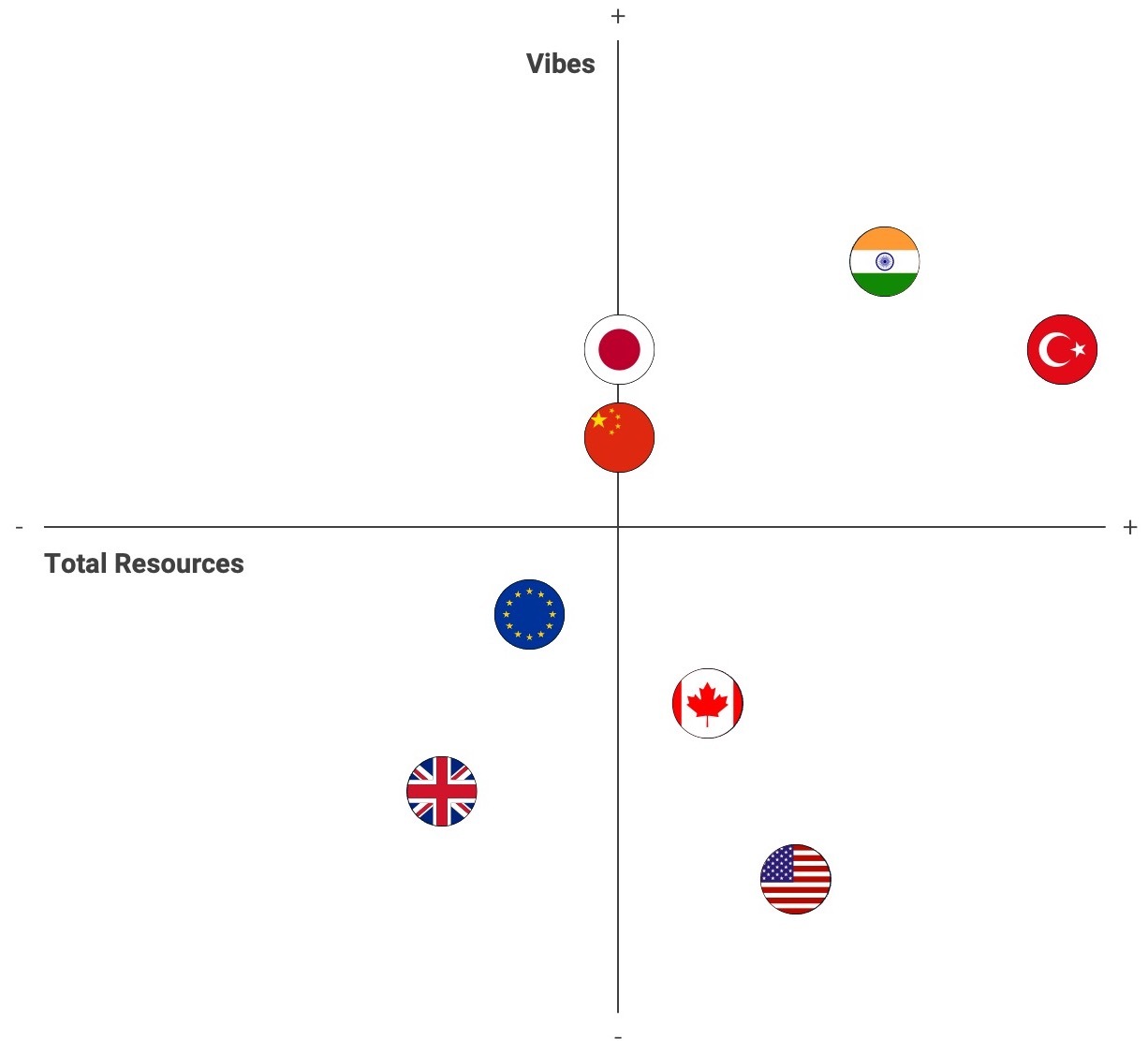
    So, globally, there’s a gap. Universities and academics know what kind of product they’d like to offer the public, but nobody wants to pay for it—either privately or publicly. That gap, I’d say, is about 10-15% in most countries. India and Turkey being exceptions to the rule with recent increases.

    TM: That’s interesting. Are these funding challenges playing out in the same way in Canada, or are there unique factors at play here?

    AU: When it comes to public funding, I think Canada’s pretty much following the global trend. Maybe we’ve defunded institutions a bit more than some other countries, but that’s because we thought we’d found a workaround: international students. I always say public funding of public education is a public good, but foreign funding of public education? That’s a public great. If you can get another country’s middle class to subsidize your middle class’s education, why wouldn’t you do it?

    And that’s what Canada did. We thought that marketization would save us and in marketization, in our case, was largely about internationalization. For a decade, every time governments said, “We’re not investing this year,” institutions said, “That’s fine, we’ll bring in another 10,000 international students.” And it worked—for a while, a decade really. But we weren’t the only ones. The UK, Australia, and the Netherlands became similarly dependent on international students.

    And in all those countries, decades of nimbyism and a failure to build housing eventually hit a breaking point. Housing prices soared, and international students—fairly or unfairly—got blamed for it.

    In Canada, we’ve seen the federal government move to cut international immigration, including reducing the number of international students coming in. That’s caused rental prices to drop for the first time in years. But it’s also exposed the vulnerability of this funding model. You can’t rely on international students forever if the public doesn’t want to pay for higher education.

    TM: One of our past guests, Simon Marginson, has talked extensively about the growing polarization in higher education around the world. We’ve heard about this polarization in the U.S. with the Trump administration, in Russia, and in other places. Can you summarize what this polarization means and how it’s playing out globally?

    AU: I’m not convinced that polarization is the right way to frame it. What we’re really seeing is the increased politicization of higher education, a public good.

    For a long time, the idea was that publicly funded higher education would be responsive to the public. But if the public goes bananas—if they elect fascists—then higher education reflects that. It’s not polarization per se; it’s increased state control over higher education, regardless of how much governments are actually funding it.

    In Canada and the U.S., for instance, governments don’t fund post-secondary education to a huge extent, but they’re exerting more and more influence over it. Meanwhile, in places like China and Russia, we’re seeing autocratic governments tighten their grip on higher education—not because of polarization, but because they see academia as a threat. Putin has been in Russia for 25 years, there’s not a new polarization, he’s now choosing to exert greater state control.

    For years, there was this idea that higher education would democratize these countries. “Educate more people, and they’ll demand democracy.” But it didn’t happen. Instead, higher education made autocrats more aware of the potential for political dissent and using higher education to affect political change, and they’ve responded by cracking down on it.

    I think this trend is almost universal. Governments are less democratic overall because of short time frames. You see it in Canada, where provincial governments increasingly order universities to do things. And next week, Alma Maldonado is going to talk about how a left-wing populist government in Mexico is doing similar things. It’s not a left-right issue—it’s about state control.

    TM: Do you think Canada is more insulated from this politicization, or are we seeing divides within our own higher education system? It’s January 6th right now, Justin Trudeau stepped down about 4 hours ago and we’re going to go into an election. How does this affect the next handful of years in Canadian higher education?

    AU: We’re not insulated from it, but the pressures here are less extreme. For example, the Ontario government made a big deal about free speech on campus six years ago, but all it has amounted to is a two-page report every year from the Higher Education Quality Council of Ontario and nothing else happened. It’s performative but the conservatives are happy because they showed those liberal jerks where to get off, and that’s fine. The right is satisfied with a certain level of performativity.

    You’re seeing it right now in Alberta, there’s been some noise about shutting down equity, diversity, and inclusion (EDI) programs. Calgary and Alberta have rebranded EDI portfolios as “access, community, and inclusion,” but they’re not doing anything fundamentally different, even though they have different letters of the alphabet. Boards and universities know it’s worth being inclusive, and they’re not going to stop doing that.

    So you have to give conservative governments symbolic victories over universities, but they still want their kids to go there. That’s different from the U.S., where we’re seeing a real shift in how Republican families view higher education and how many children, male and female, want to attend university. Here, I think we’ll see culture war issues pop up, but I don’t think they’ll reach U.S. levels.

    TM: Another hot topic on the podcast this year has been the vocationalization of higher education—this push for more work-ready graduates. Is this part of a global trend?

    AU: I’m not actually sure this is a new trend. Since at least the 1960s, as we’ve moved from elite systems of higher education to mass and then universal systems, vocationalization has been part of that shift. Once higher education is no longer a luxury good, it becomes more about what people can get out of it.

    Massification has always been accompanied by vocationalization because most people want to know that what they’re studying will help them get ahead. That’s not new.

    You do hear rhetorical volleys about this, like “We need more plumbers and fewer philosophy grads.” I think Rick Scott might’ve been the one to say that. But you don’t actually see governments translating that rhetoric into significant program changes. What really drives programming shifts is student demand—what applicants choose to study. Which is very different from governments coming in and making these changes. For example, are students less interested in the humanities? Sure. But we still have higher humanities enrollments today than for 99% of human history. They’re not as high as they were in the 1980s or 1990s, but they’re still significant.

    In countries that are newer to mass or universal higher education—like in parts of Africa, Asia, and Latin America—you’re seeing more demand for vocational programs. That’s because it’s not just the upper class going to university anymore. Middle-class and lower-middle-class families want to make sure their investment in education leads to tangible returns, they don’t want to do it just because it’s a nice time.

    So, is vocationalization a global trend? Yes, but it’s been happening for decades. It’s not a new phenomenon.

    TM: In Canada, do you think recent changes to immigration and student work visa policies will shift the balance between vocational and liberal arts education?

    AU: Let me start with vocational education in Canada, because I think it’s one of the best things we do. Over the last 60 years, we’ve built a remarkable system—completely unplanned, of course. Canadians don’t really plan higher education; we stumble into things. But we ended up with a system that offers a lot of options for people who don’t want to go to university or pursue more theoretical studies.

    We’ve created pathways into the middle class through vocational education, which I think is the secret to Canadian egalitarianism. The community college system—whether it’s polytechnics, local community colleges, or CÉGEPs in Quebec—provides young people with opportunities that don’t exist in many countries. And they’re good options that lead to good jobs.

    The problem is, like universities, no one wants to pay for it. Governments don’t seem to understand that not training enough people is part of what’s causing bottlenecks in areas like building things and meeting labour needs. It’s wild—especially in Ontario, where the Ford government has no sense of how this all ties together.

    On the international student front, Canada’s college system has been attractive because it offers a pathway to permanent residency. That’s brought in a lot of international students, and some colleges have benefited immensely—especially those that took full advantage of this, and pigged out. They’ve become incredibly rich, and much of that money has gone into building infrastructure. But now, with changes to immigration and postgraduate work visa policies, we’re going to lose a lot of those students. It’s already starting to hurt.

    In Ontario, for example, international students were cross-subsidizing some of the most expensive programs, particularly in the trades. Without them, it’s going to be tough to keep some of those programs running. We’re going to see closures and cuts.

    Universities, on the other hand, won’t be as affected. Most international students at universities are in business, science, and engineering programs, which are less impacted by the policy changes. But for colleges, especially those that relied heavily on international students, the next few years are going to be very difficult. It’s carnage in the colleges and it’s bad for universities.

    TM: Last question. Which of the recent trends do you think will stick, and what do they mean for the future of Canadian higher education?

    AU: I think most of the trends we’re seeing now will stick around for a few years. I don’t foresee governments suddenly having a revelation and deciding, “We should fund post-secondary education more.” It just doesn’t seem likely. You might see some marginal changes, but they won’t be transformative.

    Take Alberta as an example. Over the next decade, they’re expecting a 30 to 40 percent increase in the youth population. You’d think that would lead to investments in higher education capacity—this is as predictable as it gets with demographics—but it’s not happening. It’s not that they can’t see it; they simply don’t want to spend the money.

    One way Canada stands out, though, is how limited our thinking has become when it comes to skills. The PIAAC data came out recently, but it barely made a ripple. Twenty years ago, governments would have looked at that data and asked, “What skills do our young people need to succeed in the world?” Now, when you mention skills, they only think about trades and healthcare. The broader idea of transversal skills—those that matter for the entire economy, not just specific occupations—has disappeared from the conversation.

    Our policy community in higher education seems to have been lobotomized over the past couple of decades. We’ve stopped focusing on the big issues. That said, when governments are lazy or inattentive, institutions sometimes have the space to innovate. I think we’ll see some exciting developments around teaching, AI, and microcredentials. Maybe not as much as some expect, but more than I would’ve thought a few years ago.

    I also expect shorter university programs to emerge—likely returning to three-year degrees, as we had in the 1980s and 1990s. With labour shortages becoming more acute, institutions won’t be able to keep students for four years anymore. This will take time—probably a decade or so—but I think it’s coming.

    In general, universities are going to need to focus more on labour market outcomes, skills, and efficiency. Students will likely appreciate this shift, especially if institutions start respecting their time more. But it’s going to require universities to think differently about money. For decades, the solution has been to find more revenue and throw it at problems. That’s no longer viable. Now, they’ll have to look at the cost side and find smarter, more efficient ways to operate.

    It’s going to lead to a very different kind of university system—one that’s more focused on cost-effectiveness, shorter programs, and labour market alignment. These changes could last five, maybe even ten years, but they’re coming, and they’re going to reshape the sector.

    TM: Alex, thanks for joining us this week. Join us next week, when Alex is back as host, and Alma Maldonado joins us again to give an update on the Mexican higher education system. See you then!

    *This podcast transcript was generated using an AI transcription service with limited editing. Please forgive any errors made through this service.

    Source link

  • Top 10 U.S. Higher Ed Stories of 2024 with Robert Kelchen

    Top 10 U.S. Higher Ed Stories of 2024 with Robert Kelchen

    Robert Kelchen is a prolific higher education researcher and also the head of the University of Tennessee at Knoxville’s Department of Educational Leadership and Policy Studies. He is also a pretty steady blogger on higher education, but he doesn’t have the time to post quite as much as he did before he took on all those extra admin duties. One of the casualties of his reduced blogging schedule is that he no longer posts his regular “top ten” stories of the year in US higher education, which I, as an outsider, always used to find a handy way to keep track of what mattered over the long term in the US.

    But last year, Robert agreed to reprise his role of summarizer-in chief for us on the year’s final pod, and reaction was so positive, we thought we would have him on again for our final podcast of 2024. As always, Robert is sharp, succinct, and not one to shy away from unconventional calls. And so, without further ado, let’s hear Robert’s Top Ten.


    The World of Higher Education Podcast
    Episode 3.14 | Top 10 U.S. Higher Ed Stories of 2024 with Robert Kelchen

    Transcript

    Alex Usher (AU): Robert, let’s start things off. What’s your number 10 story this year?

    Robert Kelchen (RK): Number 10 out of the U.S. is more changes to big-time college athletics. It seems like things cannot stay stable, and that’s in part because there is so much money involved. So, the big changes this year are more teams changing athletic conferences. Everyone is trying to jockey for position in big-time college athletics to be on the right side of TV contracts. Never mind that the next round of TV contracts may look very different with people cutting the cord from cable. The other big piece is a landmark settlement with former athletes. That requires a financial settlement and then also athletes going forward are going to get about 20 percent or so of all revenue.

    AU: Gross revenue?

    RK: Yeah. So, this also affects the number of scholarships that programs can offer. Previously for big-time athletics, that number was limited. Now, it’s not limited. They focus more on roster sizes instead. This means colleges have some really tough financial choices to make. Because they have to pay athletes, and if they want programs to be competitive, they need to offer more scholarships. That means what will probably happen is some colleges are going to look at dropping sports to club status so they don’t have to pay for scholarships. While also keeping in mind they can’t just drop the women’s sports, at least under Title IX regulations. Although, who knows what’s going to happen for regulations.

    AU: We’ll get to that. We’ll get to that. Let’s move along to number nine.

    RK: Number nine is college closures. It always seems to hang on the list because we continue to see closures. We had a really chaotic closure in early June with the University of the Arts in Philadelphia. I don’t think they were on anyone’s radar for closing.

    Their public financials at the time looked decent, but then their accreditor stepped in, saying, “We’re going to shut you down,” and it happened within a week.

    It was apparently for financial reasons. And it wasn’t immediately obvious from the financial statements from, say, a year and a half ago, what was going on. But it seems like they just ran out of cash very quickly. And it got to the point where, with a week’s notice, students couldn’t finish, faculty couldn’t find jobs, and staff couldn’t find jobs. It was just the absolute worst way to do things.

    AU: Has the number of closures actually ticked up—I mean, you’ve made the point on many occasions that there are always program closures.

    RK: Yeah, you know, there are always program closures. They really did try to push a lot of the low-performing for-profits out, and there just aren’t as many now.

    But I think the big piece that’s coming now is not college closures as much as program closures and academic restructuring. It’s a great time to be a consultant in this industry. Because consultants are the ones brought in to help do the studies on this, identify programs that may need to be closed, and institutional leaders like it because someone else is making the tough calls.

    AU: What about number eight?

    RK: Does anyone want international student? They’ve been a cash cow for many institutions for a while now but that’s beginning to change. Australia’s gotten the majority of the global news coverage on this, with their efforts to try to cap enrollment, which is really divisive there, especially among the more rural institutions that would like more international students. You’re seeing it in Canada, the UK, and the US looking to move in that direction. That potentially creates opportunities in Southeast Asia or in Europe.

    Another wildcard in international students is what’s going to happen with both China and India? Where China is always at risk of having a major policy change, and there seems to be a fair amount of instability in India right now.

    AU: Number seven?

    RK: Number seven is state funding for higher education. There’s been a lot made in the U.S. about disinvestment in public higher education, but over the last decade or so, state funding for higher education in most states has been pretty strong. The states where it’s been the weakest are often the more politically liberal states, and that’s basically because they’ve had more longstanding budget issues. But a number of the more conservative states have funded pretty well, and state funding is at a two-decade high right now.

    I have a hard time seeing that continuing because state budgets have largely flatlined for the upcoming fiscal year. There have been some states that have gone down the route of tax cuts from post-pandemic money that’s starting to come due. But also, there’s just more skepticism about the value of public higher education. And there are states like Utah where enrollment is up substantially. But they’re looking at cutting funding and telling universities and colleges to expect less in the way of enrollment. This really creates the haves and have-nots in public higher education. The big-name public universities are growing like crazy. The regionally focused colleges are struggling mightily.

    AU: You’ve talked about a flight to quality among students. Is it likely that state funding starts to follow into the flagships more than it used to?

    RK: It depends in part on the funding model. If it’s an enrollment or performance funding type model, then that will happen. But also, states don’t want to see regional institutions fail. So they need to have some kind of capacity there.

    The big question that states have to wrestle with is how big they want their flagship institution to be. Do they want to push students to regional institutions? In some states, they have the governance structure in place to do that, even though it’s extremely politically painful. And in other states, there’s no centralization whatsoever, so there’s really nothing they can do about it.

    AU: What about number six?

    RK: Number six is the protests about the war in Gaza and the fall of several Ivy League presidents. I did some analysis back in the spring, and it was really only at a fairly small number of colleges, these protests. But they happened at the institutions that policymakers care about — the super-elite private colleges and some of the big public flagships. Congressional Republicans found that hauling in college presidents — especially women of color — plays really well to their base. And I think that was one of the reasons behind republican elector success.

    AU: That appearance in front of Congress by the presidents of Penn, MIT, and Harvard really was kind of the flashpoint of the year, wasn’t it? I mean, two of them were out within a month of that appearance. It’s another example of Americans assuming that what happens at a very small handful of prominent private institutions is actually reflective of something bigger, isn’t it?

    RK: That’s exactly it. And one of the big reasons is that so many of the policymakers and so many of the journalists — that is their sphere, that’s what they know. We’re also seeing a really interesting dichotomy as President-elect Trump announces his key political appointments. He’s abolishing the Department of Education, reforming higher education, but at the same time, all his press releases highlight the colleges these people went to. So, he’s saying, “They went to NYU, they went to Penn,” while simultaneously dumping on them.

    AU: Robert, what about number five?

    RK: Number five is the increased political realignment by educational attainment. It used to be that if people had a bachelor’s degree, there was a pretty good chance they were pro-business Republicans. That was a substantial part of the base — part of what really kept the party going post-Reagan through the George W. Bush years.

    Then, I think we saw a bit of this starting with Obama, and then it really moved forward. The Democrats made substantial gains among college-educated individuals, especially those with postgraduate degrees. Then Trump came in 2016 and really accelerated the realignment, where college-educated individuals shifted to the Democratic Party, while non-college-educated individuals moved toward the Republican Party.

    That is a sea change to where pollsters now are focusing on weighting polls based on education instead of race or gender. There are still divides in those areas, of course. But what this means for higher ed is that higher education has long been relatively apolitical in the U.S. — probably had a 50-year run that way. But that has started to change dramatically, and that change threatens higher education enrollment as well as public support for the sector.

    AU: It’s tough for a public university. I mean, it’s like saying hospitals are Democrats, right? Or K-12 schools are Republican. It’s weird for a public institution to be identified as partisan. It can’t be easy for public university presidents to be in that position. What can they do? What are they doing to try to reverse that trend?

    RK: One piece of it is who becomes a president of a university or system. We’re seeing more politicians take on those roles. Some of them are unsuccessful, but some of them are very successful as they try to be the bridge between academics and the legislature.

    The other big piece is focusing on outreach and the public mission. Public higher education has two main advantages: one is community outreach, which includes things like agricultural extension classes and community programming. The other is athletics like football, it’s a big driver of public support.

    AU: Okay, what about number four?

    RK: Number four is accreditation. It’s a topic that’s deep in the weeds for a lot of people, but it’s in the political spotlight right now.

    Two big examples stand out. One is the toughest accreditation job in the U.S., which is at the Southern Association of Colleges and Schools (SACS). We no longer have truly regional accreditation in the U.S. — that went away under the first Trump administration. But SACS is still largely focused on conservative southern states, and those states are not happy with accreditation. In Florida, for instance, they decided you have to switch accreditors every cycle. SACS President Belle Whelan is retiring, and I have no idea who in the world would want that job. That is probably the most difficult job in American higher education.

    AU: What’s the potential impact of accreditation becoming more politicized?

    RK: Some of it is just administrative burden for higher ed. If institutions are expected to switch accreditors or if accreditation standards change constantly, that’s a lot of administrative cost.

    But the bigger issue is, will accreditors uphold basic standards? They’ve largely punted on academic standards because every time they try, they get sued. They often win those cases, but it’s expensive. So, accreditors have largely focused on finance. But, the perception is that they’re focused too much on diversity, equity, and inclusion. SACS is actually the only major accreditor that does not require that.

    Another big pressure on accreditation is that several accreditors are now trying to push for shorter bachelor’s degrees. The U.S. traditionally has 120-credit bachelor’s degrees, but there’s a push for 90-credit degrees — shorter, faster, cheaper, better. There’s a strong rationale for it, but also concerns about educational quality. This could completely upend the higher ed finance system. If you get less revenue per student and you eliminate some of the upper-level courses, that might work. But it seems like they’re taking away more of the lower-level general education courses, and those courses subsidize other parts of the system.

    AU: Interesting. Okay, I think DEI has something to do with number three as well.

    RK: Yes. State governments are pushing higher education hard on more of these social issues. Texas and Florida have taken the lead on trying to ban any mention of diversity, equity, and inclusion. In a lot of conservative states — including mine — DEI is now known as “access and engagement” or “access and belonging” or something else. They don’t want to use those words because people expect emails and course syllabi to be searched for those terms.

    At the University of North Texas, for example, the new leader, who came from the Texas Higher Education Coordinating Board, required that all mentions of DEI be eliminated. They focused on the education school, which is also searching for a new dean.

    AU: But it’s gone beyond just excising words or renaming units. If I recall correctly, at North Texas, they were even getting rid of words like “racism” from course syllabi, which makes it hard to teach U.S. history, doesn’t it?

    RK: It does. There was a round of this about a half dozen years ago where the response was to get rid of the words and do the same thing, the legislatures did not like that so now they’re trying to go back and root all of these out.

    AU: Alright, let’s move on. What’s number two? We’ve got to be coming pretty soon to the election, right?

    RK: We are. But I actually don’t think the election is number one this year. The election of Trump is a big deal, and it will have large effects on American higher education. Will the U.S. Department of Education go away? I’m still extremely skeptical of that. Every Republican since 1979 has said they want to abolish it, but it’s difficult to get rid of an agency. And also, Republicans may have unified control in Washington, D.C., but it’s by the skin of their teeth. They can afford to lose, I think, only two votes in the House of Representatives, and it’s a fractured caucus. They’ve got a lot of other priorities, too.

    Plus, you have members looking ahead to 2026 and wondering if they can get re-elected when the majority party typically loses seats in a midterm election. So, it’s going to be a very unsettled, interesting time. But I don’t see the Department of Education going away.

    The bigger question is, what can sneak its way onto that one bill each year that can be passed completely on a partisan basis? The U.S. has a mechanism called reconciliation, where anything with a budgetary impact can go through the Senate with just 50 votes instead of 60. So, that’s where the action will be.

    If they wanted to make changes to student loans, for example, that would have a direct budgetary impact, so it could be part of a reconciliation bill. The challenge is then uniting the Republican caucus. They’re not always well-aligned. And they’ll have to figure out their priorities. Is it immigration? Is it tax cuts, since the Trump tax cuts are set to expire at the end of 2025?

    And even within education, how big is their focus going to be on K-12 education versus higher education? If history is any guide, K-12 will get most of the attention.

    AU: We also have a new Secretary of Education. She seems quite different from Betsy DeVos. What do you expect from her?

    RK: Yeah, she’s definitely different. Her name’s Jovita Carranza. She ran the Small Business Administration, and by all accounts, she got fairly good marks from employees over there. She’s actually one of the few high-level Trump appointees who did not go to an elite institution. She got a teaching certificate and a French degree from East Carolina University. I just found that fascinating. But I think it’s part of the strategy — put the person with a teaching credential in charge of the Department of Education. From a management perspective, she seems competent. From a policy perspective, it’s a little less clear.

    The stated goal is still to get rid of the Department of Education. But even if that’s their goal, actually pulling it off is another story. There’s legislation to basically break apart the department and shuffle its components into other federal agencies. But that’s a long, complicated process. I’d probably say the chances of it happening are maybe 5 to 10 percent at best.

    AU: Yeah, that sounds about right. Okay, bring us to number one.

    RK: Number one doesn’t come from the White House this year — it comes from the U.S. Supreme Court. And it’s a big one. The Supreme Court decision in Loper Bright overturned a 40-year-old precedent called Chevron. The Chevron doctrine gave federal agencies broad discretion to interpret laws where the statute was vague, and courts would generally defer to the agency’s interpretation. It was seen as a major source of power for the so-called “administrative state.”

    But conservatives have wanted to get rid of Chevron for years. They saw it as giving too much power to unelected bureaucrats. Well, they finally got what they wanted. The Supreme Court’s ruling says, “No more deference to agencies. If the statute isn’t clear, it’s Congress’s job to fix it.”

    AU: So why is that such a big deal for higher ed?

    RK: It’s a big deal because so much of higher education policy in the U.S. happens through administrative rulemaking. Look, the Higher Education Act hasn’t been reauthorized since 2008. Congress hasn’t done anything. So everything that’s happened since then — like changes to student loans, Title IX rules, and accreditation requirements — has been done through executive action or rulemaking by the Department of Education.

    With Loper Bright, that power is now significantly reduced. Agencies can no longer just “interpret” laws as they see fit. They need clear statutory authority from Congress.

    So, here’s the twist. Loper Bright was something conservatives pushed for because they didn’t like how Democratic administrations used Chevron to expand regulations on, say, environmental protection or labor standards. But now, with a Republican administration on the way, they’ve tied their own hands.

    If Trump wants to make big changes to higher education — like dismantling the Department of Education, reforming student loans, or changing Title IX — he’s going to have a harder time doing it through executive action. He’s going to need Congress, and Congress isn’t exactly known for its efficiency.

    AU: So, to summarize, when Democrats were in power, Chevron was seen as a bad thing because it gave them more power. But now, with a Republican in power, they’ve realized that Chevron would’ve been useful for them, too.

    RK: That’s it. It’s ironic, right? They dismantled their own ability to govern. And I think the Trump administration learned a lot the first time about how to effectively use executive authority. They were pretty bad at it in the early years, but they figured it out by the end. Well, now their hands are tied in some crucial areas.

    AU: So, in the end, the impact of the Trump presidency might be a lot less than people think because he won’t be able to wield executive power in the same way.

    RK: That’s quite possible.

    AU: Fascinating. Well, Robert, thank you so much for being with us today. It’s been a great ride, as always. We’ll see you back here in 12 months, and we’ll see how much has changed by the end of 2025.

    RK: Probably quite a bit.

    AU: Yeah, no doubt. Thanks, Robert. And it just remains for me to thank our excellent producers, Tiffany MacLennan and Sam Pufek, and of course, you — our listeners — for tuning in. If you have any questions or comments about today’s episode, feel free to reach out to us at [email protected]. And don’t forget to subscribe to our YouTube channel so you never miss an episode of The World of Higher Education.

    We’ll be back on January 9th with our first episode of the new year. Our guest is a mystery for now — you’ll just have to wait and see. Stay well, have a good holiday season, and bye for now.

    *This podcast transcript was generated using an AI transcription service with limited editing. Please forgive any errors made through this service.
    Source link

  • The Fifteen: December 6, 2024

    The Fifteen: December 6, 2024

    Welcome back to The Fifteen, your source for the newest and emerging stories from around the world of higher education. Last week, we looked at cuts coming to universities at home and abroad. This week, however, we’re looking at emerging markets around the world, from India, China and even Uzbekistan. Enjoy this week’s articles.

    1. Among the many disasters awaiting American higher education in 2025 is the potential for a radical politicization of accreditation. Trump’s Vision for College Accreditation Could Shake Up the Sector process, (The Chronicle)
    2. The Colombian government’s financial problems are starting to affect higher education. Institutions may be required to offer free tuition without public funding, and the student loan agency, ICETEX, is in disarray. Coverage, promotion and free admission enter intensive care due to the country’s fiscal crisis, (El Observatorio de la Universidad Colombian)
    3. If you believe UNESCO statistics, Uzbekistan has now moved into third place overall among exporting student nations, behind only China and India. Uzbekistan is third-biggest source of foreign students, (University World News)
    4. China is once again expanding its Double First-Class initiative to support university research. In theory, it’s about expanding institutional inclusion and encouraging interdisciplinarity. I have my doubts about the latter. China expands successful world-class universities initiative, (University World News)
    5. An interesting piece from the Times Higher on the difficulties Australia is having in making its “New Columbo” plan for outbound student mobility meet its objectives.  Australian outward student mobility programme stuck in ice, (Times Higher Education)
    6. Also from Australia: the Tertiary Education Quality and Standards Agency has published an overview of how universities there are using Gen AI. Gen AI strategies for Australian higher education: Emerging practice, (TEQSA)
    7. Bryan Penprase has a piece on America’s “mega-universities.”  There are some interesting notions in here, particularly on how scale drives down cost, but comparisons with “mainstream” universities are difficult without accounting for fields of study offered and the kinds of students being catered to.  The Mega-Universities Disrupting Higher Education, (Forbes)
    8. Instead of asking international students to come to you, why don’t you go to them?  Demand remains strong for transnational Education in UK institutions, proving it can be done. Global appetite for UK TNE shows no sign of diminishing, (University World News)
    9. Asian universities are rising to meet the steady growth in demand for higher education, sometimes through partnerships with Western Institutions. Asia’s Universities Are Redefining Excellence In Higher Education, (Forbes)
    10. On a related note, market intelligence says that the higher education sector is projected to continue to grow into 2050. HolonIQ examines global trends shaping the future of work, (The PIE)
    11. The marketized education systems of Australia, Canada, the UK, and the US are all having a hard time coping with changing rules and student preferences, but a financial crunch is also on in more heavily subsidized systems like France, where one university President says that if the state does not come up with more money soon, (currently very low) tuition fees will need to increase 10x.  “Il faudrait multiplier les frais d’inscription par dix en 2025 si l’État ne fait rien” alerte la présidente de l’Université Paul-Valéry à Montpellier,” (Midi Libre)
    12. The EU is exploring the possibility of creating a “European degree” which would be recognized across Europe in the hopes of promoting mobility and collaboration through its “University Alliances” scheme, though some (us included) question the effect it would have. Ministers seek to reward alliances as EU degree talks go on, (University World News)
    13. Every year, the Higher Education Policy Institute (HEPI) in London ranks UK universities on the Social Mobility Index based on the “social distance” travelled by socio-economically disadvantaged graduates from each institution.  Here’s this year’s rankings: 2024 English Social Mobility Index, (HEPI)
    14. An opinion piece discusses concerns around quality assurance in universities and the Ghana Tertiary Education Commission’s history of relaxed standards. Is Ghana’s Higher Education System Failing Its Graduates? The Case for Stronger Standards and Industry-Relevant Training, (Modern Ghana)
    15. New research applies statistical modelling to the adoption of Natural Language Processing systems like ChatGPT for higher education students. Adoption of ChatGPT in Higher Education-Application of IDT Model, Testing and Validation, (IEEE Xplore)

    And, as it is December 6th, we ask our readers take a moment to remember:

    Geneviève Bergeron

    Hélène Colgan

    Nathalie Croteau

    Barbara Daigneault

    Anne-Marie Edward

    Maud Haviernick

    Maryse Laganière

    Maryse Leclair

    Anne-Marie Lemay

    Sonia Pelletier

    Michèle Richard

    Annie St-Arneault

    Annie Turcotte

    Barbara Klucznik-Widajewicz

    Source link

  • Skilled for the Future: How China is Transforming Vocational Education with Gerard Postiglione

    Skilled for the Future: How China is Transforming Vocational Education with Gerard Postiglione

    If there’s one thing we know for sure about Confucian societies, it’s the value they place on scholarship.  Being a student doesn’t just connote future financial success; the very act of studying itself carries an important element of moral virtue.  It’s one of the things that has driven university participation rates to extraordinarily high levels in East Asia, and also among diaspora populations in countries around the world.  Here in Canada, 25 years ago, Statistics Canada polled parents across Canada on their expectations for their children’s education, and they literally could not fins a Chines parent whose ambitions for their children involved community college.

    But not everyone can go to university.  Well, they can, but it doesn’t leave you with the most balanced labour force.  So if you’re running a higher education system and you want to get people to focus on vocational skills, what do you do?  Well, if you’re China, one strategy might be to create vocational credentials but attach to them something a little bit more academic…like a degree?  Call it a “vocational university”

    With me once again today, this time to talk about Vocational higher education in China is Gerard Postiglione, professor of higher education at the University of Hong Kong.  We cover the origins of the Chinese government’s vocational education policy, it’s recent successes, and the development of a new type of institution called a vocational university.  It’s a good, quick tour through an underappreciated part of the global higher education system. 

    Let’s turn things over to Gerry.


    The World of Higher Education Podcast
    Episode 3.13 | Skilled for the Future: How China is Transforming Vocational Education with Gerard Postiglione

    Transcript

    Alex Usher (AU): Gerry, could you give us a sense of where vocational education traditionally fits within Chinese tertiary or post-secondary education? This is a Confucian society, and as places like Korea and Japan have shown, there’s a strong cultural preference for book learning. The connotations of being a scholar often include elements of moral virtue. So, where does vocational education fit into this?

    Gerard Postiglione (GP): Well, China has gone through tremendous transitions in the 20th century—from the Qing dynasty to the Republic, and then from the Republic to the People’s Republic of China in 1949. At that time, China was overwhelmingly poor, with about 80 to 85 percent of the population living in poverty. There was a lot to do. The first phase of change involved learning from the Soviet Union, which placed a strong emphasis on linking schools and factories, education, and labor.

    During this period, there was no issue of employment because jobs were assigned. But with the market reforms starting in 1978 and accelerating in the 1980s, everything changed. In 1985, there was a major Communist Party policy to universalize nine years of basic education. However, at the same time, access to universities remained extremely limited—only about 1 to 2 percent of the 18-to-22-year-old age group. At the senior secondary level, vocational and technical education accounted for about 50 percent of enrollment. That was a significant shift toward developing technical skills in senior secondary high school. That was a major change, and it was very difficult. Of course, there were costs and finances to handle, equipment to manage, and so on but that’s when China launched into its first phase of technical vocational education.

    AU: There’s always been kind of a view, and this isn’t restricted to China, of course, that vocational education is a “less than” choice. Earlier this year, there was a big stir about a student named Jiang Ping from a fashion vocational high school. She won a national math competition beating students from very prestigious institutions. She said she wanted to stay in vocational education, which caused quite a sensation. Though, of course, there was even more attention later when it turned out her teacher had helped her during the competition, which led to her disqualification. But it reflects this broader tension, doesn’t it? That vocational education is still seen as a distant second choice to a traditional academic university if you can get in. What do you think?

    GP: The Jiang Ping case was widely reported, and it was unfortunate. I can understand her teacher’s hope to see her student excel, especially in such a high-profile competition as the Alibaba Global Mathematics Competition. It was the first time contestants were allowed to use AI tools, which added a new dimension. But when it was discovered that her teacher had helped her during the competition, she was eliminated.

    As for the broader question, yes, that traditional Confucian view of education as primarily academic does still resonate, and you’re right—it’s not unique to China. In many countries, academic higher education is seen as more prestigious and valuable than vocational pathways. In China’s case, for students moving into senior secondary education, if they weren’t excelling academically, vocational technical education became the primary option for about 50 percent of students.

    It’s also worth noting that China’s higher education system includes both four-year bachelor’s degrees and three-year specialized colleges, similar to community colleges. So there’s always been a dual pathway. But roll ahead to the future, I think those attitudes are starting to shift, especially with the leadership taking strong steps to highlight the value and persuade people of the value of vocational and technical education in an age increasingly defined by high technology and specialized skills.

    AU: In 2019, the Chinese government introduced the National Vocational Education Reform Implementation Plan. What were its key elements? What were they trying to achieve?

    GP: That was a massive plan, introduced at a time when access to senior secondary education had reached about 50 percent, moving China past the stage of mass higher education and into universal higher education, with a postsecondary access rate of around 60 percent. The government’s approach was very strategic. They looked at their industrial development plans, identified key industries, and considered their long-term goals for funding science and technology, as well as for developing both high-level and mid-level skills.

    The aim was clear: to become the global leader in vocational education. This included strengthening the three-year diploma programs, which already make up nearly 50 percent of China’s higher education system and transforming many of the rapidly expanded provincial universities into application-oriented institutions offering bachelor’s degrees that are heavily vocational and technical in focus.

    I’ve seen this transformation firsthand through work with Asian Development Bank projects in provinces like Gansu and Yunnan. In Gansu, they built an entire city of vocational and technical education colleges, referred to as a “vocational technical city.” Yunnan, meanwhile, has become a model province for western China, pushing ahead with this initiative.

    This plan is not just about upgrading skills but also about providing jobs for graduates in a slowing economy, with GDP growth now at around 5 percent. It’s a highly ambitious and comprehensive effort to align education with the needs of both the labor market and the country’s economic development.

    AU: Let’s talk about vocational universities specifically. My understanding is that they come out of the same period or the same plan. How do they differ from traditional universities or vocational colleges? What makes their programming and curriculum unique?

    GP: Well, the first thing to note is that the entire system, including the top-tier universities, is now putting more emphasis on application-oriented skills. That said, the top universities—like the flagship and highly-ranked institutions—are focused on the rapid advancements in science, technology, and innovation, so there’s not as much of an issue there.

    But for the rest of the system, which is massive, the focus is aligning more closely with the labor market and economic needs. Vocational universities—now sometimes translated as Colleges of Applied Science or Universities of Applied Science—are distinct in their close relationship with industry. That’s the key element. They aim to bring industries much closer to the education system.

    This is challenging because many of the academics at these institutions were trained in traditional disciplines, often with PhDs, and they’re now being asked to collaborate with industry, which is more focused on production and profits. But that collaboration is crucial to the success of these institutions. At the upper levels, this is working quite well—for example, Huawei now employs a large number of PhD holders and is very application-oriented. But for the rest of the country, it’s more complex.

    State-owned enterprises are heavily encouraged to engage with these application-oriented universities. Meanwhile, the private sector, which is growing, also plays a significant role. Private vocational colleges or universities of applied science have a strong incentive to ensure their graduates get jobs—otherwise, they won’t attract students. This dynamic means there’s learning on both sides, with the public and private sectors influencing each other.

    Another distinct feature of these institutions is their emphasis on skills certification. Students earn credits for the skills they acquire, and a credit bank system is in place to support this. This allows students to build up credentials over time, aligning their education with workforce needs.

    AU: You raised something here that I think is kind of important because in India, they’re building what are called skills universities. I can’t quite figure out how they work or what they’re supposed to do, but there seems to be a big corporate aspect to them. For instance, they’re inviting industries directly to teach programs or design the curriculum. Is that also happening in Chinese vocational universities, whether public or private?

    GP: Well, I’ve only been to India a couple of times, so I wouldn’t claim to be an expert on the system there. But from what I’ve seen, they’re dealing with similar issues around skills training and apprenticeships for college students. That said, I think China is moving much faster in this respect.

    In China, there’s a real effort to bring industry into the universities. This involves recruiting members of companies to go into universities and teach, collaborate with academic staff, and form centers for training and experimentation. There are experimental vocational—or let’s call them colleges of applied science—being set up in cities all over the country. This is a very serious effort, and both the government and the Communist Party are strongly committed to making it work.

    China is also working on developing proper evaluation systems for this model, though that process is still underway. But the key is getting industry directly involved in the university, and that’s a central part of the plan. There’s also a focus on internationalization, with China being very open to learning from models around the world. For instance, I’ve been asked to introduce elements of the German model. I actually published a paper with a Chinese economist comparing the German model with China’s approach, and that’s been influential in shaping how this sector is developing.

    AU: Is this focus on vocationalization a reaction to high graduate unemployment from traditional universities? I recall that back in 2014, China planned to convert several universities into polytechnics. Is this part of the same trend?

    GP: Yes, I think the translations of the terms—whether you call them polytechnics, universities of applied science, or something else—don’t really matter too much. The key thing is that these are application-oriented bachelor’s degree programs. And the introduction of these degrees addresses a critical issue: families in China traditionally don’t want their children to go anywhere but academic higher education. But if a degree comes from a university, even if it’s vocationally oriented, that helps resolve concerns about the image of vocational education.

    Graduate unemployment is certainly a pressing issue. The economy is growing more slowly than before, and when you move from mass higher education to universal higher education—China’s access rate is now over 60%—it’s inevitable that this kind of challenge emerges. It’s partly a transitional phase, but it’s also something the government is addressing with both short-term measures and longer-term plans.

    I’ve seen this kind of thing before. For example, when I was a student in the United States during an economic downturn, graduate unemployment was a serious issue for several years. China is dealing with something similar now. It’s likely to take three, four, or even five years to turn things around, but the government is actively working on stimulus plans to address these short-term challenges.

    At the same time, they’re focusing on the longer-term development of a higher education system that aligns with the labor market and the country’s broader economic goals. It’s a significant concern, but I think they’re holding the line for now.

    AU: Sure. And so what’s student uptake like at these vocational universities? I mean, you said earlier that if their graduates don’t get jobs, then students won’t apply. So are students actually enrolling in these institutions? Do parents want their kids to attend? What’s the demand for this compared to traditional universities?

    GP: Well, the demand for education in China is still tremendous. It’s deeply rooted in Chinese civilization. Education is highly valued, and many of my own students, even in Hong Kong, have gone all the way through the system. If there were such a thing as a second or third doctorate, I’m sure they’d pursue that too. So yes, the demand is there, and the students are generally very good. There’s a heavy emphasis on education across the board.

    Now, when it comes to uptake, there’s a bit of a difference between the state-run system and the private sector. For public vocational universities, there’s no problem with enrollment because these are degree-granting programs. Degrees carry significant weight culturally, and parents and students see the value in them.

    The private sector is a different story. Private institutions don’t receive much government funding; they rely on student fees, investments, and donations. Some private vocational colleges are extremely successful and manage to compete well, but they need to deliver outcomes—mainly, good job placements—or they won’t attract students. What’s interesting is how the state system learns from the private sector. The private colleges have to be responsive to the labor market to survive, and their success in this area can influence public institutions.

    For the public system, though, uptake isn’t really an issue. Plus, there are opportunities for additional training. For example, if you have a bachelor’s degree and find that you need certain skills for the job market, you can take a “top-up” year to get the training you need. It’s a flexible system that adapts to labor market demands.

    AU: Right. Well, that’s very similar to our community colleges in Canada. Final question: as China continues to reform and expand its higher education system, what do you see as the future for vocational universities? Are they going to become a bigger part of the mix moving forward? And if so, will it be focused on certain fields, or do you see it expanding more broadly?

    GP: Vocational and technical higher education in China is already a major component of the higher education system, and it’s going to remain that way. One of the reasons for China’s productivity in areas like green skills, battery production for electric vehicles, and other technical aspects of the green economy is this strong foundation in vocational education.

    China has learned a lot from international experience—working with companies like Tesla, IBM, and John Deere—and it’s applying those lessons. The government’s plan is to go full throttle with higher vocational technical colleges, polytechnics, or colleges of applied science—whatever you want to call them. And they have a long-term strategy to ensure these institutions are central to their higher education system.

    I’d also expect that other countries in the region, particularly middle-income developing countries, will follow this path. China’s approach is setting an example for how to align higher education with economic development, especially in sectors that are crucial for the future.

    AU: Gerry, thanks so much for being with us today.

    GP: You’re very welcome.

    AU: And it just remains for me to thank our excellent producers, Tiffany MacLennan and Sam Pufek, and of course, you, our listener, for joining us. If you have any questions or suggestions for future episodes, please get in touch at [email protected]. Don’t forget to subscribe to our YouTube channel and join us next week for the final episode of the year, featuring Robert Kelchen from the University of Tennessee. He’ll share his top 10 stories in U.S. higher education. Bye for now.

    *This podcast transcript was generated using an AI transcription service with limited editing. Please forgive any errors made through this service.

    Source link

  • Money and Vibes | HESA

    Money and Vibes | HESA

    As I mentioned yesterday, I recently spent some time at the International Association of Universities’ (IAU) annual meeting in Tokyo earlier this month. It’s tough to organize a meaningful international meeting about what you might call the “hard” issues in university management (resources, budget allocations, management styles) because these vary so much from one part of the world to another, and so the program tends to be taken up with more universalist themes like “values.” 

    The interesting thing about values was the divide in the room(s) about how insecure everyone felt about them. The white folks in the room spoke a lot about “challenging times,” which was mostly code for “holy crap, not Trump again, won’t we ever get out of this authoritarian populist nightmare?” But interestingly, the Africans in particular were not really interested in this discussion. They deal with strong-arming governments nearly all the time, and so there was a slight edge of “wake up, times are always challenging” to some of their interventions. 

    I’ll spare you the blow-by-blow, but something occurred to me as I listened to the various sessions: “vibes” are really the way that universities keep score of their successes, collectively at any rate. Sure, it’s nice that governments give them money—and they are bloody expensive to run—but what really matters is whether they are loved and respected. 

    For an empiricist like me, this is really annoying. I can measure investments and can compare them from one university or one country to another. But vibes? Very difficult to measure. Hard even to come up with a definition that makes sense across countries: in Canada we do measure how much the public “trusts” universities, but in other countries the vibes are much more directly about their ability to accept new students, or whether they are helping the country advance economically.

    But what the hell? Let’s give it a try!

    Below is a 2×2 (it’s not social science unless there is a 2×2!) that shows change in both total financial resources and vibes over the past five years in various countries. Data for the money axis is from my own records and analysis (you can see some of it back here from the talk I gave in Helsinki a couple of months ago), while data on the vibes axis is totally made up, based on my own observations. I’d be happy to discuss a better way to operationalize and measure this axis, but for the moment let’s just say this attempt to visualize how universities are faring is illustrative rather than in any way definitive and move on to the exercise itself

    (If you’d like to argue for a specific source of information for various countries, or just argue my choice of placement of a particular country on the vibes scale, get in touch!)

    What you can see plainly from Figure 1 is that higher education systems occupy one of three quadrants. There’s the one where both money and vibes are changing for the better (Turkey, India), one where money is going up but vibes are going down (the USA), and places where both money and vibes are headed in the wrong direction (the UK). 

    What we don’t see, really, are any countries in the top left quadrant where vibes are going up but money is going down. And I think what that tells you is that good vibes are not absolutely required in order for universities to receive new money, but they make it a whole heck of a lot easier. Which is of course why university Presidents are so concerned with public opinion.

    Anyways, this is all pretty theoretical. But I think it points to the possibility that perhaps measuring public sentiment about universities in consistent ways across countries might yield some interesting insights into the determinants of public funding. And in any event, if vibes are the way that universities measure their own success, shouldn’t we try to measure that in the same way we measure institutional finances?

    Source link

  • From Jazz to Symphony | HESA

    From Jazz to Symphony | HESA

    I spent all last week in Asia, at events put on by the International Association of Universities (IAU) in Tokyo and the Organization for Economic Co-operation and Development (OECD) in Jakarta. As usual, these meetings were interesting for me not so much because I can discover secrets of “how they do things better elsewhere” (they don’t, by and large, we’re all screwed for roughly the same reasons, which is that the public does not want to pay for the kind of institutions that academics want to work in), but simply because they help me get a wider take on the direction that global academia is heading.

    And here’s the thing: having sat through five days of meetings, I am more convinced than ever that universities are, globally, caught in a conflict of their basic institutional logics. And also, that for some reason, no one wants to talk about this openly even though it is self-evidently a pretty big deal. Let me explain.

    Over the course of the 19th and 20th centuries, at different paces in different parts of the world, universities went from being purely institutions of instruction to institutions that also engaged in advanced research. In the United States, where this process went the furthest, the fastest, it was shaped substantially by one man: Vannevar Bush, President of MIT and special scientific advisor to President Roosevelt during WWII. Bush was appropriately excited by the strides made by American science during the war, and wanted the party to continue after the war was over only with one difference: instead of giving scientists untold billions and placing them under military control as was the case for the Manhattan Project, Bush thought the correct path forward was for the government to give scientists untold billions and then leave them alone to make their own decisions about how the money should be spent. That’s not quite how things panned out, but there is no question that the system of curiosity-driven research that emerged gave an awful lot of power to individual researchers and left universities as mere intermediaries for funding. Or, as a colleague sometimes puts it, with respect to research missions, universities are simply holding companies for the research agendas of individual professors.

    And let’s face it, this worked well for many decades. The scientific output of universities working under this model has been amazing (see my interview with David Baker on global science from a few weeks ago). And it didn’t require universities to take on a particularly dirigiste role with respect to the faculty. In some ways, quite the opposite. It was during this period after all that a professor challenged then-Columbia President Eisenhower with the immortal words: “we faculty are not employees of the university…we are the university.” So as far as anyone could tell, the public could just dump money on scholars working in hubs and good things would happen.

    Somewhere over the past few decades, though, the mission of universities changed. Instead of being asked to provide research, they were asked to promote local economic growth, or provide solutions to “grand challenges” or sustainable development goals. And these were challenges that universities took on—gladly for the most part. “Look!” they said to themselves, “Society wants our knowledge/help/advice, we get to show how useful we are, and then people will love us and give us even more money.” And trust me, this is happening All. Over. The. World. Oh sure, the details vary a bit by place in terms of whether the push is more on institutions to push local economic growth or to help deliver social progress, and the extent to which this obligation is imposed on institutions and to what extent they embrace it on their own…but the trend is universal, unmistakable. 

    Except (how can I put this?) I am fairly sure that the lessons institutions learned with respect to growing research outputs do not translate well into these new missions. Research is something that can be done within academia; these new tasks require partnerships and relationships. Things which institutions are a lot more capable of delivering reliably than individual professors, whose commitment to particular endeavors may be more transitory, shaped as they often are by the availability of funding streams, changing research interests, the occasional switch of institutions, etc.

    It has taken universities awhile to work this out. The initial assumption that universities could take on all these missions could be met in much the same way that the research mission was: just assemble a lot of smart people in one place, and wonderfully imaginative solutions will naturally emerge. No central coordination necessary, and great universities could continue working as they had always done: like a great jazz band, where the anarchy is the point.

    But if these new missions actually imply a need for more durable structures to bring stability to partnerships and relationships, then a jazz band approach is probably not such a hot idea. If these missions require institutions to be able to act corporately, strategically, then jazz doesn’t cut it anymore. Neither does Big Band. You need something closer to a symphony orchestra. And boy, the implication of that change is significant. The locus of control and responsibility shifts upwards from professors to the larger institution. Professors, increasingly, would need to be treated as if they are second cello—that is, as parts of a larger musical enterprise—instead of as Thelonius Monk or John Coltrane. It would be a fundamental re-think of what it means to be an academic.

    There you have it: an old version of a university in which great things happen just because you put a bunch of smart people in close proximity to one another, and another which requires substantially more organization and (in a Weberian sense) bureaucracy. And it’s not that universities are being asked to choose—they aren’t. It’s worse than that: because these new missions are meant to be in addition to the older ones of teaching and research, universities are being asked to be both of these things at the same time. And that’s a recipe not only for unhappiness, but also for incoherence. Universities are simply becoming less effective as their missions multiply. 

    None of this has escaped the notice of governments. They were mostly quite enthusiastic about the idea of universities as community resources, places that in effect apply brain power on-demand to various types of social and economic problems and are getting frustrated that jazz-based universities can’t deliver. Despite promises to the contrary, old-style universities simply aren’t set up to deliver the promised results, leaving an expectations gap that is souring relations with that subset of governments that don’t view higher education as the enemy in the first place.

    And this, in turn, is contributing to a widespread recession in vibes around universities: simply put, they are not liked and admired the way they used to be. But more on that tomorrow.

    Source link