Category: writing

  • New Way to Teach Writing by Incorporating AI – Sovorel

    New Way to Teach Writing by Incorporating AI – Sovorel

    AI is here, and it is here to stay, which means that academia needs to incorporate it so that students learn about AI’s capability and are ready to use it properly. The most complained about issue in writing classes today is that students simply use AI to write their essays for them and, in the process, do not learn anything and use AI improperly. “The Anders 4 Phase AI Method of Writing Instruction,” is able to overcome these issues. This instructional method develops students’ writing skills while teaching AI literacy, which includes critical thinking. Different aspects of this method can also be applied to other courses/assignments. The Anders 4 Phase AI Method of Writing Instruction is a much-needed new way to develop writing in a way that better aligns with the new realities of how many people are already writing with AI.

    Key Components (the four phases):

    1. Foundational Writing Skills Development: instruction and assessment on key aspects of writing such as sentence structure, paragraph structure, transitional sentences, use of personal voice, researching, outlining, thesis statements, and any other needed writing components. Done through: multiple-choice, fill-in-the-blank, and short in-class writing.
    2. Understanding of Different Essay Types: instruction and assessment on key aspects of different essay types done through multiple-choice, fill-in-the-blank, and short in-class writing
    3. Prompt Engineering Development: instruction and assessment on prompt engineering using an advanced prompt formula, the ability to create effective prompts for AI to generate good essays that have proper formatting, student voice, and accurate information. Evaluated via multiple-choice, fill-in-the-blank tests, and in-class writing of prompts and additional drafting.
    4. Use of AI for Writing with Full Personal Accountability: assessment on specific essay creation done via student submission of essays developed through the use and assistance of AI. Additional in-class exams on key contents and periodic student presentations on created essays (to help ensure student accountability of knowledge integration).

    Key Benefits:

    • Develops students’ foundational knowledge of writing and ability to create multiple essay types
    • Eliminates issues with students inappropriately using AI to write essays without fully understanding writing components
    • Reduces instructors’ stress/anxiety in feeling the need to run AI detection tools (no longer needed)
    • Helps to directly develop students’ understanding of effective writing while simultaneously developing their critical thinking, AI literacy, and ethical AI use skills

    A much more detailed description of this method is available through the Sovorel Center for Teaching & Learning YouTube educational Channel:

    For an even more detailed informational article on The Anders 4 Phase AI Method of Writing Instruction, you can go here: https://brentaanders.medium.com/the-new-way-to-teach-writing-1e3b9a14ef64

    Source link

  • Crafting technology-driven IEPs

    Crafting technology-driven IEPs

    Key points:

    Individualized Education Plans (IEP) have been the foundation of special education for decades, and the process in which these documents are written has evolved over the years.

    As technology has evolved, writing documents has also evolved. Before programs existed to streamline the IEP writing process, creating IEPs was once a daunting task of paper and pencil. Not only has the process of writing the IEP evolved, but IEPs are becoming technology-driven.

    Enhancing IEP goal progress with data-driven insights using technology: There are a variety of learning platforms that can monitor a student’s performance in real-time, tailoring to their individual needs and intervening areas for improvement. Data from these programs can be used to create students’ annual IEP goals. This study mentions that the ReadWorks program, used for progress monitoring IEP goals, has 1.2 million teachers and 17 million students using its resources, which provide content, curricular support, and digital tools. ReadWorks is free and provides all its resources free of charge and has both printed and digital versions of the material available to teachers and students (Education Technology Nonprofit, 2021).

    Student engagement and involvement with technology-driven IEPs: Technology-driven IEPs can also empower students to take an active role in their education plan. According to this study, research shows that special education students benefit from educational technology, especially in concept teaching and in practice-feedback type instructional activities (Carter & Center, 2005; Hall, Hughes & Filbert, 2000; Hasselbring & Glaser, 2000). It is vital for students to take ownership in their learning. When students on an IEP reach a certain age, it is important for them to be the active lead in their plan. Digital tools that are used for technology-driven IEPs can provide students with visual representations of their progress, such as dashboards or graphs. When students are given a visual representation of their progress, their engagement and motivation increases.

    Technology-driven IEPs make learning fun: This study discusses technology-enhanced and game based learning for children with special needs. Gamified programs, virtual reality (VR), and augmented reality (AR) change the learning experience from traditional to transformative. Gamified programs are intended to motivate students with rewards, personalized feedback, and competition with leaderboards and challenges to make learning feel like play. Virtual reality gives students an immersive experience that they would otherwise only be able to experience outside of the classroom. It allows for deep engagement and experiential learning via virtual field trips and simulations, without the risk of visiting dangerous places or costly field trip fees that not all districts or students can afford. Augmented reality allows students to visualize abstract concepts such as anatomy or 3D shapes in context. All these technologies align with technology-driven IEPs by providing personalized, accessible, and measurable learning experiences that address diverse needs. These technologies can adapt to a student’s individual skill level, pace, and goals, supporting their IEP.

    Challenges with technology-driven IEPs: Although there are many benefits to
    technology-driven IEPs, it is important to address the potential challenges to ensure equity across school districts. Access to technology in underfunded school districts can be challenging without proper investment in infrastructures, devices, and network connection. Student privacy and data must also be properly addressed. With the use of technologies for technology-driven IEPs, school districts must take into consideration laws such as the Family Educational Rights and Privacy Act (FERPA).

    The integration of technology into the IEP process to create technology-driven IEPs represents a shift from a traditional process to a transformative process. Technology-driven IEPs create more student-centered learning experiences by implementing digital tools, enhancing collaboration, and personalized learning experiences. These learning experiences will enhance student engagement and motivation and allow students to take control of their own learning, making them leaders in their IEP process. However, as technology continues to evolve, it is important to address the equity gap that may arise in underfunded school districts.

    Latest posts by eSchool Media Contributors (see all)

    Source link

  • Writing Assignments in the Age of AI – Sovorel

    Writing Assignments in the Age of AI – Sovorel

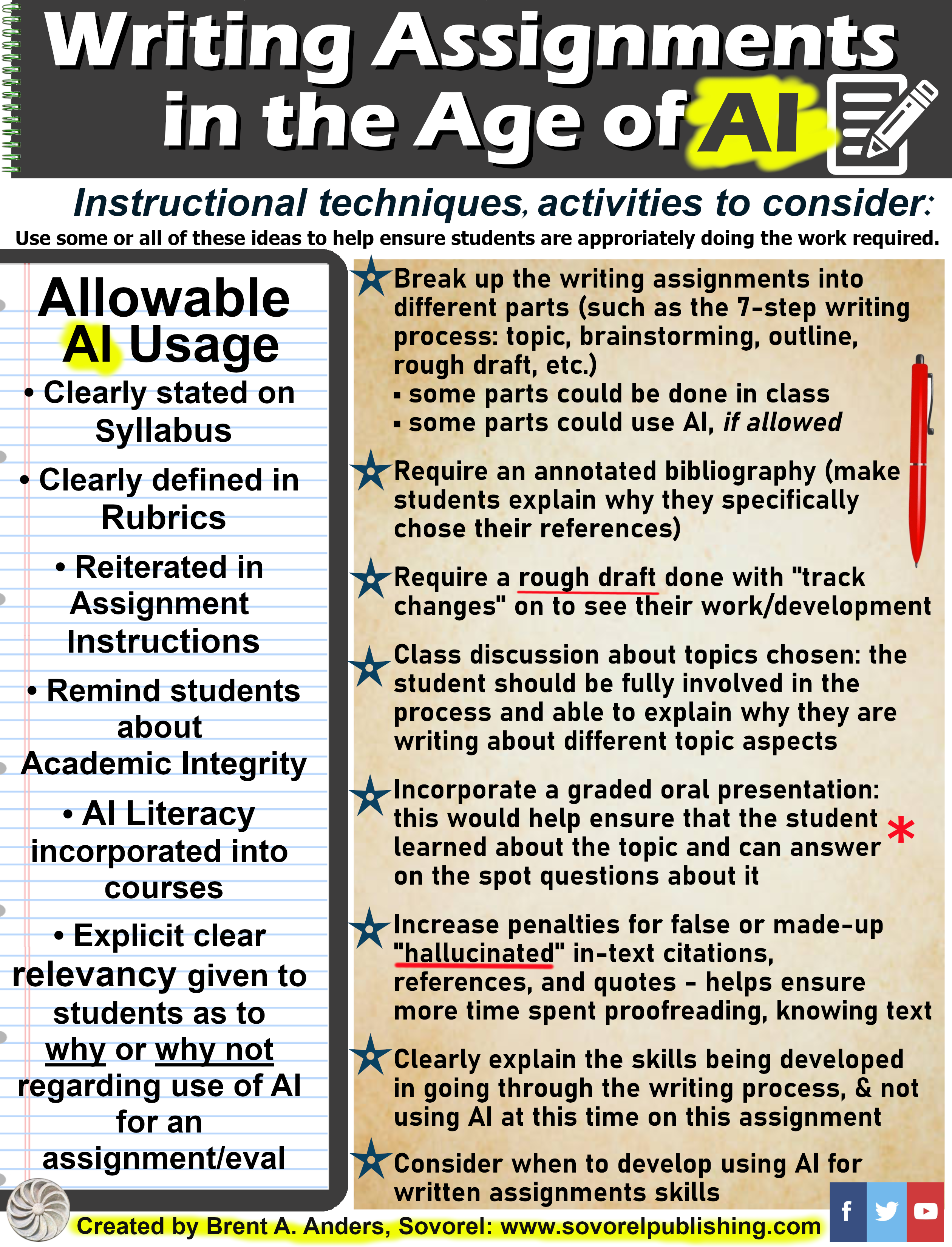
    I put this infographic together to help many instructors that are struggling with this issue as they teach and are trying to keep students from using AI when they are not supposed to. Be sure to take every opportunity to help students learn about AI Literacy when you can, even when telling them that for this assignment/eval they won’t be able to use it.

    You as the instructor are the subject matter expert and must be the one deciding how AI will be used in your classroom and for your assignments/evaluations. For some assignments, the use of AI may not be the right answer in that you are trying to help them develop skills mastery, so they can properly gain the skill of what “right” looks like. Be sure to fully explain that to them so that they have full relevancy and understanding as to why they can or can not use AI.

    Source link

  • My Goodbye to Trent University – THE STUDENT LIFE BLOG

    My Goodbye to Trent University – THE STUDENT LIFE BLOG

    Photos and written by Amy Bridges

                This post is not only my goodbye to the 2021-2022 year but my goodbye to the blog and Trent University. The winter semester was my last semester of my B.A. which also means it was my last semester at Trent University. My experience at Trent University has been a long hard journey.

                I knew that my decision to go to university was going to change my life but I did not realize how much. Choosing Trent University was one of the best decisions of my life. While at Trent I was able to find my passion and gain the confidence to follow it, meet people who have made a huge impact on my life and was even able to gain experiences I wouldn’t have anywhere else.  

                In my four years at Trent, I have changed majors, went on an archaeological dig, gained experience working in a museum, worked for a professor and for 2 other departments in the university, moved apartments, had one of the worst seizures of my life, dealt with a pandemic, and was accepted to a Masters program. It has been a rollercoaster of an experience but I would not have traded it in for anything. These last four years have been challenging but the most rewarding.

    Even though I have been finished classes and set to graduate for a couple of weeks now I am still conflicted about leaving Trent. I am excited to be finished and I am proud of what I have accomplished, but I am sad that it means I will be leaving Trent and that I won’t be seeing the same people every week. Moving onto U of T for my Masters is going to be an exciting next step but terrifying at the same time.

                As I struggle with saying goodbye to Trent, I am also saying goodbye to this blog. This will be my last post on The Student Life Blog. I have been writing for the blog for 3 out of the 4 years I have been at Trent. I will be handing off the blog to another writer and in September you will be able to continue your journey at Trent with them. I am sure they will love this blog as much as I have over the past 3 years and I look forward to seeing where this blog goes in the future. Thank you for reading!

    Colour outside the lines,

    Amy Bridges 

    Source link

  • Find joy in the small things – THE STUDENT LIFE BLOG

    Find joy in the small things – THE STUDENT LIFE BLOG

    Photos and written by Amy Bridges

                   If the pandemic has taught me anything its that you need to find joy in the small things. These last couple of years have been hard and unforgiving and it has been hard to find joy amongst the mess. I have had to teach myself to find joy in the small things so that I don’t completely lose my mind. Since it has been a long journey to get here, I’m going to give you a list of some of the small things I have learned to appreciate a little more.

    Treats

                   I have learned to get excited and to enjoy even the small treats like a cupcake or a special drink. I have found that a bad day can get better with a cupcake or currently because I haven’t had them all winter a bowl of berries! They aren’t much in the grand scheme of things but doing a happy dance because I have a small bowl of strawberries has made a big difference in my day. I have also found that there are non-food treats that I have gotten excited about that again are small but make the day a little brighter. One being a new water bottle, or a new book. They are small but have a large impact!

    Music

                   The last couple of years music has been a great outlet. I have been using music to help curb my mood. When I’m having a bad day, I blare a song I know I can’t help but move to and it helps to boost my mood. Sometimes its only a little bit but that little bit helps.

    A small luxury

                   The most recent small joy I have found is in bath bombs. Normally I only take a 45-minute bath which again isn’t that long in the grand scheme of things but it is enough. I have found a great local business BombzRUs who makes fantastic bath bombs and the colours and smells that come from them are just wonderful. The 45-minutes I spend just enjoying the colourful sparkly water is just what I needed to make the day better or to set myself up for a good sleep for the next day.

    Sunrises

                   Since I work at 8am and I take transit I leave the house at 7am. I am not a morning person but I have had to learn how to be. Recently there has been one upside to getting up and leaving the house by 7am and that is the sunrises. The only way I would have been able to see them is if I was up early. So, I will take the small joy of a beautiful sunrise since I have to be up early anyways.

    While I am sure there are more these are currently the small joys that I have been focusing on while I try to minimize the impacts of rough days.

    Source link