
Federal lawmakers are divided over whether the Family Educational Rights and Privacy Act and the Protection of Pupil Rights Amendment should be used to protect student’s LGBTQ+ status from parents or to reveal it.
The disagreements arose during a Wednesday hearing held by the House Education and Workforce’s Early Childhood, Elementary and Secondary Education subcommittee as the two originally bipartisan laws — which are meant to protect students’ records and information collection from unauthorized disclosures — are increasingly being wielded by federal authorities to crack down on districts over their privacy policies on issues like students’ gender pronouns.
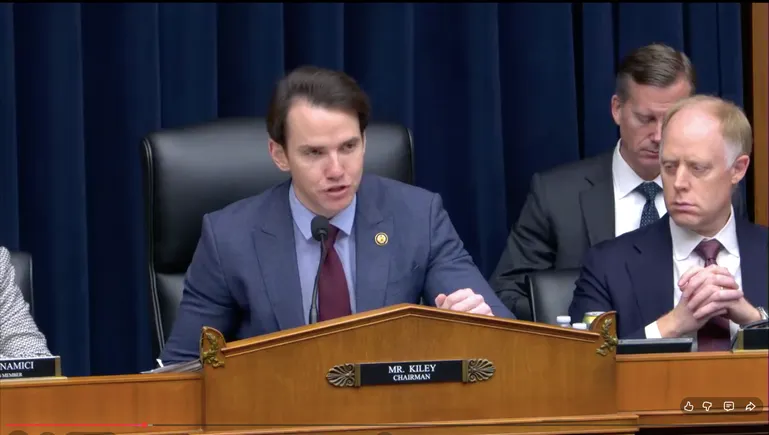
“This should not be a partisan issue,” said Rep. Kevin Kiley, R-Calif., chairman of the subcommittee. “Keeping parents in the dark is wrong.”
Kiley and witnesses at the hearing said some school districts keep dummy files in order to keep parents in the dark about information like a preferred name a student is using in school, have “secret transition policies” directing staff to withhold from parents if children express a gender identity different from their sex at birth, and conduct “intrusive” surveys and evaluations of students’ mental health.
However, representatives and witnesses on the other side of the issue say that policies requiring parents to know students’ gender identities, sexual orientations, or pronoun and name changes jeopardize student safety and housing security in some cases, and also violate student rights.
“Forcing teachers to out every student every time they want to go by a different name or engage in some form of self-expression is an unrealistic expectation and disrupts the teacher-student bond,” said Rep. Suzanne Bonamici, D-Ore. “If students are not talking to their parents about their gender identity, maybe there’s a good reason for that. A lot of homeless youth are LGBTQ, and they get kicked out of their house when they reveal their gender identity.”
LGBTQ+ people are overrepresented in the homeless youth population, according to the National Network for Youth, a nonprofit that aims to reduce youth homelessness. These youth are 120% more likely to experience homelessness than their non-LGBTQ+ peers and represent up to 40% of all youth experiencing homelessness, despite accounting for only 9.5% of the overall population.
Administration cracks down on schools protecting LGBTQ+ students
According to Parents Defending Education, a conservative parental rights group, over 1,200 districts impacting more than 21,000 schools and a collective 12.4 million students have policies stating that district personnel “can or should keep a student’s transgender status hidden from parents.”
Nearly half of those noted districts are in California, which has a state law that went into effect this year preventing school employees from disclosing any information related to a student’s sexual orientation, gender identity, or gender expression to any other person without their consent. The law also prohibits schools from requiring employees to disclose such information to parents and is the subject of an Office for Civil Rights investigation launched in March.
By contrast, at least 15 states have policies requiring schools to reveal students’ LGBTQ+ status under some circumstances, according to the Movement Advancement Project, which tracks issues related to transgender students.
The hearing last week and disagreements over the essence of the privacy laws — as well as LGBTQ+ student safety — came as the Trump administration increasingly uses FERPA and PPRA to investigate schools for civil rights violations, similar to the investigation in California.
In August, for example, it launched investigations into four Kansas school districts for alleged FERPA violations also related to withholding student information from parents’ related to LGBTQ+ status. “My offices will vigorously investigate these matters to ensure these practices come to an end,” said McMahon in a statement related to the Kansas investigations.
Ultimately, these investigations could be used to withhold funds from schools, many of which are in states with LGBTQ+ protection laws requiring such school policies.
In March, the U.S. Department of Education sent districts a Dear Colleague letter warning that documents such as gender plans being withheld from educational records available to parents may be considered civil right violations.
“Many states and school districts have enacted policies that imply students need protection from their parents,” said U.S. Education Secretary Linda McMahon in a March statement. “Going forward, the correct application of FERPA will be to empower all parents to protect their children from the radical ideologies that have taken over many schools.”
Last week, the issue also made it to the 2nd U.S. Circuit Court of Appeals after a mother said a New York school violated her constitutional rights when it didn’t inform her of the child’s request that staff use gender neutral pronouns and a masculine name. The mother in Vitsaxaki v. Skaneateles Central School District ultimately withdrew the student from the district. Alliance Defending Freedom is representing the mother.
At least three other cases filed by ADF are also pending, including against Texas’ Houston Independent School District and Michigan’s Rockford Public Schools.
‘Worth no more than the paper they’re printed on’ as department dissolves
The issue of privacy laws and its new enforcement strategy under the Trump administration also made it to lawmakers’ radar as the Education Department is downsizing by transferring the management of many of its core oversight responsibilities, including for elementary and secondary education, to other agencies.
Such a move would weaken the enforcement of privacy laws, some witnesses and lawmakers said.
In 2018, the Education Department’s Office of the Inspector General said the department failed to conduct timely and effective investigations of complaints related to data privacy, as cases piled up in a backlog without any effective strategy to track the number or status of the complaints it received.
“And that has largely not been resolved,” said Cody Venzke, senior policy counsel at the ACLU’s National Political Advocacy Department, during the House subcommittee hearing. Dissolving the department could compromise student privacy oversight and make the backlog worse, he said.
“Moreover, FERPA and the PPRA — they are premised on receiving funds from the department of education,” said Venzke. “If those critical grants are dispersed elsewhere throughout the federal government, FERPA and PPRA become worth no more than the paper they’re printed on.”