
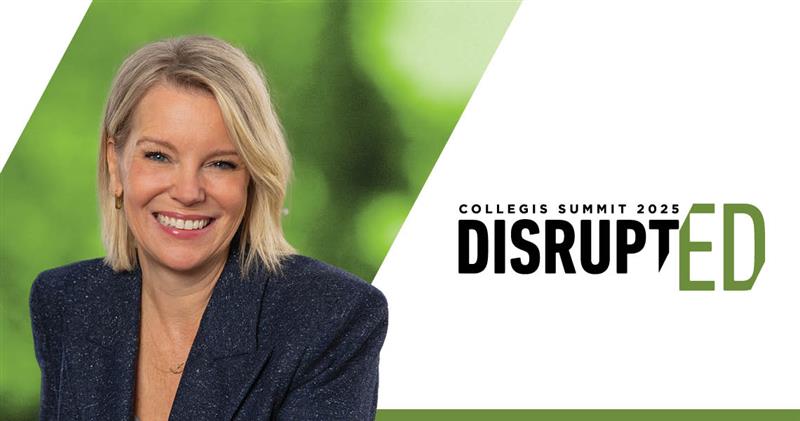
Two weeks ago, I had the privilege of gathering with higher ed leaders from across the country for our annual Collegis conference, designed to spark candid dialogue about the future of higher education. We were fortunate to bring together leaders from institutions of all types and sizes, recognizing that while their contexts differ, the profound disruption reshaping higher education is affecting them all. As we heard from industry experts and schools “winning” during these unprecedented times, it was so rewarding to see excitement build around how to not just navigating this disruption but embrace and drive it.
We’ve hosted several conferences over the years, but this one felt different. Maybe it was the collective honesty in the room or the mix of optimism and unease we all carried about the future of higher education. Whatever it was, the conversations reminded me how critical it is for our industry to embrace discomfort as a catalyst for progress.
In higher education, disruption is often seen as something that happens to us, driven by external forces we have to react to. But our focus this year was on flipping that script. Instead of responding to disruption, we talked about creating it by becoming the catalysts who challenge long-held models and reimagine how to meet the needs of today’s and tomorrow’s students.
These conversations also reinforced the value of stepping out of the day-to-day to connect with peers and have the kind of honest, intentional conversations that spark real change. I felt honored to be amongst a group of leaders so passionate about the need to evolve for one main reason — the student.
Rethinking what “ready” really means
One thought-provoking statement that stood out to me came from presenter Casey Evans, Chief Operating Officer at ASU EdPlus. She posed: Institutions focus too much on students being college-ready. We need to flip that and ask ourselves, are WE, the college, ready for the students?
It’s a simple reframing, but it changes everything. Too often, we measure readiness as a student’s ability to fit into the systems we’ve built. But what if readiness meant our ability to adapt those systems to meet students where they are?
I spoke with leaders who are looking to do exactly that — using data, technology, and empathy to design experiences that are more flexible, inclusive, and human. These institutions aren’t lowering standards, they’re reimagining them. They’re asking what it means to be student-ready, not system-bound.
The power of deconstruction
Another theme that emerged was around innovation. Fixing broken processes isn’t innovation. Reimagining them is.
I heard from presidents, provosts, and enrollment leaders who are bravely seeking to dismantle long-standing workflows and rebuild them one step at a time. Not because it’s easy or efficient, but because it’s necessary.
That kind of deconstruction takes courage. It means letting go of what feels comfortable and, at times, rebuilding from the ground up with the student experience leading the way. It’s a daunting idea, but real innovation happens when we move past fixing what’s broken and start imagining what’s possible.
Leading through ambiguity
We also explored what it means to lead in an era that’s unpredictable and accelerating. Technology, policy shifts, and political forces are reshaping higher ed faster than ever, often in ways we can’t control.
Change once seemed to follow a pattern. Now it’s fluid — much like unstructured data: constant, complex, and always evolving. Uncertainty isn’t the exception anymore; it’s the environment we operate in.
That’s why intuition alone isn’t enough. Leaders need data to anticipate, adapt, and make confident decisions in real time. True leadership today means creating space for curiosity and collaboration, moving forward even when the path isn’t clear, and trusting that progress is built on motion, not perfection.
Creating space for humanity
Throughout the event, we discussed how technology could better support human connection across the student experience. There’s a real desire to reduce friction in the journey, make data work harder, and give faculty and staff more time to focus on what they do best: connecting, mentoring, and inspiring.
That vision resonates deeply with me because it’s exactly what I believe is possible. Technology isn’t a replacement for human interaction, but it can absolutely enhance it. When designed intentionally and used strategically, it creates space for humanity. It creates space for students to feel seen, for advisors to act sooner, and for institutions to operate with both empathy and precision.
This is the kind of transformation higher ed leaders are striving toward, and it’s one we’re excited to help bring to life.
Looking ahead
As I left DisruptED, I felt both challenged and inspired. Change in higher ed isn’t slowing down. Technology, regulation, and politics are reshaping our world in ways we can’t always control — but how we respond is up to us.
There is no new normal. Continuous, unpredictable change is the norm, and with it comes opportunity. With the right data, strategy, and partners, institutions can move from reacting to leading — anticipating what’s next instead of catching up.
Change isn’t optional, but progress is. And as this community of leaders continues to show, disruption doesn’t divide us. It pushes us forward when we’re bold enough to lead together.
Innovation Starts Here
Higher ed is evolving — don’t get left behind. Explore how Collegis can help your institution thrive.