
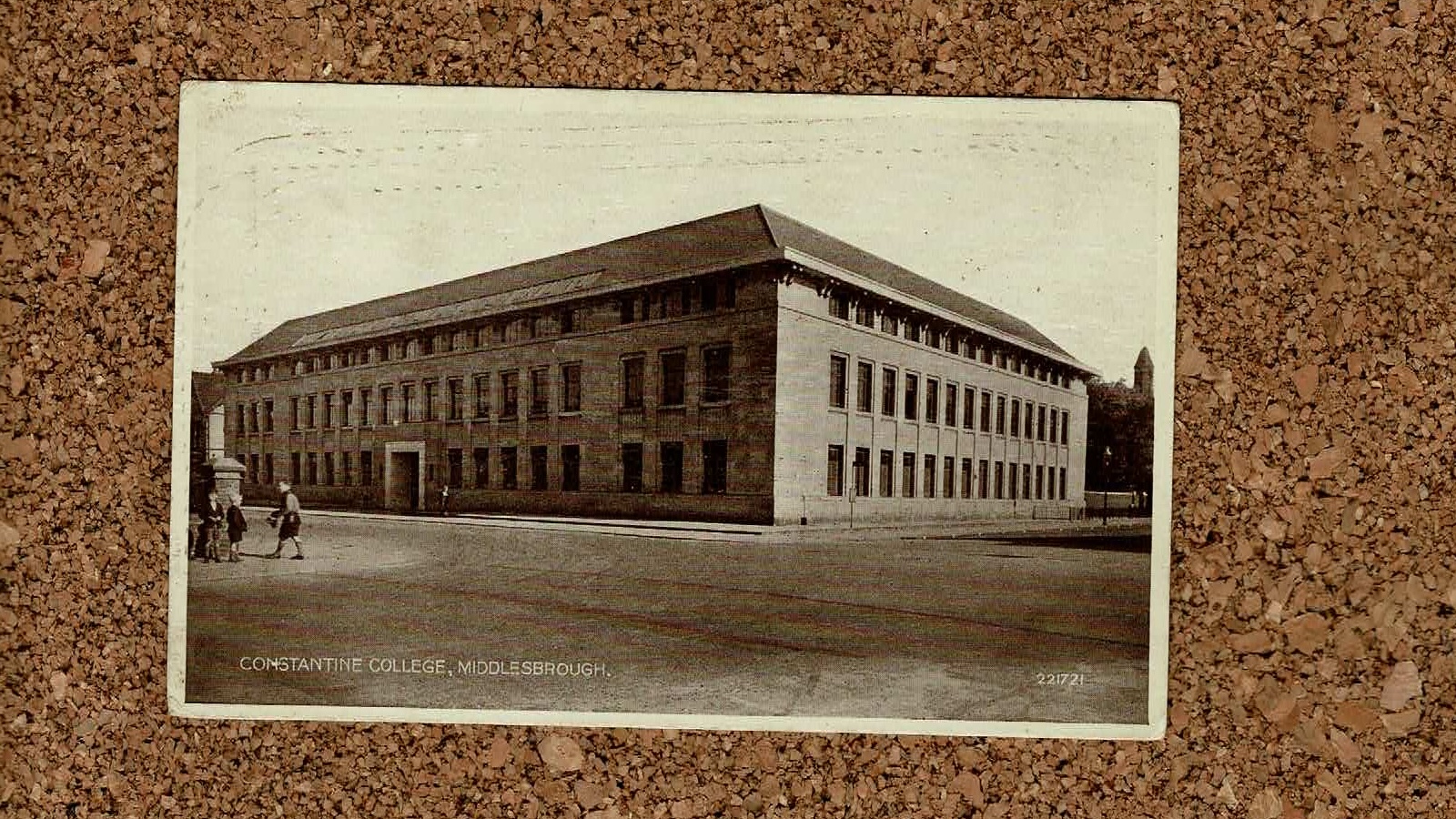
In August 1856, Joseph Constantine was born in Schleswig-Holstein (then Denmark, later Germany, famously questionable) to British parents: his father, Robert, was an engineer working on the Schleswig-Holstein railway. Joseph went to Newcastle Grammar School and in 1881 moved to Middlesbrough. There he set up in the shopping business, and did very well for himself.
He was obviously imbued with a passion for Middlesbrough. We learn from the Yorkshire Post and Leeds Intelligencer on 2 July 1930 that:
Mr Constantine was an active member of the Tees Conservancy Commission, whose work was closely associated with Mr Amos, the general manager. It was to him that Mr. Constantine first broached the idea, in June 1916, of doing something substantial for Middlesbrough. The idea that should connected with higher education was his own, but it was Mr. Amos who suggested that a visit should be made to Armstrong College Newcastle.
Mr Constantine was greatly impressed with the good work of that institution, and made up his mind to provide the youth of his own town with similar educational facilities. It was is the office of the Mayor, then Mr Joseph Calvert, that Mr Constantine disclosed his proposal and the terms of his gift. The prolongation of the war prevented Mr Constantine from seeing the fulfilment of his dream, and the changed conditions made the gift of £40,000 inadequate for the scheme. But the generosity of Mr Constantine’s widow and his family in giving the same amount, enabled the building of the college to be accomplished.
On 6 November 1922 (we read in the next day’s Leeds Mercury) the Middlesbrough Education Committee met, and in order to progress the scheme for a college, constituted itself, with representatives of Joseph Constantine (who may by then have been frail: he died six weeks later), as the governing body of the new college. A site had by then been bought, but commencing the build had run into difficulties. The governing body hence formed a sub-committee to look at other colleges to get ideas for buildings.
In April 1927 the Town Council awarded the building contract – £65,000 – to Messrs Easton, a Newcastle firm (one alderman objected, arguing that the tender should go to a Middlesbrough firm which had bid at only £100 more). Building work was completed in time for the first students to be enrolled in September 1929. Constantine Technical College was born (Joseph Constantine was, apparently, against the college being named for him, but was persuaded by the mayor).
It offered what we would now think of as both further and higher education, including University of London external degrees. By 1931 it was appointing its second Principal: Dr T J Murray was appointed from the Smethwick Municipal College, on an annual salary of £900, rising to £1200. ICI was offering scholarships for degree students and the students’ guild was organising its third charity rag, starting on 2 July and lasting for almost two weeks. The events list (from the South Bank Express, 18 June 1932) looked – mostly – good:
- Saturday: motorized treasure hunt
- Monday: students night at the Gaumont Palace, including a male beauty chorus and a female beauty competition (the latter open to all girls in Teesside over 16 years old)
- Wednesday: opening of the amusement park by the beauty queen
- Thursday: rag dances, three held simultaneously in Middlesbrough, Redcar and Stockton
- Friday: boxing
- Saturday: rag day, street collection, parade and jazz concert
- Monday: mock civic night (presumably some sort of debating competition?)
- Wednesday: sports day
The college continued to develop through the 1950s and 1960s. It expanded, as can be seen by the relocation of its art school. In the 1960s there was some agitation for the creation of a technical university for the north east, for which Constantine College must have been in the frame. But these hopes were dashed in 1967, with the Secretary of State confirming that no funds would be available.
The college renamed itself as Constantine College of Technology before becoming the Teesside Polytechnic in 1969. The local college of education was incorporated in the 1970s, and in 1992 it became the University of Teesside (this is the point where, as I wrote about last week, it was in partnership for a while with Durham University for the creation of University College Stockton). In 2009 it was renamed again, as Teesside University.
Teesside is one of the few universities to have a biological organism named after it. Pseudomonas teessidea is a bacterium which can help to clean contaminated soil, and was discovered by Dr Pattanathu Rahman, then a Teesside University microbiologist.
Here’s a jigsaw of the postcard – unposted but I guess dates from the 1930s, not long after the college was opened. Unposted, but there’s still a message: