
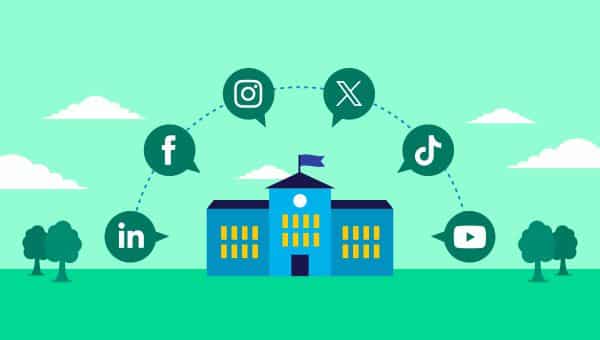
The Impact of Social Platforms on Higher Education Marketing
There are currently more than 5.6 billion social media users worldwide, according to Statista. This means that about two-thirds of the world’s population uses some form of social media to communicate.
For many of us, using social media has become second nature. But the digital space has changed drastically since we saw the emergence of social media marketing in the early 2000s and beyond. So, too, should your social media marketing strategy, so that you can effectively reach your institution’s intended audience and make an impact when everyone else is trying to do the same.
While social media is a commonplace platform for communication today, have you ever considered how significantly social media has changed the way we communicate?
4 Top Social Media Platforms Changing Communication
Let’s take a look at what the most used social platforms have contributed to our new way of communication and how you can utilize them in your higher education marketing campaigns.
1. Facebook
Facebook is seen as the most predominant social media platform, and it has the numbers to back it up, with nearly 3.1 billion monthly users. While Meta’s Facebook still remains one of the top social media platforms since its conception, its audience demographics have shifted with the rise of Instagram and TikTok. With the dominating demographic now being women ages 25 to 34, Facebook is not the higher education marketing platform it once was. Not for traditional prospective and current students, anyway.
However, this platform can be effective for marketing flexible, online degree programs that target adult learners. It’s also a great avenue for communicating with alumni, recent graduates, and even parents of students.
2. YouTube

With nearly 2.6 billion monthly active users, YouTube was launched in 2005 and quickly grew to become one of the top social media platforms by 2010.
YouTube isn’t focused on generating content for short-term attention spans like other platforms. While Instagram, TikTok, and even Facebook primarily host short-form videos averaging 30 seconds to a minute long, YouTube’s premise is to expand on short-form content and host longer videos, such as how-tos, influencer lifestyle content, and vlogs, allowing viewers to form a more intimate connection with the content.
One of the main ways institutions utilize YouTube is with the rise of virtual campus tours, allowing potential students from anywhere to experience a university campus. This allows universities to expand their applicant pool by reaching potential students who may not be able to attend an in-person campus tour.
Take a look at a couple of examples of virtual campus tours from Clemson University and Cornell University, which have received 62,000 and 136,000 views, respectively:
YouTube can also be a great place to highlight student success stories and testimonials.
3. Instagram

This Meta-owned social media platform has about 3 billion monthly users. In 2017, Instagram edged out Snapchat for one of the top spots among the most popular social media platforms. How? Instagram saw a gap in its algorithm where it wasn’t meeting younger audiences’ needs that Snapchat excelled at: catering to short attention spans.
In 2016, Instagram expanded on its platform offerings, including not only the ability to share photos in a timeline, but also launching a Stories feature. Similar to Snapchat, IG Stories gave users the ability to showcase shorter bursts of content that showcased the use of filters, stickers, and more, making the platform more interactive. With the launch of IG Reels in 2020, Instagram rounded out its offerings within the platform, giving users the ability to view and create short-form videos.
Since Instagram is most popular among a large younger demographic of users ages 18 to 34, Instagram is one of the number one tools higher ed marketers should be using to reach a wide variety of their university community, from prospective students to current students and young alumni.
4. TikTok
TikTok has nearly 2 billion users. After its launch in 2018, TikTok quickly grew into one of the most popular social media platforms, surpassing X (formerly Twitter) and Snapchat and creating a new demand for short-form video across all platforms.
Primarily geared towards Gen Z and Millennial audiences, TikTok is a fast-paced, trend-focused app, making it one of the ideal platforms for marketing to university students. The original TikTok algorithm was unique compared to other social media platforms because it continually personalizes content to keep users engaged.
How Did Social Media Change the Way We Communicate?
Social media has changed how we communicate with one another in many ways. It has allowed us to share information in new ways, quickly gain global insights into worldwide news and trends, and forge new online communities of like-minded individuals.
Fostered the Ability to Share
Since its launch in 2004, Facebook, one of the first ever social media platforms, has created a place to share anything from daily thoughts to groundbreaking ideas. This has continued to be the foundation of social media platforms that have followed in Facebook’s footsteps, from Snapchat to Instagram to TikTok.
Each of these platforms has expanded on the original foundation to add features such as stories, short-form video, and interactive filters. This further encouraged immediate, frequent sharing among participants and a sense of urgency around being an active social media user. This illustrates our first point: Social media has given audiences the opportunity to share and collaborate in real-time on a global scale. Over time, we shifted from passive consumers of information to active participants in content creation and distribution.
In higher ed, this has greatly impacted how institutions communicate with prospective and current students, alumni, and other members of their wider community. Institutions have been given the opportunity to share with their communities in real time: Student successes are immediately celebrated, university news can be instantly delivered to a For You page (FYP) or timeline in a matter of seconds, and audiences can immediately communicate back. Social media has fostered this ability to share, allowing institutions to create stronger brand awareness and community engagement.
Provided Global Perspective
This brings us to our second point: Social media has enabled people, brands, institutions, and organizations to come together in one common place, erasing traditional communication boundaries that once hindered our ability to connect.
Students in one part of the world can now explore what campus life looks like in another, simply by watching a TikTok tour, reading Instagram stories, or following a university ambassador on YouTube. These behind-the-scenes glimpses, often created by real students, offer an authentic, unfiltered perspective of life at institutions that might have otherwise been unreachable.
Faculty benefit from this reach too, using platforms like LinkedIn or X to share academic work, engage with global peers, and promote collaborative initiatives. Conferences, lectures, and panels can now be live-streamed or shared widely after the fact, broadening access to educational content for international audiences who may never set foot on campus.
From a marketing standpoint, this global connectivity has changed the way institutions can position themselves and expand their offerings. Nearly two-thirds of institutions are exploring how to bring traditional on-campus programs online, utilizing the global reach driven by social media to appeal to nontraditional learners, including working parents and older adults.
Ultimately, the rise of social media has made it possible for institutions to extend their mission and messaging farther than ever before.
Encouraged Personal Connections
If you’re a social media user, you’ve likely experienced the benefits of how digital platforms have improved our overall communication. One of the most notable benefits is how platforms — from Facebook to LinkedIn and Instagram to TikTok — have given people the ability to connect on a personal level, whether it’s reconnecting with old friends, networking with new professional acquaintances, or sparking life-long friendships through comments, likes, and shares.
As social media has grown over the years, we’ve developed interest-based communities that allow us to communicate with like-minded individuals, sharing ideas and building a sense of belonging that might not be easily found in the “real world.” For nontraditional and online students, this can be life changing.
For institutions working towards appealing to this modern student demographic, utilizing these features can be beneficial in showcasing how nontraditional and online students can be part of the school’s community.
The Challenge: Creating Bite-Size Messaging
With all of the ways social media has improved our communication, there are also some negative effects. One of which is particularly challenging for marketers: shortened attention spans.
The digital world moves quickly, and evidence has shown that the average attention span when looking at a screen has decreased from 2.5 minutes in 2004 to just 47 seconds in recent years. Many audience demographics, particularly younger generations, have become accustomed to “snackable” content.
Think about it: An average TikTok or Reel is 15 to 30 seconds long, Stories on Snapchat and Instagram disappear within 24 hours, and even static image carousels average only 3-5 slides. Because of this, marketers are left with less time to capture interest and low engagement on traditional content formats like text-only posts and longer videos.
With social media being one of the most beneficial marketing tools in higher ed, it’s imperative that marketers learn to work with its fast-paced nature, not against it. We can do this by prioritizing visual content. Social media has made us into visual communicators: memes, gifs, short-form video, graphics, and more have begun to dominate our FYPs and timelines.
Shifting your strategy to prioritize content like eye-catching graphics and short-form video can push your content to the forefront of your audience’s feed and encourage higher engagement activity.
Improve Your Social Media Strategy With Archer
Looking to up your social media marketing game? Archer Education can help. We offer a variety of tech-enabled marketing, enrollment, and retention services, and our enrollment marketing team helps higher ed institutions with social media marketing, content creation, search engine optimization (SEO), academic thought leadership, and more.
Here at Archer, we partner with accredited universities to enable higher-ed leaders and marketers to accelerate their online program growth and enrollment. We believe that education is the great equalizer in our society, and we strive to help institutions make education more accessible for all adult learners.
If you’d like to learn more, contact our team and explore our offerings today.