
I’ve been traveling this week, so got a bit behind on my reflections on Harold Jarche’s Personal Knowledge Mastery (PKM) workshop. The other thing that is a bit frustrating, is that I haven’t been disciplined about my typical sensemaking habits and practices and seem to have lost the notes I took on a video he shared about something new to me: network weaving. At some point, maybe my reflections will resurface (my digital inboxes are overflowing, at the moment, and search seems no use to me if I can’t even find the haystack that the needle may be hiding in with those notes). That’s all just to say, I’m all over the place right now.
Network Weaving
I stubbornly don’t want to rewatch the video at this exact moment. I’m sitting in an airport, next to an outlet with all my devices happily charging until it is time to get on my first of two flights for the day. To say that I am a person with battery anxiety is an understatement. Here’s what I remember about watching Networks: Weaving People, Ideas and Projects, though, mixed with the connections I found with other ideas I’ve encountered in the past.
June Holley describes network weaving as connecting people, ideas, and projects. Hearing her describe the generosity and intentionality involved in network weaving had me reflecting on Coaching for Leaders Episode 279 with Tom Henschel: How to Grow Your Professional Network. Prior to listening to that conversation between Dave and Tom, I had thought about networking more as something I was never very good at, but tolerated, since I knew it was necessary in most professions.
Tom described different types of networking and it was then that I realized I actually loved it and did it all the time; just that I hadn’t thought of what I enjoy doing falling under the category of networking. I enjoy meeting someone new and then identifying who else I know that is into the same stuff that they’re into. I think what Tom was describing is a lot like June Holley’s description of network weaving. Jarche shares this short Network Weaving 101 article from Valdis Krebs, which describes how this process is all about “closing triangles.” Krebs writes:
A triangle exists between three people in a social network. An “open triangle” exists where one person knows two other people who are not yet connected to each other — X knows Y and X knows Z, but Y and Z do not know each other. A network weaver (X) may see an opportunity or possibility from making a connection between two currently unconnected people (Y and Z). A “closed triangle” exists when all three people know each other: X-Y, X-Z, Y-Z.
This makes so much sense to me, instantly. Some of the other content that Jarche has shared has been challenging for me to take in (which I appreciate, as he’s stretching me and helping me grow). But this one, I feel like I get on a more instinctive level. Like I’ve been doing something for much of my life, without having a word for it, yet experiencing such joy each time it happens.
Imposter Syndrome
I’m also realizing that one of the ways I try to calm my nerves when preparing to do a keynote or workshop may very well be embodied by the idea of network weaving. The lizard part of my brain starts to tell myself that I have nothing to offer (this gets exasperated by being in a hotel room in an unfamiliar city, after sitting too long on airplanes all day). One of the best listener emails I ever received came from Itamar Kastner in Scotland. He said that he knows I’m a fan of music and thought I might enjoy Grace Petrie, and English Folk singer-song writer “in the protest singer tradition of Billy Bragg and Woody Guthrie,” he explained over email. Yes, indeed, Itamar was spot on in recommending Grace Petrie’s Nobody Knows That I’m a Fraud:
To thwart the less sophisticated parts of my brain that make me wonder what I’m doing in a hotel room, preparing for the next day’s adventures, I work to shift my focus away from how I am feeling and what I might like people to experience in the session with me. I even try to shrink it down more than a bunch of nameless faces and think about a single person and where they may be struggling and potentially feeling alone or like a failure in some way. What sorts of imposter syndrome symptoms might otherwise be relieved through my vulnerability in not having everything figured out, yet learning out loud, anyway? How might that posture provide fertile ground for others to do the same?
The second half of how I can calm my nerves is to remember that my job isn’t to talk about what I do in my own teaching, necessarily. Rather, I get to share these incredible stories and point people back to the source of inspiration that I’ve found through the podcast across all these years. This feels very much like what I now understand to be a form of collective network weaving (as in connecting many people to new ideas, people, and projects. The last eleven and a half years, I’ve been fortunate to get to talk to people from all over the world who love teaching and learning (just like me). The stories within those conversations are limitless sources of hope, practice, and feelings of solidarity.
Jackie Shay offers the final piece of the puzzle for unraveling those feelings of insecurity that can be present for so many of us, by the way. I realize that last sentence mixed at least two metaphors at once, but give me a break. I’m sitting in an airport, remember? 😂 On Episode 571: Overcoming Imposter Syndrome Through Joyful Curiosity, Jackie asks:
Why can’t we recognize that these different types of intelligences have just as much value as intellectual intelligence?
I’m not supposed to ever be even close to the smartest person in the room. Not even close. But curiosity and connection? Those are two pursuits I’ve enjoyed my whole life and are forms of intelligence to be valued and cultivated in ourselves and others. As we prepare to share our sensemaking process with others, how about we stop trying to out-perform the imaginary room of intelligent people we’ll be talking at and start working on creating conversations that spark imagination?
Jackie Shay is tremendously good at getting people curious and engaged. I remember so vividly talking to Jackie about my memories of camping with my family in Joshua Tree as a little girl and getting swept away in all the specifics that flooded into my mind. Then, I felt like I should pull back and joked about revealing a bigger focus on capitalism than I had hoped for a conversation about nature/science. My brother and I used to have a whole economy we had built out of the various elements in the desert back then, like the quartz crystals and different types of plants.
Jackie laughed with me, but also let me know that sorting and categorizing things (as we had done with the different elements there in the desert) was actually a big part of science. We were doing science, even though I didn’t have a word for that at the time (and clearly didn’t in my embarrassment feeling like no one wanted to hear about my childhood memories until she pointed out to me that we had been doing science, without realizing it). I recalled Alexis Pierce Caudell recommending Categories We Live By: How We Classify Everyone and Everything, by Gregory L. Murphy on Episode 527. While I wish I had finished reading it by now, but it sits in the virtual pile of books I’ve started but have yet to complete. It’s not a science book, though, well… except maybe the varieties related to library science and information technology. I obviously need to read the book before I should be commenting on what it is and isn’t. Sigh.

I don’t think at all that this picture of my brother and I was actually taken in Joshua Tree. I’m going to have to see if I can find one in the photo albums I haven’t quite gotten to scanning yet. But it reminds me of our imaginative life that we had when our family would take trips together.
Closing Triangles
As Valdis Krebs described, network weaving is all about closing triangles. At the keynote I gave for the ETOM conference today, I didn’t exactly close a triangle. However, I got to spend some time with a couple of past Teaching in Higher Ed podcast guests. Christina Moore discussed Inclusive Practices Through Digital Accessibility on Episode 293 and Mobile-Mindful Teaching and Learning on Episode 456. VaNessa Thompson helped us discover How to Engage on Social Media on Episode 416.
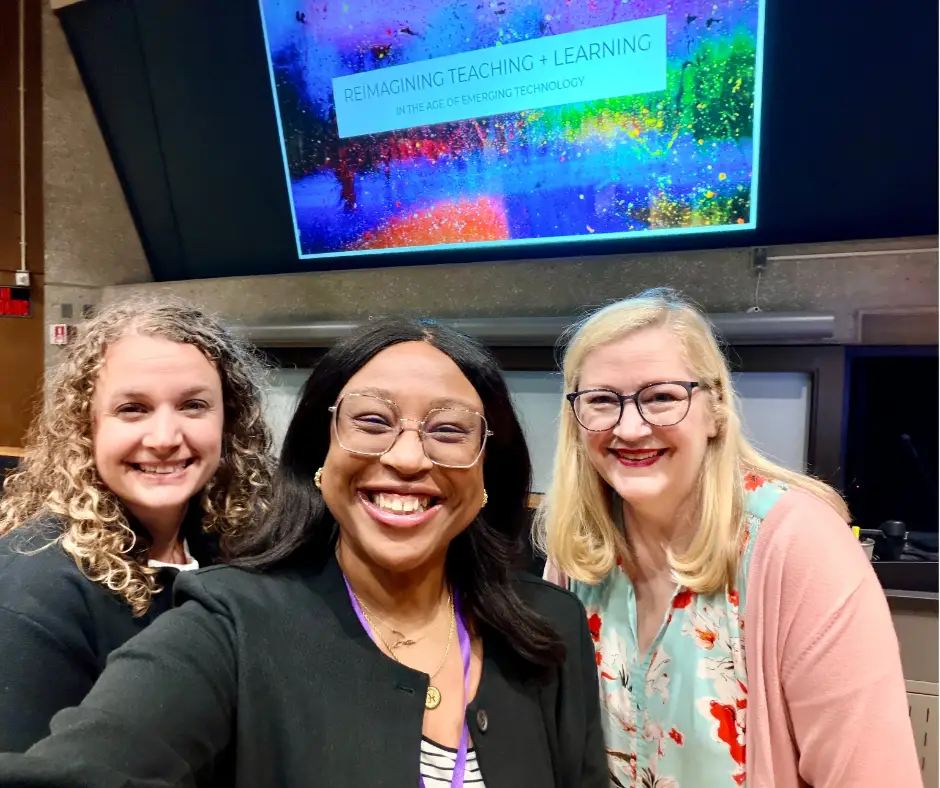
VaNessa and Christina already know each other and I know them. Still, this memory we now share tightens the bond between us and now creates a triangular relationship between the three of us. Again, not necessarily closing triangles here. But certainly doing something new with going from one-on-one relationships and now having this shared triangle to remember and potentially strengthen in the future.
PS. My talk was aligned with the conference theme (innovation). I had some fun with alliteration and divided the talk into: 1) innovation 2) imagination and 3) imitation (which was kinda like curation, but I just couldn’t break the alliteration streak I was on there). In my reading for the topic of connectors, I just saw a quick reference in Beth Kanter’s piece that Jarche shared about how helpful network weaving can be when we’re “stumbling through the fog of innovation.” I like that phrase “fog of innovation” and only wish I had come across it before today’s keynote. 🤦♀️🫠