In early November, following extensive debate by the RISE negotiated rule-making committee, the U.S. Department of Education proposed a definition of “professional degree” for federal student aid that could deter talented students from pursuing health-care careers. The proposed rule, stemming from the One Big Beautiful Bill Act, would leave students in many fields critical for our future health-care workforce subject to a $20,500-per-year federal student loan cap.
Physician assistant/associate programs stand to be strongly affected. These programs are intensive, highly structured and clinically immersive. Students complete rigorous professional-level coursework while rotating through multiple clinical sites to gain hands-on experience. Unlike in many graduate programs, PA students cannot work during their studies, as clinical rotations are full-time and often require travel across multiple locations. Within this context, federal student aid is not optional; it is the lifeline that allows students to stay in their programs and complete the training they have worked for years to achieve. Without it, some students will have no choice but to abandon the profession entirely.
The financial gap under the department’s proposal is striking. Tuition alone —not including expenses like housing, food and other needs—for PA programs often exceeds $90,000 for the duration of the program due to the unique costs associated with health professional education, such as simulation technology and clinical placement expenses. Under the department’s proposal, federal student aid would only cover a fraction of this amount. For students without access to private resources, the gap will likely be insurmountable.
These challenges are not hypothetical. A student accepted into a PA program may face a choice to take on crippling private debt or leave the career track entirely. Students in nurse practitioner, physical therapy and occupational therapy programs face the same reality. Each of these programs combines intense academic and clinical requirements, preparing graduates for immediate entry into practice. Federal policy must recognize this reality if it hopes to support the next generation of health-care professionals.
The consequences extend far beyond individual students. PA students, along with other health professions students, are essential to addressing workforce shortages, especially in rural and underserved areas. Every student forced to forgo pursuing a PA program due to financial barriers represents a future provider absent from the health-care system. At a time when demand for care is rising, federal policy that fails to recognize these students risks worsening shortages and limiting access to care for patients who need it most.
The Department of Education has the opportunity to correct this in the final rule. Explicitly including PA students, along with nurse practitioners, physical therapists, occupational therapists and other professions that meet the statutory criteria for professional degrees would ensure that aid reaches students fully committed to intensive, licensure-preparing programs. Recognition will reduce financial stress, allow students to focus on becoming high-quality health-care providers and maintain the pipeline of skilled professionals critical to patient care.
Including PA and other health professions students in the department’s final rule is both necessary and prudent. It allows students to complete programs they cannot otherwise afford, protects the future health-care workforce and ensures that communities continue to have access to vital services. The Department of Education can achieve clarity, fairness and meaningful impact by explicitly recognizing these professional students.
Sara Fletcher is chief executive officer of the PA Education Association.
Every college and university president I know has on their faculty the Angry Eight. Or the Furious Five. Sometimes just the Irked Individual. One president told me about an initiative that was resisted but finally passed with all but one vote in favor. That lone no was a victory: If the person had voted yes, it would have signaled compromise of values.
When I ask whether the Angry Eight are still producing scholarship or doing good work in the classroom, you can guess the answer. After one president at a fancy-pants institution got a vote of no confidence, I read the many pages of materials filed against him. Then I googled each faculty name to check their research activity. Looks like these folks sure had a lot of free time.
What’s most troubling to presidents, they say, is when the Angry Eight take the floor to rant and everyone else in the room starts looking at their phones or nails. No one stands up to the bullies. It’s hard for faculty to argue for decisions they know their colleagues won’t like; most of us remember being not picked for middle school teams. Plus, we know our peers will be evaluating us when it comes to tenure and promotion. Even when they’re not angry, it still always seems to be the same people doing all the talking. Not a great example of classroom management or collaborative decision-making.
To be clear, the presidents and chancellors I know respect and admire their faculty. They say that the vast majority take their jobs seriously. They are devoted teachers, they publish, they shoulder the massive workload of helping run a university. This is also my experience. I am grateful to have colleagues willing to staff all the necessary committees. I’ve done enough service to know I’m generally more useful in the classroom and am smarter, nicer and more temperate on the page than I ever was when I served in Faculty Senate.
As an assistant professor, I kept my big fat mouth shut in Senate. Before I had tenure, I knew I needed to learn the culture of the professoriate. But after a few years sitting silently through meetings wondering why so much time was devoted to copyediting policies and procedures and also hearing colleagues rant about how the administration was doing wrong and terrible things, I thought, Oh! This is how we were supposed to behave. Distrust and don’t bother to verify! Accuse and rant! So I learned to speak out. And never shut up.
I wish I could blame my previous bad behavior to youthful arrogance or on a life spent in school without exposure to professional work, where you have supervisors and are expected to deliver. But nope. I came to a faculty role in my early 40s with plenty of “real world” experience. When I was staff as a university press editor and in an admissions office, I knew if I didn’t do my job, I could and should be fired. Post-tenure? Party time!
Over time I was enculturated into an attitude of you’re not the boss of me. When administrators asked for reports, colleagues shrugged: We’re not going to do that. The reasoning? They always ask; nothing happens; it’s a waste of effort. Forget it.
I’ve seen faculty members who, once promoted, stopped even pretending to do the scholarly work that had earned them promotion and just spent time on committees doing the “whatever it is, I’m against it’ dance.
Which brings me back to shared governance, the thing that makes academe both fascinating and baffling to outsiders. Curriculum must be controlled by subject matter experts, otherwise you end up with, say, a health official who believes long-effective vaccines are harmful. Expertise matters. No physicist should decide which books writers read and no writer should be teaching organic chemistry.
But neither should I be telling the basketball coach who needs more playing time (though I think I know) or the CFO which budget model to use. Sure, I worked in admissions a long time ago, but the enrollment VP knows more than I ever did.
And yet, we faculty members often think we know more than we do about, well, everything and feel like we can express that in Faculty Senate.
It would be an interesting experiment to ask everyone on a campus for a definition of “shared governance.” Like “Foucauldian,” it gets tossed around with more bravado than clarity. One former president told her faculty, “Shared governance is not the same as co-management.” Too often the Angry Eight are up in arms about things that are clearly outside their lane.
And too often, free speech and academic freedom get conflated (though both may be a thing of the past, as we’ve been seeing in recent weeks). Faculty must have control over what goes on in the classroom. And we need leaders who will fight against legislators who’d prefer we include in our syllabi things like phrenology and pastafarianism.
Here’s what scares me: That threat may not be as crazy as it seems. While most presidents are swept up tracking the deluge of doo-doo coming out of D.C. (and the states), faculty members tend not to keep up with general higher ed news and don’t realize how dire things are beyond their campus walls.
Why? Because faculty are focused on doing their jobs (and doing them well, even as all of us are being asked to do more with less). Most don’t have the time, bandwidth or interest to track higher ed policy shifts, public distrust or enrollment crises. Most have not paid attention to the One Big Beautiful Bill Act and its evil policy spawn. Many don’t even know how their own budgets work, clinging to the naïve belief that cutting football would rain millions down on academic affairs. Every campus has its magic-money-tree myth.
And those who have been around a few blocks feel like they’ve heard this song before. Administrators come and go but we’ve been here and we’ll outlast you. The last guy who came in said we were broke. So did the guy before him. Whatev.
Um. No. Right now things are pretty freaking dire.
Presidents’ hardest task may be educating their campuses on these realities without scaring the bejesus out of everyone. How to convince people who have never really had to worry about job security that the sky is in fact falling? That the world has changed and we’re no longer respected? That not everyone thinks college is worth it and they’re showing that by not showing up? That AI has already changed everything?
Our roles as teachers and scholars are more essential than ever, and we need to protect and defend higher ed to keep doing what we do best. It’s not the time to be fighting in Faculty Senate meetings about where the recycling bins should be placed on campus or if there are dust bunnies in offices or which departments, with four tenured faculty and three students, need to be preserved.
Shared governance is an important way of keeping each other accountable. Yes, there are presidents who do hinky things. There are careerist and craven provosts. Some deans operate out of self-interest or play favorites. Many administrators never learned to be good managers. A system of checks and balances used to be built into our nation’s government is essential.
The average tenure of a president has gone down from six years to about 60 days. When a president “resigns abruptly,” it’s not usually because they were embezzling or sleeping with students, but because they are caught between boards who want change and faculty who do not. They are faced with a number of seemingly insurmountable challenges from the outside. Before we take votes of no confidence or dig in for a fight about dust bunnies, it might be helpful to remember we can’t keep going through leaders like Kleenex during flu season if we want our institutions to survive.
Given how many institutions are closing, merging or getting rid of faculty, I’m grateful there are still a few people who are willing to step up in higher education so I can just focus on my students and feel fortunate to still have a job.
Though really, if I’m being honest, I still think that little point guard deserves more minutes.
Rachel Toor is a contributing editor at Inside Higher Ed and the co-founder of The Sandbox, a weekly newsletter that allows presidents and chancellors to write anonymously. She is also a professor of creative writing and the author of books on weirdly diverse subjects. Reach her here with questions, comments and complaints compliments.
This blog was kindly authored by Dr Emily Magrath, Director of Programme Development and Impact at IntoUniversity.
After fielding a flurry of questions from the classroom of 7 and 8 year olds – ‘what is my favourite colour?’, ‘Is this a university?’, ‘Do staff sleep in the building at night?’ – we settle together to explore the question: ‘what is a career?’ Today, this looks like high-vis jackets and hard hats for civil engineers to plan the needed infrastructure for a town; paleontologists codifying discovered fossils; and foley artists creating a soundscape for a forest epic. The students identify the skills they have used and tell me their many ambitions – the room includes possible footballers, doctors, engineers, nurses, lawyers, fashion designers, a taxi driver (like his dad) and a mathematician. This is a starting point, one which gives them years to think about their future possibilities and, more importantly, to build the knowledge and skills to make them future realities.
The potential for talent is everywhere
Geography has become a primary driver of inequality in the UK. Despite initiatives to widen access to university and despite increases in higher education progression rates, areas remain where progression rates and education outcomes remain persistently and stubbornly low. As recently articulated by Alan Francis OBE, Chair of the Social Mobility Commission, this continues to ‘waste talent and limit potential’ across the UK.
Mounting evidence is stark in emphasising the particular challenges of these areas, so-called cold spots, which are, in reality, places systematically starved of opportunity with intersecting barriers: geographical isolation; lack of or expensive transport options; lack of teacher quality; and a lack of graduate jobs. Young people from disadvantaged backgrounds who want to pursue higher education in these locations face hard choices, often commuting to university, struggling to pursue their chosen career in their local area or having to leave it behind. It is not a surprise then to see the UPP Foundation’s inquiry on Higher Education attitudes in Doncaster this year determining that for many young people university is seen as a “bad bet.”
In the face of these challenging intersections, starting widening participation work at 16 or 17, (or even 14 or 15) is too late. Interventions beginning at these points ultimately have failed many students in these regions – approaches must be anchored from primary age.
Why start at primary age?
It is clear that students from disadvantaged backgrounds face additional educational barriers. Their starting point often shows significant gaps to more advantaged peers, and without intervention, these can become entrenched well before secondary school. In 2023, the Education Policy Institute estimated the disadvantage learning gap at age 5 to be 4.6 months. This was wider than it had been prior to the pandemic. Furthermore, in some areas of deprivation, 50% of young people begin school with delayed language development.
There are no easy solutions, but earlier intervention is essential for building learning progress, fostering positive educational experiences and supporting students to acquire necessary qualifications for progression to higher education.
I would like to study accounting. I want to be rich and I love maths. I would like to study at Oxford university because it’s one of the best universities
Year 6 student, IntoUniversity
Alongside academic development, the implicit and explicit messaging young people hear is key. Young people are full of aspirations, but they need to hear not only how to connect these to actual pathways, but also that they can achieve them. Otherwise, their beliefs can become fixed – often in early teenage years – that university is not for ‘people like them’.
An antidote to this is to start conversations early and normalise university spaces. I have seen powerful examples of how sustained work can make a difference: a widening participation officer telling 10 and 11 year olds that the local university was “their university,’ they were welcome to ask questions and find out what happened there; seeing toddlers at ease climbing over benches in a lecture theatre at a family learning day; and the 18 year old who told me they just assumed they would go to the city’s university because ‘you took me there every year since I was little’.
Building place based ecosystems
Just after the pandemic, I met a father photographing his son in a graduation gown and mortar board at one of our primary graduation trips to a university – the culmination of a programme where students have imagined a university future for themselves. He proudly showed me photos of his older children in previous years (fortuitously aged so that none had missed out during the pandemic). This engagement with the university was a touchstone for each child and for the family.
The children go through the programme in Year 4, 5 and 6, and so they know it’s coming, and their siblings know it’s coming. They have an aspiration, and they know about what’s next. It’s a clear message for our school. Education is a journey, it continues in Secondary school and beyond and opens up opportunities. Because it is built into our curriculum, university feels like an entitlement for them. It is available for them.
Primary School Headteacher about IntoUniversity primary school programme
The recent Ruskin Institute for Social Equality’s report on coastal cold spots this year similarly emphasised geography’s critical role in higher education access. It showed that, accounting for similar backgrounds, young people can experience as much as a fivefold difference in their likelihood of progressing to HE based on where they live. The report argued that a move away from ‘collaborative, place-based, cross-sector approach’ to one emphasising individual universities’ targets has not served these areas well.
Consistent, long-term, sustained work from an early age is the only path forward when countering the entrenched challenges of cold spot areas. These are not challenges that can be solved by one intervention, one school, one charity or one university. Young people in these places need ecosystems of sustained support and opportunities available from an early age. That is how we can shift the dial on persistently low progression rates and ensure equitable access to higher education for all young people, regardless of where they live.
This story was produced by The 19th and reprinted with permission.
The mother was just arriving to pick up her girls at their elementary school in Chicago when someone with a bullhorn at the nearby shopping center let everyone know: ICE is here.
The white van screeched to a halt right next to where she was parked, and three Immigration and Customs Enforcement agents piled out. They said something in English that she couldn’t decipher, then arrested her on the spot. Her family later said they never asked about her documentation.
She was only able to get one phone call out before she was taken away. “The girls,” was all she said to her sister. Her daughters, a third grader and a fourth grader, were still waiting for her inside the school.
Luckily, the girls’ child care provider had prepared for this very moment.
Sandra had been taking care of the girls since they were babies, and now watched them after school. She’d been encouraging the family to get American passports for the kids and signed documents detailing their wishes should the mother be detained.
When Sandra got the call that day in September, she headed straight to the school to pick up the girls.
Since President Donald Trump won a second term, Sandra has been prepping the 10 families at her home-based day care, including some who lack permanent legal status, for the possibility that they may be detained. (The 19th is only using Sandra’s first name and not naming the mother to protect their identities.)
She’s worked with families to get temporary guardianship papers sorted and put a plan in place in case they were detained and their kids were left behind. She even had a psychologist come and speak to the families about the events that had been unfolding across the country to help the children understand that there are certain situations their parents can’t control, and give them the opportunity to talk through their fears that, one day, mamá and papá might not be there to pick them up.
Read more
And for two elementary school kids, that day did come. Sandra met them outside the school.
“When they saw me, they knew something wasn’t right,” Sandra said in Spanish. “Are we never going to see our mom again?” they asked.
For all her planning, she was speechless.
“One prepares for these things, but still doesn’t have the words on what to say,” Sandra said.
Related: Young children have unique needs and providing the right care can be a challenge. Our free early childhood education newsletter tracks the issues.
After that day, Sandra worked with the mother’s sister to get the girls situated to fly to Texas, where their mother, who had full custody of them, was being detained, and then eventually to Mexico. She hasn’t heard from them in over a month. The girls were born in the United States and know nothing of Mexico.
“I think about them in a strange country,” Sandra said. “‘Who is going to care for them like I do?’ Now with this situation I get sad because I think they are the ones who are going to suffer.”
In this year of immigration raids, child care providers have stepped up to keep families unified amid incredible uncertainty. Some are agreeing to be temporary guardians for kids should something happen to their parents. The workers themselves are also under threat — 1 in 5 child care workers are immigrant women, most of them Latinas, who are also having to prepare in case they are detained, particularly while children are in their care. Already, child care workers across the country have been detained and deported.
“The immigration and the child care movements, they are one in the same now,” said Anali Alegria, the director of federal advocacy and media relations at the Child Care for Every Family Network, a national child care advocacy group. “Child care is not just something that keeps the economy going, while it does. It’s also really integral to people’s community and family lives. And so when you’re destabilizing it, you’re also destabilizing something much more fundamental and very tender to that child and that family’s life.”
A loose network of resistance has emerged, with detailed protection plans, ICE lookout patrols, and Signal or Whatsapp chats. Home-based providers like Sandra have been especially involved in that effort because their work often means their lives are even more intertwined with the families they care for.
“All the families we have in our program, I consider them family. We arrive in this country and we don’t have family, and when we get support, advice or the simple act of caring for kids, as child care providers we are essential in many of these families — even more in these times,” said Sandra, who has been caring for children in the United States for 25 years. All the families she cares for are Latinx, 70 percent without permanent legal status.
According to advocacy groups, child care providers are increasingly being asked to look after kids in case they are detained, typically because they are the only trusted person the family knows with U.S. citizenship or legal permanent residence. Parents are asking child care workers to be emergency contacts, short-term guardians and, in some cases, even long-term guardians.
“We heard this under the first Trump administration, and we’re hearing it much more now. It’s not so much a matter of if, but when, right now, and it used to be the other way around,” said Wendy Cervantes, the director of immigration and immigrant families at the Center for Law and Social Policy, an anti-poverty nonprofit. “It adds just additional stress and trauma because they deeply care about these kids. Many of them have kids of their own and obviously have modest incomes, so as much as they want to say, ‘yes’, they can’t in some cases.”
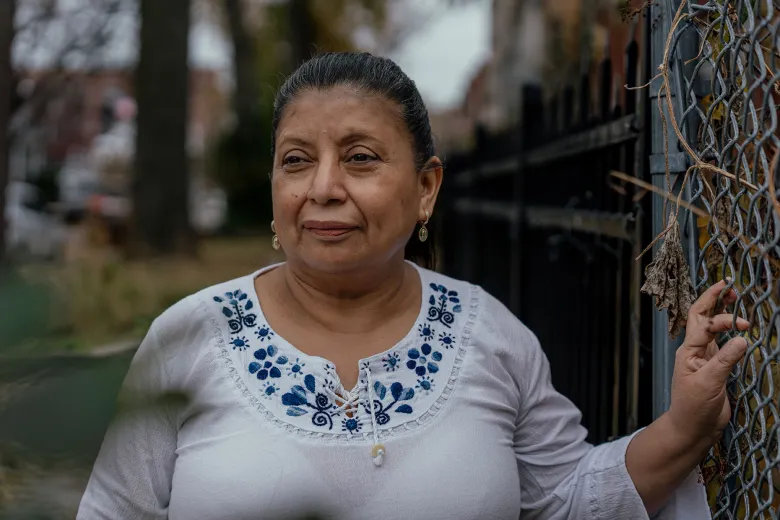
The question was posed to Claudia Pellecer a couple weeks ago. A home-based child care provider in Chicago for 17 years, Pellecer cares for numerous Latinx families, at least one of whom doesn’t have permanent legal status.
In October, one of those moms was due to appear before ICE for a regular check-in as part of her ongoing asylum case. But she knew that many have been detained at those appointments this year.
The mother asked Pellecer to be her 1-year-old son’s legal guardian should she be taken away.
“I couldn’t say no because I am human, I am a mother,” Pellecer said.
Claudia Pellecer, who runs a small daycare for young children out of her home, stands for a portrait outside her house. Credit: Jamie Kelter Davis for The 19th
They got to work getting the baby a passport and filling out the necessary guardianship paperwork. Pellecer kept the originals and copies. The mother closed her bank account, cleaned out her apartment and prepped two bags, one for her and one for the baby. If the mother was deported, Pellecer would fly with him to meet her in Ecuador, they agreed.
The day of the appointment, she dropped the baby off with Pellecer and set the final plan. Her appointment was at 1 p.m. “If at 6 p.m. you haven’t heard from me, that means I was detained,” she told Pellecer, who cried and wished her luck.
At the appointment, the judge asked her three sets of questions:
“Why are you here?”
“Are you working? Do you have a family?”
“Do you have proof of what happened to you in your country?”
Claudia Pellecer plays games with children in the living room of her home daycare, where she cares for up to eight young children a day. Credit: Jamie Kelter Davis for The 19th
The judge agreed to let her stay and told her to continue working. The mother won’t have a court date again until 2027.
“We learned our lesson,” Pellecer said. “We had to prepare for the worst and hope for the best.”
But their relief was short-lived. Recent events in Chicago have sent child care workers and families into panic, as the people who have tried to keep families together are now being targeted.
Resistance networks have sprung up rapidly in Chicago in recent weeks after a child care worker was followed to Spanish immersion day care Rayito de Sol on the city’s North Side and arrested in front of children and other teachers. The arrest was caught on camera and has sparked demonstrations across the city.
Erin Horetski, whose son, Harrison, was cared for by the worker who was arrested at Rayito de Sol in early November, said parents there had been worried ICE might one day target them because the center specifically hired Spanish-speaking staff.
The morning of the arrest, parents were texting each other once they heard ICE was in the shopping center where the day care is located.
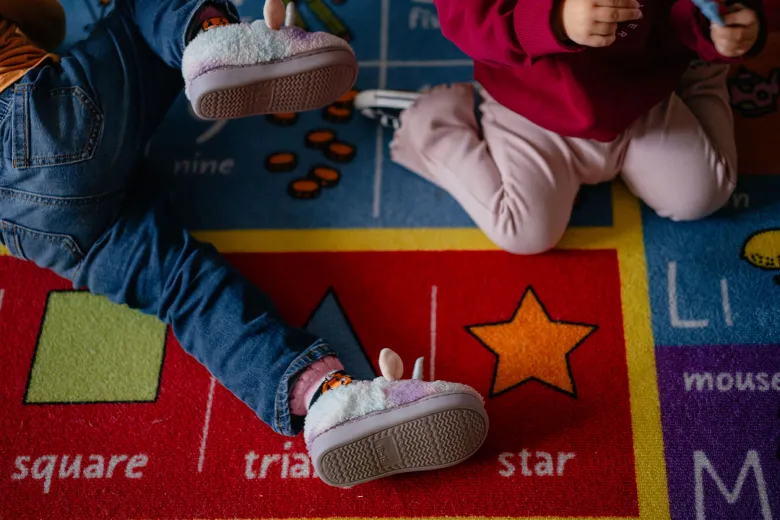
Children crawl on a colorful rug while playing educational games at Claudia Pellecer’s home daycare. Credit: Jamie Kelter Davis for The 19th
Her husband was just arriving to drop off their boys as ICE was leaving. The first thing out of his mouth when he called her: “They took Miss Diana.”
Agents entered the school without a warrant to arrest infant class teacher Diana Patricia Santillana Galeano, an immigrant from Colombia. DHS said part of the reason for her arrest was because she helped bring her two teenage children across the southern U.S. border this year. “Facilitating human smuggling is a crime,” DHS said. Santillana Galeano fled Colombia fearing for her safety in 2023, filed for asylum and was given a work permit through November 2029, according to court documents. She has no known criminal record. After her arrest, a federal judge ruled that her detention without access to a bond hearing was illegal and she was released November 12.
Horetski said the incident, the first known ICE arrest inside a day care, has spurred the community to action. A GoFundMe account set up by Horetski to support Santillana Galeano, has raised more than $150,000.
Horetski said what’s been lost in the story of what happened at Rayito is the humanity of the person at the center of it, someone she said was “like a second mother” to her son.
“At the end of the day, she was a person and a friend and a mother and provider to our kids — I think we need to remember that,” Horetski said.
Now, the parents are the ones coming together to put in place a safety plan for the teachers, most of whom have continued to come to the school and care for their children.
They are working on establishing a safe passage patrol, setting up parents with whistles at the front of the school to stand guard during arrival and dismissal time to ensure teachers can come and go to their cars or to public transit safely. Parents are also establishing escorts for teachers who may need a ride to work or someone to accompany them on the bus or the train. A meal train set up by the parents is helping to send food to the teachers through Thanksgiving, and two local restaurants have pitched in with discounts. Some of the parents are also lawyers who are considering setting up a legal clinic to ensure workers know their rights, Horetski said.
A young child watches an educational TV show in the living room of Claudia Pellecer’s home daycare in Chicago. Credit: Jamie Kelter Davis for The 19th
Figuring out how to come together to support teachers and the children who now have questions about safety is something that “continues to circle in all of our minds and brains,” Horeski said. “It’s hard to not have the answers or know how to best move forward. We’re in such uncharted territory that you’re like, ‘Where do you go from here?’ So we’re kind of paving that because this is the first time that something like this has happened.”
Prep is top of mind now for organizers including at the Service Employees International Union, where Sandra and Pellecer are members,who are convening emergency child care worker trainings to set up procedures, such as posted signs that say ICE cannot enter without a warrant, showing them what the warrants must include to be binding, helping them set a designated person to speak to ICE should they enter and talking to their families to offer support.
Cervantes has been doing this work since Trump’s first term, when it was clear immigration was going to be a key focus for the president. This year has been different, though. Child care centers were previously protected under a “sensitive locations” directive that advised ICE to not conduct enforcement in places like schools and day cares. But Trump removed that protection on his first day in office this year, signaling a more aggressive approach to ICE enforcement was coming.
Cervantes and her team are currently in the midst of a research project about child care workers across the country, conversations that are also illuminating for them just how dire the situation has become for providers.
“We are asking providers to make protocols for what is basically a man-made disaster,” she said. “They shouldn’t have to worry about protecting children and staff from the government.”
Since you made it to the bottom of this article, we have a small favor to ask.
We’re in the midst of our end-of-year campaign, our most important fundraising effort of the year. Thanks to NewsMatch, every dollar you give will be doubled through December 31.
If you believe stories like the one you just finished matter, please consider pitching in what you can. This effort helps ensure our reporting and resources stay free and accessible to everyone—teachers, parents, policymakers—invested in the future of education.
The next generation of nurses will need to master not only clinical skills, but also technology, compassion, and cultural awareness.
Across the country, the nursing profession stands at a pivotal moment. Hospitals and communities are grappling with workforce shortages, an aging population, and rapid technological advances that are redefining how healthcare is delivered. The nurses of tomorrow must be clinically skilled, culturally aware, and technologically fluent — ready to care for patients with both competence and compassion.
To meet this demand, nursing education is undergoing a transformation. Programs and nursing educators nationwide must reimagine how students learn, practice, and collaborate, weaving innovation and inclusion into every aspect of training. Simulation labs, artificial intelligence, and virtual reality are no longer optional enhancements — they are essential tools that prepare nurses to deliver safe, effective, and equitable care in an increasingly complex health system.
Leading the way
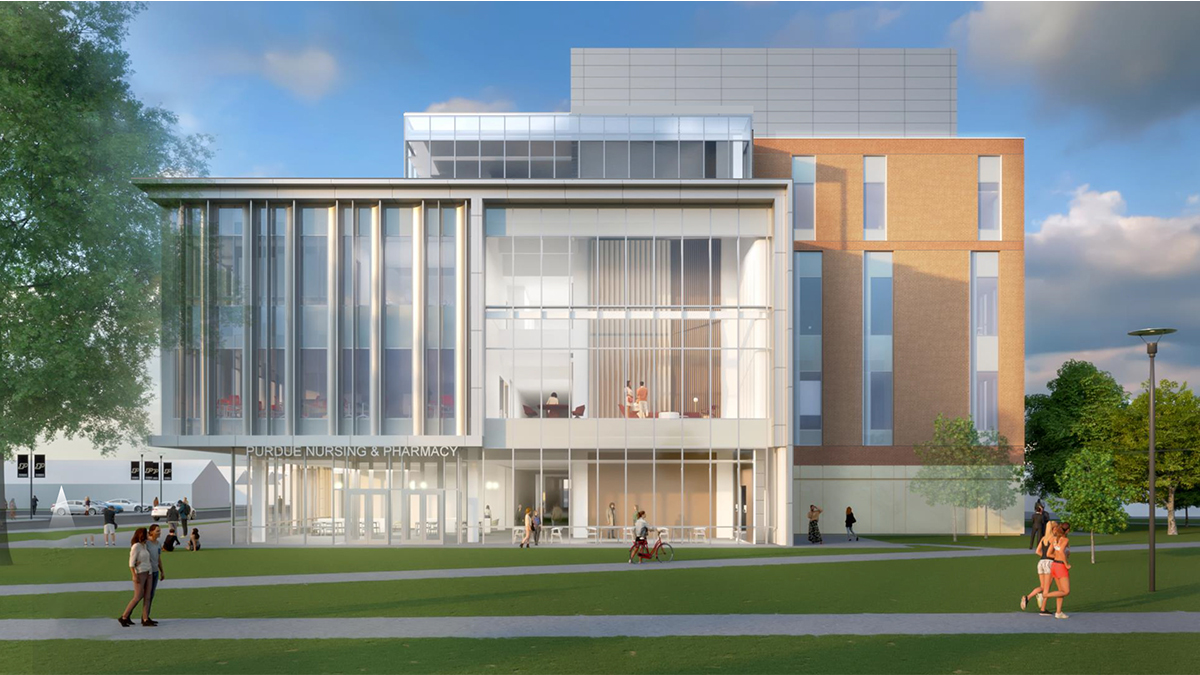
One school helping lead this transformation is Purdue University’s School of Nursing, where innovation is shaping what it means to prepare tomorrow’s healthcare professionals. With the new Nursing and Pharmacy Education Building scheduled to open in spring 2027, Purdue will unite students, faculty, and research under one roof. The four-story facility is designed for collaboration and connection, featuring modern classrooms, study spaces, and simulation environments that replicate real-world medical situations.
Libby Richards, Ph.D.
Interim Head and Professor, Purdue University School of Nursing
“Our goal is to create a space that feels like an academic home — comfortable, collaborative, and equipped for the future of healthcare,” said Libby Richards, interim head of the School of Nursing.
Technology is central to this vision. The building will include advanced simulation systems and immersive virtual and augmented-reality labs, allowing students to practice complex procedures and develop clinical judgment in a safe, hands-on environment. Through programs like The Heart Through Virtual Reality, nursing students can explore the inner workings of the human heart — watching chambers contract and valves open in real time to deepen understanding of cardiac care.
Representation matters
Julian Gallegos, Ph.D.
Assistant Head for Graduate Programs and Assistant Professor, Purdue University School of Nursing
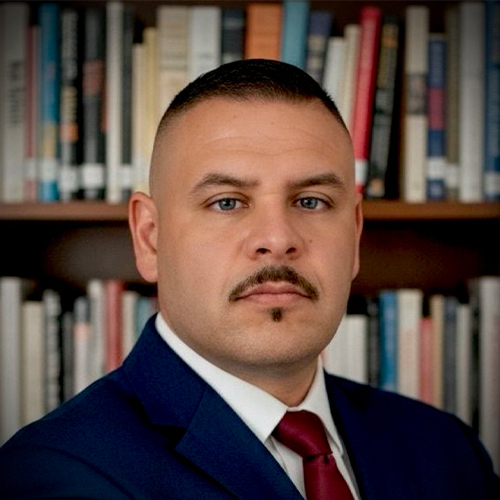
Purdue’s innovation also extends to representation within the profession. Faculty member Julian Gallegos leads initiatives to recruit and support men in nursing, encouraging representation and mentorship through Purdue’s chapter of the American Association for Men in Nursing and his research focus on men’s health. “We need to ensure that all students see themselves reflected in this profession,” Gallegos said.
Tyson Magee
Doctor of Nursing Practice Student, Purdue University School of Nursing
Research within Purdue’s School of Nursing reflects this same forward momentum. Doctor of Nursing Practice student Tyson Magee is studying how AI-generated exercise plans can improve patient engagement and outcomes. “AI won’t replace the nurse,” Magee said. “But nurses who understand it will deliver more individualized care.”
When the new building opens, Purdue Nursing expects to expand enrollment to help address critical workforce needs across Indiana and beyond. The investment underscores a lasting commitment to preparing healthcare professionals who merge innovation with empathy — defining not only the future of nursing education, but the future of care itself.
In a healthcare landscape facing critical workforce shortages, one medical specialty offers something extraordinary: the ability to transform lives instantly while building a sustainable, fulfilling career. Welcome to podiatric medicine — where clinical excellence meets meaningful patient relationships, and where your impact is both immediate and lasting.
At Kent State University College of Podiatric Medicine — founded in 1916 and one of the nation’s oldest podiatric medical schools — we’ve prepared over 7,000 physicians who don’t just treat conditions: they restore mobility, prevent devastating complications, and give patients their lives back.
Kent State’s campus is located just outside a medical mecca, offering clinical rotations through world-class hospitals including the Cleveland Clinic, University Hospitals, MetroHealth, and the VA, to name a few. This unmatched network ensures students gain diverse, high-caliber experiences. Our reach also expands globally, with opportunities to experience podiatric medicine abroad — including in Arezzo, Italy.
Dr. Nick Campitelli
2001 Graduate, Kent State University College of Podiatric Medicine
Meet Dr. Nick Campitelli, a 2001 graduate practicing in Fairlawn, Ohio. “What’s cool about podiatry is people usually come in with pain, and if you can relieve it instantly, they walk out thrilled because they can get back to their life,” he explained. Dr. Campitelli built a thriving practice while maintaining work-life balance. His innovative social media presence educates millions about foot health while building patient trust. Beyond practice, he mentors Kent State students during surgical externships at world-class facilities.
Dr. Crystal Holmes
2002 graduate, Kent State University College of Podiatric Medicine
Dr. Crystal Holmes, a 2002 graduate, demonstrates podiatric medicine’s academic reach. Now a Clinical Professor at the University of Michigan Medical School and chair of Kent State’s Advisory Board, she specializes in diabetic foot care — preventing the devastating complications she witnessed affecting family members. “At Kent State, I developed my interviewing skills and those soft skills for building relationships, delivering news with respect and calm,” she said.
Why choose podiatric medicine?
Choosing podiatric medicine means choosing your specialty from day one. Unlike many other medical paths, you’ll have the flexibility to shape your career — whether through surgical practice, sports medicine, wound care, biomechanics, pediatrics, or diabetic limb preservation. You’ll treat a diverse patient population while enjoying a desirable work-life balance that supports both professional success and personal well-being. This specialty uniquely combines surgical expertise with longitudinal patient care. Podiatric physicians are the only doctors receiving specialized medical and surgical training specifically in lower extremity care.
You can specialize in sports medicine, diabetic wound care, pediatrics, or surgery — working in private practices, hospitals, or academic settings.
And the advantages are compelling, including:
Competitive salaries averaging over $200,000
Flexible scheduling and autonomy in practice style
The ability to provide instant relief that changes lives
The Kent State difference
Kent State’s dedicated faculty and counseling staff focus exclusively on podiatric medical students — no competing obligations. They offer tutoring at no charge and comprehensive faculty mentorship guiding students through curriculum, clinical experiences, and residency selection. Kent State is also one of just two podiatric medicine programs based at a top-tier, R1 research university.
Your journey starts with one step. Take it at Kent State.
Ready to explore this rewarding specialty? Visit Step Into Podiatry to shadow a practicing DPM or contact us at 216-231-3300 or [email protected].
Not long after I had received most of my student’s mid-semester survey results, I came across an AI tool that would create a song. The tool is Suno (suno.com) and it uses AI to create both the music and the lyrics. For some odd reason, I wondered if it might create a song based on by student survey results?
I needed lyrics for the song, so I took the survey results and placed them into Google’s Gemini to develop a summary of the results. The summary was not poetic nor lyrical, so I asked Gemini to write some song lyrics based on the survey summary. Silly I know, but that is how this story started. I then added the lyrics to Suno and chose ska/reggae as the style of music. It was pretty fun to hear about my class though a happy, upbeat song. The students in the class got a kick out of it too and the faculty I shared it with got a good laugh.
And there it was, a song about my class and how the students felt about it.
Having spent the last 20 years as an instructional designer, I have worked with faculty enough to know how difficult institutional surveys can be. Often, the most disgruntled students point to course deficiencies and that is what the faculty remember. Then there are deciles and scores and comparisons and the worry that these numbers will negatively affect the tenure process or rehiring as a part time faculty. In general, there is a negative vibe around these surveys and how they are used. I wondered if those single page pdfs could be shared in a different way? Maybe someone singing the results to them? Maybe just a friendly voice letting them know about the things they did well and the things they might improve upon.
I thought about how different the experience of a voice might be when delivering the information. Might it “feel” better? Worse?
I had been playing with Google’s recently released NotebookLM (notebooklm.google.com) and I wondered what raw survey data might sound like in the “podcast” feature. I started with just my self-created mid-course evaluations and it was really interesting to hear two “people” talk about my class. I wondered what other “sources” I might give NotebookLM to fill out the conversation and how I might customize the podcast.
At first, I added the course goals and objectives. But as you can also add YouTube videos, so I added my seven-minute course introduction from YouTube. The class was online, so I added the QM standards and because the class was about pedagogy and technology, I added the ISTE standards. Adding these other “sources” really started to flesh out the podcast as the successes and challenges were framed against existing standards in teaching and learning. Listening too it kept me present on the topic of improving my class and now I was hearing how my student feedback stacked up against common learning practices.
Soon it was the end of the course and I had asked the students for final evaluation with a few broad questions. They all wrote quite a bit about their experiences in the course, and I added it to the sources in NotebookLM. I also added a video about open pedagogy by David Wiley and another from Stephen Downes. I included a piece of writing about care and inclusivity in higher education. By adding all of those, the podcast was becoming very detailed and full of ideas for improvement backed up by the solid resources I had provided.
I added an AI generated summary of John Dewey’s thinking about learning and another about the same from Carl Rogers. In this way, I was getting the information to include my heroes and favorites in the field. The rationale the podcasters presented for course improvement was backed up by a lot of good thinking! While I started with just the mid-quarter evaluations, as of today, the list of sources looks like this:
Mid-Quarter Student Survey
Course Final Reflections by Students
Institutional Course Evaluation
QM Higher Education Standards
ISTE Standards for Teachers and Students
High Impact Practices in Higher Education
Course Description and Objectives
College Program Goals and Objectives
Care and Inclusion in Higher Education
Carl Rogers Theory of Education
Introduction to Open Pedagogy – Stephen Downes
John Dewey’s Theory of Teaching & Learning
Open Pedagogy – David Wiley
All the Course Announcements
Class Introduction Video
Reflections on Teaching with Google Sites
Then, perhaps the most deeply impactful thing I did was I customized the prompt to make the podcasters speak directly to me, Todd.
Up to this point the podcasters were simply talking generically about a class, now they were talking to me directly by name. It made it feel far more personal. It was more personal. And it was kind of creepy, but it made a difference.
One thing I learned was that even if the speakers are AI generated, it feels good to hear positive things about your course and especially if the kind words are backed up with how some of your heroes would agree with what you are doing. The podcasters always start out with praise and that feels better than the charts and decile numbers on the university student survey.
I keep trying to get the podcast to really focus on improvement and thus far I have already made a few adjustments to the class based on suggestions they made. Those suggestions were alluded to in the student narratives, but the whole of resources I had included in the NotebookLM made those comments seem different. I don’t know how to explain that. Maybe it was that in the student narrative it was one or two sentences among many and in the podcast, it was worded differently, and more detail was given. The human voice is amazingly powerful, even when it is not actually human.
Where am I today? Well, I started seeing if I could transform the two podcasters text into a single person giving me the same advice. I am interested to see if a single voice feels different? It has met with limited success as all of this has been done with free tools. There are time limits and character limits on the free versions of many of the tools.
Google’s NotebookLM has a beta feature that allows you to ask the podcasters questions. I have learned that if you state your name, they refer to you directly. I have also learned that the answers they provide are pretty amazing and that you can really drill down to pretty specific detail around assignments and course structure.
I have also been sharing this with other faculty, and I have had nothing but good feedback about the experience. One noted that they thought the podcast would make a great advertisement for their course. They also said they had wished that they had the tool when they were writing their tenure package as it combined a good deal of disparate pieces of information into a single space. Another said that hearing the student feedback was a more positive experience compared to reading the data. I also heard about the concerns they have. Concerns like privacy and the AI tools making mistakes. To that end I would say, don’t put student names in the AI tools and make sure to listen carefully to how the sources are expressed.
And now, NotebookLM allows you to create narrated PowerPoint type presentations based on your notebook resources!
If you think this might be a way to improve your teaching, NotebookLM is a free tool and you can give this a try right now. https://notebooklm.google.com/
Todd Conaway is an instructional designer at the University of Washington | Bothell with eighteen years of experience working with faculty in and around digital pedagogy. He was a high school English teacher and has been teaching a variety of courses at the community college and university level for twenty-five years.
Given the likely media habits of Wonkhe’s astute and cerebral readership, you’ve probably had a good fill of Andy Haldane in recent days.
The former chief economist of the Bank of England has hardly been off the news and current affairs shows. First describing the pre-budget speculation as a “fiscal fandango,” and then continuing his sharp critique by lamenting the prospects for economic growth following the announcement last week.
Haldane is best known for his economic analysis but as the author of the Levelling Up white paper (RIP) he is also a thoughtful commentator on all things related to “place” and has taken a keen interest in the civic university agenda. If you are not feeling too over-saturated with Haldane content, it is worth revisiting his essay for the Kerslake Collection last year. In it he celebrated the impact of the civic movement within the sector and the great practice it has fostered, but politely pointed out that the Civic University Commission that Lord Kerslake chaired, and its aftermath, had very little impact on policy.
A place to call home
This government, like the last one, has often spoken about the importance of place. Whether we think of geographical inequality or “left behind places,” across the political spectrum it is recognised that this complex issue is behind much of the political instability we have seen over the last decade. When it comes to why this matters Cabinet Office minister Josh Simmons put it well the other day when he said “Everything we do in policy should focus on place. We all experience the world through where we live and who we live with.”
Policy action has not always matched the rhetoric but to be fair to this government, while critics may argue there is a lack of much needed radicalism when it comes to place, there have been a range of welcome place-based initiatives announced during the budget and over the last few months including the Pride in Place strategy, place-based budget pilots, and local economic growth zones.
For higher education policy specifically, the government has of course included civic engagement as one of its five priorities and the industrial strategy highlights universities as “engines of innovation and skills” that are key to driving economic growth. Nevertheless, it is fair to say that civic engagement is a priority the Whitehall machine is struggling to get to grips with. Universities are inherently policy-domain-spanning institutions – and yet policy ownership of their “civic mission” is restricted to one Whitehall department (Education), where the much more expansive role of universities in driving economic and social growth within their cities and regions is not considered alongside their role in skills and education.
It is not just the fact universities are often thought of as “big schools” by government which limits their role in place-based policymaking, but, as the National Civic Impact Accelerator (NCIA)/Civic University Network outlined recently there is a “profound fragmentation in both policy and place.” The siloed nature of government departments adds complexity and can limit ambition and potential for unlocking the role of universities in supporting their place. As the NCIA report outlines, the different layers of devolution also presents a fragmented landscape in which universities work.
Civic 2.0
So, what can we do about it? Following the NCIA programme we want to build on the success they have had in developing great practice in the sector. We are delighted that the National Co-ordinating Centre for Public Engagement has agreed to host the Civic University Network, convene a national community of practice, and maintain the assets of the Civic University Network and National Civic Impact Accelerator. This ensures continuity for the sector and provides a platform for sharing knowledge and accelerating civic leadership.
In addition to sector-practice we want to start making a difference to policy and overcoming the Haldane critique! A group of universities and funders – the universities of Birmingham, Newcastle and Queen Mary alongside Midlands Innovation and the NCCPE – have got together to establish a programme to develop policies and ideas which would enable universities’ place-based role to grow.
We are at the start of this journey but our intended approach is to be both ambitious and pragmatic. What this means in reality is that we do not anticipate a radical departure from the current system in the near or medium term. While we recognise the higher education market and the way research is funded is often at odds with the place agenda, the fiscal environment and challenges faced by government means there is little appetite for structural change.
Instead, we want to identify significant themes universities could play a role in tackling, such as social cohesion and rebuilding institutional capacity in local communities, as well as a small number of policy shifts or ideas across different parts of Whitehall to ensure universities are enabled to be more active players in supporting local growth and civic engagement over the next few years.
In turn this will also help us to provide the sector with additional momentum, leadership and representation on the civic/place agenda – ensuring greater visibility, highlighting excellent practice, developing spokespeople and case-studies for policy makers to engage with and to facilitate partnerships between university leaders, other sectors and national/ regional policymakers.
We are starting out as a small group of universities and funders committed to the civic agenda, but we recognise there are many other institutions from across the country with different missions and specialisms who really care about the role they play in the places they are part of.
We would welcome you to join our programme, with the intention that over time we will be able to build a sustainable entity which wouldn’t just look at “civic wins” for the medium term but could also explore the system changes we need to better serve our places for the decades to come.
About one in four college students is both first-generation and from low-income backgrounds, making the path to a college degree especially challenging. At Boston College’s Messina College, a new, two-year, fully residential associates degree program, a wide range of support is helping change that. John Yang visited the campus to learn more as part of our ongoing series, Rethinking College.