Blog

  • Side hustles, moonlighting, resting actors, and multiple jobholding in creative work

    Side hustles, moonlighting, resting actors, and multiple jobholding in creative work

    How do creatives sustain their careers?

    We used large UK datasets to map how careers work in creative occupations, showing how having a second job is twice as prevalent in key creative jobs than occupations; mixing creative and non-creative jobs is normal, especially outside London; and having a non-creative main job and a creative “side hustle” rarely leads to a single full-time creative job.

    Having multiple jobs isn’t a stepping-stone into full-time creative work. It is how creatives sustain their careers.

    Who has two jobs?

    We used the UK Labour Force Survey (2015–2021) to look at occupational and social patterns, and Understanding Society (2011–2019) for longitudinal transitions. We used the DCMS definition of creative occupations, rather than industries (so graphic designers working in retail are in, accountants working in theatres are out). We also developed a typology of multiple jobholding: portfolio (both jobs creative); main creative (creative main job plus a non-creative second job); side creative (non-creative main job plus a creative second job).

    We found that having a second job is almost twice as common for core creative workers, (arts/culture production such as music, performance, visual arts, publishing, museums/libraries, film/TV/photo) compared to the rest of the workforce (6.8 per cent, against 3.5 per cent) but less common (3.2 per cent) for non-core creative jobs (advertising, architecture, crafts, design, IT). Some roles are extreme outliers, with relatively high proportions of actors (14 per cent) and musicians (12.8 per cent) having second jobs.

    These proportions are higher than the general workforce, but they are also lower than popular discourse might suggest. This might be explained by how the data is collected (both jobs need to have been worked at during the same, specified, week). Even with this note of caution, the demographic patterns of multiple jobholding, and changes over time, give important insights into creative careers.

    The type of second job held by people whose first job is creative is important. For those with second jobs, 38 per cent of those jobs are in other core creative occupations- true “portfolio” work. A further 27.5 per cent of those jobs are professional but non-creative roles, especially teaching and corporate training. And 25.5 per cent are non-creative, non-professional roles, for example retail, hospitality and admin roles.

    Even more notable was the size of the core creative workforce whose creative occupation was a second job: there are far more people with a non-creative first job and core creative second job (about 113,000 per year) than there are core creatives with a second job (about 54,000 per year). In other words, where people have two jobs, creative work is more often the add-on rather than the main job.

    What other characteristics have an impact?

    Our analysis compared multiple jobholders to creatives with a single job, and found that combining creative and non-creative work is significantly more likely outside London. Outside the capital, sustaining a purely creative main job looks harder, and mixing jobs is more common.

    Portfolio workers are more likely to be graduates and to come from non-middle class backgrounds than are single-job creatives. Side creatives are much more likely to be employees (rather than self-employed) in their main job, suggesting that it is more about balancing income volatility than it is about enjoying the freedom of self-employment. However, main creatives are less likely to be employees—reflecting the prevalence of self-employment in core creative roles. And side creatives are more likely to be men.

    Part-time work signals both constraint and choice: creatives in multiple jobs are more likely to work part-time because they couldn’t find full-time work—but also more likely to say they didn’t want full-time, suggesting both labour market scarcity and preferences are in play.

    Covid changed things, but did not totally overturn these patterns. In 2021 the share of workers making their living only from creative jobs fell, while main and side creative patterns increased—consistent with pandemic disruption pushing creatives to diversify.

    Does a creative side-job turn into a creative main job?

    After one year, portfolio and main creatives are somewhat more likely to move to a single creative job (45 per cent and 39 per cent, respectively) than to remain in their dual-job pattern (31 per cent and 36 per cent). Side creatives mostly remain side creatives – they rarely report a single creative job after a year. After three years, the pattern hardens: side creatives are still the least likely to have moved into a single creative job. Dual-jobholding looks like a strategy for persisting with a creative career rather than transitioning fully to a single creative job.

    Policymakers should understand that dual jobholding is an endemic and long-lasting feature of creative work. It needs to be incorporated into “good work” policies, rather than removed completely from the creative economy. It can be an important counterbalance to income volatility associated with creative projects.

    This research also has implications for one of the common measures of success for graduates, which specifies a good, skilled, full-time job. Creative occupations are counted as skilled, but the LFS analysis shows how difficult it is to find full time creative work, and that creative work is highly likely to be hidden behind primary employment in a less-skilled occupation. This means that in various places, including regulatory outcomes and league tables, there is a likelihood of positive outcomes for creative graduates being under-reported.

    At the same time, policy must address the inequalities associated with creatives and second jobs. For example, the chances of making a living solely from creative work outside London are substantially lower, and London-centric career pathways are unrealistic for many during a cost-of-living crisis.

    For many creatives, multiple jobholding isn’t a stepping stone on the way to a single steady role, it’s their actual career. It should not be understood as a failure to “achieve” a single creative job. It is a pragmatic but unequal employment pattern, which needs to be accounted for in industrial strategies.

    Source link

  • Experts react to artificial intelligence plan – Campus Review

    Experts react to artificial intelligence plan – Campus Review

    Australia’s first national plan for artificial intelligence aims to upskill workers to boost productivity, but will leave the tech largely unregulated and without its own legislation to operate under.

    Please login below to view content or subscribe now.

    Membership Login

    Source link

  • Students to live, learn with seniors at UC – Campus Review

    Students to live, learn with seniors at UC – Campus Review

    The Australian Capital Territory is set to welcome its first intergenerational retirement and aged care community, to be developed on the University of Canberra’s (UC) Bruce campus.

    Please login below to view content or subscribe now.

    Membership Login

    Source link

  • How to make lectures more interesting – Campus Review

    How to make lectures more interesting – Campus Review

    Commentary

    A growing number of academics are borrowing from the playbook of top YouTube creators to build content for courses

    A lecture is no longer synonymous with a room full of students and a wall of text. Something new is happening at our universities.

    Please login below to view content or subscribe now.

    Membership Login

    Source link

  • Texas Tech Puts Its Anti-Trans Rules In Writing

    Texas Tech Puts Its Anti-Trans Rules In Writing

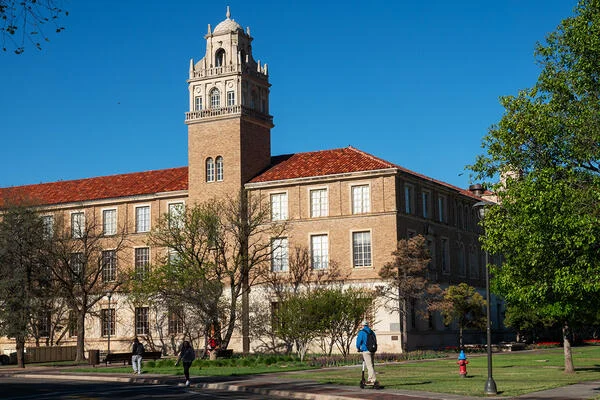
    Months after beginning to enforce unwritten policies about how faculty members can and cannot teach topics related to gender, Texas Tech University system officials released a memo Monday that officially put those policies—and more—in writing.

    “Effective immediately, faculty must not include or advocate in any form course content that conflicts with the following standards,” Chancellor Brandon Creighton wrote in the memo to system presidents, which was passed along to faculty members. The standards include specific rules around race and sexuality that were not previously discussed, system faculty members told Inside Higher Ed. The memo also enshrines that the Texas Tech system recognizes only two sexes—male and female.

    The fuzzy anti-trans policies that were first introduced via a game of censorship telephone at Angelo State University in September have now been made clear and expanded upon across the entire five-university Texas Tech system. Course content related to race and sexuality is now also subject to heightened scrutiny. Although the memo doesn’t ban outright discussion of transgender topics or any topics that suggest there are more than two genders, policies across the country stating that there are only two sexes or genders have been used to restrict transgender rights.

    Texas Tech is far from alone in its efforts; public systems across Texas have taken on varying politically motivated course reviews, leaving faculty members in the state angry and confused. For example, the University of Texas system recently completed a review of all courses on gender identity, and the Texas A&M system board approved a new policy last month mandating presidential approval for classes that “advocate race or gender ideology, sexual orientation, or gender identity.”

    According to Creighton’s memo, faculty members may not “promote” or instill the belief that one race or sex is superior to another; that an individual is, consciously or unconsciously, inherently racist, sexist or “oppressive”; that any person should be discriminated against because of their race or sex; that moral character is determined by race or sex; that individuals bear responsibility or guilt because of the actions by others of the same race or sex; or that meritocracy or a strong work ethic are racist, sexist or “constructs of oppression.”

    Creighton defined advocacy as “presenting these beliefs as correct or required and pressuring students to affirm them, rather than analyzing or critiquing them as one viewpoint among others. This also includes course content that promotes activism on issues related to race or sex, rather than academic instruction.”

    The memo also outlines a Board of Regents–controlled review process, complete with a flowchart, for courses that include content related to gender identity and sexuality. Although race is mentioned earlier in the memo, it’s unclear whether race-related course content will also be subject to this review.

    “We’ve been in this slow rollout process already. We had to go through all of the courses and essentially do the flowchart before the flowchart existed,” said a faculty member at Angelo State who wished to remain anonymous for fear of retribution. “Anything that would cover transgender [people] was flagged.”

    Creighton, a former member of the Texas State Senate, justified the new rules using Senate Bill 37, a law he sponsored earlier this year that, among other things, gave the control of faculty senates to public institution governing boards and established a once-every-five-years review process for general education curricula. An earlier version of the bill that passed the Senate contained language that’s very similar to the restrictions in the Texas Tech memo, including censoring specific course topics that suggest any social, political or religious belief is superior to another and allowing administrators to unilaterally remove faculty senate members for their personal political advocacy. The existing law does not prohibit teaching about transgender identity, racial inequality, systemic racism, homosexuality or any other individual topic.

    “This directive is the first step of the Board of Regents’ ongoing implementation of its statutory responsibility to review and oversee curriculum under Senate Bill 37 and related provisions of the Education Code. This curriculum review under Senate Bill 37 will, in part, ensure each university is offering degrees of value,” Creighton wrote.

    Texas Tech University system spokespeople did not respond to Inside Higher Ed’s questions about the memo, including what next steps might be.

    “The Board’s responsibility is to safeguard the integrity of our academic mission and maintain the trust of Texans,” Board of Regents chairman Cody Campbell said in a news release. “The Board welcomed the clarity provided by Senate Bill 37, which reaffirmed the Regents’ role in curriculum oversight. This new framework strengthens accountability, supports our faculty, and ensures that our universities remain focused on education, research, and innovation—core commitments that position the TTU System for continued national leadership.”

    Faculty across the system are largely upset about the changes but unsure about how to push back, a faculty member told Inside Higher Ed. One Texas Tech professor emeritus, Kelli Cargile Cook, told The Texas Tribune she began drafting a resignation letter.

    “I’ve been teaching since 1981 and this was going to be my last class. I was so looking forward to working with the seniors in our major, but I can’t stomach what’s going on at Texas Tech,” she told the Tribune. “I think the memo is cunning in that the beliefs that it lists are, at face value, something you could agree with. But when you think about how this would be put into practice, where a Board of Regents approves a curriculum—people who are politically appointed, not educated, not researchers—that move is a slippery slope.”

    Brian Evans, president of the Texas chapter of the American Association of University Professors, criticized the memo Tuesday. 

    “Empowering administrators to censor faculty experts’ teaching decisions does a disservice to the university, its students and the state,” Evans said. “Such a system is inconsistent with long-standing principles of academic freedom, university policy and the First Amendment.”

    Graham Piro, faculty legal defense fund fellow for campus advocacy at the Foundation for Individual Rights and Expression, decried the memo in a statement Tuesday.

    “The Texas Tech memo unconstitutionally singles out specific viewpoints on these topics, implying that faculty members must adhere to the state’s line on these issues—and that dissenters face punishment. The memo is also so broadly worded that an overzealous administration could easily punish a professor who seeks to provoke arguments in class or advocates outside the classroom for changes to curricula that reflect developments in teaching,” Piro said.

    “Decades ago, the Supreme Court recognized that the First Amendment ‘does not tolerate laws that cast a pall of orthodoxy over the classroom.’ It instead wrote that ‘truth’ is discovered not by ‘authoritative selection,’ but ‘out of a multitude of tongues.’ These principles are timeless, and Texas Tech should not compromise them, no matter the political winds of the day.”

    He also likened the memo to Florida’s Stop WOKE Act, currently blocked by a federal court, which severely limited how Florida faculty members could talk and teach about race, gender and sexuality.

    Source link

  • Career Growth Series 1 – CUPA-HR

    Career Growth Series 1 – CUPA-HR

    CUPA-HR’s Career Growth Series is a three-part professional development opportunity for higher ed HR professionals who want to explore how to grow, lead and thrive in their careers. The three 90-minute virtual workshops in each series offer practical tools, peer insights and reflective space to support your growth.

    While you can register for only one or two of the workshops, together they form a cohesive journey — from identifying creative, self-directed development opportunities to evaluating leadership readiness and building the skills and strategies needed to step into and succeed in leadership roles.

    The Career Growth Series is a pilot program that is open to invited CUPA-HR members. Seats are limited to support interaction among participants. The workshops will be highly interactive, so come prepared to engage, reflect and share ideas. The sessions will not be recorded.

    New to CUPA-HR Virtual Events?

    CUPA-HR is a nonpartisan, nonprofit educational organization of HR professionals serving our nation’s institutions of higher education. The content and discussions in these workshops are intended to be educational in nature and do not constitute legal advice or counsel. To that end, we request that participants refrain from promoting partisan positions during the workshops. 


    Building the Blueprint for Your Professional Development Journey

    Wednesday, August 13 | 1:00-2:30 p.m. ET

    This workshop invites you to rethink professional development by exploring unconventional, self-directed strategies that align with your position and career aspirations. Through interactive activities and real-world examples, you’ll learn how to identify meaningful growth opportunities, build support for your development plan and articulate the value of your learning. Explore how curiosity, creativity and commitment can be key drivers for shaping a fulfilling professional journey in higher ed HR.

    Presenters

    Krista Vaught, Ed.D.
    Principal Advisor, Employee Experience and Learning and Development
    Frontier Design

    Natalie Trent
    Talent Management Manager
    Grand Valley State University


    Navigating Career Possibilities: Is Leadership Your Next Destination?

    Wednesday, August 20 | 2:00-3:30 p.m. ET

    This workshop will help you explore if leadership/management is the right next step in your career journey and will challenge the assumption that upward mobility is the only route to career fulfillment. Through self-assessment, peer dialogue and real-world insights, you’ll examine your motivations and strengths — and the realities of leadership roles. Leave with clarity on your path forward, whether it involves formal leadership or alternative growth opportunities in higher ed HR.

    Presenters

    Dawn Aziz, Ph.D.
    Director, Organization and Employee Development
    Wayne State University

    Kristen Finley
    Talent and Organizational Development Specialist
    Clemson University

    Elizabeth Oeltjenbruns
    Organization Development Consultant
    University of South Florida

    Krista Vaught, Ed.D.
    Principal Advisor, Employee Experience and Learning and Development
    Frontier Design


    From Aspiration to Action: Positioning Yourself for a Successful Transition Into Leadership

    Wednesday, August 27 | 2:00-3:30 p.m. ET

    This workshop is for higher ed HR professionals who are pursuing a leadership or managerial role or have recently transitioned into leadership/management. You’ll explore essential leadership competencies, reflect on your readiness, and learn strategies to build experience and credibility, even without a formal title. Through interactive discussions and real-world insights, you’ll gain tools to confidently navigate the shift from team member to a formal leadership role.

    Laura Boehme
    Vice President of People and Technology
    Central Oregon Community College

    Krista Vaught, Ed.D.
    Principal Advisor, Employee Experience and Learning and Development
    Frontier Design

    CORE
    Employee Development

    STRATEGIC LEADERSHIP
    Leading the Higher Ed Business Model

    ENGAGEMENT
    Self-Awareness and Accountability


    New to CUPA-HR Virtual Events?
    The CUPA-HR website requires you to create a free site account if you don’t already have one. After you’ve created a website account and established a login, you can then proceed to register for this event. If you have any questions while registering, please contact CUPA-HR toll free at 877-287-2474 or via e-mail at [email protected].

    Need to Cancel a Registration?
    Fill out the cancellation form.

    Source link

  • Higher Ed HR Accelerator Cancellations and Substitutions

    Higher Ed HR Accelerator Cancellations and Substitutions

    Higher Ed HR Accelerator

    Higher Ed HR Accelerator Cancellations and Substitutions

    Use this form to cancel your Higher Ed HR Accelerator registration or to designate a substitute attendee.

    The post Higher Ed HR Accelerator Cancellations and Substitutions appeared first on CUPA-HR.

    Source link

  • Reports – BEES Survey – CUPA-HR

    Reports – BEES Survey – CUPA-HR

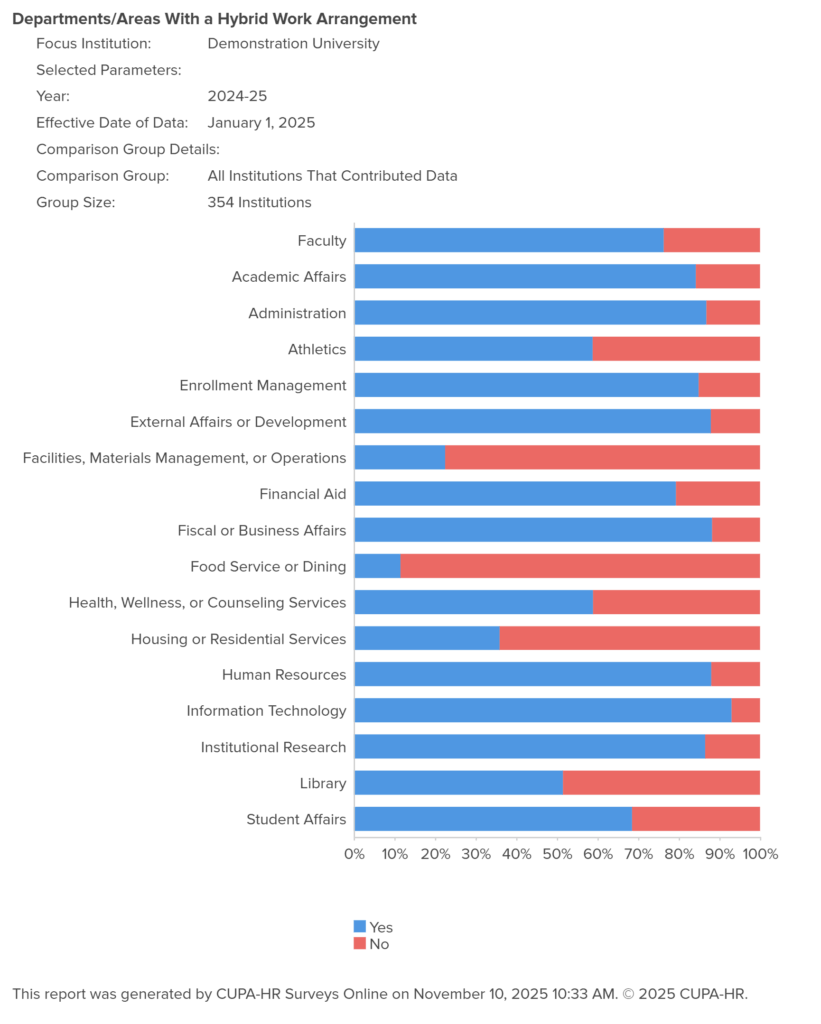
    CUPA-HR Research is pleased to introduce redesigned Benefits, Employee Experience, and Structure (BEES) Survey reports in DataOnDemand. Our new reports feature a fresh look and feel and now include charts for most variables. Charts make it easier than ever to share the latest trends with leadership and teammates so you can continue to build and maintain competitive employee experience and benefits packages. Even better — your institution still has time to earn your discount on 2026 BEES DataOnDemand by participating in the BEES Survey.

    If your institution already subscribes to BEES DataOnDemand, log in to DataOnDemand to see the above chart for your peers (as opposed to all institutions that contributed data). If your institution has a BEES subscription, but you don’t have access, have your CHRO or primary CUPA-HR contact assign you access using these steps. Finally, if your institution does not currently have a BEES DataOnDemand subscription, consider participating in the BEES Survey to get a discount on 2026 BEES DataOnDemand.

    Source link

  • FIRE poll: 90% of undergrads believe words can be violence even after killing of Charlie Kirk

    FIRE poll: 90% of undergrads believe words can be violence even after killing of Charlie Kirk

    • Nine out of ten undergrads believe that “words can be violence”
    • Differences in views becoming more stark between liberal and conservative students

    PHILADELPHIA, Dec. 2, 2025 — Ninety one percent of undergraduate students believe that words can be violence, according to a new poll by the Foundation for Individual Rights and Expression and College Pulse.

    The survey’s findings are especially startling coming in the wake of Charlie Kirk’s assassination — an extreme and tragic example of the sharp difference between words and violence.

    “When people start thinking that words can be violence, violence becomes an acceptable response to words,” said FIRE Chief Research Advisor Sean Stevens. “Even after the murder of Charlie Kirk at a speaking event, college students think that someone’s words can be a threat. This is antithetical to a free and open society, where words are the best alternative to political violence.”

    The new 21-question poll, conducted between Oct. 3-31 by FIRE and College Pulse, assessed free speech on campus in the wake of Kirk’s assassination at Utah Valley University on Sept. 10 and asked undergraduates about their comfort level with a number of controversial topics. The survey of 2,028 undergrads included an oversample of 204 students at Utah Valley, and has a margin of error of +/- 2%. 

    Half of students surveyed say that because of what happened to Kirk, they are now less comfortable attending or hosting controversial public events on their campus, and one in five say they are less comfortable attending class. 

    Other findings show stark differences between students at Utah Valley and other schools, as well as widening rifts between liberal and conservative students:

    • When asked whether the country is headed in the right or wrong direction for people’s ability to freely express their views, 84% of Utah Valley students said “wrong direction,” significantly higher than the 73% reported by students at other schools.
    • Moderate and conservative students across the country became significantly less likely to say that shouting down a speaker, blocking entry to an event, or using violence to stop a campus speech are acceptable actions. In contrast, liberal students’ support for these tactics held steady, or even increased slightly.
    • Among moderate and conservative students, opposition to controversial speakers generally declined. Opposition among liberal students, on the other hand, either held steady or increased for all of the controversial speakers compared to the spring.

    The gaps between conservative and liberal students may be widening, but some concerns transcend politics. A majority of students of all persuasions (53%) say that political violence is a problem among all groups, considerably more than the 35% of Americans who recently said this in FIRE’s October National Speech Index

    “Students want to feel safe, and the killing of Charlie Kirk naturally eroded their sense of safety,” said Stevens. “What we want students to recognize is that the safest environment is one in which people can speak their minds without fear of censorship or violence.”


    The Foundation for Individual Rights and Expression (FIRE) is a nonpartisan, nonprofit organization dedicated to defending and sustaining the individual rights of all Americans to free speech and free thought — the most essential qualities of liberty. FIRE educates Americans about the importance of these inalienable rights, promotes a culture of respect for these rights, and provides the means to preserve them.

    Katie Stalcup, Communications Campaign Manager, FIRE: 215-717-3473; [email protected]

    Source link

  • Higher Ed HR Accelerator – CUPA-HR

    Higher Ed HR Accelerator – CUPA-HR

    Sponsored By

    Join us for a dynamic virtual event designed specifically for higher ed HR professionals, focused on the effective and responsible use of AI in the workplace. We’ll explore the legal and ethical implications of AI compliance and offer practical insights on how to ensure AI-driven tools are implemented in ways that enhance HR effectiveness while maintaining adherence to compliance standards. The presenters will showcase real-world applications of AI and highlight how these technologies can be used to streamline processes and support higher ed HR in everyday work.

    Topics include:

    Navigating Legal HR in the Age of AI

    HR professionals should understand not only the benefits of AI but also the risks and regulations that have emerged in this new legal frontier. In this segment, we’ll discuss the use of AI in employment practices, relevant government regulations related to AI, and how to address employees using ChatGPT and other generative AI programs in their work. We’ll also explore the latest trends in AI-related employment litigation and steps employers can take to reduce the likelihood of legal risk related to AI.

    AI and the ADA: Accommodations and Compliance

    In this segment, we’ll discuss how AI is transforming workplace accessibility and get an overview of the legal responsibilities that come with this transformation. Explore how AI can interact with the Americans with Disabilities Act and how AI-driven tools and strategies can be adapted to support reasonable accommodations for employees with disabilities.

    Showcase: Prompt Engineering For Smarter, Easier HR Workflows

    In this segment, presenters from LSU will highlight how prompt engineering tools like ChatGPT and Microsoft Copilot have transformed their institution’s HR processes. Learn how to reduce time spent on HR administrative tasks like HR document templates, communication, policies, performance management and training. We’ll also hear about security and confidentiality considerations when using AI and how HR leaders can be proactive in safeguarding employee information.

    Showcase: Assessing AI Risk: A Practical Evaluation Framework

    AI is reshaping HR, but ensuring responsible adoption starts with understanding vendor risk. In this segment, presenters from Segal will offer a practical AI risk survey process designed to evaluate third-party vendors across 30 key questions — from data privacy and bias mitigation to security and transparency. Learn how this framework can help HR leaders make informed decisions, strengthen governance and reduce operational risk, and leave with actionable insights and a tool you can adapt for your own campus.

    CUPA-HR is a nonpartisan, nonprofit educational organization of HR professionals serving our nation’s institutions of higher education. The content and discussions in this virtual event are intended to be educational in nature. They do not constitute legal advice or counsel, and they shall not promote partisan positions on the issues discussed. To that end, we request that participants refrain from promoting partisan positions during this event as well.


    Presenters

    Lisa Koblin
    Partner
    Saul Ewing

    Matthew D. Kohel
    Partner
    Saul Ewing

    Emily Hernandez
    HRIS Manager
    LSU Health Sciences Center-New Orleans

    Aaron Miley
    Associate Director, Human Resources
    LSU Health Sciences Center-New Orleans

    Michael Stoyanovich 
    Vice President and Senior Consultant, Administration and Technology
    Segal


    CORE
    AI Technology
    Risk Management, Compliance, Public Policy


    This program has been submitted for recertification credit through HRCI and SHRM, and we anticipate approval for 1.75 hours.

    New to CUPA-HR Virtual Events?
    The CUPA-HR website requires you to create a free site account if you don’t already have one. After you’ve created a website account and established a login, you can then proceed to register for this event. If you have any questions while registering, please contact CUPA-HR toll free at 877-287-2474 or via e-mail at [email protected].

    Need to Cancel a Registration?
    Fill out the cancellation form.

    Source link