Blog

  • The Arts Aren’t ‘Nice to Have’ — They Can Boost Student Engagement & Attendance – The 74

    The Arts Aren’t ‘Nice to Have’ — They Can Boost Student Engagement & Attendance – The 74


    Get stories like this delivered straight to your inbox. Sign up for The 74 Newsletter

    Chronic absenteeism is a longstanding problem that has surged to troubling levels. Recent data show that in 20 states, more than 30% of students are chronically absent, about twice the rate seen before the pandemic. Absenteeism is a multifaceted problem, and the reasons students stop showing up aren’t always academic. Sometimes it’s because they don’t feel connected to their school, or they are not engaged in the curriculum. Other times, they face adversity outside the classroom. While the problem is complicated, it’s easy to overlook one of its simplest, most effective solutions: What if the key to keeping students is a performance stage, a music room or an art studio — a creative outlet to shine?

    Despite decades of research, arts education is still treated as a “nice-to-have” when education budgets allow. From 2015 to 2019, the NAMM Foundation conducted a four-year study across 1,700 New York City public schools serving over 1.1 million students. They found that schools offering music and arts programming had lower rates of chronic absenteeism and higher overall school-day attendance than those that didn’t. Similarly, a comparison of cohort data over seven years found that dropout rates fell from 30% to just 6% among students participating in consistent arts programming.

    Clearly, the arts are a powerful tool for academic engagement, resilience and, most importantly, graduation. For example, after tracking more than 22,000 students for 12 years, the National Dropout Prevention Center found that those with high levels of involvement in the arts were five times more likely to graduate from high school than those with low involvement.

    But while over 90% of Americans feel the arts are important for education, only 66% of students participate, and access remains uneven. Charter schools, the fastest-growing segment of public education, have the lowest availability of arts courses: Just 37% of public charter high schools offer arts instruction. Students in charter schools, military families and homeschool programs are too often the ones with the fewest opportunities to engage with the arts, despite needing them most.

    This is an issue that the Cathedral Arts Project in Jacksonville, Florida, is trying to solve.

    In partnership with and with funding from the Florida Department of Education, our program piloted a year-long arts education initiative during the 2024-25 school year, reaching more than 400 students in charter schools, homeschools, military families and crisis care. Our teaching artists visited classrooms weekly, providing instruction in dance, music, visual arts and theater. Throughout the year, students in kindergarten through high school found joy, confidence and connection through creative learning. Homeschool students brought history to life through art projects, children from military families found comfort and stability during times of deployment and young people in crisis discovered new ways to express themselves and heal. Each moment affirmed the power of the arts to help children imagine what’s possible.

    To better understand the impact of this work, we partnered with the Florida Data Science for Social Good program at the University of North Florida to analyze reports and survey evaluations collected from 88% of program participants. Here’s what we found:

    Students grew not only in artistic skill, but also in self-confidence, teamwork, problem-solving and engagement. After completing the program, over 86% of students said they “like to finish what they start” and “can do things even when they are hard” — a key indicator of persistence, which is a strong predictor of long-term academic success. Students rated themselves highly in statements like, “I am good at performance.”

    Families noticed, too. In the age of screens, nearly three-quarters reported that their child had increased in-person social interaction since beginning arts programming and had improved emotional control at home. Nearly one-third saw noticeable gains in creative problem-solving and persistence through challenges.

    According to the State of Educational Opportunity in America survey conducted by 50CAN, parents view the arts as a meaningful contributor to their child’s learning, and they want more of it. In Florida, where families have been given the power of school choice, they’re increasingly seeking out programs that inspire creative thinking and meaningful engagement while promoting academic success. But finding them isn’t always easy. When funding allows, traditional public schools may offer band or visual arts, but these options are often unavailable to families choosing alternative education options for their children.

    Now in its second year, our program fills this critical gap by working directly with school choice families across northeast Florida, bringing structured arts instruction to students who otherwise wouldn’t have access. 

    What makes the arts such an effective intervention? It’s structure, expression and connection. When students learn through the creative process, they navigate frustration, build resilience and find joy in persistence. These are not soft skills — they’re essential for survival, and increasingly important in today’s workplaces.

    Arts education is a necessary investment in student achievement. It’s time for other states to treat it that way and follow Florida’s lead.


    Did you use this article in your work?

    We’d love to hear how The 74’s reporting is helping educators, researchers, and policymakers. Tell us how


    Source link

  • Moral Capital and Locus of Control

    Moral Capital and Locus of Control

    Moral capital has become a contested currency in American public life. It is deployed by political elites to justify austerity, by campus executives to rationalize managerial authority, and by think tanks to discipline the working class. Yet moral capital also rises from below—from students building mutual-aid networks, from adjuncts organizing for fair wages, from communities confronting the harms universities have helped produce. In an era defined by climate peril, surveillance capitalism, and proliferating wars, the stakes of who controls moral capital—and who gets to exercise real agency—have never been higher.

    At the center of this struggle lies a fraught psychological and sociological concept: locus of control. Higher education constantly toggles between narratives of internal control (grit, resilience, personal responsibility) and external control (the market, political pressures, funding cycles). Powerful actors encourage an internal locus of control when it shifts blame downward, and an external locus of control when it shields institutional failure. Students, staff, and faculty live suspended in this contradiction, expected to absorb the consequences of decisions made far above them.

    Quality of Life as Moral Imperative

    Quality of Life—once peripheral to higher education policy—is now a defining moral issue. Students and workers contend with unstable housing, food insecurity, unsafe campuses, inaccessible mental health care, and relentless economic pressures. For many, these burdens are compounded by existential crises: climate anxiety, global conflicts, democratic backsliding, and precarity amplified by technological surveillance.

    Institutions often portray these crises as personal challenges requiring self-management. But Quality of Life is not an individual moral failure; it is a metric of collective conditions. When a university community’s quality of life declines, it signals a profound imbalance between agency and structure—a distorted locus of control.

    The Industry’s Manufactured Moral Capital

    Universities have long crafted narratives that elevate their own moral standing while displacing responsibility onto individuals. The “grateful striver” student, the “self-sacrificing” adjunct, the “visionary” president—these tropes protect managerial systems from scrutiny and allow elites to accumulate moral capital even as Quality of Life deteriorates for everyone else.

    This manufactured moral authority collapses under existential pressures. As campuses confront heatwaves, flooding, militarized policing, housing crises, widening wars, and state-sanctioned surveillance, it becomes impossible to sustain the fiction that individuals can simply “grit” their way to stability.

    Reclaiming Moral Capital 

    Moral capital is not owned by institutions. It can be reimagined, reclaimed, and reoriented. Four longstanding modes of internal discipline—temperance, celibacy, critical thinking, and solidarity—take on new urgency when placed in the context of planetary and political crisis.

    Temperance

    Temperance, stripped of its historical misuse, becomes a strategy of mindful refusal in the face of consumption-based exploitation. It includes rejecting burnout culture, resisting technological tools that monitor student behavior, and refusing to internalize blame for systemic failures. In an era of climate breakdown, temperance also signifies ecological responsibility—a modest but meaningful form of internal control aligned with global survival rather than institutional convenience.

    Celibacy

    Broadly interpreted, celibacy represents intentional self-limitation that protects one’s emotional and cognitive bandwidth. Amid surveillance-driven social media, algorithmic manipulation, and institutions that increasingly commodify student identity, celibacy can be a form of psychological sovereignty. It creates space for reflection in a world designed to keep people reactive, distracted, and easily governed.

    Critical Thinking

    Critical thinking remains the academy’s most subversive tradition—especially when deployed against the university itself. It helps students analyze the interplay between personal agency and systemic constraint. It equips them to understand climate injustice, militarism, and the geopolitics of knowledge production. And it exposes the ways mass surveillance—from learning analytics to campus police technologies—erodes autonomy and shifts the locus of control away from individuals and communities toward powerful institutions.

    Solidarity

    Solidarity transforms private moral commitments into collective action. It breaks the isolation manufactured by surveillance systems, precarity, and competitive academic cultures. Solidarity has historically been the source of the most effective nonviolent strategies—from civil rights sit-ins to anti-war mobilizations to student debt strikes. Today, as geopolitical conflicts escalate and authoritarian tendencies rise, the power of organized nonviolence becomes an existential necessity. It is one of the few tools capable of confronting militarized policing, resisting state repression, and challenging the corporate infrastructures that profit from crisis.

    Nonviolent Strategies in an Era of Global Threat

    Nonviolent action remains a potent form of moral capital—and one of the most effective forms of collective agency. Research across conflicts shows that sustained, mass-based nonviolent movements often outperform violent struggles, especially against highly resourced opponents. For universities, which increasingly collaborate with defense contractors, data brokers, and state surveillance agencies, nonviolent resistance has become both a safeguard and a moral compass.

    Sit-ins, teach-ins, encampments, divestment campaigns, and labor actions reassert external locus of control as something communities can influence—not by force, but by moral clarity, strategic discipline, and the refusal to comply with harmful systems.

    Mass Surveillance as a Threat to Moral Agency

    Mass surveillance is now woven into the fabric of academic life. Learning management systems track student behavior down to the minute. Proctoring software uses biometrics to police exams. Campus police drones and public-private security networks feed data into law enforcement databases. Administrative dashboards quantify student “risk” and worker “efficiency” in ways that reshape institutional priorities.

    This surveillance apparatus corrodes moral capital by reducing human judgment to automated metrics. It also distorts locus of control: individuals are told to take responsibility while being monitored and managed by opaque systems far beyond their influence.

    Reclaiming agency requires dismantling or limiting these systems, demanding transparency, and reasserting human dignity in spaces now governed by algorithms.

    Toward a More Honest Locus of Control

    Moral capital and locus of control are not academic abstractions. They are lived realities shaped by climate disruption, war, inequality, and surveillance. Higher education must stop using moral narratives to deflect responsibility and instead cultivate practices that reinforce real agency: temperance, celibacy, critical thinking, solidarity, and the disciplined power of nonviolent resistance.

    In a world marked by existential threats, reclaiming moral capital from below is not simply an intellectual exercise—it is a condition for survival, and a pathway to collective liberation.

    Sources

    Frantz Fanon, The Wretched of the Earth

    Erica Chenoweth & Maria Stephan, Why Civil Resistance Works

    Shoshana Zuboff, The Age of Surveillance Capitalism

    Naomi Klein, This Changes Everything

    Paulo Freire, Pedagogy of the Oppressed

    Astra Taylor, Democracy May Not Exist, but We’ll Miss It When It’s Gone

    Source link

  • WEEKEND READING: Three reasons why the TEF will collapse under the weight of OfS  and DfE expectations

    WEEKEND READING: Three reasons why the TEF will collapse under the weight of OfS  and DfE expectations

    Author:
    Professor Paul Ashwin

    Published:

    This blog was kindly authored by Paul Ashwin, Professor of Higher Education, Lancaster University.

    The Office for Students (OfS) and the Department of Education (DfE) have big plans to make the TEF much more consequential. They want future TEF outcomes to determine whether institutions can increase their intake of students and their undergraduate tuition fees in line with inflation, which could mean the difference between survival or merger/closure for many institutions. These plans require that the OfS to show that the TEF provides a credible measure of institutional educational quality, whilst also fulfilling the OfS’s central remit of acting in the interest of students. The OfS consultation on the future approach to quality regulation provides an opportunity to assess the OfS’s latest attempt at such a justification. To say it looks weak is a huge understatement. Rather, unless there is a radical rethink, these proposals will lead to the collapse of the TEF.

    There are three reasons why this collapse would be inevitable.

    Firstly, the TEF provides a broad, if flawed, measure of institutional educational quality. This was fine when the main consequence of a TEF award was the presence or absence of a marketing opportunity for institutions. However, if the TEF has existential consequences for institutions, then a whole series of limitations are suddenly cast in a deeply unflattering spotlight. The most obvious of these is that the TEF uses programme level metrics to make judgements about institutional quality. It is both conceptual and methodological nonsense to attempt to scale-up judgements of quality from the programme to the institutional level in this way, as has been routinely stated in every serious review of the National Student Survey. This didn’t matter too much when the TEF was lacking in teeth, but if it has profound consequences, then why wouldn’t institutions consider legal challenges to this obvious misuse of metrics? This situation is only exacerbated by the OfS’s desire to extend the TEF to all institutions regardless of size. The starkest consequence of this foolhardy venture is that a small provider with insufficient student experience and outcomes data could end up being awarded TEF Gold (and the ability to increase student recruitment and tuition fees in line with inflation) on the basis of a positive student focus group and an institutional statement. How might larger institutions awarded a Bronze TEF react to such obvious unfairness? That the OfS has put itself in this position shows how little it understands the consequences of what it is proposing.

    Second, in relation to the OfS acting in the student interest, things look even worse. As the TEF attempts to judge quality at an institutional level, it does not give any indication of the quality of the particular programme a student will directly experience. As the quality of degree programmes varies across all institutions, students on, for example, a very high quality psychology degree in an institution with TEF Bronze would pay lower tuition fees than students on a demonstrably much lower quality psychology degree in an institution that is awarded TEF Gold. How can this possibly be in the student interest? Things get even worse when we consider the consequences of TEF awards being based on data that will be between four and ten years out of date by the time students graduate. For example, let’s imagine a student who was charged higher tuition fees based on a TEF Gold award, whose institution gets downgraded to a TEF Bronze in the next TEF. Given this lower award would be based on data from the time the student was actually studying at the institution, how, in the name of the student interest, would students not be eligible for a refund for the inflation-linked element of their tuition fee?

    Thirdly, the more consequential that the TEF becomes, the more pressure is put on it as a method of quality assessment. This would have predictable and damaging effects. If TEF panels know that being awarded TEF Bronze could present an existential threat to institutions, then they are likely to be incredibly reluctant to make such an award. It is not clear how the OfS could prevent this without inappropriately and illegitimately intervening in the work of the expert panels.  Also, in the current state of financial crisis, institutional leaders are likely to feel forced to game the TEF. This would make the TEF even less of an effective measure of educational quality and much more of a measure of how effectively institutions can play the system. It is totally predictable that institutions with the greatest resources will be in by far the best position to finance the playing of such games.

    The OfS and DfE seem determined to push ahead with this madness, a madness which incidentally goes completely against the widely lauded recommendations of the TEF Independent Review. Their response to the kinds of issues discussed here appears to be to deny any responsibility by asking, “What’s the alternative?” But there are much more obvious options than using a broad brush mechanism of institutional quality to determine whether an institution can recruit more students and raise its undergraduate tuition fees in line with inflation. For example, it would make more sense and be more transparent to all stakeholders, if these decisions were based on ‘being in good standing’ with the regulator based on a public set of required standards. This would also allow the OfS to take much swifter action against problematic providers than using a TEF-based assessment process. However things develop from here, one thing is certain: if the OfS and DfE cannot find a different way forward, then the TEF will soon collapse under the weight of expectations it cannot possibly meet.

    Source link

  • Transform Your Instructional Coaching with Notebook LM Today

    Transform Your Instructional Coaching with Notebook LM Today

    Jeffrey D. Bradbury
    Latest posts by Jeffrey D. Bradbury (see all)

    TL:DR – Key Takeaways

    • NotebookLM for Instructional Coaches revolutionizes resource management by allowing coaches to use their specific materials instead of generic AI outputs.
    • The tool helps create professional development materials quickly, enabling coaches to synthesize various sources effortlessly.
    • NotebookLM offers unique features like audio overviews, video explanations, and infographics, enhancing the way coaches present information.
    • Coaches can organize notebooks by purpose, rename their sources for clarity, and customize responses for different audiences.
    • Joining communities like GEG helps coaches share strategies and stay updated on innovative practices using NotebookLM.

    As an instructional coach, you’re constantly juggling multiple responsibilities—supporting teachers, creating professional development materials, organizing resources, and staying current with educational technology. What if there was a tool that could help you synthesize information, create engaging content, and save hours of prep time? Enter NotebookLM, Google’s AI-powered workspace that’s revolutionizing how coaches work with information.

    What Makes NotebookLM Different for Coaches?

    Unlike general AI tools like ChatGPT or Gemini that pull from the entire web, NotebookLM gives you complete control over your sources. You choose exactly what information goes in—whether it’s your district’s strategic plan, professional development materials, curriculum documents, or teacher resources—and NotebookLM works exclusively with that content.

    This is a game-changer for instructional coaches. You’re not getting generic advice or hallucinated information. You’re getting insights, summaries, and resources based on your specific materials, aligned to your district’s goals, and tailored to your teachers’ needs.

    Real-World Applications for Instructional Coaches

    Creating PD Materials in Minutes

    Imagine this scenario: You’ve gathered resources about implementing Google Workspace tools in the classroom. You have PDFs, website links, video tutorials, and Google Docs with implementation guides. Instead of manually synthesizing all this information, you can upload these sources to NotebookLM and ask it to create a newsletter for teachers, generate a quick-start guide, or develop talking points for your next coaching session.

    One coach recently used NotebookLM to record a 40-minute lesson observation, uploaded the audio as a source, and asked it to create professional development slides with detailed presenter notes. The tool generated beautiful, comprehensive slides that captured the key teaching strategies demonstrated in that lesson—all without the coach spending hours creating materials from scratch.

    Building Notebooks for School Leaders

    Several coaches are now creating custom notebooks for their school leaders that include strategic plans, policy documents, and instructional frameworks. School leaders can then interact with these notebooks to get quick answers, generate reports, or explore connections between different initiatives—all while staying grounded in the district’s actual documents.

    Powerful Features That Save Coaches Time

    Audio Overviews (The Podcast Feature)

    One of NotebookLM’s most popular features creates AI-generated podcast discussions from your sources. Upload your curriculum materials, coaching protocols, or meeting notes, and NotebookLM will generate a conversational audio overview that makes complex information more digestible. These “deep dive” or “brief” options let you control the length and depth—perfect for sharing with busy teachers who prefer audio learning.

    Video Overviews with Visual Styles

    The newest feature generates explainer videos complete with visuals, making it easier to create engaging PD content. You can choose from multiple visual styles and customize what the video focuses on—ensuring the content stays relevant to your coaching goals rather than pulling in extraneous information.

    Infographics and Slide Decks

    Need to create professional-looking materials quickly? NotebookLM can generate infographics in landscape, portrait, or square formats, and create slide decks in both detailed and presenter modes. The image generation has improved dramatically, producing visuals that look polished and professional—often better than what many of us could create manually in the same timeframe.

    Smart Strategies for Instructional Coaches

    Organize by Purpose

    Should you create one massive notebook with all your coaching resources, or multiple smaller ones? Most coaches find success with focused notebooks organized by purpose—perhaps one for Google Workspace training, another for literacy coaching, and another for new teacher support. This approach allows you to keep sources relevant and responses targeted.

    Rename Your Sources

    When you upload documents, rename them to something meaningful for your audience. Instead of “Google_Docs_Editor_Help_Final_v3.pdf,” rename it to “How to Create a Google Doc for Teachers.” This becomes especially important when sharing notebooks with teachers who need to understand what sources are included.

    Customize for Your Audience

    The new “Configure Chat” feature lets you set how NotebookLM responds. You can create prompts that tell the tool to speak at a second-grade reading level, communicate with teachers who aren’t tech-savvy, or address cabinet-level administrators. This customization ensures the responses match your audience’s needs.

    Share Strategically

    In education domains, you can share notebooks within your district, either giving full access or chat-only access (with Google Workspace for Education Plus). This makes it easy to create resource hubs that teachers can explore independently, reducing the number of repeat questions you field.

    Ready to explore NotebookLM with fellow instructional coaches? Join the Google Educator Group (GEG) for Instructional Coaches—a global community of nearly 500 coaches who share strategies, resources, and support.

    Our community hosts monthly meetings, shares practical demonstrations, and provides ongoing support as you implement new tools and strategies in your coaching practice.

    Getting Started with NotebookLM

    The best way to understand NotebookLM’s potential is to experiment with it. Start small:

    1. Record a coaching conversation or PD session and upload the audio
    2. Gather 3-5 documents on a topic you’re currently coaching on
    3. Upload them to a new notebook and ask NotebookLM to summarize key themes
    4. Try the audio overview feature to see how it synthesizes your sources
    5. Share it with a trusted colleague for feedback

    Remember, this tool continues to evolve rapidly. Features that launched just weeks ago are already more powerful, and new capabilities are added regularly. The key is to start using it, share what works with your coaching community, and stay curious about new possibilities.

    Take Your Coaching Impact Further

    As you explore new tools like NotebookLM to enhance your coaching practice, consider diving deeper into frameworks that amplify your impact. My book, Impact Standards, provides actionable strategies for educators and coaches who want to make a lasting difference in their schools and districts.

    Get Impact Standards

    Want to stay connected and receive regular insights, tools, and strategies for instructional coaching? Subscribe to my newsletter for exclusive tips that will help you continue growing as an educational leader.


    The future of instructional coaching involves smart use of AI tools that amplify—not replace—the human connections at the heart of our work. NotebookLM is one more tool in your coaching toolkit, helping you spend less time on content creation and more time on the relationships and conversations that truly transform teaching and learning.

    Upgrade Your Teaching Toolkit Today

    Get weekly EdTech tips, tool tutorials, and podcast highlights delivered to your inbox. Plus, receive a free chapter from my book Impact Standards when you join.


    Discover more from TeacherCast Educational Network

    Subscribe to get the latest posts sent to your email.

    Source link

  • Hawai’i DOE Spending More on Buses for Fewer Students – The 74

    Hawai’i DOE Spending More on Buses for Fewer Students – The 74


    Get stories like this delivered straight to your inbox. Sign up for The 74 Newsletter

    The number of bus drivers serving Hawaiʻi schools has reached its highest point in four years, but the Department of Education is still falling short of meeting families’ transportation needs.

    This year, 545 bus drivers are serving Hawaiʻi schools, up from 436 last fall, according to recent datafrom the DOE. The department is still short 130 drivers, who are primarily provided through the bus companies Ground Transport Inc. and Roberts Hawaiʻi.

    The department sparked widespread criticism from parents and lawmakers last August when it abruptly cancelled over 100 bus routes for students days before the new school year. To avoid severe shortages this year, DOE consolidated some bus routes with low ridership and launched a new carpooling initiative for parents, according to a recent memo from Deputy Superintendent Jesse Souki. 

    Last year, nearly half of Hawaiʻi students didn’t qualify for bus transportation because they lived within walking distance to their local schools or received a geographic exception to attend a campus outside of their neighborhood. This fall, nearly 13% of students rely on the bus services available to regular education students, down from roughly 16% in the 2023-24 academic year

    Special education students receive their own bus services that are required under federal law. 

    Demand for bus drivers has fallen over the past two years, with DOE contracting for 694 drivers in 2023, compared to 675 this fall. Bus companies were better able to keep up with DOE’s demands before the Covid-19 pandemic, and the state was only short 28 drivers in 2019.

    Despite the decline in DOE’s need for drivers, the costs of transporting kids has increased over the past several years. Last school year, the department spent a total of $76 million in state and federal funds on student transportation, compared to $60 million in 2022.

    To reduce families’ reliance on buses, the department has offered free city bus passes to middle and high school students on Oʻahu and Kauaʻi. In the first quarter of the school year, roughly 6,200 Oʻahu students and 99 Kauaʻi students took advantage of the bus passes, according to the DOE, with the majority of participants from Oʻahu schools.

    Maui and Hawaiʻi County already offer free bus services to students.

    This fall, DOE also introduced a carpool pilot program, which allows parents in the Mililani and Kekaulike complexes to connect with nearby families who can transport their kids between school and home.

    Only 3% of families in the complexes have registered for the program, according to the DOE.

    The department will give more updates on student transportation during Thursday’s Board of Education meeting.


    Did you use this article in your work?

    We’d love to hear how The 74’s reporting is helping educators, researchers, and policymakers. Tell us how

    Source link

  • How Can Unions Defend Worker Power Under Trump 2.0? (Labor Notes)

    How Can Unions Defend Worker Power Under Trump 2.0? (Labor Notes)

    In the December issue: 

    New York’s Working Class Elects a Movement Mayor, by Luis Feliz Leon
    Zohran Kwame Mamdani, a Democratic Socialist and the Democratic nominee, will be New York City’s next mayor, after trouncing former Governor Andrew Cuomo in a primary and general election double whammy. Volunteers were galvanized by Mamdani’s relentless focus on the affordability crisis and principled stand against Israel’s unfolding genocide in Gaza.

    Canadian Postal Workers Strike Again, by Danielle Smith
    Canadian postal workers are back on strike—again—as they fight to save a vital public service. “By staying on the job and continuing to wait for demoralizing offers, we show that we accept this, we’re not going to fight. So we decided we’re going out,” said Nova Scotia letter carrier Basia Sokal. 

    Indiana Casino Dealers Are Bringing Back the Recognition Strike, by Alexandra Bradbury
    There are no clocks in a casino, so the dealers all set their phone alarms for noon. Everyone was a bundle of nerves. Before work, a couple of people threw up.

    But when the cacophony of alarms sounded, everyone lifted their hands in the air, slammed down the lids on their games of baccarat, blackjack, craps, and roulette, and announced they were on strike. “It was more powerful than anything I’ve ever felt in my life,” said dealer Tera Arnold. “I had goosebumps head to toe.”

    PLUS: Articles published so far in our Roundtable Series: How Can Unions Defend Worker Power Under Trump 2.0?, a Stewards’ Corner on welcoming immigrant members into the union, and more! 

    Source link

  • Northwestern Settles With Trump Administration

    Northwestern Settles With Trump Administration

    pabradyphoto/Getty Images

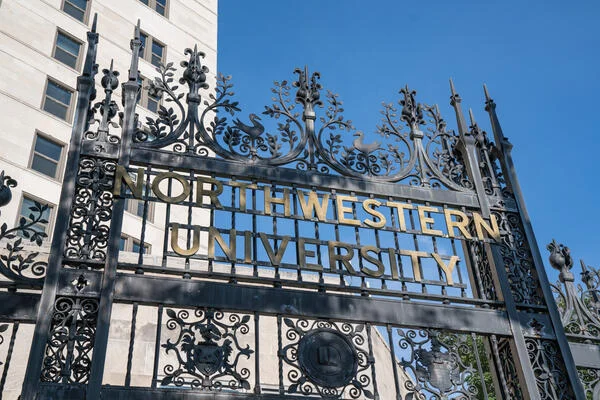
    Northwestern University has reached an agreement with the Trump administration to restore federal research funding. The university will pay the federal government $75 million and enact various changes. In return, the federal government will lift a freeze on millions in research funding.

    As part of the settlement, Northwestern agreed to adhere to federal antidiscrimination laws and to not give preferences in admissions, scholarships, hiring or promotion that are based on race, color or national origin; to maintain clear free speech policies; and to mandate antisemitism training for all students, faculty and staff. University officials will also reverse a 2024 deal made with pro-Palestinian student protesters in which Northwestern agreed to provide more support for Muslim, Middle Eastern and North African students and greater financial transparency.

    The settlement also bars Northwestern’s Feinberg School of Medicine from performing “hormonal interventions and transgender surgeries” on minor patients, according to language in the agreement. However, university officials have said that does not reflect a change in practice. Instead the agreement merely codifies that Northwestern will not provide such services.

    Northwestern is now the sixth university to strike a deal with the Trump administration, following settlements with the University of Pennsylvania, Columbia University, Brown University, the University of Virginia and Cornell University. Of those settlements, Northwestern has the second-highest financial payout at $75 million, trailing only Columbia, which agreed to pay $221 million. Unlike the Brown and Cornell settlements, all of the money will go directly to U.S. government.

    A Path Forward

    Northwestern leadership cast the settlement as a win, despite the $75 million payout.

    “It was the best and most certain method to restore our federal funding both now and in the future,” interim president Henry Bienen said in a video message following the settlement.

    The Trump administration froze $790 million in federal research funding earlier this year amid concerns about alleged antisemitism on campus following pro-Palestinian demonstrations in 2024. Last year, at the height of the protests, then-president Michael Schill struck a deal with pro-Palestinian students, known as the Dearing Meadow agreement, which has now been scuttled. That deal was heavily scrutinized by Congress when Schill testified in May 2024. (Schill would later resign, stepping down this fall amid the standoff over frozen federal research funding.)

    Though Harvard University brought a successful lawsuit against the federal government, prompting a judge to rule in July that a similar funding freeze there was illegal, Northwestern aimed to avoid a costly and protracted legal battle in an effort to quickly restore research dollars.

    Bienen argued in the video that “suing would have cost time and money that we believe the university could not risk” and the settlement was “the best path forward for us to be able to turn the page.” Despite an endowment valued at more than $14 billion, Bienen said, the university could not afford to sustain its research mission on its own. Had that freeze continued, Bienen said it would “gut our labs, drive away faculty, and set back entire fields of discovery.”

    Northwestern, like other wealthy institutions hit with federal funding freezes, has made a number of cost-cutting moves as it navigated sudden financial challenges related to the research enterprise. Earlier this year Northwestern eliminated 425 jobs as part of overall budget reductions.

    Now the federal funding spigot is set to be turned back on, though officials noted on the university website that “some terminated grants will not be reinstated, specifically those the federal government has cut” and that “these decisions were not specific to Northwestern.”

    The university did not admit to any wrongdoing in the settlement.

    Northwestern also answered a question that has been hanging over numerous other universities in its settlement communications, stating that it will not sign the Trump administration’s proposed “Compact for Academic Excellence in Higher Education.” Originally floated to only a few universities before it was opened to all, the compact would provide preferential treatment in federal funding in return for various changes, many of which experts warn would undermine academic freedom. So far, few institutions have expressed interest in the proposal.

    A Landmark Deal

    Federal officials also hailed the settlement with Northwestern as a win.

    “Universities that receive federal funding have a responsibility to comply with the law, including protecting against racial discrimination and antisemitism,” Assistant Attorney General Harmeet K. Dhillon of the Justice Department’s Civil Rights Division said in a news release. “We appreciate the significant improvements Northwestern has made and are gratified to reach an agreement that safeguards of rights [sic] of all the university’s applicants, students, and employees.”

    Education Secretary Linda McMahon called the settlement a landmark deal.

    “The deal cements policy changes that ‘will protect students and other members of the campus from harassment and discrimination,’ and it recommits the school to merit-based hiring and admissions. The reforms reflect bold leadership at Northwestern, and they are a roadmap for institutional leaders around the country that will help rebuild public trust in our colleges and universities,” McMahon said in the DOJ news release that announced the settlement.

    Source link

  • 3,000 Children Repeating Third Grade Under New Indiana Literacy Requirement – The 74

    3,000 Children Repeating Third Grade Under New Indiana Literacy Requirement – The 74


    Get stories like this delivered straight to your inbox. Sign up for The 74 Newsletter

    About 3,000 Indiana students are repeating third grade this school year for not meeting the state’s reading proficiency standards.

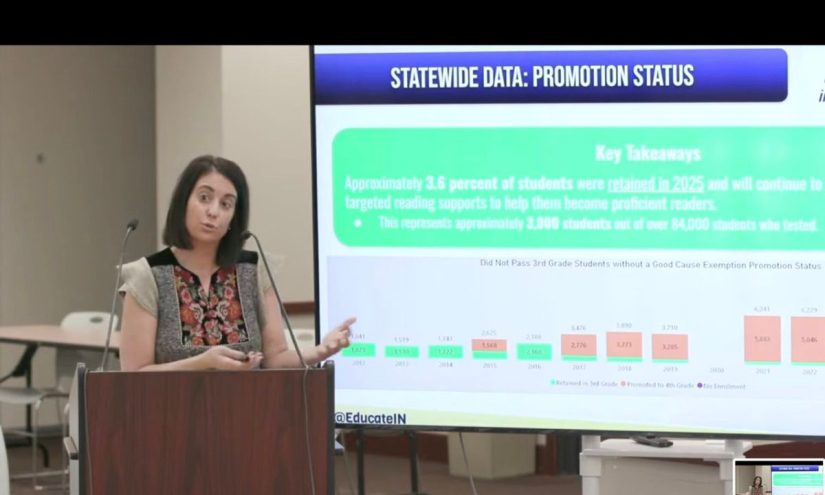
    Data released Wednesday by the Indiana Department of Education showed 3.6% of the 84,000 children who took the statewide IREAD exam were retained in third grade under the first enforcement of a requirement approved by the Legislature in 2024.

    Those 3,040 retained students are more than seven times the 412 children held back in third grade two years ago.

    Education Secretary Katie Jenner credited improved performance by students in the IREAD exam given last school year with the retention figure being lower than anticipated when the literacy requirement was being debated.

    “The numbers that were being thrown out is that it would be 7,000 to 10,000 that this law would trigger retention,” Jenner told State Board of Education members. “But, in fact, a huge shout out to our teachers and our people, we have thousands of kids who are now readers.”

    Education officials announced in August that 87.3% of third graders — about 73,500 out of more than 84,000 students statewide — demonstrated proficient reading skills in 2024-25. They hailed the nearly five percentage point improvement from the previous school year as the largest year-to-year jump since the state began IREAD testing in 2013.

    That left about 10,600 children who didn’t meet the standard, with almost 7,000 being given “good cause exemptions” to avoid retention. Nearly 75% of those given exemptions were special education students and about 24% are English learners with less than two years of specific literacy services.

    Anna Shults, the Department of Education’s chief academic officer, said the new retention requirement was having its intended effect.

    “We are now ensuring that students that are promoted on to grade four are doing so with an ability to read and show mastery of key foundational reading skills,” Shults told the State Board of Education.

    The Department of Education will have an online dashboard providing breakdowns of the Indiana Reading Evaluation and Determination assessment, or IREAD, by school district and individual schools, including charter schools and nonpublic schools.

    Officials noted about 670 children who didn’t meet the literacy standards were not enrolled in Indiana schools this year, saying they likely moved out of state or were being homeschooled.

    Jenner said a determination would need to be made about those students if they returned to Indiana schools.

    “That’s a question that we’ll need to sort through, because some may move back into Indiana, or if they left for homeschool may come back in,” Jenner said. “Because we’re looking at every unique student, I think we’ll try to figure out exactly where they are.”

    According to 2023 data, 13,840 third-graders did not pass I-READ-3. Of those, 5,503 received an exemption and 8,337 did not. Of those without an exemption, 95% moved onto 4th grade while only 412 were retained.

    Indiana Capital Chronicle is part of States Newsroom, a nonprofit news network supported by grants and a coalition of donors as a 501c(3) public charity. Indiana Capital Chronicle maintains editorial independence. Contact Editor Niki Kelly for questions: [email protected].


    Did you use this article in your work?

    We’d love to hear how The 74’s reporting is helping educators, researchers, and policymakers. Tell us how

    Source link

  • Medugrift and the price makers in higher education

    Medugrift and the price makers in higher education

    In the United States, the cost of higher education is not a natural phenomenon. It is deliberately constructed by a network of institutional actors who function as price makers: university presidents, chief financial officers, boards of trustees, governors, and state legislators. They determine what students pay, how institutions are structured, and whose interests higher education ultimately serves. Their decisions shape tuition, labor conditions, program priorities, and the balance between education and the expanding world of medugrift—the hybrid system where medicine, education, debt, and corporate extraction intersect.

    For decades, the American public has been told that tuition rises because education is inherently expensive. But as Richard Wolff argues in his critiques of the “War on the Working Class,” the economic decisions shaping tuition, labor costs, athletics, administrative growth, and capital projects reflect class priorities. The price makers choose which costs are fundamental and which are negotiable. They choose what gets built, who gets hired, and how much debt institutions take on. They choose who pays.

    University presidents now act more like corporate executives than academic leaders. They negotiate seven-figure salaries, travel globally for fundraising, and preside over campuses where luxury construction often outruns academic needs. They approve budgets that elevate branding and athletics while pressuring academic departments to justify their existence through profit metrics. Tuition increases rarely slow presidential compensation; instead, they are framed as regrettable necessities dictated by “the market” or “competitive realities.”

    CFOs enforce a financial logic that prioritizes credit ratings, cash reserves, and debt-financed expansion. They present budgets as neutral, but each line reflects a hierarchy of value. Instruction is cast as a cost center. Staff health care, faculty benefits, and student services become “inefficiencies.” Meanwhile, massive expenditures on consultants, real estate, information systems, and administration are justified as essential to “modernization.” The result is predictable: the people who teach and learn bear the burden while those who administer expand.

    Trustees represent another layer of price making. Often drawn from banking, private equity, real estate, biotech, and corporate medicine, trustees bring a worldview shaped by capital accumulation rather than public service. They authorize tuition hikes, approve investment strategies, and greenlight partnerships that blend public education with private profit. Many trustees sit simultaneously on hospital boards or medical investment firms, allowing medugrift to flourish in the shadows of institutional legitimacy. Their decisions shape which programs expand, which shrink, and which students are offered genuine opportunity.

    State governors and legislators are external architects of scarcity. Since the 1980s, state governments have systematically defunded public higher education while channeling resources to mass incarceration, gambling revenue schemes, corporate tax breaks, and subsidies to companies like Amazon. These choices undermine the ability of public institutions to remain affordable and force them to operate increasingly like private universities. The shift from public funding to tuition revenue is not inevitable; it is a political strategy. HBCUs and tribal colleges have lived with this manufactured scarcity for generations. Their chronic underfunding—documented in numerous state audits and federal investigations—illustrates what happens when government treats education for marginalized communities as optional.

    The emergence of medugrift reveals a deeper structural problem. At the intersection of higher education and corporate medicine sits an engine of extraction. University medical systems leverage public funding, student tuition, and philanthropic contributions to build financial empires that often serve administrators first and communities last. Medical schools charge extreme tuition while placing students into debt-heavy paths. University hospitals consolidate regional health systems, increasing costs while reducing access. Research produced through public dollars is routinely captured by private pharmaceutical or biotech companies. Meanwhile, residents and faculty in these health systems often endure poor working conditions and stagnant pay. Medugrift conceals itself behind the prestige of medicine, but its logic mirrors that of predatory education: privatize gains, socialize losses, and extract from those with the least bargaining power.

    Who determines the costs to students? The answer lies in the aggregated decisions of these actors. When a university raises tuition to protect its bond rating, that is a decision. When trustees invest in athletics while cutting humanities programs, that is a decision. When governors choose prisons over scholarships, that is a decision. When state legislatures allow gambling revenue to substitute for stable taxation, that is a decision. Each choice shifts the financial burden downward while consolidating power upward.

    This is not simply mismanagement; it is a class project. The people who determine prices do not feel them. Students, families, adjunct instructors, and underfunded communities do. For working-class students, particularly those from historically excluded backgrounds, the price makers have built a system defined by debt, precarity, and limited mobility.

    Nothing about this system is inevitable. There was a time when public universities were affordable, when trustees included community members and labor leaders, when presidents were educators, and when medical centers served the public rather than corporate conglomerates. If the price makers can build this system, a more democratic and humane system can be built to replace it.

    The question for the coming decade is not whether higher education is too expensive. The public has already reached its verdict. The question is whether students, workers, and communities will continue to let the price makers—and the medugrift machinery attached to them—define who gets educated, who gets indebted, and who gets left behind.

    Sources

    Richard D. Wolff, Understanding Socialism; Capitalism Hits the Fan

    Elisabeth Rosenthal, An American Sickness

    Harriet A. Washington, Medical Apartheid

    Rebecca Skloot, The Immortal Life of Henrietta Lacks

    Alondra Nelson, Body and Soul

    State Higher Education Finance (SHEF) Reports

    U.S. Department of Education, Office for Civil Rights, HBCU Funding Analyses

    Source link

  • WEEKEND READING The art of reimagining universities: a vision for higher education

    WEEKEND READING The art of reimagining universities: a vision for higher education

    Join HEPI for a webinar on Thursday 11 December 2025 from 10am to 11am to discuss how universities can strengthen the student voice in governance to mark the launch of our upcoming report, Rethinking the Student Voice. Sign up now to hear our speakers explore the key questions.

    This blog was kindly authored by Professor Rathna Ramanathan, Provost, Central Saint Martins; Executive Dean for Global Affairs and Professor of Design and Intercultural Communication, University of the Arts London.

    The structure of our universities is stuck in the past. The recent post-16 education and skills white paper praises our universities as globally excellent institutions but calls for a reorientation towards national priorities and greater efficiency. As academics and creatives functioning as outsiders, we can use this position productively to define future pathways.

    We’re living through multiple crises at once – climate emergency, polarization, AI disruption – yet most universities still organize themselves around departments created decades ago. Institutions talk endlessly about ‘interdisciplinary collaboration’ and ‘preparing students for the future’, yet their actual structures often make both nearly impossible.

    At Central Saint Martins, University of the Arts London, we have tried something different. We have redesigned the College by rethinking what an art and design college should focus on and how it can work, guided by shared principles that emerged from asking: ‘What does it look like when we work together at our best?’

    The real question

    We ask students to be creative, adaptive, bold. To embrace complexity and imagine different futures. What could our universities achieve if we reorganised ourselves with the same creativity we demand from students?

    The institutions that thrive in the coming decades won’t be those defending traditions most fiercely. They will be those with the courage to redesign themselves for the world emerging, not the one they were built for. That’s uncomfortable. Structural change is difficult and uncertain. Letting go of familiar categories and hierarchies requires trust. Building new collaborative cultures alongside new organisational structures demands sustained effort. This discomfort might be precisely the point. If universities can’t model the adaptive, experimental, principles-led thinking we claim to teach, why should anyone trust us to prepare the next generation for an uncertain future? More bluntly, if we don’t practice what we teach, do we deserve to thrive?

    The problem: structure shapes everything

    For over a century, universities have organised themselves into disciplinary silos. This made sense when knowledge was more stable, and career paths were more predictable. But today’s urgent challenges  don’t heed disciplinary boundaries and require insights from science, policy, economics, ethics, design, and creative practice simultaneously.

    Most universities recognise this. They create joint programmes and support cross-department initiatives. Yet the fundamental architecture remains unchanged: separate budgets, isolated governance structures, academic staff working within disciplinary lanes. It’s like trying to renovate a house by rearranging the furniture while leaving the walls intact.

    For students, this disconnect is glaring. They see interconnected problems everywhere, yet are asked to choose a single discipline and stay within it. They want to learn how to think, not just master a predetermined skill set. Traditional university structures also inadvertently reinforce whose knowledge counts and whose doesn’t, often privileging Western over non-Western perspectives, theory over practice, and individual achievement over collective wisdom. In an era demanding intercultural, community-centred, and future-focused approaches, these inherited biases have become institutional liabilities.

    The experiment: principles before structure

    Central Saint Martins’ transformation began with a fundamental question: ‘What does it look like when we work together at our best?’ From this inquiry emerged five core principles that now guide decision-making at College level: address shared conditions that transcend disciplines; seek common ground through equitable collaboration; treat the whole life of the College as creative material; bring practice to every space; and deepen connections with communities beyond our walls. These aren’t aspirational statements. They’re operational principles that inform the creation of a new structure: ‘Schools of Thought’.

    Three schools of thought: foundations, not hierarchies

    Most university ‘schools’ function as management layers above departments with administrative structures for top-down control. At Central Saint Martins, we are inverting this model. Our Schools of Thought establish shared foundations beneath courses and programmes, creating common ground where disciplines naturally converge.

    Each school aims to be transdisciplinary (integrating ways of thinking), not merely multidisciplinary (putting disciplines side-by-side). They’re collective, not just collaborative. The naming strategy – C + S + M = CSM – emphasises the whole over parts. Rather than reinforcing disciplinary boundaries, they create space for working across schools while adapting to changing conditions.


    C School [Culture]
    explores culture as a vital form of enquiry and expression, developing thinking and practice across art, performance and curation. It recognises culture in the immediate world around us, understanding it as a sense-making activity.


    S School [Systems]
    explores how different forms of designing allow us to understand and intervene in the complex human systems shaping our world through graphic communication, product and industrial design, architecture, business innovation, and creative enterprise.


    M School [Materials]
    investigates radical approaches to materials, making, and meaning-making through fashion, textiles, and jewellery to digital interaction, scientific innovation, and multi-species regeneration.

    Why principles matter more than plans

    What makes this transformation different from typical restructuring is its foundation in shared principles rather than predetermined outcomes. The principles emerged from collective reflection on the College’s actual lived experience, examining when authentic collaboration and meaningful impact happen. They aim to capture the heart of the College’s culture rather than imposing an abstract ideal. They create coherence without rigidity, alignment without conformity.

    Schools of Thought are not viewed as resolved but as vehicles for ongoing transformation. They provide low-walled frameworks for continuous evolution, adapting to changing conditions while staying true to core values. As communities and conversations develop, the schools themselves will transform, shaped by the very practices they enable.

    The deeper shift: embedding justice and sustainability

    Traditionally, art and design education has reinforced colonial perspectives, unsustainable production and cultural hierarchies; biases that reproduce invisibly through inherited disciplinary structures. The principle of ‘addressing shared conditions’ makes complicity in global crises unavoidable rather than optional, preventing justice and sustainability from being relegated to elective courses or diversity initiatives.

    ‘Seeking common ground’” creates space for marginalised knowledge systems, while ‘taking the whole life of the College as material’ reveals institutional truths through the lived experiences of our staff and our students rather than stated values alone.

    We can’t truly prepare students for the climate crisis, technological disruption, or polarisation by adding modules to unchanged systems. The structure needs to embody the values and capacities these challenges demand.

    What creativity teaches

    Creative education isn’t primarily about self-expression or beautiful objects. But approached as Central Saint Martins has, creativity becomes a methodology for engaging with uncertainty as traditional certainties collapse.

    ‘Bring practice to every space’ makes thinking-in-formation visible, cultivating comfort with ambiguity and the capacity to learn from failure—all critical for navigating unpredictable futures. “Deepen external connections” recognises that knowledge develops through genuine dialogue with communities beyond institutional walls, not expert pronouncements.

    These approaches value prototyping and iteration over perfect solutions, holding contradictory ideas simultaneously, collaborating across difference, and making abstract possibilities tangible. We want to apply creative principles to institutional transformation, treating the restructuring as an experimental, collaborative, and iterative process rather than a top-down plan.

    Lessons for all higher education

    Although rooted in creative arts, the principles-led approach transfers across sectors. Imperial College London’s recently launched Schools of Convergence Science reflects similar recognition that traditional structures no longer serve contemporary challenges. Structural change requires more than new organisational charts. It requires:

    • Culture shifts embedded in governance: Principles that guide decision-making at every level, ensuring new structures don’t simply replicate old patterns.
    • Foundation-level transformation: Creating common ground where collaboration becomes natural rather than requiring special initiatives.
    • Recognition of complicity: Acknowledging how inherited structures perpetuate problems, then actively working to transform those conditions.
    • Treating institutional structure as material: Applying the same creative, experimental, iterative approaches we teach students.
    • Making the whole life of the institution visible: Valuing informal experience alongside formal roles, practice alongside theory, collective wisdom alongside individual expertise.

    Any university can ask itself: What principles characterise when we work at our best? How could we design structures that enable rather than constrain that work? What would it mean to organise around shared conditions rather than inherited categories?

    As higher education gets increasingly othered in new policies, outsiders can provide the breakthroughs needed by taking a fresh perspective. As ‘The genius of the amateur’ points out, outsiders often succeed because progress is about generating models which we then test, apply and refine. We can’t do this alone at Central Saint Martins, University of the Arts London, we need to do this collectively: to genuinely practice for ourselves what we teach and to create a space which isn’t about silos or othering but where all of us are welcome.

    Source link