Months after U.S. President Donald Trump suddenly cut U.S. international assistance for the prevention and treatment of AIDS and the HIV virus that leads to it, the ripple effects are now changing health programs — and opening new debates — around the world.
More than US$2.5 billion has been stripped from the President’s Emergency Plan for AIDS Relief or PEPFAR, the major U.S. funding stream for global treatment, prevention and research of AIDS.
In 2025, the U.S. National Institutes of Health terminated 191 specific grants for programs to prevent and treat HIV, the virus that causes AIDS. That’s a funding loss of more than $200 million, and more cuts seem likely in the 2026 budget.
Among the casualties of the funding cuts: two million adolescent girls and young women in sub-Saharan Africa no longer have access to a program that offered services for HIV prevention, sexual and reproductive health and protection from physical sexual violence as well as education and empowerment.
Also in jeopardy: prevention of mother-to-child transmission of HIV through counseling, testing, preventive therapy, early diagnosis in infants and pediatric treatment services.
Halting HIV treatment
All this leaves tens of thousands of doctors, nurses and support staff in Kenya, South Africa and Mozambique without needed support. Almost all U.S.-supported research programs on HIV vaccines and tuberculosis were halted.
Some governments have responded. Ethiopia, for example, imposed new taxes to pay salaries of workers previously covered by U.S.-funded projects. Patients who were treated at community-based clinics are now being referred to government-run facilities.
The aid cutoff has hobbled one of the world’s greatest public health triumphs: about 31.5 million people in treatment around the world, according to the World Health Organization.
In all, HIV/AIDS has killed more than 44 million people since its emergence in the mid-80s, including 630,000 last year, demonstrating the need for continued HIV/AIDS prevention, treatment and research.
Transformational treatment
The U.S. pullback comes just as a game-changing prevention drug is entering the market: Lenacapavir is a long-acting drug administered twice a year.
But instead of a rapid scale-up of a transformational treatment, the overall cuts in U.S. aid across all diseases could lead to 14 million additional deaths over five years according to a projection in the medical journal Lancet.
UNAIDS has warned that without replacement funding, the PEPFAR cuts could result in an extra six million HIV infections and four million more AIDS-related deaths by 2029.
The UN agency has urged countries to transform their HIV responses. Other nations have started to step in. The Global Fund to Fight AIDS, TB and Malaria has collected pledges of US$11.34 billion from governments and $1.3 billion from private donors, of which $912 million is coming from the Gates Foundation.
An argument is gaining momentum that the crisis is a blessing in disguise for nations and programs that have come to rely too much on U.S. money.
The world working together
Each protracted health threat — Ebola, Mpox, COVID-19 — makes the case for self-reliance and a system of enhanced regional cooperation and collaboration that leverages international agreements such as the International Health Regulations and the WHO Pandemic Treaty while respecting national sovereignty.
Consider the G20 Health Working Group. It brings together all the countries in the G20 — a forum of the world’s largest economies — plus collaboration with the World Health Organization, World Bank and other partners to strengthen global health systems, promote universal health coverage and coordinate responses to major health challenges.
It aims at building resilient, equitable and sustainable health systems worldwide. The G20 Global Health Group has in recent years focused on funding gaps and investments needed to meet 2030 targets: health inequities between high and low-income countries and responses to climate change and migration pressures on health systems.
The ultimate idea is to integrate health with humanitarian, peace and development goals by, among other things, adopting a primary health care approach; strengthening human resources for health; stemming the tide of Non-Communicable Diseases; enhancing pandemic prevention, preparedness and response; and supporting science and innovation for health and economic growth to accelerate health equity, solidarity and universal access.
Restoring, sustaining and scaling-up coverage of essential HIV/AIDS prevention, care, treatment and protection services through countries and communities’ self reliance will be a major indicator of this commitment.
Questions to consider:
1. How can the elimination of U.S. health funding be a “blessing in disguise” for African nations?
2. Why has the funding of HIV/AIDS treatment and prevention around the world been considered a success story?
3. How might access to health treatment be a problem where you live?
Degree apprenticeships, programs that let students earn a college degree while gaining paid work experience, are a fast-growing model in education and workforce development. But new research from the think tank New America finds access to them remains limited and uneven.
A report released this month by New America’s Center on Education & Labor found that about 350 institutions nationwide offered nearly 600 degree apprenticeship programs integrated with associate, bachelor’s or master’s degrees, preparing students for 91 different occupations.
Among institutions that offer them, degree apprenticeships are concentrated in a small number of fields, with K–12 teaching and registered nursing accounting for the largest share.
Ivy Love, a senior policy analyst at New America, said degree apprenticeships are especially valuable for states facing teacher or nurse shortages.
“These are two rapidly growing professional areas for degree apprenticeships,” Love said. “There is an opportunity to make these paths into these professions more accessible.”
Degree apprenticeships combine paid work experience, on-the-job training, employer-aligned classroom instruction and recognized credentials with an associate, bachelor’s or master’s degree. Learners participate in work-based learning while completing coursework—known as related technical instruction—at a college or university that aligns with what they are learning on the job.
These programs are emerging at a moment of growing skepticism about the value of a college degree. In New America’s Varying Degrees 2025 survey, just 52 percent of adults—a slim majority—said a postsecondary credential is the minimum level of education they believe a close family member needs to ensure financial security.
At the same time, New America found that earning a postsecondary degree remains the surest path to economic stability and family-supporting wages. In 2024, households with two adults needed to earn more than $100,000 a year to support two children—a level of pay that typically requires at least an associate degree, the report said.
Lancy Downs, a senior policy analyst at New America, said one story that stood out in the report came from an administrator at an Alabama community college where more than half the students attend part-time. The administrator explained that this is because school is optional, but work is not.
“We see [degree apprenticeships] as an effective way to upskill people into higher-paying jobs with more upward mobility,” Downs said. “They also help bring more people into professions well suited for this model, allowing students to earn a paycheck, attend school and take on minimal debt at the same time.”
The findings: The report found that programs that prepare K–12 teachers made up 156 of the nearly 600 degree apprenticeships identified, while registered nursing programs accounted for 51. Other positions represented include electro-mechanical and mechatronics technologists and technicians, electricians, and industrial engineering technologists and technicians.
With the exception of teaching, most degree apprenticeship opportunities are concentrated at the associate-degree level. Two-thirds of the programs awarded associate degrees, 29 percent awarded bachelor’s degrees and 4 percent awarded master’s degrees, according to the report. Most associate-level credentials were associate of applied science degrees.
Love said occupational requirements are the main factor driving these patterns: Careers in teaching typically require a bachelor’s degree, while nursing careers can be started with an associate degree.
“Community colleges have been really involved in degree apprenticeships, many of them for quite some time,” Love said. She noted that although some universities offer degree apprenticeships as well, community colleges’ “workforce orientation” gives them more familiarity with the model, and two-year institutions are more likely to have close connections to employers in technical fields.
The report also found that rural and small-town colleges are disproportionately represented among institutions offering teacher apprenticeships, suggesting degree apprenticeships in teaching are shaped by local workforce needs.
Downs said she suspects the prevalence of the “grow-your-own” model in teacher training explains this pattern.
“It’s possible that the prevalence of those already in teaching contributed to the overrepresentation in many rural communities,” Downs said.
The implications: Downs said degree apprenticeships’ small program size, reliance on public funding and other structural factors must be addressed for programs to succeed.
“We don’t really fund degree apprenticeships the same way we fund K–12 schools or even higher education,” Downs said, noting that most funding comes from “one-off” federal grants.
“More funding is needed to get [degree apprenticeship] programs up and off the ground and figure out how to run them sustainably,” she said.
Beyond funding, Downs said the programs also need to be thoughtfully designed to meet the needs of the students they serve.
“If you can get credit for what you’re learning on the job, you don’t have to sit in a classroom to learn the same thing again. It makes the programs more efficient for learners and employers, which we support,” Downs said.
Love said the degree apprenticeship model allows students to combine the benefits of work and education in a single pathway.
“This is a ‘yes, and’ strategy,” Love said. “Through [degree apprenticeship] programs, we hope to learn more in the coming years about how they open pathways to important professions while giving people another option that brings the best of both worlds together.”
Get more content like this directly to your inbox. Subscribe here.
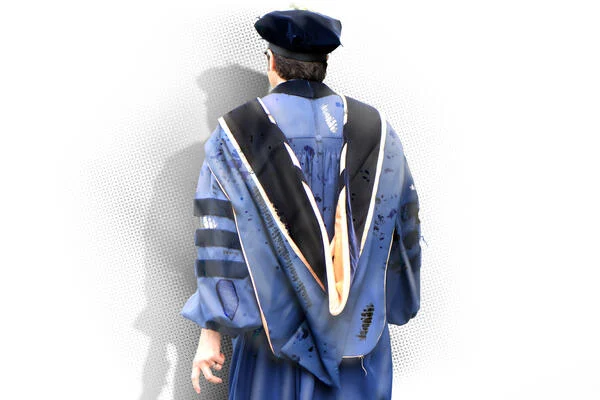
George Washington University is pausing admissions to five Ph.D. programs for fall 2026, citing financial hardships.
According to social mediaposts, applicants to the programs received emails last week alerting them that the programs “will not be reviewing applications for the 2026–2027 academic year.” The emails went on to say that their application fees would be refunded and offered them the opportunity to be considered for master’s programs instead.
The Ph.D. programs affected are in clinical psychology, anthropology, human paleobiology, political science and mathematics.
A university spokesperson attributed the pauses to financial difficulties.
“Like many universities, we are taking a close look at how best to support our PhD programs while maintaining the highest standards in doctoral education in a difficult fiscal environment. Our recent actions do not reflect a long-term closure or suspension of programs,” the spokesperson told Inside Higher Ed in an email. “Rather, they represent a need to limit new commitments in order to ensure that we fully meet our funding commitments to continuing PhD students” in those five departments.
Two faculty members told Inside Higher Ed that the university was also slashing the total number of Ph.D. packages across all departments within the Columbian College of Arts & Sciences. GWU did not respond to a question about those additional cuts.
The suspensions follow other instances of high-profile institutions slashing admissions to Ph.D. programs due to budget concerns, including Boston University, the University of Chicago and Harvard University. In a recent Faculty Senate meeting, GWU president Ellen Granberg asked the university’s schools and divisions to prepare “budget contingency plans” amid declines in applications from international students, the student newspaper, The GW Hatchet, reported. International students accounted for about 13 percent of the institution’s enrollment this fall, a decrease from the previous year.
Huynh-Nhu Le, who leads the clinical psychology Ph.D. program, said that faculty have been aware for a while that cuts might be coming. In addition to declines in international students, GWU has been a victim of the Trump administration’s research funding cuts. And the program’s cohort size was already shrinking; for fall 2025, the clinical psych Ph.D. admitted a record low three students, down from the typical eight or nine.
But Le didn’t expect that the program would admit no new students for fall 2026. The pause came as a result of the College of Arts & Sciences allocating just two slots for its three doctoral psychology programs combined. Because the American Psychological Association requires a minimum number of students in a clinical psychology Ph.D. cohort to promote “professional socialization,” Le decided not to admit any this year.
The decision is likely to have a “ripple effect” on GWU’s clinic, Le said, where first-year students typically perform vital duties like answering phones and conducting intake appointments.
‘Hoping It’s an Anomaly’
Other departments had to make similarly difficult decisions. According to Joel Brewster Lewis, an associate mathematics professor and the director of the department’s graduate programs, annual Ph.D. funding packages are decided by the dean’s office. This year, the amount of funding available to the mathematics department was equivalent to the number of continuing Ph.D. students in the department, meaning there was no funding available for new students.
“We as a department opted to continue their funding next year rather than defund them and run admissions on those packages,” Lewis wrote in an email.
In the human paleobiology program, funding for an incoming Ph.D. student would have been available only if a current student graduated this summer, according to Alison Brooks, a professor in the anthropology department and a faculty member within the Center for the Advanced Study of Human Paleobiology. One student is on track to graduate this summer, she said, but by the time the department knows for sure, it would be too late to admit another student.
GWU’s human paleobiology Ph.D. program is one of the most recognized at the institution, Brooks said. In a typical year, the program admits roughly three students.
“We have very high numbers of graduates in tenure-track jobs and other prestigious positions. Two members of our small faculty are in the National Academy of Science and Medicine. And generally we get some funding every year to support research initiatives, in addition to outside funding, to carry on with what we do,” she said. “We’re not necessarily being singled out, but we’re not being preferred, either.”
Le, of the clinical psychology Ph.D. program, said she hopes this year is just a “blip.”
“It’s really unfortunate. It’s not only our program—I think other clinical programs in the U.S. are going through the same thing,” she said. “I’m hoping it’s an anomaly for this year.”
Student advocates say the department’s decision could allow for fraud at the cost of taxpayers.
Greggory DiSalvo/iStock/Getty Images Plus
The Trump administration will no longer automatically enforce an accountability measure for the owners of private institutions that consumer advocacy groups say is critical to protecting students and taxpayers.
The regulation was originally put in place by the Biden administration, first as guidance and then in regulations. Under the policy, primary owners of for-profit and nonprofit colleges were required to sign onto a contract, known as a Program Participation Agreement, in order for their institution to access federal student aid. The aim of requiring the individual or corporation who owns an institution to sign onto the PPA signature requirement was to hold them accountable for unpaid debts, misuse of federal funding and compliance with federal aid law.(PPAs still have be signed by the president or CEO of the institution.)
But now, according to a Jan. 16 announcement, the owners will not always have to assume personal liability after ED voluntarily settled with a Missouri Christian college that challenged the requirement. The education secretary does, however, reserve the right to require signatures on a case-by-case basis if necessary to “protect the financial interest of the United States.”
Education Under Secretary Nicholas Kent said the change will maintain liability standards as much as possible while abiding by the law, which limits the department’s authority to force owners to assume personal liability to circumstances when “institutions have financial problems.” The department intends to further clarify how it will conduct case-by-case evaluations through a rule-making session but did not clarify when that session will be held.
“The Biden Administration’s regulation was over broad as it required all private institutional owners, including at faith-based colleges, to sign program participation agreements,” Kent said in a statement to Inside Higher Ed. “Moving forward, the Trump Administration will adhere to the law … This approach will protect taxpayers while not creating undue burden on institutions.”
Student and taxpayer advocates, however, view the decision as a major mistake—particularly because it extends beyond nonprofit religious institutions like the one behind the lawsuit, granting more flexibility to for-profit institutions as well.
“Taking the blanket signature requirement away does nothing to protect students. It does nothing to protect the taxpayer interest. Really, the only people with benefits are those who could be held financially responsible,” said Dan Zibel, vice president and chief counsel of Student Defense, a legal advocacy group.
He cited newscoverage and research reports as evidence that the owners of some for-profit institutions can access federal aid and take advantage of students. But when those owners were forced to sign a PPA contract, they could be less freely inclined to defraud students, he explained.
It forced them to “acknowledge their own skin in the game,” Zibel said. So by halting the enforcement of these contracts, particularly for for-profit owners, the department “is sorely misguided and makes it harder, not easier, for the department to protect students and taxpayers.”
Hannibal-LaGrange University and its sponsor, the Missouri Baptist Convention, argued in the lawsuit that the department’s requirement exceeded the agency’s statutory authority and violated the Religious Freedom Restoration Act. Other private institutions and their lobbyists have also pushed back, saying many of LaGrange’s arguments extend to nonreligious institutions and corporate owners.
Jordan Wicker, Career Education Colleges and Universities’ senior vice president of legislative and regulatory affairs, called the change “a meaningful course correction” for “unintended consequences” and institutional burdens created by the regulation.
“The 2023 rule … made the risk to institutions significantly greater when it comes to routine recertifications, acquisitions, ownership changes, any corporate restructuring or even simple business financial transactions,” Wicker said. “Particularly for proprietary institutions, you’re looking at a dampening effect of the market, or the devaluation of schools because of hesitancy for new capital to enter that space.”
“[Signing on for liability] is an extraordinary risk in the world of business and operations, and so it created a hesitancy,” he added.
Lawyers at Duane Morris LLP, a law firm that represents public, private, nonprofit and proprietary colleges, said the decision was “significant for institutions and their owners, sponsors, investors and lenders because it responds to significant adverse effects” of the rule.
In a breakdown of the announcement, the firm noted that while ED is now requiring officials to sign the agreements only when necessary, the department only has the authority, in their view, to allow individual owners to take on liability—not full corporate entities.
As a result, “the market effects will likely persist to some extent unless the issue is fully resolved through final, legally sustainable regulatory action,” the firm stated.
But Zibel argued that the fact businesses are wary of taking on liability shows why this regulation is necessary and conforms with the law.
“For-profit companies have been able to make sizable profits and scam students, which has cost the federal government and cost taxpayers billions of dollars, with no one at the end of the day held financially accountable for this,” he said. “The federal government should be doing everything in their power to make sure that doesn’t happen.”
Zibel also believes that the way in which the department terminated enforcement of this policy is illegal. Federal law requires the department to go through a specific process, known as negotiated rule making, to both create and repeal regulations. That process includes opportunity for public comment as well as a discussion between representatives of multiple constituent groups and the department. None of those steps were followed in this case.
“Doing things by settlement is not how this is supposed to happen,” he said.
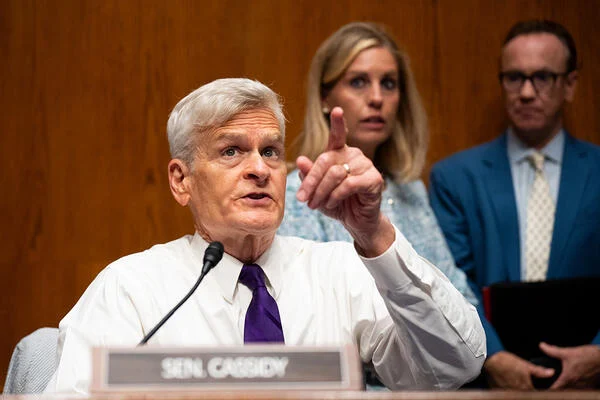
Cassidy sent information requests to 35 universities.
Bill Clark/CQ–Roll Call Inc./Getty Images
A Senate committee chair has launched an investigation into what he says is a decline in how prepared freshmen accepted into selective institutions are for math courses there.
Sen. Bill Cassidy, the Louisiana Republican who chairs the Senate Committee on Health, Education, Labor and Pensions, announced Friday that he’s sent letters to 35 institutions, including Ivy League universities, the Georgia Institute of Technology, Rice University and more.
“The United States faces a crisis in student achievement at the K–12 level that has begun to spill over into higher education, especially in math,” Cassidy wrote in the letters.
He cited the widely discussed November report from the University of California, San Diego, in which a university working group said that one in 12 first-year students in the fall placed into math below a middle school level, despite having a solid math grade point average from high school.
“This state of affairs is unacceptable and demands immediate corrective action,” Cassidy said.
He’s asking each of these institutions to provide data on freshman placement into math courses, explanations of how placements are decided, information on math classes that include precollege content, descriptions of universitywide math graduation requirements and info on whether they require the SAT, ACT or other math tests for admission. The due date is Feb. 5.
A Cassidy spokesperson didn’t respond to requests for comment Friday on why he’s only investigating selective institutions.
The UC San Diego report provided some reasons for its first-year students’ math deficits.
“This deterioration coincided with the COVID-19 pandemic and its effects on education, the elimination of standardized testing, grade inflation, and the expansion of admissions from under-resourced high schools,” the report said. “The combination of these factors has produced an incoming class increasingly unprepared.”
Tom Alter (center) speaks at free speech rally on his behalf in Austin.
Texas State Employees Union
“I responded, ‘No, it’s OK, I’m aware. Let’s just ignore it. Let’s not give it any air,’” Alter said about the infiltrator’s doxing campaign. Then the texter followed up with a link to a statement from Texas State president Kelly Damphousse, posted to the university website and on Facebook, “announcing my termination for ‘inciting violence,’ effective immediately,” Alter said.
A few years ago, this story—a tenured professor fired publicly without notice or due process for asking a rhetorical question during an unaffiliated talk—would have dominated the higher education news cycle for weeks. In fact, it was such a rare occurrence that the names of those removed for similar speech incidents gained legendary status in academic circles. In 2014, the University of Illinois at Urbana-Champaign, under pressure from major donors, revoked a tenure offer to American Indian studies professor Steven Salaita because of his tweets criticizing Israel and its actions in Gaza. The scandal generated newscoverage and commentary for years. Similarly, following a coordinated campaign led by law professor Alan Dershowitz, political scientist and Holocaust researcher Norman Finkelstein was denied tenure at DePaul University despite votes in favor from the department and the college. Finkelstein resigned soon after.
But Alter’s story was quickly overshadowed by a bigger one: He was fired the same day that conservative commentator Charlie Kirk was shot and killed during a campus event at Utah Valley University, sparking a more dramatic wave of faculty removals. Like many Americans, faculty took to social media to voice their opinions on Kirk. Under pressure from right-wing politicians and online activists, universities in conservative states responded with academic Jedburgh justice: punish first, ask questions later.
Michael Rex, an English and creative writing professor at Cumberland University in Tennessee, was dismissed for a post about Kirk that said, “kharma [sic] is a beautiful bitch.” Anna Kenney, an associate professor of pediatrics at Emory University in Georgia, was also terminated after calling Kirk a “disgusting individual” online. Karen Leader, an associate professor of art history at Florida Atlantic University, was put on administrative leave and investigated for months after sharing several X posts about Kirk’s public comments alongside the tag line, “This was Charlie Kirk.”
Tenure was of little help. One of the most unusual and coveted perks of an academic career, tenure historically has come with two key benefits: job security and protection from dismissal or discipline over unpopular ideas, said Deepa Das Acevedo, a legal anthropologist and tenure researcher at Emory University. But the speed and ease with which universities dismissed their faculty for personal speech exposed the tenure system’s corroded foundation, worn away by years of encroaching state policies, administrative leadership changes and a cultural shift in how the American public thinks about academia. Now faculty are left to wonder: Has the drastic politicization of the country, combined with the Trump administration’s relentless attacks on higher ed, rendered tenure moot?
To understand how September’s swift firings became possible, we must start in Wisconsin.
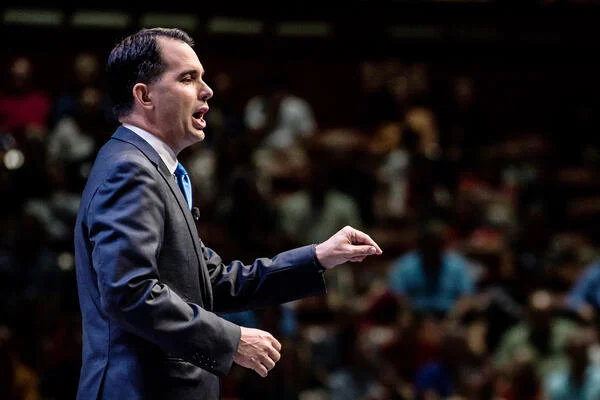
Former Wisconsin governor Scott Walker introduced some of the first modern legislation against tenure.
Sean Rayford/Getty Images
States Challenge the Academy
In 2014, then–Wisconsin governor Scott Walker challenged the “Wisconsin Idea,” the state’s century-old philosophy that all citizens should benefit from knowledge produced by the university system and that “basic to every purpose of the system is the search for truth.” He wanted the university to orient its mission toward meeting the state’s workforce needs—a philosophy of higher ed that remains popular with conservatives, demonstrated at the federal level by President Donald Trump’s ambition to promote vocational and trade schools.
Walker ultimately failed to alter the university system’s mission, but succeeded in another effort: weakening tenure. In 2015, via a $73 billion budget, Walker, a Republican, made good on his proposal to eliminate language in the state code that protected tenure and shared governance. His new policy handed the power to set tenure policies to the University of Wisconsin system Board of Regents, of which 16 of 18 members are appointed by the governor. The new rules also gave the regents the ability to fire tenured professors when programs were cut or modified—an option that was previously available only in cases of financial exigency.
Walker’s attack on tenure wasn’t the first, but it “made it big on my radar,” Das Acevedo said. Other tenure experts agreed—Walker’s straightforward attack set in motion a landslide of other conservative efforts to curb tenure.
“A number of the efforts [to erode tenure] have come from Republicans, and they’re often tied to larger complaints about the politics of the academy—that faculty members are too progressive; that they are promoting diversity, equity and inclusion; and that they’re trying to indoctrinate students,” said Tim Cain, associate director and professor of higher education at the University of Georgia’s Louisa McBee Institute of Higher Education.
Between 2012 and 2022, state legislatures considered 13 tenure bans and 3,000 bills that addressed faculty or tenure in some way, according to a 2025 study by University of North Texas professor of higher education Barrett Taylor and Ph.D. student Kimberly Watts. The outright tenure bans proved largely unpopular—to date, no state has fully eliminated tenure for faculty—but many evolved into laws that sought to weaken tenure’s protections without getting rid of the status entirely.
In 2022, Florida enacted a law that green-lighted post-tenure review at public institutions. In 2023, while conservatives fumed over critical race theory, Texas enacted Senate Bill 18, which broadened the grounds for terminating a tenured professor to include “exhibit[ing] professional incompetence” and engaging in ill-defined “conduct involving moral turpitude,” among other reasons.
“What we’re seeing is an increase in these efforts, certainly,” Cain said. “The legislation that was proposed in Texas initially was to ban tenure. What was actually passed and signed into law was weakening tenure. A lot of times legislation changes through the process, and you might see more extreme versions that get watered down in one way or another. But they can still be quite problematic for advocates of faculty and advocates of tenure.”
Tenure advocates aren’t against regular evaluations for tenured professors, but the American Association of University Professors argues that post-tenure review “shouldn’t be undertaken for the purpose of dismissal.” State legislatures have weaponized post-tenure review policies in recent years, giving administrators regular opportunities to review and subsequently sanction or fire tenured faculty without real cause. Ohio’s Senate Bill 1 and Kentucky’s House Bill 4, which both took effect in 2025, implemented post-tenure review for public university faculty. In December, the South Dakota Board of Regents also adopted a post-tenure review policy. The University of Tennessee requires tenured professors to be reviewed every six years. Dan Collier, assistant professor of higher and adult education at the University of Memphis, said the lack of protection for tenured professors in the state is discouraging his pursuit of tenure. On LinkedIn, he announced that he told his dean he didn’t care about tenure—only the related pay bump.
“My protections in Tennessee are nowhere near the same as somebody who would also be protected by a union and other laws that exist in somewhere like Michigan or California,” Collier told Inside Higher Ed.
He hesitated to put all the blame on conservatives, however.
“While certain Republican-led states may be reducing tenure protections more than they have in the past, that’s not to say that Democrats or blue states are actually ramping them up to protect anybody, either,” said Collier.
Exploiting Financial Turmoil
Most tenure policies at both the state and institutional level have always allowed for institutions to lay off tenured faculty in cases of financial exigency—periods of extreme financial distress, similar to personal bankruptcy. Financial exigency serves as a kind of escape hatch that allows institutions to bypass their own policies and make large cuts, including laying off tenured faculty, closing programs or undertaking significant administrative overhaul.
In its 1940 statement on academic freedom, the AAUP said that financial exigency was the only case beyond adequate cause in which tenured faculty can be terminated. The AAUP defines financial exigency as “a severe financial crisis that fundamentally compromises the academic integrity of the institution as a whole and that cannot be alleviated by less drastic means.”
The COVID-19 pandemic and the financial stress it put on college campuses brought about a flurry of financial exigency announcements—at least, on their face, Das Acevedo said. “I realized that a lot of those schools were not actually declaring financial exigency,” she said. “They were saying ‘financial exigency,’ and citing difficulties and the pandemic and whatnot, but they weren’t declaring themselves to be in a state of financial exigency.”
Still, the pandemic normalized tenured faculty layoffs in periods of financial strain.
“Many small liberal arts colleges had used the pandemic, in many cases, as an excuse to reorganize the layout of faculty,” said Anita Levy, senior program officer at the AAUP. “So yes, there probably was an acceleration at that moment” of tenured faculty layoffs.
It’s not exactly that anything about tenure has changed. It’s more that universities, like many other employers, have become more willing to skirt the boundaries of what is legally permissible.”
—Deepa Das Acevedo, legal anthropologist and tenure researcher at Emory University
William Paterson University in New Jersey laid off 13 tenured or tenure-track professors mid-pandemic in 2021 and proposed cutting an additional 150 professors over the course of three years, even though the institution never formally declared financial exigency. Also in 2021, the Kansas Board of Regents voted to allow its universities to terminate employees, including tenured professors, without declaring financial exigency. In 2024, the University of Wisconsin Board of Regents voted to lay off 35 tenured faculty members in University of Wisconsin–Milwaukee’s now-shuttered College of General Studies—a decision that Walker’s 2015 efforts allowed for.
Despite the hair-trigger firings after Kirk’s death, reductions in force remain the biggest threat to tenured professors at present, said Das Acevedo. “The overwhelming majority of tenured faculty lose their jobs not because they were fired for a cause, but because they were the victim of a [reduction in force],” she said.
She underscored the point with a statistic: More tenured faculty members have lost their jobs as the result of a RIF at 13 universities over the past five years than the total number of faculty members who were fired for cause at all universities in the last 20 years.
When tenured professors lose their jobs, colleges and universities are increasingly replacing those roles with adjunct appointments, which give institutions more flexibility in their staffing—and, therefore, spending—year to year. The trend threatens tenure and academic freedom in a different way: by limiting the number of professors who are granted tenure’s traditional protections, said Levy.
“There has been an increase in contingent faculty appointments, which influences how the rights of others are treated on campus,” Levy said. “In other words, right now, 21 percent of the academic labor force is tenured. While the AAUP holds that all full-time faculty members, regardless of rank, should be considered eligible for the protections of tenure, that’s not the case, unfortunately, in much of higher ed.” A 2023 study from the AAUP showed that, in the fall of that year, 23 percent of faculty held full-time tenured positions, down from 39 percent in fall 1987. Between fall 2002 and fall 2023, the number of contingent appointments increased by 65 percent, while tenured appointments increased by only 6 percent and tenure-track appointments fell by 7 percent.
The shift in favor of hiring adjunct faculty reflects a change in leadership strategy, said Collier. “You have HR policies that continuously change to favor administrators, and intentions to corporatize higher education and treat faculty more as employees instead of shared governance,” he said.
Photo illustration by Justin Morrison/Inside Higher Ed | blankvoid, chiravan39, Lee Lawson and PeskyMonkey/iStock/Getty Images
Protest as Fireable Offense
Tenure isn’t dead quite yet—several faculty members fired or put on leave after Kirk’s death have been reinstated in recent months. The University of South Dakota tried to fire art professor Michael Hook over his post about Kirk before abandoning the effort in October amid a legal battle. Darren Michael, a tenured professor of theater at Austin Peay State University, was reinstated in December and paid $500,000 to reimburse him for counseling services, though part of the settlement dictates that Michael will resign in May. At Florida Atlantic University, Karen Leader and finance professor Rebel Cole, both tenured, returned to the classroom in November following two months of paid administrative leave.
Their untenured colleague Kate Polak wasn’t so lucky. Polak, an English instructor, was put on leave in September after the university received complaints that she “celebrated” Kirk’s murder online, including writing that seeing him killed was a “win.” The university announced last week that she would not return to her position.
Institutions haven’t been consistent in how they apply social media speech standards. For example, the University of Tennessee at Knoxville suspended anthropology professor Tamar Shirinian for posting on social media that Kirk was a “disgusting psychopath” and that his wife was a “sick fuck for marrying him.” Nine years earlier, when protesters stopped traffic in Charlotte, N.C., after police shot and killed a Black man in an apartment parking lot, UT Knoxville law professor Glenn Reynolds suggested on Twitter that motorists “run them [the protesters] down.” University officials criticized Reynolds’s tweet, but did not sanction him and ultimately said it was an “exercise of his First Amendment rights.”
You get celebrated for all things social justice, but once you try to advocate for justice in Palestine, you’re basically killing your career and no one will stand by you.”
—Sang Hea Kil, former tenured justice studies professor at San José State University
Speech-related sanctions became more common a few years ago, as the American political landscape slid to the right and online cancel culture made it easy to wield a pressure campaign against universities. Student and faculty protests and counterprotests over Israel’s actions in Gaza following Hamas’s Oct. 7 terrorist attack attracted a variety of university responses, but faculty sanctions or firings were more sporadic than they are now, Das Acevedo said. Among those punished was Maura Finkelstein, who is Jewish and a tenured associate professor at Muhlenberg College. She reposted a statement from a Palestinian American artist that criticized Zionists and told readers not to “welcome them in your spaces” or “make them feel comfortable.”
Most recently, San José State University fired Sang Hea Kil, a tenured professor in the justice studies department who had worked at the university since 2007. University officials took issue with her advocacy for Palestine—but it was her activist work that got her hired in the first place, she said.
“My department hired me as a scholar activist,” she said. “I won a lot of awards as a student activist … and so I did not miss a beat when I arrived at my tenure-track position, and I kept on doing scholar-activist things.”
Kil’s work has always gotten under administrators’ skin; even before she was tenured, she helped lead a successful campaign against internal corruption that led to the resignations of several upper-level administrators. But things changed in 2024.
“The two things that I think that are different 1769462754 are one, new McCarthyism heralded by the Trump administration, and then two, Palestinian exceptionalism,” she said. “You get celebrated for all things social justice, but once you try to advocate for justice in Palestine, you’re basically killing your career and no one will stand by you.”
Kil and Collier agree that the shifting political landscape is partially to blame for the changing rules. If faculty members tick off conservative politicians, it can lead to serious financial and political consequences for the entire institution, Collier said.
“Upper administrators are going to be very, very risk-averse right now, because who wants to get the attention of the Trump administration at the moment?” said Collier. “If they’re focused on Harvard and they’re focused on Columbia, and you are at a regional institution [that] hasn’t gotten selected attention, are you going to push that envelope and get that attention? Because what they’re doing to those larger institutions would be extremely harsh penalties for a less-resourced institution.”
Kil and others believe that she is the first full professor fired from an American college or university for pro-Palestine speech.
“My case becomes really important because they’re going after the tenure system,” she said. The progression from Salaita’s revoked tenure offer in 2014, to Finkelstein in 2024 and Kil in 2025, “shows the escalation that higher ed administrators are willing to go in this political context.”
The weakening of tenure isn’t due to a flaw in the tenure system, Das Acevedo stressed, but to institutions’ increasing refusal to stand up for the traditional protections.
“It’s not exactly that anything about tenure changed,” Das Acevedo said. “It’s more that universities, like many other employers, have become more willing to skirt the boundaries of what is legally permissible, or outright go beyond what is legally permissible, and either pay the consequences in the form of a financial settlement or, in some cases, just not suffer any consequences.”
(This story has been updated to correct Dan Collier’s title. He’s an assistant professor of higher and adult education at the University of Memphis.)
The administration’s push to deport international students and scholars prompted protests and lawsuits.
David Dee Delgado/Getty Images News
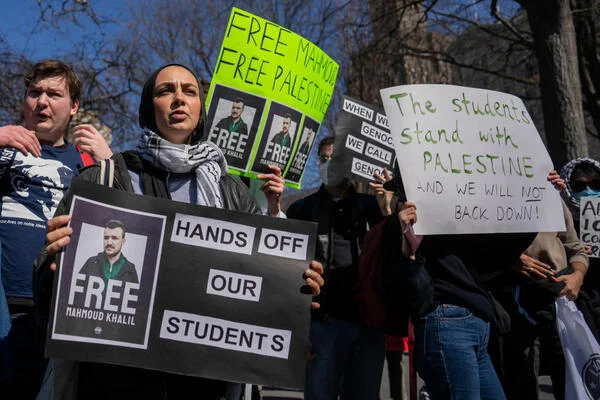
Federal government officials targeted and arrested international students for First Amendment–protected activity last year, despite internal concerns about the legality of such efforts, newly unsealed court documents show.
Dossiers and summaries compiled by government officials used to justify legal action against international students targeted by the Department of Homeland Security do not include allegations of criminality but instead focus on their participation in pro-Palestinian protests.
Documents show such arrests were in connection with students exercising their First Amendment rights, with DHS officials casting pro-Palestinian protests as antisemitic and arguing that targeted individuals presented a threat to U.S foreign policy based on their activism.
While a judge ruled against the federal government last fall, documents unsealed on Thursday offer new insights into the case. That same day, U.S. District Judge William Young also ruled that the Trump administration’s policy of targeting international students and faculty members for their activism was unlawful and in violation of the First Amendment and the Administrative Procedure Act, and he imposed limits on how the federal government may pursue related immigration actions.
Targets named in the documents include Mahmoud Khalil, Rümeysa Öztürk, Mohsen Mahdawi, Yunseo Chung—all current students or recent graduates—and Badar Khan Suri, a postdoctoral fellow at Georgetown University. All were targeted for speech protected by the First Amendment.
In a memo intended for U.S. Secretary of State Marco Rubio, subordinates flagged various transgressions that they argued justified action against international students and scholars, such as leading campus protests. In the case of Öztürk, the justification was that she had written an op-ed in a student newspaper in which she called for Tufts University, which she attends, to divest from companies with direct ties to Israel due to concerns about Palestinian casualties.
Federal officials tried to tie Suri to Hamas through his wife, a Palestinian American whose father once advised a Hamas leader. A government memo included claims from outside sources that Suri “actively spreads the terror group’s propaganda and promotes virulent antisemitism.” DHS officials have repeated such claims publicly but have not provided any evidence.
Officials painted protest activities broadly as antisemitic, arguing in one document that targets such as Khalil were “creating a hostile environment for Jewish students and indicating support for a designated terrorist organization.” However, documents did not include evidence of any ties to or support for Hamas. Instead, officials broadly framed participation in protests or social media posts critical of the Israeli government and military as inherently supportive of Hamas.
But even as they targeted students, federal officials knew they were on shaky legal ground.
“Given the potential that a court may consider his actions inextricably tied to speech protected under the First Amendment, it is likely that courts will scrutinize the basis for this determination,” federal government officials wrote in a memo that justified the arrest of international scholars.
Before issuing the order Thursday, Young blasted federal officials from the bench last week, proclaiming that Rubio and U.S. Secretary of Homeland Security Kristi Noem failed to uphold the Constitution and engaged in a “conspiracy to pick off certain people” for their beliefs, despite clear First Amendment concerns.
Free speech advocates have sharply criticized the federal government for arresting and attempting to deport international students solely based on their pro-Palestinian activism.
“Newly unsealed evidence makes it even clearer that Rubio and Noem knew they were targeting students based solely on their political speech and that they knew this policy was unconstitutional. They just didn’t care,” Jameel Jaffer, director of the Knight First Amendment Institute at Columbia, which supported plaintiffs in the case, wrote online. “The policy had nothing to do with fighting antisemitism and everything to do with suppressing legitimate and constitutionally protected criticism of Israel.”
The lawsuit against the Trump administration was filed last year by the American Association of University Professors and the Middle East Studies Association. In a social media post following the order, AAUP president Todd Wolfson wrote, “This ruling is not everything we needed or expected but it is still a significant step forward.”
DHS officials did not respond to a request for comment.
Legislation introduced by Mississippi representative Trey Lamar, chairman of the state’s House Ways and Means Committee, proposes consolidating six Mississippi community colleges, Magnolia Tribunereported. The bill has been referred to the House Universities and Colleges Committee for review.
If signed into law, the bill would merge the Mississippi Delta and Coahoma community college districts, the East Mississippi and Meridian community college districts, and the Copiah-Lincoln and Southwest Mississippi community college districts by July 2027. The move would reduce the number of community colleges in the state from 15 to 12.
College facilities wouldn’t have to close, “unless the facility is an unneeded administrative office located within a community college district which has been abolished,” according to the legislation.
Lamar argued consolidating the community colleges will mean more money to go around.
“At a time where the community college system is asking the taxpayers of Mississippi to fund tens of millions in new investment into the system, the savings realized from administrative consolidation at our smaller schools could be immediately rolled into the 12 remaining community colleges for significant staff and faculty pay raises,” he told the Magnolia Tribune.
Kell Smith, executive director of the Mississippi Community College Board, told Inside Higher Ed, “The proposal to consolidate several Mississippi community college districts raises important questions worth careful consideration. Any potential administrative efficiencies should be weighed alongside the impact on students, faculty, staff, and the communities these colleges serve. Clear communication, transparency, and input from stakeholders will be essential as discussions move forward.”
International scholars represent a vital economic force in the United States, contributing an estimated $42.9 billion to the economy and supporting more than 355,000 jobs during the 2024–25 academic year. But navigating the U.S. immigration system as an international student or postdoctoral researcher can be a long and complex journey.
While everyone is subject to their individual situations, for many, the process begins with an F-1 student visa, which they hold as they complete a Ph.D. over five to six years. After graduation, they may choose to transition to Optional Practical Training (OPT), which provides a year of work authorization, with a two-year extension for STEM graduates. Some may then transition to a H-1B temporary work visa, which provides for three years of work authorization and is renewable for another three years.
Depending on their visa journey, after this period of potentially 10 to 15 years on a temporary visa, a scholar who decides they would like to seek permanent residency would have several pathways available to them. The EB-1A (extraordinary ability) category allows for self-petitioning without an employer. It’s often the fastest route if one meets the strict qualifications.
EB-1B is for outstanding professors or researchers and requires employer sponsorship. EB-2, another common path, is for individuals with advanced degrees such as Ph.D. holders; it often requires employment sponsorship and a labor certification (a process that certifies that the job offer will not adversely impact U.S. workers), unless one qualifies for a National Interest Waiver, which waives the job offer and labor certification requirement and allows for self-petitioning. Unfortunately, the green card timeline is also heavily influenced by one’s country of birth due to annual per-country limits.
As universities recognize the critical importance of international students and scholars to their academic communities and the broader economy, innovative programs have emerged to address the unique challenges faced by this population. Below, we highlight some commendable strategies implemented by leading universities to support international students beyond traditional academic services.
Career Development and Professional Preparedness
Universities can collaborate with private organizations like Beyond the Professoriate, which offers a PhD Career Conference addressing critical career-related topics. These career-focused initiatives are particularly valuable because they address the reality that many international students and scholars will pursue careers outside academia, yet traditional graduate programs often provide limited exposure to industry pathways.
Complementing these efforts, universities can implement career-readiness workshops tailored specifically for international scholars to address their unique professional development needs. The effectiveness of such programs lies in their practical approach to addressing real-world concerns such as navigating visa restrictions or OPT applications and securing employment that supports immigration status.
We recommend that institutions thoughtfully include entities that hire international students in their programming and create events that specifically connect employers and international scholars. Institutions should also help scholars explore job opportunities beyond the United States.
Mentorship Networks and Alumni Connections
Mentorship programs represent another cornerstone of effective international student support. Programs like the Graduate Alum Mentoring Program, Terrapins Connect, Alumni Mentoring Program and Conference Mentor Program serve as exemplary models. Successful programs take a systematic approach to matching mentors and mentees based on shared interests, career goals and often similar international backgrounds, creating authentic relationships that provide comprehensive support for scholars’ academic journeys and beyond. For international students and scholars unfamiliar with cultural norms around American professional networking, having a guide with a shared background transforms potentially overwhelming experiences into valuable opportunities for professional development.
Another strategy is systematically highlighting the accomplishments of international students, scholars and faculty, and staff members at the university level. Recognition programs can include features in university publications, special awards ceremonies, spotlight presentations, fellowships and social media campaigns showcasing international student achievements. These initiatives celebrate contributions, demonstrate the value of international diversity and provide positive role models while combating negative stereotypes.
Peer Support
Since they first emerged in the early 1900s, international student associations have been central to their members’ identity formation and have long enriched U.S. campuses and social life. In these challenging times, such organizations can help their members find the support they need. National organizations such the Graduate Students Association of Ghanaian Students in the USA (GRASAG-USA) or the North American Association of Indian Students (NAAIS), as well as localchapters of groups like the Indian Students Association, continue to be effective social and emotional support resources for international students.
Providing Support in Navigating Immigration Policy Changes
Given the lengthy and often uncertain nature of immigration processes, U.S. institutions play a vital role in offering both practical support and emotional reassurance to their international members. Some institutions offer free legal consultations with external immigration attorneys. Institutions may choose to provide internal immigration advice in addition to external consultations.
Furthermore, universities can offer programs spotlighting lesser-known immigration options, such as the O-1 visa for individuals with extraordinary ability.
By providing clear information, legal support and proactive communication, institutions and organizations can alleviate much of the stress international scholars face.
The most effective approaches involve integrated systems that combine multiple strategies rather than relying on single interventions. Successful universities create comprehensive ecosystems addressing career development, mentorship, community building and recognition as interconnected elements of student success. When institutions act not just as employers or educators, but as advocates, they empower the international talent they have invested in and ensure that global knowledge continues to thrive.
The authors acknowledge Sonali Majumdar and Bénédicte Gnangnon for their valuable contributions toward this article.
Zarna Pala serves as assistant director of the Biological Sciences Graduate Program at the University of Maryland, College Park. She earned her Ph.D. in molecular parasitology from BITS Pilani, India, and brings multifaceted experience spanning infectious diseases research, academic administration and innovative program design; her work encompasses strategic admissions planning, cross-institutional partnerships, developing professional development resources and advocacy for early-career researchers.
Rashmi Raj is the assistant dean for student and postdoctoral affairs at the Stowers Institute for Medical Research. She completed her doctorate in biochemistry at the National University of Singapore prior to completing a postdoc in metabolic engineering at Northwestern University; in her current role, Rashmi oversees postdoctoral program development, faculty development and career development programming and alumni engagement for both predoctoral and postdoctoral researchers.
Henry Boachi is a program manager at University of Virginia’s Environmental Institute. He leads the institute’s recruitment, professional development and community engagement work with postdoctoral scholars through the Climate Fellows Program. He also supports practitioner fellows who are recruited to enrich UVA’s climate research efforts with their professional field (nonfaculty) experiences.
This blog was kindly authored by Lewis Eves, Teaching Associate at the University of Nottingham.
Neuroinclusivity is increasingly important in Higher Education. A recent survey shows that 22% of UK students have a neurodivergent diagnosis (e.g. ADHD or Autism), with up to 28% identifying as neurodivergent in some way. This constitutes an overrepresentation of neurodivergence among students compared to the general population, of which only 15-20% are diagnosed as neurodivergent.
Meanwhile neurodivergent disclosure rates among academic staff are significantly lower. In 2023, only 1.8% of academic staff disclosed a neurodivergent condition.
It’s unsurprising that neurodivergent people would be underrepresented in academia. Academia is structured around neurotypical behaviours, activities and thought processes that are intuitive for those whose brain functions conform to the collective standard.
As such, academia privileges ways of working that are difficult for neurodivergent people to navigate. The need to excel in, and constantly switch between, research, teaching and administrative tasks poses challenges for neurodivergent staff. This discourages neurodivergent people from pursuing careers in academia. Meanwhile, those who do pursue academia express fear and anxiety that disclosing their neurodivergence might negatively impact their careers.
The growing gap between the number of neurodivergent academics and students poses a challenge for higher education. How is a traditionally neurotypical environment, lacking in lived experience of neurodivergence, going to adapt to the learning needs of an increasingly neurodivergent community?
Neuroinclusive teaching
As a neurodivergent academic, I often reflect on the challenges I faced as a student. I use this lived experience to inform my teaching practice, employing various techniques and measures to support the learning of neurodivergent students.
Inductive Teaching
Teaching in Higher Education is mostly deductive. A top-down approach that focusses on teaching staff telling students what is important to know, providing examples and testing students’ understanding.
This is something that I struggled with as a student, and is something that my neurodivergent students have shared that they struggle with too. I suspect the issue is that the way a neurotypical teacher links ideas and concepts to real-world examples is not as intuitive for neurodivergent students. Neurodivergence means that brains link and connect information differently.
To address this, I employ inductive approaches in my teaching. This involves focussing first on examples, preferably examples from students’ lived experience, and using these examples to discuss and learn key ideas and concepts. This enables students to connect examples and concepts in a way that is intuitive for them. It is also a more collaborative learning process, promoting discussion and sharing of ideas that I find benefits both neurodivergent and neurotypical students.
Structure
Secondary and further education are highly structured learning environments, with students’ learning time being timetabled and supervised. Higher education, however, is much less structured. Some subjects have very few timetabled sessions, with a significant emphasis on independent study.
Many students struggle with this transition into a less structured learning environment. However, this sudden drop in structure is something that neurodivergent students particularly struggle with. It was something that I struggled with as a student, and now that I teach, it is one of the more common topics that my neurodivergent students wish to discuss with me.
To help address this issue, I support the structuring of students’ independent study. One method I use is hosting regular study workshops in which students can complete their assignments. I facilitate these using techniques like body doubling. This is a productivity technique commonly used by those with ADHD, which relies on the natural rhythms of productivity in shared workspaces to encourage focus. All students are welcome, and the feedback has been overwhelmingly positive, especially from neurodivergent students.
Neuroinclusive policy
In my experience of teaching in higher education, there are opportunities to develop teaching practice to better support the increasing number of neurodivergent students. In my experience of teaching in higher education, there are opportunities to develop teaching practice to better support the increasing number of neurodivergent students. However, this will need to be done sector-wide, which will require supportive and effective policymaking.
These policies should promote teaching and learning practices that make learning environments more accessible, equitable and inclusive. These require co-creation with the neurodivergent community, who are underrepresented in academia. Accordingly, for policy to promote neuroinclusive teaching and learning for students, it must also promote academic neuroinclusion.
Achieving this will require a decoupling of academic performance monitoring and career progression from neurotypical behaviours. This will help address barriers to disclosure and empower neurodivergent academics to more effectively inform teaching and learning practices based on their lived experience.
Research and guidance from UCL lists numerous suggestions that could be incorporated into broader policy. This includes:
Promoting greater flexibility and accessibility in research, focussing on the depth of contributions rather than the breadth of activity neurotypical scholars may engage in.
Challenging the culture of ‘publish-or-perish’ that privileges quick publication, recognising the value of slower, high-quality research that alleviates pressure on both neurodivergent and neurotypical researchers.
Changes like these will take time. However, if the higher education sector is serious about creating a neuroinclusive environment and effectively supporting the growing demographic of neurodivergent students, we need to take these steps.