Blog

  • Gender disparity in university leadership: what lessons can East Africa learn from the UK and Europe?

    Gender disparity in university leadership: what lessons can East Africa learn from the UK and Europe?

    This blog was kindly authored by Naomi Lumutenga, Executive Director and co-founder of Higher Education Resource Services (East Africa).

    Despite commendable interventions in recent decades, a gendered leadership gap persists at varying levels within higher education institutions. In 2024, women led 27% of the top 200 universities in the US; 36% in the top UK universities; 55% in the Netherlands’ top 11; and 29% in Germany’s top 21. In contrast, female leadership was far less common in Sub-Saharan Africa: only two of Ethiopia’s 46 universities, two of Tanzania’s 60, and six of South Africa’s 26 public universities were headed by women. While some may argue that comparisons with Western institutions are unfair due to their longstanding systems, the disparity highlights persistent structural barriers to gender parity in university leadership. Shifting focus from individual to organisational transformation can deliver change. As an example, long-standing financial systems have been leapfrogged. Currently, it is quicker to wire money to and within many African countries, compared to Europe or the USA. Linear comparisons along time periods, to effect change, do not, therefore, tell the full story; the real focus should be on the political will from within universities to acknowledge the value in and shift leadership towards gender parity.

    Our organisation, (Higher Education Resource Services East Africa) addresses gender equality in universities, as these institutions shape future leaders. Prestigious institutions like the University of Oxford have produced multiple prime ministers and policymakers across the globe, as the recent HEPI / Kaplan Soft Power Index demonstrates. In East Africa, notable alumni of Uganda’s Makerere University include past and serving national leaders like veteran Mwalimu Julius Nyerere and Benjamin Mkapa (Tanzania); Mwai Kibaki (Kenya); Paul Kagame (Rwanda); Milton Obote (Uganda); and Joseph Kabila (Democratic Republic of Congo). However, Makerere University (unlike the University of Oxford) has never had a female Vice Chancellor.

     The structure and landscape of such institutions matter because they model frameworks and practices for the communities they serve. The persistent unequal representation triggered the work of HERS-EA that culminated, in part, in our recent publication.

    Findings from our unpublished study conducted in 2024 across 35  universities in East Africa illustrated the situation starkly.  This study was conducted by Makerere University in collaboration with HERS-East Africa, supported by the Bill and Melinda Gates Foundation. The aim was to analyse the underlying barriers that prevent women from progressing into leadership and, for those who advance, from thriving. While some of the findings might be culturally unique to East African contexts, the majority were acknowledged, at the annual Engagement Scholarship Consortium conference in Portland, USA (October 2024), as being relevant to any higher education institution. In Japan, for example, there is evidence of cultural pressure exerted differently when women seek promotion; as Kathy Matsui asserts, women decline promotional offers for fear of how they might be treated when/if they get pregnant.

    Our study of premier universities in East Africa found that, despite gender equality policies, female leadership remains rare: only two of seven top universities had a female Chancellor (a ceremonial role), none had a female Vice Chancellor, and just one had a female Deputy Vice Chancellor (who was nearing retirement). With respect to enrolment, while most institutions claimed gender parity at admission, few tracked or reported gender disaggregated data at graduation or PhD completion, and evidence of tracking progress was limited.

    PhDs, research leadership, and grant management are important for university leadership, so we highlighted these areas and addressed implicit institutional norms.   Drawing on these lived experiences, we concluded that gender discrimination in university leadership persists through biased job criteria, age limits, and interview questions. Other barriers include a lack of accountability, inadequate strategies against sexual harassment, and poor support for women to complete PhDs.

    Co-created recommendations included trialling an adapted equivalent of the non-punitive Athena Swan Charter, which develops a culture of self-assessment while mitigating potential backlash. The Athena Swan Charter was initiated in the UK in 2005, and it is gaining global traction. It provides a sliding scale of progression towards gender equality, from bronze to silver and gold. Other proposed interventions included providing writing bootcamps with childcare and research advisors present, away from family and other distractions. Aspects of the quota system and structural frameworks in Scandinavian countries were discussed, but while lessons can be learnt from these transformational shifts, the real stumbling block is the lack of political will for changing norms rather than individual women within East African institutions. However, change is possible. Rwanda’s post-1994 Genocide national policies include quotas, and they are revised every three years to assess progress towards gender equality in all sectors. Currently, women hold 61.3% of the total seats in parliament, and they occupy 66% of the total seats in cabinets. Overall, Rwanda is now considered one of the best achievers in the world for gender equality. Perhaps lessons can be learnt from Rwanda’s progress that can give us all reason to hope.

    Source link

  • Eviction sets single mom on a quest to keep her kids in their schools

    Eviction sets single mom on a quest to keep her kids in their schools

    by Bianca Vázquez Toness, The Hechinger Report
    November 18, 2025

    This story was produced by the Associated Press and reprinted with permission.

    ATLANTA — It was the worst summer in years. Sechita McNair’s family took no vacations. Her younger boys didn’t go to camp. Her van was repossessed, and her family nearly got evicted — again.

    But she accomplished the one thing she wanted most. A few weeks before school started, McNair, an out-of-work film industry veteran barely getting by driving for Uber, signed a lease in the right Atlanta neighborhood so her eldest son could stay at his high school.

    As she pulled up outside the school on the first day, Elias, 15, stepped onto the curb in his new basketball shoes and cargo pants. She inspected his face, noticed wax in his ears and grabbed a package of baby wipes from her rental car. She wasn’t about to let her eldest, with his young Denzel Washington looks, go to school looking “gross.”

    He grimaced and broke away.

    “No kiss? No hugs?” she called out.

    Elias waved and kept walking. Just ahead of him, at least for the moment, sat something his mother had fought relentlessly for: a better education.

    The link between where you live and where you learn

    Last year, McNair and her three kids were evicted from their beloved apartment in the rapidly gentrifying Old Fourth Ward neighborhood of Atlanta. Like many evicted families, they went from living in a school district that spends more money on students to one that spends less.

    Thanks to federal laws protecting homeless and evicted students, her kids were able to keep attending their Atlanta schools, even though the only housing available to them was in another county 40 minutes away. They also had the right to free transportation to those schools, but McNair says the district didn’t tell her about that until the school year ended. Their eligibility to remain in those schools expired at the end of last school year.

    Still wounded by the death of his father and multiple housing displacements, Elias failed two classes last year, his freshman year. Switching schools now, McNair fears, would jeopardize any chance he has of recovering his academic life. “I need this child to be stable,” she says.

    Related: Become a lifelong learner. Subscribe to our free weekly newsletter featuring the most important stories in education.

    With just one week before school started, McNair drove extra Uber hours, borrowed money, secured rental assistance and ignored concerns about the apartment to rent a three-bedroom in the Old Fourth Ward. At $2,200 a month, it was the only “semi-affordable” apartment in the rapidly gentrifying ward that would rent to a single mom with a fresh eviction on her record.

    On Zillow, the second-floor apartment, built in 2005, looked like a middle-class dream with its granite countertops, crown molding and polished wood floors. But up close, the apartment looked abused and held secrets McNair was only beginning to uncover.

    The first sign something was wrong came early. When she first toured the apartment, it felt rushed, like the agent didn’t want her to look too closely. Then, even as they told her she was accepted, the landlord and real estate agent wouldn’t send her a “welcome letter” laying out the agreement, the rent and deposit she would pay. It seemed like they didn’t want to put anything in writing.

    When the lease came, it was full of errors. She signed it anyway. “We’re back in the neighborhood!” she said. Elias could return to Midtown High School.

    But even in their triumph, no one in the family could relax. Too many things were uncertain. And it fell to McNair — and only McNair — to figure it out.

    The first day back

    Midtown is a high school so coveted that school administrators investigate student residency throughout the year to keep out kids from other parts of Atlanta and beyond. For McNair, the day Elias returned to the high school was a momentous one.

    “Freedom!” McNair declared after Elias disappeared into the building. Without child care over the summer, McNair had struggled to find time to work enough to make ends meet. Now that the kids were back in class, McNair could spend school hours making money and resolving some of the unsettled issues with her new apartment.

    McNair, the first person in her family to attend college, studied theater management. Her job rigging stage sets was lucrative until the writers’ and actors’ strike and other changes paralyzed the film industry in 2023. The scarcity of work on movie sets, combined with her tendency to take in family and non-family alike, wrecked her home economy.

    The family was evicted last fall when McNair fell behind on rent because of funeral expenses for her foster daughter. The teen girl died from an epileptic seizure while McNair and everyone else slept. Elias found her body.

    McNair attributes some of Elias’s lack of motivation at school to personal trauma. His father died after a heart attack in 2023, on the sidelines of Elias’s basketball practice.

    On his first day back at school this August, Elias appeared excited but tentative. He watched as the seniors swanned into school wearing gold cardboard crowns, a Midtown back-to-school tradition, and scanned the sidewalk for anyone familiar.

    If Elias had his way, his mom would homeschool him. She’s done it before. But now that he’s a teenager, it’s harder to get Elias to follow her instructions. As the only breadwinner supporting three kids and her disabled uncle, she has to work.

    Elias hid from the crowds and called up a friend: “Where you at?” The friend, another sophomore, was still en route. Over the phone, they compared outfits, traded gossip about who got a new hairdo or transferred. When Elias’s friend declared this would be the year he’d get a girlfriend, Elias laughed.

    When it was time to go in, Elias drifted toward the door with his head down as other students flooded past.

    The after-school pickup

    Hours later, he emerged. Despite everything McNair had done to help it go well — securing the apartment, even spending hundreds of dollars on new clothes for him — Elias slumped into the backseat when she picked him up after class.

    “School was so boring,” he said.

    “What happened?” McNair asked.

    “Nothing, bro. That was the problem,” Elias said. “I thought I was going to be happy when school started, since summer was so horrible.”

    Of all of the classes he was taking — geometry, gym, French, world history, environmental science — only gym interested him. He wished he could take art classes, he said. Elias has acted in some commercials and television programs, but chose a science and math concentration, hoping to study finance someday.

    After dinner at Chick-fil-A, the family visited the city library one block from their new apartment. While McNair spoke to the librarian, the boys explored the children’s section. Malachi, 6, watched a YouTube video on a library computer while Derrick, 7, flipped through a book. Elias sat in a corner, sharing video gaming tips with a stranger he met online.

    Related: Schools confront a new reality: They can’t count on federal money 

    “Those people are learning Japanese,” said McNair, pointing to a group of adults sitting around a cluster of tables. “And this library lets you check out museum passes. This is why we have to be back in the city. Resources!”

    McNair wants her children to go to well-resourced schools. Atlanta spends nearly $20,000 per student a year, $7,000 more than the district they moved to after the eviction. More money in schools means smaller classrooms and more psychologists, guidance counselors and other support.

    But McNair, who grew up in New Jersey near New York City, also sees opportunities in the wider city of Atlanta. She wants to use its libraries, e-scooters, bike paths, hospitals, rental assistance agencies, Buy Nothing groups and food pantries.

    “These are all resources that make it possible to raise a family when you don’t have support,” she said. “Wouldn’t anyone want that?”

    Support is hard to come by

    On the way home, the little boys fall asleep in the back seat. Elias asks, “So, is homeschooling off the table?”

    McNair doesn’t hesitate. “Heck yeah. I’m not homeschooling you,” she says lightly. “Do you see how much of a financial bind I’m in?”’

    McNair pulls into the driveway in Jonesboro, the suburb where the family landed after their eviction. Even though the family wants to live in Atlanta, their stuff is still here. It’s a neighborhood of brick colonials and manicured lawns. She realizes it’s the dream for some families, but not hers. “It’s a support desert.”

    As they get out of the car, Elias takes over as parent-in-charge. “Get all of your things,” he directs Malachi and Derrick, who scowl as Elias seems to relish bossing them around. “Pick up your car seats, your food, those markers. I don’t want to see anything left behind.” Elias would be responsible for making the boys burritos, showering them and putting them to sleep.

    McNair heads out to drive for Uber. That’s what is necessary to pay $450 a week to rent the car and earn enough to pay her rent and bills.

    But while McNair is out, she can’t monitor Elias. And a few days after he starts school, Elias’s all-night gaming habit has already drawn teachers’ attention.

    “I wanted to check in regarding Elias,” his geometry teacher writes during the first week of school. “He fell asleep multiple times during Geometry class this morning.”

    Elias had told the teacher he went to bed around 4 a.m. the night before. “I understand that there may be various reasons for this, and I’d love to work together to support Elias so he can stay focused and successful in class.”

    A few days later, McNair gets a similar email from his French teacher.

    That night, McNair drives around Atlanta, trying to pick up enough Uber trips to keep her account active. But she can’t stop thinking about the emails. “I should be home making sure Elias gets to bed on time,” she says, crying. “But I have to work. I’m the only one paying the bills.”

    Obstacles keep popping up

    Ever since McNair rented the Atlanta apartment, her bills had doubled. She wasn’t sure when she’d feel safe giving up the house she’d been renting in Clayton County, given the problems with the Atlanta apartment. For starters, she was not even sure it was safe to spend the night there.

    A week after school started in August, McNair dropped by the apartment to check whether the landlords had made repairs. At the very least, she wanted more smoke detectors.

    She also wanted them to replace the door, which looked like someone had forced it open with a crowbar. She wanted a working fridge and oven. She wanted them to secure the back door to the adjoining empty apartment, which appeared to be open and made her wonder if there were pests or even people squatting there.

    But on this day, her keys didn’t work.

    She called 911. Had her new landlords deliberately locked her out?

    When the police showed up outside the olive-green, Craftsman-style fourplex, McNair scrolled through her phone to find a copy of her lease. Then McNair and the officer eyed a man walking up to the property. “The building was sold in a short sale two weeks ago,” he told McNair. The police officer directed the man to give the new keys to McNair.

    Related: The new reality with universal school vouchers: Homeschoolers, marketing, pupil churn

    The next day, McNair started getting emails from an agent specializing in foreclosures, suggesting the new owners wanted McNair to leave. “The bank owns the property and now you are no longer a tenant of the previous owner,” she wrote. The new owner “might” offer relocation assistance if McNair agreed to leave.

    McNair consulted attorneys, who reassured her: It might be uncomfortable, but she could stay. She needed to try to pay rent, even if the new owner didn’t accept it.

    So McNair messaged the agent, asking where she should send the rent, and requested the company make necessary repairs. Eventually, the real estate agent stopped responding.

    Some problems go away, but others emerge

    Finally, McNair moved her kids and a few items from the Jonesboro house to the Atlanta apartment. She didn’t allow Elias to bring his video game console to Atlanta. He started going to bed around 11 p.m. most nights. But even as she solved that problem, others emerged.

    It was at Midtown’s back-to-school night in September that McNair learned Elias was behind in most of his classes. Some teachers said maybe Midtown wasn’t the right school for Elias.

    Perhaps they were right, McNair thought. She’d heard similar things before.

    Elias also didn’t want to go to school. He skipped one day, then another. McNair panicked. In Georgia, parents can be sent to jail for truancy when their kids miss five unexcused days.

    McNair started looking into a homeschooling program run by a mother she follows on Facebook. In the meantime, she emailed and called some Midtown staff for advice. She says she didn’t get a response. Finally, seven weeks after the family’s triumphant return to Midtown, McNair filed papers declaring her intention to homeschool Elias.

    It quickly proved challenging. Elias wouldn’t do any schoolwork when he was home alone. And when the homeschooling group met twice a week, she discovered, they required parents to pick up their children afterward instead of allowing them to take public transit or e-scooters. That was untenable.

    Elias wanted to stay at home and offered to take care of McNair’s uncle, who has dementia. “That was literally killing my soul the most,” said McNair. “That’s not a child’s job.”

    Hell, no, she told him — you only get one chance at high school.

    Then, one day, while she was loading the boys’ clothes into the washing machine at the Atlanta apartment, she received a call from an unknown Atlanta number. It was the woman who heads Atlanta Public Schools’ virtual program, telling her the roster was full.

    McNair asked the woman for her opinion on Elias’s situation. Maybe she should abandon the Atlanta apartment and enroll him in the Jonesboro high school.

    Let me stop you right there, the woman said. Is your son an athlete? If he transfers too many times, it can affect his ability to play basketball. And he’d probably lose credits and take longer to graduate. He needs to be in school — preferably Midtown — studying for midterms, she said. You need to put on your “big mama drawers” and take him back, she told McNair.

    The next day, Elias and his mother pulled up to Midtown. Outside the school, Elias asked if he had to go inside. Yes, she told him. This is your fault as much as it’s mine.

    Now, with Elias back in school every day, McNair can deliver food through Uber Eats without worrying about a police officer asking why her kid isn’t in school. If only she had pushed harder, sooner, for help with Elias, she thought. “I should have just gone down to the school and sat in their offices until they talked to me.”

    But it was easy for her to explain why she hadn’t. “I was running around doing so many other things just so we have a place to live, or taking care of my uncle, that I didn’t put enough of my energy there.”

    She wishes she could pay more attention to Elias. But so many things are pulling at her. And as fall marches toward winter, her struggle continues. After failing to keep up with the Jonesboro rent, she’s preparing to leave that house before the landlord sends people to haul her possessions to the curb.

    As an Uber driver, she has picked up a few traumatized mothers with their children after they got evicted. She helped them load the few things they could fit into her van. As they drove off, onlookers scavenged the leftovers.

    She has promised herself she’d never let that happen to her kids.

    Bianca Vázquez Toness is an Associated Press reporter who writes about the continuing impact of the pandemic on young people and their education.

    The Associated Press’ education coverage receives financial support from multiple private foundations. AP is solely responsible for all content. Find AP’s standards for working with philanthropies, a list of supporters and funded coverage areas at AP.org.

    This <a target=”_blank” href=”https://hechingerreport.org/she-wanted-to-keep-her-son-in-his-school-district-it-was-more-challenging-than-it-seemed/”>article</a> first appeared on <a target=”_blank” href=”https://hechingerreport.org”>The Hechinger Report</a> and is republished here under a <a target=”_blank” href=”https://creativecommons.org/licenses/by-nc-nd/4.0/”>Creative Commons Attribution-NonCommercial-NoDerivatives 4.0 International License</a>.<img src=”https://i0.wp.com/hechingerreport.org/wp-content/uploads/2018/06/cropped-favicon.jpg?fit=150%2C150&amp;ssl=1″ style=”width:1em;height:1em;margin-left:10px;”>

    <img id=”republication-tracker-tool-source” src=”https://hechingerreport.org/?republication-pixel=true&post=113392&amp;ga4=G-03KPHXDF3H” style=”width:1px;height:1px;”><script> PARSELY = { autotrack: false, onload: function() { PARSELY.beacon.trackPageView({ url: “https://hechingerreport.org/she-wanted-to-keep-her-son-in-his-school-district-it-was-more-challenging-than-it-seemed/”, urlref: window.location.href }); } } </script> <script id=”parsely-cfg” src=”//cdn.parsely.com/keys/hechingerreport.org/p.js”></script>

    Source link

  • As the supply of applicants declines, college admissions gets kinder and gentler

    As the supply of applicants declines, college admissions gets kinder and gentler

    by Jon Marcus, The Hechinger Report
    November 18, 2025

    PLEASANTVILLE, N.Y. — As she approached her senior year in high school, the thought of moving on to college was “scary and intimidating” to Milianys Santiago — especially since she would be the first in her family to earn a degree.

    Once she began working on her applications this fall, however, she was surprised. “It hasn’t been as stressful as I thought it would be,” she said.

    It’s not that Santiago’s anxiety was misplaced: The college admissions process has been so notoriously anxiety inducing that students and their parents plan for it for years and — if social media is any indication — seem to consider an acceptance as among the greatest moments of their lives.

    It’s that getting into college is in fact becoming easier, with admissions offices trying to lure more applicants from a declining pool of 18-year-olds. They’re creating one-click applications, waiving application fees, offering admission to high school seniors who haven’t even applied and recruiting students after the traditional May 1 cutoff.

    The most dramatic change is in the odds of being admitted. Elite universities such as Harvard and CalTech take as few as 1 applicant in 33, but they are the exception. Colleges overall now accept about 6 in 10 students who apply, federal data show. That’s up from about 5 out of 10 a decade ago, the American Enterprise Institute calculates.

    “The reality is, the overwhelming majority of universities are struggling to put butts in seats. And they need to do everything that they can to make it easier for students and their families,” said Kevin Krebs, founder of the college admission consulting firm HelloCollege.

    This has never been as true as now, when the number of high school graduates entering higher education is about to begin a projected 15-year drop, starting with the class now being recruited. That’s on top of a 13 percent decline over the last 15 years.

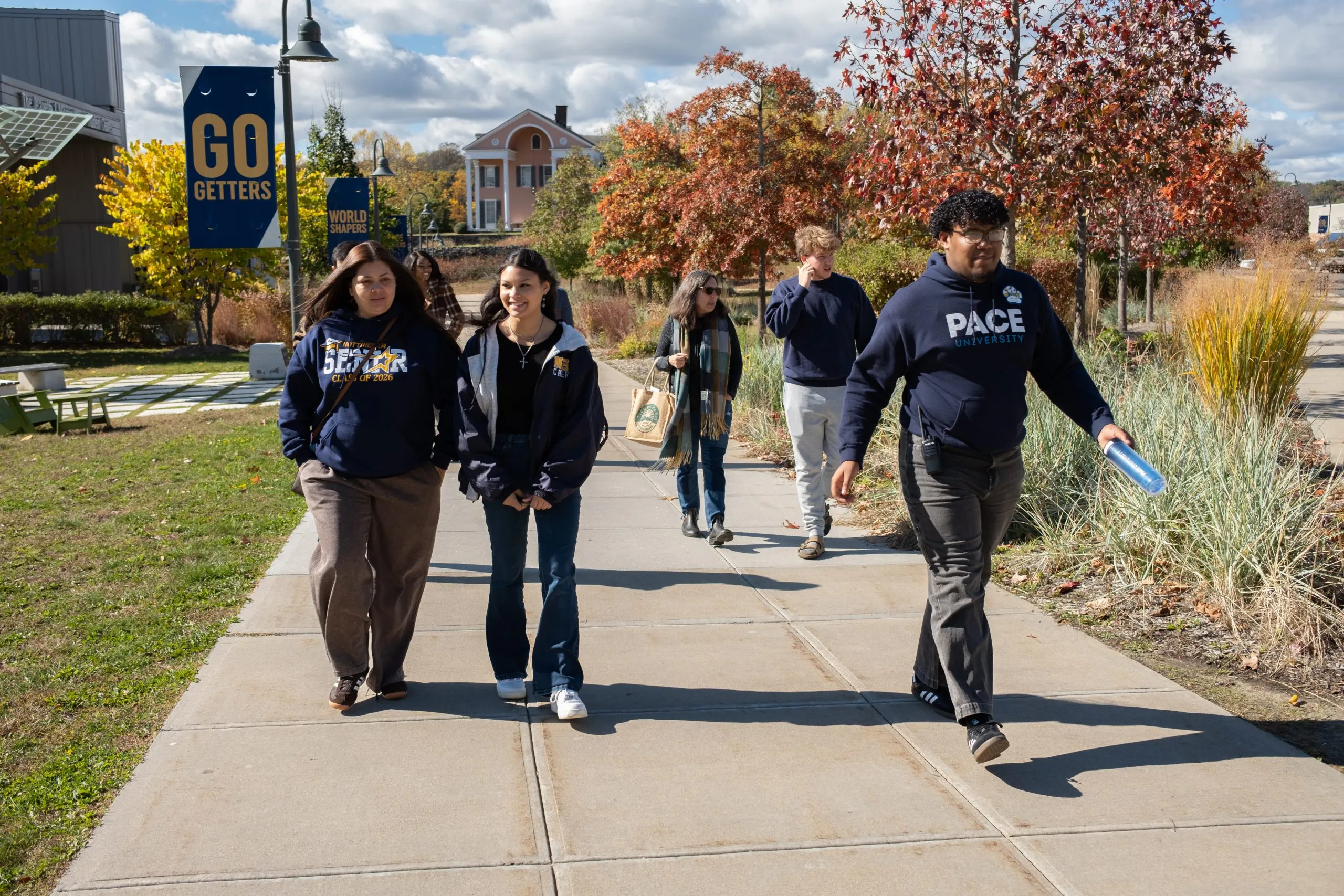
    Santiago, who lives in Hamilton, New Jersey, was waiting for a tour to start at Pace University as a video on repeat showed exuberant students and drone footage of the leafy, 200-acre grounds about 30 miles north of New York City, where the university also has a campus. 

    Related: Interested in more news about colleges and universities? Subscribe to our free biweekly higher education newsletter.

    Pace was one of 130 New York state colleges and universities that during October waived their application fees of from $50 to $90 per student, per school. That’s just one of the ways it’s trying to make admissions easier. 

    “That was a little eye-opening, when we received that letter,” Sueane Goodreau of Ithaca, New York, said about the free application offer as she waited for a tour of Pace’s campus with her high school senior son, Will. Compared to when her older daughter applied to college just three years ago, said Goodreau, “it does feel a little more receptive.”

    There was an even bigger incentive offered by Pace: Prospects such as Santiago and Goodreau who visit are promised an additional $1,000 a year of financial aid if they enroll. Applicants who come to visit a campus are twice as likely to enroll as those who don’t, research has found.

    The students’ names awaited them on a welcome sign at the reception desk in the office where tours depart. “You Belong Here,” pronounced another placard, on an easel in the waiting area. There was a QR code they could scan if they wanted to chat one-on-one with an admissions officer — who, in earlier times at many schools, were often unapproachable.

    “I feel like I’m already a student here,” Santiago quipped.

    The reason the university encourages that feeling? It’s simple, said Andre Cordon, dean of admission, in the distinctive pink Choate House at the center of the campus: “We want more students to apply. We don’t want to put up hurdles.”

    So many hurdles previously stood along the route to college admission, it’s become a part of popular culture. “Everyone thinks we’re sadists — that we like saying no,” noted Tina Fey in her role as a Princeton admissions officer in the 2013 movie “Admission.” 

    Related: The number of 18-year-olds is about to drop sharply, packing a wallop for colleges — and the economy 

    Perceptions such as those are hard to change. Not only do young Americans aged 18 to 29 believe it isn’t any easier to get into college than it was for people in their parents’ generation, 45 percent of them think it’s harder, a Pew Research Center survey found. More than three-quarters say the admissions process is complex, and more than half that it’s more stressful than anything else they’ve done during their time in elementary, middle or high school, according to a separate survey, by the National Association for College Admission Counseling, or NACAC.

    “People have that notion that all campuses are in the same category as MIT, Harvard, Stanford” with their impossibly low acceptance rates, said Cordon. (Pace took 76 percent of its applicants last year, university statistics show.) And “teenagers are still teenagers. There’s anxiety no matter what. They overthink things, and they overthink the admissions process.”

    There’s also still a lot of genuine emotion in the process, he said. For many parents, “It’s a pride thing. It’s a status thing. It’s showing off. Or from the student’s side, it’s, ‘I want to make my parents proud.’ ”

    In the new world of university admissions, however, that no longer necessarily even requires filling out an application.

    “Congratulations! You’ve been admitted,” a new California State University website tells prospective students, before they enter a single piece of information about themselves. 

    Cal State is the latest system to deploy so-called direct admission: They will automatically accept any student who earns at least a C in a list of required high school courses, starting in January for students in some and expanding the following year to every high school in the state.

    Related: To fill seats, more colleges offer credit for life experience

    Public universities or systems in Alabama, Arizona, Connecticut, Georgia, Hawai’i, Idaho, Illinois, Indiana, Minnesota, New York, North Carolina, Tennessee, Texas, Utah, Washington and Wisconsin also now offer various forms of direct admission — some beginning this fall — accepting students automatically if they meet certain high school benchmarks.

    Several systems now allow students to apply to several public universities and colleges with a single application, avoiding the time-consuming process of completing different forms, writing essays, collecting letters of recommendation or paying fees. 

    Through Illinois’s new One Click College Admit, for instance, high school students can have their transcripts provided instantly to 10 of the state’s 12 four-year public universities and all of its community colleges and get back a guaranteed offer of admission to at least one, depending on their grades.

    “Especially first-generation students, they don’t have that knowledge of how to apply to college,” said José Garcia, spokesman for the Illinois Board of Higher Education. “That’s among the people we’re trying to reach — those who might be intimidated by the name of an institution or not feel confident in their academic abilities or their grades.”

    Several of these programs have been advocated for public institutions by governors and legislatures worried about a continued supply of college-educated workers in their states as the proportion of high school graduates going on to get degrees declines.

    “Basically we need to have a bigger pipeline,” said David Troutman, deputy commissioner for academic affairs at the Texas Higher Education Coordinating Board. “We have to do everything we can to open that door to all students, not just a few. So we have to make sure we’re making the process as painless as we can.”

    Now private colleges are jumping aboard the direct-admission bandwagon. More than 210 have arranged through the Common App — an online application used by about 1,100 institutions nationwide — to extend offers of direct admission for the coming academic year to students who filed the Common App but have not applied. That’s almost twice as many as signed on last year, when Common App says 119 institutions in 35 states made more than 733,000 unsolicited offers. 

    It’s still early to definitively know the effect of this on whether students ultimately enroll. In Idaho, which in 2015 became the first state to try direct admission, enrollment of first-time undergraduates at participating public universities rose 11 percent

    Direct admission by itself does not resolve the other reasons students forgo college, however, said James Murphy, director of postsecondary policy at the nonprofit Education Reform Now, which advocates for more access to and diversity in higher education.

    “It’s the furthest thing from a panacea,” Murphy said. “How do we know? Because colleges embraced it so quickly. Any reform taken up so quickly by colleges is likely to have more benefit to colleges than to students.”

    While direct admission might help colleges get closer to enrollment targets, for example, he said, “it works best when it’s paired with financial aid and other resources that actually make it easier” to pay.

    Waiving application fees has driven increases in applications, some research has shown. During the month that fees were waived last fall in New York state, a quarter of a million students applied to the public State University of New York, up 41 percent from the same period the year before, according to the state’s Higher Education Services Corporation, or HESC. 

    Related: After years of quietly falling, college tuition is on the rise again

    While college applications may not seem expensive, at around $50 each, many students “aren’t just paying one application fee. They can be paying multiple fees,” which add up, said Angela Liotta, HESC’s director of communication. 

    Universities and colleges are trying other ways to ease the process. More than 2,000 continue to make submitting the results of SAT and ACT scores optional, for instance, something many started doing during the pandemic. More have extended their deadlines or recruited after the traditional May 1 cutoff, when incoming classes were previously considered locked in. 

    Students are noticing. One way is through the massive amount of marketing materials they’re getting, begging them to apply. The median high school student gets more than 100 letters and emails from colleges and universities each month, a survey by the education technology company CollegeVine found — an old-style approach that CollegeVine found turns out for this generation to be generally ineffective.

    Will Goodreau, who was visiting Pace, for instance, got “so many emails and texts,” he said, laughing. “I must have given somebody my number for something.”

    All of these things appear to be slowly changing students’ perception of admission. In that NACAC survey, fewer of those who had already gone through the process — while they still found it challenging — considered it as challenging as students who hadn’t started yet.

    There could be more changes ahead. A lawsuit was filed in August against 32 colleges and universities that practice so-called early decision, under which students who apply before the usual admission period are more likely to get in, but are obligated to enroll. The practice, which the lawsuit seeks to end, helps colleges fill their classes, but prevents students from shopping around for better offers of financial aid.

    Whatever happens, students and their parents should know that “they’re actually the ones in control of this process,” said Krebs, of HelloCollege. “The reality is that at a lot of schools, if you have the grades, you’re going to get in.”

    Contact writer Jon Marcus at 212-678-7556, [email protected] or jpm.82 on Signal.

    This story about applying to college was produced by The Hechinger Report, a nonprofit, independent news organization focused on inequality and innovation in education. Sign up for our higher education newsletter. Listen to our higher education podcast.

    This <a target=”_blank” href=”https://hechingerreport.org/colleges-ease-the-dreaded-admissions-process-as-the-supply-of-applicants-declines/”>article</a> first appeared on <a target=”_blank” href=”https://hechingerreport.org”>The Hechinger Report</a> and is republished here under a <a target=”_blank” href=”https://creativecommons.org/licenses/by-nc-nd/4.0/”>Creative Commons Attribution-NonCommercial-NoDerivatives 4.0 International License</a>.<img src=”https://i0.wp.com/hechingerreport.org/wp-content/uploads/2018/06/cropped-favicon.jpg?fit=150%2C150&amp;ssl=1″ style=”width:1em;height:1em;margin-left:10px;”>

    <img id=”republication-tracker-tool-source” src=”https://hechingerreport.org/?republication-pixel=true&post=113378&amp;ga4=G-03KPHXDF3H” style=”width:1px;height:1px;”><script> PARSELY = { autotrack: false, onload: function() { PARSELY.beacon.trackPageView({ url: “https://hechingerreport.org/colleges-ease-the-dreaded-admissions-process-as-the-supply-of-applicants-declines/”, urlref: window.location.href }); } } </script> <script id=”parsely-cfg” src=”//cdn.parsely.com/keys/hechingerreport.org/p.js”></script>
    Source link

  • Neoliberalism and the Global College Meltdown

    Neoliberalism and the Global College Meltdown

    Over the past four decades, neoliberalism has reshaped higher education into a market-driven enterprise, producing what can only be described as a global College Meltdown. Once envisioned as a public good—a tool for civic empowerment, social mobility, and national progress—higher education in the United States, the United Kingdom, and China has been transformed into a competitive market system defined by privatization, debt, and disillusionment.

    The United States: From Public Good to Profit Engine

    Nowhere has neoliberal ideology had a more devastating effect on higher education than in the United States. Beginning in the 1980s, with the Reagan administration’s cuts to federal grants and the expansion of student loans, higher education funding shifted from public investment to individual burden. Universities adopted corporate governance models, hired armies of administrators, and marketed education as a private commodity promising personal enrichment rather than collective advancement.

    The results are visible everywhere: tuition inflation, student debt exceeding $1.7 trillion, and the proliferation of predatory for-profit colleges. Elite universities transformed into financial behemoths, hoarding endowments while relying on contingent faculty. Meanwhile, working-class and minority students were lured into debt traps by institutions that promised upward mobility but delivered unemployment and despair.

    The U.S. College Meltdown—a term that describes the system’s moral and financial collapse—is a direct consequence of neoliberal policies: deregulation, privatization, and austerity disguised as efficiency. The profit motive replaced the public mission, and the casualties include students, adjuncts, and the ideal of education as a democratic right.

    The United Kingdom: Marketization and Managerialism

    The United Kingdom followed a similar trajectory under Margaret Thatcher and her successors. The introduction of tuition fees in 1998 and their tripling in 2012 marked the formal triumph of neoliberal logic over public investment. British universities became quasi-corporate entities, obsessed with league tables, branding, and global rankings.

    The result has been mounting student debt, declining staff morale, and a hollowing out of intellectual life. Faculty strikes over pensions and pay disparities underscore a deeper crisis of purpose. Universities now function as rent-seeking landlords—building luxury dorms for international students while cutting humanities departments. The logic of “student-as-customer” has reduced education to a transaction, and accountability has been redefined to mean profit margin rather than social contribution.

    The UK’s College Meltdown mirrors that of the U.S.—a story of financialization, precarious labor, and the erosion of public trust.

    China: Neoliberalism with Authoritarian Characteristics

    At first glance, China seems to defy the Western College Meltdown. Its universities have expanded rapidly, producing millions of graduates and investing heavily in research. But beneath this apparent success lies a deeply neoliberal structure embedded in an authoritarian framework.

    Since the 1990s, China’s higher education system has embraced competition, rankings, and market incentives. Universities compete for prestige and funding; families invest heavily in private tutoring and overseas degrees; and graduates face a saturated labor market. The result is mounting anxiety and unemployment among young people—known online as the “lying flat” generation, disillusioned with promises of meritocratic success.

    The Chinese model fuses state control with neoliberal marketization. Education serves as both an instrument of national power and a mechanism of social stratification. In this sense, China’s version of the College Meltdown reflects a global truth: the commodification of education leads to alienation, regardless of political system.

    A Global System in Crisis

    Whether in Washington, London, or Beijing, the pattern is strikingly similar. Neoliberalism treats education as an investment in human capital, reducing learning to a financial calculation. Universities compete like corporations; students borrow like consumers; and knowledge becomes a tool of capital accumulation rather than liberation.

    This convergence of economic and ideological forces has created an unsustainable higher education bubble—overpriced, overcredentialized, and underdelivering. Across continents, graduates face debt, underemployment, and despair, while universities chase rankings and revenue streams instead of justice and truth.

    Toward a Post-Neoliberal Education

    Reversing the College Meltdown requires more than reform; it demands a new philosophy. Public universities must reclaim their civic mission. Education must once again be understood as a human right, not a private investment. Debt forgiveness, reinvestment in teaching, and democratic governance are essential first steps.

    Neoliberalism’s greatest illusion was that markets could produce wisdom. The College Meltdown proves the opposite: when education serves profit instead of people, it consumes itself from within.


    Sources:

    • Wendy Brown, Undoing the Demos (2015)

    • David Harvey, A Brief History of Neoliberalism (2005)

    • Tressie McMillan Cottom, Lower Ed (2017)

    • The Higher Education Inquirer archives on the U.S. College Meltdown

    • BBC, “University staff strikes and student debt crisis,” 2024

    • Caixin, “China’s youth unemployment and education anxiety,” 2023

    Source link

  • Higher education’s civic role has never been more important to get right

    Higher education’s civic role has never been more important to get right

    As the £4.3 million National Civic Impact Accelerator (NCIA) programme draws to a close in December, universities across the country are grappling with a fundamental question: what does sustainable civic engagement actually look like?

    After three years of momentum building and collective learning, I find myself observing the sector at a crossroads that feels both familiar and entirely new. The timing feels both urgent and opportune.

    The government’s renewed emphasis about universities’ civic role – most notably through Bridget Phillipson’s explicit call for institutions to “play a greater civic role in their communities” creates opportunity and expectation. Yet this arrives at a challenging time for universities, with 43 per cent of England’s institutions facing deficits this year.

    Despite this supportive policy context, I still find myself having conversations like, “but what exactly is civic?”, “is civic the right word?” or – most worryingly – “we can’t afford this anymore.”

    As universities face their most challenging financial circumstances in decades, we need to be bolder, clearer, and more precise about demonstrating our value to places and communities, across everything we do.

    Determination

    Instead of treating place-responsive work as a competition on some imagined league table or trying to redefine the term to fit the status quo, we need to come together to demonstrate our value to society collectively. But perhaps most importantly, we need to commit to reflect and do better despite the financial challenges.

    This isn’t about pinning down a narrow, one-size-fits-all definition and enforcing uniformity. Instead, it’s about recognising and valuing the diversity of place-responsive approaches seen across the country. From the University of Kent’s Right to Food programme to Anglia Ruskin University’s co-creation approach to voluntary student social impact projects. From Dundee’s Art at the Start project to support infant mental health and address inequalities, to how Birmingham City University is supporting local achievement of net-zero ambitions through their climate literacy bootcamps.

    Sometimes, it means making tough choices to reimagine how these valuable ways of working can be embedded across everything we do. Sometimes it means making this work visible, using a shared language to bring coherence – and crucially – committing, even in tough times, to honest reflection on our practice and a determination to keep improving.

    The waypoint moment

    I’ve found it helpful to describe civic engagement as an expedition. Most of us can imagine some kind of destination for our civic ambitions – perhaps obscured by clouds – with many paths before us, lots of different terrains, and a few hazards on the trail.

    Through the NCIA’s work – led by Sheffield Hallam University in partnership with the National Coordinating Centre for Public Engagement (NCCPE), the Institute for Community Studies, City-REDI, and Queen Mary University of London – we’ve distilled three years of intensive evidence gathering and experimentation into fourteen practical “waypoints” for civic engagement, now launching as part of our Civic Field Guide (currently in Beta version).

    These aren’t just statements – they’re navigation signals based on well-trodden paths from fellow explorers. They come with a bespoke set of tools, ideas and options to deal with the terrain ahead.

    You can think of them like those reassuring signs on coastal walks. Helping you understand where you are and what direction you’re heading but giving you freedom to explore or take a detour.

    Take our waypoint on measuring civic impact. It encourages universities to develop evaluation systems that can document progress quantitatively, alongside the rich narratives that illustrate how civic initiatives transform real lives and strengthen community capacity. It draws on examples from universities that have tried to tackle this challenge, acknowledging both their successes and the obstacles they’ve encountered, whilst offering practical tools, frameworks and actionable guidance. But it deliberately avoids prescribing a one-size-fits-all measurement approach. Because every place has different needs, ambitions and challenges. Both the civic work itself and how we measure it must be tailored to the unique character of our places and communities.

    Our waypoints cover everything from embedding civic engagement as a core institutional mission to navigating complex policy landscapes. They address the “passion trap” that many of us might recognise, where civic work is reliant on a few individual champions rather than an institutional culture. They tackle issues of partnership development, cultivating active citizenship, and contributing to regional policymaking.

    Perhaps most importantly, they recognise that authentic civic engagement isn’t about universities doing things to or even for their places, it’s about embracing other anchor institutions, competitors, businesses and communities as equal partners throughout the entire process of identifying needs, designing solutions, and implementing change.

    This often means decentring the university from the relationship. Some of the strongest partnerships start with universities asking not “what can we do for you?” but “what are you already trying to achieve, and how might we contribute?”.

    The embedding challenge

    James Coe’s recent thoughts on how to save the civic agenda challenged us all to think about how universities move beyond “civic-washing” to genuine transformation. The NCIA’s evidence suggests the answer lies in weaving civic responsibility into everything we do, not just the obvious.

    Being civic means thinking about procurement policies that support local businesses. It means campus facilities genuinely accessible to community groups. It means research questions shaped by community priorities, not just academic curiosity. It means student placements that address local challenges whilst developing skills and confidence.

    Such as at the University of Derby. Their CivicLAB supports academics, students and the community to share insights on research and practice through a place-based approach to knowledge generation. Located centrally within the university, this interdisciplinary group cuts across research, innovation, teaching, and learning. Established in late 2020, CivicLAB has already created civic opportunities for over 14,600 staff, students and external stakeholders and members of the public.

    The civic question also means responding to the sceptics with evidence: demonstrating how place-based engagement creates richer contexts for research and more meaningful experiences for students; showing how equitable partnerships, far from distracting from core academic work, can actually enhance teaching and scholarship; and providing examples of how civic engagement has strengthened global excellence, helping local communities connect their priorities and assets to broader movements and opportunities.

    The future of civic engagement

    At CiviCon25 – our national, flagship conference which took place in Sheffield last month – we brought together civic university practitioners, engaged scholars, senior leaders and community partners to wrestle with the challenges that will shape the next decade of civic engagement.

    Our theme of “where ideas meet impact” captured something fundamental about our work: too often in higher education, brilliant ideas never quite make it into practice, or practice develops in isolation from the best thinking. We sometimes get stuck reinventing the wheel, endlessly debating definitions instead of delivering for our communities.

    But something different is happening now. A new generation of determined, ambitious civic universities are leading this movement forward, and I’ve been privileged to witness their journeys first-hand. They’ve been extraordinarily generous. Sharing what’s worked, being honest about setbacks, and helping others navigate the same challenges many of them faced alone. It’s their insights, experiments, and wisdom that have shaped the NCIA’s fourteen waypoints.

    As the NCIA draws to its scheduled conclusion, there’s something bittersweet about this moment. The infrastructure exists. The evidence is compelling. The policy environment has never been more supportive. But whatever happens next, we need to demonstrate our value to society collectively and commit to reflect and do better despite the financial challenges.

    The civic trail will always have its hazards. We’ve learned that much. But with good maps, experienced guides, and companions who share the commitment to reach the destination, these hazards become navigable challenges rather than insurmountable barriers.

    The fourteen waypoints offer the higher education sector a map and compass. Not every university need follow this path, but those that choose civic engagement as core mission must commit fully to the patient work of institutional change, equitable partnership building, and community-led impact.

    The trail is well marked now. The question is: who else will join the journey?

    Source link

  • Feds cannot withhold funding from UC system amid lawsuit, judge rules

    Feds cannot withhold funding from UC system amid lawsuit, judge rules

    This audio is auto-generated. Please let us know if you have feedback.

    Dive Brief:

    • A federal judge on Friday issued a preliminary injunction barring the Trump administration from freezing the University of California system’s research funding as part of civil rights investigations. 
    • In a scathing ruling, U.S. District Judge Rita Lin found the administration’s actions unconstitutional, describing “a playbook of initiating civil rights investigations of preeminent universities to justify cutting off federal funding,” with the aim of “forcing them to change their ideological tune.”
    • While a lawsuit over the Trump administration’s actions is ongoing, Lin barred the federal government from using civil rights investigations to freeze UC grant money, condition its grants on any measure that would violate recipients’ speech rights, or seek fines and other money from the system.

    Dive Insight:

     In her ruling, Lin described a “three-stage playbook” that the Trump administration uses to target universities. First, an agency involved with the administration’s Task Force to Combat Anti-Semitism announces civil rights investigations or planned enforcement actions. Then, the administration issues mass grants cancellations without following legally mandated administrative procedures, Lin wrote.

    In the third stage, Lin said, the U.S. Department of Justice demands payment of millions or billions of dollars in addition to other policy changes in return for restored funding. A DOJ spokesperson on Monday declined to comment on the lawsuit. 

    In the case of UC, the judge ruled that plaintiffs — a coalition of faculty groups and unions, including the American Association of University Professors — provided “overwhelming evidence” of the administration’s “concerted campaign to purge ‘woke,’ ‘left,’ and ‘socialist’ viewpoints from our country’s leading universities.”

    It is undisputed that this precise playbook is now being executed at the University of California,” wrote Lin, citing public statements by Leo Terrell, senior counsel in the DOJ’s civil rights wing and the head of administration’s antisemitism task force. Terrell alleged that the UC system had been “hijacked by the left” and vowed to open investigations. 

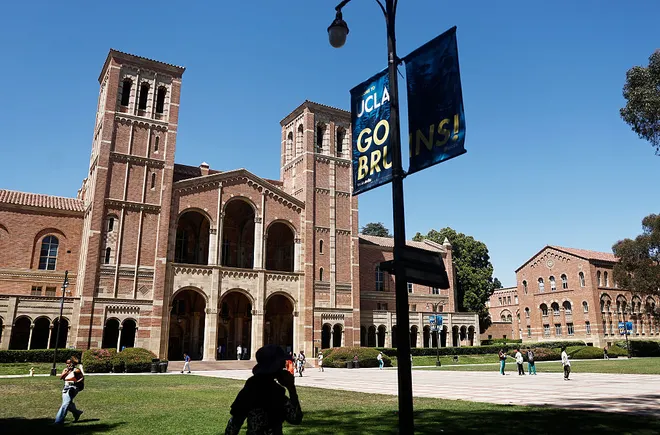
    The Trump administration did just that. In August, it froze $584 million in research funding at the University of California, Los Angeles after concluding that the institution violated civil rights law. It primarily cited UCLA’s decision to allow a 2024 pro-Palestinian protest encampment to remain on campus for almost a week before calling in the police. 

    The administration has sought a $1.2 billion penalty from UCLA to release the funds and settle the allegations. “The costs associated with this demand, if left to stand, would have far-reaching consequences,” Chancellor Julio Frenk said in a public message in August. 

    Lin noted in her Friday ruling that the administration also sought settlement terms “that had nothing to do with antisemitism,” including policy changes to how UCLA handles student protests, an adoption of the administration’s views on gender, and a review of its diversity, equity and inclusion programs.

    The administration’s campaign resulted in a significant and ongoing chilling of faculty’s actions, both in and out of the classroom, Lin said.

    In addition to teaching and conducting research differently, members of the plaintiff groups have also changed how they engage in public discourse and limited their participation in protest, Lin said. Faculty have self-censored on topics such as structural racism and scrubbed their websites of references to DEI out of fear of reprisal. 

    These are classic, predictable First Amendment harms, and exactly what Defendants publicly said that they intended,” Lin concluded.

    While acknowledging the importance of combating antisemitism, Lin said the government was “silent on what actions UCLA took to address” antisemitism issues on its campus between May of 2024, when pro-Palestinian protesters established an encampment, and July 2025, when the DOJ concluded UCLA had violated civil rights law by not doing enough to protect Jewish students from harassment.

    As part of a separate lawsuit, Lin in September ordered the National Institutes of Health and other agencies to restore suspended grants to UCLA. 

    UCLA and the UC system are just one of several prominent universities similarly targeted by the federal government. At least five institutions so far have signed deals with the Trump administration to resolve federal civil investigations. The agreements brokered by Columbia, Brown and Cornell universities require each to pay millions of dollars to the federal government, causes favored by the Trump administration or both.

    Harvard University, on the other hand, has fought back against the administration’s tactics. After repeated federal attacks, accompanied by unprecedented ultimatums, the university sued the administration and successfully had the government’s $2.2 billion funding freeze against it reversed. The Trump administration has previously stated its intent to appeal. 

    Source link

  • The Impact of Data on Annual Giving Strategy

    The Impact of Data on Annual Giving Strategy

    A Conversation With West Virginia University Foundation’s Kristen Shipp

    Special thanks: It’s a privilege to support West Virginia University (WVU) Foundation’s annual giving outreach and big tent Giving Day Initiative. For almost 10 years, the WVU Day of Giving has relied on the ScaleFunder platform to power its campaign, leading to record-breaking success and a huge positive impact throughout the WVU community. The Foundation has also used the RNL360 report to establish a starting point for the strategic planning, link their wide-reaching fundraising efforts to major donations, and identify actions that can be implemented right away to boost the performance of their annual giving program.

    Our work in the advancement and nonprofit space feels pretty unsettled these days. There’s no shortage of uncertainty and daily headlines that often add to the confusion and concern. Navigating the distractions is hard and can be exhausting.

    What helps cut through the noise and keeps us focused on the work at hand? Our answer is data. Specifically, our RNL360 analytics report has proven to be an invaluable resource. Maybe it’s strange to think of data as a friend, but it can be a source of comfort, creating a little calm and providing clarity and guidance as we do our best to deliver for the people and communities we serve.

    We developed the RNL360 to illustrate historic and current giving trends. The report highlights metrics you would expect, including donor retention, consistency, path to major giving, and behaviors by generation. It offers important context for leaders and stakeholders, especially those new to or outside the advancement field. Insights from the analysis help shape our work with client partners. Whether it’s development of the fiscal year plan, segmentation, revisiting ask arrays or identifying priority donors for higher touch outreach. The “readout” also brings colleagues from across campus together for a better understanding of the general fundraising landscape and relevant, institution-specific trends.

    Focus on what’s actionable

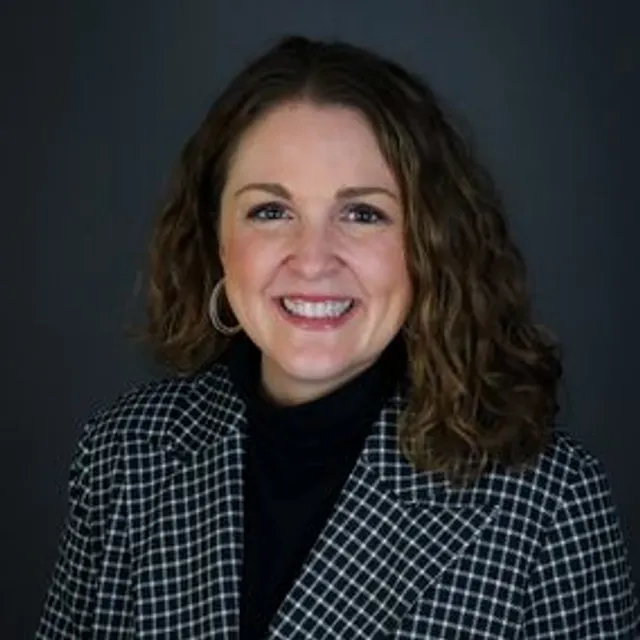
    Kristin Shipp, West Virginia University Foundation
    Kristin Shipp

    At a time when resources are stretched and the stakes are high, RNL360 is used to inform both strategic planning and practical execution—it’s designed to provide specific takeaways and identify donors who should be prioritized.

    We just wrapped up a report with our partners at West Virginia University Foundation (WVUF). We learned a lot, and asked Kristen Shipp, the Foundation’s executive director of annual giving, to weigh in and share her valuable perspective.

    Success in bringing (and keeping) new donors on board

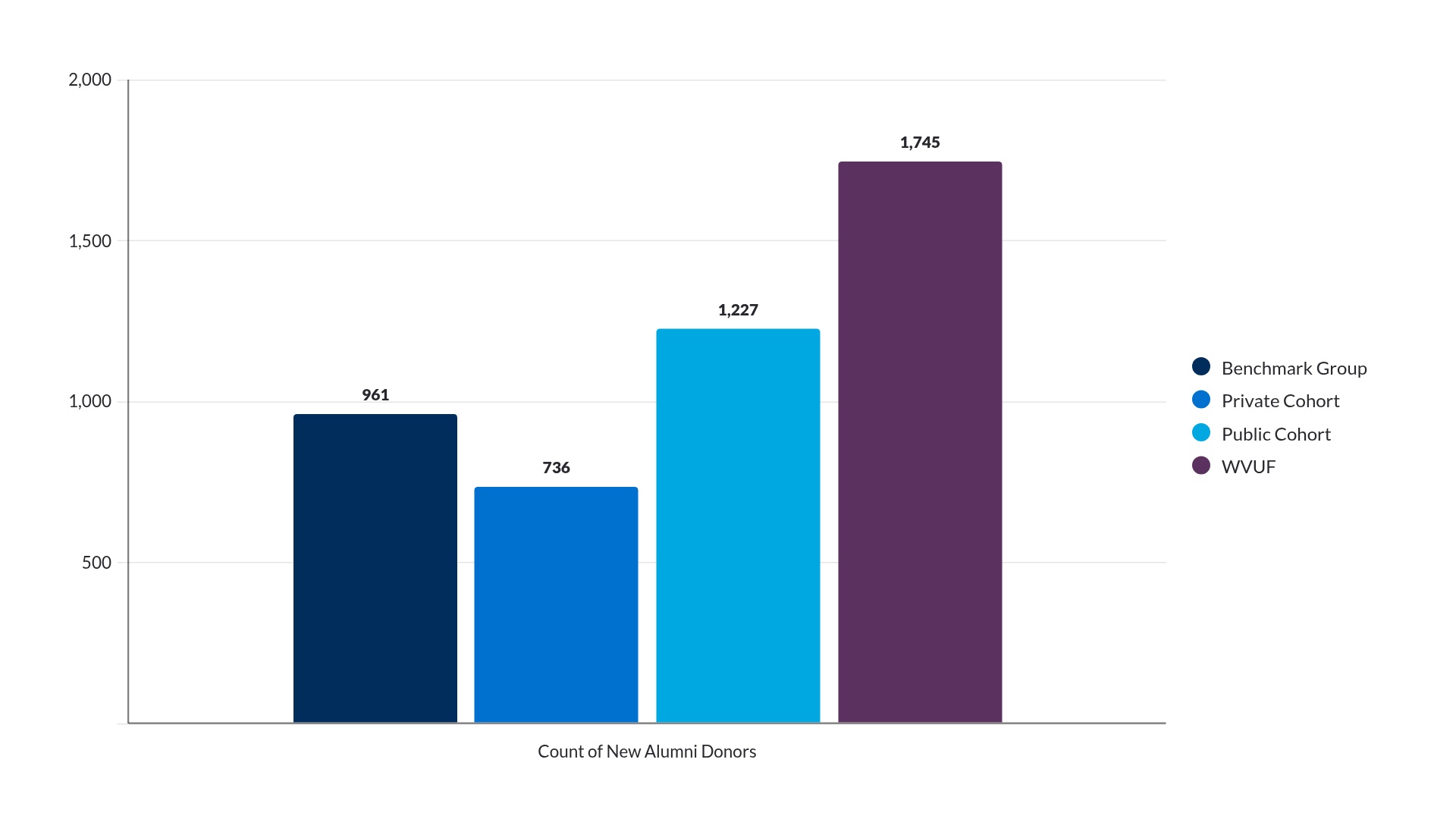
    WVUF’s count of 1,745 new alumni donors last fiscal year was well ahead of the benchmark group and the Foundation also received first-time gifts from an impressive count of more than 5,000 family and friends.

    Q: As you think about acquisition, what’s working for you? What are the campaigns or messages that actually convert?

    Kristen Shipp: WVU Day of Giving has been one of the key drivers in acquiring new donors. Each participating group is highly engaged on social media and takes full advantage of the challenges to inspire alumni and friends to give. Another effective strategy is peer-to-peer fundraising, which allows individuals to promote specific initiatives within their own networks, creating a more personal and powerful connection to the cause.

    Q: How are you approaching stewardship with new donors?

    KS: Our donor engagement team leads first-time donor stewardship by sending personalized messages through ThankView. This has been an effective stewardship strategy that has helped us strengthen donor retention. Overall rates have improved since our last RNL360, and retention among new alumni donors is up more than ten points.

    Median gifts on the rise

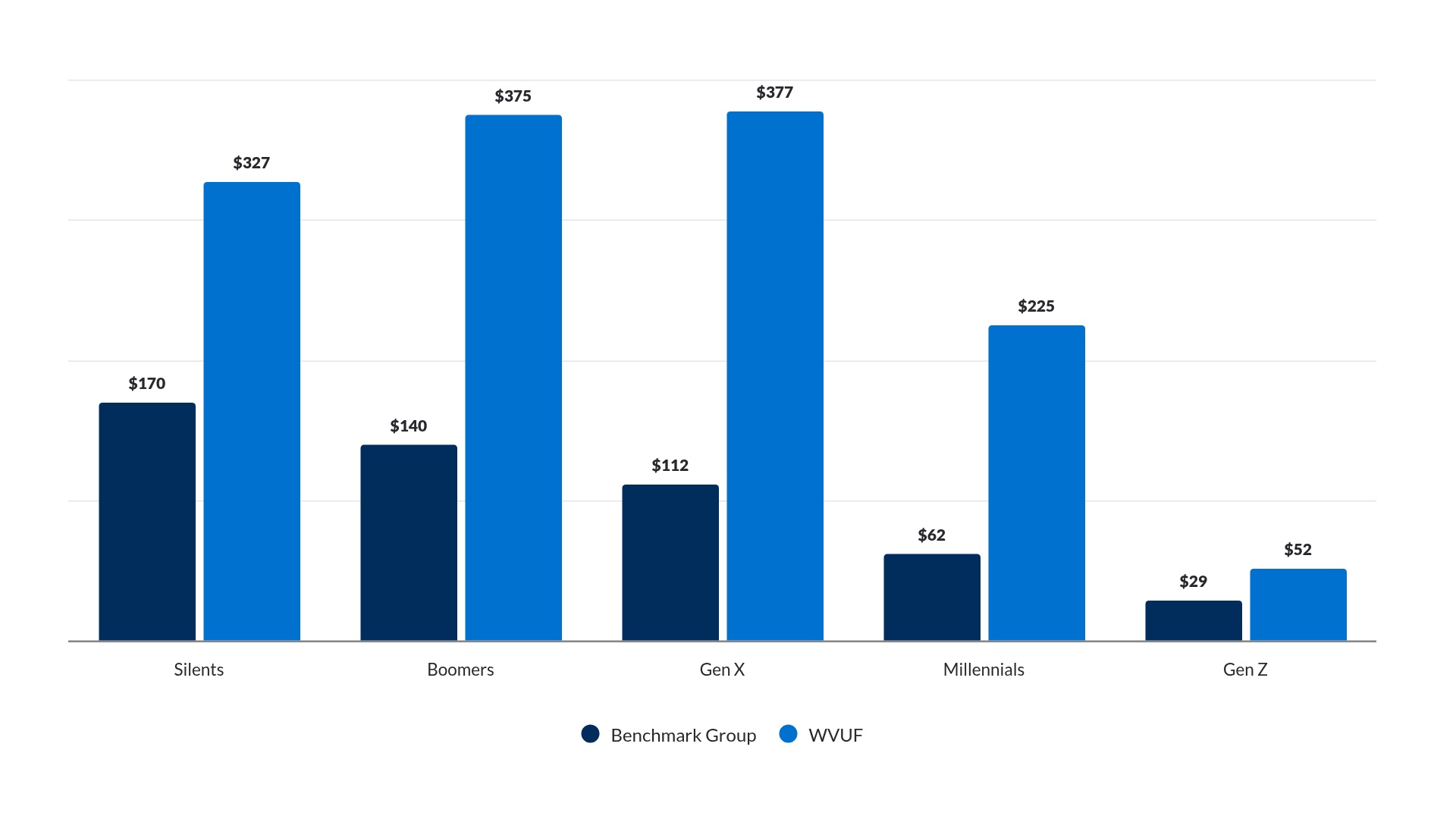
    We know that while younger generations are philanthropic, and many have capacity to make bigger gifts, most are directing their philanthropy elsewhere—giving to other causes and charities. WVUF has increased median gift amounts across all generations.

    Q: Are there one or two strategies you’ve found successful in driving movement with gift amounts? Any that are especially effective with younger generations?

    RNL 360 BenchmarkRNL 360 Benchmark

    KS: While the area of greatest need will always remain a priority, we also strive to provide opportunities throughout the year for alumni and donors to give to areas that align with their personal interests. Through our recent alumni survey, fielded by RNL, we learned that many are particularly interested in supporting mental health services, the student emergency fund, and initiatives that assist first-generation students. These priorities are featured in WVU Day of Giving, and we also leverage crowdfunding and peer-to-peer fundraising to raise awareness and support for these important areas.

    Practical, real-world application

     Alumni Donors  Alumni Donors
    Loyal donors = At least five years of consecutive giving.
    New donors = No gift history or no giving in the last decade.

    Q: Can you share a couple of specific ways that you are using the RNL360 outputs? Is the data helpful across teams and departments?

    KS: Through RNL360, we learned that in FY25, 44% of our individual donors were alumni. This reinforces the importance of developing audience-focused strategies for our annual giving campaigns to ensure our messaging resonates with both alumni and non-alumni donors. Another helpful insight was the number of new alumni donors—only 30% were graduates from the last decade. This highlights the need to better connect recent graduates with causes they’re passionate about and to engage them through the communication channels they prefer.

    Keeping the faith and focus

    Q: Circling back to the unsettling times…you’ve experienced a lot of change at WVU and the Foundation. What helps you reduce the noise and stay focused? Anything professionally or personally that helps keep you positive and motivated?

    KS: There have been many changes at WVU and the WVU Foundation, but with change comes new opportunity. I feel incredibly fortunate to be expanding the Annual Giving team by welcoming new staff members. It’s exciting to build a team that shares the same vision, drive, and passion—and to have fun together along the way. I like to keep things light and engaging, so whenever the moment allows, you’ll probably catch me sharing a funny movie quote or GIF with my teammates.

    Ready to increase engagement with your donors?

    Webinar: Starting at the Source: A Look into Data-Driven Paths to Donor GrowthWebinar: Starting at the Source: A Look into Data-Driven Paths to Donor Growth

    Reach out to us today, and we’ll set up a time to discuss your best fundraising strategies. Our strategists can discuss how to optimize your fundraising strategies with the right data, how you can have a great Giving Day, and much more.

    Or watch our webinar, Starting at the Source: A Look into Data-Driven Paths to Donor Growth, where we dive into more detail on insights we’ve learned from an analysis of more than six million cohort records.

    Talk with our fundraising experts

    Let’s talk about how you can increase donor engagement and strengthen your donor pipeline. Ask for a free consultation with our experts.

    Schedule consultation

    Source link

  • Why Small Private Colleges Matter More Than Ever – Edu Alliance Journal

    Why Small Private Colleges Matter More Than Ever – Edu Alliance Journal

    Opinion Piece by Dean Hoke — Small College America and Senior Fellow, The Sagamore Institute

    A Personal Concern About the Future of Public Education

    It’s impossible to ignore the rising level of criticism directed at our nation’s public schools. On cable news, social media channels, political stages, and in school board meetings, teachers and administrators have become easy targets. Public schools are accused of being ineffective, mismanaged, outdated, or, in some corners, ideologically dangerous. Some commentators openly champion the idea of a fully privatized K–12 system, sidelining the public institutions that have educated the vast majority of Americans for generations.

    For those of us who have spent our lives in and around education, this rhetoric feels deeply personal. Public schools aren’t an abstraction. They are the places where many of us began our education, where our children discovered their strengths, where immigrants found belonging, where students with disabilities received support, and where caring adults changed the trajectory of young lives.

    Behind every one of those moments stood a teacher.

    Amid this turbulence, there is one group of institutions still quietly doing the hard work of preparing teachers: small private nonprofit colleges.

    Small Private Colleges: An Overlooked Cornerstone of Teacher Preparation

    Despite the noise surrounding public education, small private colleges remain committed to the one resource every school depends on: well-prepared, community-rooted teachers.

    They rarely make national headlines. They don’t enroll tens of thousands of students. But they are woven into the civic and human infrastructure of their regions—especially in the Midwest, South, and rural America.

    This reality became even clearer during a recent episode of Small College America, in which I interviewed Dr. Michael Scarlett, Professor of Education at Augustana College. His insights provide an insider’s view into the challenges—and the opportunities—facing teacher preparation today. Note to hear the entire interview click here https://smallcollegeamerica.transistor.fm/28

    I. The Teacher Shortage: A Structural Crisis

    Much has been written about the teacher shortage, but too often the conversation focuses on symptoms rather than causes. Here are the forces shaping the crisis.

    1. Young people are turning away from teaching

    Data from the ACT show that only 4% of students express interest in becoming teachers—down from 11% in the late 1990s. Bachelor’s degrees in education have fallen nearly 50% since the 1970s. Surveys show that fewer than 1 in 5 adults would recommend teaching as a career.

    The message is clear: Teaching is meaningful, but many no longer see it as sustainable.

    As Dr. Scarlett told us: “The pipeline simply is not as wide as it needs to be.”

    Recent data offers a glimmer of hope: teacher preparation enrollment grew 12% nationally between 2018 and 2022. However, this modest rebound is almost entirely driven by alternative certification programs, which increased enrollment by 20%, while traditional college-based programs grew by only 4%. This disparity underscores a critical concern: the very programs that provide comprehensive, relationship-based preparation—including those at small colleges—are not recovering at the same rate as faster, less intensive alternatives.

    2. Burnout and attrition have overtaken new entrants

    The pandemic accelerated an already-existing national trend: teachers are leaving faster than new ones are entering.

    Reasons include:

    • Student behavior challenges
    • Standardized testing pressure
    • Emotional fatigue
    • Inequities across districts
    • Lack of respect
    • Political and social media hostility

    As Scarlett notes, these realities weigh heavily on early-career teachers: “What new teachers face today goes far beyond content knowledge. They face inequities, discipline issues, emotional exhaustion… and they’re expected to do it all.”

    3. Alternative certification can’t fill the gap

    Alternative routes help—but they cannot replace the traditional college-based pipeline. Many alt-cert teachers receive less pedagogical training and leave sooner.

    Scarlett captures the trend: “Teaching has always attracted people later in life… we’ve definitely seen an uptick.”

    And while alternative routes have seen growth in recent years—increasing 20% between 2018 and 2021—this expansion has not translated into solving the shortage. As of 2025, approximately 1 in 8 teaching positions nationwide remains either unfilled or filled by teachers not fully certified for their assignments. The shortcut approach cannot substitute for comprehensive preparation.

    “The national teacher shortage is real… and retention is just as big a challenge as recruitment.” — Dr. Michael Scarlett

    II. The Quiet Backbone: How Small Private Colleges Sustain the Teacher Workforce

    Small private colleges graduate fewer teachers than large public institutions, but their impact is disproportionately large—especially in rural and suburban America.

    1. They prepare the teachers who stay

    About 786 private nonprofit colleges offer undergraduate education degrees—representing roughly 20% of all teacher preparation institutions in the United States. Together, they produce approximately 25,119 graduates per year, an average of 32 per institution.

    These numbers may seem modest, but these graduates disproportionately:

    • Student-teach locally
    • Earn licensure in their home state
    • Take jobs within 30 miles of campus
    • Stay in the profession longer

    Public schools desperately need these ‘homegrown’ teachers who understand the communities they serve.

    2. Small colleges excel at the one thing teaching requires most: mentoring

    Teacher preparation is not transactional. It is relational. And this is where private colleges excel. Scarlett put it plainly: “Close relationships with our students, small classes, a lot of direct supervision… we nurture them throughout the program.” In a profession that relies heavily on modeling and mentorship, this matters enormously.

    3. Faculty—not adjuncts—supervise student teachers

    One of the most striking differences: “Full professors… working with the students in the classrooms and out in field experiences. Other institutions outsource that.”

    This is not a trivial distinction. Faculty supervision affects:

    • Preparedness
    • Confidence
    • Classroom management
    • Retention

    Where larger institutions rely on external supervisors, small colleges invest the time and human capital to do it right.

    4. They serve the regions hit hardest by shortages

    Rural districts have the highest percentage of unfilled teaching positions. Many rural counties rely almost exclusively on a nearby private college to produce elementary teachers, special education teachers, and early childhood educators.

    When a small college stops offering education degrees, it often leaves entire counties without a sustainable teacher pipeline.

    5. They diversify the educator workforce

    Small colleges—especially faith-based, minority-serving, or mission-driven institutions—often enroll first-generation students, students of color, adult career-changers, and bilingual students. These educators disproportionately fill shortage fields.

    “What we have here is special… students understand the value of a small college experience.” — Dr. Michael Scarlett

    III. Should Small Colleges Keep Offering Education Degrees? The Economic Question

    Let’s be direct: Teacher preparation is not a high-margin program.

    Costs include:

    • Intensive field supervision
    • CAEP or state accreditation
    • High-touch advising
    • Small cohort sizes

    Education majors also often have lower net tuition revenue compared to business or STEM.

    So why should a small college continue offering a program that is expensive and not highly profitable?

    Because the alternative is far worse—for the institution and for the region it serves.

    1. Cutting teacher-prep weakens a college’s identity and mission

    Many private colleges were founded to prepare teachers. Teacher education is often central to institutional mission, community trust, donor expectations, and alumni identity.

    Removing education programs sends the message that the college is stepping away from public service.

    2. Teacher-prep strengthens community partnerships

    Education programs open doors to:

    • District partnerships
    • Dual-credit pipelines
    • Grow Your Own initiatives
    • Nonprofit and state grants
    • Alumni involvement

    These relationships benefit the entire institution, not just the education department.

    3. Education majors support other academic areas

    Teacher-prep indirectly strengthens:

    • Psychology
    • English
    • Sciences
    • Social sciences
    • Music and arts

    When teacher education disappears, these majors often shrink too.

    4. The societal mission outweighs the limited revenue

    There are moments when institutional decisions must be driven by mission, not margins. Producing teachers is one of them.

    5. Addressing concerns about program quality and scale

    Some critics question whether small programs can match the resources and diversity of perspectives available at large universities. This is a fair concern—and the answer is that small colleges offer something different, not lesser.

    Graduation and licensure pass rates at small private colleges consistently match or exceed those of larger institutions. What smaller programs may lack in scale, they compensate for through personalized mentorship, faculty continuity, and deep community integration. These are not peripheral benefits—they are the very qualities that predict long-term teacher retention.

    IV. Why Students Still Choose Teaching—and Why Small Colleges Are Ideal for Them

    Despite all the challenges, students who pursue teaching are deeply motivated by purpose.

    Scarlett described his own journey: “I wanted to do something important… something that gives back to society.”

    Many education majors choose the field because:

    • A teacher changed their life
    • They want meaningful work
    • They value community and service
    • They thrive in supportive, intimate learning environments

    This makes small colleges the natural home for future teachers.

    V. What Small Colleges Can Do to Strengthen Their Programs

    Below are the strategies that are working across the country.

    1. Build Grow Your Own (GYO) teacher pipelines

    Districts increasingly partner to:

    • Co-fund tuition
    • Support paraeducator-to-teacher pathways
    • Provide paid residencies
    • Guarantee interviews for graduates

    2. Develop dual-credit and “teacher cadet” high school programs

    Scarlett sees this as a major reason for hope: “We’re seeing renewed interest in teaching through high school programs… This gives me hope.”

    3. Offer specialized certifications (ESL, special ed, early childhood, STEM)

    These areas attract students and meet district needs.

    4. Create 4+1 BA/M.Ed pathways

    Parents and students love the value.

    5. Provide flexible programs for career-changers

    The rise of adult learners presents a major opportunity for private colleges. “We prepare our students for the world that exists.” — Dr. Michael Scarlett

    VI. Why Small Colleges Must Stay in the Teacher-Prep Business

    If small private colleges withdraw from teacher preparation, the consequences will be immediate and dramatic:

    • Rural and suburban schools will lose their primary source of new teachers.
    • Teacher diversity will shrink.
    • More underprepared teachers will enter classrooms.
    • Districts will become more dependent on high-turnover alternative routes.
    • Student learning will suffer.

    And the profession will lose something even more important: the human-centered preparation that small colleges provide so well.

    • The teacher shortage will not be solved by legislation alone.
    • It will not be solved by fast-track certification mills.
    • It will not be solved by online mega-universities.
    • It will not be solved by market forces.
    • It will be solved in the classrooms, hallways, and mentoring relationships of the small colleges that still believe in the promise of teaching.

    If we want public schools to remain strong, we must support the institutions that prepare the teachers who keep them alive. Small private colleges aren’t just participants in the teacher pipeline—they are its foundation.

    When these colleges thrive, they produce educators who stay, who care, and who transform communities. That’s not just good for education—it’s essential for American democracy.


    Dean Hoke is Managing Partner of Edu Alliance Group, a higher education consultancy firm. He formerly served as President/CEO of the American Association of University Administrators (AAUA). Dean has worked with higher education institutions worldwide. With decades of experience in higher education leadership, consulting, and institutional strategy, he brings a wealth of knowledge on colleges’ challenges and opportunities. Dean is the Executive Producer and co-host for the podcast series Small College America and a Senior Fellow at the Sagamore Institute based in Indianapolis, Indiana.

    Source link

  • The high costs of cheap food

    The high costs of cheap food

    From New York to Jakarta, the scene is the same: Shelves overflowing with cheap, ultra-processed snacks and sugary drinks have become the new normal for millions of children. As a result, for the first time in history, more children are obese than underweight.

    UNICEF’s new Feeding Profit report explains why: Across the globe, cheap and intensely marketed ultra-processed foods dominate what families are able to put on the table, while nutritious options remain out of reach.

    Across the world, one in 20 children under five and one in five children and adolescents aged five to 19 are overweight. The number of overweight children and teens in 2000 almost doubled by 2022, with South Asia experiencing an increase of almost 500%. In East Asia, the Pacific, Latin America, the Caribbean, the Middle East and North Africa, the increase was at least 10%.

    Ultra-processed foods and beverages, defined as industrially formulated, are composed primarily of chemically-modified substances extracted from foods, together with additives and preservatives to enhance taste, texture and appearance as well as shelf life.

    These foods — which are often cheaper, nutrient poor and higher in sugar, unhealthy fats and salt — are now more prevalent than traditional, nutritious foods in children’s diets.

    Can we wean ourselves off ultra-processed foods?

    Studies show there’s a direct link between eating a lot of ultra-processed foods and an increased risk of overweight and obesity among children and adolescents. Among teens aged 15-19 years, 60% consumed more than one sugary food or beverage during the previous day, 32% consumed a soft drink and 25% consumed more than one salty processed food.

    Today, children’s paths to healthy eating are shaped less by personal choice than by the food environments that surround them. Those are the places where and conditions under which people make decisions about what to eat. They connect a person’s daily life with the broader food system around them, and are shaped by physical, political, economic and cultural factors that help determine what foods are available, affordable, appealing and regularly eaten.

    Such environments are steering children toward ultra-processed, calorie-dense options, even when healthier foods are available.

    Around the world, countries are beginning to push back. In Mexico, where nearly four million children aged 4-10 are obese, the government took a bold step in March 2025. It banned the sale of ultra-processed foods and sugary drinks in schools.

    The new rules go beyond restriction: Schools must offer fresh, regional foods such as fruits, vegetables and seeds, promote water as the default beverage, and establish health education programs. The policy also calls for regular health monitoring, mandatory fortification of wheat and corn flours, and more opportunities for physical activity, with penalties for schools that fail to comply.

    Taking steps to slim down our diets

    In September 2025, Malaysia’s Ministry of Education followed similar steps. It now prohibits 12 categories of ultra-processed foods and drinks in school canteens, from instant noodles and skewered snacks to frozen desserts and candy.

    But even as countries rewrite their food policies, millions of families still face difficult choices at the market.

    Shauna Downs, associate professor of food policy and public health nutrition at Rutgers University, has seen firsthand how hunger and obesity can coexist within the same communities in her research on informal settlements in Nairobi, Kenya.

    “People are able to find nutrient-rich foods, like leafy greens, fruits, and vegetables, and animal-source foods, but they’re often expensive, and what they can get that’s cheaper is things like mandazi [fried dough], which provide energy, and they taste good, but they’re not getting the nutrients they need,” she said.

    Families that want to buy the nutrient-rich foods are forced into heartbreaking choices, Downs said.

    “So now they’re making a decision between ‘Am I gonna buy this food from the market, which my family needs, or am I gonna pay for my child to go to school?’” she said.

    Looking at food environments

    By spotlighting the food environment, consumers and researchers alike can move past the tired “eat less, move more” narrative to fight childhood obesity and ask a better question: Why wasn’t the healthy plate the obvious, easy and most affordable choice in the first place?

    Long before ultra-processed foods flooded grocery shelves, they quietly took over another key part of children’s lives: school cafeterias. Back in 1981, the Reagan administration cut US$1.5 billion in U.S. school food funding, pushing public institutions to rely on convenience over nutrition.

    Pamela Koch, associate professor of nutrition and education at Teachers College, Columbia University, said that one of the things cut was for funding for schools  upgrade their kitchens.

    “That was the same time as the food supply was becoming more and more [saturated] with highly-processed food, and a lot of food companies realized, ‘Wait, we could have a market selling to schools. Schools don’t have money to buy supplies’,” Koch said.

    Companies began offering deals: Sign a long-term contract and receive a free convection oven to reheat ultra-processed foods. For schools facing budget cuts and limited staffing, the decision was simple. The cost of that convenience would echo for decades.

    Let’s start with school meals.

    The nonprofit Global Child Nutrition Foundation, highlights school meals as an essential lever for transforming food systems: Create demand for nutritious foods, improve the livelihoods of those working in the food system and promote climate-smart foods. However, the cost of scaling up national programs depends on the strength of supply chains, underlying food markets, logistics and procurement models.

    Countries that depend on imported food, already challenged by infrastructure and expensive trading costs, will face additional challenges in delivering healthy school meals.

    In much of the world, climate stress and weak infrastructure are making nutritious food both more difficult to grow and more expensive to purchase.

    Small-scale farmers, sheep and cattle farmers, forest keepers and fishers — known collectively as smallholder farmers — grow much of the food in low-income countries. They face worsening yields due to climate change, land degradation and lack of access to the technology and resources that support sustainable food production.

    At the same time perishable foods are becoming more expensive because the global supply chain — how food gets shipped from a farm in one country through distribution networks to store shelves in another country — is increasingly threatened by political tension, the lasting effects of the COVID-19 pandemic and climate change.

    Durability over nutrition

    Kate Schneider, assistant professor of sustainable food systems at Arizona State University, said that smallholder farmers grow food as their livelihood. “They’re not able to grow enough food, which is partly a story of climate change,” Schneider said. “Multiple generations now have been farming … year after year on the same land, but without external inputs –– fertilizers and modern, high-yielding seeds –– they are resulting in very low yields.”

    Even when fresh fruits and vegetables are available, logistical barriers make it easier to sell ultra-processed foods. Fresh produce is heavy, vulnerable to spoilage and expensive to move, especially in countries with poor transport networks.

    “When we’re thinking about fresh items, they’re perishable, and they need a cold chain,” Schneider said. “You’re paying, when you buy an apple, for the three that also rotted.”

    Meanwhile, ultra-processed products like soda avoid this problem entirely: “It’s cheaper for them to have a ton of different bottling plants around countries than to distribute long distances,” Schneider said.

    The result of these challenges is a global system that rewards durability over nutrition and continues to make healthy food increasingly out of reach.

    Connecting sustainability of diets and the environment

    The EAT-Lancet Commission 2.0, a scientific body redefining healthy and sustainable diets, offers a different view: The ultra-processed foods fuelling obesity are also pushing food systems beyond climate and biodiversity limits.

    Its newly published report says that nearly half the world’s population can’t afford a healthy diet, while the richest 30% generate more than 70% of food-related environmental damage.

    The planetary health diet suggests a plant-rich diet that consists of whole grains, fruits, vegetables, nuts and beans, with only moderate or small amounts of fish, dairy and meat.

    To build healthier and more just food systems, experts also recommend a whole list of other things: make nutritious diets more accessible and affordable; protect traditional diets; promote sustainable farming and ecosystems; reduce food waste.

    And all of this should be done with the participation of diverse sectors of the society.

    The responsibility of transforming food systems falls not only on governments but also on donors and financial partners, development and humanitarian organizations, academic institutions and civil society. The stakes are high, but so is the potential to change. With bold, coordinated action, the next generation of children can be nourished by healthy food, while building food systems that sustain both people and the planet


    Questions to consider:

    1. How is obesity connected to the environment?

    2. What are some governments doing to try to tackle the obesity crisis?

    3. What changes could you make to your diet to make it healthier?


    Source link