Blog

  • Trump Can’t “Blanket” Deny UC Grants or Demand Payout

    Trump Can’t “Blanket” Deny UC Grants or Demand Payout

    A judge ordered federal agencies Friday to end their “blanket policy of denying any future grants” to the University of California, Los Angeles, and further ruled that the Trump administration can’t seek payouts from any UC campus “in connection with any civil rights investigation” under Titles VI or IX of federal law.

    The ruling also prohibits the Department of Justice and federal funding agencies from withholding funds, “or threatening to do so, to coerce the UC in violation of the First Amendment or Tenth Amendment.” In all, the order, if not overturned on appeal, stops the administration’s attempt to pressure UCLA to pay $1.2 billion and make multiple other concessions, including to stop enrolling “foreign students likely to engage in anti-Western, anti-American, or antisemitic disruptions or harassment” and stop “performing hormonal interventions and ‘transgender’ surgeries” on anyone under 18 at its medical school and affiliated hospitals.

    The administration’s targeting of the UC system came to the fore on July 29. That’s when the DOJ said its months-long investigations across the system had so far concluded that UCLA violated the equal protection clause of the 14th Amendment and Title VI of the Civil Rights Act of 1964 in its response to alleged antisemitism at a spring 2024 pro-Palestinian protest encampment.

    Federal agencies—including the National Institutes of Health, National Science Foundation and Department of Energy—quickly began freezing funding; UC estimated it lost $584 million. But UC researchers sued and, even before Friday’s ruling, U.S. District Court judge Rita F. Lin of the Northern District of California ordered the restoration of almost all of the frozen funding.

    Friday’s ruling came in a case filed this fall by the American Association of University Professors, the affiliated American Federation of Teachers and other unions. Lin again was the judge.

    “Defendants did not engage in the required notice and hearing processes under Title VI for cutting off funds for alleged discrimination,” she wrote.

    “With every day that passes, UCLA continues to be denied the chance to win new grants, ratchetting [sic] up Defendants’ pressure campaign,” she wrote. “And numerous UC faculty and staff have submitted declarations describing how Defendants’ actions have already chilled speech throughout the UC system. They describe how they have stopped teaching or researching topics they are afraid are too ‘left’ or ‘woke,’ in order to avoid triggering further funding cancellations by Defendants. They also give examples of projects the UC has stopped due to fear of the same reprisals. These are classic, predictable First Amendment harms, and exactly what Defendants publicly said that they intended.”

    Source link

  • 1.1 Million College Students – The 74

    1.1 Million College Students – The 74


    Get stories like this delivered straight to your inbox. Sign up for The 74 Newsletter

    Maia Jackson should have been cranking out a research paper for her communications class. Instead, she found herself queuing up at a food pantry to secure groceries for her household amid the nation’s longest government shutdown. 

    “I walked out with a shopping cart full of food,” the 25-year-old college senior said. “I could barely carry it all. I got cereal. I got some frozen meat, hamburger buns. I got a bag of black beans, and then I got a bag of rice.”

    Finding a package of chicken strips, a dish she knew her picky 2-year-old daughter would actually eat, almost made her cry, Jackson said. She expects the combination of perishable, bagged and canned foods to last them a month. By then, she hopes her Supplemental Nutrition Assistance Program (SNAP) payments — widely known as food stamps — will have resumed.

    On November 1, SNAP benefits ground to a halt during the federal budget impasse that began a month earlier, with President Donald Trump’s administration refusing to fully fund these payments, a matter now tied up in court. Even as the Senate has reached a framework deal that leaves lawmakers and the White House a step closer to ending the shutdown, the disruption in benefits has revealed how fragile the social safety net is for vulnerable Americans. That includes single parents and young adults experiencing food insecurity, a problem that occurs when people lack regular access to the nourishment needed to sustain their health. 

    An estimated 1.1 million college students rely on SNAP, including parents like Jackson, who attends North Dakota State University (NDSU) in Fargo. For such students, a delayed SNAP payment isn’t a mere hiccup, but a serious setback that can imperil their education, their health and stability for their children, experts contend.

    “It’s such a distraction for me as a single mom in school,” Jackson said. “I don’t have any bandwidth to give to trying to find food at pantries.”

    She tried to minimize the time she spent at the food pantry last week by making an appointment first, but she was still one of a couple of dozen people in line. The visit prevented her from completing her research paper by its due date, which will likely result in her grade being docked. Jackson, who has so far maintained a 4.0 grade point average, isn’t happy about that prospect, but with her family members an hour away and her child’s father mostly out of the picture, she had to prioritize food over her education.


    No college student should have to choose between a basic need and school, said Deborah Martin, a senior policy associate for The Institute for College Access & Success, a nonprofit that advocates for college access and affordability. 

    “A lot of students have to make these daily tough decisions where they’re wondering, ‘Where am I going to get my next meal from?’ instead of focusing on homework, on classwork,” Martin said. “We know that when students have these unmet basic needs such as food insecurity, they’re more likely to struggle academically, less likely to persist from semester to semester, and in some cases, may even drop out of college altogether.”

    Roughly 60 percent of college students are women. For the most marginalized students, the risk of quitting school due to food insecurity may be even greater. The Government Accountability Office (GAO), a nonpartisan federal agency that provides fact-based information to Congress, reported last year that about 80 percent of food-insecure students are nontraditional — meaning their parents don’t financially support them, they didn’t begin college immediately after high school or they are caring for dependents. Moreover, the 2023-2024 Student Basic Needs Survey Report from the Hope Center, a research center at Temple University focused on the food, housing and health of college students, found that around three-quarters of parenting, Black and Indigenous students experience insecurity related to a basic need

    Most of these students, the GAO discovered, do not sign up for services like SNAP, and those who do may hesitate to discuss their food insecurity. As a mom and a slightly older student who works part-time, Jackson has felt largely alone on campus as SNAP benefits have paused. Her classmates don’t appear to share her anxiety over the shutdown, if they know about it at all. 

    A woman shops at the Feeding South Florida food pantry on October 27, 2025 in Pembroke Park, Florida.
    (Joe Raedle/Getty Images)

    “A lot of the kids that I’m in class with, they’re not in the same circumstance,” Jackson said. “It’s weird to see a lot of people just carrying on as usual.”

    Since most of her classmates — about an even percentage of NDSU students are women and men — are childfree and on the school meal plan, she doesn’t want to be a “downer” by bringing up her difficulties. For the same reason, she didn’t explain to her professor why her paper was late. “I didn’t want to tell him, ‘Oh, I couldn’t write it because I was standing in the food pantry line’ because it just sounds so sad,” she said. “What’s he supposed to say? I don’t want him to feel bad for me. I don’t want to be pitied.”

    But faking normal could come at a high cost for college students who don’t reach out for help. Martin fears these young adults will resort to using high-interest payment plans or acquire credit card debt just to afford groceries.

    “The longer that students and other SNAP participants don’t receive their funds, this is just more days that students are going to have to make these difficult decisions,” she said.


    Some college administrators are taking action. When the shutdown began, Compton College President and CEO Keith Curry contacted Everytable, a food company that offers inexpensive made-from-scratch meals via carryout storefronts and a delivery service. The college, about 18 miles southeast of downtown Los Angeles, has partnered with Everytable for seven years to provide all students — approximately 6,000 of whom attend full time — with one nutritious free meal on weekdays. 

    The federal government crisis prompted Curry and Everytable CEO Sam Polk to scale up that program so SNAP-recipient and economically disadvantaged students didn’t suffer during the shutdown.

    “We need to do something. Can we split the cost?” Curry recalled asking Polk. “I think if we double the meals, at least they get another meal for the day.”

    On November 5, Compton College’s most underprivileged students began getting two free meals per day, or 10 per week. The need for such an intervention there is substantial: A 2025 basic needs survey of students found that 81 percent of them experience at least one form of insecurity related to a basic need. That includes signs of food insecurity such as skipping meals, reducing meal sizes or fearing they will run out of food. Most Compton College students are moderately food insecure, the survey revealed, indicating persistent hardship. Women make up 61 percent of the student body.

    “Right now, students have other stress, and what we’re doing to them is adding more stress,” Curry said of the shutdown. “They still want to do well in classes, but now they don’t have food.” 

    Together, Compton College and Everytable have the resources to supply students with 10 weekly meals for a month, Curry said. The students are deeply grateful for the additional provisions, according to Dee Garrett, who oversees Everytable’s operation at the college.

    “What better way to start your studies than with a stomach that’s full?” Garrett asked. “You don’t have to think about, ‘Oh, my God, my stomach. I can’t concentrate or focus.’”

    Asked what impact he hopes the scaled-up program makes, Curry said he’s more interested in letting students know they’re not alone.  

    “It’s not about the impact. It’s about our students knowing that we were there for them during this time,” he said. “In our community, when students need us most, we have to step up and be there for them, and they’re never going to forget that.”

    Martin applauds the efforts of colleges and K-12 schools, which have connected students and their families to food banks, to curb food insecurity during the shutdown. But she also advocates for long-term policies to ensure students have enough food to eat. That includes the Enhance Access to SNAP Act, proposed legislation to remove the barriers that prevent economically disadvantaged college students from utilizing benefits generally — not just during the current crisis. 

    However, Martin continued, “the most important thing that we can do right now in this moment is for these SNAP benefits to be fully funded and for them to go out to students as soon as possible.”


    Back in Fargo, Jackson has refocused her attention on her coursework now that she has a month’s worth of food. Still, she worries about the people who couldn’t make it to a pantry or that the government will cut other social services she needs. She currently earns $400 monthly working part time as an academic journal editor. The job, which she performs remotely, allows her to attend school and be her daughter’s primary caretaker when the toddler is not in day care. 

    “If they cut child care, if they cut these programs I rely on, I would have to drop out of school,” Jackson said. “But I’m trying to give my daughter a better life than that.”

    Jackson is majoring in university studies with a pre-law emphasis, a dramatic shift from her life before motherhood when she dropped out of school and struggled with addiction. Getting pregnant inspired her to undergo a transformation, which she largely credits to the Jeremiah Program. The national nonprofit provides single mothers with support for college, child care and housing, and it recently started a campaign to raise $190,000 to cover essential needs for families who have lost SNAP and other benefits because of the shutdown. The organization estimates that single-parent families represent nearly a third of families in the United States, with 80 percent of those headed by mothers.  

    Jackson has been deeply disturbed to see the misperceptions that abound about mothers like herself. She’s encountered online commenters who have characterized SNAP recipients as “welfare queens.”

    If she could confront such individuals in person, Jackson would emphasize how much value mothers add to society. “And on top of it… we are all in school and working, too,” she said. “The insinuation is that we’re just scammers, freeloaders, when, in reality, I’m working very hard every day to hopefully not need these supports.”

    This story was originally reported by Nadra Nittle of The 19th. Meet Nadra and read more of their reporting on gender, politics and policy.


    Did you use this article in your work?

    We’d love to hear how The 74’s reporting is helping educators, researchers, and policymakers. Tell us how

    Source link

  • WEEKEND ESSAY: Summarising and responding to the post-16 white paper

    WEEKEND ESSAY: Summarising and responding to the post-16 white paper

    This blog was kindly authored by Professor Roger Brown, the former Vice Chancellor of Southampton Solent University and Dr Helen Carasso, Honorary Norham Fellow of the Department of Education at the University of Oxford. Their previous book, Everything for Sale? The Marketisation of UK Higher Education was published by Routledge in 2013.

    It is eighth blog in HEPI’s series responding to the post-16 education and skills white paper. You can find the others in the series here, here, here, here, here, here and here.

    We need a reset to ensure the system can play its critical role in delivering provision aligned to the government’s growth and Industrial Strategy ambitions, support training at scale, deliver opportunity and outcomes for all, and reduce the persistent gaps in outcomes for the most advantaged students.

    (HM Government, 2025, p.46).

    As this statement of intent shows, the post-16 Education and Skills White Paper published last month has ambitious aims for the higher education sector in England. These are framed in the context of a wide range of proposals covering not only higher education but also further education and what used to be called ‘industrial training’. So far as higher education is concerned, the main proposals are:

    • To promote greater provider specialisation, including through greater collaboration
    • To increase financial sustainability and efficiency
    • To improve access and participation
    • To strengthen the incentives on providers to promote growth
    • To improve quality

    Specialisation and collaboration

    The Government wants to see greater specialisation: ‘over time there will be fewer broad generalist providers and more specialists’ (p.49). The White Paper seems to envisage two types of specialisation (a) by broad orientation, ‘teaching only’, ‘research’ and ‘teaching with applied research in specific disciplines’ (p.49) and (b) by discipline ‘a provider may decide to specialise across multiple disciplines or to focus on one or two where they are strongest’ (p.49). It is not clear how this will be achieved, but the White Paper speaks of ‘incentivising a more strategic distribution of research activity across the sector’ (p.50). This would be done through reforms to research funding. There will be a more permissive approach to collaboration on the part of the regulators. The Government declares that it will work with the Office for Students ‘to ensure there is a more robust process for market entry’ (p.50) but nothing is said about market exit.

    Financial sustainability and efficiency

    The White Paper confirms the earlier announcement by the Secretary of State that the undergraduate tuition fee cap for all providers will be increased in line with forecast inflation in the academic years 2026-27 and 2027-28. These ad hoc increases are intended to support the financial sustainability of institutions until legislation can be put in place to make such increases automatic. The Government will work with the sector to improve research cost recovery, with measures including improvements to TRAC (Transparent Approach to Costing) and support for collaboration and sharing of infrastructure. The White Paper also notes the potential of AI for dramatic improvements in research productivity. However, future Government support for research will be tied to ‘three distinct priorities’:

    Protecting and promoting curiosity-driven research; supporting the delivery of government priorities, missions and the Industrial Strategy; and providing targeted innovation, commercialisation and scale-up support to drive growth.

    (p.50)

    Moreover, improving cost recovery may ‘result in funding a lower volume of research [but] at a more sustainable level’ (p.52) and the research assessment system will be reformed ‘to better incentivise excellence and support the Government’s vision for the sector’ (p.53).

    Improving access and participation

    There are signs that the Government has registered the scale of the financial pressures on students with maintenance loans increasing with forecast inflation each year. Means-tested maintenance grants for students from the lowest income households (funded by the new International Student Levy) will be introduced. However these will be confined to those who are studying courses that support the Government’s missions and Industrial Strategy. The long-awaited introduction of modular teaching funding through the Lifelong Learning Entitlement (LLE) will also be focused on ‘key subjects for the economy, informed by the Industrial Strategy’ (p.56). However, given that the LLE model is to be used to operate loans for all eligible home undergraduates, it is unclear what this will mean in practice.

    To reduce administrative burdens, the regulation of Access and Participation Plans will be refined to focus on those parts of the sector where there is the greatest room for improvement. The Government will ‘develop options to address cold spots in under-served regions and tackle the most systemic barriers to access’ (p.57). It will also explore the reasons for the declining proportion of UK doctoral applicants in some fields. This could include reducing the financial barriers for those from lower socio-economic backgrounds.

    Incentives for growth

    The Strategic Priorities Grant will be reformed so as to align with the priority sectors that support the Industrial Strategy, the Government’s Plan for Change and future skills needs. Providers will be expected to review their curricula to increase flexibility and strengthen progression. Student support (i.e. eligibility for SLC loans) for Level 6 courses may be made conditional on the inclusion of accredited break points in degree programmes. Universities will be required to engage with Local Skills Improvement Plans. There will be ‘a new market monitoring function, drawing together key datasets to provide a clear, single picture of higher education supply and demand’ (p.61).

    The Government has protected the overall funding of UKRI (at £8.8bn). It will continue to ensure that there is ‘the right balance’ between the three research funding priorities. Some of UKRI’s funding will be ‘pivoted to align to areas of strategic importance as described in the Industrial Strategy sector plans’ (p. 62).

    The country’s ‘global leaders’ will be placed on a more sustainable footing through the linking of fee cap increases to quality (as discussed below) and the projected improvements in research cost recovery. The Government will work with the sector ‘to maintain a welcoming environment for high-quality international students’ (p.63). However, there will be tighter enforcement of visa approvals and monitoring of international students’ course enrolments and completions. Finally, providers will be encouraged to develop ‘civic plans’ that fit with their strengths and priorities.

    Improving quality

    Even though three-quarters of providers received Gold or Silver ratings in the last (2023) TEF, ‘we need to raise the bar across the system…with pockets of poor provision undermining the reputation of the sector’ (p.64). On the REF, the White Paper acknowledges the risk that research funding and assessment frameworks can incentivise ‘perverse behaviours’ with publication becoming ‘the main aim’ (p.65) (why did it take them so long?).

    There will be an increase in the OfS’s capacity to conduct ‘quality investigations’. Ultimately, the Government will legislate to ensure that the Office is able to impose recruitment limits where growth risks poor quality and future fee uplifts will become conditional on providers achieving a higher threshold through the Office’s quality regime.

    The Government will work with UCAS, the OfS and the sector to improve the quality of information for individuals ‘informed by the best evidence on the factors that influence the choices people make as they consider their higher education options’(p.66). An OfS review of its approach to degree awarding powers will include the role of external examiners and ‘the extent to which recent patterns of improving grades can be explained by an erosion of standards, rather than improved teaching and assessment practices’ (p.67). Employers will be consulted on whether the academic system is giving graduates the skills and knowledge they need for the workplace (p.67). Using the model of Progress 8 in the schools, the Government will work with the OfS to develop options for measuring and comparing progress in higher education.

    The Government will also consider its approach to research assessment ‘to ensure it meets our needs and ambition for research and innovation’ (p.68). There will be a pilot ‘to seek better information on how our strategic institutional research funding is used’ (p.68).

    The White Paper in its historical context

    In our forthcoming book Every Student Has Their Price: The Neoliberal Remaking of English Higher Education,to be published by Policy Press next year, we identify the progression of reforms that have enable the marketisation of English higher education. These reforms to funding, regulation and market entry have enabled a significant growth in the number of competing higher education providers to more than 400 (see the December 2023 HEPI Debate Paper Neoliberal or not? English higher education in recent years Roger Brown and Nick Hillman).

    The White Paper vigorously reaffirms the official view, evident in the 1985 Green Paper The Development of Higher Education into the 1990s (Department for Education and Science, 1985) that the role of higher education is first and foremost about meeting the needs of the economy: what Salter and Tapper many years ago termed ‘the economic ideology of higher education’ (The State and Higher Education, 1994). But whereas most previous White Papers have at least paid lip service to the wider functions of higher education this one doesn’t even bother. It is, in fact, the most wide-ranging attempt yet to tie the future development of the sector to the Government’s perceptions of the present and future requirements of the economy, and specifically the presumed requirements of the labour market.

    The White Paper’s impacts can be expected to mostly reinforce those of the earlier reforms in at least six areas: demand and equity, supply, funding, the higher education workforce and the system.

    Demand and equity

    The White Paper is silent on the future size of the sector. So far, the neoliberal reforms have done little to check the huge increases in numbers and participation rates that we have seen. Nor have they made much difference to the continuing gaps in participation by different social groups or the tendency for students from wealthier backgrounds to go to better-resourced institutions. This is because – as nearly every independent analysis has shown – the major barriers to wider participation lie much further back in the education system and these in turn largely reflect the structure of our society and economy. So it is very hard to see the White Paper proposals making much difference to access or demand. But there are one or two warning signs. The stipulation that maintenance grants will be restricted to students on courses closer to the Industrial Strategy will not only constrain student choice but perhaps also reinforce the divisions between higher and lower tariff providers that were exacerbated by the abolition of the numbers limits in 2015. Is there perhaps another potential binary line here, with better off students free to pay to study humanities and social science at wealthier and more prestigious institutions and go on to well-paid jobs in the City or the professions, while poorer students are obliged to study ‘practical and applied’ subjects at less well resourced and less prestigious ones?

    Supply

    It is striking that there are no proposals for expanding the number of providers, indeed the White Paper envisages toughening the rules for market entry, as we have seen. The Government appears to assume that it will be existing providers that will cater for the cold spots in under-served regions, rather than new ones. This will at least mean some greater stability.

    Funding

    It seems highly unlikely that the proposals for fee indexation will be sufficient to redress the post-2016 funding squeeze, wean universities off of their reliance on international student fees (even without the tax represented by the International Student Levy) or restore the unit of resource in real terms. UUK analysis suggests that there will be an overall £2.5bn reduction in sector funding across the academic years 2024-25 to 2026-27 compared to 2023-24. Whilst the intention to improve research cost recovery is welcome, it will almost certainly be insufficient to reverse the long-term decline in research funding since 1980, and indeed the Government partially accepts this.

    This combination of some additional funding, together with a strong drive towards increasing efficiency and encouragement for institutions to consider specialisation, collaboration and restructuring as options, is placed within the context of recognition that ‘the higher education sector is rightly and proudly autonomous’(p.53). This freedom, the Government states, has its consequences, so ‘the leadership of the sector must take responsibility for managing their institutions robustly and in the public interest’ (p.53). The OfS will therefore be supported to tighten the management and governance requirements of institutional registration. Indeed, there will be a ‘….focus on targeting sharp regulation where it is most needed, to drive the positive change required to maintain our world-leading higher education system.’ (p48)

    Quality

    The White Paper notes some of the quality issues that have arisen over the period, including grade inflation and (some) sub-contracting (franchising), most of which are in fact due to the combination of increased competition and reduced funding that has characterised the period of the reforms. The proposal that future fee increases should be linked to quality raises as many questions as it answers. Whilst this idea has often been floated in the past, it has not been seriously applied in the UK since the days of the Polytechnics and Colleges Funding Council when sector committees advised the funding council on the allocation of additional funded student numbers to ‘deserving’ institutions on a broadly disciplinary basis.

    The proposal that the OfS should be able to confine future fee uplifts to ‘providers achieving a higher quality threshold through the OfS’s quality regime’ is also par for the neoliberal course. The potential weight that this places on TEF outcomes makes the current review of the exercise even more crucial, including the importance of designing a process that acknowledges the role of a variety of institutions offering forms of education that might be different but not automatically ‘better’ or ‘worse’.

    The proposal that the OfS should review the degree awarding powers process and the role of external examiners in protecting standards also raises many questions.  But the issue is the same, namely, how and to what extent can the traditional ways in which the academic community has, generally, successfully guarded its standards resist the combined pressures of competition, consumerism and inadequate funding.

    The proposals on information for students continue with the hopeless – in the authors’ view – quest for the Holy Grail of information that will quickly and cheaply enable students and other ‘users’ of the system to make reasonable choices about subjects, courses and providers, the insuperable difficulties of which were explained at length in the HEPI Debate Paper referred to earlier. Similarly hopeless is the idea of a progress measure for higher education along the lines of Progress 8 in the schools. We can only sympathise with the hapless individuals who will be tasked with taking these ideas forward.

    The proposal to review research assessment raises concerns that future exercises could be tilted, like research funding, towards greater emphasis on (a) impact, and (b) subjects considered most relevant to the Industrial Strategy. Haven’t the reforms to increase the role of impact in research assessment over the years already gone far enough?

    Staff

    The White Paper breaks new ground in one respect at least, in that the position of staff, and in particular the precarity of many early career researchers, is mentioned. However, what will happen here will depend very much on how much of a financial recovery there will be (if any), on how much system restructuring takes place and on what form any increased collaboration takes. If this takes the form of institutional mergers, we can expect more redundancies and potentially worsening of terms and conditions. The experience of mergers in HE indicates that the only significant, permanent savings come from disposing of assets: any savings on things like shared services are offset by the greater costs of the managerial coordination required.

    The system

    The Government clearly hankers after a more streamlined system that is both more efficient in its use of resources and offers a wider, or at least clearer, set of choices for students, employers and other ‘users’. As with so many other aspects of the White Paper we have been here before. In the early 1980s the old University Grants Committee consulted on designating the existing universities as ‘R’, ‘X’ or ‘T’, depending on their research intensity. The proposals were universally rejected. In the early 2000s, HEFCE toyed with the notion of dividing institutions into separate and distinctive groups depending on their overall orientation, but this also foundered. The institutions were almost all strongly opposed, the criteria and data for selection were insufficiently robust to be a basis for policy and the Funding Council anyway lacked the necessary powers. The same seems likely to be the case here, especially given the renewed emphasis on institutional autonomy built into HERA(2017).

    Where does the sector go next?

    In our forthcoming book, we argue that the post-80s reforms of higher education in England are a reflection of the key planks of neoliberalism: privatisation, marketisation and reduced claims on the taxpayer. The press release accompanying the White Paper speaks of it being a ‘landmark statement’. This it certainly is, if not in the sense seemingly meant by its authors. If the essence of neoliberalism is the subordination of all social and cultural activities to the needs of the economy, then this is indeed a ‘landmark’ document of which the authors of neoliberalism would have been justly proud.

    Source link

  • Honoring Giving Day Excellence | The 2025 RNL Givey Winners

    Honoring Giving Day Excellence | The 2025 RNL Givey Winners

    Giving days have become a foundation for fundraising, helping institutions energize their donor base and create an incredible burst of philanthropic passion. As these days have evolved, so have the strategies institutions have used to amplify their efforts, rally donors around a theme, and gamify giving to take the results to the next level.

    To recognize the creativity and strategy of these programs, RNL created the Giveys, and annual award celebrating the most innovative and successful Giving Day campaigns. This year we are pleased to announce 28 winners among our ScaleFunder partners.

    The Giveys showcase a sampling of the outstanding work and unique approaches RNL’s many partners take to engage their communities and maximize their fundraising efforts. This year’s winners used pop culture-inspired themes and high-tech ambassador toolkits to bolster strategic support from the ScaleFunder and use of our easy-to-build platform to generate record-breaking fundraising events. Read about the winners and see their giving pages below, or watch our recent webinar where we unveiled the winning institutions.

    2025 RNL Giveys Winners & Highlights

    Category: Creative Giving Day Theme

    Missouri State Giving Day
    • Winner: University of Texas at Dallas
      • University of Texas at Dallas launched a fully integrated Taylor Swift-inspired campaign that spanned their logo, site text, graphics, and ambassador toolkit. The theme culminated in a fun, on-campus concert featuring a Taylor Swift impersonator and a selfie station.
    • Winner: Missouri State University
      • Missouri State won for their Taylor Swift-inspired theme that carried across their site’s banner image and ambassador materials, demonstrating a high-energy approach that resonated with their community

    Category: Omnichannel Engagement

    • Winner: Michigan Tech University
      • Michigan Tech University was recognized for their professional and unified omnichannel strategy. They utilized high-quality branding, student photos, and front-and-center dates across postcards, digital ads, and email to ensure the campaign was seen everywhere.

    Category: Creative Social Media

    • Winner: West Virginia University (WVU)
      • West Virginia University was celebrated for its use of creative social media challenges and contests, leveraging the Walls.io social media aggregator. Our favorites included a “Day of Giving Social Prop Challenge” tied to their save-the-date postcard, a “Country Roads Challenge” asking people to sing the John Denver song, and a “Pet Photo Challenge.”

    Category: Gamification Excellence

    RPI Giving DayRPI Giving Day
    • Winner: The University of Mississippi
      • The University of Mississippi team was honored for leaning into what makes them unique! They tied their campaign to the hearts of their donors by offering unique and personalized rewards such as a manufacturing excellence fire pit and a signed, personalized print from artist Marshall Ramsey.
    • Winner: Indiana State University
      • Indiana State was recognized for an excellent display of matches and challenges on their site, particularly the “New Donor Challenge.” This challenge targeted first-time donors, successfully using a major gift to be unlocked once a specific number of new donors gave.
    • Winner: Rensselaer Polytechnic Institute (RPI)
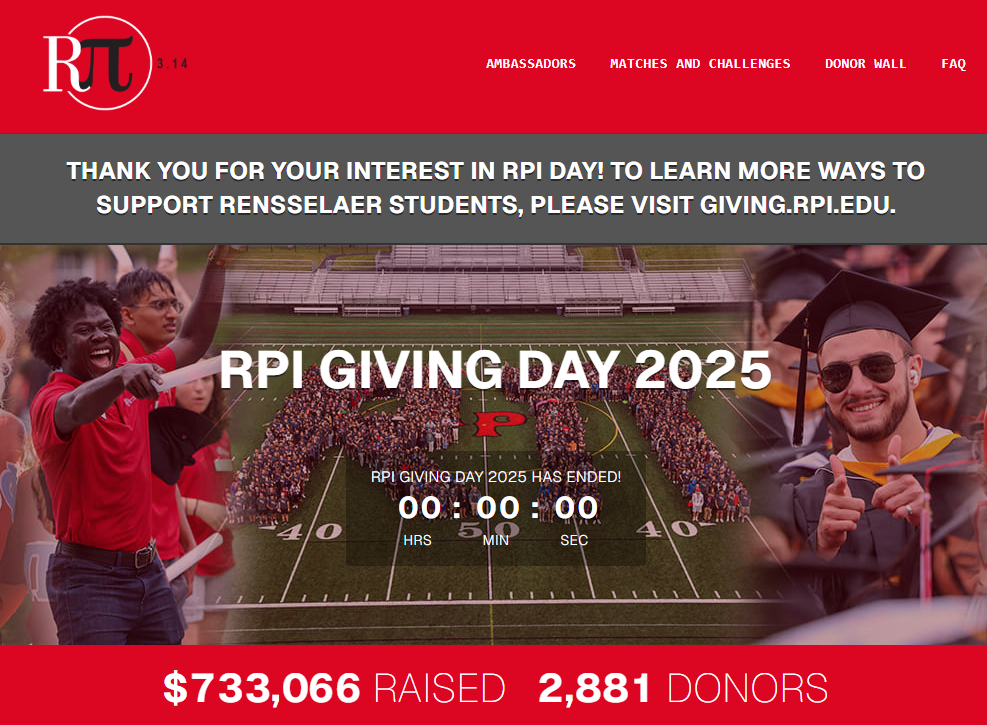
      • We applaud RPI for tying their gamification directly into their giving day date, March 14th (Pi Day). Challenges included goals like 3,142 laps around the armory and gifts of $3.14 or $31.42, along with highlighting pet posts for their president’s dog’s birthday party.
    • Winner: Montclair State University
      • Montclair State University was highlighted for their fun, relatable challenge that asked young alumni to “give up a coffee” and make a modest gift, then rewarded them with a coupon for a free coffee, encouraging repeat engagement.

    Category: Ambassador + Donor Engagement

    University of Oregon Giving DayUniversity of Oregon Giving Day
    • Winner: University of Oregon
      • The University of Oregon won for their “Ducks Give Day” campaign. They offered a free sticker pack for signing up as an ambassador and motivated participation in their “You+2” campaign, where ambassadors made a gift and secured two others to make a gift, then they earned an exclusive Oregon pin and pair of socks.
    • Winner: The University of Texas Health Science Center at Houston
      • UT Health Houston put together a Giving Day campaign toolkit to engage the ambassadors by providing professional, easy-to-use graphics and copy-and-paste sample messaging. The success of their campaign stemmed from understanding of their audience and a commitment to making it simple for people to spread the word and help them meet their goals.

    Category: On-Campus Engagement

    • Winner: University of Wisconsin-La Crosse
      • Celebrated for an excellent on-campus promotion strategy to generate awareness and engagement, which included free T-shirt giveaways, a kickoff pep rally, a voting contest for campus areas to receive funding, and a “Class Cab” golf cart.

    Category: Awesome Greek Organization

    • Winner: Kappa Alpha Theta
      • Kappa Alpha Theta was recognized for their well-designed and welcoming ScaleFunder site design, which featured animated graphics and powerful donor testimonials directly on the page, leaning into their core message of sisterhood and connection.

    Category: New Giving Day Partner

    University of DelawareUniversity of Delaware
    • Winner: University of Delaware
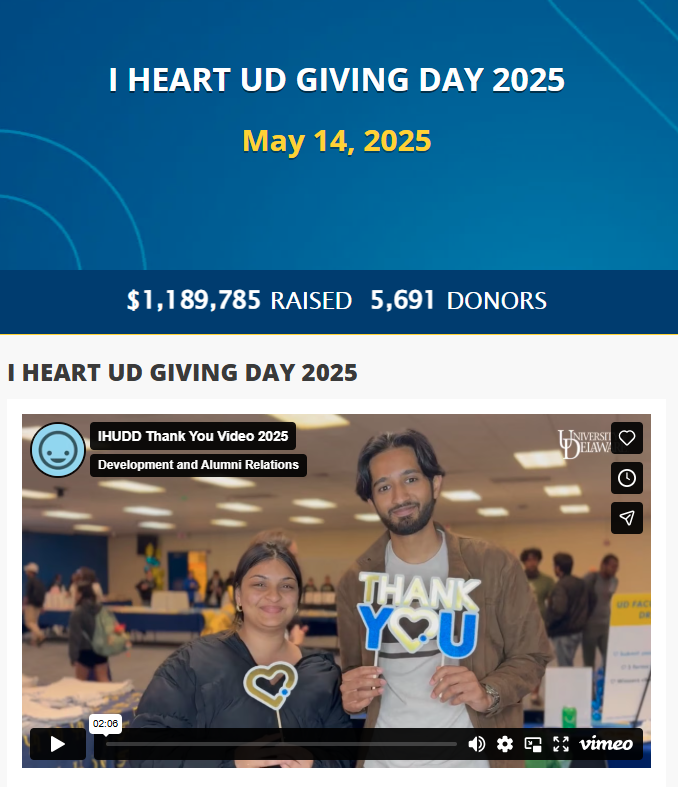
      • The University of Delaware was honored for their successful first “iHeartUD Giving Day,” demonstrating excellent branding and execution, especially after needing to change their Giving Day date. Their quick, professional communication and successful campaign showed great promise, and they were true experts at keeping their community in the loop about iHUD happenings.
    • Winner: California State University, Stanislaus
      • California State University, Stanislaus was recognized for a very strong entry, leveraging years of success with RNL’s crowdfunding platform for their first Giving Day. They created a unique theme, “1960 Minutes of Giving” (based on their founding year), and used a unique domain label: “stanforacause.”

    Category: Fall Giving Day

    • Winner: The University of Alabama
      • Featured for their recent “Clash of the Capstone” campaign, which pitted students against alumni in a competition to see who could bring in the greatest number of gifts, creating a fun, engaging way to host a second, focused giving day in the fall.
    • Winner: UC Berkeley
      • Recognized for the success of their second annual fall giving day, the “Oski’s Bearathon.” The campaign, which focuses on driving donations to student organizations, uses a fun, quirky theme and is a top example of how to successfully run multiple, distinct Giving Day campaigns in one year.

    Category: Frictionless Giving Experience

    • Winner: Butler University
      • Butler University was celebrated for proactively adding custom questions to their donation form to collect information vital for advancement services and athletics, streamlining the gift processing workflow for their campus partners.

    Category: Giving Day Video

    • Winner: University of Houston
      • The University of Houston created an engaging Giving Day campaign, which featured a video game theme. This included a fun, well-done video and the development of an actual playable game called “Shasta’s Birthday Dash,” accessible right on their Giving Day site. This gamified approach allowed participants to play, collect points by passing virtual campus landmarks, and track their scores on a visible leaderboard, making the celebration of their “years of excellence” a memorable and interactive experience.

    Category: Incentivized Giving

    • Winner: Northern Kentucky University
      • Northern Kentucky University developed highly effective donor incentives as part of their annual Giving Day campaign. These incentives included offering a choice of a long-sleeve T-shirt for any gift of $68 or more (honoring their founding year) and leveraging a partnership with AAA to enter all donors of any gift size into a drawing to win two round-trip Delta Airline ticket vouchers anywhere in the continental United States.

    Ready for a record-breaking giving day?

    RNL Giving Day Powered by ScaleFunder combines the most powerful giving day platform with strategic assessments, omnichannel marketing, and stewardship to make your giving day a major success and increase future giving.

    RNL Giving Day Powered by ScaleFunderRNL Giving Day Powered by ScaleFunder

    Category: Site Design

    • Winner: The University of Mary Washington
      • The University of Mary Washington earned recognition for their successful site refresh, which featured a custom-drawn campus wallpaper design for their Giving Day platform. Additionally, they leveraged a unique campus tradition, the “Devil Goat Challenge,” which pits even and odd class years against each other for additional challenge funds.
    • Winner: Ivy Tech Community College
      • Ivy Tech Community College Giving Day campaign prioritized team alignment across the entire organization and featured a visually fantastic site design. Their platform created a positive, celebratory atmosphere through its use of dynamic graphics and animation, including a banner with confetti dropping.
    • Winner: Tarleton State University
      • Tarleton State University created a professional and engaging Giving Day site that effectively showcased their branding, especially for the Texan Excellence Fund. Their use of vibrant giving area tiles that instantly captured attention and encouraged visitors to scroll and click through to learn about the different campus areas needing support.
    • Winner: Washington State University
      • Washington State University reached the outstanding milestone of their 10th annual Giving Day this year with their, “Cougs Give,” campaign. The university Giving Day site is well designed, featuring a “film noir” theme that used black and white imagery with a bold pop of red in their tile graphics, creating a memorable and visually sophisticated look that was carried throughout the entire campaign.

    Category: Multi-Campus Showcase

    • Winner: The University of Alaska
      • The University of Alaska leveraged an exceptional multi-campus showcase feature, which unified its various campus identities through the creative use of their mascots. Their campaign stood out with engaging features like mascots animating in and out of the banner images and a fun “hide and seek” challenge that visually highlighted each campus’s unique identity.

    Category: Athletics Giving Day

    • Winner: Virginia Tech University
      • Virginia Tech successfully hosted a second Giving Day specifically dedicated to their athletics, branded with the strong theme “Triumph Together.” This initiative united the university’s annual giving and athletics teams, serving as a powerful tool to generate engagement, secure great donor numbers, and cultivate loyal, all-around Virginia Tech fans.

    Category: Giving Tuesday

    • Winner: Northern Arizona University
      • Northern Arizona University was recognized for their cohesive and successful Giving Tuesday campaign that featured a fall theme and their “Lumberjacks” identity. Their strategy featured a beautiful site design and creative, engaging messaging, such as substituting “gifts” with “axe of kindness” and playful puns to reinforce the thematic branding and celebrate who they are.

    Category: Early Giving

    • Winner: Marshall University
      • Marshall University was recognized for their creative and effective use of early giving functionality on the ScaleFunder platform, which streamlined the donation process for both donors and staff. They simplified the experience by allowing gifts directly on the campaign site, customizing the donation button to say “Give Early,” and easily hiding the total aggregator and donor wall until the official launch to generate excitement.

    Category: Wild Card

    • Winner: Salem State University
      • Salem State University was recognized for enhancing their Giving Day with creative, multi-media engagement features promoted directly on their homepage, offering fun ways for their community to participate beyond just donating. These features included a high-energy “Viking Warrior Day hype up” Spotify playlist and a curated YouTube playlist offering various pre-recorded activities, such as an alumni-led morning yoga session and an evening meditation.

    Ready to have your award-winning Giving Day?

    These stories of record growth, community engagement, and frictionless giving celebrated at RNL’s 2025 Giveys highlights that with the right tools, consulting support, and strategic planning, any institution can host a successful and engaging digital fundraising campaign.

    Whether you’re looking to launch your first Giving Day, elevate your annual campaign, or start a new crowdfunding initiative, RNL’s ScaleFunder platform provides the technology, insights, and support to turn your vision into a fundraising victory.

    Contact us today to explore how RNL’s ScaleFunder can help you engage your donors, mobilize your ambassadors, and build a tradition of giving day excellence.

    Source link

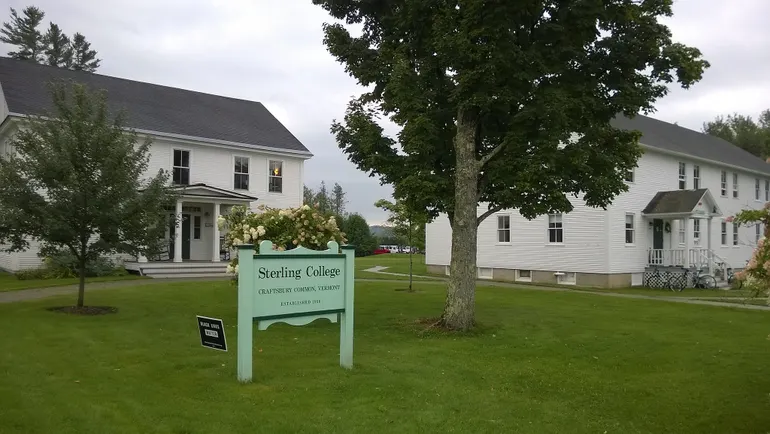
  • Sterling College in Vermont to close

    Sterling College in Vermont to close

    This audio is auto-generated. Please let us know if you have feedback.

    Dive Brief:

    • Sterling College, in Vermont, plans to close after its spring 2026 semester in response to enrollment declines and financial pressure, the private institution announced Wednesday. 
    • The environmental studies-focused college will end its associate and bachelor’s programs following the spring semester, after which it plans to operate its summer internship program, depending on student need.
    • In its announcement, Sterling said that its governing board’s decision to close “reflects the College’s commitment to transparency, responsibility, and care in the face of persistent financial and enrollment challenges.”

    Dive Insight:

    Fewer than 40 students are at Sterling for the current semester, with about 30 faculty and staff members running the college, the institution’s president, Scott Thomas, told a local media outlet this week.

    Closing now “allows us to responsibly support students through their continuing time at Sterling and assist with transitions to partner institutions,” the college said in a FAQ about its closing.

    Sterling is finalizing several teach-out agreements with regional peers College of the Atlantic, Community College of Vermont and Champlain College, all of which will require the approval of its accreditor, the New England Commission of Higher Education. The college will hold its final commencement in May, it said. 

    Just between 2021 and 2023, the small college’s enrollment fell by just over 38% to 78 students, according to federal data. 

    Sterling’s tuition revenue declined with the shrinking student body. Between fiscal years 2021 and 2024, net tuition and fee revenue dipped 10.3% to about $835,700. 

    The college was also heavily dependent on private grants to sustain it. In 2024, for example, it logged $4.9 million in grant revenue, most of it restricted. However, the college’s endowment was relatively paltry. Its total investment assets amounted to $1.2 million in 2024. 

    Founded over 65 years ago, Sterling offers bachelor’s and associate degrees only in environmental studies. Bachelor’s students have the option to pursue self-directed concentrations in topics under the environmental umbrella, such as ecology, natural resource management and social justice. 

    The college touts outdoor learning and its experiential approach. Along with NECHE, it is accredited by the Association for Experiential Education, and it is one of a handful of federally recognized work colleges, which require students have work at least 80 hours per semester as part of their educational program

    Based in Craftsbury, Vermont, Sterling owns forest, wetlands, a farm, a yurt, a climbing wall and 307 acres in nearby Bear Swamp. The college encourages students to camp for short periods on campus property and allows them to hunt, fish and trap during designated seasons outside the campus center. 

    The college’s property was valued at $3.4 million in fiscal 2024. Sterling said the board will later decide “how to steward the College’s remaining resources in a manner consistent with its mission and all applicable legal requirements.”

    Given the possibility of running its internship program through August “if needed,” the college noted that “it is, as yet, unknown if and when College operations will cease entirely.”

    Source link

  • New Jersey Weighs Biggest Update of Charter School Rules in 30 Years – The 74

    New Jersey Weighs Biggest Update of Charter School Rules in 30 Years – The 74


    Get stories like this delivered straight to your inbox. Sign up for The 74 Newsletter

    Senate lawmakers on Monday advanced legislation that would launch the most comprehensive overhaul of New Jersey’s regulation of charter schools in 30 years.

    The bill advanced by the Senate Education Committee on Monday would outright ban for-profit charter schools, require them to post a range of documents online, and impose residency requirements for some charter school trustees.

    “We have not looked at charter schools as a whole legislatively in this committee since the 1990s, so this is an opportunity where we’re trying to do that,” said Sen. Vin Gopal (D-Monmouth), the panel’s chair and the bill’s prime sponsor.

    The bill comes as New Jersey charter schools have faced scrutiny after reporting revealed top officials were paid far more than their counterparts at traditional public schools, including, among others, a Newark charter school CEO who was paid nearly $800,000 in 2024.

    The proposal, which Gopal said was the product of a year of negotiations, would require charter schools to post user-friendly budgets that include the compensation paid to charter school leaders and school business administrators. They must also post existing contracts.

    Charters would be required to post meeting notices, annual reports, board members’ identities, and facility locations online. Some critics have charged that charter schools routinely fail to provide notice of their public meetings.

    The legislation would also require the state to create a dedicated charter school transparency website to host plain language budgets, 990 disclosure forms filed with the IRS, contracts with charter management organizations, and a list of charter schools on probation, among other things.

    It would also ban fully virtual charter schools.

    “We support the bills as a step forward in holding all public schools in our state accountable for fiscal and transparency requirements that will ultimately best serve our students,” said Debbie Bradley, director of government relations for the New Jersey Principals and Supervisors Association.

    The two sides remained at odds over the membership of charter school boards.

    Charter critics argued residency for those positions — which, unlike traditional public school boards, are largely appointed rather than elected — should mirror those imposed on regular public schools.

    In New Jersey, school board members must live in the district they serve. That’s not the case for charter schools, whose trustees face no residency or qualification limits under existing law.

    The bill would only impose a residency requirement on one-third of a charter school’s trustees, and rather than forcing them to live in the district, the bill would require charter trustees to live in the school’s county or within 30 miles of the school.

    That language was criticized by statewide teachers union the New Jersey Education Association, which has called existing law governing charter schools outdated and flawed.

    “School board representation should remain primarily local, and when we mean local, we don’t mean within a 30-mile radius. A 30-mile radius of Newark could include Maplewood, South Orange, communities that don’t necessarily represent what Newark looks like as a community,” said Deb Cornavaca, the union’s director of government relations.

    Charter school supporters said their boards need flexibility because their leadership has broader responsibilities than counterparts in traditional public schools.

    “Running a charter is a little different than running a traditional district. You need experience in school finance. You need to fundraise a bunch of money on the front end because you’re not getting paid on the front end,” said New Jersey Charter School Association President Harry Lee, adding they also needed familiarity with real estate and community experience.

    Amendments removed provisions that would have required charter school board members to be approved by the state commissioner of education, though the commissioner retains sole power over whether to allow the formation of a new charter, a power that gives the commissioner some veto power over a charter’s board.

    Gopal acknowledged the 30-mile residency rule was a sticking point and said legislators would discuss it before the measure comes before the Senate Budget Committee. Earlier, he warned the bill was likely to see more changes as it moved through the Legislature.

    Some argued enrollment in charter schools should be more limited by geography, arguing that out-of-district enrollments that are common at New Jersey charters could place financial strain on the students’ former district.

    Most per-pupil state and local funding follows students who enroll in charter schools, even if their departure does not actually decrease the original district’s expenses because, for example, those schools still require the same number of teachers and administrators.

    Charter operators said that would make New Jersey a national outlier and argued that a separate provision that would bar new charter schools when there are empty seats in existing area charters should come out of the bill.

    “It could be read as a moratorium on charters, so we want to revisit that provision,” Lee said.

    Such vacancies could exist for various reasons, they argued, including student age distributions.

    Alongside that measure, the panel approved separate legislation that would bar charter schools from setting criteria to enroll students, ban them from imposing other requirements on a student randomly selected to attend, and place new limits on how such schools can enroll children from outside their district.

    That bill would also bar charter schools from encouraging students to break with the district. Some opponents have charged that charter schools push out low-performing students to boost their metrics.

    The committee approved the bills in unanimous votes, though Sens. Owen Henry (R-Ocean) and Kristin Corrado (R-Passaic) abstained from votes on both bills, saying they are broadly supportive but need more time to review amendments.

    New Jersey Monitor is part of States Newsroom, a nonprofit news network supported by grants and a coalition of donors as a 501c(3) public charity. New Jersey Monitor maintains editorial independence. Contact Editor Terrence T. McDonald for questions: [email protected].


    Did you use this article in your work?

    We’d love to hear how The 74’s reporting is helping educators, researchers, and policymakers. Tell us how
    Source link

  • With Butchers Disappearing, High Schools Look to Step In – The 74

    With Butchers Disappearing, High Schools Look to Step In – The 74


    Get stories like this delivered straight to your inbox. Sign up for The 74 Newsletter

    LEWISTOWN — Slaughterhouses and butchers used to be scattered throughout the United States, numbering about 10,000 in 1967.

    Only about 3,000 remain and about 85% of the American meatpacking industry is controlled by four companies: JBS, Tyson Foods, Cargill and Smithfield. The other 15% of that market share is held in part by small and very small meat producers scattered across the country, including some in Montana.

    About half of small and medium meat processors have disappeared in the last 20 years, and a decades long University of Illinois study found the average length of a meat processing business surviving was 9.7 years. Between inspections, startup costs and other factors, it’s not an easy business to get into or keep afloat. 

    This is true for much of the agricultural industry, and many small businesses have disappeared as corporate America has exerted its will on farmers and ranchers. About 70% of the consumer’s dollar went to cattle producers in 1970, with the other 30% going to processors and retailers. Cattle producers now get about 30% of the consumer’s dollar, according to Farm Action.

    Additionally, about 98% of America’s beef is processed in just over 50 plants. Beef processing co-ops have been created around the state in an effort to help give beef producers more options, but there’s another problem too — employees.

    That’s the place some educators in Montana are looking to step in. Fergus High School in Lewistown, for example, has a robust agricultural education program. It’s also part of the Central Montana Career and Technology Education Academy, a public charter school that was set up this year to connect students with skills and knowledge needed to work in agriculture.

    ‘A dying art’

    Logan Turner, one the teachers at Fergus High School, put it pointedly.

    “Kids aren’t really getting into it,” he said. “Cutting meat is kind of a dying art.”

    His goal has been, in part, to help change that trend. The technical academy seeks to bridge a gap of agricultural knowledge. Beyond meat cutting, classes at the school include farm business management, fabrication and science classes geared toward teaching about soil health among others.

    Turner grew up on his family’s farm outside Missoula and quickly decided he wanted to be a teacher. There’s an urgency for him too, with worries, among them a feeling no one knows where their food comes from and the world’s growing population. 

    “We’ve always been faced with this big issue as agriculturalists,” Turner said. “2050 is right around the corner, and there’s going to be two billion more people on the face of the planet, and how are we going to feed them all? I think it all starts with education and understanding … and so I felt like being an educator probably was the best way for me to contribute.”

    Only about three percent of the food Montanans eat is produced in the state. There are options for eating local food, but they can sometimes be hard to find. 

    Having kids learn about these could also help them enter the workforce with more ideas about what they want to do, which is one of the goals of the program. Orin Johnson, the Central Montana CTE Academy director, said they also want to get students as close as possible to certification in a variety of careers.

    “Every kid doesn’t learn the same way,” Johnson said. “And some really do strive and need to be hands on, and it’s about finding a way to create opportunities that they can be hands on.”

    Students at the school have shown interest and it’s included partnerships with Future Farmers of America and the Montana Farmers Union, which gave the meat processing program two grants totaling about $13,000 over the summer.

    “We do a lot of meat processing at my house because my dad loves hunting, and so we do a lot of wild game,” said Shyanne Ricks, a student at the school who’s gone through the program. “And so doing the meats class really helps with seeing the whole process, not just wild game.”

    Ricks, along with Tori Rindal, a freshman at the school, and the other Lewistown agricultural education teacher — Jared Long — went to the Montana Farmers Union Annual convention and spoke about the program.

    Rindal said she’s hoping to take the meats class next year. Long pointed out agricultural education is broad and students can take many different paths.

    The program offers five pathways: welding, natural resource and conservation, meat processing, animal science and agricultural mechanics. There’s a variety of classes within those, both Long and Turner explained.

    “The common misconception is that it’s just cows and plows,” Long said. “So that’s really our job, we feel like, is to open doors to kids that they might never have.”

    Daily Montanan is part of States Newsroom, a nonprofit news network supported by grants and a coalition of donors as a 501c(3) public charity. Daily Montanan maintains editorial independence. Contact Editor Darrell Ehrlick for questions: [email protected].


    Did you use this article in your work?

    We’d love to hear how The 74’s reporting is helping educators, researchers, and policymakers. Tell us how

    Source link

  • International enrolments at UK business schools on the mend

    International enrolments at UK business schools on the mend

    UK business schools continue to be buffeted by hostile immigration policies, with some institutions noting two consecutive years of declining overseas enrolments, according to 2025/26 results from the 2025 Chartered Association of Business Schools (ABS) annual membership survey of 48 members.

    But the picture seems to be improving. Almost half of the schools surveyed (46%) reported an increase in international enrolments, up from just 11% the previous year. At undergraduate level, 45% reported rising numbers, compared with 64% at postgraduate level.

    Nevertheless, the association has pointed to policies affecting international students in the UK as continuing causes for concern for business schools as promises made in Keir Starmer’s immigration white paper become a reality.

    While international enrolments at the undergraduate level were down on 2024/25 for 14% of respondents, this is far lower than the 39% who reported the same trend in 2024/25.

    Similarly, while a sizeable chunk of respondents (39%) said overseas enrolments for postgraduate students were down year on year, this is still a noticeable improvement than over three quarters of respondents the year before.

    But the Chartered ABS noted that international enrolments will still be lower than before 2024/25, with some schools reporting two years of decline in a row.

    The Chartered ABS pointed to hostile policies in the UK as a potential reason for declining international enrolments. The UK government’s decision to reduce the Graduate Route by six months is already having an effect, it said, with 60% of survey respondents saying the incoming policy has had a negative impact.

    “The shortening of the Graduate Route, the ban on student dependants, and the proposals for the international student levy will continue to have a damaging impact on business school finances, and by extension, their parent institutions,” warned Stewart Robinson, chair of the Chartered ABS and dean of Newcastle University Business School.

    “These results reveal that while some institutions are seeing student numbers grow and finances stabilise, many institutions continue to face significant challenges. Budget cuts, restructuring, and redundancies will continue, and many business schools will face another year of declining student numbers and income,” he added. 

    The survey revealed that many UK business schools are feeling the pinch, with an increasing number (48%) reporting a drop in year-on-year income in 2025/26 compared to 36% in 2024/25.

    Budget cuts, restructuring, and redundancies will continue, and many business schools will face another year of declining student numbers and income
    Stewart Robinson, Chartered ABS and Newcastle University Business School

    However, more than half of the schools surveyed (58%) said they expected income to increase in 2025/26 – an improvement on the previous year, when more than half expected further decline.

    A slew of policies affecting the international education sector were announced as part of the immigration white paper, with stakeholders concerned that each could have a serious impact on overseas enrolments.

    The government has decided to cut the Graduate Route from two years to just 18 months, shaving six months off the visa route for international graduates from UK institutions.

    A levy on the income institutions make from international student fees was also announced as part of the changes, with a later decision to ringfence this cash to spend on maintenance grants for domestic students. Critics have warned that the move could decimate international enrolments if students are put off by the higher fees many institutions will have to set to cover the cost of the tax.

    An earlier decision to ban almost all international students from bringing their dependants to the country with them on a student visa. Since 2024, when the policy was announced, net migration numbers in the UK have seen a steep decline.

    Source link

  • NZ warns against exploitation as working hours for int’l students rise

    NZ warns against exploitation as working hours for int’l students rise

    As part of its plan to grow the international education sector — which includes doubling its contribution to $7.2 billion and increasing international enrolments to 119,000 by 2034 — New Zealand has introduced new immigration changes.

    The changes extend in-study work rights to all tertiary students on approved exchange or study abroad programs and clarify that most students who change providers or lower their study level will need a new visa.

    Apart from these, eligible tertiary students in post-school education, such as universities and polytechnics, and secondary students in Years 12-13 can now work up to 25 hours a week. Secondary students will continue to require parental and school approval for in-study work.

    The increased limit applies to all new visas granted from November 3, even if the application was submitted earlier.

    Moreover, students already holding visas with a 20-hour work limit will need to reapply, either through a variation of conditions or by obtaining a new study visa, to access the increased allowance.

    Stakeholders have noted the importance of making sure that the relaxed rules do not result in students being exploited for low-paid or exploitative work.

    The increase to in-study work rights comes at a time when New Zealand has 40,987 study visa holders eligible to work, with 29,790 of those visas expiring on or before 31 March 2026 and 11,197 after.

    The New Zealand government says the change will make the country “more competitive globally” and improve the overall student experience, at a time when international student satisfaction remains strong at 87%.

    “International students make a significant contribution to the economy, with each student spending around $45,000 on average in 2024 – supporting local businesses, tourism, and job creation,” Jeannie Melville, deputy COO for immigration at the Ministry of Business, Innovation and Employment, told The PIE News.

    “As part of the International Education Going for Growth Plan, changes were announced to immigration settings to support sustainable growth and enhance New Zealand’s appeal as a study destination. These changes aim to maintain education quality while managing immigration risk.”

    International students have the same minimum employment rights as any other worker, including being paid at least the minimum wage and working within visa conditions
    Jeannie Melville, Ministry of Business, Innovation and Employment

    The rise in working hours is a “confidence signal” that will help with living costs and shows that New Zealand is welcoming, according to Frank Xing, director of marketing and operations at Auckland-based Novo Education Consulting.

    But authorities are still expected to keep a close eye on the changes amid past concerns of international students working long hours for below-minimum wages, being denied sick leave, and struggling to find jobs.

    The New Zealand government has taken steps to address workplace exploitation in the past, including launching the multilingual Introduction to Your Employment Rights module to help migrant workers understand their agreements and rights.

    “International students have the same minimum employment rights as any other worker, including being paid at least the minimum wage and working within visa conditions. Exploitation, such as underpayment or forcing excessive hours, is a criminal offence under the Immigration Act and we do act against employers who exploit workers.

    “Immigration New Zealand (INZ) has strengthened protections for migrant workers, including the Worker Protection Act that took effect in January 2024,” Melville said, adding that this allows authorities to issue infringement notices, publish the names of non-compliant employers, and stop them from supporting migrant visa applications for a period.

    “We have also tightened visa settings and improved monitoring to reduce exploitation risks.”

    According to ex and current international students The PIE spoke with, employers often pushed them to work beyond the weekly hour limit, and while students tried to balance extra hours by reducing them later or carrying them into holiday periods, any overtime during term time was usually unpaid until the breaks.

    Some students also alleged mistreatment or harsh behaviour at their workplaces, though experiences varied by employer.

    Despite these concerns, Melville noted that students can report any instances of exploitation by calling Crime Stoppers on 0800 555 111, which she described as “a confidential and safe way to make a report”.

    According to Xing, the changes in working hours don’t replace core factors like academic fit, career pathways, and post-study visas that drive student applications but they will help international students avoid situations where they can be taken advantage of.

    “Extending legal working hours should also reduce the temptation to accept low-paid, cash-in-hand jobs. Of course, vigilance is still needed,” he said.

    He called for better student education on their employment rights, as well as stronger penalties for employers who break the rules and easier reporting channels for students.

    “It’s early days since the rule took effect – around 10 days – but we’re already seeing more enquiries mentioning ‘25 hours’ alongside programme and city choice, especially as other destinations tighten settings,” Xing added, noting that current international students have also requested help from their Licensed Immigration Advisers to apply for a variation of conditions to move from 20 to 25 hours.

    It’s early days since the rule took effect – around 10 days – but we’re already seeing more enquiries mentioning ‘25 hours’ alongside programme and city choice, especially as other destinations tighten settings
    Frank Xing, Novo Education Consulting

    The increase to 25 hours per week isn’t limited to students. New Zealand has also extended part-time work rights to dependent child visitor visa holders and skilled Migrant Category Interim visa holders.

    The move comes as a record number of New Zealanders leave amid a weakening economy, with relaxed migrant work rules seen as a way to fill workforce gaps and support students’ transition into future employment.

    “In certain professions, like healthcare, the number of hours of relevant work experience is a very important factor – it can directly affect your employability and career progression,” stated Vijeta Kanwar, director of operations, New Zealand Gateway.

    “For example, some job vacancies specify that a candidate must have 100 or even 500 hours of work experience. In that context, gaining five extra hours a week over a year can significantly increase the total experience a student has, enhancing their opportunities when pursuing post-study work.”

    “We’ve seen more enthusiasm from students, especially those looking to gain international work experience. They’re quite excited because, in many professions, the number of hours of work experience you gain, especially if it’s linked to your intended career, has huge importance.”

    Just in June this year, New Zealand announced that degree holders from countries including India, France, Germany, Italy, Sri Lanka, Singapore, South Korea, Sweden, and Switzerland can now bypass the qualification assessment process for certain immigration categories.

    Subject to New Zealand’s cabinet discussions, the government is also set to introduce a new short-term work visa for some vocational graduates and streamline visa processes, according to INZ.

    Source link

  • Jim Ryan Breaks Silence on UVA Resignation

    Jim Ryan Breaks Silence on UVA Resignation

    Former University of Virginia president Jim Ryan has broken his silence concerning his abrupt resignation, accusing the Board of Visitors of dishonesty and complicity in his ouster, which came amid federal government scrutiny over the university’s diversity, equity and inclusion practices.

    In a 12-page letter to the UVA Faculty Senate on Friday, Ryan wrote that he was “stunned and angry” over the board’s lack of honesty as it faced pressure from the federal government to force him out due to an alleged failure to dismantle DEI initiatives. Ryan also wrote that recent letters by UVA rector Rachel Sheridan and Governor Glenn Youngkin do not “present an accurate accounting of my resignation,” which prompted him to release his own statement.

    Inside Higher Ed has uploaded Ryan’s full letter below.

    Ryan’s letter follows a message Sheridan sent to the UVA Faculty Senate on Thursday. In that letter, Sheridan downplayed the pressure from the federal government to force Ryan out. While she acknowledged that the Department of Justice “lacked confidence in President Ryan to make the changes that the Trump Administration believed were necessary to ensure compliance,” she disputed the notion that his resignation was part of the agreement that the university recently reached with the federal government to pause investigations into DEI practices.

    The full text of that letter is available below.

    Also on Thursday, Youngkin sent a letter related to Ryan’s departure to Governor-elect Abigail Spanberger, who has called for UVA to halt its ongoing presidential search until her board picks are in place. The Republican governor pushed back on his Democratic successor’s claims that Ryan was ousted as a result of federal overreach and accused her of interfering in the search. Youngkin also accused Ryan of “not being committed to following federal law.”

    That letter has been uploaded in full below.

    This is a breaking news story and will be updated.

    Source link