Blog

  • A Teacher’s Take on Game-Based Learning – The 74

    A Teacher’s Take on Game-Based Learning – The 74


    Get stories like this delivered straight to your inbox. Sign up for The 74 Newsletter

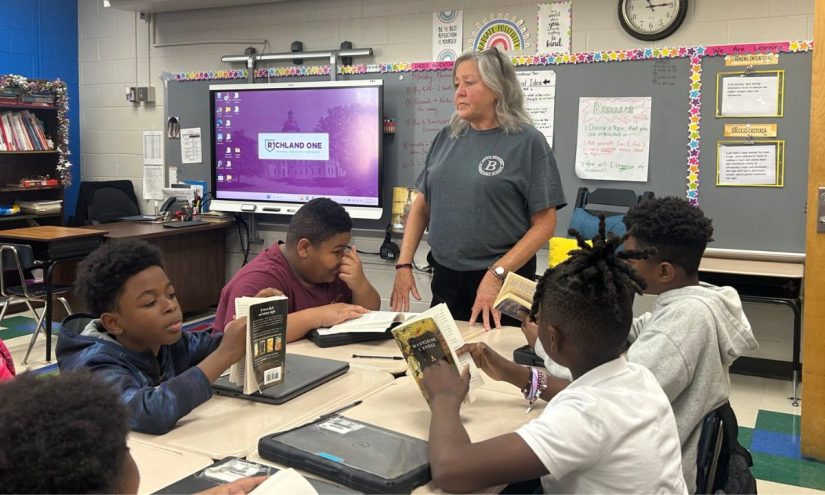
    I see it every fall: A student suddenly needs to go to the bathroom mid-lesson. Another zones out completely, distracting nearby classmates during a lesson. Tears well up as a child struggles with a problem they just can’t get through.

    These are the telltale signs of math anxiety creeping back into my classroom, and it’s heartbreakingly common. Between 70% and 78% of students experience a decline in math skills over the summer across elementary grades. By the time they reach fifth grade, students can lag behind their peers by two to three years.

    That means students are missing out on crucial math skills that form the foundation for everything that comes later. As many teachers can attest, math remains one of the hardest subjects to teach because the basics aren’t always as black and white as they seem.

    I’ve had to look for new ways to break down those barriers and ease the pressure. That’s why I’ve leaned into game-based learning. It takes something stressful and makes it approachable. In teaching math, that makes all the difference.

    I first brought games into my math block because I wanted to try something different. A student suggested we review a concept with a math game he had used, and I decided to give it a shot.

    There are plenty of games: Math Reveal, Quizizz and Coolmath among them. In my class we use Prodigy, which allows students to play as wizards exploring different fantasy worlds. They progress through the game by engaging in math-based quests and battles, answering a series of math questions to power spells, cast attacks or heal their wizard. Behind the scenes, the platform analyzes each student’s strengths and gaps, then adjusts and tailors content to the appropriate learning level.

    The benefits were clear almost immediately, and the atmosphere in my classroom shifted. Kids who normally avoided eye contact were leaning in, laughing and actually asking to do math. It was a small change at first, but it began breaking down the anxiety that had been holding students back.

    Their anxiety turns into curiosity, and their avoidance shifts into active participation. Students knew they could make mistakes, try again and keep moving without the fear of failure they often carried into traditional lessons.

    Over time, I’ve learned that these games weren’t just fun. They were powerful teaching tools. Game-based learning platforms helped students review after new lessons and revisit older concepts to keep their skills sharp. As a result, when we moved on to fractions or multi-step problems, they weren’t burdened by forgotten fundamentals.

    Now, I incorporate game-based learning throughout my curriculum. I may introduce a new lesson with a quick round or have students partner up to practice and reinforce a concept. Before a test, I can assign relevant game modules that give students a low-stakes way to practice and prepare.

    I noticed students catching up quicker than in previous years. At the start of one school year, I had eight students who were pulled out of my class for extra math help. By the end of the year, only two needed the extra support.

    And let’s be honest: These tools have helped me, too. Teaching math can be overwhelming, especially with constant pressure to get every student up to speed and prepared for benchmark tests.

    Game-based learning became a comforting resource for me because it offers new ways to personalize lessons and celebrate small wins. As students play, I can track their learning in real time to see which skills they’ve mastered, where they’re struggling and how their performance is shifting over time. Students can move at their own pace now, and I can step into the role of guide rather than taskmaster.

    Like any classroom tool, game-based learning works best when you use it with intention. Over the years, I’ve learned some strategies that make it more than just “play time.”

    • Play along: When I first started using game-based learning platforms, I didn’t fully understand how each game worked or the way they built in rewards, challenges, and storylines that keep kids engaged.

      That changed when I created my own character and began playing alongside my students. Suddenly, when a student shouted, “I just beat the Puppet Master!” I knew exactly what that meant, and I could celebrate and learn with them.

      By experiencing the games myself, I learned how to implement them in the classroom. I could see firsthand how to weave them into lessons, when to use them for review versus pre-teaching, and how to keep the fun from becoming a distraction.

    • Assign with purpose: I don’t just let students log in and click around. I strategically tie games to the key concepts we’re learning that week or use them to revisit skills. For example, I might assign a short warm-up where they tackle problems from earlier in the year so they’re never losing touch with old material. Cyclical practice helps build long-term retention while lowering the stress of new concepts.
    • Differentiate lessons: One of the biggest wins with game-based learning is how easy it is to differentiate and personalize learning. In any classroom, I have students at wildly different levels: Some need extra review, others are ready to race ahead. With games, I can assign work that meets each child where they are.

      That flexibility saves me time, but more importantly, it saves students from unnecessary stress. They can master concepts step by step, and I can gently move them up without overwhelming them.

    When I first introduced game-based learning, I didn’t know what to expect. It felt like one more thing to manage. But I let students guide me, and the results spoke for themselves. They were more engaged, less anxious and more willing to try.

    For teachers who are unsure, my advice is simple: Give it a chance. Watch your students light up when math feels less like a hurdle and more like a game. For me, the greatest reward has been seeing kids who once dreaded math start to relax, build confidence and move from “I can’t do this” to “Can we play again?”

    Game-based learning isn’t about replacing rigor. It’s about sparking curiosity, reducing fear and creating the kind of engagement that fosters a genuine love of learning. Most of all, it reminds us — and our students — that math can, and should, be fun.


    Did you use this article in your work?

    We’d love to hear how The 74’s reporting is helping educators, researchers, and policymakers. Tell us how
    Source link

  • No Frogs Were Actually Harmed in Describing Systems Thinking – Teaching in Higher Ed

    No Frogs Were Actually Harmed in Describing Systems Thinking – Teaching in Higher Ed

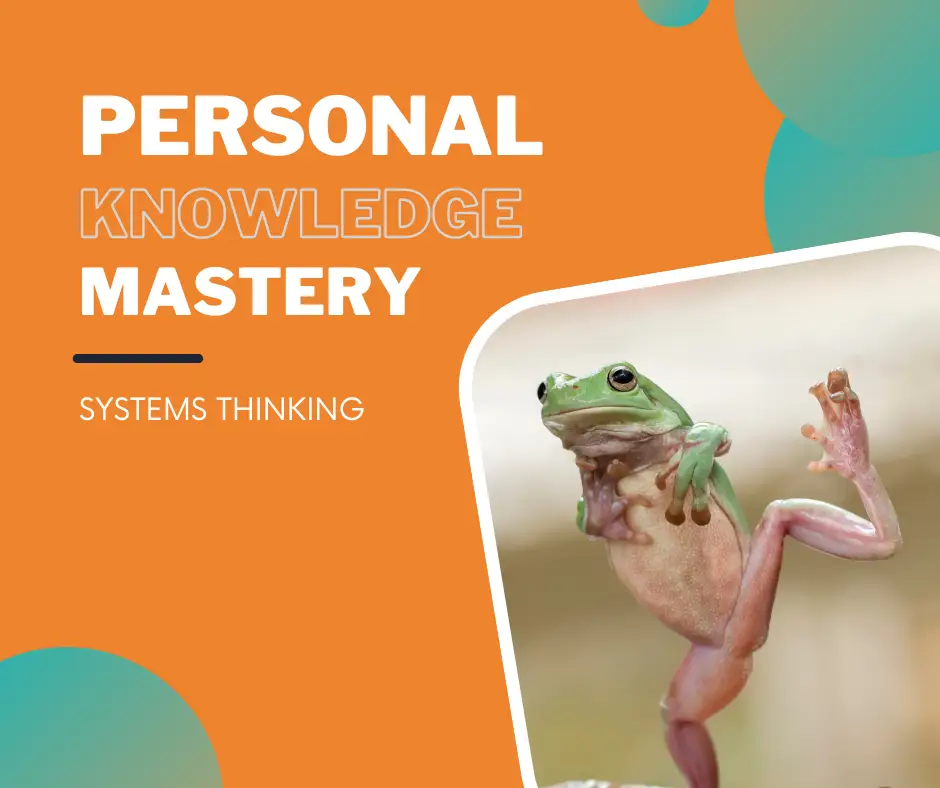
    This post is one of many, related to my participation in  Harold Jarche’s Personal Knowledge Mastery workshop.

    As we round down our time in the PKMastery workshop, I’m now presented with a topic that is both familiar, yet still incredibly challenging for me: systems thinking. One of the best books I read in my MA was The Fifth Discipline: The Art & Practice of the Learning Organization. I discovered that I didn’t have a digital copy (where I like to keep highlights) and was fortunate to find it on sale for $1.99, plus a digital credit that made it “free”.

    The key dimensions of the disciplines of the learning organization are listed by Senge in the introduction:

    • Systems thinking: He describes here how rain happens, with a bunch of different events that happen across distance, time, and space, yet: “… they are all connected within the same pattern. Each has an influence on the rest, an influence that is usually hidden from view. You can only understand the system of a rainstorm by contemplating the whole, not any individual part of the pattern.” We use systems thinking to be more effective at seeing the full picture and associated patterns, as well as to find ways to facilitate change.
    • Personal mastery: Senge distinguishes the multiple meanings of the word mastery. Yes, it can mean dominance over another, yet can also have to do with proficiency. He defines personal mastery as, “…the discipline of continually clarifying and deepening our personal vision, of focusing our energies, of developing patience, and of seeing reality objectively.”
    • Mental models: These baked in assumptions, over-generalized beliefs impact how we understand and explain what happens and the actions we take as a result of those paradigms.
    • Building shared vision: Organizations that achieve great things do so through leadership capacity at developing a shared perspective on where the organization is headed. Senge describes: “When there is a genuine vision (as opposed to the all-too-familiar “vision statement”), people excel and learn, not because they are told to, but because they want to.”
    • Team learning: Senge encourages us to look to the Greeks’ practice of dialog vs discussion. When we are in dialog, our ideas are free-flowing and we can build a capacity to suspend our assumptions and actually think together. In contrast, the word discussion has ties with word like “percussion” and “concussion” and the idea of competitive ideation can take place.

    Senge describes how the fifth discipline is systems thinking, because it weaves together the other disciplines toward intentional transformation. When we can visualize something better, we can understand it more effectively, as Jarche illustrates in a story about when NASA first released a picture of the earth, taken from space. He writes how:

    There are many ways to use visualization to understand data better. The real value of big data is using it to ask better questions. Visualization can be a conversation accelerator.

    Taking existing systems and using visualization to surface the ways the various parts of the system shape the other parts is vital in increasing our individual and collective abilities to learn.

    What Holds Us Back From Being a Learning Organization

    In chapter two, Senge writes about what he calls organizational learning disabilities. I’m not sure he communicates in such a way to support more of an asset-based framework for disability that many of us have become familiar with today. But I still want to list and describe them here, as this was my biggest takeaway from the book, reading it more than twenty years ago.

    1. “I am my position”

    “When asked what they do for a living, most people describe the tasks they perform every day, not the purpose of the greater enterprise in which they take part. Most see themselves within a system over which they have little or no influence. They do their job, put in their time, and try to cope with the forces outside of their control. Consequently, they tend to see their responsibilities as limited to the boundaries of their position.”

    1. “The enemy is out there”

    “When we focus only on our position, we do not see how our own actions extend beyond the boundary of that position. When those actions have consequences that come back to hurt us, we misperceive these new problems as externally caused. Like the person being chased by his own shadow, we cannot seem to shake them.”

    1. The illusion of taking charge

    “All too often, proactiveness is reactiveness in disguise… True proactiveness comes from seeing how we contribute to our own problems. It is a. product of our way of thinking, not our emotional state.”

    1. The fixation on events

    Senge describes how we evolved out of societies where people had to be focused on events to survive, like watching for the saber-toothed tiger to show up and be able to respond immediately.

    “Generative learning cannot be sustained in an organization if people’s thinking is dominated by short-term events. If we focus on events, the best we can ever do is predict an event before it happens so that we can react optimally. But we cannot learn to create.”

    1. The parable of the boiled frog

    “Learning to see slow, gradual processes requires slowing down our frenetic pace and paying attention to the subtle as well as the dramatic… The problem is our minds are so locked in one frequency, it’s as if we can only see at 78 rpm; we can’t see anything at 33-1/3. We will not avoid the fate of the frog until we learn to slow down and see the gradual processes that often pose the greatest threats.”

    Remember that this is meant to be a metaphor to help us explain this phenomenon. No frogs were harmed in sharing this boiling frog apologue.

    1. The delusion of learning from experience

    “Herein lies the core learning dilemma that confronts organizations: we learn best from experience but we never directly experience the consequences of many of our most important decisions. The most critical decisions made in organizations have systemwide consequences that stretch over years or decades.”

    1. The myth of the management team

    “All too often, teams in business tend to spend their time fighting for turf, avoiding anything that will make them look bad personally, and pretending that everyone is behind the team’s collective strategy—maintaining the appearance of a cohesive team. To keep up the image, they seek to squelch disagreement; people with serious reservations avoid stating them publicly, and joint decisions are watered-down compromises reflecting what everyone can live with, or else reflecting one person’s view foisted on the group. If there is disagreement, it’s usually expressed in a manner that lays blame, polarizes opinion, and fails to reveal the underlying differences in assumptions and experience in a way that the team as a whole could learn from.”

    Senge goes on to describe what Chris Argyris from Harvard calls “skilled incompetence” (gift, non-paywalled article from HBR)- groups of individuals who get super good at making sure to prevent themselves from actually learning. Since we’re talking frogs a lot in this series of PKM posts, I can’t help but bring up another illustrative story having to do with skilled incompetence.

    The cartoon character Michigan J Frog would only dance and sing when the man who found him was alone. Any time that someone else entered the picture, the frog just sat there, making normal frog noises. Here’s a look at his antics:

    Looks to me like skilled incompetence and also some seriously skilled frog theatrics (but only when no one is looking).

    What Comes Next

    The next part of The Fifth Discipline is something Senge calls “the beer game.” It is a memorable look at what happens when we are unable to see the entire system, but only one part of it. Let’s just say there’s a supposed shortage of beer, and then lots and lots of beer. But you should read it, as I’m nowhere capturing the marvelous metaphor that is the beer game.

    Readers are also instructed how to map systems in this book, though it is a practice that I never mastered. Jarche links to Tools for Systems Thinkers: Systems Mapping, by Leyia Acaroglu. which gives a great introduction and series of maps to use to explore complex ideas. Acaroglu illustrates their value by describing:

    As a practicing creative change-maker, I use systems mapping tools like this all the time when I want to identify the divergent parts of the problem set and find unique areas in which to develop interventions. I also use them to gain clarity in complexity, and find it especially useful when working in teams or collaborating because it puts everyone on the same page.

    I pretty much want to take every class that Levia and her team have available on the Unschool of Disruptive Design site. I’m also thinking I had better settle myself down a bit and wrap up this PKMastery course before biting off anything more. That, plus a couple of big conferences coming up I still need to prepare for…

    Source link

  • More South Carolina Students Are Graduating, But Many Aren’t Ready for Life After High School – The 74

    More South Carolina Students Are Graduating, But Many Aren’t Ready for Life After High School – The 74


    Get stories like this delivered straight to your inbox. Sign up for The 74 Newsletter

    COLUMBIA — South Carolina high schools posted their highest graduation rate in a decade, but a quarter of students still aren’t ready for college or the workforce, according to state report card data released Monday.

    Generally, South Carolina’s schools improved compared to last year, according to the statewide data that gauges how well schools perform based on test scores, classroom surveys and student growth, among other metrics. Education officials applauded a 10-year high in the number of students graduating on time — meaning they graduated four years after entering ninth grade — while saying they would continue pushing for programs to improve how well those students were prepared for life after high school.

    “We have to make sure that our diplomas are worth more than the piece of paper that they are written on,” said state Superintendent Ellen Weaver.

    Overall, 270 schools rated “excellent” this year, an increase from 232 last year. The bottom tier of “unsatisfactory” decreased from 49 to 31, and “below average” schools dropped from 186 to 145.

    Any time the number of schools in the lowest tier shrinks, that’s good news, since it means children across the state are getting a better education, said Patrick Kelly, a lobbyist with the Palmetto State Teachers Association.

    “There’s encouraging information here,” Kelly said of the report cards.

    Officials from the state Department of Education and the independent Education Oversight Committee, which is tasked by state law with grading schools, announced the results at Annie Burnside Elementary School in Columbia, which jumped two tiers this year, from “average” to “excellent.”

    At the Richland District One school, 83% of the 306 students live in poverty. The school’s big rating boost was due to significant student improvement, as shown by their test scores, and results on a survey about the school’s general environment, according to its report card.

    “Our academic gains are no coincidence,” said Principal Janet Campbell. “They are the result of setting measurable goals, challenging our students to reach them and supporting them along the way.”

    Graduation rates and readiness

    This year, 87% of high schoolers graduated on time, up from 85% last year. That’s worth celebrating, Kelly said.

    “Our goal should be for every student in South Carolina who has the ability to earn a high school diploma,” he said.

    Three-quarters of students were ready for either college or a career after graduation, a gain of 3 percentage points, according to the state data. Less than a third were ready for both.

    Although the gap between students who are graduating and those who are prepared for what comes next continues to shrink slightly, state officials remain concerned about it, Weaver said.

    “At the end of the day, we want our students, when they leave a South Carolina high school, to know that that diploma that they carry is a diploma of value,” Weaver said. “This is a diploma that is going to ensure that they are ready to go onto whatever post-secondary success looks like for them.”

    All 11th graders in the state take a test assessing skills commonly needed for jobs, divided into four areas: math, reading, understanding data and “soft skills,” which include aspects of a job such as dressing professionally and working well with others. Results are graded from 1 to 5, with higher scores suggesting students are ready to pursue more careers.

    Students are considered career-ready if they receive a score of 3 or higher on that test, earn a technical education certificate, complete a state-approved internship or receive a high enough score on the Armed Services Vocational Aptitude Battery to enlist in the military. This year, 73% of students met that benchmark, compared to 70% last year, according to report card data.

    College readiness is based on a student’s score on the ACT or SAT college entrance exam, college credit earned through a dual-enrollment course and/or scores on end-of-course Advanced Placement tests.

    One-third of graduating students were college-ready, which is on par with at least the past five years, according to state data. The rate of high school students applying for college also continued to decrease, with 59% reporting filling out applications this year, compared with 61% last year.

    A gap between graduation rate and readiness for the next step suggests schools are sometimes passing students without actually imparting the skills they need to succeed in life, Kelly said.

    For instance, district policies setting minimum grades teachers can give makes it easier for students to pass their classes, even if they haven’t actually done the work, Kelly said. Alternatives for students who fail tests or classes are sometimes easier, meaning a student can catch up without actually learning the same skills as their peers, he said.

    “We’ve put some policies in place that make it harder to evaluate what a student knows and can do,” Kelly said.

    Beginning this school year, students can follow a so-called pathway to earn credentials that build on each other every year, allowing students to learn more advanced skills meant to make it easier to find a job in the field they want to pursue, said April Allen, chair of the Education Oversight Committee’s governing board.

    “At the same time, we recognize that strengthening the system must go hand-in-hand with addressing the barriers that keep students from wholly engaging in school,” said Allen, who’s also a government relations director for Continental Tire.

    Chronic absenteeism and test scores

    For example, the number of students who missed at least 10 days of school this year remained a concern, Allen said.

    Around 23% of students were chronically absent, essentially the same number as last year. The more days of school a student misses, the less likely they are to perform as expected for their grade level on end-of-year tests, according to a report the committee put out last year.

    Those tests, in turn, play a role in determining how well a school or a district is performing. Officials and teachers’ advocates credited the Palmetto Literacy Project and a change in how early educators teach reading for improving English scores, but math scores remain low, with less than half of third- through eighth-graders able to perform on grade level, according to state testing data.

    Just over half the state’s high school students scored at least a C, which is a 70%, on their end-of-course Algebra I exams, often taken freshman year, according to report card data. Nearly 69% passed their English 2 exams, typically taken sophomore year.

    While rooting for improvement, teachers’ advocates also warned against depending too heavily on a single exam score in deciding how well teachers and students are performing. A single, high-pressure exam at the end of the year is not necessarily the best indicator of school performance, said Dena Crews, president of the South Carolina Education Association.

    “If people are making judgments based on that, they’re missing a whole lot about schools and districts,” Crews said.

    Teacher support

    The Department of Education plans to focus on teachers in 2026, Weaver said.

    “The No. 1 thing that we have to do to support student learning is take care of our teachers,” Weaver said.

    She is asking legislators to raise the minimum pay for a first-year teacher to $50,000, up from $48,500. Legislators have increased the pay floor in increments for years, with the stated goal of reaching $50,000.

    Weaver is also asking for $5 million to continue a pilot program that awards teachers bonuses based on how well their students perform on tests. She also wants to start a program that offers extra pay to exceptional teachers who mentor others. The additional responsibility would be another way to earn more money without leaving the classroom to go into school administration, she said.

    Supporting teachers is key in improving how well schools are performing, Kelly said. The promising results in this year’s report cards came after the first dip in teacher vacancies since 2019, he added.

    “It should not be a surprise to see school performance improve as teacher vacancies go down,” Kelly said.

    SC Daily Gazette is part of States Newsroom, a nonprofit news network supported by grants and a coalition of donors as a 501c(3) public charity. SC Daily Gazette maintains editorial independence. Contact Editor Seanna Adcox for questions: [email protected].


    Did you use this article in your work?

    We’d love to hear how The 74’s reporting is helping educators, researchers, and policymakers. Tell us how
    Source link

  • What Happens When We Start Making the Work Visible – Teaching in Higher Ed

    What Happens When We Start Making the Work Visible – Teaching in Higher Ed

    This post is one of many, related to my participation in  Harold Jarche’s Personal Knowledge Mastery workshop.

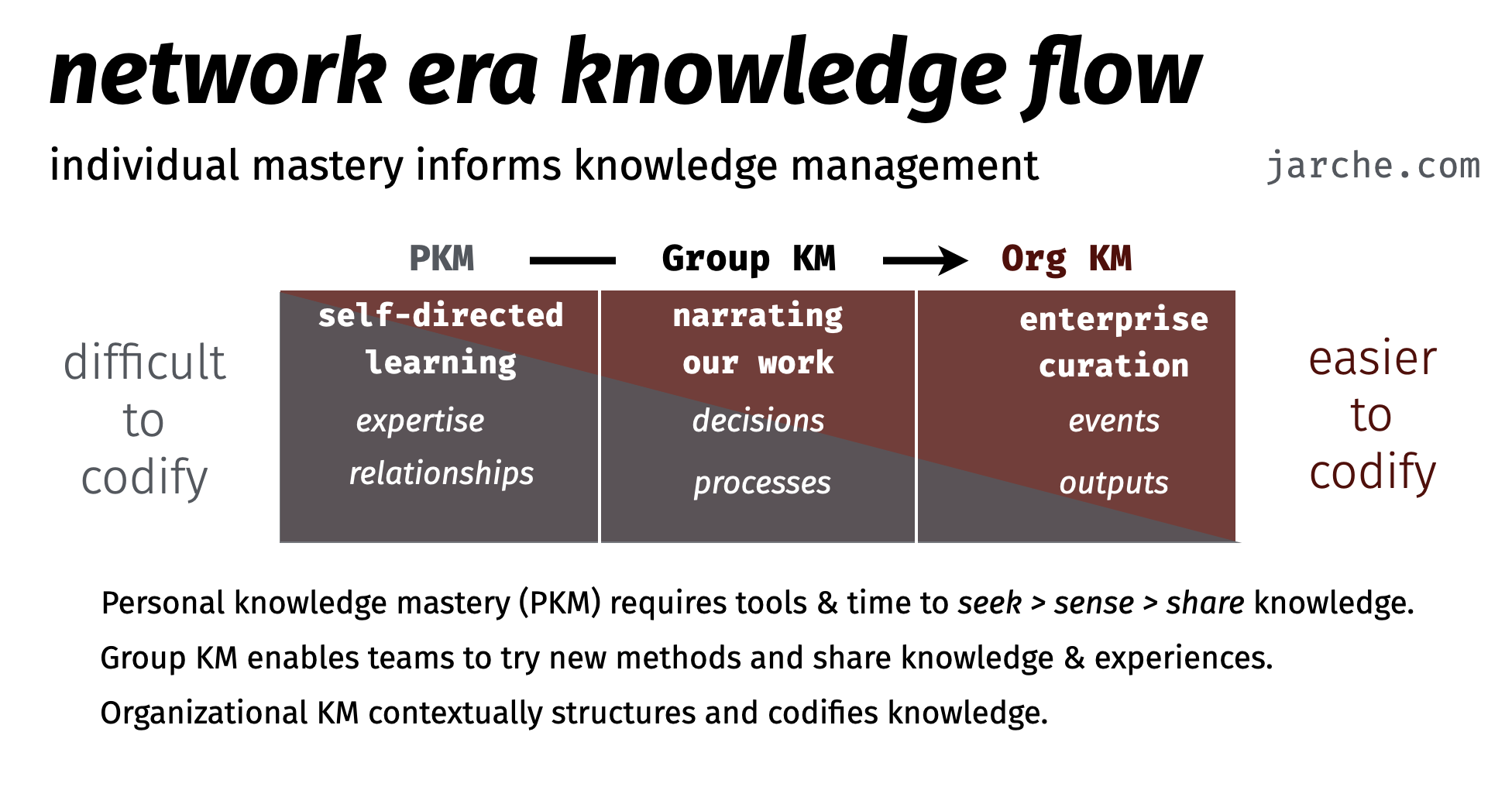
    Jarche informs us that when we narrate our work, we don’t experience knowledge transfer, but what we do get is greater understanding. Our individual, self-directed learning is difficult to codify, he explains, and is more focused on relationships and expertise. When we narrate our work, focusing on decisions and processes, we make that work more visible to others. This means we can experiment and share knowledge, learning together in real time. The results of this thinking together results in enterprise curation, where we can more easily codify knowledge and experience the results of our earlier efforts.

    network era knowledge flow individual mastery informs knowledge management Personal knowledge mastery (PKM) requires tools and time to seek, sense, and share knowledge

    The value of social bookmarks are hard to see, at first. However, over time, especially when combined with the use of feed aggregators and readers, we eventually get to witness the power of PKM as a discipline. I’ve been using Raindrop.io bookmarks for years, now, and enjoy having shareable bookmarks (which I can surface, when a situation encourages that practice), yet most of my collections are private. One that is now public is my growing collection of AI articles, in both an RSS feed and just a browsable page.

    I do find myself cringing a bit as I save items there, knowing that I certainly don’t endorse each link I save and the topic of AI is so controversial and polarizing. I’ve got everything up there from the world as we know it is crumbling to its core to fun hacks to use AI to build you a rocket ship to the moon (or load your dishwasher) or some such thing.

    Jarche states that our emphasis when we narrate our work should be on making our thinking accessible, but to avoid disrupting people with what we choose to share. He writes:

    The key is to narrate your work so it is shareable, but to use discernment in sharing with others. Also, to be good at narrating your work, you have to practice.

    One practice Jarche mentions under his tips and links section is to keep a journal. While I’ve not been good at this practice since my teenage years long ago, I did find many of these 6 Ways Keeping a Journal Can Help Your Career compelling. In Episode 425 of Teaching in Higher Ed, I share Viji Sathy’s and Kelly Hogan’s suggestion to keep a “Starfish” folder. There are variations of the beloved story of the starfish, including this Tale of the Starfish page from the Starfish Foundation with a powerful video describing the power in making a difference for a single starfish, even if we can’t rescue them all.

    I have kept up with digital encouragement folders for years now, both on my email accounts, as well as in my file directories (across my personal and professional domains). While not a journal, exactly, these stories and words can bring me encouragement during difficult times.

    I’ve been paying for the Day One Journal App for years now, though entirely languish in my practice of journaling. I would switch over to Obsidian, which has the benefit of future proofing any notes I take using Obsidian, since they are just text files sitting wherever I want them to be (as in if the app went away, the text files are still there and readable).

    However, Day One brings together all the TV and movies that I’ve watched, all my social media posts and images, and all the videos I’ve favorited on YouTube. I use Sequel to track what I want to watch, which then optionally integrates with the free Trakt service, which allows for an IFTTT rule to add an entry to Day One each time I mark something as watched in Sequel. In case you’re wondering about how I accomplish this, I found these two automations on IFTTT and never had to change a thing.

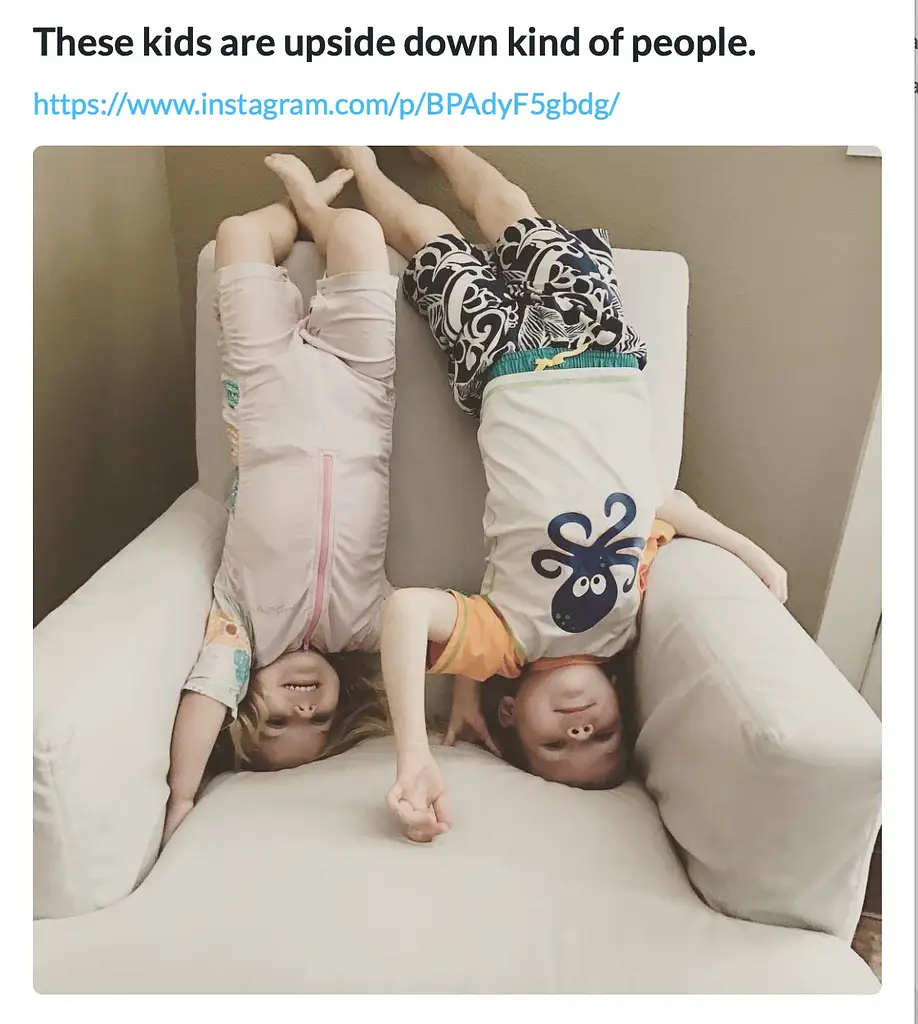
    Perhaps someday I’ll go down a rabbit trail of trying to figure out a longer-term, non-subscription based model for collecting all those memories across all those different services and not locking myself into DayOne. For now, I’m enjoying revisiting this glimpse of these two upside down kind of people from 2017….

    Two kids stand on their heads, upside down in a cushioned swivel chair

    …and then having this song from Jack Johnson start playing on the soundtrack of my mind for what I’m sure will last at least a few hours.

    Source link

  • I Can See Clearly Now The Frogs Are Here – Teaching in Higher Ed

    I Can See Clearly Now The Frogs Are Here – Teaching in Higher Ed

    This post is one of many, related to my participation in  Harold Jarche’s Personal Knowledge Mastery workshop.

    Sometimes we think we need experts, sure. But we shouldn’t dismiss the power of finding fellow seekers. There are times when an expert might help us, but also times they leave us behind or otherwise are unable to contribute to our growth. They may not have sufficient beginner’s mind or childlike curiosity. We may need the empathy and lack of judgement that can be possible with someone who is still wrestling through these same ideas, themselves.

    I’ve often tried to coach students in showing them the ways that they can help their professors, when they often think their only possible role is as one being the receiver of help. Similarly, when we are in a seeking role, we aren’t able to see the ways we can add value to the learning process for ourselves and others. We can wrestle with trying to give the appearance of competence versus staying in the seeker’s mindset and focusing on curiosity and wonder. This hesitance at potentially looking foolish to others in our incompetence can not only hold us back from learning, but also cause us to feel alone. It is vital to connect with other seekers and experience the benefits of those roles within our networks.

    Jarche writes:

    Your fellow seekers can help you on a journey to become a Knowledge Catalyst, which takes parts of the Expert and the Connector and combines them to be a highly contributing node in a knowledge network. We can become knowledge catalysts — filtering, curating, thinking, and doing — in conjunction with others. Only in collaboration with others will we understand complex issues and create new ways of addressing them. As expertise is getting eroded in many fields, innovation across disciplines is increasing. We need to reach across these disciplines.

    I sure hope Harold is right about cross-disciplinary innovation expanding, as we need that more than ever. In Range: Why Generalists Triumph in a Specialized World, David Epstein instructs:

    Compare yourself to yourself yesterday, not to younger people who aren’t you. Everyone progresses at a different rate, so don’t let anyone else make you feel behind. You probably don’t even know where exactly you’re going, so feeling behind doesn’t help. Instead… start planning experiments.

    The Value of Experiments

    What are experiments? Epstein describes them by introducing physicist Andre Geim and his “Friday night experiments” (FNEs). It was through these endeavors that Geim won not a fancy Nobel Prize, but an Ig Nobel (which Geim shares with collaborator M V Berry via their Of Flying Frogs and Levitrons piece, available through the Internet Wayback Machine). The Ig Nobel is bestowed on those who at first seem like they’re doing something ridiculous. From Wikipedia:

    The Ig Nobel Prize (/ˌɪɡ noʊˈbɛl/) is a satirical prize awarded annually since 1991 to promote public engagement with scientific research. Its aim is to “honor achievements that first make people laugh, and then make them think.” The name of the award is a pun on the Nobel Prize, which it parodies, and on the word “ignoble”.

    A serious researcher, Geim is (as of 2025) the only person to both win a Nobel and an Ig Nobel prize. Those who are in line to potentially win an Ig Nobel are first informed, such that they can determine if the satirical nature of the designation might be detrimental to their research careers. For his FNEs, Geim was experimenting with levitating frogs with magnets and was awarded the satirical prize for that less “serious” work. Through another FNE, Geim wound up developing “gecko tape,” which was based on the properties of geckos’ feet. These less serious experiments contributed to his more “serious” research, which ultimately led to his prestigious receipt of a Nobel Prize.

    A lump of graphite, a graphene transistor, and a tape dispenser.

    This 2010 image of a lump of graphite, a graphene transistor, and a tape dispenser, items that were given to the Nobel Museum by researchers Andrew Geim and Konstantin Novoselov to reflect their Nobel research. Before their discoveries, it was believed to be impossible to create material that could conduct electricity in such thin layers as graphene is now able to, which has opened up even more possibilities in both material science and electronics.

    In his first-person narrative from his 2010 Nobel Prize, he describes how his Russian literature tutor critiqued his writing for trying too hard to parrot experts vs trusting his own intuition. Geim writes:

    My tutor said that what I was writing was good but it was clear from my essays that I tried to recall and repeat the thoughts of famous writers and literature critics, not trusting my own judgement, afraid that my own thoughts were not interesting, important or correct enough. Her advice was to try and explain my own opinions and ideas and to use those authoritative phrases only occasionally, to support and strengthen my writing. This simple advice was crucial for me – it changed the way I wrote. Years later I noticed that I was better at explaining my thoughts in writing than my fellow students.

    I once was able to interview a recipient of the Ig Nobel for Teaching in Higher Ed: Episode 591 – Rethinking Student Attendance Policies for Deeper Engagement and Learning with Simon Cullen and Danny Oppenheimer. Danny is the one of these two collaborators with this great honor. Take a look at the incredible title of the piece that won him the Ig Nobel: Consequences of Erudite Vernacular Utilized Irrespective of Necessity: Problems with Using Long Words Needlessly, by Daniel M. Oppenheimer Imagine how bummed I was that despite me being so excited to ask him more about it, my nerves got the best of me and I entirely forgot to ever mention it during our conversation for the podcast.

    Researching Versus Searching

    Epstein describes in Range the ways in which the novice mindset gets weaved together with the expert mindset in such transformative ways. He reveals how us being willing to be vulnerable in our not knowing and early experimentation through an art historian’s description of how Geim is emblematic of this willingness to stay in the not knowing longer. Epstein tells how:

    Art historian Sarah Lewis studies creative achievement, and described Geim’s mindset as representative of the “deliberate amateur.” The word “amateur,” she pointed out, did not originate as an insult, but comes from the Latin word for a person who adores a particular endeavor. “A paradox of innovation and mastery is that breakthroughs often occur when you start down a road, but wander off for a ways and pretend as if you have just begun,” Lewis wrote.

    My friend, Naomi, and I always joke with each other about our “rabbit trail” emails back and forth to each other. I often wish there were a better expression that more precisely evokes the delight that can come from a diversion. Two years before he won the Nobel, Geim was asked to explain his research process. He described how instead of always going deep, he likes to stay in the shallow and move around. He described:

    I don’t want to carry on studying the same thing from cradle to grave. Sometimes I joke that I am not interested in doing re-search, only search.

    Seeking as Doing

    Jarche illustrates how when trust is low that doers, connectors, and catalysts can address the limitations of credibility that exist in the roles of professors, stewards, and experts. He asserts: We Need Less Professing and More Doing. He describes how someone like Zeynep Tukekci can be not a medical professional herself, but so gifted at weaving “knowledge from many disciplines into a coherent narrative.”

    Jarche stressing the doing part made me think of Mike Caulfield, who says that novice fact checkers need not to solely focus on critical thinking, but he would rather we all get far better at teaching critical doing skills. I’ve been having a blast following Mike’s own critical doing skills as he documents his experiments with in what ways AI may be able to help with critical thinking/doing. He is in the process of learning out loud, as he identifies the less helpful approaches for trying to use AI for fact checking and where he sees promise for achieving better results than most people would be able to come up with, themselves.

    In a lot of ways, I’m seeing Harold Jarche’s Personal Knowledge Mastery Workshop as my own set of small experiments. In Dave’s recent Coaching for Leaders Episode 747, he interviews Laure Le Cunff, author of Tiny Experiments: How to Live Freely in a Goal-Obsessed World. Le Cunff explains how:

    The secret to designing growth loops is not better knowledge or skills, but your ability to think about your own thinking, question your automatic responses, and know your mind.

    Sounds a lot like PKM to me… Until next time. For now, it is dinnertime around here and we ordered Cheesecake Factory. It’s good to be back home. In the meantime, here’s for our individual and collective ability to see clearly now, as we practice PKM together.

    Source link

  • conflict, peace and international education 

    conflict, peace and international education 

    It’s that time of year again. On streets and in shops across the UK this, someone will have been be selling poppies. And today, on Remembrance Sunday, at War Memorials from tiny villages to Whitehall, people will gather for a period of silence. A moment to reflect, to remember. 

    For me personally, there is a family connection. My paternal great-grandfather was killed in WWI, leaving four young children. His name is on the vast Tyne Cot memorial in Belgium, one of 35,000 of the missing who died in the Ypres Salient after August 16, 1917, and have no known grave.

    But I also think of another memorial, the one I gathered around for the years I worked at Sheffield University. This is the moving tribute to the students and staff who lost their lives in two World Wars. 

    This carved stone monument at the University’s core was once located in the original library, and it contains arguably the most sacred and painful book in its collection – a Book of Remembrance.

    Sheffield University had its own battalion in WWI and it was almost completely destroyed on the first day of the Battle of the Somme in 1916. Some 512 young men lost their lives in a single day. I was once given permission to lift off the glass cover and open the book. It was shocking, each page crammed full of so many hundreds of names. 

    For many of those students, hopefully joining up and travelling to France was the first time they had been overseas, just as it was for my great-grandfather. He left his mining village on the unluckiest of journeys – first to Gallipoli where he was gassed, and then to France where he died in the mud. 

    Today, students have a very different opportunity for travel, for connection. A century after my great-grandfather died, I have travelled the world in peacetime thanks to international education. I’ve been to Delhi and seen the vast war memorial at India Gate with its eternal flame and walls of other names – Hindu, Sikh, Muslim. I have friends from China whose relatives long ago would have dug the trenches as part of as part of the 140,000 strong Chinese Labour Corps for the British and French armies.

    Remembrance Day isn’t a British only tradition – a whole world was drawn into those terrible events. 

    What international students teach us now 

    And I have international students friends who don’t need a poppy to remind them to remember because they come from countries with current experience of conflict. 

    Who are they? A refugee scholar from Syria working on environmental sustainability. A Gaza scholar who rejects the language of resilience and uses her research to build deep understanding. A friend in Singapore who has family in Russia and Ukraine. And the Afghan scholars who have become not only friends but family, those who teach us all that the peace to sit with your loved ones and share a meal is never to be taken for granted. That for young girls and women to access education, university, careers and have choices is a right hard won that must be cherished. Each of them is also my teacher. 

    As the world changes, nationalism grows and spheres of influence are fortified by economic and literal weapons, those who understand one another are more important than ever

    And this is also why I believe in international education. Peace takes understanding. It takes work. As the world changes, nationalism grows and spheres of influence are fortified by economic and literal weapons, those who understand one another are more important than ever. 

    It is a tragedy that language courses close because, as John le Carré said, learning a language is an act of friendship. But international education in all its forms is also what my NISAU friends call a ‘living bridge’.

    Whether it happens through traditional programmes of overseas study, short courses, institutional partnerships, TNE or internationalisation at home, global education offers a precious opportunity to meet in peace. To gain a perspective not only on what others think and how they see the world, but about yourself. 

    Why it matters that #WeAreInternational 

    When years ago we founded a campaign called #WeAreInternational , it was a statement not about a structure of higher education but about who we are and want to be. It doesn’t mean abandoning your identity, it means opening it up to possibility. That is in itself an education. 

    John Donne famously wrote that no man is an island but that we are deeply connected to one another, all of us connected to the continent. And when others are harmed, we are all diminished. That the bell that tolls for any life is ringing for humanity too. 

    On Remembrance Sunday this year, as we are urged never to forget, there is also an implicit call to action – not to wage war but to build peace. How do we do that? Nobody is pretending it’s easy, but I think the education we are privileged to support has a very human part to play. 

    I think of the words of my Afghan scholar friend Naimat speaking at City St George’s University of London to students earlier this week. As the minute’s silence begins on today, I will think of my great-grandfather Robert, the lost students of Sheffield University, and the words of this international student who knows of what he speaks. 

    To achieve peace at all times, we must do three things:

    1. Acknowledge the past: we must study and accept the hard lessons, the disconnected dots, and the mistakes of history.
    2. Act in the present: we must stand up against injustice wherever it occurs, recognising that a violation of human rights in one corner of the world eventually casts a shadow over all of us.
    3. Prioritise the future: we must commit to sustained dialogue – not just talk, but a genuine exchange of ideas where all voices, especially the most marginalised, are heard and valued.

    Dialogue, he says, is the non-violent tool we possess to sustain peace. It is how we convert fear into understanding, and resentment into cooperation. And international education offers a precious and powerful opportunity for both. 

    Source link

  • WEEKEND READING: The future of languages in a multilingual Britain

    WEEKEND READING: The future of languages in a multilingual Britain

    This blog was kindly authored by John Claughton, Co-Founder of The World of Languages and Languages of the World and former Chief Master of King Edward’s School, Birmingham.

    The other day, there was a big crowd packed into the Attlee Room in Portcullis House to celebrate the European Day of Languages – it was a comfort that no one had deemed it necessary to wear a sombrero or lederhosen. It was a co-production by the All Party Parliamentary Group for Languages and the All Party Parliamentary Group for Europe. The French and EU Ambassadors to London were the guests of honour, and the meeting was chaired by that rara avis, Darren Paffey, an MP who had been a languages academic. And he even has a wife who teaches languages. Is there, after all, a candle of hope for us all?

    The event was, like Gaul, divided into three parts. The first part was the noble land of diplomacy, with emphasis on the need for mutual understanding, co-operation and mobility in pursuit of global prosperity and harmony. At least everyone agreed that it was time for Erasmus to return – the programme, not the author of In Praise of Folly.

    Part Two was less to do with the noble sentiments of the Republic of Plato than the sewers of Romulus. It was about the grim facts of language learning presented by Megan Bowler, the harbinger of darkness, who wrote the HEPI report on the ‘language crisis’:

    • only 3% of A-level entries are in languages, and a mighty slug of those would come from independent schools;
    • undergraduate enrolments in languages are down by 20% in five years;
    • language teacher recruitment is less than half of what it needs to be;
    • there would still be language teacher shortages if every languages graduate went into teaching.
    • 28 out of 38 post-1992 universities have closed their language departments:
    • it is now quite common for Oxbridge colleges to get fewer than 10 applicants each for languages. That’s less than Classics, by Jove.

    Nor did the recent announcement about the end of IB funding bring any cheer: after all, every IB pupil has to study a language between the ages of 16 to 18.

    After the cold wind of reality had blown through the room, Vicky Gough, the Schools Adviser at the British Council, and Bernardette Holmes, the Director of the National College for Language Education (NCLE), talked of the tracks across this bleak terrain which might lead to better days. The HEPI report itself makes ten recommendations, and there are clearly things that universities can do to make languages more appealing – ‘Bring back Erasmus,’ they cry. However, the future of languages in university cannot lie in the hands of universities. The landscape can only be changed by a fundamental rethink about the teaching of languages at the very beginning of this journey. And that rethink has to reflect the fundamental change that has taken place in the pupils who now sit in our classes. Here are some ‘facts’ which show that fundamental change:

    • 20% of primary school pupils are categorised as EAL, i.e. English is not their first language;
    • this figure materially understates the percentage of pupils who are multilingual in our schools: for example, I know that over 50% of the pupils in the school where I was head were bilingual, even though none of them were categorised as EAL.
    • in many areas of many of our cities, there are primary schools where 90% of pupils are classed as EAL pupils.
    • there are many, many schools in London, or Birmingham, or Leicester, or Bradford where 30, or 40, or even 50 languages are spoken.
    • the schools with the greatest linguistic diversity are very often the schools in the most disadvantaged areas, areas where language uptake is at its lowest.

    And yet, little or no attention, or regard or honour is given to these languages, or to the pupils that speak them. Instead, in 96% of primary schools, it is French or Spanish which is taught, often by primary school teachers who don’t even have a GCSE in the subject. It may be no surprise that too few pupils arrive keen to study a language at GCSE when their language experience has been limited and, to their already multilingual minds, irrelevant.

    So, if there is to be progress, if there is to be a halt in the decline in languages and in the regard for languages, the answer may not lie in doing a bit better what we have always done, but in doing something different. If primary school pupils were taught not French and Spanish, but about languages, their own languages, as well as English and ‘modern foreign languages’ – and even Latin – the following things might happen:

    • pupils might see that languages are relevant, interesting, valuable, even fun;
    • pupils might learn more about themselves and each other, engendering mutual understanding and respect;
    • pupils might feel that they belong in school, and feel that there is not so great a gap between their life at home and their life at school;
    • parents might feel that what was going on at school had some regard for their history and their culture;
    • pupils might be more inclined to study languages, whether their own family/heritage language, and this could be a massive asset for their futures, in human and economic terms;
    • and, as these young people grow up, they might become the kind of adults who can build an integrated, cohesive, respectful and diverse society, and thus silence the voices of division in our political debate.
    • and this approach would demolish the hierarchy of languages which has so beset us for so long.

    Thus, it would place languages at the heart of our society. That would be nice, wouldn’t it? By strange chance, I have been working with some colleagues for several years to create a programme that does just that, but I’ve reached my word limit.

    But wait, dear reader. As a special dispensation, I have been granted more words in a HEPI blog. O frabjous day. So, I’d better be quick. It’s called WoLLoW, World of Languages, Languages of the World, a brilliant palindromic acronym with an Egyptian faience hippopotamus as a logo – just look at all those Greek words – in honour of the Hippopotamus Song by Flanders and Swan. So, if that’s its wondrous name, what does it do? Well, here are some examples:

    • a WoLLoW lesson can encourage boys and girls to talk about their own language, their own family, their own history.
    • it can explore why and how English is the most mongrel of all languages, a dog’s breakfast of Celtic, Anglo-Saxon, Viking, Norman French, and polysyllabic Graeco-Latin inventions.
    • it can prove that the pupils can learn the Greek alphabet more quickly than their teachers, and thereby discover why physics isn’t spelt fisiks and dinosaurs have such preposterous names.
    • it can ask why Tuesday is Tuesday here and lots of different things everywhere else – and a WoLLoW lesson might even ask why there are seven days in a week.
    • in a WoLLoW lesson pupils can learn braille and/or sign-language, or even create their own language.

    This looks quite good fun, and it turns out that it is. Another word limit looms, but I can say that it not only cheers up pupils but it also has an impact on those who teach it. The last of my words must go to a pupil at my old school, a Malaysian Muslim, who, whilst in Year 11, taught WoLLoW in a local, Birmingham primary school:

    Working on these lessons, from the very first session, has not only given the children we have taught the opportunity to have their languages and cultures represented in class discussions, but has also allowed me to reconnect with my language and feel more confident in reclaiming it as a part of who I am. I am someone who, like, I suspect, a lot of the children we have taught, has felt disconnected from his language for a long time, and has been given the chance to once again put it front and centre and find their sense of self within it again.

    The rest is silence.

    Source link

  • Network Weaving as an Antidote to Imposter Syndrome – Teaching in Higher Ed

    Network Weaving as an Antidote to Imposter Syndrome – Teaching in Higher Ed

    I’ve been traveling this week, so got a bit behind on my reflections on Harold Jarche’s Personal Knowledge Mastery (PKM) workshop. The other thing that is a bit frustrating, is that I haven’t been disciplined about my typical sensemaking habits and practices and seem to have lost the notes I took on a video he shared about something new to me: network weaving. At some point, maybe my reflections will resurface (my digital inboxes are overflowing, at the moment, and search seems no use to me if I can’t even find the haystack that the needle may be hiding in with those notes). That’s all just to say, I’m all over the place right now.

    Network Weaving

    I stubbornly don’t want to rewatch the video at this exact moment. I’m sitting in an airport, next to an outlet with all my devices happily charging until it is time to get on my first of two flights for the day. To say that I am a person with battery anxiety is an understatement. Here’s what I remember about watching Networks: Weaving People, Ideas and Projects, though, mixed with the connections I found with other ideas I’ve encountered in the past.

    June Holley describes network weaving as connecting people, ideas, and projects. Hearing her describe the generosity and intentionality involved in network weaving had me reflecting on Coaching for Leaders Episode 279 with Tom Henschel: How to Grow Your Professional Network. Prior to listening to that conversation between Dave and Tom, I had thought about networking more as something I was never very good at, but tolerated, since I knew it was necessary in most professions.

    Tom described different types of networking and it was then that I realized I actually loved it and did it all the time; just that I hadn’t thought of what I enjoy doing falling under the category of networking. I enjoy meeting someone new and then identifying who else I know that is into the same stuff that they’re into. I think what Tom was describing is a lot like June Holley’s description of network weaving. Jarche shares this short Network Weaving 101 article from Valdis Krebs, which describes how this process is all about “closing triangles.” Krebs writes:

    A triangle exists between three people in a social network. An “open triangle” exists where one person knows two other people who are not yet connected to each other — X knows Y and X knows Z, but Y and Z do not know each other. A network weaver (X) may see an opportunity or possibility from making a connection between two currently unconnected people (Y and Z). A “closed triangle” exists when all three people know each other: X-Y, X-Z, Y-Z.

    This makes so much sense to me, instantly. Some of the other content that Jarche has shared has been challenging for me to take in (which I appreciate, as he’s stretching me and helping me grow). But this one, I feel like I get on a more instinctive level. Like I’ve been doing something for much of my life, without having a word for it, yet experiencing such joy each time it happens.

    Imposter Syndrome

    I’m also realizing that one of the ways I try to calm my nerves when preparing to do a keynote or workshop may very well be embodied by the idea of network weaving. The lizard part of my brain starts to tell myself that I have nothing to offer (this gets exasperated by being in a hotel room in an unfamiliar city, after sitting too long on airplanes all day). One of the best listener emails I ever received came from Itamar Kastner in Scotland. He said that he knows I’m a fan of music and thought I might enjoy Grace Petrie, and English Folk singer-song writer “in the protest singer tradition of Billy Bragg and Woody Guthrie,” he explained over email. Yes, indeed, Itamar was spot on in recommending Grace Petrie’s Nobody Knows That I’m a Fraud:

    To thwart the less sophisticated parts of my brain that make me wonder what I’m doing in a hotel room, preparing for the next day’s adventures, I work to shift my focus away from how I am feeling and what I might like people to experience in the session with me. I even try to shrink it down more than a bunch of nameless faces and think about a single person and where they may be struggling and potentially feeling alone or like a failure in some way. What sorts of imposter syndrome symptoms might otherwise be relieved through my vulnerability in not having everything figured out, yet learning out loud, anyway? How might that posture provide fertile ground for others to do the same?

    The second half of how I can calm my nerves is to remember that my job isn’t to talk about what I do in my own teaching, necessarily. Rather, I get to share these incredible stories and point people back to the source of inspiration that I’ve found through the podcast across all these years. This feels very much like what I now understand to be a form of collective network weaving (as in connecting many people to new ideas, people, and projects. The last eleven and a half years, I’ve been fortunate to get to talk to people from all over the world who love teaching and learning (just like me). The stories within those conversations are limitless sources of hope, practice, and feelings of solidarity.

    Jackie Shay offers the final piece of the puzzle for unraveling those feelings of insecurity that can be present for so many of us, by the way. I realize that last sentence mixed at least two metaphors at once, but give me a break. I’m sitting in an airport, remember? 😂 On Episode 571: Overcoming Imposter Syndrome Through Joyful Curiosity, Jackie asks:

    Why can’t we recognize that these different types of intelligences have just as much value as intellectual intelligence?

    I’m not supposed to ever be even close to the smartest person in the room. Not even close. But curiosity and connection? Those are two pursuits I’ve enjoyed my whole life and are forms of intelligence to be valued and cultivated in ourselves and others. As we prepare to share our sensemaking process with others, how about we stop trying to out-perform the imaginary room of intelligent people we’ll be talking at and start working on creating conversations that spark imagination?

    Jackie Shay is tremendously good at getting people curious and engaged. I remember so vividly talking to Jackie about my memories of camping with my family in Joshua Tree as a little girl and getting swept away in all the specifics that flooded into my mind. Then, I felt like I should pull back and joked about revealing a bigger focus on capitalism than I had hoped for a conversation about nature/science. My brother and I used to have a whole economy we had built out of the various elements in the desert back then, like the quartz crystals and different types of plants.

    Jackie laughed with me, but also let me know that sorting and categorizing things (as we had done with the different elements there in the desert) was actually a big part of science. We were doing science, even though I didn’t have a word for that at the time (and clearly didn’t in my embarrassment feeling like no one wanted to hear about my childhood memories until she pointed out to me that we had been doing science, without realizing it). I recalled Alexis Pierce Caudell recommending Categories We Live By: How We Classify Everyone and Everything, by Gregory L. Murphy on Episode 527. While I wish I had finished reading it by now, but it sits in the virtual pile of books I’ve started but have yet to complete. It’s not a science book, though, well… except maybe the varieties related to library science and information technology. I obviously need to read the book before I should be commenting on what it is and isn’t. Sigh.

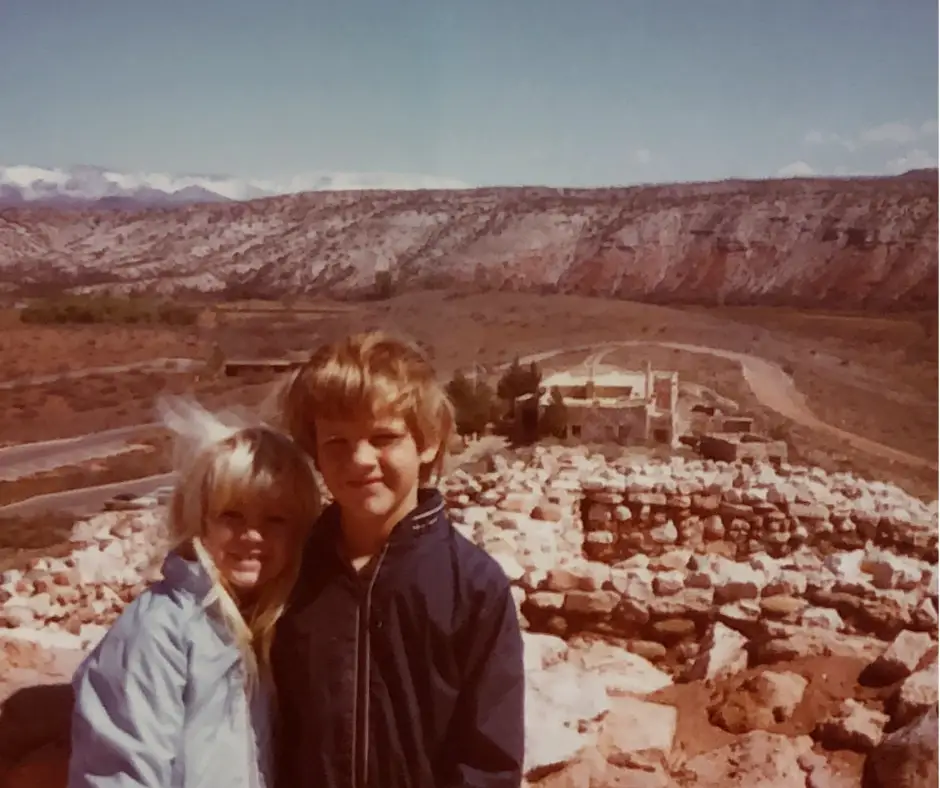
    Two young kids about the age of six and eight stand in front of hills in the background and stone structures in the foreground. The stones make up the shape of walls and other structures.

    I don’t think at all that this picture of my brother and I was actually taken in Joshua Tree. I’m going to have to see if I can find one in the photo albums I haven’t quite gotten to scanning yet. But it reminds me of our imaginative life that we had when our family would take trips together.

    Closing Triangles

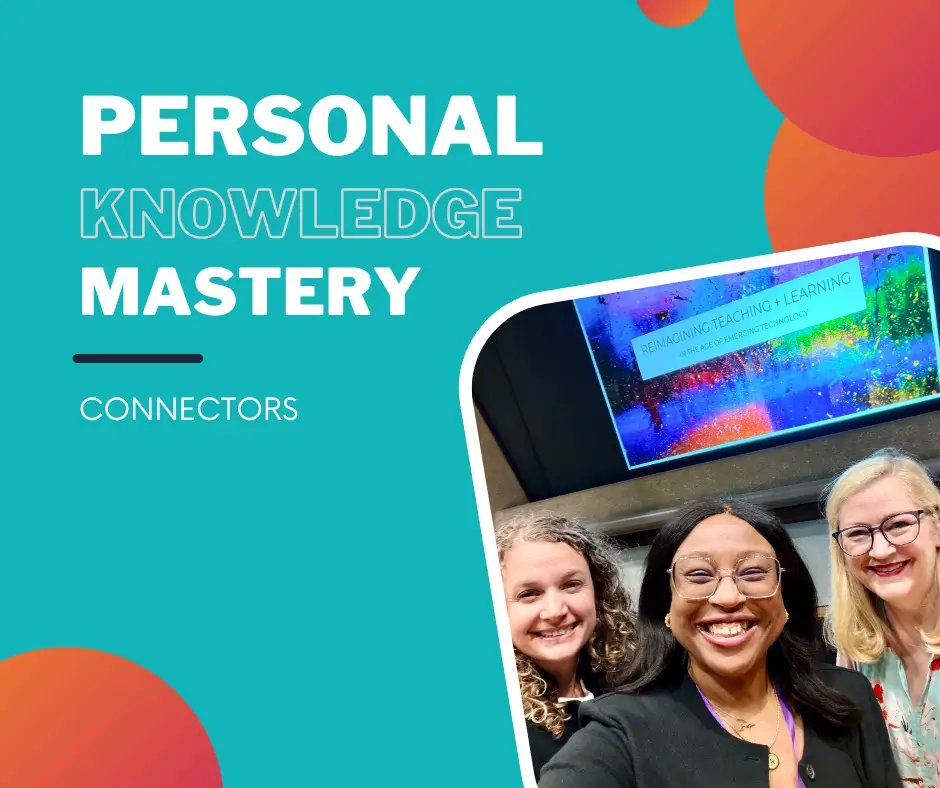
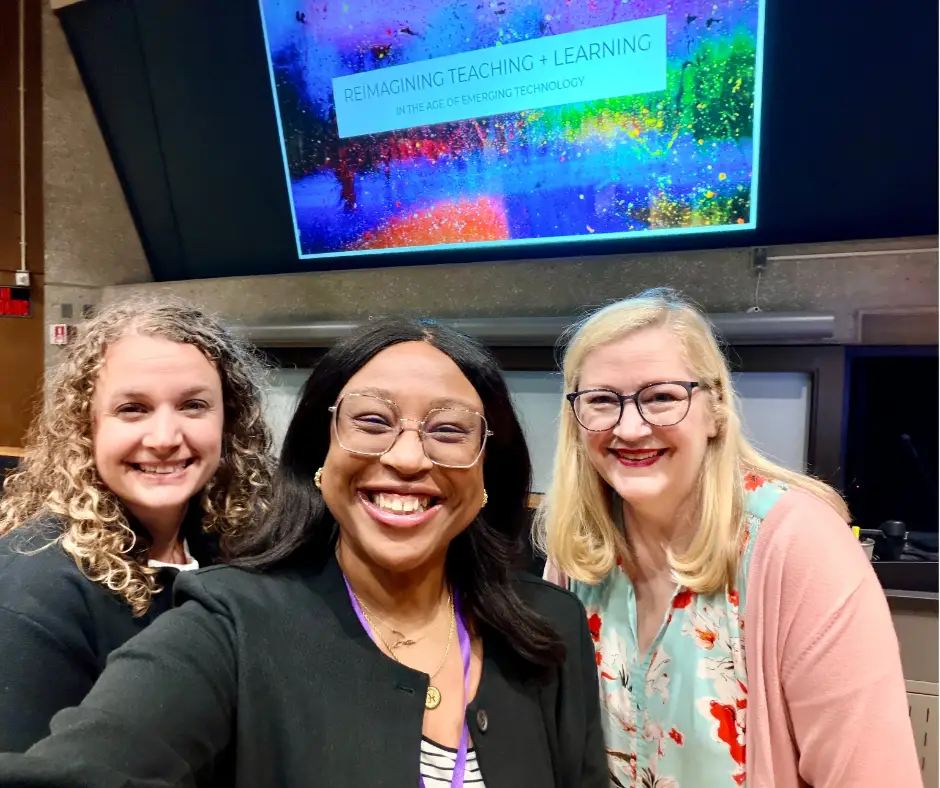
    As Valdis Krebs described, network weaving is all about closing triangles. At the keynote I gave for the ETOM conference today, I didn’t exactly close a triangle. However, I got to spend some time with a couple of past Teaching in Higher Ed podcast guests. Christina Moore discussed Inclusive Practices Through Digital Accessibility on Episode 293 and Mobile-Mindful Teaching and Learning on Episode 456. VaNessa Thompson helped us discover How to Engage on Social Media on Episode 416.

    Three women stand at the front of a large lecture hall in front of a colorful presentation slide

    VaNessa and Christina already know each other and I know them. Still, this memory we now share tightens the bond between us and now creates a triangular relationship between the three of us. Again, not necessarily closing triangles here. But certainly doing something new with going from one-on-one relationships and now having this shared triangle to remember and potentially strengthen in the future.


    PS. My talk was aligned with the conference theme (innovation). I had some fun with alliteration and divided the talk into: 1) innovation 2) imagination and 3) imitation (which was kinda like curation, but I just couldn’t break the alliteration streak I was on there). In my reading for the topic of connectors, I just saw a quick reference in Beth Kanter’s piece that Jarche shared about how helpful network weaving can be when we’re “stumbling through the fog of innovation.” I like that phrase “fog of innovation” and only wish I had come across it before today’s keynote. 🤦‍♀️🫠

    Source link

  • Tenn. Law Aimed at Students Who Make School Shooting Threats Ensnares a Retiree – The 74

    Tenn. Law Aimed at Students Who Make School Shooting Threats Ensnares a Retiree – The 74

    School (in)Security is our biweekly briefing on the latest school safety news, vetted by Mark KeierleberSubscribe here.

    Larry Bushart Jr. was just freed from a Tennessee jail cell after spending more than a month behind bars — for a Facebook post.

    The high-profile arrest of the 61-year-old retiree and former cop — which made waves in free speech circles — has all the hallmarks of a bingeworthy culture war clash in 2025: 

    • A chronically online progressive turns to Facebook to troll his MAGA neighbors about President Donald Trump’s seemingly lopsided response to school shootings compared to the murder of right-wing pundit Charlie Kirk
    • An elected, overzealous county sheriff intent on shutting him up
    • A debate over the limits of the First Amendment — and the president’s broader efforts to silence his critics
    Eamonn Fitzmaurice / T74

    The controversy, I report this morning, also calls attention to a series of recent Tennessee laws that carry harsh punishments for making school shooting threats and place police officers on campus threat assessment teams working to ferret out students with violent plans before anyone gets hurt. 

    In Bushart’s case, the sheriff maintained that his post referring to the president’s reaction to a 2024 school shooting in Perry, Iowa, constituted a threat “of mass violence at a school,” apparently the local Perry County High School. The rules that ensnared Bushart have also led to a wave of student arrests and several free speech lawsuits. His is likely to be next, Bushart’s lawyer told The Washington Post.


    In the news

    Updates in Trump’s immigration crackdown: Federal immigration officers chased a Chicago teacher into the lobby of a private preschool Wednesday and dragged her out as parents watched her cry “tengo papeles!” or “I have papers.” The incident is perhaps the most significant immigration enforcement act in a school to date. | The 74

    • Proposed federal rules would allow Immigration and Customs Enforcement to collect iris scans, fingerprints and other biometric data on all immigrants — including, for the first time, children under 14 years old — and store it for the duration of each individual person’s “lifecycle.” |  Ars Technica
    • On the same day Cornell University notified an international student that his immigration status had been revoked, Google alerted him that federal authorities had subpoenaed his personal emails. Now, the institution won’t say whether federal authorities had tapped into university “emails to track [students] as well.” | The Cornell Daily Sun
    • In California, federal immigration officers shot a U.S. citizen from behind as he warned the agents that students would soon gather in the area to catch a school bus. The government says the shots were “defensive.” | Los Angeles Times
    • ‘Deportation isn’t a costume’: A Maine middle school principal is facing pushback for a federal immigration officer Halloween costume, complete with a bulletproof vest that read “ICE.” | Boston.com
    • In Chicago communities that have seen the most significant increase in immigration enforcement, school enrollment has plunged. | Chalkbeat
    • Also in Chicago, a federal judge ordered the Trump administration to hand over use-of-force records and body camera footage after trick-or-treaters were “tear-gassed on their way to celebrate Halloween.” | USA Today

    A bipartisan bill seeks to bar minors from using AI chatbots as petrified parents testified their children used the tools with dire consequences — including suicide. Some warn the change could stifle the potential of chatbots for career or mental health counseling services. | Education Week

    • A Kentucky mom filed a federal lawsuit against online gaming communities Discord and Roblox alleging the companies jeopardized children’s safety in the name of profit. After her 13-year-old daughter died by suicide last year, the mom said, she found the girl had a second life online that idolized school shooters. | 404 Media
    • Character.AI announced it will bar minors from its chatbots, acknowledging safety concerns about how “teens do, and should, interact with this new technology.” | BBC
    Getty Images

    A jury awarded $10 million to former Virginia teacher Abby Zwerner on Thursday, two years after she was shot by her 6-year-old student. Zwerner accused her former assistant principal of ignoring repeated warnings that the first grader had a gun. The student’s mother was sentenced to nearly four years in prison for felony child neglect and federal weapons charges. | The New York Times

    ‘Creepy, unsettling’: This family spent a week with Grem, a stuffed animal with artificial intelligence designed to “learn” children’ s personalities and hold educational conversations. | The Guardian

    A judge ordered the Trump administration to release federal funds to California school districts after it sought to revoke nearly $165 million in mental health grants as part of a broader crackdown on diversity, equity and inclusion.  The grants funded hundreds of school social workers and counselors. | EdSource

    In 95% of schools, active-shooter drills are now a routine part of campus life. Here’s how states are trying to make them less traumatic. | The Trace

    Sign-up for the School (in)Security newsletter.

    Get the most critical news and information about students’ rights, safety and well-being delivered straight to your inbox.

    A lawsuit against a Pennsylvania school district alleges educators failed to keep students safe after a 12-year-old girl was attacked by a classmate with a metal Stanley drinking cup. | NBC10

    ‘Inviting government overreach and abuse’: The Education Department was slapped with two lawsuits over new Public Service Loan Forgiveness rules that could bar student borrowers from the program who end up working for the president’s political opponents, including organizations that serve immigrant students and LGBTQ+ youth. | The Washington Post


    ICYMI @The74

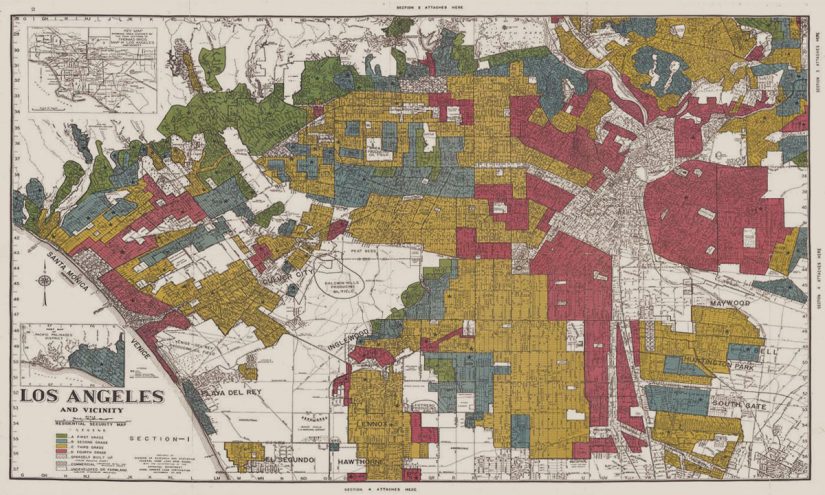
    1939 redlined maps of Los Angeles showing neighborhoods deemed eligible and ineligible for economic aid

    How LAUSD School Zones Perpetuate Educational Inequality, Ignoring ‘Redlining’ Past

    Students Want Schools to Incorporate AI in Learning But Express Some Fears

    LifeWise’s Big Red Bus Is Driving Thorny Questions about Church and State


    Emotional Support

    Matilda plots her escape.


    Did you use this article in your work?

    We’d love to hear how The 74’s reporting is helping educators, researchers, and policymakers. Tell us how
    Source link

  • Missouri Voters Approve Four-Day School Week in Two Districts, Showing Rising Support – The 74

    Missouri Voters Approve Four-Day School Week in Two Districts, Showing Rising Support – The 74


    Get stories like this delivered straight to your inbox. Sign up for The 74 Newsletter

    When the Independence School District announced it was switching to a four-day week during the 2023-24 school year, it drew questions from local families and statewide officials.

    Parents wondered what kind of child care they would have on days without classroom instruction. And lawmakers debated whether the state needed to intervene.

    Ultimately, Missouri’s General Assembly passed a law requiring a vote for non–rural school districts to authorize a four-day week.

    On Tuesday, the Independence and Hallsville school districts became the first large districts to receive the approval of voters to continue with four-day weeks.

    “I knew that the majority of our community supported it,” Hallsville Superintendent Tyler Walker told The Independent. “I was a little bit surprised to see how much support it was.”

    In Hallsville, residents had two questions on the ballot related to the school district. One asked about the four-day week and the other was a bond measure previously passed in April but not confirmed by the State Auditor.

    The election drew 25% of registered voters, according to the Boone County Clerk, and 75% of those voted in favor of the four-day school week. The vote authorizes the schedule for the next 10 years, when then the district will have to hold another special election.

    Walker didn’t think the margin would be that wide. Earlier surveys from the district’s 2022 adoption of the schedule put approval at around 60%.

    He believes that the district’s growing success on standardized tests and other publicly available metrics have given families confidence that the four-day week isn’t such a bad thing.

    “Our community has grown to appreciate the four day week more after experiencing it for a few years,” he said.

    Todd Fuller, director of communications for the Missouri State Teachers Association, told The Independent that voters in districts who have already been operating in a four-day week like Independence and Hallsville have an idea of how it works for their students. The state law, passed in 2024, will require a vote prior to the schedule’s adoption for those who do not already adopt the abbreviated week.

    “Anyone who’s a constituent of the district has had time to digest this process, and they’ve been able to decide over a two-year period whether it’s been beneficial or not beneficial for their kids,” Fuller said. “So if they are expressing that feeling with their vote, then we’re going to have a pretty good understanding of what they really want.”

    The association doesn’t have an official stance on the four-day week. But Fuller said the teachers it represents have been pleased with the schedule.

    Jorjana Pohlman, president of Independence’s branch of the Missouri National Education Association, told The Independent that the overall sentiment is positive from the district’s educators.

    Mondays out of the classroom have become a good time for teachers to have doctor’s appointments, spend time with their families and plan for the week ahead, she said.

    “In the beginning, it was fear of the unknown for families as well as teachers,” she said. “A lot of teachers had the attitude of, ‘Let’s try it.’ They, I think overall, felt it was a positive thing.”

    A study by Missouri State University researchers looked at recent applicants to teaching positions in Independence, finding that the four-day week was a key part of the district’s recruitment.

    In particular, 63% of applicants rated the four-day schedule as a top-three reason for applying, and 27% said it was their top priority.

    The study also looked at the value of the four-day week for applicants, asking how much they would sacrifice in salary to work at a district with the schedule. On average, applicants were willing to sacrifice $2267 annually for the four-day week.

    Walker said the schedule has also improved recruitment in Hallsville, with a dramatic uptick in veteran teachers applying to positions.

    With teachers coming to Independence schools particularly for their schedule, some worried that returning to a five-day week would have large consequences for staffing. But Pohlman said a survey showed that the loss of educators is less than many would think.

    “The educators, they care deeply about their students, and they want what’s best for students and for the community, whether it’s four day week or five day week,” she said. “They are still going to be committed.”

    Almost a third of Missouri districts have adopted a four-day week, with around 91% of those districts in rural settings. Only districts in cities with at least 30,000 residents, or those located in Jackson, Clay, St. Louis, Jefferson and St. Charles counties, must call for a vote before moving to a four-day week.

    Missouri Independent is part of States Newsroom, a nonprofit news network supported by grants and a coalition of donors as a 501c(3) public charity. Missouri Independent maintains editorial independence. Contact Editor Jason Hancock for questions: [email protected].


    Did you use this article in your work?

    We’d love to hear how The 74’s reporting is helping educators, researchers, and policymakers. Tell us how
    Source link