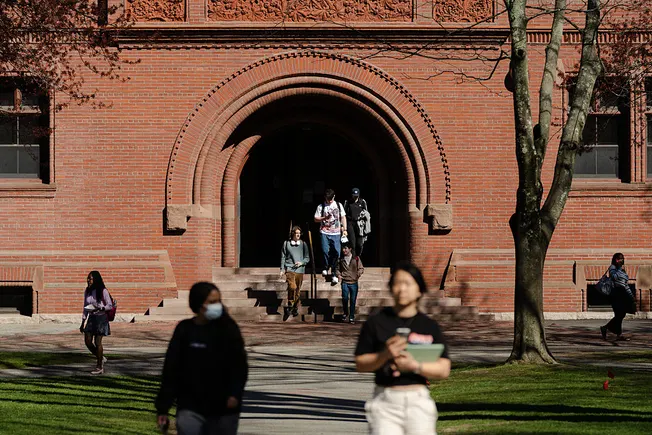
A federal district court in Massachusetts found yesterday that the government violated Harvard University’s First Amendment rights, as well as Title VI of the Civil Rights Act of 1964, when it stripped the university of billions in federal funding last April. At the time, the Trump administration’s explanations for the cuts strongly suggested its actions were based on hostility towards Harvard’s political viewpoint, though the government eventually shifted to an argument that they were an effort to fight campus anti-Semitism.
Much of the opinion covers a dispute about what court has jurisdiction to hear the case. But when it comes to the First Amendment and Title VI, the court’s reasoning echoes what FIRE has saidpublicly and in our own amicus brief in the Harvard case: Pursuing the worthy end of fighting anti-Semitic and other unlawful discrimination on campus does not justify flatly unlawful and unconstitutional methods.
Here are FIRE’s three quick takeaways about this decision and what it means for campus rights.
Government cannot force private institutions like Harvard to punish speech protected by the First Amendment
Like many universities, Harvard receives hundreds of millions of dollars every year in research grants and student aid. That money comes with both formal legal requirements and less-formal leverage over how the university operates.
In a letter it sent to Harvard in April, the federal government tried to use this leverage to make sweeping demands of Harvard if it wished to continue receiving federal funds, including prohibiting the admission of international students deemed “hostile” to “American values,” political litmus tests in the name of viewpoint diversity, and even the derecognition of pro-Palestinian student groups.
As our nation’s oldest and wealthiest university, if Harvard was unwilling to defend its rights in court, it was unlikely that any other institution would have the fortitude to do so.
But as FIRE’s amicus brief pointed out, “the government cannot strongarm private actors into punishing speech that the First Amendment protects from state intrusion,” noting that the Supreme Court reaffirmed this principle just last year in National Rifle Association v. Vullo, . In Vullo, the NRA accused New York state financial services chief Maria Vullo of using state power to coerce companies not to do business with the NRA because of the state’s opposition to the organization’s pro-gun viewpoint.
The district court read the law the same straightforward way. Comparing the government’s actions at each step to the actions at issue in Vullo, the court found:
Defendants (like Maria Vullo) urged and threatened Harvard (in the position of the insurer) to hire faculty and make curricula and research choices that better aligned with the government’s preferred viewpoints, to the detriment of professors and researchers with competing views (like the NRA). Pursuant to Vullo, using this type of coercion to suppress speech, third-party or otherwise, is not permissible.
Whether it’s a state or federal official doesn’t matter: They may not use their power to coerce private actors to unconstitutionally do the government’s bidding.
Feds must follow Title VI if it wants to strip funding for Title VI violations
FIRE has also expressed alarm about the government’s failure to follow the procedures Congress prescribed when stripping funding from Harvard (and other universities) in the name of fighting race, color, and national origin discrimination (including anti-Semitic discrimination) under Title VI of the Civil Rights Act of 1964.
Being stripped of federal funding under civil rights law has long been seen as a nuclear option. The loss would likely shut down all but the richest colleges and universities by barring them not just from federal research grants but also from federal student aid, such as Pell grants and federally subsidized loans. That’s why Title VI requires the government to give institutions like Harvard “notice, a hearing, and an opportunity to come into compliance voluntarily before the government can terminate funding,” as we wrote in our amicus brief. Yet the government skipped the process and failed to do so.
Again, predictably, this failure did not escape the court. It outlined the same procedures to which FIRE pointed in its brief, noting that it was “undisputed” that the government did not comply with them before freezing and terminating funding. Rejecting the government’s arguments that it could “combat anti-Semitism” at Harvard by terminating funding under different provisions, the court found that “Congress has…passed a law that explicitly provides for when and how an agency can terminate federal funding to address this type of discrimination—and that law is Title VI, which dictates that ‘no such action shall be taken until the department or agency’ has gone through the appropriate procedures.”
Harvard’s free speech record is terrible, but be thankful one university found its spine
FIRE has always been a critic of Harvard’s handling of student and faculty free speech issues. When I say always, I mean that literally. As we told the court, Harvard’s repeated failure to honor student and faculty rights over decades was a major contributor to Boston civil liberties lawyer (and Harvard Law alumnus) Harvey Silverglate’s decision to co-found FIRE in 1999. But none of Harvard’s problems excuse the government’s decision to make these unlawful, unconstitutional demands.
FAQ: Responding to common questions about the fight between Harvard and the Trump administration
Harvard vs. Trump isn’t just a headline, but a battle to decide whether the government can use funding to force ideological conformity. In this explainer, FIRE makes clear why not.
Harvard should be commended for standing up for its legal rights rather than settling under this intense government pressure. As our nation’s oldest and wealthiest university, if Harvard was unwilling to defend its rights in court, it was unlikely that any other institution would have the fortitude to do so.
The decision should also serve as a needed wake-up call for government agencies charged with enforcing our civil rights laws. As we wrote with regard to Columbia University, which recently settled with the government under similar circumstances, there’s plenty of reason to have legitimate concerns about Title VI violations on college campuses. But Title VI requires that the federal government follow the appropriate procedures for a reason. When followed in good faith, the process increases the chance of just outcomes for colleges, students, and faculty while combatting unlawful discrimination. Federal agencies must follow our Constitution and laws while they do their important work.
This audio is auto-generated. Please let us know if you have feedback.
Dive Brief:
The Foundation for Individual Rights and Expression sued the University of Texas System on Wednesdayon behalf of students over a new state law that directs public colleges to prohibit expressive activitieson campusfrom 10 p.m. to 8 a.m.
The lawsuit also takes aim at the statute’s provisions that prohibit inviting speakers to campus, using devices to amplify speech, or playing drums or other percussive instruments during the last two weeks of any term.
FIREcalled the provisions “blatantly unconstitutional,” arguing they violate First Amendment and due process rights on public colleges.The group is urging the judge overseeing the case to declare the prohibitions unconstitutional and to permanently block the UT System from enforcing them.
Dive Insight:
Texas state Sen. Brandon Creighton— who authored the billand has been named the sole finalist for chancellor of theTexas Tech University System — has framed the legislation as a response to pro-Palestinian demonstrations campuses both within Texas and across the nation last year.
“While the world watched Columbia, Harvard and other campuses across the country taken hostage by pro-terrorist mobs last year, Texas stood firm. UT allowed protest, not anarchy,” Creighton told Austin American-Statesman earlier this year after lawmakers passed his bill.
In the new lawsuit, several student groups— including the independent student newspaper at the University of Texas at Dallas, an interdenominational student ministry,and libertarian organization Young Americans for Liberty — say the legislation blocks a broad array of protected speech.
That’s because the legislation defines expressive activities as “any speech or expressive conduct protected by the First Amendment to the United States Constitution.”
“Early morning prayer meetings on campus, for example, are now prohibited by law,” the lawsuit says. “Students best beware of donning a political t-shirt during the wrong hours. And they must think twice before inviting a pre-graduation speaker, holding a campus open-mic night to unwind before finals, or even discussing the wrong topic — or discussing almost anything — in their dorms after dark.”
Other activities covered by the 10-hour daily block on expressive activities include screening a film at midnight, “wearing a Halloween costume after 10 p.m.,” photographing the sunrise, setting up an information booth early on the morning of election day to boost voter awareness, or even saying, ‘Good morning,’ the lawsuit says.
The Retrograde, a student-run newspaper at UT-Dallas, voiced concerns that the ban covers their reporting and publishing deep into the night. Working in those hours is necessary for the students to fulfill their journalist mission, according to the lawsuit.
Similarly, the student ministry group, the Fellowship of Christian University Students’ chapter on UT-Dallas, often meet to discuss issues of faith — even after their official events conclude at 10 p.m.
“The First Amendment doesn’t set when the sun goes down,” FIRE senior supervising attorney JT Morris said in a statement Wednesday. “University students have expressive freedom whether it’s midnight or midday, and Texas can’t just legislate those constitutional protections out of existence.”
Along with the UT System’s board members and chancellor, the lawsuit also names the heads of UT-Austin and UT-Dallas as defendants.
The UT System said via email Thursday that it has not reviewed the lawsuit and declined to comment further. UT-Austin and UT-Dallas did not immediately respond to a request for comment.
The 10-hour daily block on expressive activities exempts commercial speech. According to the lawsuit, that means students would be banned from protesting world hunger at 7 a.m. but they would not be prevented from hosting a bake sale at that time.
That type of content-based restriction makes the law unconstitutional, the lawsuit argues.
The lawsuit also argues against the prohibitions on certain types of expressive activities — including inviting speakers or playing percussive instruments — during the last two weeks of any term. Those bans are overly broad, the lawsuit alleges.
UT-Austin, for instance, has seven academic terms, meaning bans on those expressive activities would cover 98 days of the year. At UT-Dallas, these bans would be in place for over 90 days, according to the lawsuit.
Developed with the help of volunteer leaders and member institutions across the country, The Job Descriptions Index provides access to sample job descriptions for positions unique to higher education.
Descriptions housed within the index are aligned with the annual survey data collected by the CUPA-HR research team. To aid in the completion of IPEDS and other reporting, all position descriptions are accompanied by a crosswalk section like the one below.
Crosswalk Example
Position Number: The CUPA-HR position number BLS SOC#: Bureau of Labor Statistics occupation classification code BLS Standard Occupational Code (SOC) Category Name: Bureau of Labor Statistics occupation category title US Census Code#: U.S. Census occupation classification code VETS-4212 Category: EEO-1 job category title used on VETS-4212 form
***SOC codes are provided as suggestions only. Variations in the specific functions of a position may cause the position to better align with an alternate SOC code.
Sample Job Descriptions
Business Continuity/Emergency Planning Professional
Responsible for the development, administration and maintenance for a college or university’s business continuity program that supports the continuance of critical functions before, during, or after a disaster. Reviews and evaluates risk assessment, business impact analysis plans and planning proposals, and materials. Design, direct and oversee campus-wide disaster exercises in accordance with the Federal Emergency Management Agency (FEMA) requirements. May serve as liaison with federal, state, and local agencies to coordinate continuity and restoration activities, emergency management plans, or services. May assign and/or supervise the work of others. Works under limited supervision, with considerable latitude for the use of initiative and independent judgment.
CROSSWALKS Position Number: 178000 BLS SOC #: 11-3031 BLS Standard Occupational Code (SOC) Category Name: Financial Managers US Census Code: 0120 VETS-4212 Category: First/Mid-Level Officials
Advises the CEO on policy, procedural, and operational issues of the system or district. May be charged with leading the operationalization of strategic initiatives for the CEO. Represents the CEO to senior vice presidents, campus officials, and critical external constituents. Serves as a visible top-level leadership role for the institution on behalf of the CEO; considered a peer of the institution’s other senior/executive officers.
CROSSWALKS Position Number: 187020 BLS SOC #: 11-9033 BLS Standard Occupational Code (SOC) Category Name: Education Administrators, Postsecondary US Census Code: 0230 VETS-4212 Category: First/Mid-Level Officials
Responsible for leading and maintaining campus-wide risk management and/or compliance programs. Generally reports to an executive position. May involve a single incumbent who fulfills both roles of risk and compliance or may involve multiple incumbents fulfilling one or both of these roles for different units or divisions.
CROSSWALKS Position Number: 196270 BLS SOC #: 11-1021 BLS Standard Occupational Code (SOC) Category Name: General and Operations Managers US Census Code: 0110 VETS-4212 Category: First/Mid Level Officials
Conducts research and studies on the institution under the supervision of the IR Director. Responsibilities typically include the design of studies, data collection, analyses, and reporting.
CROSSWALKS Position Number: 428100 BLS SOC #: 13-1111 BLS Standard Occupational Code (SOC) Category Name: Management Analysts US Census Code: 0710 VETS-4212 Category: Prof
Responsible for one or several areas of Title IX compliance under direction of the head.
CROSSWALKS Position Number: 423155 BLS SOC #: 13-1071 BLS Standard Occupational Code (SOC) Category Name: Human Resources Specialists US Census Code: 0630 VETS-4212 Category: Prof
Responsible for assuring equal access for persons with mental health and other disabilities to all educational and vocational programs. Identifies and provides reasonable accommodations at institution to ensure equal educational opportunities for individuals with disabilities.
CROSSWALKS Position Number: 423115 BLS SOC # 21-1012 BLS Standard Occupational Code (SOC) Category Name: Educational, Guidance, and Career Counselors and Advisors US Census Code # 0230 VETS-4212 Category: Prof
Plans, directs, and oversees the administration of all programs and services ensuring compliance with ADA and provides leadership and consultation in promoting access and equity for persons with disabilities.
CROSSWALKS Position Number: 423110 BLS SOC # 25-9099 BLS Standard Occupational Code (SOC) Category Name: Educational Instruction and Library Workers, All Other US Census Code # 0230 VETS-4212 Category: Prof
Directs daily operations of the Office of Disability Services to ensure equal access for students and staff with disabilities to all aspects of campus life (programs, services and activities) as outlined by the Americans with Disabilities Act. Responsibilities include reviewing and maintaining medical documentation, determining reasonable accommodations, implementing accommodations, organizing and arranging awareness activities, supervising staff, advising other departments, researching and purchasing assistive technology and maintaining a budget. As the primary contact for university administrators, faculty, staff and students, serves as the compliance officer for the ADA in academic, physical and employment areas.
CROSSWALKS Position Number: 423100 BLS SOC # 25-9099 BLS Standard Occupational Code (SOC) Category Name: Educational Instruction and Library Workers, All Other US Census Code # 0230 VETS-4212 Category: Prof
Responsible for coordinating the institution’s compliance with federal and state discrimination and sexual harassment laws. Responsibilities may include providing educational programs regarding discrimination and sexual harassment prevention; responding to, investigating and seeking resolution to allegations of discrimination and sexual harassment; selecting and overseeing sexual harassment advisors who serve as additional information resources on issues of sexual harassment; training student peer educators to facilitate discussions with other students on sexual harassment. With regard to the OCR letter of April 4, 2011 expanding upon Title IX sexual harassment and violence guidelines, also oversees all Title IX complaints and reports student sexual harassment, sexual violence and related allegations of misconduct. Identifies and addresses any systemic problems relating to complaints and works with other departments to ensure Title IX policies communicated to all constituencies. Assists law enforcement personnel in handling reports and complaints of sexual violence and related misconduct.
CROSSWALKS Position Number: 423150 BLS SOC # 13-1071 BLS Standard Occupational Code (SOC) Category Name: Human Resources Specialists US Census Code # 0630 VETS-4212 Category: Prof
Oversees academic and/or institutional assessment. Collaborates with faculty, staff, and administrators in establishing and refining an academic/institutional assessment framework directed at improving student learning and achievement or institutional quality. Shares best assessment practices and serves as a resource to faculty and staff. Works with accreditation staff and administrators to ensure alignment of assessment with accreditation efforts. May supervise staff who work in improving learning outcomes, retention, or institutional quality.
CROSSWALKS Position Number: 429100 BLS SOC #: 13-1111 BLS Standard Occupational Code (SOC) Category Name: Management Analysts US Census Code: 0710 VETS-4212 Category: Prof
Creates and implements all new government-funded programs that promote the admission and retention of students from low-income and disadvantaged backgrounds; audits current programs and consistently works to improve the institution’s offerings; completes all reporting required by the Department of Education.
CROSSWALKS Position Number: 423140 BLS SOC # 13-1071 BLS Standard Occupational Code (SOC) Category Name: Human Resources Specialists US Census Code # 0630 VETS-4212 Category: Prof
Develops and conducts research in areas that may include: student retention and attrition; student goal attainment; financial optimization analysis; enrollment management modeling and forecasting; resource utilization, institutional costs and productivity; access and equity studies; and functional benchmarking specific to higher education. Responsible for identification and analysis of patterns in institutional data, make critical observations of policy impact, and recommending strategies and actions. May select and adapt quantitative methods, practices and theories to perform forecasting and analysis, interpret results, document findings, and organize and implement research projects, identifying ways to improve research design and data validity.
CROSSWALKS Position Number: 429000 BLS SOC # 13-1111 BLS Standard Occupational Code (SOC) Category Name: Management Analysts US Census Code # 0710 VETS-4212 Category: Prof
SAMPLE JOB DESCRIPTIONS
Institutional Review Board (IRB) Coordinator
Responsible for support of the Institutional Review Board (IRB) in managing protocols, applications, approvals, and records. May be responsible for scheduling IRB meetings, helping to select board members, contacting board members, and/or communicating with researchers about the IRB process. The IRB reviews applications involving research with human subjects to ensure that the rights of human participants are protected.
CROSSWALKS Position Number: 427200 BLS SOC # 43-9199 BLS Standard Occupational Code (SOC) Category Name: Misc Office and Administrative Support Workers, All Other US Census Code # 5940 VETS-4212 Category: Prof
Conducts investigations under the direction/ oversight of the head of institutional Title IX compliance. Drafts reports and findings for institutional decision-making.
CROSSWALKS Position Number: 423160 BLS SOC #: 13-1071 BLS Standard Occupational Code (SOC) Category Name: Human Resources Specialists US Census Code: 0630 VETS-4212 Category: Prof
Developed with the help of volunteer leaders and member institutions across the country, The Job Descriptions Index provides access to sample job descriptions for positions unique to higher education.
Descriptions housed within the index are aligned with the annual survey data collected by the CUPA-HR research team. To aid in the completion of IPEDS and other reporting, all position descriptions are accompanied by a crosswalk section like the one below.
Crosswalk Example
Position Number: The CUPA-HR position number BLS SOC#: Bureau of Labor Statistics occupation classification code BLS Standard Occupational Code (SOC) Category Name: Bureau of Labor Statistics occupation category title US Census Code#: U.S. Census occupation classification code VETS-4212 Category: EEO-1 job category title used on VETS-4212 form
***SOC codes are provided as suggestions only. Variations in the specific functions of a position may cause the position to better align with an alternate SOC code.
Sample Job Descriptions
Chief Cost Accounting Administrator
Directs institution-wide cost accounting activities, including development of facilities and administrative fringe benefit rates. Negotiates fringe benefit rates with the federal government, manages fixed assets for the institution, develops and maintains institution’s disclosure statement required by federal government, and develops institutional policy and procedures.
CROSSWALKS Position Number: 178000 BLS SOC #: 11-3031 BLS Standard Occupational Code (SOC) Category Name: Financial Managers US Census Code: 0120 VETS-4212 Category: First/Mid-Level Officials
Responsible for the coordination of pre-award and/or post-award activities relating to grant and contract proposals. Pre-award activities include assisting departmental faculty in the development, preparation, and submission of grant and contract proposals. Also ensures that all applications meet agency and university guidelines and published time tables and deadlines. Post-award activities include establishment of accounts in the financial accounting system, re-budgeting of funds, and making of changes to the award or expenditures. Requires a bachelor’s degree or equivalent plus 2-3 years’ related experience.
CROSSWALKS Position Number: 433110 BLS SOC #13-2031 BLS Standard Occupational Code (SOC) Category Name: Budget Analysts US Census Code # 0840 VETS-4212 Category: Prof
Grant Writer, Sponsored Contracts/ Grants Administration
Assists the Principal Investigator (PI) with the development or completion of non-technical aspects of grant proposals. Typically responsible for editing, formatting, and the submission of grant proposals. May also research sources for grant opportunities for the principle investigators. Can assist with fundamental budget preparation for grant proposals.
CROSSWALKS Position Number: 433130 BLS SOC # 13-2031 BLS Standard Occupational Code (SOC) Category Name: Budget Analyst US Census Code # 0840 VETS-4212 Category: Prof
Coordinates the budget portion of the pre-award cycle and manages the post-award cycle of sponsored projects, grants, contracts, and special funds. Position often reports to the Comptroller.
CROSSWALKS Position Number: 433120 BLS SOC # 13-2031 BLS Standard Occupational Code (SOC) Category Name: Budget Analysts US Census Code # 0840 VETS-4212 Category: Prof
Developed with the help of volunteer leaders and member institutions across the country, The Job Descriptions Index provides access to sample job descriptions for positions unique to higher education.
Descriptions housed within the index are aligned with the annual survey data collected by the CUPA-HR research team. To aid in the completion of IPEDS and other reporting, all position descriptions are accompanied by a crosswalk section like the one below.
Crosswalk Example
Position Number: The CUPA-HR position number BLS SOC#: Bureau of Labor Statistics occupation classification code BLS Standard Occupational Code (SOC) Category Name: Bureau of Labor Statistics occupation category title US Census Code#: U.S. Census occupation classification code VETS-4212 Category: EEO-1 job category title used on VETS-4212 form
***SOC codes are provided as suggestions only. Variations in the specific functions of a position may cause the position to better align with an alternate SOC code.
Sample Job Descriptions
Child Care Center Teacher
Degreed, professional teacher. Plans and implements a developmentally appropriate curricula and activities for children and families enrolled at a campus childcare center or early childhood development program. Using observation and developmental profiles/checklists, maintains appropriate records of children’s progress. Supervises personnel assigned to assist with classroom activities (including students, assistants, and volunteers).
CROSSWALKS Position Number: 457125 BLS SOC #: 25-3099 BLS Standard Occupational Code (SOC) Category Name: Teachers and Instructors, All Other US Census Code: 0020 VETS-4212 Category: Prof
Responsible for the direction and supervision of child/day care center activities. Performs a variety of professional and administrative duties, including program administration and management of budgets, facilities, personnel, and special projects for a single site. Coordinates the childcare support services program with day care center teachers and other staff. Must meet state license requirements. May require a master’s degree in early childhood education or related field. Requires 5-8 years’ experience with child development programs.
CROSSWALKS Position Number: 457120 BLS SOC #: 39-1020 BLS Standard Occupational Code (SOC) Category Name: First-Line Supervisors of Personal Service Workers US Census Code: 0020 VETS-4212 Category: Prof
Reviews customer requirements, creates test cases, executes testing plan using testing tools and automation, and tests applications, databases, or systems developed against the test cases to ensure there are no bugs and requirements are met.
CROSSWALKS Position Number: 461180 BLS SOC #: 15-1231 BLS Standard Occupational Code (SOC) Category Name: Computer Network Support Specialists US Census Code: 1050 VETS-4212 Category: Prof
Following more than a year of scrutiny from Republicans over how Northwestern University handled pro-Palestinian campus protests last year as well as a months-long federal funding freeze, President Michael Schill plans to step down.
Schill, who has been president since 2022, announced his departure Thursday.
“Over the past three years, it has been my profound honor to serve as president of Northwestern University,” Schill wrote in a message to the campus community. “In that time, our community has made significant progress while simultaneously facing extraordinary challenges. Together, we have made decisions that strengthened the institution and helped safeguard its future.”
Schill’s exit marks an end to a tumultuous tenure at Northwestern.
The wealthy private institution in Illinois has weathered attacks from congressional Republicans over a deal Schill struck with pro-Palestinian campus protesters who set up an encampment on university grounds. Congress hauled Schill in for a hearing on antisemitism in May 2024 over his agreement with the protesters. Schill agreed to provide more insight and input into university investment decisions, amid demands to divest from companies attached to the Israeli war effort. He also promised more support for Palestinian students and faculty, among other concessions.
(However, Northwestern has not provided the level of endowment transparency it promised.)
The president defended the deal before Congress. Schill, who appeared alongside the leaders of Rutgers University and the University of California, Los Angeles, was the main target for congressional Republicans, but he stood his ground—batting away hypothetical questions and refusing to discuss the conduct of individual faculty members.
Still, accusations that Northwestern mishandled antisemitism have continued to dog Schill since, and the Trump administration launched an investigation into alleged civil rights violations and later froze $790 million in federal research funding at the university, which led to deep job cuts this summer.
Schill and other Northwestern leaders said in July that they were working to restore the research funding and were “hopeful it will happen soon.”
Faculty members and other critics also raised concerns about actions taken by Northwestern under his leadership. Steven Thrasher, a journalism professor involved in pro-Palestinian protests on campus, alleged in March that Northwestern denied him tenure for his activism.
Schill also navigated turmoil in athletics when a whistleblower alleged in late 2002 that hazing was allowed to run unchecked in the football program. Schill briefly suspended and later fired Northwestern football coach Pat Fitzgerald and a subordinate. The coach sued Northwestern for wrongful termination in 2023; the two parties reached an undisclosed settlement last month.
“As I reflect on the progress we have made and what lies ahead, I believe now is the right time for new leadership to guide Northwestern into its next chapter,” Schill said Wednesday.
Schill will remain in his role until an interim president steps into the job.
Schill’s pending exit now means only one of seven campus leaders who were called to testify in congressional hearings on campus antisemitism in late 2023 and 2024 still has her job. Leaders at Harvard University, the University of Pennsylvania, Columbia University, UCLA, Rutgers and now Northwestern stepped down within a year of the hearings. (Then–UCLA chancellor Gene Block was already set to retire.) Only Sally Kornbluth at Massachusetts Institute of Technology remains in her job.
Rep. Elise Stefanik, a New York Republican, who emerged as one of the more aggressive inquisitors in prior campus antisemitism hearings, celebrated the news on social media.
“LONG overdue!” she wrote on X. “@NorthwesternUni President Michael Schill finally resigned today after he failed protect Jewish students, caved to the demands of the antisemitic, pro-Hamas mob on Northwestern’s campus, and failed to hold students who perpetuate antisemitic attacks accountable at an Education and the Workforce Committee hearing.”
The White House also welcomed Schill’s resignation in an emailed statement.
“The Trump Administration looks forward to working with the new leadership, and we hope they seize this opportunity to Make Northwestern Great Again,” spokesperson Liz Huston wrote.
Earlier this month, China’s State Council amended the Regulations on the Administration of the Entry and Exit of Foreigners, highlighting the growing importance of its global talent strategy.
Effective from October 1, the visa, which will be subject to approval by the authorities of the People’s Republic of China, will be open to international youths who have earned undergraduate or STEM degrees from leading domestic and global research institutions.
The visa will also be open to young international professionals engaged in education and research in STEM fields.
As per reports, compared with ordinary visa categories in China, the K visa is designed to provide greater convenience for holders through multiple entries, longer validity, and extended stay durations.
We see it as a powerful signal that China is not only open for business but is actively and competitively seeking to attract the world’s best and brightest minds Charles Sun, China Education International
It will also create opportunities for exchanges and collaboration across education, science, technology, culture, business, and entrepreneurship with applications no longer needing sponsorship from a local enterprise, relying instead on the applicant’s age, educational background, and work experience.
“We see it as a powerful signal that China is not only open for business but is actively and competitively seeking to attract the world’s best and brightest minds,” Charles Sun, founder and managing director of China Education International, told The PIE News.
“A key attractive feature is the inclusion of provisions for spouses and children. Making it easier for families to relocate together is perhaps one of the most important factors in convincing top-tier talent to make a long-term commitment to a new country.”
According to data from Studyportals, this move comes at a time when interest in pursuing Artificial Intelligence degrees in the US is declining, while interest in studying the same in China is on the rise.
“When comparing January to July 2025 to the same period in 2024, relative demand for artificial intelligence degrees (on-campus Bachelor’s and Master’s and PhDs) in the US on Studyportals dropped 25% year-over-year, while interest in AI degrees in China rose 88%,” read a report shared by Studyportals.
“Both Beijing and Washington are racing to secure technological leadership in the ‘Race on AI’. According to Harvey Nash “Digital Leadership Report 2025” artificial intelligence has created the world’s biggest and fastest-developing tech skills shortage in over 15 years. This shortage has created a race for talent, with companies like Meta reportedly handing out $100m sign-on bonuses to win top talent.”
While interest in pursuing such degrees in China is growing amid its global talent push, the US remains a powerhouse in the field.
International students account for 70% of all full-time graduate enrolments in AI-related programs and make up more than half of all international students in the country enrolled in STEM disciplines.
“Nations that succeed in drawing the brightest minds and in creating an environment for innovative business to thrive, will not just advance their economies, they will command the future of technology, security, and influence,” stated Edwin Rest, CEO of Studyportals.
“International students do not only bring revenue to local economies and soft power, they also fuel innovation, startups, and job creation.”
Dr. Martin Luther King Jr. often reminded us that ‘the arc of the moral universe is long, but it bends toward justice.’ Yet arcs do not bend on their own; people must pull them. For Black women in higher education, that bending is not a metaphor but a lived, exhausting struggle. Justice is not just a concept but a long, arduous climb. We teach. We research. We lead. And sometimes, we must also stand against the very institutions that hired us.
Dr. Leah P. Hollis By a unanimous 3-0 decision, I recently won a federal appeal in a complex unequal pay case, Hollis v. Morgan State University (No. 24-1476, 4th Cir. 2025), after close to a decade of retaliation and erasure from a prior employer. The Fourth Circuit ruled that the district court wrongly applied Title VII’s timing/exhaustion rules to the Title IX, § 1983 Equal Protection, and Maryland law claims and reversed that mistake.
More importantly, the panel rejected the lower court’s cramped reliance on the McDonnell-Douglas burden-shifting framework. Since 1973, the Supreme Court’s McDonnell-Douglas case has forced discrimination plaintiffs through a rigid three-step burden-shifting test—one that too often shuts cases down before a jury can ever weigh the evidence. However, the Fourth Circuit emphasized instead Rule 56’s simple question: could a reasonable jury find discrimination?
As the court put it, the record contained “circumstantial evidence—including evidence of pretext—that would allow a jury to infer” bias. Judge Quattlebaum went further in a separate concurrence, praising the majority for skipping the rigid McDonnell Douglas steps and instead “pointing out the evidence that creates a genuine dispute of material fact.” He urged the Supreme Court to scrap McDonnell Douglas altogether, calling it “unnecessarily complex” and “more restrictive than Title VII itself.” This appeal and decision chips away at rigid judge-made hurdles that for decades have silenced plaintiffs before a jury could ever hear their stories.
Why Procedure Matters in Civil Rights
For discrimination litigants, this decision is more than technical. The old McDonnell-Douglas test forced plaintiffs to meet rigid “prima facie” boxes and disprove every employer excuse, often leading to dismissal at summary judgment. By centering Rule 56, the Fourth Circuit made clear that all the evidence, biased remarks, shifting justifications, policy deviations, comparators, and suspicious timing, belongs in one evidentiary bundle. In turn, this lowers the procedural bar, makes it harder for employers to paper over bias, and gives plaintiffs a fairer chance to be heard.
My own scars tell the story. I was paid tens of thousands less than men doing the same job, called names behind closed doors, had dossiers suppressed, gaslighted for leadership errors, and was unjustly demoted to “at-will.” Like many women in my department, I scraped for resources while being told to stay quiet, told I was nothing. Silence, they said, was the price of survival. I refused. And when the Fourth Circuit reversed, it was more than a personal win—it was a civil rights intervention that affirmed the importance of truth, insisting that such truths be considered as a whole, the way we live them, not dissected into sterile sound bites.
The 300,000 Who Couldn’t Stay
Between April and June 2025 alone, nearly 300,000 Black women exited the U.S. labor force because they felt unsafe, not by choice but by structural neglect. As of September, unemployment for Black women hovers near 6 percent—twice that of their white counterparts. These departures are not accidents; they are ruptures in equity and dignity, the consequence of harassment, unequal pay, bullying, and institutional betrayal.
Each exit letter echoes the same civil rights path: Harriet Tubman walking 4,500 miles to free enslaved people, Dr. Martin Luther King Jr. jailed 29 times, Colin Kaepernick forfeiting his NFL career. Several times on my journey, I was told, “you’re ruining your life” or “ be grateful to have a job.” But what if Harriet turned back? What if Martin stopped dreaming? What if Colin stood up and stayed quiet? Their resistance was costly; so too is the exodus of Black women from today’s workplaces. Justice does not bloom in surrender.
Intersectional Betrayal in the Academy
In higher education, Black women are showcased on websites and brochures yet undermined in daily practice. Research confirms we are disproportionately bullied, mobbed, and harassed. We remain the only group that required the Crown Act to affirm that our natural hair is lawful. Too often, the hostility comes not only from men but also from women—including women of color—who proclaim solidarity in public but dismantle it in private. These wounds, born of silence and duplicity, are institutional betrayals as old as the academy itself. That is why social justice must be more than a logo or slogan. When institutions use taglines as a façade, people make life-changing decisions based on those promises—only to discover too late that the commitments were hollow, leaving their careers and families in jeopardy. Zora Neale Hurston said it plainly: “The Black woman is the mule of the world.” That weight remains. And yet, even when battered, we persist. Because if we do not disrupt silence, the record calcifies into precedent.
Truth Telling as a Contact Sport
Writing in my personal capacity and researcher in this area, I still serve as a professor, still honor my students, and still respect the office I hold. This appeal shows that justice doesn’t clock out, the fight for equality yawns on despite the fatigue of its warriors; yet we walk on, dream on of a day when one should not have to fight for the dignity they were born with. Whistleblowers and resisters are often isolated, mischaracterized, and told to take the “high road.” Yet if we as educators do not teach justice by living it, the next generation inherits our silence as permission.
I prevailed because the record mattered, and because the Georgetown Civil Rights and Appellate Courts Immersion Clinic believed in my case and had the determination to fight for justice. What we do not correct becomes precedent. The appellate court saw what those in power at my prior institution chose to ignore—the pretext, the contradictions, the lies. With support from family, counsel, and ancestors, I stood. And now, with Hollis v. Morgan State joining Ames v. Ohio in questioning the stranglehold of McDonnell-Douglas, the judiciary too has taken a step toward clearing the road.
The Unending Path Forward
This is not the end. My case now returns to the district court where it will either go to trial or may yet be resolved through mediation. My forthcoming book, Disrupt the Not Telling, by Oxford University Press, will continue excavating the silences and erasures imposed on Black women scholars. As Audre Lorde reminds us: “Your silence will not protect you.” Some of us cannot speak loudly, constrained by family, caregiving, or survival—but presence, prayer, and quiet resistance are also forms of disruption.
The fight for equity is cyclical, echoing Reconstruction, the Red Summer of 1920s, and the civil rights movement 1960s. Each time, the nation tries to turn us back. Yet like Harriet, Martin, and Colin, those of us who set out on the trail of justice cannot turn back.
The exodus of 300,000 Black women from the workforce is not just a labor statistic—it is the latest reminder that civil rights remain unfinished, and that silence cannot be its price.
_______
Dr. Leah P. Hollis is Associate Dean and Professor at Penn State University.
What are the limits of presidential power? How many
days has it been since President Trump’s TikTok ban moratorium went
into place? What is the state of the conservative legal movement?
And where did former FIRE president David French
go on his first date?
French and Sarah Isgur
of the popular legal podcast “Advisory
Opinions” join the show to answer these questions and
discuss the few free speech issues where they disagree with
FIRE.
Timestamps:
00:00 Intro
02:18 Origin story of “Advisory Opinions”
08:15 Disagreements between FIRE and AO
15:04 Why FIRE doesn’t editorialize on the content of
speech
24:27 Limits of presidential power
43:30 Free speech, the dread of tyrants
51:01 The prosecution of political figures
58:01 Cracker Barrel
01:00:09 State of the conservative legal movement
Enjoy listening to the podcast? Donate to FIRE today and
get exclusive content like member webinars, special episodes, and
more. If you became a FIRE Member
through a donation to FIRE at thefire.org and would like access to
Substack’s paid subscriber podcast feed, please email [email protected].
Welcome back to our fourth season. Time Flies. We’ve gone back to an audio only format ’cause apparently y’all are audio and bibliophiles and not videophiles, so we decided to chuck the extra editing burden. Other than that, though, it’s the same show. Bring you stories on higher education from all around the world. So, let’s get to it.
Today’s guest is Pedro Teixeira. He’s a higher education scholar from the University of Porto in Portugal, focusing to a large extent on the economics of education, but he also just finished a term as that country’s Secretary of State for higher education. That’s a position closer to a junior minister rather than a deputy minister, but it has elements of both.
I first met Pedro about 20 years ago, and I ran into him again this summer in Boston at the Center for International Higher Education’s biannual shindig, where he was giving the Philip Altbach lecture. And let me tell you, this was the best lecture I have listened to in a long time.
Two reasons for this. First, Pedro spoke about his experiences as a Secretary of State trying to negotiate a new funding formula with universities in that country. I won’t spoil the details, but one big highlight for me was that he was in the rare position of being a politician, trying to convince universities not to have a performance-based element in their funding formula. And second, he talked about the future of higher education in the face of possible falling returns to education due to wider adoption of artificial intelligence.
It was such a good talk, I knew my World of Higher Education podcast listeners would think it was great too. And while I couldn’t record it, I did do the next best thing. I invited Pedro to be our lead off guest for this season’s podcast. Let’s listen to what he has to say.
The World of Higher Education Podcast Episode 4.1 | From Funding Formulas to AI: Pedro Teixeira on Higher Education’s Next Challenges
Transcript
Alex Usher: Okay, so Pedro, you were an academic at CIPES (Centre of Research on Higher Education Policy) at the University of Porto, and you went from that to being a minister of state. That’s not an unfamiliar path in Portuguese higher education—Alberto Amal, I think, did something similar. But that move from academia to government, how big a shift was that? What did you learn, and what were you not expecting when becoming a minister of state?
Pedro Teixeira: I think you’re right in the sense that there are quite a few people who have done this, not only in Portugal but also in other parts of Europe, in different areas. And I think it’s always a bit of a challenge, because there’s this expectation that, since you’re an academic—and especially if you’re an expert on the topic—people expect you to have a solution for all the problems. And it’s not exactly like that.
At the same time, I think one is worried that what you do in office will be coherent with what you had advocated as an academic and with what you had written about specific topics. That’s challenging.
In some respects, I wasn’t very surprised by what I faced, because I had been involved in advisory roles and I knew people who had been in that kind of policy role. So I think I wasn’t—I mean, there were the things you expect, like the amount of work and the long days. But I never felt that was really the most difficult part. Of course, going through these things and living them is a little different than knowing them in the abstract.
But I think the main concern for me was the permanent pressures. You are always concerned with something, always worried either about the problems you have to deal with or the problems that will emerge.
What I was not so happy with was the lack of a sense of urgency in some of the actors, both on the government side and on the side of stakeholders in the sector. Because if you feel the problems are significant, you need to move forward—of course not rushing, but you do need to move forward.
On the positive side, I think the quality and dedication of staff was very important. Civil service is often criticized, but I found that very important. And the other thing that was also very important was the role of data and evidence, while at the same time you also need to develop arguments and persuade people about the points you’re trying to make.
Alex Usher: So what were those urgent issues? I know one of the big things you dealt with was a funding formula—and we’ll come to that later—but what, to your mind, were the other big urgent issues in Portuguese higher education at that time?
Pedro Teixeira: As we know, most people in their higher education system always think their system is very specific, very different from everyone else. But in fact, we know there are a lot of commonalities across education sectors.
In many ways, the challenges were the same ones that people describe as belonging to mass systems, or what others might call mature systems. One significant issue, of course, was the adverse demographic trends.
Another was the tension between, on the one hand, wanting to broaden access and enhance equity in the system, and on the other, facing enormous pressures toward stratification and elitism, with the system tending to reproduce socioeconomic inequalities.
There were also issues related to diversity versus isomorphism. On the one hand, people agree that in order for a mass system to function, it needs to be diverse. But there are pressures in the system that tend to push institutions toward mimicking or emulating the more prestigious ones.
The balance between missions is another challenge. This relates to that issue of isomorphism, because research has become so dominant in defining what higher education institutions do and how they see their mission.
And, of course, there were issues of cost and relevance: who should pay for higher education, and how can we persuade society to put more resources into a sector that, because it is a mass system, is already absorbing a significant amount of public funding?
Alex Usher: All right. On that point about demographics, I saw a story in one of the Portuguese newspapers this week saying that applications were down 15% this year. Is that a rapidly evolving situation? That seems like a lot.
Pedro Teixeira: No. There’s been a downward trend over the last three or four years, but because the number of applicants was bigger than the number of places, it didn’t disturb things much. Most of what we’re seeing now is actually due to the fact that in 2020, with the pandemic, exams for the conclusion of secondary education were suspended.
They were only reintroduced this year. That decision was taken at the end—actually by the government I was part of—at the beginning of 2023. But in order to give students and schools time to adjust, the change only applied to the students who were starting secondary education then. Those are the students who applied this year for higher education.
Basically, when you look at the data—we don’t yet have the numbers on how many graduated from secondary education—but the number of applicants is very much in line with what we had in 2019, which was the last year we had exams for the conclusion of secondary education.
And in fact, if you take into account the declining trend of the last three or four years, I would say it’s not a bad result. It actually means the system managed to compensate for those losses.
Alex Usher: Managed to absorb.
Pedro Teixeira: Yeah, yeah. But it’s also a signal for the sector in that respect.
Alex Usher: So let’s go back to the funding formula issue, because I know that was a big part of your tenure as Secretary of State for Higher Education. What was wrong with the old formula, and what did you hope to achieve with a new one?
Pedro Teixeira: There are two things. I think there were some issues with the old formula. It was designed in 2006, so 15 years had passed. The sector was very different by then—the situation, the challenges, everything had changed.
Also, like many formulas of that time, it was quite complicated, with many indicators and many categories for fields of study. That didn’t make the system very transparent. If you introduce too many indicators and variables, in many ways the message you want to convey is lost. A funding formula is supposed to be an instrument to steer the system.
But the larger problem was that this old formula hadn’t been applied for the last 12 years. When the Great Recession started around 2005–2010, the government suspended its application. Since then, the budgets of all institutions have evolved in the same way—same amount, same direction—regardless of their number of students or their performance.
So when we came into government in 2022, the situation was, in many cases, very unbalanced. Some institutions that had grown significantly didn’t have funding to match that growth. Others that had declined hadn’t seen any adjustments either.
The idea of having a new formula was preceded by an OECD review commissioned by the previous government, which we took over. Our idea was to design a simpler and more transparent formula that would form part of the funding system. In addition to the formula, we introduced funding contracts, focused mainly on institutions located in more peripheral regions of the country.
The idea was also to have a four-year period of gradual implementation of the new model and funding system. At the same time, this would correct some of the imbalances caused by not having applied any formula for 12 years.
Alex Usher: And how did institutions respond to those proposals? Were they on your side? Were there things they liked, and things they didn’t like? Universities don’t like change, after all.
Pedro Teixeira: On the other hand, I think a significant part of the sector was very keen to finally have some kind of formula—some set of rules that would be applied to the whole sector. Of course, some institutions were afraid that by reintroducing a formula, given their recent evolution, they might end up on the losing side.
But one of the key aspects of the process was that this was always seen as a formula, or a new system, that would be introduced within a pattern of growth in funding for the sector—not as a way of redistributing funds from some institutions to others. That made the process easier. It would have been much more difficult if we had been taking money from some institutions to give to others.
This required political commitment from the government, and it was very important to have the backing of the Prime Minister and the Minister of Finance. That meant we could correct imbalances without creating disruption for institutions.
I would say the main critical points were, first, the differentiation between sectors. We have a diverse education system with universities and vocational institutions. Then there was the question of whether to differentiate between regions. Our decision was to have a formula that applied in the same way to all regions, and then use funding contracts as additional resources targeted for strategic purposes—mainly for institutions located in more deprived or less populated regions.
Another point raised in discussions was fields of study. Everyone wants their own fields—or the ones in which they are strongest—to be better funded. But we really wanted to simplify the mechanism, and I think that helped.
Finally, there was the issue of performance indicators. We didn’t propose to introduce them from the start. Because we had gone so many years without a formula, we didn’t have consistent data, and moreover we wanted performance indicators to be developed collaboratively with institutions. The idea was that institutions themselves would decide which areas they wanted to focus on, which areas they wanted to contribute to, and therefore which indicators they wanted to be assessed by.
Because we decided that performance indicators would come in a second step, some institutions wanted them introduced earlier. That was also a point of discussion.
Alex Usher: I find that fascinating, because I don’t think I’ve ever heard of universities—maybe “demanding” is the wrong word—but being disappointed that there wasn’t enough performance-based funding in a system. Why do you think that was?
Pedro Teixeira: I’m not sure I was surprised, but it was significant that some institutions were pressing for it. In some ways, it could have been a strategic approach by certain institutions because they thought they would be on the winning side.
But I think it also has to do with the fact that this competitive, performance ethos has so deeply permeated higher education. At some point, I even said to some institutions: be careful what you wish for. Because in some cases, this could curtail your autonomy and increase the possibility of government interference in your ability to devise your own strategy.
Actually, I think that was, in many ways, the only real public criticism that came up. And that was quite interesting, to say the least.
Alex Usher: I want to shift the ground a little bit from Portugal to Boston. Two months ago, you gave the Philip B. Altbach Lecture at Boston College’s Center for International Higher Education. You devoted a lot of your talk to artificial intelligence and how it’s likely to change higher education. Could you tell us a little bit about your views on this?
Pedro Teixeira: That’s a fascinating topic. Of course, it’s an important issue for many people around the world and for many education institutions.
It’s fascinating because, to a certain extent, we’ve been nurtured by a view that has dominated over the last decades—that progress has been skill-biased. In previous waves of technological progress, the labor market tended to favor those with higher skills. Education was often seen as contributing to that, helping people be on the winning side, and the returns to more education and more skills seemed to confirm it.
My concern is that this wave may be slightly different. I’m not saying it will destroy a lot of jobs, but I am concerned that it may affect skilled and experienced workers in ways that previous waves did not.
We’ve already seen, and many of us have already experienced in our own jobs, that AI is performing certain tasks we no longer have to do. It’s also changing the way we perform other tasks, because it works as a collaborative tool.
So I think there is a serious possibility that AI—especially generative AI—will change the tasks associated with many jobs that today require a higher education degree. We need to pay attention to that and respond to it.
I worry that because education has been such a success story over the last half-century in many countries, there is a degree of complacency. People take a relaxed attitude, saying: “We’ve seen previous changes, and we didn’t experience so many problems, so we’ll be fine this time as well.”
I think there are quite a few aspects we need to change in our approach.
Alex Usher: And what might those areas be? Because I have to say, whenever I hear people discussing AI and radical change in the labor market, I think: that’s the stuff that’s actually hardest for higher education to deal with—or for any kind of education to deal with.
Education is often about teaching a corpus of knowledge, and there is no corpus of knowledge about AI. We’re all flailing blindly here—it’s totally new.
I think a lot about James Bessen and his book Learning by Doing. He was talking about how education worked during the Industrial Revolution in Manchester, and in other parts of England that were industrializing. Basically, when there’s a totally new technology, who are you going to get to teach new people? There’s no settled corpus of knowledge about it.
What do you think higher education institutions should be doing in that context?
Pedro Teixeira: One of the major concerns I have is that we tend to focus so much on the impact of digitalization and technology on science and technology fields. But we should be much more attentive to how it’s changing non-technical fields—health professions, the humanities, and the social sciences. These make up a very large part of higher education, and a very large part of the qualified workforce in many of our countries.
I think there are several things we need to do. The first is to rethink the balance between the different missions of higher education. At the moment, so much of the pressure and so many of the rewards are focused on missions other than education, teaching, and learning. We need to rebalance that. If institutions don’t commit themselves to education, it will be much more difficult for anything significant to happen at the basic level—among professors, programs, and so on.
If AI does affect more experienced workers, that means many people will need more support in terms of lifelong learning. They will need support in reskilling, and in some cases, in changing their professional trajectories. This is an area where many higher education institutions preach much more than they practice.
So I think we need to rethink how we allocate our efforts in education portfolios, moving more attention toward lifelong learning. So far, the focus has been overwhelmingly on initial training, which has been the core of the sector in many systems.
Finally, we would need to rethink—or at least introduce—changes at the level of initial training: the way we teach, the way we assess students, the way we train and retrain academic staff. None of this will be obvious. But in the end, it will all come down to how much institutions are committed to education as the prime mission of higher education.
Alex Usher: So even if AI is not a mass job killer—either now or in the future—we are seeing declining rates of return on higher education around the world. There’s massive graduate unemployment in China, quite a bit in India, and in the United States, for the first time, young graduates are less likely to be employed than non-graduates of the same age.
What does it mean for the higher education sector globally if rates of return decline? Are we heading for a smaller global higher education sector?
Pedro Teixeira: I tend to be cautious with some of these conclusions. We may be extracting too much from what could be transitional situations. We’ve seen in the past moments where there were problems adjusting supply and demand for graduates, and those didn’t necessarily lead to a permanent or structural situation where education became less relevant.
In countries like China and India, higher education systems have expanded tremendously in recent years. In some ways, what we’re seeing now is similar to what other countries experienced when they went through massive expansions and the economy couldn’t absorb the rising number of graduates as quickly as the education system was producing them.
It’s also not surprising that in many countries we’re seeing lower relevance of initial training—bachelor’s or first-cycle degrees. That’s a supply-and-demand issue. As systems move from elite to mass, that’s normal. But in many cases, we’ve seen a growing premium for postgraduate degrees and for continuing education. So I’d be cautious about concluding that education will become less and less relevant.
That said, I would repeat my concern about complacency. I don’t necessarily expect a decline in the sector, but perhaps a slower pattern of growth. That will be a challenge, because we’re coming out of decades of relentless growth in many education systems.
I also think we’ll see a broader scope in how we approach education and differences in higher education portfolios. It’s not that there aren’t many things we can do, but it will probably require us to rethink what we expect from professors and where institutions should focus their attention.
Alex Usher: Right. Pedro, thank you so much for being with us today.
Pedro Teixeira: My pleasure.
Alex Usher: And it just remains for me to thank our excellent producers, Sam Pufek and Tiffany MacLennan, and you, our listeners and readers, for joining us. If you have any questions or comments about today’s episode, or suggestions for future episodes, don’t hesitate to get in touch with us at [email protected].
Join us next week when our guest will be the University of Melbourne’s Andrew Norton. He’ll be talking about what lies ahead for Australian higher education under a second Labor government. Bye for now.
*This podcast transcript was generated using an AI transcription service with limited editing. Please forgive any errors made through this service.Please note, the views and opinions expressed in each episode are those of the individual contributors, and do not necessarily reflect those of the podcast host and team, or our sponsors.