In today’s connected world, school safety extends far beyond hallways. Experts highlight how to protect students through cybersecurity, digital literacy, and trust-centered policies.
Safety starts with digital literacy
For schools today, safety means more than locked doors. In an era where student data is currency and misinformation spreads at viral speed, digital security has become just as critical as physical protection.
Megan Derrick, Ph.D. candidate at the University of South Florida and instructional designer at Hillsborough College, identifies “two big red flags: data privacy and misinformation. Hackers love student data, and AI makes fake news spread faster than a viral TikTok.” For her, protecting schools requires both strong cybersecurity systems and teaching students to be critical consumers of information.
But safety isn’t only technical. “True protection is both technical and human,” says Yanbei Chen, a doctoral researcher at Syracuse University. Her work emphasizes combining infrastructure with education in digital citizenship, so students and teachers feel safe engaging with technology.
Both Derrick and Chen agree that digital literacy should be integrated across subjects, not siloed into a single workshop. “Students should know how to fact-check a source and avoid clicking on emails that promise free AirPods,” Derrick says. Chen adds that administrators and teachers can model responsible online behavior, weave discussions of privacy and bias into lessons, and provide opportunities for students to practice safe decision-making.
Safety ensures trust and resilience
Balancing safety with openness remains a key challenge. Derrick emphasizes the role of transparency: “Policies should not feel like surveillance. They should feel supportive.” When students and teachers understand the reasons behind safeguards, collaborative and creative learning can thrive within secure boundaries.
Looking ahead, emerging technologies and stronger policies offer hope. Transparent data practices, inclusive design, and human-centered AI can help schools build environments that are both innovative and resilient.
As Chen puts it, “Digital literacy and cybersecurity are not just technical skills — they’re part of preparing students to be thoughtful, ethical participants in a digital society.”
In short, protecting schools in the digital age means equipping students and educators not only to avoid risks but to thrive. That requires blending strong safeguards with a culture of trust, transparency, and resilience.
Cornell University has reached a deal with the Trump administration to pay the government a $30 million settlement—and invest another $30 million in agricultural research—in exchange for having its frozen federal research funding restored.
The agreement, announced Friday, makes Cornell the latest institution to strike a deal with the federal government in an effort to settle investigations into alleged civil rights violations. The settlement follows similar arrangements at the University of Pennsylvania, Columbia University, Brown University and the University of Virginia. Concessions varied by university, with Columbia making the biggest payout at $221 million.
Collectively, those institutions were targeted for a range of alleged violations, including allowing transgender athletes to compete on women’s sports teams, failing to police campus antisemitism amid pro-Palestinian protests and operating supposedly illegal diversity, equity and inclusion practices as the Trump administration cracked down on DEI initiatives.
Now the university will see roughly $250 million in frozen federal research funding immediately restored. The federal government will also close ongoing civil rights investigations into Cornell.
While some institutions, including Columbia, have given tremendous deference to the federal government and agreed to sweeping changes across admissions, hiring and academic programs, the deal at Cornell appears to be relatively constrained, despite the $30 million payout.
Under the agreement, Cornell must share anonymized admissions data broken down by race, GPA and standardized test scores with the federal government through 2028; conduct annual campus climate surveys; and ensure compliance with various federal laws. Cornell also agreed to share as a training resource with faculty and staff a July memo from U.S. Attorney General Pam Bondi barring the use of race in hiring, admissions practices and scholarship programs. And in addition to paying the federal government $30 million over three years, Cornell will invest $30 million “in research programs that will directly benefit U.S. farmers through lower costs of production and enhanced efficiency, including but not limited to programs that incorporate [artificial intelligence] and robotics,” according to a copy of the agreement.
Cornell leaders cast the deal as a positive for the university.
“I am pleased that our good faith discussions with the White House, Department of Justice, and Department of Education have concluded with an agreement that acknowledges the government’s commitment to enforce existing anti-discrimination law, while protecting our academic freedom and institutional independence,” Cornell president Michael Kotlikoff said in a statement shared with Inside Higher Ed. “These discussions have now yielded a result that will enable us to return to our teaching and research in restored partnership with federal agencies.”
Education Secretary Linda McMahon also celebrated the deal in a post on X.
“The Trump Administration has secured another transformative commitment from an Ivy League institution to end divisive DEI policies. Thanks to this deal with Cornell and the ongoing work of DOJ, HHS, and the team at ED, U.S. universities are refocusing their attention on merit, rigor, and truth-seeking—not ideology. These reforms are a huge win in the fight to restore excellence to American higher education and make our schools the greatest in the world,” she wrote.
Some outside observers, however, excoriated the settlement as capitulation to authoritarianism.
“The Trump administration’s corrupt extortion of higher ed institutions must end. Americans want an education system that serves the public good, not a dangerously narrow far right ideology that serves billionaires,” American Association of University Professors President Todd Wolfson said in a statement, which also urged colleges to fight intrusion by the federal government.
This is a breaking news story and will be updated.
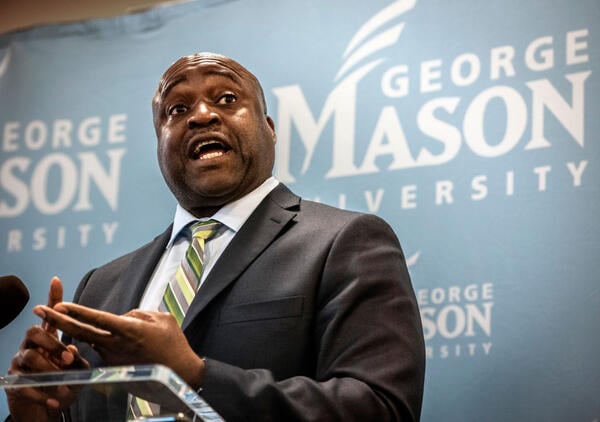
House Republicans have accused George Mason University President Gregory Washington of lying to Congress about diversity practices at his institution, ratcheting up pressure on the president to step down.
The Republican-led House Judiciary Committee alleged in a report released Thursday night that Washington made “multiple false statements to Congress” in testimony about diversity, equity, and inclusion efforts at GMU. The public university has been under fire for months over allegedly illegal DEI practices as the Trump administration has sought to crack down on such initiatives, claiming they are discriminatory and violate federal civil rights law. The Judiciary Committee report also alleged that the university “likely violated federal civil rights law by discriminating based on race in its hiring practices to advance Dr. Washington’s diversity, equity, and inclusion initiative.”
Washington has denied breaking the law through efforts to diversify GMU’s faculty and staff, telling Congress that the university did not practice illegal discrimination under his leadership.
The report is the latest salvo from Republicans who have launched federal investigations into GMU over its hiring policies, including demands that the embattled president apologize for allegedly discriminatory practices, which he has refused to do as he denies any wrongdoing.
What’s in the Report
The House Judiciary Committee’s report zoomed in on an effort by GMU, launched shortly after Washington took office in July 2020, to diversify employee ranks. The Anti-Racism and Inclusive Excellence initiative the president introduced aimed to make faculty and staff “mirror student Demographics” at GMU, which is among the most diverse institutions in the country. As part of that effort, GMU tasked schools and departments with hiring more underrepresented individuals.
But in Congressional testimony, Washington denied the initiative was a strict mandate.
“These are overall goals and they’re aspirational in focus,” Washington said, according to a transcript of his Sept. 17 interview released by the House Judiciary Committee Thursday.
Though the Anti-Racism and Inclusive Excellence initiative stemmed from his office, Washington told Congress that faculty in each department developed plans for their unit. He also cast the creation of such plans as optional, telling Congress “if units did not want to develop a plan, they did not have to.”
But the House Judiciary Committee claimed Washington lied about that.
“Documents and testimony obtained by the Committee … show that Dr. Washington and his deputies actively sought to punish schools that did not comply with his racial discrimination mandates,” the committee report states. “A senior GMU official told the Committee that GMU financially punished any school that resisted Dr. Washington’s unconstitutional initiative.”
Congress pointed to testimony from Ken Randall, the dean of George Mason University’s Antonin Scalia Law School, as evidence that Washington lied about the plan being optional.
“You’d get fired if you didn’t have a plan,” Randall said, according to an interview transcript.
Washington also denied the administration formally reviewed plans to diversify faculty hiring. Republicans accused him of lying about that, too, pointing to internal remarks from then-vice president of Diversity, Equity, and Inclusion Sharnnia Artis (who now has a different title), in which she said the DEI team “consistently reviewed, monitored, and supported” such plans.
“Again, the evidence contradicts Dr. Washington’s testimony,” the report states.
However, Douglas Gansler, a lawyer representing the GMU president sharply disrupted claims that his client lied to Congress, which he accused of carrying out a “political lynching” in an emailed statement to Inside Higher Ed.
“The political theater of the politicians accusing Dr. Washington of misrepresenting anything to them is unadulterated nonsense. Dr. Washington has never discriminated against anybody for any reason and did not utter one syllable of anything not verifiably completely true,” Gansler wrote.
What Happens Next
The GMU Board of Visitors has said little in the immediate aftermath of the report.
“Today, the Board of Visitors received an interim staff report from the U.S. House of Representatives Committee on the Judiciary. We are reviewing the report and consulting with University counsel and counsel for Dr. Washington,” board members wrote in a brief statement. “The Board remains focused on serving our students, faculty and the Commonwealth, ensuring full compliance with federal law and positioning GMU for continued excellence.”
While the board is reviewing the report, it appears unlikely members would be able to take action against Washington. GMU’s board, which is stocked with GOP donors and political figures appointed by Republican Governor Glenn Youngkin, is currently without a quorum after Virginia Democrats blocked multiple appointments in recent months. Now a legal battle over those blocked appointments is slowly winding its way through the judicial system. While the Virginia Supreme Court heard arguments in the case last month, it has yet to issue a ruling on the matter. In the meantime, with only six of its 16 seats filled, GMU’s board is hobbled.
Youngkin’s office did not immediately respond to a request for comment from Inside Higher Ed.
The George Mason chapter of the American Association of University Professors offered a fiery defense of Washington, arguing in a statement the committee was carrying out a politically motivated attack designed to erode institutional autonomy and impose partisan control over the public university.
“The Committee’s unfounded accusations, dependence on clearly compromised sources, and selective presentation of ‘evidence’ represent an unprecedented abuse of congressional power—designed not to find the truth, but to silence leadership that refuses to yield to political pressure,” the GMU-AAUP chapter wrote in an emailed statement to Inside Higher Ed.
GMU students, employees and community members rallied in support of president Gregory Washington earlier this year, amid concerns the board would fire him.
With Washington under pressure from Congress, state and national Democrats have rallied to his defense, accusing the GOP of waging an ideological war on universities and hypocrisy by focusing on the GMU president’s alleged dishonesty while federal officials brazenly lie in court.
“In Donald Trump’s Gangster State, they pick the target first and figure out the charges later,” House Judiciary Democrats wrote on X. “Today’s target: GMU President Gregory Washington. The Trump Education Department failed to find evidence of employment discrimination at GMU. So [House Judiciary committee] Chairman [Jim] Jordan opened his own investigation. When that one only confirmed Dr. Washington followed Virginia law, Jordan pivoted and conjured up an absurd and convoluted criminal referral based on an alleged lie that takes 8 pages to explain.”
Representative James Walkinshaw—a Democrat in Virginia’s 11th district, which includes GMU—called Washington “an exemplary leader” in a biting statement posted on Bluesky.
“Make no mistake, this is an attack on free speech and academic freedom,” Walkinshaw wrote. “It’s cancel culture at its worst and the American people are tired of right-wing snowflakes like Jim Jordan trying to silence anyone who doesn’t bend the knee to their bizarre MAGA ideology.”
The First Amendment was born out of colonial attempts to silence the press with libel laws. Yet more than two centuries later, the wealthy and powerful still use the legal system to bully critics into submission through meritless defamation lawsuits — also known as strategic lawsuits against public participation, or SLAPPs.
One recent example comes from Seymour, Indiana, where attorney Brett Hays sued local resident Anthony Couch over things Couch said on his Facebook page, Seymour Immigration. The page calls itself a “media/news company” and says it aims to “show the destruction of Seymour IN brought on by the illegal immigration problem in Seymour IN and the nation.”
For the rich, free speech — for others, a SLAPP in the face
Texas lawmakers once stood up for free speech. Now, some seem more interested in helping the rich sue critics into silence.
Couch wrote that Hays “is making a killing on representing illegal immigrant crimes” and quoted Hays’ website, which stated, “Even undocumented individuals have rights which they can and should exercise,” offering to help them understand those rights. In a separate post that didn’t mention Hays, Couch wrote, “Notice most if not all are listed as WYTE….this is how they keep the immigrant crime numbers down.” Hays says Couch’s posts, which accuse him of professional “misconduct and unfitness,” are false and damaging — so he’s suing Couch for defamation and wants a judge to make him take down the posts.
But those posts are actually a textbook example of protected opinion. Hays doesn’t deny that he defends people accused of crimes or that his website offers help to undocumented immigrants. Couch’s take, that Hays is “making a killing,” is just an opinion and a common figure of speech, not a factual claim that can be proven true or false. The First Amendment protects this kind of criticism, regardless of whether it is fair, eloquent, or well-reasoned.
The court sided with Couch for now, denying Hays’ request for an emergency order that would’ve forced Couch to delete his Facebook posts. In its decision, the Court said Couch never claimed “that Hays committed any act of incompetence as an attorney,” and that the phrase “making a killing” is “at worst hyperbole or a snide comment.” The court also noted that the other statement Hays complained about didn’t even mention him by name, and appeared to be a complaint about the legal system in general. In response to Hays’ lawsuit, Couch filed an anti-SLAPP motion — a move to dismiss lawsuits meant to silence speech — which the court hasn’t yet ruled on.
SLAPPs like this are filed fairly routinely. FIRE has defendedmultiplespeakers against SLAPPs and SLAPP threats. One of our clients, Iowa pollster J. Ann Selzer, was sued by President Donald Trump for “election interference” and violations of the Iowa Consumer Fraud Act after her 2024 pre-election poll showed Kamala Harris leading Trump by three points — despite Trump ultimately carrying the state by more than 13. In fact, a federal court just dismissed a copycat lawsuit filed against Selzer by a subscriber to The Des Moines Register, styled as a class action, which FIRE also defended.
VICTORY! Federal district court dismisses class-action suit against pollster J. Ann Selzer
Federal district court tosses ‘fake news’ lawsuit against pollster J. Ann Selzer, affirming First Amendment protections for election commentary.
To combat this weaponization of the courts, often by those with significant power and resources, many states have enacted anti-SLAPP laws. These laws protect journalists, news organizations, and ordinary citizens who publicly voice their opinions, expediting the dismissal of meritless defamation lawsuits before they drain defendants’ time and money. As of now, 38 states plus Washington, D.C. have anti-SLAPP laws on the books.
The strength of anti-SLAPP protections varies by state, but most follow the same two-step process. First, the individual being sued files a motion to strike the SLAPP, arguing that the case targets their speech on an issue of public concern. If they can show that, the burden flips: the plaintiff then has to prove their lawsuit actually has merit.
Think of it as an expedited mini-trial that lets judges quickly toss out frivolous claims and spares defendants the time and court costs of full-blown litigation. If the plaintiff can’t make their case, the lawsuit gets tossed — and in many states, the plaintiff has to pay the defendant’s legal fees. That fee-shifting rule discourages people from filing bogus suits and encourages lawyers to take on free speech cases for clients who otherwise would not be able to afford defending themselves.
While the Selzer case is high-profile given the parties involved, SLAPPs involving everyday Americans like Anthony Couch are all too common — and far less visible. Thankfully, Indiana not only has an anti-SLAPP law on the books, but one robust enough to earn a B+ rating from the Institute for Free Speech. Under that law, discovery is paused once the defendant files an anti-SLAPP motion, and successful defendants can recover attorney’s fees. However, if the anti-SLAPP motion is deemed frivolous, the defendant must pay the plaintiff’s attorney’s fees instead.
The anti-SLAPP hearing in Couch’s case has been set for Feb. 20. Indiana’s strong anti-SLAPP protections give defendants like Couch a fighting chance to avoid costly, drawn-out litigation and hold would-be censors accountable for misusing the judicial process to suppress criticism. The fee-shifting provision may also encourage local attorneys to represent Couch, who is currently defending himself, and other unjustly targeted speakers.
The Seymour Immigration page remains active, and Couch does not seem deterred by the lawsuit, likely buoyed by the protections Indiana law affords. But without those safeguards, his story might not be one of defiance, but of silence.
FIRE defends the individual rights of all Americans to free speech and free thought — no matter their views. FIRE’s proven approach to advocacy has vindicated the rights of thousands of Americans through targeted media campaigns, correspondence with officials, open records requests, litigation, and other advocacy tactics. If you think your rights have been violated, submit your case to FIRE today.
Penn State University Libraries’ Teaching and Learning with Technology’s (TLT) Dreamery Speaker Series will host guest speaker Melody J Buckner, associate vice provost of digital learning and online initiatives at the University of Arizona, Dec. 3 and 4. She will lead sessions focused on designing courses that foster adaptability and flexibility in the digital age. Learn more via the PSU News article.
The new campus, Queen Elizabeth’s School in Dubai, will bring over 450 years of British academic heritage to the UAE, offering students access to the National Curriculum for England under the same standards that have made the Barnet school a consistent “outstanding” performer and a leader in UK education.
Developed in partnership with GEDU Global Education, the project recently received initial approval from Dubai’s Knowledge and Human Development Authority (KHDA), making a historic move, as it is the first UK state grammar school to establish an international branch.
“This landmark approval allows us to accelerate our vision to deliver world-leading K-12 education to students from across the UAE,” said Caroline Pendleton-Nash, CEO of Queen Elizabeth’s Global Schools.
“The Dubai branch campus will remain faithful to the mission, ethos, tradition, and exacting academic standards of Queen Elizabeth’s School, Barnet, while embracing Dubai’s spirit of innovation and ambition,” she said.
She added: “In uniting the heritage of one of the UK’s most distinguished schools with the vision of Dubai, we aspire to set a new global benchmark for educational excellence.”
Opening initially from nursery to year 8, the Dubai campus will then expand in phases to include sixth form. The school’s location in Dubai Sports City provides access to exceptional athletic facilities, ensuring that sport and wellbeing remain integral.
We are also excited by the potential for international collaboration, which, in time, will build a global network of Elizabethans for the benefit of our new students as well as those within the state sector in Barnet Neil Enright, Queen Elizabeth’s School, Barnet
Neil Enright, headmaster of Queen Elizabeth’s School, Barnet, emphasised the school’s commitment to fostering opportunity and leadership, saying: “We are delighted to have received this encouragement from the KHDA to offer a rounded and enriching QE education to children in the UAE, spreading opportunity and supporting students to become the leaders of their generation.”
“We are also excited by the potential for international collaboration, which, in time, will build a global network of Elizabethans for the benefit of our new students as well as those within the state sector in Barnet,” he said.
“[That prior interest] confirmed to us the strength of our brand and the strength of a rounded but highly academic education. So the senior staff and governors here have been looking at this move for quite a long time,” he said.
This time, though, working with GEDU, the school was confident it was the right move. “They’re educationalists, they are experienced at partnering with a number of universities in other parts of the world…we felt a real alignment of values with them,” said Enright.
Dan Clark has been appointed as the school’s founding principal, having been deputy head of the elite Marlborough College since 2020.
“Throughout my career in outstanding schools, I’ve seen how powerful education can be,” said Clark.
“It challenges pupils to think deeply, act responsibly and believe in their own capacity to achieve.”
“These values are fundamental to the QE approach. As founding principal of QE Dubai Sports City, I’m excited to establish a community that will produce confident, able and responsible young people who are ready to shape the future.”
A new report from the Century Foundation found that state and institutional grant aid too often flows to higher-income students who don’t need it, while low-income students continue to struggle with unmet need.
The analysis, released Thursday, shows that more than half of students from the top income quartile, 56 percent, receive grants that surpass their financial need, compared to a mere 0.2 percent of students from the bottom income quartile. That means that top income quartile students were 280 times more likely to receive grants that exceeded their level of need than their lowest income peers. The share of white students that receive grants beyond their needs (19 percent) far exceeds the share of Black of Hispanic students who receive such grants (5 percent).
Part of the issue is that the share of state grants that are merit-based jumped 17 percentage points between 1982 and now, according to the report. Over all, about 10 percent of grant aid—at least $10 billion annually in state and institutional aid—exceeds students’ financial need.
The analysis also found that state grants disproportionately go to students at highly selective public colleges versus students at open-admission public four-year institutions—$3,693 and $842 on average, respectively. And at four-year public colleges over all, students with an Expected Family Contribution of zero were less likely than students with higher EFCs to receive aid from their institution.
“What people think about as a pillar of the financial aid system in higher education has become a windfall for wealthy students that leaves working families paying the bill for tuition increases,” Peter Granville, the report’s author and a fellow at the Century Foundation, said in a news release.
Immigration Minister Lena Diab told a House of Commons committee last week that the Strengthening Canada’s Immigration System and Borders Act (Bill C-12) would target “people who are going to be committing large-scale fraud”.
However, an opposition member, Conservative MP Michelle Rempel Garner, rejected the idea that the Liberal government needs sweeping powers to keep the immigration system functioning.
“That sounds like an authoritarian dictatorship to me,” Rempel Garner said.
Languages Canada Executive Director Gonzalo Peralta told The PIE News there was a need to define under what conditions Immigration Refugees and Citizenship Canada (IRCC) could cancel student visas.
“The term ‘public interest’ as grounds for cancelling visas or applications is vague and does not provide the assurances needed to ensure that legitimate students are not inadvertently impacted by the legislation,” Peralta said.
At the committee meeting, Rempel Garner argued: “It seems like you’re trying to give yourself and your department more powers to correct mistakes in the system that they could have made in screening out potential fraud to begin with.”
The term ‘public interest’ as grounds for cancelling visas or applications is vague and does not provide the assurances needed
In the wake of a large number of fraudulent study permit applications made by unscrupulous education agents, in 2023 the department implemented a system requiring applicants to present a verified letter of acceptance from a designated learning institution in order to obtain a study permit.
In many cases, the students said they were not aware that their agent was submitting fraudulent documents on their behalf.
MP Rempel Garner called out the minister for blaming students and other newcomers to Canada. “Why don’t you make the system work instead of punishing the victims of human trafficking,” she demanded at the meeting.
Larissa Bezo, president of the Canadian Bureau for International Education (CBIE), told The PIE her group supports measures to uphold the integrity of the International Student Program. “However, we do not want to see international students who have been the victims of fraud unfairly punished,” Bezo said.
Peralta of Languages Canada condemned the Liberal government for failing to consult with the sector about this legislation and other policy changes.
“In the case of the proposed Bill C-12, a more comprehensive definition is needed of the specific conditions under which IRCC could cancel visas,” Peralta said.
Canadian immigration policy has hit the headlines over the past week after Prime Minister Mark Carney’s government set out its intention to cut new international study permits by more than 50% in 2026-2028 – going further with enrolment caps that are already causing significant problems for the international education sector.
As Thu Thu Htet, “T”, was nearing graduation at her high school in Burma, she knew she wanted to go abroad to study engineering. She wanted to study at the Rochester Institute of Technology in New York State, but didn’t want to spend tens of thousands of dollars a year in tuition, since international students don’t qualify for federal aid.
Instead, she decided to start her higher education journey at Monroe Community College, also in Rochester, where tuition is cheaper. T, now in her second semester, has made friends with dozens of other international students at MCC, who have helped her feel less lonely being so far away from family.
“There are times where I don’t feel like I fit in. Or I feel alone sometimes. The most important thing is the friends that you have,” she said.
International student enrolments have surged at US community colleges ever since the pandemic, including this fall. As community colleges host more international students, administrators are looking for ways to make them feel welcome on campuses where most students are local commuters.
One way international students at MCC can find support is through campus life. T serves as the president of the Global Union – a student-run club for international students, immigrant students, and anyone interested in learning about other cultures. Through her role, she greets new students, helps them to overcome challenges, and organises events to help them showcase their cultures.
“Sometimes, you need to be around people that have the same feeling as yours. When we are in the same club with immigrants, refugees, or other international students, we feel like we fit in with each other,” T said.
An unexpected increase
Because of President Trump’s policies, analysts predicted a 15% drop in total international students at American colleges and universities this fall. Experts warned that the Trump administration’s near month-long pause on visa interviews, travel bans, and war against many of the nation’s most prestigious universities would harm enrolment.
Instead, this fall’s international student enrolment across all degree programs, including OPT, grew by 0.8%, according to the Student and Exchange Visitor Information System (SEVIS) data that the Department of Homeland Security publishes.
Community colleges have helped to move the needle. For associate degree programs, international student enrolment increased by 9.1%, with community colleges welcoming nearly 5,500 more students than last year. Meanwhile, enrolment shrunk slightly for master’s programs and hardly changed for bachelor’s programs.
Rather than choosing not to study in the US this fall, it seems like students are choosing different kinds of degrees or schools. That’s according to Chris Glass, director of Boston College’s higher education program, who recently analysed the latest SEVIS data.
“If we’re to take this data at face value, the system is far more resilient than the tumultuous headlines would suggest,” Glass previously told The PIE News .
Based on his analysis, the over 9% growth of international students at community colleges may not be a fluke. Glass argues that international students gravitate toward schools with less political spotlight, more affordable tuition, and access to opportunities after graduation. Community colleges check all of those boxes.
MCC is hosting more international students now than before the pandemic. This fall, the campus’ international student body grew by 35%, hosting 120 students from over 30 countries.
MCC’s international recruiting efforts for soccer, baseball, and other sports has helped to draw students from across continents, said Carly O’Keefe, MCC’s assistant director of global education and international services. The current men’s and women’s soccer team roster has a combined 34 international students.
In addition, unlike many other community colleges, MCC has dorms. For T, attending a college with on-campus dorms was critical, since she had no family or friends in Rochester to live with.
O’Keefe said international students at MCC bring ideas and culture from across the globe, enriching a campus where most students are local. Some local students – limited by jobs, financial constraints, or family obligations – have never traveled overseas.
“They’re able to make friendships with people from other countries that they maybe would have never connected with otherwise,” she said.
Finding a community through campus life
The wall of the Global Union office is decorated with dozens of paintings of hot air balloons containing flags, created by students to represent their countries. Colourful cloth flags and souvenirs from across the world fill the room.
“At the time when I saw the Korean flag, I was so proud,” said Onyu Cha, a first-semester international student from South Korea studying nursing.
Hot air balloon paintings at Global Union office. Photo: MCC Global Union
Onyu made friends with other Koreans through campus life and through her sister, who also lives in Rochester. Recently, she and other Korean students went to her sister’s house to cook food for the holiday of Chuseok, a mid-autumn harvest festival often referred to as Korean Thanksgiving.
Through her role as the vice-president of the Global Union, Onyu has got to learn about the cultures of other students. Currently, the club is planning for an event to celebrate holidays from across the world, all on one day. That’s similar to last year’s Global Fusion Festival – an event in the campus atrium to celebrate the cultures of all MCC students. It featured African drummers, Ukrainian dancers, and food from across the globe.
Judichael Razafintsalama – a student from Madagascar who graduated from MCC last May – said serving as the Global Union president allowed him to support his fellow international students.
Having international students on campus at a community college can be really enriching to a local community
Dr. Melissa Whatley, William & Mary
The summer before starting his first year at MCC, Razafintsalama landed in Rochester around 2am. When he got to his dorm, he realised he had no food. The vending machines were empty, the campus’ food services were closed, and he hadn’t set up rideshare on his phone. To get groceries, he walked two hours to a Walmart and back, carrying four bags while jet lagged.
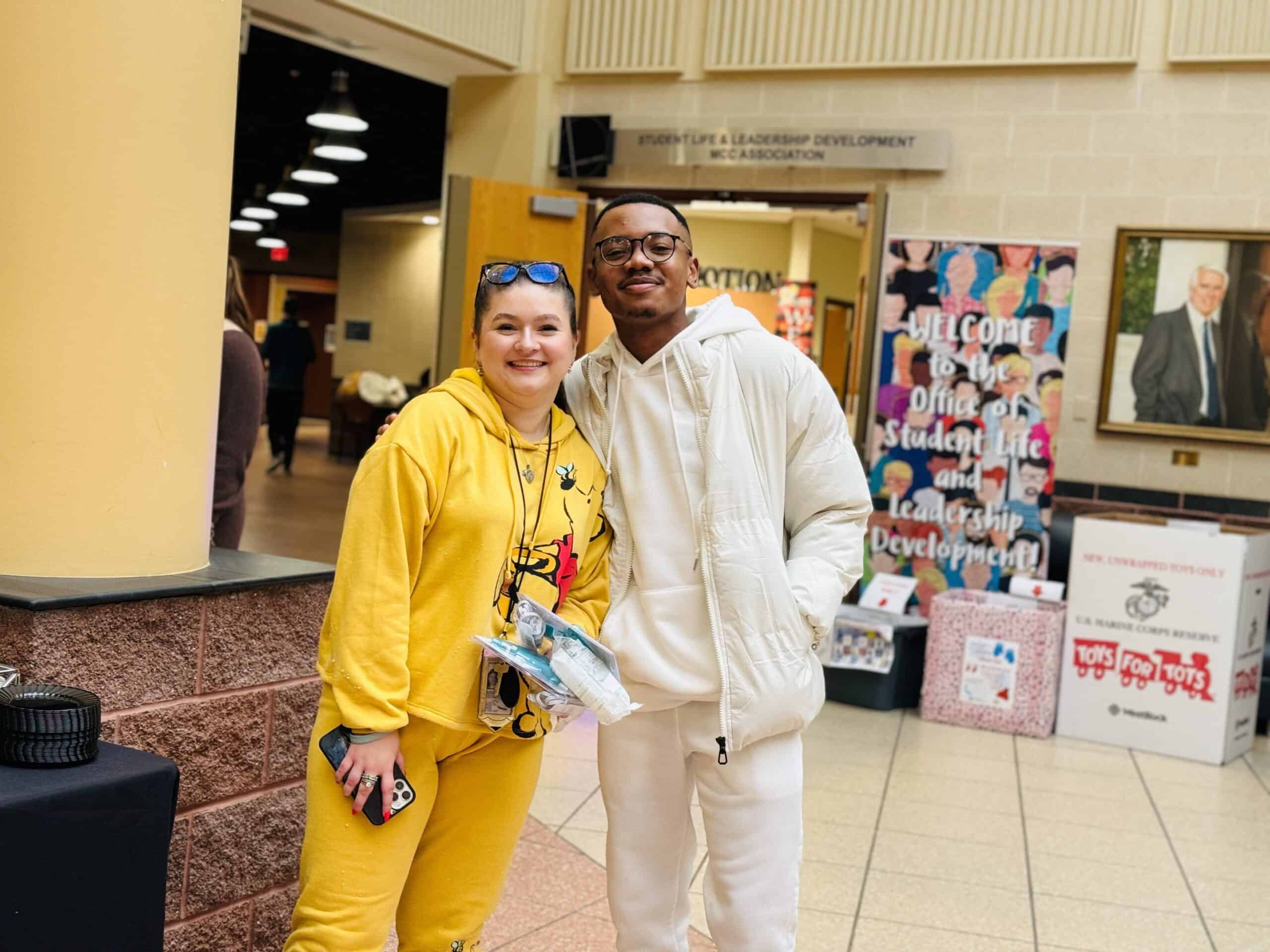
Now, international students come together to help the Office of Global Education provide packages of canned food, granola bars and utensils for incoming international students.
“We even helped two of our students move into their apartment and make sure that everything is settled after going through what I went through,” Razafintsalama said.
Razafintsalama said he’s had the chance to teach others at MCC about his country and his culture. Most students he encountered had never met anyone from Madagascar, the island nation off the southeastern coast of Africa.
“They usually attach it to the cartoon movie,” he said. “It’s great because I can see that people are interested in my country and to see what it actually is like.”
Supporting international students’ social and housing needs is critical to making them feel welcome, said Dr. Melissa Whatley, an assistant professor of higher education at William & Mary University. Her research group recently released a report on international education at community colleges, finding that 82% hosted international students.
Whatley hopes that these colleges are providing international students with campus life opportunities and, if they don’t have dorms, are helping students to find housing.
“Having international students on campus at a community college can be really enriching to a local community, to the extent that the community is equipped to welcome them,” she said.
Concerns over travel ban
Currently, the US hosts over 1.2 million international students or recent graduates, according to SEVIS data. The dataset doesn’t distinguish between students and graduates working temporarily through Optional Practical Training (OPT). More in-depth statistics will become available once the Institute of International Education publishes its annual report later in November.
However, because of President Trump’s travel ban, some prospective international students have been restricted from studying in the US. That includes Burmese students who didn’t secure a visa before June 9.
MCC has seen an uptick in Burmese students ever since a civil war broke out in the country, interrupting higher education for many students. The war began in 2021 when military forces toppled the country’s democratically elected government. Last spring, MCC still hosted more students from Burma than from any other country, O’Keefe said.
Now, Burma is among the 12 countries included in Trump’s travel ban, impacting all immigrant and non-immigrant visas. Seven more countries are under a partial travel ban that impacts international student visas.
As for international enrolments at MCC? “We’ll see how the trends change over the next few semesters. I would be surprised to see such a significant level of continued growth but we can hope things at least stay stable,” O’Keefe said in an email.
The takeaway from this fall’s enrolment data is that students’ perceptions take a long time to change, said Gerardo Blanco, academic director of the Centre for International Higher Education at Boston College. He previously told The PIE that the 0.8% international student increase revealed in SEVIS records came as a surprise, but that doesn’t mean there won’t be a decline in coming years.
“I hope the takeaway message is not that the US is invincible, in that even hostile policies towards international students cannot change perceptions,” he said.
by Anna Mountford-Zimdars, Louise Ashley, Eve Worth, and Chris Playford
Higher education has become the go-to solution for social inequality over the past three decades. Widening access and enhancing graduate outcomes have been presented as ways to generate upward mobility and ensure fairer life chances for people from all backgrounds. But what if the very ecosystem designed to level the playing field also inadvertently helps sustain the very inequalities we are hoping to overcome?
Social mobility agendas appear progressive but are often regressive in practice. By focusing on the movement of individuals rather than structural change, they leave wealth and income disparities intact. A few people may rise, but the wider system remains unfair – but now dressed up with a meritocratic veneer. We explore these issues in our new article in the British Journal of Sociology, ‘Ambivalent Agents: The Social Mobility Industry and Civil Society under Neoliberalism in England’. We examined the role of the UK’s ‘social mobility industry’: charities, foundations, and third-sector organisations primarily working with universities to identify ‘talented’ young people from less advantaged backgrounds and help them access higher education or elite careers. We were curious – are these organisations transforming opportunity structures and delivering genuine change, or do they help stabilise the present system?
The answer to this question is of course complex but, in essence, we found the latter. Our analysis of 150 national organisations working in higher education since the early 1990s found that organisations tend to reflect the individualistic approach outlined above and blend critical rhetoric about inequality with delivery models that are funder-compatible, metric-led and institutionally convenient. Thus – and we expect unintentionally on part of the organisations – they often perform inclusion of ‘talent’ without asking too many uncomfortable structural questions about the persistence and reproduction of unequal opportunities.
We classified organisations in a five-part typology. Most organisations fell into the category of Pragmatic Progressives: committed to fairness but shaped by funder priorities, accountability metrics, and institutional convenience. A smaller group acted as Structural Resistors, pushing for systemic change. Others were System Conformers, largely reproducing official rhetoric. The Technocratic deliverers were most closely integrated with the state, often functioning as contracted agents with managerial, metrics-focused delivery models. Finally, Professionalised Reformers seek reform through evidence-based programmes and advocacy, often with a focus on elite education and professions.
This finding matters beyond higher education. Civil society – the world of charities, voluntary groups, and associations – has long been seen as the sphere where resistance to inequality might flourish. Yet our findings show that many organisations are constrained or co-opted into protecting the status quo by limited budgets, demanding funders, and constant requirements to demonstrate ‘impact’. Our point is not to disparage gains or to criticise the intentions of the charity sector but to push for honest and genuine change.
Labour’s new Civil Society Covenant, which promises to strengthen voluntary organisations and reduce short-termism, could create opportunities. But outsourcing responsibility for social goods to arm’s-length actors also risks producing symbolic reforms that celebrate individual success stories without changing the odds for the many. If higher education is to deliver genuine fairness, we must distinguish between performing fairness for a few and redistributing opportunities for the many. We thus want to conclude by suggesting three practical actions for universities, access and participation teams, and regulators such as the Office for Students.
Audit for Ambivalence
Using our typology, do you find you are working with a mix of organisations, or mainly those focused on individuals? (Please contact us for accessing our coding framework to support your institutional or regional audits.)
Rebalance activity towards structural levers
Continue high-quality outreach, but, where possible, shift resources towards systemic interventions such as contextual admissions with meaningful grade floors, strong maintenance support, foundation pathways with guaranteed progression and fair, embedded work placements
Ask the regulator to measure structural outcomes as well as individual ones, at sector and regional levels. When commissioning work, ask for participatory governance and community accountability and measure that too.
We believe civil-society partnerships can play a vital role – but not if they become the sole heavy-lifter or metric of success. Universities are well positioned to embrace structural levers, protect space for critique, and hold themselves accountable for distributional outcomes. If this happens, the crowded charity space around social mobility could become a vibrant counter-movement for genuine change to opportunities and producing fairness rather than a prop for maintaining an unequal status quo.
In terms of research, our next step is speaking directly to people working in the ‘social mobility industry.’ Do they/you recognise the tensions we highlight? How do they navigate them? Have we fairly presented their work? We look forward to continuing the discussion on this topic and how to enhance practice for transformative change.
Anna Mountford-Zimdars is a Professor in Education at the University of Exeter.
Louise Ashley is Associate Professor in the School of business and management at Queen Mary University London.
Eve Worth is a Lecturer in History at the University of Exeter.
Christopher James Playford is a Senior Lecturer in Sociology at the University of Exeter.