This episode is about leadership in Higher Education. Meet Carole Chabries, PhD who has journeyed from campus leadership roles to coach and consultant at Third Rail Leadership. Here’s ways she supports leaders at colleges and universities.
Carole Chabries, PhD is a coach for leaders in Higher Education after a long-time being an academic leader herself. We met through our friend (and fellow podcast guest here on The Social Academic), Dr. Jennifer Askey. When Carole shared she was appearing on video on her local tv station in Milwaukee? I thought, how fun would that be to chat about here on the podcast.
This is The Social Academic, on online presence for faculty, researchers, and graduate students. I’m Jennifer van Alstyne. I help academics like you feel confident when you show up online. You have agency in creating a stronger online presence for yourself. Let’s build a strong digital footprint through your academic website, social media, and bio writing.
Quotes
Supporting Your Team
“I think on a campus, if you’re in any kind of leadership role, the best thing you can do for your team is to be aware that they are constantly on edge in ways that have nothing to do with their work.”
Leading in Rigid Systems
“Higher ed is… complex. In many places, it’s toxic, it’s often really rigid. And so how do you make change if you’re a really heart-centered devoted person? I love working with folks who are trying to solve that problem.”
Authentic Branding
“When I hit the publish on the homepage [of my rebrand]… it represents something that feels very real and true in my gut. It just feels true to me.”
Interview
Jennifer van Alstyne: Dr. Carole Chabries of Third Rail Leadrship. I’m so excited for this conversation because higher education leadership is not actually something that I’ve covered on The Social Academic podcast before, and I feel like you’re the best person to come and chat about this. We actually met in a meeting with Dr. Jennifer Askey, who has also been on this show, and one of the things that came up at our last time when we connected was that you were appearing on a video on TV. That was so cool to hear about. And so we’re going to be chatting about that in this episode. But first, let’s chat about you. Tell me a little bit about your background in higher ed.
Carole Chabries: Okay. Well, I have wanted to be a teacher my entire life, so I got to college and I was like, I will just stay in college and keep going. I earned three degrees in English literature with the intention originally of becoming an English professor. And in my graduate program, I realized tenure looked like hell. That looked like jail to me. I was trained in a really dysfunctional department, didn’t want anything to do with a life like that. And so I stepped into administration, which I know most people think is evil, but I had some really great mentors in administration as a grad student. And so I never even applied for a tenure track job. I got the PhD and I got the hell out of professor life. I still kept teaching, but never as a full-time tenure track professor. I’ve spent nearly, I mean I don’t know, 25 years, nearly 30 years by now leading departments, leading different academic units, always inside of academic affairs, kind of on the proverbial linear ladder. You think you’re going to keep getting promoted. And there was a time in my early forties when I thought I really want to be a college president. Running big organizations that are mission-driven just really speaks to me. And then the closer I got to presidents and the more I saw their life, the less I wanted it. Running the organization seems great, but all of the BS that comes along with it was just completely uninteresting to me. Anyway, I stayed on the path and, until I didn’t, and now I’m a consultant.
Jennifer: Now, Third Rail Leadership is newer. But you’ve been consulting for some time, is that right?
Carole: Yeah, yeah. Longer than it might look. I actually got my first consulting project in December of 2015. It was a random assignment, a request from a college president who needed something done and he was like, “We don’t really know how to do it, but maybe you could figure it out for us.” And I was like, “Yes, I am totally your girl.” So I kept consulting like that, but in 2021, it became really clear to me that I was going to need a path to exit. And I knew that going back to hoping that a college president would call me with a cool project, not going to pay the bills. And so I decided to actually get focused about building a business. I did that, launched it in early 2022, recently renamed it. Now Third Rail Leadership is three and a half years old.
Jennifer: Congratulations! I know that you just launched a new website, so that is very exciting. Oh, before we move on, I just want to show people the homepage. This is-
Carole: Oh, thank you.
Jennifer: Fascinating to see the colors and how visually engaging it is. I saw this website when it was in draft, and this is amazing. I’m so happy that it is live. For everyone who’s listening, that is thirdrailleadrship.com. I’m curious about who you love to work with, who do you dream about working with Third Rail Leadership?
Carole: Okay, can I answer that two different ways?
Jennifer: Yeah.
Carole: In the world of law of attraction, I apparently am a magnet for people who are being treated like, ‘Can I swear on the show?’ People who are being treated badly. And so a lot of my clients come to me because they are working for somebody who is not just antagonizing them, but sabotaging them, papering their files, lying about their capabilities, their competence, building a case against them, pushing them out. I wouldn’t say I am eager to work with those people, but those are clearly my people, and I have been that person. I have had that happen to me at two different institutions. I feel the pain, and I know both the technical and the legal aspects of dealing with that. But the people I love working with, beyond that, and there’s overlap. These are sometimes the same people. The people I love working with are people who are really drawn to lead. They have a deep desire to fix something or make something better. Maybe it’s culture, maybe it’s a department, whatever, but they feel called to be the person who improves things for other people, and then they’re not really sure how to do it. Because higher ed is, it’s complex. In many places, it’s toxic, it’s often really rigid. And so how do you make change if you’re a really heart-centered devoted person? I love working with folks who are trying to solve that problem.
Subscribe to The Social Academic blog.
The form above subscribes you to new posts published on The Social Academic blog.
Want emails from Jennifer on building your online presence? Subscribe to her email list.
Looking for the podcast? Subscribe on Spotify.
Prefer to watch videos? Subscribe on YouTube.
Jennifer: I really like that. And I actually honestly am not a higher education leader. That was never a dream of mine. But heart-centered is really how I approach my work, and I honestly feel like I could not do that within a university campus setting. I need to be someone who works with people across institutions and different countries. I think it’s really important to me to have that flexibility. And so I’m curious about the flexibility that you’ve created in Third Rail Leadership. What are some of the new ways that you can support people because this exists?
Carole: That’s a really great question. So there are the typical ways, because I’m available as a person to people who need a coach or consultant or whatever. But I have, I think the two things that I’ve done that I would not have done if I had stayed in higher ed, one is I took the bones of a leadership workshop I had been teaching since 2011 I think, and I kind of claimed it. I rebuilt it in a way that was fun, engaging, it drives on the scholarship of teaching and learning. The photos I have from these workshops, people blowing bubbles and people laughing. It sounds silly, but it’s just really personal and personable. And that’s a big workshop. It’s a workshop where I can go into an organization and I can train a hundred people who are in leadership roles in that place. Normally you go away to go to a leadership training and you come back and maybe you bring a few things, but this is really designed to help an entire organization get some momentum in their leadership culture.
So that’s different. The other thing that I do that I would not have done if I had never entered the world of marketing is I publish a weekly newsletter. And those three degrees in English that I have mean I love writing essays. You can’t really write an essay every week for newsletter. I mean, some can, like Heather Cox Richardson, she manages that. She’s brilliant and wonderful at it, but I think people who are in leadership roles don’t really need an in-depth highfalutin leadership essay every week. They need, how the f**k do I do this? I’ve got this little problem, I need some ideas to, and also I think people really need to feel seen. If I can say it this way, seen in their agony. We’re all seen when things are beautiful, but when things aren’t going well, you kind of sit in your office by yourself and you feel isolated.
And so one of the things a newsletter does is it kind of shines a light on how many of the terrible things that happen to us individually are actually systemic. They’re happening to people all over the country. It’s not just you. It’s not just your institution. And that’s one thing I could never have done at an institution because the leadership of an institution will read something like that and assume rightly or wrongly, often rightly, that you’re criticizing the institution. Maybe, maybe not, but every institution is part of this big complex, systemic thing. Being able to speak honestly and openly and directly about this, for me has been immensely liberating. And I know for my readers because of the responses I get, people are just really grateful to have a space like this.
Jennifer: It sounds like the advice that marketers give is niching down, creating a focus, and leaders are your audience. But it sounds like what’s really valuable about it is that you get to focus and talk directly to the people that you most want to support. Not really from a marketing perspective, but from a relationship building perspective of how we tell our story and how we relate to each other when we’re busy in our lives. And those leaders are making decisions every day. I love that they get to experience your thoughts as part of that process.
Carole: Yeah, thanks.
Jennifer: I’m curious about, you mentioned that there are some recurring systemic issues, and I just want to make sure that I have a clear understanding of what some examples of that might be. Is there something that’s particularly resonated with maybe your newsletter audience, for instance?
Carole: A couple weeks ago, I published a newsletter and within an hour, probably half a dozen people, so not a huge number, but four to six people wrote back immediately to say, “Oh my god, this is happening to me too. I thought I was the only one.” And the situation is, you are on the job market. You are in the interview process. You are appealing and attractive as a finalist. You accept the job and you get there and they have completely lied to you. They have completely misled you about either what the work is, what the problems are, or what the culture’s like. And so I could name four people who said to me, how did I miss the signs?
And the answer is, you didn’t. It’s not you. One of those systemic things is that we are not honest about the problem we’re trying to solve. We get super excited about finding a savior figure in the search process. We bring them in, they move, they bring their family, they leave friends behind, they leave a house behind. We bring them to this institution, and then we’re like, “Oh hey, by the way, let me tell you how it really is.” If I could fix one thing, it would be that. I actually have a dream about building an app for that. But that’s a different conversation for another time.
Subscribe to The Social Academic blog.
The form above subscribes you to new posts published on The Social Academic blog.
Want emails from Jennifer on building your online presence? Subscribe to her email list.
Looking for the podcast? Subscribe on Spotify.
Prefer to watch videos? Subscribe on YouTube.
Jennifer: One of the things that I think is really powerful is the flexibility to tell our story with our online presence. And we initially connected for this episode because you were like, “Hey, I’m going on TV. I get to tell my story.” And maybe we’re feeling a little bit of thoughtfulness and consideration and worry over, “What am I going to say? How am I going to say it?” I guess I’m curious, before we watch a little clip of the video, can we chat a little bit about how you were feeling before? Because so many people who are listening to this are like, I maybe want to appear in a video one day and I have no idea what to expect.
Carole: Yeah, yeah. You’re very kind to say, I was being thoughtful. I was terrified. I was going to be on live TV and thought, “I don’t have anything worth saying, what am I going to do? What am I going to wear?” I felt all the insecurities, all the uncertainties. Some of what helped is that I shared them with the producer who said, “Oh, yeah, everyone feels that way, and here’s what we do to make sure that you don’t feel that way during the interview.” They were fantastic about prepping me. They also had a process of, so they asked for my talking points. Having to write my talking points actually made me think about the flow and the purpose of the conversation. What was worth saying that I could say in five or six minutes to this particular group of people, that’s a kind of focused discipline you don’t really have to exercise until you have an outside circumstance calling for it. I’d never done this. But having to write those talking points out, actually maybe because a writer by training, I ended up writing a script because I needed to see how the questions and my answers could kind of flow off each other. That helped me get so focused, not just about the, it’s a commercial, it’s genuinely commercial, but it helped me get really focused about my business. It was an amazing intellectual activity for me.
Jennifer: Can we talk about that aspect for a sec? That it is a commercial because a lot of people have something important that they want to share, and they feel like they need to wait for someone else to say, invite them on a podcast to talk about it. You had an opportunity to create and be part of shaping the story of how your video was going to be out there. What was that process like for you?
Carole: Yeah, so it started with a cold pitch from a salesperson, which I just was like, I get a million of those. Not interested. But something kept me coming back to this one. And my first answer was, I can’t possibly do this. I’m working on this rebrand. I don’t have time. And then I was telling a friend of mine that was my response and she said, “Carole, you can schedule the commercial to coincide with your rebrand. The universe is handing you a gift and you’re sitting there saying, ‘Eh, not this gift.’ What’s wrong with you?” I was like, yes, what is wrong with me? My first step was acceptance and an acceptance of the work and the emotional work and the kind of intellectual work that was part of this.
And then I would guess there were probably two parts of the process. One part of the process was all me getting over myself, thinking about what am I going to look like? What am I going to wear? How am I going to appear? Am I going to stutter? Just all the emotional insecurities and the self presentation. But the other part of it was actually the more I worked on the rebrand and the script simultaneously, the more confident I felt because I found that I was finding words and phrases and images. They were being pulled from me because I had an assignment, but they were there and it was really affirming and really powerful to just kind of feel it come together. The morning we went, I went to film, I actually felt nervous. I’m like, “Am I going to be shiny on screen?” But I mean, man, they’re pros. They put me totally at my ease. We actually had a genuine conversation, even though I knew how it was going to go, I ad-libbed, she ad-libbed, we laughed. It was amazing. Not only would I do it again, I am already figuring out the things that are happening on a calendar that will give me a good reason to go back and make another commercial.
Jennifer: I love that!
Carole: Yeah, yeah.
Jennifer: That is so meaningful because I feel like the fear and worry and anxiety, it really turned into such a warm and welcoming kind of experience. And I feel like I relate to that. Not because done a live video on TV, but with my professional photo shoot, I had never done professional photos before and I had so much worry and anxiety about what it would be like to sit in the makeup chair and have my hair done. I did hire my wedding team to come do it and they put me so much at ease that I was excited to do it again and have recommended it to so many people because I was, I did not know that this could be fun and that I would want to be engaging in this type of process. And I didn’t know how many people my photos would touch. And maybe we don’t always dream about how many people the video that you created can touch, but it sparks interest in far more people than we expect. And I feel like that is something that I’m excited to watch this clip with you for.
Carole: Can I say one thing before you show it? Maybe the biggest moment of conversion for me was when I realized it’s going to show on a weekday from nine to 10 when the people I work with are busy. None of my potential clients are going to be watching this. But what I needed was a six minute professionally produced video that I could repurpose. And so that was a big shift for me and a really important reason that I ended up deciding to do this.
Jennifer: I know, and even today, this is almost an unexpected repurposing because just last night I was like, “Wait, let’s see if we can actually watch a clip together.” And so everyone who’s watching this is my first time doing a screen share video during this. Let’s see how it goes. Bear with me. Okay, let’s see. I am going to mute myself and then I can press play.
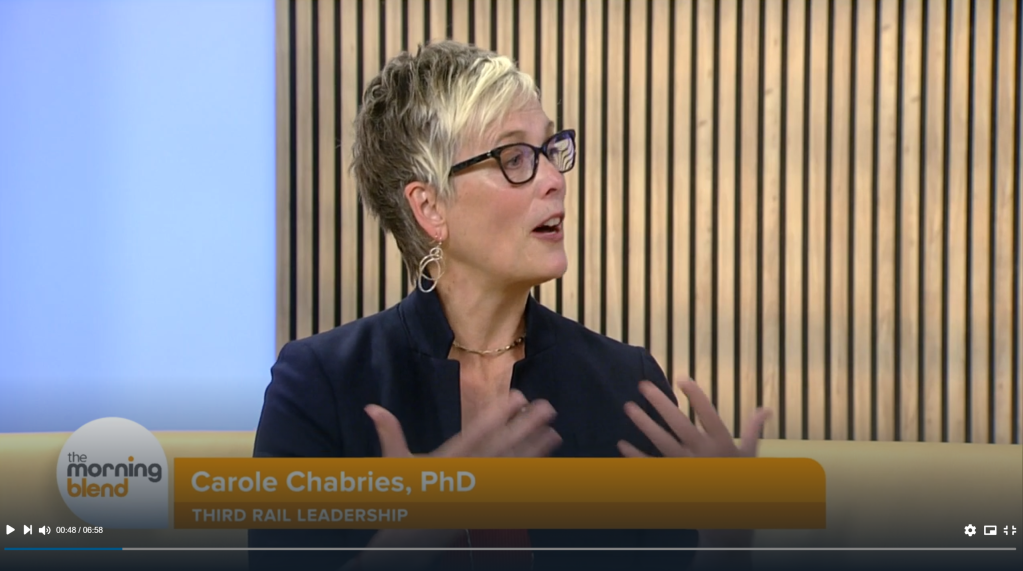
Video on TMJ4 News, a video promotion on The Morning Blend to share her story.
Subscribe to The Social Academic blog.
The form above subscribes you to new posts published on The Social Academic blog.
Want emails from Jennifer on building your online presence? Subscribe to her email list.
Looking for the podcast? Subscribe on Spotify.
Prefer to watch videos? Subscribe on YouTube.
Jennifer: I feel like that’s powerful, and I feel like that’s something that, safety, I feel like that has been a necessary part of our thinking in higher education this year. Maybe before we chat more about video, maybe that’s my next question for you. Do you have a message for people, for higher ed leaders, for people on campuses who frankly are going through it this year?
Carole: I wish I was profound and articulate. I think the most important thing for any of us as humans is to not be under constant threat. And we live in a world where we are all under constant threat, many of us more so than others. I think on a campus, if you’re in any kind of leadership role, the best thing you can do for your team is to be aware that they are constantly on edge in ways that have nothing to do with their work. And then you bring in the intersection of campus. Is ICE going to show up? Is your grant going to get pulled? Is enrollment going to tank because international students aren’t coming to the US? It’s all layered, but underneath it, people are terrified existentially. And it is so important to start there, to recognize that and not to pretend that everything’s fine and people need to quit overreacting.
Jennifer: It’s not an overreaction, but the intention and the thoughtfulness and the third rail safety. I really like that the work that you’re doing brings together all your experience, but also creates new systems of support for campuses that frankly, an outside person can be so supportive in a way that, when I’m working with faculty on their websites, thinking about themselves on their own is quite difficult. But when we’re in conversation about it, it feels exactly like what you were talking about for your video. It feels reaffirming. It gives space to think through the words and to make better decisions. And I feel like that’s the kind of support that your company provides. Making better decisions, creating better safe spaces and systems for the people on campuses. What else should I know about the work that you do? Because I feel like I want to help people take that next step to get in touch with you.
Carole: I guess I’ll say three things. The very best thing people can do if they are curious about this is to sign up for my newsletter. It’s called The Leadership LiveWire. If you go to my website, thirdrailleadership.com, there’s a big orange subscribe button in the top right. It’s a free weekly newsletter. It is voice-y. It sounds like me, I swear. I have sometimes had people write back to me and say, I’m really mad at today’s issue, but then they don’t unsubscribe. People have real genuine responses to it. The best thing to do is to move into my world and get to know me through the newsletter. If you are an individual who is struggling against whatever systemic BS is happening to you, I do take one-on-one coaching clients. I don’t take very many. I only take a few, but it’s always worth asking if I have space.
And so you can email me at [email protected], or you can go to the website. Whatever you want to do. And we could even have just a free preliminary conversation about the sort of support you need. Sometimes I think there are people who are better than me in my world who can help people, and I will recommend them or refer them instead. And then the third thing is if you are in any sort of professional development role, so if you’re the director of a center for teaching and learning or you’re in HR, or you’re responsible for faculty development on your campus, I would really ask you to consider bringing in 10 1/2 Lessons for Leaders to your campus. Not only because I love it, it’s a really unique offering in the professional development space, but the feedback from faculty and staff who’ve attended it is nearly universal.
I can’t think of a person who has said, “I didn’t like this. I didn’t learn from it.” People talk about having practical skills they can use that day. People talk about having this sense of community, and as they try to implement some of the tools we learn, and it’s really fun. We have stickers. It’s cute, it’s fun, it’s active, and it’s something that you can bring really affordably to your entire campus. It’s way more affordable to do that than to send some folks away. So, my newsletter, coaching if you need it, or a workshop for your campus if that’s kind of the thing that you’re in charge of making sure happens.
Subscribe to The Social Academic blog.
The form above subscribes you to new posts published on The Social Academic blog.
Want emails from Jennifer on building your online presence? Subscribe to her email list.
Looking for the podcast? Subscribe on Spotify.
Prefer to watch videos? Subscribe on YouTube.
Jennifer: I feel like in the video, did you mention that the stickers were designed by your son?
Carole: Yeah. Yeah.
Jennifer: That is so cool. What was that like? Because honestly, there’s so many people who listen to this who have a really talented family member who probably, they might not have considered asking for support like that. What was that like?
Carole: It was great, and it was kind of a combination of things. I needed help. I needed to get some of my time back, and I needed somebody to help me to design the stickers. My kids are always interested in making money, so we have a family side hustle, but I was like, “Oh, this is kind of like that.” And my kid at the time was doing a lot of social media for his forensics team in high school, and so I’d seen his eye and I just thought I could pay someone I don’t know, or I can pay my own kid, which of course once you have a business is also a little break for you too. So highly recommend. But I asked him to do it. I shared my Canva account with him. We went back, it was just like any other designer. We went back and forth. He gave me some things I hated. He gave me some things I was like, “That’s brilliant. How did you come up with that?” And then at the workshops, when I tell people that my 17-year-old designed these, everybody loosens up the idea that families involved and a kid, it’s just been a win for everyone. It’s been super fun.
Jennifer: Well, I really appreciate that. I collaborate with my husband a lot and stuff, and I feel like family has been an unexpected theme on The Social Academic podcast this season. I’m delighted that we got to sneak that tidbit in. We have had a conversation about the video, about your website, but one of the things that I feel like came up was that you have gone through this rebranding process. Would you be open to, not necessarily what prompted that, but how publishing everything once you finished working on it felt because that just happened, right?
Carole: Yeah. Actually, literally this morning I updated the homepage and finally published it. I mean, I’m happy to answer both questions. It came about because some bullies who I now call #Floridamen sent me a cease and desist letter for my business name. And I was like, fine, they’re MAGA-adjacent. I don’t want to be associated with them. I think my brand should be as far apart from theirs as possible. I actually was really excited to rebrand before I understood how much work it was going to be. But the work came at a really interesting time in the life of my consultancy because I think for the last nine months I had really been grappling with how to really focus on a particular thing and talk about it in a particular way. But there was no urgent reason to do that. And the rebranding gave me an external urgency, which as an academic, I’m super used to responding to.
That part of me was like, alright, let’s get on the deadline. That was great. And then the work was immense. I told a friend of mine, it kicked me ass and broke, kicked my ass and broke me open. It really pulled out so much more of my core being than I expected it to so that when I did finally hit publish, well, okay, so there are many pages. The first one I hit publish on, I was like, “Eeek,” there are still more to come. But this morning when I hit the publish on the homepage, I had actually just worked through some coding problems using ChatGPT. There’s some HTML and JavaScript to make some things happen that I have no idea how to make happen because I write words, and I felt such a sense of accomplishment. Chat and I had figured out the Java and the HTML and the page was working the way I wanted it to. And it represents something that feels very real and true in my gut. It just feels true to me. And so when I published my first website in the first iteration of this business, I was petrified even weeks later. It’s public, people can see me, ahhh. Now I’m like, hell yeah. Hell yeah. It’s great.
Jennifer: I love that. Everyone who is listening, you can check out ThirdRailLeadership.com and be sure to hit the subscribe button in the top corner so you can get Carole’s newsletter. What’s your newsletter called again?
Carole: The Leadership Livewire.
Jennifer: The Leadership Livewire. Actually third rail, you mentioned in the interview that it was, it’s really about safety, but could you define it for people? I realized not everyone maybe knows what third rail is.
Carole: Yeah, so I think the most common understanding of Third Rail is part of a transit system. It’s the source of electricity that powers a train or a subway, or I’ve got one right outside my window here in Milwaukee. And it’s, if you’ve ever taken public transit, you probably have seen those big warnings like ‘Don’t Touch.’ That’s the third rail. It’s immensely high voltage and if you touch it, it will kill you. The other use is in politics. Sometimes a topic that will kill somebody’s career is called a third rail topic. All of the associations with it are danger and deadly. But as I said in the interview, in a transit system, all of that voltage is designed and it’s controlled and it’s used well to connect people. And that’s what really, it’s that polarity that really attracted me to the name.
Jennifer: That’s beautiful. I am so excited because this conversation has, honestly, it’s been inspiring. I’ve never considered doing television even though I do this video often, but I feel like it’s something I’d actually be open to now because you are someone that I know who had such a good, warm experience with it. And I hope that this video inspires other people to consider a rebrand or really putting yourself out there when it comes to your side business or your consulting business if you’re an academic or you’ve recently left academia. And I want to consider being on video, whether it’s coming on a podcast like mine or creating something that is really highly produced and intentional, like the TV spot that we looked at together. For everyone who’s listening, the link for the full video and Carole’s website is going to be in the description below. But Carole, is there anything else that you’d like to chat about before we wrap up?
Carole: Oh my gosh. Is there anything left to cover? Okay, I do have a question. I asked this of all my workshop registrants. What’s your favorite taco?
Jennifer: Oh, my favorite taco is like a fish taco. I really like fish taco with some cabbage. I feel like that’s my favorite. What’s yours?
Carole: I recently, well not recently, but a while ago, I became a fan of Korean tacos and cannot get enough.
Jennifer: I changed my favorite.
Carole: Fish tacos were my favorite for a long time.
Jennifer: I love that. I love Korean food, so that’s amazing. Oh, I’m so happy! This was a great conversation. For everyone who’s listening, I want you to know that a full text transcript and English captions for this interview will be available in the coming weeks. I’m also going to put it up on The Social Academic blog. Please subscribe, like, and know that updates are coming that will help this be more shareable and useful for the people that you know, too. Carole, thank you so much for coming on the show.
Carole: Jennifer, thanks for inviting me. It was wonderful to be here.
Subscribe to The Social Academic blog.
The form above subscribes you to new posts published on The Social Academic blog.
Want emails from Jennifer on building your online presence? Subscribe to her email list.
Looking for the podcast? Subscribe on Spotify.
Prefer to watch videos? Subscribe on YouTube.
Bio
Carole Chabries helps leaders stay grounded when chaos starts swirling. Through her programs and workshops, she teaches the art of steady leadership: the kind that builds trust and momentum while helping people care for each other. After more than two decades in leadership roles, Carole founded Third Rail Leadership to prepare leaders the way great professors prepare students: through curiosity, compassion, and lasting connection. She lives in Milwaukee, Wisconsin, with her two sons, two dogs, and one husband.