Last week I and several colleagues visited a local technical high school to see what kind of dual-enrollment courses we could offer there. The school was leaps and bounds beyond what technical high schools were known for when I was a student: It had an impressive range of programs, new facilities, dedicated staff and some very poised students. I’d be proud to have them here.
That said, I couldn’t help but notice a pattern that hasn’t changed over the decades: gender segregation by field remains robust.
The electronics lab and the computer gaming lab were full of young men. The allied health area was almost entirely young women. When I asked the admins there whether that was typical of what they’ve seen, they responded that it was.
This week I dropped by a continuing-education conference that the college hosts for dental hygienists. I noticed that the attendees were nearly all women. A woman who runs a complementary program and was in attendance told me that over 98 percent of the dental hygienists in our state are women. Strikingly, she noted that the few men in the field have a terrible time getting hired; dentists are afraid that patients will mistake male hygienists for dentists.
This, in 2025.
In each case, the organizers were fully aware of the gender split. They certainly didn’t encourage it and, in some cases, tried actively to counter it. That has been true for years. Yet the patterns persist; if anything, they seem to be strengthening in certain occupational areas.
It’s not news that women have been graduating college at higher rates than men for several decades now. But if you looked only at HVAC and cybersecurity programs, you wouldn’t know it. Conversely, if you looked only at allied health programs, you’d wonder how the percentage of men even hits double digits. The disjuncture between greater integration in certain professional fields and markedly persistent segregation in others is striking.
Honestly, if you had asked me 30 years ago, I would have expected to see much more integration by now. Maybe not parity, but something far closer to it than what we have now. And the fact that the patterns exist among current high school students suggests that it isn’t just a matter of one generation slowly replacing another.
My own bias is that, generally speaking, more integration is better. That means more women in welding and more men in nursing. That’s because defaulting to individual choice as an explanation doesn’t take account of the conditions in which those choices are made. Whether your preferred metaphor is critical mass or a tipping point, there’s often a threshold of representation beneath which folks who might otherwise have wanted to be there will feel unwelcome. That threshold is usually well below absolute parity, but above being the “only.”
Having enough people like you—however defined—in the field can make the option seem more welcoming.
So, no, I don’t believe in trying to engineer absolute parity in all things. People have free will, and an occupational draft isn’t likely to lead anywhere good. But surely we can make headway toward making more choices more welcoming for more types of people. We know that having too much sameness in a group leads to groupthink and that groups with multiple perspectives tend to make better decisions. The same can be said of professions. I didn’t think we’d still be making those points in 2025, but here we are.
The UNC system doesn’t have a policy that specifies how syllabi are treated under open-records laws.
Photo illustration by Justin Morrison/Inside Higher Ed | Liudmila Chernetska and Davizro/iStock/Getty Images
As right-wing groups increasingly weaponize Freedom of Information Act requests to expose and dox faculty members who teach about gender, race and diversity, University of North Carolina system campuses are split over whether syllabi and other course materials should be subject to public records requests.
In July, officials at the University of North Carolina at Chapel Hill determined that the documents are not automatically subject to such requests after the Oversight Project, founded by the conservative think tank the Heritage Foundation, requested that the university hand over any course materials from more than 70 classes that contained one of 30 words or phrases, including “gender identity,” “intersectionality,” “queer” and “sexuality.” Officials ultimately denied the request, writing, “There are no existing or responsive University records subject to disclosure under the North Carolina Public Records Act. Course materials, including but not limited to exams, lectures, assignments and syllabi, are the intellectual property of the preparer.”
The requested materials are protected by copyright policies, a UNC Chapel Hill spokesperson told Inside Higher Ed. “The university has a longstanding practice of recognizing faculty’s intellectual property rights in course materials and does not reproduce these materials in response to public records requests without first asking for faculty consent,” they wrote in an email.
But an hour’s drive west, at the University of North Carolina at Greensboro, officials decided just the opposite. Professors were asked to hand over their spring 2025 syllabi in response to a Freedom of Information Act request earlier this fall, said Chuck Bolton, a professor of history at UNC Greensboro and chair of the Faculty Senate. He is among dozens of faculty members who were asked to upload their syllabi into a central database.
“The Public Records Act is inclusive in its coverage and unless there is an explicit exception, which this is not, it is covered,” UNC Greensboro spokesperson Diana Lawrence said in an email. “As a matter of public policy, transparency should take [precedence] over questions where there is doubt and we do not believe that the Federal Copyright Act provides a specific exemption or preempts what has been passed in state law.”
Which university is interpreting the law correctly? It’s hard to know, said Hugh Stevens, an attorney who specializes in public records and FOIA law and litigation at the law firm Stevens Martin Vaughn & Tadych. There is no case law specific to this question, and the answer likely depends on how different course materials—from lecture notes to syllabi to course descriptions—are defined under the law.
“It’s probably a matter of degree,” Stevens said. “Something that you post online for your class to read, it’s pretty hard to say those are not subject to [public records requests]. But on the other hand, the materials that you use to prepare to teach your class, but which are never published to anybody, are certainly, in my view, copyrightable and proprietary.”
For years, UNC Greensboro put syllabi online as part of an accreditation requirement, said Jeff Jones, a history professor and head of the institution’s American Association of University Professors chapter. After the university’s website was redesigned and accreditation procedures changed, the syllabi were no longer posted.
The UNC system doesn’t have a policy that specifies how syllabi are treated under open-records laws, leaving the decision up to individual campuses. The policy “does not discuss distribution of course materials” and “essentially covers the basic functions and procedures involved with records requests,” said UNC system spokesperson Andy Wallace.
But the system does define copyrightable works, which include coursework produced by faculty members, Wallace added.
Lawrence, the Greensboro spokesperson, did not respond to questions about whether the university’s records request was also from the Oversight Project and whether it has already provided the material. The FOIA request has not been made public, but Bolton, the history professor, believes it’s a narrower request than what UNC Chapel Hill received and that it is focused exclusively on syllabi.
The opposing interpretations of the law from two universities in the same public system have left faculty confused and worried about their safety as right-wing groups rifle through course materials for any terminology they don’t like, usually related to gender identity, sexuality or race. Faculty members at Texas A&M University, the University of Houston and George Mason University, among others, have been targeted and sometimes threatened on social media for their instruction and teaching materials. Bolton said he knows of several UNC Greensboro faculty members who have been doxed.
“Faculty have been upset and scared and freaked out about it, because there are people that seem to be [making FOIA requests] because they are trying to create gotcha moments by taking certain things out of context,” he said.
Michael Palm, an associate professor of media and technology studies and cultural studies at UNC Chapel Hill, said in an email that while many faculty are glad Chapel Hill decided not to release the requested course materials, some expressed frustration about the lack of transparency. “We were disappointed when we learned through news reports that UNC Chapel Hill’s lawyers had decided not to respond to the requests, rather than having that decision communicated to us by administrators,” he said.
Some professors are also concerned about how long and how vigorously the university will continue to protect faculty. “We are all concerned about the increasing political interference into our classrooms and attempts to quash our academic freedom,” said Erik Gellman, a history professor at Chapel Hill.
Bolton, at UNC Greensboro, has similar worries.
“This is a tough time for universities,” he said. “There are a lot of attacks coming from a lot of different directions, and that increases the anxiety and anger on behalf of the faculty, because we know that these kinds of things are not being done just because people want to find out what’s on our syllabus for intellectual reasons. They’re doing it for more nefarious reasons.”
Donald Trump’s defunding of scientific research and proposed new charges on migrant labor will not be enough to deter international academics from heading to America, given the country’s unparalleled willingness to reward academic talent, Radenka Maric has argued.
Since February 2022, Maric has served as president of the University of Connecticut, a six-campus public research university with a $3.6 billion annual operating budget.
The Bosnian-born engineer is arguably one of the world’s most well-traveled university leaders, having worked in seven countries in a 30-year career, including Japan (where she earned her Ph.D. at Kyoto University and worked at Toyota’s material science research division), Canada (where she led the Institute for Fuel Cell Innovation at the National Research Council Canada), and Italy (where she was a visiting professor at Polytechnic University of Milan on a Fulbright scholarship).
“As someone born in Bosnia without a U.S. college degree, I would never have been made a university president in Japan, Italy or even Canada,” argued Maric, who studied at Belgrade University in Serbia, where she later worked as a junior scientist.
“I don’t have that traditional academic pedigree required by some countries. I didn’t study at Harvard—I have a ‘Japanese Harvard’ Ph.D., but who really cares about my Japanese degree—nor have I been a provost or dean at a big U.S. university,” she continued.
“But American universities don’t care if you studied in Italy or Serbia—they are only focused on excellence in science and innovation, which means ‘what is your h-index?,’ ‘where have you published?’ and ‘how many people have you brought with you on your journey?’” Maric said.
Despite uncertainty over federal science funding—with several national agencies facing cuts of about 50 percent to their budgets next year—the academic meritocracy promised by U.S. universities will continue to appeal to international researchers, Maric believes.
“That is what is powerful about American academia. As long as the American dream is there—that people like me can make it on their own merits—then America will be a magnet for talent. Crises will come and go,” she said.
The current uncertainty over funding has undoubtedly caused problems, Maric explained, while there are growing concerns over plans to charge a $100,000 fee for H-1B skilled worker visas, up from $7,000—a move that would make it much more difficult for U.S. universities to employ foreign Ph.D. students or postdocs.
On the likely damage of Trump’s recent higher education policies, Maric said, “It depends how long this lasts, but America has a great capacity to resituate itself very quickly. If you compare how the U.S. pivoted after the 2008 financial crisis, it came back much quicker than any other nation.”
Despite her evident enthusiasm for her adopted homeland, Maric said she was also inspired by her time in Japan. “This was the 1990s and I was the only woman doing a Ph.D. at Kyoto’s engineering school. I stayed for 12 years there, so it wasn’t just the language that I learned but the culture. There is an immense amount of care in how everything is done, so I applied this to my career by thinking, ‘how can I improve my skills?’ or ‘how can my research get better?’
“When I was in Japan, it was constantly stressed that there was no great science if it didn’t lead to great technology. And there is no great technology without a product, and there is no product without a market,” Maric explained of her approach to applied science—she worked in the field of battery technology for Toyota and later Panasonic before leaving to join a start-up in Atlanta.
“The most important thing about Japan is kata—a way of doing things in a particular way. There is a natural tendency to do things in a certain way and there is a desire to protect their culture, so eventually I knew I had to leave,” reflected Maric on her leap from Toyota to the U.S. start-up world.
Recruited to lead a battery fuel research group in Vancouver, Maric eventually headed to Connecticut—a state with long-established defense and manufacturing industries, in which the university now plays a crucial research role.
“Since 2010 the state has been recruiting faculty in renewable and environmental sustainability, including CO2 capture, so I’ve been part of this, but the history of manufacturing goes back to the mid-19th century when bicycle companies had their first factories in Connecticut,” Maric said.
Her university’s willingness to recruit someone with an eclectic CV—including stints in corporate R&D, academia and start-ups covering three continents—then promote them to the top job is a good example of why American academia will continue to thrive, despite the current challenges, Maric said.
“I am not a traditional person, but I was always a hard worker who sought to improve myself and bring people along with me whenever I could. Not many foreigners—whatever their expertise or experience—will become university presidents, but it is possible in America,” she said.
The report, released Thursday, shows the majority of students see a positive return on investment within 10 years, but Strada says it isn’t enough.
Chaichan Pramjit/iStock/Getty Images Plus
Seventy percent of the country’s college graduates see their investment pay off within 10 years, but that outcome correlates strongly to the state where a student obtains their degree, according to the Strada Foundation’s latest State Opportunity Index.
The report, released Thursday, shows that states such as California and Delaware surpass the average at 76 percent and 75 percent, respectively, while North Dakota, for example, falls significantly short at 53 percent.
Across the board, the nation still has a ways to go before it can ensure all graduates see a positive return on investment, according to the report.
“Too many learners invest substantial time and money without achieving strong career and earnings outcomes,” it says. “Meanwhile, many employers struggle to find the skilled talent they need to fill high-wage jobs.”
Strada hopes that the index and the five categories it highlights—outcomes, coaching, affordability, work-based learning and employer alignment—will provide a framework for policymakers to “strengthen the link between education and opportunity.”
“The State Opportunity Index reinforces our belief at Strada Education Foundation that we as a nation can’t just focus on college access and completion and assume that a college degree will consistently deliver for all on the promise of postsecondary education as a pathway to opportunity,” Strada president Stephen Moret said in a news release. “We must look at success beyond completion, with a sharper focus on helping people land jobs that pay well and offer growth opportunities.”
A new report analyzes earnings for college graduates from different majors.
Nuthawut Somsuk/Getty Images
Despite mounting public skepticism about the value of a college degree, the data is still clear: Over all, college graduates have much higher earning potential than their peers without a bachelor’s degree. But the limits of those boosted earnings are often decided by a student’s major.
American workers with a four-year degree ages 25 to 54 earn a median annual salary of $81,000—70 percent more than their peers with a high school diploma alone, according to a new report that Georgetown University’s Center on Education and the Workforce published Thursday. However, the salary range for workers with a bachelor’s degree can span anywhere from $45,000 a year for graduates of education and public service to $141,000 for STEM majors.
And even within those fields, salary levels have a big range. Humanities majors in the prime of their careers earn between $48,000 and $105,000 a year, with a median salary of $69,000. Meanwhile, business and communications majors earn between $58,000 and $129,000 a year, with a median salary of $86,000.
“Choosing a major has long been one of the most consequential decisions that college students make—and this is particularly true now, when recent college graduates are facing an unusually rocky labor market,” said Catherine Morris, senior editor and writer at CEW and lead author of the report, “The Major Payoff: Evaluating Earnings and Employment Outcomes Across Bachelor’s Degrees.”
“Students need to weigh their options carefully.”
The report, which analyzed earnings and unemployment data collected by the U.S. Census Bureau’s American Community Survey from 2009 to 2023, also documented rising unemployment for recent college graduates. In 2008, recent graduates had lower unemployment rates relative to all workers (6.8 percent versus 9.8 percent). But that gap has narrowed over the past 15 years; since 2022, recent college graduates have faced higher levels of unemployment relative to all workers.
Morris attributed rising unemployment for recent college graduates to a mix of factors, including increased layoffs in white-collar fields, the rise of artificial intelligence and general economic uncertainty. At the same time, climbing tuition prices and the student debt crisis have heightened consumer concern about a degree’s return on investment.
“Over the past 15 years, there’s been more and more of a shift toward students wanting to get degrees in majors that they perceive as lucrative or high-paying,” Morris, who noted that STEM degrees, especially computer science, have become increasingly popular. Meanwhile, the popularity of humanities degrees has declined.
But just because a degree has higher earning potential doesn’t mean it’s immune to job instability. In 2022, 6.8 percent of recent graduates with computer science degrees were unemployed, while just 2.2 percent of education majors—who typically earn some of the lowest salaries—were unemployed.
“The more specific the major, the more sensitive it is to sectoral shocks,” said Jeff Strohl, director of the center at Georgetown. “More general majors actually have a lot more flexibility in the labor market. I would expect to see some of the softer majors that start with higher unemployment than the STEM majors be a little more stable.”
And earning a graduate degree can also substantially boost earnings for workers with a bachelor’s degree in a more general field, such as multidisciplinary studies, social sciences or education and public service. Meanwhile, the graduate earnings premium for more career-specific fields isn’t as high.
“About 25 percent of bachelor of arts majors don’t by themselves have a positive return on investment,” Strohl said. “But we need to look at the graduate earnings premium, because many B.A. majors don’t stand by themselves.”
Although salaries for college graduates are one metric that can help college students decide on a major, Morris said it shouldn’t be the only consideration.
“Don’t just chase the money,” she said. “The job market can be very unpredictable. Students need to be aware of their own intrinsic interests and find ways to differentiate themselves.”
The share of Americans who believe higher education has lost its way is on the rise, according to a new survey the Pew Research Center published Wednesday.
Of the 3,445 people who responded to the survey last month, 70 percent said higher education is generally “going in the wrong direction,” up from 56 percent in 2020. They cited high costs, poor preparation for the job market and lackluster development of students’ critical thinking and problem-solving skills.
The survey results come amid turmoil for the higher education sector, which was already facing rising public skepticism about the value of a college degree before Donald Trump took office earlier this year. But over the past nine months, the Trump administration has terminated billions in federal research grants and withheld even more money from several selective institutions.
Another survey published this week found that most Americans oppose the government’s cuts to higher education.
Earlier this month, Trump asked universities to sign a compact that would give them preference in federal funding decisions if they agree to make sweeping operational changes, including suppressing criticism of conservative views on campus.
But the state of campus free speech is already one factor driving the public’s overall negative views about higher education, according to the survey.
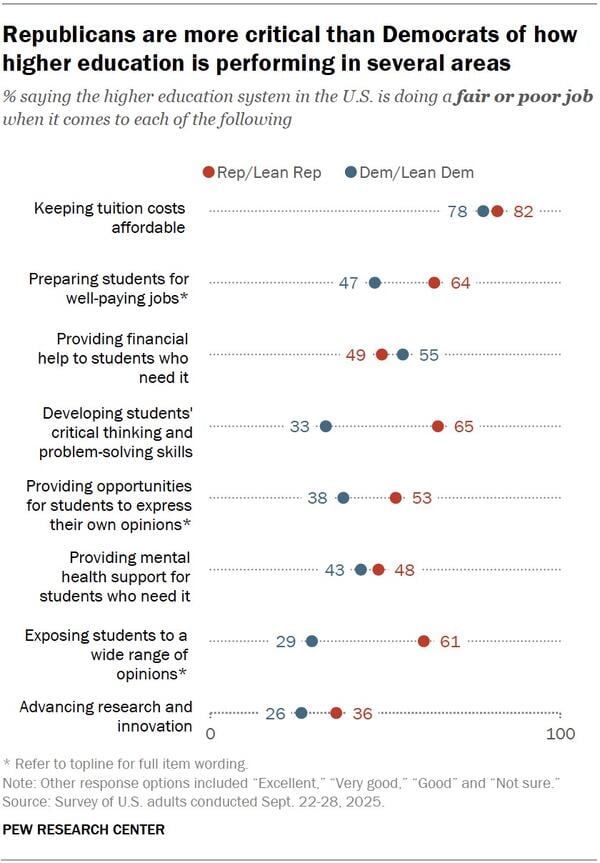
Forty-five percent of respondents said colleges and universities are doing a fair or poor job of exposing students to a wide range of opinions and viewpoints; 46 percent said institutions are doing an inadequate job of providing students opportunities to express their own opinions and viewpoints.
Political leanings also influenced perceptions of higher education, though the gap between Republicans and Democrats has narrowed in recent years.
According to the survey, 77 percent of Republicans and Republican-leaning respondents said higher education is moving in the wrong direction, compared to 65 percent of Democrats and Democratic-leaning respondents.
Republicans were more likely than Democrats to say that universities are doing a poor or fair job of preparing students for well-paying jobs, developing students’ critical thinking and problem-solving skills, exposing students to a wide range of opinions and viewpoints, and providing opportunities for students to express their own opinions and views.
A recent report from the Community College Research Center at Columbia University’s Teachers College found that high school students graduate college at higher rates and earn more after college if they’ve taken a combination of dual-enrollment and Advanced Placement courses.
The report, released Tuesday, drew on administrative data from Texas on students expected to graduate high school in 2015–16 and 2016–17, as well as some data from students expected to complete in 2019–20 and 2022–23. It explored how different kinds of accelerated coursework, and different combinations of such work, affected student outcomes.
Researchers found that students who combined Advanced Placement or International Baccalaureate courses with dual-enrollment courses boasted higher completion rates and earnings than their peers. Of these students, 92 percent enrolled in or completed a credential a year after high school, and 71 percent earned a credential by year six.
These students also showed the strongest earnings outcomes in their early 20s. They earned $10,306 per quarter on average at age 24, compared to $9,746 per quarter among students who took only dual enrollment and $8,934 per quarter for students who took only AP/IB courses. However, students taking both dual-enrollment and AP/IB courses tended to be less racially and socioeconomically diverse than students taking AP/IB courses alone, the report found.
Students who combined dual enrollment with career and technical education—who made up just 5 percent of students in the study—also reaped positive outcomes later in life. These students earned $9,746 per quarter on average by age 24, compared to $8,097 per quarter on average for students with only a CTE focus.
“Most dual-enrollment students in Texas also take other accelerated courses, and those who do tend to have stronger college and earnings trajectories,” CCRC senior research associate Tatiana Velasco said in a press release. “It’s a pattern we hadn’t fully appreciated before, which offers clues for how to expand the benefits of dual enrollment to more students.”
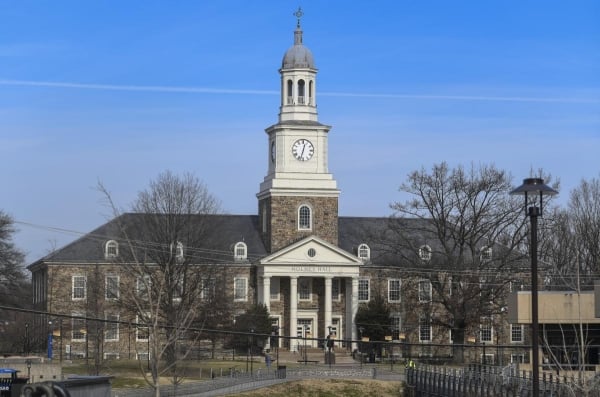
Philanthropist MacKenzie Scott has gifted Morgan State University $63 million in unrestricted funds, the largest gift in the university’s history.
In 2020, Scott awarded the historically Black university in Baltimore $40 million, which went toward multiple research centers and endowed faculty positions, among other advancements.
Morgan State leaders announced that the new funding will help build the university’s endowment, expand student supports and advance its research.
David K. Wilson, president of Morgan State, called the gift “a resounding testament to the work we’ve done to drive transformation, not only within our campus but throughout the communities we serve.”
“To receive one historic gift from Ms. Scott was an incredible honor; to receive two speaks volumes about the confidence she and her team have in our institution’s stewardship, leadership, and trajectory,” Wilson said in the announcement. “This is more than philanthropy—it’s a partnership in progress.”
One of the great ironies and great frustrations of my career teaching first-year college writing was having students enter our class armed with a whole host of writing strategies which they had been explicitly told they needed to know “for college,” and yet those strategies—primarily the following of prescriptive templates—were entirely unsuited to the experience students were going to have over the next 15 weeks of our course (and beyond).
I explored and diagnosed these frustrations in Why They Can’t Write, and while many other writing teachers in both high school and college shared that they’d seen and been equally (or more) frustrated by the same things. In the intervening years, there’s been some progress, but frankly, not enough, primarily because the structural factors that distorted how writing is taught precollege have not been addressed.
As long as writing is primarily framed as workforce preparation to be tested through standardization and quantification, students will struggle when invited into a more nuanced conversation that requires them to mine their own thoughts and experiences of the world and put those thoughts and experiences in juxtaposition with the ideas of others. The good news, in my experience, is that once invited into this struggle, many students are enthusiastic to engage, at least once they genuinely believe that you are interested in the contours of their minds and their experiences.
Clark calls for a “higher ed and secondary ed alliance” based in the values we all at least claim to share: free inquiry, self-determination and an appreciation for lives that are more than the “skills” we’re supposed to bring to our employers.
Something I can’t help but note is that the challenges college instructors are having getting students to steer clear of outsourcing their thinking to large language models would be significantly lessened if students had a greater familiarity with thinking during their secondary education years. Unfortunately, the system of indefinite future reward that has been reduced to pure transactions in exchange for grades and credentials has signaled that the outputs of the homework machine are satisfactory, so why not just give in?
When I go to campuses and schools and have the opportunity to speak to students, I try to list all kinds of reasons why they shouldn’t just give in, reasons which, in the end, boil down to the fact that being a big dumb-dumb who doesn’t know anything and can’t do anything without the aid of a predictive text-generation machine is simply an unfulfilling and unpleasant way to go through life.
In short, they will not be happy, even if they find ways to navigate their “work” with the aid of AI, because humans simply need more than this from our existences.
In a world where machines can handle the technical knowledge, the only differentiator is being human.
This is not news to those of us with those degrees, like my sister-in-law, who took her liberal arts degree from Denison University all the way to a general counsel job at a Fortune 300 company, or someone else with a far humbler résumé … me.
As I wrote in 2013 in this very space, the key to my success as an adult who has had to repeatedly adapt to a changing world is my liberal arts degrees, degrees that armed me with foundational and enduring skills that have served me quite well.
But, of course, it is about more than these skills. My pursuit of these degrees also allowed me to consider what a good life should be. That knowledge has put me in a position where—knock wood—I wake up just about every morning looking forward to what I have to do that day.
This is true even as the things I most care about—education, reading/writing, uh … democracy—appear to be inexorably crumbling around me. Perhaps this is because my knowledge of the value of humanistic study as something more than a route to a good job makes me more willing to fight for its continuation.
Sometimes when I encounter some hand-wringing about the inevitability of AI and the uncertainty of the future, I want to remind the fretful that we actually have a very sound idea of what we should be emphasizing, the same stuff we always should have been emphasizing—teaching, learning, living, being human.
We have clear notions of what this looks like. The main question now is if we have the collective will to move toward that future, or if we will give in to something much darker, much less satisfying and much less human.
While generative artificial intelligence tools have proliferated in education and workplace settings, not all tools are free or accessible to students and staff, which can create equity gaps regarding who is able to participate and learn new skills. To address this gap, San Diego State University leaders created an equitable AI alliance in partnership with the University of California, San Diego, and the San Diego Community College District. Together, the institutions work to address affordability and accessibility concerns for AI solutions, as well as share best practices, resources and expertise.
In the latest episode of Voices of Student Success, host Ashley Mowreader speaks with James Frazee, San Diego State University’s chief information officer, about the alliance and SDSU’s approach to teaching AI skills to students.
An edited version of the podcast appears below.
Q: Can you give us the high-level overview: What is the Equitable AI Alliance? What does it mean to be equitable in AI spaces?
James Frazee, chief information officer at San Diego State University
A: Our goal is simple but ambitious: to make AI literacy and access available as opportunities to all of our students, and I mean every student, whether they started at a community college, a California State University like ours or at a University of California school. We want to make sure they all have that same foundation to understand and apply AI responsibly in their lives, in their careers and during their academic journey.
Through this alliance, we’re trying to align resources and expand access to institutionally supported AI tools. So when people are using the free tools, they’re not free, right? They’re paying for them with their privacy, with their intellectual property. We want to make sure that they have access, not only to the training they need to use these tools responsibly, but also to the high-quality tools that are more accurate and that have commercial data protection so that they can rest assured that their intellectual property isn’t being used to train the underlying large language models.
Q: The alliance strives to work across institutions, which is atypical in many cases in higher ed. Can you talk about that partnership and why this is important for your students?
A: The Equitable AI Alliance emerged from survey results. We have this listening infrastructure we’ve created here at San Diego State—we launched an AI survey in 2023, within months of ChatGPT going public. We really wanted to establish a baseline and determine what tools our students were using, what opinions did they have about AI and maybe, most importantly, what did they expect from us institutionally in order to help them meet the moment?
During the analysis of those survey findings, we discovered evidence of a growing digital divide. For instance, we asked students about how many devices they had. If you have a smartphone, a tablet, a desktop and a laptop, you would have four smart devices.
What we found was more devices led to people being more likely to say that AI had positively affected their education, and more devices meant that they were more likely to be paying for the paid versions of these tools. We also saw in the open-ended responses … people being concerned about fee increases as a result of AI, people being concerned about students who didn’t have access to these tools or fluency with these tools being disadvantaged.
People were saying, “The people who are using these have an unfair advantage,” right? Students were asking questions about, is everybody going to be able to afford what they need in order to keep up with AI? So that really was a key driver in forming this alliance.
Q: When it comes to consolidating those resources or making sure that students have access, what does that look like? And how do you all share?
A: The Equitable AI Alliance is really two things. First, it’s a consortium that’s all about saving time and saving money and having universities and colleges come together to really look at ways to form these partnerships to democratize access to these high-quality tools. And also to provide the training that people need. So that’s kind of the first part of it, and that’s much larger than the regional consortium.
But we have a regional consortium between our San Diego Community College District, San Diego State University and the University of California at San Diego, which is also dubbed the Equitable AI Alliance. And the mission there is to ensure that every student, no matter where they begin their journey, has access to AI literacy, to those high-quality tools and opportunities to leverage those to help them succeed, both inside and outside of the classroom.
It’s really, ultimately about responding to the workforce needs that we’re seeing. Employers today are demanding students come to them with fluency using these tools, and if they don’t have that fluency, they’re not going to get that internship or that job interview. So it’s really important. That’s where those microcredentials that we’re sharing across our institutions are really powerful, because they can put that badge on their LinkedIn profile, which may make the difference between them getting the interview or not, just having that little artifact there that demonstrates that they have some skills and knowledge can really make an impact.
Q: What is the microcredential? How are students engaging with that?
A: The microcredentials themselves are really powerful because they’re basically mini courses in our learning management system. We try and make them bite-size enough to where people actually get through them.
There are five modules. The first module is really kind of demystifying AI—this is not some dark art. We try to explain, at a high level, how does AI work?
The second module, which is arguably the most important one, is all about responsible use. The fact that these models are built on information from human beings, which is inherently biased. How to be critical consumers of that information, the environmental costs, the human costs, talking about how to cite the use of these tools in your work, both academically and professionally.
Then there’s a module on what AI can do for you. And so we have different microcredentials, a microcredential for faculty, there’s microcredentials for students. For instance, in the microcredential for students, it’s focusing on using AI to find jobs, prepare for jobs, tailor your résumé for a particular job or internship, how to do role-playing—to practice for an interview, let’s say.
And then there’s finding apps, finding generative AI tools, how to do that, because there’s different AI tools you might want to use for certain things, like maybe you want to create some sort of graphic—you might want to use Midjourney or DALL-E, or whatever it might be.
And then there’s the activities. Part of the idea with the activities, which they have to do in order to earn the badge, is that we’re designing activities that try and keep the microcredential evergreen. So for instance, when we first rolled out the microcredential, nobody had heard of DeepSeek, because it didn’t exist. So now we have an activity that has people going out and looking for the latest large language models that are emerging. Every day, there’s some new model, it seems—that is something to be aware of.
And then bringing it back to again, why it’s important for them to be able to be in the loop, pointing out the fact that these models are often very sycophantic, right? They want to tell you what they think you want to hear. And so you really have to go back and forth and ideate with the tools, which requires a little practice, a little coaching, and you have to fact-check everything. And so that’s a really big part of this idea of, what does it mean to be literate when it comes to using these tools?
Q: When it came to developing the microcredential, who were the stakeholders at the table?
A: We have a long history of engaging with faculty and providing fellowships to faculty. That’s a way for us to incentivize engagement with faculty.
That manifests itself in the form of course release. So, in other words, we provide them with reassigned time, buy them out of teaching a course, so that they can come and work with us and consult with us. We have a long history of doing that, and this goes back decades, first helping us with faculty development around moving courses online.
We wanted that to be done by faculty for faculty. Yes, we have instructional designers who are staff, but we really wanted the faculty to be driving that. We identified in 2023 our first AI faculty fellows, and we got a faculty member from information systems and a faculty member from anthropology—very different in terms of their skill sets and their orientation to research. One a qualitative ethnographic researcher, another more of a quantitative machine learning focus. Very complementary in terms of just balancing each other out.
Twenty twenty-three was the first time we had ever provided fellowships to students. We provided fellowships to two students. One was an engineering student and another was an Africana studies student. Again, very different in terms of the academic domain and the discipline they were in, but again, very balanced.
So those two AI student fellows and the two AI faculty fellows helped us design the survey instrument, get the IRB [institutional review board] approvals, launch the survey, promote the survey. I really want to give credit where credit is due: We got an incredible response rate. We’re lucky if we usually get like a 3 percent response rate from a student survey. We got a 21 percent response rate in 2023; 7,811 students responded to that survey.
The credit for that goes to Associated Students, our student government. The president of Associated Students that year ran on a platform of getting students high-paying jobs, and he knew for students to get high-paying jobs, they needed to be conversant with AI. So he helped us promote that survey, and the whole campaign was around “your voice matters.” So thanks to his help and the help of these AI student fellows, we got this incredible response from our students.
So anyway, the students and the faculty fellows helped us analyze those results and then use that data to build these microcredentials. So very much involving faculty and students and our University Senate, our library. I mean, the library knows a thing or two about information literacy, right? They absolutely have to be at the table. Our Center for Teaching and Learning, which is responsible for providing faculty with professional development on campus, they were also very involved from the very outset, so very much of a collaborative effort.
Q: I wanted to ask about culture and creating a campus culture that embraces AI. How are you all thinking about engaging stakeholders in these hard conversations and bringing different disciplines to the playing field?
A: I think it’s really important. That’s what the data has done for us. It’s really created space for these conversations, because faculty will respond to evidence. If you have data that is from their students, who they care about deeply, that creates space for these conversations.
For instance, one of the things that emerged from the survey findings was inconsistency. In the same course, maybe taught by different instructors, there would be different expectations and policies with regard to AI.
In multiple sections of Psychology 101—and that’s not a real example, I’m just using that as a fictitious example—one instructor might completely forbid the use of AI and another one might require it, and that’s stressful for students because they didn’t know what to expect.
In fact, one of the comments that really resonated with me from the survey was, and this is a verbatim quote, “Just tell us what you expect and be clear about it.” Students were getting mixed messages.
So that led to conversations with our University Senate about the need to be clear with our students. I’m happy to report, just this past May, our University Senate unanimously passed a policy that requires an AI … statement in every syllabus. That was an important step in the right direction.
The University Senate also created guidelines for the use of generative AI in assessments and deliverables. You know, it’s important that you not be prescriptive with your faculty. You need to provide them with lots of examples of language that they can use or tweak, because they own the curriculum, and knowing that you don’t have to take a one-size-fits-all approach.
Maybe one assignment, it’s restricted; in another assignment, it’s unrestricted, right? You can do that. And they’re like, “Oh yeah, I can do that.” Giving them examples of language they can use, and also encouraging them to use this as an opportunity to have a conversation with their students.
The students want more direction on how to use these tools appropriately. And I think if you race to a policy that’s all about academic misconduct, it’s frankly insulting to the students, to just assume everybody’s cheating, and then when they leave here and go into their place of business, they’re going to be expected to use these tools. So, really powerful conversations.
That’s been key here—just talking about [AI]. I mean, it’s this seismic kind of epistemic shift for our faculty and how knowledge is created, how we acquire knowledge, how we represent knowledge, how we assess knowledge. It’s a stressful time for our faculty—they need to be able to process that with other faculty, and that’s super important.
Q: It’s also important that you’re having that conversation collegewide, because if this is a career competency and students do need AI skills, it needs to happen in every classroom, or at least be addressed in every classroom.
A: That’s a really good point, Ashley. In fact, we’re launching a program this year that we’re calling the AI-ready course design workshop, and the idea for that is that we’re identifying a faculty member from every major and we are paying them—and this is super important, too: It’s really a sign of respect, in terms of acknowledging the labor required to reimagine an assignment, to weave AI into the fabric of that assignment.
The goal is to have a faculty member from every major who teaches a required course in that major at least two times. We want to make sure that they have an opportunity to do this and then refine it and do it again. They’re being paid over break this winter to reimagine an assignment that leverages AI, and it is a deliverable. They will produce a three- to five-minute introspective video where they reflect on what they did, why they did it and what were the learning outcomes, both for them and for their students.
That is great because we will have an example from every major of how you can use AI in the fabric of your teaching. And I think that’s what faculty need right now. Again, they need lots of examples, and we’re incentivizing that through this program. We already have something we call the “AI in action” video series, so we already have some examples, but we don’t have examples from every major.
For us right now, I think you’re seeing a lot of engagement from faculty in engineering and sciences. We’re concerned that our humanities faculty need to engage; we need to engage the political scientists. We need to engage the philosophers and the historians. They can’t just sit this out. They’re really going to be key players in moving this forward, to prepare our students, regardless of major, for this AI-augmented world that we’re living in.
Q: What are some of the lessons that you’ve learned that you hope higher education can learn from? How do you all hope to be a model to your peers across the sector?
A: I think key is the importance of data and using data to inform the choices you’re making, whether it’s in the classroom, whether it’s in the cabinet. I report to the president, and using data to really drive those conversations, and using that to make sure that you’re engaging all of those stakeholders.
For instance, we’re looking at the survey data. That survey that we did in 2023 and repeated in 2024, we’ve now scaled up to the entire California State University system, and that is underway right now. In fact, I was just looking at the latest response rates. We have had, as of this morning, 77,714 people responding to the survey … which is about a 15 percent response rate. We’ve got half a million students in the CSU, so it’s a big number.
I was looking at [the data] with the council of vice presidents and my colleague … the provost, and I said, “When you look at the numbers for San Diego State, we’ve had 10,682 responses from students. We’ve had 406 responses from faculty and 556 responses from staff. But relative to the students, the response rate from faculty is pretty low.” So I talked with [the provost] about sending a message out to our academic leaders—the deans and the department chairs and the school directors—encouraging their faculty to respond to the survey, so that we have a balanced perspective.
Everybody has a voice. That is certainly something that I want to encourage; this whole idea of incentivizing faculty engagement, I think, is important. I think you really need to provide that encouragement for faculty to experiment, to show off, and then to really use that as an opportunity to recognize those faculty and celebrate them. That does a couple things. One, it honors them for taking the risk to do this work. Then it might inspire another faculty [member] to build on that work, or have coffee with that person and talk about what they wish they would have known that they could advise this person on who maybe is early career and would appreciate their advice. I think that idea of incentivizing faculty engagement is another thing that I would encourage the audience to consider.
Q: What’s next for you all? Are there other cool interventions or programs that are coming out?
A: That survey data is going to do quite a few things for us. It’s going to help us to not only refine the microcredentials and the work we’re doing with the microcredentials, but it’s also going to allow us to scaffold conversations with industry and our industry partners in terms of being responsive to the competencies they’re going to need in their industry.
I think it’s something like 35 out of the top 50 AI companies are housed here in California, but they can’t find the talent they need in California, let alone the United States, so they’re having to go abroad to get the people they need to continue to innovate. So using this as an opportunity to work with our industry partners to make sure we’re preparing this workforce that they need to continue to innovate, that’s a key element of it, and then using this data also to help us get additional resources and use that data to say, “Hey, here’s a gap we’ve identified. We need to fill this gap,” and using that data to make the case for that investment.