On Oct. 14, Indiana University abruptly fired Director of Student Media Jim Rodenbush after he refused to enforce unconstitutional content restrictions on the student paper the Indiana Daily Student. The very next day, IU ordered IDS to halt print publication.
This illustrates why IU ranked dead last among public universities — and third-to-last overall — in FIRE’s 2026 College Free Speech Rankings. Firing a student media adviser for refusing to censor a student newspaper, then banning print editions of that paper, sends a message that would chill even the most courageous young journalist: Cover stories we don’t like, and you’ll lose your ability to print — and your faculty support.
What did the Indiana Daily Student do to provoke this reaction?
They used their front page to attack IU’s track record on free speech, citing IU’s suspension of the Palestine Solidarity Committee and IU’s ranking as the worst public university in the nation for free speech. In the wake of these stories hitting newsstands, administrators summoned Rodenbush to a meeting to discuss “expectations” for what belongs in the paper.
IU’s Media School instructed the student paper to publish an edition exclusively devoted to homecoming flattery with “no other news at all.” When Rodenbush stood his ground, administrators then said they “lost trust” in his leadership — and immediately fired him.
But public universities can’t order students to publish puff pieces. They can’t shut down newspapers for coverage that makes administrators uncomfortable. And they can’t fire advisers who refuse to play the censorship game.
Firing Rodenbush and banning the paper are textbook First Amendment violations that IU claims are part of a digital-first media strategy. But that’s a smokescreen. Cutting the print edition and removing a longtime adviser after critical coverage isn’t a strategy. It’s retaliation. And it’s illegal.
IU is failing its students, its faculty, and the Constitution it is bound to uphold. FIRE is demanding that IU reverse the print ban, offer Rodensbush reinstatement, and make a public commitment to restore student press freedom on campus.
Stand with us and tell IU President Pamela Whitten to end this censorship crusade.
On October 14, Indiana University abruptly fired Director of Student Media Jim Rodenbush after he refused to enforce unconstitutional content restrictions on the student paper the Indiana Daily Student. The very next day, IU ordered IDS to halt print publication.
This illustrates why IU ranked dead last among public universities — and third-to-last overall — in FIRE’s 2026 College Free Speech Rankings. Firing a student media adviser for refusing to censor a student newspaper, then banning print editions of that paper, sends a message that would chill even the most courageous young journalist: Cover stories we don’t like, and you’ll lose your ability to print — and your faculty support.
What did the Indiana Daily Student do to provoke this reaction?
They used their front page to attack IU’s track record on free speech, citing IU’s suspension of the Palestine Solidarity Committee and IU’s ranking as the worst public university in the nation for free speech. In the wake of these stories hitting newsstands, administrators summoned Rodenbush to a meeting to discuss “expectations” for what belongs in the paper.
IU’s Media School instructed the student paper to publish an edition exclusively devoted to homecoming flattery with “no other news at all.” When Rodenbush stood his ground, administrators then said they “lost trust” in his leadership — and immediately fired him.
But public universities can’t order students to publish puff pieces. They can’t shut down newspapers for coverage that makes administrators uncomfortable. And they can’t fire advisers who refuse to play the censorship game.
Firing Rodenbush and banning the paper are textbook First Amendment violations that IU claims are part of a digital-first media strategy. But that’s a smokescreen. Cutting the print edition and removing a longtime adviser after critical coverage isn’t a strategy. It’s retaliation. And it’s illegal.
IU is failing its students, its faculty, and the Constitution it is bound to uphold. FIRE is demanding that IU reverse the print ban, offer Rodensbush reinstatement, and make a public commitment to restore student press freedom on campus.
Stand with us and tell IU President Pamela Whitten to end this censorship crusade.
Every year, tens of thousands of infants are born prematurely, at a low birthweight, or with other conditions that would make them automatically eligible for therapeutic services that could help them thrive.
When everything goes smoothly, early intervention provides those services, required by federal law for children ages birth to 3. Funding sources for the program can vary, but it’s often paid for by a mix of federal, state, local, and private insurance dollars.
But far too few of the youngest children actually receive that help. (It’s an issue I wrote about earlier this year.) One particular gap is in services provided to infants from birth to 1. Only about 1.3 percent of babies that age receive early intervention services, compared to 7.5 percent of 2- to 3-year-olds, according to a new report from the think tank New America.
Kayla Khan, a long-time speech therapist, has experienced that gap herself.
When her infant daughter was released after a month and a half in neonatal intensive care, she asked the discharge team about early intervention services. Because of her background, she knew about the therapies.
At the time, the family lived in the Washington D.C. area, and no one at the hospital was helpful. “They said, ‘You don’t want that,’ or, ‘It’s not going to help you,’” Khan recalled.
After moving to Seattle a few months later, Khan finally connected with early intervention services that provided physical and feeding therapy to her daughter. She now helps lead a decade-old effort in Seattle to provide care and support specifically to families of “tiny babies” who are transitioning from the hospital to home.
The program relies on building trust and communication with hospital staff to ensure eligible babies get referred to early intervention and speeding up the evaluation timeline so babies get seen within three days of a referral — “really, really, really fast” for a system where the requirement for referral is 45 days, Khan said. Her program also connects families with therapists who are skilled and trained in the specific needs of newborns.
“We’re making this process that was designed for all children, birth to 3, work for the tiniest babies,” Khan said.
This kind of targeted attention for the youngest is desperately needed, according to the New America report and another that focused on Illinois, from early nonprofit advocacy group Start Early. (I recently completed a reporting fellowship with New America which supported some of my writing on early intervention, among other topics.)
Among the two reports’ recommendations:
Make the list of conditions that automatically qualify a baby for early intervention easy to understand and find. States have identified scores of different qualifying conditions that make a child more likely to develop a delay, including extreme prematurity, low birthweight, a parent with a substance use disorder, and child welfare involvement. But, as the New America report points out, finding a user-friendly list of the conditions can be a challenge. “The eligibility criteria and the way things work varies so much from one state to the next,” said report co-author Carrie Gillispie, the Early Development & Disability project director at New America.
The Start Early report noted that in a related study, two families were judged ineligible for early intervention despite their children having medical conditions that should have made them automatically eligible.
Consider co-locating early intervention staff in the NICU to make the transition as smooth as possible. Coordinators would be physically present in NICUs to build relationships, participate in medical rounds, and lead the process to enroll children in early intervention programs, the Start Early authors wrote. Both reports stress the importance of providing the family with a personal connection to early intervention before a baby gets discharged from the hospital.
Improve coordination and communication with the early intervention system, hospitals and pediatricians. Pediatricians are not always notified when doctors in the hospital refer a child to early intervention services. And well-child visits are often so short that physicians miss the full developmental picture. Too often, referrals come after a child is already starting to struggle, said Sarah Gilliland, a senior policy analyst in the New Practice Lab at New America, who co-wrote the report.
Bridge cultural and language barriers with families by hiring more multilingual hospital and early intervention staff. Cultural divides are pervasive throughout the early intervention system, where the overwhelming majority of the therapists and other providers in many communities are white, English-speaking women. But even simple forms often go untranslated: One survey found that nearly three-quarters of state early intervention referral forms are only available in English, the New America report noted. The report also stressed that families should be reassured that early intervention services are meant to be support, not surveillance. “Hesitant families might benefit from a connection with families within their own communities who can explain what to expect from early intervention,” the authors wrote.
Strengthen electronic referral systems and centralize enrollmentin early intervention programs. When I reported on the too-often broken path from the NICU to early intervention in Chicago, I heard stories of a system that relied heavily on faxing paper forms. NICU physicians often had no idea what happened with referrals they made. Indeed, surveys have found that only a fraction of early intervention coordinators have access to technology that links children’s electronic health records to the referral system.
Some states and communities are introducing technological advances which could be implemented more widely, the New America report noted. For instance, one state is trying to address the problem using “e-referrals,” which share an infant’s medical records directly with the early intervention system.
We want to hear from you
We want to help you make sense of the first year of the Trump administration and the effects on education. What have you experienced? What do you want to know more about? Tell us, and you will help inspire reporting by our journalists. Email [email protected].
This story about preemies was produced by The Hechinger Report, a nonprofit, independent news organization focused on inequality and innovation in education. Sign up for the Hechinger newsletter.
The Hechinger Report provides in-depth, fact-based, unbiased reporting on education that is free to all readers. But that doesn’t mean it’s free to produce. Our work keeps educators and the public informed about pressing issues at schools and on campuses throughout the country. We tell the whole story, even when the details are inconvenient. Help us keep doing that.
Four of the nine universities initially asked to sign have rejected the document.
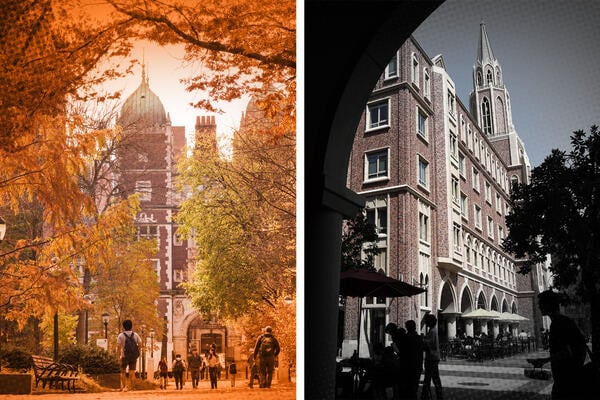
Photo illustration by Justin Morrison/Inside Higher Ed | Jumping Rocks/Universal Images Group/Getty Images | Mario Tama/Getty Images
The Universities of Pennsylvania and Southern California have now refused to sign the Trump administration’s “Compact for Academic Excellence in Higher Education,” making them the third and fourth of the nine initial institutions that were presented the deal to publicly turn it down. No institution has agreed to sign so far.
Both announcements came Thursday, a few days before the Oct. 20 deadline to provide feedback on the proposal. Beong-Soo Kim, interim president of the University of Southern California, shared his message to Education Secretary Linda McMahon, which outlined how USC already seems to adhere to the compact.
“Notwithstanding these areas of alignment, we are concerned that even though the Compact would be voluntary, tying research benefits to it would, over time, undermine the same values of free inquiry and academic excellence that the Compact seeks to promote,” Kim wrote. “Other countries whose governments lack America’s commitment to freedom and democracy have shown how academic excellence can suffer when shifting external priorities tilt the research playing field away from free, meritocratic competition.”
Kim added that the compact does raise issues “worthy of a broader national conversation to which USC would be eager to contribute its insights and expertise.”
California governor Gavin Newsom, a possible Democratic presidential contender in 2028, had threatened that any university in his state that signed the compact would “instantly” lose billions of state dollars.
Over at Penn, President J. Larry Jameson wrote in a message to his community Thursday that his university “respectfully declines to sign the proposed Compact.” He added that his university did provide feedback to the department on the proposal.
Penn spokespeople didn’t say Thursday whether the university would sign any possible amended version of the compact that addressed the university’s concerns, nor did they provide Inside Higher Ed a copy of the feedback provided to the Trump administration. (Penn is the only university of the four that didn’t provide its response to McMahon.)
The White House also didn’t provide a copy of Penn’s feedback, but it emailed a statement apparently threatening funding cuts for universities that don’t sign the compact.
“Merit should be the primary criteria for federal grant funding. Yet too many universities have abandoned academic excellence in favor of divisive and destructive efforts such as ‘diversity, equity, and inclusion,’” spokesperson Liz Huston said in the statement. “The Compact for Academic Excellence embraces universities that reform their institutions to elevate common sense once again, ushering a new era of American innovation. Any higher education institution unwilling to assume accountability and confront these overdue and necessary reforms will find itself without future government and taxpayers support.”
Brown University announced it had rejected the compact Wednesday, and the Massachusetts Institute of Technology did the same last Friday. Following MIT’s rejection, the Trump administration said the compact was open to all colleges and universities that want to sign it.
The compact is a boilerplate contract asking colleges to voluntarily agree to overhaul or abolish departments “that purposefully punish, belittle, and even spark violence against conservative ideas,” without further defining what those terms mean. It also asks universities to, among other things, commit to not considering transgender women to be women, to reject foreign applicants “who demonstrate hostility to the United States, its allies, or its values” and to freeze “effective tuition rates charged to American students for the next five years.”
In exchange for these agreements, the White House has said signatories would “be given [funding] priority when possible as well as invitations to collaborate with the White House.” But the White House hasn’t revealed how much extra funding universities would be eligible for, and the nine-page compact doesn’t detail the potential benefits. The compact, and the Thursday statement from the White House, can also be read as threatening colleges’ current federal funding if they don’t sign. Multiple higher ed organizations have allied in calling on universities to reject the compact.
Jameson said in his statement that “at Penn, we are committed to merit-based achievement and accountability.”
Earlier this year, the Trump administration said that Penn violated Title IX of the Education Amendments of 1972 when it allowed a transgender woman to swim on the women’s team in 2022, and officials issued several demands to the university. Penn ultimately conceded to those demands over the summer, a decision that the administration said restored about $175 million in frozen federal funds.
Marc Rowan, a Penn graduate with two degrees from its Wharton School of Business who’s now chief executive officer and board chair for Apollo Global Management, wrote in The New York Times that he “played a part in the compact’s initial formulation, working alongside an administration working group.” Rowan argued that the compact doesn’t threaten free speech or academic freedom.
Apollo has funded the online, for-profit University of Phoenix. AP VIII Queso Holdings LP—the previous name for majority owner of the University of Phoenix—was the successor of Apollo Education Group, which went private in 2017 in a $1.1 billion deal backed by Apollo Global Management Inc. and the Vistria Group.
AP VIII Queso Holdings LP was recently renamed Phoenix Education Partners as part of a new deal to take the company public once again. Phoenix Education Partners, now owner of the University of Phoenix and backed by both Apollo and Vistria, started trading on the stock market last week and was valued at about $1.35 billion after the first day.
Four of the nine universities initially asked to sign have rejected the document.
Photo illustration by Justin Morrison/Inside Higher Ed | Jumping Rocks/Universal Images Group/Getty Images | Mario Tama/Getty Images
The Universities of Pennsylvania and Southern California have now refused to sign the Trump administration’s “Compact for Academic Excellence in Higher Education,” making them the third and fourth of the nine initial institutions that were presented the deal to publicly turn it down. No institution has agreed to sign so far.
Both announcements came Thursday, a few days before the Oct. 20 deadline to provide feedback on the proposal. Beong-Soo Kim, interim president of the University of Southern California, shared his message to Education Secretary Linda McMahon, which outlined how USC already seems to adhere to the compact.
“Notwithstanding these areas of alignment, we are concerned that even though the Compact would be voluntary, tying research benefits to it would, over time, undermine the same values of free inquiry and academic excellence that the Compact seeks to promote,” Kim wrote. “Other countries whose governments lack America’s commitment to freedom and democracy have shown how academic excellence can suffer when shifting external priorities tilt the research playing field away from free, meritocratic competition.”
Kim added that the compact does raise issues “worthy of a broader national conversation to which USC would be eager to contribute its insights and expertise.”
California governor Gavin Newsom, a possible Democratic presidential contender in 2028, had threatened that any university in his state that signed the compact would “instantly” lose billions of state dollars.
Over at Penn, President J. Larry Jameson wrote in a message to his community Thursday that his university “respectfully declines to sign the proposed Compact.” He added that his university did provide feedback to the department on the proposal.
Penn spokespeople didn’t say Thursday whether the university would sign any possible amended version of the compact that addressed the university’s concerns, nor did they provide Inside Higher Ed a copy of the feedback provided to the Trump administration. (Penn is the only university of the four that didn’t provide its response to McMahon.)
The White House also didn’t provide a copy of Penn’s feedback, but it emailed a statement apparently threatening funding cuts for universities that don’t sign the compact.
“Merit should be the primary criteria for federal grant funding. Yet too many universities have abandoned academic excellence in favor of divisive and destructive efforts such as ‘diversity, equity, and inclusion,’” spokesperson Liz Huston said in the statement. “The Compact for Academic Excellence embraces universities that reform their institutions to elevate common sense once again, ushering a new era of American innovation. Any higher education institution unwilling to assume accountability and confront these overdue and necessary reforms will find itself without future government and taxpayers support.”
Brown University announced it had rejected the compact Wednesday, and the Massachusetts Institute of Technology did the same last Friday. Following MIT’s rejection, the Trump administration said the compact was open to all colleges and universities that want to sign it.
The compact is a boilerplate contract asking colleges to voluntarily agree to overhaul or abolish departments “that purposefully punish, belittle, and even spark violence against conservative ideas,” without further defining what those terms mean. It also asks universities to, among other things, commit to not considering transgender women to be women, to reject foreign applicants “who demonstrate hostility to the United States, its allies, or its values” and to freeze “effective tuition rates charged to American students for the next five years.”
In exchange for these agreements, the White House has said signatories would “be given [funding] priority when possible as well as invitations to collaborate with the White House.” But the White House hasn’t revealed how much extra funding universities would be eligible for, and the nine-page compact doesn’t detail the potential benefits. The compact, and the Thursday statement from the White House, can also be read as threatening colleges’ current federal funding if they don’t sign. Multiple higher ed organizations have allied in calling on universities to reject the compact.
Jameson said in his statement that “at Penn, we are committed to merit-based achievement and accountability.”
Earlier this year, the Trump administration said that Penn violated Title IX of the Education Amendments of 1972 when it allowed a transgender woman to swim on the women’s team in 2022, and officials issued several demands to the university. Penn ultimately conceded to those demands over the summer, a decision that the administration said restored about $175 million in frozen federal funds.
Marc Rowan, a Penn graduate with two degrees from its Wharton School of Business who’s now chief executive officer and board chair for Apollo Global Management, wrote in The New York Times that he “played a part in the compact’s initial formulation, working alongside an administration working group.” Rowan argued that the compact doesn’t threaten free speech or academic freedom.
Apollo has funded the online, for-profit University of Phoenix. AP VIII Queso Holdings LP—the previous name for majority owner of the University of Phoenix—was the successor of Apollo Education Group, which went private in 2017 in a $1.1 billion deal backed by Apollo Global Management Inc. and the Vistria Group.
AP VIII Queso Holdings LP was recently renamed Phoenix Education Partners as part of a new deal to take the company public once again. Phoenix Education Partners, now owner of the University of Phoenix and backed by both Apollo and Vistria, started trading on the stock market last week and was valued at about $1.35 billion after the first day.
ACE and the Association of College and University Educators (ACUE) have reaffirmed our long-standing collaboration to continue driving transformative change in faculty development and elevate teaching excellence across higher education. For more information about the updates to this nearly decade-long alliance, click here.
To learn more and register for an Oct. 29 webinar that will feature ACE President Ted Mitchell and ACUE Chairman and CEO Andrew Hermalyn, click here.
If you have any questions or comments about this blog post, please contact us.
This week on the podcast we look at Wales’ emerging higher education settlement, as Universities Wales publishes its manifesto for the May 2026 Senedd elections amid polling that points to a potential Plaid-led administration.
Plus we discuss new Office for Students’ data on subcontracted (franchised) provision showing weaker continuation, completion and progression outcomes relative to sector averages, and assess the Institute of Student Employers’ latest survey, with graduate hiring down overall but highly variable by sector amid persistently high applications per vacancy.
With Debbie McVitty, Editor at Wonkhe, Sarah Cowan, Head of Policy (Higher Education and Research) at the British Academy, Sarah Stevens, Director of Strategy at the Russell Group and presented by Jim Dickinson, Associate Editor at Wonkhe.
Brazil exited the age of slavery 135 years ago. It remains a multi-racial society today. But for much of the twentieth century, Brazil suffered an enormous bout of amnesia. From being one of the last societies on earth to give up slavery, it immediately began touting itself as a place where colour did not matter, that it was a post-racial society.
But then about 30 years ago, things changed. Race — or more accurately race and inequality — became a much more prominent subject of debate, and various measures were brought in to lessen racial inequality. In higher education, however, Brazil did not however take the path of “affirmative action” as the United States did. Instead: it went the route India did with respect to caste: hard, fixed numerical quotas.
Today we’re going to look at how that this policy has worked out, and joining me to do so is Luiz Augusto Campos: He’s a professor of sociology and Political science at the State University of Rio de Janeiro, and he’s co-editor of a recent book on quotas in Brazilian higher education called O impacto das cotas: Duas decadasde acao affirmativano Ensino superior brasileiro. We had a great discussions about how Brazilian admissions quotas came to be and how they have change higher education. Of particular interest to me is that these quotas were imposed in some of the country’s most elite institutions — and how the arrival of quotas has managed to make policies of free tuition at elite institutions much less regressive.
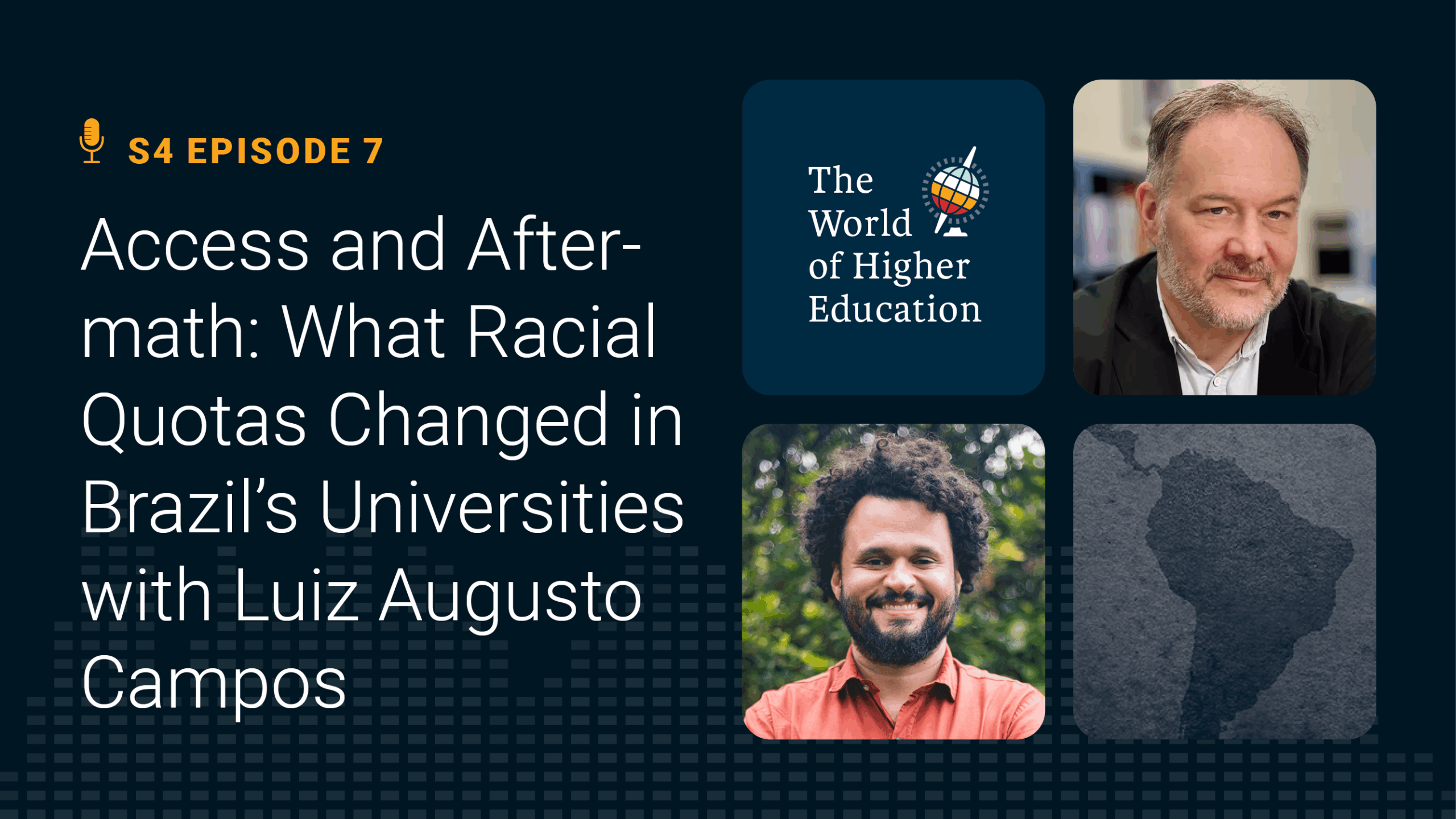
The World of Higher Education Podcast Episode 4.7 | Access and Aftermath: What Racial Quotas Changed in Brazil’s Universities with Luiz Augusto Campos
Transcript
Alex Usher (AU): Luiz, before we start talking about quotas in higher education, let’s paint a picture of race in Brazil. Like the United States, Brazil was a colonial slave state—one where emancipation didn’t happen until 1888. But for a long time, there was a kind of myth that Brazil had become a post-racial society, one where people didn’t see race. So, what are the politics of race like in Brazil, and what’s changed over, say, the last 50 years?
Luiz Augusto Campos (LAC): That’s true, and I can say that almost everything has changed in recent years. At the beginning, Brazil was portrayed as a racial democracy—the idea that people in Brazil don’t see race and that there’s no racism. It’s complicated to understand how a country that was completely slave-based in the past could create this myth.
The myth was actually quite successful in the sense that most Brazilians used to believe it. It’s connected to how people viewed our history of slavery. In the past, people used to say that Brazilian slavery was a kind of soft slavery compared to other countries. Historians now show that’s not true, but that was how people saw it.
It was also tied to the myth of miscegenation—the idea that every Brazilian was of mixed race. And if everyone was mixed race, there was supposedly no place for racism, because you couldn’t practice racism against someone who was mixed, as everyone was.
But after 50 or 60 years, this national myth started to change—first because of the rise of the Black movement, which began to call out racism in Brazil, and later because of data on racial inequality. We’ve historically had very good data on race in Brazil—it’s a kind of legacy from the 18th century, through censuses and demographic records.
Those numbers began to show that, despite this idea of racial democracy, racial inequality remained deeply entrenched in Brazil, right up until the end of the 1990s. I think those two things—the activism of the Black movement and the hard data—really contributed to changing people’s belief in the myth of racial democracy.
AU: Just to be clear, when you talk about data on race, how is race classified? I don’t think it’s just white and Black, right? How does that work?
LAC: It’s changed over time, but we generally work with five racial categories. Even today, the Brazilian census is quite good. When a census worker comes to your house, they’ll ask you to identify your race using one of five options: Black, Brown, White, Yellow—which refers to Brazilians of Asian descent—and Indigenous.
That last category isn’t meant for people with distant Indigenous ancestry, but rather for those who actually live within Indigenous communities.
AU: Within higher education, how did race historically affect access? How big were the participation gaps between racial groups prior to the introduction of quotas?
LAC: The differences were huge. At the beginning of the 1990s, about 70 percent of students in public higher education were white. And it’s important to note that Brazil has both a public and a private higher education system.
AU: Right—and even though the private system is larger, the public system is the more selective and prestigious one. That’s where people want to go, correct?
LAC: Exactly. The private system is much bigger, but the public system is more selective, higher quality, and more prestigious.
At the start of the 1990s, around 70 percent of enrollments in the public system were white students. That was a real injustice, because the public system is completely tuition-free. So essentially, the government was collecting taxes from the majority of the population—who are largely Brown, Black, and poor—and using that money to fund the education of white students, who mostly came from middle- and upper-class backgrounds.
AU: Let me just ask—if about 70 percent of students in public higher education were white, how did that compare to the population as a whole?
LAC: In Brazil, the population has usually been about half white and half non-white. At the beginning of the 1990s, around 57 percent of people self-identified as white, but they made up about 70 percent of students in public universities.
It’s interesting, though, because racial classification in Brazil has also shifted over time—the proportions of people identifying as white, Black, or Brown have changed. But to answer your question directly, today less than 50 percent of students in public higher education are white. Black and Brown students now make up the majority in the public system.
AU: Let’s think about how we got there. In the 1980s and 1990s, as you said, racial politics started to change across Brazil. People realized this wasn’t really a racial democracy. How did quotas become the tool for achieving racial justice, rather than affirmative action as practiced in the United States at the time?
LAC: It’s a really complex process—and not one that was carefully planned.
First, we had the earliest proposals coming from the Black movement, mostly from an important Black leader in Brazil who was a congressman at the time. He introduced several bills for affirmative action, most of them based on quotas, though they included other ideas as well—such as direct financial support for Black Brazilians and other measures. But the core idea of quotas was already there in the early 1980s.
After that, we saw the rise of a movement creating preparatory courses for university entrance exams. In Brazil, admission to public universities is based on a standardized test, and these prep courses were designed by Black activists to help Black, Brown, and low-income students prepare for it.
The first actual quota policy began at my own university—the State University of Rio de Janeiro—at the beginning of the 2000s. Interestingly, the counselor who approved the quota system was from a right-wing party. He wasn’t necessarily a racial justice advocate; he was just a politician looking for proposals to champion, and this was one he decided to push through.
From that point onward, other universities began to adopt and replicate the model. Today, Brazil likely has the largest racial quota system in the world.
AU: So, how did we go from a situation in the 1980s and 1990s, where a few institutions were experimenting with quotas, to a point where the federal government actually mandated them for all federal universities in 2012? What led up to that decision, and how does the current quota system work?
LAC: It’s a complex story. In the beginning, there was fierce opposition to quotas in Brazil. Even intellectuals and public figures who had long supported anti-racist efforts criticized the quota system when it was first proposed.
At the same time, there were also important groups supporting these policies, but the federal government initially stayed on the sidelines. During Lula’s first two terms, he was personally supportive of such initiatives, but because the topic was so controversial, his government took a cautious approach. They said, “We need to wait—this is a divisive issue,” and chose not to sponsor a national quota bill for higher education at that stage.
However, during Lula’s broader reform of the higher education system, the government did introduce incentives for universities to adopt diversity policies. And for many institutions, quotas were simply the most practical approach—bureaucratically, they’re straightforward to implement. You just reserve a certain percentage of seats, and that’s it.
The Black movement also played a critical role. Activists developed strategies and frameworks to encourage universities to adopt quotas, and because Brazilian universities enjoy a high degree of autonomy, many were able to introduce these policies on their own.
AU: My understanding is that the quota system is actually a kind of two-level structure. The main rule is that 50 percent of students must come from public secondary schools, and then within that, there are race-based quotas that vary depending on the region—since, I assume, the racial makeup of Brazil isn’t homogenous across the country.
LAC: Exactly. First, it’s important to understand that Brazil’s quota system is primarily socioeconomic. The first criterion is that 50 percent of students admitted to public universities must come from public schools. On average, public schools in Brazil are of lower quality than private schools. You don’t pay to attend them, but the quality is generally weaker.
Within that 50 percent, there’s another socioeconomic division: 25 percent of seats are reserved for students from lower-income backgrounds, and 25 percent for students from higher-income backgrounds who still attended public schools.
Then, inside those categories, there are racial quotas. And as you said, the racial proportions vary by state, depending on the local population.
AU: It’s now been a couple of decades since quotas were first introduced, and 13 years since the federal law came into effect. You mentioned earlier that there’s been a significant narrowing of racial access gaps. How substantial has that change been?
LAC: In terms of access, it’s very significant. Today, we can say that Brazilian universities are truly Black and Brown universities. If you visit a campus in Brazil now, you’ll see far more Black and Brown students than in the past.
That said, there are still limits and challenges. While the public higher education system has changed dramatically in both racial and socioeconomic terms, it remains quite small compared to the private sector. In the 1990s, the public system made up almost half of Brazil’s entire higher education system. Today, it accounts for only about 20 percent.
AU: What about graduation rates? It’s one thing to get into university, but as you mentioned, students from public secondary schools might not have had the same preparation. Has the system been able to adjust to ensure that racial minorities are graduating at the same rate as white students?
LAC: In terms of graduation, the rates are quite similar. Black and Brown students now graduate at roughly the same rate as white students. But there are still differences because, even with quotas, access isn’t evenly distributed across all majors.
AU: So, there’s still stratification within the system.
LAC: Yes, exactly. Because racial quotas exist within the broader socioeconomic quota, the share of seats reserved for Black and Brown students ends up being about half of their proportion in the overall Brazilian population.
As a result, in some programs—especially in the less selective ones—you might see 50 or 60 percent of students identifying as Black or Brown. But in the most selective fields, like law or engineering, that number drops to around 20 percent.
It’s also important to note that not all quota seats are filled. Universities sometimes introduce additional requirements or special exams that can limit how these racial quotas are implemented in practice.
AU: Based on your overview of quotas and their results, is there anything you think could be improved in the system?
LAC: Yes, there’s quite a lot that could be improved. We have a new law from 2023 that made some small but important updates to the 2012 legislation. It’s a good law—I think it corrected several issues—but there are still many areas that need attention.
First, data access. In Brazil, getting access to racial data is actually harder today than it used to be. This is partly due to new data protection laws that were meant to regulate big tech companies, but in practice they’ve ended up restricting academic research instead. So, access to race-related data for research is now much worse than before.
Second, the admissions system itself is extremely complicated. Students take a national standardized exam—the ENEM—to apply for higher education. Through this unified system, they can choose from roughly 6,000 different programs across the country.
Within that, there are multiple overlapping quota categories. Besides the main racial and socioeconomic quotas, there are additional ones—like for students with disabilities—which exist inside the broader categories. Altogether, there are around 16 groups, and combining all of them within a single national admissions platform makes it very difficult to fill every quota properly.
So, while the policy framework is strong, the system still has a lot of complexity and operational challenges that need to be addressed.
AU: And what do you think the future holds for quotas in Brazilian higher education? Is there a limit to how far quotas can help narrow the access gap? And can you imagine a future in which quotas wouldn’t be needed anymore?
LAC: I can imagine that future—and I hope for it. I think we’re all working toward a world where quotas are no longer necessary. But for now, they’re still very much needed.
At the moment, the quota system itself isn’t under serious attack. What is under pressure, though, is public higher education—and really the higher education system as a whole. There’s a growing discourse, mostly from the far right, claiming that higher education isn’t necessary, that people should simply “work hard” instead.
Public universities, in particular, have become targets. Critics accuse them of being useless or of being dominated by the far left, which simply isn’t true.
To answer your question directly, I’d say the quota system in Brazil is quite stable right now. But the institutions that sustain it—especially public universities—are facing challenges. Looking ahead, I think the next step is to expand affirmative action beyond higher education, into other areas like the labor market and public institutions, where access for Black and Brown Brazilians remains limited.
AU: Luiz, thank you so much for being with us today.
LAC: Thank you. It’s my pleasure.
AU: And it just remains for me to thank our excellent producers, Sam Pufek and Tiffany MacLennan, and you, our readers and listeners, for joining us. If you have any questions about today’s episode or suggestions for future ones, don’t hesitate to contact us at [email protected]. Next week is a break week—but after that, we’ll be back with another fascinating conversation. Bye for now.
*This podcast transcript was generated using an AI transcription service with limited editing. Please forgive any errors made through this service.Please note, the views and opinions expressed in each episode are those of the individual contributors, and do not necessarily reflect those of the podcast host and team, or our sponsors.
Your job now requires a new level of transparency that you are reluctant to provide. This media crisis will burn for several more days if we sit silent. We are in a true leadership moment and I need you to listen to your communications expert. I can make your job easier and more successful.
Signed,
Your Communications Director
As superintendents come under more political fire and frequent negative news stories about their school districts circulate, it is easy to see where the instinct to not comment and just focus on the work might kick in. However, the path forward requires a new level of transparency and truth-telling in communications. In fact, the work requires you to get out in front so that your teachers and staff can focus on their work.
I recently spoke with a school district facing multiple PR crises. The superintendent was reluctant to address the issues publicly, preferring one-on-one meetings with parents over engaging with the media or holding town hall-style parent meetings. But when serious allegations of employee misconduct and the resulting community concerns arise, it’s crucial for superintendents to step forward and take control of the narrative.
While the details of ongoing human resources or police investigations cannot be discussed, it’s vital to inform the community about actions being taken to prevent future incidents, the safeguards being implemented, and your unwavering commitment to student and staff safety. All of that is far more reassuring than the media reporting, “The district was not available for comment,” “The district cannot comment due to an ongoing investigation,” or even worse, the dreaded, “The school district said it has no comment.”
Building trust with proactive communication
A district statement or email doesn’t carry the same weight as a media interview or an in-house video message sent directly to community members. True leadership means standing up and accepting the difficult interviews, answering the tough questions, and conveying with authentic emotion that these incidents are unacceptable. What a community needs to hear is the “why” behind a decision so that trust is built, even if that decision is to hold back on key information. A lack of public statement can be perceived as indifference or a leadership void, which can quickly threaten a superintendent’s career.
Superintendents should always engage with the media during true leadership moments, such as district-wide safety issues, school board meetings, or when the public needs reassurance. “Who Speaks For Your Brand?” looks at a survey of 1,600 school staff who resoundingly stated that the superintendent is the primary person responsible for promoting and defending a school district’s brand. A majority of the superintendents surveyed agreed as well. Promoting and defending the district’s brand includes the negative–but also the positive–opportunities like the first day of school, graduation, school and district grade releases, and district awards.
However, not every media request requires the superintendent’s direct involvement. If it doesn’t rise to the severity level worthy of the superintendent’s office, an interview with a department head or communications chief is a better option. The superintendent interview is reserved for the stories we decide require it, not just because a reporter asks for it. Reporters ask for you far more than your communications chief ever tells you.
It is essential to communicate directly and regularly with parents through video and email using your district’s mass communication tools. You control the message you want to deliver, and you don’t have to rely on the media getting it right. This is an amazing opportunity to humanize the office. Infuse your video scripts with more personality and emotion to connect on a personal level with your community. It is far harder to attack the person than the office. Proactive communications help build trust for when you need it later.
I have had superintendents tell me that they prefer to make their comments at school board meetings. School board meeting comments are often insufficient, as analytics often indicate low viewership for school board meeting live streams or recordings. In my experience, a message sent to parents through district alert channels far outperforms the YouTube views of school board meetings.
Humanizing the superintendent’s role
Superintendents should maintain a consistent communications presence via social media, newsletters, the website, and so on to demonstrate their engagement within schools. Short videos featuring interactions with staff and students create powerful engagement opportunities. Develop content to create touch points that celebrate the contributions of nurses, teachers, and bus drivers, especially on their national days of recognition. These proactive moments of engagement show the community that positive moments happen hourly, daily, and weekly within your schools.
If you are not comfortable posting your own content, have your communications team ghostwrite posts for you. You never want a community member asking, “What does the superintendent do all day? We never see them.” If you are posting content from all of the school visits and community meetings you attend, that accusation can never be made again. You now have social proof of your engagement efforts and evidence for your annual contract review.
Effective communication is a superintendent’s superpower. Those who can connect authentically and show their personality can truly shine. Many superintendents mistakenly believe that hard work alone will speak for itself, but in today’s politically charged landscape, a certain amount of “campaigning” is necessary while in office. We all know the job of the superintendent has never been harder, tenure has never been shorter, and the chance of being fired is higher than ever.
Embrace the opportunity to engage and showcase the great things happening in your district. It’s worth promoting positive and proactive communications so that you’re a seasoned pro when the challenging moments come. There might just be less of them if you get ahead.
Greg Turchetta, Apptegy
Greg Turchetta is the Strategic Communications Advisor at Apptegy and was the Senior Chief Communications Officer for the Richland School District in Columbia, South Carolina.
Latest posts by eSchool Media Contributors (see all)
A federal judgeon Tuesday temporarily blocked University of Texas System officials from enforcing a state law that bans free speech and expression on public campuses between the hours of 10 p.m. and 8 a.m.
The Foundation for Individual Rights and Expression sued leaders of the UT system in Septemberon behalf of student groups who argued the law violated their First Amendment rights.
U.S. District Judge David Alan Ezra, a Reagan appointee,found that plaintiffs raised “significant First Amendment issues” with the law and its application, and he granted a preliminary injunction on enforcement while the case plays out.
Dive Insight:
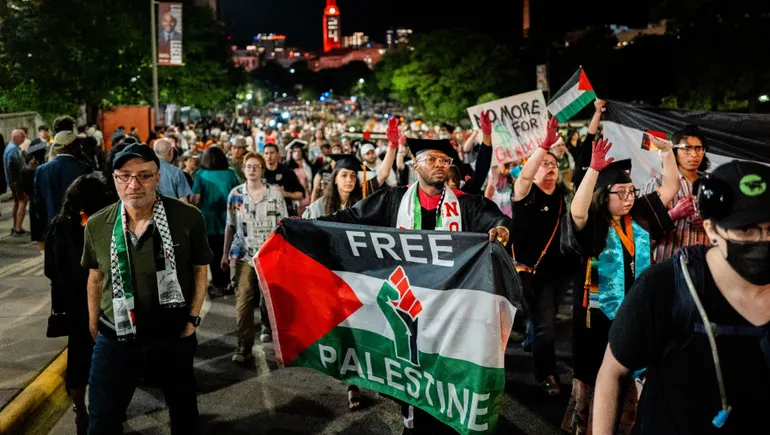
Texas passed SB 2972, earlier this year in the wake of 2024’s wave of pro-Palestinian protests on U.S. campuses.
“In April 2024, universities across the nation saw massive disruption on their campus,” state Sen. Brandon Creighton, the primary author of the bill, wrote in a statement of intent. “Protesters erected encampments in common areas, intimidated other students through the use of bullhorns and speakers, and lowered American flags with the intent of raising the flag of another nation.”
Along with specifically prohibiting First Amendment-protected activityovernight, the law also bars the campus community from inviting speakers to campus, using devices to amplify speech and playing drums or other percussive instruments during the last two weeks of any term.
In its complaint, FIRE called the law “blatantly unconstitutional.”
“The First Amendment doesn’t set when the sun goes down,” FIRE senior supervising attorney JT Morris said in a September statement. “University students have expressive freedom whether it’s midnight or midday, and Texas can’t just legislate those constitutional protections out of existence.”
Ezra agreed in his ruling.
“The First Amendment does not have a bedtime of 10:00 p.m.,” the judge wrote. “The burden is on the government to prove that its actions are narrowly tailored to achieve a compelling governmental interest. It has not done so.”
In his ruling, Ezra wrote that the law’s free speech restrictions were not content-neutral and so must survive a strict legal test for the government to show that the law is the least restrictive possible to achieve a “compelling” goal.
The judge pointed to public posts by Texas Gov. Greg Abbott and the bill’s statement of intent, both decrying the pro-Palestinian protests. Abbott described the protests as antisemitic and called for the arrest and expulsion of protestors.
“The statute is content-based both on its face and by looking to the purpose and justification for the law,” Ezra wrote.
Ezra also highlighted that the statute carved out an exception for commercial speech in his ruling.
“Defendants betray the stated goal of preventing disruption and ensuring community safety by failing to expand the Bans to commercial speech,” he wrote. “Students can engage in commercial speech that would otherwise violate the Bans simply because it is not ‘expressive activities,’ no matter how disruptive.”
In response to the law, the University of Texas at Austin adopted a more limited version of the policy that only banned overnight expressive activities in its common outdoor area that generate sound to be heard from a university residence.
However, Ezra concluded the pared-down policy wasn’t enough to protect students’ constitutional speech rights, as UT-Austin could change it or enforce it subjectively.
“The threat of prosecution arises not only from UT’s adopted policy but also from the legislative statute,” the judge wrote. “As adopted, UT Austin is not currently in compliance with the statute, and at any point could change or be instructed to change its policies to comply with the law.”
FIRE cheered the injunction on Tuesday.
“We’re thankful that the court stepped in and halted a speech ban that inevitably would’ve been weaponized to censor speech that administrators disagreed with,” FIRE Senior Attorney Adam Steinbaugh said in a statement.
In its lawsuit, the free speech group has asked the judge to permanently block the law’s enforcement.