A new collection of essays, AI and the Future of Universitiespublished by HEPI and the University of Southampton, edited by Dr Giles Carden and Josh Freeman, brings together leading voices from universities, industry and policy. The collection comes at a point when Artificial Intelligence (AI) is projected to have a profound and transformative impact on virtually every sector of society and the economy, driving changes that are both beneficial and challenging. The various pieces look at how AI is reshaping higher education – from strategy, teaching and assessment to research and professional services.
You can read the press release and access the full report here.
The Department of Education’s second round of layoffs affected nearly 500 employees and left several offices with a few or no staffers.
Photo illustration by Justin Morrison/Inside Higher Ed | Tierney L. Cross/Getty Images | Matveev_Aleksandr/iStock/Getty Images
Education Secretary Linda McMahon has essentially gutted the postsecondary student services division of her department, leaving TRIO grant recipients and leaders of other college preparation programs with no one to turn to.
Prior to the latest round of layoffs, executed on Friday and now paused by a federal judge, the Student Services division in the Office of Postsecondary Education had about 40 staffers, one former OPE employee told Inside Higher Ed. Now, he and others say it’s down to just two or three.
The consequence, college-access advocates say, is that institutions might not be able to offer the same level of support to thousands of low-income and first-generation prospective students.
“It’s enormously disruptive to the students who are reliant on these services to answer questions and get the information they need about college enrollment and financial aid as they apply and student supports once they enroll,” said Antoinette Flores, a former department official during the Biden administration who now works at New America, a left-leaning think tank. “This [reduction in force] puts all of those services at stake.”
The layoffs are another blow to the federal TRIO programs, which help underrepresented and low-income students get to and through college. President Trump unsuccessfullyproposed defunding the programs earlier this year, and the administration has canceleddozens of TRIO grants. Now, those that did get funding likely will have a difficult time connecting with the department for guidance.
In a statement Wednesday, McMahon described the government shutdown and the RIF as an opportunity for agencies to “evaluate what federal responsibilities are truly critical for the American people.”
“Two weeks in, millions of American students are still going to school, teachers are getting paid and schools are operating as normal. It confirms what the president has said: the federal Department of Education is unnecessary,” she wrote on social media.
This is the second round of layoffs at the Education Department since Trump took office. The first, which took place in March, slashed the department’s staff nearly in half, from about 4,200 to just over 2,400, affecting almost every realm of the agency, including Student Services and the Office of Federal Student Aid.
Nearly 500 employees lost their jobs in this most recent round, which the administration blamed on the government shutdown that began Oct. 1. No employees in FSA were affected, but the Office of Postsecondary Education was hit hard.
Jason Cottrell, a former data coordinator for OPE who worked in student and institution services for more than nine years, lost his job in March but stayed in close contact with his colleagues who remained. The majority of them were let go on Friday, leaving just the senior directors and a few front-office administrators for each of the two divisions. That’s down from about 60 employees total in September and about 100 at the beginning of the year, he said.
At the beginning of the year, OPE included five offices but now is down to the Office of Policy, Planning and Innovation, which includes oversight of accreditation, and the group working to update new policies and regulations.
Cottrell said the layoffs at OPE will leave grantees who relied on these officers for guidance without a clear point of contact at the department. Further, he said there won’t be nonpartisan staffers to oversee how taxpayer dollars are spent.
“Long-term, I’m thinking about the next round of grant applications that are going to be coming in … some of [the grant programs] receive 1,100 to 1,200 applications,” he explained. “Who is going to be there to actually organize and set up those grant-application processes to ensure that the regulations and statutes are being followed accurately?”
Flores has similar concerns.
“These [cuts] are the staff within the department that provide funding and technical assistance to institutions that are underresourced and serve some of the most vulnerable students within the higher education system,” she said. “Going forward, it creates uncertainty about funding, and these are institutions that are heavily reliant on funding.”
Other parts of the department affected by the layoffs include the Offices of Special Education and Rehabilitation Services, Communications and Outreach, Formula Grants, and Program and Grantee Support Services.
Although the remaining TRIO programs and other grant recipients that report to OPE likely already received a large chunk of their funding for the year, Cottrell noted that they often have to check in with their grant officer throughout the year to access the remainder of the award. Without those staff members in place, colleges could have a difficult time taking full advantage of their grants.
“It’s going to harm the institutions, and most importantly, it’s going to harm the students who are supposed to be beneficiaries of these programs,” he said. “These programs are really reserved for underresourced institutions and underserved students. When I look at the overall picture of what has been happening at the department and across higher education, I see this as a strategic use of an opportunity that this administration has created.”
Brown settled with the Trump administration earlier this year, but the compact doesn’t offer the same protections, the university president wrote in her rejection of the deal.
The compact, initially sent to nine institutions, would require universities to make a number of far-reaching changes, including suppressing criticism of conservatives on campus. Of the original nine, Brown is now the second to reject the deal after the Massachusetts Institute of Technology.
The administration has promised preferential treatment on federal funding for those that sign on, though the document itself doesn’t detail those benefits. Higher ed experts and observers have warnedagainst signing, arguing that it threatens institutional independence and give the federal government much more power over universities.
Following MIT’s rejection, the Trump administration said the compact was open to all colleges. But of the original nine invitees, there are no takers so far, though officials at the University of Texas system have indicated they view the proposal favorably. The system’s flagship in Austin was part of the nine.
“President Trump is committed to restoring academic excellence and common sense at our higher education institutions,” White House spokesperson Liz Huston said in a statement. “Any university that joins this historic effort will help to positively shape America’s future.”
Brown president Christina Paxson released her response to federal officials Wednesday, arguing that while Brown agreed with some of the aims of the proposal—such as keeping tuition costs down and maintaining a vibrant exchange of ideas across the ideological spectrum—other issues, including academic freedom concerns, prompted the university to reject the compact.
She also pointed to the settlement Brown and the Trump administration reached in July to restore more than $500 million in frozen federal research funding amid an investigation into alleged campus antisemitism. She noted that the agreement “reflects similar principles” to the compact. But while the settlement did not wade into campus curriculum or programs, the compact would impose much greater restrictions on academic offerings for signatories.
“In return for Brown signing the July agreement, the federal government restored the University’s research funding and permanently closed three pending investigations into shared ancestry discrimination and race discrimination. But most important, Brown’s existing agreement with the federal government expressly affirms the government’s lack of authority to dictate our curriculum or the content of academic speech—a principle that is not reflected in the Compact,” Paxson wrote.
A White House official said that the settlement was aimed at “rectifying past harm and discrimination,” whereas the compact is more “forward looking.”
Paxson also echoed concerns raised by MIT president Sally Kornbluth—who wrote in her letter to the Education Department that “scientific funding should be based on scientific merit alone”—and other higher ed groups such as the Association of American Universities, of which Brown is a member.
Paxson wrote, “A fundamental part of academic excellence is awarding research funding on the merits of the research being proposed.”
”The cover letter describing the compact contemplates funding research on criteria other than the soundness and likely impact of research, which would ultimately damage the health and prosperity of Americans,” she added. “Our current agreement with the federal government—beyond restoring Brown’s research funding from the National Institutes of Health—affirms the University’s ability to compete fairly for new research grants in the future, a doctrine of fairness and a commitment to excellence that aligns with our values.”
The Department of Education did not respond to a request for comment.
Todd Wolfson, president of the American Association of University Professors, celebrated the decision on social media and in a statement, highlighting efforts by Brown employees to push back against the compact, including a campus protest last week that called on administrators to reject the deal.
Both the national AAUP and Brown’s AAUP chapter have spoken out against the compact, and faculty at other universities along with students have also urged their leaders to reject the compact.
“By declining to compromise its core mission, Brown University has affirmed that no amount of federal inducement is worth surrendering the freedom to question, explore, and dissent,” Wolfson said in the statement. “In rejecting the Compact, Brown stands as a bulwark for higher education’s sacred commitment to academic freedom and institutional self-governance.”
Enjoy listening to the podcast? Donate to FIRE today
(https://www.thefire.org/) and
get exclusive content like member webinars, special episodes, and
more. If you became a FIRE Member
through a donation to FIRE at thefire.org and would like access to
Substack’s paid subscriber podcast feed, please email [email protected].
As summer wraps up, education marketers everywhere know what’s next? The back-to-school rush. It’s that time when inboxes fill up, campaigns go live, and every message counts. This season isn’t just about new classes or fresh notebooks; it’s the start of a new student recruitment marketing cycle, a chance to re-engage current students, attract new ones, and build momentum for the year ahead.
In a competitive space like higher education, you can’t rely on luck. You need a clear, intentional strategy that speaks directly to your students and stands out in a noisy market. Whether you’re a career college, university, or language school, this is the chance is to set the tone and build lasting connections.
In this playbook, you’ll find practical, proven back-to-school marketing strategies for success. From personalized outreach and short-form video to smart content planning and accessible design, consider this your guide to an A+ marketing season.
Struggling with enrollment?
Our expert digital marketing services can help you attract and enroll more students!
Audit Last Year’s Campaigns and Set SMART Goals
Before launching any new campaign, take a breath and look back. What worked in your student recruitment marketing last year, and what didn’t? Pull up your analytics and dig deep into the data: conversion rates, click-through rates (CTR), engagement metrics, and ROI for every channel. If your online open house had strong attendance but few follow-up applications, ask why. If your email series saw above-average opens, figure out what made it work: was it timing, tone, or topic?
Use these insights to set SMART goals: Specific, Measurable, Achievable, Relevant, and Time-bound. Avoid vague aims like “increase applications.” Instead, go for something concrete, like “increase undergraduate application starts by 15% by the end of Q3.”
Why is it important for schools to audit previous marketing campaigns before launching new ones? Auditing past campaigns helps schools understand their previous recruitment efforts. By analyzing data such as click-through rates, conversion rates, and ROI, institutions can set SMART goals for the new academic year. This ensures resources are directed toward tactics that actually drive inquiries, applications, and enrollments instead of repeating ineffective strategies.
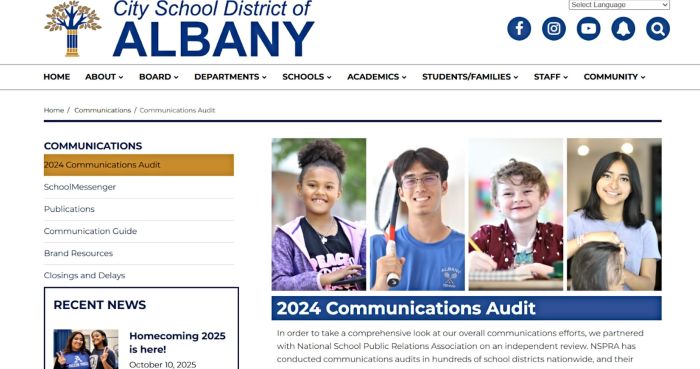
Example: City School District of Albany (NY) The district undertook a comprehensive communications audit with the National School Public Relations Association, reviewing all print and digital outreach. The 2024 audit report identified strengths and challenges and led to specific 2024–25 implementation goals, for example, hiring a new school communications specialist and streamlining internal communication protocols. These SMART goals were directly tied to audit recommendations, ensuring measurable improvements in engagement and consistency.
Tactical Tip: Create a simple scorecard or dashboard with last year’s metrics and this year’s goals. Track results on a weekly or monthly basis, and adjust tactics as needed. Data-driven agility is your best advantage.
Personalize Your Outreach to Prospective Students
Personalization should already be part of your strategy. Between 70 – 80% of students now expect it from schools. The back-to-school period is the perfect time to show you understand each prospect’s needs.
Start with your CRM data. Segment audiences by program, location, or funnel stage, then tailor messages accordingly. Send unfinished applicants a quick “deadline reminder” email, while offering current students a “Welcome Back” guide. Both feel personal and drive engagement.
Your website can do this too. Dynamic banners or content blocks that change by visitor type make a big impact. Tools like HubSpot, Slate, or Mautic by HEM help automate it all, even inserting names or programs into messages.
Example: University of Idaho. To personalize outreach at scale, U of I introduced AI-driven personalized video messages for prospective students during the 2024 recruitment cycle. Applicants received videos addressing them by name, hometown, and academic interest, creating a one-to-one connection. This individualized approach was added on top of existing personalized print and email campaigns. The results were impressive: emails containing the personalized video links saw a 45% open rate (versus 24% for standard emails), and the university reported higher application and admission rates across all student segments after launching over ten such video campaigns.
How can educational institutions use personalization to improve student engagement? Personalization allows schools to communicate directly to a student’s interests, program choices, and stage in the admissions funnel. Using CRM and marketing automation tools like Mautic by HEM, teams can segment audiences, send customized emails, and display dynamic website content based on visitor data. When prospective students receive tailored messages, like deadline reminders or personalized welcome guides, they’re more likely to respond, apply, and enroll.
Tactical Tip: Gather preferences early through short surveys (“What’s your dream career?”). Feed those insights into your campaigns, and when prospects see content that matches their interests, they’re far more likely to apply or enroll.
Engage Through Video and Social Media Content
Currently your audience is scrolling, and fast. Gen Z and Gen Alpha spend hours on TikTok, Instagram, and YouTube, where video dominates. In fact, video now makes up more than 80% of all internet traffic, so if it’s not central to your strategy, you’re already behind.
Show what campus life feels like. Create short videos that capture move-in day buzz, a lively lab session, or the roar of the first football game. Student testimonials and livestreamed Q&As work especially well because they’re authentic and emotional, two things today’s viewers respond to.
Your social media profiles are your school’s digital storefront. Keep them fresh with “Day in the Life” takeovers, campus challenges, and UGC that shows students’ real experiences. Repost their content (with credit) to build authenticity. Even micro-influencers (popular students or alumni) can amplify your reach organically.
Use social media to build community, too. Create incoming class groups groups on Facebook or Discord where students connect before arriving, or run quick Instagram polls (“What are you most excited about this fall?”) to boost engagement.
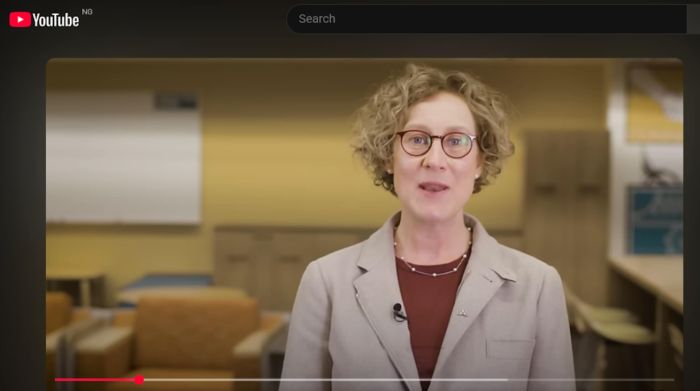
Example: University of Minnesota. The university kicked off the 2024 academic year with an energetic “Welcome Back to School 2024” video message from the new president, Dr. Rebecca Cunningham. Shared on the official UMN YouTube channel and social media, the video welcomes students and faculty to campus and sets an enthusiastic tone for the year. This engaging content, featuring the president and campus scenes, was used to boost school spirit online and was widely viewed and shared within the community.
What role do video and social media play in back-to-school marketing? Video and social media are now essential tools for reaching Gen Z and Gen Alpha students. Platforms like TikTok, Instagram, and YouTube are where prospective students spend most of their time, making short-form, authentic videos key to capturing attention. Schools can share move-in day highlights, “Day in the Life” student takeovers, or live Q&As to showcase campus life and build emotional connections with their audience before the academic year begins.
Tactical Tip: Format videos for each platform: vertical and under 60 seconds for TikTok or Reels, longer for YouTube. Post “move-in prep” content in August and “welcome week” highlights in September to match student timelines.
Visual Tip: Mix polished and raw footage. A sleek virtual tour pairs perfectly with a student’s unfiltered dorm vlog. That balance between professional and real builds trust and attention.
Plan an Integrated Content Calendar for the Academic Year
When you’re juggling multiple channels, such as email, social media, blogs, print, and events, it’s easy for campaigns to lose focus. A well-structured content calendar keeps everything aligned. It outlines what you’ll publish, when, and where, ensuring every platform supports the same strategy.
Start with a brainstorming session before fall begins. Identify monthly themes that match your recruitment cycle. August could highlight move-in and orientation, September might focus on study tips and student life, and October on deadlines and fall events. Include major dates like FAFSA deadlines, holidays, and open houses so nothing slips through the cracks.
For each theme, plan content across different stages of the funnel. During back-to-school, for instance, pair “slice of campus life” stories for awareness with targeted “why choose us” posts for decision-making prospects.
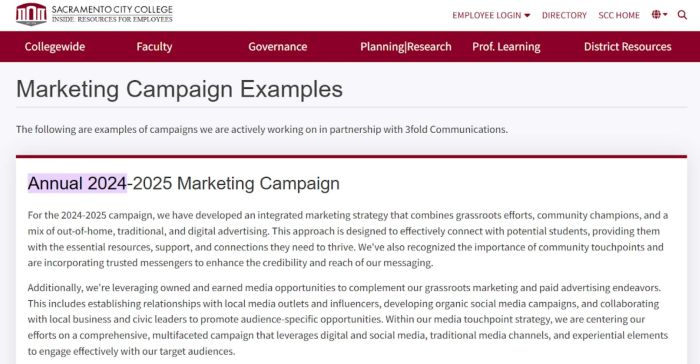
Example: Los Rios Community College District (CA). For the 2024–2025 recruitment cycle, Los Rios (a district of four colleges) developed an integrated marketing content strategy spanning grassroots outreach, traditional media, and digital channels. Their annual marketing campaign plan was managed through a central calendar and included coordinated content across platforms: social media posts, email campaigns, community events, billboards, and more.
Tactical Tip: Add columns in your calendar for audience, goal, and platform. Tools like Trello, Airtable, or even Google Sheets can help your team stay organized.
Pro Tip: Capture new assets early in the semester. Fresh photos, short videos, and student testimonials from those first lively weeks will fill your content library with authentic, high-energy material you can repurpose all year.
Maximize Reach With Targeted Digital Advertising
Even the strongest content needs help reaching the right audience. Digital advertising ensures your message gets in front of prospective students and their parents at the right time and place.
Begin by defining your audience and selecting the platforms that align with their habits. For high school seniors, Google Ads and Instagram are usually most effective. For local adult learners, Facebook or regional streaming ads may deliver better results. Match your spend to where your audience is most active.
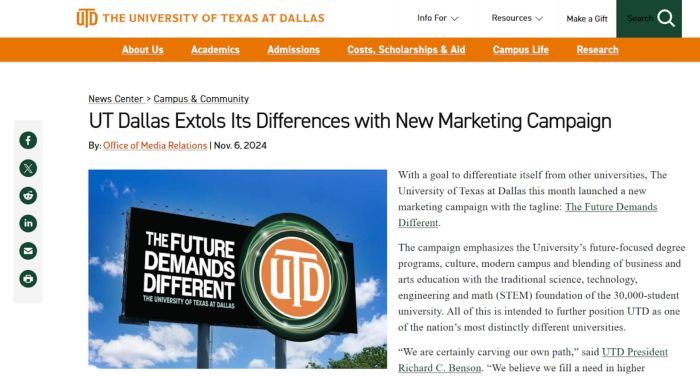
Example: University of Texas at Dallas. In late 2024, UT Dallas launched a new branding campaign, “The Future Demands Different,” which employed highly targeted digital and media advertising to recruit students. The campaign focused heavily on specific geographic markets: primarily North Texas, with select expansion into other Texas cities and neighboring Oklahoma, where the university offers special tuition rates. UTD produced its first-ever broadly distributed TV commercial featuring current students and placed these ads strategically on local television newscasts, streaming platforms, and even during NBA game broadcasts (Dallas Mavericks) to reach its target audience.
Next, focus on timing and relevance. Seasonal messages like “Apply by October 15” or “Start your future this fall” create urgency and keep your campaigns connected to the academic calendar. Pair them with engaging, authentic visuals that reflect campus life and excitement for the new year.
Retargeting is another essential tactic. Students who visit your website or start an application are warm leads. Remind them to take the next step with a clear, encouraging ad.
Tactical Tip: Track your campaigns closely. Test headlines, images, and calls to action to see what resonates, and refine your approach as data comes in. Ensure your landing pages are fast, mobile-friendly, and consistent with your ads. That seamless experience is what turns clicks into conversions.
Streamline Marketing with Automation and AI
The back-to-school season can feel like organized chaos, with hundreds of inquiries, events to manage, and deadlines everywhere. That’s why automation and AI are no longer nice-to-haves; they’re essential for keeping communications personal while giving your team room to breathe.
Start with a strong CRM connected to a marketing automation system. Platforms like Mautic by HEM, designed for education marketers, make it easy to automate email campaigns, social posts, and lead nurturing. For example, when a student downloads your course catalog, your system can automatically follow up the next day with a webinar invite. This keeps engagement flowing without constant manual effort.
Email automation is especially effective this time of year. Set up a simple three-step sequence: welcome, tips for applying, and a deadline reminder. Keep your design clean, concise, and mobile-friendly, as most students will read emails on their phones.
AI chatbots are another huge time-saver. Schools like Georgia State University have seen success with their chatbot “Pounce,” which helped reduce summer melt by answering student questions around the clock. You can deploy similar chat tools on your website or Facebook Messenger to guide prospects when staff aren’t available.
AI can also optimize your digital ads, test creative variations, and even suggest the best posting times on social media. Just keep a human eye on the outputs. AI should assist with the creation process, not replace, a real connection.
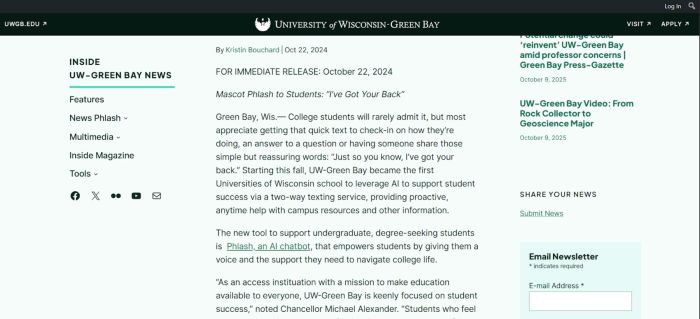
Example: University of Wisconsin–Green Bay. UW–Green Bay became the first in its state system to deploy an AI-driven chatbot for student outreach in Fall 2024. Nicknamed “Phlash,” the bot engages undergraduate students via two-way text messaging, providing 24/7 answers to common questions and proactively checking in on students’ well-being. For example, every 7–10 days, Phlash sends a brief text asking how the student is doing and offers guidance or resources based on their needs. In its first week, 96% of UWGB students opted in to receive messages from Phlash, and over 2,100 student replies were recorded within 24 hours of the first check-in text.
Tactical Tip: Use automation analytics to fine-tune your back-to-school marketing strategies. Track open rates, chatbot inquiries, and ad conversions. If you notice a drop-off, tweak timing or content. Over time, these insights will help you refine your approach and build smarter, more human campaigns.
Ensure Accessible and Inclusive Marketing Materials
When your campaigns are accessible and welcoming to everyone, you reach more prospective students and reflect the values your institution stands for.
Start with accessibility basics. Add descriptive alt text to all images so screen readers can describe visuals to users with vision impairments. Caption every video and provide transcripts. These help not only Deaf or hard-of-hearing students but also anyone watching on mute. Check color contrast, too: combinations like red on green can be hard to read for color-blind users. Use clear fonts, readable sizes, and designs that meet accessibility standards.
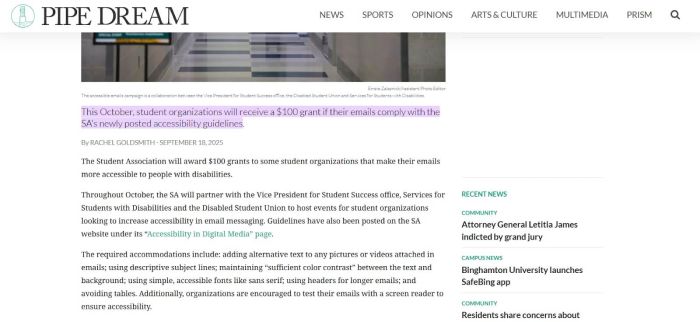
Example: Binghamton University (Student Association). At Binghamton, student leaders launched an “accessible emails” initiative in Fall 2025 to improve the inclusivity of campus communications. The Student Association (SA), in partnership with the campus disability services office, rolled out digital accessibility guidelines and challenged all student organizations to apply them in their back-to-school email newsletters. These guidelines included using alt text on images, high-contrast colors, readable fonts, and captions on videos, and simple adjustments to make emails and social posts readable by screen readers and accessible to those with disabilities. To incentivize adoption, the SA offered $100 grants (via a raffle) to clubs that complied with the new accessibility standards in their October emails.
Make sure your content works across all devices. Responsive, mobile-friendly emails and web pages prevent frustration and help more users complete inquiry forms or explore programs on their phones.
Representation matters as well. Feature students from diverse backgrounds and experiences, and consider multilingual or culturally inclusive content if you serve international audiences.
Tactical Tip: Run a quick accessibility audit using tools like WAVE or Axe to spot missing tags or low-contrast text. Train your marketing team on simple habits, like using CamelCase in hashtags (#FirstDayAtCampus), that make your content more inclusive. Small changes go a long way toward making every student feel seen and included.
Measure, Adapt, and Refine Your Strategy
Great marketing doesn’t stop at launch; it evolves. Once your back-to-school campaigns are live, monitor results closely and be ready to adjust. Use Google Analytics 4, CRM dashboards, such as HEMs Mautic, and other social insights to see what’s working. Focus on metrics that matter, like inquiries and applications.
Hold quick debriefs with your team after major pushes. Ask what content resonated, which channels drove engagement, and whether event turnout met expectations. Maybe your career-focused posts got strong traction, or your TikTok videos outperformed Facebook. Use that data to refine your next phase of content and budget allocation.
Flexibility is your biggest advantage. Test different formats, refine your messaging, and pivot when something isn’t working. Every campaign teaches you more about your audience.
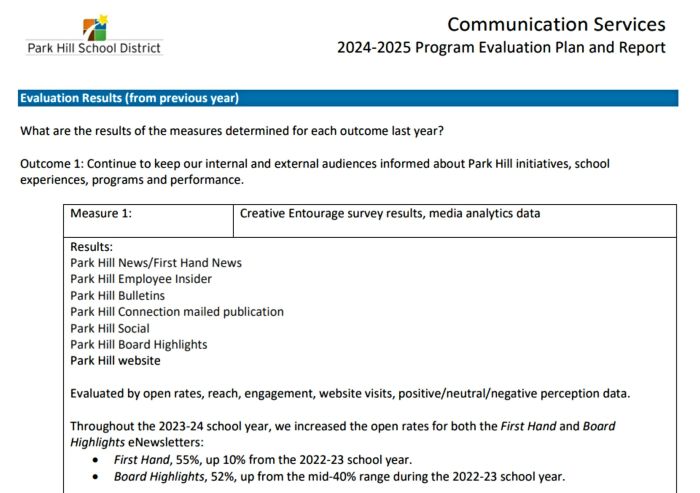
Example: Park Hill School District (MO). Park Hill’s communications department exemplifies a cycle of measurement and refinement in its marketing strategy. Each year, they collect detailed analytics on communication channels, email open rates, social media engagement, website traffic, and even advertising partnership revenue, and compare them to prior years’ benchmarks. In their 2023–24 report, for instance, the team noted improvements like an increase in the staff newsletter open rate from the mid-40% range up to 52%, and a jump in Facebook reach by 167% year-over-year. They also track outcomes of marketing initiatives (e.g., four years of in-house advertising brought in $148,800 in revenue in 2023–24) to evaluate ROI. These metrics inform mid-course corrections and the setting of new goals.
Tactical Tip: Keep communication open across teams. Marketing, admissions, and academics should share insights regularly. If your in-house resources are stretched, consider bringing in experts like HEM. Our team offers digital strategy, content, automation, and CRM support so you can scale campaigns efficiently and keep enrollment goals on track. Measure what matters, learn fast, and never stop improving.
Wrapping Up
The back-to-school season sets the tone for the entire year. When you combine strategy with creativity, the results speak for themselves. Reviewing last year’s data, setting SMART goals, personalizing outreach, producing engaging videos, organizing content calendars, and using automation or targeted ads all work together to move the needle. Add accessibility and inclusion, and your marketing becomes not just effective, but meaningful.
At the heart of it all is one principle: keep students front and center. Understand what drives them, where they spend time, and how your institution can meet their goals. That empathy fuels every great campaign.
Effective higher education marketing is a perfect blend of art and analysis. It’s about pairing strong storytelling with measurable outcomes. And when you need a partner to help balance both, Higher Education Marketing (HEM) is here. We specialize in data-driven strategy, automation, SEO, and social campaigns built to amplify your institution’s voice.
The new academic year is full of opportunities. With the right preparation and a willingness to adapt, your marketing can inspire action, drive enrollment, and welcome a new wave of students ready to thrive. Here’s to your most successful back-to-school season yet.
Struggling with enrollment?
Our expert digital marketing services can help you attract and enroll more students!
Frequently Asked Questions
Question: Why is it important for schools to audit previous marketing campaigns before launching new ones? Answer: Auditing past campaigns helps schools understand their previous recruitment efforts. By analyzing data such as click-through rates, conversion rates, and ROI, institutions can set SMART goals for the new academic year. This ensures resources are directed toward tactics that actually drive inquiries, applications, and enrollments instead of repeating ineffective strategies.
Question: How can educational institutions use personalization to improve student engagement? Answer: Personalization allows schools to communicate directly to a student’s interests, program choices, and stage in the admissions funnel. Using CRM and marketing automation tools like Mautic by HEM, teams can segment audiences, send customized emails, and display dynamic website content based on visitor data.
Question: What role do video and social media play in back-to-school marketing? Answer: Video and social media are now essential tools for reaching Gen Z and Gen Alpha students. Platforms like TikTok, Instagram, and YouTube are where prospective students spend most of their time, making short-form, authentic videos key to capturing attention.
Journalists from FOX News, ABC, and over a dozen other news organizations are refusing to sign the Pentagon’s new policy for press credentials, saying in a joint statement that it “threatens core journalistic protections.” They’re right about that. At least a couple of the policy’s provisions burden fundamental newsgathering with vague restrictions that invite government overreach.
There’s no way to know when you’re ‘soliciting government employees to break the law’
The most troubling provision of the policy is found in the “Security Risks” section and states, in part:
There is a critical distinction between lawfully requesting information from the government and actively soliciting or encouraging government employees to break the law. The First Amendment does not permit journalists to solicit government employees to violate the law by providing confidential government information.
This runs into a functional problem and a legal problem. Let’s deal with the functional problem first.
In most cases, journalists don’t know what answer they’re going to get to a question before they ask. For example, if a journalist asks a question about whether the department is investigating a report on social media of overseas terrorism targeting American assets, the potential responses range from the totally unclassified (e.g., no) to the highly sensitive (e.g., troop locations and plans).
While a journalist might reasonably infer that the United States is engaging in some activity that falls into the sensitive or classified categories, they don’t have any power to determine what answer they actually receive. The policy’s interpretation of solicitation or encouragement seems to invest a lot of discretion into the Department of War to decide whether the question was soliciting sensitive information. And it also sets up reporters to be scapegoats for when federal employees release too much information. The fault there starts — and ends — with those employees, not journalists simply doing their job.
The legal problem with this provision is that it’s not based in any actual law. As stated, it undermines well-established law. The First Amendment has limited enumerated exceptions, such as speech that is defamatory, speech that would inspire imminent lawless action, and obscenity. “Asking a question where the answer might be classified” isn’t on the list, and reporting on national security matters is protected speech.
The fundamental “right of citizens to inquire” includes asking the government questions. If the First Amendment guarantees the right “verbally to oppose or challenge police action without thereby risking arrest,” then it guarantees the right to peaceably ask an officer questions without risking arrest. [City of Houston v.] Hill, 482 U.S. at 462–63. Likewise, if the government cannot hold Americans in contempt for “speak[ing] one’s mind, although not always with perfect good taste, on all public institutions,” it cannot jail them for posing questions to public institutions. Bridges v. California, 314 U.S. 252, 270 (1941).
There’s an attempted savings clause in the policy that says the rules “do not prohibit you … from engaging in constitutionally protected journalistic activities, such as investigating, reporting, or publishing stories.” That offers little comfort when it also opines that some questions aren’t constitutionally protected.
The remedy here is not to go after reporters, who we expect to ask tough and probing questions of government officials. Rather, it’s for Pentagon staff to practice message discipline by following law and policy when asked sensitive questions. This is not an unreasonable ask; after all, the government has spent decades finding new and creative ways not to answer such questions, like the Glomar response. It doesn’t need to threaten journalists with punishment if, by misadventure, they accidentally get one answered.
‘Unprofessional conduct’ could lead to loss of credentials
Appendix A lists reasons why credentials might be pulled from “any person reasonably determined to pose a security or safety risk to DoW personnel or property.” That includes “those who have been convicted of any offense involving . . .unprofessional conduct that might serve to disrupt Pentagon operations.” But a later sentence clarifies that “actions other than conviction may be deemed to pose a security or safety risk” and might also lead to loss of credentials.
One can imagine situations where this might be appropriate, but if I’m parsing that correctly, a journalist merely seen as unprofessional — even without being “convicted of any offense” — could be regarded as a security risk and have their credentials revoked. That by itself sounds like a problem. It sounds like even more of a problem after President Trump was asked whether he would consider removing the restrictions and replied that he thinks Secretary of War Pete Hegseth “finds the press to be very disruptive in terms of world peace and maybe security for our nation,” adding, “The press is very dishonest.”
Most journalists would agree that dishonesty is unprofessional. If the commander in chief already thinks you’re dishonest, then what journalist’s credential is likely to survive this provision?
In one instance, the policy singles out journalists for diminished rights
One thread that runs through the entire credentialing policy is that the government doesn’t want anyone taking pictures of the Pentagon or its environs (the “Pentagon reservation”). In most cases, people need permission and a handler before engaging in recording. When it comes to sensitive areas, this is understandable. But the policy has a particularly odd restriction at the 9/11 Memorial on Pentagon grounds:
News media visiting the National Pentagon 9/11 Memorial in their personal capacity, not as a member of the press, may take photos using their personal devices. Filming or photography in the Memorial for a news media interview or to obtain b-roll requires an exception, as described below under Filming/Photography Exception Requests.
If this were a restraint directed at order, traffic, the use of large cameras or amplification devices, that might make sense. If it were a general time, place, and manner restraint, that might make some sense. But this is a restriction on photography based on the intent to engage in the freedom of the press guaranteed by the Constitution. In other words, you can have the picture, as long as you don’t intend to show anyone. It’s hard to imagine a worse reason to restrict photography.
How would this even work in practice? Every day, we see reporters crowdsource photos from events on social media. So reporters are barred from taking a picture, but can get permission from the non-journalist next to them who published the photo on X? I understand the need for extraordinary security around the Pentagon, but singling journalists out for less favorable treatment than the general public is inherently suspect.
With these issues, it shouldn’t be surprising that nearly every media outlet has refused to sign the acknowledgement, including CNN, NPR, CBS, FOX, The Washington Times, and The New York Times. Only One America News, a pro-Trump news outlet, has agreed so far.
In recent months, the Pentagon had made revisions to improve this policy based on feedback. It’s unclear how much the outlets and the Pentagon will cooperate going forward.
(H/t to the Reporter’s Committee for Freedom of the Press, both for writing to the Department of War about the policy and actually sharing the policy with the world, which, in the most recent version, was rare indeed.)
It has been just six years since the Paris Climate Agreement set a race against time to rein in global heating. But the Earth is sending ever-harsher signals of alarm.
When the accord was signed, we were on course for global heating of 4°C from the start of the industrial era to the end of this century. Now the figure is around 2.7°C. So something has been achieved, but relative safety comes at no more than 1.5°C.
There is still a gap between the policies put in place over the past six years and what is needed to achieve that lower figure, the International Energy Agency (IEA) said in its annual outlook, published in October.
Yet we know what to do: substitute renewable energy for the power we get from fossil fuels by mid-century; decarbonize industry and adapt land-use to trap carbon in soil and plants; adapt our means of transport and our growing cities to use less energy; and protect marine areas to enhance carbon absorption in oceans.
“Two parallel and contradictory processes are in play,” wrote environmentalist and author George Monbiot in a Guardian opinion piece on November 3. “At climate summits, governments produce feeble voluntary commitments to limit the production of greenhouse gases. At the same time, almost every state with significant fossil reserves … intends to extract as much as they can.”
Everything depends, he concluded, on which process prevails.
Making strides in renewable energy
Similar tensions are in play at industrial and economic levels. On the plus side, there is now a surprisingly strong backstory in renewable wind and solar energy, particularly solar, and particularly in the United States, the heaviest polluter historically per person, and China, the biggest polluter in absolute quantities of its emissions.
The energy crisis resulting from Russia’s invasion of Ukraine last February has prompted policies that will boost clean energy, the IEA added in its World Energy Outlook, which projects trends out to 2030.
While the crisis has created a temporary upside for coal, in the long run, production of renewable energy will outpace the production of energy derived from fossil fuels, the report said.
Another positive sign is the nascent hydrogen industry.
Widely occurring and carbon-free, this gas could decarbonize long-distance travel and industries that are heavy emitters. Producing it without carbon emissions implies using intermittent renewable energy when it is over-abundant, a virtuous circle.
However, none of this is yet at industrial scale — barring a few hydrogen-powered trains. Not all claims for hydrogen can be borne out, and it is not yet a viable financial concern.
There is a significant plus on the political front with the election of Luiz Ignácio Lula da Silva as Brazil’s next president. He promises to end the record deforestation of the Amazon under his predecessor, Jair Bolsonaro, and is to take office in January.
But there is no slowdown in fossil fuels.
Yet investment in fossil fuels still dwarfs cash flowing into renewables, even though they offer economic advantages. The United States, for example, has ploughed over $9 trillion into oil and gas projects in Africa since it signed the Paris Agreement, The Guardian found.
Africa, a continent starved of cash for energy but with vast potential for solar power, is now under pressure — including from international oil companies operating in its national parks — to exploit its fossil fuel resources just to bring electric power to its people.
The fossil fuel industry’s damage doesn’t end there. There has been drastic under-counting of carbon emissions, a new tracking tool backed by former U.S. Vice President Al Gore has found. Oil and gas companies have underestimated their emissions threefold, Gore said when launching the tool at the United Nations Climate Summit (COP 27) in Egypt this month.
“For the oil and gas sector it is consistent with their public relations strategy and their lobbying strategy. All of their efforts are designed to buy themselves more time before they stop destroying the future of humanity,” The Guardianquoted Gore as saying.
Investing in Africa
Across the world, policies are in place to invest over $2 trillion in clean energy by 2030, half as much again as today, led by the United States and China, but also including the European Union, India, Indonesia and South Korea, according to the IEA.
In the United States, solar was already becoming the star of the new energy scene, according to an annual report from Berkeley National Labs. The country added 1.25 terrawatts of solar capacity in 2021. That’s more than the installed solar capacity in the entire world, which reached 1 terrawatt in early 2022.
That was before the Biden Administration enacted the Inflation Reduction Act, which brings extra impetus for the sector. The United States plans to add 2-1/2 times its existing solar and wind capacity every year between now and 2030 and grow its fleet of electric vehicles seven-fold, the IEA said.
At the same time, Africa is desperate for energy investment.
To provide access to electricity for its population, the continent would need $25 billion per year, the IEA said in its annual Africa Energy Outlook, published in June. “This is around 1% of global energy investment today, and similar to the cost of building just one large liquefied natural gas (LNG) terminal,” it said.
The continent has 60% of the world’s best solar resources but only 1% of installed solar photovoltaic capacity. This is already the cheapest source of power in many parts of Africa and would outcompete all other energy sources across the continent by 2030, the IEA said.
The energy watchdog projects that solar, wind, hydropower and geothermal energy would provide over 80% of new power generation capacity in Africa by 2030. No new coal-fired power plants would be built once those now under construction are completed. Half the cost of adding new solar installations out to 2025 could be covered by investments that would otherwise have gone into discontinued coal plants.
Yet this assessment leaves out the plans for increased oil and natural gas developments on the continent.
Pressure from energy companies
A report just published by Rainforest UK and Earth Insight 2022 found that the area of land allocated across Africa for such developments is set to quadruple under existing plans. That report focuses on the Congo Basin, but in East Africa, French oil major TotalEnergies is pushing ahead with a large-scale oil project and trans-continental pipeline in Uganda.
These oil and gas projects would lock the continent into fossil fuels for decades to come and blow a hole in the bid to keep global heating to no more than 1.5°C.
These energy projects have wide support among African leaders, who contrast the immediacy of such investments and their benefits for their countries with the reluctance of Western nations to put up the finance agreed over a decade ago for energy transitions and preservation of biodiversity.
African environmentalists question the wisdom of this carbon bomb. But it is hard to dismiss the idea that broken promises by the countries that have caused the climate crisis has driven Africa into the arms of the fossil fuel industry.
TotalEnergies’ CEO Patrick Pouyanné argues that the world cannot quit fossil fuels before it has alternative sources of energy.
“The mistake being made now is to think that the solution for the climate is to abandon fossil fuels,” he said in an interview with French TV station LCI on November 17. “The solution is first to build the new decarbonized energies that we need.”
“If you do both at the same time, what happens?,” Pouyanné said. “Exactly what you reproach us for — prices rise because of the rarity of supply, because the demand for oil is not falling.”
The monopoly power of fossil fuel firms
These energy companies have long fought the switch from fossil fuels to renewables.
Half a century ago, Total concealed a report it had commissioned that clearly explained how burning fossil fuels would cause global heating and the consequences we are seeing today.
Other oil and gas companies, notably Exxon, acted similarly and responded to their findings by funding climate-denying think tanks and political lobbyists.
More recently, as the evidence mounted, they turned their attention to lobbying for exemptions, even though the scientific consensus demands that to achieve the 1.5°C limit on warming, there can be no new oil, gas or coal exploration or extraction.
A record number of fossil fuel lobbyists attended this month’s climate summit in Egypt (see the graphic here).
Fossil fuels no longer make economic sense.
The sector is a good example of reality flouting economic theory, which teaches that if a new technology reaches a point where it outcompetes an existing one, the new technology will replace the older one.
This should be happening with solar versus coal, oil and gas — and indeed is predicted to happen by 2050. Meanwhile, harmful emissions continue to rise.
Energy markets and the fossil fuel firms themselves do not obey basic economics for the simple reason that they are monopolies with the power to skew conditions in their favor.
The oil producers’ monopoly, in the form of OPEC, has controlled production to keep prices higher for decades. In the 1990s, the big Western oil companies went through a frenzy of mega-mergers that created today’s top five — Shell, ExxonMobil, BP, Chevron, and ConocoPhillips — whose sheer size gives them disproportionate bargaining and lobbying power.
Now activists are trying to gain support for a Fossil Fuel Non-Proliferation Treaty as a way of reining in the root cause of the climate emergency. The initiative was put before the United Nations in September and the COP 27 climate summit in November.
“Will you be on the right side of history? Will you end this moral and economic madness?” Ugandan climate activist Vanessa Nakate asked global leaders at the summit.
On that, the jury is still out.
Landmark deal opens way for loss and damage fund
It has taken 27 climate summits, but the COP 27 in Egypt finally managed to pull out an agreement to set up a specific fund to aid poor countries hit by damage caused by climate disasters. The deal was approved on November 20 after a marathon negotiating session.
The proposal had been fought tooth and nail by the rich industrialized countries whose emissions have fostered global heating, stirring resentment among poorer countries who have suffered the most extreme consequences and have the least ability to mitigate the damage.
Details will be hammered out over the coming year, and there is as yet no money in the fund. It was nevertheless a major step forward.
However, the final agreement failed to call for phasing out all fossil fuels and for warming emissions to peak by 2025, both heavily opposed by oil-producing countries, raising fears that the goal of limiting warming to 1.5°C by mid-century will not be achievable.
Questions to consider:
1. Where is a major boom in solar energy taking place? 2. What is Africa’s energy dilemma? 3. Why do you think fossil fuel majors have so much influence?
Just before I headed out on a work/vacation trip (I’m in Costa Rica today), the Government of Alberta dropped the report of the Expert Panel on Post-Secondary Institution Funding and Alberta’s Competitiveness, which I had previewed back here when the panel was formed about a year ago. So, on the way to the airport, I dashed off this blog to give you all the skinny.
First: it’s a good report! Might be the most sensible report on PSE that’s come out in Canada for quite some time, not least for the ways the Panel went beyond its mandate and actually addressed the elephant in the room, which was “how is Alberta going to educate this huge wave of students heading its way?” – a point which the government pointedly omitted from the Panel’s terms of reference. There are a few things in here which I think are a bit under-thought, which I will address below. But in the main, this is a report which you could apply in almost every province and we’d have a much better system than we have now.
The report starts by laying out what it calls a “framework” for policy, which should:
Provide a space for every qualified Alberta student who wants to pursue post-secondary education (though, this could be quite expensive…I think it was a deliberate political choice to not include any costing in this document)
Focus on outcomes, providing incentives and rewarding performance in three key areas: teaching and student experience, research, and the impact institutions have on the communities they serve.
Set tuition in a manner that balances the importance of certainty for students with the reality of increasing costs in institutions.
Encourage government to reconsider the extent of controls it exercises over institutions, and reduce unnecessary red tape, so as to provide institutions with the autonomy and flexibility they need.
See? All eminently sensible. But, of course, the devil is in the details, which the panel outlines in eleven specific recommendations. Seven of these are so sensible that they barely require comment. These include recommendation 3 (improve funding and administration of apprenticeship programs), recommendation 4 (fund IT infrastructure on a long-term basis rather than via ongoing operating funding), recommendation 6 (bring back student grants!), recommendation 7 (more international students!), recommendation 8 (government to back off, provide institutions with more autonomy), recommendation 9 (less red tape for institutions), and recommendation 10 (faster government approval of new programs).
So far, so good. The remaining four recommendations present some complications, though. I’ll go through them one by one.
Recommendation 1 suggests that Alberta should adopt an actual funding formula to divide public spending between institutions (it is currently one of the largest jurisdictions in the world without one; to my knowledge only BC is bigger). It further suggests that the formula consists of three components: weighted enrolment, (i.e. weighted to recognize that clinical education costs more than laboratory education which costs more than classroom education), performance (assuming the indicators are smart and measurable, which the panel suggests might not be the case for all the indicators in the current performance-based funding arrangement), and a “base” funding component.
All fine in principle, but two points. First, when you have institutions as disparate in size as Alberta does (50K at University of Alberta to 1300 at the Alberta University of the Arts), a “base” component is hard to design properly. The idea is to recognize that institutions have fixed costs that probably won’t get covered properly under an enrolment-weighted formula alone but that’s hard to do in a way that actually works but doesn’t wildly subvert any normal principles of equity (I know, I tried sketching one for the Manitoba College system a decade ago, and it’s hard). Second – and somewhat relatedly – the Panel skips over the bit where a previous government within the last decade tried to do develop a formula much like this one and discovered that any sensible enrolment-weighted system would probably eviscerate two or three of the smaller regional colleges, which was seen as impractical from a political POV (the Minister of the Day trashed the report without publishing it, which is why you may not have heard this story). The math and politics won’t have changed, so getting this idea up and running might be easier said than done.
Onwards to recommendation 2, which asks the government to introduce targeted, time-limited funding initiatives to a) attract top research talent, b) support innovation and developing technology, and c) provide incentives and support for collaboration among institutions. The ideas are fine, but the logic for time-limiting the measure seems obscure to me.
Now to recommendation 5, on tuition fees. This is where the report is at its hand-waviest, and I think there is a lot of subtext here which is not fully explained. Currently, there is a 2% cap on all tuition increases. The panel wants that to be maintained for students once they have begun their studies, so as to give them “price stability”. But they also think that institutions should be given “discretion” to raise tuition for first-year students more radically year-by-year, because institutions need money.
Here’s where it gets handwave-y. The panel does not advocate for de-regulation; whether out of conviction or political realism I can’t say. Rather, it suggests that the Alberta government should set “maximum allowable tuition” every year, on a field of study basis, and institutions should have the freedom to set tuition fees up to that maximum. I think the logic at work here is the same as that seen in the UK in both the 2006 and 2012 fee reforms, which was that if the government set a maximum, institutions would have space to “compete on price” and the big prestigious universities would be able to charge a quality premium. As we saw in the UK, though, this is a naïve assumption: since price tends to act as a proxy for quality in the public mind (because God forbid anyone actually try to measure quality), what happens in these situations is that all institutions will quickly drive to the max, meaning that in effect, it’s still government setting the fees, with all the politics that entails (decent chance the maximum will be $0 if/when the NDP return to power). I am not sure this has been well thought-through.
Anyways, on to the final recommendation, which is that on Equity, Diversity and Inclusion (which, it should be noted, was also not part of the Panel’s mandate). In the discussion section, it cites mostly American examples, argues for “institutional neutrality” with respect to political issues (this means no boycotts, apparently, although I suspect if the panel told Alberta’s Ukrainian community that U of A was going to be forced to maintain relations with Russian universities on grounds of institutional neutrality, there would be riots). It also makes veiled references to “federal research grant requirements, which require explicit commitments to equity, diversity and inclusion as part of their selection and approval process…[which] can limit academic freedom and direct the focus of research”. So far, so Alberta.
But then if you look at the actual recommendation, there are two points to make. The first is that the panel chooses to place “Indigenization” as a separate category from the rest of EDI (they don’t quite say Indigenization = good, EDI = bad, but you’d be forgiven for thinking that this is in fact the panel’s view). And the second is that the actual recommendation is pretty anodyne. It’s written in such a way that allows the anti-woke to claim that we need constant vigilance and for institutions to be able to hit the snooze button and go back to sleep because they already do what is being recommended. Not quite a nothing burger, but pretty close.
In any event: it’s a solid report and while I think there will be one or two twists and complications in implementation, the direction in which it points is a promising one. Hopefully the government will accept the report and get to work on it as soon as possible.
As the vice president of academic affairs and a member of the admissions committee at SSP International (SSPI), a nonprofit organization offering immersive scientific experiences, I review hundreds of applications each year from rising seniors for our flagship program, Summer Science Program. What we’ve learned is that many of our bright and talented students are navigating their academic careers without access to the same supports as similarly high-achieving students.
Where other Summer Science Program applicants might benefit from private tutors, college consultants, or guidance from parents familiar with the college application process and the high stress of today’s competitive college market, these students rise to the top of the applicant pool without leaning on the same resources as their peers.
This is especially true for first-generation students who will be the first in their families to graduate from high school, go through the college admissions process, apply for financial aid, and enroll in college. Not only do they need to be more resourceful and self-reliant without the support of their personal networks, but they also often take on the responsibility of guiding their parents through these processes, rather than the other way around.
School counselor shortage
For many students who are underrepresented in academia, their exposure to different colleges, careers, and networks comes from their school counselors. While the American School Counselor Association (ASCA) recommends a minimum student-to-school counselor ratio of 250:1, the nationwide shortage of counselors led to a national average ratio of 385:1 between 2020-2023. That is a lot of strain on counselors who already serve as jacks of all trades–needing to keep up with evolving college admissions processes, understand the financial circumstances of hundreds of families, provide emotional support, and stay on top of the job market to advise accordingly. This ultimately affects the level of personalized counseling students receive.
Making the college admissions process accessible
In 2020, SSPI launched College Link, a mentorship program offering Summer Science Program alumni access to one-on-one or group mentoring. Mentors support students during their transition from high school to college through guidance on financial aid, early decision/early action processes, college applications, personal essay writing, resume workshopping, and more. To date, College Link has served over 650 mentees and recruited over 580 mentors sourced from SSPI’s 4,200 alumni network.
This mentorship network comprises individuals from various backgrounds, leading successful and diverse careers in academia and STEM. Mentors like Dr. Emma Louden, an astrophysicist, strategist, and youth advocate who also helped develop the program, provided SSPI’s recent alumni with insights from their real-world professional experiences. This helps them explore a variety of careers within the STEM field beyond what they learn about in the classroom.
Demographic data from last year’s Summer Science Program cohort showed that 37 percent of participants had parents with no higher education degree. That is why College Link prioritizes one-on-one mentoring for first-generation college alumni who need more personalized guidance when navigating the complexities of the college application and admission process.
College Link also offers group mentoring for non-first-generation students, who receive the same services from several mentors bringing great expertise on the varying topics highlighted from week to week.
With the support of College Link, nearly one hundred percent of Summer Science Program alumni have gone on to attend college, including MIT, Stanford, Harvard, Caltech and other prestigious institutions.
Using College Link as a blueprint
As the U.S. continues to face a counselor shortage, schools can further support students, especially first-generation students, through the college admissions process by creating mentorship networks using the College Link model. Schools can tap into their alumni network and identify successful role models who are ready to mentor younger generations and guide them beyond the admissions process. With the widespread implementation of Zoom in our everyday lives, it is now easier than ever to build networks virtually.
Mentorship networks in schools can provide additional support systems for high school students and alleviate the pressures school counselors experience daily during college admissions season. Let’s continue to ensure the college admissions process is accessible to all students.
Dr. Mike Manzella, SSP International
Dr. Mike Manzella is the VP of Academic Affairs at SSP International, where he oversees all academic aspects of SSPI’s new and existing STEM research programs and SSPI’s Summer Science Program faculty recruiting efforts. Mike holds a B.S. in Biotechnology from the Rochester Institute of Technology and a PhD in Microbiology and Molecular Genetics from Michigan State University.
Latest posts by eSchool Media Contributors (see all)
In South Korea, education has long been the most powerful route to social mobility and prestige, but a recent study shows how that pursuit is changing. Published in the Asia Pacific Education Review (2025), one of the newest article in transnational education (TNE) research investigates why Korean students are now choosing to study at US branch campuses located inside their own country rather than traveling abroad. Focusing on N University, a US-affiliated institution within the Incheon Global Campus, the study explores how students balance ambition, constraint, and identity in one of the world’s most competitive education systems.
Korea’s higher education landscape is characterised by rigid hierarchies in which the name of a university often outweighs individual academic or professional ability. Admission to elite institutions such as Seoul National, Korea, and Yonsei University is still viewed as a ticket to success. At the same time, US degrees continue to hold exceptional symbolic power, representing international competence, social status, and career advantage. Yet, for many families, studying abroad is prohibitively expensive, while competition for domestic university places remains intense. The result is that a growing number of students are enrolling in American branch campuses at home, institutions that promise the prestige of a US education without the cost and distance of overseas study.
To explain this trend, the researchers propose a Trilateral Push–Pull Model. Traditional models of student mobility describe decision-making as a process between two countries or schools: one that pushes students out and another that pulls them in. However, international branch campuses (IBCs) add a third dimension. Korean universities push students away through limited access and rigid hierarchies. US universities attract them with prestige and global capital but are often out of reach financially and logistically. The IBC exists between these poles, offering an American degree and English-language instruction within Korea’s borders. This framework captures how students navigate overlapping pressures from domestic and global systems.
Drawing on interviews with 21 Korean students, the study reveals several interconnected findings. Many participants viewed the IBC as a second choice, not their first preference but a realistic and strategic option when other routes were blocked. They were attracted by the prestige of American degree, USstyle curriculum (in English), smaller classes, and opportunities for studying at the home campus abroad. At the same time, they expressed anxiety about the ambiguous status of their institution. Several students described N University as “in between”, uncertain whether it was truly American or fully Korean. This ambiguity, they said, made it difficult to explain their school to relatives, peers, or teachers, who were unfamiliar with the branch campus model. In a culture where school reputation carries great weight, such uncertainty caused unease even when students were satisfied with their learning experience.
The study also underscores the continuing role of family influence and educational aspiration. Many students reported growing up in households where parents believed education was the only reliable path to success and were willing to make sacrifices for English proficiency and global exposure. For these families, IBCs offered a middle ground: a way to obtain a foreign education without leaving home or paying international tuition. Students who attended Korean secondary schools typically saw the IBC as an alternative after failing to gain admission to top domestic universities. Those with international or bilingual school backgrounds viewed it as a substitute for studying abroad, particularly after the COVID-19 pandemic made overseas education less appealing or feasible.
In both groups, the IBC served as a strategic compromise. It allowed students to maintain a sense of global ambition while avoiding the financial, emotional, and logistical risks of full international mobility. It also provided a form of what sociologist Jongyoung Kim calls global cultural capital: the symbolic value and recognition that come with foreign credentials. By earning an American degree at home, students could claim global status without physically migrating. This pattern illustrates how globalisation in higher education is increasingly taking place within national borders.
Beyond individual motivations, the study connects these choices to larger demographic and policy challenges. Korea’s declining college-age population and government-imposed tuition freezes have created fierce competition among universities for a shrinking pool of students. In this environment, IBCs serve dual roles: they act as pressure valves that absorb unmet domestic demand and as prestige bridges that connect local students to the symbolic power of American education. However, their long-term sustainability remains uncertain. Many IBCs struggle with limited public visibility, uneven recognition, and questions about academic legitimacy. Unless they establish a clearer institutional identity and stronger integration within the local higher education system, they risk being viewed as peripheral rather than prestigious.
The research also broadens theoretical understanding of international education. By incorporating the IBC as a third actor in the push–pull framework, the study challenges the assumption that global learning always requires cross-border mobility. It also refines the concept of global cultural capital, showing that students can now accumulate globally valued credentials and symbolic advantage through domestic avenues. In countries like South Korea, where education is deeply tied to social status, this shift represents an important transformation. The global and the local are no longer opposites but increasingly intertwined within the same institutional spaces.
In conclusion, Korean students’ choices to enroll in US branch campuses reveal a strategic negotiation between aspiration and limitation. These institutions appeal not to those lacking ambition but to those who seek to reconcile global goals with financial and social realities. They reflect a world in which higher education is simultaneously global and local, mobile and immobile. For IBCs to thrive, they must move beyond copying Western models and instead cultivate programs that are meaningful in their local contexts while maintaining international quality.