Blog

  • Zitkala-Sa and Native American Rights and Heritage

    Zitkala-Sa and Native American Rights and Heritage

    Zitkala-Sa, whose English name was Gertrude Simmons Bonnin, was a powerful voice for Native American rights and a pioneering Indigenous writer. Born in 1876 on the Yankton Indian Reservation in South Dakota, she was a member of the Yankton Dakota Sioux Nation. Her life’s work centered on preserving Indigenous culture while advocating for the rights and citizenship of Native peoples during a time of intense pressure toward forced assimilation.

    At age eight, Zitkala-Sa left her reservation to attend White’s Manual Labor Institute, a Quaker missionary boarding school in Indiana. This experience profoundly shaped her perspective, and she later wrote candidly about the trauma of cultural erasure—the cutting of her hair, the prohibition of her language, and the deliberate attempt to strip away her Indigenous identity. These early essays, published in The Atlantic Monthly in 1900, brought national attention to the realities of boarding school experiences.

    Despite the challenges she faced, Zitkala-Sa excelled academically and musically. She became an accomplished violinist, performing with the Carlisle Indian School band and even playing at the Paris Exposition in 1900. She briefly taught at Carlisle but grew disillusioned with the school’s assimilationist mission and resigned to pursue her own path.

    Her literary accomplishments were groundbreaking. In 1901, she published Old Indian Legends, commissioned by Boston publisher, Ginn and Company, a collection of Dakota stories she learned as a child and gathered from various tribes. 

    Her autobiographical essays were first published in The Atlantic Monthly in 1900. In 1921, she compiled these essays along with new work into American Indian Stories, which blended autobiography, traditional tales, and political commentary.  

    She also co-wrote the libretto for The Sun Dance Opera (1913), one of the first operas written by a Native American. Her writing style was eloquent and accessible, making her work a bridge between Native and non-Native audiences. Zitkala-Sa’s activism defined the latter half of her life. She worked as a community organizer, traveling to reservations to document the poor conditions and advocate for change. In 1926, she co-founded the National Council of American Indians and served as its president until her death. She lobbied Congress, fought for citizenship rights (achieved with the Indian Citizenship Act of 1924), and championed Indigenous self-determination.

    Old Indian Legends, 1901

    Throughout her life, Zitkala-Sa navigated the tension between two worlds without abandoning her heritage. She used the tools of Western education—writing, music, political organizing—to protect and honor Indigenous cultures. She passed away in 1938, leaving behind a legacy that continues to inspire Indigenous writers, activists, and artists today. Her work reminds us that cultural preservation and adaptation can coexist, and that one voice, raised persistently and eloquently, can create lasting change.

    Oklahoma’s Poor Rich Indians – 1924


    Source link

  • Expert council on governance reports – Campus Review

    Expert council on governance reports – Campus Review

    Universities will be required to justify how much is spent on consultants and disclose whether vice-chancellors are drawing multiple incomes as recommended by a governance committee on Saturday.

    Please login below to view content or subscribe now.

    Membership Login

    Source link

  • Canberra finds staff underpaid $1.5m – Campus Review

    Canberra finds staff underpaid $1.5m – Campus Review

    The University of Canberra will review casual academic staff payslips after it found professional employees have been underpaid over $1.5 million over six years.

    Please login below to view content or subscribe now.

    Membership Login

    Source link

  • Staff opinion of using AI – Campus Review

    Staff opinion of using AI – Campus Review

    To continue onto Campus Review, please select your institution.

    Source link

  • Subcontractual higher education beyond the headlines

    Subcontractual higher education beyond the headlines

    We’ve written a lot about subcontractual provision on Wonkhe, and it is fair to say that very little of it has been positive.

    What’s repeatedly hit the headlines, here and elsewhere, are the providers that teach large numbers of students in circumstances that have sparked concerns about teaching quality, academic standards, and indeed financial probity or even ethics.

    There are a fair number of students that are getting a very bad deal out of subcontractual agreements and, although we’ve been screaming about this for several years, it is good to finally see the beginnings of some action.

    Student number tools

    The long-awaited release of OfS data is not perfect – there’s lots that we’d love to see that does not appear to have been delivered. One of these is proper student numbers: it should be possible to see data on how many students are studying at each subcontracted provider at the last census point.

    Instead, we are scrabbling around with denominators and suppressions trying to build a picture of this part of the sector that is both heavily caveated and three years out of date. This isn’t good enough.

    And it is a shame. Because as well as the horror show, the data we do have offers a glimpse of a little known corner of higher education that arguably deserves to be celebrated.

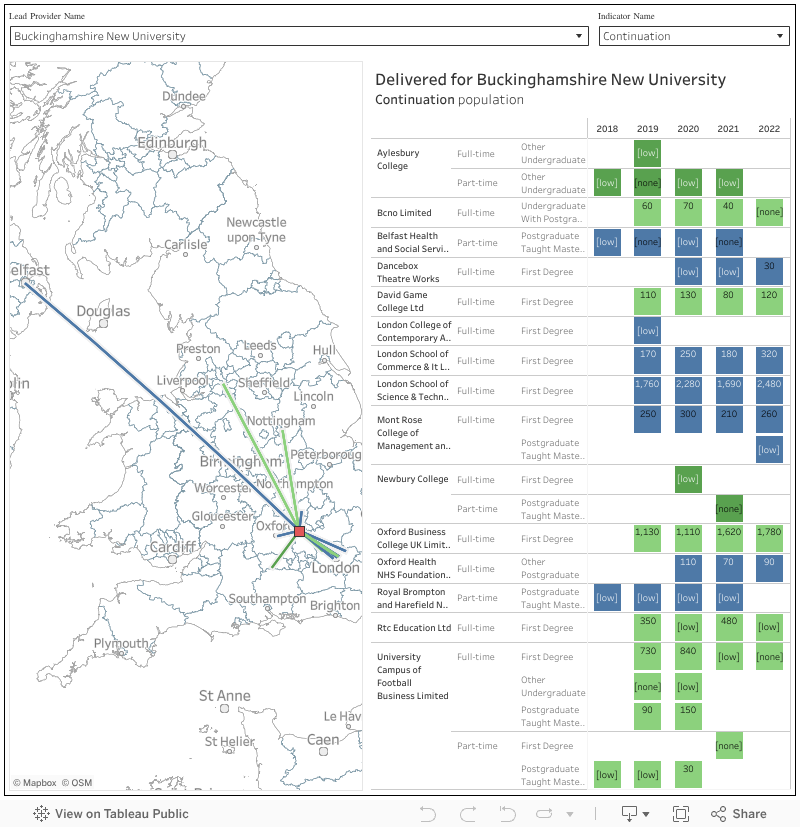
    I’ve developed some new visualisations to help you explore the data – these add substantial new features to what I have previously published. Both these dashboards work in broadly the same way – the first allows you to examine relationships at delivery providers, the second at lead providers. You choose your provider of interest at the top left, which shows the various relationships on a map on the left hand side. On the right you can see denominator numbers for each year of data – you can use the filter at the top right to see information about the total number of students who might be continuing, completing, or progressing in a given year.

    Each row on the right hand side shows a combination of provider (lead provider on the first dashboard, delivery provider on the second), mode, and level – with denominators and suppression codes available in the coloured squares on the right. The suppression codes are as follows:

    • [DQ]: information suppressed due to low data quality from the 2022-23 collection
    • [low]: There are more than 2 but fewer than 23 students in the denominator
    • [none]: There are 2 students or fewer in the denominator
    • [DP]: Data redacted for reasons of data protection
    • [DPL]: Data redacted for reasons of data protection (very low numbers,
    • [DPH]: Data redacted for reasons of data protection (within 2 of the denominator)
    • [RR] below threshold response rate (for progression)
    • [BK] no benchmarks (the benchmark includes at least 50 per cent of the provider’s students)

    You can see available indicators (including upper and lower confidence intervals at 95%), benchmarks, and numeric thresholds by mousing over one of the coloured squares. The filled circle is the indicator, the outline diamond is the benchmark, and the cross is the threshold.

    [Full screen]

    [Full screen]

    A typology

    It’s worth noting the range of providers that are subcontracted to deliver higher education for others. There were an astonishing 681 of these between 2014 and 2022.

    A third of those active in delivering provision for others (227) are registered with the Office for Students in their own right. Fifty-nine of these are recognisable as universities or other established higher education providers – including 14 in the Russell Group.

    Why would that happen? In some cases, a provider may not have had the degree awarding powers necessary for research degrees, so would partner with another university to deliver particular courses. In other cases, the peculiarities of this data mean that apprenticeship arrangements are shown with the university partner. There’s also some examples of two universities working together to deliver a single programme.

    We also find many examples of longstanding collaborations between universities and teaching organisations in the arts. Numerous independent schools of dance, drama, and music have offered higher education qualifications with the support of a university – the Bird School’s relationship with the Doreen Bird College of Performing Arts began in 1997. Italia Conti used to have an arrangement with the University of East London, it now works with the University of Chichester.

    There are 135 organisations delivering apprenticeships in a relationship with an OfS-registered higher education provider. Universities often offer end point assessment and administrative support to employers and others who offer apprenticeships between level 4 and level 7.

    Two large providers – Navitas and QA – offer foundation courses and accredited year one courses for international students at UK universities: QA also offers a range of programmes aimed at home undergraduates. We could also add Into as a smaller example. This dataset probably isn’t the best place to see this (QA is shown as multiple, linked, organisations) but this is a huge area of provision

    Seventy-four subcontracted providers are schools, or school centred initial teacher training (SCITT) organisations. As teacher training has gradually moved closer to the classroom and away from the lecture hall, many schools offer opportunities to gain the industry-standard Postgraduate Certificate in Education (PGCE), which is the main route to qualified teacher status. A PGCE is a postgraduate qualification and is thus only awarded by organisations with postgraduate degree awarding powers.

    In total there are 144 providers subcontracted to deliver PGCE (initial teacher training) courses, primarily schools, local councils, and further education colleges (FECs). There are 166 FECs involved in subcontracted delivery – and this extends far beyond teacher training. Most large FECs have a university centre or similar, offering a range of foundation and undergraduate courses often (but not always) in vocational subjects. The Newcastle College Group used its experience of delivering postgraduate taught masters courses for Canterbury Christ Church University to successfully apply for postgraduate degree awarding powers – the first FEC to do so.

    We find 23 NHS organisations represented within the data. Any provider delivering medical, medical related, or healthcare subjects will have a relationship with one or more NHS foundation trust – as a means to offer student placements, and bring clinical expertise into teaching. This is generally an accreditation requirement. But in many cases, the relationship extends to the university awarding credit or qualifications for the learning and training that NHS staff do. The Oxford Health NHS Foundation Trust works with multiple providers (the University of Oxford, Oxford Brookes University, and Buckinghamshire New University), to offer postgraduate apprenticeships in clinical and non-clinical roles.

    Nine police organisations (either constabularies or police and crime commissioners) have subcontractual relationships with registered higher education providers. Teesside University works with the Chief Constable of Cleveland to offer an undergraduate apprenticeship for prospective police officers.

    All three of the UKs armed forces have subcontractual relationships with higher education providers. The British Army currently works with the University of Reading to offer undergraduate and postgraduate degrees in leadership and strategic studies – in the past it has offered a range of qualifications from Bournemouth University. Kingston University has a relationship with the Royal Navy, currently offering an MSc in Technology (Maritime Operations) undertaken entirely in the workplace.

    Ecosystem

    When I talk to people about franchise and partnership arrangements, most (perhaps thinking of the examples that make the mainstream press) ask me whether it would not be easier to simply ban such arrangements. After all, it is very difficult to see any benefit from the possibly fraudulent and often low quality behavior that is plastered all over The Times on a regular basis.

    As I think the data demonstrates, a straight-ahead ban would be hugely damaging – swathes of national priorities and achievements (from NHS staff development, to offering higher education in “cold spots”, to the quality of performances on London’s West End) would be adversely affected. But the same could be said for increases in regulatory overheads.

    There are a handful of very large providers (I’d start with Global Banking School, Elizabeth School of London, Navitas, QA, Into, London School of Science and Technology, and a few others – and from the data you’d have included Oxford Business Colleges) that are, effectively, university-like in size and scope. It is very difficult to understand why these are not registered providers given the scale of their operations (GBS, Into, and Navitas already are) and this does seem to be the right direction of travel.

    There are a clutch of medium-sized delivery providers, often in a single long-standing relationship with a higher education institution. Often, these are nano-specialisms, particularly in the creative arts or in locally important industries. In many of these cases oversight on quality and standards from the lead provider has been proven over a number of years to work well – and there seems little benefit to changing this arrangement. I would hope for this group – as is likely to happen for the FECs, SCITTs, NHS, police, and armed forces – that a change to regulatory oversight only happens where there is an issue identified.

    There is also a long tail of very small arrangements, often linked to apprenticeships (and regulated accordingly). For others at this end of the scale it is difficult to imagine OfS having the time or the capacity to regulate, so almost by default oversight remains with the lead partners. I know I say this in nearly every article, but at this end it feels like we need some kind of regular review of the way quality processes work for external providers within lead providers – we need to be sure lead providers are able to do what can be a very difficult job and do it well.

    Source link

  • How higher education became a get rich quick scheme

    How higher education became a get rich quick scheme

    Sometimes, the problem with both media coverage and regulation is that critique of a part of the sector taints it all.

    When ministers or media outlets find sharp practice in recruitment or failings in student support, everything from OfS Insight Briefs to Sunday Times splashes can feel like the whole class being kept in for lunch when you weren’t making any noise.

    So has been the case for franchising. A specific group of universities has been subcontracting out to a specific group of private colleges in recent years – a group which has rightly picked up attention from the media, the National Audit Office (NAO), the Public Accounts Committee (PAC), the Office for Students (OfS), the Student Loans Company (SLC) and the Department for Education (DfE).

    Independent HE, for example, have argued elsewhere on the site that while they strongly support a tougher regime around franchising, the proposed approach of requiring only larger providers (300+ students) to register would be insufficient – missing many bad actors while creating administrative bottlenecks and failing to hold lead providers properly accountable for their partners. Instead, they advocate for universal basic registration for all teaching providers.

    Now, following last week’s long-awaited publication of data on subcontractual partnerships from OfS, we’re pretty confident that it’s possible to isolate and identify a specific subset of undergraduate providers in the English sector.

    Its defining characteristics are that its providers are privately owned, are (very much) for-profit, deliver non-specialist courses principally in Business and Management, and have been (very) rapidly expanding in recent years.

    Last year OfS said that in some cases there has been an “exponential growth” in student numbers in subcontractual partnerships over the last few years, with some lead providers now teaching more students through these arrangements than directly on their own campuses.

    It said that among other potential concerns, this raises questions about the direction of travel for the lead provider’s own strategic identity, aims and objectives.

    Our definition of a specific sub-sector is not perfect. There are a number of providers whose wholly-owned or directly-delivered satellite campus operations share some of those characteristics. Student numbers have not been formally published, and as ever there is lag in the data in general.

    In 2023-24, OfS’ student characteristics data dashboard shows that there were 101,950 students enrolled overall on subcontracted Business and Management courses – up from just 5,630 a decade ago.

    And if we derive from full-time, first degree continuation statistics, aggregate where companies are owned by the same parent, and attach those characteristics to partnerships where the entrant population was 100 or more in 2023-24, we can see 16 providers that enrolled over 40,000 FT FD entrants in 2022.

    Below threshold

    Aggregating both multiple providers in a group, and this sub set in general, is not an exact science. For each partnership between a university and private college, OfS has only published a denominator population rounded to 5 – which makes precision impossible. But we can estimate this sub group’s outcomes “performance” by implying a numerator from the percentages, and recompiling the numbers.

    The result is not stellar. In OfS’ press release to accompany the data, we learned that 77 per cent of FT FD subcontracted students continued courses into a second year, compared to 88 per cent in the sector as a whole. Against a regulatory minimum of 80 per cent, this group of providers averaged just 70 per cent.

    We learned that 74 per cent of subcontracted students completed their course, compared to 87 per cent for the sector as a whole and a regulatory minimum of 75 per cent. This subgroup scored just 70 per cent.

    The further out that a metric is from when students start, the longer it takes to pick up results – a real regulatory issue in a subsector that is expanding so rapidly. But when we look at progression to a graduate job or further study, it’s 71 per cent for the sector as a whole, 57 per cent of subcontracted students, and just 53 per cent of this subsector – against a regulatory minimum of 60 per cent.

    These providers are almost certainly inflating the sector’s performance on access – especially for those who are doing the franchising-to – access and participation stats are not (yet) split by partnership. But they are also dragging down the sector’s performance on outcomes, and giving subcontracting a bad name – all three of the key metrics would likely be above threshold if this group was removed.

    More importantly, if we follow OfS’ logic on outcomes and thresholds – that the figures are signals of whether students have the potential to succeed on the course, and receive good teaching and support through their studies – the group has been expanding yet failing.

    One area, though, where the group is not failing, is on financial performance.

    Healthy profits

    In 2023, the Russell Group estimated that in 2022/23, English universities on average supplemented the cost of educating each UK undergraduate student by £2,500 per year, with all subjects now making a loss on average.

    Not so much here in this sub sector. Because most of the 18 providers are not on the OfS register, the format (and even visibility) of annual accounts is uneven. Financial years and levels of disclosure differ, some are showing on Companies House as posting accounts late, and in many cases some of the income from fees moves up into a parent company in a way that prevents proper transparency.

    But on the basis that the bulk of their income is tuition fees after any franchising fee retained by the university passing on the SLC money that it gets, and assuming that “cost of sales” usually covers the provision of education rather than administrative expenses that are often dominated by acquisition costs, we can calculate a gross profit for the latest year that figures are available for.

    Below that line often huge dividends, director remuneration, domestic agent fees and the costs of renting space or borrowing from a parent co deflate the final profit figures. But in gross terms, notwithstanding that some of the group were micro-entities and exempt at last accounts publication, the group in scope posted gross profits of £504m on an income of £815m.

    Company Period end Turnover (£) Gross profit (£) Note
    Cecos Computing International Limited 31 Mar 2024 £ 20,269,818 £ 9,916,813
    Elizabeth School of London Limited 31 Aug 2024 £ 74,947,093 £ 46,856,529
    Fairfield School of Business Ltd 31 Aug 2024 £ 10,463,430 £ 7,254,024
    Global Banking School Limited 29 Feb 2024 £ 233,566,242 £ 128,068,724
    LCA (Education LTD + London LTD) 31 Dec 2024 £ 70,068,058 £ 36,388,054
    Ld Training Services Limited 31 Aug 2024 £ 10,185,134 £ 9,460,083
    London College of Contemporary Arts Ltd 31 May 2024 £ 25,360,932 £ 17,223,552
    London PT College Limited Not disclosed in abridged filings
    London School of Commerce & IT Limited 31 Mar 2024 £ 6,385,138 £ 3,434,817
    London School of Science & Technology Limited 30 Jun 2024 (15months) £ 83,771,009 £ 62,903,105 Group figures as filed
    Mont Rose College of Management and Sciences Limited 31 Aug 2024 £ 9,904,941 £ 8,489,293
    Navitas UK Holdings Limited (group) 30 Jun 2024 £ 57,222,133 £ 27,004,304
    Oxford Business College UK Limited 31 Aug 2023 £ 49,734,100 £ 31,030,795
    QAHE (LM+NU+UR) Limited 31 May 2024 £ 60,800,000 £ 34,400,000
    St. Piran’s School (GB) Limited 31 Dec 2024 £ 72,470,964 £ 59,211,778
    UK College of Business and Computing Ltd 31 Jul 2024 £ 18,032,506 £ 14,196,396
    Waltham International College Limited 31 Jul 2024 £ 12,127,614 £ 8,118,100
    TOTAL £ 815,309,112 £ 503,956,367

    Figures like that should push any sensible policymaker into windfall tax territory – or at the very least taking some of that profit and using it to relieve students burdened by a lifetime of debt of some of the balance. But more broadly, perhaps policymakers should take a step back and ask whether what’s being facilitated here should be.

    Avoiding scandals

    Ever since I was sent a photo back in 2022 of a domestic agent’s pull-up banner in a London shopping centre inviting students to claim their £15,000 in maintenance support, we’ve been trying to get to the bottom of what’s been happening with franchising.

    There’s a compelling reason for that. Franchising scandals over the last decade caused huge reputational damage for the sector and created an enormous regulatory distraction. When HEFCE and the Department for Education were spending their time devising ways to crack down on sharp practice, they weren’t focusing on improving the sector. The opportunity costs of franchising scandals are significant.

    We could see what was coming – a repeat of the problem. The Office for Students, already stretched, would end up spending much of its time attempting to regulate the rapid expansion. There was real danger of further reputational damage for the sector.

    What we’ve found are highly litigious providers, and real difficulty in getting the data we needed. We wanted to see who these rapidly expanding private companies were – companies specialising in “widening access” students, and lead providers appearing in graphs showing students claiming maintenance loans without fee loans.

    And from a student perspective, one of the issues has long been that if they want to find out what the outcomes would be like, they can’t really tell.

    This matters because almost all higher education advertising says “here’s what this has been like in the past, and so here’s what might happen to you.” The big problem was that when they apply to those providers, they are often told about the franchising provider’s outcomes – not the franchisee provider’s. They hear about the university’s figures for business studies, but can’t see the actual provider’s numbers.

    Franchise partners change frequently, and course names change often. The historical data needed to support statistics on Discover Uni simply aren’t available. Given that providers often have franchising deals with multiple universities, it can’t be unreasonable to ask how well these colleges perform on continuation, completion and graduate employment – especially when so much advertising focuses on careers and improving life chances, while obscuring debt.

    In OfS’ words:

    This [data] will be useful for prospective students, lead providers responsible for registering the students, and institutions responsible for teaching students on these courses.

    Even if the regulation was tightened, the incentives for the latter two of the parties on that list may be too strong to ever aspire beyond minimums. And for students – who have characteristics that are least frequently associated with an “informed actors in a choice market” ideal, even OfS’ data doesn’t show each of the franchised-to providers in aggregate.

    Why?

    This leaves us with a simple question. If the problem is non-specialist franchised provision – which certainly appears to be the case – why is the Department for Education funding it?

    It’s not provision that’s otherwise unavailable. It’s not serving some niche that doesn’t already exist. Students with talent, drive and aspiration would still access traditional universities. Students unsuitable for full-time study would pursue other routes. Students who need more support would have more money spent on them if it wasn’t being delivered to the bottom line in profit.

    This is, lest we forget, a part of the sector where expectations on harassment and sexual misconduct, or free speech, or charter work on mental health or fair admissions, are established only in part and often only in theory – and where student protection in the event of course, campus or provider closure is even thinner than it is elsewhere. Why are these risks concentrated on some of the least advantaged students in the sector?

    There are now real risks in contraction. Already some of the providers on the list have closed campuses and shuttered courses. Have reportable events been made? Are students being compensated for any breach of contract? And what happens if any of these companies just collapse – when the lead provider is often hundreds of miles away? These are tasks the government needs to take on.

    There are risks to allowing franchising, risks to allowing private providers to access the loan book, and risks to having no student number caps. In the last decade, the view was that the potential rewards were greater than risks. But notwithstanding the need to contract with care, it simply cannot be true that the world would be worse if these providers didn’t exist.

    Many things could be done. We’ve made proposals over on the Post-18 Project on different ways to regulate and restrict what’s happening here that draw on valuable lessons from colleagues in FE. But at the simple core, it comes down to this – why does DfE think it’s worth the risk to keep open the student loan book to private providers through franchise agreements for non-specialist subject higher education?

    The faster the government changes course, the faster all of us can turn our attention to improving higher education’s contribution to society and economic growth – rather than chasing around owners of colleges who, collectively, are getting rich off outcomes which OfS says are unacceptably poor.


    Source link

  • Five myths: Higher education at this weekend’s Battle of Ideas

    Five myths: Higher education at this weekend’s Battle of Ideas

    • HEPI Director, Nick Hillman OBE, spent some of his weekend listening to, and participating in, discussions about higher education at the Battle of Ideas at Church House in Westminster.
    • Here are his remarks from a debate on whether we are now in ‘The Era of the Downwardly Mobile Graduate’.

    Thanks for inviting me to speak. I agreed to do so for two reasons. First, the Battle of Ideas is a wonderful grassroots event. Secondly, Claire Fox invited me to speak immediately after the murder of Charlie Kirk. My daughter is keen on telling me where Charlie Kirk was misguided but, whether she is right or wrong, universities should be places where free and fervent debate thrives; not places where discussion gets closed down with a bullet. That should not need saying but, sadly, of course it does.

    Last night, I went to a gig in Oxford by the fabulous band EMF – I first saw them as a fresher 35 years ago and, yes, they are still going. As you doubtless know, their most famous song is ‘Unbelievable’. And most of what we have heard, and are going to hear, is exactly that: unbelievable. Not in the ‘incroyable’ sense of the word, but in the sense that the claims are simply not true.

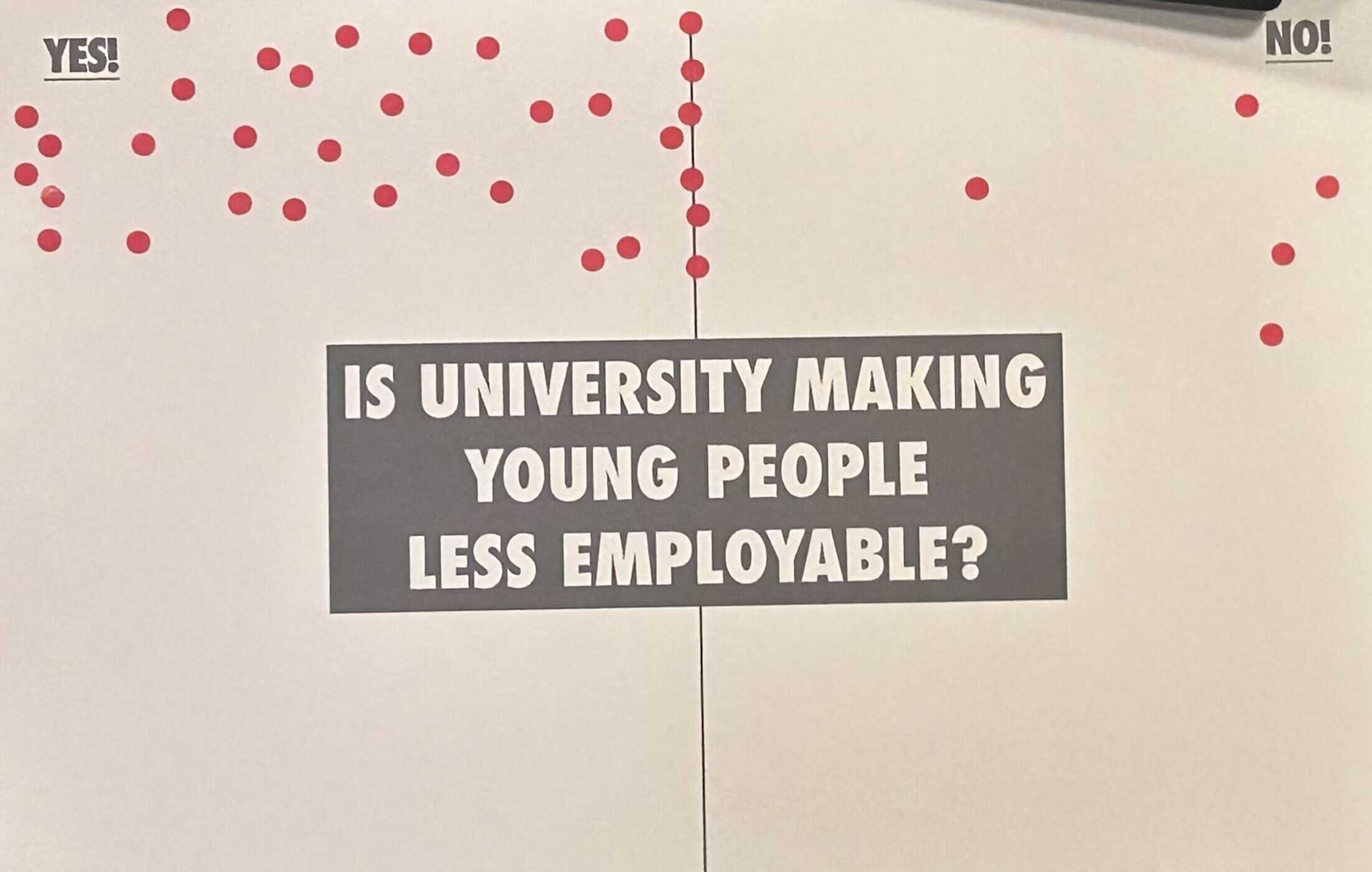
    Let me explain in my few minutes why pretty much every point in the advertising blurb for this event is a myth.

    Myth 1

    We are told there are millions upon millions of people in ‘non-graduate roles’. But this relies on weird and poorly understood definitions of what graduate jobs are. Official definitions obviously rely on jobs being categorised into graduate and non-graduate.

    My favourite critique of what this means comes from an – admittedly – old article by Peter Brant (on Wonkhe), which looked at the official classification from a few years ago, writing:

    A civil servant who was promoted from an Executive Officer to a Higher Executive Officer would be moving from a graduate job to a non-graduate job. Managing an off-licence is a graduate job, managing a pub or a wine bar is a non-graduate job. A singer is a graduate role, a dancer is a non-graduate role. A clown is a graduate job, the manager of a circus is a non-graduate job. And – my personal favourite – a rag-and-bone man is a graduate job, an antiques dealer is a non-graduate job. The list goes on and on.

    Myth 2

    Myth number 2 is the idea that graduates ‘face grim prospects’. The OECD’s new Education at a Glance, which is an annual compendium of global education facts, shows this to be untrue.

    Unemployment is much lower among UK graduates than among non-graduates – irrespective of subject area studied. Indeed, unemployment is much lower among UK graduates than graduates in other developed countries too.

    OECD data, Education at a Glance https://www.hepi.ac.uk/events/launch-of-oecds-flagship-report-education-at-a-glance-2025-hosted-by-hepi-on-tuesday-9-september-2025/

    There isn’t time to go into the huge other benefits of higher education but they include better physical and better mental health.

    The OECD also show the UK does have a problem of low incomes. But this is not among graduates, where our outcomes are positive and comparable with those in other countries. We are literally at the bottom of the OECD league when it comes to earnings for people who have left school with low or no qualifications. They are the people being most let down.

    Myth 3

    The third myth in the blurb for today is that AI will remove the need for employers to recruit people with higher level skills. This is just a revamped version of John Maynard Keynes’s nonsense prediction that people at the end of this current decade would in future work for just 15-hours a week.

    We published a collection of essays on AI last week. Perhaps the most thought-provoking one was by Professor Rose Luckin of the UCL Knowledge Lab. She argues persuasively that:

    The AI revolution represents a pivotal moment where humans need to become more intelligent, not less, as we develop increasingly sophisticated tools.

    Do come to our webinar on the back of the report early next month.

    Myth 4

    The fourth myth is that there are multiple really good alternative options to higher education. Ministers of different stripes have been telling us for years that there is about to be a huge expansion of apprenticeships for young people. Meanwhile, your children and mine are being pumped full of information about why they should do an apprenticeship rather than traditional higher education.

    Yet the number of degree apprenticeships for school leaver is tiny, the number of apprenticeships has fallen since the Apprenticeship Levy was introduced and all those people who worry about university drop-outs should take a look at the high non-continuation rate for apprenticeships.

    Apprenticeships don’t just happen because Keir Starmer or Kemi Badenoch say they should. Apprenticeships are jobs with training attached and the state of the labour market and the regulation of apprenticeships, not to mention the structure of the British economy, are not conducive to big increases in supply.

    Myth 5

    The final myth is the idea that there are tonnes of ‘disaffected university leavers’. Of course, higher education does not work out for all those who go all of the time. Indeed, we have shown in work with the University of Bristol that a high proportion of graduates would make a different choice, such as a different course and / or institution, if they were going back in time.

    However, whether they chose exactly the right course or not, in our new work with King’s College Policy Institute, we show shows that a mere 8% of graduates regret their decision to enter higher education. Meanwhile other work shows younger graduates might have even lower regret rates than that.

    Source link

  • Science of Reading Training, Practice Vary, New Research Finds – The 74

    Science of Reading Training, Practice Vary, New Research Finds – The 74


    Get stories like this delivered straight to your inbox. Sign up for The 74 Newsletter

    North Carolina is one of several states that have passed legislation in recent years to align classroom reading instruction with the research on how children learn to read. But ensuring all students have access to research-backed instruction is a marathon, not a sprint, said education leaders and researchers from across the country on a webinar from the Hunt Institute last Wednesday.

    Though implementation of the state’s reading legislation has been ongoing since 2021, more resources and comprehensive support are needed to ensure teaching practice and reading proficiency are improved, webinar panelists said.

    “The goal should be to transition from the science of reading into the science of teaching reading,” said Paola Pilonieta, professor at the University of North Carolina at Charlotte who was part of a team that studied North Carolina’s implementation of its 2021 Excellent Public Schools Act.

    That legislation mandates instruction to be aligned with “the science of reading,” the research that says learning to read involves “the acquisition of language (phonology, syntax, semantics, morphology, and pragmatics), and skills of phonemic awareness, accurate and efficient work identification (fluency), spelling, vocabulary, and comprehension.”

    The legislature allocated more than $114 million to train pre-K to fifth grade teachers and other educators in the science of reading through a professional development tool called the Language Essentials for Teachers of Reading and Spelling (LETRS). More than 44,000 teachers had completed the training as of June 2024.

    Third graders saw a two-point drop, from 49% to 47%, in reading proficiency from the 2023-24 to 2024-25 school year on literacy assessments. It was the first decline in this measure since LETRS training began. First graders’ results on formative assessments held steady at 70% proficiency and second graders saw a small increase, from 65% to 66%.

    “LETRS was the first step in transforming teacher practice and improving student outcomes,” Pilonieta said. “To continue to make growth in reading, teachers need targeted ongoing support in the form of coaching, for example, to ensure effective implementation of evidence-based literacy instruction.”

    Teachers’ feelings on the training

    Pilonieta was part of a team at UNC-Charlotte and the Education Policy Initiative at Carolina (EPIC) at UNC-Chapel Hill that studied teachers’ perception of the LETRS training and districts’ implementation of that training. The team also studied teachers’ knowledge of research-backed literacy practices and how they implemented those practices in small-group settings after the training.

    They asked about these experiences through a survey completed by 4,035 teachers across the state from spring 2023 to winter 2024, and 51 hour-long focus groups with 113 participants.

    Requiring training on top of an already stressful job can be a heavy lift, Pilonieta said. LETRS training looked different across districts, the research team found. Some teachers received stipends to complete the training or were compensated with time off, and some were not. Some had opportunities to collaborate with fellow educators during the training; some did not.

    “These differences in support influenced whether teachers felt supported during the training, overwhelmed, or ignored,” Pilonieta said.

    Teachers did perceive the content of the LETRS training to be helpful in some ways and had concerns in others, according to survey respondents.

    Teachers holding various roles found the content valuable in learning about how the brain works, phonics, and comprehension.

    They cited issues, however, with the training’s applicability to varied roles, limited differentiation based on teachers’ background knowledge and experience, redundancy, and a general limited amount of time to engage with the training’s content.

    Varied support from administrators, coaches

    When asking teachers about how implementation worked at their schools, the researchers found that support from administrators and instructional coaches varied widely.

    Teachers reported that classroom visits from administrators with a focus on science of reading occurred infrequently. The main support administrators provided, according to the research, was planning time.

    “Many teachers felt that higher levels of support from coaches would be valuable to help them implement these reading practices,” Pilonieta said.

    Teachers did report shifts in their teaching practice after the training and felt those tweaks had positive outcomes on students.

    The team found other conditions impacted teachers’ implementation: schools’ use of curriculum that aligned to the concepts covered in the training, access to materials and resources, and having sufficient planning time.

    Some improvement in knowledge and practice

    Teachers performed well on assessments after completing the training, but had lower scores on a survey given later by the research team. Pilonieta said this suggests an issue with knowledge retention.

    Teachers scored between 95% to 98% across in the LETRS post-training assessment. But in the research team’s survey, scores ranged from 48% to 78%.

    Teachers with a reading license scored higher on all knowledge areas addressed in LETRS than teachers who did not.

    When the team analyzed teachers’ recorded small-group reading lessons, 73% were considered high-quality. They found consistent use of explicit instruction, which is a key component of the science of reading, as well as evidence-backed strategies related to phonemic awareness and phonics. They found limited implementation of practices on vocabulary and comprehension.

    Among the low-quality lessons, more than half were for students reading below grade level. Some “problematic practices” persisted in 17% of analyzed lessons.

    What’s next?

    The research team formed several recommendations on how to improve reading instruction and reading proficiency.

    They said ongoing professional development through education preparation programs and teacher leaders can help teachers translate knowledge to instructional change. Funding is also needed for instructional coaches to help teachers make that jump.

    Guides differentiated by grade levels would help different teachers with different needs when it comes to implementing evidence-backed strategies. And the state should incentivize teachers to pursue specialized credentials in reading instruction, the researchers said.

    Moving forward, the legislation might need more clarity on mechanisms for sustaining the implementation of the science of reading. The research team suggests a structured evaluation framework that tracks implementation, student impact, and resource distribution to inform the state’s future literacy initiatives.

    This article first appeared on EdNC and is republished here under a Creative Commons Attribution-NoDerivatives 4.0 International License.


    Get stories like these delivered straight to your inbox. Sign up for The 74 Newsletter

    Source link

  • Six States Lead Nation in Anti-DEI Legislative Push, New Report Finds

    Six States Lead Nation in Anti-DEI Legislative Push, New Report Finds

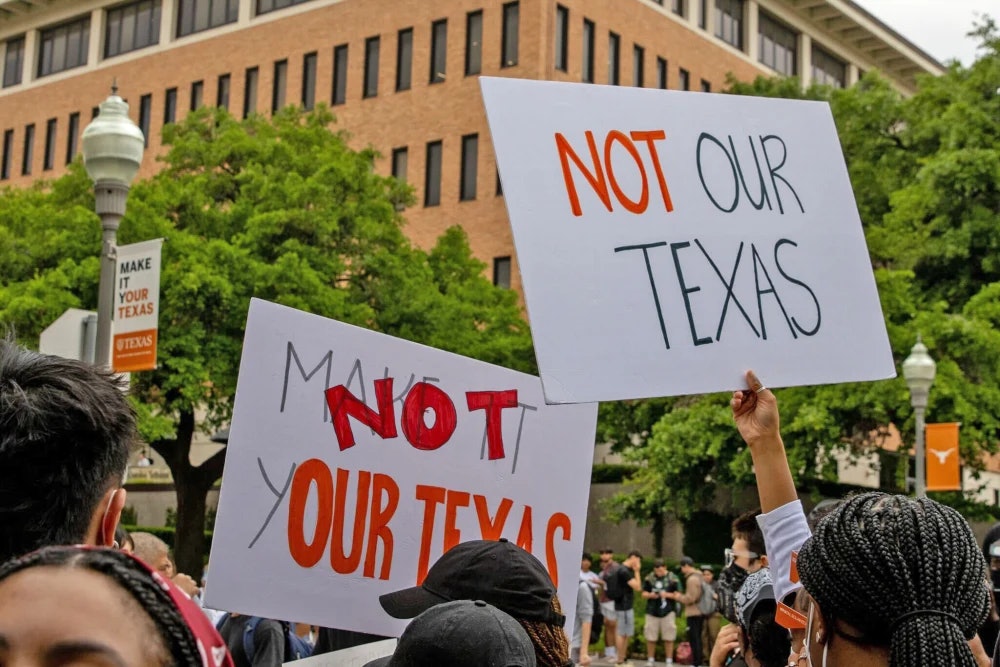
    A new policy brief from the University of Southern California reveals that six states—Texas, Missouri, Tennessee, Iowa, Oklahoma, and Indiana—have emerged as national leaders in efforts to dismantle diversity, equity, and inclusion (DEI) programs in higher education, with significant consequences for students and faculty of color.

    The report, “DEI Under Fire: Policy, Politics, and the Future of Campus Diversity,” released by USC’s Black Critical Policy Collective, analyzed legislative trends across all 50 states between August 2024 and July 2025. Researchers developed a composite scoring system based on bills introduced and laws passed, identifying states with the most aggressive anti-DEI activity.

    Texas topped the rankings with a composite score of 16, having introduced 10 bills and passed three laws restricting DEI efforts. Missouri followed with 15 bills introduced, though none passed into law. Tennessee, Iowa, Oklahoma, and Indiana rounded out the top six states, all scoring between 9 and 14 on the composite scale.

    As of July 2025, 14 states have passed a total of 20 anti-DEI laws, up from 12 states with 14 laws when data collection began in December 2024. These laws typically target four main areas: elimination of DEI offices and staff, bans on mandatory diversity training, prohibitions on diversity statements in hiring, and restrictions on identity-based preferences in admissions and employment.

    “Diversity, equity, and inclusion are not peripheral ideals. They are institutional functions—woven into the operational, cultural, and legal architecture of colleges and universities,” wrote Dr. Kendrick B. Davis, series editor for the Critical Policy Collective, in the report’s introduction. “When those functions are restricted or removed, the effects are material.”

    The institutional responses have been swift and substantial. At the University of Texas System, at least 49 DEI-related employees were terminated following the passage of three bills in 2023. The system shut down its Multicultural Engagement Center and Gender & Sexuality Center at UT-Austin and eliminated funding for student identity-based organizations and scholarships for undocumented students.

    In Iowa, following Senate File 2435’s passage in May 2024, the University of Iowa eliminated its Office of Inclusive Education and Strategic Initiatives and laid off 11 DEI-related staff members. The university also removed scholarships specifically aimed at racially minoritized students, redirecting funds to support low-income students more broadly. By October 2024, Iowa’s state universities had reallocated more than $2.1 million from DEI programs.

    Indiana University announced one of the most sweeping academic restructurings in its history, planning to suspend, eliminate, or consolidate at least 43 undergraduate programs, including African American and African Diaspora Studies, Gender Studies, and multiple language programs. The changes follow passage of Senate Bills 202 and 289, which banned DEI offices and prohibited diversity statements in hiring.

    Preliminary enrollment data following the 2023 Supreme Court decision in Students for Fair Admissions v. Harvard—which effectively ended race-conscious admissions—shows declining representation of students of color at several elite institutions. At Harvard Law School, Black student enrollment in 2024 dropped to 19 first-year students, down from 43 the previous year. MIT reported a 1% decrease in the proportion of Hispanic and Black students, while UNC-Chapel Hill experienced a 5% decrease in Black, Indigenous, and people of color students overall.

    “The ongoing attacks on DEI, manifested in policy restrictions forcing institutions to comply with race-evasive policies, have significant implications for racial and ethnic diversity, student access and success, and workforce development,” the report states.

    Research shows faculty diversity benefits all students by fostering critical thinking and better preparing graduates for diverse workforces. However, DEI rollbacks make it significantly more difficult to recruit faculty of color, as institutions are now restricted from considering race in hiring decisions—a limitation reinforced by the Harvard ruling.

    The report’s authors—Mya Haynes, Glenda Palacios Quejada, Shawntae Mitchum, and Alexia Oduro—note that even private institutions like Vanderbilt University have implemented similar changes despite not being subject to state laws, “reflecting broader anxieties within the private sector about maintaining—or being seen to maintain—equity-oriented infrastructure under political scrutiny.”

    Student activism has emerged in response to the restrictions. Iowa State University students organized rallies and petitions opposing the elimination of the DEI office and restructuring of the LGBTQIA+ Center. In Alabama, university professors and students filed a lawsuit challenging the state’s DEI ban, arguing it violates First Amendment rights.

    “What is one of the things that’s sometimes difficult to see is the level of coordination between states,” Davis said in an interview. “Texas, Oklahoma, Iowa, Indiana, Tennessee, and Missouri—they’re not just a random collection. They’re a coordinated collection of states that have made some formal, some informal decisions, but what is clear through the legislation is that they share a common goal in restricting access to anything that is culturally relevant or sensitive to racially and ethnically minoritized groups in this country.” 

    Davis noted that while federal actions have dominated recent headlines, states initiated the anti-DEI movement shortly after 2020.

    “We have to remember the states started this anti-DEI, anti-critical race theory movement shortly after 2020,” he explained. “This has been a long time in the making, and I think the current federal efforts are just complementary to what states had already been doing.” The report aims to help policymakers and practitioners “get through some of the noise” and track the escalating legislative activity across multiple states, Davis said.

    The report recommends that institutions embed DEI principles within broader student success initiatives, leverage private funding where public funding is restricted, and strengthen alliances among students, faculty, staff, and community organizations to advocate for institutional accountability.

    Missouri represents a notable exception in the analysis. Despite introducing 14 bills targeting DEI—more than any state except Texas—none have passed into law. The report attributes this to intense legislative gridlock, ideological conflicts within the Republican majority, and strong opposition from educational institutions and community organizations. However, the 2025 legislative session has seen renewed efforts to advance anti-DEI policies.

    The researchers emphasize that the policy shifts carry particular consequences for Black, Latino, and Indigenous communities, who are losing access to culturally affirming resources, mentorship opportunities, and financial aid programs specifically designed to address historical inequities in higher education access.

    “If access is conditional and inclusion retractable, higher education cannot claim to serve the public,” Davis wrote.

    The report represents the third in a series examining how equity is being withdrawn across the education pipeline.


    Source link

  • Dartmouth Joins Growing List of Elite Universities Rejecting White House Academic Compact

    Dartmouth Joins Growing List of Elite Universities Rejecting White House Academic Compact

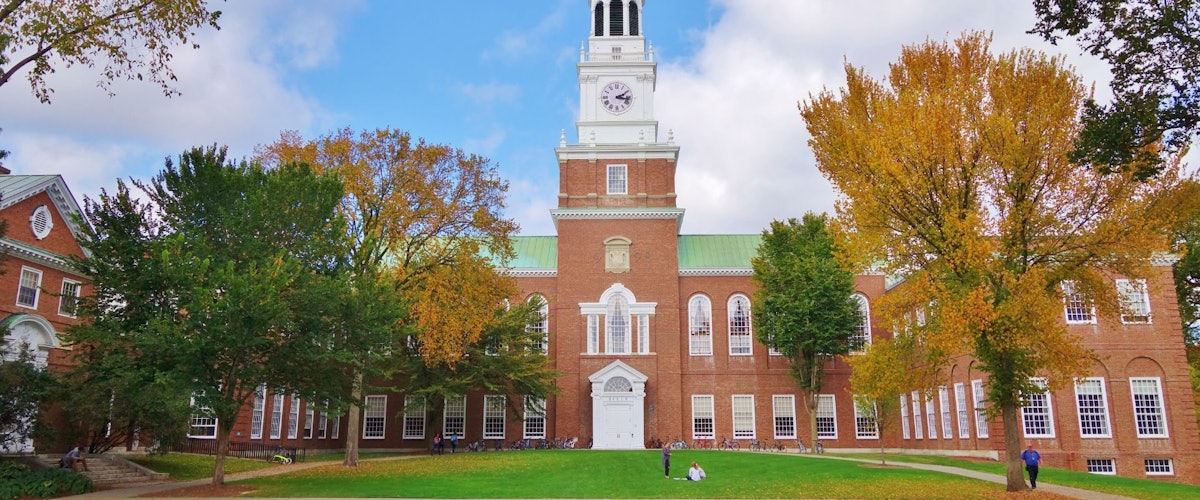
    Dartmouth CollegeFile photoDartmouth College has declined to sign the Trump administration’s “Compact for Academic Excellence in Higher Education,” becoming the latest prestigious institution to prioritize institutional autonomy over preferential federal funding access.

    In a statement released Saturday, Dartmouth President Dr. Sian Beilock firmly articulated the college’s position ahead of Monday’s deadline, emphasizing that governmental oversight—regardless of political affiliation—represents an inappropriate mechanism for directing the mission of America’s top research universities.

    “I do not believe that the involvement of the government through a compact—whether it is a Republican- or Democratic-led White House—is the right way to focus America’s leading colleges and universities on their teaching and research mission,” Beilock stated.

    The compact, extended to nine select institutions, promised enhanced access to federal research dollars in return for compliance with several administration policy mandates. These requirements included adopting the administration’s gender definitions for campus facilities and athletics, eliminating consideration of race, gender and various demographic factors from admissions decisions, and restricting international student enrollment.

    Despite rejecting the compact’s terms, Beilock expressed openness to dialogue, indicating her willingness to explore how to strengthen the traditional federal-university research partnership while maintaining higher education’s focus on academic excellence.

    The decision followed significant campus pressure, with nearly 500 Dartmouth faculty members and graduate students signing a petition advocating for rejection, according to the Valley News.

    In her statement, Beilock emphasized the fundamental principle at stake: “Universities have a responsibility to set our own academic and institutional policies, guided by our mission and values, our commitment to free expression, and our obligations under the law.”

    She framed institutional independence as essential to rebuilding public confidence across political lines and preserving American higher education’s global preeminence.

    Dartmouth’s decision aligns with rejections announced last week by peer institutions including the Massachusetts Institute of Technology, Brown University, the University of Pennsylvania and the University of Southern California, suggesting a coordinated defense of academic autonomy among elite research universities.

    Source link