Social media is a front door for student outreach.
Let us be honest: College planning is not just about campus tours and glossy brochures anymore. These days, it is about late-night scrolling. It is about finding your future in a 15-second TikTok or watching a day-in-the-life dorm vlog on YouTube, possibly squeezed between a skateboarding dog and a viral dance challenge. And let us admit it, none of this is mindless. Students make real decisions right there in the middle of the scroll, about where they belong, who they want to be, and what opportunities are out there (Astleitner & Schlick, 2025).
That is the story the 2025 E-Expectations Trend Report tells us. Social media is not a bonus channel for student outreach; it is the front door. In fact, 63% of students are on Instagram, but only 53% see college content there. That is a missed opportunity (RNL, Halda, & Modern Campus, 2025). Here is the twist: Colleges know social is powerful, too. The 2025 Marketing and Recruitment Practices Report for Undergraduate Students shows that enrollment teams rank social media, retargeted, and video ads among their most effective digital tactics. Still, when it comes time to pull out their wallets, colleges spend most of their spending on Instagram and Facebook, while TikTok and YouTube, where teenagers spend much of their time, are left underused (RNL, 2025).
Social media is where the search begins
The E-Expectations data shows that for 56% students, social media matters most when they start thinking about college. Before they ever request information or take a tour, they are watching you. They are searching for clues, hints, and maybe a sign that this could be their future home.
We know they are asking themselves:
“Could I see myself there?”
“Do these students look like me?”
“Would I fit in?”
This lines up with findings from the Pew Research Center (2024), which reports that over 90% of teenagers use social media every day, and platforms like Instagram and TikTok are where they are most active. More importantly, teenagers rely on these platforms for support in decision-making, including school decisions (American Student Assistance, 2021).
For first-generation and underrepresented students, that early scroll matters even more. Social media often serves as their first “window in,” a way to explore campus life and build confidence before they ever reach out (Wohn, Ellison, Khan, Fewins-Bliss, & Gray, 2013; Brown, Pyle, & Ellison, 2022). Maybe they are wondering if the dining hall food is as good as those Instagram stories claim, or if the students in the videos hang out together.
Your social media should say:
“We see you. We want you to feel welcome before you even set foot on campus.”
Yet, the 2025 Marketing Practices Report suggests that many institutions lead with brand identity campaigns, polished facilities videos, or rankings rather than authentic student stories that help them feel like they belong (RNL, 2025). Students are looking for belonging; colleges are still showing off prestige. That gap is where connections can get lost.
What makes students follow?
The E-Expectations data makes one thing clear: Students want more than glossy photos. They want real, raw, relevant content that speaks to their life and dreams.
37% follow colleges for student life content.
31% want “the lowdown” on how to apply.
30% are all about content in their major
That desire for honesty is backed up by research: High school students value user-generated content for authenticity but still expect official accounts to provide reliable information. The sweet spot is when both work together (Karadağ, Tosun, & Ayan, 2024). Emotional validation from peers does not just spark a like; it deepens their sense of connection (Brandão & Ramos, 2024). In other words, students are not just following but searching for a place where they feel understood.
Not just where, but when
The E-Expectations data details a crucial truth: Social media matters most when students start college planning. More than half (56%) are scrolling and watching before picking up a brochure or visiting a website. After that, social media’s influence drops steadily as they move through applications, visits, and acceptance. By the time they are accepted, only 21% say social media still plays a significant role (RNL, 2025).
The Marketing Practices Report, however, shows that many colleges still dial up their social spend around yield campaigns (RNL, 2025). That timing mismatch means institutions may miss the critical “imagination phase” when students decide if a school even makes their list. We want to meet them at the beginning, not just at the finish line.
Other research backs this up: Universities with consistent, active presences across platforms are far more likely to stay on students’ minds (Capriotti, Oliveira, & Carretón, 2024), and aligning posts with algorithmic sequencing ensures they see the content when it matters (Cingillioglu, Gal, & Prokhorov, 2024). We want to make sure we are in their feed when they need us the most, not just when institutions need them.
Human connections start with digital ones
Behind every follow, like, and story tap is a student looking for an exciting and safe future. Research on elite universities shows the highest engagement comes from Instagram content that blends professionalism with authenticity (Bonilla Quijada, Perea Muñoz, Corrons, & Olmo-Arriaga, 2022). Prospective students use social media to assess fit, culture, and belonging in admissions (Jones, 2023).
When we lean into authentic stories on students’ platforms, we can transform social media from a megaphone into a welcome mat. The 2025 Marketing and Recruitment Practices Report shows that social ads are effective, but they work best when they align with the raw, real, and relevant content students say draws them in (RNL, 2025).
This is what we should be doing
Institutions should aim to do more than hope students do not scroll past. Encourage exploration, curiosity, and the search for stories that sound like their own. Teenagers are not interested in polished perfection alone; they are looking for something real that feels possible for them.
You, as institutions, need to show up where students are. Meet them in their late-night scroll, not just in a campus brochure. Answer their questions about laundry machines and dining hall mysteries, as well as the questions about belonging and opportunity. When you share genuine stories and welcome every curiosity, no matter how unusual, you help students see themselves on your campuses.
Our collective mission goes beyond applications and acceptance rates. We want students to find their people, place, and purpose. We care about more than numbers; we care about each student’s journey. Let us help them write the next chapter, not just enroll for the next semester.
Be the reason a student stops scrolling and starts imagining a future with you!
Students are already scrolling. The question is: Will they stop on your story? Get the data, benchmarks, and practical recommendations in the 2025 E-Expectations Report. The late-night scroll is real. Let’s make sure students find you there! Explore the 2025 E-Expectations Report for practical strategies to build authentic, high-impact connections with prospective students.
Talk with our marketing and recruitment experts
RNL works with colleges and universities across the country to ensure their marketing and recruitment efforts are optimized and aligned with how student search for colleges. Reach out today for a complimentary consultation to discuss:
When Starr Dixon heard the Trump administration was floating a proposal last spring to eliminate Head Start, the 27-year-old parent in rural Michigan cried for a week.
The free, federally funded early learning program has been life-changing for her and her young daughter, she said. It provided stability after Dixon, who lives about 100 miles north of Lansing, left a yearslong abusive relationship.
While her 3-year-old daughter has blossomed socially, emotionally and verbally in the program during the last year and a half, Dixon has taken on numerous volunteer positions with Head Start, gaining experience that she can put on her resume after a 7-year gap in employment. She hopes to ultimately apply for a job at Head Start.
“It has just completely transformed my life,” she said.
This year, I talked to people in communities across rural America and learned how Head Start is essential in places where there are few other child care options. Head Start also provides an economic boost for these areas and serves as direct support for parents, many of whom go on to volunteer for or get jobs at their local programs.
Related: Young children have unique needs and providing the right care can be a challenge. Our free early childhood education newsletter tracks the issues.
Though my reporting focused on western Ohio, parents in other parts of the country, like Dixon, shared similar stories with me about how critical Head Start is to their lives. But since January, the Trump administration has taken what some call a “death by a thousand cuts” approach to the program, firing federal staff, closing regional offices and offering no increase in spending on Head Start in budget proposals.
All those moves have caused chaos and upheaval. In Alabama, Jennifer Carroll, who oversees 39 Head Start sites run by the Community Action Partnership of North Alabama, told me she is reassuring the families she works with that her program’s funding is stable for at least the rest of the year. Carroll fears that if parents think Head Start funding is in jeopardy, they’ll pull their children out of the program, disrupting their learning.
Another example: Keri Newman Allred is the executive director of Rural Utah Child Development Head Start, which operates Head Start programs spread across 17,000 square miles in central and east Utah. Newman Allred estimates her programs, which employ 91 residents and serve 317 children, can survive for one more year. After that, without more money, they will have to make cuts to the program if they want to give teachers a raise to meet inflation.
While other Head Start programs can supplement operations with private donations, Newman Allred’s programs serve some of the most sparsely populated parts of America, known as “frontier counties,” where there are no deep-pocketed philanthropies. Her programs rely solely on federal funding.
In April, the Department of Government Efficiency, or DOGE, abruptly shuttered five of Head Start’s 10 regional offices. Programs in Maine that were without directors or that needed assistance with regulations, finances or federal requirements have been left to go it alone without consistent, daily support.
“The closure of regional offices has all but crippled programs,” said Sue Powers, senior director of strategic initiatives at the Aroostook County Action Program in the rural, northernmost tip of Maine. “No one’s checking in. When you’re operating in a program that is literally in crisis, and you need [regional staff] and do not have them, it’s more than alarming.”
This story about Head Start was produced by The Hechinger Report, a nonprofit, independent news organization focused on inequality and innovation in education. Sign up for the Hechinger newsletter.
The Hechinger Report provides in-depth, fact-based, unbiased reporting on education that is free to all readers. But that doesn’t mean it’s free to produce. Our work keeps educators and the public informed about pressing issues at schools and on campuses throughout the country. We tell the whole story, even when the details are inconvenient. Help us keep doing that.
Prospective students no longer make decisions based on glossy brochures or carefully scripted marketing campaigns. They want real stories from real people, and they want to picture themselves as part of campus life before they ever set foot on it. That’s why student ambassadors have become indispensable.
A student ambassador is more than a tour guide or spokesperson – they’re the authentic voice of your institution: a current student or recent graduate who shares lived experiences, highlights your community, and gives prospective students a glimpse of what life is really like. By acting as both storyteller and guide, ambassadors help institutions build trust at a time when trust is critical.
This article explores who student ambassadors are, what they actually do, and why creating a program can give your institution a competitive edge. We’ll also cover how to select the right ambassadors, highlight the qualities that make them effective, and provide examples of schools that have successfully built and implemented programs.
Struggling to stand out in a crowded market?
Boost enrollment with digital student ambassador strategies!
What Is a Student Ambassador Program?
A student ambassador program is a structured initiative where carefully selected students serve as official representatives of their school. These ambassadors, whether current students or recent alumni, act as the institution’s authentic storytellers, sharing first-hand experiences with prospective students, parents, alumni, and the wider community.
At its core, the program creates a bridge between the school and its audiences. Ambassadors embody the institution’s values and culture, providing insights that go far beyond brochures or websites. They might guide campus tours, host Q&A sessions, or showcase their daily life through social media takeovers. In every interaction, they give others a genuine window into what it’s like to be part of the community.
The structure of these programs can vary, but most are run through admissions or marketing departments. Some rely on volunteers, while others pay ambassadors through work-study arrangements. Training is usually provided, ensuring ambassadors are prepared to represent the school across recruitment events, digital campaigns, and peer-to-peer outreach.
The benefits are mutual. Institutions gain trusted, relatable voices that enhance visibility and build trust with future students. Meanwhile, ambassadors themselves develop leadership, communication, and professional skills that strengthen their résumés. Done well, these programs turn students into a school’s most powerful advocates.
Roles and Responsibilities of Student Ambassadors
So, what exactly do student ambassadors do? The short answer: a lot. They wear many hats, all focused on building connections and giving prospective students an authentic glimpse into campus life. Let’s break down their core responsibilities.
Welcoming Campus Hosts
Ambassadors lead tours, host orientation sessions, and share personal stories that bring campus life to life. Whether guiding a group across campus or welcoming students on a shadow day, they create a sense of belonging from the very first interaction.
Outreach and Q&A
Ambassadors are often the friendly voices behind follow-up calls, emails, or DMs. They answer questions about academics, housing, or student life, providing honest, peer-to-peer advice that builds trust.
Event Support
From open houses to admitted student days, ambassadors are the student face of recruitment events. They staff tables, join panels, and even help run virtual sessions, adding energy and relatability that administrators alone can’t replicate.
Content Creation and Promotion
Many student ambassador programs now include a digital storytelling component. Ambassadors create Instagram takeovers, vlogs, blogs, or TikTok snippets that showcase “a day in the life” through authentic eyes. This user-generated content is gold. It resonates far more than polished marketing materials.
Peer Mentorship
Beyond recruitment, ambassadors often mentor new students, particularly freshmen or international students. They answer questions, point peers toward resources, and serve as friendly guides who help boost retention and ease the transition into campus life.
Liaisons with Administration
Ambassadors also act as bridges between students and staff. They communicate common concerns to the administration and relay updates back to peers, fostering two-way communication and trust.
At their core, student ambassadors represent and connect. They don’t just speak about the institution, they embody it. Every tour they lead, message they send, or video they post becomes a living example of the school’s values in action.
Students want to see themselves in your school’s story.Ambassadors make that possible. They provide the human touch that no brochure or website ever could, turning curiosity into connection, and connection into enrolment.
Qualities of an Effective Student Ambassador
Not every student is the right fit for the ambassador role. Schools need to carefully select students who can represent their institution with authenticity and professionalism. So, what qualities set great student ambassadors apart?
Strong Communication Skills: Effective ambassadors are clear, confident communicators. Whether chatting one-on-one with a nervous high schooler or speaking to a room of parents, they know how to connect. Online, their warmth and clarity shine through in emails, chats, or social media posts.
Positivity and Enthusiasm: The best ambassadors radiate genuine excitement about their school. Their positivity is contagious, making visitors feel welcome and leaving a memorable impression.
Leadership and Initiative: Great ambassadors don’t wait to be told what to do. Whether it’s helping a lost visitor or jumping into an online Q&A, they show reliability and initiative.
Inclusivity and Empathy: Ambassadors ensure everyone feels valued. They’re sensitive to cultural differences, welcoming to all, and empathetic toward students navigating the uncertainty of big transitions.
Professionalism: Even as students, ambassadors understand they represent the school’s brand. They arrive prepared, dress appropriately, and conduct themselves with courtesy, on campus and online.
Knowledgeable and Resourceful: Ambassadors know the school’s programs, services, and traditions. And if they don’t know an answer, they know how to find it quickly.
Digital Fluency: Today’s ambassadors are digital natives. They’re comfortable creating TikToks, hosting webinars, or managing Instagram takeovers. Their ability to adapt to new platforms is a vital asset.
When these qualities come together, communication, enthusiasm, leadership, empathy, professionalism, knowledge, and tech skills, you get a true embodiment of the school’s values, someone who can make every interaction personal and every prospective student feel like they belong.
Why Student Ambassadors Are Important (Benefits for Your Institution)
Why should your institution invest in a student ambassador program? The answer is simple: ambassadors are one of the most effective ways to bring authenticity, engagement, and trust into your recruitment and marketing efforts. Let’s break down the key benefits.
Authenticity in Marketing
Prospective students are savvy. They don’t just want glossy brochures; they want honest voices. Student ambassadors bring that authenticity by sharing real stories, challenges, and triumphs. Their perspective humanizes your institution’s brand and makes every piece of content, whether a social media post or campus tour, more relatable and trustworthy.
Increased Engagement
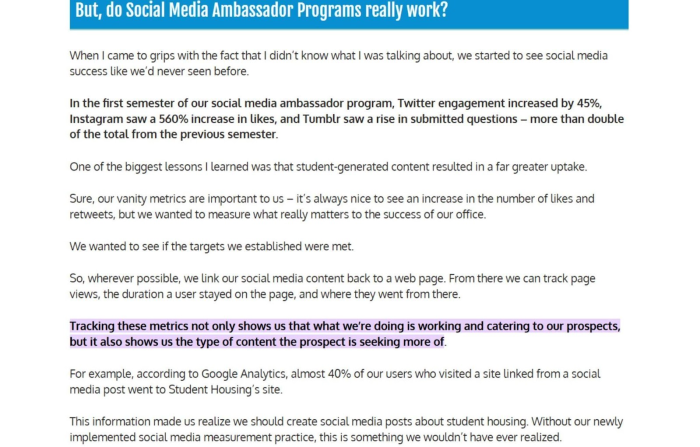
When prospects hear directly from peers, engagement skyrockets. A student-led social media post, blog, or Q&A session feels personal, not promotional. For example, the University of Guelph’s student ambassador program boosted digital interactions dramatically, with a 45% increase in Twitter engagement and a 560% surge in Instagram likes within one semester. That’s the power of peer-driven content.
Better Recruitment & Enrolment Outcomes
A personal connection can make the difference between “I’m interested” and “I’m applying.” Ambassadors help prospects imagine themselves on campus, creating bonds that admissions staff alone can’t replicate. Schools like John Cabot University in Rome showcase ambassadors prominently in their recruitment strategy, even encouraging prospective students to contact ambassadors directly. That accessibility fosters trust and can translate into higher application and enrolment rates.
Stronger Community & Retention
Ambassadors bring new students and help keep them. By welcoming newcomers, offering guidance, and serving as peer mentors, ambassadors ease the transition to college life. At Bishop O’Dowd High School in California, nearly 400 student ambassadors reshaped the campus environment, creating what leaders called “a culture of positivity and engagement.” Programs like this build pride, morale, and stronger student retention.
Expanded Reach (Especially Online)
Your admissions team can’t be everywhere at once, but ambassadors can extend your reach digitally. From Instagram takeovers to late-night chats with international prospects, ambassadors provide real-time, student-to-student communication across time zones. They also bring the institution into spaces where prospects already spend time, such as YouTube, TikTok, and Discord, ensuring no question goes unanswered.
Leadership Development (A Two-Way Benefit)
It’s not just the institution that benefits. Ambassadors gain professional skills in leadership, communication, and digital engagement. Many list the role on resumes, use it to network with alumni, and carry their ambassador pride into their alumni years. That growth feeds back into your institution: the more empowered the ambassadors feel, the stronger advocates they become during and after their studies.
More than just friendly faces, student ambassadors are powerful storytellers, culture shapers, and recruitment catalysts. They infuse authenticity into marketing, build personal bridges with prospects, enrich campus life, and extend your institution’s digital footprint. In the higher ed landscape, their influence can be the deciding factor in whether a prospect chooses your school.
How to Build a Successful Student Ambassador Program
So you’re ready to launch a student ambassador program. Where do you start? Building a program that feels authentic, sustainable, and effective requires more than just asking a few enthusiastic students to help at open houses. It needs strategy, structure, and a focus on both institutional goals and student development. Here’s a roadmap to help you design a program that works.
1. Define Clear Objectives
Before recruiting a single ambassador, clarify why your program exists.
Is your priority to boost applications?
Do you want to increase engagement at open houses and virtual events?
Or is the goal to expand your reach internationally?
Your objectives shape everything else, from who you recruit to the channels you emphasize. For example, if international recruitment is a focus, it makes sense to involve multilingual students or those who’ve studied abroad.
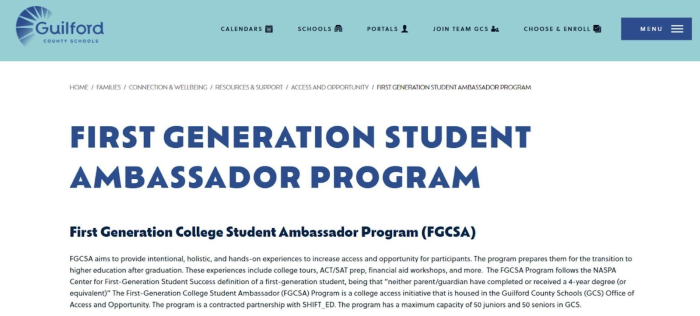
Example: The First Generation College Student Ambassador Program in Guilford County Schools was launched with a specific objective: to increase access to college for first-generation students. The program “aims to provide intentional, holistic, and hands-on experiences to increase access and opportunity” for participants and prepares them for the transition to higher education. By explicitly stating this purpose, the district kept the program focused, offering college tours, SAT/ACT prep, and workshops, all designed to meet the clear goal of empowering first-gen students to succeed after graduation.
Not every student is ambassador material. Create eligibility guidelines that reflect the qualities you need.
Look for:
Strong communication and interpersonal skills
Academic reliability (solid GPA)
Active involvement in campus life
A positive, professional online presence
Diversity matters, too. Aim for a team that represents different programs, backgrounds, and perspectives so prospective students can connect with someone who reflects their own journey.
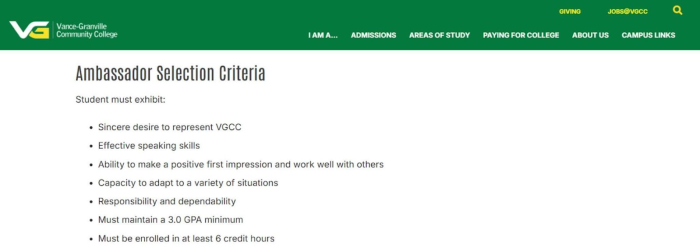
Example:Vance-Granville Community College (NC): VGCC’s Student Ambassador Leadership Program sets strict selection criteria to ensure ambassadors have the right qualities. Applicants must “maintain a 3.0 GPA minimum” and be enrolled half-time, and they are evaluated on attributes like effective speaking skills, a positive first impression, adaptability, responsibility, and dependability. By codifying these requirements, VGCC attracts top student leaders who are academically solid and genuinely motivated to represent the college.
Treat ambassador recruitment like a competitive job search.
Ask for an application form where students share why they want the role.
Request a short essay, or even better, a one-minute video to showcase personality and enthusiasm.
Review their social media presence; as they’ll likely use it in the role.
Conduct interviews or group activities to evaluate how they interact under pressure.
The mix of application, interview, and review helps you select students who are genuinely passionate and prepared to represent your school.
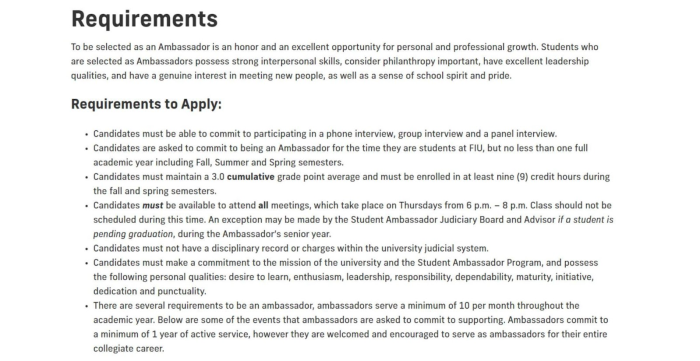
Example: Florida International University:FIU treats ambassador recruitment like a job hiring process, requiring candidates to go through multiple interview stages. Prospective FIU Student Ambassadors must “commit to participating in a phone interview, group interview, and a panel interview” as part of the application. Only students who successfully navigate all rounds and meet other requirements (e.g., 3.0 GPA, full-year commitment) are selected.
Provide ambassadors with FAQ sheets on admissions, housing, or financial aid so they feel confident answering questions. Assign a staff coordinator as a mentor and check in regularly. Occasional refresher sessions help keep everyone sharp.
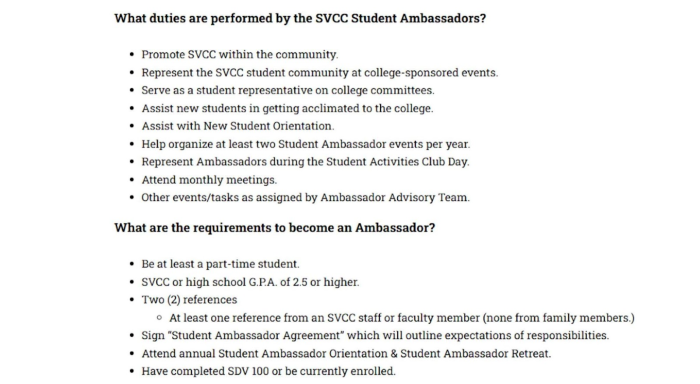
Example: Southside Virginia Community College: SVCC invests in training and team development for its ambassadors by mandating an orientation and an annual retreat. All new ambassadors must “attend annual Student Ambassador Orientation & Student Ambassador Retreat” and participate in monthly meetings. During these sessions, students receive guidance in public speaking, event hosting, and campus knowledge. The retreat, in particular, serves as both training and bonding – a dedicated time to build skills and camaraderie. Ongoing support from staff advisors (assigned at each campus) further ensures ambassadors have mentorship throughout the year.
Clarity is essential. Outline exactly what ambassadors will do and how often.
Examples include:
Weekly or monthly campus tours
Required participation in a set number of events per semester
Social media contributions (Instagram stories, blog posts, TikTok takeovers)
Optional extras like mentoring first-year or international students
Compensation can be financial (work-study wages or stipends) or perks like free merch, event tickets, or professional development opportunities. Make sure the role feels rewarding and achievable alongside academics.
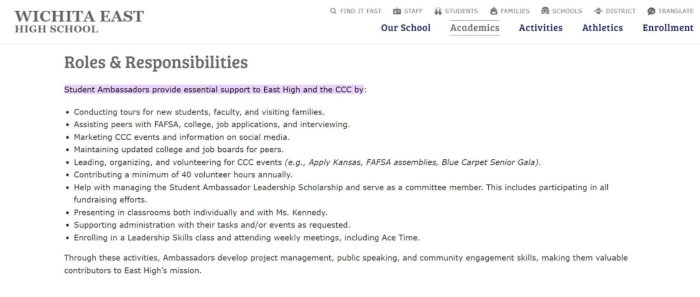
Example: Wichita East High School: East High’s ambassadors operate under a clear set of responsibilities and expectations. According to the program description, ambassadors lead campus tours for new students and visitors, assist peers with college and job applications (including FAFSA help), promote school events on social media, maintain information boards, and volunteer at key events like college fairs. They are required to contribute a minimum of 40 volunteer hours annually in these activities. Ambassadors must also uphold school conduct standards and serve as role models.
A successful ambassador program is also a community. Encourage bonding through:
Regular team meetings
Social gatherings or retreats
Recognition events or ambassador spotlights
A strong sense of camaraderie boosts morale and translates into better representation at events.
Example: The College Preparatory School: At College Prep, fostering community is central to the ambassador program. The school’s Admission Ambassadors represent a student body of 370, where connection, curiosity, and collaboration are defining values. Each ambassador profile highlights not only individual strengths but also the shared culture of independence, kindness, and deep relationships that tie the community together. By spotlighting ambassadors’ personal stories and the values they embody, College Prep nurtures a sense of team identity that extends beyond recruitment events. This approach creates cohesion among ambassadors themselves while reflecting the school’s wider commitment to inclusivity and connection, ensuring the program is both a showcase and a unifying force for the entire student body.
Think beyond tours and open houses. Ambassadors can be powerful storytellers for your brand.
Invite them to contribute blogs, vlogs, or Q&As for your website.
Run student social media takeovers for a “day in the life” view.
Feature ambassadors in recruitment videos or email campaigns.
Have them moderate online communities for admitted students, such as Facebook or Discord groups.
Encouraging ambassadors to share personal milestones, like landing an internship or study abroad experience, also strengthens your brand with authentic proof points.
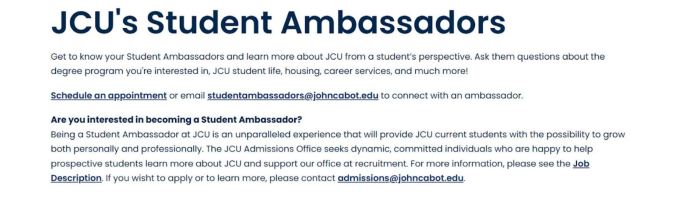
Example: John Cabot University: JCU has woven student ambassadors directly into its admissions and marketing communications. The university’s website features a “Meet Your Student Ambassadors” page with profiles of current students (including photos, majors, hometowns, and personal stories) and actively invites prospects to connect with them. Interested students can schedule a one-on-one video call via Calendly or send an email to reach a JCU ambassador. This approach makes ambassadors a front-line part of marketing – essentially living testimonials that lend authenticity. JCU ambassadors also create content: they share their experiences through blogs and social media takeovers, giving an inside look at life in Rome.
Don’t let your program run on autopilot. Measure its impact and adjust.
Ask prospective students if ambassador interactions influenced their decision.
Gather feedback from ambassadors about training, workload, and support.
Monitor metrics: event attendance, social media engagement, and application trends.
If you notice gaps, like not enough STEM majors on your team or weak performance at virtual events, adapt accordingly. A good ambassador program evolves with your institution’s needs and with changes in student behavior.
Example: University of Guelph:Guelph’s social media ambassador initiative shows the importance of measuring impact and iterating. After launching the program, Guelph didn’t just celebrate a surge in likes and follows – they dug into analytics to see what prospective students cared about. For example, by tracking which web pages prospects visited via ambassadors’ posts, the admissions team discovered an unexpectedly high interest in student housing information. With that insight, they adjusted their content strategy: ambassadors began creating more posts about dorm life and residence tours.
When structured thoughtfully, a student ambassador program becomes a win-win. Prospective students see a genuine, welcoming face of your institution. Current students gain leadership skills and professional growth. And your institution benefits from more authentic marketing, stronger recruitment outcomes, and an energized campus culture.
It’s more than a marketing tactic; it’s an investment in your community. Build it right, and your ambassadors will become some of your strongest advocates, now and well into their alumni years.
Turning Students Into Your Strongest Advocates
Student ambassador programs are far more than a recruitment tool. They are a way to put authentic student voices at the heart of your institution’s story. Ambassadors connect with prospects in ways no brochure or campaign ever could, offering real-life perspectives that build trust and spark genuine interest.
For institutions, the benefits are clear: more authentic marketing, stronger engagement, improved recruitment outcomes, and a livelier campus community. For students, it’s a chance to develop leadership, communication, and professional skills while giving back to the school they love.
The key is to be intentional. Define your goals, select the right ambassadors, support them with training, and continually refine the program. Done well, an ambassador initiative can become one of your institution’s most impactful long-term assets. Creating student advocates who not only help today’s prospects but remain champions of your brand long after graduation.
Struggling to stand out in a crowded market?
Boost enrollment with digital student ambassador strategies!
Frequently Asked Questions
Question: What is a student ambassador program?
Answer: A student ambassador program is a structured initiative where carefully selected students serve as official representatives of their school. These ambassadors, whether current students or recent alumni, act as the institution’s authentic storytellers, sharing first-hand experiences with prospective students, parents, alumni, and the wider community.
Question: What is the role of a student ambassador?
Answer: The short answer: a lot. They wear many hats, all focused on building connections and giving prospective students an authentic glimpse into campus life.
Question: What qualities does a student ambassador have?
Answer: A student ambassador has strong communication skills, enthusiasm, leadership, inclusivity, professionalism, knowledge of their institution, resourcefulness, and digital fluency, allowing them to authentically represent their school and connect meaningfully with prospective students.
Last year, FIRE launched the Free Speech Dispatch, a regular series covering new and continuing censorship trends and challenges around the world. Our goal is to help readers better understand the global context of free expression. Want to make sure you don’t miss an update? Sign up for our newsletter.
Quebec secularism minister may ‘strengthen secularism’ by banning public prayer
There doesn’t need to be a tension between secularism, free expression, and freedom of religion. Governments should ensure people are neither forced to adopt, nor abandon, religious views at the whims of the state. But Quebec is pursuing a different route, with the province’s Secularism Minister’s repeat public promises to ban public prayer.
The details of Jean-François Roberge’s planned legislation are not yet available but he has cited his “mandate to strengthen secularism” as a reason he’ll be introducing a bill to ban prayer in public places this fall. Roberge’s commitment follows earlier comments from Premier François Legault that “[w]hen we want to pray, we go to a church, we go to a mosque, but not in public places.” Legault also specifically mentioned Islamic prayer as a target.
Alarming new legislation in Canada, worsening repression in Hong Kong, and online global takedowns emerging from India
Alarming new legislation in Canada, worsening repression in Hong Kong, and online global takedowns emerging from India.
Enforcing neutral limits on public activity to ensure traffic isn’t disrupted, for example, would be one thing. But public comments by Quebec officials thus far have suggested this effort to enforce secularism in public spaces will be much broader and limit what religious expression can be conveyed outside the confines of houses of worship.
There’s other free speech news out of Canada, too. At Techdirt, Mike Masnick reports that on the other side of the country, the British Columbia Civil Resolution Tribunal issued a troubling $72,000 fine against X because it geo-blocked, rather than globally blocked, non-consensual intimate images the tribunal ordered to be taken down. As Masnick points out, it’s part of a growing broader challenge on the global internet where courts and officials are ordering extra-terroritorial takedowns — can one country censor the internet for everyone? As FIRE wrote about last year, Australia’s eSafety commissioner made a similar attempt to globally remove a video on X of a man stabbing a bishop.
And Kneecap, the Irish rap trio that’s faced controversy and even police investigation in the UK for band members’ speech about Israel, Hamas, and Hezbollah, has been banned from entering Canada. Parliamentary Secretary for Combating Crime Vince Gasparro cited their “hate speech” and “glorification of terrorism” that “are contrary to Canadian values and laws” as the reason.
Latest from the UK: Graham Linehan, Palestine Action, and Epstein projection arrests during Trump’s visit
It seems the UK’s free speech woes are making headlines every week, but that was especially true with the arrest of Graham Linehan, who was detained by five officers when he arrived in Heathrow Airport from Arizona earlier this month. Linehan was arrested for a series of posts on X, including one where he said if “a trans-identified male is in a female only space…call the cops, and if all else fails, punch him in the balls.” As my colleague Jacob Mchangama explained about the arrest, “a provocative tweet from more than four months ago suggesting that someone ‘punch’ others in a hypothetical situation does not meet any meaningful threshold of incitement (imminent or not).”
Public attention on the UK’s average of 30 arrests a day for online expression may be hitting its mark. Home Secretary Shabana Mahmood said in comments in the Commons that “there is a line between content that is offensive, rude, ill-mannered, and incitement to violence, incitement to hatred.” She added that “it is important that we police that line between these types of comments effectively, so that everybody in this country can have confidence in our policing system, but also confidence in exercising their rights under the law of our land.” Her words follow remarks from Met Police Commissioner Sir Mark Rowley, who said “I don’t believe we should be policing toxic culture wars debates and officers are currently in an impossible position.”
The mass arrests of protesters who “express support” — to be clear, just through words — for banned group Palestine Action continue full steam ahead. In one weekend this month, police arrested over 400 protesters, some of whom were taken in just for holding signs reading, “I oppose genocide. I support Palestine Action.” Protest organizers were also charged.
President Trump, fresh off threatening to set the U.S. Department of Justice on people who engage in so-called “hate speech” against him, was at the center of some speech controversies during his visit to the UK last week. First, four activists were arrested after projecting, without permission, images of Donald Trump and Jeffrey Epstein onto Windsor Castle. The statute under which they were arrested should certainly raise eyebrows. They were taken in for suspicion of “malicious communications,” which targets “indecent or grossly offensive” messages intended to “cause distress or anxiety to the recipient.” Similarly, activists cried foul when police stopped them from driving an advertising van featuring images of Trump and Epstein through Windsor, where the president was staying.
Blasphemy news: Nigerian mob executes alleged offender, and Moroccan feminist found guilty
As I write about regularly at the Free Speech Dispatch, blasphemy is not only still a criminal act in dozens of countries, but an offense for which the allegation alone can sometimes result in a public killing — no judge, no jury, just executioners. So was the case in Nigeria weeks ago when a mob executed a woman by burning her to death after she was accused of blaspheming against the Prophet Muhammad. The victim, a food vendor, was accused of making a blasphemous remark after “a man jokingly proposed marriage” to her.
And Moroccan feminist Ibtissam Lachgar, whose arrest I discussed in the last Dispatch, was found guilty and sentenced to two and a half years in prison, along with a $5,000 fine, for blasphemy after posting a photo of herself wearing a shirt with the message, “Allah is Lesbian.”
Chinese mining company weaponizes cybercrime law against Sierra Leone journalist
Chinese-owned mining company Leone Rock Metal Group filed a complaint with Sierra Leone’s Criminal Investigation Department against editor Thomas Dixon after he published an investigation alleging labor violations at the company. Dixon was detained and interrogated for hours on charges of “cyberbullying and stalking.” He also says the company “offered to drop its complaint if he agreed never to report on the company again—a condition he flatly rejected.” Another journalist was detained on similar charges just after Dixon was released on bail.
China’s censorship goes global — from secret police stations to video games
2025 is off to a repressive start, from secret police stations in New York to persecution in Russia, Kenya, and more.
Singapore’s Home Affairs and Law Minister Kasiviswanathan Shanmugam, who is and also coordinating minister for National Security, and Manpower Minister Tan See Leng are suing Online Citizen editor Terry Xu — and attempting to get a court in Taiwan, where Xu lives, to intervene. They’re suing over Xu’s reporting on Singapore’s luxury property market.
India’s Supreme Court ordered content creators to apologize for mocking disabilities in their online content. “Influencers commercialise speech. When a speech falls in the ambit of commercial or prohibitive categories, the immunity under right to free speech is not available,” the justices said.
Cambodia’s National Assembly unanimously passed legislation allowing those who “collude” with foreign forces or are involved in “destruction of sovereignty, territorial integrity and national security” to be stripped of citizenship. Rights groups said it “will have a disastrously chilling effect on the freedom of speech of all Cambodian citizens.”
American comedian Sammy Obeid is alleging that shows he planned to hold in Singapore were canceled because the Infocomm Media Development Authority wouldn’t issue him the permits over the content of his comedy. IMDA said it wouldn’t issue the permits because Obeid submitted them too late — but Obeid claims the delays were ultimately because of issues with his script discussing Israel in the show. And under the Protection from Online Falsehoods and Manipulation Act, Obeid has also been ordered to carry corrections to social media posts accusing Singapore of censorship over the incident.
The Chinese government has had a busy month of international art censorship. Weeks after successfully pressuring a Thai art gallery to censor an exhibit criticizing authoritarian governments, Chinese officials also pushed back against a Taiwanese art exhibit at the Republic of Kazakhstan’s Central State Museum. The day before the show was set to open “the museum abruptly announced that it would begin a one-month renovation.”
Bihar police arrested a 20-year-old man for using “abusive language” against Indian Prime Minister Narendra Modi at a political rally.
Hong Kong’s schools must now review details of activities held by all outside organizations and individuals, as well as the backgrounds of the organizers and guests, to ensure they “do not involve contents that endanger national security, nor promote political propaganda and improper values.”
Hong Kong, free speech, and what musing about sci-fi can teach us
Indonesian officers have arrested thousands of protesters in recent weeks who demonstrated against President Prabowo Subianto Djojohadikusumo’s policies. The protests broadened “when an armored police vehicle hit and killed a rideshare driver.”
Nepal is still reeling after mass protests in response to government corruption and unpopular policies, including a short-lived ban on social media platforms. Dozens were killed in the protests and the Prime Minister has since resigned and not been seen publicly.
The full and total silencing of women under the Taliban continues. Now, books written by women are banned from Afghanistan’s higher education system.
Punishment under Thailand’s ban on criticism or mockery of the royal family, lese-majeste, continues to crush political dissent in the country. People’s Party MP Chonthicha Jangrew was sentenced to two years and eight months for Facebook posts that “insulted the monarchy, incited social conflict and threatened national security.” Influencer Aniwat Prathumthin was given a suspended sentence for years old Facebook posts and, as part of her sentence, must complete community service on royal holidays. But there was some positive news: Anchan Preelert, a Thai woman who was sentenced to a shocking 43 years for lese-majeste in 2021, was pardoned and freed last month.
Powerful Israeli minister to cut funding for awards event over winning film’s content
Miki Zohar, Israel’s culture and sports minister, has promised to revoke funding for the Ophir Awards after “The Sea,” an “Arabic-language drama about a Palestinian boy from the West Bank who risks his life to go to the beach in Tel Aviv,” won the top prize. Zohar says the Ophir ceremony, for which film awards are voted on by the Israeli Academy of Film and Television, “spit in the face of Israeli citizens” and that “The Sea” portrays Israeli soldiers “in a defamatory and false way.”
It’s been a bad month for free speech, basically everywhere. But there is good news.
Egyptian-British writer and human rights activist Alaa Abd el-Fattah has been in prison in Egypt since 2019 for “spreading false news and harming Egypt’s national interest” after sharing a social media post about a prisoner’s death. But after years of campaigning from activists and his family — including his mother, who has undergone multiple hunger strikes — Abd el-Fattah will be freed after a pardon from Egyptian president Abdel Fattah al-Sisi.
Hiring and job searching are difficult in many industries, but among the most challenging is healthcare.
Healthcare jobs are specialized, and they generally tend to be highly competitive to get. Plus, salaries aren’t always listed, and some jobs posted may be fake. What’s more, most healthcare professionals are already working demanding roles so their time to search for a new job is limited.
Sheldon Arora saw a need — and the potential — for a better way to connect healthcare job seekers with employers.
That’s why Arora designed StaffDNAⓇ, a mobile app that helps facilitate filling healthcare roles, benefitting employers and job seekers alike.
Arora, the CEO of StaffDNA, realized early in his career that hiring was an inefficient process. As a tech entrepreneur, he started companies that helped solve the most challenging aspects of matching employees with the right role at the right time. The industry he noticed had the most inefficient hiring process and could benefit the most from the right technology was healthcare.
“We were looking for ways to make the hiring process in healthcare more efficient for a long time,” Arora said. “We saw that facilities needed on-demand access to healthcare professionals, and healthcare professionals needed more options and transparency in their job searches.”
The resource combines a self-service app with a search platform for various needs for healthcare in all professions, specialties, job types, and settings.
“We built a platform where job seekers and facility hiring managers could connect in real time, and we removed many layers and obstacles that stood in the way of connecting people looking to find the jobs they loved. We knew we wanted to improve the entire process, so we did just that,” said Arora, who launched the app about one month before the start of the COVID-19 pandemic, when healthcare jobs were needed most. Downloads skyrocketed.
How it works
“The StaffDNA marketplace is the only platform where all stakeholders in the hiring process, including hospitals, vendors, suppliers, and job seekers, can come together to address the healthcare staffing issue once and for all,” said Arora, adding that candidates can search, apply, and get hired all within the StaffDNA app. “We’re tying together all the participants in healthcare hiring and giving them the platform they need to efficiently get people hired in the right roles.”
In the StaffDNA app, all jobs, specialties, and locations, as well as job descriptions and compensation, are shown up front. “Everything they need can be found directly in the app, from employment in their area to facility details, and even the color of scrubs they’ll need to wear,” Arora noted. “We also give candidates the ability to customize pay packages based on housing and benefit needs so they can have a better idea of what their take-home pay will be.”
Helpful features
Two new features of the StaffDNA app — DNAVault™ and DNAInsights™ — make the app even more beneficial for job seekers and hiring professionals.
DNAVault allows anyone — job seekers, students, or professionals in any industry — to securely store sensitive documents, including licenses and credentials. The app makes it easy and convenient to keep these materials safely in one place, and applicants can send these items directly to their employer, school, or anyone through DNAVault’s secure online storage. DNAVault will also notify users when their documents are about to expire so they know when to renew them.
“The inspiration for DNAVault came from my daughter, Madison, who is in medical school,” Arora said. “She was explaining how many documents and certifications she needed to keep track of and how they were required to access them from anywhere.”
DNAInsights was created for healthcare facilities. It offers data on the number of job openings within a given radius, along with competitive pay rates, which are critical resources for hospital hiring managers. StaffDNA is the first company to provide healthcare facilities with real-time job data for all per-diem, travel, local, and staff positions — for free. “Until now, hiring managers in healthcare have had no tools to gauge pay rates in their markets,” Arora said. “So, we built the technology to support how hospitals and facilities determine pay rates when hiring.”
Making a difference
StaffDNA has been downloaded 2 million times and counting, and Arora has heard from users about its real-life impacts, including candidates taking dream vacations due to high-paying assignments or exploring the country through travel assignments they’ve picked up through the app.
Arora shared that he was attending a healthcare industry conference in Las Vegas when a nurse told him she got a pay raise thanks to StaffDNA. “She said she was working at a hospital and saw a job opening in her profession, which paid more than what she was currently earning,” he said. “She used the data to request an hourly pay raise, and she got it. She thanked me for helping her earn a better income. It was exciting to hear her story.”
Arora is hopeful the app has a broader impact, too — that is, not only on the people using the app but public health as a whole.
“Through StaffDNA, healthcare professionals are empowered to find jobs they love, and hiring facilities can hire the right people for the right roles,” Arora said. “When these two things come together, we know ultimately patient care is improved and communities thrive.”
Last week, The Royal Bank of Canada (RBC) put out a discussion paper called Testing Times: Fending Off A Crisis in Post-Secondary Education, which in part is the outcome of a set of cross-country discussions held this summer by RBC, HESA, and the Business Higher Education Roundtable. (BHER). The paper, I think, sums up the current situation pretty well: the system is not at a starvation point but is heading in that direction pretty quickly and that needs to be rectified. On the other hand, there are some ways that institutions could be moving more quickly to respond to changing social and economic circumstances. What’s great about this paper is that it balances those two ideas pretty effectively.
I urge everyone to read it themselves because I think it sums up a lot of issues nicely – many of which we at HESA will be taking up at our Re: University conference in January (stay tuned! the nearly full conference line-up will be out in a couple of weeks, and it’s pretty exciting). But I want to draw everyone’s attention to section 4 of the report, in particular which I think is the sleeper issue of the year, and that is the regulation of post-secondary institutions. One of the things we heard a lot on the road was how universities were being hamstrung – not just by governments but by professional regulatory bodies – in terms of developing innovative programming. This is a subject I’ll return to in the next week or two, but I am really glad that this issue might be starting to get some real traction.
The timing of this release wasn’t accidental: it came just a few days before BHER had one of its annual high-level shindigs, and RBC’s CEO Dave MacKay is also BHER’s Board Chair, so the two go hand-in-hand to some extent. I was at the summit on Monday – a Chatham House rules session at RBC headquarters – which attracted a good number of university and college presidents, as well as CEOs – entitled Strategic Summit on Talent, Technology and a New Economic Order. The discussions took up the challenge in the RBC paper to look at where the country is going and where the post-secondary education sector can contribute to making a new and stronger Canada.
And boy, was it interesting.
I mean, partly it was some of the outright protectionist stuff being advocated by the corporate sector in the room. I haven’t heard stuff like that since I was a child. Basically, the sentiment in the room is that the World Trade Organization (WTO) is dead, the Americans aren’t playing by those rules anymore, so why should we? Security of supply > low-cost supply. Personally, I think that likely means that this “new economic order” is going to mean much more expensive wholesale prices, but hey, if that’s what we have to adapt to, that’s what we have to adapt to.
But, more pertinent to this blog were the ways the session dealt with the issue of what in higher education needs to change to meet the moment. And, for me, what was interesting was that once you get a group of business folks in a room and ask what higher education can do to help get the country on track, they actually don’t have much to say. They will talk a LOT about what government can do to help get the country on track. The stories they can tell about how much more ponderous and anti-innovation Canadian public procurement policies are compared to almost any other jurisdiction on earth would be entertaining if the implications were not so horrific. They will talk a LOT about how Canadian C-suites are risk-averse, almost as risk-averse as government, and how disappointing that is.
But when it comes to higher education? They don’t actually have all that much to say. And that’s both good and bad.
Now before I delve into this, let me say that it’s always a bit tricky to generalize what a sector believes based on a small group of CEOs who get drafted into a room like this one. I mean, to some degree these CEOs are there because they are interested in post-secondary education, so they aren’t necessarily very representative of the sector. But here’s what I learned:
CEOs are a bit ruffled by current underfunding of higher education. Not necessarily to the point where they would put any of their own political capital on the line, but they are sympathetic to institutions.
When they think about how higher education affects their business, CEOs seem to think primarily about human capital (i.e. graduates). They talk a lot less about research, which is mostly what universities want to talk about, so there is a bit of a mismatch there.
When they think about human capital, what they are usually thinking about is “can my business have access to skills at a price I want to pay?” Because the invitees are usually heads of successful fast-growing companies, the answer is usually no. Also, most say what they want are “skills” – something they, not unreasonably, equate with experience, which sets up another set of potential misunderstandings with universities because degrees ≠ experience (but it does mean everyone can agree on more work-integrated learning).
As a result – and this is important here – it’s best if CEOs think about post-secondary education in terms of firm growth, not in terms of economy-wide innovation.
Now, maybe that’s all right and proper – after all, isn’t it government’s business to look after the economy-wide stuff? Well, maybe, but here’s where it gets interesting. You can drive innovation either by encouraging the manufacture and circulation of ideas (i.e. research) or by diffusing skills through the economy (i.e. education/training). But our federal government seems to think that innovation only happens via the introduction of new products/technology (i.e., the product of research), and that to the extent there is an issue with post-secondary education, it is that university-based research doesn’t translate into new products fast enough – i.e. the issue is research commercialization. The idea that technological adoption might be the product of governments and firms not having enough people to use new technologies properly (e.g. artificial intelligence)? Not on anyone’s radar screen.
And that really is a problem. One I am not sure is easily fixed because I am not sure everyone realizes the degree to which they are talking past each other. But that said, the event was a promising one. It was good to be in a space where so many people cared about Canada, about innovation, and about post-secondary education. And the event itself – very well pulled-off by RBC and BHER – made people want to keep discussing higher education and the economy. Both business and higher education need to have events like this one, regularly, and not just nationally but locally as well. The two sides don’t know each other especially well, and yet their being more in sync is one of the things that could make the country work a lot better than it does. Let’s keep talking.
K12 Inc., now rebranded as Stride, is a Wall Street darling—but for students, it’s a nightmare. Critics call it “one of the worst charter schools in America,” with dropout rates soaring above 50% and graduation rates below 30%. Behind the glossy marketing and investor pitches, Stride operates as a pipeline not to opportunity, but to debt, dead-end jobs, and corporate profit.
Stride presents itself as an innovative online education platform, but the numbers tell a different story. Full-time virtual schools nationally graduate just 54.6% of students, compared to 85% in traditional public schools. K12/Stride’s virtual offerings hover around 56.3%, with blended programs faring slightly better at 80.9%. In some districts, however, the picture is grim: Kansas K12 charters reported graduation rates as low as 26.3%, while local brick-and-mortar schools achieved nearly 90%.
High student churn compounds the problem. Stride-powered schools report turnover of 50–57%, highlighting systemic disengagement and academic instability. Student-teacher ratios are extreme, sometimes exceeding 40:1, more than double the national average. Only a third of K12 schools met Adequate Yearly Progress under No Child Left Behind, illustrating a chronic failure to deliver even basic accountability.
K-12 education is meant to be a pipeline—leading students into college, skilled careers, and financial stability. For students leaving Stride underprepared or without diplomas, that pipeline is broken. Many are pushed into low-wage work, forced into remedial college courses, or trapped in a credential system designed to extract debt rather than confer opportunity. In this way, Stride acts less as an educational institution and more as a conveyor belt funneling vulnerable youth into economic precarity.
Stride is backed by investors and private equity interests that profit from this dysfunction. Its glossy “Graduation Guarantee,” introduced in 2021, promises remediation for students who age out without graduating. But these measures are reactive, not systemic; they don’t address the structural incentives that prioritize profit over learning. Every public dollar flowing into Stride’s coffers is money extracted from communities, while many students exit the system with weak credentials and limited prospects.
The broader story is clear: billionaire-backed for-profit virtual schools like Stride are part of a national effort to privatize public education, monetize student debt, and commodify learning. They transform education from a public good into a profit center, leaving students and families to bear the real cost. Without accountability, oversight, and a renewed commitment to equitable public education, this pipeline—supposed to carry students toward opportunity—will continue to deliver them into debt, underemployment, and economic marginalization.
As students and teachers prepare for a new school year, it’s important to remember that success in the classroom isn’t just about academics; it’s about supporting the whole child. From motor skills and posture to organization, focus, and sensory regulation, the right strategies can make the learning process smoother and more enjoyable for everyone.
While occupational therapy (OT) is often associated with special education, many OTs like me use and share the supportive tips and tools described below in general education settings to benefit all learners. By integrating simple, classroom-friendly strategies into daily routines, teachers can help students build independence and confidence and see long-term success.
Motor skills
One of the most crucial areas to address is motor skills. Many children entering kindergarten have not yet fully mastered tasks such as cutting or forming letters and shapes correctly. Simple strategies can encourage independence, such as using a “scissor template” taped to a desk to guide proper finger placement or offering verbal cues like “thumbs up” to remind children how to hold the tool correctly. Encouraging the use of a “helper hand” to move the paper reinforces bilateral coordination.
For writing, providing small pencils or broken crayons helps children develop a mature grasp pattern and better handwriting skills. Posture is equally important; children should sit with their feet flat on the floor and their elbows slightly above the tabletop. Adjustable desks, sturdy footrests, or non-slip mats can all help. Structured warm-up activities like animal walks or yoga poses before seated work also prepare the sensory system for focus and promote better posture while completing these tasks.
Executive function
Equally important are executive function skills–organization, planning, and self-regulation techniques–that lay the foundation for academic achievement. Teachers can support these skills by using visual reminders, checklists, and color-coded materials to boost organization. Breaking larger assignments into smaller tasks and using timers can help children manage their time effectively. Tools such as social stories, behavior charts, and reward systems can motivate learners and improve impulse control, self-awareness, and flexibility.
Social-emotional learning
Social-emotional learning (SEL) is another vital area of focus, because navigating relationships can be tricky for children. Social-emotional learning helps learners understand their emotions, express them appropriately, and recognize what to expect from others and their environment.
Traditional playground games like Red Light/Green Lightor Simon Says encourage turn-taking and following directions. Structured programs such as the Zones of Regulation use color-coded illustrations to help children recognize their emotions and respond constructively. For example, the “blue zone” represents low energy or boredom, the “green zone” is calm and focused, the “yellow zone” signals fidgetiness or loss of control, and the “red zone” reflects anger or frustration. Creating a personalized “menu” of coping strategies–such as deep breathing, counting to 10, or squeezing a stress ball–gives children practical tools to manage their emotions. Keeping a card with these strategies at their desks makes it easy to remember to leverage those tools in the future. Even something as simple as caring for a class pet can encourage empathy, responsibility, and social growth.
Body awareness
Body awareness and smooth transitions are also key to a successful classroom environment. Some children struggle to maintain personal space or focus during activities like walking in line. Teachers can prepare students for hall walking with warm-up exercises such as vertical jumps or marching in place. Keeping young children’s hands busy–by carrying books rather than using a cart–also helps. Alternating between tiptoe and heel walking can further engage students during key transitions. To build awareness of personal space, teachers can use inflatable cushions, small carpet squares, or marked spots on the floor. Encouraging children to stretch their arms outward as a guide reinforces boundaries in shared spaces as well.
Sensory processing
Supporting sensory processing benefits all learners by promoting focus and regulation. A sensory-friendly classroom might include fabric light covers to reduce glare, or subtle scent cues used intentionally to calm or energize students at different times. Scheduled motor breaks during transitions–such as yoga stretches, pushing, pulling, or stomping activities–help reset the sensory system. For students with higher sensory needs, a “calming corner” with mats, pillows, weighted blankets, and quiet activities provides a safe retreat for regaining focus.
The vital role of occupational therapists in schools
Employing OTs as full-time staff in school districts ensures these strategies and tools are implemented effectively and provides ongoing support for both students and educators alike. With OTs integrated into daily classroom activities, student challenges can be addressed early, preventing them from becoming larger problems. Skill deficits requiring more intensive intervention can be identified without delay as well. Research demonstrates that collaboration between OTs and teachers–through shared strategies and co-teaching–leads to improved student outcomes.
Wishing you a successful and rewarding school year ahead!
Linda Rini, OTD, MS, OTR/L, CLC, Touro University School of Health Sciences Occupational Therapy Program
Linda Rini, OTD, MS, OTR/L, CLC, is an assistant professor in the Touro University School of Health Sciences Occupational Therapy Program.
Latest posts by eSchool Media Contributors (see all)
For the first time in more than a decade, interest rates across the world are rising from what some say were their lowest levels in 5,000 years.
You heard that right. The idea of lending money — and charging a fee for doing so — is as old as civilisation. Central banks, the institutions now responsible for guiding a country’s rates, are much more recent. Sweden’s Riksbank, in 1668, was the first, closely followed by the Bank of England in 1694.
Don’t worry. This spin through history is meant only to show that interest rates have a long, if not always respected, past.
In our drama-filled present, the world is watching — with interest — where they will go from here.
So why do interest rates matter? And why now, in particular?
Why do interest rates matter?
To vastly oversimplify the argument: lending rates matter because prices matter. And interest rates are the most tried-and-tested tool for keeping prices under control.
Even those who prefer getting their financial advice from TikTok and YouTube, rather than consulting traditional financial institutions, would be hard-pressed to miss the fact that prices for essentials such as food, fuel and cooking oil are rising faster across the industrialized world than they have in decades.
This can be particularly hard for those starting their working lives. Nearly half the Generation Zs and Millennials in a 46-country Deloitte poll said they live paycheque to paycheque. Of the thousands surveyed, nearly one-third (29% of Gen Zs and 36% of Millennials) said inflation was their most pressing worry right now.
The global rise in prices is the result of a perfect storm of factors: among others, a food shortage caused by Russia’s blockade of Ukraine’s ports, soaring energy costs and the effects of droughts, heatwaves and other climate-linked extreme weather on agriculture; a resurgence in consumer buying deferred during COVID-19 lockdowns; and a surge in demand for workers.
And while wages are also rising after years of near dormancy, they are not increasing fast enough to keep pace with prices. So even the most carefully managed household budget is facing new strains.
That’s where interest rates come in.
Slowing inflation without stalling economies
Central banks hope that by making it more expensive to borrow, they can slow the pace of inflation. That they have been able to keep rates at or near zero for so long is because the world was in an extraordinary period of extended price stability.
There is little that even the cleverest economic steward can do to fix the external factors affecting inflation — Ukraine, droughts, labour shortages — but they can try to put the brakes on internal drivers such as consumer demand.
So that’s why rates are increasing in most major economies faster than they have since the latter part of the last century.
The U.S. Federal Reserve, arguably the world’s most powerful central bank, has raised rates three times this year and is expected to increase them again this week. Peers such as the European Central Bank and the Bank of England are following suit, although some are taking a cautious approach because they want to slow their economies without stalling them completely.
The question is: How far will rates rise and how will that affect a global economy that has been buffeted in the past few years by a pandemic, geopolitical turmoil and a supply chain crisis?
Consider hypothetical futures.
Economists say a few possible paths lie before us.
The best-case scenario is what they call a “soft landing”: interest-rate rises could put a quick end to the price spiral without causing a halt or, worse, a reversal in economic growth. When prices stop rising, rates do too.
There are potential pluses for the young in this brightest of hypothetical futures. It could allow wages to catch up with costs, boosting buying power. And if there is a halt or reversal in property prices, they could at last have a chance to buy without having to face cripplingly high mortgage rates.
The second-best scenario is a brief recession that ends quickly and brings with it tamer prices and stable or lower lending rates. See above for benefits.
“I am not confident in the soft-landing scenario,” said Greg McBride, Chief Financial Analyst at Bankrate.com. “A recession is very likely the price to be paid for getting inflation under control. And painful as recessions are — even mild recessions are not fun for anybody — that is medicine we are better off taking now in an effort to get back to price stability.”
If interest rates rise too slowly or not enough, this opens the door to the worst of all possible worlds — a phenomenon known as stagflation.
Stagflation is an ugly thing. Prices soar, economic growth slows and it becomes harder and harder to make ends meet. The fact is that economic growth will slow as rates rise, even in the best of our possible outcomes. But as long as prices follow, we will escape the economic purgatory that big economies faced in the 1970s.
Now is the time for smart financial management.
Whatever future lies ahead, McBride said, the best way to ride it out is to practice sound financial management. That applies whether you are a student, just joining the job market or starting your own business.
“The fundamentals are critically important,” he said. “That is: invest in yourself and your future earning power; watch your expenses; live beneath your means; save and invest the difference; and don’t rely on debt to support your lifestyle if your income cannot.”
This last is particularly important in a time of rising rates.
“There are points in life where you need debt,” he said. “You may need to borrow to get through school. You’re probably going to have to borrow to buy a house.”
But you must never lose sight of “the end game” of paying that debt off, particularly if, as with most credit cards, it carries high or variable interest rates. And don’t borrow for non-essentials.
McBride said: “Leaning against debt, like a crutch to support a lifestyle your income cannot, doesn’t lead anywhere good.”
QUESTIONS TO CONSIDER
1. What is stagflation and why is it the worst-case scenario?
2. How can policymakers tame inflation?
3. How have the prices for food, fuel and other goods changed where you live?
News of the policies comes after a Texas bill was signed into a law that prohibits people from using bathrooms that differ from their sex assigned at birth in state buildings.
Photo illustration by Justin Morrison/Inside Higher Ed | rustamank/iStock/Getty Images
Employees at Angelo State University in Texas could be fired for displaying a pride flag or discussing any topic that suggests there are more gender identities than male and female.
Spokespeople for Angelo State have not confirmed or denied details of the policies reportedly discussed at meetings Monday between faculty, staff and institutional leaders. But, local news magazine the Concho Observer reported that the policies would ban discussion of transgender topics or any topics that suggest there are more than two genders.
The policies would also require instructors to remove information about transgender topics on syllabi and refer to students by their given names only, not any alternative names. Safe space stickers and LGBTQ+ flags would be banned and employees wouldn’t be allowed to include their pronouns in their email signatures.
News of the policies comes just as Gov. Greg Abbott signed a bill on Monday that prohibits people from using the bathroom that differs from their sex assigned at birth in state buildings, including public universities, NBC reported. Institutions that violate this law face fines of up to $125,000.
The Angelo State policies are the latest in a string of attacks on academic freedom at Texas public universities in recent weeks. Texas A&M University officials terminated a professor, demoted two other faculty members and, as of Thursday, accepted the president’s resignation in response to a viral video that showed a student challenging a professor in class for teaching about gender identity.
“What is happening at ASU is part of a larger assault on higher education and marginalized communities across Texas and the nation,” Brian Evans, president of the Texas Conference of the American Association of University Professors, said in a statement. “Moreover, it is an overt attempt to erase individuals of diverse backgrounds and experiences by limiting not only what can be taught but also what ideas students can explore. These policies and this extremist push to censor open inquiry, debate, and discovery is an affront to the U.S. and Texas Constitutions and an assault on the very foundations of our colleges and universities.”
It is unclear exactly whom the new policies at Angelo State will apply to, and whether there are exceptions, particularly for displays and conversations held in private offices or for conversations outside of the classroom.
Angelo State spokespeople did not answer any of the questions Inside Higher Ed asked about the new policies, and instead provided the following statement: “Angelo State University is a public institute of higher education and is therefore subject to both state and federal law, executive orders and directives from the President of the United States, and executive orders and directives from the Governor of Texas,” spokesperson Brittney Miller wrote. “As such, Angelo State fully complies with the letter of the law.”
Miller also sent a link to a Jan. 30 letter from Abbott that said, “All Texas agencies must ensure that agency rules, internal policies, employment practices, and other actions comply with the law and the biological reality that there are only two sexes—male and female,” as well as President Donald Trump’s Jan. 20 executive order stating that the United States only recognizes two genders, male and female.
What type of legal case faculty could bring in response—and whether they may have a case at all—will depend largely on the policy details, said Eugene Volokh, a professor of law emeritus at the University of California, Los Angeles, School of Law.
There are no Texas state laws that explicitly prohibit faculty members from discussing LGBTQ+ topics in classrooms. Even Brian Harrison, the Texas state representative who is largely responsible for making the Texas A&M video go viral, said as much during an interview Sept. 13 on a conservative radio show.
“The governor and lieutenant governor and speaker have been telling everybody for two years now that we passed bans on DEI and transgender indoctrination in public universities,” Harrison said. “The only little problem with that? It’s a complete lie. The bill that was passed to ban DEI explicitly authorizes DEI in the classroom—same thing with transgender indoctrination.” Harrison has introduced several bills to ban these topics, but so far none have been passed.
The legislation Harrison referred to is Texas Senate Bill 17, which bans diversity, equity and inclusion efforts by public institutions. It was signed into law in 2023 and includes carve-outs for academic instruction, scholarly research and campus guest speakers. Meanwhile, House Bill 229 took effect on Sept. 1 and specifies that the state recognizes two genders. It applies to data collection by government entities only and does not restrict academic instruction or speech.
Public employers, because they only speak through their employees, can generally tell people what to say as part of their job, Volokh said. “A police department may order police officers to talk in certain ways to their citizens and to not talk in other ways to citizens, right? In fact, we expect the police department to do that,” he said. “The question is whether there’s a specific, special rule that protects the rights of college or university professors.”
The courts are largely undecided on that, he added. “It’s being litigated right now in other federal courts. It’s been raised in past cases, and there isn’t really a clear answer,” he said.
“It’s certainly possible that [professors] may have First Amendment rights to choose to teach what they want to teach, but it’s also possible that boards will also say, ‘No, when you’re on the job and talking to a captive audience of students that the university provided for you … we, the university, get to tell you what to teach.’”
Other state university systems have implemented similar policies with the opposite effect. For example, the University of California system requires university-issued documents to offer three gender identity options—male, female and nonbinary—and for all university documents and IT systems to include an individual’s “lived name” instead of their legal name. If an individual’s lived name is different from their legal name, their legal name must be kept confidential.
This article has been updated to correct the Texas Senate bill number.