Blog

  • Students told degrees revoked in WSU hack – Campus Review

    Students told degrees revoked in WSU hack – Campus Review

    Western Sydney University (WSU) has been warned it may be in breach of its data safety obligations by the university watchdog after thousands of students and graduates received scam emails claiming their qualifications had been stripped.

    Please login below to view content or subscribe now.

    Membership Login

    Source link

  • Not knowing is the start of learning

    Not knowing is the start of learning

    “I don’t know” is an underrated student response.

    If viewed in a positive light instead of as a lack of understanding or a fault, it can become a catalyst for enquiry, supporting students with their research and knowledge building skills.

    What does “I don’t know” mean?

    Picture yourself as a student who has been asked a direct question during a lecture.

    This was a position I found myself in on several occasions during my own undergraduate science degree course. Sometimes I would know the answer and be able to respond confidently – relieved. On other occasions, perhaps not coming up with the answer immediately, I would default to “I don’t know”.

    Many academics recall a particular lecturer who motivated them to succeed. For me, this lecturer emerged as a mentor during my own MSc in chemistry. He used to hold challenging tutorials, if  I asked a difficult question, there was nowhere to go. I simply had to stay with the moment and work through the question.

    I didn’t realise it at the time, but this helped me find a starting point for figuring out things I didn’t understand and embracing the discomfort that comes with not understanding something…yet!

    More questions

    Why do we ask students questions? Questions can be posed to the entire room, known as open questioning. This type of question can work well at the beginning of a session or when we want to offer choice in terms of who wishes to answer a question. We can also ask objective, subjective or speculative questions.

    Or we can pose direct questions to specific, individual, students. Their use may seem like quite an intense approach but can offer benefits. Directed questions can create a “high pressure, high stakes” atmosphere, it is often one that is more memorable for the individual involved and allows the lecturer to assess whether that individual understands the topic at hand. It presents a mechanism for the student to check their understanding and to build resilience by answering under pressure.

    It can also act as a gateway to Socratic questioning, which can allow the student or wider attending group to explore the topic being studied in more depth and with greater thought.

    Working as a lecturer in both further education (with BTEC students) and higher education institutions, I have gained experience with how to support students through these moments and how to make the questioning process less daunting.

    It is easy to take “I don’t know” at face value, believing that a student really does not know the answer to a given question. However, “I don’t know” could be a default answer for something completely different.

    “I don’t know” could mean: “I need time to think about that”, “I didn’t hear what you asked”, “I don’t want to answer in front of…”, “I don’t like being put on the spot”, “I’m not interested”, “I’m not sure if the answer I’m thinking of is correct” or even… “I don’t know”.

    How we respond is something to think about.

    Conversational, not confrontational

    As universities (across the UK and globally) embrace active collaborative learning approaches, the traditional lecture has sometimes come to be viewed as didactic in a negative sense.

    Evidence presented following a 2019 report by Nottingham Trent University, Anglia Ruskin University and University of Bradford has shown that active collaborative learning methods such as team-based learning create engaging learning environments with positive links to progression and attainment. Nottingham Trent University has followed up through a university-wide TBL pilot study during the 2024-25 academic year.

    Interactive lectures can act as a “half-way house” between traditional lectures and active collaborative learning sessions. Effective questioning strategy can make them more engaging. When lectures are interactive, open, directed and Socratic questioning can be sprinkled in using a non-confrontational approach, such that the questions become part of the conversation and are no longer perceived as an unwelcome assessment of knowledge.

    The important thing is how the lecturer approaches this; an effective application being one where students can feel comfortable answering the questions posed. Importantly, asking the correct questions, will help students to leap from where they currently are, with a project for example, to what they could potentially explore next, or to what their results could possibly mean. “How do you think that process happens?”, “What do you think about that?” or “What would it mean if you got the opposite result?”, are a few examples of questions we could ask to encourage a student to dig deeper.

    Using questions to frame conversations can create this exploratory environment where an initial not knowing can lead to the confidence to learn more about the topic being studied, moving further into Vygotsky’s zone of proximal development.

    Enjoy the silence

    Whether in a large lecture theatre, an active collaborative learning room, a small workshop session or an online session, questions can be posed and time given for the answers to come.

    As lecturers posing questions to students, we need to remember to give students time to answer the question or to think about a possible answer. It is common to only allow a few seconds before jumping back in to prompt the student, to bounce the question to someone else or even for us to answer it yourself.

    Building in thinking time can make the difference. Feeling even stranger in a silent, online environment, it’s important to allow the silence and discomfort to fill the space and wait for an answer – any answer – even “I don’t know” to break through! Then, there is something to work with.

    Turning the heat up – or down

    As lecturing academics, we also have the responsibility to turn down the heat if we can see that a questioning experience is becoming too intense for a given student or group of students. Questioning should be challenging but not traumatic – know when to pull back.

    Having knowledge of your students is the best way of managing this as one can be aware of a student’s profile, background and temperament or how much they enjoy engaging with an interactive questioning approach. For some students, it may not be effective to pose directed questions, particularly in front of a large audience. Think “How will this student respond if I ask them a directed question?” “Will it help them develop their understanding and build resilience, or will it be too much for them?”

    For such students, weaving in discussion during group or individual activities in a conversational way may be the best approach to gauge their understanding. For larger cohorts, where we may not know the temperament or preference of all students, intuition and experience can be the key, allowing us to pose questions and then decide whether to persist or perhaps back off and move on – potentially returning to discuss the topic with that student later or in a different session.

    And it is important to return to the reason we pose questions. Questioning is more than transactional. If used effectively, it can help us to understand what our students are learning and thinking about, and that can generate real discussion. “Do my students understand this topic?”, “Can my students explain what is happening in this experiment?” or “Are they enjoying it?”.

    Taking a question path approach, students can also learn to use this process, applying enquiry-based learning as they explore their subjects of study independently


    Source link

  • Madchester? A sketch from the Conservative Party Conference

    Madchester? A sketch from the Conservative Party Conference

    I used to get nostalgic attending Conservative Conferences in Manchester. Being shouted at by far-left protestors reminded me of my time as a right-of-centre student union hack in the early 1990s.

    Just like the early 2020s, the early 1990s was a period when an unpopular Conservative administration was limping towards the end of its time in office. Trying to persuade other Manchester-based students to veer right rather than left was a challenge that guaranteed abuse. In one instance, someone kicked away one of my crutches (after I broke my ankle trying to high jump…). That still seems an odd way to convince me of the superiority of their views. There were lighter moments too, as when a fresher muddled up the Conservation Society with the Conservative Association. There are only so many times ‘Do you go out in the field?’ can be answered with ‘We help out at local by-elections.’

    This year, however, any abuse of passers-by was reserved for Labour’s Liverpool shindig, where a motley and shouty selection of anti-ID card, anti-abortion and anti-Israel protestors were in need of a Strepsil or two. Depressingly, I heard one protestor shout at a conference delegate who supported ID cards, ‘I bet you went to university.’ Even Steve Bray gave the Tories a miss this year, though his portable speakers were blasting away in Liverpool. (A friend suggested we should ask him where his extremely loud portable sound system came from … ‘Steve Bray as sponsored by Richer Sounds’?)

    If there was nostalgia to be had at the Conservative Conference, it was for the 1970s. There were multiple screenings of Margaret v Ted – An inconceivable victory, in which Michael Portillo narrated the story of Thatcher’s victory in the Conservative leadership election of 1975. There were various fringe meetings on ‘why nothing works’ that also recalled the 70s, especially when held in the shadow of the old Free Trade Hall, where 49 years ago the Sex Pistols played their most famous gig (though Anarchy in the U.K. had yet to join the setlist). The problem for the Tories is that change takes time, so the state of public services in 2025 has more to do with past Conservative Governments than the Labour one elected in 2024 – and everyone knows it.

    HEPI is non-partisan, always keen to publish views from across the political spectrum. That’s why we attended both the Conservative and Labour Conferences and why we are weighing up whether to go to Reform’s Conference next year. But I started this blog with shouty abuse because it links to the theme of HEPI’s fringe event held in conjunction with the University of Sussex, the University of Manchester and Goldsmiths, University of London: ‘How can universities best win back public support’. 

    Our speakers had different answers to this important question.

    • Neil O’Brien MP, the Shadow Minister for Policy Renewal and Development, ascribed the lukewarm approach towards universities to the (arguably) high number of low-quality degrees as well as to the lack of incentives on universities to prioritise economic growth.
    • Professor Sasha Roseneil from the University of Sussex (Kemi Badenoch’s alma mater) pointed the finger at endless negative media coverage, which she said was out of kilter with what the public really think about universities.
    • Professor Annabel Kiernan from Goldsmiths shifted the tone by reminding us about the many positives – not all financial – of a broad education, which Professor Duncan Ivison from the University of Manchester echoed before warning of the need to stop universities falling into the hole that already contains all those other areas of life that the electorate have deemed to be failing.
    • Finally, Alex Stanley of the NUS put students centre stage along with all the challenges they are currently facing. Anyone who thinks the NUS is still obsessed with the issues outside the mainstream of students’ concerns should listen to Alex’s wise words, which are always persuasively put.

    There weren’t half as many events on higher education in Manchester as there were the previous week in Liverpool. But one other organisation that made the effort was the King’s College Policy Institute, which hosted a panel on ‘What is the Conservative approach to higher education and skills integration?’ in which I took part.

    It wasn’t entirely clear if the title was referring to the Conservatives’ past, present or future policies but, for my take, I pointed out their early years in office after 2010 included a well-defined set of policies built around:

    1. increasing the unit of resource for teaching (via higher tuition fees and loans) and protecting research spending even in the depth of austerity;
    2. giving more power to students and institutions through the removal of student number caps; and
    3. placing a renewed focus on teaching quality and student outcomes.

    (As readers may know, I worked on these areas before joining HEPI in 2014, so declare an interest in them.)

    I went on to note the biggest problems facing our system of post-compulsory learning are not actually in higher education. The OECD’s recent Education at a Glance, which HEPI helped to launch, showed we have a high participation rate, a low drop-out rate and excellent graduate outcomes (on average), whether we are talking about employment, wages or health. But it also showed terrible (average / relative) outcomes for those who leave school with only GCSEs or equivalent.

    I ended my remarks by pleading with the Conservative Party to strive towards a ‘three Bs strategy’. By this, I meant focusing on the half of the population doing much worse educationally: Boys. For every 54 young women that make it to higher education, only 40 young men do so. Yet Minister after Minister and Government after Government have failed to adopt a dedicated focus on the scandal of male underachievement.

    I also suggested a future Conservative Government should focus on Bilingualism or at least inculcating a Bare familiarity with a language other than English. Language learning has declined catastrophically since a second language stopped being compulsory at Key Stage 4 (GCSE-level) around 20 years ago. The idea then was that primary school language learning would be bolstered and lots of secondary school pupils would voluntarily enrol for a language GCSE or two. But it has not worked out like that: there are now more A-Levels taken in PE than in French, German and Classical Languages combined. It seems ironic that a factor nudging people towards Brexit was one of Tony Blair’s education policies.

    My third B is ‘BTECs’ and similar, which the last Conservative Government and the current Labour one have been trying to kill slowly. Yet T-Levels and A-Levels are not right for everyone and much of the recent progress in widening participation in higher education has been among BTEC students.

    So most people who have considered the question, including Professor Becky Francis (who is overseeing the Curriculum and Assessment Review), agrees there should be a third way. Last week’s Labour Conference has left people expecting a brand new vocational qualification alongside As and Ts, producing a policy already confusingly labelled V-A-T (as if VAT were popular …). But the floor is littered with politicians’ attempts to design new vocational qualifications (GNVQs, diplomas etc). This approach is far from guaranteed to succeed: indeed, unless the errors of the past are meticulously avoided, the new approach will be more likely to fail than to succeed.

    That surely gives His Majesty’s Official Opposition a duty to scrutinise the current Government’s approach and provides a possible opportunity for them to rebuild a reputation for being knowledgable, moderate and competent. Yet as I file this piece, news is coming in that the Leader of the Opposition will instead opt to focus her main Conference speech on Wednesday on kicking universities and promising to slash the number of university places. This will be accompanied by a promise of more apprenticeships … but they said that in government yet presided over a reduction.

    It is almost as if someone believes saying, ‘Vote Conservative and we will stop your child(ren) from going to university’ could be a vote winner.

    Source link

  • 3 Academics Share Nobel Prize in Physics

    3 Academics Share Nobel Prize in Physics

    Three academics affiliated with U.S. universities have been awarded the 2025 Nobel Prize in Physics “for the discovery of macroscopic quantum mechanical tunnelling and energy quantisation in an electric circuit,” the Royal Swedish Academy of Sciences announced Tuesday morning.

    British physicist John Clarke, a professor of experimental physics at the University of California, Berkeley; French physicist Michel Devoret, professor emeritus of applied physics at Yale and a professor at the University of California, Santa Barbara; and John Martinis, also a physics professor at UCSB, will share the nearly $1.2 million prize.

    They won for performing a series of experiments using an electronic circuit made of superconductors, which can conduct a current with no electrical resistance, demonstrating “that quantum mechanical properties can be made concrete on a macroscopic scale,” according to the announcement.

    “It is wonderful to be able to celebrate the way that century-old quantum mechanics continually offers new surprises. It is also enormously useful, as quantum mechanics is the foundation of all digital technology,” said Olle Eriksson, chair of the Nobel Committee for Physics.

    Source link

  • Three Notable StatsCan Papers | HESA

    Three Notable StatsCan Papers | HESA

    Over the summer, Statistics Canda put out a few papers on higher education and immigration which got zero press but nevertheless are interesting enough that I thought you might all want to hear about them. Below are my précis: 

    The first paper, Recent trends in immigration from Canada to the United States by Feng Hou, Milly Yang and Yao Lu, is a very general look at outbound migration to the United States, looking  specifically at the characteristics of Canadian citizens who applying for labour certification in the United States in 2015 and in 2024. I found the three top-line results all somewhat surprising.

    • The number of US certification applicants declined by just over 25% between 2015 and 2024.
    • Outbound migration to the US by Canadians is predominantly a “new” Canadian thing. In 2015, Canadian citizens born outside Canada made up 54% of those seeking certification, and by 2024 that proportion had increased to nearly 60%.
    • Among Canadians seeking US certification in 2015, 41% had a master’s or doctoral degree.  In 2024, that proportion had fallen to 31%.

    In other words, brain drain to the US changed significantly over the space of a decade: fewer Canadians headed south, and among those who did, declining proportions were Canadian-born or held advance degrees. All somewhat surprising.

    The second paper, Fields of study and occupations of immigrants who were international students in Canada before immigration by Youjin Choi and Li Xu, divides out two recent cohorts (2011-15 and 2016-21) of immigrants and starts to tease out various aspects of their current status in Canada.  Here the key findings were:

    • In the 2011-15 period, 13% of all immigrants were former international students. By the 2016-21 period, that number had risen to 23%.
    • About a third of immigrants who were students in Canada say their highest degree was taken outside Canada. It’s a bit difficult to parse this. It may mean, for instance, that they obtained a bachelor’s degree in Canada, went to another country for their master’s degree and came back; it may also mean that they took a master’s degree abroad and took some kind of short post-graduate certificate here.
    • A little over a third of all immigrants who studied in Canada have a STEM degree, a proportion that increased a tiny bit over time. This is higher than for the Canadian-born population, but not hugely different from that of immigrants who did not study here.
    • A little under half of all former international STEM students in the immigrant pool were working in a STEM field, but this is strongly correlated with the level of education. Among sub-Bachelor’s graduates this proportion was a little over 20%, while among those with a Master’s degree or higher it was over 50%. This is significantly higher than it is for Canadian-born post-secondary graduates. In non-STEM fields, the relationship is reversed (i.e. Canadian-born graduates are more likely to be working in an aligned field).

    In other words, former international students are a rising proportion of all immigrants, a high proportion are STEM graduates, and a high proportion of them go on to work in STEM fields. All signs that policy is pushing results in the intended direction.

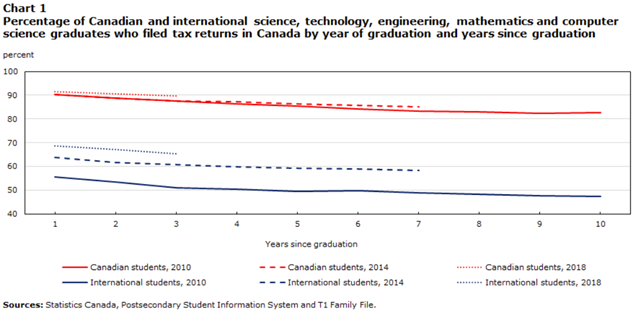
    The final paper, Retention of science, technology, engineering, mathematics and computer science graduates in Canada by Youjin Choi and Feng Hou, follows three cohorts of both domestic and international student graduates to see whether they stayed in the country (technically, it measures the proportion of graduates who file tax returns in Canada, which is a pretty good proxy for residency). The results are summed up in one incredibly ugly chart (seriously, why is StatsCan dataviz so awful?), which I reproduce below:

    So, in the chart the Y-axis is the percentage of STEM graduates who stay in Canada (measured by the proxy of tax filing) and the X-axis is years since graduation. Since they are following three different cohorts of graduates, the lines don’t all extend to the same length (the earliest cohort could be followed for ten years, the middle for seven and the most recent for just three).  The red set of lines represents outcomes for Canadian-born students and the blue set of lines does the same for international students.

    So, the trivial things this graph shows are that: i) both Canadian and international students leave Canada but ii) international students do so more frequently and iii) leaving the country is something that happens gradually over time. The interesting thing it shows, though, is that the most recent cohort (class of 2018) of STEM graduates are more likely to stay than earlier ones, and that this is especially true for international students: the retention rate of international graduates from the class of 2018 was almost fifteen percentage points higher than for the class of 2015.

    Was it a more welcoming economy? Maybe. But you’d have to think that our system of offering international students a path to citizenship had something to do with it too.

    Two other nuggets in the paper:

    • Canadian-born STEM graduates are slightly more likely to leave than non-STEM graduates (it’s not a huge difference, just a percentage point or two) while among international student graduates, those from STEM programs are substantially less likely to leave than those from non-STEM fields (a fifteen-point gap or more).
    • Regardless of where they are from, and regardless of what they studied, graduates from “highly-ranked” universities (no definition given, unfortunately) were more likely to leave Canada, presumably because degree prestige confers a certain degree of mobility.

    You are now fully up to date on the latest data on domestic and international graduates and their immigration pathways. Enjoy your day.

    Source link

  • Tools and ideas to engage students in career-connected learning

    Tools and ideas to engage students in career-connected learning

    Key points:

    For nearly two decades, I’ve worked to improve teaching and learning with technology. And while the continuously evolving nature of technology has changed the trajectory of my career many times, I have always tried to drive deeper student engagement.

    Education stakeholders agree on the importance of engagement in learning. According to the recently released Education Insights Report, K-12 leaders, teachers, parents, and students overwhelmingly agree that engagement drives learning. To be more specific, 93 percent of educators say it’s a critical metric for achievement, 99 percent of superintendents rank it among the top predictors of school success, and 92 percent of students report that engaging lessons make school more enjoyable.

    During my career, I’ve found that one of the best ways to engage students in learning is to connect what is being taught to students in the classroom to potential career paths. One way to connect the dots between classroom lessons and their application to a potential career is through career-connected learning.

    Career-connected learning (CCL) experiences–such as classroom career lessons, job fairs, and mentorships–have a measurable impact on student engagement and future orientation. A recent report found that 88 percent of students participate in at least one CCL opportunity, and that having a mentor nearly doubles student engagement (37 percent vs. 16 percent), while also increasing students’ hope about their future (40 percent vs. 25 percent).

    Educational technology can help educators scale CCL learning in their district. At my school, I’ve found success with Career Connect, which can be accessed through Discovery Education Experience. This technology solution is an innovative, virtual platform that facilitates direct, real-time connections between K-12 educators, students, and industry professionals. Key features include on-demand, virtual classroom visits and an easy-to-navigate dashboard with accompanying standards-aligned lesson plans and activities.

    Career Connect has allowed instructional specialists and professional development consultants in our field to assist CTE teachers with additional credible and trusted resources. This enables our educators to create meaningful connections and higher engagement by embedding real-world voices to help students see the “why” behind learning, which sparks curiosity and motivation. Plus, the solution helps ensure equitable access for all students, because the virtual format allows schools anywhere to bring a broad range of professionals from all the over the world directly into their classrooms.

    Another favorite tool is CareerPrepped, a free resource by the Association for Career and Technical Education. Designed to meet the needs of learners, educators, and employers, the platform supports skills-based hiring, soft-skills development, and work-based learning through a dynamic digital platform.

    With over 40 essential workforce skills, students can build Skill Builders across competencies like teamwork, communication, problem-solving, time management, and more. These skills are demonstrated through Skill Badges and a career portfolio that houses real-world evidence such as project artifacts and multimedia illustrations. Students can create a personal portfolio that connect to platforms like LinkedIn. Then, students can request feedback on their skill evidence from peers, educators, and industry mentors, helping them understand strengths and areas for improvement.

    CareerPrepped offers value for educators by bridging the gap between academic learning and employability while enhancing work-based learning outcomes. Students actively document and prove their skills to employers and class alike.

    Implementing career-focused technology tools such as Career Connect and CareerPrepped in education offers many ways to integrate CCL into the classroom. Here are some potential strategies to consider:

    • Employee Spotlights: Host brief live or recorded talks with people in various careers to hear about job journeys and directly tie in a classroom lesson to that career. Bonus points if that employee is a former student of that district!
    • Micro-Internships: Arrange one-hour or one-day job shadows with local partners.
    • Challenge-Based Projects: Partner with businesses on real problems, like designing a locally-sourced cafeteria menu or revamping a playground.

    In summary, career-connected learning is a vital component of any classroom in this day and age, because it brings together traditional learning with real-world opportunities. By engaging students with industry partners, mentors, and authentic workplace experiences, students are empowered to see clear pathways from education to career success.

    These connections not only strengthen technical and employability skills but also foster confidence and purpose for each student. Ultimately, career connections ensure that all students graduate prepared, inspired, and equipped to thrive in both postsecondary education and the workforce.

    Latest posts by eSchool Media Contributors (see all)

    Source link

  • Federal Union Sues Trump Admin Over Political OOO

    Federal Union Sues Trump Admin Over Political OOO

    J. David Ake/Getty Images

    The American Federation of Government Employees, a union representing federal workers, sued the Trump administration Friday, challenging the automated out-of-office email responses it placed on many employees’ email accounts when the government shut down. 

    The message, which was placed on the email accounts of all furloughed staff members without their consent, blamed Democrats in the Senate for causing the shutdown.

    AFGE’s members, who will be represented by the legal firms Democracy Forward and Public Citizen Litigation Group, argue in the complaint that the message Trump attached to their email accounts is “partisan political rhetoric.” Not only does it violate the Hatch Act, a federal law that requires nonappointed government staff to stay nonpartisan, but it also violates the First Amendment rights of the individual employees, they argue. 

    “The Trump-Vance administration is losing the blame game for the shutdown, so they’re using every tactic to try to fool the American people, including taking advantage of furloughed civil servants,” Skye Perryman, president of Democracy Forward, said in a news release. “Even for an administration that has repeatedly demonstrated a complete lack of respect for the Constitution and rule of law, this is beyond outrageous. The court must act immediately to stop this flagrant unlawfulness.”

    Source link

  • A Compact for Control (opinion)

    A Compact for Control (opinion)

    For more than 80 years, the system of higher education in the United States has partnered with the federal government to produce the best science, technology and scholarship in the world. Competing for federal research support on the basis of merit, universities have produced countless innovations and spurred enormous economic growth. The Trump administration has now proposed a “Compact for Academic Excellence in Higher Education” that threatens to destroy this partnership.

    Holding hostage federal loans and grants, the “compact” is essentially a unilateral executive decree that cannot be refused. Although it sounds in high and unobjectionable ideals, it is in fact designed to undermine the traditional academic independence and freedom that have sustained the greatness of American universities. The compact should be immediately and forcefully rejected by all self-respecting institutions of higher education.

    Universities and colleges have two essential missions. They serve to increase our knowledge of the world and to educate our young. Knowledge cannot be increased if it is assessed by political criteria, as distinguished from standards of intellectual merit. But the compact requires that institutions of higher education abolish “institutional units that … belittle … conservative ideas.” What exactly counts as conservative is unstated and left in the control of the administration. The compact seeks to supplant intellectual competence with explicitly political criteria, to be determined by a political agency. This demand violates not only academic freedom, but also free speech. It imposes government orthodoxy on private entities.

    The compact demands that universities offer empirical verification that each institutional field, department and unit represent a “broad spectrum of viewpoints.” It thus invites government to overrule scientific consensus on the range of acceptable inquiry. Most colleges of environmental sciences, for example, teach that global climate change is accelerated by human conduct. But Trump himself, speaking before the United Nations, branded this view the “greatest con job.” Most medical schools teach that vaccines are important to health. But Trump’s secretary of health and human services “has been crusading against vaccines for decades.” Under the compact, government might insist that every biology department house a vaccine denier, or that every environmental science program contain a climate change skeptic. Political control of this kind would quickly degrade the intellectual integrity of university scholarship.

    Early in the 20th century, American universities were managed by laypersons who attempted to censor and control the scholarship of professors. But in 1915, the newly established American Association of University Professors defined and defended academic freedom in the canonical Declaration of Principles on Academic Freedom and Academic Tenure. The declaration set forth principles that are now enshrined in contracts at virtually every American college and university. These principles protect academic freedom, which rests on the axiom that scholarly excellence is to be determined by academic rather than political standards. Trump’s proposed compact wantonly violates this essential principle, even as it purports to protect academic freedom.

    The declaration also makes clear the educational goal of American colleges and universities, which is to equip students to think for themselves. The compact, in contrast, requires universities to suppress “support for entities designated by the U.S. Government as terrorist organizations.” Government may of course create such designations, but unfortunately they may also be problematic, overbroad or erroneous. Students and professors should be allowed to criticize such errors, but the compact would prevent this. It would require American colleges and universities to become instruments of official thought control. This is what happened in the United States during World War I, when professors were fired for opposing the war. We have spent a century repenting those mistakes, and now the Trump administration demands that we repeat them.

    Some provisions in the compact are unobjectionable because they merely restate existing law. The Supreme Court has outlawed the use of race in admissions. Congress has laid out procedures for enforcing antidiscrimination law under Title VI and Title IX. These tools are adequate to enforce the law. But the compact has a larger goal: It seeks to break the independence of American higher education, an independence that has fueled the ascent of American colleges and universities to greatness. The compact goes far beyond the Supreme Court’s ruling on affirmative action to require that all admissions decisions “be based upon and evaluated against objective criteria.” It also requires “grade integrity,” freezing tuition rates for five years, disclosure of postgraduate earnings and free tuition for students in the hard sciences at universities with large endowments. It limits the percentage of foreign students and requires screening for anti-American bias.

    The diversity of American institutions of higher education is commonly understood to be a source of its enormous strength. Competing against each other for students, American colleges and universities admit students based on their own distinct and legal criteria. But the administration seeks to end that heterogeneity. For many institutions what matters is the creativity of a student’s essay, the qualitative assessment of recommendations and the resilience of an applicant’s personality as revealed in a résumé. The administration would have universities ignore all that. It would turn our colleges and universities into drab, bureaucratic and uniform institutions, under the shadow of the continuous threat of government interference.

    Under the compact, universities also must commit to institutional neutrality, the idea that university leaders and departments will not officially comment on social and political issues of the day that do not affect the university. This is an ideal embodied in the 1967 Kalven report at the University of Chicago, but its adoption and interpretation is a very local matter, and it should not be required as a condition for receipt of federal funds.

    Institutional neutrality is important because it protects the maximum freedom of students and faculty to vigorously inquire, without battling the pall of official ideas. But some institutions might have specific missions that they deem essential. For example, a religious institution of higher learning might have a certain set of principles that require leaders to speak out. If government gets to decide what counts as a social or political issue, a medical school might not be able to opine on the safety of vaccines, an environmental department on the impacts of climate change or a law school on violations of the rule of law. Of course, universities may choose not to opine on these matters, but for the administration to impose this silence is truly inimical to a marketplace of ideas.

    The compact insists that universities “commit to defining” gender roles “according to reproductive function and biological processes.” Gender troubles certainly abound in universities, and prior administrations may have contributed to these difficulties. But these quandaries are for universities to settle. The diversity of approaches taken by American colleges and universities is our greatest strength. The compact unaccountably seeks to impose its own ideology on all institutions of higher education. It seeks to replace a pluralist market with a single orientation set by Washington, D.C.

    The architect of America’s public-private research partnership, Vannevar Bush, asserted that “scientific progress” required “the free play of free intellects, working on subjects of their own choice, in the manner dictated by their curiosity for exploration of the unknown.” The Trump administration would do well to recognize that a genuine marketplace of ideas requires academic freedom for scholars and a competitive environment for institutions.

    For the administration to attempt to use federal funds to force colleges and universities to toe a conservative line is to create what our constitutional law calls unconstitutional conditions. No university that is committed to independently searching for the truth, or to producing students who can think for themselves, should submit to the deliberate and possibly illegal humiliations contained in the compact. Institutions that do so may very well cease being universities in the full sense of the term. They should just say no.

    Robert Post is the Sterling Professor of Law at Yale Law School, where he served as dean from 2009 to 2017. His research specialties include issues of free speech and academic freedom.

    Tom Ginsburg is the Leo Spitz Distinguished Service Professor of International Law at the University of Chicago Law School and director of Chicago’s Forum for Free Inquiry and Expression.

    Source link

  • Why Higher Ed Must Be Intentional With AI

    Why Higher Ed Must Be Intentional With AI

    Walk into almost any office on a campus right now and you’ll hear the same thing: “We’re experimenting with AI.” Someone is drafting social posts in ChatGPT. Someone else is piloting a chatbot for admissions FAQs. Another is tinkering with predictive models in the CRM.

    These efforts are well intentioned, but nearly three years into the ready availability of generative AI tools, higher ed needs to understand that dabbling isn’t enough anymore.

    Higher education is under immense pressure. From the demographic cliff to the search cliff, the drop in international enrollment to the decline in the public perception of higher education, our industry is fraught with challenges. When we combine these challenges with the escalating expectations from students and families and the “experience economy,” we’re setting ourselves up to fall dangerously behind.

    AI can be part of the solution to those challenges. But if we limit ourselves to scattered experiments, we risk wasting resources and missing the opportunity to use AI as a true strategic advantage.

    The Risks of Dabbling 

    When AI adoption is fragmented, several challenges emerge:

    • Duplicated work and tool sprawl. Different units adopt different tools, leading to confusion, inconsistent data and hidden costs.
    • Inconsistent brand voice. Without shared guidelines, AI-generated content can erode the consistency of a university’s storytelling.
    • Ethical blind spots. Dabbling often means no governance. Sensitive student data can inadvertently end up in AI tools.
    • Staff frustration. When AI feels like extra work instead of a supportive tool, teams become skeptical. That makes adoption harder later.
    • Lost momentum. When experiments aren’t connected to measurable outcomes, leadership may conclude that AI “doesn’t work here.”

    The paradox is this: Dabbling may feel safer, but it is actually riskier than intentional adoption.

    What Intentional Adoption Looks Like 

    Intentional adoption doesn’t mean rushing into automation or replacing staff. It means aligning AI with institutional goals, building literacy across teams, creating ethical guardrails and sharing results transparently.

    Take admissions chatbots. Many institutions piloted them to handle high-volume FAQs. Some fizzled out because there was no plan for training, governance or integrating insights back into the enrollment strategy. But at campuses where chatbots were tied to yield goals, tested with student input and connected to human follow-up, they became powerful tools for reducing melt and increasing student satisfaction.

    Or consider content creation. I’ve seen marketing teams use AI to repurpose one student story into dozens of assets, like email copy, Instagram posts, video scripts. When done thoughtfully, this allowed teams to do more with the same staff, freeing time for higher-level strategy. When done haphazardly, it can lead to a flood of off-brand content that students recognize as AI, eroding trust.

    A Framework for Readiness 

    So how can institutions move from dabbling to adopting? One approach I use with teams is the AI Maturity Matrix.

    The matrix evaluates readiness across six dimensions—vision, leadership support, skills, governance, collaboration, and technology—and places organizations on a five-stage curve:

    1. Nascent: AI is barely leveraged, or individual experiments happen in silos.
    2. Developing: Small pilots exist but aren’t connected to strategy.
    3. Scaling: Multiple projects are coordinated and tied to goals.
    4. Optimized: AI is part of daily workflows, with governance and training in place.
    5. Transformational: AI is a true differentiator, fueling innovation and efficiency across the institution.

    Most higher ed teams that I speak with fall in the second and third categories. They are experimenting and maybe scaling, but without the governance or strategy to optimize. The matrix helps teams see their starting point clearly and, more importantly, identify what it will take to get to the next stage.

    The key is not to leap from nascent to transformational overnight, but instead move steadily, stage by stage, building capacity along the way.

    A Call to Action for Higher Ed Leaders 

    The issue isn’t whether higher education will use AI; it’s whether we’ll use it well.

    If you’re leading a team, here are three questions to start with:

    1. Do we know where we stand on the AI maturity curve?
    2. Are our current experiments connected to our overarching goals?
    3. What’s one step we could take in the next 30 days to build intentional capacity?

    These questions are urgent. Students are already comparing their campus experience to the seamless, personalized interactions they get from Amazon, Spotify or Netflix. Faculty and staff are already using AI tools in their personal lives, whether institutions acknowledge it or not. The longer we leave AI adoption uncoordinated, the greater the gap grows between what higher ed delivers and what students expect.

    I still hear from people who believe AI is a passing fad. Meanwhile, the world around us is shifting in significant ways that have the potential to leave us far behind. Institutions must approach their AI adoption with clarity and intentionality. Those that treat it as a novelty risk being left behind.

    The time for dabbling is over. The time for intentional adoption is now. 

    Jaime Hunt is president of Solve Higher Ed and an adjunct faculty member at West Virginia University teaching courses in higher ed marketing and emerging media.

    Source link

  • Digital Learning Project Manager at Notre Dame

    Digital Learning Project Manager at Notre Dame

    I heard from my friend Sonia Howell, director of the Office of Digital Learning at the University of Notre Dame, that she is recruiting for a digital learning project manager. I asked Sonia if she wanted to share more about the role in this Featured Gig series.

    Q: What is the university’s mandate behind this role? How does it help align with and advance the university’s strategic priorities?

    A: Excellence in undergraduate education is essential to how Notre Dame envisions itself fulfilling its institutional mission. The digital learning project manager will contribute directly to the educational experience of our undergraduate students, working with faculty, learning designers, a media team and other project management professionals to create cutting-edge digital offerings meant to enhance Notre Dame’s signature residential learning environment.

    In addition, the person in this role will manage initiatives that bring elements of Notre Dame’s academic life to learners beyond our campus. These range from online courses open to the general public to online pathway programs for current high school students exploring college opportunities and incoming first-year Notre Dame students prepping for the rigors of a university curriculum.

    Q: Where does the role sit within the university structure? How will the person in this role engage with other units and leaders across campus?

    A: The digital learning project manager is a member of the Office of Digital Learning, which is part of a larger unit, reporting to the Office of the Provost, called Notre Dame Learning. Housing the ODL and the Kaneb Center for Teaching Excellence, Notre Dame Learning brings together their teaching and learning expertise along with that of the Office of Information Technology’s Teaching and Learning Technologies group to serve as the hub of learning excellence and innovation at Notre Dame.

    Working in the ODL will give the person in this position the chance to collaborate directly with instructors, the university’s academic departments and colleges, and colleagues across the Notre Dame Learning organization. They will work closely with the ND Learning leadership team to advance the organization’s strategic priorities.

    Q: What would success look like in one year? Three years? Beyond?

    A: From day one, building relationships will be paramount in this position. The Notre Dame family embodies a strong sense of community, and successful project managers on our campus are those who embrace the human component of their work, recognizing that shepherding a project from initiation to completion requires personal connection as much as it does the ability to keep a group on task. The importance of being able to understand faculty priorities and concerns, interface with administrators both internal and external to Notre Dame, and partner with colleagues across the ODL and Notre Dame Learning more generally cannot be overstated. As these relationships deepen over time, the digital learning project manager will become a go-to member of the Notre Dame Learning team and assume a larger role in driving its initiatives.

    Q: What kinds of future roles would someone who took this position be prepared for?

    A: Given all the different skill sets someone in this position will draw on and/or develop—e.g., project management, client/stakeholder relations, written and verbal communication, familiarity with media production and learning design processes, knowledge of higher education and organizational dynamics more broadly—it is a role that can serve as a springboard into opportunities with expanded leadership components. This might be within a unit like the Office of Digital Learning, in other areas of higher ed such as student services or information technology, or in fields outside academia altogether. Named as America’s Best Large Employer by Forbes earlier this year, Notre Dame is a great place both to work and build toward future career success.

    Please get in touch if you are conducting a job search at the intersection of learning, technology and organizational change. If your gig is a good fit, featuring your gig on Featured Gigs is free.

    Source link