Blog

  • How Witnessing Violence Impacts Brain Development (opinion)

    How Witnessing Violence Impacts Brain Development (opinion)

    On Sept. 10, a public lecture at Utah Valley University became the site of a nightmare when the political commentator Charlie Kirk was killed before thousands of students. Whatever one thinks of Kirk’s politics, the trauma endured by those young witnesses will last far longer than the news cycle. For adolescents, such moments do not fade when the cameras leave. They etch themselves into the brain—literally. Witnessing violence, even indirectly, negatively impacts brain development.

    At the University of Southern California’s Center for Affective Neuroscience, Development, Learning and Education (CANDLE), our colleagues recently studied how violence exposure shapes young people. Again and again, the evidence is stark: When adolescents witness or hear about violence in their communities, their developing brains bear the burden. The anterior cingulate cortex—a region critical for processing stress and pain, emotional regulation, motivation, learning, and social connection—has a greater decrease in gray-matter volume in adolescents exposed to more community violence. This pattern of gray-matter volume decrease has been seen in ground troops deployed to war and in people affected by post-traumatic stress disorder. It has been linked to anxiety, depression and difficulty sustaining attention.

    Yet neuroscience also points to a path forward. Our newest research, published this year in the Journal of Research on Adolescence, offers a striking counterpoint: Adolescents are not passive victims of their environments. They have within them the capacity to buffer these harms, within themselves and within society. That capacity is what we call transcendent thinking.

    Transcendent thinking is the ability to move beyond the immediate details of an event and consider the complexities that characterize a diverse society, to explore perspectives that differ or conflict with one’s own and to contemplate the bigger picture: What does this mean for me, for my community, for justice and fairness? When teenagers reflect in these ways, they are not escaping reality but engaging it more deeply. They are searching for meaning, considering multiple perspectives and placing their experience in a larger human story. This, in turn, helps them imagine how things might be different, and how they might contribute to the change.

    In our study of 55 urban adolescents, those who more frequently engaged in transcendent reflection about social issues showed a greater increase in gray-matter volume in the anterior cingulate cortex two years later—the very brain region seen to be most vulnerable to violence exposure. In other words, transcendent thinking didn’t erase the negative effects, but it appeared to give young people’s brains some scaffolding to adapt and heal.

    This has profound implications for how we respond to political and community violence. The instinct, understandably, is to shield young people from harsh realities. But shielding won’t work. Adolescents are already encountering violence—whether on the street, online or in lecture halls. What they need are the tools to make sense of it, to weave their experiences into narratives of purpose and agency rather than despair. And for this, they need curiosity about the experiences of others and safe opportunities to think across difference.

    Fortunately, transcendent thinking is not rarefied or inaccessible. It is something every young person can do and likely already does spontaneously. The challenge is to nurture it deliberately and thoughtfully. Schools and colleges can make space for students to grapple with complex social issues and to connect classroom learning with ethical and civic questions. Families and communities can invite adolescents into intergenerational storytelling, where young people see how others have wrestled with hardship and injustice. Education that emphasizes civic reasoning and dialogue can strengthen not only academic outcomes but also neurological resilience and long-term well-being.

    This is both a scientific and a civic imperative. Neuroscience is showing us that meaning making changes the brain. We need support for educators to find ways to translate that science into daily practices that help young people transform tragedy into purpose. Our vision is to illuminate the capacities that empower adolescents to question their and others’ beliefs, to engage across difference, to imagine futures and work to create the world they want to live in.

    The tragedy at Utah Valley University underscores how high the stakes have become. America’s young people are coming of age amid rising polarization and public acts of violence. We cannot protect them or shield them from it, but we can equip them to counter its developmental impacts.

    Transcendent thinking is not a cure-all. But it is a proven developmental asset that can buffer the effects of witnessing community violence on the brain. It is also a civic skill we urgently need: the ability to see beyond the present conflicts and tragedies to the larger questions of justice, community and meaning.

    If we want to safeguard both adolescent development and democratic life, we must equip schools, colleges, families and communities with the tools to cultivate transcendent thinking.

    Mary Helen Immordino-Yang is the Fahmy and Donna Attallah Professor of Humanistic Psychology and a professor of education, psychology and neuroscience at the University of Southern California and founding director of the USC Center for Affective Neuroscience, Development, Learning and Education.

    Kori Street is executive director of USC CANDLE.

    Source link

  • Fixed Tuition

    Fixed Tuition

    A few days ago, someone mentioned how nice it would be if students could have their tuition level held steady after enrollment, so they could plan. It got me thinking.

    The usual version of that proposal assumes that students enroll full-time at a given tuition level, then sail through, full-time, unimpeded, until their on-time graduation. The benefit to the students (and their families) is obvious, both in terms of absolute amounts of money and in terms of predictability. As a parent who has been paying out-of-state tuition since 2019, I get the appeal.

    Of course, the rest of the economy doesn’t freeze costs for years at a time, and college employees live in that economy. So annual tuition increases would still have to happen, but they could only be inflicted upon new students. In any given year, freshmen would pay more than sophomores, who would pay more than juniors and so on. The first year that happened, the increase for freshmen would have to be pretty dramatic to ensure that future years would generate enough revenue. Or, theoretically, states could make up the difference.

    That doesn’t seem likely.

    For example, Pennsylvania hasn’t even passed its budget yet for this year. You know, the one that we’re several months into. Uncertainty rolls downhill; asking us to guarantee years in advance when we don’t even have this year’s figure yet isn’t realistic. In its defense, the state is dealing with a federal funding situation that could be described as mercurial. Higher ed funding at the state level competes with other priorities, such as the state versions of Medicaid.

    Now, if the promise of fixed tuition led to a more rational federal budgeting process …

    OK, OK. Seriously, though, using variable revenues to cover fixed costs is a dangerous game. Very elite private schools often have the option of using endowment returns to provide predictable operating funds, which, in turn, could lead to more predictable tuition charges. But those of us at the mercy of annual (and frequently late) state allocations don’t have that option.

    Even allowing for all of that, though, I can’t help but wonder about the student that the model assumes. It’s essentially the IPEDS model: first-time, full-time, degree-seeking, supported by family. In the community college world, that describes a small minority of the student body.

    Here, students move into and out of full-time status from semester to semester. Sometimes life happens and they step out for a bit (or longer), then decide to return years later. They usually work for pay, often full-time, while they’re taking classes. Stop-start patterns of enrollment make predictable tuition harder to define. They also necessarily lead to higher increases for those who come back, since the entire increase for any given year is visited upon new students, rather than being spread evenly across classes.

    Free community college would have solved this, of course, by setting a figure of zero and leaving it there. As long as operating support increased with costs, that would be sustainable, and it’s admirably simple. But that doesn’t appear to be on the table at the federal level, and states can’t deficit spend during recessions, which is usually when demand for other services increases and tax revenues drop.

    If we could set public funding in a way that covers fixed costs, leaving only the variable costs to be covered by tuition, then there could be a real possibility for a (clearly defined) tuition freeze. Or at least the levels would be low enough that annual increases wouldn’t hurt so much. Until that happens, though, it’s just untenable. As a parent, that bothers me, but the blame should be placed where it actually belongs.

    Source link

  • Charlie Kirk’s Death Is a Test for Campus Free Speech

    Charlie Kirk’s Death Is a Test for Campus Free Speech

    With national attention already focused on campus free speech, the assassination of Charlie Kirk at Utah Valley University has intensified a fractious moment for higher education. Voices on the right have blamed colleges for Kirk’s death, calling them “indoctrination camps” and comparing them to “madrassas that radicalize jihadis.”

    Though the suspect is not a student, Kirk’s killing has intersected with concerns that students are increasingly unable or unwilling to engage with dissenting views. Critics have cited the most recent FIRE College Free Speech Rankings survey, which shows that one in three students thinks it’s acceptable to use violence to stop a speaker.

    Colleges did not cause Kirk’s death, but leaders cannot ignore the finding that a third of students support using violence against a speaker. Though most students will never resort to violence, the possibility forces colleges to reassess campus security. UVU’s police chief admitted more than half his force of 15 officers wasn’t able to secure the crowd of 3,000 people at the Kirk event. Security experts noted that stopping a shooting from the top of a building hundreds of feet away requires Secret Service–style sweeps. The incident raises questions about bringing outside speakers to campuses. With so many budget problems in higher ed, who will cover the costs of keeping them safe?

    Yet on the ground at UVU, life on campus looked far different from critics’ portrayals. In the hours after the shooting, the student newspaper, The UVU Review, reported that professors reached out to students to offer resources and reprieves from coursework. Students called everyone in their phone to tell them they were safe. Strangers hugged each other and students offered a ride home to anyone who needed it. They put aside their differences to grieve together. “It feels like life stopped for us,” said one student. “But it kept going for everyone else. I’m ready for life to start again, no matter how changed it’ll be.”

    Given Kirk’s prominence, students across the country will feel like this incident has changed their lives, too. With more than 850 campus chapters, Turning Point USA is an organization where conservative students have found community. And even for students who disagreed with Kirk he inspired them to engage with political issues and debate their ideas.

    But the reactions to Kirk’s death reveal that the ideological fissures on campus have only deepened. At least 15 faculty and staff members have been fired for appearing to condone the shooting on social media, many after online campaigns called for their dismissal. Meanwhile, at a candlelit vigil at the University of North Carolina at Chapel Hill—a campus that has faced its own tragedy—student Walt Wilson told The Daily Tarheel he was mourning Kirk even though he disagreed with him. “Getting killed over debate and fostering free speech, especially in a place like a university where that is supposed to prosper, is a real tragedy and shows an issue of communication and reconciliation,” he said.

    Free speech survives only if protected in practice. This moment will test higher education’s resolve: Will political pressure drive colleges to retreat, or will they recommit to free expression as a path through turmoil?

    Source link

  • Helping kids learn how their brains work

    Helping kids learn how their brains work

    What if improving children’s mental health — and life outcomes — could be done by teaching kids how their brains work?

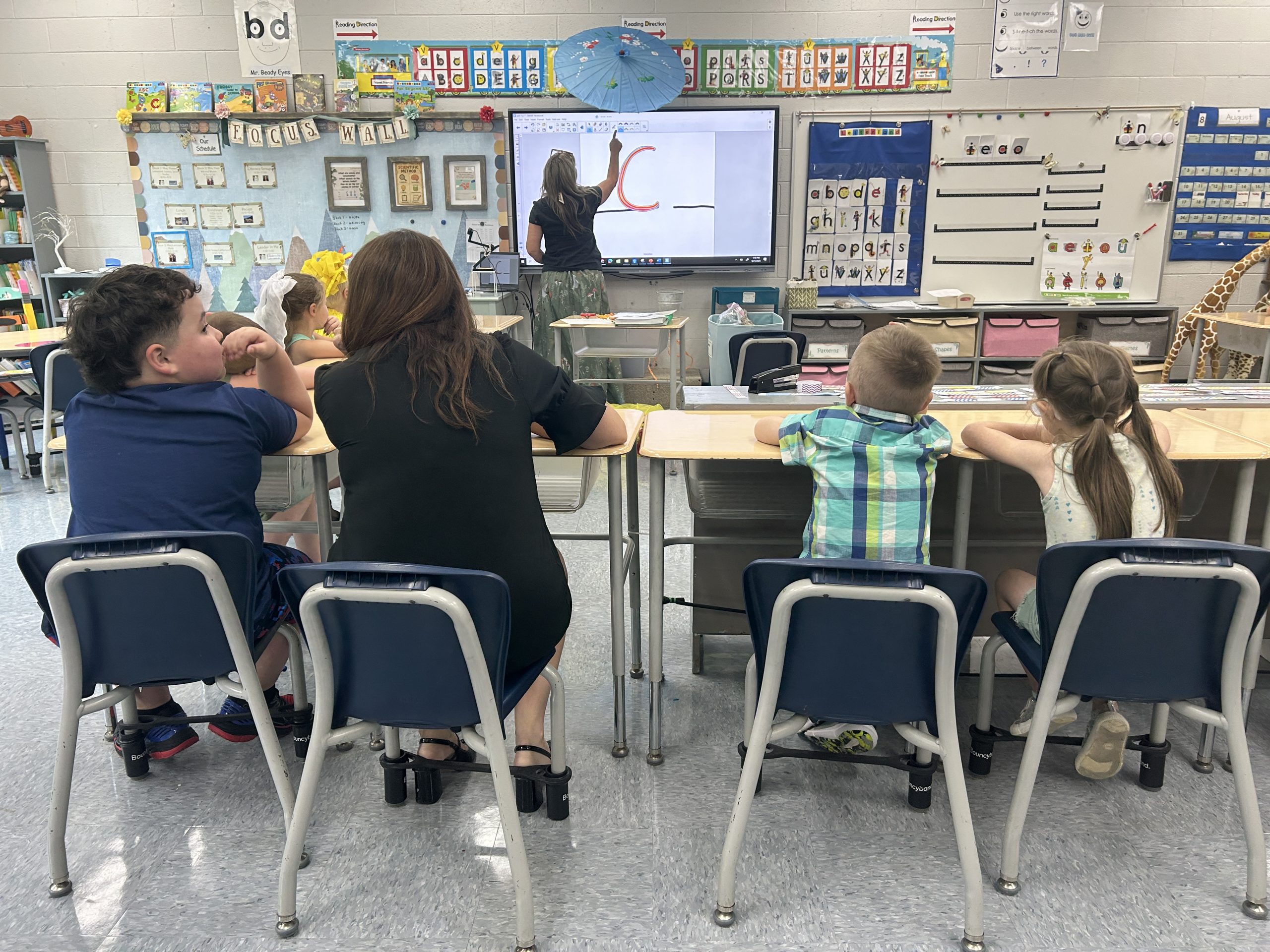
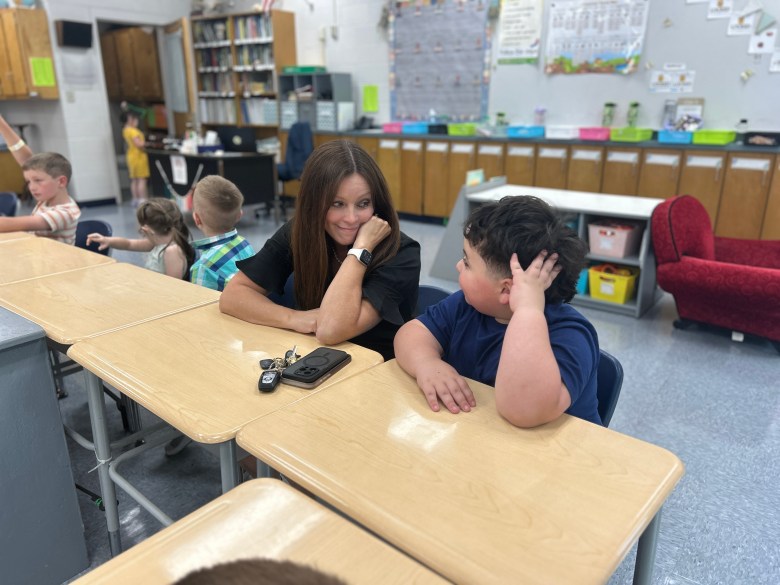
    That’s a key idea behind the approach of teachers at Momentous School in Dallas, a private elementary school that serves 225 students, most of whom come from low-income families. Each day, educators present lessons on neuroscience and mindfulness, from the youngest learners all the way up to fifth graders. 

    Preschoolers in the school’s 3-year-old classroom learn about the brain by singing “The Brain Song” to the tune of “Bingo” (“I have a brain in my head/And it’s for thinking”). They practice mindfulness by lying down with stuffed animals on their stomachs and watching them move up and down as they breathe.

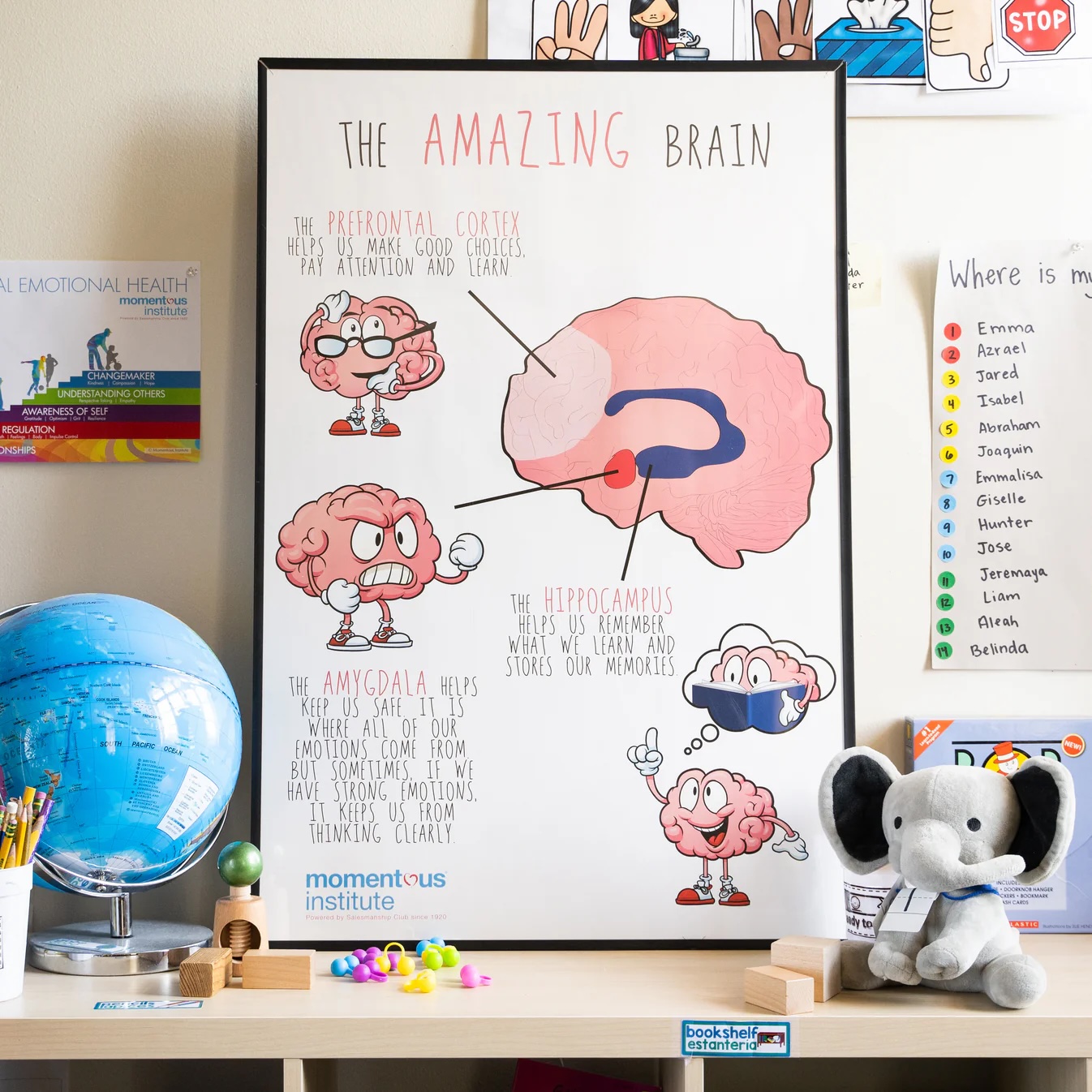
    Older students learn calming strategies like slowly counting each finger on their hands while breathing in and out. Classrooms offer tactile models of the brain to help students learn about different parts such as the prefrontal cortex, which controls such processes as executive function and problem solving, and the brain stem, which regulates breathing and blood pressure.

    This focus on mindfulness is happening in schools across the country, according to the Child Mind Institute, a nonprofit focused on children’s mental health. Experts say the goal is teaching self-awareness and regulation.

    “Once the kids feel they can calm themselves, even just through breathing it’s like the ‘wow’ moment,” said Rick Kinder, creator of a mindfulness program called “Wellness Works in Schools,” in an article by the Child Mind Institute.

    At Momentous School, conversations about the brain continue throughout the day, as teachers can be heard encouraging students to identify their emotions or asking, “What’s your amygdala saying to you in this moment?” according to Jessica Gomez, a psychologist and executive director of Momentous Institute, the Dallas-based mental health nonprofit that operates the school. (The amygdala processes emotions in the brain.)

    Through these frequent discussions and additional lessons on mental health and healthy relationships, teachers are “trying to normalize these things as part of the human condition versus something that is stigmatizing,” Gomez said. The school also holds regular parent nights to educate families on how the brain works and teach emotional regulation strategies that families can practice together at home.

    Momentous School, which launched in 1997 and is funded by philanthropic donations, was developed to put into practice mental health and brain science research from Momentous Institute*. A recent study by Momentous Institute and the Center for BrainHealth at the University of Texas at Dallas found this approach may be contributing to positive outcomes for graduates of the school. Of the 73 Momentous School students who went on to graduate from high school in 2016 through 2018, 97 percent earned a high school diploma and 48 percent earned a college degree.

    These findings come at a time when lessons on emotions, relationships and social awareness, often referred to as social and emotional learning, have become a flashpoint in education and culture wars. Studies show such lessons can improve academic performance: Other researchers unaffiliated with Momentous School have also found that teaching about the brain can provide motivation for students and improve academic and social development. 

    As teachers and students head back to school and face new routines and social situations, now is a good time to build relationships and introduce even young students to ideas about how their brain works, Gomez said. Although many students at Momentous deal with challenges such as poverty, she believes that the school’s emphasis on mental health and brain science has helped families to better cope with those pressures. 

    “The point isn’t to never have stress in your life, it’s to know what to do with it,” Gomez said. “Children and parents having agency and tools helps them know how to navigate life stressors, which has a buffering effect on their brain.” 

    *Clarification: This story has been updated to clarify that Momentous School was developed based on research by Momentous Institute.

    Contact staff writer Jackie Mader at 212-678-3562 or [email protected].

    This story about neuroscience in education was produced by The Hechinger Report, a nonprofit, independent news organization focused on inequality and innovation in education. Sign up for the Hechinger newsletter.

    The Hechinger Report provides in-depth, fact-based, unbiased reporting on education that is free to all readers. But that doesn’t mean it’s free to produce. Our work keeps educators and the public informed about pressing issues at schools and on campuses throughout the country. We tell the whole story, even when the details are inconvenient. Help us keep doing that.

    Join us today.

    Source link

  • They can’t count on federal money

    They can’t count on federal money

    ASHE COUNTY, N.C. — In the time it took to read an email, the federal money vanished before Superintendent Eisa Cox’s eyes: dollars that supported the Ashe County school district’s after-school program, training for its teachers, salaries for some jobs. 

    The email from the Department of Education arrived June 30, one day before the money — $1.1 million in total — was set to materialize for the rural western North Carolina district. Instead, the dollars had been frozen pending a review to make sure the money was spent “in accordance with the President’s priorities,” the email said. 

    In a community still recovering from Hurricane Helene, where more than half of students are considered economically disadvantaged, Cox said there was no way they could replace that federal funding. “It is scary to think about it, you’re getting ready to open school and not have a significant pot of funds,” she said.

    School leaders across the country were reeling from the same news. The $1.1 million was one small piece of a nearly $7 billion pot of federal funding for thousands of school districts that the Trump administration froze — money approved by Congress and that schools were scheduled to receive on July 1. For weeks, leaders in Ashe County and around the country scrambled to figure out how they could avoid layoffs and fill financial holes — until the money was freed July 25, after an outcry from legislators and a lawsuit joined by two dozen states.

    “I had teachers crying, staff members crying. They thought they were going to lose their jobs a week before school,” said Curtis Finch, superintendent of Deer Valley Unified School District in Phoenix. 

    About $1.1 million was at stake for the Ashe County school district in western North Carolina this summer when a portion of K-12 schools’ federal funding was frozen. Credit: Ariel Gilreath/The Hechinger Report

    Now, as educators welcome students back to classrooms, they can no longer count on federal dollars as they once did. They must learn to plan without a playbook under a president intent on cutting education spending. For many districts, federal money is a small but crucial sliver of their budgets, potentially touching every part of a school’s operations, from teacher salaries to textbooks. Nationally, it accounts for about 14 percent of public school funding; in Ashe County, it’s 17 percent. School administrators are examining their resources now and budgeting for losses to funding that was frozen this summer, for English learners, after-school and other programs.

    So far, the Trump administration has not proposed cutting the largest pots of federal money for schools, which go to services for students with disabilities and to schools with large numbers of low-income students. But the current budget proposal from the U.S. House of Representatives would do just that. 

    At the same time, forthcoming cuts to other federal support for low-income families under the Republican “one big, beautiful bill” — including Medicaid and SNAP — will also hammer schools that have many students living in poverty. And some school districts are also grappling with the elimination of Department of Education grants announced earlier this year, such as those designed to address teacher shortages and disability services. In politically conservative communities like this one, there’s an added tension for schools that rely on federal money to operate: how to sound the alarm while staying out of partisan politics.

    For Ashe County, the federal spending freeze collided with the district’s attempt at a fresh start after the devastation of Helene, which demolished roads and homes, damaged school buildings and knocked power and cell service out for weeks. Between the storm and snow days, students here missed 47 days of instruction.

    Cox worries this school year might bring more missed days: That first week of school, she found herself counting the number of foggy mornings. An old Appalachian wives’ tale says to put a bean in a jar for every morning of fog in August. The number of beans at the end of the month is how many snow days will come in winter. 

    “We’ve had 21 so far,” Cox said with a nervous laugh on Aug. 21.

    Related: A lot goes on in classrooms from kindergarten to high school. Keep up with our free weekly newsletter on K-12 education

    Fragrant evergreen trees blanket Ashe County’s hills, a region that bills itself as America’s Christmas Tree Capital because of the millions of Fraser firs grown for sale at the holidays. Yet this picturesque area still shows scars of Hurricane Helene’s destruction: fallen trees, damaged homes and rocky new paths cut through the mountainsides by mudslides. Nearly a year after the storm, the lone grocery store in one of its small towns is still being rebuilt. A sinkhole that formed during the flooding remains, splitting open the ground behind an elementary school.

    Ashe County Schools Superintendent Eisa Cox visits classrooms at Blue Ridge Elementary School during the first week of the school year in Warrensville, N.C. Credit: Ariel Gilreath/The Hechinger Report

    As students walked into classrooms for the first time since spring, Julie Taylor — the district’s director of federal programs — was reworking district budget spreadsheets. When federal funds were frozen, and then unfrozen, her plans and calculations from months prior became meaningless.

    Federal and state funding stretches far in this district of 2,700 students and six schools, where administrators do a lot with a little. Even before this summer, they worked hard to supplement that funding in any way possible — applying to state and federal grants, like one last year that provided money for a few mobile hot spots for families who don’t have internet access. Such opportunities are also narrowing: The Federal Communications Commission, for example, recently proposed ending its mobile hot spot grant program for school buses and libraries. 

    “We’re very fiscally responsible because we have to be — we’re small and rural, we don’t have a large tax base,” Taylor said.

    Related: English learners stopped coming to class during the pandemic. One group is tackling the problem by helping their parents

    When the money was frozen this summer, administrators’ minds went to the educators and kids who would be most affected. Some of it paid for a program through Appalachian State University that connects the district’s three dozen early-career teachers with a mentor, helps them learn how to schedule their school days and manage classroom behavior. 

    The program is part of the reason the district’s retention rate for early career teachers is 92 percent, Taylor said, noting the teachers have said how much the mentoring meant to them. 

    Also frozen: free after-school care the district provides for about 250 children throughout the school year — the only after-school option in the community. Without the money, Cox said, schools would have to cancel their after-school care or start charging families, a significant burden in a county with a median household income of about $50,000.

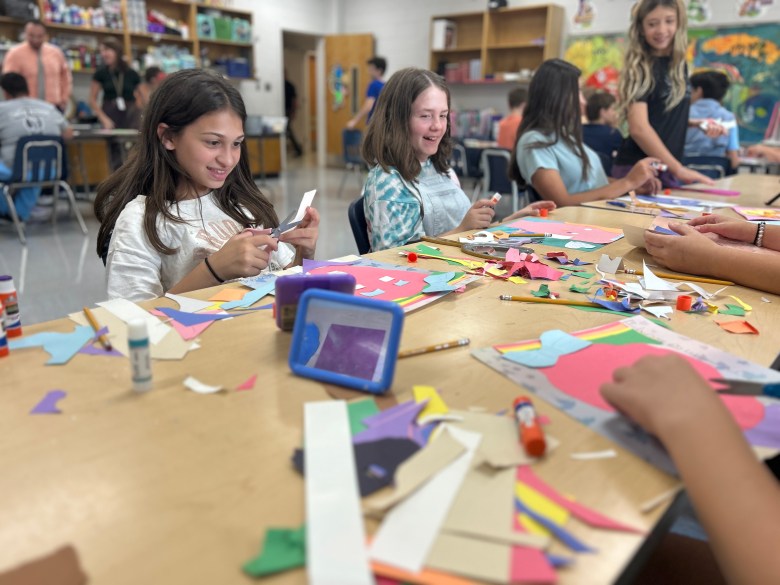
    Sixth grade students make self-portraits out of construction paper during the first week of the school year at Blue Ridge Elementary School in Warrensville, N.C., in August. Credit: Ariel Gilreath/The Hechinger Report

    The salary for Michelle Pelayo, the district’s migrant education program coordinator for nearly two decades, was also tied up in that pot of funding. Because agriculture is the county’s biggest industry, Pelayo’s work in Ashe County extends far beyond the students at the school. Each year, she works with the families of dozens of migrant students who move to the area for seasonal work on farms, which generally involves tagging and bundling Christmas trees and harvesting pumpkins. Pelayo helps the families enroll their students, connects them with supplies for school and home, and serves as a Spanish translator for parent-teacher meetings — “whatever they need,” she said.

    Kitty Honeycutt, executive director of the Ashe County Chamber of Commerce, doesn’t know how the county’s agriculture industry would survive without the migrant students Pelayo works with. “The need for guest workers is crucial for the agriculture industry — we have to have them,” she said. 

    A couple of years ago, Pelayo had the idea to drive to Boone, North Carolina, where Appalachian State University’s campus sits, to gather unwanted appliances and supplies from students moving out of their dorm rooms at the end of the year to donate to migrant families. She’s a “find a way or make a way” type of person, Honeycutt said. 

    Cox is searching for how to keep Pelayo on if Ashe County loses these federal funds next year. She’s talked with county officials to see if they could pay Pelayo’s salary, and begun calculating how much the district would need to charge families to keep the after-school program running. Ideally, she’d know ahead of time and not the night before the district is set to receive the money. 

    Related: Trump’s cuts to teacher training leave rural districts, aspiring educators in the lurch

    Districts across the country are grappling with similar questions. In Detroit, school leaders are preparing, at a minimum, to lose Title III money to teach English learners. More than 7,200 Detroit students received services funded by Title III in 2023. 

    In Wyoming, the small, rural Sheridan County School District 3 is trying to budget without Title II, IV and V money — funding for improving teacher quality, updating technology and resources for rural and low-income schools, among other uses, Superintendent Chase Christensen said.

    Schools are trying to budget for cuts to other federal programs, too — such as Medicaid and food stamps. In Harrison School District 2, an urban district in Colorado Springs, Colorado, schools rely on Medicaid to provide students with counseling, nursing and other services.

    The district projects that it could lose half the $15 million it receives in Medicaid next school year. 

    “It’s very, very stressful,” said Wendy Birhanzel, superintendent of Harrison School District 2. “For a while, it was every day, you were hearing something different. And you couldn’t even keep up with, ‘What’s the latest information today?’ That’s another thing we told our staff: If you can, just don’t watch the news about education right now.”

    Related: Tracking Trump: His actions on education 

    There’s another calculation for school leaders to make in conservative counties like Ashe, where 72 percent of the vote last year went for President Donald Trump: objecting to the cuts without angering voters. When North Carolina’s attorney general, a Democrat, joined the lawsuit against the administration over the frozen funds this summer, some school administrators told state officials they couldn’t publicly sign on, fearing local backlash, said Jack Hoke, executive director of the North Carolina School Superintendents’ Association.

    Cox sees the effort to slash federal funds as a chance to show her community how Ashe County Schools uses this money. She believes people are misguided in thinking their schools don’t need it, not malicious. 

    “I know who our congresspeople are — I know they care about this area,” Cox said, even if they do not fully grasp how the money is used. “It’s an opportunity for me to educate them.”

    If the Education Department is shuttered — which Trump said he plans to do in order to give more authority over education to states — she wants to be included in state-level discussions for how federal money flows to schools through North Carolina. And, importantly, she wants to know ahead of time what her schools might lose.

    As Cox made her rounds to each of the schools that first week back, she glanced down at her phone and looked up with a smile. “We have hot water,” she said while walking in the hall of Blue Ridge Elementary School. It had lost hot water a few weeks earlier, but to Cox, this crisis was minor — one of many first-of-the-year hiccups she has come to expect. 

    Still, it’s one worry she can put out of her mind as she looks ahead to a year of uncertainties.

    Meanwhile, the anxiety about this school year hasn’t reached the students, who were talking among themselves in the high school’s media center, creating collages in the elementary school’s art class and trekking up to Mount Jefferson — a state park that sits directly behind the district’s two high schools — for an annual trip. 

    They were just excited to be back.  

    Marina Villeneuve contributed data analysis to this story. 

    Contact staff writer Ariel Gilreath on Signal at arielgilreath.46 or at [email protected].

    This story about public school funding was produced by The Hechinger Report, a nonprofit, independent news organization focused on inequality and innovation in education. Sign up for the Hechinger newsletter.

    The Hechinger Report provides in-depth, fact-based, unbiased reporting on education that is free to all readers. But that doesn’t mean it’s free to produce. Our work keeps educators and the public informed about pressing issues at schools and on campuses throughout the country. We tell the whole story, even when the details are inconvenient. Help us keep doing that.

    Join us today.

    Source link

  • TEF6: the incredible machine takes over quality assurance regulation

    TEF6: the incredible machine takes over quality assurance regulation

    If you loved the Teaching Excellence Framework, were thrilled by the outcomes (B3) thresholds, lost your mind for the Equality of Opportunity Risk Register, and delighted to the sporadic risk-based OfS investigations based on years-old data you’ll find a lot to love in the latest set of Office for Students proposals on quality assurance.

    In today’s Consultation on the future approach to quality regulation you’ll find a cyclical, cohort based TEF that also includes a measurement (against benchmarks) of compliance with the thresholds for student outcomes inscribed in the B3 condition. Based on the outcomes of this super-TEF and prioritised based on assessment of risk, OfS will make interventions (including controls on recruitment and the conditions of degree awarding powers) and targeted investigation. This is a first stage consultation only, stage two will come in August 2026.

    It’s not quite a grand unified theory: we don’t mix in the rest of the B conditions (covering less pressing matters like academic standards, the academic experience, student support, assessment) because, in the words of OfS:

    Such an approach would be likely to involve visits to all providers, to assess whether they meet all the relevant B conditions of registration

    The students who are struggling right now with the impacts of higher student/staff ratios and a lack of capacity due to over-recruitment will greatly appreciate this reduction in administrative burden.

    Where we left things

    When we last considered TEF we were expecting an exercise every four years, drawing on provider narrative submissions (which included a chunk on a provider’s own definition and measurement of educational gain), students’ union narrative submissions, and data on outcomes and student satisfactions. Providers were awarded a “medal” for each of student outcomes and student experience – a matrix determined whether this resulted in an overall Bronze, Silver, Gold or Requires Improvement.

    The first three of these awards were deemed to be above minimum standards (with slight differences between each), while the latter was a portal to the much more punitive world of regulation under group B (student experience) conditions of registration. Most of the good bits of this approach came from the genuinely superb Pearce Review of TEF conducted under section 26 of the Higher Education and Research Act, which fixed a lot of the statistical and process nonsense that had crept in under previous iterations and then-current plans (though not every recommendation was implemented).

    TEF awards were last made in 2023, with the next iteration – involving all registered providers plus anyone else who wanted to play along – was due in 2027.

    Perma-TEF

    A return to a rolling TEF rather than a quadrennial quality enhancement jamboree means a pool of TEF assessors rather than a one-off panel. There will be steps taken to ensure that an appropriate group of academic and student assessors is selected to assess each cohort – there will be special efforts made to use those with experience of smaller, specialist, and college-based providers – and a tenure of two-to-three years is planned. OfS is also considering whether its staff can be included among the storied ranks of those empowered to facilitate ratings decisions.

    Likewise, we’ll need a more established appeals system. Open only to those with Bronze or Needs Improvement ratings (Gold and Silver are passing grades) it would be a way to potentially forestall engagement and investigations based on an active risk to student experience or outcomes, or a risk of a future breach of a condition of registration for Bronze or Requires Improvement.

    Each provider would be assessed once every three years – all providers taking part in the first cycle would be assessed in either 2027-28, 2028-29, or 2029-30 (which covers only undergraduate students because there’s no postgraduate NSS yet – OfS plan to develop one before 2030). In many cases they’ll only know which one at the start of the academic year in question, which will give them six months to get their submissions sorted.

    Because Bronze is now bad (rather than “good but not great” as it used to be) the first year’s could well include all providers with a 2023 Bronze (or Requires Improvement) rating, plus some with increased risks of non-compliance, some with Bronze in one of the TEF aspects, and some without a rating.

    After this, how often you are assessed depends on your rating – if you are Gold overall it is five years till the next try, Silver means four years, and Bronze three (if you are “Requires Improvement” you probably have other concerns beyond the date of your next assessment) but this can be tweaked if OfS decides there is an increased risk to quality or for any other reason.

    Snakes and ladders

    Ignore the gradations and matrices in the Pearce Review – the plan now is that your lowest TEF aspect rating (remember you got sub-awards last time for student experience and student outcomes) will be your overall rating. So Silver for experience and Bronze for outcomes makes for an overall Bronze. As OfS has decided that you now have to pay (likely around £25,000) to enter what is a compulsory exercise this is a cost that could lead to a larger cost in future.

    In previous TEFs, the only negative consequence for those outside of the top ratings have been reputational – a loss of bragging rights of, arguably, negligible value. The new proposals align Bronze with the (B3) minimum required standards and put Requires Improvement below these: in the new calculus of value the minimum is not good enough and there will be consequences.

    We’ve already had some hints that a link to fee cap levels is back on the cards, but in the meantime OfS is pondering a cap on student numbers expansion to punish those who turn out Bronze or Requires Improvement. The workings of the expansion cap will be familiar to those who recall the old additional student numbers process – increases of more than five per cent (the old tolerance band, which is still a lot) would not be permitted for poorly rated providers.

    For providers without degree awarding powers it is unlikely they will be successful in applying for them with Bronze and below – but OfS is also thinking about restricting aspects of existing providers DAPs, for example limiting their ability to subcontract or franchise provision in future. This is another de facto numbers cap in many cases, and is all ahead of a future consultation on DAPs that could make for an even closer link with TEF.

    Proposals for progression

    Proposal 6 will simplify the existing B3 thresholds, and integrate the way they are assessed into the TEF process. In a nutshell, the progression requirement for B3 would disappear – with the assessment made purely on continuation and completion, with providers able to submit contextual and historic information to explain why performance is not above the benchmark or threshold as a part of the TEF process.

    Progression will still be considered at the higher levels of TEF, and here contextual information can play more of a part – with what I propose we start calling the Norland Clause allowing providers to submit details of courses that lead to jobs that ONS does not consider as professional or managerial. That existing indicator will be joined by another based on (Graduate Outcomes) graduate reflections on how they are using what they have learned, and benchmarked salaries three years after graduation from DfE’s Longitudinal Educational Outcomes (LEO) data – in deference to that random Kemi Badenoch IFS commission at the tail end of the last parliament.

    Again, there will be contextual benchmarks for these measures (and hopefully some hefty caveating on the use of LEO median salaries) – and, as is the pattern in this consultation, there are detailed proposals to follow.

    Marginal gains, marginal losses

    The “educational gains” experiment, pioneered in the last TEF, is over: making this three times that a regulator in England has tried and failed to include a measure of learning gain in some form of regulation. OfS is still happy for you to mention your education gain work in your next narrative submission, but it isn’t compulsory. The reason: reducing burden, and a focus on comparability rather than a diversity of bespoke measures.

    Asking providers what something means in their context, rather than applying a one-size-fits-all measure of student success was an immensely powerful component of the last exercise. Providers who started on that journey at considerable expense in data gathering and analysis may be less than pleased at this latest development – and we’d certainly understood that DfE were fans of the approach too.

    Similarly, the requirement for students to feed back on students in their submissions to TEF has been removed. The ostensible reason is that students found it difficult last time round – the result is that insight from the valuable networks between existing students and their recently graduated peers is lost. The outcomes end of TEF is now very much data driven with only the chance to explain unusual results offered. It’s a retreat from some of the contextual sense that crept in with the Pearce Review.

    Business as usual

    Even though TEF now feels like it is everywhere and for always, there’s still a place for OfS’ regular risk-based monitoring – and annex I (yes, there’s that many annexes) contains a useful draft monitoring tool.

    Here it is very good to see staff:student ratios, falling entry requirements, a large growth in foundation year provision, and a rapid growth in numbers among what are noted as indicators of risk to the student experience. It is possible to examine an excellent system designed outside of the seemingly inviolate framework of the TEF where events like this would trigger an investigation of provider governance and quality assurance processes.

    Alas, the main use of this monitoring is to decide whether or not to bring a TEF assessment forward, something that punts an immediate risk to students into something that will be dealt with retrospectively. If I’m a student on a first year that has ballooned from 300 to 900 from one cycle to the next there is a lot of good a regulator can do by acting quickly – I am unlikely to care whether a Bronze or Silver award is made in a couple of years’ time.

    International principles

    One of the key recommendations of the Behan review on quality was a drawing together of the various disparate (and, yes, burdensome) streams of quality and standards assurance and enhancement into a unified whole. We obviously don’t quite get there – but there has been progress made towards another key sector bugbear that came up both in Behan and the Lords’ Industry and Regulators Committee review: adherence to international quality assurance standards (to facilitate international partnerships and, increasingly, recruitment).

    OfS will “work towards applying to join the European Quality Assurance Register for Higher Education” at the appropriate time – clearly feeling that the long overdue centring of the student voice in quality assurance (there will be an expanded role for and range of student assessors) and the incorporation of a cyclical element (to desk assessments at least) is enough to get them over the bar.

    It isn’t. Principle 2.1 of the EQAR ESG requires that “external quality assurance should address the effectiveness of the internal quality assurance processes” – philosophically establishing the key role of providers themselves in monitoring and upholding the quality of their own provision, with the external assurance process primarily assessing whether (and how well) this has been done. For whatever reason OfS believes the state (in the form of the regulator) needs to be (and is capable of being!) responsible for all, quality assurance everywhere, all the time. It’s a glaring weakness of the OfS system that urgently needs to be addressed. And it hasn’t been, this time.

    The upshot is that while the new system looks ESG-ish, it is unlikely to be judged to be in full compliance.

    Single word judgements

    The recent use of single headline judgements of educational quality being used in ways that have far reaching regulatory implications is hugely problematic. The government announced the abandonment of the old “requires improvement, inadequate, good, and outstanding” judgements for schools in favour of a more nuanced “report card approach” – driven in part by the death by suicide of headteacher Ruth Perry in 2023. The “inadequate” rating given to her Cavendish Primary School would have meant forced academisation and deeper regulatory oversight.

    Regulation and quality assurance in education needs to be rigorous and reliable – it also needs to be context-aware and focused on improvement rather than retribution. Giving single headline grades cute, Olympics-inspired names doesn’t really cut it – and as we approach the fifth redesign of an exercise that has only run six times since 2016 you would perhaps think that rather harder questions need to be asked about the value (and cost!) of this undertaking.

    If we want to assess and control the risks of modular provision, transnational education, rapid expansion, and a growing number of innovations in delivery we need providers as active partners in the process. If we want to let universities try new things we need to start from a position that we can trust universities to have a focus on the quality of the student experience that is robust and transparent. We are reaching the limits of the current approach. Bad actors will continue to get away with poor quality provision – students won’t see timely regulatory action to prevent this – and eventually someone is going to get hurt.

    Source link

  • What Ofsted inspections reveal about university leadership and culture

    What Ofsted inspections reveal about university leadership and culture

    The arrival of Ofsted inspections of degree apprenticeships in higher education was never going to be smooth. But what’s become clear is just how underprepared some universities were for the emotional and organisational demands that these inspections bring.

    As part of my doctoral research, I conducted a qualitative study, based on 20 semi-structured interviews with academic and professional services (PS) staff from 19 English universities. What I found reveals more than just overstretched teams or complaints about workload. It tells a story of institutional neglect within a sector where the rhetoric is one of apprenticeships being embraced while quietly sidelining the staff delivering this provision.

    As government policy surrounding apprenticeships, flexible/modular provision, and the growth and skills levy starts to become clearer, the findings act as a warning shot. The issues higher education staff face during Ofsted inspections reflect deeper structural and cultural problems – ones that won’t be solved with another “you’ve got this!” email from the vice chancellor’s office.

    A marginalised provision

    Apprenticeships have always had an awkward status in HE. They’re professionally significant and they can attract noteworthy employer relationships, but they remain institutionally peripheral. As one participant put it, “we’ve never been invited to a senior leader’s meeting to talk about apprenticeships.”

    Almost all academic participants described their apprenticeship work as invisible in workload models and poorly understood by senior leaders. One participant reported that they get “50 hours a year to look after apprenticeships, even though I would consider it to be my full-time role.” Another simply said, “we feel like the poor relation.” PS staff described the work during the Ofsted inspection creating “a permanent status of panic” and detailed 12-hour working days that ran through weekends until they were “running on fumes”. One cancelled a long-planned family holiday. Others reported stress-related illness, insomnia, extended sick leave, and the need for medication.

    The most striking point during many of the interviews wasn’t just the volume of work to support apprenticeship delivery or the Ofsted inspection – it was the sense that senior leaders within their institution didn’t acknowledge it or even care.

    Inspections as emotional events

    There are multiple other accountability mechanisms within HE: the Teaching Excellence Framework, the Office for Students’ conditions of registration, the Quality Assurance Agency, the Department for Education apprenticeship accountability framework, and professional accreditation processes. This results in a complex and multi-agency system of regulation and scrutiny. However, among participants, Ofsted inspections weren’t experienced as just another audit or review. They were felt as emotional, personal, a question of professional competence, and in many cases traumatic.

    The anticipation alone triggered stress symptoms and anxiety. One PS participant said:

    Before the inspection started, I was terrified because I was going to be representing my university. What if I get it wrong? I kept feeling sick.

    Another participant feared that the inspection outcome, if unsuccessful, could undermine years of hard work and this loss of control and emotional volatility left them feeling depleted and unwilling to experience an Ofsted inspection again:

    I cannot be here in five years’ time. I’m not going through that again. I had some stress symptoms which didn’t let up for six to eight months.

    Teaching staff viewed the inspection as a test of professional credibility and the emotional toll was compounded by the expectation to present calm professionalism: “I spent time telling everyone to be careful and not let your guard down” while managing their own fears and “the impending pit of doom” and those of their colleagues. Another said: “I was really worried about my colleague being pulled into an observation with an inspector. Her practice is wonderful, but she would have fallen apart. I wanted to protect her wellbeing.”

    The need to “perform professionalism” while internally unravelling created a specific kind of emotional labour which was often invisible to those in leadership roles. It was obvious that participants weren’t just preparing evidence: they were absorbing institutional risk. In doing so, they became the shock absorbers for their university’s unpreparedness.

    The problem isn’t Ofsted, it’s us

    One might assume the findings are a critique of Ofsted. In fact, most participants described the inspectors as “courteous”, “professional”, “kind”, “amazing” or “approachable”. The frustration wasn’t aimed at the inspectors; it was aimed at the system.

    One problem was the mismatch between Ofsted’s frameworks and the reality of delivering apprenticeships in higher education. Teaching staff spoke of “squeezing your programme, pedagogy, everything into an arbitrary box” that didn’t reflect their practice. Others questioned why Ofsted couldn’t operate more like consultants, “sharing best practice and providing exemplars” rather than simply evaluating.

    While almost all participants described inspectors as courteous and supportive, they also expressed concerns about the disempowering effects of inspection dynamics. One noted

    The power dynamic is… ‘If we don’t think you’re good enough, we’re going to close you down’. There are other regulatory bodies that don’t have the ability to put people out of jobs. It’s crazy.

    That perception of existential risk was heightened because many institutions appeared to have no clear inspection plan. No training. No joined-up strategy. “We only got Ofsted training two days before the inspection,” said one participant. Others had to “design and deliver” their own training from scratch “without any support” from their leadership which meant it was difficult to get people to engage with it.

    Teaching staff shared their views that traditional academic CPD (such as research outputs and pedagogic innovation) continues to be prioritised over compliance-linked work like Ofsted inspections, despite the institutional reputational risks:

    If any of us wanted to go off to London to present a research paper, we would have accommodation paid for us, we’d be able to go to that conference, no problem. But if we ask for £150 worth of CPD on how to improve apprenticeship delivery it wouldn’t be allowed. It’s not a business priority.

    Not malicious, just indifferent

    Overall, my research tells a story about institutional neglect. Unlike toxic leadership or micro-management, this form of harm is quieter. It’s not what leaders do; it’s what they fail to do. It’s the absence of engagement and the unwillingness to fund training. Most importantly, it’s the lack of psychological safety during a high-pressured event like an Ofsted inspection. As one participant said, “when the Ofsted inspectors came in, it was really hard to listen to senior leaders talking about how much they support staff… the reality is very different.”

    This isn’t about bad management, it’s about structural marginalisation. Apprenticeship provision was described as falling outside the strategic priorities of some institutions and their senior leaders were perceived as having “no awareness, no understanding” and that they “don’t particularly care about apprenticeships”. Research, undergraduate teaching, and the TEF occupied the centre of institutional gravity. Apprenticeships did not.

    Some participants said they almost wished for a “requires improvement” judgement just to get leadership to take them seriously. One observed:

    I had hoped that we would get ‘requires improvement’ because it would have made senior leadership pay attention to the changes we need to make. Senior staff have this sense of complacency as if the ‘good’ rating shows that we’re fine.

    The government is watching

    With this government promising a reshaping of apprenticeships and skills, and the growth and skills levy pushing modular/skills learning into new territory, the pressures experienced in apprenticeship provision in HE are likely to spread. Inspection and regulation in this space aren’t going away. Nor should they. But my findings suggest the real threat to quality and staff wellbeing is not external scrutiny, it’s internal culture.

    The risks here are reputational and ethical. Strategic responsibility for inspection readiness and staff wellbeing needs to sit at the top table, not with the most overworked and marginalised staff in the room. Here are five things that universities should do, right now:

    Stop marginalising apprenticeship teams. If universities are serious about their current apprenticeship provision and the imminent skills/flexible learning opportunities coming our way, the teams supporting these activities must be embedded into institutional strategy, not treated as marginalised, compliance-heavy provision.

    Build inspection readiness into annual planning, not panic-mode two days before the inspection starts.

    Invest in meaningful CPD for apprenticeships, including training on inspection frameworks, evidence expectations, managing emotional load during inspection periods, and conference attendance for the skills and apprenticeships agenda.

    Create psychological safety. No one should feel personally responsible for the entire institution’s regulatory fate.

    Use governance structures to ask hard questions. Boards and Senates should demand answers: how are we resourcing our skills and apprenticeship provision? What preparations do we have in place for the new skills/modular provision that will inevitably be inspected? Does leadership in schools/faculties understand their skills and apprenticeships provision fully? Do all colleagues get equal access to relevant CPD to do their job effectively?

    Ofsted didn’t bring stress into higher education; it just exposed a stretched system and the fragility of institutional operations and governance which relies on invisible labour.

    With the introduction of the growth and skills levy and a significant shift toward modular and flexible provision, the emotional and operational burdens seen in apprenticeship delivery and Ofsted inspections risk being replicated at scale unless universities adapt. When senior leaders are thinking about the structures and metrics for expanding into new opportunities such as modular/skills provision, they also need to carefully consider culture, responsibility, support, and compassionate leadership.

    If they replicate the same dynamics – underfunded, misunderstood, marginalised, and shouldered by isolated staff – universities risk institutionalising burnout and anxiety as conditions of participation in apprenticeships and skills.

    Source link

  • Ford, Trump and the War on Education (Henry A. Giroux and William Paul)

    Ford, Trump and the War on Education (Henry A. Giroux and William Paul)

    Analyses of fascism too often fixate on its most spectacular expressions: staggering inequality, systemic racism, the militarization of daily life, unbridled corruption, monopolistic control of the media, and the concentration of power in financial and political elites. Fascism thrives on a culture of fear and racial cleansing and the normalization of cruelty, lies, and state violence. Yet what is often overlooked is how culture and education now function as decisive forces in legitimating these authoritarian passions and in eroding democratic commitments. As Hannah Arendt, Jason Stanley, Richard Evans, Chris Hedges, and others remind us, the protean origins of fascism are never fully buried; they return in altered and often disguised forms, seeping into everyday life and reshaping the common sense of a society.

    Under US President Donald Trump, we face a terrifying new horizon of authoritarian politics: the erosion of due process, mass abductions, vicious attacks on higher education, and the steady construction of a police state. Canada has not yet descended into such full-fledged authoritarianism, but troubling echoes are undeniable. Public spaces and public goods are under assault, book bans have appeared in Alberta, languages of hate increasingly target those deemed disposable, the mass media bends to corporate interests, labour is suppressed, and democratic values are met with disdain. These may not replicate the worst horrors of the past, but they reveal how culture and education become the terrain upon which democracy is dismantled and authoritarianism gains legitimacy. These are warning signs of a gathering darkness that must be confronted before they harden into something far more sinister.

    Culture and Pedagogy

    Fascism thrives not only on brute police power, prisons, or economic violence but also on culture and pedagogy. Culture has increasingly become a site in the service of pedagogical tyranny. It works through erasure and repression, through memory stripped of its critical force, and through dissent silenced in the name of order. Fascism is never solely a political or economic system; it is a pedagogical project, a machinery of teaching and unlearning that narrows the horizon of what can be said, imagined, or remembered.

    Today authoritarianism seeps insidiously into everyday life, embedded in seemingly obvious maneuvers that consolidate power under the guise of technical or bureaucratic necessity. Its mobilizing passions often emerge unobtrusively in maneuvers that hide in the shadows of the mundane, often at the level of everyday experience.

    This creeping logic is starkly visible in Ontario, where Doug Ford’s Progressive Conservative (PC) government has moved to seize control of local school boards. What may look like routine administrative measures should be read as a warning: authoritarianism does not arrive only with grandiose spectacles or open attacks on democracy’s foundations; it gains ground quietly, through the erosion of the ordinary, the capture of the local, and above all, through the weaponization of education as a tool to dismantle democracy itself.

    The Ford government’s seizure of the Toronto, Toronto Catholic, Ottawa-Carleton, and Dufferin-Peel Catholic district school boards is extraordinary, even for this democracy-averse regime. Education Minister Paul Calandra has even mused about eliminating trustees altogether before the 2026 local elections, declaring “Everything is on the table.” His justification that Ontario’s Ministry of Education (MOE) has allowed them to make too many decisions on their own is both unsupported and revealing. It exposes a deeper authoritarian project: the desire to centralize power and strip away democratic oversight from institutions closest to local communities. It curbs liberal instincts of trustees who see first-hand the vast diversity of lives and needs of the families who rely on their schools.

    This is precisely how authoritarian control operates: by eroding intermediary structures that connect people to power. Just as Donald Trump sought to bend national cultural institutions like the Smithsonian Museum to his will, Ford dismantles the modest democratic functions of trusteeship. Both cases illustrate how authoritarianism works through the fine print of governance as much as through grandiose pronouncements.

    Manufactured Deficits and Structural Starvation

    The pretext for takeover was financial mismanagement. Yet none of the investigators found evidence of serious fiscal incompetence. The truth is that boards submitted balanced budgets year after year but only after slashing programs and services, closing outdoor education centres, selling property, cutting staff, and raising fees. What really drives their fiscal crises is a decades-old funding model – first imposed by the Mike Harris PC government in 1997 – that shifted resources from local taxes to provincial grants. This was not a move toward equitable funding; these were neoliberals of the first order who believed in central control of funding so they could squeeze school boards and education workers to contain costs.

    This model, based on enrolment rather than actual need, starved boards of resources for special education, transportation, salaries, and infrastructure. For instance, school boards don’t get funding for actual children who need special education support but rather on the basis of a predictive model MOE devised. Boards pay for the kids MOE doesn’t fund. The Ford government hasn’t funded the full increase for statutory teacher benefits for years, leaving boards short by millions. The result is a structural deficit: chronic underfunding that leaves even well-managed boards teetering on insolvency. The Ford government, while claiming to increase spending, has in fact cut funding per student by $1,500 in real terms since 2018. This is the problem faced by with 40 percent of Ontario school boards.

    It is this manufactured insolvency that led Minister Calandra to get the most out of a useful crisis and put the four school boards under supervision and maybe next eliminate all school boards in the province. Here we see neoliberal austerity converging with authoritarian ambition. Underfunding is not a policy mistake; it is a deliberate strategy to weaken public education, undermine trust in democratic institutions, and prepare the ground for privatization schemes such as vouchers and charter schools. In this instance, the policy of underfunding is a way of weakening public education and then blaming whatever problems occur on education itself. This is gangster capitalism at work, cloaked in the language of fiscal responsibility but fueled by a pedagogy of dispossession.

    Eliminating Trustees, Silencing Communities

    If board takeovers were simply about money, supervisors would have been told to just find savings. Instead, elected trustees were suspended, their offices shuttered, their tiny stipends cut off, and their ability to communicate with constituents forbidden. Calandra’s power grab has all the elements of Elon Musk’s DOGE assaults in the US: move fast, offer absurd excuses, and blame the victims. The supervisors replacing trustees – accountants, lawyers, and former politicians with no background in education – now wield greater power than the elected community representatives they displaced.

    This substitution of technocrats for democratically accountable representatives is part of fascism’s pedagogy. It teaches the public to accept disenfranchisement as efficiency, to see obedience as order. Parents who ask why a program disappeared or why their child’s special education class has grown larger are now met with silence. In this vacuum, the lesson learned is that participation is futile and resistance meaningless – precisely the kind of civic numbing oligarchic fascism requires.

    Command, Control, and the Policing of Education

    Ford’s government frames these takeovers as a “broader rethink” of governance, but the real project is clear: the imposition of command and control over education. This move sends a strong message that it’s time to duck our heads and get back to basics: teaching “reading, writing, spelling, and arithmetic and the whole shebang…” as Doug Ford complained last fall after teachers and students attended a rally in support of the Grassy Narrows First Nation and its efforts to deal with generations of mercury contamination in their area. He proclaimed, with no evidence, that the field trip was “indoctrination” by teachers because activists protesting Israeli genocide were present. Community members who supported an Indigenous curriculum, modern sexual education, or even school-name changes honoring anti-colonial figures are dismissed or painted as obstacles. The message from Ford and Calandra is blunt: stick to the basics – reading, writing, arithmetic – and leave politics at the door.

    Yet politics hangs over classrooms like a shroud. Despite his Captain Canada complaints about the Trump tariffs, Ford admires the President quick-marching America toward fascism. In an off-mic moment he commented recently: “Election day, was I happy this guy won? One hundred per cent I was.” It’s not the racism, the authoritarianism, the compulsive lying, the fraud, the sexual assaults that bothers the Premier; it’s that he got stiffed by his friend.
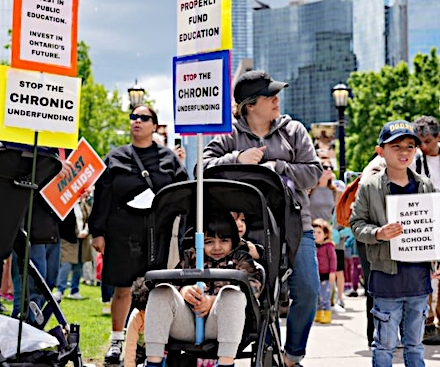
    Usurping trustees according to University of Ottawa professor Sachin Maharaj is just another step toward the Progressive Conservatives’ goal to “squelch the pipeline of more progressive leaders” like those gaining notice and experience attending to the needs of local schools.

    The banning of the Toronto Muslim Student Alliance’s screening of the film No Other Land, which documents Israeli settler violence, shows how censorship now masquerades as neutrality. This is the pedagogy of repression in action: narrowing what can be taught, remembered, or discussed until education is reduced to obedience training. What parades as a “broader rethink” is part of the authoritarian language of censorship and control. Like Trump’s attacks on “critical race theory” or his censorship of the Smithsonian, Ford’s moves are not about protecting students from politics but about protecting power from critique. The real issue here is constructing authoritarian policies that narrow critical thinking, teacher autonomy, essential funding, and knowledge that enable schools to both defend and facilitate democracy.

    For Ford and his adherents, the real issue is not that schools are failing but that they are public and have a vital role to play in a democracy. The real threat to Ford is that a democracy can only exist with informed citizens. Yet that is precisely the role education should assume.

    Bill 33: Codifying Authoritarianism

    The perversely named Bill 33, the Supporting Children and Students Act extends this authoritarian logic. It allows the Minister to investigate boards or trustees on the mere suspicion they might act “inappropriately” or against the “public interest” – an elastic phrase that grants unchecked power. It checks much-maligned Diversity Equity and Inclusion efforts by refusing boards the right to name schools, forcing them to abandon diversity-affirming figures in favor of colonial or sanitized names. It mandates the reintroduction of police officers into schools, despite community opposition to surveillance and “unaccountable access to youth by cops.”

    At work here is the legacy of colonialism, a legacy that is terrified of diversity, of those deemed other, being able to narrate themselves. Viewed as threat, this anti-democratic language ultimately falls back on issues of control and security. This is one instance of how authoritarianism consolidates itself, not through tanks in the streets but through legislation that transforms education into an arm of the security state. Pedagogical spaces are militarized, memory is policed, and students are taught that surveillance is normal and dissent dangerous.

    Trumpasitic Authoritarianism

    Ford’s methods echo those of his southern counterpart. Just as Trump’s politics thrive on dispossession, erasure, and the weaponization of culture, Ford borrows from the same authoritarian playbook. The takeover of school boards not only tightens political control but also grants easy access to billions of dollars in public land, enriching developers tied to his government. Here, neoliberal profiteering fuses seamlessly with authoritarian centralization, an example of the merging of gangster capitalism with the pedagogy of repression.

    What do you expect from a government that makes decisions reflecting the arrogance of power? The Ford government cut Toronto city council in half soon after took office in 2018 and threatened to use a constitutional override, the Notwithstanding Clause, Section 33 of Canada’s Charter of Rights and Freedoms, to overturn a Superior Court justice’s decision that the move was unconstitutional. Ford actually used the clause to push through a bill restricting election advertising in 2021 and again, pre-emptively, in 2022, buttressing back-to-work legislation against striking public workers, among the lowest paid in the province. He’s considering using it again after his decision to remove bike lanes from Toronto streets was overturned in court; power makes you petty.

    Democracy in the Smallest Details

    The takeover of Ontario school boards may appear less dramatic than Trump’s assaults on national institutions, but its implications are just as dire. Authoritarianism advances not only through spectacle but through the slow erosion of local democratic practices that once seemed secure.

    If fascism is a pedagogy of fear, amnesia, and conformity, then resistance must be a pedagogy of memory, solidarity, and imagination. To defend education is to defend democracy itself, for schools are not simply sites of instruction but laboratories of citizenship, places where young people learn what it means to speak, to question, to remember, and to act. When trustees are silenced, when curricula are censored, when communities are stripped of their voice, what is lost is not only oversight but the very possibility of democratic life.

    What is at stake, then, is far larger than budget shortfalls or bureaucratic reshuffling. It is whether the future will be governed by communities or dictated from above by those who mistake obedience for learning and silence for peace. Fascism thrives in these small erasures, in the details that seem technical until they harden into structures of domination.

    The lesson could not be clearer: democracy dies in increments, but it can also be rebuilt in increments – through collective memory, through civic courage, through the refusal to allow education to become a weapon of obedience. To resist the Ford government’s authoritarian incursions is not only to protect local school boards; it is to reclaim the very ground on which democratic hope stands. •

    Henry A. Giroux currently is the McMaster University Professor for Scholarship in the Public Interest and The Paulo Freire Distinguished Scholar in Critical Pedagogy. His most recent books include The Violence of Organized Forgetting (City Lights, 2014), Dangerous Thinking in the Age of the New Authoritarianism (Routledge, 2015), coauthored with Brad Evans, Disposable Futures: The Seduction of Violence in the Age of Spectacle (City Lights, 2015), and America at War with Itself (City Lights, 2016). His website is henryagiroux.com.

    William Paul is editor of School Magazine website.

    This article first appeared at the Social Project Bullet

    Source link

  • New HEPI Policy Note: Universities’ role in global conflict

    New HEPI Policy Note: Universities’ role in global conflict

    Author:
    HEPI

    Published:

    With the UK Government moving to a posture of ‘war fighting readiness’ amid intensifying global conflict, a new HEPI Policy Note warns higher education remains an untapped asset in national preparedness.

    The Wartime University: The role of Higher Education in Civil Readiness by Gary Fisher argues UK universities must be recognised as central pillars of national security and resilience. The paper highlights how higher education institutions represent a ‘composite capability’ to enhance and sustain civil readiness, spanning defence, health, skills, logistics and democratic continuity, but warns this potential remains under-recognised and poorly integrated into emergency planning frameworks.

    You can read the press release and access the full report here.

    Source link

  • Elon University and Queens University of Charlotte announce intent to merge

    Elon University and Queens University of Charlotte announce intent to merge

    This audio is auto-generated. Please let us know if you have feedback.

    Dive Brief:

    • Elon University and Queens University of Charlotte plan to merge by summer 2026, the private North Carolina institutions said Tuesday. 
    • While leaders are still ironing out the details, Elon intends to operate Queens “in partnership” with the latter’s leaders once the merger is complete, according to a joint news release. The universities said more details about the new institution’s leadership structure and programming details will be released in early 2026.
    • Leaders from Elon and Queens plan a fall listening tour in the Charlotte area to get feedback on the proposed merger from students, faculty, staff, alumni and civic leaders, and they will use the input to help develop a plan for the combination, the institutions said.

    Dive Insight:

    Elon and Queens, which sit about 115 miles apart, framed their intent to merge as complementary for each institution and a way to help meet the educational needs of the Charlotte area in the coming years. 

    The combination “creates new advantages of scale, bringing together resources, faculty expertise, research capacity and student services across both universities,” they said in the release. 

    The trustees of both institutions unanimously supported the proposed merger and will hold a joint meeting next month ahead of planning for integrating the institutions’ operations, the universities said. The boards are expected to finalize the partnership details in November.

    Students at both universities will be able to continue their programs uninterrupted, according to a merger FAQ.

    Elon is by far the larger institution, and the one on a growth trajectory. Between 2018 and 2023, fall enrollment rose 3.1% to 7,207 students. During that same period, Queens’ fall headcount dropped 27.2% to 1,846.

    Of the two institutions, Elon also has deeper financial resources, with assets amounting to $1.3 billion in fiscal 2024 compared to $337.8 million for Queens. 

    Queens’ budget has suffered from falling tuition revenues and a decline in government grants and contracts, in addition to rising expenses. In 2024, it reported a total deficit of $8.7 million. Meanwhile, Elon logged a hefty surplus of $70.4 million during the same year.

    But in the FAQ, the universities said their plan to merge did not stem from financial distress and is “not driven by crisis.”

    Instead, they pointed to the workforce needs of the Charlotte area, noting growing demand for graduate degrees as well as a growing shortage of nurse practitioners, physician assistants and lawyers in the area.

    The merger would “accelerate new programs across vital industries” and expand access to Elon’s law school in Charlotte — the only one in the city today, the institutions said.

    Queens has deep roots in Charlotte. It was founded in 1857, initially as a women’s college before becoming fully coed in the 1980s. Elon was founded in the city of the same name in 1889.  

    Queens has long been a leader in undergraduate and graduate education, deeply connected to Charlotte’s civic and business community and committed to shaping the region and nation through thought leadership,” Jesse Cureton, who took over as acting president of Queens this summer, said in a statement. 

    He added that the merger with Elon “ensures continuity for our students and faculty while creating bold new opportunities to expand our impact and strengthen Charlotte’s role as a hub for higher education.” 

    Elon President Connie Ledoux Book said that the combination “unites two institutions deeply committed to student success, and together, we will expand relevant, high-impact programs that connect academic excellence with real-world opportunity in service to the Charlotte region.”

    Source link