Blog

  • Higher Education Inquirer covered Charlie Kirk and Turning Point for nearly a decade

    Higher Education Inquirer covered Charlie Kirk and Turning Point for nearly a decade

    For almost a decade, the Higher Education Inquirer investigated right wing influencer Charlie Kirk and his Turning Point Empire.  Kirk was groomed by Bill Montgomery (a surrogate for Richard Nixon in Florida for Nixon’s Reelection Campaign) and Steve Bannon when Bannon was at Breitbart. Kirk quickly learned the dirty tricks of the Nixon-Reagan era and the dog whistles of white supremacy and misogyny. He also quickly gained funding from right wing billionaire Foster Freiss. 

    In mid-2016, we communicated our concerns with Michael Vasquez at Politico, who later moved on to the Chronicle of Higher Education (CHE).  CHE later reported that Kirk created a plan to win student elections using outside (illegal) money. We also contacted the Southern Poverty Law Center and the Anti-Defamation League who both listed TPUSA as a hate group. 

    For nearly a decade and a half, Kirk and Turning Point USA incited violence on campus and on social media through its playbook of dirty tricks, racist and sexist agitation, and surveillance.  That’s why we warned folks not to engage with TPUSA before this semester started. 

    As we reported in 2018:

    Charlie Kirk, with no evidence whatsoever, alleged that a less qualified woman of color took his slot at West Point.

    Source link

  • Energy Department withdraws controversial Title IX athletics rule

    Energy Department withdraws controversial Title IX athletics rule

    The U.S. Department of Energy canceled plans to issue a rule that would have removed a regulatory requirement for colleges and schools receiving funding from the agency. The requirement in question is meant to level the playing field between women and men in athletics. 

    The Energy Department’s rule would have no longer required colleges and schools receiving Energy Department funding to provide women or girls a chance to try out for contactless men’s or boys’ sports teams in cases where no equivalent sports team exists for them.

    Under current requirements, for example, girls must be allowed to try out for spots on the boys’ baseball team if there is no girls’ softball team. 

    In May, the Trump administration quietly proposed rescinding this requirement, along with a handful of other regulatory changes, by issuing a “direct final rule.” That process is usually reserved for uncontroversial regulations that are not expected to receive pushback, allowing an agency to issue new policies without incorporating changes based on public feedback. 

    On Sept. 10, however, the Energy Department said it was withdrawing the proposed change entirely after it received over 21,000 comments — many of them opposing the changes. The rescission came after the administration initially delayed the rule’s July 14 effective date until Sept. 12 amid significant pushback. 

    The withdrawal was celebrated by Title IX civil rights advocates, who worried the rule would reverse progress for girls and women in sports.

    However, a handful of other changes remain — albeit delayed — on the Energy Department’s docket that would impact colleges and schools receiving the agency’s grants. 

    For example, the agency still plans to move forward with a rule that would no longer require colleges and schools to prevent systemic racial discrimination that may result from seemingly neutral policies.The Energy Department has twice delayed that proposal’s effective date as a result of pushback, most recently to Dec. 9

    “Withdrawing the athletics rule shows that public pressure works, but continuing forward with the other rules shows this administration is still determined to chip away at opportunities for women, girls, and communities of color,” said Shiwali Patel, senior director of safe and inclusive schools at the National Women’s Law Center, in a Sept. 9 statement. “Rescinding these other rules will deepen inequities in education and beyond.” 

    Patel and other education civil rights experts have expressed concern over the rules being issued through an expedited process. 

    The Energy Department did not comment in time for publication. However, it said in its notice of the proposal’s withdrawal that it is allowed to propose a rule in the future “that may be substantially identical or similar to those previously proposed.” 

    The administration’s decision to release the proposed rules through the Energy Department and attempt to push them through quickly marks a shift from typical K-12 policymaking, which is usually left to the U.S. Department of Education, some education experts said in July. 

    It could have been a trial run: Had the Energy Department’s proposals gone uncontested, it’s possible other agencies would have also tried setting education policy this way, they said. 

    “This is a paradigm shift on the part of how the federal government articulates and connects some of these tools to their education priorities,” Kenneth Wong, an education policy professor at Brown University, said in July, when the rules were originally set to take effect. “Basically every single school, in practically every single school district, has some grants from one of the many agencies in the federal government.” 

    Source link

  • Trump Administration Withholds Millions for TRIO Programs

    Trump Administration Withholds Millions for TRIO Programs

    Normally, back-to-school season means that the staff who lead federally funded programs for low-income and first-generation college students are kicking into high gear. But this month, the Trump administration has frozen hundreds of millions of dollars in TRIO grants, creating uncertainty for thousands of programs. Some have been forced to grind to a halt, advocates say.

    Colleges and nonprofits that had already been approved for the award expected to hear by the end of August that their federal funding was on its way. But rather than an award notice, program leaders received what’s known as a “no cost extension,” explaining that while programs could continue to operate until the end of the month, they would not be receiving the award money. 

    Over all, the Council for Opportunity in Education, a nonprofit advocacy group that focuses on supporting TRIO programs, estimates that the Trump administration has withheld about $660 million worth of aid for more than 2,000 TRIO programs. (Congress allocated $1.19 billion to TRIO for the current fiscal year.) 

    As a result of the freeze, COE explained, many colleges and nonprofit organizations had to temporarily pivot to online services or shutter their programs and furlough staff. Roughly 650,000 college students and high school seniors will lack vital access to academic advising, financial guidance and assistance with college applications if the freeze persists, they say.

    “For many students, these first few weeks of the year are going to set the trajectory for their whole semester, especially if you’re an incoming freshman,” said COE president Kimberly Jones. “This is when you’re making critical choices about your coursework, trying to navigate the campus and just trying to acclimate to this new world. If you’re first-gen, you need the guidance of a program to help you navigate that.”

    Jones said that Education Department officials said this week that the pause is temporary. However, the Department of Education did not immediately respond to Inside Higher Ed’s request for comment Friday.

    TRIO Under Threat

    Originally established in the 1960s, TRIO now consists of seven different programs, each designed to support various individuals from disadvantaged backgrounds and help them overcome barriers of access to higher education.  

    Not all the TRIO programs have had funding withheld. Roughly 1,300 awards for certain programs—such as Upward Bound Math-Science, Student Support Services and any general Upward Bound projects with a June 1 start date—were disbursed on time, Jones said. But that’s only 40 percent of the more than 3,000 TRIO programs.  

    Other programs, including Upward Bound projects with a Sept. 1 start date, Veterans Upward Bound, Educational Opportunity Centers and Talent Search, are still waiting for checks to land in their accounts.

    Policy experts added that funding for the McNair Postbaccalaureate Achievement program, a TRIO service focused on graduate students, also has yet to be distributed. But unlike most of the programs, funding for McNair is not due until Sept. 30. Still, Jones and others said they are highly concerned those funds will also be frozen.

    Given the unpredictability of everything this year around education, we can’t make any assumptions. Until we get those grants in the hands of our constituents, we have to assume the worst.”

    —COE president Kimberly Jones

    President Donald Trump proposed cutting all funding for TRIO in May, saying that the executive branch lacks the ability to audit the program and make sure it isn’t wasting taxpayer dollars. But so far, House and Senate appropriators have pushed back, keeping the funding intact. 

    When confronted by Sen. Susan Collins, a Maine Republican and longtime TRIO advocate, at a budget hearing in June, McMahon acknowledged that “Congress does control the purse strings,” but went on to say that she would “sincerely hope” to work with lawmakers and “renegotiate” the program’s terms. 

    And while advocates hope that funds will eventually be reinstated, most experts interviewed remain skeptical. With 18 days left until the end of the fiscal year, any unallocated TRIO funds will likely be sent back to the Department of Treasury, never to reach the organizations they were intended for. 

    The Trump administration has tried to freeze or end other education-related grant programs—including a few TRIO programs that were cut off in June—which officials said “conflict with the Department’s policy of prioritizing merit, fairness, and excellence in education; undermine the well-being of the students these programs are intended to help; or constitute an inappropriate use of federal funds.”

    And while some of the funding freezes have been successfully challenged in court, the judicial process needed to win back federal aid is slow. Most colleges don’t have that kind of time, the advocates say.

    “Given the unpredictability of everything this year around education, we can’t make any assumptions,” Jones said. “Until we get those grants in the hands of our constituents, we have to assume the worst.”

    ‘Crippling’ Effects 

    For Summer Bryant, director of the Talent Search program at Morehead State University in Kentucky, the funding freeze has been “crippling.”

    Talent Search is a TRIO program focused on supporting middle and high school students with college preparation. And while the loss of about $1 million hasn’t forced Bryant to shut down her program quite yet, it has significantly limited her capacity to serve students.

    After paying the program’s 10 staff members for the month of September, Bryant has just over $1,000 left—and that’s between both of the grants she received last year.

    “It may sound like a lot, but when you take into account that we’re providing services to eight counties and 27 target schools, coupled with the fact that driving costs about 50 cents a mile and some of our schools one-way are almost 120 miles away, that’s not a lot of money,” she said. “So instead, I had to make a Facebook post notifying our students and their guardians that we would be pausing all in-person services until we receive our grant awards.”

    Even then, Morehead TRIO programs are based in a rural part of Appalachia, so broadband access and choppy connections are also a concern. 

    “Doing things over the phone or over a Zoom is just not as effective as doing it face-to-face—information is lost,” Bryant said. And because this freeze is happening during the most intensive season for college applications, “even a one month delay could lead to a make-or-break moment for a lot of our seniors,” she added.

    It’s not just Bryant facing these challenges. Of Morehead’s nine preapproved TRIO grants, only four have been awarded. The same scenario is playing out at campuses across the country.

    Democratic senators Jeff Merkley of Oregon and Raphael Warnock of Georgia, along with 32 other lawmakers from both sides of the aisle, demanded in a letter sent Wednesday that the administration release the funds. Collectively, they warned that failure to do so “will result in irreversible damage to our students, families, and communities, as many rely on the vital programs and services provided by TRIO programs.”

    They wrote that TRIO has produced over six million college graduates since its inception in 1964, promoting a greater level of civic engagement and spurring local economies. 

    “The data proves that TRIO works,“ the senators stressed. “Students’ futures will be less successful if they do not receive their appropriated funds immediately.” 

    Rep. Gwen Moore, a Wisconsin Democrat and TRIO alumna, and 53 fellow House members sent a similar letter the same day.

    The freeze is hitting community colleges particularly hard; they receive half of all TRIO grants, said David Baime, senior vice president for government relations at the American Association of Community Colleges.

    Baime said he has “no idea” why the department is withholding funds and added that while he is hopeful the federal dollars will be restored, there is an “unusual degree of uncertainty.”

    Between a handful of TRIO grants that were terminated with little to no explanation earlier in the year and the recent decision to cancel all grant funding for minority-serving institutions, worries among TRIO programs are high, Jones from COE and others said.

    Still, Baime is holding out hope.

    “The department has gone on record saying that fiscal year 2025 TRIO funds would be allocated,” he said. “So despite the very concerning delays, we remain optimistic.”


    Source link

  • 3 More Faculty, Staff Removed for Kirk Comments

    3 More Faculty, Staff Removed for Kirk Comments

    Photo illustration by Inside Higher Ed | LeoPatrizi/E+/Getty Images

    At least five faculty and staff members have been fired so far for comments they made in response to the death of Turning Point USA founder and conservative firebrand Charlie Kirk, who was shot and killed Wednesday during an event at Utah Valley University. 

    Investigators announced Friday they arrested a suspect, 22-year-old Tyler Robinson, who is now being held in a Utah jail without bail. Utah governor Spencer Cox said during a press conference Friday that a family friend turned Robinson in to authorities after the suspect suggested to a relative that he’d killed Kirk. Robinson was not a student at Utah Valley.

    The Utah Board of Higher Education said in a statement that Robinson is a third-year student in the electrical apprenticeship program at Dixie Technical College and that he attended Utah State University for one semester in 2021.

    Among the latest college employees terminated for their responses to Kirk’s killing, Lisa Greenlee was removed as a part-time instructor from Guilford Technical Community College in Jamestown, N.C., on Thursday after she made comments criticizing Kirk to students during an online class, saying, “I’ll praise the shooter; he had good aim.” A video of her remarks made the rounds on X, where right-wing accounts encouraged the college to fire her.

    “We deeply regret that students, employees, and the community were impacted by her comments. Greenlee’s behavior is not consistent with the college’s values and mission to serve Guilford County. Her statement regarding the assassination of Charlie Kirk does not support the open and respectful learning and working environment that GTCC provides every day,” GTCC president Anthony Clarke said in a statement. “We want to reiterate that supporting violence is reprehensible and will not be tolerated at the college.” Greenlee did not respond to Inside Higher Ed’s request for comment. 

    Two employees at Cumberland University in Lebanon, Tenn., were dismissed Thursday for making “inappropriate comments on the internet related to the tragic shooting of Charlie Kirk,” university president Paul Stumb wrote in a statement posted on X. He identified the employees as Michael Rex, an English and creative writing professor, and Max Woods, an assistant esports coach, but he did not share what they said. Like Greenlee, both had been the subject of online campaigns advocating for their firing. 

    “This decision was not made lightly,” Stumb wrote. “We understand the importance and the impact of this action, and we want to emphasize that we conducted a comprehensive investigation prior to making our decision.” 

    Before Stumb’s statement was publicized, Rex posted an apology on his Facebook page. “No one deserves to be murdered,” he wrote. “I did not think about the pain and anger that my words would create. My comments were not meant to celebrate nor to foster political violence and for any traums [sic] my words caused, I am truly sorry.” Rex and Wood did not respond to Inside Higher Ed’s request for comment.

    The recent firings follow the dismissals of Laura Sosh-Lightsy, a student affairs administrator at Middle Tennessee State University, and an unnamed staff member at the University of Mississippi.

    A Clemson university professor is also subject to an ongoing push by X users to have him fired for statements on Kirk’s death. On Friday afternoon, the university posted a statement that alluded to the situation. “We stand firmly on the principles of the U.S. Constitution, including the protection of free speech. However, that right does not extend to speech that incites harm or undermines the dignity of others. We will take appropriate action for speech that constitutes a genuine threat which is not protected by the Constitution.”

    Source link

  • Energy Department withdraws controversial Title IX athletics rule

    Energy Department withdraws controversial Title IX athletics rule

    This audio is auto-generated. Please let us know if you have feedback.

    The U.S. Department of Energy canceled plans to issue a rule that would have removed a regulatory requirement for schools receiving funding from the agency. The requirement in question is meant to level the playing field between boys and girls in athletics. 

    The Energy Department’s rule would have no longer required schools receiving Energy Department funding to provide girls a chance to try out for contactless boys’ sports teams in cases where no equivalent sports team exists for them. Under current requirements, for example, girls must be allowed to try out for spots on the boys’ baseball team if there is no girls’ softball team. 

    In May, the Trump administration quietly proposed rescinding this requirement, along with a handful of other regulatory changes, by issuing a “direct final rule.” That process is usually reserved for uncontroversial regulations that are not expected to receive pushback, allowing an agency to issue new policies without incorporating changes based on public feedback. 

    On Sept. 10, however, the Energy Department said it was withdrawing the proposed change entirely after it received over 21,000 comments — many of them opposing the changes. The rescission came after the administration initially delayed the rule’s July 14 effective date until Sept. 12 amid significant pushback. 

    The withdrawal was celebrated by Title IX civil rights advocates, who worried the rule would reverse progress for girls and women in sports.

    However, a handful of other changes remain — albeit delayed — on the Energy Department’s docket that would impact schools receiving the agency’s grants. 

    For example, the agency still plans to move forward with a rule that would no longer require schools to prevent systemic racial discrimination that may result from seemingly neutral policies.The Energy Department has twice delayed that proposal’s effective date as a result of pushback, most recently to Dec. 9

    “Withdrawing the athletics rule shows that public pressure works, but continuing forward with the other rules shows this administration is still determined to chip away at opportunities for women, girls, and communities of color,” said Shiwali Patel, senior director of safe and inclusive schools at the National Women’s Law Center, in a Sept. 9 statement. “Rescinding these other rules will deepen inequities in education and beyond.” 

    Patel and other education civil rights experts have expressed concern over the rules being issued through an expedited process. 

    The Energy Department did not comment in time for publication. However, it said in its notice of the proposal’s withdrawal that it is allowed to propose a rule in the future “that may be substantially identical or similar to those previously proposed.” 

    The administration’s decision to release the proposed rules through the Energy Department and attempt to push them through quickly marks a shift from typical K-12 policymaking, which is usually left to the U.S. Department of Education, some education experts said in July. 

    It could have been a trial run: Had the Energy Department’s proposals gone uncontested, it’s possible other agencies would have also tried setting education policy this way, they said. 

    “This is a paradigm shift on the part of how the federal government articulates and connects some of these tools to their education priorities,” Kenneth Wong, an education policy professor at Brown University, said in July, when the rules were originally set to take effect. “Basically every single school, in practically every single school district, has some grants from one of the many agencies in the federal government.” 

    Source link

  • UW-Stevens Point partners with community college to shore up struggling branch

    UW-Stevens Point partners with community college to shore up struggling branch

    Dive Brief:

    • The University of Wisconsin-Stevens Point is teaming up with a community college to share space, offer joint programming and develop transfer pathways between the institutions. 
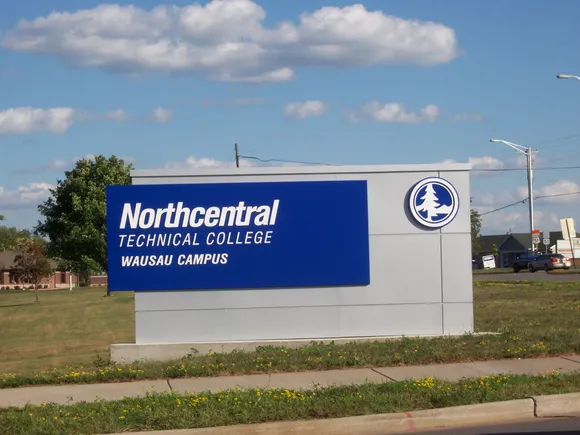
    • Under the partnership, UW-Stevens Point’s Wausau branch will relocate to nearby Northcentral Technical College’s campus in the city beginning in fall 2026. 
    • Through the partnership, the university plans to increase degree programs in Wausau in high-demand fields like healthcare and business. For example, the two institutions are discussing collaborating on a surgical technician program, they said.

    Dive Insight:

    The partnership between UW-Stevens Point and NTC comes after years of steep enrollment decline at the university’s Wausau location and questions about the branch’s viability. 

    Between fall 2011 and fall 2023, full-time equivalent enrollment at UW-Stevens Point’s Wausau campus fell by a vertiginous 78.5% to just 232 students, according to institutional evaluations of the Universities of Wisconsin system by Deloitte last year. 

    The university’s Marshfield campus suffered a similar decline. Deloitte’s assessment of both campuses was that the sharp enrollment drop-offs “threaten the future viability” of those locations. 

    It also added pressure to the university as a whole. Without making operational changes, Deloitte forecast UW-Stevens Point would face mounting deficits in the years ahead. 

    NTC has also seen declines in recent years. Between 2018 and 2023, fall headcount declined 8.7% to 5,838 students at the technical college, per federal data.

    The institutions hope that joining forces can help play to their strengths while offering students new reasons to attend each college. The UW-Stevens Point branch will offer bachelor’s and master’s degrees while NTC offers associate degrees and certificates. 

    “Students will have a seamless connection between UWSP and NTC,” Miranda Gentry-Siegel, executive of UW-Stevens Point’s Wausau campus. “Advisers from both schools will work together to find options that fit students’ interest and finances.”

    The institutions also pointed to the potential for joint programs, collaboration between faculties on program design, combined student support services, and cost savings by reducing duplicated programs and services.

    Faculty from UW-Stevens Point will stay employees of the university upon moving to teach at NTC’s campus, according to a FAQ page. It also signaled the possibility that some staff positions could be cut, noting that those who lose their positions will be “given the opportunity” to pursue jobs elsewhere in UW-Stevens Point or in the county government. 

    The university is working with Marathon County to determine future use of its current campus, which is about two miles from NTC.

    After the move to NTC’s facilities, UW-Stevens Point will end its varsity sports programs in men’s basketball and women’s volleyball through the Wisconsin Competitive Sports League, the university said.

    Several branch campuses within the Universities of Wisconsin system have shuttered in recent years. UW-Milwaukee closed its campus in Washington County in 2024 and its Waukesha campus this summer. However, the university is opening a center at Waukesha County Technical College to offer bachelor’s and graduate programs. 

    Additionally, UW-Platteville closed its Richland campus in 2023, and UW-Oshkosh shuttered its Fond du Lac branch in 2024.

    Source link

  • We are in the cancel culture part of the tragedy cycle

    We are in the cancel culture part of the tragedy cycle

    First, two children lost their father and a wife her husband. Then people lost their humanity. And now, a nation loses another piece of its soul. This part of the cycle is its own special kind of awful: the cancel culture machine.

    It goes like this: A tragedy happens. Someone reacts by celebrating that tragedy for whatever reason. Then the social media mob comes to demand this person be fired, expelled, or otherwise punished for their views.

    Time and time again, we resort to this mob mentality when tragedy strikes. When Barbara Bush died. When the Queen diedRush LimbaughOtto WarmbierGeorge Floyd. After 9/11. After October 7. The attempted assassination of Donald Trump.

    As free speech advocates, it places us in a painful position. Charlie Kirk’s assassination was an attack on free speech and open discourse. In a free society, we must not be afraid to express our views, no matter how strongly some might oppose them. That’s the point of free speech. But it is precisely for that reason why we must not respond to mockery of Kirk’s assassination by canceling everyone who offends us: because that too creates a society where people are afraid to express themselves.

    Cancel culture ends when we decide that people can be horrifically wrong and still entitled to the grace that enables us all to grow from our worst moments. 

    Among the people targeted in the aftermath of Kirk’s heinous murder include:

    Businesses

    • The Carolina Panthers have fired a PR staffer for social media posts.
    • A DC comic book writer has had her series cancelled for her social media posts.
    • PHNX Sports has fired a staff writer for his posts.
    • The general manager of a burger restaurant in Quincy, Illinois, was fired for a post.
    • A restaurant in Wayzata, Minnesota, said it would review security camera footage and fire any employee seen to have celebrated.
    • Wausau River District has fired their executive director over her social media post.
    • A political contributor to MSNBC was fired over his on-air comments; Cumberland University in Lebanon, Tennessee, subsequently cancelled a scheduled speech.

    Schools and universities

    • The Florida Department of Education has said it would investigate every teacher who makes “disgusting comments” about the tragedy.
    • An assistant dean of Middle Tennessee State University has been fired for a social media post.
    • Naples (NY) Central School District has started a formal investigation of one staff member’s posts.
    • A cheerleading coach from Meridian (ID) High School was fired over a video.
    • A teacher at Ridgeview Elementary School in Lakeside, Florida, has been suspended for her posts.
    • A teacher at Greenville (SC) County Schools was suspended and then terminated for his post after a member of congress called for his firing.
    • A teacher at Lake Norman Charter School in Huntsville, North Carolina, has been placed on leave pending an investigation of his post.
    • A teacher at Gaston County (NC) Schools is under investigation for their post.
    • A teacher at the School District of Lancaster (PA) is facing some action, described as a “personnel matter,” for their posts.
    • A teacher at Lee County (FL) School District is being investigated for their post.
    • The University of Mississippi fired an executive assistant over her post, after a member of the state house said he would vote against continued university funding until her firing.
    • Linden (NJ) Public Schools had to shelter in place after the school received threats because a post was erroneously claimed to have been written by an employee. In reality, the author never worked there.
    • A teacher at Wachusett (MA) Regional School District has been suspended for her social media posts.
    • A teacher at Framingham (MA) Public School District has been suspended for her social media video.
    • A teacher at Vassar (MI) Public Schools has been suspended for her social media posts.
    • A teacher at Oksaloosa (IA) High School has been suspended for his social media post after U.S. Rep. Marionette Miller-Meeks promised to contact the school.
    • A teacher at the Cleveland Heights-University Heights (OH) School District has been suspended for alleged social media posts.
    • A professor at East Tennessee State University has reportedly been suspended after state lawmakers complained about his posts.

    Legislators and government officials

    • The U.S. State Department has warned that it will review the legal status of immigrants who mock the tragedy.
    • U.S. Sen. Marsha Blackburn and U.S. Rep. Andy Ogles have called for the firing of a Cumberland University professor over his post.
    • U.S. Rep. Lauren Boebert has called for the firing of a Colorado Department of Health staffer for a social media post.
    • U.S. Rep. Riley Moore has called on West Virginia University to remove a state lawmaker from a gender equity council based on her posts.
    • A Michigan state senator has demanded a University of Michigan professor be fired for his post.
    • A Virginia state senator has demanded a dean at the Chesterfield School Board be fired for her posts.
    • A Texas state senator has demanded a teacher be fired for liking someone else’s post.
    • A city councilman in Jacksonville, Florida, called for the removal of a city appointee over a now-deleted post.
    • A South Carolina state lawmaker called for the firing of a Clemson University professor over his posts.
    • The Louisiana attorney general is calling for the firing of a New Orleans firefighter for a now-deleted post.
    • The Toledo Fire Department is investigating one firefighter’s post. 

    Have no doubt: There will be more. 

    A website is actively soliciting reports of posts “celebrating Charlie’s death” to preserve them for, presumably, posterity. (Take my word for it or don’t. Linking the website would tend to undermine the larger goal here.)  And in a counter-cancellation remarkable for its willingness to victim-blame, a Tennessee lawmaker has called for all events by Kirk’s organization, Turning Point USA, to be cancelled “out of fear of violence and threat to public safety.” 

    When state lawmakers and officials make demands to employers to fire people for their speech, those demands can violate the First Amendment. When private people and businesses do the same, it undermines the culture of free expression we all want to cultivate. To be clear, a business owner can fire employees for any lawful reason. At times, a misalignment of values or a need to retain customers will be those perfectly legitimate reasons. But performative firings are participation in a cancel culture that undermines American values.

    Violence must never be a response to speech

    America must be an open society where we feel safe to share our ideas in the public square, not just from behind bulletproof glass and bulletproof vests.


    Read More

    None of us are immune to these instincts. Kirk’s organization, Turning Point USA, maintains a Professor Watchlist. As we noted back when it was launched in 2016, the watchlist is protected speech. But as we also noted and predicted, the watchlist has been used to call for sanctions on professors for their protected academic expression, contributing to the scourge of cancel culture. We have opposed those calls, too.

    Governments and lawmakers must do better. The rest of us should do better, too. 

    When someone indulges their worst impulses after a tragedy, we should use our own voices to challenge them. Or if we’re really courageous, we can be like Daryl Davis, a black musician and activist who through love, compassion, and constructive dialogue has convinced dozens of people to leave and denounce the Ku Klux Klan. We should remember we don’t win an argument by ruining someone’s life. We just ruin someone’s life. 

    We are not so fortunate, in this imperfect world, that Charlie Kirk’s murder is the last tragedy we experience. Nor is it the last time that some of us take a moment that calls for compassion and fill it with vitriol. If we (as a society) were to wait for either of those things to stop being true before ending cancel culture, that’s the same as ceding freedom of speech to the assassins and the mobs. 

    Cancel culture ends when we decide that people can be horrifically wrong and still entitled to the grace that enables us all to grow from our worst moments. 


    Source link

  • Student acceptance of violence in response to speech hits a record high

    Student acceptance of violence in response to speech hits a record high

    The sickening assassination of Charlie Kirk at a campus speech this week has brought attention to worrying trends in political violence and the public’s stated support for it. 

    According to FIRE’s annual College Free Speech Rankings survey, in 2020, the national average showed about 1 in 5 students said it was ever acceptable to use violence to stop a speaker. That number has since risen to a disturbing 1 in 3 students.

    While we have seen no evidence that Kirk’s shooter is a student, there’s no doubt that the 50% increase in this level of support for political violence among college students over the last 5 years has broad implications for the future of the country.

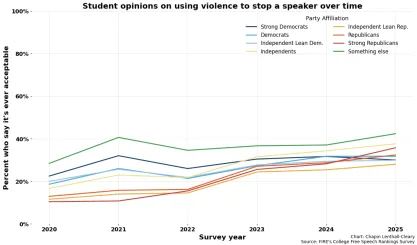
    When we subdivide by party affiliation, we see a more complete story, but the trends are roughly the same.

    Student opinions by party

    Students who identify as “Strong Democrats” are one of the few groups that haven’t markedly increased in support for using violence to stop a speaker, but only because they started at a higher rate of acceptance. Once the second most accepting of violence, they are now the second least accepting, thanks to a rise in acceptance by other groups. In other words, they didn’t get better — everyone else got worse. But consistently the worst group of all remains those who identify as “Something else.” 

    The portions of “Strong Republicans” and “Republicans” who accept the use of violence to stop a speaker have more than tripled in four years. Even acceptance among “Independents” has more than doubled. To give you a sense of how bad things have gotten, the group that currently accepts violence the least, Republican-leaning independents, would have ranked alongside those who accepted it the most back in 2020.

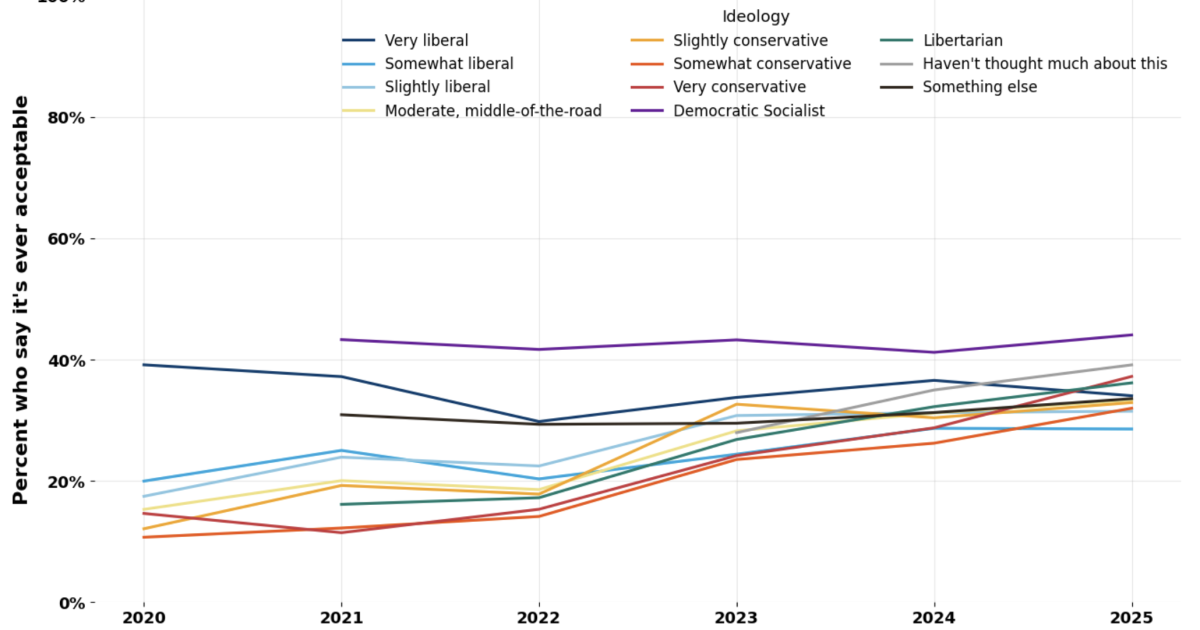
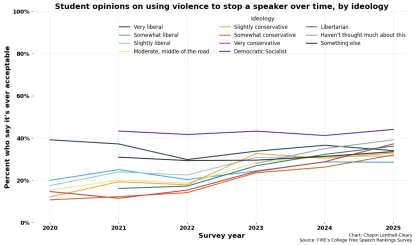
    Now let’s take a closer look at the problem by switching from party affiliation to examining specific ideologies:

    Student opinions by ideology

    Those students who are the furthest to the left have been the most accepting of violence for as long as we’ve asked the question. That includes very liberal and democratic socialist students. But a rising tide of acceptance of violence has raised all boats. Now, regardless of party or ideology, students across the board are more open to violence as a way to shut down a speaker. What was once an extreme and fringe opinion has become normalized.

    Where do we go from here? Violence is antithetical to free speech, and political violence is wholly incompatible with — and toxic to — democracy. As FIRE Executive Vice President Nico Perrino put it, it is a cancer in our body politic. Hopefully, the horrific image of the assassination of a young father, in front of his family, during a campus speech will show students who say they support violence what that actually looks like in practice.

    The great innovation of free speech is that we settle disputes with words and arguments, not violence. Too many have turned away from this principle. For the sake of all Americans, we must return to it.

    Source link

  • When Emergency Departments Are Waiting Rooms, Patients Suffer

    When Emergency Departments Are Waiting Rooms, Patients Suffer

    Home » Careers in Nursing » When Emergency Departments Are Also Waiting Rooms, Patients and Providers Suffer

    Emergency department boarding — when stabilized patients wait hours or days for transfers to other departments — is a growing crisis.

    Ryan Oglesby, Ph.D., M.H.A., RN, CEN, CFRN, NEA-BC

    President, Emergency Nurses Association

    An elderly woman arrives in the emergency department with a fractured hip. Nurses and doctors assess and stabilize her, and the decision is made to admit her for additional treatment.

    The patient waits.

    An adolescent experiencing a mental health crisis arrives, is assessed and stabilized, but needs to be transferred to a psychiatric hospital for further care.

    The patient waits.

    Every day, patients in similar situations wait in emergency departments not equipped for extended inpatient-level care until they can be moved to a bed elsewhere in the hospital or to another facility.

    The Emergency Department Benchmark Alliance reports the median waiting time, called ED boarding, is approximately three hours. However, many patients wait much longer, sometimes days or even weeks, and the effects are far-reaching. It has a profound impact on emergency department resources and emergency nurses’ ability to provide safe, quality patient care. 

    Negatives for patients and providers

    When admitted patients remain in the emergency department (ED), nurses juggle inpatient-level care with acute emergencies, leading to heavier and more intense workloads. Although ED nurses are highly adaptable, adjustments to their care approach create further disruptions in what most nurses would already describe as the controlled chaos of the emergency department, where no patient can be turned away.

    Research has shown that admitted patients who board in the emergency department have longer overall length of stays and less-than-optimal outcomes compared to those who are not boarded. 

    Boarding can also exacerbate patient frustration and family concerns about wait times, emotions that often escalate into physical violence against healthcare workers.

    Over time, all of these factors increasingly lead emergency nurses to burn out, while the entire emergency care team’s efficiency and morale erode.

    Many departments adjust processes, staff roles, and use of space to better tend to their boarded patients, but these are not long-term solutions. Boarding is a whole-hospital challenge, not simply one for the emergency department to figure out.

    Recommendations for change

    In 2024, Emergency Nurses Association (ENA) representatives were among the contributors to the Agency for Healthcare Research and Quality summit. The event’s findings point to a need for a collaboration between hospital and health system CEOs and providers, as well as regulation and research to establish standards and best practices.

    ENA also supports passage of the federal Addressing Boarding and Crowding in the Emergency Department Act (H.R. 2936/S. 1974). The ABC-ED Act would provide opportunities for improving patient flow and hospital capacity by modernizing hospital bed tracking systems, implementing Medicare pilot programs to improve care transitions for those with acute psychiatric needs and the elderly, and evaluating best practices to more rapidly implement successful strategies that minimize boarding.

    Boarding is a problem affecting emergency departments, large and small, around the world, but the solutions need to involve decision-makers at the top of the hospital and healthcare systems, as well as front-line healthcare workers who see this crisis firsthand.

    Most importantly, those solutions must focus on doing everything to ensure each patient receives the absolute best care possible in ways that also protect the precious health and well-being of emergency nurses and all staff.

    Source link

  • Operational Efficiency in Hospitals: Impact on Neonatal Nurses

    Operational Efficiency in Hospitals: Impact on Neonatal Nurses

    Home » Careers in Nursing » Operational Efficiency in U.S. Hospitals: Impact on Neonatal Nurses, Patient Safety, and Outcomes

    Operational efficiency in hospitals — the streamlining of staffing, workflows, and resource use — is essential to delivering safe and high-quality care. 

    Taryn M. Edwards, M.S.N., APRN, NNP-BC

    President, National Association of Neonatal Nurses

    At its core, operational efficiency helps reduce delays, minimize risks, and improve patient safety. Nowhere is this more critical than in neonatal intensive care units (NICUs), where even small disruptions can affect outcomes for the most fragile patients. From preventing infections to reducing medical errors, efficient operations are directly linked to patient safety and nurse effectiveness.

    In NICUs, nurse-to-patient ratios and timely task completion are directly tied to patient safety. Studies show that many U.S. NICUs regularly fall short of national staffing recommendations, particularly for high-acuity infants. These shortfalls are linked to increased infection rates and higher mortality among very low-birth-weight babies, some experiencing a nearly 40% greater risk of hospital-associated infections due to inadequate staffing.

    In such high-stakes environments, missed care isn’t just a workflow issue; it’s a safety hazard. Neonatal nurses manage hundreds of tasks per shift, including medication administration, monitoring, and family education. When units are understaffed or systems are inefficient, essential safety checks can be delayed or missed. In fact, up to 40% of NICU nurses report regularly omitting care tasks due to time constraints.

    Improving NICU care

    Efficient operational systems support safety in tangible ways. Structured communication protocols, such as standardized discharge checklists and safety huddles, reduce handoff errors and ensure continuity of care. One NICU improved its early discharge rate from just 9% to over 50% using such tools, enhancing caregiver readiness and parental satisfaction while decreasing length of stay.

    Work environments also matter. NICUs with strong professional nursing cultures and transparent data-sharing practices report fewer safety events and higher overall care quality. Nurses in these units are up to 80% less likely to report poor safety conditions, even when controlling for staffing levels.

    Finally, operational efficiency safeguards nurses themselves. By reducing unnecessary interruptions and missed tasks, it protects against burnout, a key contributor to turnover and medical error. Retaining experienced neonatal nurses is itself a vital safety strategy, ensuring continuity of care and institutional knowledge.

    Ultimately, operational efficiency is a foundation for patient safety, clinical excellence, and workforce sustainability. For neonatal nurses, it creates the conditions to provide thorough, attentive care. For the tiniest patients, it can mean shorter stays, fewer complications, and stronger chances for a healthy start.

    Source link