At least a quarter of students across a broad range of graduate and professional programs could need private loans, which tend to come with higher interest rates, in order to pay for their education once new caps on federal loans take effect next summer, multiple studies show. For some, the loans could become so costly as to make earning a master’s or doctoral degree unattainable.
Currently, this group can borrow federal loans up to the total cost of attendance thanks to a program known as Grad PLUS. But starting July 1, students will max out at either $20,500 or $50,000 per year depending on whether they enroll in a graduate or professional program, respectively. And those in graduate programs will only be able to take out $100,000 over all, while students in professional programs will be limited to $200,000. Congress made the changes as part of the One Big Beautiful Bill Act, which passed earlier this summer.
The caps mean that the median borrower in four of the nine largest professional programs likely will need to find other financing to pay tuition bills, according to a recent analysis from the Postsecondary Education and Economics Research Center at American University. Borrowers in the 75th percentile exceed the cap in six of the nine fields.
And it’s not just the most costly doctoral programs such as medicine and dentistry in which students will face such a challenge, PEER notes. Out of the 30 master’s degree programs with the highest loan volume, 50 percent of students exceed the cap in nearly half of them.
Many of these students could struggle to find a private lender to make up the difference, potentially forcing them to drop out or not enroll in the first place, policy experts at PEER and other research groups say. And even if a student finds a lender, taking out a private loan could lead to steep, sometimes predatory, interest rates that take decades to pay off. (Research shows that low-income individuals particularly struggle to secure private financing because of a range of factors such as low credit scores, a lack of assets or an inconsistent flow of income.)
Before this new law, “students could have just filled out their FAFSA, applied for loans through the Department of Education and been able to borrow up to the full cost of attendance of their program,” said Jordan Matsudaira, director of the PEER Center and a former deputy under secretary at the Department of Education.
But now, for upward of a quarter of graduate students, it likely won’t be that simple.
“I think that will come as a surprise to a lot of people,” he said.
Can Private Lenders Fill the Gap?
Other researchers at Urban Institute and Jobs for the Future have also crunched the numbers on the loan caps and reached similar findings.
Jobs for the Future estimated in a report released last month that if this loan cap had been in place for the 2019–20 graduating class, roughly 38 percent of graduate borrowers would have needed to take out more loans beyond the cap. And thanks to the limit, the federal government would have issued $9.7 billion less in loans—a decrease of about 28 percent, according to the report.
Urban also used data from 2019–20 but broke it down by program, finding that dentistry would have the largest share of students exceeding the cap. About 56 percent would have exceeded the annual limit, and 58 percent blew through the aggregate cap. Other programs with a high share of students that could be pushed into the private market include medicine, at 41 percent, a master’s in public health, at 29 percent, and a master’s in fine arts, at 26 percent.
Policy experts on both sides of the political aisle tend to agree that the student debt crisis needs to be addressed. But unlike conservative lawmakers and analysts who believe these caps are necessary in order to lessen student debt and encourage colleges to lower costs, some researchers worry the limits are too aggressive and don’t account for nuances like a program’s return on investment.
“The kind of pain involved here is a little bit bigger than it needed to be to rein in the most egregious abuses in the system,” Matsudaira said. “The better approach over all would have been to adopt an approach where different fields of study had different limits that were scaled with borrowers’ ability to repay.”
Some questions about how the loan limits will work and which programs they’ll apply to will be answered later this month when the Education Department starts to work through the rule-making process to carry out the law’s provisions. Representatives from nursing, aviation and social work have already started to speak out about why their programs should be considered professional degrees and therefore be eligible for the higher cap.
“In today’s economy, the majority of graduate education is practical and workforce-aligned, preparing students for jobs in health care, education, counseling, technology and much more,” Stephanie Giesecke, a representative of the National Association of Independent Colleges and Universities, said at a public hearing in August. “The definition that is too narrow risks excluding programs that are vitally important to communities and employers nationwide.”
Like Matsudaira, Ethan Pollack, a senior director of policy at JFF, said that while he sympathizes with the Republican diagnosis that debt is too high, he probably would have gone about addressing it a different way. But rather than suggesting changes to the cap itself, JFF’s report looked at the financial impact on borrowers and suggested ways that institutions, the government and private lenders can adjust in response.
One key recommendation was the use of outcomes-based financing for private loans, which would base payments in part on borrowers’ earnings after graduating. Pollack said that this approach could help students who lack strong credit histories or cosigners still pursue well-paying degrees like a juris doctorate.
But current regulations, like requiring a bank to disclose a flat annual percentage rate, or APR, when offering a loan, make it difficult for some private vendors to explore new models like outcomes-based financing, he explained. If the government were to build on the recent legislation by amending current regulations and introducing new guardrails for private lenders, Pollack added, the OBF model could make nonfederal loans more affordable for borrowers of all backgrounds.
“The federal government, in some sense, is stepping on the gas and the brake at the same time,” he said. “They’re saying that they want the private market to be stepping up, but at the same time, the federal government is one of the obstacles to the private market being able to step up in the way that we would all like them to, which is to be offering financing with much more student-friendly terms.”
Matsudaira, on the other hand, was more skeptical.
“The big question is whether the private sector is really going to be able to come in and fill a hole that big,” he said. “And even if they do, how long does it take for them to spin up to be able to do those kinds of things?”
This HEPI blog was authored by Elaine Jackson, Lecturer in Business and Management at the University of the West of Scotland.
Imagine earning a full salary while studying for your degree, graduating debt-free, and having a guaranteed job at the end. This isn’t fantasy, it’s exactly what graduate apprenticeships offer. Yet these programmes represent just 8% of Scotland’s university intake, despite employers desperately needing skilled workers in the very sectors where apprenticeships thrive.
The story of what’s possible starts with people like Donna. Through her graduate apprenticeship with a Local Authority, she delivered a project that secured £280,000 in funding and earned recognition as a nominee for the 2025 Convention of Scottish Local Authorities (COSLA) excellence awards. Her success demonstrates the transformative potential of combining work and study but it also highlights a troubling question: if graduate apprenticeships work so well, why aren’t there more of them?
Graduate apprenticeships (GAs), also known as Degree Apprenticeships (DAs) in the UK, represent a specific model of work-based learning where the apprentice is an employee who is simultaneously studying for a full undergraduate or master’s degree. These programmes typically last three to six years, with apprentices spending approximately 20% of their time studying and 80% working.
The scale challenge reveals a deeper problem
The numbers reveal a stark reality. Since these programmes launched in 2017, only 37,000 Scots have enrolled in Foundation and Graduate Apprenticeships combined across all years combined. To put that in perspective, 16,340 Scottish 18-year-olds accepted traditional university places in just 2024 alone. Graduate apprenticeships are growing alongside regular university degrees, offering an alternative pathway rather than replacing traditional routes, but they’re growing far too slowly.
This slow growth becomes even more puzzling when we consider the demand. Skills Development Scotland reports that social work faces a 9.3% vacancy rate, while engineering, digital technology, healthcare, and business management show similar patterns of unmet need. These are exactly the sectors where graduate apprenticeships are proving most successful, yet only 1,378 new opportunities are projected for 2024-25 across all Scottish universities.
So, what would realistic growth look like? Based on current university capacity, documented employer partnerships, and persistent skills shortages, Scotland could reasonably support 2,000-2,500 new apprentices each year, nearly doubling current numbers. This figure accounts for genuine employer capacity to provide meaningful workplace learning, not just any company willing to take on apprentices. It represents growth that the system could absorb without compromising quality.
But three fundamental barriers prevent this expansion from happening and understanding them reveals why good intentions alone aren’t enough to scale successful programmes.
Why growth remains elusive: Three critical barriers
The first barrier is financial, and it’s more complex than simply needing more money. Graduate apprenticeships cost significantly more to deliver than traditional degrees, yet they’re funded as if they were the same thing. Think about how a typical university lecture works: one professor teaches 200 students in a hall, students complete assignments independently, and most learning happens through individual study. Now consider how apprenticeships work: Glasgow Caledonian University provides one-to-one mentoring and three-way liaison between each student, their employer, and university staff throughout the entire programme. Class sizes on these programmes are typically 15-35 students, not 200, and every apprentice needs dedicated support to balance work and study successfully.
This intensive approach works, apprentices like Donna achieve remarkable outcomes. But it is expensive. Evidence from England’s apprenticeship system shows funding ranges from £1,500 to £27,000 depending on complexity, with degree-level programmes requiring the higher amounts. Yet Scottish universities, already facing a £4,000 to £7,000 funding gap per student, receive the same amount whether they’re delivering a large lecture or providing intensive one-to-one support. This creates a perverse incentive: the better the apprenticeship programme, the more money the university loses.
The second barrier involves employer readiness, and here Scotland faces a fundamental difference from countries where apprenticeships work at scale. In Germany and Switzerland, companies must meet standardised quality criteria before they can take on apprentices. They need qualified supervisors, structured learning programmes, and formal assessment processes. This ensures every apprentice receives genuine training, not just a work placement.
Scotland takes a different approach: any employer can participate without meeting specific training standards. While this sounds more flexible, it creates wildly inconsistent experiences. Some employers, like those partnering with the University of the West of Scotland, provide excellent mentoring and career development. Others treat apprentices more like temporary staff, offering limited learning opportunities. This inconsistency doesn’t just harm individual apprentices, it undermines confidence in the entire system, making other employers hesitant to participate and students uncertain about programme quality.
The third barrier is bureaucratic complexity that would frustrate even the most determined institutions. Universities wanting to create new apprenticeship programmes must navigate approval processes across Skills Development Scotland, degree-awarding bodies, and professional accreditation requirements. The Scottish Funding Council’s guidance spans multiple pages covering compliance requirements across 14 different subject areas. When universities are already struggling financially, investing scarce resources in complex approval processes for programmes that may not even cover their costs becomes increasingly difficult to justify.
These barriers explain why graduate apprenticeships remain promising but small-scale, despite clear demand from both employers and students. Early evidence suggests positive retention outcomes among graduate apprentice cohorts, though comprehensive longitudinal data is still emerging given the programmes’ recent introduction. This contrasts with broader patterns where Scotland faces challenges retaining skilled graduates, particularly in STEM fields where migration to other regions for career opportunities remains a persistent concern.
The investment case
The solutions are straightforward, though not simple to implement. First, funding must reflect delivery reality. Universities need premium funding of 125-135% of standard degree rates to cover the intensive support that makes apprenticeships effective. Given that Scottish universities already receive £2,020 less per student than English institutions, this investment would address both general underfunding and apprenticeship-specific costs.
Second, Scotland should build employer capacity systematically rather than simply recruiting more participants. This means developing quality standards for workplace learning, supporting successful employers to mentor others, and focusing on sustainable growth rather than rapid expansion that compromises quality.
Third, approval processes need streamlining. Rather than navigating multiple agencies with overlapping requirements, universities should face consolidated processes that maintain quality while reducing bureaucratic barriers to innovation.
The investment required, approximately £20-35 million annually to reach 2,000-2,500 starts, is significant but justified. Graduate apprenticeships address multiple policy priorities simultaneously: reducing student debt, developing skills where shortages are most acute, and retaining talent in Scotland rather than losing graduates to other regions.
Funding viability: A realistic investment in Scotland’s economic future
The question of funding viability deserves a data-driven response. The proposed £20-35 million annual investment represents just 0.03-0.06% of Scotland’s £59.7 billion public budget—smaller than typical annual budget variations. Scotland already invests £185 million annually in apprenticeships, making this 11-19% increase both modest and strategically targeted.
A phased expansion demonstrates fiscal responsibility while addressing urgent skills gaps. Starting with £15 million (expanding from 1,200 to 1,500 graduate apprentices), scaling to £25 million by year three (2,000 apprentices), and reaching £35 million by year five (2,500 apprentices) aligns expansion with demonstrated employer capacity while allowing quality oversight.
International benchmarking supports this scale. England’s apprenticeship system spends £1,500-27,000 per apprentice depending on complexity, with degree-level programmes requiring higher investments. Scotland’s proposed £14,000-20,000 per graduate apprentice (including university premium funding) sits within this proven range while delivering superior outcomes through integrated workplace learning.
The return on investment is compelling: each graduate apprentice avoids approximately £15,000 in student debt compared to the Scottish average, while earning during their studies and contributing immediately to productivity. Graduate apprentices also avoid the debt burden that affects traditional students, providing a genuine alternative to debt-financed higher education.
Rather than adopting loan models that would undermine the fundamental “earn while learning” proposition, Scotland should view this as infrastructure investment—comparable to the £150 million being invested in offshore wind manufacturing. Both create sustainable employment, address skills shortages, and position Scotland competitively in growth sectors. Analysis of successful apprenticeship systems consistently shows that sustainable models rely on public investment rather than employer or student financing.
The choice is strategic, not fiscal. Scotland can afford this investment; the question is whether it can afford not to make it when facing documented skills shortages in sectors critical to economic growth and the net-zero transition.
Conclusion
The choice facing Scottish policymakers is ultimately about ambition and fiscal realism. The evidence shows what works, the economic case is compelling, and the investment is demonstrably affordable through phased implementation. Scotland can accept that graduate apprenticeships remain a valuable but limited option, or it can make a modest, strategic investment to unlock their transformative potential for addressing skills shortages and retaining talent. Now it’s time to scale what works.
Tanish Doshi was in high school when he pushed the Tucson Unified School District to take on an ambitious plan to reduce its climate footprint. In Oct. 2024, the availability of federal tax credits encouraged the district to adopt the $900 million plan, which involves goals of achieving net-zero emissions and zero waste by 2040, along with adding a climate curriculum to schools.
Now, access to those funds is disappearing, leaving Tucson and other school systems across the country scrambling to find ways to cover the costs of clean energy projects.
The Arizona school district, which did not want to impose an economic burden on its low-income population by increasing bonds or taxes, had expected to rely in part on federal dollars provided by the Biden-era Inflation Reduction Act, Doshi said.
But under HR1, or the “one big, beautiful bill,” passed on July 4, Tucson schools will not be able to receive all of the expected federal funding in time for their upcoming clean energy projects. The law discontinues many clean energy tax credits, including those used by schools for solar power and electric vehicles, created under the IRA. When schools and other tax-exempt organizations receive these credits, they come in the form of a direct cash reimbursement.
At the same time, Tucson and thousands of districts across the country that were planning to develop solar and wind power projects are now forced to decide between accelerating them to try to meet HR1’s fast-approaching “commence construction” deadline of June 2026, finding other sources of funding or hitting pause on their plans. Tina Cook, energy project manager for Tucson schools, said the district might have to scale back some of its projects unless it could find local sources of funding.
“Phasing out the tax credits for wind and solar energy is going to make a huge, huge difference,” said Doshi, 18, now a first-year college student. “It ends a lot of investments in poor and minority communities. You really get rid of any notion of environmental justice that the IRA had advanced.”
Emma Weber leads a chant at a Colorado state capitol rally in support of “The Green New Deal for Colorado Schools.” Credit: Courtesy of Emma Weber
The tax credits in the IRA, the largest legislative investment in climate projects in U.S. history, had marked a major opportunity for schools and colleges to reduce their impact on the environment. Educational institutions are significant contributors to climate change: K-12 school infrastructure, for example, releases at least 41 million metric tons of emissions per year, according to a paper from the Annenberg Institute at Brown University. The K-12 school system’s buses — some 480,000 — and meals also produce significant emissions and waste. Clean energy projects supported by the IRA were helping schools not only to limit their climate toll but also to save money on energy costs over the long term and improve student health, advocates said.
As a result, many students, consultants and sustainability leaders said, they have no plans to abandon clean energy projects. They said they want to keep working to cut emissions, even though that may be more difficult now.
Related: Become a lifelong learner. Subscribe to our free weekly newsletter featuring the most important stories in education.
Sara Ross, cofounder of UndauntedK12, which helps school districts green their operations, divided HR1’s fallout on schools into three categories: the good, the bad and the ugly.
On the bright side, she said, schools can still get up to 50 percent off for installing ground source heat pumps — those credits will continue — to more efficiently heat and cool schools. The network of pipes in a ground source pump cycles heat from the shallow earth into buildings.
In the “bad” category, any electric vehicle acquired after Sept. 30 of this year will not be eligible for tax credits — drastically accelerating the IRA’s phase-out timeline by seven years. That applies to electric school buses as well as other district-owned vehicles. Electric vehicle charging stations must be installed by June 30, 2026 at an eligible location to claim a tax credit.*
The expiration of the federal tax credits could cost a district up to $40,000 more per vehicle, estimated Sue Gander, director of the Electric School Bus Initiative run by the nonprofit World Resources Institute.
Solar projects will see the most “ugly” effects of HR1, Ross said.
Los Angeles Unified School District is planning to build 21 solar projects on roofs, carports and other structures, plus 13 electric vehicle charging sites, as part of an effort to reduce energy costs and achieve 100 percent renewable energy by 2040. The district anticipated receiving around $25 million in federal tax credits to help pay for the $90 million contract, said Christos Chrysiliou, chief eco-sustainability officer for the district. With the tight deadlines imposed by HR1, the district can no longer count on receiving that money.
“It’s disappointing,” Chrysiliou said. “It’s nice to be able to have that funding in place to meet the goals and objectives that we have.”
Emma Weber, at left, trains student leaders at Sunrise Movement’s “summer intensive” in Illinois this year. Credit: Courtesy of Emma Weber
LAUSD is looking at a small portion of a $9 billion bond measure passed last year, as well as utility rebates, third-party financing and grants from the California Energy Commission, to help make up for some of the gaps in funding.
Many California State University campuses are in a similar position as they work to install solar to meet the system’s goal of carbon neutrality by 2045, said Lindsey Rowell, CSU’s chief energy, sustainability and transportation officer.
Tariffs on solar panel materials from overseas and the early sunsetting of tax credits mean that “the cost of these projects are becoming prohibitive for campuses,” Rowell said.
Sweeps of undocumented immigrants in California may also lead to labor shortages that could slow the pace of construction, Rowell added. “Limiting the labor force in any way is only going to result in an increased cost, so those changes are frightening as well,” she said.
New Treasury Department guidance, issued Aug. 15, made it much harder for projects to meet the threshold needed to qualify for the tax credits. Renewable energy projects previously qualified for credits once a developer spent 5 percent of a project’s cost. But the guidelines have been tightened — now, larger projects must pass a “physical work test,” meaning “significant physical labor has begun on a site,” before they can qualify for credits. With the construction commencement deadline looming next June, these will likely leave many projects ineligible for credits.
“The rules are new, complex [and] not widely understood,” Ross said. “We’re really concerned about schools’ ability to continue to do solar projects and be able to effectively navigate these new rules.”
Schools without “fancy legal teams” may struggle to understand how the new tax credit changes in HR1 will affect their finances and future projects, she added.
Some universities were just starting to understand how the IRA tax credits could help them fund projects. Lily Strehlow, campus sustainability coordinator at the University of Wisconsin, Eau-Claire, said the planning cycle for clean energy projects at the school can take ten years. The university is in the process of adding solar to the roof of a large science building, and depending on the date of completion, the project “might or might not” qualify for the credits, she said.
“At this point, everybody’s holding their breath,” said Rick Brown, founder of California-based TerraVerde Energy, a clean energy consultant to schools and agencies.
Brown said that none of his company’s projects are in a position where they’re not going to get done, but the company may end up seeing fewer new projects due to a higher cost of equipment.
Tim Carter, president of Second Nature, which supports climate work in education, added that colleges and universities are in a broader period of uncertainty, due to larger attacks from the Trump administration, and are not likely to make additional investments at this time: “We’re definitely in a wait and see.”
For youth activists, the fallout from HR1 is “disheartening,” Doshi said.
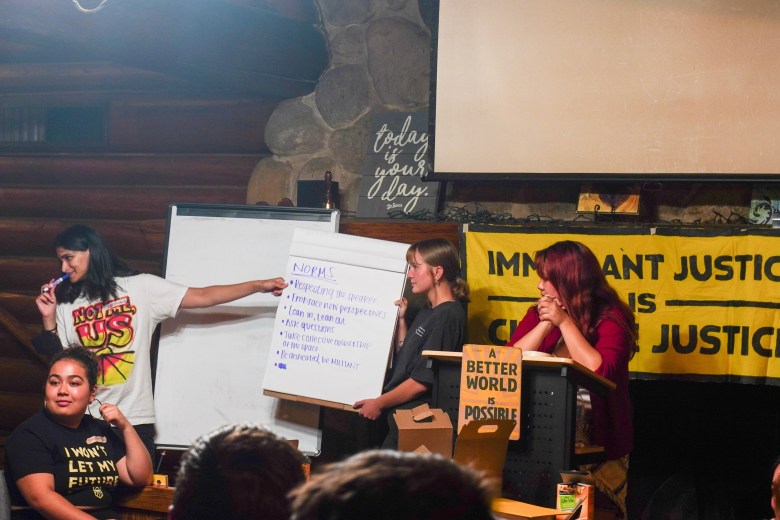
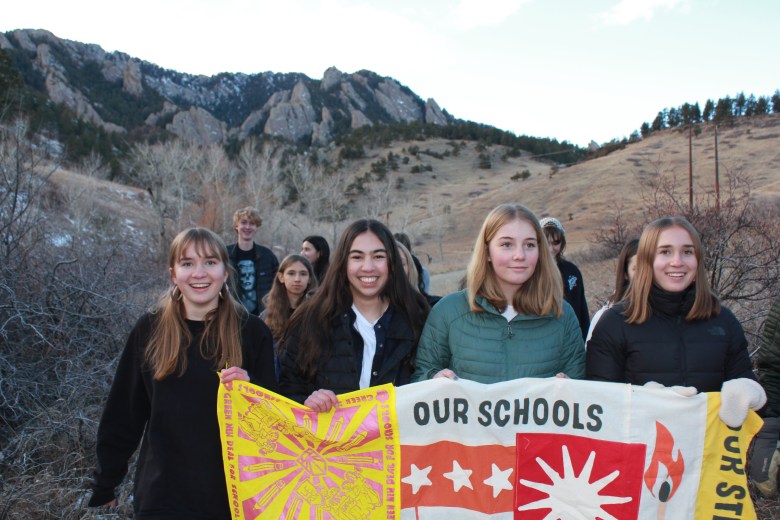
Emma and Molly Weber, climate activists since eighth grade, said they are frustrated. The Colorado-based twins, who will start college this fall, helped secure the first “Green New Deal for Schools” resolution in the nation in the Boulder Valley School District. Its goals include working toward a goal of Zero Net Energy by 2050, making school buildings greener, creating pathways to green jobs and expanding climate change education.
Emma, far left, and Molly Weber, far right, work with climate leaders from the Boulder Valley School District’s Sunrise Movement to prepare for Colorado’s legislative session. Credit: Courtesy of Emma Weber
“It feels very demoralizing to see something you’ve been working so hard at get slashed back, especially since I’ve spoken to so many students from all over the country about these clean energy tax credits, being like, ‘These are the things that are available to you, and this is how you can help convince your school board to work on this,’” Emma Weber said.
The Webers started thinking about other creative ways to pay for the clean energy transition and have settled on advocating for state-level legislation in the form of a climate superfund, where major polluters in a community would be responsible for contributing dollars to sustainability initiatives.
Consultants and sustainability coordinators said that they don’t see the demand for renewable energy going away. “Solar is the cheapest form of energy. It makes sense to put it on every rooftop that we can. And that’s true with or without tax credits,” Strehlow said.
*Correction: This version of the story includes updated information on the timeline for the expiration of tax credits for electric vehicle charging stations.
Contact editor Caroline Preston at 212-870-8965, via Signal at CarolineP.83 or on email at [email protected].
The Hechinger Report provides in-depth, fact-based, unbiased reporting on education that is free to all readers. But that doesn’t mean it’s free to produce. Our work keeps educators and the public informed about pressing issues at schools and on campuses throughout the country. We tell the whole story, even when the details are inconvenient. Help us keep doing that.
With the clutch of traditional higher education flashpoints accounted for – A level and SQA results days, and a clearing season reported to be particularly fraught in some quarters – the summer is drawing to a close, and a new academic year is upon us.
Eighteen year olds are set to attend universities in record numbers, up 5 per cent year on year and up 27 per cent since 2016. This is unquestionably a great thing. However, it masks a troublingly stubborn decline in mature students numbers.
In recent years, the number of these students – those aged 21 and over (or 25 and over for postgraduate study) – entering UK universities has been falling at an alarming rate, down by 26 per cent since 2016 according to UCAS. This decline may sound like a niche concern, but it carries big implications for the wider economy, for skills shortages, and for the prospects of people who want to reskill later in life.
As the government prepares to roll out the Lifelong Learning Entitlement (LLE), there’s an urgent opportunity to rethink how the sector and society support adult learners and to ensure that lifelong education becomes a central pillar of our skills system.
The current picture
While the signs from clearing so far offer some encouragement, due perhaps to a sluggish economy, the data remains stark. Over the past decade or more, the number of mature students entering higher education has steadily declined, down 43 per cent since 2012.
The causes are multifaceted, but a shift began with the introduction of higher fees in 2012 and has persisted – it is well established that mature students tend to be more debt-averse, so this coupled with the rising cost of living and the upfront financial commitment of a degree will no doubt put off many.
Others may well be put off by a lack of flexibility. While real strides have been made in this area, particularly at modern universities, the structures of funding and regulation mean a lot of courses are still designed for school-leavers with the time and freedom to study full-time. Family responsibilities, limited employer support for training and the still-dominant perception that universities are designed for 18-year-olds will also play a role.
The pandemic briefly nudged some adults back into learning, but the overall trend remains downward. Without targeted action, these numbers are unlikely to recover on their own.
A price to pay
Why does this matter beyond the university sector? Because a thriving economy depends on people being able to learn, retrain, and adapt throughout their lives. Mature students often bring real-world experience into classrooms and tend to choose courses that fill urgent skills shortages – in health and social care, teaching, engineering, IT, and other high-demand sectors.
When these pathways dry up, industries suffer. Skills gaps are prevalent across key sectors and have been estimated by the Recruitment and Employment Confederation to cost the economy almost £40bn per year. Without a pipeline of retrained workers, employers struggle to fill gaps, productivity growth stalls, and regional economies miss opportunities to regenerate.
It’s also an issue of social mobility. For people whose school results closed off higher education the first time around, mature study offers a second chance to change careers, boost their earnings, and improve their families’ prospects. If that route disappears, inequality widens – and our economy pays the price.
A new hope?
The LLE, due to launch in 2026, aims to reshape post-18 education in England by enabling a move away from the traditional three- or four-year degree as the default model. Instead, individuals will be able to draw on a single pot of funding – equivalent to four years of study, or around £38,000 – and use it flexibly over their lifetimes, taking courses in smaller, more targeted chunks.
In principle, this modular approach could open the door for adults with work and family commitments, allowing them to pursue short courses when needed and return later for further study without losing access to funding. By making learning more flexible, affordable, and tied to labour market needs, the LLE is pitched as a way to lower barriers that currently deter many mature learners, particularly in an economy being reshaped by AI, automation, and the green transition.
Yet the promise of the scheme is far from guaranteed. The rollout is proving complex, with uncertainties over how funding will be administered, whether universities and colleges will be equipped to redesign courses in modular formats, and how easily learners will be able to navigate the system. Awareness is another challenge: adults with established careers and busy lives may not know the scheme exists, or may find the process of accessing funding too bureaucratic to be worth the effort. Employers, meanwhile, will need to support staff in using the entitlement – something that cannot be assumed.
There are also cultural and practical reasons to doubt whether large numbers of mature learners will take up the LLE. Adults may be reluctant to re-enter formal education, particularly if they are anxious about returning to study, lack confidence with digital learning, or doubt the value of small qualifications in the job market. Others may weigh the potential benefits against the costs – not only financial, but also in time and disruption to family or work responsibilities – and decide against it.
In short, while the LLE represents a bold attempt to modernise lifelong education, its success will depend on whether the system can overcome significant implementation hurdles and whether mature learners themselves see it as accessible, relevant, and worthwhile.
The role of modern universities
Universities are at the heart of this challenge. They too cannot rest on their laurels and must continue to consider how they design, market, and deliver their courses if they are to serve lifelong learners as effectively as they serve 18-year-olds fresh from colleges. Modern universities, which traditionally teach the majority of mature undergraduates, must continue to lead this agenda from the front.
Partnerships with local employers, another area in which modern universities lead, are key. By aligning courses with regional economic needs – for example, creating pathways into green technologies, health and care, or digital sectors – universities can help ensure that adults return to education with a clear line of sight to better jobs.
But a cultural shift is just as important. Universities need to be hubs for lifelong learning, not just finishing schools for young adults, and the government has significant work to do in getting the word out to the general public that the opportunity to study or re-train is there to be taken.
The decline in mature students is more than a higher education story. It’s a warning sign for our economy and for our ability to adapt to change. The LLE offers a chance to reverse the trend – but only if universities, employers, and policymakers work together to make lifelong learning a reality.
In a fast-changing world, education cannot stop at 21. The people of Britain need a system that allows people to keep learning, keep adapting, and keep contributing to the economy throughout their lives.
In full disclosure, I work in higher education marketing. But I’m here to say: Marketing can’t fix a bad program. OK, maybe “bad” is too strong of a word, but degree programs that aren’t aligned to the modern learner’s needs and expectations — or the job market — can be challenging. Let’s discuss.
For this article, we’ll primarily focus on adult online learners. And these prospective students are very different from those coming right out of high school. According to Common App, first-time college students apply to about six different colleges, on average. The online learner typically inquires with only two institutions, according to an EducationDynamics report, and 45% apply to just one.
What does this mean for schools with online programs? You have to get in front of your target audience quickly and make your case clearly. But if you don’t have the right mix of features or programs for these students, it doesn’t matter if your marketing is excellent.
Give Online Learners What They Need
Online learners typically work at least part time and often full time. They have different needs and expectations for their higher education experience. They need flexibility. They also don’t want to be in school longer than necessary. Most are earning a degree to improve their career options.
Below are a few things to consider when formatting your programs and processes for online students.
Efficiency
Once online learners have decided to take the step of applying, they’re committed and want to get started quickly. According to the EducationDynamics report, 80% enroll in the school that admits them first, and more than 50% expect to begin courses within a month of being admitted.
That means admissions teams have to move quickly and the programs must offer multiple start dates per year. If you make prospective students wait, you lose out. Delays can make an otherwise good program fall into the “bad” category.
This one can be challenging. You need enough students to merit multiple start dates. That’s where that good marketing comes in!
Relevant Skills
Online learners choose online because they’re working and need a flexible school schedule to accommodate their work and personal commitments. But let’s focus on the work part here. These students need skills and credentials that will boost their earnings and opportunities. That’s one of the most cited reasons for returning to school.
So, again, the degree must match the skills students need to find work. If the only online programs you offer are in computer science, you may find that you’re wasting your marketing dollars. Yes! Computer science! In the age of artificial intelligence (AI), computer science and engineering graduates are struggling to find work.
Personal opinion: Liberal arts and studies will become more important if they can teach students the durable skills needed in the AI era — communication, critical thinking, and research skills.
Clear Information
Degree program pages and websites sometimes obscure information users need to make decisions. And we saw above how quickly online learners are making decisions and want to get started. If your program page hides costs, financial aid information, credit hours, and requirements, you’re going to drop out of their consideration set.
Online learners want to weigh available information and make informed decisions. Some will certainly have price sensitivity, but it’s not the only consideration, so don’t hide tuition rates and fees. The EducationDynamics report notes that “flexibility can even overcome cost, with 30% of respondents indicating they would enroll at a more expensive institution if the available format, schedule, or location were ideal.” Show your cards. Let the students make their decisions with the information available.
If your program doesn’t meet student requirements in this area, marketing won’t make a significant impact on your enrollments.
Be Discriminating in Your Marketing Spend
Sometimes there are politics at play or other reasons to market or support certain programs, but when possible, be thoughtful and intentional about where you spend your marketing dollars. Because marketing can’t solve for a challenging program, you must put your budget toward programs that meet student needs, including those that meet the criteria above.
It’s tempting to give equal shares to all programs, but unless you have an unlimited budget, that’s not the best use of your funds.
If you must give some marketing love to all programs, even the “bad” ones, try a brand-focused approach that connects to an all-programs page. For example, send some limited traffic to a dedicated landing page that briefly covers all available programs. That way, you’ve covered the challenged programs without dedicated resources.
Use the remainder of your budget on programs that align with students’ needs, so you can enjoy a lower cost per enrollment. Who doesn’t love a “chase the winners” strategy?
Need More Help?
Archer Education has deep expertise in both of these areas: marketing and program assessments. Our Strategy and Development team can help you take an unfiltered view of your programs and processes to create a plan for future success, even as the market shifts. If you have good programs and need marketing support, we’re here for that, too.
After four decades in higher education and now beginning my third presidency, I’ve watched the ground shift dramatically beneath campus leaders. Here in 2025, outrage often outpaces facts, and presidents can sometimes become targets less for their actions than for what they represent.
Set against that backdrop, churn is high: 55 percent of presidents reportedly expect to step down within five years, and the average stint is 5.9 years, which is 2.6 years shorter than in 2006. Among presidents of color, it’s just over half.
The criticisms aimed at presidents under fire generally fall into three categories. First, the leader is genuinely ineffective or has made serious missteps. Second, the office itself is the lightning rod because it’s the place where the “buck stops.” Third, presidents are singled out for personal or political reasons, broadly defined, like being new, coming in as an external hire, or being a member of an underrepresented group. Opponents see these presidents as easy targets: less networked, more vulnerable, and therefore more expendable. This piece focuses on the third group: the leaders most vulnerable to attacks rooted in identity or circumstance rather than performance.
Such attacks are rarely random. They are orchestrated and designed to do harm. Some of these systematic campaigns rise to the level of defamation, attorney Katy Young, managing partner at Ad Astra Law Group, warns. In these moments, the silence of the campus, community, and board is not a strength—it is a surrender.
What follows is a playbook I wish university leaders and their board members would review and discuss before a sudden media blitz engulfs their president and campus.
Build early warning systems
Institutions are rarely blindsided because no one saw trouble coming. They’re blindsided because the right people weren’t talking early enough, or because the early signals were dismissed as noise.
In today’s hyperconnected environment, the difference between a passing controversy and a crisis often comes down to whether leaders catch the warning signs early. To build an effective early warning system, leaders need to think in three modes: proactive (anticipating), concurrent (tracking), and reactive (responding).
Before it happens: Run regular simulation exercises with trusted faculty, staff, and students who influence opinion on and off campus. Role-play how the university spokesperson or designated officials would respond to an orchestrated campaign disguised as “concern” or “accountability.”
As it ramps up: Communications staff must move beyond scanning headlines and Google alerts. They need to monitor social media channels, blogs, templated letters to the editor, alumni Facebook chatter, and local op-eds. Repeated or similar comments on these platforms can be early signals that a coordinated campaign is already underway.
When it breaks: Establish input and feedback loops with trusted stakeholders. If rumors are circulating, gather information from those who have received the “intel.” Listen carefully, collect details without “killing the messenger,” and thank those who come forward. Their willingness to share may give you just enough time to respond strategically before the game slips out of your hands.
Align legal and communication responses
One of the biggest mistakes I’ve seen universities make is allowing the legal and communications teams to develop strategies in isolation, by default rather than design. When this happens, the plays don’t line up, and the institution starts from a confused rather than cohesive position.
Lawyers for both public and private universities are trained to limit legal exposure. Typically, their instinct is to say—and to have others say—as little as possible. A common legal move is a bland placeholder: “We take this seriously and are looking into it,” or the always popular “Because this issue is under investigation, we cannot comment further at this time.”
Public institutions face more legal constraints under the First Amendment and state law than do private institutions. While the latter may have more regulatory leeway, both share the reputational risks of silence.
Communications professionals, by contrast, are trained to frame and guide the narrative. In a 24/7 social media environment, their role is to move quickly to establish context, add examples that illustrate institutional values, and sustain credibility with key audiences. Good communicators also insist on honesty—especially in tough situations—because nothing erodes trust faster than the perception of a cover-up.
Both approaches—when coordinated early on—can add value. Siloed strategies, by contrast, look like the right hand doesn’t know what the left is doing. Or worse, that the university is running a trick play to hide something.
Once a false narrative takes hold, it’s nearly impossible to “unring the bell.” That’s why legal and communications strategies must be integrated from day one. Boards must also resist the temptation to rely solely on legal advice. What makes sense in a courtroom may destroy credibility in the court of public opinion.
Steps for integrating legal and PR strategies
Appoint a crisis liaison to help stakeholders weigh the tradeoffs between caution and urgency.
Develop and rehearse a communications playbook in advance of a crisis that maps out roles and responsibilities and stresses the need for consistency in messaging for all audiences. You will also want to define who has final authority.
Ensure the board has balanced information and recommendations from both professionals.
Understand the costs of a communications delay.
Institutions that opt for silence to reduce legal exposure risk an erosion of trust in both the university and its leaders.
Train boards to lead, not lag
Boards can unintentionally make a crisis worse by staying quiet at key moments or by failing to visibly support their leader. (The Association of Governing Boards has found that nearly 40 percent of boards have not done scenario planning or have no plans to do it.) Very few presidents can remain viable or effective in the face of board abandonment or governance silence, or even the perception of abandonment.
That’s why boards must be trained in modern crisis response and media literacy. Though time consuming, Boards should consider annually run tabletop simulations—simple scenario-based exercises widely available from higher ed associations—so they practice crisis communication and governance before the real test arrives. Hands-on trainings like these remind boards that fiduciary duties are not the only ones that should be addressed in meetings, retreats, and the like.
In times of calm, not crisis, trustees should think about how their voice—or lack of it—shapes current and ongoing institutional narratives. Timely, confident, values-based statements from boards can reassure stakeholders that the institution is steady and supportive of a leader unfairly under fire.
Decide when to weigh in and when to wait
Not every attack requires a megaphone response. But some do. When misinformation is demonstrably false and spreading, the institution must correct the record loudly and clearly.
When facts are still emerging, it’s appropriate for a trusted spokesperson—not the president or board chair—to acknowledge the situation, commit to transparency, and set expectations for updates. But when the president is the target of personal, vicious, and untrue attacks, the board chair or designee should step forward. Staying under the radar in these cases is read as reticence or hesitancy, not prudent governance. To the targeted president, it can feel like desertion.
Know when to settle—and when to go to court
This may be the most contested element in the playbook.
Too often, the decision between settling and going to court is made strictly as a legal calculation. But in cases of defamation, settling can reinforce false narratives, deepen community skepticism, and leave current and future leaders wondering if the board will have their back when it matters most.
Timing, the strength of the legal arguments, and reputational harm all matter. Settlement may demonstrate common and financial sense when these conditions are in play: it is very early in the proceedings, the university’s legal position is weak, and little public attention has been drawn to the dispute. By contrast, settlement may be ill-advised when a case has been in the system for years, the filings strongly favor the university, and reputational harm has already been magnified by a media campaign.
In my own experience at California Lutheran University, both my predecessor Chris Kimball and I were dismissed from a long and highly visible lawsuit just as the university entered serious settlement discussions. As a defendant who had been the target of a vicious four-year media campaign, I was relieved to have my personal name cleared. But as a three-time university president, I was disappointed that the decision to settle prevented the truth from coming fully to light in the court system—through testimony, documents, and rulings.
The truth is the most powerful play we have, and settlements often keep it on the sidelines. That is the major and lingering downside, especially when settlements occur late in the game that the university is otherwise winning.
Build coalitions before you need them
When the contest turns rough, the teammates who step onto the field are the ones you’ve practiced and trained with long before. Effective coalitions aren’t built in the middle of a crisis; they are built in times of calm, long before the crisis hits.
Engage faculty leaders who understand the complexity and tradeoffs of the issue being contested. Build a cadre of alumni who speak about that issue from experience, not hashtags. Help students see the value of facts over speculation. Coalitions built on trust and mutual respect are the ones most likely to defend their institution and leaders when opponents try to shout them down.
Final thoughts: Protecting the presidency is protecting the institution and higher education as a whole
Character assassination doesn’t just harm a leader; it weakens the institution’s ability to attract students, retain donors, recruit faculty, and live out its mission. It also undermines public confidence in higher education at a moment when trust is finally starting to rebound.
Perhaps most importantly, it sets a dangerous precedent for our students, who may reasonably ask: If the institution won’t back its leader when things get messy, why should we believe it will back us?
Protecting presidents from orchestrated defamation is not about shielding us from critique. Fair critique is a healthy and vital part of accountability. What we must resist is the conflation of accountability with calculated campaigns of destruction.
Our opponents already have a playbook. It’s time we write, revise, and share our own. My hope is that this piece serves as one chapter in a larger guide to which many ACE members will contribute—because protecting the presidency is not just about safeguarding one leader. It’s about preserving the integrity and stability of the academy, especially at times like these, when individual leaders, specific institutions, and the whole sector are under fire.
If you have any questions or comments about this blog post, please contact us.
Charlie Kirk was shot and killed at Utah Valley University today. The killer was not immediately caught. The Higher Education Inquirer has been covering Kirk and his organization, Turning Point USA, since 2016. Kirk has been a polarizing force in the United States, particularly on US college campuses. HEI hopes this event will not lead to further violence. Since its inception, we have urged for peace and nonviolence.
Charlie Kirk was shot during an event at Utah Valley University today. Details of the incident are still unfolding.
Political violence is never an acceptable response to speech. Free speech allows us to settle our differences peacefully and is essential to a free and democratic society.
Our thoughts are with Charlie Kirk and his family.
Charlie Kirk, the young founder of Turning Point USA, a campus-focused conservative organization that rose to general prominence on the right, died Wednesday after he was shot during one of his group’s events at Utah Valley University in Orem.
Kirk, 31, leaves behind a wife and two children. He first rose to prominence in 2012 after creating Turning Point and speaking out about the need to reform higher education. In recent years, he became a close ally of Donald Trump.
Kirk died doing what he had become known and drawn protests for: visiting college campuses and sharing his right-wing views. He was at Utah Valley kicking off Turning Point’s The American Comeback Tour, which planned at least 10 stops on college campuses across the country. Some had urged the university to cancel his appearance. More than 3,000 people attended the event, Utah officials said.
Kirk, wearing a white shirt that said “freedom,” handed out red Make America Great Again hats and then sat under his signature “Prove Me Wrong” tent in the courtyard in the middle of campus to take questions from the audience. According to The Deseret News, Kirk had said there were “too many” mass shooters who were transgender and then fielded another question on the issue when he was shot.
“I want to be very clear this is a political assassination,” said Utah governor Spencer Cox at a press conference Wednesday evening.
Matthew Boedy, author of a forthcoming book on Kirk and head of the Georgia state conference of the American Association of University Professors, said Kirk’s death “could be compared to the second assassination [attempt] on President Trump. Assassination attempts—you would think they would unite us, but as we’ve seen, they have divided us even more so.”
Kirk’s group galvanized conservative activism on campuses nationwide and fueled criticisms of higher ed that are now shared by the White House and the Republicans who control Congress. As higher ed itself became a national political issue, Kirk transcended from a campus presence to a national conservative figure, speaking at the Republican National Conventions in 2020 and 2024, the Conservative Political Action Conference, and on other big stages. He had more than 5.4 million followers on X, where right-leaning profiles are prominent.
Turning Point’s website claims to have “a presence on over 3,500 high school and college campuses nationwide, over 250,000 student members, and over 450 full- and part-time staff all across the country.” And the group’s own events drew national political figures: Donald Trump Jr., Tucker Carlson, Steve Bannon, Tulsi Gabbard, Kristi Noem and others attended the Student Action Summit in July, Times Higher Education reported. Among other things, Kirk said at the event in Tampa, Fla., that no foreigners should be allowed to own homes or get jobs before U.S. citizens.
“This is the greatest generational realignment since Woodstock,” Kirk said. “We have never seen a generation move so quickly and so fast, and you guys are making all the liberals confused.”
Kirk expanded on his views in several books, which include Campus Battlefield: How Conservatives Can WIN the Battle on Campus and Why It Matters and The College Scam: How America’s Universities Are Bankrupting and Brainwashing Away the Future of America’s Youth.
In a statement on X Wednesday, Turning Point confirmed his death and said, “May he be received into the merciful arms of our loving Savior, who suffered and died for Charlie.” Leading Republicans and Democrats issued statements mourning his passing, which President Trump announced himself on Truth Social.
“The Great, and even Legendary, Charlie Kirk, is dead,” Trump wrote. “No one understood or had the Heart of the Youth in the United States of America better than Charlie. He was loved and admired by ALL, especially me, and now, he is no longer with us.”
Trump ordered U.S. flags to be lowered to half-staff.
Former president Obama posted on X that “we don’t yet know what motivated the person who shot and killed Charlie Kirk, but this kind of despicable violence has no place in our democracy. Michelle and I will be praying for Charlie’s family tonight, especially his wife Erika and their two young children.”
Education Secretary Linda McMahon called Kirk “a friend and an invaluable adviser” in a social media post.
“He loved America with every part of his being,” she added. “My heart is broken for his family and friends who loved him, and for the millions of young Americans whom he inspired.”
California governor Gavin Newsom, a potential Democratic presidential candidate who had Kirk on his podcast earlier this year, posted, “The attack on Charlie Kirk is disgusting, vile, and reprehensible. In the United States of America, we must reject political violence in EVERY form.”
Local, state and federal law enforcement are investigating the shooting.
Utah Valley closed campus and canceled classes until Sept. 14. Authorities searched the grounds for the shooter, and officials said in the evening that a person of interest was in custody.
Ellen Treanor, a university spokesperson, said Kirk was shot around 12:15 p.m. local time Wednesday, and that police believe the shot came from the Losee Center, about 200 yards away.
Treanor said Kirk’s private security took him immediately to a hospital, where he underwent surgery.
University police quickly arrested a person, who was later released when the officers determined he wasn’t the shooter, said Scott Trotter, another university spokesperson. The Utah governor’s office, the FBI and other agencies are coordinating with the university police department in investigating, Trotter said. (Utah law allows individuals to carry firearms on campuses.)
UVU officials said in a statement that they were “shocked and saddened” by Kirk’s death.
“We firmly believe that UVU is a place to share ideas and to debate openly and respectfully,” the statement said. “Any attempt to infringe on those rights has no place here.”
At the Wednesday press conference, Jeff Long, the UVU police chief, said that what happened was a “police chief’s nightmare.” Six officers were working the event alongside Kirk’s security team.
“You try to get your bases covered, and unfortunately, today, we didn’t,” he said. “Because of that, we have this tragic incident.”
Charlie Kirk was kicking off his “American Comeback Tour” at Utah Valley University.
Photo by Trent Nelson/The Salt Lake Tribune/Getty Images
Turning Point, headquartered in Phoenix, has been at the center of several controversies over the years. About a decade ago, it launched its Professor Watchlist, which has resulted in academics being the targets of vitriol and threats for their alleged views. Last year, two Turning Point workers admitted to charges from an October 2023 incident in which they followed and filmed a queer Arizona State University instructor on campus, with one of them eventually pushing the instructor face-first onto the concrete.
Boedy said Wednesday that Kirk was the most influential person who doesn’t work in the White House.
“He has made Turning Point into an indispensable organization for conservative causes,” he said. “He’s become the new face of Christian nationalism, which is a growing trend in America. And of course, he has, I would say, changed college campuses.”
He added that campus events like Wednesday’s were his “bread and butter.”
“He is very smart,” he said. “He was one of the pioneers of the ‘prove me wrong’ mantra.”
Steady lead generation for colleges and universities is what keeps enrollment strong. Without a consistent flow of qualified inquiries, even the best programs struggle to meet their targets. The challenge, however, is that prospective students now have more options than ever, online and on campus, at home and abroad. Competing for their attention requires more than just a few ads or a static website; it demands a thoughtful, multi-channel strategy that builds trust and delivers value.
The good news is that digital marketing offers powerful tools to do just that. From content that tells your school’s story to SEO, social media engagement, targeted ads, and personalized email campaigns, every channel plays a role in capturing interest and moving students closer to enrollment. Add in technologies like CRM systems, chatbots, and virtual events, and institutions can create highly tailored experiences that convert browsers into applicants.
This article explores nine proven strategies to boost lead generation for higher education in the current industry. We’ll highlight real-world examples, including case studies from HEM’s own work, and show how combining smart tactics with the right technology can help your institution attract, nurture, and convert more qualified student leads.
Struggling with lead generation?
Our expert digital marketing services can help you attract and enroll more students!
1. Leverage Content Marketing to Attract and Engage Prospective Students
Content marketing is one of the most reliable ways for higher education institutions to generate quality leads. By creating blog posts, videos, and downloadable guides that address real student questions, schools can attract organic traffic, build trust, and guide prospects through the enrollment funnel. Effective content also boosts SEO, keeping your institution visible when students search for programs or career paths.
How can content marketing help universities generate more leads? Content marketing attracts prospective students by answering their questions and showcasing institutional strengths. Blogs, guides, and videos build trust, improve SEO visibility, and highlight success stories. This engagement draws high-intent visitors to program pages, where they can convert into inquiries or applications.
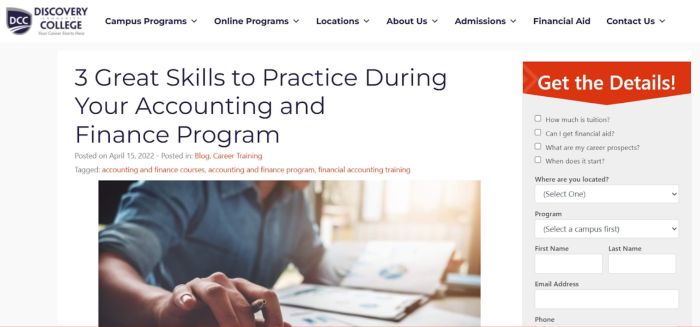
Example: Discovery Community College’s official blog uses program-specific keywords in post titles to boost SEO. For example, one post is titled “3 Great Skills to Practice During Your Accounting and Finance Program,” directly incorporating the Accounting and Finance program name. This keyword-focused approach makes it far more likely that the content appears in search results when potential students are googling that training area. By optimizing blog content for high-intent queries, Discovery Community College increases its visibility to the right audience and draws in quality traffic (prospects already interested in those programs).
Gated content like e-books or checklists can add another layer—prospects are more willing to share contact details if the resource provides clear value, such as a scholarship checklist or career outlook guide.
2. Optimize Your Website for Search Engines (SEO)
Even the best content won’t generate leads if students can’t find it. That’s why SEO is essential. Since most students begin their school search online, ranking on the first page of Google for program- and location-based keywords (“MBA programs in Canada,” “best nursing degree in Ontario”) is critical. The higher you rank, the more qualified traffic you attract.
Effective SEO starts with understanding what prospective students are searching for and weaving those terms naturally into your program pages, blog posts, and FAQs. On-page basics, like strong titles, meta descriptions, mobile-friendly design, and fast load times, should work hand in hand with technical SEO and local optimization.
How can universities leverage SEO to improve their lead generation efforts? SEO boosts visibility when students search for programs, scholarships, or career outcomes. By optimizing program pages, blogs, and local listings with relevant keywords, universities appear in top search results. This organic traffic delivers high-intent leads, students actively seeking education opportunities, directly into the recruitment funnel.
Example: Partnering with HEM, Cumberland College invested in multilingual SEO, optimizing its website in both English and French. Within a year, organic traffic grew by 27.5%, and leads from SEO traffic surged by 386%. This data-driven strategy directly fueled a 20–35% increase in new enrollments, proving how powerful SEO can be for lead generation for higher education.
3. Optimize Your Website’s Landing Pages and Lead Capture Forms
Attracting visitors is only half the battle; converting them into leads is what drives enrollment. Landing pages and inquiry forms are at the heart of conversion rate optimization (CRO) for higher education. With education landing pages averaging a 4.5% conversion rate, small improvements can mean a big jump in inquiries. To maximize results:
Mobile-first design: Students browse on their phones, so pages must load fast and display seamlessly.
Clear, concise copy: Use scannable headlines and bullet points to highlight benefits.
Prominent CTA: Each page should push one clear action: “Request Info” or “Register Now,” with an eye-catching button.
Short forms: Ask only for essential info (name, email, program interest). Long forms create friction.
Trust signals: Add student testimonials, alumni outcomes, or accreditation badges to reassure visitors.
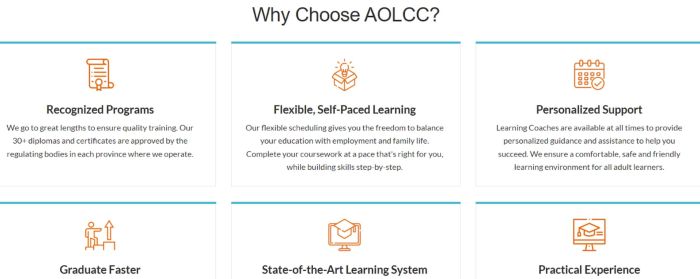
Example: The Academy of Learning Career College’s landing pages highlight clear program benefits and unique selling points to persuade visitors. AOLCC outlines its proposition value on landing pages, essentially listing what students gain from the program, and expands on each point to hold interest. By foregrounding these program benefits, AOLCC’s pages effectively communicate value and encourage prospects to take the next step (e.g., request info or apply).
4. Implement Chatbots and Live Chat for Instant Engagement
Today’s prospective students expect instant answers when they land on a university website. Chatbots and live chat make that possible, engaging visitors the moment they arrive instead of waiting for them to stumble upon a form. A chatbot that greets with a simple “Do you have questions about admissions or programs?” lowers barriers, creates an immediate connection, and often captures leads that would otherwise leave without taking action.
Configured well, education chatbots can handle common questions around deadlines, prerequisites, or housing 24/7. When a query requires a human touch, they can hand off to a live staff member or at least collect contact details for follow-up. This style of communication appeals especially to Gen Z, who spend significantly more time on messaging apps than older generations and respond well to the casual, conversational tone of chat.
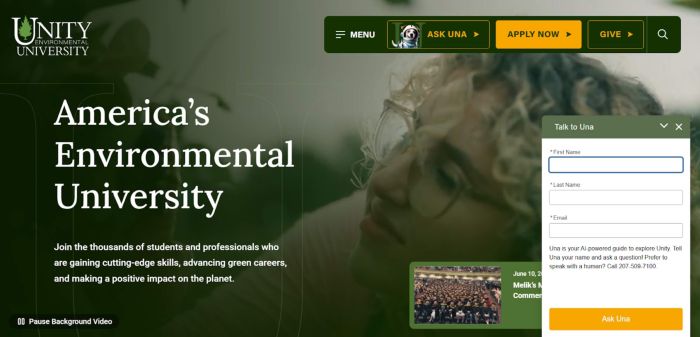
Example: Unity Environmental University launched an AI virtual agent named “Una” to assist prospective students in finding suitable programs and navigating the application process. According to Unity’s press release, Una is available 24/7 as a personalized guide, providing instant answers about admissions and even helping complete application steps.
From a practical standpoint, institutions can blend live and automated support depending on resources. Staff-led chat during business hours provides personal attention, while chatbots can cover after-hours. The key is visibility: a small but inviting chat icon, integrated with your CRM to capture leads automatically, turns your site into an “always-on” recruitment assistant. In higher education lead generation, that combination of accessibility, speed, and personalization is increasingly what sets strong digital strategies apart.
5. Harness the Power of Social Media Platforms
Social media remains one of the most powerful tools for lead generation for colleges. Prospective students spend hours daily on platforms like Instagram, TikTok, Facebook, LinkedIn, and X. Making these spaces essential for reaching and engaging them. Each channel serves a slightly different role: Instagram and TikTok connect best with high school and undergraduate audiences, LinkedIn appeals to graduate and professional prospects, while Facebook often reaches parents and working adults.
What role do social media platforms play in lead generation for higher education institutions? Social media connects universities with prospects where they already spend time. Authentic posts, student takeovers, and targeted ads spark awareness, build community, and drive traffic to lead forms. Engagement nurtures interest over time, transforming casual followers into applicants and amplifying recruitment campaigns.
To generate leads, institutions should focus on consistent posting, authentic storytelling, and quick responses to comments or direct messages. Content like student takeovers, alumni testimonials, and “day in the life” videos resonates strongly, helping prospects envision themselves at your school.
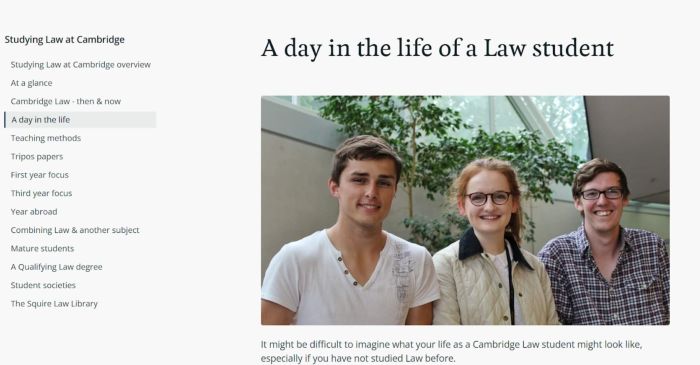
Example: The University of Cambridge leverages authentic, student-led “Day in the Life” videos on its official channels (website, YouTube, TikTok) to showcase everyday student experiences. These videos are produced through the university’s own outlets, not third-party media, ensuring they are direct primary sources from Cambridge. For instance, Cambridge’s Faculty of Law features a “Day in the life of a Law student” video on its official site and YouTube, where “three first year Law students, Robbie, Katie and Scott, give us an insight into a typical day in their lives, using hand-held cameras”. In this video, the students themselves film their lectures, study sessions, and social activities, offering a genuine glimpse into daily life in Cambridge.
Done well, social media builds community, nurtures awareness, and funnels engaged viewers toward applications or info requests.
6. Invest in Targeted Paid Advertising (SEM & Social Ads)
While organic search and social media build long-term visibility, paid advertising can accelerate lead generation for colleges by reaching the right students at the right time. Search engine marketing (SEM), such as Google Ads, is especially valuable for competitive programs or new offerings that don’t yet rank organically. Targeting keywords like “online MBA in healthcare” ensures your ads appear when students are actively searching, capturing high-intent leads ready to convert.
On social platforms, precise targeting by age, interests, location, or even undergraduate major allows you to reach audiences that align with your programs. Retargeting campaigns are equally powerful, reminding visitors who viewed your site or started an application to take the next step.
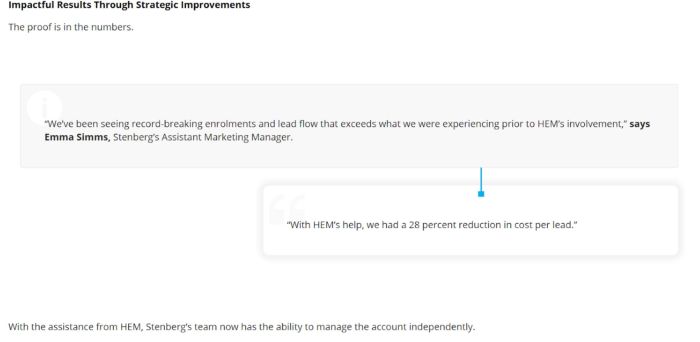
Example: Stenberg College leveraged Google Ads to attract more qualified leads for its healthcare and nursing programs. HEM’s case study notes that Stenberg uses Google Ads as a “key marketing tool to recruit students,” and with HEM’s expertise, the college’s ads now generate both more leads and better-qualified leads for admissions. The partnership allowed Stenberg to optimize keywords, ad creatives, and targeting, resulting in improved ROI on their ad spend and a healthier enrollment pipeline.
7. Nurture Leads With Email Marketing and Marketing Automation
Capturing a lead is only the start. The real work begins with nurturing that interest into enrollment. Email marketing remains one of the most powerful tools in higher ed lead generation, delivering an estimated ROI of $36 for every $1 spent. Students also welcome it: surveys show nearly 70% prefer to hear from institutions via email.
The key is relevance. Segment leads by program, stage in the decision journey, or demographics, and tailor messages accordingly. Personalization should go beyond using a first name. It should highlight specific programs, address common concerns, or share stories aligned with student interests. Mapping emails to the student journey also ensures prospects receive the right content at the right time, from early-stage guides to deadline reminders.
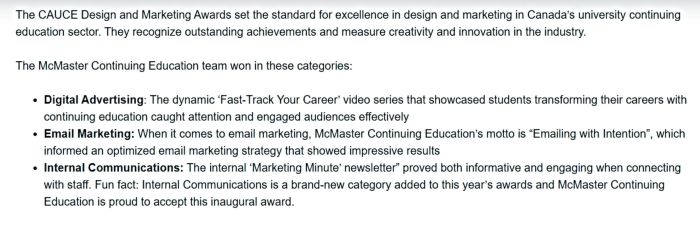
Example: By developing email campaigns tailored to specific learner personas (“Emailing with Intention”), McMaster’s Continuing Ed achieved email engagement far above industry benchmarks. In fact, its automated drip emails earned about a 27.9% open rate, outperforming average open rates (~21.5%) for education emails. This persona-driven strategy was recognized with national marketing awards, underscoring how segmenting messaging to audience needs leads to more engaged prospects and higher conversion potential.
8. Host Events and Leverage Virtual Engagement Opportunities
Events remain one of the most effective lead generation tools in higher education because they let prospects experience your institution firsthand. In-person open houses, campus tours, and information sessions build emotional connections as students meet faculty, see facilities, and imagine themselves on campus. From a lead gen perspective, event registrations and check-ins capture valuable contact information, which can then be nurtured with timely follow-up emails or calls.
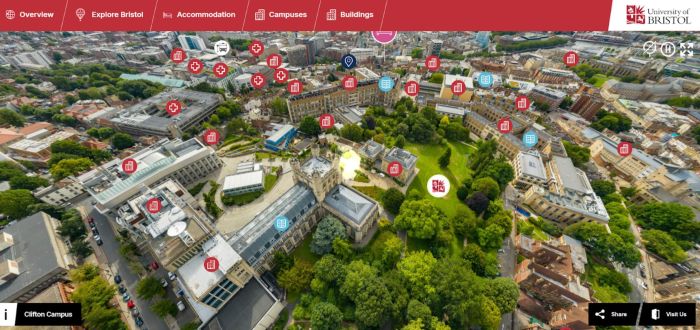
Virtual events have expanded this reach even further. Online open houses, live webinars, and 360° virtual tours allow schools to engage international prospects and those unable to travel. The University of Bristol, for example, hosts a dedicated page for virtual campus and city tours, giving global audiences a way to explore on their own time.
Example: Bristol has embraced virtual engagement to reach students globally. The university maintains a dedicated page for virtual events and tours, where prospects can take self-guided 360° campus tours and even explore the city online. During the pandemic, such virtual open days were crucial: over half of UK prospective students surveyed (59%) attended at least one virtual open day. By offering rich virtual events and tours, the University of Bristol kept students engaged during lockdowns and expanded its reach beyond those able to visit in person. This virtual strategy not only sustained interest through difficult times but continues to complement in-person events as a convenient lead generator.
The most effective events, whether in-person or online, blend interactivity with personal connection. Live chats, Q&As, and student ambassador involvement ensure attendees feel engaged, while follow-up communications help convert that interest into applications.
9. Utilize CRM Systems and Data Analytics to Refine Your Outreach
Behind every strong lead generation program is a system that manages, tracks, and optimizes outreach. A Customer Relationship Management (CRM) platform, such as HubSpot, Slate, or HEM’s own Mautic CRM, centralizes prospect data, automates follow-ups, and makes it easier to measure performance.
Every new lead, whether from a form, ad, or event, flows into the CRM, where it can be segmented, scored, and assigned to counselors. Automated workflows ensure timely engagement: for example, sending a personalized welcome email immediately after an inquiry and triggering reminders if no action follows.
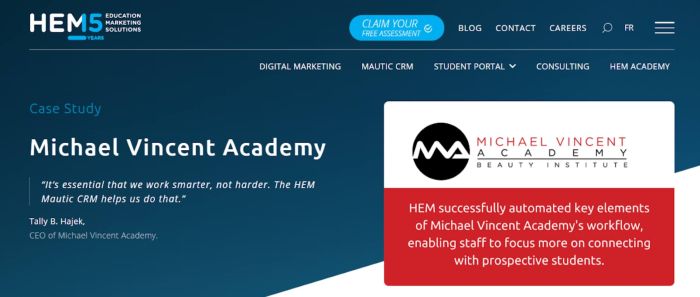
Example:Michael Vincent Academy overhauled its recruitment process by adopting a customized CRM automation solution with HEM. Michael Vincent Academy automated key workflows using the CRM, which dramatically improved efficiency in managing inquiries. Staff could spend less time on manual follow-ups and more on building relationships with prospects. The result was a smoother funnel, inquiries were responded to promptly, and no prospective student fell through the cracks, ultimately leading to higher enrollment yields.
Analytics make this even more powerful. By monitoring lead sources, campaign performance, and student behaviors, institutions can refine targeting and invest where returns are strongest. Business School Lausanne, for instance, leverages data insights to optimize international outreach and ensure global diversity in recruitment.
In short, a data-driven CRM approach ensures no lead slips through the cracks and every prospect receives timely, personalized attention.
Integrating the 9 Strategies Into a Cohesive Lead Generation Plan
Effective lead generation in higher education isn’t driven by one silver bullet; it’s the outcome of multiple strategies working together. Content fuels SEO, SEO drives visitors to optimized landing pages, social media and paid ads amplify your reach, while email and CRM workflows nurture prospects into applicants. Layered on top, data and analytics help refine every stage, creating a cycle of attraction, engagement, and conversion that grows stronger over time.
Real-world outcomes show the power of this integrated approach. Webster University Geneva reported a 30% surge in enrollments through digital marketing and timely follow-ups, while Cumberland College doubled its lead flow by combining SEO content with paid ads and social engagement. Even more targeted initiatives, like Queen Anne’s School’s multi-platform ad campaigns or McMaster University’s persona-based email drips, prove that each tactic can meaningfully contribute to the bigger picture when executed strategically.
Think of your role as designing a system that balances creativity with data. Keep testing new formats, from TikTok challenges to interactive quizzes, while staying agile to shifts like AI tools or evolving privacy rules. Above all, keep the student experience front and center: personalization, authenticity, and responsiveness are what today’s learners value most.
By applying the nine strategies outlined in this guide, your institution can not only attract more qualified leads but also convert them into enrolled students in a sustainable, scalable way. Lead generation may be challenging, but with a student-first mindset and a data-informed strategy, you’ll build a steady pipeline of future students ready to join your community.
Struggling with lead generation?
Our expert digital marketing services can help you attract and enroll more students!
Frequently Asked Questions
Question: How can content marketing help universities generate more leads? Answer: Content marketing attracts prospective students by answering their questions and showcasing institutional strengths. Blogs, guides, and videos build trust, improve SEO visibility, and highlight success stories. This engagement draws high-intent visitors to program pages, where they can convert into inquiries or applications.
Question: What role do social media platforms play in lead generation for higher education institutions? Answer: Social media connects universities with prospects where they already spend time. Authentic posts, student takeovers, and targeted ads spark awareness, build community, and drive traffic to lead forms. Engagement nurtures interest over time, transforming casual followers into applicants and amplifying recruitment campaigns.
Question: How can universities leverage SEO to improve their lead generation efforts? Answer: SEO boosts visibility when students search for programs, scholarships, or career outcomes. By optimizing program pages, blogs, and local listings with relevant keywords, universities appear in top search results. This organic traffic delivers high-intent leads, students actively seeking education opportunities, directly into the recruitment funnel.