Blog

  • Why K-12 educators need data literacy, not just data

    Why K-12 educators need data literacy, not just data

    Key points:

    Walk into any data meeting at a K-12 school today, and you’ll likely see a familiar scene: educators huddled around printed reports, highlighters in hand, trying to make sense of student data spread across multiple dashboards. If you’ve ever left one of these meetings feeling mentally exhausted without clear next steps, you’re not alone. The problem isn’t that we lack data in education, but rather that most dashboards show us the past–not the path ahead. It’s like trying to drive while only looking in the rearview mirror.

    The education sector sits on massive amounts of student data, yet most schools lack data maturity. They’ve committed to using data and may even have systems that centralize records. But they haven’t embraced what’s possible when we move from having data to using it well; from describing what happened to predicting what’s likely to happen if nothing changes.

    We have dashboards–now what?

    Every district has dashboards. We can see attendance rates, assessment scores, and demographic breakdowns. These tools tell us what happened, which is useful–but increasingly insufficient for the challenges facing K-12 schools. By the time we’re reacting to chronic absenteeism or declining grades, we’re already behind. And, when does an educator have time to sit down, pull up multiple dashboards, and interpret what they say about each student?

    The power of any data dashboard isn’t in the dashboard itself. It’s in the conversations that happen around it. This is where data literacy becomes essential, and it goes far beyond simply reading a chart or calculating an average.

    Data literacy means asking better questions and approaching data with curiosity. It requires recognizing that the answers we get are entirely driven by the questions we ask. A teacher who asks, “Which students failed the last assessment?” will get very different insights than one who asks, “Which students showed growth but still haven’t reached proficiency, and what patterns exist among them?”

    We must also acknowledge the emotional dimension of data in schools. Some educators have been burned when data was used punitively instead of for improvement. That resistance is understandable, but not sustainable. The solution isn’t to check professional expertise at the door. It’s to approach data with both curiosity and courage, questioning it in healthy ways while embracing it as a tool for problem-solving.

    From descriptive to predictive: What’s possible

    Let’s distinguish between types of analytics. Descriptive analytics tell us what happened: Jorge was absent 15 days last semester. Diagnostic analytics tell us why: Jorge lives in a household without reliable transportation, and his absences cluster on Mondays and Fridays.

    Now we get to the game-changers: predictive and prescriptive analytics. Predictive analytics use historical patterns to forecast what’s likely to happen: Based on current trends, Jorge is at 80 percent risk of chronic absenteeism by year’s end. Prescriptive analytics go further by helping the educator understand what they should do to intervene. If we connect Jorge’s family with transportation support and assign a mentor for weekly check-ins, we can likely reduce his absence risk by 60 percent.

    The technology to do this already exists. Machine learning can identify patterns across thousands of student records that would take humans months to discern. AI can surface early warning signs before problems become crises. These tools amplify teacher judgment, serving up insights and allowing educators to focus their expertise where it matters most.

    The cultural shift required

    Before any school rushes to adopt the next analytics tool, it’s worth pausing to ask: What actually happens when someone uses data in their daily work?

    Data use is deeply human. It’s about noticing patterns, interpreting meaning, and deciding what to do next. That process looks different for every educator, and it’s shaped by the environment in which they work: how much time they have to meet with colleagues, how easily they can access the right data, and whether the culture encourages curiosity or compliance.

    Technology can surface patterns, but culture determines whether those patterns lead to action. The same dashboard can spark collaboration in one school and defensiveness in another. That’s why new tools require attention to governance, trust, and professional learning–not just software configuration.

    At the end of the day, the goal isn’t simply to use data more often, but to use it more effectively.

    Moving toward this future requires a fundamental shift in how we think about data: from a compliance exercise to a strategic asset. The most resilient schools in the coming years will have cultures where data is pervasive, shared transparently, and accessible in near real-time to the people who need it. Think of it as an instructional co-pilot rather than a monkey on the back.

    This means moving away from data locked in the central office, requiring a 10-step approval process to access. Instead, imagine a decentralized approach where a fifth-grade team can instantly generate insights about their students’ reading growth, or where a high school counselor can identify seniors at risk of not graduating with enough time to intervene.

    This kind of data democratization requires significant change management. It demands training, clear protocols, and trust. But the payoff is educators empowered to make daily decisions grounded in timely, relevant information.

    Turning data into wisdom

    Data has been part of education from the very beginning. Attendance records, report cards, and gradebooks have always informed teaching. What’s different now is the volume of data available and the sophistication of tools to analyze it. K-12 educators don’t need to become data scientists, but they do need to become data literate: curious, critical consumers of information who can ask powerful questions and interpret results within the rich context of their professional expertise.

    The schools that harness their data effectively will be able to identify struggling students earlier, personalize interventions more effectively, and use educator time more strategically. But this future requires us to move beyond the dashboard and invest in the human capacity to transform data into wisdom. That transformation starts with data literacy, and it starts now.

    Latest posts by eSchool Media Contributors (see all)

    Source link

  • Trump 2.0’s impact on higher ed: The first year in 8 numbers

    Trump 2.0’s impact on higher ed: The first year in 8 numbers

    This audio is auto-generated. Please let us know if you have feedback.

    Monday marked the end of the first year of President Donald Trump’s second term, and higher education is still reeling from months of nonstop federal whiplash and policy changes.

    The Trump administration has used wide-ranging and unprecedented tactics to gain influence over the academic sector and advance its policy goals. In turn, some college leaders have been forced to decide between defending their institution’s independence and policies or yielding to the federal government’s demands due to financial pressure.

    Below, we’re breaking down some of the biggest impacts of the second Trump administration’s first year, number by number.

    150+

    The number of investigations the Trump administration either opened into colleges or cited while warning of a potential loss of federal funding.

    In March, the U.S. Department of Education put 60 colleges on notice over ongoing Title VI probes into allegations that they weren’t doing enough to protect Jewish students from discrimination or harassment. Title VI bans federally funded institutions from discriminating based on race, color or national origin.

    U.S. Secretary of Education Linda McMahon warned the colleges, many of whose investigations predated Trump’s second term, that federal funding “is a privilege” that is “contingent on scrupulous adherence to federal antidiscrimination laws.”

    Less than a week later, the Education Department opened 51 additional investigations into colleges over allegations they had programs or scholarships with race-based restrictions for participation or eligibility. The agency again cited potential Title VI violations, along with a February guidance letter aimed at snuffing out diversity, equity and inclusion efforts. That guidance was ultimately struck down in August by federal courts.

    Several well-known colleges were named in both sets of investigations, including Yale, Cornell, Tulane and Arizona State universities.

    Since last March, the Trump administration has opened additional college investigations over institutional policies that run antithetical to the president’s higher education agenda, such as allowing transgender students to play on sports teams aligning with their gender identity. 

    6

    The number of colleges that have publicly brokered deals with the Trump administration to settle allegations of civil rights violations.

    Most of the institutions — Brown University, Columbia University, Cornell University, Northwestern University, and the University of Pennsylvania each faced hundreds of millions of dollars in frozen or canceled federal funding. By settling with the Trump administration, university leaders sought to restore their funding and remove political targets from their institutions.

    The remaining institution, the University of Virginia, still had its funding intact but faced five federal investigations that could have threatened access to such funds. The U.S. Department of Justice paused those probes with the promise of closing them if the university “completes its planned reforms prohibiting DEI” through 2028.

    But many higher education experts have decried such agreements as violating academic freedom and emboldening the Trump administration’s assault on the sector.

    In one deal, Columbia University agreed to pay the federal government $221 million — the most of any college so far — and implement sweeping policy changes. Those included reporting extensive admissions data to the Trump administration, socializing “all students to campus norms and values” via training, and allowing an independent monitor to oversee the university’s compliance with the agreement. 

    The settlement will also put up walls between Columbia and international students by requiring the university to reduce its financial dependence on their tuition dollars and making applicants declare why they wish to study in the U.S.

    Source link

  • The Dangers of Pathologizing Administration (opinion)

    The Dangers of Pathologizing Administration (opinion)

    “One of my most distinguished colleagues … for a time refused to attend any meetings and made a point of always working on a book while others met to discuss departmental and university issues. After two years of boycotting meetings … [he] published a very nice book on the presidency … [and] cheerfully pointed out that he had written virtually the entire book during hours when he was not present at meetings.” —Benjamin Ginsberg, The Fall of the Faculty: The Rise of the All-Administrative University and Why It Matters (Oxford, 2011)

    Popular culture is rife with depictions of the hapless or even evil academic administrator, typically a dean. Most administrators know and regularly use the “double secret probation” line from the authoritarian and humorless Dean Wormer in Animal House (1978). In Old School (2003), Jeremy Piven portrayed a particularly noxious and conniving dean, who finally met his death when he was crushed by a car while fly fishing.

    More recently, dean representations have been kinder. For example, the dean from the 2021 Netflix series The Chair both misquotes Shakespeare to English faculty and uses the line “butts in seats” when trying to juice his English Department into taking action to stem the loss of majors and students. He is at least nice and kind.

    Maybe the most accurate representation of a dean was the one portrayed by Oscar Nuñez in the 2023 TV drama Lucky Hank, a modernized version of an excellent academic satire, Richard Russo’s Straight Man (1997). Constrained by a hapless president hell-bent on cutting faculty positions, and frustrated by turbulent and upset professors, again in the English Department, Dean Rose at least tries to muddle through with compassion. So, ineffective but nice is about as good as it gets for the representation of deans in popular culture.

    Popular culture provides lenses through which many of us see the world. A year before Animal House’s Dean Wormer, moviegoers were introduced to George Lucas’s menacing dark side of the force in Star Wars. And today, when a promising colleague tries their hand at administration, some may say that they have “gone over to the dark side.” Indeed, one of our old Ph.D. advisers (Jeff’s) emailed him with that remark—and he certainly heard it from many others, too—when he took an associate dean role in 2013.

    Several years ago, Jeff gave a presentation on how senior tenured faculty can make change difficult and the need for deans to more effectively consult and lead with them through shared governance. As part of his presentation, he showed an image of Bill Lumbergh, the mediocre boss played by Gary Cole in Office Space (1999), wearing a Darth Vader helmet. The line Jeff used in the presentation was, essentially, “faculty find us to be an odd mix of both pure evil and mediocrity.”

    The line landed well, with steady laughter for around 10 seconds in a room of at least 50 deans and associate deans. That strong response reveals the degree to which attacks on administrators are ubiquitous across universities and even disciplines.

    Indeed, beyond popular culture, we tend to vilify and pathologize administrators even within academia. In an Inside Higher Ed article titled “Who and What Is ‘The Administration’?,” a piece designed to help academics understand governance and organizational charts, Kathy Johnson Bowles describes academics’ general feeling about “the administration” being “a shadowy, amorphous group of suit-wearing, exorbitantly paid employees. They are to be vilified for making knuckleheaded, illogical, tone-deaf decisions that put the institution at risk, insult the faculty, demoralize the staff, enrage students and underestimate the power of the alumni.”

    Rather than taking the temperature of faculty attitudes, as Bowles does, Ginsberg, in his The Fall of the Faculty, offers a host of disparaging remarks about administrators, using a broad brush to condemn them as incompetent. For example, in writing about associate deans, whom he disparagingly calls “deanlets,” he says, “Many deanlets’ managerial savvy consists mainly of having the capacity to spout last year’s management buzz words during meetings, retreats, and planning exercises.”

    Ginsberg summarizes his whole project as such: “My book sounds a warning and offers a prescription designed to slow if not halt the spread of administrative blight. The prescribed medication will come too late for some victims, but others may yet recover.” While the expansion of administration versus faculty positions is a legitimate problem, to compare it to a disease is unnecessarily critical and simply enlarges the gap between faculty and administration that is so damaging to academic culture.


    Our own journey into academic administration was not a direct one. Years ago, we were both working together at a university in east Texas, and we had a regular poker game that included three other faculty members. On a Saturday night, once we settled seriously into the steady work of picking cards, tossing chips and reading each other’s faces, we regularly hit on two or three subjects. Invariably, we would end up talking about departmental issues (we came from three different departments, all in the liberal arts) and our less-than-impressive dean. We were all relatively young assistant professors, so we made bold claims about the way things should be at the university.

    Looking back, some were very sharp ideas, and others were naïve. One night Jeff said something along the lines of, “If we are so smart, shouldn’t we become deans? You know, lead, follow or get out of the way.” We had a good chuckle and returned to our game. Nearly 16 years later, while Jeff was the only one to take the path to become a dean, at least three of the other four friends have spent significant time serving as department-level administrators.

    If years ago we began as youthful know-it-alls with a slight disdain for our dean, what happened to commit us to various forms of administration? What led us to the dark side? For Jeff, his pathologization of administration earlier in his career began to end upon reading The Fall of the Faculty, a book he finally closed in fatigue. A fatuous and stunningly self-indulgent, even mean-spirited book, it opened his eyes not only to his knee-jerk approach to his dean at the time but also the degree to which faculty, and mostly senior faculty, had used ridicule and hatred of administration as a justification for not providing service and not engaging with the serious issues of the university. For Lee, his own concerns about the dangers of pathologization were driven home when a faculty colleague actually said to him that just because he had an administrative role, he would continue to lose friends.

    In both of these examples, we find the myth of the dark side at play. Faculty render an image of Darth Administrator so they can imagine themselves to be the light side of the force—Professor Skywalkers all, pure in defending the virtue and mission of higher education. But light and dark are complementary opposites, and as Jeff’s example above should indicate to anyone familiar with Star Wars’ lore, anger and hatred are the way of the Sith.

    An essay about the othering of university administrators written by two middle-aged, straight, white full professors may seem problematic, to say the least. To be clear, we are not claiming this othering as an issue of oppression. And indeed, we note that administrators from underrepresented backgrounds can be othered in very troubling ways. Rather, we identify this pathologizing of administration because it disrupts the functioning of higher education.

    It would be unfair if we did not acknowledge that administrators also grouse about faculty. For Lee, in his less generous moments, this may take the form of simply repeating a faculty complaint in a new setting as a bit of dry humor (e.g., “Did you know that requiring faculty to teach more than twice a week might cause the university to lose its R-1 status?”). We are not so naïve as to suggest that there should be no tension between faculty and administration or in any workplace. But what makes the faculty pathologizing of administration so different is its pervasive and public nature. Treating administration as the “dark side” has become the norm within academia, but it is a norm that is our undoing.


    Probably the most important problem that arises from this pathologization is the inability of faculty and administrators to cross the divide and work effectively together. There are always faculty who figure out how to do it, or do it because they know it is key to winning the support and advocacy they require. But what happens when faculty disdain or distrust for administration creates an obstacle? Perhaps a faculty member, lacking faith in their administration, will fail to ask for support for a student to attend a conference. In such a case, it is the student who will suffer the consequences. Or perhaps upon receiving a request from a faculty member who has repeatedly slighted the administration, an administrator may do their job in a professional but minimal way, still helping the faculty member, but maybe not moving heaven and Earth to make their life better. Why should they?

    Constant negativity coarsens administrator experiences and attitudes. Over the years we have openly heard “We need fewer deans here,” “You’re just going to leave soon for another higher-paying job,” “I don’t know why you are paid so much,” “We need to return to the old model with no deans,” “Administrators don’t teach real classes” and other troubling statements. With all this in mind, we ask our faculty colleagues—because faculty are the colleagues of administrators and vice versa—to consider a few questions.

    • Think of the damage that has been done to U.S. institutions by politicians vilifying university professors as lazy and ineffective. Why would you contribute to this effort? And how would you feel about your colleagues if that is how they spoke about you, and so unabashedly?
    • Effective administration often requires learning the culture of an institution and building strong relationships. Faculty rightly complain about administrators job-hopping across institutions. But to what degree do faculty drive away potential leaders and allies?
    • Consider also the opportunity cost for faculty. Viewing administrators through the “dark side” lens, or knowing that their colleagues hold these negative views, may deter talented faculty from moving into leadership roles and accomplishing great things in their careers. This, of course, leaves a lot of space for the less talented among us. Whom do you want in the administrative role—the person with the strongest knowledge of how the university works, vision for the program, capacity for listening, etc.? Or simply the person with the thickest skin, who can take the most guff from faculty and who plays favorites to make the right people happy?

    Finally, we need to shift the debate away from faculty versus administration. If we remember that the purpose of higher education is our students, and if we always center our students in conversations between faculty and administration, we stand a much better chance of working together.


    Closing this gap is a responsibility that falls on all of us. Administrators and faculty can do a lot more to communicate and engage more effectively, thereby making such othering less likely. In an earlier essay, we discussed ways to improve shared governance. Administrators who build trust through small actions—i.e., doing the thing they said they would do, closing out communications and being as transparent and consultative as possible—will close the gap on their side substantially. Faculty who are able and willing to set aside the casual critiques and invite administrators into collaborations, to bring problems with solutions to them—or who are even willing to have a chat over a cup of coffee—will likewise do a great deal to close the gap from their side.

    Returning to Ginsberg’s example of the faculty member who wrote a book instead of attending departmental meetings, this moment epitomizes the desire of some faculty to see themselves as islands alone in the ocean. However, a university is not a place for islands. It is more like one of those ancient Mediterranean warships, the triremes, with masses of people rowing together in unison. By refusing department meetings and service, Ginsberg’s colleague took his oar out of the water, making the rowing harder for everyone else. Likewise, as junior faculty we observed the failure of some senior faculty to perform their work while engaging in casual slander of administrators. To what degree does faculty abdication of their duties actually contribute to the growth of administration? Somebody has to do the work.

    So, please, do the work, step into leadership, put your oar in the water, come to the dark side, acknowledge the humanity of administrators and let us work together to build a stronger and more positive university for everyone.

    Jeff Crane is the dean of the College of Arts, Humanities and Social Sciences at California State Polytechnic University, Humboldt, and host of the Yeah, I Got a F#%*ing Job With a Liberal Arts Degree podcast and co-host of the SNAFUBAR podcast.

    Lee Bebout is a professor of English and recovering departmental administrator at Arizona State University whose recent research on political efforts to thwart social transformation has provided insight into how higher education resists change.

    Source link

  • Better Defining and Measuring Higher Ed’s Value

    Better Defining and Measuring Higher Ed’s Value

    News this month that a group of stakeholders convened by the U.S. Education Department agreed on a new federal approach to assessing colleges offered fresh evidence that we as a country have decided to judge the value of higher education based primarily on students’ economic outcomes.

    The mechanism approved by the federal negotiating panel will set minimum earnings thresholds for graduates of academic programs at all colleges and universities; programs that fail to hit the mark will lose federal loan access or even Pell Grant funds, depending on how widespread the failure is.

    Building a new government accountability scheme around postcollege economic outcomes makes sense: Ensuring that learners come out of their educational experience better off financially than they would have been otherwise is a logical minimum requirement.

    But it reflects a larger problem, which is that we don’t have good ways of defining, let alone measuring, what quality or success look like in postsecondary education. And those of us who believe in higher education have erred badly by letting politicians and critics judge it exclusively by a narrow economic outcome like postgraduation salary.

    Most importantly, we’ve never come close to being able to measure learning—how much students cognitively gain from a course of study or academic experience. What a game changer it would be if we could—we’d really know which institutions actually help their learners grow the most. (I suspect such a measurement would upend our thinking about which colleges and universities are “the best,” and that part of why we haven’t ever solved this problem is because it wouldn’t be in the interest of the institutions that are most esteemed now.)

    Instead we look for proxies, and as our ability to track people’s movements between education and work has improved, we’ve focused on postcollege economic outcomes as our primary (if not exclusive) way of judging whether institutions serve learners well.

    That’s logical in many ways:

    1. Most learners cite career success as their top reason for pursuing postsecondary education and training,
    2. Federal and state governments invest in higher education in large part because of the institutions’ economic contributions, and
    3. It’s comparatively easy. We can’t expect politicians with limited understanding and expertise to develop sophisticated accountability systems.

    But overdependence on postcollege economic outcomes to judge higher education’s success and value ignores the full range of benefits that colleges and universities purport to deliver for individuals and for society collectively. It also has a range of potential unintended consequences, including deterring students from entering fields that don’t pay well (and institutions from supporting those fields).

    Many academic leaders hoped that if they ignored calls for accountability, the demands would fade. But in that vacuum, we ended up with limited, flawed tools for assessing the industry’s performance.

    The resulting loss of public confidence has damaged higher education, and turning that tide won’t be easy. But it’s not too late—if college leaders take seriously their need to marshal proof (not just words) that their institutions are delivering on what they promise.

    What would that look like? College leaders need to collectively define for themselves and for the public how their institutions are willing to be held accountable for what they say they do for learners and for the public good.

    This needs to be a serious attempt to say (1) this is what we purport to provide to individuals and to society, (2) this is how we will gauge success in achieving those goals, and (3) we commit to publicly reporting on our progress.

    Pushback against this sort of measurement and accountability (excluding those who simply don’t believe colleges should have to prove themselves, who at this point must be ignored) tends to focus on two reasonable complications: (a) different types of institutions do different things and have differing missions, and (b) some of what colleges and universities do can be difficult (and perhaps impossible) to measure.

    On argument (a), it’s certainly true that any effort to compare the full contributions of major research universities and of community colleges, for example, would need to focus on different things. The research university indicators might account for how many inventions their scientists have developed and how many graduate students they train; the community college indicators might include reskilling of unemployed workers and ESL classes for new immigrants preparing to become citizens.

    But in their core functioning focused on undergraduate learners, most colleges do pretty much the same thing: try to help them achieve their educational goals, including a mix of the practical (developing knowledge, skills and preparation for work), the personal (intellectual and personal growth), and the collective (contributions to society, including being engaged participants in communities and society).

    And on critique (b), yes, it’s true that some of what colleges and universities say they do may be hard to measure. But have we really tried? There are lots of big brains on college and university campuses: Couldn’t a working group find ways to quantify whether or not participation in a postsecondary course of study produces people with greater intercultural understanding or empathy? Or that they are more likely to donate to charity or to vote in national elections?

    The goal of this initiative would be to develop (through the collective participation of a diverse group of institutional and other stakeholders, through an existing association or a new coalition of the willing created expressly for this purpose) a broadly framed but very specific menu of indicators that would present a fuller picture of whether colleges and universities are delivering on the promises they make to students and to society more broadly. Ideally we’d generate institution-level data that would scaffold up to an industrywide portrait.

    The information would almost certainly give college leaders fodder to make a better public case about what their institutions already do well. But it would just as likely also reveal areas where the institutions fall short of what they say in their mission statements and where they collectively need to improve, and provide a scorecard of sorts to show progress over time.

    At the core, it would give them a way of showing, to themselves and to their critics, that they are willing to look at their own performance and prove their value, rather than just asserting it as they have arrogantly done for a long time. Colleges and universities would get public credit for being willing to hold themselves accountable.

    What would we want to measure, and how would we do so? Smarter people than me would need to help answer those questions, but possible areas of exploration include the following, based on ground laid over the years by the Gates Foundation’s Postsecondary Value Commission, Lumina and Gallup in a 2023 report, and others.

    Economic indicators might include:

    • Lifetime earnings
    • Employment and unemployment rates/job placement in desired field
    • Return on investment (comparing learners’ spending on their education with their lifetime earnings)
    • Social mobility (Do colleges help people advance up the economic ladder? Can we update the 2017 Chetty data to become a regular part of the landscape?)
    • Debt repayment

    Noneconomic indicators might include:

    • Employer alignment (Do higher education programs help students develop the skills and knowledge employers demand—technical skills like AI readiness and “human skills” such as critical thinking, problem-solving and creativity?)
    • Civic and democratic engagement (voting rates, charitable contributions)
    • Empathy and social cohesion (Does going to college make us more empathetic? More inclined to understand those who are different? Less racist?)
    • Health and emotional well-being/happiness (Surely with all the health data out there, one might be able to document some correlation, if not causation?)
    • Intercultural/global understanding

    Most of the indicators above would gauge contributions to individuals, rather than to society as a whole (though obviously some accrue to society). Those who believe we’ve stopped viewing higher education as a public good might argue for trying to measure the contributions institutions make to local and national economies (through their research, role as employers. etc.), as community anchors (medically, culturally, spiritually), and the like.

    Higher education has serious work to do to earn back the American public’s trust and confidence. Argumentation won’t suffice. I recognize that it may be hard to find (or develop) tangible information to build a data-based case that colleges and universities do what they say they do in their mission statements and promotional brochures.

    But could it hurt to try? What we’re doing now isn’t working.

    Doug Lederman was editor and co-founder of Inside Higher Ed from 2004 through 2024. He is now principal of Lederman Advisory Services.

    Source link

  • MSI Cuts Create Barriers for Indigenous Learners (opinion)

    MSI Cuts Create Barriers for Indigenous Learners (opinion)

    As we start the new year, my leadership team, like many others across the country, is confronting the financial fallout from the Department of Education’s decision to end grant programs for certain minority-serving institutions, including ours. The department has framed its September shift of funds away from MSIs and toward historically Black colleges and universities and tribal colleges and universities (TCUs) as an expansion of opportunity. Yet as an Indigenous education scholar and a college president, I see it creating new barriers for Indigenous learners. This decision is complex and requires deeper analysis to understand its lasting impacts.

    Federal support for Native education is a part of the federal trust responsibility, codified by at least 150 treaties, as well as various statutes and court decisions. Those treaties provide explicit provisions for various services, including education, that were guaranteed to Tribal Nations and their citizens by the United States government in exchange for land. This trust responsibility follows both Tribal Nations and individual tribal citizens. Ultimately, the federal trust responsibility is both a legal and moral obligation.

    In 2008, ​​Congress created Native American–serving nontribal institutions (NASNTIs), a new category of MSI, to ensure federal grant support for institutions educating Native students outside of tribal colleges and universities. Only about 12 percent of Native students attend TCUs. Stripping more than $54 million away from the other institutions that serve large numbers of Native students effectively undermines the federal government’s trust responsibility. Furthermore, this funding, which went not to just NASNTIs, but also but to Asian American and Native American Pacific Islander–serving institutions (AANAPISIs) and Alaska Native and Native Hawaiian–serving institutions (ANNHs)—typically supported programs open to all students at these institutions who qualified, not just Native learners.

    This loss is not abstract. At Fort Lewis College in Durango, Colo., where I am president, 37 percent of our students are Native American, representing more than 128 Tribal Nations and Alaska Native villages. We are the only NASNTI in the state. Recent federal cuts will mean a $2.27 million loss in critical grant support—dollars that have historically funded things like our peer educator tutoring, peer mentoring and summer bridge programs, all essential academic supports aimed at increasing student retention and graduation.

    In my role, I meet students every week who tell me that the support they received through these programs gave them the academic confidence to formally enroll or stay in school and a community to belong to on campus. For many students, these programs are the difference between continuing on the track toward graduation or leaving higher education altogether. Cutting this funding pulls away the very safety nets that level the playing field.

    Funding the institutions that support these students is also critical for boosting graduation rates, preparing a strong workforce and overall Tribal Nation building. Higher education access and success is a long-standing issue for Native communities, where only 42 percent of Native students graduate within six years, compared to 64 percent nationally, and only 17 percent of Native adults hold a bachelor’s degree. At a time when many communities are facing shortages of teachers, health-care providers and public servants, undermining critical pathways to higher education hurts our economy. Investing in these institutions is not only moral but profoundly practical.

    Finally, the decision to reallocate funding away from NASNTIs is especially damaging because it frames Native-serving institutions as competitors with TCUs, instead of partners in the shared mission of educating historically underserved students. There is no question that TCUs and HBCUs have both been woefully underfunded for decades. These institutions serve critical historical and present-day roles, providing access to higher education and meeting community and tribal needs. They deserve robust, sustained federal investment. TCUs, in particular, play an essential role in rural areas and tribal communities. That said, needed investments in these institutions should not come at the expense of the NASNTIs and other MSIs that educate vast numbers of Native students.

    By shifting this money, the Department of Education forces communities that are deeply aligned in our commitment to serving Native students and communities to fight for scarce resources, all while the department fails to meet its federal trust responsibility. NASNTIs and TCUs do not succeed at the expense of one another; we succeed together when federal policy recognizes the full breadth of our contributions.

    The Department of Education has an opportunity to reaffirm, not retreat from, its responsibility to Native students. That means sustaining investment in TCUs and HBCUs and restoring support for the NASNTIs that educate large numbers of Indigenous learners. When we fund the full ecosystem of Native-serving colleges and universities, we strengthen Native communities and the nation as a whole. True recognition of Native heritage lies in a commitment that honors the promises made and ensures that every Native student has the educational resources to thrive.

    Heather J. Shotton is president of Fort Lewis College.

    Source link

  • OPINION: Colleges need to recruit more men, but Trump’s policies are making it difficult

    OPINION: Colleges need to recruit more men, but Trump’s policies are making it difficult

    by Catharine Hill, The Hechinger Report
    January 20, 2026

    While attending a gathering of Ivy League women years ago, I upset the audience by commenting that a real challenge for U.S. higher education was the declining participation of men in higher education, not just the glass ceiling and unequal pay faced by women.  

    At the time, I was president of Vassar College (which did not become co-ed until 1969). We surveyed newly admitted students as well as first-year students and learned that the majority expressed a preference for a gender-balanced student body, with as co-educational an environment as possible.  

    With fewer men applying, that meant admitting them at a higher rate, something some other selective colleges and universities were already doing. While, historically, men were much more likely to attain a college degree than women, that changed by 1980. For more than four decades now, the number of women on campuses has surpassed the number of men.  

    Related: Interested in innovations in higher education? Subscribe to our free biweekly higher education newsletter. 

    These days, 27 percent more women than men age 25 to 34 have earned a bachelor’s degree, according to the Pew Research Center. Aiming for greater gender balance, some colleges and universities have put a “thumb on the scale” to admit and matriculate more men.  

    But the end of affirmative action, along with the Trump administration’s statements warning schools against considering gender identity (or race, ethnicity, nationality, political views, sexual orientation and religious associations) in admissions, could end this preference. 

    To be clear, I believe that the goal of admissions preferences, including for men, should be to increase overall educational attainment, not to advantage one group over another. Economic and workforce development should be a top higher education priority, because many high-demand and well-paying jobs require a college degree. America should therefore be focused on increasing educational attainment because it is important to our global competitiveness. And the selective schools that have high graduation rates should give a preference to students who are underrepresented in higher education — including men — because it will get more Americans to and through college and benefit our economy and society.  

    Preferencing students from groups with lower overall educational attainment also helps colleges meet their own goals.  

    For schools that admit just about all comers, attracting more men — through changes in recruitment strategies, adjustments in curricula and programs to support retention — is part of a strategy to sustain enrollment in the face of the demographic cliff (the declining number of American 18-year-olds resulting from the drop in the birth rate during the Great Recession) and declining international applicants due to the administration’s policies.  

    Colleges that don’t admit nearly all applicants have a different goal: balancing the share of men and women because it helps them compete for students.  

    Selective schools don’t really try to admit more men to serve the public good of increasing overall educational attainment. They believe the students they are trying to attract prefer a co-educational experience. 

    We are living in a global economy that rewards talent. When selective colleges take more veterans, lower-income students and students from rural areas and underrepresented groups, the chance of these students graduating increases. That increases the talent pool, helping to meet employer demand for workers with bachelor’s degrees.  

    The U.S. has been slipping backward in education compared to our peers for several decades. To reverse this trend, we need to get more of our population through college. The best way to do this is by targeting populations with lower educational attainment, including men. But by adding gender to the list of characteristics that should not be considered in admissions decisions, the Trump administration is telling colleges and universities to take the thumb off the scale for men.  

    I suspect this was unintended or resulted from a misunderstanding of who has actually been getting a preference in the admissions process, and in assuming incorrectly that women and/or nonbinary applicants have benefited.  

    Over the last 15 years or more, some attributes, including academic performance, have likely been traded off in order to admit more men. How big these trade-offs have been has differed from college to college and will be hard to calculate, given all the student characteristics that are considered in making admissions decisions.  

    I’m in favor of making these trade-offs to contribute to improved overall educational attainment in America.  

    But given the Trump administration’s lumping of gender with race, college and university policies intended to attract men will now face the same legal challenges that affirmative action policies aimed at improving educational attainment and fairness face.  

    Differential admit rates will be scrutinized. Even if the administration doesn’t challenge these trade-offs, rejected women applicants may seek changes through the courts and otherwise, just as happened with regard to race.  

    Related: Trump’s attacks on DEI may hurt men in college admission  

    Admitting male athletes could also unintentionally be at risk. If low-income has become a “proxy” for race, then athletic admits could become “proxies” for men. (Some schools have publicly stated that they were primarily introducing football to attract male applicants.) 

    Colleges and universities, including selective ones, are heavily subsidized by federal, state and local governments because they have historically been perceived as serving the public good, contributing to equal opportunity and strengthening our economy.  

    Admissions decisions should be evaluated on these grounds, with seats at the selective schools allocated according to what will most contribute to the public good, including improving our nation’s talent pool.  

    Targeting populations with lower-than-average college-going rates will help accomplish this. That includes improving access and success for all underserved groups, including men.  

    Unfortunately, the current administration’s policies are working directly against this and are likely to worsen educational attainment in America and our global competitiveness.  

    Catharine “Cappy” Hill is the former managing director of Ithaka S+R and former president of Vassar College. 

    Contact the opinion editor at [email protected]. 

    This story about men and college was produced by The Hechinger Report, a nonprofit, independent news organization focused on inequality and innovation in education. Sign up for Hechinger’s weekly newsletter. 

    This <a target=”_blank” href=”https://hechingerreport.org/colleges-men-trump-new-policies-disadvantage/”>article</a> first appeared on <a target=”_blank” href=”https://hechingerreport.org”>The Hechinger Report</a> and is republished here under a <a target=”_blank” href=”https://creativecommons.org/licenses/by-nc-nd/4.0/”>Creative Commons Attribution-NonCommercial-NoDerivatives 4.0 International License</a>.<img src=”https://i0.wp.com/hechingerreport.org/wp-content/uploads/2018/06/cropped-favicon.jpg?fit=150%2C150&amp;ssl=1″ style=”width:1em;height:1em;margin-left:10px;”>

    <img id=”republication-tracker-tool-source” src=”https://hechingerreport.org/?republication-pixel=true&post=114387&amp;ga4=G-03KPHXDF3H” style=”width:1px;height:1px;”><script> PARSELY = { autotrack: false, onload: function() { PARSELY.beacon.trackPageView({ url: “https://hechingerreport.org/colleges-men-trump-new-policies-disadvantage/”, urlref: window.location.href }); } } </script> <script id=”parsely-cfg” src=”//cdn.parsely.com/keys/hechingerreport.org/p.js”></script>

    Source link

  • As men stop going to college, women have now overtaken them in graduate and professional degrees

    As men stop going to college, women have now overtaken them in graduate and professional degrees

    by Jon Marcus, The Hechinger Report
    January 20, 2026

    WATERTOWN, Mass. — Amanda Leef remembers thinking for the first time about becoming a veterinarian when she was 4 and found a garter snake in her Michigan backyard.

    “I think every girl goes through a phase of wanting to be a vet,” Leef said.

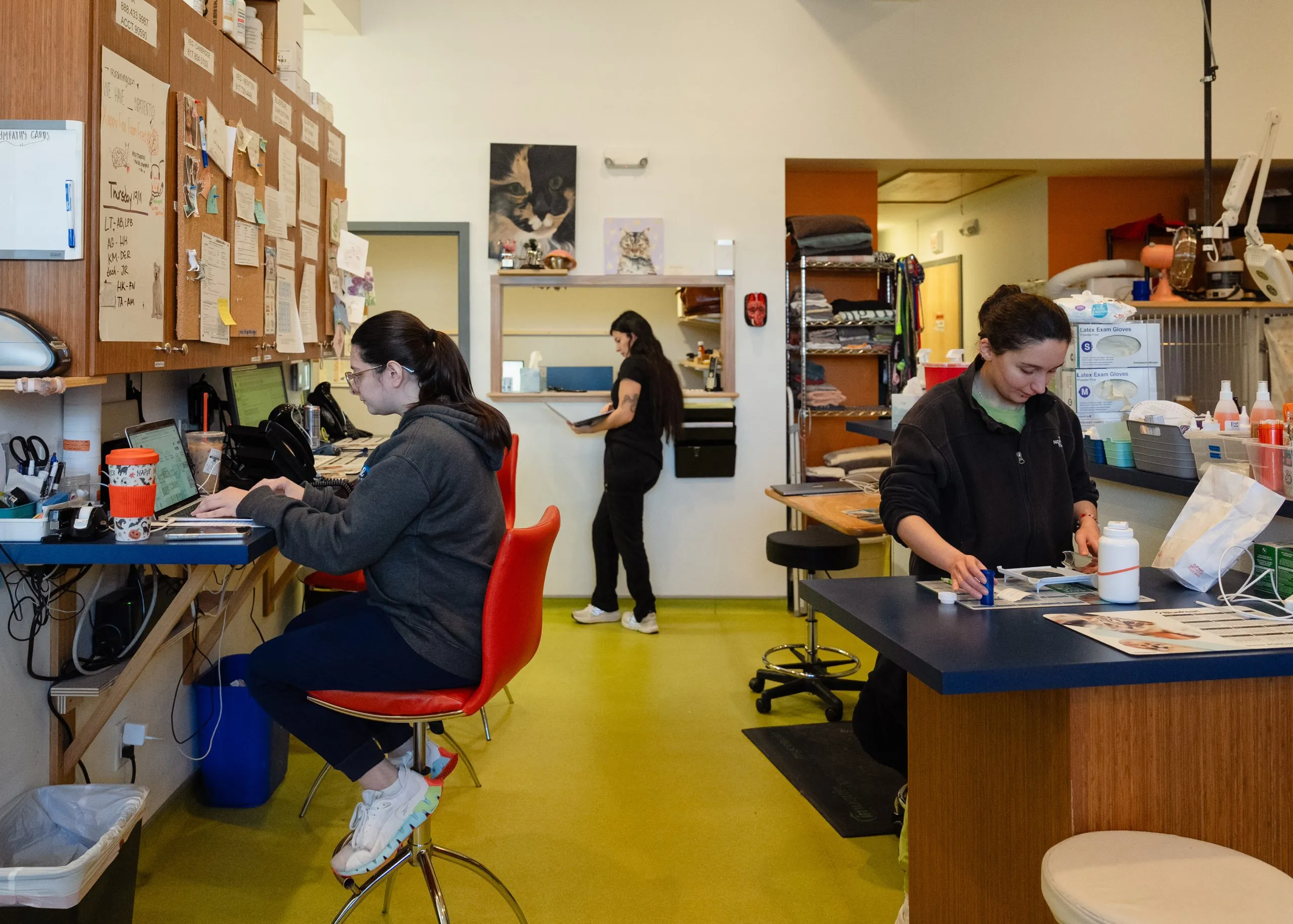
    For her, it wasn’t just a phase. Now, at 48, she co-owns her own bustling veterinary practice, Heal Veterinary Clinic, in this Boston suburb. 

    All seven veterinarians here are women. So is the large team of vet techs, and the entire rest of the 22-member medical staff.

    “In really broad generalities, I think women are more interested in the emotional and empathetic side of things than men are,” Leef said, sitting on the floor of an examination room with one of her patients, an affectionate, white-furred golden retriever named Cypress.

    For that and other reasons, women studying veterinary medicine now outnumber men by four to one

    It’s not just veterinary school. The number of women has surpassed the number of men in law school, medical school, pharmacy school, optometry school and dental school.

    Women in the United States now earn 40 percent more doctoral degrees overall, and nearly twice as many master’s degrees, as men, according to the U.S. Department of Education — a trend transforming high-end work. 

    This is no longer some distant statistical abstraction. Americans can see it when they take their pets to the vet or their kids to the dentist, need a lawyer or an eye exam, see a therapist or pick up a prescription.

    The dramatic shift in who is being trained for these fields is partly because more women are going into them. But it’s also the result of a steady slide in the number of men enrolling in graduate and professional schools. And while that may be elevating women, it’s affecting the nation’s economic competitiveness and even the point at which people get married and have children.

    “Having all students represented and engaged in graduate study ensures that we have healthy communities and families and a vital economy,” said Chevelle Newsome, president of the Council of Graduate Schools.

    Related: Interested in innovations in higher education? Subscribe to our free biweekly higher education newsletter.

    Graduate schools — including the 460 Newsome represents — have their own motive for wanting more men to enroll. They’re facing new threats from declining international enrollment, impending federal borrowing limits for graduate study and a public backlash against the high cost and uneven returns of graduate degrees.

    The main reason women have overtaken men in graduate school, however, is that more women than men are earning the undergraduate degrees required to go on to advanced study. 

    “Women certainly still see education in terms of upward mobility,” said Lisa Greenhill, chief organizational health officer at the American Association of Veterinary Medical Colleges, whose job includes trying to diversify veterinary medicine. “Men have a lot more options. They feel like they don’t have to go to a four-year program or a graduate program.”

    The number of men enrolled as undergraduates in college nationwide has dropped by nearly a quarter of a million, or 4 percent, just since 2020, the National Student Clearinghouse Research Center reports. 

    Women now account for about 60 percent of undergraduate enrollment. Nearly half of women aged 25 to 34 have bachelor’s degrees, compared to 37 percent of men, according to the Pew Research Center.

    “Men aren’t seeing higher education as valuable,” said Newsome. Many go into the trades or take other jobs straight out of high school to begin immediately earning a wage, forgoing the need to spend time in or money on college. Even men who do get undergraduate degrees may not see the value in continuing beyond them, she said.

    The effects of this have been stark and swift.

    The number of women earning law degrees passed the number of men in 2019, figures from the American Bar Association, or ABA, show; while only four of the law schools ranked among the 20 most prestigious by U.S. News & World Report had more women than men in 2016, women now outnumber men at 18 of them, according to the nonprofit law student news site JURIST. 

    Related: Trump’s attacks on DEI may hurt men in college admission

    That’s already having a real-world impact. By 2020, the ABA says, the majority of general lawyers working for the federal government were women, and by 2023, the majority of associates at law firms were.

    In medical schools, the number of women also overtook the number of men in 2019. Today, 55 percent of future doctors are women, up from 48 percent in 2015, according to the Association of American Medical Colleges, or AAMC.

    Women already make up significantly larger proportions of residents in specialties including endocrinology, pediatrics, obstetrics and gynecology, family medicine and psychiatry.

    Women also outnumber men by three to one in doctoral programs in psychology, and by nearly four to one in master’s programs, the American Psychological Association reports. They make up 55 percent of graduates of dental schools, and 72 percent in pediatric dentistry, according to the American Dental Association. 

    More than seven out of 10 students in schools of optometry are women, the Association of Schools and Colleges of Optometry says. And at pharmacy schools, women constitute two-thirds of students working toward master’s degrees and 56 percent of those seeking doctorates, statistics from the American Association of Colleges of Pharmacy show.

    There are still more men than women in doctoral and master’s degree programs in business, engineering, math and the physical sciences. But women make up substantial majorities of graduate enrollment in health sciences, public administration, education, social and behavioral sciences and biological and agricultural sciences, according to the Council of Graduate Schools.

    While this represents impressive progress for women, the declining number of men enrolling in graduate programs is bad news for universities and colleges that offer them, for some patients in the health care system and for the economy.

    That’s because the growing number of women going to graduate and professional schools can’t continue forever to outpace the decline in the number of men. Total graduate enrollment at private, nonprofit colleges and universities was already down this fall, the Clearinghouse reports. 

    Related: Football fantasy: Colleges add sports to bring men, but it doesn’t always work

    That’s a problem made worse by visa restrictions and cuts to federal research funding, which have helped reduce the number of international students coming to the United States for graduate study by 12 percent, according to the Institute of International Education. 

    New federal loan limits scheduled to take effect next year are widely expected to further eat into graduate school enrollment. The changes will cap borrowing at $100,000 for graduate students and $200,000 for those in professional programs. That’s much less than the $408,150 the AAMC says it costs to get a medical degree from a private, nonprofit university or the $297,745 from a public one. The association of medical colleges projects a national shortage of as many as 124,000 physicians by 2034.

    The price of getting a graduate degree has more than tripled since 2000, according to the Georgetown University Center on Education and the Workforce. Graduate degrees have become a critical revenue source for universities, which take in about $20 billion a year from master’s programs alone, a separate analysis, by the right-leaning think tank the American Enterprise Institute, calculates.

    Students of all genders are increasingly questioning the return on that investment. Nearly 40 percent of prospective graduate students say graduate programs that cost more than $10,000 a year are too expensive, a new survey by the enrollment management consulting firm EAB finds. Payoffs vary widely, making some graduate degrees “a potentially high-risk investment,” the Georgetown Center on Education and the Workforce has concluded. 

    The proportion of Americans 25 and older with master’s degrees or higher has fallen since 2000, from first in the world to 24th, according to the World Bank, while the percentage of those with doctoral degrees has dropped during that period from first to seventh.

    “That is a huge concern, when you think about where economies are going,” said Claudia Buchmann, an Ohio State University sociologist who studies this issue and is coauthor of the book “The Rise of Women.” “If we’re trying to compete on a global level, the fact that men’s college-going rates are so stagnant means we can’t fix this problem until we get more men.”

    Related: Even as women outpace men in graduating from college, their earnings remain stuck

    Men are, after all, half the nation’s labor force. And while some graduate degrees may not pay off, many of them do, substantially. People with advanced degrees are also much less likely to be unemployed.

    “When you think about global economic competitiveness for the United States — despite the skepticism that’s out there — education and training are still the keys to good jobs,” Buchmann said. Falling behind by that measure “is doing damage to men in this country.”

    But experts worry that the gender shift is self-perpetuating. Men may be put off by what they see as the “feminization” of professions in which they now are the minority, research by the veterinary medical colleges association concluded. 

    “I’m not seeing a national effort to say we need to change this,” Buchmann said. “If anything, the opposite is true.” 

    Graduate school leaders say the most effective efforts at reversing this trend are at the undergraduate level. “A lot of the effort from the graduate community has been to reach down and support those projects,” said Newsome, who was formerly dean of graduate studies at California State University, Sacramento. Universities also are encouraging employers to sponsor graduate education for male employees, she said.

    The effects of this widening gender divide are not just economic. New studies show that growing gender disparities in education can affect relationships. Marriage rates have fallen as levels of education rise, according to research from Iowa State University; each additional year of schooling reduces by about 4 percentage points the likelihood that someone between 25 and 34 is married. The proportion of Americans in that age bracket who are married has declined from 80 percent in 1970 to 38 percent today.

    Related: Universities and colleges search for ways to reverse the decline in the ranks of male students

    “When folks are looking for partners, there’s a desire to find someone economically comparable,” said Greenhill, of the veterinary medical colleges association. Added Buchmann, at Ohio State: “A lot of masculine norms are about being the breadwinner of the family. If the woman is the principal breadwinner, that presents not just economic challenges, but challenges to make marriages work.”

    More-educated women are also more likely to delay or forgo having children, according to separate research from the Wharton School of Business at the University of Pennsylvania.

    Back at her veterinary clinic, Amanda Leef makes the rounds, checking in on a dog getting his teeth cleaned and a pair of kittens waiting to be adopted. 

    Only one male veterinarian has ever applied to work there, Leef said. He was hired, but eventually left to go into research.

    “It does change the personality of a clinic” to be made up of only women, she said. “A staff that’s diverse is more accessible to a broader range of people. I just think the world is better with greater gender diversity.”

    Contact writer Jon Marcus at 212-678-7556, [email protected] or jpm.82 on Signal.

    This story about higher education and men was produced by The Hechinger Report, a nonprofit, independent news organization focused on inequality and innovation in education. Sign up for our higher education newsletter. Listen to our higher education podcast.

    This <a target=”_blank” href=”https://hechingerreport.org/women-far-outnumber-men-in-law-school-med-school-vet-school-and-other-professional-programs/”>article</a> first appeared on <a target=”_blank” href=”https://hechingerreport.org”>The Hechinger Report</a> and is republished here under a <a target=”_blank” href=”https://creativecommons.org/licenses/by-nc-nd/4.0/”>Creative Commons Attribution-NonCommercial-NoDerivatives 4.0 International License</a>.<img src=”https://i0.wp.com/hechingerreport.org/wp-content/uploads/2018/06/cropped-favicon.jpg?fit=150%2C150&amp;ssl=1″ style=”width:1em;height:1em;margin-left:10px;”>

    <img id=”republication-tracker-tool-source” src=”https://hechingerreport.org/?republication-pixel=true&post=114073&amp;ga4=G-03KPHXDF3H” style=”width:1px;height:1px;”><script> PARSELY = { autotrack: false, onload: function() { PARSELY.beacon.trackPageView({ url: “https://hechingerreport.org/women-far-outnumber-men-in-law-school-med-school-vet-school-and-other-professional-programs/”, urlref: window.location.href }); } } </script> <script id=”parsely-cfg” src=”//cdn.parsely.com/keys/hechingerreport.org/p.js”></script>

    Source link

  • How to make online courses more engaging – Campus Review

    How to make online courses more engaging – Campus Review

    Surveys show the challenge clearly. In New Zealand, students report feeling less engaged online than in traditional classrooms. In the US, 78 per cent of learners say face-to-face courses hold their attention better.

    This pattern appears globally, and universities often identify the same cause: conventional courses are simply too long and dense for digital formats. So how do we make online learning both simpler and more engaging?

    Why engagement drops in online university courses

    Most online courses still mirror traditional academic structures. Long lectures, heavy materials, and limited interaction assume learners will consume content the same way they would in person – but that rarely happens.

    In physical classrooms, engagement comes naturally through conversation, questions, and shared energy. Online, those moments are harder to recreate. Without interaction, digital learners can easily feel isolated or overwhelmed by complicated terms and information overload – and motivation quickly drops.

    The three pillars of engagement

    Fortunately, research and practice point to three proven solutions: microlearning, interaction, and personalization.

    1. Microlearning
    Bite-sized modules help learners absorb information faster and stay focused. Studies show microlearning leads to up to 60 per cent faster completion and 50 per cent higher engagement. Over 70 per cent of Gen Z and millennials prefer short, digestible content over long lectures – and it’s easy to see why. Smaller lessons feel manageable, rewarding, and easy to complete.

    2. Interaction
    Gamified tasks, simulations, and quizzes turn learners from passive viewers into active participants. Studies show that interactive simulations can boost retention by 67 per cent. In some cases, gamified online learning can be even more engaging than traditional classroom discussions because every learner participates equally.

    3. Personalisation
    When training adapts to a learner’s goals or progress, it becomes more meaningful. 78 per cent of teachers confirm that personalisation drives higher motivation and completion rates. It makes learners feel seen, and helps them focus on what really matters to their growth.

    Why short courses are easier to build than ever

    Many institutions want to create short, interactive, and personalised courses but worry it will take too much time or too many resources. That was true in the past, when updating course structure meant redoing everything manually.

    Now, new authoring tools make the process fast and scalable. For instance, iSpring Suite AI helps educators design short courses directly in PowerPoint, complete with quizzes, interactive scenarios, and gamified elements. Its templates and built-in content library significantly cut course creation time down from months to weeks.

    Middlesex University adopted iSpring Suite to increase learner participation through shorter, interactive, and personalised experiences. The result? Over 12,000 quiz views in a single academic year.

    With AI-assisted authoring, educators can also now test and refine ideas in real time – no large teams or budgets required.

    Creating digital courses is as easy as designing a presentation, and you can try it free for two weeks.

    The bottom line

    To keep learners engaged, universities must rethink course design and focus on shorter, interactive, and personalised learning experiences. These formats match how people actually consume information today.

    The next generation of online education won’t just replicate traditional classrooms It will redefine engagement. And with the right tools, creating meaningful digital learning experiences is now faster, simpler, and more accessible than ever.

    Find out how iSpring Suite AI can turn slides into engaging courses in minutes and register for your two week free trial.

    Do you have an idea for a story?
    Email [email protected]

    Source link

  • Why universities struggle to act on early warning data

    Why universities struggle to act on early warning data

    Dashboards light up with warning signals weeks into term, yet intervention often comes too late—if at all.

    Despite significant investment in learner analytics and regulatory pressure to meet an 80 per cent continuation threshold for full-time undergraduates, universities consistently struggle to act when their systems flag at-risk students.

    This implementation gap isn’t about technology or data quality. It’s an organisational challenge that exposes fundamental tensions between how universities are structured and what regulatory compliance now demands.

    The Office for Students has made its expectations clear: providers must demonstrate they are delivering positive outcomes, with thresholds of 80 per cent continuation and 75 per cent completion for full-time first degree students. Context can explain but not excuse performance below these levels. Universities are expected to identify struggling students early and intervene effectively.

    Yet most institutions remain organised around systems designed for retrospective quality assurance rather than proactive support, creating a gap between regulatory expectations and institutional capability.

    The organisational challenge of early intervention

    When analytics platforms flag students showing signs of disengagement—missed lectures, incomplete activities, limited platform interaction—institutions face an organisational challenge, not a technical one. The data arrives weeks into term, offering time for meaningful intervention. But this is precisely when universities struggle to act.

    The problem isn’t identifying risk. Modern analytics can detect concerning patterns within the first few weeks of term. The problem is organisational readiness: who has authority to act on probabilistic signals? What level of certainty justifies intervention? Which protocols govern the response? Most institutions lack clear answers, leaving staff paralysed between the imperative to support students and uncertainty about their authority to act.

    This paralysis has consequences. OfS data shows that 7.2 per cent of students are at providers where continuation rates fall below thresholds. While sector-level performance generally exceeds requirements, variation at provider and course level suggests some institutions manage early intervention better than others.

    Where regulatory pressure meets organisational resistance

    The clash between regulatory expectations and institutional reality runs deeper than resource constraints or technological limitations. Universities have developed (sometimes over centuries) around a model of academic authority that concentrates judgement at specific points: module boards, exam committees, graduation ceremonies. This architecture of late certainty served institutions well when their primary function was certifying achievement. But it’s poorly suited to an environment demanding early intervention and proactive support.

    Consider how quality assurance typically operates. Module evaluations happen after teaching concludes. External examiners review work after assessment. Progression boards meet after results are finalised. These retrospective processes align with traditional academic governance but clash with regulatory expectations for timely intervention. The Teaching Excellence Framework and B3 conditions assume institutions can support students before problems become irreversible, yet most university processes are designed to make judgements after outcomes are clear.

    The governance gap in managing uncertainty

    Early intervention operates in the realm of probability, not certainty. A student flagged by analytics might be struggling—or might be finding their feet. Acting means accepting false positives; not acting means accepting false negatives. Most institutions lack governance frameworks for managing this uncertainty.

    The regulatory environment compounds this challenge. When the OfS investigates providers with concerning outcomes, it examines what systems are in place for early identification and intervention. Universities must demonstrate they are using “all available data” to support students. But how can institutions evidence good faith efforts when their governance structures aren’t designed for decisions based on partial information?

    Some institutions have tried to force early intervention through existing structures—requiring personal tutors to act on analytics alerts or making engagement monitoring mandatory. But without addressing underlying governance issues, these initiatives often become compliance exercises rather than genuine support mechanisms. Staff comply with requirements to contact flagged students but lack clear protocols for escalation, resources for support, or authority for substantive intervention.

    Building institutional systems that bridge the gap

    Institutions successfully implementing early intervention share common organisational characteristics. They haven’t eliminated the tension between regulatory requirements and academic culture—they’ve built systems to manage it.

    Often they create explicit governance frameworks for uncertainty. Rather than pretending analytics provides certainty, they acknowledge probability and build appropriate decision-making structures. This might include intervention panels with delegated authority, clear escalation pathways, or risk-based protocols that match response to confidence levels. These frameworks document decision-making, providing audit trails that satisfy regulatory requirements while preserving professional judgement.

    They develop tiered response systems that distribute authority appropriately. Light-touch interventions (automated emails, text check-ins) require minimal authority. Structured support (study skills sessions, peer mentoring) operates through professional services. Academic interventions (module changes, assessment adjustments) involve academic staff. This graduated approach enables rapid response to early signals while reserving substantive decisions for appropriate authorities.

    And they invest in institutional infrastructure beyond technology. This includes training staff to interpret probabilistic data, developing shared vocabularies for discussing risk, and creating feedback loops to refine interventions. Successful institutions treat early intervention as an organisational capability requiring sustained development, not a technical project with an end date.

    The compliance imperative and cultural change

    As the OfS continues its assessment cycles, universities face increasing pressure to demonstrate effective early intervention. This regulatory scrutiny makes organisational readiness a compliance issue. Universities can no longer treat early intervention as optional innovation—it’s becoming core to demonstrating adequate quality assurance. Yet compliance-driven implementation rarely succeeds without cultural change. Institutions that view early intervention solely through a regulatory lens often create bureaucratic processes that satisfy auditors but don’t support students.

    More successful institutions frame early intervention as aligning with academic values: supporting student learning, enabling achievement, and promoting fairness. They engage academic staff not as compliance officers but as educators with enhanced tools for understanding student progress. This cultural work takes time but proves essential for moving beyond surface compliance to genuine organisational change.

    Implications for the sector

    The OfS shows no signs of relaxing numerical thresholds—if anything, regulatory expectations continue to strengthen. Financial pressures make student retention more critical. Public scrutiny of value for money increases pressure for demonstrable support. Universities must develop organisational capabilities for early intervention not as a temporary response to regulatory pressure but as a permanent feature of higher education.

    This requires more than purchasing analytics platforms or appointing retention officers. It demands fundamental questions about institutional organisation: How can governance frameworks accommodate uncertainty while maintaining rigour? How can universities distribute authority for intervention while preserving academic standards? How can institutions build cultures that value prevention as much as certification?

    The gap between early warning signals and institutional action is an organisational challenge requiring structural and cultural change. Universities investing only in analytics without addressing organisational readiness will continue to struggle, regardless of how sophisticated their systems become. These aren’t simple changes, but they’re necessary for institutions serious about supporting student success rather than merely measuring it.

    The question facing universities isn’t whether to act on early warning signals—regulatory pressure makes this increasingly mandatory. The question is whether institutions can develop the organisational capabilities to act effectively, bridging the gap between data and decision, between warning and intervention, between regulatory compliance and educational values.

    Those that cannot may find themselves not just failing their students but failing to meet the minimum expectations of a regulated sector.

    Source link

  • A new international education strategy

    A new international education strategy

    The Westminster government’s newest iteration of the international education strategy commits the UK to three ambitions: to increase the UK’s international standing through education, to recruit high quality international higher education students from a diverse range of countries, and to grow education exports to £40bn a year by 2030.

    Last time we got an International Education Strategy from the government was back in 2019 – famously it committed the government to increase education exports to £35bn per year, and to increase the number of international HE students studying in the UK to 600,000 per year, again: both by 2030.

    The government’s current best estimate for performance against those targets – which deals with the 2022 calendar year – suggests income from education exports was £32.3bn for that year – with around three quarters of that being derived from higher education activity. For a variety of reasons, it isn’t great data.

    And HESA tells us that there were 758,855 international higher education students during the 2022-23 academic year, though numbers have fallen since.

    Diversification across sub-sectors

    Within the higher education sector the perception has been that this decline in international student numbers has been a political choice in the face of wider public concerns around immigration rather than any failing among universities: changes to dependant visa access, a reduction in the length (from 24 months to 18 months) of the graduate visa for postgraduate taught students, reported difficulties in obtaining student visas, and the onset of price rises linked to the forthcoming international student levy.

    Though a lot of the UK’s historic strengths in international education come via its higher education providers, the strategy is at pains to emphasis the full spectrum of what is on offer, noting:

    We see diversification across sub-sectors as key to long-term success

    Accordingly much of the strategy deals with early years and schools, non-HE tertiary education, English language training, special educational needs, and education technology. But, as with higher education, there is little detail: this will be filled in via an action plan developed by a reconstituted Education Sector Action Group (ESAG). This ministerially-chaired forum will bring together government, industry, and sector representative bodies: each representative will lead on a sub-sector action plan to be published within 100 days of appointment.

    Of course, we don’t even know which minister will chair the forum yet – the strategy is owned jointly by the Department for Education, the Department of Business and Trade, and the Foreign and Commonwealth Development Office. We do know that Steve Smith retains his role as international education champion, and that the strategy will be supported by a range of existing tools and programmes: notably for higher education these include research and technology partnerships including Horizon Europe, plus things like Erasmus+ (from 2027) and Turing (newly confirmed for 2026-27).

    The British Council will play a prominent role too – most notably in the expansion of transnational education provision across every part of the sector. Here robust quality assurance will play a key part – we get detail on schools-level accreditation and oversight, but the parallel section on higher education quality assurance and international standards is missing (despite case studies on the University of London, and the India campus of the University of Southampton). The section on the work of the British Council-led Alumni UK programme (launched in 2022) offers recognition of the value of alumni as international ambassadors.

    And what’s in it for higher education?

    The meat of the strategy for higher education providers concerns a “strategic approach to sustainable international student recruitment”. The key words are “well-managed” and “responsible” recruitment, and a quality student experience should lead to world-class outcomes. It is very encouraging to see that support systems and infrastructure (including local housing) are on the radar too.

    Institutions will be “encouraged to diversify their recruitment”, moving away from reliance on any single country”. There’s support for the sector-owned Agent Quality Framework to tackle poor practices, and a suggestion that government will:

    work closely with the sector to ensure that our institutions recruit international higher education students in a way that maintains quality and student experience. This includes considering factors such as skills and entry requirements, adequate infrastructure, local housing, and support systems

    A section on “maintaining a competitive offer” flags the retention of the (18 month) graduate route, the high potential individual route for those graduating from top 100 institutions (nothing to do with helping UK international education expand, but it is in there), and the change in visa conditions enabling graduates to start businesses while transferring to the “investor founder” route. The international student levy clearly does not help to maintain a competitive offer but we get details of that here too:

    The levy will be fully reinvested into higher education and skills, including the reintroduction of targeted maintenance grant for disadvantaged domestic students, helping to break down barriers to opportunity as part of the government’s Plan for Change and making our higher education system more inclusive for the benefit of all students

    However this ends up benefitting home students, there is no detail on how the policy might discourage (via higher prices, for example) international recruitment.

    Indeed, throughout the strategy there is nothing that deals with the restrictions being placed on higher education as the largest single contributor to educational exports, and how that situation will cause problems (despite warm words about “unlocking the full potential of our education sector”) in meeting this expanded and challenging financial target.

    Source link