Blog

  • The leadership challenges embedded in the 2025 OECD report, Education at a Glance

    The leadership challenges embedded in the 2025 OECD report, Education at a Glance

    • Yesterday, HEPI and Cambridge University Press and Assessment jointly hosted the UK launch of the OECD’s Education at a Glance. You can see the OECD’s slides here.
    • Here we publish a response to the OECD from Professor Sir Chris Husbands, who is a former Vice-Chancellor of Sheffield Hallam University and also former Chair of the Teaching Excellence Framework (TEF) Panel. Chris is a Trustee of HEPI and spoke at the launch.

    There is one line in the 2025 OECD Education at a Glance report which should be in bright flashing lights for this and all governments. The supporting data is on page 112 of the main report. It is this: Individuals with greater educational attainment generally face a lower risk of unemployment and earn higher wages. Race, gender, deprivation, place, subjects studied all impact outcomes in different ways, but the overall conclusion is clear, and in his HEPI briefing on the report, the OECD’s chief analyst Andreas Schleicher got the summary down to just two words: education pays.

    The 2025 OECD Education at a Glance report comes in at 541 pages, and the annual appearance of the report has made it the definitive guide to education system performance and policy dynamics all around the world: in the now familiar graphs of compelling clarity, and crisp text judgements, the OECD team have made themselves indispensable to institutional leaders, policy analysts and decision makers.

    This year’s report has a specific focus on tertiary education, which in OECD terms includes, but stretches a bit further than, higher education. There are some familiar and unsurprising themes in the 2025 report, but they are nonetheless important for being set out so clearly. A few key findings stood out for me, all of them speaking clearly to the English and UK policy agendas.

    First, advantages are inherited: those who have at least one tertiary-educated parent are more than twice as likely to attain a tertiary qualification than those whose parents have below upper secondary attainment, though the gap is smaller in the UK than elsewhere (p.56).

    Secondly, life is getting tougher for those without qualifications: the employment rate for young adults without upper secondary qualifications fell by 6 points since 2019, and by 9 points for men (pp.82-3).

    Thirdly, at the same it’s getting better for the better qualified: the nearly one-in-six with a Master’s degree have higher employment rates and earnings than those with an undergraduate degree (p48).

    Fourthly, education is losing the battle for public funding as the costs of health, pensions and defence rise: between 2015 and 2022, government spending on education declined from nearly 11% of budgets to just over 10% (p.278).

    And fifthly, despite that decline, R&D is strengthening to drive growth and competitiveness. Where it is highest, government drives it: in the UK, Israel and Switzerland, government R&D expenditure is more than twice private expenditure (p.329).

    There is more fine-grained analysis about English higher education. England, on the OECD data, is an outlier in important respects.

    First: English HE is well-funded by comparison with the OECD, whatever it feels like in the sector just now.  The finding is important: total tertiary expenditure per student, including R&D, is $35,000, among the highest in the OECD and 65% above the average (p.327). 

    Secondly, however, in the UK government tertiary expenditure is $8,000, 48% below the OECD average (p.331). This is a result of high tuition fees:  undergraduate fees are three times the OECD average.

    The third way in which England is an outlier is that access to higher education and completion rates within it are high – fourteen percentage points above the OECD average (p.246): access to higher education is far more a consequence of maintenance support than fee levels, but high fee levels almost certainly disincentivise non-completion. Finally, while there is a gap between economic returns to science and technology disciplines on the one hand and arts and humanities on the other in all OECD countries, the gap is much higher in the UK than in almost all other countries (p.111). 

    Putting all this together poses some knotty challenges. England has a successful, relatively accessible higher education system, but one which is very expensive when budgets for education are getting tighter. And this is happening when the economic returns to high levels of qualification are strengthening: masters and doctoral graduates enjoy higher returns than those with undergraduate degrees, while the least qualified face more intense difficulties. These challenges go beyond the voluminous data in Education at a Glance.

    First, and painful for English higher education, the challenge is not simply the level of current funding, but funding in relation to what is a high-cost operating and delivery model. That model secures strong results in terms of access for disadvantaged students and high completion rates, but it is relatively inflexible. It’s unclear whether a lower-cost and potentially more flexible operating model would put some of the successes of the English system at risk.

    Secondly, it is the economic, social and increasingly political costs of the plight of the lowest attaining young people, and especially young males without qualifications, which is attracting political attention. If money is tight, it’s more likely to go towards that problem, and the London government’s decision to move skills funding into the Department of Work and Pensions appears to be a signal of intent.

    These are the leadership challenges which emerge from this year’s report: how to reshape our successful HE system so that its strengths remain, but it can be more responsive and flexible. It needs to adapt to a changing labour market and to a society in which division and inequality are being reinforced with greater ferocity.

    Source link

  • How To Teach With AI Transparency Statements – Faculty Focus

    How To Teach With AI Transparency Statements – Faculty Focus

    Source link

  • Senators ask VCs to justify $1m salaries – Campus Review

    Senators ask VCs to justify $1m salaries – Campus Review

    An Inquiry into the quality of university governance has asked the vice-chancellors of universities who are cutting staff why they are paid up to $1 million per year.

    Please login below to view content or subscribe now.

    Membership Login

    Source link

  • What Australia can learn from UK unis – Campus Review

    What Australia can learn from UK unis – Campus Review

    It’s not often we get invited to deep dive into the workings of other universities, even less so when they’re on the other side of the world.

    Please login below to view content or subscribe now.

    Membership Login

    Source link

  • UTS defends decision to cut courses – Campus Review

    UTS defends decision to cut courses – Campus Review

    The University of Technology Sydney (UTS) has given evidence to a federal senate inquiry that probed how cutting education and public health courses aligns with its public mission.

    Please login below to view content or subscribe now.

    Membership Login

    Source link

  • Academic coaching is data-driven support for students in the dark

    Academic coaching is data-driven support for students in the dark

    Universities offer a wide range of support to students – lecturers’ office hours, personal tutors, study skills advisors, peer-mentoring officers, mental health and wellbeing specialists, and more.

    But even with these services in place, some students still feel they are falling through the cracks.

    Why? One of the most common pieces of student feedback might offer a clue – “I wish I had known you and come to you earlier”.

    Within the existing system, most forms of support rely on students to take the first step – to reach out, refer themselves, or report a problem.

    But not all students can or will: some are unsure who to turn to, others worry about being judged, and many feel too overwhelmed to even begin. These are the students who often disappear from view – not because support does not exist, but because they cannot access it in time.

    Meanwhile, academics are stretched thin by competing research and teaching demands, and support teams – brilliant though they are – can only respond once a student enters this enquiry-response support system.

    Systematic support that requires courage

    As a result, students struggling silently often go unnoticed: for those “students in the dark”, there is often no obvious red flag for support services to act on until it is too late.

    NSS data in recent years reveal a clear pattern of student dissatisfaction with support around feedback and independent study, indicating a growing concern and demand for help outside the classroom.

    While the existing framework works well for those confident and proactive students, without more inclusive and personalised mechanisms in place, we risk missing the very group who would benefit most from early, student-centred support.

    This is where academic coaching comes in. One of its most distinctive features is that it uses data not as an outcome, but as a starting point. At Buckinghamshire New University, Academic Coaches work with an ecosystem of live data – attendance patterns, assessment outcomes, and engagement time with the VLE – collaborating closely with data intelligence and student experience teams to turn these signals into timely action.

    While our academic coaching model is still in its early phase, we have developed simulated student personae based on common disengagement patterns and feedback from colleagues. These hypothetical profiles help us shape our early intervention strategies and continuously polish our academic coaching model.

    For example, “Joseph”, a first-year undergraduate (level 4) commuter student, stops logging into the VLE midway through the term. Their engagement drops from above cohort average to zero and stays that way for a week. In the current system, this might pass unnoticed.

    But through live data monitoring, we can spot this shift and reach out – not to reprimand but to check in with empathy. Having been through the student years, many of us know, and even still remember, what it is like to feel overwhelmed, isolated, or simply lost in a new environment. The academic coaching model allows us to offer a gentle point of re-entry with either academic or pastoral support.

    One thing to clarify – data alone does not diagnose the problem – but it does help identify when something has changed. It flags patterns that suggest a student might be struggling silently, giving us the opportunity to intervene before there is a formal cause for concern. From there, we Academic Coaches reach out with an attentive touch: not with a warning, but with an invitation.

    This is what makes the model both scalable and targeted. Instead of waiting for students to self-refer or relying on word of mouth, we can direct time and support where it is likely to matter most – early, quietly, and personally.

    Most importantly, academic coaching does not reduce students to data points. It uses data to ask the right questions and to guide an appropriate response. Why has this student disengaged? Perhaps something in their life has changed.

    Our role is to notice this change and offer timely and empathetic support, or simply a listening ear, before the struggle becomes overwhelming. It is a model that recognises the earlier we notice and act, the greater the impact will be. Sometimes, the most effective student support begins not with a request, but with a well-timed email in the student’s inbox.

    Firefighting? Future-proofing

    The academic coaching model is not just about individual students – it is about rethinking how this sector approaches student support at a time of mounting pressure. As UK higher education institutions face financial constraints, rising demand, and increasing complexity in students’ needs, academic coaching offers a student-centred and cost-effective intervention.

    It does not replace personal tutors or other academic or wellbeing services – instead, it complements them by stepping in earlier and guiding students toward appropriate support before a crisis hits.

    This model also helps relieve pressure on overstretched academic staff by providing a clearly defined, short-term role focused on proactive engagement – shifting the approach from reactive firefighting to preventative care.

    Fundamentally, academic coaching addresses a structural gap: some students start their university life already at a disadvantage – unsure how to fit into this new learning environment or make use of available support services to become independent learners – and the current system often makes it harder for them to catch up.

    While the existing framework tends to favour confident and well-connected students, academic coaching helps rebalance the system by creating a more equitable pathway into support – one that is data-driven yet recognises and respects each student’s uniqueness. In a sector that urgently needs to do more with less, academic coaching is not just a compassionate gesture, but a future-facing venture.

    That said, academic coaching is not a silver bullet and it will not solve every problem or reach every student. From our discussions with colleagues and institutional counterparts, one of the biggest challenges identified – after using data to flag students – is actually getting them on board with the conversation.

    Like all interventions, academic coaching needs proper investment, training, interdepartmental cooperation, clear role boundaries, and a scalable framework for evaluating impact.

    But it is a timely, student-centred response to a gap that traditional structures often miss – a role designed to notice what is not being said, to act on early warning signs, and to offer students a safe place to re-engage.

    As resources tighten and expectations grow, university leadership must invest in smarter, more sensible forms of support. Academic coaching offers not just an added layer – it is a reimagining of how we gently guide students back on track before they drift too far from it.

    Source link

  • My new consulting company! | Teacherrogers

    My new consulting company! | Teacherrogers

    On July 1, 2025, I founded Futurescape Instructional Design, LLC. This was the day after I lost my job. I had wanted to create a consulting company after retirement, but the job loss jump-started this venture! This is my third company, so I’m not a novice. I collaborated with generative AI (GenAI) to come up with a name that reflected both my instructional design background and futures thinking training. I also relied on GenAI to help me write the outline for my business plan. I was thrilled with the outcome. This blog describes my new company.


    Executive Summary

    Futurescape Instructional Design, LLC, founded by Dr. Sandra Rogers, is dedicated to transforming teaching and learning to meet tomorrow’s needs. We offer comprehensive instructional design services and foresight-building workshops, informed by futures thinking strategies, for academic institutions, education nonprofits, educational technology corporations, and individual educators. Our dual-focus approach enables individuals and organizations to deliver high-quality learning experiences today while also anticipating and shaping the future of education.

    Mission Statement

    Our company’s mission is to support educators and institutions in their efforts to enhance teaching and learning practices and environments in the short term, ultimately improving students’ long-term learning outcomes through research-based instructional design and future-focused thinking.

    Goals

    1. By improving their course designs, course material, and built-in learner support (e.g., orientation modules, learning strategy guides, help page), our instructional design services will positively impact our clients’ teaching methods and learning environments.
    2. By training them on futures thinking strategies and practices, our clients will become meta-aware of signals and drivers of possible futures. They will learn how to analyze, manipulate, prioritize, and act on them to prepare for digital transformations and related changes now and on the horizon.

    Instructional Design Overview

    Our instructional design services draw upon 30 years of educational experience, advanced academic credentials, and research-based best practices. We serve K-16 institutions, education nonprofits, education technology companies, and individual educators to help them build accessible, effective, inclusive, and engaging learning experiences. The service includes a client intake survey, a memorandum of understanding, timelines, a feedback process, and accessibility compliance guidelines.

    Services Offered

    The following services address the myriad of instructional design work. They can be provided singly or in combination. The client must complete an intake survey and provide sample content and syllabus before the initial meeting. For on-site work, the client will cover travel expenses and per diem.

    • Prep Time – The designer’s review of content, context, and stakeholders’ needs takes place in advance of the initial meeting. It relies on information and material provided during the initial point of contact and via the Client Intake Survey.
    • Course Design Consultations – One-on-one or whole group consultation for instructional design and related aspects to build high-quality, research-based courses. Guidance, per client request, could include structuring content, optimizing instructional strategies, integrating technology, creating a community of inquiry, designing for equity and inclusion, and aligning objectives with desired outcomes.
    • Course Design and Development – First, the designers will consult with the client to understand desired outcomes for the course design. Course material will be collected; the syllabus will be used as a plan of action. Second, backwards mapping of course outcomes to assessments, content (including media plans), and strategies will be a collaborative process. Prototyping of a course module will be shared for feedback and approval before the actual course design begins. Course design generally takes six months because it involves work from both the instructor and the designer. Fast-track builds can be created in three months if the instructor has the time.
    • Course Redesigns – Revitalize existing courses to improve access, engagement, equity, inclusion, learning outcomes, and relevance. The designer will meet with the client to understand project parameters and provide recommendations before starting the project. Course redesigns can include items listed separately in services offered (e.g., quality review, course remediation, or custom course document creation). Course redesigns can be accomplished in 1-3 months, depending on how much time the instructor has available.
    • Quality Assurance Reviews – Clients will provide or otherwise select a rubric for quality assurance (QA) reviews. The review consists of a comprehensive course evaluation for instructional alignment, usability, inclusion, effectiveness, and compliance with accessibility standards. A QA review also checks to see if links are broken and whether the link title matches the linked content. Feedback is shared via a QA checklist. Items approved for revision or replacement are discussed.
    • Content and Course Remediation for WCAG 2.1 AA Compliance – Ensure courses are accessible to learners and compliant by remediating course pages and materials to meet Web Content Accessibility Guidelines (WCAG) 2.1 AA standards per ADA Title II regulations. The new regulations require courses to be 100% accessible by April 2026. The designer can remediate content and share standards to avoid facing similar issues with new material or course designs. Content remediation is a lengthy process. For example, one PDF can take 10 minutes if it doesn’t include a lot of images. However, a PowerPoint with numerous images can take an hour.
    • Job Aids – This service provides custom creations of course documents (e.g., guides, rubrics, syllabi) and/or ancillary videos (e.g., virtual tours, tutorials, explainers). Creating material requires a consultation with the client before production. Media production is a lengthy process. For example, a 3-minute video could take an hour to produce the final version. Clients will be invited to share feedback on document and video creation for guidance and approval.

    To learn more, especially about the futures thinking workshops, visit my new company website. I’m happy to share that I have my first client and a few prospective ones. Reach out if you’re interested!

    Source link

  • Virginia Democrats Accuse GMU Rector of Conflict of Interest

    Virginia Democrats Accuse GMU Rector of Conflict of Interest

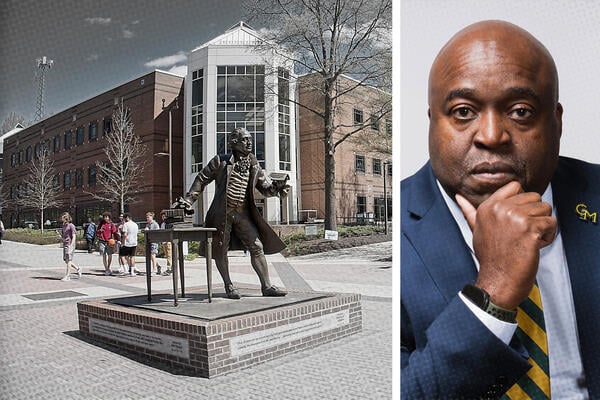
    Photo illustration by Justin Morrison/Inside Higher Ed | Robert Knopes/UCG/Universal Images Group/Getty Images | Maxine Wallace/The Washington Post/Getty Images

    Virginia Democrats want George Mason University board rector Charles Stimson to recuse himself from federal investigations into the university as well as discussions about the university president’s future, saying that his role at the Heritage Foundation, which recently released a report critical of GMU, presents a conflict of interest.

    The letter comes almost two weeks after a state Senate committee blocked 14 gubernatorial appointments to university boards, including six at GMU, which left the Board of Visitors without a quorum. The letter also follows the Heritage report that accused GMU of attempting to hide diversity, equity and inclusion programs. Stimson has had several jobs at Heritage, where he’s currently deputy director of the organization’s legal and judicial studies center.

    The Trump administration has accused GMU of engaging in discriminatory hiring practices and implementing “unlawful DEI policies” and has opened several investigations into the university.

    However, GMU president Gregory Washington has stood his ground, arguing that the federal government rushed the investigation and disputing its findings while rejecting calls to personally apologize. Now, as GMU’s Board of Visitors is stuck without a quorum while a legal challenge over the appointments plays out, state Democrats are seeking to neutralize Stimson in his role as rector.

    A Call for Recusal

    Senate Majority Leader Scott Surovell and other top Democrats in the Senate, L. Louise Lucas and Mamie E. Locke, specifically took issue with the Heritage report’s call to “withhold federal taxpayer funds from universities that violate the Civil Rights Act of 1964,” which the Education Department accused GMU of doing. State Democrats argued that Stimson’s employer is essentially seeking to harm the university.

    “This creates an untenable ethical conflict where your employer’s published position is diametrically opposed to your duties as Rector,” the lawmakers wrote to Stimson.

    (Stimson is one of multiple university board members appointed by Republican governor Glenn Youngkin with distinctly right-wing profiles, including some with ties to conservative think tanks, the Trump administration, GOP megadonors and former Republican politicians, Inside Higher Ed found earlier this year.)

    State Democrats also raised concerns over how he became rector.

    “The appearance of impropriety is compounded by the fact that your selection as Rector reportedly occurred only after direct intervention by Governor Youngkin, raising questions about whether your Heritage Foundation affiliation influenced that appointment,” the Democrats wrote.

    Given what they view as a conflict of interest, the three Democratic leaders called on Stimson to recuse himself “from all Board of Visitors deliberations, discussions, and votes” involving Washington’s employment status or performance evaluations, GMU responses to federal DEI investigations or compliance concerns, GMU funding strategies and university DEI policies.

    “If you cannot commit to this recusal, I believe the appropriate course would be your resignation as Rector to eliminate this conflict entirely,” Surovell and the other Democrats wrote to Stimson while calling on him to respond “outlining the specific steps you will take to address this conflict.”

    Neither GMU officials nor Stimson responded to requests for comment from Inside Higher Ed.

    Youngkin accused Democrats of trying to undermine university boards.

    “Virginia’s progressive left elected officials are trying to paralyze the governing boards of Virginia’s colleges and universities by using despicable bullying and intimidation tactics,” Youngkin wrote in a post on X.

    Faculty Support

    As Washington, GMU’s first Black president, has found himself in the Trump administration’s cross hairs and fighting back, board support has been a constant question. Rumors of Washington’s expected firing swirled in July, but the Board of Visitors kept him on the job.

    George Mason faculty have also rallied around the embattled president, with dozens of professors, students and others protesting outside the July meeting. GMU’s chapter of the American Association of University Professors applauded the senators’ letter on Tuesday.

    “We believe that Mr. Stimson has failed to fulfill his fiduciary duties and has repeatedly exceeded his proper authority as Rector of the Board of Visitors. His conflicting leadership role at the Heritage Foundation and his repeated attempts to overreach his authority threaten the foundation of Virginia’s largest public university, endangering its governance, stability, and future,” the GMU-AAUP Executive Committee wrote in an email to members.

    The local AAUP chapter struck a sharper tone than Virginia’s Senate leadership, alleging that Stimson has “usurped GMU President Gregory Washington’s authority to manage the university’s responses to federal investigations, contrary to the president’s delegated authority established in the [Board of Visitors’] Bylaws.”

    GMU-AAUP also echoed the call for Stimson to recuse himself from certain board duties.

    “If Rector Stimson cannot commit to this recusal, we join Senators Surovell, Lucas, and Locke in calling for his resignation as Rector to eliminate this conflict entirely,” the organization wrote. “The independence, integrity, and future of George Mason University depend on nothing less.”

    The group previously voted no confidence in the Board of Visitors in July.

    Source link

  • Scholarship, Not Ideology, Guides Civics Curricula

    Scholarship, Not Ideology, Guides Civics Curricula

    To the editor,

    I write in response to Ryan Quinn’s recent article (“The Battle for ‘Viewpoint Diversity’” Sept. 2, 2025) on the new civic center at Utah State University, which mandates general education courses on Western civilization. In his words: “Utah’s Legislature created a civic center at Utah State University committed to ‘viewpoint diversity and civil discourse’ … Those courses must include three that engage with ‘primary texts predominantly from Western civilization,’ such as ancient Israel, Greece or early Christianity. There’s no mention of Islam.”

    Well, there’s no mention of Shintoism, Confucianism or Buddhism, either, but I fail to see what’s puzzling about excluding Islam from a “Western civilization” curriculum. Islam’s primary texts played no part in the political construction of the West. Quinn’s implied request is analogous to demanding that a curriculum devoted to Aztec or Inca civilization include the Bible simply because Spain invaded, conquered, subjugated and colonized those societies. 

    As a matter of civics, the distinction between the Islamic world and the West is foundational and elementary. It is recognized historically and intellectually by all who have studied the West’s construction.

    Most Americans—and by extension, our education systems—naturally focus on their own historical and cultural heritage. We’re in the United States; courses here typically reflect what shaped this nation: Greco-Roman republicanism, state Christianity and Enlightenment ideals. People are curious how and why our country got to where it is. If we taught in Iran, China or elsewhere, the focus would reflect their heritage—not ours.

    This isn’t a value judgment. It’s just a fact. As odd as it sounds, the United States was conceived as a reactivation of the Roman Republic 1,800 years after it came to an abrupt halt. The Founders live action role played as ancient Romans in their writings. It’s strange, but that’s precisely why it fascinates students. So these texts are not political baggage; they’re intriguing questions of origin and identity.

     The question here isn’t moral judgment or wishful thinking. It’s scholarly clarity. Let’s demand substance, not ideology.

    Mike Fontaine is a professor of classics at Cornell University.

    Source link

  • 2026 College Free Speech Rankings: America’s colleges get an ‘F’ for poor free speech climate

    2026 College Free Speech Rankings: America’s colleges get an ‘F’ for poor free speech climate

    • Claremont McKenna takes the top spot, while Barnard College, Columbia University, and Indiana University come in last.
    • 166 of the 257 schools surveyed got an F for their speech climate.
    • For the first time ever, a majority of students would prevent speakers from both the left and right who express controversial views, ranging from abortion to transgender issues, from stepping foot on campus.

    WASHINGTON, D.C., Sept. 9, 2025 – If America’s colleges could earn report cards for free speech friendliness, most would deserve an “F”— and conservative students are increasingly joining their liberal peers in supporting censorship.

    The sixth annual College Free Speech Rankings, released today by the Foundation for Individual Rights and Expression and survey partner College Pulse, show a continued decline in support for free speech among all students, but particularly conservatives. Students of every political persuasion show a deep unwillingness to encounter controversial ideas. The survey, which is the most comprehensive look at campus expression in the country, ranked 257 schools based on 68,510 student responses to a wide array of free speech-related questions.

    The rankings come at a notable moment for free speech on college campuses: clashes over the Israeli-Palestinian conflict, a vigorous and aggressive culture of student activism, and the Trump administration’s persistent scrutiny of higher education. 

    “This year, students largely opposed allowing any controversial campus speaker, no matter that speaker’s politics,” said FIRE President and CEO Greg Lukianoff. “Rather than hearing out and then responding to an ideological opponent, both liberal and conservative college students are retreating from the encounter entirely. This will only harm students’ ability to think critically and create rifts between them. We must champion free speech on campus as a remedy to our culture’s deep polarization.”

    The best colleges for free speech

    1. Claremont McKenna College
    2. Purdue University
    3. University of Chicago
    4. Michigan Technological University
    5. University of Colorado, Boulder
    6. University of North Carolina, Greensboro
    7. Vanderbilt University
    8. Appalachian State University
    9. Eastern Kentucky University
    10. North Carolina State University

    The worst colleges for free speech

    1. Loyola University, Chicago

    2. Middlebury College

    3. New York University

    4. Boston College

    5. University of California, Davis

    6. Northeastern University

    7. University of Washington

    8. Indiana University

    9. Columbia University

    10. Barnard College

    EXPLORE THE RANKINGS

    For the second time, Claremont McKenna has claimed the top spot in the rankings. Speech controversies at the highest-rated schools are rare, and their administrations are more likely to support free speech. The schools that improved their score the most, including Dartmouth College and Vanderbilt University, worked to reform their policies and recently implemented new programs that support free speech and encourage open discourse. 

    The lowest-rated schools are home to restrictive speech policies and some of last year’s most shocking anti-free speech moments, including threats to press freedom, speaker cancellations, and the quashing of student protests.

    “Even one egregious anti-free speech incident can destroy students’ trust in their administration and cause a school to plummet in the rankings,” said FIRE Vice President of Research Angela C. Erickson. “If campus administrators, faculty, and students want to enjoy an atmosphere of trust on campus, they can start by protecting each other’s rights.”

    Other key findings from the report include:

    • 166 of the 257 schools surveyed got an F for their speech climate, while only 11 schools received a speech climate grade of C or higher.
    • Only 36% of students said that it was “extremely” or “very” clear that their administration protects free speech on campus.
    • A record 1 in 3 students now holds some level of acceptance – even if only “rarely” — for resorting to violence to stop a campus speech.
    • 53% of students say that the Israeli-Palestinian conflict is a difficult topic to discuss openly on campus. On 21 of the campuses surveyed, at least 75% of students said this — including 90% of students at Barnard.
    • For the first time ever, a majority of students oppose their school allowing any of the six controversial speakers they were asked about onto campus — three controversial conservative speakers and three controversial liberal ones.

    “More students than ever think violence and chaos are acceptable alternatives to peaceful protest,” said FIRE Chief Research Advisor Sean Stevens. “This finding cuts across partisan lines. It is not a liberal or conservative problem — it’s an American problem. Students see speech that they oppose as threatening, and their overblown response contributes to a volatile political climate.” 

    Explore the full rankings here.


    The Foundation for Individual Rights and Expression (FIRE) is a nonpartisan, nonprofit organization dedicated to defending and sustaining the individual rights of all Americans to free speech and free thought—the most essential qualities of liberty. FIRE recognizes that colleges and universities play a vital role in preserving free thought within a free society. To this end, we place a special emphasis on defending the individual rights of students and faculty members on our nation’s campuses, including freedom of speech, freedom of association, due process, legal equality, religious liberty, and sanctity of conscience.

    CONTACT 

    Katie Stalcup, Communications Campaign Manager, FIRE: 215-717-3473; [email protected] 

    Source link