As congressional Republicans scratched and clawed to pass President Trump’s signature policy effort, the One Big Beautiful Bill Act—a sprawling, tax-heavy package celebrated as much for its branding as for its contents—it is notable how few people could explain what exactly was in it. Tax cuts for some, probably. A Social Security bonus, maybe. A gutting of public benefits, almost certainly. What is clear, though, is that the bill’s complexity was always in service of its politics: When no one understands tax policy, it’s much easier to sell whatever story you want.
That confusion is exactly why we should be teaching tax policy more broadly—not just in sparsely attended law school classes and accounting departments, but in general education curricula and first-year seminars. Tax isn’t just a technical rule-following subject; it’s a civic one. Tax policy shapes everything from fairness and inequality to the functional shape of the state itself. Yet, most students will graduate college without ever being asked to consider what tax is for—much less whom it helps, whom it harms and why it remains so easy to obscure.
That is precisely the starting point for the course I designed at Drexel University, Introduction to Tax Theory and Policy, which I teach in our innovative undergraduate law major, housed at the Thomas R. Kline School of Law. It’s not a course for aspiring tax attorneys, prospective C.P.A.s or Excel mavens—few of my students intend to practice tax law. They’re interested in criminal or family law, or they’re business majors, future social workers, engineers or undecided second-years. But they’re all taxpayers—and that’s the relevant bit.
Courses like mine aim to democratize access to legal and policy tools so that all students, irrespective of their major, can become more informed and empowered participants in civic life. In class, we don’t parse tax rates or calculate deductions. No calculators are required, and at no point is anyone expected to consider the straight-line depreciation of an apartment complex. We ask why the system is built the way it is, and we talk about the power that it reflects and protects. We talk about values: what kinds of behavior the tax code encourages or punishes. We talk about trust and legitimacy: What happens when people believe the system is rigged, and what if they’re right? In short, we treat tax not as a set of arcane rules and rates to memorize, but as a lens through which we can better understand the power structures we live under.
The surprising part (at least to me, when I first taught it and admittedly just hoped I wouldn’t be lecturing to an empty room) is how much students connect with this approach. More than connect with it—they often enjoy it. I’ve received feedback from students that describes the class as life-changing and course reviews that have noted how it changed assumptions regarding what tax even is. High praise from 19- and 20-year-olds.
The course itself draws on philosophy, political theory, economics and law—but what it really cultivates is a kind of civic literacy. It asks students to think about who they are in relation to the state and how much of their future may be shaped by the tax policy they’ve never been taught to see. For many, it is the first time they’ve encountered taxation not as something to dodge, but as something to question, debate and reimagine in furtherance of their own values.
In one session, we explore how the tax code is employed as a kind of soft steering wheel in the economy—how it at turns encourages homeownership, subsidizes sports stadiums, directs corporate research and development, and shapes (or even outright creates) the market for electric vehicles. Another week, we explore estate taxes and inheritance: not just who pays, but what it means to redistribute wealth across generations and what happens when we don’t. We read Garrett Hardin’s “The Tragedy of the Commons,” engage in spirited debates about the potential for tax to solve the artificial intelligence copyright debate, and unpack why TurboTax spent two decades fighting free filing.
Over the course of the class, the question shifts away from what is a tax and toward whose values does this system reflect? That shift—from mere definitional awareness to focused critical engagement—is when I know the class is working. Students cease to see tax as someone else’s problem and begin seeing it as a potent tool of and for democracy.
In their final papers, students have proposed remarkably forward-looking and sophisticated tax policy reforms—reflecting both creativity and civic seriousness. One student argued that companies receiving public subsidies through tax credits, like chemical and drug manufacturers, should be barred from claiming additional credits to remediate harms their products create. Another proposed a data-collection “sin tax” aimed at discouraging exploitative surveillance practices by tech companies. These aren’t rote academic exercises. They’re thoughtful intervention proposals that treat tax as a lever for shaping society.
If tax policy determines who gets what, who pays for it and how the government keeps a hand in the marketplace, then it belongs squarely at the heart of a liberal arts education. We don’t cabin discussions of justice in law schools, and we don’t isolate questions of the public good in policy programs—why do we treat taxation, which intersects with both and innumerable other facets of modern life, as off-limits or too technical for undergraduates?
This isn’t a plea to teach undergraduates to file their own taxes—though there is probably a case to be made for that, too. It’s about ensuring curricula help them understand how the world works and how it’s been designed to work for some more than others. That means tackling the politics of Internal Revenue Service funding, exploring how “tax relief” often functions as an upstream transfer of wealth and how a positively sprawling bill like the one recently passed through Congress can obscure much more than it reveals.
If no one understands how tax policy works, how can anyone meaningfully weigh in on whether they support one revenue bill or another? On issues like immigration, abortion or education funding, many people bring at least some passing knowledge or lived experience to the conversation. Tax remains, for most, a black box. The more opaque it becomes, the more tempting it is for lawmakers to retreat into it—tucking major redistributive choices into the shadows of the tax code, where they can be shielded from public scrutiny.
On the other hand, when students come to see tax as a form of the civic superstructure—something they live within and not just under—they are empowered to not only understand tax policy but to shape it. That should be one of the goals of any serious undergraduate education.
We don’t have to, and should not, keep treating tax as one professional niche within other professional niches. If we want students to understand how tax relates to power, fairness and democratic participation, we should give them the tools to talk about it. This needn’t focus on the rates and rules but should illustrate the values taxes reflect and trade-offs they embed.
Courses like mine don’t require a background in economics, accounting or law. They require a willingness to take seriously the idea that how we tax equates to how we govern. If we can help students see tax not as a source of dread or line item on their paycheck, but as the site of collective economic decision-making, we don’t just produce better-informed graduates—we’ll also produce more engaged citizens.
Andrew Leahey is a practice professor of law at Drexel University’s Thomas R. Kline School of Law.
Experiential learning opportunities provide students with a space to connect in-classroom learning to real-world situations. A student-run clinic at Widener University provides graduate health science professional students with hands-on learning and career experiences while supporting community health and well-being for Chester, Pa., residents.
The Chester Community Clinic was founded in 2009 for physical therapy services but has since expanded to cover other health and wellness services, including occupational therapy and speech-language pathology. The clinic gives students studying those fields leadership opportunities, experience working with diverse clients and the confidence to tackle their professional careers.
What’s the need: Before the clinic was established, physical therapy students at Widener would volunteer at a pro bono clinic in nearby Philadelphia. But students pushed for a clinic within Chester, which is considered a primary care health professional shortage area, meaning it lacks enough providers to serve the local population.
For some patients, a lack of health insurance can impede their ability to receive care. In Pennsylvania, 5.4 percent of residents are without private or public health insurance, roughly two percentage points lower than the national average. The clinic addresses gaps in health care by providing services for free while educating future health science professionals.
How it works: The clinic is led by a board of 12 to 14 students from each class and supervised by faculty and community members who are licensed physical therapists. Students begin service in their second semester of the program and participate in the clinic until their final clinical placement.
Most clients are referred by a physician but have been turned away from local PT clinics due to a lack of health insurance or because they exceeded the allotted insurance benefits for PT.
During appointments, students provide direct physical therapy services to patients, including making care plans, walking them through exercises and creating medical records.
Over the years, the clinic has expanded to include occupational therapy, speech-language pathology, clinical psychology and social work services. In 2024, Widener included a Community Nursing Clinic to provide pro bono services as well.
All students studying physical therapy, occupational therapy and speech-language pathology at Widener volunteer at the clinic as part of the program requirements. PT students are required to serve a minimum of three evenings per semester; board members typically serve more hours.
The clinic’s multifaceted offerings increase opportunities for students to work across departments, engaging with their peers in other health professions to establish interdisciplinary plans for care.
Free Talent
Other colleges and universities offer pro bono student services to support community members and organizations:
Gonzaga University has a student-led sports consulting agency that offers strategy ideas and tools to sports brands and teams.
Utah Valley University students can intern with a semester-long program that provides digital marketing to businesses in the region.
American University’s Kogod School of Business has a business consulting group that provides students with project-based consulting experience.
Carroll University faculty and students in the behavioral health psychology master’s program run a free mental health clinic for those in the area.
The impact: Since the clinic began in 2009, students have provided over 12,000 physical therapy appointments to community members, worth about $1.3 million in costs, according to a 2024 press release from the university.
A 2017 program evaluation, published in the Internet Journal of Allied Health Sciences and Practice, found that PT students who served in the pro bono clinic felt more equipped to launch into clinical work. They were prepared to manage documentation, use clinical reasoning and engage in interprofessional communication.
A 2020 study of the clinic also found that students performed better than expected in cultural competence, perhaps due to their experience engaging with clients from a variety of ethnicities, socioeconomic backgrounds, health literacy levels, religions and languages.
Both Widener and students in the health science professions continue to support the development of other pro bono clinics. The class of 2015 created The Pro Bono Network, facilitating advancement of student-run pro bono services among 109 member institutions across the country. This past spring, Widener’s annual Pro Bono Network Conference welcomed 250 individuals working at or affiliated with pro bono clinics, and featured 32 student leaders presenting their work.
How do your students gain hands-on experience and give back? Tell us more.
This article has been updated to reflect the addition of a pro bono nursing clinic in 2024, not the creation of it, and to identify students as health science professional students, not health professional students.
As the writing across the curriculum and writing center coordinator on my campus, faculty ask me how to detect their students’ use of generative AI and how to prevent it. My response to both questions is that we can’t.
In fact, it’s becoming increasingly hard to not use generative AI. Back in 2023, according to a student survey conducted on my campus, some students were nervous to even create ChatGPT accounts for fear of being lured into cheating. It used to be that a student had to seek it out, create an account and feed it a prompt. Now that generative AI is integrated into programs we already use—Word (Copilot), Google Docs (Gemini) and Grammarly—it’s there beckoning us like the chocolate stashed in my cupboard does around 9 p.m. every night.
A recent GrammarlyGO advertisement emphasizes the seamless integration of generative AI. In the first 25 seconds of this GrammarlyGO ad, a woman’s confident voice tells us that GrammarlyGO is “easy to use” and that it’s “easy to write better and faster” with just “one download” and the “click of a button.” The ad also seeks to remove any concerns about generative AI’s nonhumanness and detectability: it’s “personalized to you”; “understands your style, voice and intent so your writing doesn’t sound like a robot”; and is “custom-made.” “You’re in control,” and “GrammarlyGO helps you be the best version of yourself.” The message: Using GrammarlyGO’s generative AI to write is not cheating, it’s self-improvement.
This ad calls to my mind the articles we see every January targeting those of us who want to develop healthy habits. The ones that urge us to sleep in our gym clothes if we want to start a morning workout routine. If we sleep in our clothes, we’ll reduce obstacles to going to the gym. Some of the most popular self-help advice focuses on the role of reducing friction to enable us to build habits that we want to build. Like the self-help gurus, GrammarlyGO—and all generative AI companies—are strategically seeking to reduce friction by reducing time (“faster), distance (it’s “where you write”) and effort (it’s “easy”!).
Where does this leave us? Do we stop assigning writing? Do we assign in-class writing tests? Do we start grading AI-produced assignments by providing AI-produced feedback?
Nope.
If we recognize the value of writing as a mode of thinking and believe that effective writing requires revision, we will continue to assign writing. While there is a temptation to shift to off-line, in-class timed writing tests, this removes the opportunity for practicing revision strategies and disproportionately harms students with learning disabilities, as well as English language learners.
Instead, like Grammarly, we can tap into what the self-help people champion and engage in what organizational behavior researchers Hayagreeva Rao and Robert I. Sutton call “friction fixing.” In The Friction Project (St. Martin’s Press, 2024), they explain how to “think and live like a friction fixer who makes the right things easier and the wrong things harder.” We can’t ban AI, but we can friction fix by making generative AI harder to use and by making it easier to engage in our writing assignments. This does not mean making our writing assignments easier! The good news is that this approach draws on practices already central to effective writing instruction.
After 25 years of working in writing centers at three institutions, I’ve witnessed what stalls students, and it is rarely a lack of motivation. The students who use the writing center are invested in their work, but many can’t start or get stuck. Here are two ways we can decrease friction for writing assignments:
Break research projects into steps and include interim deadlines, conferences and feedback from you or peers. Note that the feedback doesn’t have to be on full drafts but can be on short pieces, such as paragraph-long project proposals (identify a problem, research question and what is gained if we answer this research question).
Provide students with time to start on writing projects in class. Have you ever distributed a writing assignment, asked, “any questions?” and been met with crickets? If we give students time to start writing in class, we or peers can answer questions that arise, leaving students to feel more confident that they are going in the right direction and hopefully less likely to turn to AI.
There are so many ways we faculty (unintentionally) make our assignments uninviting: the barrage of words on a page, the lack of white space, our practice of leading with requirements (citation style, grammatical correctness), the use of SAT words or discipline-specific vocabulary for nonmajors: All this can signal to students that they don’t belong even before they’ve gotten started. Sometimes, our assignment prompts can even sound annoyed, as our frustration with past students is misdirected toward current students and manifests as a long list of don’ts. The vibe is that of an angry Post-it note left for a roommate or partner who left their dishes in the sink … again!
What if we were to reconceive our assignments as invitations to a party instead? When we design a party invitation, we have particular goals: We want people to show up, to leave their comfort zones and to be open to engaging with other people. Isn’t that what we want from our students when we assign a writing project?
If we designed writing assignments as invitations rather than assessments, we would make them visually appealing and use welcoming language. Instead of barraging students with all the requirements, we would foreground the enticing facets of the assignment. De-emphasize APA and MLA formatting and grammatical correctness and emphasize the purpose of the assignment. The Transparency in Learning and Teaching in Higher Education framework is useful for improving assignment layout.
write in authentic genres and for real-world audiences;
share their writing in and beyond the classroom;
receive feedback on drafts from their professors and peers that builds on their strengths and provides specific tasks for how to improve their pieces; and
understand the usefulness of a writing project in relation to their future goals.
Much of this is confirmed by a three-year study conducted at three institutions that asked seniors to describe a meaningful writing project. If assignments are inviting and meaningful, students are more likely to do the hard work of learning and writing. In short, we can decrease friction preventing engagement with our assignments by making them sound inviting, by using language and layouts that take our audience into consideration, and by designing assignments that are not just assessments but opportunities to explore or communicate.
How then do we create friction when it comes to using generative AI? As a writing instructor, I truly believe in the power of writing to figure out what I think and to push myself toward new insights. Of course, this is not a new idea. Toni Morrison explains, “Writing is really a way of thinking—not just feeling but thinking about things that are disparate, unresolved, mysterious, problematic or just sweet.” If we can get students to truly believe this by assigning regular low-stakes writing and reinforcing this practice, we can help students see the limits of outsourcing their thinking to generative AI.
As generative AI emerged, I realized that even though my writing courses are designed to promote writing to think, I don’t explicitly emphasize the value of writing as mode of discovery, so I have rewritten all my freewrite prompts so that I drive this point home: “This is low-stakes writing, so don’t worry about sentence structure or grammar. Feel free to write in your native language, use bullet points, or speech to text. The purpose of this freewriting is to give you an opportunity to pause and reflect, make new connections, uncover a new layer of the issue, or learn something you didn’t know about yourself.” And one of my favorite comments to give on a good piece of writing is “I enjoy seeing your mind at work on the page here.”
Additionally, we can create friction by getting to know our students and their writing. We can get to know their writing by collecting ungraded, in-class writing at the beginning of the semester. We can get to know our students by canceling class to hold short one-on-one or small group conferences. If we have strong relationships with students, they are less likely to cheat intentionally. We can build these bonds by sharing a video about ourselves, writing introductory letters, sharing our relevant experiences and failures, writing conversational feedback on student writing, and using alternative grading approaches that enable us to prioritize process above product.
There are no “AI-proof” assignments, but we can also create friction by assigning writing projects that don’t enable students to rely solely on generative AI, such as zines, class discussions about an article or book chapter, or presentations: Generative AI can design the slides and write the script, but it can’t present the material in class. Require students to include interactive components to their presentations so that they engage with their audiences. For example, a group of my first-year students gave a presentation on a selection from Jonathan Haidt’s The Anxious Generation, and they asked their peers to check their phones for their daily usage report and to respond to an anonymous survey.
Another group created a game, asking the class to guess which books from a display had been banned at one point or another. We can assign group projects and give students time to work on these projects in class; presumably, students will be less likely to misuse generative AI if they feel accountable in some way to their group. We can do a demonstration for students by putting our own prompts through generative AI and asking students to critique the outputs. This has the two-pronged benefit of demonstrating to students that we are savvy while helping them see the limitations of generative AI.
Showing students generative AI’s limitations and the harm it causes will also help create friction. Generative AI’s tendency to hallucinate makes it a poor tool for research; its confident tone paired with its inaccuracy has earned it the nickname “bullshit machine.” Worse still are the environmental costs, the exploitation of workers, the copyright infringement, the privacy concerns, the explicit and implicit biases, the proliferation of mis/disinformation, and more. Students should be given the opportunity to research these issues for themselves so that they can make informed decisions about how they will use generative AI. Recently, I dedicated one hour of class time for students to work in groups researching these issues and then present what they found to the class. The students were especially galled by the privacy violations, the environmental impact and the use of writers’ and artists’ work without permission or compensation.
When we focus on catching students who use generative AI or banning it, we miss an opportunity to teach students to think critically, we signal to students that we don’t trust them and we diminish our own trustworthiness. If we do some friction fixing instead, we can support students as they work to become nimble communicators and critical users of new technologies.
Catherine Savini is the Writing Across the Curriculum coordinator, Reading and Writing Center coordinator, and a professor of English at Westfield State University. She enjoys designing and leading workshops for high school and university educators on writing pedagogy.
By Michael Grove, Professor of Mathematics and Mathematics Education and Deputy Pro-Vice-Chancellor (Education Policy and Academic Standards) at the University of Birmingham.
We are well beyond the tipping point. Students are using generative AI – at scale. According to HEPI’s Student Generative AI Survey 2025, 92% of undergraduates report using AI tools, and 88% say they’ve used them in assessments. Yet only a third say their institution has supported them to use these tools well. For many, the message appears to be: “you’re on your own”.
The sector’s focus has largely been on mitigating risk: rewriting assessment guidance, updating misconduct policies, and publishing tool-specific statements. These are necessary steps, but alone they’re not enough.
Students use generative AI not to cheat, but to learn. But this use is uneven. Some know how to prompt effectively, evaluate outputs, and integrate AI into their learning with confidence and control. Others don’t. Confidence, access, and prior exposure all vary, by discipline, gender, and background. If left unaddressed, these disparities risk becoming embedded. The answer is not restriction, but thoughtful design that helps all students develop the skills to use AI critically, ethically, and with growing independence.
If generative AI is already reshaping how students learn, we must design for that reality and start treating it as a literacy to be developed. This means moving beyond module-level inconsistency and toward programme-level curriculum thinking. Not everywhere, not all at once – but with intent, clarity, and care.
We need programme-level thinking, not piecemeal policy
Most universities now have institutional policies on AI use, and many have updated assessment regulations. But module-by-module variation remains the norm. Students report receiving mixed messages – encouraged to use AI in one context, forbidden in another, ignored in a third, and unsure in a fourth. This inconsistency leads to uncertainty and undermines both engagement and academic integrity.
A more sustainable approach requires programme-level design. This means mapping where and how generative AI is used across a degree, setting consistent expectations and providing scaffolded opportunities for students to understand how these tools work, including how to use them ethically and responsibly. One practical method is to adopt a ‘traffic light’ or five-level framework to indicate what kinds of AI use are acceptable for each assessment – for example, preparing, editing, or co-creating content. These frameworks need not be rigid, but they must be clear and transparent for all.
Such frameworks can provide consistency, but they are no silver bullet. In practice, students may interpret guidance differently or misjudge the boundaries between levels. A traffic-light system risks oversimplifying a complex space, particularly when ‘amber’ spans such a broad and subjective spectrum. Though helpful for transparency, they cannot reliably show whether guidance has been followed. Their value lies in prompting discussion and supporting reflective use.
Design matters more than detection
Rather than relying on unreliable detection tools or vague prohibitions, we must design assessments and learning experiences that either incorporate AI intentionally or make its misuse educationally irrelevant.
This doesn’t mean lowering standards. It means doubling down on what matters in a higher education learning experience: critical thinking, explanation, problem-solving, and the ability to apply knowledge in unfamiliar contexts. In my own discipline of mathematics, students might critique AI-generated proofs, identify errors, or reflect on how AI tools influenced their thinking. In other disciplines, students might compare AI outputs with academic sources, or use AI to explore ideas before developing their own arguments.
We must also protect space for unaided work. One model is to designate a proportion of each programme as ‘Assured’ – learning and assessment designed to demonstrate independent capability, through in-person, oral, or carefully structured formats. While some may raise concerns that this conflicts with the sector’s move toward more authentic, applied assessment, these approaches are not mutually exclusive. The challenge is to balance assured tasks with more flexible, creative, or AI-enabled formats. The rest of the curriculum can then be ‘Exploratory’, allowing students to explore AI more openly, and in doing so, broaden their skills and graduate attributes.
Curriculum design should reflect disciplinary values
Not all uses of AI are appropriate for all subjects. In mathematics, symbolic reasoning and proof can’t simply be outsourced. But that should not mean AI has no role. It can help students build glossaries, explore variants of standard problems, or compare different solution strategies. It can provoke discussion, encourage more interactive forms of learning, and surface misconceptions.
These are not abstract concerns; they are design-led questions. Every discipline must ask:
What kind of skills, thinking and communication do we value?
How might AI support, or undermine, those aims?
How can we help students understand the difference?
These reflections play out differently across subject areas. As recent contributions by Nick Hillman and Josh Freeman underline, generative AI is prompting us to reconsider not just how students learn, but what now actually counts as knowledge, memory, or understanding.
Without a design-led approach, AI use will default to convenience, putting the depth, rigour, and authenticity of the higher education learning experience at risk for all.
Students need to be partners in shaping this future. Many already have deep, practical experience with generative AI and can offer valuable insight into how these tools support, or disrupt, real learning. Involving students in curriculum design, guidance, and assessment policy will help ensure our responses are relevant, authentic, and grounded in the realities of how they now learn.
A call to action
The presence of generative AI in higher education is not a future scenario, it is the present reality. Students are already using these tools, for better and for worse. If we leave them to navigate this alone, we risk widening divides, losing trust, and missing the opportunity to improve how we teach, assess, and support student learning.
What’s needed now is a shift in narrative:
From panic to pedagogy
From detection to design
From institutional policy to consistent programme-level practice.
Generative AI won’t replace teaching. But it will reshape how students learn. It’s now time we help them do so with confidence and purpose, through thoughtful programme-level design.
ALBUQUERQUE, N.M. — Maggi’s home in a suburban neighborhood here is a haven for local families. It’s a place where after just a few weeks in Maggi’s family-run child care program this spring, one preschooler started calling Maggi “mama” and Maggi’s husband “papa.” Children who have graduated from Maggi’s program still beg their parents to take them to her home instead of school.
Over the past few months, fewer families are showing up for care: Immigration enforcement has ramped up and immigration policies have rapidly changed. Both Maggi and the families who rely on her — some of whom are immigrants — no longer feel safe.
“There’s a lot of fear going on within the Latino community, and all of these are good people — good, hard-working people,” Maggi, 47, said in Spanish through an interpreter on a recent morning as she watched a newborn sleep in what used to be her living room. Since she started her own child care business two years ago, she has dedicated nearly every inch of her common space to creating a colorful, toy-filled oasis for children. Maggi doesn’t understand why so many immigrants are now at risk of deportation. “We’ve been here a long time,” she said. “We’ve been doing honest work.”
Immigrants like Maggi play a crucial role in home-based child care, as well as America’s broader child care system of more than 2 million predominantly female workers. (The Hechinger Report is not using Maggi’s last name out of concern for her safety and that of the families using her care.) Caregivers are notoriously difficult to find and keep, not only because the work is difficult, but because of poverty-level wages and limited benefits. Nationwide, immigrants make up nearly 20 percent of the child care workforce. In New York City, immigrants make up more than 40 percent of the child care workforce. In Los Angeles, it’s nearly 50 percent.
The Trump administration’s far-reaching war on immigration, which includes daily quotas for immigrant arrests, new restrictions on work permits and detainment of legal residents, threatens America’s already-fragile child care system. Immigrant providers, especially those who serve immigrant families, have been hit especially hard. Just like at Maggi’s, child care providers nationwide are watching families disappear from their care, threatening the viability of those businesses. In America, 1 in 4 children under the age of 6 has at least one foreign-born parent. Some kids who could benefit from experienced caregivers are now instead at home with older siblings or elderly relatives, losing out on socialization and kindergarten preparation. Some immigrant workers, regardless of status, are too scared to come to work, exacerbating staffing shortages. And in recent days, the administration announced that it would bar undocumented children from Head Start, the federally funded child care program for children from low-income families.
Related: Young children have unique needs and providing the right care can be a challenge. Our free early childhood education newsletter tracks the issues.
“Anti-immigrant policy can and will weaken our entire caregiving infrastructure,” said Karla Coleman-Castillo, senior policy analyst at the National Women’s Law Center. Home-based programs in particular will feel the squeeze, she said, since they tend to serve more immigrant families. “Anything that threatens the stability of families’ ability and comfort accessing early childhood education — and educators’ comfort entering or remaining in the workforce — is going to impact an already precarious sector.”
For Maggi, the fallout has been swift. In February, just a few weeks after the first changes were announced, her enrollment dropped from as many as 15 children each day to seven. Some families returned to Mexico. Others became too nervous to stray from their work routes for even a quick drop off. Some no longer wanted to give their information to the state to get help paying for care.
Maggi plays with a child in the back yard of her child care program. Maggi runs one of a few child care programs that provides 24/7 care in her town. Credit: Jackie Mader/The Hechinger Report
By May, only two children, an infant and a 4-year-old, were enrolled full time, along with six kids who came for before- or after-school care. She accepts children who pay privately and those who pay with child care subsidies through the state program for low-income children. She brings in about $2,000 a month for the infant and preschooler, and a couple hundred more each week for after-school care — down significantly from the $9,000 to $10,000 of late 2024. For parents who don’t receive a state subsidy, she keeps her rates low: less than $7 an hour. “They tell me that I’m cheap,” Maggi said with a slight smile. But she isn’t willing to raise her rates. “I was a single mom,” she said. “I remember struggling to find someone to care for my children when I had to work.”
Like many child care providers who emigrated to the United States as adults, Maggi started her career in an entirely different field. As a young mother, Maggi earned a law degree from a college in Mexico and worked in the prosecutor’s office in the northern Mexico state of Coahuila. Her job required working many weekends and late evenings, which took a toll on her parenting as a single mother. “I really feel bad that I was not able to spend more time with my daughters,” she added. “I missed a lot of their childhood.”
For a year when her girls were in elementary school, Maggi enrolled them in a boarding school, dropping them off Sunday nights and picking them up Friday afternoons. On some weekends, she took the girls to her office, even though she knew it wasn’t a place for children. Maggi longed for a different job where she could spend more time with them.
She started thinking seriously of emigrating about 15 years ago, as violence escalated. Her cousin was kidnapped and police officers she worked with were killed. Maggi received death threats from criminals she helped prosecute. Then one day, she was stopped by men who told her they knew where she lived and that she had daughters. “That’s when I said, this is not safe for me.”
In 2011, Maggi and the girls emigrated to America, bringing whatever they could fit into four suitcases. They ended up in El Paso, Texas, where Maggi sold Jell-O and tamales to make ends meet. Three years later, they moved here to Albuquerque. Maggi met her husband and they married, welcoming a son, her fourth child, shortly after.
In Albuquerque, Maggi settled into a life of professional caregiving, which came naturally and allowed her to spend more time with her family than she had in Mexico. She and her husband went through an intensive screening process and became foster parents. (New Mexico does not require individuals to have lawful immigration status to foster.) Maggi enrolled her youngest in a Head Start center, where administrators encouraged her to start volunteering. She loved being in the classroom with children, but without a work permit could not become a Head Start teacher. Instead, after her son started elementary school, she started offering child care informally to families she knew. Maggi became licensed by the state two years ago after a lengthy process involving several inspections, a background check and mandatory training in CPR and tenets of early childhood care.
It didn’t take long for Maggi to build up a well-respected business serving an acute need in Albuquerque. Hers is one of few child care programs in the area that offers 24/7 care, a rarity in the industry despite the desperate need. The parents who rely on her are teachers, caregivers for the elderly and people answering 911 calls.
In Maggi’s living room, carefully curated areas allow children to move freely between overflowing shelves of colorful toys, art supplies parked on a miniature table and rows of books. Educational posters on her walls reinforce colors, numbers and shapes. She delights in exposing the children to new experiences, frequently taking them on trips to grocery stores or restaurants. She is warm, but has high expectations for the children, insisting they clean up after themselves, follow directions and say “please” and “thank you.”
“I want them to have values,” Maggi said. “We teach them respect toward animals, people and each other.”
By the end of 2024, Maggi’s business was flourishing, and she looked forward to continued growth.
Data has yet to be released about the extent to which the current administration’s immigration policies have affected the availability of child care. But interviews with child care providers and research hint at what may lie ahead — and is already happening.
After a 2008 policy allowed Immigration and Customs Enforcement to check the immigration status of people taken into custody by local police, there was a marked decline in enrollment in child care among both immigrant and non-immigrant children. There was also a decrease in the supply of child care workers. Even though women were the minority of those deported, researchers found the policy sparked fear in immigrant communities, and many pulled back from their normal routines.
In the child care sector, that’s problematic, experts say. Immigrants in the industry tend to be highly educated and skilled at interacting with children positively, more so even than native workers. If a skilled portion of the workforce is essentially “purged” because they’re too afraid to go to work, that will lower the quality of child care, said Chris Herbst, an associate professor at Arizona State University who has studied immigration policy’s effect on child care. “Kids will be ill-served as a result.”
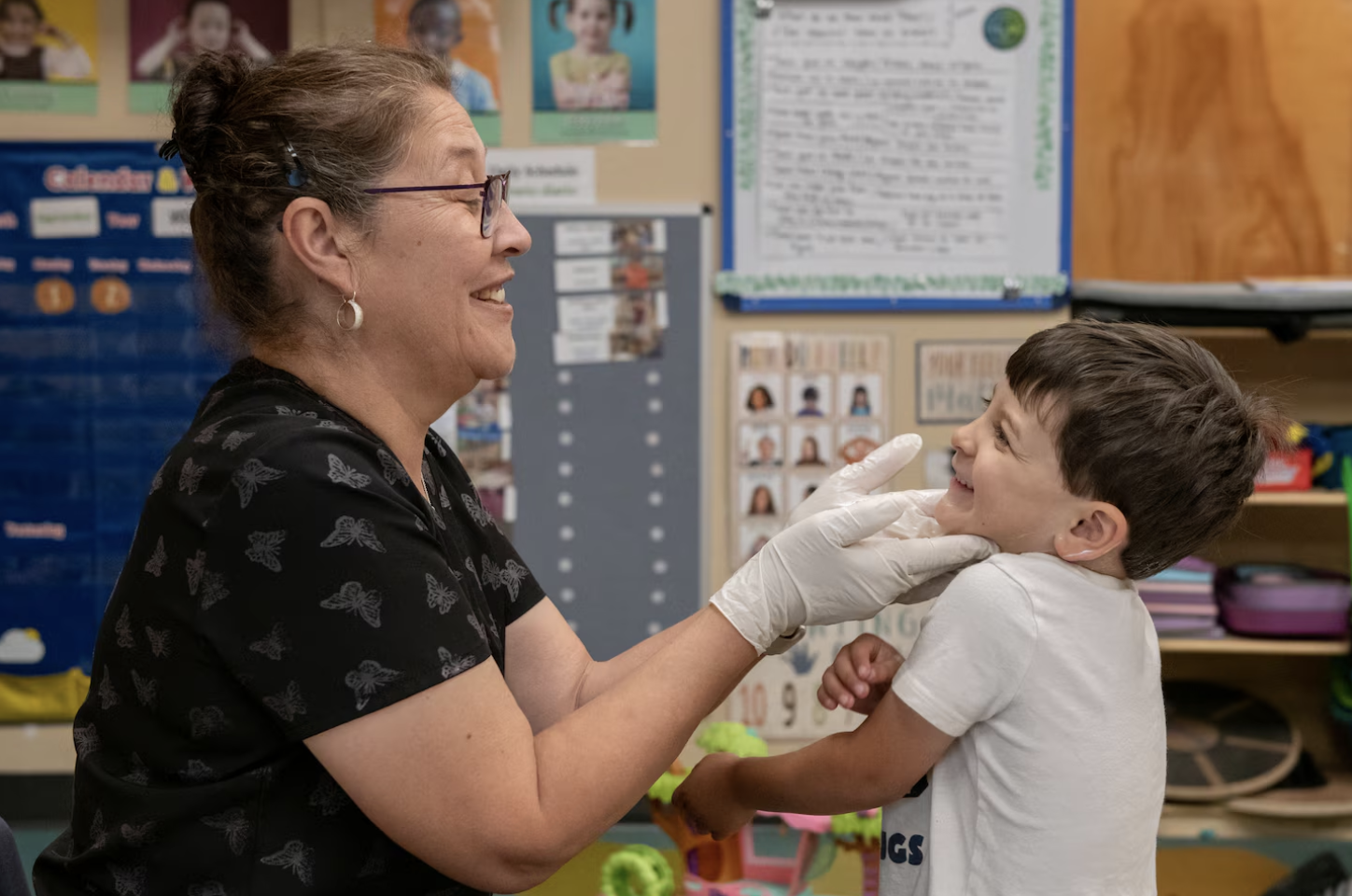
On a recent morning, Maggi stood in her living room, wearing white scrubs adorned with colorful cartoon ladybugs. Last year, the room would have been buzzing with children. Now, it’s quiet, save for chatter from Kay, the sole preschooler in her care each day. (The Hechinger Report is not using Kay’s full name to protect her privacy.) While Kay sat at a table working on a craft, Maggi cradled the infant, who had just woken up from a nap. The baby’s eyes were latched onto Maggi’s face as she fawned over him.
“Hello little one!” she cooed in Spanish. He cracked a smile and Maggi’s face lit up.
As one of her daughters took over to feed the newborn, Maggi followed Kay outside. The preschooler bounced around from the sandbox to the swings to a playhouse, with Maggi diligently following and playing alongside her.
Advocates and experts say upticks in immigration enforcement can cause stress and trauma for young children. In America, 1 in 4 children under the age of 6 has at least one foreign-born parent. Credit: Jackie Mader/The Hechinger Report
Finally Kay came to a standstill, resting her head against Maggi’s hip. Maggi gently patted her head and asked if she was ready to show off her pre-kindergarten skills. The pair sat down at a small table in the shade and Kay watched eagerly as Maggi poured out small plastic trinkets. Kay pulled three plastic toy turtles into a pile. “Mama, look! They’re friends!” Kay said, giggling.
Kay came to Maggi’s program after her mother pulled her out of another program where she felt the girl wasn’t treated well. Here, Kay is so happy, she hides when her mom comes back to get her. Still, a key aspect of the child care experience is missing for Kay. Normally, the girl would have several friends her own age to play with. Now when she is asked who her friends are, she names Maggi’s adult daughters.
Maggi worries even more about the children she doesn’t see anymore. Most are cared for by grandparents now, but those relatives are unlikely to know how to support child development and education, Maggi said. Many are unable to run around with the children like she does, and are more likely to turn to tablets or televisions for them.
She has seen the effects in children who leave her program and come back later having regressed. “Some of them are doing things well with me, and then when they come back, they have fallen behind,” she said. One child Maggi used to care for, for example, had just started to walk when the mother pulled them out of full-time care earlier this year, at the start of the immigration crackdown. In the care of a relative, Maggi found out they now spend much of the day sitting at home.
Before the second Trump administration began, the child care landscape looked bright in New Mexico, a state with a chronically high child poverty rate. In 2022, New Mexico started rolling out a host of child care policy changes. Voters approved a constitutional amendment guaranteeing a right to early childhood education, with sustained funding to support it. The state now allows families earning up to 400 percent of the federal poverty level, or nearly $125,000 a year, to qualify for free child care. That includes the majority of households in the state. Among the other changes: Providers are now paid more for children they enroll via the state’s assistance program.
The increase has been helpful for many providers, including Maggi. Before the pandemic, she received about $490 a month from the state for each preschooler enrolled in her program, compared to $870 a month now. If she enrolls infants who qualify for child care assistance, she gets paid $1,100 a month, nearly $400 more than pre-pandemic. She needs children enrolled to get the payments, however. Running her program 24 hours a day, seven days a week helps. She earns extra money from the state when caring for children evenings and weekends, and she is paid monthly to cover the cost of housing foster children.
Child care advocates in New Mexico are concerned that immigration policy will affect the industry’s progress. “I am worried because we could be losing early childhood centers that could help working families,” said Maty Miranda, an organizer for OLÉ New Mexico, a nonprofit advocacy organization. “We could lose valuable teachers and children will lose those strong connections.” Immigration crackdowns have had “a huge impact emotionally” on providers in the state, she added.
State officials did not respond to a request for data on how many child care providers are immigrants. Across the state, immigrants account for about 13 percent of the entire workforce.
Many local early educators are scared due to more extreme immigration enforcement, as are the children in their care, Miranda said. They are trying to work regardless. “Even with the fear, the teachers are telling me that when they go into their classrooms, they try to forget what’s going on outside,” she added. “They are professionals who are trying to continue with their work.”
Maggi said she’s so busy with the children who remain in her care that there is no extra time to work an additional job and bring in more income. She won’t speculate on how long her family can survive, instead choosing to focus on the hope that things will improve.
Maggi’s biggest fear at the moment is the well-being of the children of immigrants she and so many other home-based providers serve. She knows some of her kids and families are at risk of being detained by ICE, and that interactions like that, for kids, can lead to post-traumatic stress disorder, disrupted brain development and behavior changes. Some of Maggi’s parents have left her with emergency numbers in case they are detained by immigration officials.
Many of the children Maggi cares for after school are old enough to understand that deportation is a threat. “They show fear, because their parents are scared,” Maggi said. “Children are starting to live with that.”
Amid the dizzying policy changes, Maggi is trying to keep looking forward. She is working on improving her English skills. Her husband is pursuing a credential to be able to help more in her program. All three of her daughters are studying to become early childhood educators, with the goal to join the family business. Eventually, she wants to serve pre-K children enrolled in the state’s program, which will provide a steady stream of income.
In spite of all the uncertainty, Maggi said she is sustained by a bigger purpose. “I want them to enjoy their childhood,” she said on a sunny afternoon, looking fondly at Kay as the girl flung her tiny pink shoes aside and hopped into a sandbox. It’s the type of childhood Maggi remembers from her earliest days in Mexico. Kay giggled with delight as Maggi crouched down and poured cool sand over the little girl’s feet. “Once you grow up, there’s no going back.”
The Hechinger Report provides in-depth, fact-based, unbiased reporting on education that is free to all readers. But that doesn’t mean it’s free to produce. Our work keeps educators and the public informed about pressing issues at schools and on campuses throughout the country. We tell the whole story, even when the details are inconvenient. Help us keep doing that.
Inclusivity and feelings of psychological safety in the classroom should not be reserved solely for K-12 learning environments. Students in higher education also deserve nurturing spaces that focus on utilizing their personalized strengths and needs to foster increased academic and social development. A costly misconception is that pedagogical approaches in higher education must be lecture-based and teacher-led. Instead, it is an educator’s responsibility to design cooperative learning structures that facilitate comfort and collaboration regardless of grade level. These practical techniques will develop critical thinking and problem-solving abilities by creating intentional opportunities to enhance social and communication skills. The fundamental question becomes: How can educators plan for and deliver instructional content that is relatable and meaningful?
According to a recent survey by Salesforce (2022), just 12% of college students felt a strong sense of belonging in their institutions. Feelings of disconnection from their peers and institutions persisted after students returned to campus from remote learning during the COVID-19 pandemic. To address this dismal response to education, we must promote inclusive and respectful learning environments that foster engagement, motivation, and active discourse.
Purposeful Application to Teamwork
A practical and successful strategy is to design performance tasks using cooperative learning structures deliberately. Aside from promoting positive interdependence and individual accountability, students participate equally through simultaneous interactions. These actionable, collaborative strategies help educators navigate their role as facilitators, guiding and responding rather than lecturing and directing.
In an undergraduate education course, I establish a positive tone by holding morning meetings at the start of every class. The intention is to incorporate short, structured routines that foster community, address social-emotional needs, and transition students to the day’s lesson. Purposefully, I provide opportunities for students to connect and practice the social skills necessary to participate in rigorous critical thinking and problem-solving tasks. The goal is to elicit positive peer interactions and foster a sense of belonging and trust where students consider multiple perspectives and actively engage in an inclusive and receptive learning environment.
To enrich their classroom experience, I align cooperative learning structures with the lesson outcomes, ensuring that 21st-century, real-world content tasks are purposeful and authentic. Motivated by intentional opportunities for collaboration, students actively process information in favorable conditions that are both supportive and stimulating.
Unlike group work, cooperative learning activities are highly structured, with defined roles, steps, and time limits. With transparent directions, every student knows exactly what to do. Another key difference is that these structures promote built-in accountability and equal participation, requiring everyone to contribute through regular interaction and processing.
When considering a teacher’s pedagogical content knowledge, eliciting student feedback is paramount. Responding to end of course surveys, student reflections highlight the importance of the affective domain through several emerging pivotal themes. Students emphasized the significance of engaging, inclusive, and supportive learning environments. This aligns with findings from the literature, which posits that allowing students to apply course content in innovative and engaging ways fosters a deeper understanding and a heightened sense of ownership in learning (Singha & Singha, 2024). Given these findings, creating a classroom community through collaboration increases motivation and encourages students to develop their critical thinking skills and analyze problems more effectively.
Some students conveyed appreciation for interactive, relational, and consistently structured learning experiences. One student communicated, “I felt heard, valued, and important in this class… everyone truly has the opportunity to openly share without judgment.” These emotional and interpersonal experiences support long-term learning and boost goal-directed behaviors.
Another key theme was the acknowledgment of active, collaborative, and applied learning activities. One student articulated the need for relatable, real-world, authentic tasks, stating, “My favorite activity was creating videos to connect with the assignments in class.” This reflection highlights the notion that students in higher education value opportunities that enable them to transition from passive consumers of information to active participants in the learning process (Ribeiro-Silva et al., 2022). Moreover, recent research supports the implementation of faculty professional development programs focused on active learning instruction and engaging students in college classrooms (Park & Xu, 2024).
Implications for Faculty
To design assignments that work and adopt a reflective framework in your own instruction, consider implementing the following practices:
Set Clear Learning Objectives: Ensure students understand what they are expected to accomplish during collaboration. Cooperative learning is most effective when aligned with specific outcomes, especially those that require higher-order thinking (analysis, synthesis, and application). Identify what students should know, do, or beabletoexplain by the end of the activity.
Design Purposeful and Flexible Groups: Keep it interesting and diversify student groups. Avoid simple tasks that can be done individually—design work that fosters interdependence and leverages diverse perspectives. Create tasks that are complex enough to require collaboration (e.g., solving a case study, evaluating evidence, or designing a project).
Structure Group Roles and Expectations: Assign roles based on instructional content to ensure equal participation and engagement among group members. Structured roles promote engagement and accountability. Rotate roles to ensure individual accountability and contribution.
Monitor and Support Groups in Real Time: Circulate during group work, check for understanding, and intervene as needed to guide discussion or clarify misconceptions. Guide communication, active listening, respectful disagreement, and group decision-making. Active monitoring shows students their work matters and allows faculty to model and scaffold skills often.
Encourage Metacognition: Provide opportunities for students to reflect on their group work experiences and the processes involved. Reflection reinforces academic content and collaboration skills.
By implementing collaborative techniques, faculty can motivate students to apply content knowledge that will prepare their future success in relatable, real-world contexts and encourage the development and maintenance of the interpersonal skills necessary for lifelong learning. Furthermore, by refining our pedagogical practices, we can foster a more robust society with confident, culturally competent, and self-aware leaders of tomorrow.
Final Reflections
Former U.S. Secretary of Education Miguel Cardona quoted the African proverb, “If you want to go fast, go alone. If you want to go far, go together.” University settings often overlook effective pedagogical approaches that incorporate collaboration, limiting opportunities for meaningful learning experiences that enhance understanding, sustain motivation, and spark intellectual curiosity. By designing, facilitating, monitoring, and evaluating inclusive learning spaces, we can contribute to a sense of belonging and bring joy back into the classroom.
Dr. Ana Figueroa is an assistant professor of education at the University of Tampa and the Lead Instructor of the Education Foundations and Human Exceptionalities courses in the undergraduate program. Her research interests include differentiated instruction, progress monitoring, teacher mindset, and highly effective instructional strategies. She champions equitable instruction for all learners.
References
Kagan, Spencer, and Miguel Kagan. Kagan Cooperative Learning. San Clemente, CA: Kagan Publishing, 2021.
Park, Elizabeth S., and Di Xu. “The Effect of Active Learning Professional Development Training on College Students’ Academic Outcomes.” Journal of Research on Educational Effectiveness 17, no. 1 (December 20, 2024): 43–64. https://doi.org/10.1080/19345747.2022.2151954.
Ribeiro-Silva, Elsa, Catarina Amorim, José Luis Aparicio-Herguedas, and Paula Batista. “Trends of Active Learning in Higher Education and Students’ Well-Being: A Literature Review.” Frontiers in Psychology 13 (April 18, 2022). https://doi.org/10.3389/fpsyg.2022.844236.
Singha, Ranjit, and Surjit Singha. “Educational Innovation Transforming Higher Education for Workforce Readiness.” Advances in Higher Education and Professional Development, January 29, 2024, 37–55. https://doi.org/10.4018/979-8-3693-0517-1.ch003.
Inclusivity and feelings of psychological safety in the classroom should not be reserved solely for K-12 learning environments. Students in higher education also deserve nurturing spaces that focus on utilizing their personalized strengths and needs to foster increased academic and social development. A costly misconception is that pedagogical approaches in higher education must be lecture-based and teacher-led. Instead, it is an educator’s responsibility to design cooperative learning structures that facilitate comfort and collaboration regardless of grade level. These practical techniques will develop critical thinking and problem-solving abilities by creating intentional opportunities to enhance social and communication skills. The fundamental question becomes: How can educators plan for and deliver instructional content that is relatable and meaningful?
According to a recent survey by Salesforce (2022), just 12% of college students felt a strong sense of belonging in their institutions. Feelings of disconnection from their peers and institutions persisted after students returned to campus from remote learning during the COVID-19 pandemic. To address this dismal response to education, we must promote inclusive and respectful learning environments that foster engagement, motivation, and active discourse.
Purposeful Application to Teamwork
A practical and successful strategy is to design performance tasks using cooperative learning structures deliberately. Aside from promoting positive interdependence and individual accountability, students participate equally through simultaneous interactions. These actionable, collaborative strategies help educators navigate their role as facilitators, guiding and responding rather than lecturing and directing.
In an undergraduate education course, I establish a positive tone by holding morning meetings at the start of every class. The intention is to incorporate short, structured routines that foster community, address social-emotional needs, and transition students to the day’s lesson. Purposefully, I provide opportunities for students to connect and practice the social skills necessary to participate in rigorous critical thinking and problem-solving tasks. The goal is to elicit positive peer interactions and foster a sense of belonging and trust where students consider multiple perspectives and actively engage in an inclusive and receptive learning environment.
To enrich their classroom experience, I align cooperative learning structures with the lesson outcomes, ensuring that 21st-century, real-world content tasks are purposeful and authentic. Motivated by intentional opportunities for collaboration, students actively process information in favorable conditions that are both supportive and stimulating.
Unlike group work, cooperative learning activities are highly structured, with defined roles, steps, and time limits. With transparent directions, every student knows exactly what to do. Another key difference is that these structures promote built-in accountability and equal participation, requiring everyone to contribute through regular interaction and processing.
When considering a teacher’s pedagogical content knowledge, eliciting student feedback is paramount. Responding to end of course surveys, student reflections highlight the importance of the affective domain through several emerging pivotal themes. Students emphasized the significance of engaging, inclusive, and supportive learning environments. This aligns with findings from the literature, which posits that allowing students to apply course content in innovative and engaging ways fosters a deeper understanding and a heightened sense of ownership in learning (Singha & Singha, 2024). Given these findings, creating a classroom community through collaboration increases motivation and encourages students to develop their critical thinking skills and analyze problems more effectively.
Some students conveyed appreciation for interactive, relational, and consistently structured learning experiences. One student communicated, “I felt heard, valued, and important in this class… everyone truly has the opportunity to openly share without judgment.” These emotional and interpersonal experiences support long-term learning and boost goal-directed behaviors.
Another key theme was the acknowledgment of active, collaborative, and applied learning activities. One student articulated the need for relatable, real-world, authentic tasks, stating, “My favorite activity was creating videos to connect with the assignments in class.” This reflection highlights the notion that students in higher education value opportunities that enable them to transition from passive consumers of information to active participants in the learning process (Ribeiro-Silva et al., 2022). Moreover, recent research supports the implementation of faculty professional development programs focused on active learning instruction and engaging students in college classrooms (Park & Xu, 2024).
Implications for Faculty
To design assignments that work and adopt a reflective framework in your own instruction, consider implementing the following practices:
Set Clear Learning Objectives: Ensure students understand what they are expected to accomplish during collaboration. Cooperative learning is most effective when aligned with specific outcomes, especially those that require higher-order thinking (analysis, synthesis, and application). Identify what students should know, do, or beabletoexplain by the end of the activity.
Design Purposeful and Flexible Groups: Keep it interesting and diversify student groups. Avoid simple tasks that can be done individually—design work that fosters interdependence and leverages diverse perspectives. Create tasks that are complex enough to require collaboration (e.g., solving a case study, evaluating evidence, or designing a project).
Structure Group Roles and Expectations: Assign roles based on instructional content to ensure equal participation and engagement among group members. Structured roles promote engagement and accountability. Rotate roles to ensure individual accountability and contribution.
Monitor and Support Groups in Real Time: Circulate during group work, check for understanding, and intervene as needed to guide discussion or clarify misconceptions. Guide communication, active listening, respectful disagreement, and group decision-making. Active monitoring shows students their work matters and allows faculty to model and scaffold skills often.
Encourage Metacognition: Provide opportunities for students to reflect on their group work experiences and the processes involved. Reflection reinforces academic content and collaboration skills.
By implementing collaborative techniques, faculty can motivate students to apply content knowledge that will prepare their future success in relatable, real-world contexts and encourage the development and maintenance of the interpersonal skills necessary for lifelong learning. Furthermore, by refining our pedagogical practices, we can foster a more robust society with confident, culturally competent, and self-aware leaders of tomorrow.
Final Reflections
Former U.S. Secretary of Education Miguel Cardona quoted the African proverb, “If you want to go fast, go alone. If you want to go far, go together.” University settings often overlook effective pedagogical approaches that incorporate collaboration, limiting opportunities for meaningful learning experiences that enhance understanding, sustain motivation, and spark intellectual curiosity. By designing, facilitating, monitoring, and evaluating inclusive learning spaces, we can contribute to a sense of belonging and bring joy back into the classroom.
Dr. Ana Figueroa is an assistant professor of education at the University of Tampa and the Lead Instructor of the Education Foundations and Human Exceptionalities courses in the undergraduate program. Her research interests include differentiated instruction, progress monitoring, teacher mindset, and highly effective instructional strategies. She champions equitable instruction for all learners.
References
Kagan, Spencer, and Miguel Kagan. Kagan Cooperative Learning. San Clemente, CA: Kagan Publishing, 2021.
Park, Elizabeth S., and Di Xu. “The Effect of Active Learning Professional Development Training on College Students’ Academic Outcomes.” Journal of Research on Educational Effectiveness 17, no. 1 (December 20, 2024): 43–64. https://doi.org/10.1080/19345747.2022.2151954.
Ribeiro-Silva, Elsa, Catarina Amorim, José Luis Aparicio-Herguedas, and Paula Batista. “Trends of Active Learning in Higher Education and Students’ Well-Being: A Literature Review.” Frontiers in Psychology 13 (April 18, 2022). https://doi.org/10.3389/fpsyg.2022.844236.
Singha, Ranjit, and Surjit Singha. “Educational Innovation Transforming Higher Education for Workforce Readiness.” Advances in Higher Education and Professional Development, January 29, 2024, 37–55. https://doi.org/10.4018/979-8-3693-0517-1.ch003.
Big changes are coming to how families pay for college — and some colleges will need to get creative. New Parent PLUS loan caps ($20K/year, $65K total) mean schools where parents used to borrow six figures, or 50%+ of families relied on these loans will need to rethink their financial strategies. That includes several art schools and HBCUs — institutions that have long opened doors for talented students. While the full impact is still unfolding, this could spark new conversations about affordability, access, and better support for families. Change is never easy — but it can lead to smarter, more sustainable solutions for students and schools alike.
University Chancellors Council Convenor John Pollaers. Picture: Newswire
The University Chancellors Council (UCC) on Tuesday said the Commonwealth Remuneration Tribunal should advise on vice-chancellor pay packages, some of which are exceeding $1 million per year.
Please login below to view content or subscribe now.
NTEU president Alison Barnes. Picture: James Croucher
The sector union has once again called for transparency in university governing bodies after staff reported a culture of secrecy, bullying and intimidation in university councils and senates.
Please login below to view content or subscribe now.