Blog

  • College Students Want More Work-Based Learning

    College Students Want More Work-Based Learning

    Sumeet Dave always wanted to work in engineering. It just took him 20 years—and an apprenticeship.

    “I had so many closed doors,” he said of the job opportunities that followed a stint in the U.S. Army National Guard, an initial attempt at a bachelor’s degree in aerospace engineering in the ’00s and an eventual bachelor’s degree in allied health administration and management. He’d pivoted to allied health when he didn’t find a job as an MRI tech after a separate two-year program in nuclear medicine technology, he explained. But a viable career path never quite materialized.

    After working as a pharmacy technician, among other jobs, for years, Dave was looking to reskill, again. A chance conversation about apprenticeships with an administrator at Howard Community College in Maryland opened his eyes to a program in information technology with AT&T.

    “I was like, ‘What do you mean, I can actually work and take some classes?’” he recalled. “I didn’t even know there were apprenticeships out there, because I thought it was something of the past.”

    Three years later, Dave has a full-time job, a national credential in IT and a federal security clearance. He’s also looking to pursue a master’s degree with tuition reimbursement from his employer.

    “That was my dream—to go into some field of engineering—so it was great to find something like AT&T, which has an apprenticeship program where you can jump into it, which later becomes software engineering,” he said. “It’s given me a great opportunity to get my foot in the door. You make a difference, contribute to the organization, and then the sky’s the limit.”

    Sumeet Dave, a South Asian man with short black hair, wearing glasses and smiling in a computer lab

    Sumeet Dave

    Dave’s years of underemployment could be read as data points against college in the escalating college-versus-career debate—especially at a time when the hiring edge for college graduates is especially narrow. But study after study shows that college remains worth it for most learners, even when postgraduate earnings are debt-adjusted. So instead of being a simple referendum on college value, Dave’s story captures a broader shift in how career-connected students expect—and need—their college experiences to be.

    About the Survey

    Student Voice is an ongoing survey and reporting series that seeks to elevate the student perspective in institutional student success efforts and in broader conversations about college.

    Some 1,135 two- and four-year students responded to this flash survey about work-integrated learning, conducted in January. Explore the data, captured by our survey partner Generation Lab, here.

    Check out past reports from our 2025–26 survey cycle, Student Voice: Amplified.

    In Inside Higher Ed’s main 2025 Student Voice survey, most students expressed confidence that they have what they need to succeed postcollege, but they also wanted their institutions to stack the deck with more targeted career-readiness efforts. And in a follow-up Student Voice flash survey, out today, on work-integrated learning (WIL), nearly all 1,135 two- and four-year students express interest in engaging in some form of WIL.

    A quarter are interested in apprenticeships, like Dave’s, while half are interested in internships. Part-time work related to their majors, another paid option, also appeals to many students. But pay is not the only motivating factor, nor is extended exposure, as short-term job shadowing ranks relatively highly.

    Students say their top goals for WIL are technical skill development and professional networking.

    Most respondents are confident that their institution will be able to provide WIL experiences, either directly or indirectly—even if they’re not really sure what differentiates, say, an internship from a cooperative education program. But WIL participation gaps and strong interest even among students who’ve already engaged in such experiences show that demand for career-connected learning is outpacing access to it. And for many respondents, there’s new urgency around the rise of AI and automation: More than half say this makes hands-on experience even more important.

    Here are eight takeaways from the survey.

    1. Internships remain the most prevalent form of WIL, but more than a third of students haven’t participated in WIL of any kind.

    The top three models in which students have participated are internships (27 percent of the sample); part-time jobs related to their majors, on or off campus (27 percent); and undergraduate research or research assistantships (20 percent). But 36 percent of all students haven’t participated in any form of WIL, a share that increases to 40 percent for Black students and 49 percent for Hispanic students in the sample (versus 26 percent of Asian American and Pacific Islander students, 31 percent of white students, and 29 percent of those from other racial groups). Adult learners 25 and older also have an elevated nonparticipation rate of 49 percent. By institution type, private nonprofit institutions have an edge: 27 percent of their students have not participated in WIL versus 38 percent of public institution students. In a related finding, community college students were more likely than their four-year counterparts (public or private nonprofit) to signal nonparticipation, at 58 percent versus 30 percent.

    1. Most students who’ve participated in work-integrated learning found it valuable.

    Of the 750 students who have participated in WIL, three in four report that their experiences were highly valuable. Just 3 percent say their experiences had low or no value. This is relatively consistent across the sample, including among two-year students. It’s also somewhat consistent across experience types: Some 80 percent of students who’ve participated in an employer-sponsored project say it was highly valuable, as do 82 percent of internship alums and 77 percent of microinternship participants, for example.

    1. Few students understand the full spectrum of WIL options.

    From internships to co-ops to job shadowing, just 11 percent of students say they understand the differences among various WIL models to explain them very well to someone else. Most of remainder say they could explain them fairly or somewhat well, meaning that students tend to grasp some of the options in this space but could use help understanding them fully. Different forms of WIL offer different—and ideally overlapping—benefits.

    1. Nearly all students want WIL—and those who’ve already experienced it want more.

    Nearly eight in 10 students are somewhat (33 percent) or very (47 percent) interested in engaging in WIL. This is consistent across the sample, including among Hispanic students, who had the lowest participation rate in a previous question, suggesting that these students are not disproportionately missing out for lack of interest. And despite their own relatively low participation rate, 74 percent of community college students are interested in WIL—as are 70 percent of adult learners. In terms of repeat customers, 82 percent of students who’ve already participated in some form of WIL want to engage in more of it in the future.

    1. Part-time jobs and internships are of greatest interest to students.

    Paid work related to their major is the No. 1 model in which students express interest (52 percent of the sample). Internships, perhaps the most widely recognized model, are a very close No. 2, at 51 percent. No. 3 is job shadowing, at 33 percent. Apprenticeships are No. 4, at 25 percent of the sample. Fewer adult learners are interested in internships than in part-time work related to their studies.

    1. Students are looking to learn technical skills related to their field and to network and build professional relationships.

    Students view WIL as an opportunity to build practical expertise and professional connections and identity. Half say they are most interested in developing technical skills related to their field or industry, while 45 percent cite networking and relationship-building opportunities. Another 37 percent seek to build self-confidence and professional presence, and 36 percent seek stronger problem-solving and critical-thinking skills—which employers consistently rank as a top want.

    1. In the age of generative AI, many students think hands-on experience is more important than ever.

    Some 55 percent of students say this when asked how the rise of AI and automation is influencing their thinking about WIL. Thirty-nine percent are also concerned about job security in certain fields. About a third each are looking for roles that emphasize uniquely human skills and want to understand how AI is being used in their specific field. Just 8 percent say that AI has not influenced how they think about WIL.

    1. Most students express at least some confidence that their institution can offer or help them find WIL opportunities to fit their career goals.

    Some 27 percent are very confident in their colleges’ abilities here, while the majority, 52 percent, are somewhat confident. Just 4 percent of students don’t plan to seek this kind of help from their institution. This is relatively consistent across the sample, and while it’s a vote of confidence, it’s also an expectation.

    While colleges are doing more to meet that expectation, opportunity gaps persist: Nationally, participation in paid internships increased to 37 percent of four-year students graduating in 2025, up from 26 percent of graduates from the classes of 2020 to 2023, according to Strada Education Foundation’s 2025 State Opportunity Index. Those gains are mitigated by Strada’s finding that 70 percent of first-year students intend to do an internship (researchers frame this as an intent-participation gap).

    Like Inside Higher Ed’s survey, Strada has determined that students most value WIL’s ability to boost their technical skills and expand their professional networks. But internships confer particular benefits, with 73 percent of graduates who completed a paid internship landing a first job that actually requires their degree, compared to 44 percent of those who did not complete an internship. And, as in the Student Voice survey, Black and Hispanic students are disproportionately underrepresented in internship participation nationally.

    Looking more broadly, Strada has found that 43 percent of graduating seniors at four-year institutions report having had at least one of five paid, work-based learning experiences: internship, co-op, practicum/clinical/student teaching, undergraduate research and apprenticeship. Among community college students, 17 percent enrolled in 2025 reported engaging in one or more of these.

    Ultimately, participation in work-based learning is growing but uneven, and data tracking participation remains “spotty,” according to the opportunity index.

    At Butler University’s Founders College—where every student completes at least one paid internship and takes career-development courses throughout the academic year—WIL is built into the curriculum, increasing access and compounding its benefits through layering. Carolyn Gentle-Genitty, professor and founding dean of the college, said that the paid internship requirement “ensures students graduate with experiences ready for employment.”

    “Parents gravitate to this outcome,” she continued. “Students welcome the exposure, and for leaders like me, having the one paid internship as the goal, we do a better job of proactively embedding learning, exposure and skills leading up to the goal.” In their first year, for instance, students meet with potential employers and participate in job shadowing. They also engage in project-based learning, work-based communication and networking skills development ahead of their internships.

    How are employers themselves thinking about this rapidly evolving space? A recent study of human resources, learning and technical officers at global firms by the Learning Society at Stanford University found:

    • AI technologies are “transforming demand for human capabilities, and reshaping work and workers as much as they are replacing tasks.”
    • Because traditional talent pipelines are “not adapting quickly enough, workplaces themselves are becoming increasingly important—and innovative—sites of talent development.”
    • Employers are growing “more skeptical of college degrees as proxies for capability and are developing more differentiated ways to understand people’s skills, adaptability and potential.”
    • Continual investment in workers “across lengthening lifespans is becoming more common, reflecting a broader recognition that as lives lengthen, economic resilience matters more—for individuals and for the companies that depend on adaptive, capable workers.”

    Gentle-Genitty said that, in the end, “we are responding to an ever-changing, reshaped society.” And no matter the mode of WIL, “we know it’s here to stay in an AI-enhanced world. But we must define the rules of play and the start and stops—or even the amount of playing time needed for our future workforce to be ready.”

    Speaking for students trying to break through in a job market that feels at once highly competitive and full of new opportunities, Dave, the apprenticeship alum, said, “If they can do the job, give them a chance.”


    This independent editorial project is produced with the Generation Lab and supported by the Gates Foundation.

    Source link

  • 3 Questions for 2U’s Jihan Quail

    3 Questions for 2U’s Jihan Quail

    Last year, Jihan Quail rejoined 2U as global head of growth, higher education, returning to a company she first joined in 2016 and left in early 2020. In the intervening years, Quail held senior business development roles at Pathstream and Honor Education, giving her a broad view of the ed-tech landscape.

    When we met last fall, our conversation kept circling back to an intriguing question: What draws someone back to a company after years away? Her perspective on why she chose to return now—and how her thinking about university partnerships has evolved—struck me as worth sharing more broadly.

    Full disclosure: I am an (unpaid) member of the 2U University Partner Advisory Council.

    Q: What was it about this moment—and this leadership team—that made you want to come back to 2U?

    A: It came down to timing and people. I’ve worked closely with many of these leaders before. I know how they make decisions, how they show up under pressure and what they prioritize. They’re steady, disciplined and focused on building something durable, which is rare in a period of real turbulence across higher education and ed tech.

    Spending time away from 2U, working across other education and ed-tech organizations, gave me a clearer view of the landscape. I saw how different organizations respond to pressure, what they optimize for and how universities have evolved their thinking about partnerships and the services they need.

    This work is also deeply personal for me. My first job out of Yale was teaching English in Brazil, walking into a classroom with no shared language and no real idea what I was doing. It was humbling and exhausting, and it gave me an early appreciation for how complex, personal and vital education really is. That perspective has stayed with me, even as my career took a winding path through renewable energy and technology.

    That time away clarified something else: Universities are under real pressure, and not just operationally. There’s a broader crisis of confidence in higher education itself. I deeply believe in the long-term importance of universities and what they make possible—and in the enduring value of higher education for students. I want to help universities navigate this moment. The right partnerships can help them respond more quickly to market demands and emerging disciplines and deliver stronger outcomes for students. That’s what 2U is built to do, and this is the team I want to do that work with.

    Q: You’ve now seen the partnership landscape from multiple vantage points. What are universities asking for today that they weren’t a few years ago?

    A: The shift has been dramatic, and I find it genuinely exciting.

    When I first joined 2U in 2016, many universities were still going online for the first time. They had confidence in their brand and academic quality, but the mechanics were unfamiliar. They needed a guide—someone who could say, “Here’s how this works, here’s what to expect, here’s how we get you there.” The question was simply: Should we do this at all?

    By 2019, that had shifted to: We’re going online—who should we partner with? Now, in 2026, the conversation is much more sophisticated: We’ve built real capabilities, we understand our strengths and we need a partner who can fill specific gaps.

    That’s a fundamentally different dynamic. Universities aren’t necessarily looking for someone to do everything. They’re looking for a collaborator who can complement what they’ve built. Maybe they have a strong online degree strategy but need a partner to think about how that pairs with lifelong learning and alternative credentials. Maybe they’ve got instructional design covered but need a sophisticated marketing operation they can scale and access to a global learner network like edX. The conversations are more specific, more strategic and frankly more interesting.

    This is healthy for the market. Institutions are more informed, which raises the bar for everyone. And for those of us in business development, it means every conversation is a real problem-solving exercise—not a pitch, but a genuine attempt to figure out what this particular institution needs to reach the learners they’re trying to serve.

    Q: What’s different about how 2U approaches those conversations now versus when you were here the first time?

    A: We’ve always started by listening. That hasn’t changed. You can’t design a good partnership if you don’t understand what someone is actually trying to accomplish. But the tool kit has expanded considerably.

    When I was here before, our model was more comprehensive by default—longer time horizons, a certain way of doing things. That worked well for institutions building online programs from the ground up. But universities have evolved. Many have developed real capabilities over the past decade. They don’t need the same things they needed in 2016.

    Now we’re much more flexible in how we structure partnerships. We can adjust scope, time horizon and financial model—all based on what makes sense for a specific institution and program. If you want to run a clinical psychology program at national scale with placements in all 50 states, that’s a different conversation than launching a smaller cohort-based program where you’ve already got program design covered. Both are legitimate paths, and we can support either.

    That flexibility makes the work more collaborative. You’re genuinely co-designing something rather than fitting a partner into a template. For me, that’s the most rewarding part of this job—the puzzle of figuring out what’s actually going to work for each institution we serve.

    Source link

  • Tackling the contradictions – HEPI

    Tackling the contradictions – HEPI

    This blog was kindly authored by Martin Edmondson, CEO of the Graduate Futures Institute.

    The government states that it has a number of core missions. One is kickstarting growth, and one is breaking down barriers to opportunity. However, the recent growth and youth unemployment figures – (Growth 0.1 per cent ONS latest release, youth unemployment 14.5 per cent) – suggest that neither of these missions are faring especially well. Something that is perhaps not a surprise when some of the headline policies introduced by the government actively mitigate against those goals.

    Put yourself in the shoes of a small business owner – the businesses that make up the vast majority of UK companies. Right now, you have seen the cost of hiring increase through employer NI contributions and through the increase in the National Minimum Wage. In addition, you see the Employment Rights Act coming down the tracks with the introduction of greater day one rights, and a reduction from 24 to 6 months for unfair dismissal rights.

    All of these factors do one thing: increase risk. Running a small business is a constant equation of risk management, and all these factors are more likely to make a business leader risk-averse when committing to hiring someone. In addition, hiring an unproven young person can also be seen as a risk – they often don’t have years of work experience to support their credibility and capability. So, when you make that person more expensive in wages, more expensive in NI and harder to move on in cases of hiring mistakes, you can see why unemployment is increasing and growth is stagnant.

    I say all of this partly in my role as CEO of the Graduate Futures Institute, the body representing everyone who works in careers and employability in HE. Part of my role is to advocate for the positive things a graduate can do for any business – where the evidence is that a higher proportion of graduates in an area and a business increase productivity, innovation and GDP (research by the OECD and UK Treasury analysis suggests that a 1 percentage point increase in the share of graduates in a local workforce is associated with a 0.5 – 1 per cent increase in productivity). I also speak as someone who has run a small business for 20 years – trying to give opportunity to recent graduates whilst also managing all of that risk.

    De-risking youth hiring is not about weakening employment rights; it is about recognising that entry-level recruitment carries different risk dynamics and designing targeted incentives that allow opportunity and protection to sit alongside one another rather than in tension.

    Universities are working hard in this area, and can continue to do more to support the careers and employability of young people. Our members do amazing work, but they are also constrained like all in higher education by current funding pressures and this labour market context. However, the data suggests that our unemployment levels are now running worse than those in the EU – suggesting it is a policy environment issue more than anything else.

    Having said all of that, I don’t want to be someone who just complains without ideas. So here are 3 ideas – one for universities and two for government.

    Government: NI break for hiring young people

    Provide employers – specifically SMEs – with an NI break for hiring any employees under the age of 24. Despite my line of work, this isn’t a graduate-specific initiative, but one for any young person regardless of educational pathway. Giving SMEs Employer NI relief makes it more attractive and less risky to hire young people who don’t necessarily have the sort of experience that comes with age.

    Government: create city graduate schemes across UK cities and regions.

    For anyone who knows my work backstory, this idea will not come as a surprise, but it is a relatively low-cost way to support growth, improve youth employment levels and catalyse productivity in SMEs around the country. The concept is simple, turn a place into a corporate style graduate scheme – where instead of there being 100 jobs in one employer, there are 100 jobs in 100 local SMEs all hired through a central city/region wide piece of attraction and selection. This model has been well tested in Sheffield (RISE Sheffield – led by the two universities and the council) and showed significant ROI in terms of GDP, productivity and GVA. This would be relatively inexpensive (in Government terms) to roll out, perhaps £10-15m per annum to cover 10 cities, and can be seen in action now in West Yorkshire Combined Authority.

    Universities: accrediting part-time work

    We now know that around 68 per cent of students are working part-time alongside study, and given cost of living pressures this is not likely to decrease. As such universities should find models to capture, assess and accredit the skill and attribute development that is taking place in this work. Many universities are now actively building and deploying skills or attribute models in the curriculum. This will just take some creativity in assessment design to pull in the value from this work. This is an area of big interest for us as well, so we will be running an event on this topic later this year.

    Many of us recognise that this Government faces many challenges, and money and growth are in short supply, but this is not helped by significant macro policies that actively mitigate against the stated Government missions. Whilst some of these policies were well-meaning in spirit, if we actually want to stimulate growth and reduce barriers to opportunity, we should look to implement proactive policies and incentives that foster growth, de-risk hiring,  and support opportunity for all young people.

    Source link

  • Positionality statements are relevant for all research

    Positionality statements are relevant for all research

    Positionality statements are increasingly mandated by some journals and publishers.

    These statements accompany empirical work and invite authors to articulate their social, identity, methodological, and epistemological locations, to provide much-needed context (or “position”) for their research. This practice is becoming more common, and it originates from reflexive qualitative research.

    We would argue that, despite their critics, positionality statements are relevant to all research – whether qualitative, quantitative, or both – because all research is ultimately shaped, coloured, and contextualised by the people who conduct it.

    The value of reflexivity

    Reflexivity is the process by which researchers explicitly and thoughtfully consider how their background, epistemological and ethical positions, worldview, politics, and personal experiences contribute to, shape, and colour their research process. Reflexivity is increasingly recognised as central to responsible and rigorous research practice, because acknowledging one’s subjectivity is seen as a benefit – or even a toolkit and a resource – rather than a detriment, in this context.

    While reflexivity has a long history in qualitative traditions, recent shifts in higher education have encouraged reflexive engagement within quantitative research as well (for example in some work we’ve done, such as this beginner’s guide). This is a promising and important way forward.

    Quantitative approaches and researchers do not exist outside of social context. Therefore, choices about research questions, data sources, analytical techniques, and interpretation are all influenced by researchers’ epistemological commitments, their lived experiences, and subjectivities. After all, every researcher has a story (often a personal one) for how they came to (and through) their research topic.

    Positioning positionality

    One emerging mechanism for expressing and documenting reflexivity is the positionality statement. Positionality statements allow researchers to explicitly reflect on and communicate how their subjectivities, identities, values, experiences, and epistemological positioning shape their research questions, methodological decisions, and interpretation of their findings. We would argue that greater reflexivity and transparency is needed across all methodological traditions, including (and, in some cases, especially) in quantitative research, where assumptions of neutrality or objectivity can obscure the role of the researcher in knowledge production.

    The literature, which we are happy to see is growing rapidly, currently highlights three reasons why positionality statements are useful for higher education researchers.

    The first concerns equality, diversity, and inclusion. By documenting the process of reflexivity, positionality statements encourage researchers to confront how their work may uphold or challenge existing inequalities and to reflect on whose perspectives are centred or marginalised through their research choices. This logic applies, in theory, regardless of whether a study uses interviews, surveys, experiments, or administrative data because decisions about samples, categories, and comparisons are never socially neutral.

    The second reason relates to rigour and transparency. By articulating one’s positionality explicitly, researchers make visible aspects of the research process that are often left implicit (or on the editing room floor). This transparency has been proposed as a way of strengthening rigour, allowing readers to better understand how knowledge claims are produced and how alternative assumptions might lead to different conclusions. Far from weakening research, we argue that this kind of openness supports more robust, accountable, and transparent scholarship.

    And the third reason concerns integrity and ethics. Researchers have argued that positionality statements can support more ethical engagement with research by encouraging ongoing reflection on power, responsibility, and potential harms. Ethics is not confined to formal approval procedures – instead, it should be embedded in everyday research practices, including how findings are framed and communicated. Thinking reflexively can surface some of these considerations.

    Positionality statement in quantitative work

    Despite their growing presence, positionality statements in quantitative research remain inconsistently applied and under-theorised. This is concerning, given that some journals now encourage or mandate their inclusion.

    It is increasingly important, therefore, that positionality statements are done well and researchers are supported adequately. As others have noted, positionality statements are often reduced to brief descriptions or checklists of a researcher’s social identity or background, without deeper engagement with how those positionalities influence the research process. When this happens, positionality risks becoming tokenistic rather than a meaningful reflexive practice.

    Towards reflexive (quantitative) research

    There is growing interest now in better understanding how researchers currently use positionality statements and what functions these statements serve within published research.

    Between us, for example, we are currently running metascience projects that examine how and why positionality statements are used, particularly within quantitative higher education research. This work builds on broader conceptual frameworks for understanding positionality in psychology and related fields, and reflects a wider movement towards more reflexive quantitative methods,

    What this emerging body of work makes clear is that positionality statements are not about personal disclosure for its own, performative sake. They are also, importantly, not about questioning the legitimacy of particular methods or ranking researchers according to identity.

    Instead, positionality statements (if done well) are about situating knowledge claims and acknowledging that research is produced by people working within specific social, institutional, and epistemic contexts. By recognising that positionality statements are relevant to all research, this supports a much more transparent, rigorous, and ethically engaged research culture across disciplines. In this sense, positionality statements are not an optional add-on. If we are clever, they could be an integral part of what it means to do rigorous, thoughtful, ethical research.

    Source link

  • EDI and free speech are not opposing forces

    EDI and free speech are not opposing forces

    A recent report published by Alumni for Free Speech may well be the most significant report published to date about free speech, recent legislation requiring universities to promote it, and the impact that doing so might have on our higher education institutions.

    Its significance, of course, isn’t to be found in its spurious claims about how universities’ EDI spending undermines free speech, but rather in its bare-faced promotion of obvious falsehoods that advance a right-wing agenda – and a post-truth disregard for facts in favour of creating talking points with no grounding in reality.

    This debate isn’t abstract or merely rhetorical – it arrives at a moment of real vulnerability and uncertainty for UK universities, shaped by recent free speech legislation, intensified regulatory scrutiny, and heightened political anxiety across the sector.

    The Higher Education (Freedom of Speech) Act has changed the risk environment in which universities operate, introducing new statutory duties, potential financial penalties, and personal liability for institutional leaders. In that climate, reports like the AFFS’s gain outsized traction – not because of their evidential rigour, but because they offer simple explanations and scapegoats when institutions are running scared.

    Universities are also contending with declining resources, the culture-war politicisation of higher education, and growing hostility towards equity-oriented work – framed as ideological excess rather than the legal, pedagogical, and ethical necessity it actually is. The current moment demands clarity rather than caution, and engaging with this debate isn’t about defending EDI as a programme – it’s about defending the university as a space for pluralism, knowledge production, and social responsibility.

    Upon reading the AFFS report, any academic worth their salt will immediately spot the methodological and conceptual flaws, the careless – perhaps even deliberate – overestimation of the credence of its data sets, and the ideologically informed, dubious assumptions it relies upon throughout. It’s barely worth patronising readers with a critique of these things.

    But the very existence of the report, and the fact that it’s now widely circulated, warrants a response from those of us who work to promote equity in higher education and face sustained efforts to undermine what we do.

    Credibility tests

    Despite the report’s scholastic shortcomings, what the AFFS has to say brings into sharper focus a dilemma EDI professionals and critical scholars have faced for decades – do we risk countering anti-EDI claims like those in the AFFS report, even though this might confer on it a credibility it doesn’t deserve? And do we inadvertently end up defending EDI initiatives that we know can sometimes reinforce, rather than challenge, the very inequalities they aim to address?

    We only need to look at recent writings by scholars and activists genuinely committed to social justice to understand the legitimate concerns they raise – that EDI initiatives can operate as largely ineffective equity window-dressing, used to maintain an inequitable status quo while giving the impression of doing the opposite.

    Does engaging with this report, in one way or another, play into its authors’ hands – either by providing them with undeserved scholarly credibility, or by promoting the very EDI initiatives that might be undercutting our own social justice agenda?

    Perhaps the least desirable option is to ignore the AFFS report entirely – we might avoid elevating it to the status of a credible research piece and prevent the spread of its conclusions, but this leaves it free to circulate unchallenged, which will itself be considered a victory of sorts for its authors. Just another piece of landfill, pseudo-academic “research”, drifting around the internet as a populist counterbalance to genuine efforts to make lives better for some of the most marginalised in society.

    So, here we find ourselves again, having to defend the work that we do, despite being our own worst critics and wishing this was work that didn’t need doing.

    More positively, it would be remiss of us as scholars with specific responsibility for EDI initiatives within our own university not to welcome scrutiny, alternative perspectives, and the opportunity for debate. Despite our obvious misgivings about what the AFFS has produced, it’s worth responding – not just to justify the EDI work we do, but to expose the broader political and ideological agenda of these self-styled defenders of free speech.

    With that in mind, and at the risk of patronising our readers, here are some thoughts about why we shouldn’t take the AFFS report seriously – and why we should be sceptical of arguments that position a commitment to freedom of speech and to equity, diversity, and inclusion as somehow incompatible.

    Where it falls apart

    The report presents a table comparing university EDI expenditure with free-speech compliance ratings and asserts a statistically significant relationship. But correlation alone doesn’t demonstrate causation – institutions with higher EDI investment are overwhelmingly large, research-intensive universities with more complex staffing structures and regulatory exposure. Without controlling for size, student demographics, international recruitment, award-bearing research portfolios, or existing infrastructure, it’s analytically unsound to suggest that EDI spend drives non-compliance.

    At best, the data demonstrates juxtaposition, not causality – and before sector policy responds to such findings, deeper inquiry and a transparent methodology are essential.

    The report also recommends that higher EDI spend should be matched with parallel investment in free-speech protections, including dedicated free-speech officers and institutional neutrality. This framing subtly positions EDI work as a partisan agenda that needs balancing, rather than a statutory duty and moral commitment to fairness – implying that equity threatens academic freedom rather than enables it.

    Here we see the AFFS report’s internal logic and ideological assumptions promoting a fundamental misunderstanding of what EDI work is for. To set the record straight – EDI work doesn’t exist to police ideas. Its purpose is to eliminate barriers to participation, address awarding and progression inequalities, prevent discrimination and harassment, and improve students’ sense of belonging within the university.

    It’s also about improving retention and student success, and diversifying leadership and knowledge production to create a more effective institution that’s representative of all the demographics contributing to its operation. EDI expands the pool of voices that get to participate in free speech, who gets to benefit from a university education, and who ultimately goes on to thrive in our society. Freedom of speech has little substance or value if it’s limited to relatively privileged groups who already feel at home within university cultures.

    Equity isn’t censorship

    Reflecting on our decades of experience in higher education, it’s important to state clearly that a commitment to promoting equity is not a form of censorship. Decolonising the curriculum doesn’t silence academic debate, and promoting belonging for all students – including those from under-represented groups – doesn’t reduce intellectual rigour. The opposite is true. When marginalised staff and students are empowered, universities gain new knowledge, new debate, and expanded intellectual horizons.

    If a commitment to freedom of speech means that already powerful voices speak without challenge while marginalised communities must debate their humanity or endure hostilities unprotected, then what’s being defended isn’t freedom – it’s dominance. A healthy academic environment is one where contentious ideas can be debated within a culture of respect, criticality, and safety – not one where harm is tolerated in the name of neutrality.

    We must resist misleading narratives that present EDI work as overreach or ideological imposition. Universities invest in EDI because it’s a legal responsibility under the Equality Act, because it improves student achievement and wellbeing, because it’s central to global competitiveness and institutional reputation, because it strengthens research cultures, and because it helps build a university culture where everyone feels they belong.

    We don’t pursue equity work as an optional programme – we do it because excellence without inclusion is exclusionary, and because a modern university can’t thrive while inequity persists. An equitable, inclusive university isn’t a constrained intellectual space. It’s a more expansive one.

    Over to the sector

    The AFFS report is representative of a broader public conversation about the role and legitimacy of EDI strategies in UK higher education – one shaped less by evidence than by political anxiety, culture-war framing, and regulatory fear. Rather than retreating into defensive postures, universities committed to equity and fairness need a proactive and principled response built on clarity, confidence, and institutional courage.

    The first priority is communication – institutions must move beyond vague or managerial language and articulate, in plain and accessible terms, what EDI actually does, why it exists, and how it’s evaluated, transparently linking it to legal obligations, student outcomes, staff wellbeing, retention, and academic excellence. Clear narrative coherence is essential to counter caricatures that frame EDI as ideological overreach rather than core institutional infrastructure.

    Universities should also explicitly reject the framing that positions free speech and equity as opposing forces, and instead assert that equity is the condition that makes meaningful free speech possible – by expanding who can safely speak, participate, and be heard. At a time when equity initiatives are increasingly politicised, institutional hesitation risks legitimising bad-faith critique, and universities should continue to invest openly and unapologetically in strategies that build belonging, address structural racism, and challenge epistemic exclusion – while remaining critically reflexive about effectiveness and impact.

    The sector urgently needs high-quality, methodologically sound research examining not only incidents of speech regulation but the political, legal, and ideological drivers behind the current resurgence of “free speech” discourse – including who defines speech harms, whose speech is protected, and how power operates within debates framed as neutral or universal.

    Universities must also ensure that those most affected by speech regulation, harassment, and exclusion are meaningfully involved in shaping institutional responses – moving beyond consultation towards shared governance models that recognise lived experience as a form of expertise, particularly in relation to race, disability, migration status, gender, and faith.

    The question facing the sector isn’t whether universities spend too much on EDI, but whether they’re yet investing sufficiently – politically, intellectually, and materially – to transform the structures that continue to reproduce inequality. Retreat, silence, or strategic ambiguity won’t protect universities from attack.

    Standing firm

    Freedom of speech and EDI are not opposing forces. When done with integrity, accountability, and courage, EDI is the very mechanism that enables free speech – by extending voice, participation, and dignity to those historically excluded from it. Yet this work is already deeply complex and emotionally demanding in a sector where structural inequalities persist, resources are finite, and progress requires sustained cultural change rather than performative gestures or reactionary policy cycles.

    Reports like the AFFS’s don’t simply misrepresent the purpose of EDI – they actively undermine it, generating distraction, confusion, and manufactured controversy that forces practitioners to waste time rebutting poorly evidenced claims rather than progressing tangible work that improves the experiences of students and staff.

    EDI professionals already face uphill battles – institutional resistance, inconsistent leadership commitment, racism fatigue, emotional labour, and the expectation to deliver transformation without redistribution of power or resource. The last thing the sector needs is yet another bad-faith intervention masquerading as concern for free speech while in practice bolstering those who want to dilute or roll back equity work entirely.

    Challenging such narratives isn’t optional – it’s a necessary act of protection, not only of EDI programmes, but of the very principle of a university as a place where knowledge, justice, and pluralism matter.

    Our task now is to respond with clarity and resolve. We refuse the false binary that pits equity against free speech and instead reaffirm that equity is the condition that makes free speech meaningful – not a threat to it. We’ll continue building a university where inclusion isn’t seen as a concession but as foundational to academic freedom, knowledge production, and social purpose.

    Our commitment remains unwavering – to build an institution that is anti-racist, decolonial, inclusive, and intellectually ambitious for everyone, and to do so despite those who seek to derail or discredit this work.

    Source link

  • New HEPI and London Economics Report: ‘Assessing potential manifesto commitments on higher education funding in Wales’

    New HEPI and London Economics Report: ‘Assessing potential manifesto commitments on higher education funding in Wales’

    Author:
    Dr Gavan Conlon, Maike Halterbeck, and Jack Booth

    Published:

    With the 2026 Senedd elections approaching, a new HEPI and London Economics report sets out what different higher education funding reforms in Wales could mean in practice.

    Assessing potential manifesto commitments on higher education funding in Wales models the financial and distributional impact of three prominent policy options linked to the parties currently leading the polls, offering rare clarity in a debate where formal manifesto commitments have yet to appear.

    The analysis examines the consequences of keeping Plan 2 loans, reducing maintenance grants for Welsh students studying elsewhere in the UK and abolishing loan interest while extending repayment terms to 45 years. The modelling shows starkly different outcomes. Cutting maintenance grants would reduce Exchequer costs but leave affected students worse off upfront, while eliminating interest rates would significantly increase public spending while lowering repayments for many graduates. The report also highlights how fiscal constraints imposed by the UK Treasury may sharply limit what any incoming Welsh Government can realistically deliver.

    At a time when Wales’s funding settlement is under mounting pressure, this evidence-based assessment provides essential insight into who would gain, who would lose and how sustainable each option would be. For anyone seeking to understand the real trade-offs facing policymakers – and the likely direction of travel after May’s election – this is essential reading. Click here to read the press release and find a link to the full report.

    Source link

  • Larry Summers Resigns as Epstein Files Fallout Continues

    Larry Summers Resigns as Epstein Files Fallout Continues

    Kevin Dietsch/Staff/Getty Images

    Former Harvard University president Larry Summers will resign from his faculty position at the end of this academic year and will remain on leave until then, a university spokesperson confirmed to The Harvard Crimson on Wednesday. The decision is the latest of Summers’s efforts to scale back his public commitments after the extent of his longtime friendship with the late financier and convicted sex offender Jeffrey Epstein was revealed.

    In a statement to the Crimson, Harvard’s student newspaper, Summers said the decision was “difficult” and that he was “grateful to the thousands of students and colleagues I have been privileged to teach and work with since coming to Harvard as a graduate student 50 years ago.”

    “Free of formal responsibility, as President Emeritus and a retired professor, I look forward in time to engaging in research, analysis, and commentary on a range of global economic issues,” he said.

    Summers corresponded with Epstein for years after his 2008 conviction, at one point seeking advice about how to pursue a younger colleague and calling Epstein a “very good wingman.” Over the last several months, Summers has also stepped down from his teaching role at Harvard and resigned from the OpenAI Board of Directors. The New York Times declined to renew his contract with the Opinion section, the Center for American Progress ended his fellowship and Summers stepped away from an advising role at the policy research center Budget Lab at Yale University. In past public remarks, Summers has said he is “deeply ashamed” of his actions and takes responsibility for continuing to communicate with Epstein after he was convicted of soliciting sex from a minor in 2008. Summers has not been implicated in any of Epstein’s crimes.

    Also Wednesday, Harvard placed mathematics professor Martin Nowak on paid administrative leave while the university investigates his ties to Epstein, the Crimson reported. The university previously sanctioned Nowak in 2021 for facilitating Epstein’s presence at Harvard. The sanctions were lifted in 2023.

    Richard Axel, a professor of pathology and biochemistry at Columbia University, announced Tuesday he would step down from his role as co-director of the Zuckerman Mind Brain Behavior Institute to “focus on research and teaching in my lab.” He will also resign from his role as an investigator at Howard Hughes Medical Institute.

    Axel first got to know Epstein in the 1980s, The New York Times reported. In a 2007 New York magazine profile about Epstein, Axel described him as “extremely smart and probing” and said, “He has the ability to make connections that other minds can’t make.” Axel also had dinner with Epstein and helped the children of Epstein’s associates try to gain admission to Columbia. Axel has not been implicated in any criminal activity.

    “My past association with Jeffrey Epstein was a serious error in judgment, which I deeply regret,” Axel wrote in a statement. “I apologize for compromising the trust of my friends, students, and colleagues. I recognize the problems this has caused, and I will work to restore this trust. What has emerged about Epstein’s appalling conduct, the harm that he has caused to so many people, makes my association with him all the more painful and inexcusable.”

    Also in recent weeks, Bard University announced it had opened an external investigation into the communication between Epstein and university president Leon Botstein. The university is also delaying a New York gala celebrating Botstein.

    Source link

  • Segment Dormant Leads to Increase Enrollments

    Segment Dormant Leads to Increase Enrollments

    Reading Time: 12 minutes

    Every admissions CRM contains a neglected segment: inquiries who downloaded a viewbook, began an application, attended a webinar, or requested program information, then disengaged. Over time, these records accumulate and are often written off as lost opportunities.

    The typical response is to increase acquisition activity, launch another broad campaign, or invest further in top-of-funnel media. Yet in today’s enrollment funnel, acquisition costs continue to rise. Reactivation is often the more efficient growth lever.

    A well-structured student lead re-engagement campaign enables institutions to recover dormant interest without damaging sender reputation, improve ROI across the recruitment funnel, and convert marketing-qualified leads without increasing ad spend. When grounded in behavioral segmentation and lead scoring, reactivation efforts can shorten time to application and strengthen overall CRM performance.

    The difference between spam and strategy is not volume. It is segmentation, timing, and message design. This article outlines how to build a reactivation campaign rooted in behavioral data, admissions CRM logic, and practical enrollment outcomes.

    Do you need help strengthening your lead nurturing?

    Our expert digital marketing services can help you attract and enroll more students!

    What Is a Re-Engagement Campaign in Higher Education?

    A re-engagement campaign is a structured marketing automation workflow designed to reconnect with prospective students who previously showed interest but have since become inactive within the admissions CRM.

    In higher education recruitment, inactivity may include no email engagement for 60 to 120 days, stalled application progress after initial inquiry, event attendance without subsequent action, partial application abandonment, or incomplete program inquiry submissions.

    These signals indicate friction, shifting priorities, or unresolved objections, not necessarily a loss of interest.

    A student lead re-engagement campaign is not a generic “we miss you” message. It is a targeted intervention triggered by behavioral data and aligned with the prospect’s position in the enrollment funnel. Messaging, timing, and offer design are tailored to the specific barrier identified, whether informational, financial, academic, or motivational.

    When executed strategically, re-engagement strengthens lead nurturing for higher education and improves conversion efficiency without expanding acquisition spend.

    Why Re-Engagement Matters More in 2026

    Institutions across North America are operating in a more complex recruitment environment. Paid media costs continue to rise. Privacy restrictions limit granular tracking. Decision cycles are longer. Prospective students compare more programs, more formats, and more institutions before committing.

    Capturing an inquiry is no longer the finish line. It is the starting point.

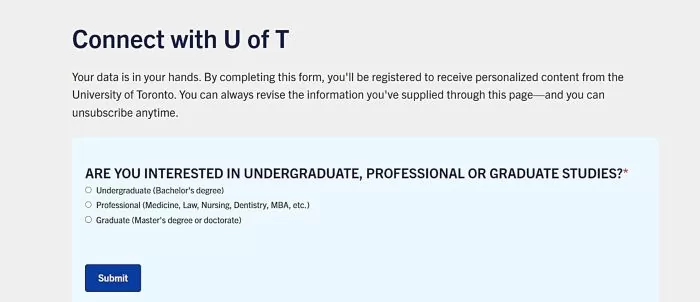
    Example: The University of Toronto uses a program-discovery and program-level content structure (“program-specific landing pages” in practice) and pairs it with a formal inquiry capture pathway: the “Connect with U of T” form registers prospects for personalized content and explicitly allows them to revise submitted info and unsubscribe.

    HEM BP Image 2HEM BP Image 2

    Source: University of Toronto

    However, inquiry volume alone does not ensure progression through the enrollment funnel. Without structured follow-up, early engagement dissipates.

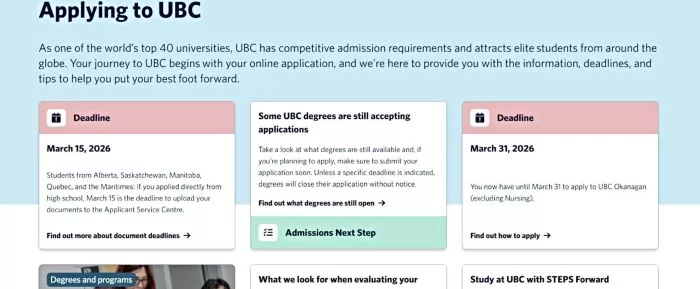
    Example: The University of British Columbia uses a stage-based application guidance architecture that organizes admissions content by applicant phase and clearly separates steps, requirements, and timelines within the enrollment process. Its Applying to UBC hub structures progression logic so prospects understand exactly where they are and what comes next. For a re-engagement strategy, this model makes it easier for admissions teams to identify where a student stalled, trigger stage-specific reactivation messaging, and reduce friction by clarifying next steps rather than sending generic reminders.

    HEM BP Image 3HEM BP Image 3

    Source: University of British Columbia

    This reflects a core reality: engagement is cyclical. Prospects move forward, pause, reassess finances or program fit, explore alternatives, and often return.

    A strong student lead re-engagement campaign acknowledges this behavior. Instead of assuming silence equals disinterest, it treats inactivity as a predictable phase within the enrollment journey and plans targeted interventions accordingly.

    Step 1: Segment Before You Send

    The most common mistake in student lead re-engagement campaigns is batch-and-blast outreach. Dormant leads are not a single audience. They paused at different points, for different reasons.

    Instead, build behavioral segmentation rules based on:

    1. Funnel Stage

    • Inquiry only
    • Application started
    • Application submitted
    • Offer received
    • Deferred

    Each stage requires different messaging. An inquiry-stage prospect needs program clarity and reassurance. A deferred applicant may need deadline reminders or financial guidance.

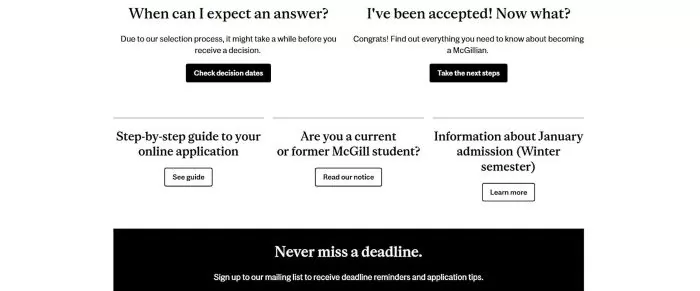
    Example: McGill University structures its admissions experience around clearly segmented applicant and admitted student pathways, differentiating communications and content based on enrollment status. Through its Undergraduate Admissions Apply hub, McGill separates application instructions from admitted student next steps while clearly outlining documentation requirements and procedural expectations. For a re-engagement strategy, this model enables precise funnel-stage segmentation within the CRM, prevents misaligned messaging between applicants and admitted students, and supports targeted reactivation campaigns based on a prospect’s exact enrollment phase.

    HEM BP Image 4HEM BP Image 4

    Source: McGill University

    Your admissions CRM should reflect comparable segmentation logic. Reactivation must align with where progression stopped.

    2. Engagement History

    Use behavioral segmentation criteria such as:

    • Pages visited
    • Program categories viewed
    • Email clicks
    • Event attendance
    • Downloaded assets

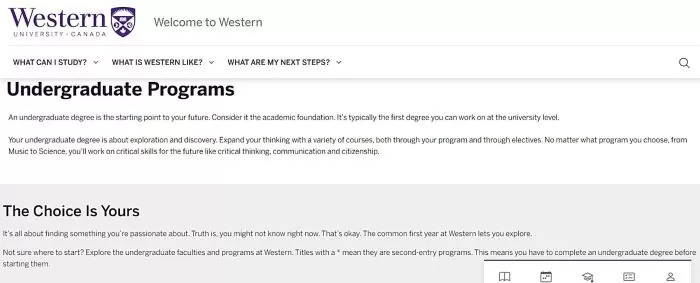
    Example: Western University structures its recruitment ecosystem around faculty-based academic segmentation and regionally informed audience pathways, organizing content by academic area while personalizing messaging based on geography and prospect type. Through its admissions hub, Western aligns program content with declared academic interests and provides differentiated entry points for domestic and international students. For a re-engagement strategy, this structure enables behavior-based follow-up that references specific faculty interest, improves email relevance by aligning with prior browsing patterns, and strengthens mid-funnel reactivation precision by grounding outreach in demonstrated intent.

    HEM BP Image 5HEM BP Image 5

    Source: Western University

    3. Lead Scoring Thresholds

    Lead scoring enables prioritization rather than reactive mass outreach.

    Example scoring logic:

    • +10 for campus visit registration
    • +5 for webinar attendance
    • -10 for 90 days of inactivity
    • +15 for application start

    When a lead’s score drops below a defined threshold, trigger a reactivation campaign. Lead scoring aligns admissions automation with behavioral signals, not arbitrary calendar timelines.

    Step 2: Design Content That Restarts the Conversation

    The objective of a student lead re-engagement campaign is not to increase pressure. It is to remove friction. When prospects disengage, it is usually because a concern remains unresolved, whether academic, financial, logistical, or personal. Effective reactivation content addresses that barrier directly.

    Strong re-engagement offers are specific, practical, and stage-aware.

    1. Program Fit Tools

    Many dormant leads are still evaluating whether a program aligns with their goals. Offer tangible evaluation resources such as career pathway guides, program comparison charts, sample course breakdowns, or graduate outcome reports.

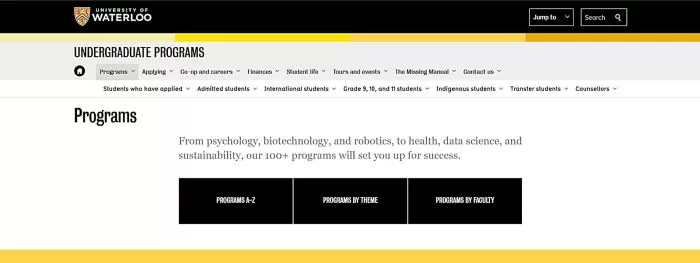
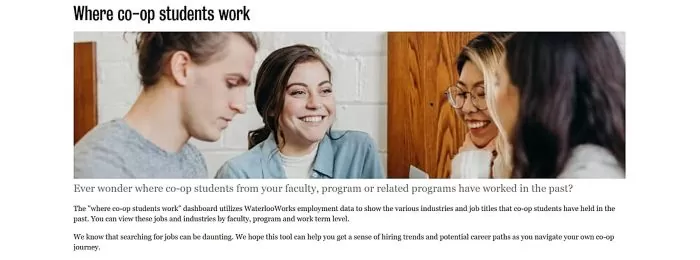
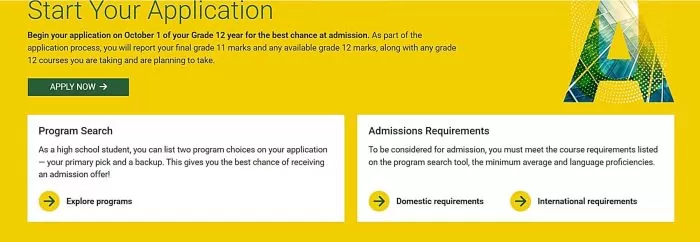
    Example: The University of Waterloo integrates employment outcomes and career data directly into its program ecosystem, embedding co-op statistics, employer data, and graduate employment metrics within academic program pages. By explicitly connecting fields of study to career pathways and measurable post-graduation results, Waterloo emphasizes return on investment and long-term outcomes as part of the recruitment narrative. For the re-engagement strategy, this approach supports ROI-focused reactivation messaging, addresses mid-funnel evaluation concerns related to employability, and provides strong content assets for prospects who stalled during program comparison.

    HEM BP Image 6HEM BP Image 6

    Source: University of Waterloo

    HEM BP Image 7HEM BP Image 7

    Source: University of Waterloo

    A re-engagement email that references verified employment outcomes or alumni pathways reframes the conversation around long-term return on investment. This is significantly more persuasive than a generic reminder to “complete your application.”

    2. Application Clarity Content

    For partially completed applicants, uncertainty about next steps often causes delay. Provide content that explains what happens after submission, outlines key dates, clarifies document requirements, or details how decisions are communicated.

    Example: The University of Alberta emphasizes step-by-step admissions process transparency through structured application checklists, clearly defined document requirements, published deadlines, and detailed explanations of decision timelines. By outlining what applicants need to submit and what happens after submission, the institution reduces ambiguity within the enrollment process. For a re-engagement strategy, this clarity helps reduce application-stage uncertainty, supports abandoned application workflows, and enables messaging focused on “here’s exactly what to expect next,” which can restore momentum for stalled prospects.

    HEM BP Image 8HEM BP Image 8

    Source: University of Alberta

    Mirroring this clarity within your admissions CRM reduces ambiguity. A reactivation message that says, “Here’s exactly what to expect next,” lowers perceived complexity and encourages progression.

    3. Financial Planning Support

    Cost is one of the most common application stall points. Offer scholarship breakdowns, tuition estimators, financial planning webinars, or FAQs about payment schedules.

    Example: The University of Calgary centralizes financial planning and scholarship information within its undergraduate admissions ecosystem, consolidating tuition details, award opportunities, funding tools, and cost guidance. By presenting clear breakdowns of expenses alongside financial planning resources, the institution reduces ambiguity around affordability and cost structure. For the re-engagement strategy, this approach directly addresses cost-related application stalls, supports funding-focused reactivation campaigns, and provides targeted content for leads who disengaged during financial consideration stages.

    HEM BP Image 9HEM BP Image 9

    Source: University of Calgary

    Re-engagement campaigns that highlight funding tools acknowledge a core decision factor rather than avoiding it.

    4. Student Stories and Social Proof

    Prospects often disengage when they struggle to picture themselves at an institution. Peer narratives reduce that distance.

    Including relatable student stories in reactivation emails reconnects emotion with intent. Social proof reinforces belonging, which frequently precedes action.

    Re-engagement succeeds when content answers the question that caused silence.

    Step 3: Use Preference Centers Instead of Unsubscribes

    One overlooked tactic in higher education marketing automation is the strategic use of a preference center. When leads disengage, the default response is often an unsubscribe link. A smarter approach offers flexibility before exit.

    Instead of forcing a binary decision, allow prospects to adjust how they hear from you. This can include switching intended programs, selecting a different intake term, reducing email frequency, or choosing specific content types such as scholarships, events, or program updates.

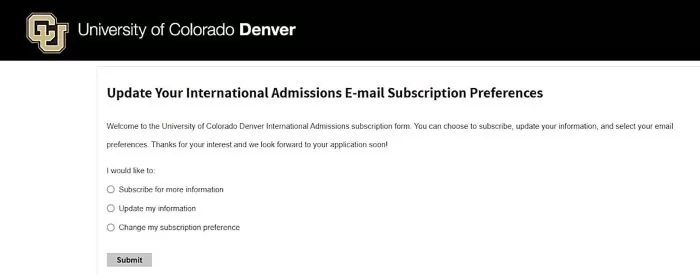
    Example: University of Colorado Denver offers an International Admissions “subscription preferences” workflow that explicitly offers “subscribe,” “update my information,” and “change my subscription preference,” and states users can “select your email preferences.” This is a clear example of consent-based preference management for prospective students.

    HEM BP Image 10HEM BP Image 10

    Source: University of Colorado Denver

    Offering preference updates protects sender reputation, reduces spam complaints, and preserves long-term lead value. A dormant prospect may not be uninterested. They may simply need different timing or information.

    Include a clear “Update email preferences” call to action within your re-engagement campaign. Flexibility sustains engagement more effectively than pressure.

    Step 4: Craft Strategic Re-Engagement Email Subject Lines

    Subject lines in student lead re-engagement campaigns should signal relevance, not desperation. When a prospect has paused, urgency alone rarely restores momentum. Clarity and contextual alignment perform better.

    Effective re-engagement email subject lines include:

    • “Still considering [Program Name]?”
    • “Your application is waiting.”
    • “Questions about funding for Fall 2026?”
    • “Compare your top programs.”
    • “Ready when you are.”

    Each example acknowledges prior interest and reopens the conversation without assuming commitment.

    Avoid:

    • Excessive urgency
    • Multiple exclamation points
    • Aggressive countdowns

    Overly forceful language can trigger unsubscribes or spam complaints, particularly among leads who are undecided rather than disengaged.

    Remember, the objective is conversation, not pressure. Re-engagement succeeds when the subject line reflects timing, context, and the prospect’s stage within the enrollment funnel.

    Step 5: Build a Structured Reactivation Campaign Workflow

    A strong student lead re-engagement campaign follows a defined progression rather than a single reminder email. Structure reinforces intent and prevents overcommunication.

    A typical workflow includes:

    • Email 1: Contextual Reminder
      Reference prior engagement, such as a downloaded guide, event attendance, or started application. Reestablish relevance.
    • Email 2: Value Add
      Provide a useful resource aligned to the prospect’s stage, such as a funding guide, program comparison tool, or admissions walkthrough. Avoid deadline pressure.
    • Email 3: Preference Confirmation
      Offer the opportunity to update email preferences, change program interest, or select a different intake.
    • Email 4: Soft Close
      Ask directly, “Would you like to stay connected?”

    If there is no response, suppress the lead from active campaigns to protect deliverability, but retain them for future intake cycles and strategic reactivation windows.

    Timing Guidelines for Admissions Automation

    Re-engagement timing should reflect funnel velocity, not arbitrary calendar triggers.

    • 60 days of inactivity for inquiry-stage leads
    • 30 days of inactivity for application-stage prospects
    • 14 days of inactivity for deposit-stage students

    Later funnel stages require shorter intervention windows because decision urgency increases as prospects approach commitment.

    These intervals must align with your institution’s enrollment cycle. Use admissions CRM reporting to calculate the median number of days between inquiry and application, and between application and deposit. Reactivation triggers should be calibrated to actual progression data, ensuring interventions occur before momentum is lost.

    Behavioral Segmentation in Action

    Behavioral segmentation becomes meaningful when applied to real admissions CRM scenarios rather than abstract categories.

    Consider Lead A. This student downloaded an Engineering brochure, attended a virtual lab tour, and then showed no activity for 75 days. The behavioral signals indicate strong STEM interest and high academic intent, followed by a mid-funnel stall. The friction point is likely evaluation rather than awareness.

    A suitable reactivation offer would include engineering alumni career outcome data, internship and co-op placement statistics, and a program comparison sheet outlining specializations. The objective is to reinforce return on investment and clarify differentiation.

    Now consider Lead B. This prospect started an application but abandoned it at the financial section. The segment reflects application-stage friction, likely related to cost or funding uncertainty.

    An effective reactivation offer would include a funding webinar invitation, a financial aid checklist, and direct contact details for an admissions advisor. Different behavioral segments require distinct messaging strategies. This precision is the foundation of effective student lead re-engagement campaigns.

    Protecting Sender Reputation

    Protecting sender reputation is central to any student lead re-engagement campaign. Large institutions such as UBC and McGill sustain strong email deliverability by enforcing disciplined segmentation, authentication standards, and database hygiene practices.

    Technical safeguards should include properly configured SPF, DKIM, and DMARC authentication protocols to protect domain integrity and prevent spoofing. When launching reactivation workflows after long periods of inactivity, domain warming strategies should be used to gradually reintroduce segmented audiences rather than sending to large dormant lists at once.

    Best practice begins with removing chronically inactive contacts rather than continuing to send to disengaged records. Engagement-based suppression logic, such as excluding contacts with 12 months of inactivity or repeated non-opens, protects inbox placement and reduces spam complaint risk. Admissions teams should monitor bounce rates, unsubscribe trends, spam complaint signals, and engagement decay over time to identify emerging deliverability risks.

    Reactivation campaigns should strengthen database quality, not compromise it. When segmentation logic, authentication protocols, and inactivity thresholds are enforced consistently, re-engagement workflows protect domain health while preserving long-term recruitment opportunity. Deliverability is not separate from enrollment performance. It underpins it.

    How This Fits into the Student Recruitment Funnel

    The student recruitment funnel typically includes:

    1. Awareness
    2. Inquiry
    3. Application
    4. Offer
    5. Enrollment

    Student lead re-engagement campaigns operate most effectively between Inquiry and Application, and between Application and Deposit. These are the stages where intent exists but momentum has slowed.

    At the inquiry stage, prospects may be evaluating fit, cost, or program structure. At the application stage, friction often relates to documentation, funding, or uncertainty about next steps. Structured reactivation workflows intervene before disengagement becomes permanent.

    By reactivating stalled leads:

    • Marketing-qualified leads increase.
    • Admissions staff workload becomes more focused.
    • Institutions frequently observe improved cost efficiency per enrolled student when reactivation workflows are integrated with segmentation and scoring logic.

    Rather than expanding top-of-funnel acquisition, institutions extract greater value from existing inquiry volume.

    This approach is particularly important for institutions recruiting across multiple provinces and internationally, where decision cycles are longer, and comparison behavior is higher. Re-engagement provides controlled, stage-aware intervention without increasing acquisition spend.

    How do you promote student engagement? Through:

    • Behavioral segmentation
    • Lead scoring
    • Relevant content offers
    • Timely follow-ups
    • Preference flexibility

    Engagement increases when communication reflects prior behaviour.

    Stop Buying What You Already Own

    Every dormant lead represents prior investment. Paid media budget generated the inquiry. Content production supported the download or event registration. CRM infrastructure stores and tracks the records. Staff time nurtured the initial interaction. When that lead stalls, the sunk cost remains.

    A well-structured student lead re-engagement campaign converts underutilized database volume into a renewed enrollment opportunity. Rather than defaulting to additional acquisition spend, institutions can reactivate intent that already exists within their admissions CRM.

    Institutions that integrate behavioral segmentation, lead scoring, admissions automation, and structured preference management consistently outperform those relying on repetitive top-of-funnel activity. Precision outperforms volume.

    Reactivation is not a secondary tactic. It is a core efficiency strategy within higher education marketing campaigns, particularly in a cost-sensitive, privacy-restricted environment.

    If you would like support structuring segmentation logic inside your admissions CRM or implementing higher education marketing automation workflows, explore HEM’s digital marketing services or connect directly with our team.

    Do you need help strengthening your lead nurturing?

    Our expert digital marketing services can help you attract and enroll more students!

    FAQs

    Q: What are re-engagement campaigns?

    A: A re-engagement campaign is a structured marketing automation workflow designed to reconnect with prospective students who previously showed interest but have since become inactive within the admissions CRM.

    Q: How do you promote student engagement?

    A: Through:

    • Behavioral segmentation
    • Lead scoring
    • Relevant content offers
    • Timely follow-ups
    • Preference flexibility

    Engagement increases when communication reflects prior behaviour.

    Q: What are the 4 C’s of student engagement?

    A: Common frameworks define the 4 C’s as:

    • Communication
    • Connection
    • Community
    • Commitment

    In recruitment marketing, this translates into consistent messaging, relational storytelling, peer proof, and clear next steps.

    Source link

  • Netflix and…chilled? New UK rules target ‘harmful or offensive’ streaming content

    Netflix and…chilled? New UK rules target ‘harmful or offensive’ streaming content

    The United Kingdom isn’t just focused on age-gating and regulating what its citizens can see and do on the internet through its Online Safety Act. Now, officials are setting their sights on what people can stream, expanding their regulatory focus beyond local television channels and into the workings of non-UK companies like Netflix.

    If the censorial headaches unleashed by the Online Safety Act’s attempts to crack down on “harmful content” on the web are any indicator, residents of the UK — as well as the streaming companies officials intend to regulate and their global audiences who watch them — have reason to worry.

    This week, communications regulator Ofcom announced “enhanced” regulation for video-on-demand services with more than 500,000 UK-based users. Some of the requirements will address accessibility features such as subtitles, but there will also be a significant focus on the aired material itself: specifically “harmful or offensive material.” Platforms with user bases of this size will be subject to a forthcoming video-on-demand code modeled on rules already in place against stations like the BBC.

    “Similar to the Broadcasting Code, this will ensure that news is reported accurately and impartially and audiences are protected against harmful or offensive material,” a UK government press release explains. “Audiences will be able to complain to Ofcom if they see something concerning, and Ofcom will have powers to investigate, and take action, where they consider there has been a breach of the code.”

    The Broadcasting Code, which will no doubt influence the upcoming rules for streaming services, explains that TV and radio stations must “provide adequate protection for members of the public from the inclusion in such services of harmful and/or offensive material.” 

    Programs containing “harmful” material including “offensive language, violence, sex, sexual violence, humiliation, distress, violation of human dignity, [and] discriminatory treatment or language” must be “justified by the context.” That context can include the time and service during which the material is aired but also much more nebulous concepts like “the degree of harm or offence likely to be caused by” it or “the effect of the material on viewers or listeners who may come across it unawares.”

    This will very likely mean bad news for UK citizens who don’t want this kind of government overreach into the streaming services they watch and who can, in theory at least, decide for themselves what material is too offensive or harmful for their TVs and tablets. But it also could be bad news for the rest of the world, too. 

    The risk of fines for ambiguously defined harmful content — and fines will no doubt be a penalty for breaches of the not-yet-written code — could very well pressure streamers like Amazon Prime and Netflix to make editorial decisions not to greenlight content that might be perceived as offensive by UK regulators, including shows and projects intended for a global audience. Companies might decide it isn’t worth the risk of either fines in the UK or the production cost of creating content that will be inaccessible to its UK-based audience. 

    And that can affect far more people than just UK citizens. As FIRE recently explained in its principles for defending speech on the global internet, the interconnectedness of today’s world means that regulations passed in one country can have significant “potential to bleed across borders,” including into the U.S. 

    We’ll keep an eye on these forthcoming regulations to see what it means for streaming companies — and, perhaps, what airs on our screens, too. 

    Source link

  • Focus on the Consideration Phase for Midfunnel Marketing- Archer Education

    Focus on the Consideration Phase for Midfunnel Marketing- Archer Education

    Why the Consideration Phase Is the Key to Higher Ed Enrollment ROI 

    Lead volume alone is not a reliable indicator of a higher education institution’s enrollment health. While inquiries reflect prospective students’ awareness of and initial interest in a program, they don’t offer much insight into whether the students feel supported, informed, or confident enough to move forward with applying to the program. 

    The real opportunity lies in how institutions engage with students during the consideration phase — when they are actively evaluating the program’s fit, feasibility, and alignment with their needs. 

    For adult and online learners in particular, this phase is anything but passive. These students often enter the enrollment funnel highly motivated, driven by career changes, job losses, personal goals, or life transitions. But without consistent engagement, that motivation can fade. 

    Unlike traditional undergraduates, adult learners typically don’t have counselors, parents, or peers guiding them through deadlines and decisions. In many cases, they’re navigating this process on their own, often while juggling work, family, and competing priorities. 

    Effective midfunnel marketing efforts provide these students with the clarity and reassurance they need to move from inquiry to application. When institutions focus on this phase intentionally, they can reduce prospects’ uncertainty, ease their decision-making process, and improve the institution’s overall enrollment efficiency. 

    The Risks of Ignoring the Midfunnel

    Institutions that don’t maintain consistent engagement with prospective students throughout the consideration phase risk creating doubt in the students’ minds. Without sustained communication, students may disengage entirely or choose a different school that provides them with clearer direction and more reliable follow-up. 

    One of the most common reasons students stall during this phase is because they encounter friction. An institution’s admissions requirements may be unclear. Its application steps may be difficult to navigate. Its financial aid information — a major factor influencing students’ decision-making process — may be overwhelming or poorly explained. For adult learners, even small barriers can become stopping points when their time and attention are limited. 

    By neglecting the midfunnel phase, institutions also run the risk of losing track of potential students altogether. Without a proactive nurturing strategy, prospects can fall into the gap between inquiry and application. If institutions aren’t intentionally tracking and engaging with students during this window, qualified students may simply drift away — not because they lost interest, but because there wasn’t anyone there to guide them forward.   

    How Engagement Shapes the Consideration Phase 

    Effective engagement during the consideration phase depends on consistent, personalized communication across channels. Students have different preferences, which is why multichannel outreach across text messaging, email, and chat is essential. Some students prefer phone conversations, while others engage far more readily through texts or emails they can review on their own time. 

    Archer’s AI-Enabled Admissions approach makes this level of coordinated, cross-channel outreach more scalable, enabling institutions to deliver tailored messaging without overwhelming their admissions and nurturing teams. 

    A personalized approach is especially important for adult and online learners. These students aren’t just evaluating academic programs — they’re assessing whether an institution understands their goals and concerns. Thoughtful engagement with them helps remove any barriers they face by explaining the institution’s processes, clarifying its timelines, and proactively addressing the students’ questions about financial aid and transfer credits.

    Behavioral data about prospective students enhances a university’s midfunnel marketing efforts by providing insight into what matters most to each student. Understanding where the students spend their time — what they click on, revisit, or ignore — helps identify their areas of hesitation. When used responsibly, this data enables timely, relevant follow-up with prospects that feels supportive rather than intrusive. 

    Engagement strategies should also adapt to students’ different profiles. Bachelor’s degree prospects and master’s degree prospects behave differently and require distinct outreach cadences. Monitoring students’ engagement patterns allows institutions to fine-tune their communication frequency and modality to accommodate each student’s habits and preferences. 

    Converting Intent Into Enrollment 

    The midfunnel phase is often defined as the consideration phase between inquiry and application, but a prospect’s deliberations rarely stop there. In reality, students continue making decisions throughout the enrollment journey, as they evaluate a school’s financial aid offer, transfer credit outcome, registration process, and time-to-completion expectation. Each step introduces new variables that can either reinforce students’ confidence or trigger their hesitation.

    Successful enrollment marketing strategies support students throughout this entire decision-making arc. Providing students with clear guidance, continuous communication, and proactive check-ins helps them move from interest to intent to application and enrollment. The goal is not excessive hand-holding but rather supportive co-piloting, providing students with the direction they need to move forward with clarity. 

    This is particularly important for adult learners who haven’t been to school in years and may feel nervous or unsure about the process. When things don’t go as expected or they run into a challenge, they may start to question whether they can make it work. Regularly engaging with students at key milestone points — such as during registration and the first week of classes — helps reinforce their sense of preparedness. 

    Ultimately, success during the enrollment funnel process should be measured by conversion quality, not raw lead counts. Strong conversion rates indicate that students are well informed, supported, and confident — conditions that also contribute to better retention and degree completion outcomes.  

    Key Takeaways

    • The consideration phase is where enrollment momentum is built or lost, making sustained midfunnel engagement an essential step in improving conversion outcomes.
    • AI-enabled engagement tools allow for scalable, personalized communication with prospects that keeps institutions connected to them throughout their decision-making process.

    Making the Consideration Phase Count

    The consideration phase is where prospective students’ enrollment momentum is either strengthened or lost. Institutions that invest in sustained, personalized midfunnel marketing efforts can reduce the friction students face and help them move forward with confidence. By staying engaged with prospects at this critical phase, colleges can convert interest into intent — and intent into lasting enrollment outcomes. 

    Archer Education partners with accredited universities to improve their performance during the consideration phase through tech-enabled, personalized marketing strategies. Using techniques that range from multichannel engagement powered by Onward to data-informed enrollment management solutions, we help institutions stay connected with prospective students when it matters most. 

    To learn more about how Archer supports sustained student engagement and conversion growth, connect with our team today. 

    Source link