Blog

  • WEEKEND READING: The one strategic role almost every university underestimates – and why it matters now more than ever

    WEEKEND READING: The one strategic role almost every university underestimates – and why it matters now more than ever

    This blog was kindly authored by Caroline Dunne, Leadership Coach, Change Mentor and former Chief of Staff.  

    For many Vice-Chancellors, the challenge is one of bandwidth. Leading a university today is equivalent to running a major regional employer – complex multi-campus operations, often turning over hundreds of millions of pounds, under intensifying public and political scrutiny. In this environment, strategic support is not a luxury; it is a prerequisite for strong, steady leadership that can hold the line between urgent pressure and long-term ambition.

    Within this context, one critical role remains under-recognised in much of the sector: the Chief of Staff.

    Drawing on insights from interviews conducted in the first quarter of this academic year with Chiefs of Staff and senior Higher Education leaders across the UK, this piece explores the strategic value of the role and why, in a period of profound turbulence, now could be the right time to put more “Chief” into the Chief of Staff.

    An untapped strategic asset

    Outside higher education, the Chief of Staff is a well-understood part of modern executive infrastructure: a senior adviser who expands the horizon of the chief executive, drives alignment, absorbs complexity and enables organisational agility.

    Inside higher education, the role is far more variable. In some institutions, the role is positioned as a strategic partner to the Vice-Chancellor; in others, it is mistaken for an ‘executive assistant-plus’ or folded into a different portfolio. Reporting lines, authority and remit differ widely, sometimes limiting the role’s ability to deliver its full strategic value.

    What emerged consistently from my interviews is this: the absence of a portfolio is the Chief of Staff’s greatest strategic advantage. It enables the role to traverse boundaries, ‘keep things moving in the grey areas’ and view institutional issues through an enterprise lens rather than a single-portfolio perspective.

    As one interviewee described it, not having a portfolio makes you:

    A free agent with an aerial view.

    Greater understanding of this untapped role is overdue. Paradoxically – and perhaps counterintuitively in a resource-constrained sector – it is precisely in this context that a well-positioned Chief of Staff becomes most critical to institutional success.

    Five modes of strategic influence

    In a sector facing systemic pressures, where, as one respondent put it, “driving change and transformation… is like pushing a boulder uphill”, the Chief of Staff plays an important catalytic role – shaping thinking, absorbing complexity and helping the organisation respond with coherence rather than fragmentation.

    I conducted 11 interviews which revealed five modes of strategic influence that a Chief of Staff brings to university leadership:

    Sense-making: turning complexity into coherence.

    Not being tied to a portfolio gives the Chief of Staff a rare vantage point. They see the connections, gaps and risks that others – focused on their own areas – may miss.

    A seat at the top table, even without formal membership, brings influence through insight rather than authority. Chiefs of Staff challenge assumptions, sharpen strategic issues and help Vice-Chancellors translate vision into coordinated action.

    One interviewee captured the essence of the role well:

    “We help make things happen, but we belong in the background.”

    Alignment and flow: moving decisions through the system.

    Universities are structurally complex, often siloed and prone to initiatives moving at different speeds in different directions. Chiefs of Staff surface dependencies, shepherd decisions through the right governance bodies, and ensure that decisions, conversations and projects maintain momentum.

    As one Chief of Staff noted:

    We make sure everyone is rowing in the same direction – even if they’re in separate boats.

    Trusted connectivity: the organisational glue

    Nearly every interviewee emphasised the relational character of the role. Chiefs of Staff build trust across formal and informal networks, read the room, join dots, create spaces for candid conversations and offer a safe space to rehearse potentially difficult issues.

    Much of their impact is intentionally invisible. As one Chief of Staff reflected, the

    most significant unseen impact is behind-the-scenes relationship building.

    Another colleague added:

    Real mastery is knowing when to be visible and when to be invisible… knowing how to master ego.

    Influence in universities is exercised as much between meetings as it is within them.

    Strategic counsel:  second pair of eyes

    Vice-Chancellors face relentless external demands. Chiefs of Staff help maintain strategic momentum by offering:

    • operational realism
    • political insight
    • institutional memory
    • horizon scanning
    • a safe environment to test ideas

    Several described themselves as the “second pair of eyes” – seeing risks early and raising issues before they land.

    We clear barriers, trial new approaches, and give leaders the space to act confidently without being swamped by operational detail – enabling principled, well-understood risks.

    Steadying influence: calm in a volatile environment


    With no portfolio interests and a broad institutional view, Chiefs of Staff help manage tension within senior teams, support leadership transitions and create calm judgement in moments of pressure.

    As one interviewee said:

    A Chief of Staff can help calm the waters – up and down and sideways.

    Another added:

    When an institution is facing uncertainty, you need someone with no skin in the game – someone invested in the success of the collective.

    “A Chief of Staff takes it to the finish line – but you’re nowhere near the ribbon.”

    The point is clear: the role is not about visibility. It is about capacity, coherence, relationships, pace and judgement.

    In a sector where senior leaders are stretched, where decisions carry political and human consequences, and where the pace of change is only accelerating, the question for institutions is no longer whether to invest in a Chief of Staff – but how to position the role for maximum effect:

    • reporting lines that enable influence
    • clarity of remit
    • proximity to decision-making
    • and a mandate that embraces both people and strategy

    As the higher education sector faces continued uncertainty, one thing is clear: well-positioned Chief of Staffs are not a luxury. They are a source of resilience, coherence and leadership capacity – precisely when the sector needs it most.

    In developing this piece, I am deeply grateful to the colleagues who generously contributed their insights including:

    Dr Giles Carden, Chief Strategy Officer and Chief of Staff, University of Southampton

    Dr Clare Goudy, Chief of Staff, Office of the President and Provost, UCL

    Thomas Hay, Head of Vice-Chancellor’s Office, Cardiff University

    Jhumar Johnson, former Chief of Staff to the former Vice-Chancellor at the Open University

    Dr. Chris Marshall, Chief of Staff and Head of the Vice-Chancellor’s Office, University of Wales Trinity Saint David

    Mark Senior, Chief of Staff (Vice-Chancellor’s Office), University of Birmingham

    Rachel Stone, Head of Governance and Vice-Chancellor’s Office, University of Roehampton 

    Luke Taylor, Chief of Staff to the President & Vice-Chancellor, University of Manchester

    Becca Varley, Chief of Staff, Vice-Chancellor’s Office, Sheffield Hallam University

    Source link

  • Infants and toddlers are a growing group among homeless children

    Infants and toddlers are a growing group among homeless children

    by Jackie Mader, The Hechinger Report
    January 17, 2026

    BOSTON, Mass. — For months, Karian had tried to make it on her own in New York.

    After the birth of her second daughter, she was diagnosed with postpartum depression, major depressive disorder and anxiety. A single mother who had moved from Boston to New York about 13 years ago, she often spent days at a time on the couch, unable to do more than handle the basics for her daughters.

    “I wasn’t taking care of myself,” she said softly on a recent afternoon. “I was not really present.” The Hechinger Report is not publishing her last name to protect her privacy.

    Karian’s mother urged her to move back home to the Boston area and offered to house her and her daughters temporarily. She started working the night shift at a fast food restaurant to save up for her own place while her mother and sister watched her children. 

    But in a city where fast food wages aren’t enough to pay the rent, her efforts felt futile. And then, a month after moving in with her family, her mother’s landlord told her the apartment was overcrowded and she had to leave. Karian and her girls, then 7 years old and 8 months old, moved into a homeless shelter, where her depression and anxiety worsened. 

    “I tried my best, but it’s not their home,” said Karian, now 31.

    Karian’s children had joined the growing ranks of very young children experiencing homelessness. Between 2021 and 2023, the number of homeless infants and toddlers increased in 48 states and the District of Columbia. The most recent estimates found that in 2023 nearly 450,000 infants and toddlers in the United States were in families that lacked a stable place to live. That was a 23 percent increase compared to 2021, according to a report released last year by the nonprofit SchoolHouse Connection in partnership with Poverty Solutions at the University of Michigan.  

    The numbers could be even higher, experts worry, because “hidden homeless” children — those who are doubled up in homes with family or friends or living in a hotel — may not be captured in tallies until they start school.

    High prices for diapers and formula, the exorbitant cost of child care, the rising cost of living, and rising maternal mental health challenges all contribute to the growing rate of homelessness among very young children, experts say. In 2024, one-third of infants and toddlers were in families that struggled to make ends meet, according to the nonprofit infant and toddler advocacy organization Zero to Three. 

    “We’re talking about families who have generationally been disadvantaged by circumstance,” said Kate Barrand, president and CEO of Horizons for Homeless Children, a nonprofit that supports homeless families with young children in Massachusetts. “The cost of housing has escalated dramatically. The cost of any kind of program to put a child in, should you have a job, is escalating,” she added. “There are a lot of things that make it really hard for families.”

    Related: Young children have unique needs and providing the right care can be a challenge. Our free early childhood education newsletter tracks the issues.

    Housing instability is dire for anyone, but particularly for young children, whose brains are rapidly growing and developing. Studies show that young children who are homeless often lag behind their peers in language development and literacy and struggle to learn self-regulation skills, like being able to calm themselves when feeling angry or sad or transition calmly to new activities. They also may experience long-term health and learning challenges.

    Early childhood programs could provide a critical source of stability and developmental support for these children. But SchoolHouse Connection found only a fraction of homeless children are enrolled in early learning programs, and the percentage who are has decreased over the past few years.

    “It’s not just incredibly tragic and sad that infants and toddlers are experiencing homelessness,” said Rahil Briggs, national director of the nonprofit Zero to Three’s HealthySteps program, which works with pediatricians to support the health of babies and toddlers. The first few years are also a “disproportionately important” time in a child’s life, she added, because of the brain development that’s happening.

    Karian and her daughters faced new difficulties after they moved into a shelter.

    They shared an apartment with another family. If the other family was using the shared common space, Karian tried to give them privacy, which meant keeping her children in the bedroom the three of them shared.

    Her older daughter had to change schools, and left without getting to say goodbye to many of her friends. At her new school, her grades dropped. The baby developed a skin condition and there was a bedbug infestation at the shelter. Karian didn’t want to put her on the floor for tummy time. She was desperate to find a home.

    “We were in a place where we couldn’t really make noise. I couldn’t really let them be kids,” she said.

    The rise in housing insecurity among young children has created more demand for programs created specifically to meet the unique needs of children who are experiencing instability and trauma. Many of these programs offer support to parents as well, through what is called a “two-generation” approach to support and services.

    Related: A school created a homeless shelter in the gym and it paid off in the classroom

    In 2021, in response to ballooning child homelessness rates, Horizons opened the Edgerley Family Horizons Center, an early learning program that serves children from 2 months to 5 years old. While some families find Horizons on their own, many are referred by shelters around the Boston area. The need is great: Edgerley serves more than 250 children, with a waitlist of 200 more. Karian’s younger child was one of those who got a spot soon after the program opened.

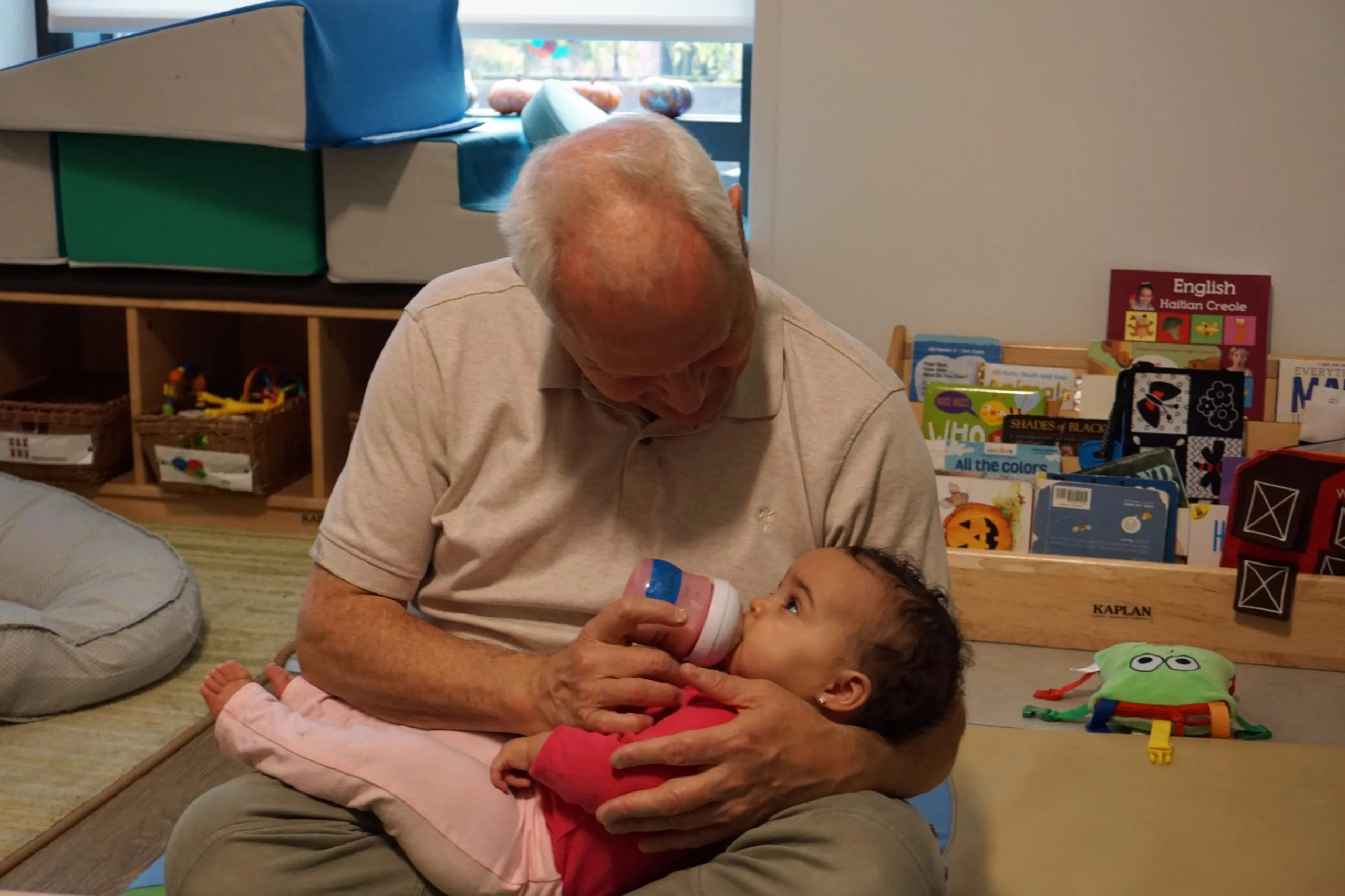
    Inside Horizons’ large, light-filled building on the corner of a busy street in Boston’s Roxbury neighborhood, every detail is tailored to the needs of children who have experienced instability. Walls are painted in soothing blues and greens. Each classroom has three teachers to maintain a low child-to-staff ratio. Many of the teachers are bilingual. All educators are trained in how to build relationships with families and gently support children who have experienced trauma. 

    The starting salary for teachers is $54,200 a year, far more than the national median for childcare workers of $32,050 and the Massachusetts median of about $39,000. That has encouraged more teachers to stay on at the center and provide a sense of security to the children there, said Horizons CEO Barrand.

    In the infant room, teacher Herb Hickey, who has worked at Horizons for 13 years, frequently sees infants who are hyperaware, struggle to fall asleep, can’t be soothed easily or cling desperately to whichever adult they attach to first. The goal for the infant teachers, he said, is to be a trusted, responsive adult who can be relied on.

    Every day, the teachers in the infant room sing the same songs to the babies. “When they hear our voices constantly, they know they’re in a safe space,” Hickey said. “This is calm.” 

    Teachers also follow the same familiar routines. The rooms are decorated simply, organized and filled with natural light. Teachers constantly scan the infants for signs of distress.

    “We have to be even more responsive,” Hickey said. “When the child starts crying, we don’t have the convenience to say, ‘I know you’re hungry, I’ll get to you.’” He said teachers want even the tiniest babies to learn that “we’re not going to leave you crying.’”

    Related: A federal definition of ‘homeless’ leaves some kids out in the cold. One state is trying to help

    Other needs arise with Horizons’ youngest children: Infants and toddlers living in homeless shelters often lag in gross motor skills. Many spend time on beds rather than on playmats on the floor, or they are kept in car seats or in strollers to keep them safe or from wandering off. That means they’re missing out on all the skills that come from active movement.  

    Even the arrangement of toys at the center has a purpose. Staff want children to know they can depend on toys being in the same location every day. For many children, those are some of the only items they can play with. Families entering a shelter environment can usually only bring a few bags, with no room for toys or books. A toddler who recently entered a shelter where Horizons runs a playroom came in holding a small empty chip bag, recalled Tara Spalding, Horizons’ chief of advancement and playspace. When a shelter staff member threw it away, the boy was inconsolable. “This is the only toy my child has,” staff recalled the mother saying.

    “This just shows the sheer poverty,” said Spalding. 

    As infant and toddler homelessness has increased, other cities and states have tried to provide more support to affected families and get a better sense of their needs. In Oklahoma, experts say, low wages, a lack of housing and eviction laws that favor landlords have led to rising homelessness rates. State officials are trying to gather better data about homeless families to determine the best use of resources, said Susan Agel, chair of Oklahoma’s Homeless Children and Youth Steering Committee. Their efforts are hampered, however, by the fact that many homeless families fear that their children will be taken away by child protective services because they are homeless. 

    In 2024, to fill that gap in data, the state launched a residency questionnaire given to every K-12 student that includes new questions about homelessness, including if there are younger children in the home who are not students and may not otherwise be counted in homeless populations. Officials say it isn’t a perfect solution, but it’s a start to get a sense of the severity of family homelessness. “We can’t devise a system for dealing with a problem if we don’t know what the problem is,” said Agel.

    In Sioux Falls, South Dakota, city officials have ramped up efforts to coordinate city agencies to respond to an increase in homelessness among infants and toddlers.

    “In general, the families we see more often have younger children. The school offers so much support, and there’s limited daycare access” to get similar support for infants and toddlers, said Tommy Fuston, Community Services and Housing Navigator at Minnehaha County’s Department of Human Services. “If a family has younger children, they’re going to struggle more.” 

    Each week, officials from the city, the Sioux Falls School District, local early childhood programs and shelters hold a “care meeting” to make sure any homeless families, or families at risk of homelessness, are quickly connected to the right resources and receive follow-up. “We don’t have unlimited resources, but I think it maximizes the resources that we do have,” Fuston said. “We’ve tried to create a village of supportive services to wrap around these folks.” The city relies extensively on private and faith-based donations to help. All shelters in town are privately funded, for example. 

    Related: Shelter offers rare support for homeless families: a child care center

    Karian heard about the child care center run by Horizons from a social worker soon after she and her daughters moved into their Boston-area shelter. In the infant room, her youngest daughter quickly settled into a routine, something Karian said didn’t happen when the baby was watched at night by family members. When staff identified speech and developmental delays, they helped connect Karian to an early intervention program where her daughter could receive therapy. Now 4 years old and in pre-K at Horizons, “she’s thriving,” Karian said. “She’s getting that nourishment.” 

    Karian also received support. Each family at Horizons is assigned a coach to help parents set personal goals and connect with resources. The organization offers classes in computing, financial management and English, all within the early learning building.

    Two months after setting goals with a family coach, Karian earned her GED, with the help of  the child care assistance. A few months later, she graduated from a culinary training program. She now works a steady job as a cafeteria manager for a local school district, where she earns a salary with benefits. 

    After a year in the shelter, her family was approved for subsidized housing and moved into their own apartment. Horizons allows families to stay in its programs for at least two years after they secure housing to make sure they are stable. 

    Now, Karian has her sights set on eventually opening a restaurant. She also has big dreams for her daughters, something that once seemed out of reach. She wants them to have ambition to “work towards something big,” she said. “I want them to have a dream and be able to achieve it.” 

    Experts say there are larger policy changes that could help families like Karian’s: increasing the minimum wage, expanding child care options like Head Start, which saves a portion of seats for homeless children, and offering more affordable housing to low-income families, to start.

    Providing more federal money to the programs that help poor families pay for child care could also help. Those programs require states to prioritize homeless children and give them the first opportunity to access that money. 

    While important, experts argue, these solutions shouldn’t need to exist in the first place.

    “We should be able to come to an agreement as a society that we should prioritize keeping families with infants and toddlers in their homes,” said Melissa Boteach, chief policy officer at Zero to Three. “Babies shouldn’t be homeless.”

    Contact staff writer Jackie Mader at 212-678-3562 or [email protected].

    This story about homeless children was produced by The Hechinger Report, a nonprofit, independent news organization focused on inequality and innovation in education. Sign up for the Hechinger newsletter

    This <a target=”_blank” href=”https://hechingerreport.org/homelessness-is-rising-fast-among-a-surprising-group-infants-and-toddlers/”>article</a> first appeared on <a target=”_blank” href=”https://hechingerreport.org”>The Hechinger Report</a> and is republished here under a <a target=”_blank” href=”https://creativecommons.org/licenses/by-nc-nd/4.0/”>Creative Commons Attribution-NonCommercial-NoDerivatives 4.0 International License</a>.<img src=”https://i0.wp.com/hechingerreport.org/wp-content/uploads/2018/06/cropped-favicon.jpg?fit=150%2C150&amp;ssl=1″ style=”width:1em;height:1em;margin-left:10px;”>

    <img id=”republication-tracker-tool-source” src=”https://hechingerreport.org/?republication-pixel=true&post=114264&amp;ga4=G-03KPHXDF3H” style=”width:1px;height:1px;”><script> PARSELY = { autotrack: false, onload: function() { PARSELY.beacon.trackPageView({ url: “https://hechingerreport.org/homelessness-is-rising-fast-among-a-surprising-group-infants-and-toddlers/”, urlref: window.location.href }); } } </script> <script id=”parsely-cfg” src=”//cdn.parsely.com/keys/hechingerreport.org/p.js”></script>


    Source link

  • DOJ must not investigate elected officials for criticizing immigration enforcement

    DOJ must not investigate elected officials for criticizing immigration enforcement

    The following statement can be attributed to FIRE’s Director of Public Advocacy Aaron Terr:

    The Department of Justice is reportedly investigating elected officials for criticizing the administration’s immigration enforcement operations. If this is the basis for the investigation, it is blatantly unconstitutional and intolerable in a free society. The right to condemn government action without fear of government punishment is the foundation of the First Amendment. 

    This would not be the first time the administration has used boundless, imaginary definitions of “obstruction” or “incitement” that have no basis in the law and run headlong into constitutional limits. The few exceptions to the First Amendment are defined by narrow, exacting standards for a reason: to prevent the government from wielding its power to squash dissent. 

    If criticism of government policy can be rebranded as a crime, then constitutional protections become meaningless and the government becomes unaccountable. That is precisely the danger the First Amendment is meant to prevent, and it is a line no administration may cross.

    Source link

  • Supporting students and free speech on campus requires reform

    Supporting students and free speech on campus requires reform

    The recent polling on students’ views on free speech, published by HEPI, presents what looks like a confusing and muddled picture of students’ perspectives.

    On the one hand, today’s students appear more alert to the demands of safety and security than previous cohorts, with increased support for the use of content warnings, safe space policies, and a decent majority (63 per cent) who agree with the premise that protection from discrimination and ensuring the dignity of minorities can be more important than unlimited freedom of expression.

    On the other, the same cohort of students expresses support for a good number of principled free speech positions, with 70 per cent agreeing that universities should never limit free speech, and 52 per cent that education should “not be comfortable” because “universities are places of debate and challenging ideas.” There is also increased support for the proposition that “a lot of student societies are overly sensitive.”

    If you’re searching for coherence in students’ position then none of our collective mental models seems to apply – whether that’s a “woke” model (in the pejorative sense of snowflake students drawing equivalence of mild offence with grievous bodily harm), or from the classical liberal pro-free speech standpoint. These, we are forced to conclude, may not be the mental models current students are using in their understanding of navigating complex political territory.

    One of the characteristics of the free speech debate has been that a lot has been said about students, and the sort of environment they ought to be exposed to while on campus, but rather less attention has been paid to what students might want to say, or what purposes and values they attach to political debate and civic participation. The current political climate is, to put it mildly, grim as hell – raucous, accusatory, significantly short on empathy and compassion and, worst of all, not producing significant improvements in young people’s lives.

    Given that context, it might not be all that surprising that most students want at least one political party banned from campus – it was Reform topping the poll that caught the headlines last week, but I find more significant that only 18 per cent of students said that no political party should be banned from campus. Could it be that students don’t feel the parties have all that much to offer them?

    The winds are changing

    This is a deeply pertinent question for contemporary student leaders, who frequently find themselves in the cross-fire of these debates.

    Speaking to student leaders about free speech policy, particularly in the wake of the Office for Students’ intervention at the University of Sussex, there’s a growing challenge for institutions to confidently be a political actor on campus. And for students there is a real sense that their attitudes to politics at university are changing.

    On my regular briefing calls with student unions I run through the top ten things happening in policy that month, and recently there’s been a steady influx of questions about what happens when students get frustrated that there’s a new student society on campus that they ideologically disagree with.

    At one students’ union a group of Reform supporting students filed to be a registered SU society following the US election in 2024. Even if the Higher Education Freedom of Speech Act wasn’t around, the SU would still be required to register and ratify the society – the only difference now is it’s clearer they must follow the joint free speech code with the university. Students signed petitions and directed their anger at the SU for ratifying the society in the first place and any subsequent events held by ReformSoc were met with student protest (also protected under the terms of the new legislation).

    The protests centered around the events being a threat to safety on campus, fearing events would border on hate speech and that the SU no longer reflected or represented them. Students that protested likely support abstract principles of free speech, yet these don’t neatly map onto what they fear may be its results. The ratification and later protests did the rounds on social media and got the attention of the public at which point a rush of unpleasant comments and attacks headed towards the SU.

    In one sense all this is as it should be – the society was enabled to exist, those who wanted to protest did so – but it’s doubtful that much actual debate took place, or that many minds were changed. The SU leaders involved were left trying desperately to stick to the law, facilitate student political engagement, keep the peace, and protect themselves from increasingly vicious attacks for doing so.

    Statements and action about EDI, decolonisation or the recent trans ruling are wrapped up in a new sense of nervousness that will frustrate both ends of the student political spectrum, albeit in different ways. I did enjoy speaking to one team who told me the frustration from students about ReformSocs has led them to put on more EDI based events in the hope more students keep coming, find their safe spaces and recognise that the campus still represents them.

    Making it happen

    All this is contributing to a real tension when it comes to understanding how SUs can best support students and student leaders to become political actors, and agentive citizens. Both the toxicity of the current political environment and the regulations that are intended to try to lay down some principles to manage it, are difficult for student leaders to navigate.

    Now that the free speech legislation is in force, the next debate needs to be about how we get to a space where universities and SUs are agents of civic and political action which isn’t seen exclusively through the lens of “woke” or even the classical liberal position – but something more directly applicable to students’ lived experience of engaging with these tricky political issues.

    There needs to be a deeper understanding and discussion within the student movement, supported by institutions, of the importance of having a plurality of ideas on campus and recognition of the particularities of the current political moment. For university to be both a safe space and also a space to be challenged, the mode of challenge needs to be tailored to the issues and the context.

    In the conversations I’ve had there’s a willingness to try and convert the protest energy into political action, to push SUs to continue to be political agents and welcoming of debate, developing students’ civic identities. I’d love to see debates about free speech reframed as an exciting opportunity, something which already allows diverse student thought, often through student societies. But just sticking to the rules and principles won’t deliver this – we need to move the conversation to the practicalities of making this happen.

    Source link

  • AI is challenging us to relocate our sense of educational purpose in the outward-future rather than the inward-past

    AI is challenging us to relocate our sense of educational purpose in the outward-future rather than the inward-past

    As the debates and discussions around use of AI continue to develop, I reflect that, perhaps too often, the questions we ask as educators about the impacts of AI can be too small.

    There seems to me to be a current over-preoccupation with inward-facing considerations of the impact of AI on our own practices and processes: How we can manage the risks of academic misconduct, how we make our assessments a bit more authentic, how we quality assure students’ development of “AI skills”. I don’t deny that these are important and timely questions, but I think they miss the bigger (knottier) purpose-led picture.

    As AI continues to infuse our work in a variety of means and ways we seem sometimes too focused on management and adaptation of processes, rather than working strategically and purposefully to define broader outcomes which face off into the professional and graduate futures of our students and the world they will occupy and shape over the next 50 years.

    Until we start asking the bigger questions about the more fundamental challenges to educational purposes that AI brings in its wake, we will not be in a position to understand the shifts in educator capabilities and competencies and indeed professional identities that such a paradigm shift will necessarily require.

    Recently, with Prof. Nick Jennings, I argued that we can see two “swim lanes” emerging in AI: one focused on process optimisation and efficiency; one on invention and co-creation. Both are useful, but they require very different things from educators.

    AI literacy for optimisation

    AI tools offer compelling possibilities to support students with personalised learning support, rapid retrieval of relevant information and coaching prompts for personal and career development. I don’t see these tools replacing human academic and student services professionals; instead they offer a degree of personalised insight and augmentation to human-centric services.

    Similarly, AI tools can assist with many of the functions of teaching and learning “delivery”, offering ideas for small-group activities, generating reading lists or other learning resources, offering prompts to structure discussion, rapidly processing student feedback, and so on. Again, this is an efficient, step change augmentation to the spectrum of digital tools that can support effective learning and teaching. Educators will adopt these if they find them to be useful, and according to their disciplinary culture, and their personal orientation towards technology in general.

    Just as we have adapted to email or MS Excel (other software is available) as baseline administrative tools used in organisations and businesses, over time I see that academic workflows will no doubt evolve in response to collective learning and accepted wider practices about the usefulness and effectiveness of various AI tools when applied to different elements of academic practice. Some tools might genuinely make academics’ lives easier; others may promise much and deliver very little.

    From an institutional perspective it makes sense to curate a flow of discussion about the adoption of AI tools for learning, teaching and student support. Doing so allows for the dissemination of useful practice, contributes to collective understanding about AI’s capabilities and limitations and, optimally, ensures that where AI tools are adopted they are applied ethically and in ways that do not compromise academic quality.

    AI literacy for reimagining education futures

    With the potential benefits of AI for optimisation duly noted, I don’t think that is the conversation that is going to be the most material for education leaders in the next few years. For me, AI does not represent a specific set of digital capabilities that must be mastered so much as it points to a future that is fundamentally uncertain, and subject to tectonic disruption.

    That loss of predictability speaks to a very different set of purposes and outcomes for education – less the acquisition of a body of knowledge than the development of high end human competencies exercised and mediated through a developed technological literacy, all underpinned by a disciplinary knowledge base.

    Every new technology, from writing to print to the internet to large language models has prompted a reconsideration of the relationship between educational purposes and disciplinary knowledge. Over time, instead of a student “coming to the discipline” as an apprentice and an assumed future practitioner, disciplinary knowledge is increasingly deployed in the service of a broader range of student outcomes – the discipline “comes to the student.” This is also increasingly reflected in portfolio careers in which core knowledge is rehashed, redeployed, recontextualised and directed towards the challenges of the world and of the workplace, none of which are solved by a single discipline. The difference between previous shifts and the paradigm shift being ushered in by AI is the speed, volatility and unpredictability of what it will do. We are in uncharted waters and, if we are honest, we are not really sure where we are headed or how best to help shape those future outcomes and destinations.

    Despite these shifts, or perhaps in part because of them, the idea of the professor still defaults to the guardian and steward of disciplinary knowledge. Recognising that the strength of UK HE in particular comes from a tradition of being organised around somewhat compartmentalised deep disciplinary knowledge, this conceptualisation has remained remarkably consistent even as higher education has become more widely available and serving purposes beyond the passing on of knowledge.

    In this sense AI can never (and should never) “replace” academics as stewards of disciplinary knowledge, but it should prompt a deep examination of what that reconfiguration of the relationship between knowledge and education purpose looks like for the different disciplines – and the moments when students need to cross disciplinary boundaries in service of their potential futures, rather than the futures we imagined when in their shoes.

    The questions and discussion I am interested in curating asks academics about the potential shape of their discipline and its associated professions in 50 years: What does it mean to think, and “do” your discipline with and alongside AI? What does AI do to the professional practices and identities of the professions allied to your disciplines? The answers to such questions are more readily imagined through contemporary cutting edge research agendas than by established approaches to engaging students with existing bodies of knowledge.

    It is only in light of our imagination of the possible futures that await our students that we can start asking what kind of educational environments and approaches we need to build to create the conditions for the development of the skills sets, attitudes and competencies they will need.

    My hunch is that we will collectively need to “unwire” ourselves from “standard” PG Cert and PG Dip teaching development tracks and be prepared to look outside the classics of higher education pedagogy and literature, including to primary education, and innovative workplace CPD to find the approaches that work best. While we might retain a foundational basket of knowledge and skills required for entry to the academic profession, I think these will resonate more strongly with a broader set of high end human competencies than with the traditional skills associated with teaching development.

    It is likely we’ll need to take a more experimental, co-creative approach to the higher education pedagogy, which engages in the outward facing futurology of graduate paths across the next 50 years as a fundamental starting point for considering our own purpose-led practices. In this we might then retain concepts and theories that serve those purposes while discarding those that have outlived their usefulness.

    Sam Grogan will be among the speakers at Kortext LIVE education leaders event on 11 February in London, as part of a panel discussing the Wonkhe/Kortext project Educating the AI Generation. Find out more and book your free spot here.

    Source link

  • Nevada public colleges eye tuition hikes to spare some 300 jobs

    Nevada public colleges eye tuition hikes to spare some 300 jobs

    This audio is auto-generated. Please let us know if you have feedback.

    Dive Brief:

    • Nevada higher education officials are considering raising tuition and fees by 12% for public four-year institutions and 9% for two-year colleges amid cost increases and the pending loss of millions in state funding. 
    • The hikes would save the equivalent of 317 full-time jobs, according to a proposal from Nevada System of Higher Education Chancellor Matt McNair and presidents of the system’s colleges.
    • More modest tuition and fee hikes could lessen student impact but lead institutions to cut 100 to 200 jobs systemwide. NSHE’s board of regents plans to consider the proposals at a Jan. 23 meeting.

    Dive Insight:

    NSHE is looking to fill a funding gap amounting to tens of millions of dollars across its seven institutions in the coming years. 

    The proposal before the regents cited, in part, general cost increases in higher ed. That includes a 20.4% cumulative increase in the Higher Education Price Index — a sector-specific measure of inflation calculated every year by the Commonfund Institute — from fiscal 2021 through 2025. 

    The Nevada higher ed system has specific costs it is trying to fund as well. A briefing from McNair and NSHE presidents pointed to a “significant deferred maintenance backlog,” as well other expenses such as student support services, technology infrastructure, cybersecurity, and a 1% merit increase for faculty salaries. 

    In 2025, the Legislature passed a more than $57 million bridge funding package to help the system absorb cost increases, but that money will run out in July 2027. The expiration will leave NSHE with a $27.1 million hole in fiscal 2028, including an $11.8 million shortfall at the University of Nevada, Las Vegas and an $11.2 million gap at University of Nevada, Reno. 

    That loss, plus salary increases in coming years, adds up to a roughly $41.4 million shortfall for the system in fiscal 2029. Officials tied that funding gap to the 317 positions that they may eliminate without more revenue. Most of those losses — 238 jobs — would come from various faculty and academic advisor positions, the rest from classified staff. 

    The heaviest proposed tuition and fee increases would cover the gap, and then some, by raising an estimated $49.3 million in revenue. 

    A lower hike of 8% for four-year college tuition and fees and 6% for community colleges would still leave a $9.3 million hole, potentially leading to 102 job cuts. An even lower price increase of 4% at four-year colleges and 3% at two-years would leave a $25.5 million shortfall and might mean 206 job reductions.

    Those numbers are representations of the funding gap in terms of jobs. NSHE’s institution leaders described a wider range of measures they may have to take absent tuition increases. Those include program eliminations and consolidation, hiring freezes, larger class sizes, reduced student services and other budget actions. 

    The briefing said that even the largest tuition spikes would still leave Nevada’s public universities cheaper by thousands of dollars annually compared to the average among their peers in the Western Interstate Commission for Higher Education. Meanwhile, staffing at NSHE colleges remains generally below peer levels, according to a board presentation

    Affordability compared to peers does not negate the reality of individual hardship that may result as cost of attendance rises,” the briefing from McNair and the colleges’ leaders stated. “The Institutions recognize that even comparatively small increases can have meaningful impacts for some students and families.”

    Source link

  • Misrepresenting Prison Education Risks Harming Students

    Misrepresenting Prison Education Risks Harming Students

    To the editor:

    We write from a Big 10 Prison Education Program, where we’ve worked for a decade to increase access to higher education for incarcerated individuals. We found the framing of the article,“Prison Education May Raise Risk of Reincarceration for Technical Violations” (Jan. 12, 2026) to be misleading and have deep concerns for its potential impact on incarcerated students and prison education programming.

    The article fails to acknowledge decades of evidence about the benefits of prison education. The title and framing deceptively imply that college programs increase criminal activity post-release at a national scale. The Grinnell study—an unpublished working paper—is only informed by data collected in Iowa. Of most impact to incarcerated students, the title and introductory paragraphs mislead the reader by implying that the blame for technical violations and reincarceration should be placed on the justice-impacted individuals themselves. Buried in the article is a nuanced, accurate, structural interpretation of the data: per Iowa-based data, incarcerated individuals who pursue college may be unfairly targeted by parole boards and other decision-making bodies in the corrections system, thus leading to a higher rate of technical violations.

    The impact of the article’s misleading framing could be devastating for incarcerated college students, especially in a climate where legislators often value being “tough on crime.”

    We understand the importance for journalism to tell the full story, and many of the Grinnell study’s findings may be useful for understanding programmatic challenges; however, this particular framing could lead to its own unintended consequences. The 1994 repeal of Pell funding collapsed prison education for nearly thirty years; as a result, the US went from having 772 Prison Ed Programs to eight. Blaming incarcerated individuals for a structural failure could cause colleges and universities to pull support from their programs. We’ve already seen programs (e.g.,Georgia State University) collapse without institutional support, leaving incarcerated students without any access to college. This material threat is further amplified by the article’s premature conclusions about a field that has only recently—as of 2022 with the reintegration of Pell—begun to rebuild.

    In a world where incarcerated students are denied their humanity on a daily basis, it is our collective societal obligation to responsibly and fairly represent information about humanizing programming. Otherwise, we risk harming students’ still emerging—and still fragile—access to higher education.

    Liana Cole is the assistant director of the education at the Restorative Justice Initiative at Pennsylvania State University.

    Efraín Marimón is an associate teaching professor of education; director, of the Restorative Justice Initiative; and director of the Social Justice Fellowship at Pennsylvania State University.

    Elizabeth Siegelman is the executive director for Center for Alternatives in Community Justice.

    Source link

  • Montana President Eyes Senate Run

    Montana President Eyes Senate Run

    Don and Melinda Crawford/UCG/Universal Images Group via Getty Images

    While the politician–to–college president pipeline is thriving in red states like Florida and Texas, University of Montana president Seth Bodnar aims to go the other direction with a Senate run.

    Bodnar is expected to launch a bid for the U.S. Senate as an Independent and will resign from his role as president, a job he has held since 2018, to do so, The Montana Free Press reported

    A Bodnar spokesperson confirmed the run and the resignation plans to the news outlet but said he would wait until after a formal announcement to provide more details. The move is reportedly part of a plan backed by Jon Tester, a Democrat who served in the Senate from 2007 to 2024. Tester was unseated by Republican Tim Sheehy in 2024.

    Bodnar

    The University of Montana

    Tester has reportedly expressed skepticism about chances for a Democratic victory but signaled support for Bodnar in a text message, viewed by local media, in which he pointed to the UM president’s background in private business, military service and Rhodes Scholar status.

    Bodnar holds degrees from the United States Military Academy and the University of Oxford. He served in Iraq as a member of the 101st Airborne Division, was a Green Beret in the U.S. Army’s First Special Forces Group, and later a lieutenant colonel in the Montana National Guard.

    Bodnar taught at West Point from 2009 to 2011 before joining General Electric, where he served in a variety of corporate leadership roles before he was recruited to take the UM presidency.

    A university spokesperson did not respond to a request for comment from Inside Higher Ed asking when a formal campaign announcement will be made or when Bodnar may step down.

    Source link

  • NYC Schools Have a Librarian Shortage, New Figures Show – The 74

    NYC Schools Have a Librarian Shortage, New Figures Show – The 74


    Get stories like this delivered straight to your inbox. Sign up for The 74 Newsletter

    Does your child’s public school have a library?

    The City Council now requires New York City’s Education Department to report data on school librarians and library access.

    The first-ever report of public school library data was released last month, and revealed that across 1,614 public schools, 1,016 have a library. Yet, there were only 273 full-time librarians and 12 part-time librarians.

    Research has shown access to school libraries with certified librarians tends to result in better academic performance and higher graduation rates at those schools. One study showed that a loss of librarians is associated with lower reading scores.

    City Council passed school librarians data law after years of advocacy from parents and librarians who warned of a drastic loss in librarians across the city. In 2023, Chalkbeat analyzed school budget item lines to find that nearly a third of schools with more than 700 students did not have a librarian listed in their budget, even though state standards require all secondary schools with more than 700 students to have a full-time certified librarian.

    This year’s data paints a similarly dire picture, and advocates have concerns about both what the data reveals and the accuracy of the data itself. For one, they are critical of the method the Education Department used to report on the number of schools that have libraries. Also, having a library space without a librarian remains a concern.

    “Even if all the numbers are accurate, it still … paints a picture that there’s still so much work that needs to be done,” said Roy Rosewood, a school librarian in Queens who’s been advocating for librarians since 2013.

    Rosewood and other advocates are concerned that the Education Department used a school’s operating hours as a proxy for the school’s library hours, according to the data. Advocates and librarians told Chalkbeat that this is not a reliable measurement of a library’s open hours, since libraries can often be shut down for testing, meetings, or other purposes.

    “Last year, the library was pretty much closed all of April and May for testing,” said one librarian who is untenured and spoke on the condition of anonymity for fear of retaliation. “A lot of times when they shut down the libraries for testing, they don’t even put the librarian to proctor those tests. So we’re not even in the space that is closed down.”

    For those two months, she spent most of her time in the teachers’ cafeteria and periodically, she walked around the school with a cart of books for students to check in or out.

    Advocates also pointed out the importance of having a librarian, not just a library.

    “A physical space means nothing,” said Jenny Fox, a New York City public school parent and founder of Librarians = Literacy, an advocacy group focused on raising awareness about the city’s library desert. Fox said she spends a lot of time educating people on what librarians do, something that is often misunderstood or overlooked.

    “They’re not just checking books in and out. They’re teaching your kids about media literacy, safety online, how to vet an article for truthfulness,” Fox said. Librarians build their own curriculum, help students with research skills, and are one of the only people in the school who interact with every child.

    An Education Department spokesperson said the department recognizes that school libraries are “essential,” and noted, “There’s still room to grow, and we will continue expanding these numbers to bring more knowledge, books, and a culture of reading to more students.”

    On his fourth day as New York City schools chancellor, Kamar Samuels visited a Brooklyn school, and parents and educators pressed him about the lack of librarians. He agreed that school libraries were “critical,” saying when schools in the districts he worked in got libraries put into their buildings, “you could see the difference in the culture that changes.”

    Parts of the City Council’s school library law have yet to be implemented. State law states that students in seventh and eight grades are required to receive at least one period of library and information instruction per week. Only about 20% of K-8 schools and junior high schools have a full-time librarian, according to a data analysis from Librarians = Literacy, suggesting the law’s requirements aren’t being met. The anonymous librarian said she is only teaching four library classes, but there are about 60 classes of seventh and eighth graders at her school.

    The data on the number of students in those grades who receive library instruction is set to be released on June 1. Next year’s data will also include information such as the number of non-licensed school librarians that are assigned to help fill the librarian gap, the number of hours per day licensed librarians are assigned to do school library work, and more.

    Chalkbeat is a nonprofit news site covering educational change in public schools. This story was originally published by Chalkbeat. Sign up for their newsletters at ckbe.at/newsletters.


    Did you use this article in your work?

    We’d love to hear how The 74’s reporting is helping educators, researchers, and policymakers. Tell us how

    Source link

  • Nigerian student interest in the US falls by 50%

    Nigerian student interest in the US falls by 50%

    Search interest in America among Nigerians dropped immediately following the announcement of the US travel ban in December 2025, with levels more than half of what they were during a high point in August last year, according to Keystone Education Group data. 

    “We continue to see audiences responding very quickly to actions and announcements from the US government and Nigeria is no exception,” said Mark Bennett, Keystone’s VP of research & insight. 

    “These announcements don’t discourage Nigerians from studying abroad, but they will prompt them to look for opportunities elsewhere. Crucially, that doesn’t have to mean elsewhere in the big four,” added Bennett. 

    European destinations have absorbed the most Nigerian student interest pivoting away from the US, with France and Italy seeing search growth of 40% and 33% respectively during the same period.  

    China has also seen a 17% boost in interest from Nigerian students, while interest in Australia grew by 21%. 

    Previously, the challenge was navigating long wait times and backlogs. Now, there is no pathway at all

    Bimpe Femi-Oyewo

    On December 16, 2025, the administration announced the expansion of the US travel ban to cover nearly 40 nations, including Nigeria, America’s eighth largest sender of international students.  

    The African nation is now subject to partial travel restrictions, which includes barring Nigerian citizens from obtaining study visas for the US. 

    Speaking to The PIE News shortly after the announcement, founder of a Nigerian education consultancy Bimpe Femi-Oyewo said the level of uncertainty caused by the ban was “incredibly destabilising” for students and the institutions that admitted them. 

    “Previously, the challenge was navigating long wait times and backlogs. Now, there is no pathway at all,” she said – adding that she was encouraging students to consider alternative pathways in Europe and Canada.  

    What’s more, the ripple effects of the travel ban and other restrictive US policies are being felt beyond the directly impacted nations, with America’s reputation as an unwelcoming study destination growing globally. 

    This is evident in Keystone’s survey data, which found the proportion of students expressing low confidence in the ease of US visa and entry requirements increasing from 14% to 21% following the expanded travel ban. 

    Source link