Blog

  • Exploring AR and VR in Education: The Future Unveiled

    Exploring AR and VR in Education: The Future Unveiled

    In 1995, Tiffin and Rajasingham envisaged…

    ‘Shirley zips into her skin-tight school uniform, which on the outside looks something like a ski suit. The lining of the suit in fact contains cabling that makes the suit a communication system and there are pressure pads where the suit touches skin that give a sense of touch. Next, she sits astride something that is a bit like a motorbike, except that it has no wheels and is attached firmly to the floor. Her feet fit on to something similar to a brake and accelerator and her gloved hands hold onto handlebars. She shouts, “I’m off to school, Dad.” Her father, who is taking time out from his teleworking, begins to remind her that the family are going teleshopping in the virtual city later in the day, but it is too late, his daughter has already donned her school helmet. She is no longer in the real world of her real home, she is in the virtual world of her virtual school.’

    (Tiffin & Rajasingham, 1995). Cover note 

    Thirty years ago, for many, this was the future of education. The authors presented a radical future for training and education inspired by emerging technologies and the promise of ubiquitous connectivity. It looked forward to a world of education that made full use of Augmented Reality (AR) and Virtual Reality (VR). It did ask serious questions about how society would be affected and how the majority of students would be trained in these new technologies and new pedagogies. How would Shirley develop as an individual, given that her interactions with teachers and fellow students were all virtual?

    In May 2019, I was invited to deliver a presentation at an AR/VR Conference in Auckland. I re-read Tiffin and Rajasingham’s book. My presentation was ‘Designing Learning Making use of AR/VR’. In short, my pitch to the “we are within a year or two…” crowd was that the technology already exists. What was lacking were meaningful, scalable user cases. This is still my concern. What is AR/VR actually good for?

    The technology is here … somewhere

    Ongoing technical advances in AR and VR continue to nudge higher education from passive consumption toward the promise of immersive, high-stakes experiential learning. More importantly, educational designers have stopped promising a ‘Shirley-like’ experience and are working to meet specific learning outcomes. 

    That is not to say that many institutions in the Occidental world still have their virtual learning labs with areas for tethered high-performance simulation, untethered mobile exploration, and collaborative “Mixed Reality” (MR) hubs. Equipped with high-fidelity Head-Mounted Displays (HMDs), such as the Apple Vision Pro or HTC Vive Pro Eye, which often include integrated eye-tracking for behavioural research, there are VR-ready workstationswith NVIDIA RTX GPUs or wearable Backpack PCs for untethered movement. All of which is a significant investment.

    Justifiable in computing, animation, or physical movement contexts, certainly. But difficult to justify for the purpose of designing learning experiences across a range of disciplines.

    User-Cases

    There are, of course, some fairly self-evident user cases for which these labs develop learning experiences. VR (and to a lesser extent AR) has been developed in the medicine and nursing programmes to provide “low-risk simulations,” where students practice surgical procedures or volatile chemical experiments repeatedly without the associated material costs or physical dangers. AR is used for “real-time project overlays,” enabling students in Architecture and Engineering to visualise Building Information Modelling (BIM) data directly on physical construction sites.

    One should remain cautious about the limits of the apparent immersion and its claims to represent experiential learning. While hardware manufacturers and VR/AR design agencies claim improvements in retention of up to 75% compared to traditional lectures (ClassVR, n.d.), evidence for specific, measurable skills is harder to find. Depending on the skills and abilities one seeks to develop in a student, there are certainly better ways to do so than in a traditional teacher-led classroom setting. But fieldwork, real-world work-based exposure, and even well-crafted educational videos are also likely to be better than ‘sit-and-listen’ contexts.

    I am particularly dubious of contexts in which there is no haptic response, given that very few benefit from Shirley’s haptic suit. 

    The evidence for effective AR/VR training experiences comes primarily from large manufacturers that need staff to be familiar with expensive machinery before they are introduced to hands-on training. Knowing which widget goes into which do-dah saves time during mentored training. But there is still the need to know whether a screw is tightened correctly, can you feel it slip into the groove, or do you feel the tension? As Boeing is finding. (Perkins & Salomon, 1989)

    I am not averse to AR/VR developments in higher education. Still, departments need to think carefully about where limited resources are allocated and which skills and abilities are genuinely being developed and assessed. More of that on Friday’s Subscriber’s post on Substack

    For a contemporary review of the current state of AR/VR, explore the blogs on Treeview Studio (Torrendell, 2026).

    References

    ClassVR. (n.d.). Benefits of VR. ClassVR. Retrieved 9 February 2026, from https://www.classvr.com/benefits-of-virtual-reality-in-education/

    Perkins, D. N., & Salomon, G. (1989). Are Cognitive Skills Context-Bound? Educational Researcher, 18(1), 16–25. https://doi.org/10.2307/1176006

    Tiffin, J., & Rajasingham, L. (1995). In search of the virtual class: Education in an information society. Routledge.

    Torrendell, H. (2026, January 4). Virtual Reality Guide 2026: Complete VR Technology Overview – Treeview. https://treeview.studio/blog/virtual-reality-complete-guide


    Source link

  • Survey Reveals What Online Adult Learners Really Need to Stay Enrolled

    Survey Reveals What Online Adult Learners Really Need to Stay Enrolled

    For today’s adult learners, persistence is about more than just academic support. It’s about navigating real-world responsibilities — jobs, caregiving, financial stress — and still finding the flexibility and value they need from their educational experience.

    To better understand what drives retention in this evolving landscape, Collegis Education partnered with UPCEA to conduct a national survey of both institutional leaders and online adult learners. The results revealed a powerful insight: While most institutions are actively investing in retention, many are missing the mark on what students actually need to stay enrolled and succeed.

    5 Key takeaways from our latest retention research

    Here are five notable insights from the research, and what they mean for colleges and universities committed to improving student outcomes.

    1. Students want flexibility and autonomy, not more oversight

    Many institutions prioritize structured check-ins and process-driven interventions, believing these strategies keep students on track. But our research shows adult learners value autonomy. They want tools that help them manage their own progress on their own time.

    This disconnect highlights a critical point: ease of enrollment doesn’t guarantee persistence. Students need systems that accommodate their lives, not ones that require compliance with rigid structures.

    2. Life stage matters more than demographics

    A 25-year-old balancing their first full-time job faces different challenges than a 45-year-old returning to school after a career break. Yet many institutions still apply a one-size-fits-all support model across adult learner populations.

    Our research shows that segmenting support by life stage (early career, mid-career, late career) helps institutions design smarter, more personalized services. That kind of alignment strengthens trust and improves outcomes.

    3. Visibility drives persistence, but institutions underdeliver

    What do students say actually helps them stay enrolled? Tools that let them track progress, set goals, and manage deadlines. A self-service progress dashboard was ranked as the most helpful support resource by students, yet institutions ranked it near the bottom.

    This doesn’t mean eliminating human touchpoints. It means empowering students with the information they need upfront, so that staff interventions can be more timely, relevant, and effective.

    4. Career goals are the anchor across segments

    Despite their differences, adult learners are united by one common motivator: career advancement. Whether they’re seeking a promotion, changing industries, or gaining credentials for long-term growth, students want programs that deliver clear ROI.

    Institutions that embed career relevance into coursework, advising, and communication are more likely to keep students engaged and enrolled.

    5. Nearly half of institutions don’t track online retention

    This was one of the most surprising data points: 48% of institutional leaders said they couldn’t report their online retention rate. Without clear tracking, it’s nearly impossible to assess what’s working or where improvement is needed.

    Better visibility into retention metrics — paired with predictive analytics and student feedback — can help institutions act earlier and more effectively.

    How institutions can start closing the retention gap

    Improving retention for online adult learners isn’t about doing more. It’s about doing the right things with the right focus. The full UPCEA-Collegis report goes into detail about three institutional shifts that can help close the gap between intention and impact:

    • Smarter automation that personalizes student support at scale
    • Segmented strategies that align with learners’ life stages and goals
    • Proactive intervention driven by real-time data and predictive tools

    Get the full story

    These insights are just scratching the surface. To explore the full findings and get actionable advice on how to build a more student-centered, data-powered retention strategy, download the full report below.

    Download the Complete Report

    “The Retention Disconnect: What Adult Learners Need and What Institutions Miss”

    Source link

  • FIRE POLL: Americans overwhelmingly want free speech protected in AI regulation

    FIRE POLL: Americans overwhelmingly want free speech protected in AI regulation

    PHILADELPHIA, Feb. 10, 2026 — A new poll from the Foundation for Individual Rights and Expression finds that while Americans are apprehensive about the rise of artificial intelligence, they overwhelmingly believe that legislators should protect freedom of speech when crafting AI legislation and are concerned about laws being used to stifle criticism of government officials.

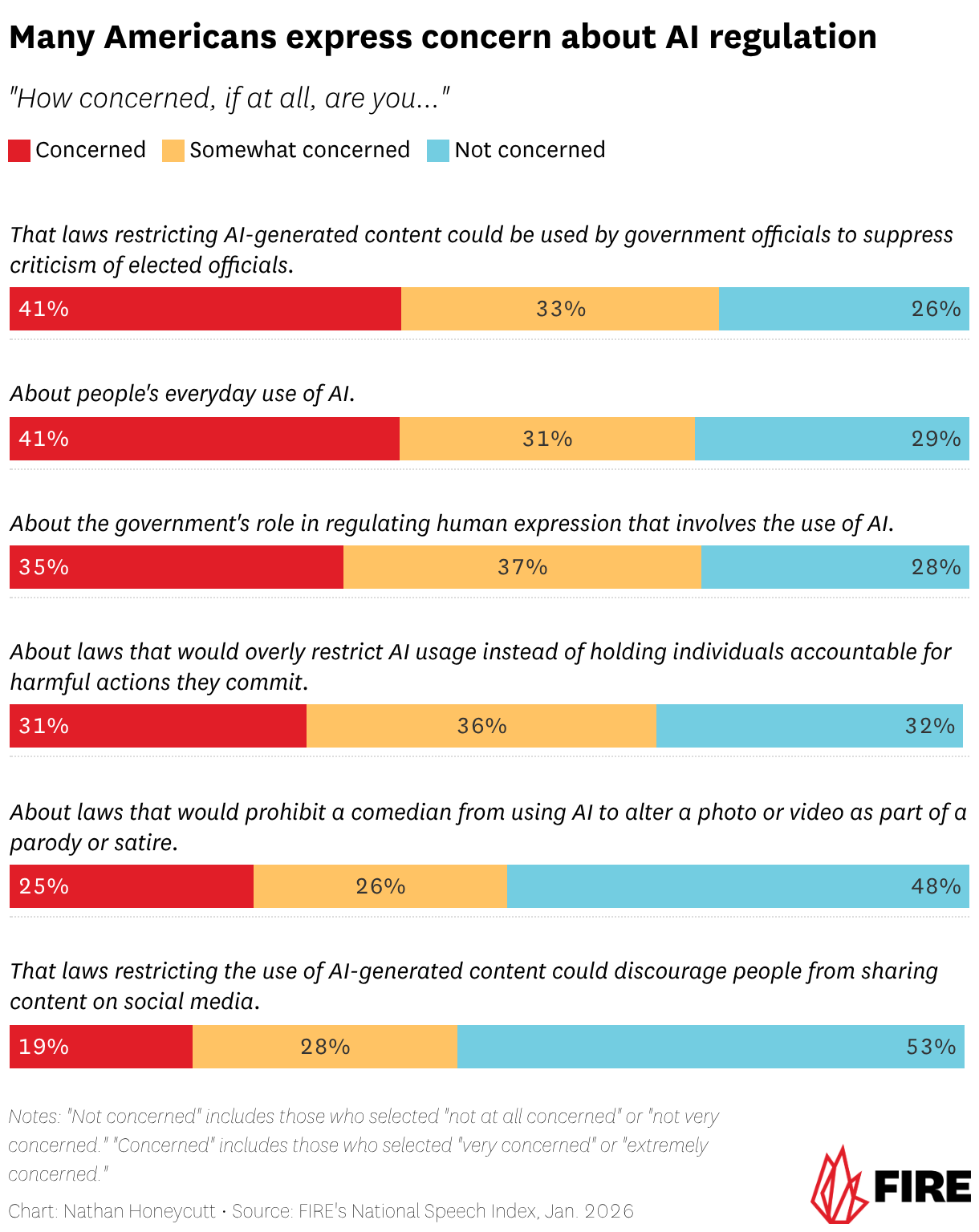
    The latest edition of the National Speech Index finds that most Americans are worried about the everyday use of AI, with 72% of Americans at least “somewhat” concerned, including 41% who are “very” or “extremely concerned.” But an identical percentage — 72% — is also at least somewhat concerned about the government regulating human-made expression that uses AI, with 35% “very” or “extremely” concerned.

    In total, a whopping 92% of Americans say it is at least somewhat important for governments to protect free speech when regulating AI, including 60% who say it is “very” or “extremely” important. Only 8% say it is “not very” or “not at all” important.

    “Our polling shows that Americans reject the false choice between regulating AI and protecting free speech,” said FIRE Chief Research Advisor Sean Stevens. “Legislators should follow their lead and regulate technology thoughtfully, without regulating away the rights of the people who use it.”

    The National Speech Index is a recurring national survey that tracks Americans’ views on free expression, censorship, and First Amendment rights. For the January 2026 edition of the NSI, FIRE asked for the first time several questions about artificial intelligence and how Americans are grappling with the First Amendment implications of regulating this emerging technology.

    Americans are most concerned about AI regulation when it could be used to criminalize criticism of government officials; 72% are concerned, and 41% “very” or “extremely” concerned that laws restricting AI-generated content could be used to suppress criticism of elected officials. By contrast, Americans are much less concerned about AI legislation’s possible effects on social media use, and nearly half (48%) are “not very” or “not at all” concerned about its effect on comedians’ ability to create parody.

    Many Americans express concern about AI regulation (Stacked Bars)

    Americans have good reason to be worried about AI regulation targeting criticism of elected officials. FIRE is currently tracking bills introduced in Texas, Alaska, Arkansas, Illinois, Maryland, Massachusetts, Mississippi, Missouri, Montana, Nebraska, New York, South Carolina, Vermont, and Virginia that would criminalize AI depictions of politicians in some form or another.

    “AI is an expressive tool, and the people who use it retain their First Amendment rights to share and seek information,” said FIRE legislative counsel John Coleman. “Like any technology, AI has its good and bad uses. But lawmakers must address genuine harms without writing laws that prevent Americans from criticizing those in power.”

    The January 2026 NSI also found that pessimism for the future of free speech has not budged from its historic high in the previous edition of the NSI in October 2025. 73% of respondents now say they believe the state of free speech is headed in the wrong direction, roughly in line with the 74% of Americans who said the same in October.

    The National Speech Index is a quarterly poll designed by FIRE and conducted by the Dartmouth Polarization Research Lab to capture Americans’ views on freedom of speech and the First Amendment, and to track how Americans’ views change over time. The January 2026 National Speech Index sampled 1,000 Americans and was conducted from Jan. 20 through 27. The survey’s margin of error is +/- 3%.


    The Foundation for Individual Rights and Expression (FIRE) is a nonpartisan, nonprofit organization dedicated to defending and sustaining the individual rights of all Americans to free speech and free thought — the most essential qualities of liberty. FIRE educates Americans about the importance of these inalienable rights, promotes a culture of respect for these rights, and provides the means to preserve them.

    The Polarization Research Lab (PRL) is a nonpartisan collaboration between faculty at Dartmouth College, Stanford University and the University of Pennsylvania. Its mission is to monitor and understand the causes and consequences of partisan animosity, support for democratic norm violations, and support for partisan violence in the American Public. With open and transparent data, it provides an objective assessment of the health of American democracy.

    CONTACT:

    Alex Griswold, Communications Campaign Manager, FIRE: 215-717-3473; [email protected]

    Source link

  • FIRE POLL: Americans overwhelmingly want free speech protected in AI regulation

    FIRE POLL: Americans overwhelmingly want free speech protected in AI regulation

    PHILADELPHIA, Feb. 10, 2026 — A new poll from the Foundation for Individual Rights and Expression finds that while Americans are apprehensive about the rise of artificial intelligence, they overwhelmingly believe that legislators should protect freedom of speech when crafting AI legislation and are concerned about laws being used to stifle criticism of government officials.

    The latest edition of the National Speech Index finds that most Americans are worried about the everyday use of AI, with 72% of Americans at least “somewhat” concerned, including 41% who are “very” or “extremely concerned.” But an identical percentage — 72% — is also at least somewhat concerned about the government regulating human-made expression that uses AI, with 35% “very” or “extremely” concerned.

    In total, a whopping 92% of Americans say it is at least somewhat important for governments to protect free speech when regulating AI, including 60% who say it is “very” or “extremely” important. Only 8% say it is “not very” or “not at all” important.

    “Our polling shows that Americans reject the false choice between regulating AI and protecting free speech,” said FIRE Chief Research Advisor Sean Stevens. “Legislators should follow their lead and regulate technology thoughtfully, without regulating away the rights of the people who use it.”

    The National Speech Index is a recurring national survey that tracks Americans’ views on free expression, censorship, and First Amendment rights. For the January 2026 edition of the NSI, FIRE asked for the first time several questions about artificial intelligence and how Americans are grappling with the First Amendment implications of regulating this emerging technology.

    Americans are most concerned about AI regulation when it could be used to criminalize criticism of government officials; 72% are concerned, and 41% “very” or “extremely” concerned that laws restricting AI-generated content could be used to suppress criticism of elected officials. By contrast, Americans are much less concerned about AI legislation’s possible effects on social media use, and nearly half (48%) are “not very” or “not at all” concerned about its effect on comedians’ ability to create parody.

    Many Americans express concern about AI regulation (Stacked Bars)

    Americans have good reason to be worried about AI regulation targeting criticism of elected officials. FIRE is currently tracking bills introduced in Texas, Alaska, Arkansas, Illinois, Maryland, Massachusetts, Mississippi, Missouri, Montana, Nebraska, New York, South Carolina, Vermont, and Virginia that would criminalize AI depictions of politicians in some form or another.

    “AI is an expressive tool, and the people who use it retain their First Amendment rights to share and seek information,” said FIRE legislative counsel John Coleman. “Like any technology, AI has its good and bad uses. But lawmakers must address genuine harms without writing laws that prevent Americans from criticizing those in power.”

    The January 2026 NSI also found that pessimism for the future of free speech has not budged from its historic high in the previous edition of the NSI in October 2025. 73% of respondents now say they believe the state of free speech is headed in the wrong direction, roughly in line with the 74% of Americans who said the same in October.

    The National Speech Index is a quarterly poll designed by FIRE and conducted by the Dartmouth Polarization Research Lab to capture Americans’ views on freedom of speech and the First Amendment, and to track how Americans’ views change over time. The January 2026 National Speech Index sampled 1,000 Americans and was conducted from Jan. 20 through 27. The survey’s margin of error is +/- 3%.


    The Foundation for Individual Rights and Expression (FIRE) is a nonpartisan, nonprofit organization dedicated to defending and sustaining the individual rights of all Americans to free speech and free thought — the most essential qualities of liberty. FIRE educates Americans about the importance of these inalienable rights, promotes a culture of respect for these rights, and provides the means to preserve them.

    The Polarization Research Lab (PRL) is a nonpartisan collaboration between faculty at Dartmouth College, Stanford University and the University of Pennsylvania. Its mission is to monitor and understand the causes and consequences of partisan animosity, support for democratic norm violations, and support for partisan violence in the American Public. With open and transparent data, it provides an objective assessment of the health of American democracy.

    CONTACT:

    Alex Griswold, Communications Campaign Manager, FIRE: 215-717-3473; [email protected]

    Source link

  • Conditions for Flourishing in Learning + Teaching

    Conditions for Flourishing in Learning + Teaching

    Dave sent me his notes from an evening event at our kids’ school about college preparation. Mind you, neither of our kids have entered high school yet. Things are certainly different from when I was preparing for college.

    Our son is helping me digitize the last huge lateral file cabinet of documents from my younger days. These files contain everything from class notes written in cursive from my undergraduate classes to printed papers with handwritten feedback from professors. I’m having all these flashbacks of particular professors and coursework and the ways I was shaped by all of these experiences.

    A single page with four short paragraphs, was mixed in with old brochures and catalogs. As soon as I noticed it wasn’t exactly five paragraphs, my mind flashed to John Warner’s *Why They Can’t Write: Killing the Five-Paragraph Essay and Other Necessities* and how proud he would have been that I hadn’t adopted the commonly-used structure. That said, I’m not sure this was my greatest piece of writing, or that John would have been proud of much else. It got the job done, however. The document was written during my senior year of high school and contained my college essay. I applied to a single university, the same university my parents had attended. I had visited a few times that year, since a friend who was a year ahead of me was enrolled.

    Contrasting the relative lack of effort put into my school selection process with what many young people go through today is wild. Given that the first college-related event has already commenced at our kids’ school, I figure that I probably am going to need to continue to adjust my thinking and understanding of what it looks like today to pursue higher education.

    Friends who have children older than ours have vividly described how stressful the process can be of walking alongside young people during the college application process. I also understand that today’s supposed measures of quality don’t hold up very well to scrutiny. Prestige and selectivity may dominate the conversation, but I’m increasingly drawn to questions about belonging, mentorship, and growth.

    Brennan Barnard has advice regarding The Question Every College Applicant Should Ask. As a college counselor, he chronicles his visits to ten college campuses over six months and is most interested in the answer to a key question:

    How easy is it for a student to be known here? You can see that in class sizes, advising structures, and whether students can quickly name an adult who’s made a difference in their experience.

    The more I sit with that question, the more it feels like a proxy for something deeper: whether an institution creates the conditions for students to flourish. I finished reading Flower Darby’s latest book last night, in preparation for an upcoming interview with her. In The Joyful Online Teacher: Finding Our Fizz in Asynchronous Classes, Flower quotes Denise Maduli-Williams from San Diego Miramar College, who describes the unique opportunities she has in her online classes to build relationships with students. Denise shares:

    I feel like I know my online students better than my in-person students. I have more interactions with them, they get to know more about me through the types of activities we do, and I’m able to individualize content, links, and resources for differ­ent students’ needs.

    That sentiment resonated with me, as I considered how many more students’ dog names I know, when they take online classes with me. I find fewer students have cats, but one last semester had a guinea pig (who sadly passed away during our semester together). I also know where they work, what music they’re into, and the nervousness they feel about their upcoming job interview. Those kinds of interactions aren’t incidental. They’re structural. They create the conditions in which students can take risks, feel supported, and grow.

    My role as an educator is centered on knowing students, as well as helping them feel like they matter. As a parent, I’m going to make sure to ask how easy it is for a student to be known at the various places we might explore. On my reading list will be Jeff Selingo’s Dream School: Finding the College That’s Right for You, or at the very least, I’ll explore whether it might be a good resource for our kids. My goal will be to not get overly swept up in other factors that turn out to be poor proxies for what truly matters: whether a place cultivates the conditions for students to thrive.

    Source link

  • Higher ed is making change happen quickly. #shorts

    Higher ed is making change happen quickly. #shorts

    Higher ed is making change happen quickly. #shorts

    Source link

  • Change fatigue in higher ed is a systemic issue. #shorts

    Change fatigue in higher ed is a systemic issue. #shorts

    Change fatigue in higher ed is a systemic issue. #shorts

    Source link

  • How can you support fatigued employees in higher ed? #shorts

    How can you support fatigued employees in higher ed? #shorts

    How can you support fatigued employees in higher ed? #shorts

    Source link

  • We have a responsibility to support fatigued employees #shorts

    We have a responsibility to support fatigued employees #shorts

    We have a responsibility to support fatigued employees #shorts

    Source link

  • Strategic Governance: The Infrastructure for University Growth

    Strategic Governance: The Infrastructure for University Growth

    Growth Is a Governance Challenge

    Picture this: Your university launches an ambitious growth strategy that includes new programs, bold enrollment targets, and a brand refresh for online programs. The marketing team hits its lead goals. Admissions teams work overtime to reach new yield levels. But then … faculty scramble to staff courses, advising and registration queues explode, and new student satisfaction sours. The strategy was sound. The execution was great — until it wasn’t. 

    What failed? Was it communication, culture, or resourcing? No, it was the absence of strategic governance.

    In a prior article, I argue that presidents and provosts must establish formal cross-functional structures with real authority to align leaders around a unified enrollment vision, coordinate strategies, and embed shared accountability metrics across the student life cycle. 

    This article goes deeper. Here, we make the case that strategic growth at the institutional level is fundamentally a governance challenge. Without intentional governance infrastructure and practice, ambitious growth strategies may fail to reach their full potential. In this article, we outline:

    • Why strategic governance matters
    • How universities can design governance infrastructure to enable sustainable growth and cultivate a governance culture that supports execution
    • Common governance pitfalls to avoid

    Why Strategic Governance Matters

    Decentralized universities can enable pockets of innovation and growth for a time. But today’s crowded and complex market demands an institutional strategy and approach. Enrollment growth, modality expansion, student success initiatives, and new credential portfolios all require coordinated decisions across multiple academic and administrative units with different incentives, budgets, and governance traditions.

    Strategic governance provides the connective tissue that turns institutional ambition into coordinated action. 

    Strategic governance addresses these challenges by creating decision rights, accountability structures, and coordination mechanisms that align academic and administrative units around institutional growth priorities.

    Defining Strategic Governance in Higher Education

    Strategic governance isn’t simply about creating more committees. It’s a system of structures, processes, roles, and norms that enable the institution to make coordinated, timely, and data-informed decisions in service of strategic goals.

    In the context of institutional growth, strategic governance answers three questions:

    • Who decides? — Decision rights and authority
    • How do they decide? — Processes, data, and cadence
    • How are decisions evaluated and execution tracked? — Accountability, incentives, and performance management

    Effective strategic governance balances autonomy with coordination, enabling institution-wide alignment on growth priorities.

    Designing Strategic Governance Infrastructure

    Developing governance infrastructure requires intentional design. But infrastructure alone is insufficient. Strategic governance succeeds when design meets shared accountability and collaborative decision-making. Below are key components universities should consider to capture both a successful infrastructure and a culture of effective governance.

    1. Executive-Level Growth Governance Bodies

    Universities should establish a cabinet-level body responsible for growth strategy. This cabinet is chaired by the provost or president and includes academic deans, enrollment leadership, and leaders from central services and planning, student affairs, and technology. 

    Executive leaders should incorporate enrollment growth and student success metrics into leadership evaluations for deans and vice presidents. Shared metrics reinforce that growth is the responsibility of the institution, not a mandate from the central office.

    Key responsibilities include:

    • Setting context-informed enrollment and program growth targets by academic unit
    • Approving portfolio strategy (programs, credentials, modalities) to ensure support and avoid duplication
    • Aligning resource planning (instructional delivery hiring, course scheduling, incremental infrastructure growth)
    • Monitoring performance and intervening as needed

    This body must have clear authority to allocate resources, set priorities, and escalate decisions to the president or board when necessary.

    Academic leaders often lack training in enterprise governance. Professional development, as needed, should cover:

    • Understanding data-driven decision-making
    • Using the RACI (responsible, accountable, consulted, informed) matrix and decision rights
    • Developing financial modeling and margin analysis skills
    • Developing change management and stakeholder alignment skills

    2. Integrated Enrollment and Student Success Council

    The integrated council should sit just below the executive cabinet and bring together admissions, marketing, financial aid, registration, advising, career services, and academic scheduling teams. Appointing cross-functional roles such as vice provost for enrollment strategy or chief student success officer signals institutional commitment to integration. These leaders should have dotted-line authority across academic and administrative units.

    The council ensures:

    • Funnel metrics remain apples-to-apples and continuously improve
    • Course and advising capacity align with enrollment plans
    • Student success interventions are coordinated across academic and student support units

    3. Program Portfolio Governance

    Growth often comes through new programs, stackable credentials, and alternative modalities. Universities need a framework that evaluates proposals based on:

    • Market demand and competitive positioning
    • Financial viability and margin contribution
    • Academic capacity and faculty workload
    • Strategic alignment with institutional mission

    This framework should also include postlaunch performance reviews to prevent portfolio sprawl and underperforming programs. Budget models can reward units that contribute to institutional growth (e.g., revenue sharing for online programs, investment funds for cross-school initiatives). Incentives should discourage siloed behavior that undermines growth.

    4. Data and Analytics Infrastructure

    Governance without data is performative. Institutions must invest in analytics platforms that integrate data from customer relationship management (CRM) systems, student information systems (SISs), learning management systems (LMSs), and finance and human resources (HR) records into executive dashboards or reports.

    Effective governance dashboards:

    • Track demand, conversion, yield, retention, and completion
    • Forecast capacity constraints (faculty, sections, advising)
    • Highlight variance from targets, with clear escalation triggers

    Data literacy training for academic and administrative leaders is essential to ensure that dashboards drive decision-making, not just reporting.

    5. Decision Cadence and Escalation Pathways

    Strategic governance requires regular review. Institutions should define which items require monthly, term-level, or annual review. Escalation pathways should specify when issues move from operational councils to executive governance bodies and ultimately to the president or board.

    Regular governance updates to faculty senates, staff councils, and boards build trust and transparency and reduce perceptions of administrative overreach.

    Common Governance Pitfalls and How to Avoid Them

    Even well-designed governance structures can fail if common implementation traps aren’t addressed. Executive leaders can underestimate how organizational dynamics, incentives, and authority structures can undermine strategic governance effectiveness. Below are some pitfalls for institutions to anticipate and avoid.

    Pitfall 1: The Appearance of Governance Without Authority

    Creating committees without decision rights leads to frustration and inaction. Charters should explicitly define authority, scope, and escalation mechanisms.

    Pitfall 2: Coordination Scope Creep That Undermines Academic Autonomy

    Strategic governance should coordinate, but not dictate, pedagogy and activities that impact instructional capacity. Academic units must retain ownership of curriculum, research agendas, and faculty governance.

    Pitfall 3: Data Without Action

    Dashboards that don’t trigger decisions or resource shifts become noise in the system. Governance bodies must commit to acting on data, even when decisions are politically challenging.

    Pitfall 4: Misaligned Budget Models

    If academic units bear the instructional costs of growth without sharing in the revenue upside, resistance is to be expected. Budget models must align financial incentives with institutional goals.

    Pitfall 5: Change Fatigue and Cultural Resistance

    Governance redesign can overwhelm institutions. Leaders should sequence changes, pilot governance structures, and celebrate early wins to build momentum.

    The President and Provost as Chief Governance Architects

    Higher education leaders increasingly recognize that enrollment growth and student success are institutional imperatives that cut across academic units, student services, finance, technology, and governance.

    Strategic governance isn’t bureaucratic overhead. It’s the operating system for institutional growth. By intentionally designing governance structures, cultivating a collaborative culture, and avoiding common pitfalls, higher education leaders can transform growth from episodic campaigns into sustainable institutional capability.

    Ultimately, strategic governance is a leadership responsibility. Presidents and provosts must act as chief governance architects, designing structures that enable coordinated execution while preserving institutional values. This requires political capital, clarity of vision, and sustained attention. The alternatives are fragmented growth, reactive operations, and eroding student experience, which proves far more costly over time.

    Build the Governance Infrastructure That Turns Growth Strategy Into Results

    Strategic growth works best when teams are aligned, decisions are clear, and everyone is moving toward the same goal. Archer Education helps institutions build the governance structures that make that alignment possible — without adding unnecessary complexity.

    As a trusted growth enablement partner, we work alongside leaders to connect strategy, enrollment, and student experience in practical, sustainable ways. If you’re ready to turn growth plans into coordinated action, let’s talk about what’s possible together.

    Source link