It is no secret that Artificial Intelligence (AI) technology is transforming college classrooms. AI tools can easily and quickly assist students in various tasks such as essay writing, literature reviews, analyzing data, formulating code, solving equations, image generation, music composition, and so much more. With minimal or no effort, within minutes, students have most assignments, test questions, or discussion problems figured out and done…enter the chaos!
As educators, this means everything that we experienced in our own education and have worked years to develop is changing. We need to rethink our role, assignments, as well as formative and summative assessments of student learning all while AI capabilities change daily.
Through all this, we feel educators can take one concrete step to control the chaos by Communicating How AI Operates in the Syllabus (C.H.A.O.S). This article highlights the significance of AI usage policies and what elements should be considered in the policy. It also provides a few useful tips to implement AI policies.
Is there a need to specify the AI usage policy in the class syllabus?
Including an AI usage policy offers clarity to students regarding acceptable usage of AI tools. Although educators are making attempts to develop campus-wide consensus about AI tools, different sections of the same course may have different AI usage policies and practices depending on the instructor and their comfort level. When an explicit AI usage policy is stated in the syllabus, students (and faculty members) can be held accountable for upholding that policy. Any incidents of inappropriate AI usage or cheating can be dealt with within the framework of the policy mentioned.
What are the elements of an AI policy?
A clear AI usage policy needs to have at least three elements – acceptable use, citations necessary, and consequences of non-adherence to the policy. The first element, a well-formulated AI usage policy, specifies acceptable AI usage in learning processes, e.g. brainstorming and creating outlines. In the policy, it is beneficial to provide examples of unacceptable usage, e.g. using whole paragraphs of AI text or writing the whole essay. To develop the acceptable use portion, faculty need to take time and honestly reflect on how they see AI tools being integrated into classroom learning, career fields, and life in general. This can range from absolutely no AI usage to intentional integration of the tools in the classroom space. Your level of familiarity, acceptance of, and perceived value in AI will help shape what is allowed.
The second element is to determine how AI usage needs to be acknowledged and cited appropriately. Again, it is helpful to provide a sample citation as students may be unfamiliar with the norms of citations while taking initial undergraduate courses.
Furthermore, AI tools often include biases, inaccuracies, or sometimes hallucinations. Humans using AI tools, in this case students, need to be aware of these shortcomings and understand that even with proper citations they will be held accountable for not reviewing and verifying the accuracy of their work before submitting. So, the citation element in the syllabus must explain that the ultimate responsibility of academic rigor for the assignment submitted lies with the student.
The last element should outline information about how the instructor will deal with non-adherence to the policy. As an instructor, will you provide a chance for students to resubmit the work? Will the usage result in a loss of points, a zero for the assignment, or a failing grade in the course? How will AI usage be checked? How will you communicate it to students? What is the process and who is involved? These are a few questions that can help an educator shape their usage policy.
Implementing AI usage policy
A few additional steps can be taken when implementing an AI usage policy to make the process smoother. Given the varied nature of AI use policy in various courses, it would be helpful to have a classroom discussion early on (day 1) and throughout the semester with each assignment and exam. Researchers have suggested using a stoplight framework e.g., Red – No AI is allowed in this course; Green – AI tools are allowed and encouraged; and Yellow- AI is permitted for following activities only (Urbaczewski, 2025).
Regularly talking about AI usage may remove some of the pressure from students who want to express themselves through their essays or art and feel seen/heard but may be afraid that their grades will be poorer if they don’t use AI tools. Sharing stories of how past students have effectively, or ineffectively, utilized AI in their work can be helpful in mitigating inappropriate usage.
Another possible step is to introduce scaffolding in high stakes summative assignments such as end of the semester projects. Instead of a one-time submission worth 100 points, students could submit intermediate steps and include the prompts they may have used to get a response from AI tools such as ChatGPT or Perplexity. Some instructors may offer extra credit for such intermediate steps.
Unlike grading or attendance policies in the syllabus, AI usage policies will be dynamic. As AI technology advances, the definition of academic integrity may need to be revisited. Faculty members may need to revise this policy each semester and update it to ensure that students are meeting learning outcomes. As the educational landscape continues to evolve, remember you can get a handle on the chaos by introducing C.H.A.O.S to keep your syllabi in alignment with the current times.
AI Disclosure: AI tools such as Editor in MS Word were used for checking grammar and spelling. No AI tools were used for brainstorming or writing this article.
Simantini Karve, PhD, is a professor of biology and professional development co-coordinator at Skyline College, San Bruno, CA.
Jessica Hurless was a professor of Communication Studies and currently serves as the Dean STEM division at Skyline College, San Bruno, CA.
Reference
Urbaczewski, Andrew, “Developing a syllabus for is course usage in the ai era” (2025). Proceedings of 2024 AIS SIGED International Conference on Information Systems Education and Research. 16. https://aisel.aisnet.org/siged2024/16
WSU chancellor Jennifer Westacott. Picture: Newswire
Universities should offer shorter, cheaper and more accessible courses that recognise prior learning to help boost Australia’s productivity, Canberra’s economic roundtable has agreed.
Please login below to view content or subscribe now.
A new report has found that clerical and administrative workers, telemarketers, salespeople, receptionists and programmers are the most likely to face work changes caused by generative artificial intelligence (gen AI).
Please login below to view content or subscribe now.
Deputy vice-chancellor of cooperation and innovation at Sweden’s Halmstad University Kristian Widen explained how market forces like IKEA changed the country’s higher education system.
Please login below to view content or subscribe now.
As budget cuts continue to ripple across the education sector, many institutions are being forced to reassess how they manage their workforce. From widespread restructures to heavier workloads, staff are feeling the strain.
These pressures are compounding existing workforce challenges. Human resource (HR) and payroll teams are navigating complex employment arrangements, evolving compliance requirements, and increasing scrutiny around underpayment.
Without the right systems in place, even minor errors can have significant consequences.
The limitations of outdated systems
For many universities and TAFEs, HR and payroll systems haven’t kept pace with the realities of modern education. What may have once worked for a more stable, less fragmented workforce is now creating unnecessary complexity.
When systems aren’t integrated, data is difficult to reconcile and even harder to act on. Payroll teams are left cross-checking spreadsheets, while HR teams struggle to track performance, training, and entitlements across multiple roles and contracts.
Manual processes create more room for error, and a lack of visibility makes it harder to ensure compliance. According to McKinsey, automating finance processes can free up 30 to 40 per cent of a team’s capacity.
Disparate platforms also limit the experience for staff. Employees struggle to access their information, update details, or understand how their workload impacts their pay and entitlements. In a climate where staff are already stretched, that lack of clarity can further impact morale and retention.
A smarter approach to HR and payroll
Education providers are turning to integrated enterprise resource planning (ERP) software to automate tasks like timesheet management, onboarding, and performance tracking, thereby freeing up teams to focus on more strategic work.
While workforce challenges persist across the sector, some institutions are proving that the right technology can deliver meaningful change.
Instead of relying on fragmented systems, organisations like GOTAFE and Victoria University have shown how ERP software, like TechnologyOne’s, can play a critical role in improving payroll accuracy, streamlining HR tasks, and boosting overall efficiency and decision-making.
These are just two recent TechnologyOne success stories among many, but their experiences reflect a broader shift happening across the sector. More institutions are recognising the value of embracing ERP software that can grow with them.
How GOTAFE transformed payroll and people management
By moving to our Human Resources & Payroll product, GOTAFE was able to unify its systems and reduce its reliance on manual processes. Staff could manage leave and payslips through self-service tools, while HR teams gained real-time insights into workforce activity and performance.
The improvements were significant. Contract generation dropped from four days to five minutes. Workforce reports that once took weeks could now be produced in two days. These changes helped the organisation make faster, more informed decisions and improve the employee experience.
Importantly, the shift was also cultural. GOTAFE moved away from customising the platform to match legacy processes, instead adopting standard functionality to unlock ongoing improvements.
The result is a more agile, data-driven workforce environment that supports both staff needs and strategic planning.
Victoria University recently completed a major digital transformation, replacing legacy platforms with a single enterprise solution with TechnologyOne’s OneEducation. While the project was initially focused on improving the student experience, the impact on staff productivity, reporting, and decision-making has been just as significant.
Before the shift, the university was operating across a patchwork of disconnected systems. Frequent outages and manual workarounds meant that staff were spending more time managing technology than using it effectively. Reporting was cumbersome, making it difficult to generate insights or respond to changes with confidence.
By unifying core systems across student management, finance, and scheduling, Victoria University has created a more connected environment for both staff and students. Manual tasks have been replaced with automated workflows. Reporting is no longer a reactive process but an embedded part of everyday decision-making.
Overall, the university fixed nearly 180 pain points. The result is a more agile workforce environment where time is spent on higher-value work and institutional knowledge is easier to share and act on.
You can find out more about Victoria University’s transformation here.
Embrace the future of education software
From shifting compliance requirements to the increasing complexity of workforce management, legacy systems are no longer equipped to support long-term success.
Modern enterprise platforms are changing that. In an environment where every hour counts, the ability to streamline tasks and remove administrative roadblocks makes a real difference.
The next generation of education software is already here. Institutions that embrace it will be better positioned to support their people, respond to challenges, and plan with confidence.
Invest in TechnologyOne’s Human Resources & Payroll today
Designed for the unique needs of higher education, it streamlines recruitment, onboarding, and workforce planning, helping institutions manage staff efficiently while ensuring compliance.
Adapt, evolve, and stay ahead with a solution built for the future of education.
From the start, Na’Siah Martin and H’Sanii Blankenship’s July trip to Washington, D.C., was destined to be a riveting stop on the teenagers’ passage to adulthood. There were the scheduled meetings with lawmakers, the monuments, the reflecting pool near where Martin Luther King Jr. broadcast his dream for racial equality 62 summers ago.
For years, the pair have been involved in the Boys and Girls Clubs of the Austin Area, the revered summer and after-school program that was now making it possible for the two blossoming leaders to meet with Texans in Congress and present their game plan for tackling mental health challenges among student-athletes, a struggle both were deeply familiar with.
But two weeks before their arrival on Capitol Hill, President Donald Trump’s administration threw one of many curveballs lobbed during the first months of his second term. The U.S. Department of Education notified state education officials on the last day of June that it would pause the disbursement of nearly $7 billion in funds for teacher development, support for students learning English, and before- and after-school programs predominantly serving low-income families, pending a review of how schools had put the money to use. That notice went out a day before states expected to begin receiving the money.
For Texas, it meant a potential loss of nearly $670 million. For Martin and Blankenship, it potentially meant losing the Boys and Girls Club, a space that has aided their growth as both leaders and individuals. Martin, 18, graduated from Navarro Early College High School in June and has participated in the club since elementary school. Blankenship, a 17-year-old incoming senior at the same school, has participated in the club for about as long as Martin.
The focus of their trip immediately broadened: They now wanted to convince federal lawmakers that cutting the funds would harm Texas kids.
“These programs aren’t just for fun,” Blankenship said. “They actually give us resources, help us grow into adults instead of just coming here and just goofing around and stuff like that. These programs, they help us cope with things we need to cope with.”
The education funding freeze was typical of the Trump administration. In recent months, it has also cut billions of dollars in food assistance and health care for families in poverty; frozenbillions in grants and contracts financially supporting universities; canceled billions for foreign aid and public broadcasting stations; laid off thousands of employees working in critical federal agencies; and sought to overhaul the U.S. immigration landscape through actions like attempting to end birthright citizenship.
Those cuts and changes have often been sweeping and abrupt, disrupting federally funded services and programs serving large swaths of people of color, people with disabilities, low-income families, LGBTQ+ Americans and immigrants. And they have come at the same time the administration has moved to lower taxes for some of America’s wealthiest households.
“We can’t look at just the cuts to education in isolation,” said Weadé James, senior director of K-12 education policy at the Center for American Progress. “I think what we’re witnessing is really the undoing of a lot of progress, and also actions that are really going to keep a lot of families trapped in cyclical and generational poverty.”
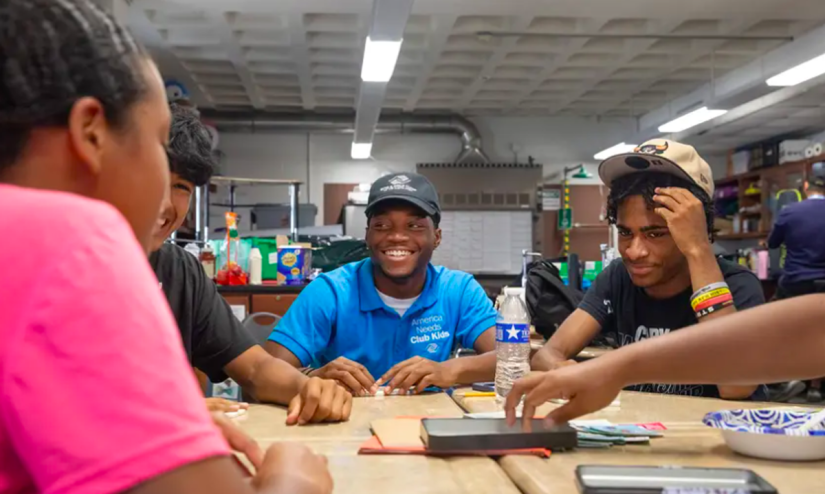
Boys and Girls Club director Jacob Hernandez watches club members play spades at Navarro Early College High School. Credit: Montinique Monroe for The Texas Tribune
Ongoing changes to the country’s educational landscape are only one part of Trump’s larger goals to eliminate what the second-term president has deemed “wasteful” spending and crack down on anything he views as diversity, equity and inclusion initiatives. A large piece of his efforts involve closing the Department of Education and sending “education back to the states,” though most decisions about education and public school funding already happen at the state and local levels.
“Teachers will be unshackled from burdensome regulations and paperwork, empowering them to get back to teaching basic subjects. Taxpayers will no longer be burdened with tens of billions of dollars of waste on progressive social experiments and obsolete programs,” Trump Secretary of Education Linda McMahon said in a statement earlier this year. “K-12 and college students will be relieved of the drudgery caused by administrative burdens—and positioned to achieve success in a future career they love.”
The disarray has resulted in profound consequences for Texas, one of the largest and most diverse states in the nation, home to more than 9,000 school campuses and 5.5 million students — the majority of whom live in low-income households and come from Hispanic and Black families. Public schools serve as a safety net for many of them. They are one of the few places where some children have consistent access to meals, where working-class parents know their kids will be taken care of.
The prospect of federal cuts to school programs triggered a wave of concern across the state. For 44-year-old Clarissa Mendez, it jeopardized the after-school program her two daughters attend while she works as a nurse in Laredo.
“I’m on shaky grounds right now because I don’t know what I’m going to do,” Mendez said last month. “I understand there has to be cuts. I understand the government needs to find out how to save money. But why does it have to affect us and our kids?”
For Gay Hibbitts, a 57-year-old trying to become a certified teacher in rural Throckmorton, the worries began months earlier.
Earlier this year, the federal government cut roughly $400 million from a program that helps teaching candidates like her pay for their education as they gain hands-on classroom experience. That left participating rural districts with one of two options: cover the costs at a time when schools are financially struggling to make ends meet, or get rid of their preparation programs during a teacher shortage.
In both scenarios, Hibbitts said, children would pay the price.
“They’re the main ones that are going to suffer,” she said.
For as long as Martin and Blankenship can remember, they have each helped raise their younger siblings, a responsibility that has been rewarding but stressful. On the one hand, Martin said, her siblings look up to her, and her academic success has motivated them to do well in school. On the other hand, Blankenship said, taking on adult responsibilities at an early age meant missing out on the type of exhilarating childhood experiences many kids desire.
Since joining the Boys and Girls Club, the program has provided them the space to be kids.
They receive tutoring and time to finish homework. They go to live sporting events, watch movies and listen to music — SZA some days, Lauryn Hill on others. They play sports, cards and board games. They can earn scholarships. They find mentorship.
“We’re the future adults, so I feel like if you help us now with programs like this, that make us happy, that give us stress relief, that let us be kids, because we can’t be kids at home, I feel like that’ll equate to happier adults,” Martin said.
Na’Siah Martin, left, and H’Sanii Blankenship traveled to Washington, D.C., in July and had a chance to discuss with lawmakers the Trump administration’s pause on roughly $7 billion in federal funding, which threatened to shutter the Boys and Girls Club. Credit: Montinique Monroe for The Texas Tribune
Neither Martin nor Blankenship enjoys public speaking. Martin actually fears it. But with the Austin Boys and Girls Club’s future in jeopardy, they decided to lean into the discomfort and use the face time with lawmakers and their staffers to make a case for the after-school program.
The pair and several other clubmates sat down with the staff of Texas Republican Sens. John Cornyn and Ted Cruz. They also met with Rep. Greg Casar, an Austin Democrat. The kids wore blue polo shirts with the words “America Needs Club Kids” etched in white. Martin, rocking a black one-button blazer, led the way.
“I gotta let these people know,” she thought.
Erica Peña is responsible for taking care of about 400 kids as she coordinates Hebbronville Elementary’s summer and after-school programs. Working with an assistant and about 25 paid volunteers, the 37-year-old often stays after hours — sometimes as late as 7 p.m. — depending on when parents can leave work to get there.
Peña breaks the after-school schedule into blocks. The first hour is for tutorials and worksheets, the later hours are usually for more fun activities like arts and crafts, kickball and cooking.
But shortly after the federal education funds were paused, the district notified Peña that it could no longer afford to keep her or the program.
“I cried, to be honest,” Peña said. “I was very upset, because I love my job, I love my students, and a lot of it is about them.”
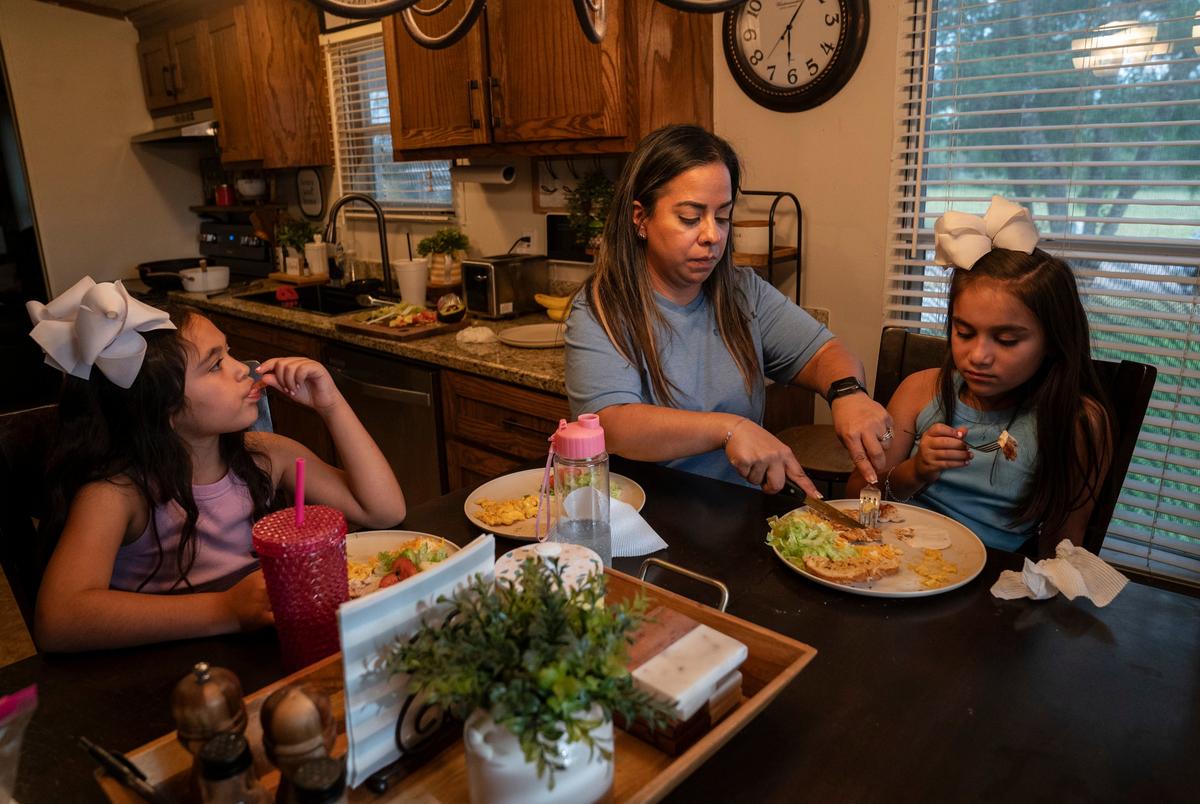
Clarissa Mendez and her daughters Catiana Ester Mendez, left, and Catalaya Avaneh Mendez pose for a photo at their home in Hebbronville on July 30, 2025. Credit: Gabriel V. Cárdenas for The Texas Tribune
Hebbronville, in far South Texas, is home to about 4,300 mostly Hispanic Texans, one-third of whom live below the poverty line. The town has no H-E-B or Walmart. The local health clinic is often busy. The town has a few day care centers, but they can get pricey.
For the average Texas family, child care is financially out of reach. The median annual cost sits at $10,706 a year — or $892 each month. That’s more than one-fourth of the average cost for in-state tuition at a four-year public college, according to the Economic Policy Institute. Access to no-cost options, like the Hebbronville after-school program, has positive effects on student attendance, behavior and learning, multiplestudies have found over the years. Such programs also keep families from having to choose between leaving their children unattended or taking time off work to stay home.
“That has a direct impact on future economic prospects for that entire family,” said Jenna Courtney, CEO of the Texas Partnership for Out of School Time, a youth advocacy organization.
Mendez, the 44-year-old Hebbronville mother with two daughters, commutes about an hour to and from Laredo every weekday to make it to her job as a nurse. She goes in at 9 a.m. and gets out at 5 p.m. Her husband operates heavy equipment and has an unpredictable work schedule.
After picking up her daughters, Mendez cooks for them and spends some time with them before she starts working from home for an additional three to four hours. The after-school program Mendez’s daughters attend allows her to save some money on daycare costs. Credit: Gabriel V. Cárdenas for The Texas Tribune
The after-school program “gives me enough time to get to town to pick them up,” she said. But with the district planning to shutter operations, Mendez needed to find care providers who could look after her children until 6-6:30 p.m., when she gets home. She pays about $1,000 a month for that service during the summer when the school program is out of session. It would likely cost her another $800 per month during the academic year.
“That’s a big chunk of our money,” Mendez said.
Without the program, she would need to find a second job.
“We’ll do what we gotta do,” she added. “But I don’t understand.”
Catalaya Avaneh Mendez plays with her sister Catiana Ester Mendez as their mother watches them at her home. The Trump administration recently froze funding that benefits after-school programs, placing financial stress on parents such as the Mendez. They would have to find and pay for daycare for their children if those programs ended. Credit: Gabriel V. Cárdenas for The Texas Tribune
Hibbitts, the 57-year-old from Throckmorton, recently joined a federally funded program that would allow her to support students in her rural hometown between Abilene and Wichita Falls. It places aspiring full-time teachers in classrooms under the supervision of more seasoned teachers and provides financial assistance for their education and living expenses.
In exchange, the district gets to retain educators familiar with the community and eager to teach.
Based on her own experience as a Throckmorton student in the 1970s, Hibbitts knows the monumental role teachers can play in a child’s life.
“They were almost like your second mother,” she said.
Texas has the largest rural population of any state in the country. Of its roughly 5.5 million students, 13% attend class on a rural campus. Those schools often have to educate their students with less: Less access to the internet and technology, less staffing, and less money to pay and retain teachers.
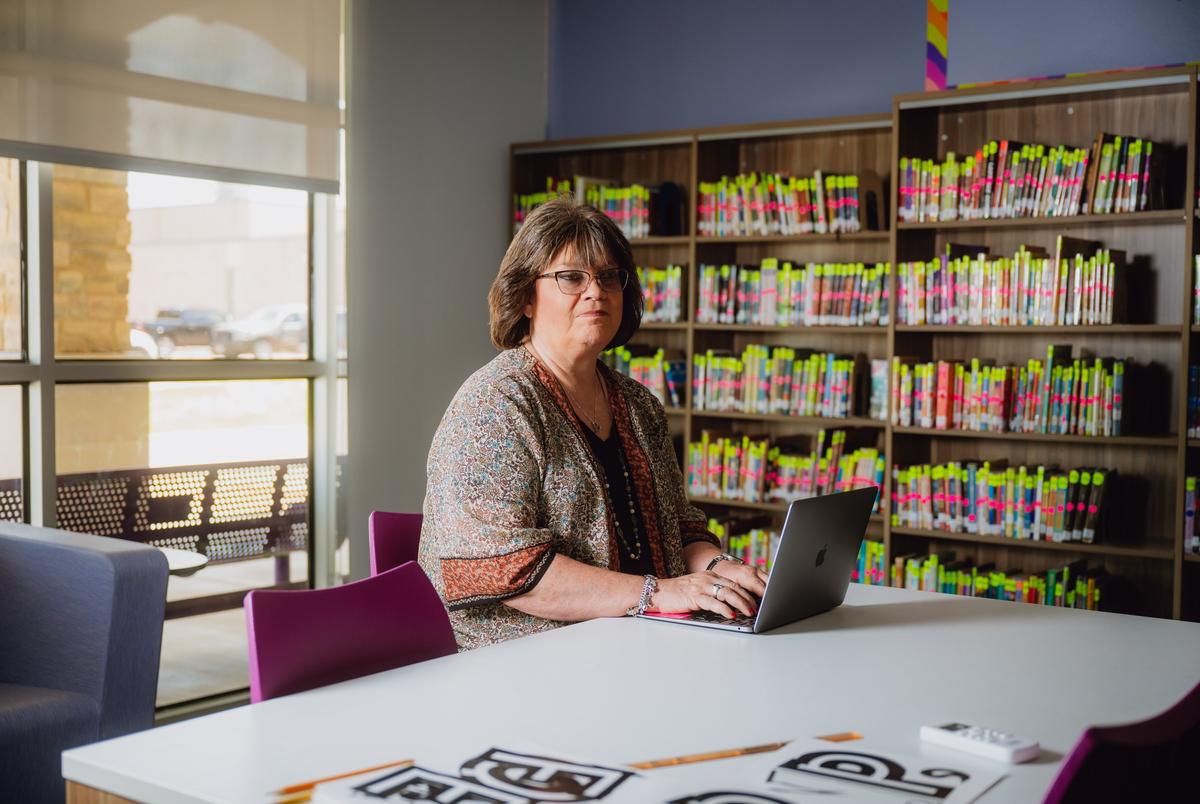
Educator Gay Hibbitts, left, speaks with her mentor, Amy Dick, a secondary social studies teacher, inside a classroom at Throckmorton Collegiate ISD on July 29, 2025. Hibbitts was part of a federally funded educator preparation program serving about 30 participants across 11 rural Texas districts. Credit: Desiree Rios for The Texas Tribune
Texas lawmakers have acknowledged that rural teachers often do not make as much as their urban and suburban counterparts, and that many have left the profession because of a lack of support. Public schools over time have also grown more reliant on hiring unlicensed educators, a trend playing out more profoundly in the rural parts of Texas.
In response, state officials recently passed laws aimed at raising teacher pay, particularly in rural schools, and enhancing teacher preparation programs.
During her first year in the Throckmorton program, Hibbitts learned how to incorporate state learning standards into lesson plans. She learned how to keep students engaged. She helped a child who struggled academically and acted out at the beginning of the school year become a “model student” who thrived in reading by the year’s end.
Then, one Sunday afternoon in April, her superintendent called her.
The Trump administration had abruptly cut the federal dollars that helped schools fund educator preparation initiatives like the one she was participating in. It would affect about 30 people across 11 rural districts in Texas.
Hibbitts was one of them.
Hibbitts participates in a safety training at Throckmorton Collegiate ISD. The funding for Hibbitts’ educator preparation program, which covered her two years of college and training costs, was cut on April 25 under the Trump administration, leaving her uncertain about her future. Credit: Desiree Rios for The Texas Tribune
In Hebbronville, Mendez and Peña each had to confront their own harsh realities. Mendez would have to search for child care in a community with few affordable options. Peña, the after-school program coordinator, would have to find a new job.
In Austin, Martin and Blankenship had trouble picturing life without the Boys and Girls Club.
Club leaders began preparing a memo to notify parents about the funding uncertainty and what it could mean for their kids. Nothing had come of the Republican, Democratic and legal efforts seeking the release of the frozen funds. The Texas kids who spoke with congressional lawmakers and staff at the U.S. Capitol hadn’t heard anything either. When the administration would make a decision about the funds was anyone’s guess.
When Blankenship got the news, he sprinted out of his room in excitement and told his mom. The moment was just as surreal for Martin.
“Knowing that it could have been me, my story, or any other club kids’ story,” Martin said, “it made me happy. But it was like, ‘Dang. I was a part — we were a part of that.’”
Peña, the Hebbronville Elementary program coordinator, was relieved. The mood in her group chat with people from the district’s after-school programs was “pretty ecstatic.” They all cried. Getting the funds meant they no longer had to look for new jobs, and parents like Mendez wouldn’t have to go searching for a place to take care of their kids after school.
Hibbitts is pursuing a bachelor’s degree in general studies with an emphasis in education and a minor in psychology at West Texas A&M. Credit: Desiree Rios for The Texas Tribune
Hibbitts, meanwhile, wasn’t immediately able to bask in the good news, as it did not restore the federal funds for her district’s teacher preparation program. But in early August, her supervisor notified her that the program was officially back up and running for the 2025-26 school year. The news cleared the way for the 57-year-old to graduate at the end of the year and to start teaching full time by the next.
“This has been life changing for somebody of my age, to be able to step up and to step into the world of education,” Hibbitts said. “I’m finishing my dream. And as my kids like to say, ‘Mom, you’re going to be 58 years old walking the stage.’”
Still, she recognizes that so much uncertainty around federal funding means there is no guarantee others will get the same chance.
Uncertainty is what Peña also keeps coming back to.
“It just gets me upset with the administration, because, why? What was the purpose of the freeze? Why did you do that? You’re hurting people, not just adults, but children,” Peña said. “It’s like in a divorce, you don’t want to put the children in the middle. If something were to happen between parents, you never put children in the middle. And by doing that, you put children in the middle.”
This article originally appeared in The Texas Tribune, a member-supported, nonpartisan newsroom informing and engaging Texans on state politics and policy. Learn more at texastribune.org.
Despite the summer heat, Toyia Diab came out to the Summer on the Block at Pulaski Elementary-Middle School to learn what it had to offer the four grandchildren she had in tow.
The family made their way to about a dozen tables snaking around the lawn on the side of the school. Diab listened to staff from the Detroit school district detail all of its resources over the pulsing base of loud music.
Diab’s family was one of many the Detroit Public Schools Community District courted this summer as part of its efforts to retain families and boost enrollment. With the loss of more than 92,000 students in the last 20 years, district officials devote some of the summer break each year to getting word out about what the city’s schools have to offer.
This year, the districtramped up efforts. It sent 40 people to canvas communities and held 19 events to create excitement about the start of school — nearly double that of previous years. It also started new initiatives, such as putting up billboards around the city. In all, the school system budgeted around $3.5 million for marketing this year. School starts Aug. 25.
Though the district has “done a fairly good job” of recruiting new students in previous years, Superintendent Nikolai Vitti told school board members at a meeting earlier this month that the main challenge is keeping them.
As a result, this year the school system also has focused on reenrollment rates. Those numbers have become a metric the district uses to “hold schools accountable,” Vitti said, though he didn’t share how many students the district typically loses during the school year.
“We have emphasized … the need to improve customer service and parent engagement, so that parents feel more welcome,” he said. “And we fight harder to keep students at the schools that they’re at, rather than having more of an attitude of, ‘Well, if you don’t like it here, then you can find another school.’”
Sharlonda Buckman, assistant superintendent of family and community engagement, told Chalkbeat the district has seen a lot of “good signs” for this school year because of the number of people her office reached in the summer.
“It’s noticeable for me, and I’ve been at this for a long time,” she said. “We’ll see what that boils down to, in terms of enrollment.”
This year, Buckman said nearly 5,000 people went to the Summer on the Block events, parties held at schools that both serve as a vehicle to sell families on sending their kids to the district and connect them with free resources.
“As a parent, you have to bring your kids to school every day in order to get the education that they need,” Diab said at the Pulaski back-to-school event. “But then you’ll find some schools, they just don’t have enough resources to keep them interested to come to school, to stay in school.”
All of the district’s summer efforts produced 532 leads on parents interested in enrolling their kids by mid-August. Around 80 of those students completed enrollment, according to the district.
Though initial enrollment numbers are up, officials say, the full impact of the district’s efforts won’t be known until the end of the 2025-26 school year.
Myriad factors have affected enrollment in DPSCD
Boosting student numbers has been among the district’s top priorities for years.
The numbers of students attending schools are crucial for districts in Michigan, where school funding is tied to enrollment.
High student mobility rates, or the rate at which kids move to different homes, contribute to the district’s difficulty in keeping children enrolled. Chronic absenteeism rates also have a direct impact on enrollment.
When DPSCD was created and the school system began being phased out of emergency management in the 2017-18 school year, enrollment shot up to more than 50,800 from 45,700 during the 2016-17 school year.
The district has struggled to move the needle much since, especially after drops during pandemic-era school closures and the years that followed.
At the beginning of this month, there were 50,890 students enrolled in the district, Vitti said at the board meeting.
“We have about 1,400 more students than we did at the end of the year enrolled in DPSCD as of today, and about 500 more as compared to the first day of school,” he said, adding that “ “enrollment is trending in a positive direction.”
Early enrollment numbers for the district are usually higher than official headcounts made in October. The number of students recorded on “Count Day” is used by the state to calculate funding for districts.
Making the case for DPSCD face-to-face
Three days before the Summer on the Block at Pulaski, more than 20 people squeezed into a sun-filled classroom at the Detroit School of Arts.
The group was contracted by the district to canvas homes in areas where attendance is low compared to the number of school-aged children living there.
This summer, the district sent canvassers to more than 78,000 homes to inform families about its schools and programs.
The group at the School of Arts was gathered to get their assignments for the day. They waited to pick up hand-out materials, including fliers listing Summer on the Block dates and pamphlets highlighting programs at application schools.
To get the energy up in the classroom before they headed out, the canvassers stood up to form a circle. Buckman, the assistant superintendent, asked them to share what they heard door-knocking.
“We’re getting a good response in terms of some of those students coming back to the district,” said one woman.
Others expressed residents’ hesitations to open their doors or to give their contact information for the district to follow up with them.
Laura Gomez, who has been canvassing for three years, said through a translator that this summer has been different in southwest Detroit, which is home to many immigrant and newcomer families.
“There are some people that are really happy we’re going out to the houses because that way they don’t have to leave their home because they don’t feel safe,” she said.
After the canvassers broke out into teams, they drove to the areas they were assigned to for the day.
Tanya Shelton and her son, David, arrived in the Crary St. Mary’s neighborhood in the northwest corner of the city.
“We’ll ask them what school district are they in, and if they are interested in DPSCD, we give some information on it,” she said as she made her way down a long block adjacent to the Southfield Freeway.
In her conversations with families, Shelton said the district’s free school lunches piqued their interest. Other canvassers said parents were interested in learning more about the academic interventionists available to students.
Most of the doors Shelton knocked on that day, though, went unanswered. She left the district’s literature at dozens of houses.
Families weigh programming, academics, and transportation in selecting schools
At Pulaski’s Summer on the Block Alexa Franco-Garcia saw more students signing up to attend the school than she has in past years.
“Right now, I have three enrollment packets in my hand, so that means they’ve completed enrollment,” she said during a break from talking with families.
Another three parents left their contact information and said they would return the paperwork the next day.
Considering it was about 30 minutes into the event, that was a strong number, said Franco-Garcia, who works in the Office of Family and Community Engagement.
In her time working in the district, Franco-Garcia has learned what kinds of questions families ask: They want to know about the curriculum, extracurricular activities, and class sizes. They wonder whether their children will be supported in special education and if they will get a bus ride to school.
Most of the sign-ups at the Pulaski event were for kindergartners who were new to the district, Franco-Garcia said.
There were 457 students enrolled in prekindergarten by the beginning of August, according to the district, up about 10 compared to the same time last year.
Diab, the grandmother, brought four kids ages 5 to 12 out to learn more about the school. They heard about the district’s community health hubs, parent academy, and mental health resources.
Teachers from the school gathered around a welcome table ready to answer questions as Principal Tyra R. Smith-Bell floated around talking with parents.
The fresh produce boxes, ice cream truck, free books, and kids’ activities also enticed more than 350 people to come – many more than in previous years, Buckman said.
Linn Flake was the first second-grader of the day to enroll at Pulaski, said Franco-Garcia. It would be his first experience at a neighborhood school, she added.
His mom, Roxanne Flake, chose DPSCD over the charter school Linn went to last year.
“I just wanted a different start,” she said.
The charter school didn’t provide transportation, said Flake, which was an inconvenience because she doesn’t currently have a car. But the Detroit school district offered bus service for Linn to Pulaski, the mother said.
Diab said she had more research to do before her family committed to Pulaski.
“We’re gonna come here and we’re gonna figure everything out – ask questions, all of that stuff, and then if it’s the right fit for them, then we’re gonna put them in,” she said.
Chalkbeat is a nonprofit news site covering educational change in public schools. This story was originally published by Chalkbeat. Sign up for their newsletters at ckbe.at/newsletters.
The gospel choir’s voices echoed through Cramton Auditorium, their blue and white robes swaying as they filled Howard University’s historic venue with spiritual melodies. Just a week after classes resumed at the prestigious HBCU, Rev. Al Sharpton took the stage to deliver a sermon that was equal parts spiritual guidance and a political rallying cry.
Reverend Al Sharpton meets with Howard University students ahead of Thursday’s March on Wall Street. Speaking to a packed auditorium days before the August 28th anniversary of the historic 1963 March on Washington, the National Action Network founder urged the Howard community to “stand up to the giants” of inequality and injustice while announcing a bold strategic shift for this year’s commemoration.
Rather than gathering in the nation’s capital this year, Sharpton announced that thousands of demonstrators—including college students from across the country—will converge on New York’s financial district this Thursday for a March on Wall Street, starting at 10 a.m. at the African Burial Ground and marching directly to Wall Street.
“The real people that are deferring the dream are on Wall Street,” Sharpton told the audience. “They’re the ones that are financing the moves for redistricting and robbing us of our right to vote and representation. So rather than come to Washington, we said, ‘We going to Wall Street this year, where they do business.’”
Using the biblical story of David facing Goliath as his central theme, Sharpton challenged the congregation to confront contemporary challenges with biblical courage.
The prominent civil rights leader was particularly pointed in his political criticism of President Donald J. Trump and his attacks on diversity, equity and inclusion and U.S. cities led by Black mayors.
Sharpton delivered some of his harshest criticism when addressing attempts to sanitize American history, particularly regarding slavery. He expressed outrage at what he described as efforts to downplay historical injustices.
“The fact that they are threatening institutions,” Sharpton said, his voice rising. “Can you imagine? It’s almost unthinkable to me that they’re saying that we are going through the Smithsonian Museum to make sure that they are in line with the feelings of one man at history.”
Sharpton said that he was incensed by suggestions that historical narratives should be altered and he chided the president who claimed that the museums focus too much on “how bad slavery was.”
In one of the sermon’s most powerful moments, Sharpton shared his family’s connection to slavery, describing how genealogical research in 2007 revealed that his great-grandfather had been enslaved on a South Carolina plantation owned by the late Senator Strom Thurmond’s ancestors.
“My great grandfather was a slave,” he told the audience. “And it occurred to me for the first time that my name Sharpton is really the owner’s name of my great grandfather. I don’t know my name, and you don’t know your name.”
Now, Sharpton added, is the time for Americans—particularly students—to fight back against the assault on history.
“If we are afraid to stand up, then we are not deserving of those that stood up and gave their lives so we could have a life worth living,” he said.
Howard University students, led by senior Tabia J. Lee, president of the school’s National Action Network chapter, will bring a delegation to participate in Thursday’s march. The student involvement, she said, represents Sharpton’s challenge that young people take a broader leadership role in today’s social justice movements.
Howard students noted that Sharpton’s visit to campus came as Howard University faces its own transition, with Dr. Ben Vinson announcing his resignation last week as president and former president Dr. Wayne A.I. Frederick returning to lead the storied institution on an interim basis.
Throughout the nearly hour-long address, Sharpton wove together themes of personal faith, historical memory, and political action. He reminded the audience of their ancestors’ resilience.
“Do you know when they walked off that plantation in 1863? After being in slavery 246 years, they had no money because they worked for no wages. They had no education; it was against the law for them to read or write… All you had is God.”
The March on Wall Street, he said, represents more than just a protest location change—it’s a strategic pivot toward confronting economic inequality at its source. And he challenged the college students to take their stand.
“Do you know in ’63 when they marched here in Washington? They were still segregated. They didn’t have the Civil Rights Act until ’64. People rode the bus all night, had chicken sandwiches in a paper bag, because there wasn’t a restaurant that would serve them on the way. Had to go in the woods to use the bathroom because they couldn’t use a rest stop, but they came anyhow,” he said. “And here you are, 60 years later, eating at any restaurant you want, checking into any hotel you want, living in any community you want, and somebody got to beg you to stand up? How broke down have we got?”
As a “pink-collar profession” — a nickname given to women-dominated occupations — teaching has historically paid less than comparable fields requiring a higher education degree, and in Philadelphia, the push to close the wage gap could lead to a strike by the end of the month.
Salaries for Philly teachers — roughly 70 percent of whom are women — begin at $54,146. That’s far below the median earnings of Pennsylvania college graduates. Now, concern over pay has become a sticking point between the Philadelphia Federation of Teachers (PFT) and the School District of Philadelphia as they negotiate a new contract, with the current collective bargaining agreement expiring August 31.
The PFT in June voted to authorize its executive board to initiate a strike if the union and the district don’t agree on a new contract by then. With the deadline imminent and no deal in sight, schools may open on August 25 only for teachers to appear on picket lines within days. A strike could leave working parents in a lurch, scrambling for childcare — a task moms usually have to complete. Many Philly teachers, however, are also parents and demanding higher salaries to better provide for their families.
PFT President Arthur Steinberg pointed out that even suburban teachers with less education often out-earn Philadelphia’s top-performing educators by up to $22,000.
Amid ongoing negotiations, Steinberg appeared with School District of Philadelphia Superintendent Tony Watlington at a welcome event for new teachers on Wednesday.
“We are optimistic about a successful conclusion by the end-of-the-month deadline, and it’s important to us that all of our employees feel seen, valued and heard,” said Watlington, who called Steinberg a “tough negotiator.”
To reach an agreement, Steinberg said, “There’s significant work that has to be done, but it’s doable.”
“Our schools are not safe, they’re not healthy for anybody to work in or go to school in,” chemistry teacher Kate Sundeen told local news station ABC 6. “We have a hard time with teacher retention and a hard time attracting new talent.”
On Friday, the national bus tour of the American Federation of Labor and Congress of Industrial Organizations (AFL-CIO) will arrive in West Philadelphia to support the PFT ahead of a possible strike. The event will be the last of six strike preparation events that have taken place before the teachers head back to work on Monday, a week before the first day of school.
Join our zero2eight Substack community for more discussion about the latest news in early care and education. Sign up now.
The U.S. military faced a new threat to national security toward the end of the 20th century. This threat affected the recruitment and retention of our nation’s armed forces, reducing their capacity to defend the denizens of the United States and our interests overseas.
The threat wasn’t the Cold War; it wasn’t tension in the Middle East; and it wasn’t international or domestic terrorism.
The threat was a lack of affordable, accessible, high-quality child care.
The makeup of the armed forces changed following the shift from a national draft to an all-volunteer military after the war in Vietnam. More service members had families in the late 1970s and 1980s — many of them with young children. And many more of those families included two working parents than in previous decades.
The child care crisis faced by the military 40 to 50 years ago was similar to the one civilians face today. More families with working parents increased the demand for child care. Thousands of children languished on waitlists, forcing families to consider forms of supervision that lacked consistent standards for safety, teacher training, student/teacher ratios, and curricula. Teachers were poorly compensated, and turnover was high.
Back then, as now, parents couldn’t afford the fees necessary to cover the costs of addressing these challenges, and limited public investment wasn’t enough to fill the gap.
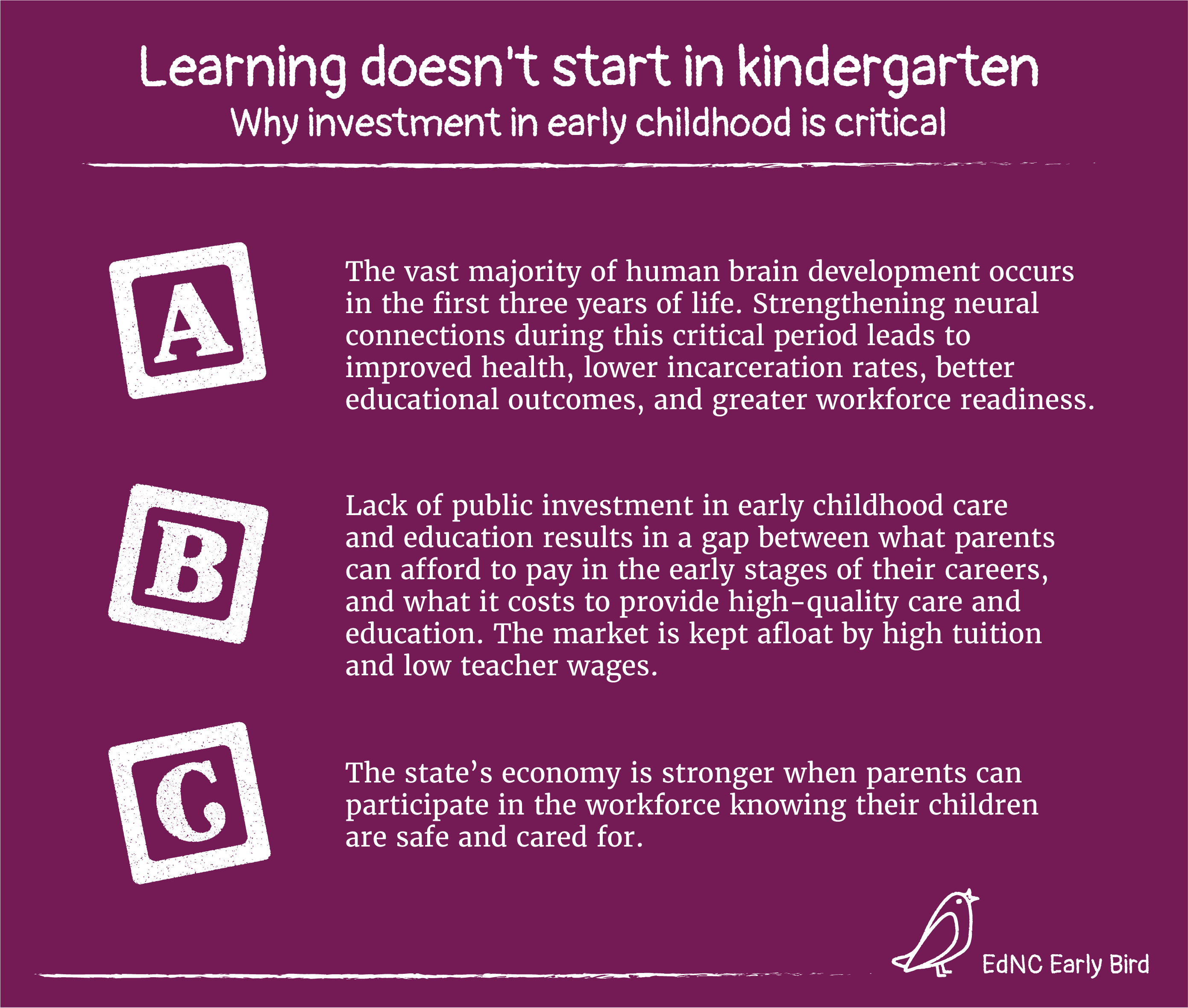
Graphic by Lanie Sorrow
Because the child care crisis was seen as a threat to the collective future of Americans, elected officials took action. Congress passed the Military Child Care Act of 1989, which put a priority on affordability, accessibility, and quality in child care for service members.
With the end of child care stabilization efforts that were undertaken during the pandemic, North Carolinians now face a similar threat to our own collective future. The military’s approach offers lessons for where we can go from here, in our communities and across our state.
An experiment in universal child care
The Military Child Care Act wasn’t the first time the military had taken the lead on child care. During World War II, women entered the workforce in massive numbers, filling the roles of men who were drafted to serve in the military. This raised the question of who would care for children when both parents were working outside the home to defend American interests.
Congress responded with the Lanham Act of 1940, creating a nationwide, universal child care system to support working families with children through age 12. Federal grants were issued to communities that demonstrated their need for child care related to parents working in the defense industry.
The program distributed $1.4 billion (in 2025 dollars) between 1943 and 1946 to more than 600 communities in 47 states. The grants could be used to build and maintain child care facilities, train and compensate teachers, and provide meals to students.
In his 2017 analysis of the Lanham Act’s outcomes for mothers and children, Chris M. Herbst, of Arizona State University’s School of Public Affairs, found that “the Lanham Act increased maternal employment several years after the program was dismantled.”
An image of Rosie the Riveter from a 1943 issue of the magazine Hygeia (published by the American Medical Association) demonstrating the need for child care.
Herbst also found that “children exposed to the program were more likely to be employed, to have higher earnings, and to be less likely to receive cash assistance as adults.”
One lesson Herbst took from his research was that the Lanham Act was successful because of the broad support it received from parents, advocates for education and women, and employers. He noted: “Each group was committed to its success because something larger was at stake.”
Today’s military-operated child care model
While the Lanham Act was a short-lived national experiment that hasn’t received much study, the military’s child care program since adoption of the Military Child Care Act of 1989 has become a widely acclaimed model for publicly subsidized early care and learning, serving about 200,000 children each year.
Four categories of child care are available through military-operated child care programs: Child Development Centers (CDCs), Family Child Care (FCC), 24/7 Centers, and School Aged Care (SAC). The official military child care website describes each program type:
Child Development Centers (CDCs) — CDCs provide child care services for infants, pretoddlers, toddlers, and preschoolers. They operate Monday through Friday during standard work hours, and depending on the location offer full-day, part-day, and hourly care.
Family Child Care (FCC) — Family child care is provided by qualified child care professionals in their homes. Designed for infants through school agers, each FCC provider determines what care they offer, which may include full-day, part-day, school year, summer camp, 24/7, and extended care.
24/7 Centers — 24/7 Centers provide child care for infants through school age children in a home-like setting during both traditional and non-traditional hours on a regular basis. The program is designed to support watch standers or shift workers who work rotating or non-traditional schedules (i.e., evenings, overnights, and weekends).
School Aged Care (SAC) — School age care is facility-based care for children from the start of kindergarten through the end of the summer after seventh grade. This program type operates Monday through Friday during standard work hours. SAC programs provide both School Year Care and Summer Camp.
Requirements for military-operated child care programs are typically more stringent than state requirements. For one thing, they must be accredited by one of the following: National Association for the Education of Young Children (NAEYC), National Early Childhood Program Accreditation (NECPA), the Council on Accreditation (COA), or the National Accreditation Commission (NAC).
For context, the requirements for licensed child care in North Carolina are relatively stringent compared with other states, but still fall below the requirements for NAEYC accreditation, which is widely recognized as the national standard. Only 110 programs in our state are NAEYC-accredited — many of which are Head Start or military-operated programs — out of about 5,300 total state-licensed programs.
Military-operated child care programs offer families hourly, part-day, full-day, extended, or overnight care, plus afterschool and summer programs.
The maximum rate is on par with the national average for civilian child care in 2023, meaning that almost every family using military-operated child care programs is paying less than the national average for typically higher-quality early care and learning.
The Department of Defense budgeted about $1.8 billion for child care in 2024 — about 0.2% of its $841.4 billion total budget.
Military child care in North Carolina
In addition to military-operated child care programs, service members may be eligible for Military Child Care in Your Neighborhood (MCCYN), a fee assistance program for families who can’t access military-operated child care. MCCYN pays a portion of the cost of enrolling children in early care and learning programs that meet the military’s high-quality standards in their community.
North Carolina is one of 19 locations where military families may be eligible for MCCYN-PLUS, which expands the MCCYN program to child care programs that participate in state or local Quality Rating and Improvement Systems (QRIS) in places where nationally accredited care is not available.
Both programs rely on the availability of high-quality child care in civilian communities. That’s a challenge in North Carolina, which was already facing a child care shortage before the pandemic. Our state has lost almost 6% of licensed child care programs since February 2020, with more expected to close because stabilization grants have ended.
According to the NC Military Affairs Commission, there are 12 military bases and more than 130,000 active-duty military members in North Carolina, giving us the fourth-largest active-duty military population in the nation.
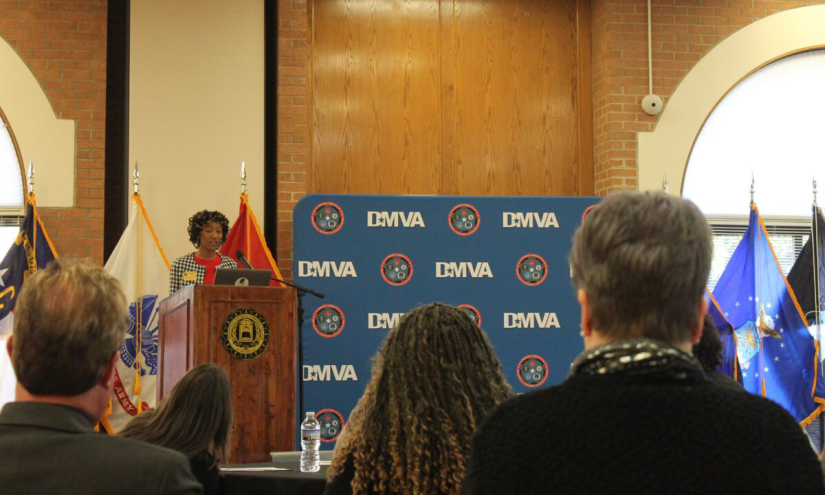
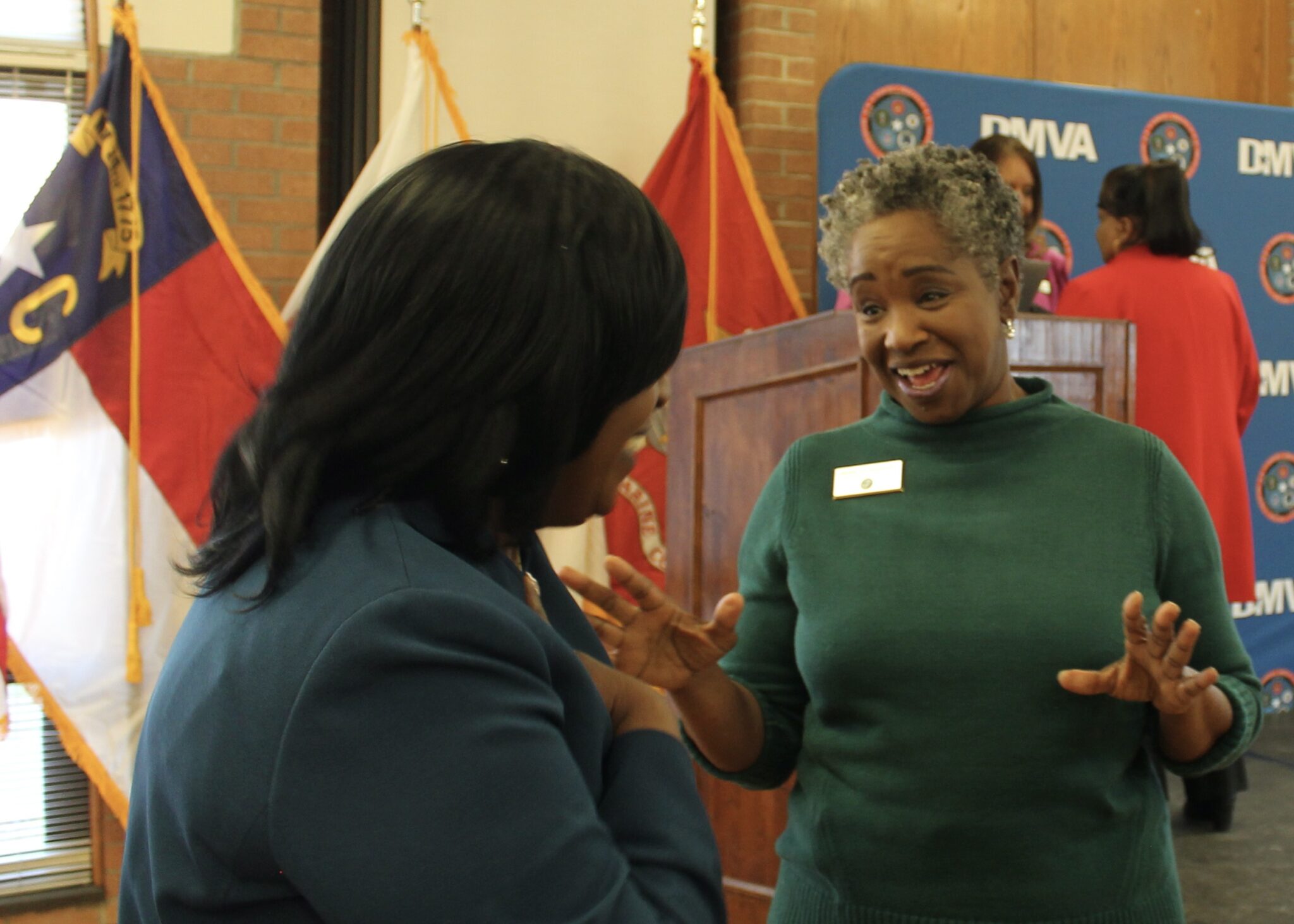
In January 2025, Fayetteville Technical Community College hosted the state’s first N.C. Military Community Childcare Summit, organized by the North Carolina Department of Military and Veteran Affairs (NCDMVA) to discuss the problem that military communities are having with access to community-based child care.
The first N.C. Military Community Childcare Summit in January 2025.( Katie Dukes/EdNC)
The summit culminated in a screening of Take Care, a documentary about North Carolina’s child care crisis produced by the state Department of Health and Human Services and featuring EdNC’s early childhood reporter, Liz Bell.
The issues of spouse resilience and child care are inextricably linked for Angie Mullennix, who works for The Honor Foundation at Fort Bragg, helping members of the U.S. Special Operations Forces (SOF) transition to careers in the private sector after their military service.
Mullennix served in the U.S. Army for four years after high school and has previously worked for the Department of Public Instruction as the state military liaison. Her husband recently retired from the SOF himself. They have two teenage children.
“If you look at the number of military spouses in North Carolina who have degrees and credentials and could be in the workforce, from nurses to lawyers, lots of them are staying at home,” Mullennix said.
“A big reason why about 40% of (military) spouses do not work is because of child care not being available to them,” Mullennix said, noting that lack of child care is also a barrier to workforce participation among the civilian population.
When Mullennix’s children were under the age of 5, she used hourly child care on base, which was available at no cost when her husband was away on assignment.
“You ask any parent in the world, I don’t care who they are, there’s nothing more important than their child’s safety — then their education,” Mullennix said. “And yet, the two things we think are the most important, we put (their providers) at the lowest pay and ask them to do quality care.”
That’s what sets military child care apart from civilian early care and learning for Mullennix: high quality standards and higher pay for early childhood educators, including benefits. She sees lessons in this for North Carolina.
“You gotta pay them to keep them, there’s no secret behind that,” Mullennix said. “If you pay them high, you can also set the standards really high.”
And because workforce participation — and military readiness — is directly tied to the accessibility and affordability of high-quality child care, not investing in it threatens our collective future.
“North Carolina, or any state that doesn’t offer child care, is shooting itself in the foot,” Mullennix said.
Lessons from military child care
Policymakers at every level who are seeking to end the child care crisis can learn much from the military child care model. One report on the topic offers these lessons:
Do not be daunted by the task. It is possible to take a woefully inadequate child care system and dramatically improve it.
Recognize and acknowledge the seriousness of the child care problem and the consequences of inaction.
Improve quality by establishing and enforcing comprehensive standards, assisting providers in becoming accredited, and enhancing provider compensation and training.
Keep parent fees affordable through subsidies.
Expand the availability of all kinds of care by continually assessing unmet need and taking concrete action steps to address it.
Commit the resources necessary to get the job done.
Both agreed these are the right takeaways for policymakers across North Carolina to consider.
Lesson 1: Do not be daunted by the task
Gale Perry said the top lesson for her is: “Start where you are, know that change is possible, and have a goal post in mind.”
She pointed out that the military’s goal wasn’t a fully publicly funded child care system. It was a system that acknowledged Americans’ values around the role of parents in raising young children — and paying for their care and education. But also that their employers and the government “have a role in offsetting that cost, so that we can ensure that child care is quality, and it is stable, and that the families can actually afford it.”
Smith said there was no “silver bullet” when she and her colleagues were tasked with solving the military’s child care crisis in the 1990s — and there isn’t one for the civilian child care crisis today.
We had to redo the standards, we had to look at the workforce, we had to look at the health and safety issues, we had to look at the fees and how we could bring those fees down. We had to look at the infrastructure of all of it. We’ve got to start thinking about the interconnectedness of all of these things if we’re going to be successful in this country.
Smith said people think that because she worked for the secretary of defense, “I could just tell all the bases what to do, and that would magically happen, which is so not true. It wasn’t just like we could give an order and everybody jumped.”
She said you just have to start where you are, and move up.
Lesson 2: Acknowledge the seriousness of the problem and the consequences of inaction
“The military understood very early the link between people getting to work and child care,” Smith said.
As the military shifted away from relying on conscription and became a more welcoming workplace for women, the need for child care became evident. Smith described working on a base where children were routinely left in cars when their parents were unexpectedly called into work.
“So (military leaders) really got the connection to their guys going to work very quickly, and I think that we still haven’t all understood that in this country,” Smith said, though she notes businesses have started making that connection since the pandemic.
“The other thing the military understood was that a pilot is every bit as important as the mechanic who works on the plane, and so they invest in all of their people,” Smith said.
She and her team had to design a program that worked for everyone, or it wouldn’t work for anyone.
Lesson 3: Improve quality
Smith said quality was of critical importance when she was designing the military’s child care system in the 1990s, especially after child abuse and neglect scandals that came to light in the 1980s.
She and her team studied the child care standards of all 50 states and created a set of military standards that fell squarely in the middle. Then they set about training the 22,000 early childhood educators they already had — most of whom were military spouses — to meet those standards.
That was a six-month training program. Then there was an 18-month training to get them to move beyond those standards toward national accreditation. They hired highly qualified trainers to work with educators at each site.
“And if you didn’t do it, guess what? You’re fired!” Smith said.
There was an incentive to participate in the training, beyond keeping their jobs — higher compensation.
“Maybe some were grumpy about it, but we didn’t have to fire people,” Smith said.
North Carolina already has some tools in place to help educators advance their education and improve their compensation, specifically through the WAGE$ and TEACH programs — both of which were highlighted in the report that identified these lessons.
“(The military) realized they had to get serious about quality and quality standards. And I would say that’s a lesson for us now, particularly in a climate that is deregulatory,” Gale Perry said. “And while I’m for sensible regulatory reform, I think we have to be really thoughtful about not wanting stacks of child deaths in child care sitting on a desk waiting to be investigated.”
Lesson 4: Keep parent fees affordable through subsidies
Smith said that while designing the military’s child care program, she and her team figured out that there was no way parents could afford the actual cost of high-quality child care. So they set up a subsidized system that would provide a 50% match — on average — to parents’ fees, paid directly to child care programs.
“We had to, on average, match parent fees dollar-for-dollar, with the higher-income people paying more and the lower-income paying less,” Smith said. “So a major, for example, would pay two-thirds of the cost, and a private would pay one-third, but the average was 50/50.”
Smith pointed out that we’re already subsidizing child care in ways that are hidden — through the public benefits and social programs that early childhood educators often rely on because of low compensation, and through lack of workforce participation.
Lesson 5: Expand the availability of all kinds of care
Gale Perry said the military’s model really stands out to her for its ability to assess unmet needs and take action to improve.
“In the early 2000s when there were the wars in Iraq and Afghanistan, there were a lot of deployments of National Guard and Reserve who did not live on post and did not have access to on-post child care,” Gale Perry said. “That is really when the military got in the business of thinking about, how do we help build capacity and make child care accessible for military families off post?”
That’s when the MCCYN came about, subsidizing high-quality early care and learning in a broader array of settings in the communities where service members live.
Smith said that the Military Child Care Act was originally targeted toward child care centers, but she recalls briefing the assistant secretary of defense on the potential effects of that strategy when they were designing the system:
I remember saying we need to apply all of this to family child care, to school-aged care, to part-day preschools, because if we don’t, all the parents are going to have a demand on these centers that we can’t meet, right? Because if you lower the cost in the centers and you improve the quality, why would somebody go to another place when they get it cheaper and better over here?
She made the case for educators in every setting getting the same access to training and the same level of compensation, because that’s what would work best for everyone.
“Everything applies to everybody,” Smith said. “And I think that was one of the smartest policy decisions we made.”
Lesson 6: Commit the resources necessary to get the job done
“There was this perception that we just had a lot of money and we threw it at” child care, Smith said. But that wasn’t the case.
“When they passed the Military Child Care Act, it didn’t come with an appropriation,” Gale Perry said. “So they had to fight equally hard for the funding, and a lot of the funding actually ended up coming from local base commanders making the decision to invest in child care.”
Now the military submits a budget request to Congress each year, and depends on those appropriations.
For state and local policymakers seeking to solve the civilian child care crisis without public investment, the woman credited with solving the military’s own child care crisis 35 years ago has a message.
“It’s gonna cost. There’s no way it doesn’t cost,” Smith said.