Blog

  • US-based TOEFL scorers “shut out” of ETS shifts, petition claims

    US-based TOEFL scorers “shut out” of ETS shifts, petition claims

    • Petition from ETS scorers takes issue with shifts being handed to offshore colleagues, claiming that such decisions are often taken last minute.
    • Concerns raised over new scorers not having English as a first language – which ETS says does not matter so long as the scorer has the correct expertise.
    • ETS defends “strategic decision” to look beyond the US for some of its scorers, saying this reflects the global nature of its business.

    “Over the past several months, ETS has stopped assigning shifts to US-based rates and scoring leaders without any clear or honest explanation,” states the petition

    “There has been a quiet transition to a completely offshore rater pool, with scoring for the TOEFL Speaking section now handled almost entirely out of India. US raters – many of whom have supported this work for over a decade – have been ghosted,” it claims.  

    According to speaking raters and leaders interviewed by The PIE News, shifts for US-based raters and scoring leaders started reducing in December 2024 and have all but dried up, though employees are still asked each month to submit their availability.  

    But according to the testing giant, scoring staff were informed in December 2024 of the expansion of ETS’s scoring capabilities beyond the US, including being told that the shift “could result in a reduction of scoring hours for US-based raters”.  

    “This change reflects our effort to meet international demand more effectively and leverage a broader, global pool of qualified scoring professionals,” an ETS spokesperson told The PIE 

    And yet, employees have complained of a lack of transparency from ETS: “Those who complained to HR or Scheduling receive either silence or vague boilerplate responses citing ‘global strategy’ or ‘volume’”, the petition states.  

    According to Teri Anglim, a scoring leader who has worked for TOEFL since 2006: “The email that came in December was well crafted… they said they were going to be including global raters and that some would see their shifts increase and others would decrease”.  

    “Come February, lots of raters would email me and say they were only scheduled for five days out of the month, some having registered their availability for every day,” said Anglim.  

    “Come March, they might get 10 days for the month, but a day and a half before their shift, they’d get an email saying that half of their shifts were cancelled,” she explained.  

    Several employees have echoed similar frustrations over shifts being cancelled at the eleventh hour.

    Speaking to The PIE anonymously, another scoring leader explained it was their understanding that “ETS still sends out availability requests every month and actually confirms one or two shifts at most, only for them to be cancelled at the last minute”.  

    “Because I work for other programs, I’m getting scheduled for them but not for TOEFL. ETS essentially wants to keep our pool of workers ‘on-call’ to the side, just in case,” they said.  

    By Anglim’s accounts, shifts for US test raters had all but dried up in April, though test scorers training the new global raters continued receiving shifts.  

    In May, the number of raters on each scoring leader’s roster was increased, with experienced leaders finding it difficult to keep up with the increased monitoring.

    “It’s humanly impossible to keep tabs on 24 people who are novices at scoring,” said Anglim, who became concerned that mistakes could slip through the cracks.  

    And yet, by June, Anglim was assigned six shifts for the whole month and saw three of them cancelled: “That was the end of TOEFL for us, the scoring leaders,” she said.  

    It’s not diverse, it’s certainly not equitable, and it’s not inclusive

    Teri Anglim, TOEFL scoring leader

    The petition is demanding that ETS provides a “clear, honest explanation of how shifts are being assigned”, as well as detailed accounts of how many US raters have received shifts since April and the ratio of US raters and the new global pool.  

    The scoring leader speaking to The PIE anonymously said they were “devastated to no longer be a part of a program [they] helped build 20 years ago… ETS used to be a great side income, but it’s mere pittance now.” 

    “[ETS] basically told us last fall that we would be training our replacements – they didn’t word it quite like that, but we all knew our days were numbered at that time.”

    Since many raters work part-time for ETS, they say they have had to rely on other jobs and pick up shifts elsewhere since the reductions.  

    “At this point in my life, I do get social security, and I’m looking for other remote jobs,” said Anglim, who holds a BA from Arizona State University and two MA degrees from the University of Texas Arlington.  

    Beyond the personal impact on employees, Anglim said she was concerned about the standard of the new scorers, with the petition claiming that the scoring of the TOEFL Speaking section is “now handled almost entirely out of India”. 

    Anglim, who trained many of the new scorers, said: “I have nothing against the raters in India – I liked working with them – though I was concerned about non-native English speakers marking the test without other people.” 

    “How can a company like the Educational Testing Service (ETS) promote DEI when having scorers only from one place is not diverse, it’s certainly not equitable, and it’s not inclusive,” she said.  

    For its part, ETS has countered the claims, stressing that new raters are given the same “rigorous” training as existing ones and that it is irrelevant whether or not English is their first language.

    Anglim recalled a case when she was reviewing the scores given to a test-taker from Germany, whose English was “impeccable” – “his vocabulary was better than I use”, she said – though he was scored two out of four for delivery.  

    In that incident, Anglim initiated a score change, but she said she was worried that individuals who have taken the test since January could be “collateral damage” of the new pool of scorers.  

    The TOEFL exam is primarily used to measure the English proficiency of test takers applying to English speaking universities in the UK, Canada, the US, Australia and New Zealand, among a few others.

    Out-of-work US-based raters fear that moving the test scoring offshore will lead to a loss of raters who instinctively know the nuances of the English language that can affect score outcomes.

    What matters is expertise, not where someone was born or what their first language was

    ETS

    Alongside a “commitment to transparency, accountability and professional respect” for its employees, the petition’s signatories want an “acknowledgment that the rater and scoring leader roles are now being filled exclusively from India”.  

    The scoring leader speaking anonymously also said they were “concerned about the integrity of the test”, fearing “it will be compromised due to raters and leaders who aren’t fully proficient in English”.  

    “My interactions with some raters over the years and with these specific ‘global raters’ left me wondering how thoroughly ETS had vetted their language abilities. 

    “I fear that TOEFL will die once US universities get wind of this shift and also if scores end up being inaccurate, leading to difficulties or even failure for international students,” they said.  

    Responding to the claims, an ETS spokesperson said that the integrity of the TOEFL would “always be [its] highest priority”.

    “All of our raters, whether English is their first or learned language, go through the same rigorous training, qualification process, and continuous monitoring to ensure scores are fair, accurate, and consistent.

    “What matters is expertise, not where someone was born or what their first language was and our diverse community of raters reflects exactly that.”

    ETS leadership have not formally responded to the petition or addressed the 342 signatories or their demands.

    Speaking to The PIE, an ETS spokesperson said the company had “a growing global customer base and a business that continues to evolve to meet the needs of learners, institutions, and partners worldwide.  

    “In response to these changing demands, we made the strategic decision in late 2024 to expand our scoring capabilities beyond the US. 

    “This shift allows us to better serve a global testing population, increase operational flexibility, and uphold the quality and efficiency our customers expect.” 

    It told The PIE: “We are grateful to the many raters and scoring leaders in the US who have supported TOEFL over the years and helped establish the standards we maintain today.  

    “ETS remains committed to treating all members of our scoring community with respect and to communicating transparently as we continue to adapt in an increasingly globalised education landscape.”

    Source link

  • The findings against Harvard are a blueprint for a National Campus Speech Code

    The findings against Harvard are a blueprint for a National Campus Speech Code

    Last month, the Department of Health and Human Services accused Harvard of violating Title VI, which bans discrimination based on race or nationality at any school that takes federal funding. Last week, it was reported that Harvard is nearing a $500 million settlement with the administration to end legal battles.

    In the past two years alone, HHS noted, Harvard has accepted nearly $800 million from the government. But the threat to Harvard’s funding is just the headline. The sweeping theory of “harassment” HHS used to justify its claim has the potential to cause huge damage, not just at Harvard but across the nation, by collapsing protected speech and misconduct into a single charge that could turn campus protest into a civil rights violation.

    There’s nothing new about the idea that we need to ban the expression of certain opinions in order to fight discrimination — that’s the reasoning behind a vast number of speech codes that FIRE has fought since 1999. The new, destructive twist on this is what we at FIRE call the cumulative theory of harassment. That’s the notion that while myriad individual instances of expression by unrelated individuals may be fully protected under the First Amendment, they can together create a cumulative harm, even to those not present and not targeted by the speech, that justifies overriding the Constitution.

    By using the cumulative theory of harassment, the government can smear those following the law with the actions of those breaking it.

    In Harvard’s case, HHS has determined that since the October 7, 2023, Hamas attack on Israel, the accumulation of antisemitic and anti-Israel rhetoric constitutes a “hostile environment on its campus for Jewish students.” HHS claims Harvard failed to “take appropriate corrective action” to end this hostile environment, thus violating Title VI.

    At first glance, this finding may seem justified, or at least not worth worrying about. After all, most Americans are not exactly enthusiastic about their tax dollars going to fund campuses that are hostile environments for Jewish or Israeli students, or anyone else, simply because of their race, color, or national origin. Still, there are several major problems with interpreting the law in the way HHS does here.

    Cumulative theory conflates protected expression with unprotected conduct

    First and foremost, the government has deemed that a hostile environment exists at Harvard by conflating constitutionally protected expression — including core political speech, which gets the highest level of protection — with unprotected conduct such as vandalism, blocking entrances and exists, even acts of physical violence.

    A single paragraph provided an illuminating look at how HHS blurs the line between protected speech and unprotected conduct in order to accuse Harvard of violating federal law:

    Harvard student groups and faculty groups posted to Instagram an antisemitic cartoon that included the Star of David, dollar signs, and nooses. The image depicted “a white hand, marked with a dollar sign inside a Star of David, tightening nooses around the necks of a Black man [Muhammad Ali] and an Arab man [Gamal Abdel Nasser].” This incendiary image was subsequently reposted on Instagram by Harvard Faculty and Staff for Justice in Palestine.

    It’s not hard to see why Jewish and Israeli students (and many others) would find this cartoon offensive. But it is undoubtedly political speech, which lies at the very core of what the First Amendment protects. In fact, the cartoon in question was originally published in 1967 by the Student Nonviolent Coordinating Committee, one of the best-known organizations of the civil rights movement of the 1960s. As the Los Angeles Times pointed out, it was controversial then as well, but this history only serves to clarify that it is indeed political speech. The Harvard groups’ use of the cartoon to make points about “apartheid and occupation” only reinforces the fact that it is political in nature.

    Furthermore, there’s no question that, in a country where the First Amendment continues to protect even the likes of the Westboro Baptist Church holding signs saying “God Hates Fags” and “Thank God for Dead Soldiers” outside military funerals, the government simply cannot take action against others for merely for posting a political cartoon on social media.[1]

    The next sentence in HHS’ paragraph reveals that some or all of these groups (the letter does not specify) apologized for posting the cartoon, but suggests the apology was insincere:

    The apology for these postings came with a photo of a figure known for saying, “The only good Zionist is a dead Zionist.” 

    Indeed, the Harvard groups eventually replaced the cartoon in the infographic with a picture of civil rights activist Kwame Ture (Stokely Carmichael), who was known for his anti-Zionist views and who famously echoed the “dead Zionist” remark during a 1990 speech at the University of Maryland. But the revised post from the Harvard groups did not quote his remark directly, despite HHS implying that the Harvard groups were trying to associate themselves with Ture’s remark from 35 years ago. Besides, even if they had, it would still be protected speech both under the First Amendment and Harvard policies. 

    Then comes the paragraph’s conclusion, where HHS mixes all of that protected speech just discussed with unprotected acts:

    A “series of anonymous acts” occurred on campus, including posters of Israeli citizens taken hostage by Hamas being vandalized with messages such as “Israel did 9/11.” There were also “instances of vandalism on campus and the posting of swastika stickers near Harvard Hillel’s Rosovsky Hall.”

    Unlike the expression in the rest of the paragraph, vandalism, even when expressive, is not protected by the First Amendment. Defacing posters or putting stickers on them, especially if their removal damages the underlying surface, can be and often is prohibited both by law and by university rules. But that’s because it damages or destroys the vandalized item, not because of the content of the speech. Defacing hateful signs with stickers saying “I love everyone!” is still vandalism, and prohibited. Posting political cartoons on Instagram is speech, and is protected. But by using the cumulative theory of harassment, the government can smear those following the law with the actions of those breaking it. 

    Cumulative theory of harassment creates a general civility code

    Another problem with the cumulative theory of harassment is that it holds current speakers responsible for creating a “hostile environment” based on the previous statements and activities of people to whom they may be entirely unrelated. This means anyone can find themselves in the position of perpetrator of hostile environment harassment without himself or herself actually engaging in harassing behavior. 

    Consider, for example, the following account said to “highlight the hostile environment created for Jewish and Israeli students at Harvard,” according to HHS:

    On May 12, 2024, a crudely drawn image of Interim President Garber was also displayed [during an encampment protest] depicting him as a devil with horns and a tail, recalling “medieval antisemitic tropes of Jews as Satan’s minions.” 

    Like posting a political cartoon to Instagram, simply displaying such a picture simply cannot be deemed harassment by any rational measure, let alone be taken as serious enough to deny the person seeing it “equal access to an educational program or activity.” The Supreme Court’s decision in Davis v. Monroe County Board of Education established the standard for peer harassment under Title IX, holding schools liable only when they are deliberately indifferent to harassment that is severe, pervasive, and objectively offensive, and even warns of “the amount of litigation that would be invited by entertaining claims of official indifference to a single instance of one-on-one peer harassment.”

    Under the cumulative theory of harassment, that’s out the window. A school like Harvard must consider each individual student’s choice to display this picture as part of a pattern of behavior that consists of everything everyone else is doing on campus during some undefined period of time, whether or not the student knew anything about it.

    HHS doesn’t tell us who displayed the picture, how long it was displayed, whether others at the protest somehow signed off on it or objected to it, how many people saw it, whether it was intended to be antisemitic, or whether HHS or Harvard knows the answers to any of these questions. It requires no coordination or organization. It doesn’t even matter whether the person who displayed the picture is hostile towards Jewish or Israeli students — maybe the artist just hates President Garber!

    But using the cumulative theory of harassment, even the message the speaker intended to communicate doesn’t matter. The speaker becomes a harasser who the school has a duty to stop, solely because of what other people, who need not even be present, might have thought about the expression that took place before the current speaker arrived. There’s only one sure way to prevent such “offenses”: you must prevent people from expressing certain opinions when and where those opinions might offend members of a protected class.

    Courts struggle to apply the cumulative theory of harassment

    While HHS’s OCR was able to draw the conclusion that the words and actions of a number of unrelated perpetrators somehow added up to a hostile environment on a given college campus, it has proved far less successful when analyzed by courts. 

    Just last month, a federal court dismissed a hostile-environment claim by a coalition of plaintiffs at Haverford College, which sued the institution using the cumulative theory of harassment. As Judge McHugh of the Eastern District of Pennsylvania wrote, the plaintiffs sought to establish their hostile environment claim “by citing some 25-plus incidents purportedly impacting the collective consciousness of 50-plus mostly unnamed individuals comprising Jews at Haverford. But such gestalt pleading cannot be employed as a strategy to avoid scrutiny by the Court.”

    McHugh noted, “several of Plaintiffs’ allegations involve protected political expression, and cannot be regulated under the guise of nondiscrimination,” later adding that “[m]any of Plaintiffs’ allegations fall into the category of pure, protected speech. Although Plaintiffs may have found much of this speech reprehensible, there is no legal cause of action for upset feelings.” 

    Among the examples of speech the plaintiffs cited as harassing, but which the court found to be protected, were a lecture on the “weaponization of Covid,” a student handing out Palestinian flags, a campus organization changing its name to “Bi-Co Students for the Liberation of Palestine,” and a number of posts disparaging Israel made by Haverford students and faculty members on their private social media accounts. 

    The court recognized each of these as instances of political expression protected by the First Amendment. In particular, the court said, “Plaintiffs do not attempt to explain how Haverford could regulate students’ and faculty’s private social media content, offering no basis on which it could assert such invasive authority,” calling into question how HHS could require Harvard to do exactly the same thing. 

    The Haverford students also complained that Haverford had not done enough to communicate its disapproval of the Hamas attack or antisemitism on campus and (with what appears to be good reason) that it had not followed all its own rules in dealing with protests. But the court did not find this to be a violation of Title VI either, noting that “government coercion of speech to adhere to a particular message tampers with First Amendment protections” and that courts “may not compel administrators to make any specific statement on any particular topic,” citing the 1943 landmark Supreme Court decision in West Virginia State Board of Education v. Barnette. (In that case, the Supreme Court found that the government could not force students to say the Pledge of Allegiance, even against the unprecedented backdrop of World War II.)

    Judge McHugh was careful throughout the brief not to discount the discomfort Jewish students at Haverford might have felt during the past year’s pro-Palestinian protests, saying they might have a legal claim that the school didn’t follow its own policies, so that part of their case can move forward. The question, he noted, was not “whether Haverford could have handled each situation better.” Rather,

    Under Title VI, the question is whether Haverford was so indifferent to known acts of harassment that it caused students to undergo harassment or made them more vulnerable to it, and thereby undermined the students’ education. Davis, 526 U.S. at 644-45. And even taking all these allegations as a whole, Plaintiffs’ pleading does not plausibly support a finding of deliberate indifference, especially where countervailing First Amendment concerns are considered in evaluating the often-fragile balance college administrators must strike.

    In another recent case, Gartenberg v. Cooper Union for the Advancement of Science and Art, Judge John Cronan of the Southern District of New York similarly found that much of the expression the plaintiff cited was “pure speech on matters of public concern,” and while some of that speech could be considered to determine intent, “it cannot itself support a claim for an objectively hostile educational environment under this Court’s interpretation of the statute.” On the other hand, the incident that headlined Gartenberg’s complaint was considered to have sufficiently alleged a violation of Title VI to allow the case to proceed to discovery. As Judge Cronan summarized the complaint:

    After first attempting to locate Cooper Union’s president, the mob descended on the building’s library, where a group of students wearing recognizably Jewish attire were sheltering behind locked doors. The demonstrators surrounded the library and proceeded to bang loudly on the library’s doors and on its floor-to-ceiling glass windows, shouting demands to be let in and continuing to direct anti-Israel slogans and wave a Palestinian flag at the Jewish students inside the library. During the roughly twenty-minute ordeal, Cooper Union’s administrators did nothing to disperse the protestors and instead directed law enforcement to stand down, even as the college’s president had just escaped the building through a back exit. None of the protestors subsequently faced any discipline.

    There is a stark difference between that sequence of events and the kinds of expression that courts have consistently protected under the First Amendment. 

    Real discrimination deserves a real response. True threats, vandalism, and violence are not protected speech and schools should act when they occur. But they must do so with the precision the Constitution requires.

    HHS claims Harvard may have been deliberately indifferent to patterns of harassment that violated Title VI. And it does identify potentially troubling incidents, as did Harvard’s own task force studying the issue of campus antisemitism. But because it has mixed and conflated incidents of protected expression with unprotected discriminatory acts, the federal government has made it impossible to separate any objective case that Harvard has violated Title VI as written and intended from an exercise in political speech-policing.

    A bipartisan error

    Given the level of partisan acrimony in American politics, and the Trump administration’s aggressiveness towards Harvard in particular, one might think that this is a right-wing or Republican problem. Unfortunately, though, this is one of the rare issues in which the Biden and Trump administrations are in substantial agreement.

    In the middle of 2024, the Department of Education under President Biden began to issue findings in a number of Title VI complaints filed in the wake of campus activity after the October 7 Hamas-led attack on Israel. As should surprise no one, the letters did highlight some pretty concerning problems at schools like the University of Michigan and (especially) CUNY’s Brooklyn College. But it made these diagnoses using the same cumulative theory of harassment that the Trump HHS is now applying to Harvard. 

    The findings it announced with regard to a third college, Lafayette College, illustrates just how absurd this approach can become. Despite Lafayette’s (apparently) responding to every complaint of antisemitism, including those that were vague or purely based on expression, the Department of Education still found it in violation of Title VI. Why? Because it failed to assess whether “social media and off-campus conduct individually or collectively created or contributed to a hostile environment.” Translation: Lafayette didn’t treat constitutionally protected speech as evidence of actionable harassment.

    As I remarked at the time, 

    If anything, Lafayette was a bit heavy-handed: Most students would think twice about posting on Instagram after being called on the carpet by the college chaplain to “discuss” their political opinions… It’s hard to see what else Lafayette could have done to try to address the allegedly hostile environment on its campus without actually descending into censorship.

    The resurrection of “group libel”

    FIRE has long explained that the U.S. has no legal category called “hate speech.” That’s still true. But the cumulative theory of harassment is starting to look a lot like an attempt to revive the old concept of group libel, a legal relic rightly abandoned decades ago.

    Group libel laws once aimed to ban statements that defamed not individuals, but entire groups. The idea: if you can’t spread lies about a person, why should you be allowed to malign a racial or ethnic group? As University at Buffalo law professor Samantha Barbas details, the press, civil liberties advocates, and even the NAACP frequently warned against these laws as Trojan horses for censorship. In 1935, when New Jersey passed an “anti-Nazi” group libel law, newspapers worried it could be used to ban criticism of Nazis. The ACLU rightly called it a sweeping threat to free speech, and described the law as “more sweeping in its threat to free speech than any measure ever passed in any state,” and in a pamphlet claimed that the law could even be used against Jews for criticizing Nazis.

    The evil of Nazi Germany soon provided the best imaginable example for group libel law advocates, and during World War II, Congress proposed a bill that would have banned sending material through the mail that exposed people to “hatred, contempt, ridicule, or obloquy” based on race or religion. While a number of labor unions supported the bill, the NAACP testified against it, concerned that it would impair constitutional rights and “lead to an aggravation of race and religious tensions.” Thankfully, the bill never got a floor vote, though some states maintained laws regulating group libel.

    While prosecutions appear to have been few and far between, in the 1952 case Beauharnais v. Illinois, the Supreme Court narrowly affirmed the constitutionality of a group libel statute, upholding a 1917 Illinois statute that outlawed making public any material that “portrays depravity, criminality, unchastity, or lack of virtue of a class of citizens, of any race, color, creed or religion [and] exposes the citizens of any race, color, creed or religion to contempt, derision, or obloquy or which is productive of breach of the peace or riots.”

    As is often the case, bad facts made for bad law. Joseph Beauharnais, president of the “White Circle League of America,” had distributed a pamphlet demanding the Chicago government “halt the further encroachment, harassment and invasion of white people, their property, neighborhoods and persons, by the Negro,” asserting that “If persuasion and the need to prevent the white race from becoming mongrelized by the negro will not unite us, then the aggressions . . . rapes, robberies, knives, guns and marijuana of the negro, surely will.” He was convicted and fined $200. 

    But if the Supreme Court’s upholding the Illinois law was group libel’s biggest moment in the sun, it was also its last. Justice Frankfurter couched his majority opinion with caveats, proving that even then, the Court seemed uncomfortable. And they had reason to be. Beauharnais didn’t age well. Legal scholars blasted it. Thurgood Marshall and the ACLU tried to get it overturned. The Supreme Court never cited it again. Even Illinois repealed the law nine years later. By 1969, Brandenburg v. Ohio effectively buried Beauharnais, by making clear that even advocating flatly illegal conduct is protected unless it incites imminent lawless action.

    Conclusion

    Real discrimination deserves a real response. True threats, vandalism, and violence are not protected speech and schools should act when they occur. But they must do so with the precision the Constitution requires — punishing conduct, not ideas, and respecting the robust political debate that higher education exists to nurture. 

    Harvard’s case should be a warning. Unless we properly respect the line between speech and misconduct, Title VI risks becoming not a shield against injustice, but a sword for enforcing the orthodoxy favored by whatever political forces wield it, now or in the future.


    [1] And while, as a private university, Harvard could legally limit freedom of speech in ways the government may not, the government also may not launder demands for censorship through a private organization, campus or not. Furthermore, just like the vast majority of private universities, Harvard promises to provide a great deal of free political expression. While such promises are frequently ignored by those universities, they are nonetheless both legally and morally binding.

    Source link

  • Veritas, My Ass (Mark Twain*)

    Veritas, My Ass (Mark Twain*)

    “The pleasure we experience in seeing a beautiful
    cathedral reminds us to admire the church’s architect. How much more should
    viewing the universe’s infinite variety stir us to praise the Beauty of its
    Creator. Consider, for a moment, the whole of creation. The splendor of the
    starry skies, the various flowers in a flower garden, the stately majesty of a
    cluster of trees, the melodious songs of birds, the variations of creatures in
    the animal kingdom, the sense and intellectual faculties of a human person, are
    like so many voices that praise the Beauty of their Author. Words fail us in
    our effort to describe adequately what the beauty of the universe tells us of
    the Divine Artist’s Beauty. Does triumphant music come closer to expressing
    God’s Beauty?”
      Bruce Ashford
    quoting Saint Augustine’s reflection on Psalm 26

    Throughout human history, our ancestors have tried to make
    sense of our being in the universe by focusing on things transcendent.   The basis of this inquiry really led to the
    formal inquiry which would soon become philosophy and theology – and the basis
    of the modern university.    It is our
    concern with these four transcendental values – the Good, the True, the Just,
    and the Beautiful that have given us the pillars on which to build a more
    enlightened community.    It is the
    second Transcendental, Veritas (Truth) that I wish to turn my attention to
    today.

    You cannot walk 10 steps at Harvard University across the
    Charles without coming upon its logo proudly proclaiming its worthy mission in
    a single word.   Veritas.   That leap of faith not only is the guiding
    principle for all who are fortunate to have professional life there, it is the
    promise that it makes throughout the centuries to continue the proud habits of
    being concerned with things transcendental.

    Veritas – the truth – always seems filled with multiple
    paradoxes.   In order to base your entire
    reason for being and professional life on such a belief, one must first accept
    that We can actually know truth.   That
    said, we tacitly understand that the most important truths are sometimes
    unknown and unknowable.   We still
    try.   The efforts that we put into
    discovering truth remind us how important they are when we find them.   Harvard was first established because the
    act of knowing truth (Veritas) is a way of coming to know the mind of our
    Creator (Harvard was established to allow young farm boys to become ministers). 

    Sometimes, we know that we are close to the truth because of
    a visceral resonance that “moves” us.  
    It shakes our soul.   It is the
    sensation that the Nobel Laureate, Romaine Rolland called the sensation of the
    Oceanic.   This is an altogether
    different feeling than the savage raw animal emotion we have become all too
    fond of, like the roar of the crowd at a professional wrestling match.   Here, we are well aware that the whole
    spectacle is simply an act – a staged falsehood (how ironic that our Education Secretary
    was once in charge of this spectacle).

    When we replace this raw emotion as a fake substitute of the
    moments that truly move us, we become less human and cease searching for the
    mind of our Creator.   This is the
    tragedy that essayist Neil Postman alludes to in his brilliant “Amusing
    Ourselves to Death” (he also warned us of the same urges in his “End of
    Education”).

    For Christians, our Guide is the Way, the Truth, and the
    Life (These are all capital to remind us of the transcendental).   We know how difficult these are because the
    founder of our religion had to suffer and die, largely because he made so many angry
    by hearing Truths (Veritas) they never wanted to heal.   Veritas is not only difficult to attain but
    once attained often makes the teller of it a target.   We need to remind ourselves that this
    Veritas exists outside what the common belief is.   Ask Galileo.   What we think, and whether we like what we
    hear has no bearing on the Truth of things. 
    Veritas.

    Scientists know that they are getting closer to the truth of
    things, the mind of the Creator, when they try to prove themselves wrong and
    have a more difficult time doing so with each attempt.   The reason for these attempts at
    falsification (and the eyes of keen editors) is to keep scientists from
    appearing foolish for advocating claims not resonant with the truth.   Just because some can convince a third of
    her fellows of a false claim, the claim remains false and they remain a fool
    (or worse, a liar).

    When a university capitulates to a fool and does not defend
    Veritas, it ceases to live up to its centuries old tradition of searching for
    Truth (as best we can).  No wonder people
    no longer take universities seriously.  
    Absent this commitment to single-mindedly fight for Veritas, there is no
    reason for the university to exist. 
    There are far less expensive ways to train for a job.

    I challenge those inside the university to redouble their
    commitment to Veritas.  This is why
    tenure is such a serious and sacred privilege.  
    Scholars understand that some Truths are so difficult for the masses to
    accept that those whose life it is to discover these inconvenient and sometimes
    dangerous Truths can risk personal dangers.  
    Therefore, if you have been honored by the recognition of tenure,
    investigate truths dangerous enough to enjoy that Privilege.  And remind all around you why the word is on every
    building and letterhead.   It is a sacred
    duty and a protection from those fools who believe they know all and should not
    be challenged by facts. 

    *Mark Twain is the pen name of a well-respected friend of the Higher Education Inquirer

    Source link

  • Is climate change carcinogenic?

    Is climate change carcinogenic?

    A study in California this year found that cancer patients were much more likely to die from the disease if they breathed in air pollution from wildfires a year after their diagnosis. 

    In 2020, flooding in Spain caused by Storm Gloria forced 118 cancer patients to cancel their radiotherapy treatment. And in 2019, researchers from the University of Michigan found a higher death rate among adult cancer patients who were affected by Hurricane Katrina. 

    It turns out that in many ways, climate change affects our health. We can see this directly when looking at cancer — something that affects one in five people around the world directly, and just about everyone else connected to those people indirectly.

    I know this first hand. Four years ago a close family member was diagnosed with cancer. It made me wonder: What could we have done to prevent it? Was it something they ate? Their amount of exercise? 

    At the time, we were living in South Korea, a country notorious for its heavy air pollution days, and I couldn’t help but wonder if that might have had an impact on the diagnosis. 

    Then, as I watched them go through multiple recurrences of cancer, the question gradually evolved into this: How can you ensure successful cancer treatment? And subsequently, how can you ensure that everyone has access to safe cancer treatment?

    Supply chain disruptions

    It turns out that air pollution isn’t the only problem. Extreme weather events caused by climate change can disrupt supply chains which results in shortages of critical medical supplies.

    In 2017, an intravenous fluid manufacturing company in Puerto Rico, for example, was destroyed by Hurricane Maria. The company was a major supplier of IV fluids for hospitals in the United States and the destruction led to a shortage in essential IV fluids. 

    In an attempt to investigate further, I contacted Dr. Kishan Gupta, a specialist in comprehensive ophthalmology, cornea and external diseases, at the Kaiser Downey Medical Center in California. Over a WhatsApp chat, he told me that Hurricane Maria not only led to major disruptions in eye drop manufacturing but also in IV saline for surgery and intraoperative anesthetics at his hospital. 

    Dr. David Kim, an orthopedic surgeon at the Worcester Medical Center in the U.S. state of Massachusetts, then told me that when IV supplies are disrupted, all surgeries that require such fluids are delayed — anything from hand and hip replacement surgeries to the removal of cancer tumors.

    IV saline and intraoperative anesthetics are crucial for cancer patients, especially IV saline, which helps to dilute toxic fluids and dehydration as a result of chemotherapy.

    Medical needs not met

    Crucially, climate change-induced extreme weather events damage infrastructure, preventing important medical equipment and supplies from reaching destined locations at an appropriate time.

    On the note of promptness, one of cancer’s most threatening characteristics is its fast, uncontrolled growth. In the field of medicine, this means that cancer treatment must be administered at the correct time, with the correct steps. 

    After Hurricane Maria in Puerto Rico, a 70% cancel rate was observed for brachytherapy, a form of radiation therapy. In Mexico after the 2017 earthquake, cancer surgeries were canceled with a median delay of 22.5 days

    During natural disasters, transportation networks and electrical systems break down. This means that people are unable to get to their hospital for treatment, and additionally, treatments like radiation which depend on electricity, can’t be administered.

    The COVID-19 pandemic, while not a climate change-induced event, showed what happens when supply chains break down. Needed supplies of everything from towels to anti-septic solutions became unavailable and as a result, people died.

    Lack of blood donors

    Of course, cancer isn’t the only health concern related to climate change. Rising temperatures and more frequent natural disasters can create favorable conditions for insects such as ticks and mosquitoes that transmit harmful pathogens. 

    Hurricanes, tornados and other extreme weather events also discourage people from traveling and that can cause a consequent lack in blood donations at hospitals, according to Dr. Sung Eun Yang at the Kaiser Panorama City Medical Center in California. “Blood and blood products are a limited precious resource,” Dr Yang said. “Donor turn out may be dependent on the weather. I recall in Boston we had a terrible winter storm with no donor turn out and experienced significant shortages in blood products.”

    In the United States, roughly 25% of blood donations in the United States go to cancer treatments. 

    Furthermore, it turns out that severe heat and humidity can affect medications — how they operate or their very properties. A number of common cancer medications are highly heat-sensitive. This means that as the Earth’ s climate warms, cancer patients who live in hot places will have a more difficult time storing and accessing safe medication, particularly in economically poor areas that can’t invest in energy-consuming storage. But even those in wealthier, cooler countries will be affected if they import products from those regions. 

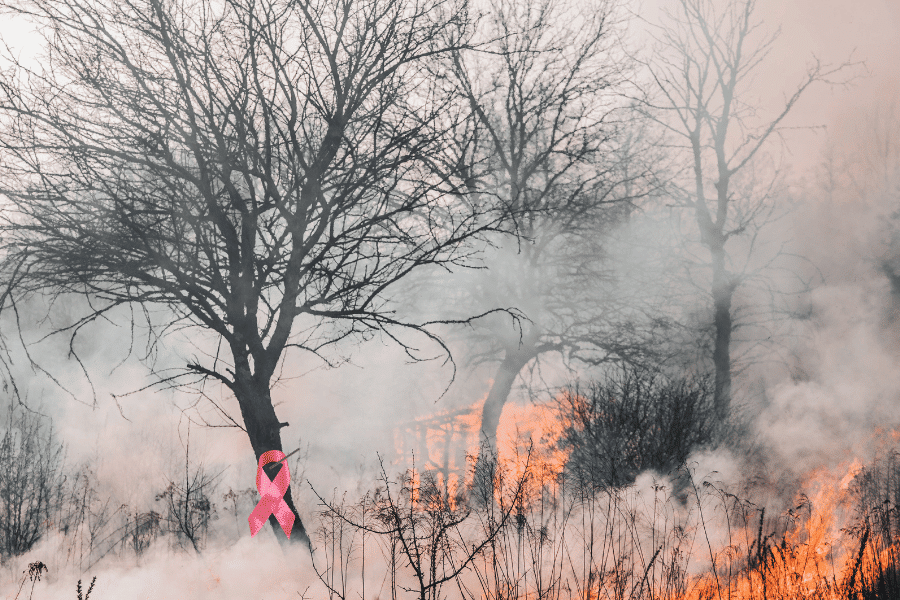
    Finally, because of climate change, we are also seeing an increase in wildfires due to extreme and sustained drought conditions and wildfires too, ultimately leading to increases in cancer. 

    For instance, cancer is the number one cause of death in the fire fighting industry, accounting for 70% of all deaths.  

    Where there’s smoke, there’s cancer?

    Harvard University researcher Mary Johnson told the publication E&E News this year that potentially harmful chemicals are released every time a structure burns.

    “Plumbing has copper and lead in it,” she stated. “Paint has toxic chemicals. Electronics, plastics have really nasty stuff in them. All these chemicals we don’t think of occurring in a wildland fire are now part of the smoke.”

    So what can we do? 

    In preparation for all potential disasters, hospitals could have a disaster plan to help ensure that patients receive any and all important data during a future disaster. For example, the United States Department of Health and Human services has released a study on the efficacy of electronic health records during disasters. If a storm is forecasted in a region, an electronic emergency chart could be made for each patient. This plan could also come in the form of new infrastructure or mechanisms meant to keep the hospital safe from floods or fires. 

    Patients should also be provided with alternate ways to access healthcare information in order to connect with local healthcare teams, and the American Association of Colleges of Nursing recently added climate change education to the list of required skills for nursing education programs. 

    Finally, past cancer survivors of disasters have suggested that countries like Puerto Rico can be more prepared and adaptable in terms of exploring alternatives like renewable energy, that aren’t as susceptible to power outages from storms. 

    As the climate deteriorates, our responsibility in pushing back against the climate crisis will expand in multiple ways. 

    Our health and the health of the people we love will depend on the health of our planet. That means that it is our responsibility to protect ourselves, our loved ones and all of those currently battling cancer from climate change.


    Questions to consider:

    1. What connection is there between climate change and cancer rates?

    2. What can be done to keep people from dying of climate-change related cancer?

    3. What, if anything, can you do to help cool down our planet?


    Source link

  • KU researchers publish guidelines to help responsibly implement AI in education

    KU researchers publish guidelines to help responsibly implement AI in education

    This story originally appeared on KU News and is republished with permission.

    Key points:

    Researchers at the University of Kansas have produced a set of guidelines to help educators from preschool through higher education responsibly implement artificial intelligence in a way that empowers teachers, parents, students and communities alike.

    The Center for Innovation, Design & Digital Learning at KU has published “Framework for Responsible AI Integration in PreK-20 Education: Empowering All Learners and Educators with AI-Ready Solutions.” The document, developed under a cooperative agreement with the U.S. Department of Education, is intended to provide guidance on how schools can incorporate AI into its daily operations and curriculum.

    Earlier this year, President Donald Trump issued an executive order instructing schools to incorporate AI into their operations. The framework is intended to help all schools and educational facilities do so in a manner that fits their unique communities and missions.

    “We see this framework as a foundation,” said James Basham, director of CIDDL and professor of special education at KU. “As schools consider forming an AI task force, for example, they’ll likely have questions on how to do that, or how to conduct an audit and risk analysis. The framework can help guide them through that, and we’ll continue to build on this.”

    The framework features four primary recommendations.

    • Establish a stable, human-centered foundation.
    • Implement future-focused strategic planning for AI integration.
    • Ensure AI educational opportunities for every student.
    • Conduct ongoing evaluation, professional learning and community development.

    First, the framework urges schools to keep humans at the forefront of AI plans, prioritizing educator judgment, student relationships and family input on AI-enabled processes and not relying on automation for decisions that affect people. Transparency is also key, and schools should communicate how AI tools work, how decisions are made and ensure compliance with student protection laws such as the Individuals with Disabilities Education Act and Family Education Rights and Privacy Act, the report authors write.

    The document also outlines recommendations for how educational facilities can implement the technology. Establishing an AI integration task force including educators, administrators, families, legal advisers and specialists in instructional technology and special education is key among the recommendations. The document also shares tips on how to conduct an audit and risk analysis before adoption and consider how tools can affect student placement and identification and consider possible algorithmic error patterns. As the technologies are trained on human data, they run the risk of making the same mistakes and repeating biases humans have made, Basham said.

    That idea is also reflected in the framework’s third recommendation. The document encourages educators to commit to learner-centered AI implementation that considers all students, from those in gifted programs to students with cognitive disabilities. AI tools should be prohibited from making final decisions on IEP eligibility, disciplinary actions and student progress decisions, and mechanisms should be installed that allow for feedback on students, teachers and parents’ AI educational experiences, the authors wrote.

    Finally, the framework urges ongoing evaluation, professional learning and community development. As the technology evolves, schools should regularly re-evaluate it for unintended consequences and feedback from those who use it. Training both at implementation and in ongoing installments will be necessary to address overuse or misuse and clarify who is responsible for monitoring AI use and to ensure both the school and community are informed on the technology.

    The framework was written by Basham; Trey Vasquez, co-principal investigator at CIDDL, operating officer at KU’s Achievement & Assessment Institute and professor of special education at KU; and Angelica Fulchini Scruggs, research associate and operations director for CIDDL.

    Educators interested in learning more about the framework or use of AI in education are invited to connect with CIDDL. The center’s site includes data on emergent themes in AI guidance at the state level and information on how it supports educational technology in K-12 and higher education. As artificial intelligence finds new uses and educators are expected to implement the technology in schools, the center’s researchers said they plan to continue helping educators implement it in ways that benefit schools, students of all abilities and communities.

    “The priority at CIDDL is to share transparent resources for educators on topics that are trending and in a way that is easy to digest,” Fulchini Scruggs said. “We want people to join the community and help them know where to start. We also know this will evolve and change, and we want to help educators stay up to date with those changes to use AI responsibly in their schools.”

    Latest posts by eSchool Media Contributors (see all)

    Source link

  • The silent hero of modern learning

    The silent hero of modern learning

    Key points:

    Education is undergoing a profound digital transformation. From immersive AR/VR learning in science labs to hybrid classrooms, real-time collaboration platforms, and remote learning at scale, how students learn and educators teach is changing rapidly. These modern, data-intensive applications require far more than basic connectivity. They demand high bandwidth, ultra-low latency, and rock-solid reliability across every corner of the campus.

    In other words, the minimum requirement today is maximal connectivity. And this is where Optical LAN (OLAN) becomes a game changer.

    The challenge with traditional LANs

    Most schools and universities still rely on traditional copper-based local area networks (LANs). But these aging systems are increasingly unable to meet the demands of today’s digital education environments. Copper cabling comes with inherent speed and distance limitations, requiring rip-and-replace upgrades every 5 to 7 years to keep up with evolving needs.

    To increase network capacity, institutions must replace in-wall cables, switches, and other infrastructure–an expensive, time-consuming and highly disruptive process. Traditional LANs also come with large physical footprints, high maintenance requirements, and significant energy consumption, all of which add to their total cost of ownership (TCO).

    In a world that’s demanding smarter, faster, and greener networks, it’s clear that copper no longer makes the grade.

    Built for the campus of the future

    Optical LAN is a purpose-built solution for both in-campus and in-building connectivity, leveraging the superior performance of fiber optic infrastructure. It addresses the limitations of copper LANs head-on and offers significant improvements in scalability, energy efficiency and cost-effectiveness.

    Here’s why it’s such a compelling option for education networks:

    1. Massive capacity and seamless scalability

    Fiber offers virtually unlimited bandwidth. Today’s OLAN systems can easily support speeds of 10G and 25G, with future-readiness for 50G and even 100G. And unlike copper networks, education IT managers and operators don’t need to replace the cabling to upgrade; they simply add new wavelengths (light signals) to increase speed or capacity. This means educational institutions can scale up without disruptive overhauls.

    Better yet, fiber allows for differentiated quality of service on a single line. For example, a school can use a 1G wavelength to connect classrooms and dormitories, while allocating 10G bandwidth to high-performance labs. This flexibility is ideal for delivering customized connectivity across complex campus environments.

    New School Safety Resources

    2. Extended reach across the entire campus

    One of the standout features of OLAN is its extended reach. Fiber can deliver high-speed connections over distances up to 20–30 km without needing signal boosters or additional switches. This makes it perfect for large campuses where buildings like lecture halls, research centers, dorms, and libraries are spread out over wide areas. In contrast, copper LANs typically max out at a few dozen meters, requiring more switches, patch panels and costly infrastructure.

    With OLAN, a single centralized network can serve the entire campus, reducing complexity and improving performance.

    3. Energy efficiency and sustainability

    Sustainability is top-of-mind for many educational institutions, and OLAN is a clear winner here. Fiber technology is up to 8 times more energy-efficient than other wired or wireless options. It requires fewer active components, generates less heat and significantly reduces the need for cooling.

    Studies show that OLAN uses up to 40 percent less power than traditional LAN systems. This translates into lower electricity bills and a reduced carbon footprint–important factors for schools pursuing green building certifications.

    In fact, a BREEAM (Building Research Establishment Environmental Assessment Method) assessment conducted by ENCON found that deploying OLAN improved BREEAM scores by 7.7 percent, particularly in categories like management, energy, health and materials. For perspective, adding solar panels typically improves BREEAM scores by 5-8 percent.

    4. Simpler, smarter architecture

    Optical LAN significantly simplifies the network design. Instead of multiple layers of LAN switches and complex cabling, OLAN relies on a single centralized switch and slim, passive optical network terminals (ONTs). A single fiber cable can serve up to 128 endpoints, using a fraction of the physical space required by copper bundles.

    This lean architecture means:

    • Smaller cable trays and no heavy-duty racks
    • Faster installation and easier maintenance
    • Fewer points of failure and lower IT footprint

    The result? A network that’s easier to manage, more reliable, and built to grow with an education institution’s needs.

    5. Unmatched cost efficiency

    While fiber was once seen as expensive, the economics have shifted. The Association for Passive Optical LAN (APOLAN) found that POL saved 40 percent of the cost for a four-story building in 2022. Even more, Optical LAN now delivers up to 50 percent lower TCO over a 5-year period compared to traditional LAN systems, according to multiple industry studies.

    Cost savings are achieved through:

    • Up to 70 percent less cabling
    • Fewer switches and active components
    • Reduced energy and cooling costs
    • Longer lifecycle as fiber lasts more than 50 years

    In essence, OLAN delivers more value for less money, which is a compelling equation for budget-conscious education institutions.

    The future is fiber

    With the rise of Wi-Fi 7 and ever-increasing demands on network infrastructure, even wireless connectivity depends on robust wired backhaul. Optical LAN ensures that Wi-Fi access points have the bandwidth they need to deliver high-speed, uninterrupted service.

    And as educational institutions continue to adopt smart building technologies, video surveillance, IoT devices, and remote learning platforms, only fiber can keep up with the pace of change.

    Optical LAN empowers educational institutions to build networks that are faster, greener, simpler, and future-proof. With growing expectations from students, faculty, and administrators, now is the perfect time to leave legacy limitations behind and invest in a fiber-powered future.

    After all, why keep replacing copper every few years when operators can build it right once?

    Latest posts by eSchool Media Contributors (see all)

    Source link

  • Higher Education Inquirer : College Meltdown Fall 2025

    Higher Education Inquirer : College Meltdown Fall 2025

    The Fall 2025 semester begins under intensifying pressure in U.S. higher education. Institutions are responding to long-term changes in enrollment, public funding, demographics, technology, and labor markets. The result is a gradual disassembly of parts of the postsecondary system, with ongoing layoffs, program cuts, and institutional restructuring across both public and private sectors.

    In a stunning turn, the U.S. Department of Education has undergone a massive downsizing, slashing nearly half its workforce as part of the Trump administration’s push to dismantle the agency entirely. Education Secretary Linda McMahon framed the move as a “final mission” to restore state control and eliminate federal bureaucracy, but critics warn of chaos for vulnerable students and families who rely on federal programs. With responsibilities like student loans, Pell Grants, and civil rights enforcement now in limbo, Higher Education Institutions face a volatile landscape. The absence of centralized oversight has accelerated the fragmentation of standards, funding, and accountability—leaving colleges scrambling to navigate a patchwork of state policies and shrinking federal support.

    AI Disruption: Academic Integrity and Graduate Employment 

    Artificial Intelligence has rapidly reshaped higher education, introducing both powerful tools and profound challenges. On campus, AI-driven platforms like ChatGPT have become ubiquitous—92% of students now use them, and 88% admit to deploying AI for graded assignments. This surge has triggered a spike in academic misconduct, with detection systems struggling to keep pace and disproportionately flagging non-native English speakers Meanwhile, the job market for graduates is undergoing a seismic shift. Entry-level roles in tech, finance, and consulting are vanishing as companies automate routine tasks once reserved for junior staff. AI-driven layoffs have already claimed over 10,000 jobs in 2025 alone, and some experts predict that up to half of all white-collar entry-level positions could be eliminated within five years. For recent grads, this means navigating a landscape where degrees may hold less weight, and adaptability, AI fluency, and human-centered skills are more critical than ever.

    Unsustainable Student Loan Debt and Federal Funding 

    A recent report from the American Enterprise Institute (AEI) highlights the depth of the crisis: more than 1,000 colleges could lose access to federal student aid based on current student loan repayment rates—if existing rules were fully enforced. The findings expose systemic failures in accountability and student outcomes. Many of these colleges enroll high numbers of low-income students but leave them with unsustainable debt and limited job prospects.

    Institutional Cuts and Layoffs Across the Country

    Job losses and cost reductions are increasing across a range of universities.

    Stanford University is cutting staff due to a projected $200 million budget shortfall.

    University of Oregon has announced budget reductions and academic restructuring.

    Michigan State University is implementing layoffs and reorganizing departments.

    Vanderbilt University Medical Center is eliminating positions to manage healthcare operating costs.

    Harvard Kennedy School is reducing programs and offering early retirement.

    Brown University is freezing hiring and reviewing academic offerings.

    Penn State University System is closing three Commonwealth Campuses.

    Indiana public colleges are merging administrative functions and reviewing low-enrollment programs.

    These actions affect not only employees and students but also local communities and regional labor markets.

    Enrollment Decline and Demographic Change

    Undergraduate enrollment has fallen 14.6% since Fall 2019, according to the National Student Clearinghouse Research Center. Community colleges have experienced the largest losses, with some regions seeing more than 20% declines.

    The “demographic cliff” tied to declining birth rates is now reflected in enrollment trends. The Western Interstate Commission for Higher Education (WICHE) projects a 15% decline in high school graduates between 2025 and 2037 in parts of the Midwest and Northeast.

    Aging Population and Shifts in Public Spending

    The U.S. population is aging. By 2030, all baby boomers will be over 65. The number of Americans aged 80 and older is expected to rise from 13 million in 2020 to nearly 20 million by 2035. Public resources are being redirected toward Social Security, Medicare, and elder care, placing higher education in direct competition for limited federal and state funds.

    State-Level Cuts to Higher Education Budgets

    According to the State Higher Education Executive Officers Association (SHEEO), 28 states saw a decline in inflation-adjusted funding per student in FY2024.

    The California State University system faces a $400 million structural deficit.

    West Virginia has reduced academic programs in favor of workforce-focused realignment.

    Indiana has ordered cost-cutting measures across public campuses.

    These reductions are leading to fewer courses, increased workloads, and, in some cases, higher tuition.

    Closures and Mergers Continue

    Since 2020, more than 100 campuses have closed or merged, based on Education Dive and HEI data. In 2025, Penn State began closing three Commonwealth Campuses. A number of small private colleges—especially those with enrollments under 1,000 and limited endowments—are seeking mergers or shutting down entirely.

    International Enrollment Faces Obstacles

    The Institute of International Education (IIE) reports a 12% decline in new international student enrollment in Fall 2024. Contributing factors include visa delays and tighter immigration rules. Students from India, Nigeria, and Iran have experienced longer wait times and increased rejection rates. Graduate programs in STEM and business are particularly affected.

    Increased Surveillance and Restrictions on Campus Speech

    Data from FIRE and the Electronic Frontier Foundation (EFF) show increased use of surveillance tools on campuses since 2023. At least 15 public universities now use facial recognition, social media monitoring, or geofencing. State laws in Florida, Texas, and Georgia have introduced new restrictions on protests and diversity programs.

    Automated Education Expands

    Online Program Managers (OPMs) such as 2U, Kaplan, and Coursera are running over 500 online degree programs at more than 200 institutions, enrolling more than 1.5 million students. These programs often rely on AI-generated content and automated grading systems, with minimal instructor interaction.

    Research from the Century Foundation shows that undergraduate programs operated by OPMs have completion rates below 35%, while charging tuition comparable to in-person degrees. Regulatory efforts to improve transparency and accountability remain stalled.

    Oversight Gaps Remain

    Accrediting agencies continue to approve closures, mergers, and new credential programs with limited transparency. Institutions are increasingly expanding short-term credential offerings and corporate partnerships with minimal external review.

    Cost Shifts to Students, Faculty, and Communities

    The ongoing restructuring of higher education is shifting costs and risks onto students, employees, and communities. Students face rising tuition, fewer available courses, and increased reliance on loans. Faculty and staff encounter job insecurity and heavier workloads. Outside the ivory tower, communities will lose access to educational services, cultural events, and local employment opportunities tied to campuses.

    The Higher Education Inquirer will continue to report on the structural changes in U.S. higher education—grounded in data, public records, and the lived experiences of those directly affected.

    Sources:

    National Student Clearinghouse Research Center, Western Interstate Commission for Higher Education (WICHE), U.S. Census Bureau, State Higher Education Executive Officers Association (SHEEO), Institute of International Education (IIE), Foundation for Individual Rights and Expression (FIRE), Electronic Frontier Foundation (EFF), Government Accountability Office (GAO), The Century Foundation, Stanford University, University of Oregon, Penn State University System, Harvard Kennedy School, Vanderbilt University Medical Center, Education Dive Higher Ed Closures Tracker, American Enterprise Institute (AEI).

    Source link

  • Ty Hawkins | Diverse: Issues In Higher Education

    Ty Hawkins | Diverse: Issues In Higher Education

    Dr. Ty HawkinsTy Hawkins has been named associate dean for academic programs at Oklahoma State University. He most recently held the position of director for the University of Central Arkansas’ School of Language and Literature.

    In his new role, Hawkins will be responsible for overseeing curriculum development, program assessment and accreditation processes for OSU’s largest academic college. 

    A native of Missouri, Hawkins earned degrees in English and Spanish from Saint Louis University and Westminster College. He is a scholar of American literature who specializes in 20th- and 21st-century texts.

    Source link

  • Complaints About Federal Student Aid Office Rise Sharply

    Complaints About Federal Student Aid Office Rise Sharply

    Photo illustration by Justin Morrison/Inside Higher Ed | Marvin Joseph/The Washington Post/Getty Images | MauMyHaT/iStock/Getty Images | subtik/E+/Getty Images

    Complaints about the Office of Federal Student Aid’s operations have increased significantly over the past few months, according to the latest edition of a survey from the National Association of Student Financial Aid Administrators. Challenges that were once just kinks behind the scenes are evolving to become student-facing issues on the front line, the association says.

    The share of institutions reporting disruptions to communication, responsiveness or processing timelines rose from 59 percent in May to 72 percent in July. Meanwhile, the share of aid offices reporting student confusion about the process increased from 32 percent to 51 percent.

    The report, which is based on responses from financial aid officers at more than 500 NASFAA member institutions across the country, builds upon a similar survey conducted in May. It shows rising frustration with the FSA, despite the agency’s attempt to rehire about 50 of the more than 300 employees laid off earlier this year.

    “I wasn’t overly surprised” by the data, said NASFAA president Melanie Storey. “But it was largely a disappointment that the trajectory is moving in the wrong direction.”

    She added that the new loan caps and repayment plan changes detailed in President Trump’s One Big Beautiful Bill Act could compound the damage, creating long-term consequences for college attainment rates.

    Given the “fissures and cracks around trust in higher education, we need to eliminate barriers and support students clearly and consistently—and that includes helping them figure out how they’re going to finance their higher education,” Storey said. “If this trajectory continues, I’m really concerned about the decisions that students and families are going to be able to make to enroll in postsecondary education.”

    An Education Department official called the NASFAA report inaccurate and accused the organization of “peddling a false narrative to preserve the status quo.”

    “It is an embarrassment for NASFAA to release a ‘survey’ that blatantly parrots falsehoods and is not representative of the higher education community nor the American people’s overwhelming charge for change,” deputy press secretary Ellen Keast said in an email to Inside Higher Ed. “While NASFAA stands idly by ready to see us fail, the Trump Administration has just launched the earliest FAFSA form ever, which they are well aware of and decided to ignore.”

    Storey responded that NASFAA has tried repeatedly to partner with the administration in their “shared goal of serving students,” applauding efforts such as FAFSA beta testing.

    But to dismiss the survey results as “fabricated or political undermines the expertise of those working directly with students every day, eager to deliver on the promise of postsecondary education, and shows that the administration is not interested in working with experts in the field to achieve the best results for students; instead, it is focused on advancing its own agenda,” she said.

    Worsening Outcomes

    It’s been an eventful few months for the FSA. Mass layoffs throughout the department, first announced in March, quickly faced legal challenges; in May, a district court temporarily blocked the executive action. But any hopes that the staffing shortage would be resolved were squashed when the Supreme Court overturned the lower court’s ruling in July. And while the justices have yet to hear the full case or issue a final ruling, the order allows Education Secretary Linda McMahon to proceed with the pink slips.

    Storey said that some of the increased frustration and concern higher ed officials expressed in the survey may be related to timing; the district court ruling spurred cautious optimism in May, which had largely tanked by July. Similarly, the repercussions of staffing shortages were not necessarily evident in May but are now becoming clear. She also noted that the mounting discontent could simply be a reflection of the cyclical nature of student aid and the imminent start of the new academic year.

    Either way, the survey suggests that FSA operations are flagging, and many NASFAA members say it’s preventing them from properly processing aid. For example, 63 percent of institutions that have submitted their E-App—a form that must be completed and approved in order to receive federal aid—said their submission had yet to be processed in July.

    Department officials argue that this data is biased due to NASFAA’s survey method. They point specifically to the sample size, saying that the 500 institutions represented are predominantly nonprofit or public institutions, reflecting only a sliver of the more than 5,000 that FSA works with—and are the ones most likely to harbor anti-Trump sentiments.

    The department also described the survey’s questions as biased toward the negative and said it was conducted just as the department finished updating its Partner Connect Portal to address various complaints, meaning the results don’t accurately reflect the new changes.

    But Storey stood by her view that most of the challenges financial aid offices face today are the same as those they reported in May, only worse, and with longer delays in response time.

    For example, previous Inside Higher Ed reporting shows that when students hit a wall and cannot log in to the FAFSA application portal, college advisers struggle to reach the central processing system that manages user IDs. While a department spokesperson said all help lines remain fully open, multiple college and NASFAA representatives say they have been unable to get through at certain times.

    The latest survey shows this is still a major problem. More than half of institutions reported issues with federal call centers, and more than 40 percent cited problems with the National Student Loan Data System. In addition, over a third flagged disruptions with student loan servicing. Collectively, the NASFAA report said, these failures affect colleges’ ability to resolve aid issues for students in real time.

    Once the delays start to hit students—which is happening more and more often, according to NASFAA’s report—it could leave them without access to loans and therefore unable to pay their bills and stay enrolled. Although colleges can grant students extensions for tuition payments or on-campus housing fees, they can’t change when off-campus rent or childcare payments are due. Situations like these often force students to take a job and attempt to pay off their debt with some college but no degree.

    So unless FSA addresses its shortcomings, Storey said, the impact could be far-reaching.

    “It’s a compounding of issues and uncertainties that I think could have a long-lasting and significant impact on postsecondary enrollment and financing,” she said.

    Source link

  • 6,000 Student Visas Revoked

    6,000 Student Visas Revoked

    Photo illustration by Justin Morrison/Inside Higher Ed | gradisca and Uladzimir Zuyeu/iStock/Getty Images

    The State Department has revoked 6,000 student visas so far this year, Fox News reported along with The Washington Post.

    Of that group, 4,000 were revoked due to crimes, including assault, driving under the influence and burglary. However, a department spokesperson told the Post that the students whose visas had been revoked “either faced arrest or charges,” but the spokesperson didn’t specify whether they were convicted.

    The spokesperson also said that between 200 and 300 visas were revoked due to “support for terrorism.” President Donald Trump has previously labeled pro-Palestinian student protesters as terrorist sympathizers and has targeted international students over their pro-Palestinian activism.

    The Post article does not address whether these students will have to stop their studies and leave the U.S. A visa—the stamp that permits an individual to enter the U.S.—is different from one’s nonimmigrant status, which refers to whether they are lawfully in the country, something immigration experts stressed amid a slew of student visa revocations in March and April.

    Source link