This audio is auto-generated. Please let us know if you have feedback.
Dive Brief:
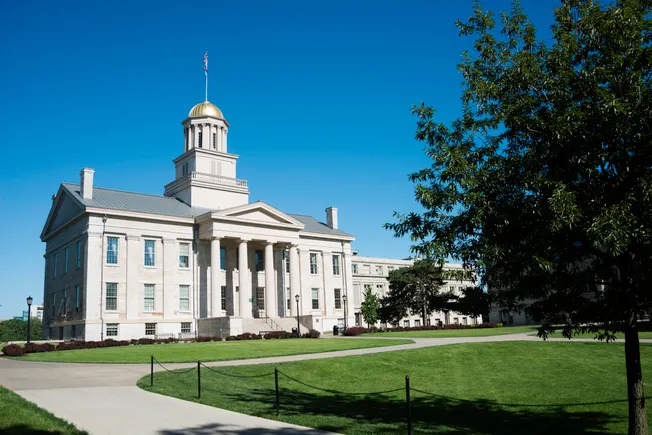
The University of Iowa has assembled a massive universitywide committee to explore new revenue opportunities and ways to boost efficiency, the public institution announced last week.
Dubbed “Resparc”—short for Revenue and Efficiencies Strategic Plan Action and Resource Committee —the group includes nearly 100 faculty, staff and officials from 35 units across the institution.
Subcommittees will explore specific areas such as philanthropy, academic programs and financial operations.Those teams will develop proposals for increasing revenue and improving operations for Resparc’s leadership and ultimately for University of Iowa’s president and provost.
Dive Insight:
The university framed its new initiative as forward-looking, meant to ensure University of Iowa “maintains its strong financial trajectory for years to come,” rather than having to wrestle reactively with challenges as they happen.
“By launching this effort from a position of financial health, the university will be able to build upon its success at a time when higher education is navigating significant disruption, from the anticipated demographic enrollment cliff to a decline in public trust and growing financial constraints,” the university said in its announcement.
Iowa’s flagship university is growing. By fall 2024, its total faculty and staff had increased 5.1% year over year to 27,795 employees, while enrollment grew 2.4% to 32,199 students.
The university’s total assets andrevenues have also been steadily rising in recent years. In fiscal 2024, its operating income — which does not include state appropriations, certain grants and contacts, investment income or gifts — stood at $36.8 million. The positive operating income stands in contrast to that of the many public universities with operating losses before those sources of revenue are factored in.
In Iowa specifically, the number of high school graduates is projected to decline by 4% from 2023 to 2041, according to the latest estimates from Western Interstate Commission for Higher Education.
University of Iowahas also seen its expenses jump along with the rest of the higher ed world, adding new financial constraints. Between fiscal years 2022 and 2024, its total operating expenses rose 15.7% to $5 billion.
The Trump administration’s aggressive moves to limit federal research funding could pose additional pressure. In 2024, University of Iowa brought in $315 million in federal research funding. The Trump administration has now terminated grants to the university worth roughly $14.3 million and having $9.7 million still left to be paid out, according to a Center for American Progress analysis of U.S. Department of the Treasury data.
Against that backdrop, many institutions — public and private — are cutting back spending and shrinking their employee base, both through layoffs and attrition. But University of Iowa officials say Resparc is different.
In a FAQ page, the university said the efficiency-seeking efforts are “a proactive planning effort, not a response to a budget crisis.” It states that the goal “is to find ways to work smarter, improve processes, reduce administrative burdens, and better leverage our collective resources and technology.”
Resparc is led by Emily Campbell, associate vice president for operations and decision support, and Sara Sanders, dean of the university’s liberal arts and sciences college.
Campbell and engineering dean Ann McKenna oversee the initiative’s revenue teams, while Sanders and Peter Matthes, vice president for external relations and senior advisor to University of Iowa President Barbara Wilson, oversee the efficiency group.
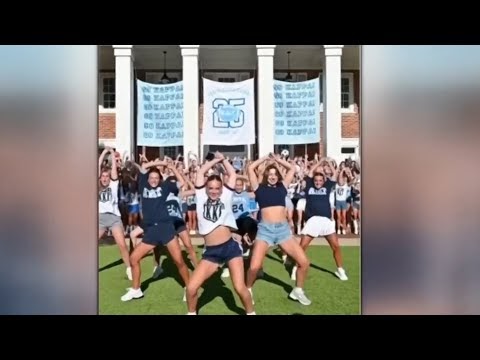
At flagship universities across the United States, predominantly white sororities remain popular institutions. They offer young women a ready-made community, social capital, and access to alumni networks. But behind this appeal lies a system that reinforces race, class, and gender hierarchies—at a time when women’s rights are being rolled back nationally.
Race and Class Tradition: Who Belongs, Who Does Not
Sororities are not only racially homogeneous but also heavily skewed by class. Recruitment practices, legacy ties, and financial obligations ensure that sorority life remains a domain for the affluent.
At Princeton University, 77% of sorority members are white, compared with 47% of the student body overall.
Socioeconomic trends are even starker. In 1999, 31% of Greek-affiliated students at Princeton identified as middle-class, but by 2024 that number had dropped to 14%. Over the same period, those identifying as upper-class doubled from 14% to 28%.
At the University of Mississippi, 48% of high school graduates in the state were Black in 2021, but only 8% of first-year students at Ole Miss were Black. White-dominated Greek life continues to thrive in this climate of underrepresentation.
A multi-campus study found 72% of Greek members identified as middle- or upper-middle class, compared with just 6% from low-income families.
These figures reveal how sororities work to reproduce the advantages of affluent white families. Membership offers exclusive networking, internships, and social connections—often denied to working-class students, students of color, and first-generation college students.
Gender Tradition
Sororities also sustain a vision of femininity rooted in conformity, beauty standards, and heteronormativity. Social events are structured around fraternities, placing men as hosts and leaders, while sorority women serve as companions or supporters.
While some sororities claim empowerment through philanthropy and sisterhood, the cultural framework continues to emphasize women’s value through appearance and deference, not leadership. This pattern reflects broader societal pressures to restore traditional gender roles.
The Broader Context: The Right to Choose Lost
The Supreme Court’s 2022 reversal of Roe v. Wade has had profound consequences for women in the U.S.
More than 25 million women of reproductive age now live in states with abortion bans or severe restrictions.
States with the most restrictive abortion laws show a 7% increase in maternal mortality overall, and 51% higher rates where laws require procedures only from licensed physicians.
The loss of Roe’s protections especially harms women of color and low-income women, who already face barriers to healthcare and mobility.
Against this backdrop, sororities’ popularity at flagship universities is revealing. These organizations celebrate conformity to class privilege and traditional gender expectations, while millions of women outside those circles see their reproductive freedoms curtailed. The alignment of sorority culture with conservative visions of femininity makes them more than relics of tradition—they become cultural reinforcers of the very inequalities deepening in U.S. society.
Why Class Matters
Social class is at the heart of the issue. Sororities provide access to powerful networks that translate into internships, job placements, and lifelong advantages. These networks overwhelmingly serve the wealthy and exclude those already disadvantaged by race, class, and gender.
At a time when women’s bodily autonomy is under political attack, the popularity of predominantly white sororities signals how elite spaces continue to consolidate privilege for a narrow group of women—while the majority face shrinking freedoms and growing precarity.
This audio is auto-generated. Please let us know if you have feedback.
Dive Brief:
The U.S. Department of State has so far revoked over 6,000 international student visas in 2025 over allegations that the students had overstayed their visas or broken laws,an agency spokesperson said via email Tuesday.
The spokesperson attributed about 4,000 of the visa revocations to law violations, such as alleged support for terrorism, assault, driving under the influence, and burglary.
The Trump administration’s attacks on international students have contributed uncertainty to the higher education landscape. International enrollment could plummet by 150,000 students this fall, which would amount to a 15% overall decline, according to a recent analysis from NAFSA: Association of International Educators.
Dive Insight:
The State Department’s news, which was first reported by Fox News, suggests that the Trump administration is continuing to use an arsenal of tactics against international students, including revoking their visas over claims they support terrorist groups.
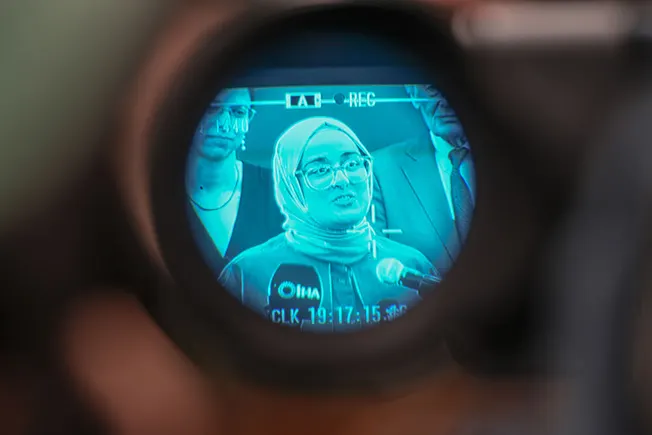
Those allegations have been at the heart of several high-profile cases where the Trump administration has sought to deport international students or green card holders. The U.S. Department of Homeland Security, for instance, claimed that Tufts University doctoral student Rümeysa Öztürk had engaged in activities “in support of Hamas” when the administration detained her and sought her deportation in March.
However, the State Department had determined days before she was detained that the government lacked evidence that she had made public statements in support of a terrorist group, The Washington Post reported in April.
In a May court ruling, a federal judge said the only specific reason DHS cited to justify Öztürk’s detention was her co-byline on a student newspaper op-ed. The piece criticized Tufts’ administration over its response to student government resolutions for the institution to divest from Israel and “acknowledge the Palestinian genocide.”
Öztürk, who has not been charged with a crime, was released in May while her case proceeds.
The State Department spokesperson said the agency has revoked roughly 200 to 300 student visas over terrorism-related claims. The spokesperson said the actions were taken under a section of the Immigration and Nationality Act that bars people from receiving visas if they have engaged in or support terrorist activities.
The spokesperson did not immediately reply to questions asking for further details about the terrorism-related allegations or whether the students who faced visa revocations were convicted of the alleged crimes.
The Foundation for Individual Rights and Expression filed a lawsuit against the Trump administration earlier this monthover its use of the Immigration and Nationality Act to attempt to deport student visa holders. The complaint alleges that the federal government has infringed on students’ First Amendment and due process rights by using the statute to target their speech.
The Trump administration has taken other actions to tighten international student enrollment as well. For one, a State Department policy announced June 18 requires student visa applicants to make their social media accounts public so government agents can review them.
Consular officers have been asked to review the profiles for “hostile attitudes” toward the U.S. — a vague mandate that “creates significant discretionary power in visa determinations that will no doubt lead to inconsistencies in implementation,” according to a June post from NAFSA.
IFP Survey on Upcoming Immigration Rules Affecting H-1B, F-1, J-1 and OPT
The Institute for Progress (IFP) is conducting an H-1B employer survey with economist Michael Clemens (George Mason University/Peterson Institute). We know this topic is of significant interest for many CUPA-HR leaders and encourage you to forward this link to those with information needed to complete the survey.
The survey is designed to document how upcoming immigration rulemakings could affect universities and other employers, including proposals to:
eliminate “duration of status” admissions for F-1 and J-1 visa holders,
institute a weighted lottery for H-1B petitions,
rescind Optional Practical Training (OPT), and
revise required wage levels for H-1B filings.
Two of these proposals — ending duration of status for F-1/J-1 holders and creating a weighted H-1B lottery — have already cleared the Office of Information and Regulatory Affairs (OIRA) review and could be published imminently; the others are anticipated.
By generating a strong university response, IFP and its partners (including the U.S. Chamber of Commerce and American Immigration Lawyers Association) aim to provide data showing the costs and negative impacts of these rules. The survey closes September 8, 2025, though the deadline may be extended depending on the federal comment period.
IFP Survey on Upcoming Immigration Rules Affecting H-1B, F-1, J-1 and OPT
The Institute for Progress (IFP) is conducting an H-1B employer survey with economist Michael Clemens (George Mason University/Peterson Institute). We know this topic is of significant interest for many CUPA-HR leaders and encourage you to forward this link to those with information needed to complete the survey.
The survey is designed to document how upcoming immigration rulemakings could affect universities and other employers, including proposals to:
eliminate “duration of status” admissions for F-1 and J-1 visa holders,
institute a weighted lottery for H-1B petitions,
rescind Optional Practical Training (OPT), and
revise required wage levels for H-1B filings.
Two of these proposals — ending duration of status for F-1/J-1 holders and creating a weighted H-1B lottery — have already cleared the Office of Information and Regulatory Affairs (OIRA) review and could be published imminently; the others are anticipated.
By generating a strong university response, IFP and its partners (including the U.S. Chamber of Commerce and American Immigration Lawyers Association) aim to provide data showing the costs and negative impacts of these rules. The survey closes September 8, 2025, though the deadline may be extended depending on the federal comment period.
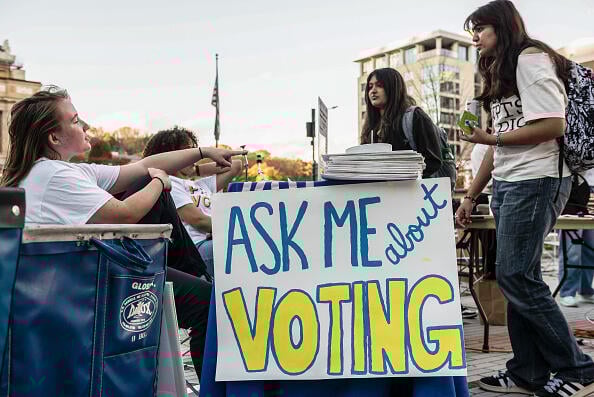
Students at the University of Pittsburgh participated in 2024 election activities.
Aaron Jackendoff/SOPA Images/LightRocket via Getty Images
The Department of Education released guidance Tuesday discouraging colleges from using Federal Work-Study funds to pay students to work on voter registration efforts and other activities it deems political.
The department announced the change to work study provisions in a Dear Colleague letter signed by acting assistant ED secretary Christopher McCaghren.
“Jobs involving partisan or nonpartisan voter registration, voter assistance at a polling place or through a voter hotline, or serving as a poll worker—whether this takes place on or off campus—involve political activity because these activities support the process of voting which is a quintessential political activity whereby voters formally support partisan or nonpartisan political candidates by casting ballots,” McCaghren wrote.
He emphasized in the letter that ED “encourages institutions to employ students in jobs that align with real-world work experience related to a student’s course of study whenever possible.”
Education Secretary Linda McMahon echoed that sentiment in a Tuesday social media post, writing that the department is “done funding political activism on college campuses!” She added, “Under the Trump Administration, taxpayer dollars will be used to prepare students for the workforce.”
McCaghren’s letter also warned colleges about “aiding and abetting voter fraud.”
While institutions are required to make a “good faith effort to distribute voter registration forms to students,” they should refrain from distributing such materials to students they believe are ineligible to vote in state or federal elections, according to the letter.
The move comes as President Donald Trump has announced plans to overhaul how elections are conducted before the upcoming midterms next year, including barring certain voting machines and mail-in voting, though he does not have the authority to make such changes.
Every educator hopes to instill a lifelong love of learning within their students. We strive to make each lesson engaging, while igniting a sense of curiosity, wonder, and discovery in every child.
Unfortunately, we don’t always succeed, and recent reports suggest that today’s students are struggling to connect with the material they’re taught in school–particularly when it comes to STEM. While there are many potential culprits behind these numbers (shortened attention spans, the presence of phones, dependency on AI, etc.), educators should still take a moment to reflect and strategize when preparing a new lesson for their class. If we truly want to foster a growth mindset within our students, we need to provide lessons that invite them to embrace the learning process itself.
One way to accomplish this is through gamification. Gamification brings the motivational elements of games into your everyday lessons. It increases student engagement, builds perseverance, and promotes a growth mindset. When used strategically, it helps learners take ownership of their progress and encourages creativity and collaboration without sacrificing academic rigor.
Here are just 4 ways that educators can transform their classroom through playful gamification:
Introduce points and badges: Modern video games like Pokémon and Minecraft frequently use achievements to guide new players through the gaming process. Teachers can do the same by assigning points to different activities that students can acquire throughout the week. These experience points can also double as currency that students can exchange for small rewards, such as extra free time or an end-of-year pizza party.
Create choice boards: Choice boards provide students with a range of task options, each with a point value or challenge level. You can assign themes or badges for completing tasks in a certain sequence (e.g., “complete a column” or “complete one of each difficulty level”). This allows students to take ownership of their learning path and pace, while still hitting key learning targets.
Host a digital breakout: Virtual escape rooms and digital breakouts are great for fostering engagement and getting students to think outside the box. By challenging students to solve content-based puzzles to unlock “locks” or progress through scenarios, they’re encouraged to think creatively while also collaborating with their peers. They’re the ideal activity for reviewing classwork and reinforcing key concepts across subjects.
Boss battle assessments: This gamified review activity has students “battle” a fictional character by answering questions or completing tasks. Each correct response helps them defeat the boss, which can be tracked with points, health bars, or progress meters. This engaging format turns practice into a collaborative challenge, building excitement and reinforcing content mastery.
When implemented correctly, gamification can be incredibly fun and rewarding for our students. With the fall semester drawing closer, there has never been a better time to prepare lessons that will spark student curiosity, creativity, and critical thinking.
We can show our students that STEM learning is not a chore, but a gateway to discovery and excitement. So, get your pencils ready, and let the games begin.
Cory Kavanagh, Van Andel Institute for Education
Cory Kavanagh is a Learning Specialist at Van Andel Institute for Education, a Michigan-based education nonprofit dedicated to creating classrooms where curiosity, creativity, and critical thinking thrive.
Latest posts by eSchool Media Contributors (see all)
As generative AI continues to gain momentum in education each year, both its adoption and the attitudes toward its use have steadily grown more positive, according to a new report from Quizlet.
The How America Learns report explores U.S. student, teacher, and parent perspectives on AI implementation, digital learning and engagement, and success beyond the classroom.
“At Quizlet, we’ve spent nearly two decades putting students at the center of everything we do,” said Quizlet CEO Kurt Beidler. “We fielded this research to better understand the evolving study habits of today’s students and ensure we’re building tools that not only help our tens of millions of monthly learners succeed, but also reflect what they truly need from their learning experience.”
AI becomes ubiquitous in education As generative AI solutions gain traction in education year over year, adoption and attitudes towards the technology have increased and improved. Quizlet’s survey found that 85 percent of respondents–including high school and college teachers, as well as students aged 14-22–said they used AI technology, a significant increase from 66 percent in 2024. Of those respondents using AI, teachers now outpace students in AI adoption (87 percent vs 84 percent), compared to 2024 findings when students slightly outpaced teachers.
Among the 89 percent of all students who say they use AI technology for school (up from 77 percent in 2024), the top three use cases are summarizing or synthesizing information (56%), research (46 percent), and generating study guides or materials (45 percent). The top uses of AI technology among teachers remained the same but saw significant growth YoY: research (54 percent vs. 33 percent), summarizing or synthesizing information (48 percent vs. 30 percent), and generating classroom materials like tests and assignments (45 percent vs. 31 percent).
While the emergence of AI has presented new challenges related to academic integrity, 40 percent of respondents believe that AI is used ethically and effectively in the classroom. However, students are significantly less likely to feel this way (29 percent) compared to parents (46 percent) and teachers (57 percent), signaling a continued need for education and guidelines on responsible use of AI technology for learning.
“Like any new technology, AI brings incredible opportunities, but also a responsibility to use it thoughtfully,” said Maureen Lamb, AI Task Force Chair and Language Department Chair at Miss Porter’s School. “As adoption in education grows, we need clear guidelines that help mitigate risk and unlock the full potential of AI. Everyone–students, educators, and parents–has a role to play in understanding not just how to use AI, but when and why it should be used.”
Digital learning demands growth while equity gap persists Just as AI is becoming a staple in education, survey results also found that digital learning is growing in popularity, with 64 percent of respondents expressing that digital learning methods should be equal or greater than traditional education methods, especially teachers (71 percent).
Respondents indicated that flexibility (56 percent), personalized learning (53 percent), and accessibility (49 percent) were the most beneficial aspects of digital learning. And with 77 percent of students making sacrifices, including loss of sleep, personal time, and missed extracurriculars due to homework, digital learning offers a promising path toward a more accommodating approach.
While the majority of respondents agreed on the importance and benefits of digital learning, results also pointed to a disparity in access to these tools. Despite nearly half (49 percent) of respondents agreeing that all students in their community have equal access to learning materials, technology, and support to succeed academically, that percentage drops to 43 percent for respondents with diagnosed or self-identified learning differences, neurodivergent traits, or accessibility needs.
Maximizing success for academic and real-world learning While discussion around AI and education has largely focused on use cases for academic learning, the report also uncovered an opportunity for greater support to help drive success beyond the classroom and provide needed resources for real-world learning.
Nearly 60 percent of respondents believe a four-year college degree is of high importance for achieving professional success (58 percent). However, more than one-third of students, teachers, and parents surveyed believe schools are not adequately preparing students for success beyond the classroom.
“As we drive the next era of AI-powered learning, it’s our mission to give every student and lifelong learner the tools and confidence to succeed, no matter their motivation or what they’re striving to achieve,” said Beidler. “As we’ve seen in the data, there’s immense opportunity when it comes to career-connected learning, from life skills development to improving job readiness, that goes well beyond the classroom and addresses what we’re hearing from students and teachers alike.”
The top five skills respondents indicated should be prioritized more in schools are critical thinking and problem solving (66 percent), financial literacy (64 percent), mental health management (58 percent), leadership skills (52 percent), and creativity and innovation (50 percent).
eSchool Media staff cover education technology in all its aspects–from legislation and litigation, to best practices, to lessons learned and new products. First published in March of 1998 as a monthly print and digital newspaper, eSchool Media provides the news and information necessary to help K-20 decision-makers successfully use technology and innovation to transform schools and colleges and achieve their educational goals.
Over the past seven months, members of the American Association of University Professors, a 110-year-old organization that is fundamental in defining and protecting academic freedom, have found themselves, their disciplines and their universities on the receiving end of the Trump administration’s unrelenting attack on higher ed.
As Republicans in some states diminish the influence of faculty senates, AAUP state- and campus-level chapters, which often also represent faculty as official unions, have led the criticism of the federal government’s actions. But how is the AAUP planning to fight now—more than half a year into Trump’s return to power, as Washington continues to pressure some of the country’s most powerful universities into making concessions?
Late last week, Inside Higher Ed interviewed Todd Wolfson, whom AAUP members elected as their president in June 2024. A former union leader at Rutgers University, Wolfson denounced the Trump-Vance ticket well before the GOP victory in November. Now, he’s leading the AAUP as it protests, sues and otherwise tussles with Trump.
The following transcript of the interview has been edited for clarity and concision.
Q: We’re now more than six months into Trump’s second administration. What is the current state of academic freedom?
A: It’s being washed over by an administration that has no respect, or even probably understanding, of the concept. We’re seeing massive infringement of academic freedom at the individual level. But then, it’s also the academic freedom of institutions.
In the McCarthy era, the attacks on academic freedom were attacks on individual faculty and demands for loyalty oaths and those sorts of attacks on individuals, not on institutions. So I’d say that, in the current moment, academic freedom is under its most fundamental attack we’ve ever seen, both in its attack on individual academics, but also on institutional autonomy from the federal government, ideological control.
Q: Did you expect the Trump administration to target higher ed this much, or in these ways? What has and hasn’t surprised you?
A: We were raising the alarm about this from before the election. We were very concerned about statements coming out of … the Trump campaign and then JD Vance’s mouth. So we recognized a threat. I mean, if you go back and look at Trump’s campaign video about higher ed, it’s like pure lunacy, right?
And it’s not that this was new—because [of Florida governor] Ron DeSantis—but it was alarming. Even with that, though, I would say that, clearly, we underestimated how dangerous it was. I did not expect a wholesale assault on the sector, squeezing it from every direction. And so, yes, I’m surprised. We were not prepared for how they’ve approached dismantling higher education.
I never expected the Trump administration to take a democracy, or the health of American society, to heart, because they’re grifters and they’re in it for their own personal power and their own personal wealth. But I did not expect that they would be so outlandishly intent on destroying a sector that’s so important to the fundamental values and power of American society.
Q: Yeah, you called then–vice presidential candidate JD Vance a fascist last August. Has he turned out to be one?
A: I would say so.
Vance and Trump and [Christopher] Rufo and Stephen Miller and the ilk that run our government are fascist in a 21st-century variant—not operating within the constructs of our society, [but] trying to rip those constructs down. I think the last six months have borne out my position pretty well.
The ilk that run our government are fascist in a 21st-century variant—not operating within the constructs of our society, [but] trying to rip those constructs down.”
Q: How has the AAUP resisted the Trump administration’s actions, and universities’ apparent responses to those actions?
A: The first and most important is we’re organizing our members, we’re doing a lot of political education with them, we’re thinking together about the problems at the campus level and then the problems at the state and national level, and we’re talking about how we approach it. We’ve grown more than this organization has ever grown in the last six months.
We built out coalition[s]. And so I think the most important [coalition]—but not the only one—is that we have established and coordinated a space called Labor for Higher Ed where all the international unions sit together and work together to come up with a coordinated plan to respond to the Trump administration. That’s never happened before. We have every major union that has higher ed workers sitting at that table.
[Secondly,] we sued the Trump administration on our own six times. With our AFT [American Federation of Teachers] as our [union] affiliate … probably another three or four times.
They’re doing so many things that are so obviously unconstitutional and illegal, and so we’re trying to use the courts to slow them down.
The third [tactic]—and you’ll see more of this, but you’ve probably been watching and seen it throughout the spring of last year—is getting our people into the streets, fighting back, offering a different vision. This has primarily happened in response to the NIH, NSF cuts.
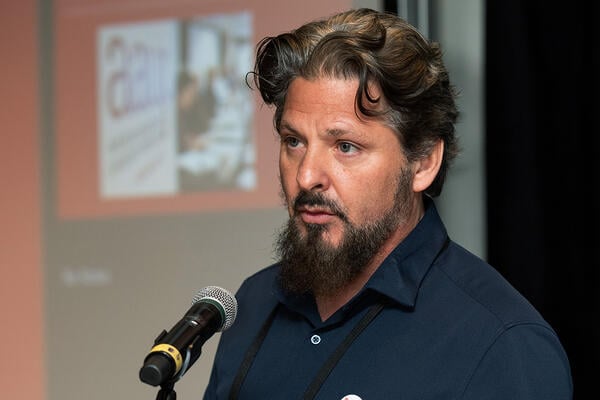
Wolfson (at podium) at a news conference at AAUP headquarters in Washington, D.C.
Ryan Quinn/Inside Higher Ed
The fourth area is that we need to offer … a countervision of higher education to the Trump vision, which is higher education ideologically controlled by the federal government, in its most extreme form, as well as the complete destruction of our biomedical research infrastructure and our research over all.
We’re working on a policy vision that will move us into the midterms … a counterimaginary of higher ed to the imaginary that’s been developed by the Trump administration, by Chris Rufo, one where we’re all Marxist ideologues indoctrinating our students.
The last area is that we’re supporting the development of organizing at the campus level to challenge and hold our administrations accountable, whether supporting the mutual aid defense compact projects that [have] mushroomed across higher ed, or supporting the fights at campus levels around academic freedom and freedom of speech, or any other number of things that we’re doing to support faculty at the campus level, to get their administrations to hold firm and not to bow to the Trump administration’s demands before they even make them.
We had 40,000 members, now we have something like 50,000 members [since Wolfson was elected president last year]. By the end of the calendar year, I’d like to see [60,000]. And that’s dues-paying members.
Q: Has there been an increase in the number of campus chapters or state conferences?
A: Since Trump was elected, I think we’ve grown by at least 40 chapters. Some of those chapters had gone dormant and then renewed and came back to life.
So if we had, when [current AAUP leaders] took office, something like 500 chapters, now there’s something like 550.
Q: Do you have any regrets about tactics or actions your organization has taken so far during the second Trump administration?
A: Certainly, I have regrets. Everyone makes mistakes. I don’t know if this is a regret, [but] I think that our sector is not fully ready to respond to the real threats. Our sector needs to be able to take militant job actions and other sorts of actions as this issue continues to ramp up.
We won’t do that if we don’t have the ability to do it at a scale that makes it powerful and meaningful and effective. And so I think that’s the thing we are working on, and anything we do—and I want to underscore this—would be nonviolent and peaceful.
But, nonetheless, we need to be able to militantly show how concerned we are—not only over our own institutions and our own jobs and our students, but also around higher education and the future of our democracy.
Q: Is what you’re saying is needed is a simultaneous general strike across higher education institutions across the country?
A: If we continue to have a federal government that takes over our cities and puts our cities under martial law and abuses the institutional autonomy of our higher education institutions and does all sorts of things that we all see are undemocratic and dangerous, we need to be prepared not only for a general strike in higher education, but a general strike over all.
I don’t think a higher education general strike is an action that will be effective, because I don’t think that higher education alone has this sort of industrial power to hurt the economy in a way that could force us to try to move through this moment.
If the Trump administration continues on its course … the only force that could respond to that effectively is a labor movement that is willing to withhold its labor, and in a general way.”
But I’m saying if the Trump administration continues on its course—which is a course that’s antidemocratic, that could undermine elections, that could take over cities, that could endanger citizens in the way it did in L.A. and now is doing in D.C., and that is destroying our democracy one piece at a time—that the only force that could respond to that effectively is a labor movement that is willing to withhold its labor, and in a general way.
Q: I was wondering whether you felt that your organization relied a little too much on litigation, or whether protest fell flat.
A: Maybe society writ large in the U.S. is depending too much on courts. I wish we were prepared, as workers in the sector, to take approaches that were more direct than just the courts. But, obviously, we can only be a reflection of the workers in the sector. We cannot, as an institution, push ourselves well beyond where our workers are at.
Q: I think many people would agree that things have gotten worse and worse as the Trump administration has progressed … What does AAUP plan to do differently going forward?
A: There can’t be an expectation that the moment that the Trump administration took office, that … all of the higher ed workers and our students would have been ready and prepared to respond. There is often a lag time between a crisis and the public’s response to that crisis.
We should be critical of ourselves and critical of our tactics and think about how to respond better and move forward better. We see the next 16 months as really important, and that rolls us through the midterms of 2026.
We don’t plan to do this alone. We plan to do this with every higher ed worker, and so that’s why Labor for Higher Ed—this table that represents millions of higher ed workers coming together and working together and coming up with this plan together—is so important. We’re also building an aligned table with our students and student organizations, and also with alumni and alumni organizations. And so we think that if those three forces can come together and fight specifically over higher ed, we can make a real fight.
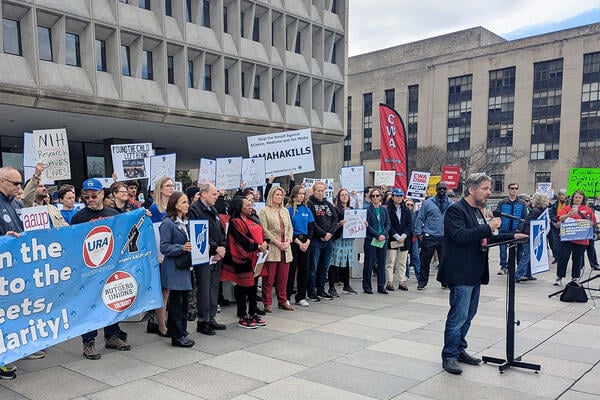
Wolfson at a rally outside the Health and Human Services Department headquarters.
Ryan Quinn/Inside Higher Ed
But I’ll say this … higher ed workers alone cannot beat back the Trump administration. It needs to be a multisector fight. Federal workers—who are also under attack—we need to build alliance with them. K–12 teachers, health-care workers, immigrant workers, progressive community organizations all need to build an aligned front that is ready to take risks, because if we don’t take those risks, we may look at what we have in 2026 and we might not have clean, fair elections.
I think we have to take that very seriously, and we have to build our power to respond.
[Currently, we need] a real fight around the budget, from now through October, a fight around the budget that demands a fully funded NIH, NSF, NASA, [that] pushes around the destruction of the student loan program [and] fights over the TRIO program … which is a program for first-generation college kids.
From there, we are going to be really working on our campuses, building campus-level campaigns and state-level campaigns around higher education.
The things we want to have in [the national] vision are things like a demand for free public higher education, college for all and an end to adjunctification, an end to student debt, more research funding … and then use that vision to really fight for candidates that lift up our imagination of higher education as we move into the midterms.
We are going to fight in the streets and we’re going to fight politically. This is a political battle, and we need to respond politically in this battle.
Q: How do you fight an enemy that seems to thrive on conflict and to derive strength partly by othering certain groups of people—and, among those groups of people … faculty?
A: Faculty and the press and people of color and women and gay people and trans people and anybody that’s not white, Christian nationalist, in the end, is othered. And then even within the white Christian nationalist community, if you’re not MAGA, or you care about a free press, or care about free inquiry, you’re othered.
That first six months was a freaking whirlwind, and so we were really reactive, we were reacting. The Trump administration set the tone—not just for us, to be clear, obviously [for] the Democratic Party, but the progressive community more generally or any sector under attack.
We have been too reactive to the political environment, and so I think the biggest thing that we need to do is stay on our message and vision.
Now there seems to be some fracturing, maybe over Palestine, in the right-wing echo chamber. But, in general, that echo chamber has operated in lockstep and it’s huge, and we don’t have anything like that. Whatever we do, we’re never going to have the megaphone that they have. But, what I do believe is that we must put out our own proactive vision. It can no longer be “Ron DeSantis is mean, and he’s saying bad things about DEI and we need to stop him,” or “Donald Trump is saying bad things about Harvard,” or “Chris Rufo, can you believe how ridiculous the things he puts out are?”
We can’t be constantly responding to them. We can’t have kids going into hundreds of thousands of dollars of debt to get a college degree, and we need to make sure that we have work with dignity and free inquiry and we need to make sure we have the best research infrastructure in the world.
Q: You mentioned Palestine. What position, what action, if any, does national AAUP need to take on Israel and Palestine at this moment? … I know that you guys already dropped your categorical opposition to academic boycotts before Trump’s election.
A: We believe strongly that no weapons should be sent to Israel, at all. Not defensive or offensive, nothing.
What do we do in the U.S., where antisemitism has been used as a weapon, in many ways, by the Trump administration to bring universities to heel—and many times stripping out, or threatening to strip out, hundreds of millions of research dollars that often affect Jewish faculty members? Versus what our position should be on the conflict in the Middle East?
First and foremost, our job is to safeguard ourselves at home and to set a vision that aligns with what we’re trying to do in the United States. We need to stand up for academic freedom, for freedom of speech, for freedom of assembly for our students so they can protest the war—the genocide, excuse me—that’s taking place in Gaza.
We need to stand up to the weaponization of antisemitism in the Title VI process. And we need to make sure that we defend our members.
We think the Jerusalem Declaration on Antisemitism, which does not get involved with questions of the Israeli state at all, is a much more apt way of defining antisemitism.
The numbers of universities and faculty and university presidents [in Gaza] that have been killed and universities that have been destroyed in this war is mammoth. We are certainly educating our members on this concept of scholasticide.
It seems pretty obvious that they are—but if, in fact, Israel is purposefully destroying the educational infrastructure, both K–12 and higher ed, of Palestine, and of Gaza, that stands against our values of academic freedom. And if that’s the case, and we can unify around that, then we will take a stand and call for an end to the scholasticide.
Q: What will it take, ultimately, to get the Trump administration to relent in its attacks on higher ed?
A: Ultimately, we need a massive movement of higher ed workers and students. But, again, I don’t think that’s enough.
I believe as higher ed goes, so goes democracy. But the converse isn’t absolutely true. Higher ed alone cannot save democracy, but we’re a critical part.
It needs to be a broader societal movement to save our country.
The Oregon Health & Science University will receive a $2 billion gift from Nike co-founder Phil Knight and his wife, Penny, to support the eponymous Knight Cancer Institute, OHSU announced last week.
It is the largest single donation ever made to a U.S. university-affiliated health center and is intended to promote the integration of cancer diagnostics, treatment and patient care.
The gift will allow the cancer institute to become self-governed within OHSU. It will have its own board of directors under the leadership of Brian Druker, a leukemia researcher who has worked closely with the Knights and who helped develop a drug that vastly improved the life span of patients with chronic myeloid leukemia.
“This gift is an unprecedented investment in the millions of lives burdened with cancer, especially patients and families here in Oregon,” said OHSU president Shereef Elnahal. “It is also a signal of trust in the superlative work that our clinicians, researchers and teammates at the Knight Cancer Institute do every day. Dr. Druker’s vision around a multidisciplinary system of care—focused squarely on making the patient’s experience seamless from the moment they receive a diagnosis—will now become reality. And thanks to the extraordinary generosity of Mr. and Mrs. Knight, Oregon will be the place to do it.”
The Knights have been key benefactors of the cancer institute. In 2013 they vowed to donate $500 million if the university could match the funds within two years—which it did, thanks to $200 million in bonds from the Oregon Legislature, $100 million from Columbia Sportswear chair Gert Boyle and assorted donations from some 10,000 individuals from all 50 states and 15 countries.