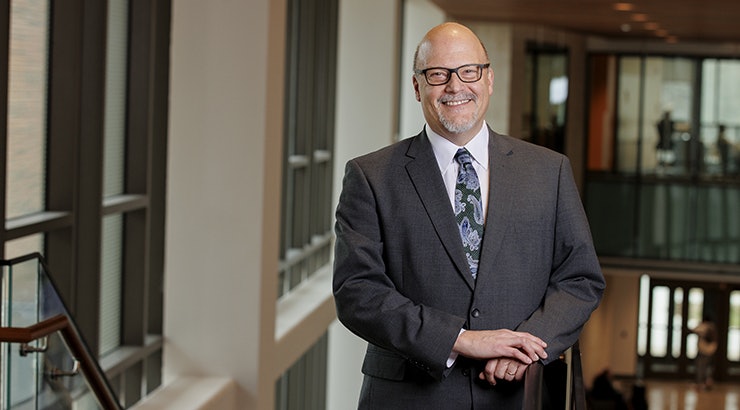
Dr. Philip Cavalier Philip Cavalierhas been named president of Kutztown University. Cavalier most recently served as provost and senior vice chancellor for Academic Affairs at the University of Tennessee at Martin (UTM), a regional public university with more than 7,000 students in northwest Tennessee. He served as interim chancellor for five months in 2023. During his seven years at the university, he led the creation of UTM’s 2025- 30 strategic plan, and two strategic enrollment plans and developed or enhanced eight academic programs aligned with student interests and local workforce needs. Before joining UT Martin, Cavalier held several faculty and senior leadership roles in higher education, including provost at Lyon College, provost and dean of the college at Eureka College, and dean of general education at Catawba College.
Cavalier holds a doctorate in English from the State University of New York at Buffalo, a master’s degree in English from Northeastern University, Boston, Mass., and a bachelor’s degree in economics from Swarthmore College.
In Alpine School District, we serve a wide range of students, from Title I to highly affluent communities. While our population has traditionally been predominantly white and middle income, that’s changing. In response to this growing diversity and shifting needs, one of my missions as professional learning and curriculum director for secondary schools has been to provide needs-based professional learning, just in time for educators, and to give them a real voice in what that looks and feels like.
I lead a team of full-time educator equivalents across every discipline: math, science, social studies, ELA, the arts, health, and PE. Together, we guide professional learning and instructional support. Over the past several years, we’ve had to take a hard look at how we teach, how we engage students, and how we prepare educators for long-term success.
Where we started: Tier 1 challenges and high turnover
When I first became curriculum director, I noticed in our data that our schools were not making much progress, and in some cases had stagnated in growth scores. We were leaning heavily on Tier 2 interventions, which told us that we needed to shore up our Tier 1 instruction.
At the same time, we were hiring between 400 and 500 teachers each year. We’re located near several universities, so we see a continuous flow of new educators come and go. They get married, they relocate, or a spouse gets into medical school, which translates to a constant onboarding cycle for our district. To meet these challenges, we needed professional learning that was sound, sustainable, and meaningful, especially early in a teacher’s career, so they could lay a strong foundation for everything that would come after.
Teacher clarity and engagement by design
Several years ago, we joined the Utah State Cohort, doing a deep dive into the Teacher Clarity Playbook. That experience was a real turning point. We were the only team there from a district office, and we took a train-the-trainer approach, investing in our strongest educators so they could return and lead professional learning in their content areas. Since then, we’ve used Engagement by Design as the framework behind much of our PD, our classroom walkthroughs, and our peer observations. It helped us think differently: How do we support teachers in crafting learning intentions and success criteria that are actually meaningful? How do we align resources to support that clarity? We’ve embedded that mindset into everything.
Coming out of the pandemic, Alpine, like many districts around the country, saw decreased student engagement. To focus deeply on that challenge, we launched the Student Engagement Academy, or SEA. I co-designed the Academy alongside two of our content specialists, Anna Davis and Korryn Coates. They’re both part-time teacher leaders at the district office and part-time visual arts teachers in schools, so they live in both worlds. That was important because we believe professional learning should always be contextualized. We don’t want teachers burning extra bandwidth trying to translate strategies across subject areas.
SEA is a yearlong, job-embedded learning experience. Teachers participate in PLCs, conduct peer observations, and complete a personalized learning project that showcases their growth. Our PLC+ coaches work directly with our lead coach, Melissa Gibbons, to gather and analyze data that shapes each new round of learning. We also included classroom observations, not for evaluation, but to help teachers see each other’s practice in action. Before observations, Anna and Korryn meet with teachers in small groups to talk through what to look for. Afterward, they debrief with the teachers: What did we see? What evidence did we see of student engagement? What did we learn? What are we still wondering? As we answer these questions about teaching, we’re also asking students about their experience of learning.
Learning from student surveys
Hearing from our students has been one of the most powerful parts of this journey. With the support of our Director of Student and Educator Well-eing, we created a student survey. We asked a random group of students questions such as:
What are you learning?
How are you learning it?
How do you know how you’re doing?
Why does it matter?
The responses were eye-opening. Many students didn’t know why they were learning something. That told us our teachers weren’t being as clear or as intentional as they thought they were. One specific question we asked was based on the fact that attendance in world language classes stayed high during the pandemic, while it dropped in other subjects. We asked students why. The answer? Relationships, expectations, and clarity. They said their world language teachers were clear, and they knew what was expected of them. That led other disciplines to reflect and recalibrate.
Today, teachers across subjects like ELA, math, and social studies have participated in a SEA cohort or aligned learning. We’re seeing them plan more intentionally, better target skills, and align instruction with assessment in thoughtful ways. They’re starting to see how mirroring instruction with how learning is measured can shift outcomes. It’s been truly exciting to witness that change. Engaging students through improved teacher clarity, positive classroom relationships (with each other, the teacher, and the content), and providing the students with appropriate levels of rigor has been a game changer.
Building teacher leadership teams
Next year, we’re focusing on developing teacher leadership skills, knowledge, and dispositions across the full geographic area of our district. We’re building professional capacity through leadership teams using the PLC+ model, with an emphasis on facilitation skills, research-based practice, and advocacy for strong instruction in every discipline.
If you’re a district leader looking to boost student engagement through professional development, my advice is simple: You can’t do it alone. You need a team that shares your values and your commitment to the work. You also have to be guided by research–there’s too much at stake to invest in strategies that don’t hold water. Finally, this is a marathon, not a sprint. Aim for small, incremental changes. There’s no silver bullet, but if you stay the course, you’ll see real transformation.
Dr. Mari Braithwaite, Alpine School District
Dr. Mari Braithwaite is the professional learning & curriculum director at Alpine School District in American Fork, Utah. She can be reached at [email protected].
Latest posts by eSchool Media Contributors (see all)
This article covers broad trends in results and university place acceptances. It’s not something you need to read if you are, or are supporting, someone on results day or with applying to university. This might be helpful though.
Though it is a perilous time to be a university one thing that is holding up seems to be undergraduate applications.
It is a bumper year – good news for students, who are more likely to be starting on the course and at the provider they really want to be at this autumn, and good news for the sector, who may have started believing the narrative that university is declining in popularity.
But we do need to separate things out – performance, both by students in achieving qualifications, by providers in running increasingly efficient and attractive recruitment operations, does mask some underlying issues. We’ve somehow reached a situation where study is becoming less affordable for students (especially relating to living costs, and especially affecting students from less advantaged backgrounds) and for universities (with the real value of fees far below 2012 levels, and changes in the market seeing growth among traditionally selective providers).
Today’s results are spectacular news for the higher education sector, but it surely must be clear to everyone that we are beginning to run out of road.
UCAS acceptances
A record number of 18 year old applicants has yielded a record number and proportion (excepting 2021) taking up their firm offers in 2025. Just under 250,000 applicants (representing 63.51 per cent of all 18 year olds applying via UCAS) have started JCQ results day knowing that the university and course they had set their heart on will be where they will study next year.
Couple this with a recovery in insurance places being taken up, and we have a historically low proportion of 18 year olds entering clearing. Just 15.15 per cent of applicants are currently in clearing, plus another 12.8 per cent still holding offers but yet to confirm.
The picture is slightly different if you look at all ages – mature applicants are more likely to be in clearing than their younger counterparts – although a non-pandemic record proportion (57.25 per cent) of all students are taking up firm offers.
That said, it is going to be a hugely competitive few days for admissions teams, but correspondingly good news for applicants looking for a place: there will be more courses looking for students.
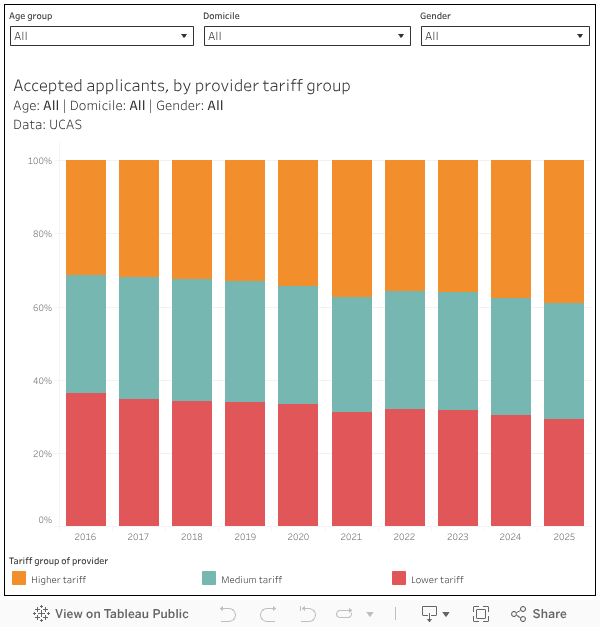
The sector will have an eye on the distribution of students across types of provider, and will see another entry in a time series that shows the growth of high tariff providers. A record 39 per cent of students who have accepted places on JCQ results day have done so at a high tariff provider – just 29.3 per cent will be starting at a low tariff provider (a record low). What’s “high tariff” these days? Anything above about 125.8 tariff points, according to DfE.
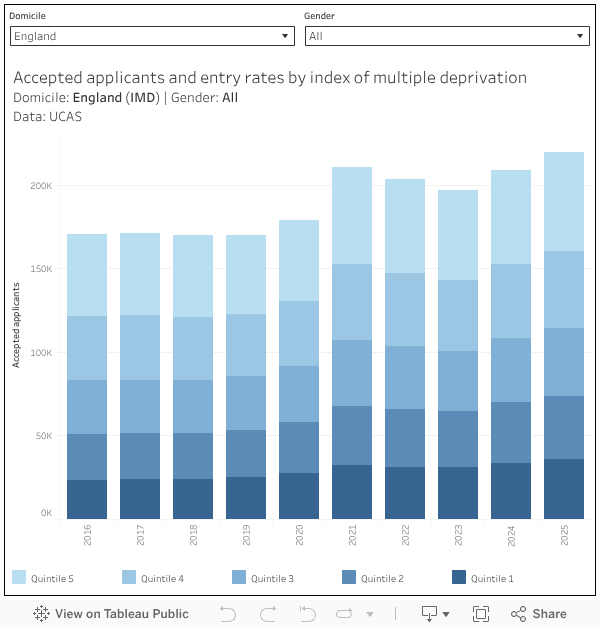
The entry rate for the most disadvantaged quintile of 18 year olds in England was 22.9 per cent – the highest proportion on record, but still a long way off the 44.5 per cent of the most advantaged quintile that will start university this autumn. Expect clearing activity to shift this slightly.
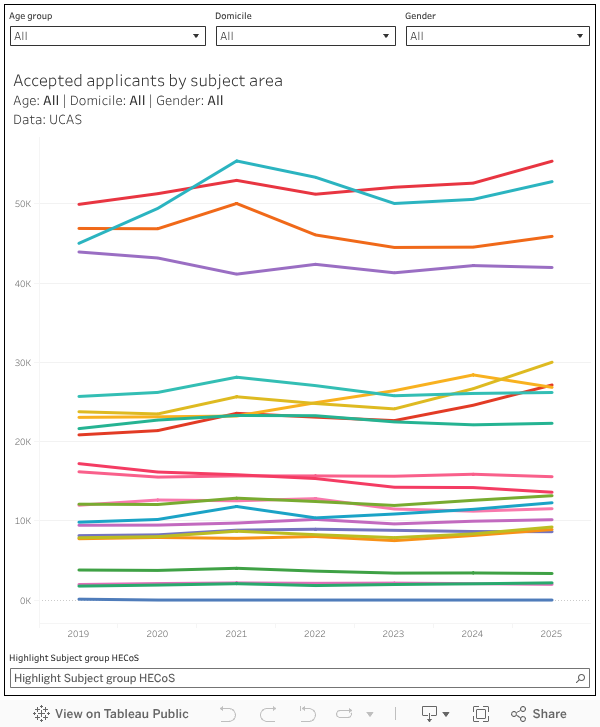
We also have data on subject area choices (at the top level of the common academic hierarchy). Of those students who have already accepted a place, business and medicine-related courses continue to grow in attractiveness – there’s been an increase in social sciences, engineering, and law (continuing a post-pandemic trend) and a sharp drop in interest for computing courses.
It is worth remembering that this represents just the first flush of acceptances – a historically large number of students, but far from the totality of this cohort. Most of the action in clearing happens early, and we’ll be covering that on Wonkhe over the next few days.
International acceptances
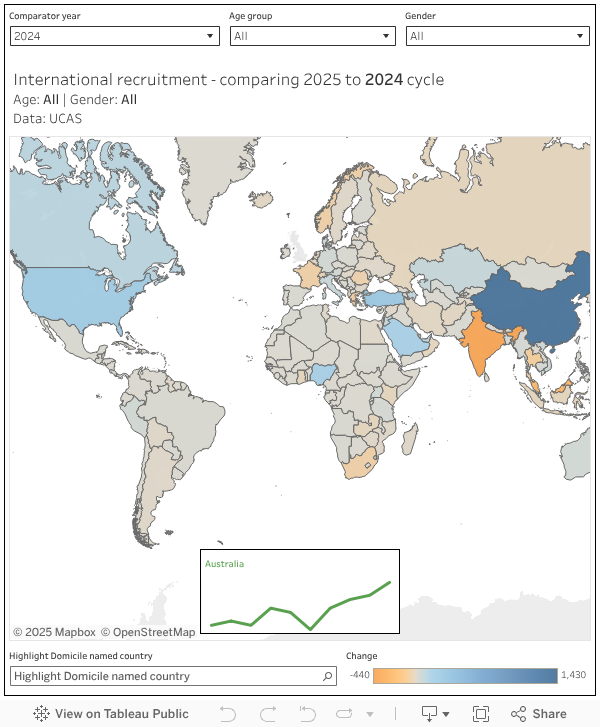
Not all international recruitment flows through UCAS or conforms to what is (for most of the world) artificial deadlines like JCQ, so this is by necessity an incomplete picture. But, again in contrast to prevailing narratives, numbers are up – there were 52,640 acceptances (up 2.9 per cent on last year) in 2025. We see strong year on year growth in China (up 14.6 per cent), the US (up 10.38 per cent), and Turkey (up 21.71 per cent). India is declining (down 9.42 per cent) and Nigeria is starting to recover (up 20.83 per cent) but still a long way off the peaks of 2022 and 2023.
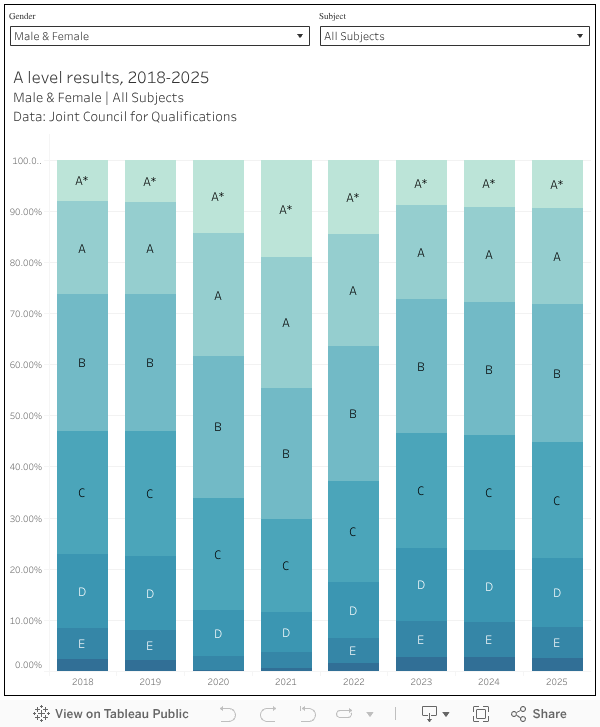
A level performance (for students in England, Northern Ireland, and Wales) generally tends to see movements below the margin of error, as the methodology underpinning the award of marks contains elements of norm-referenced methodologies). The pandemic years (2020, 2021, 2022) are the exceptions here due to changes in the grading process.
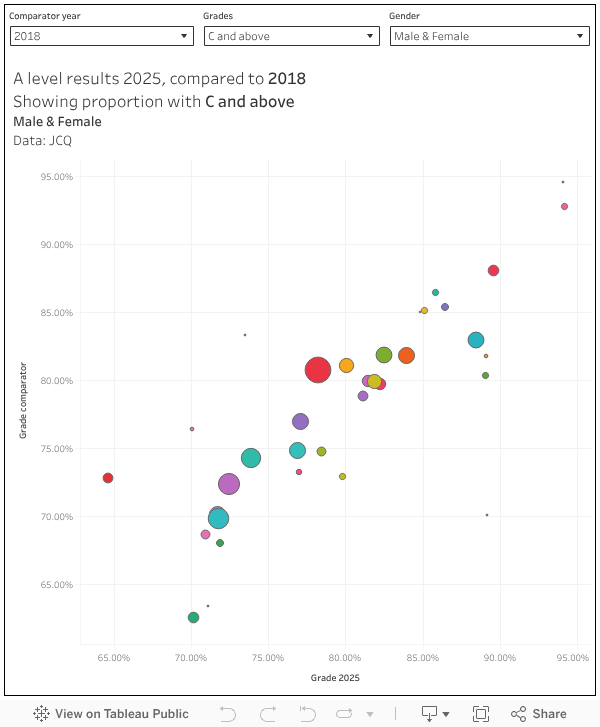
That said, there are some interesting underlying trends. Overall performance in 2025 is up (nearly 78 per cent got C and above this year, compared to 76.3 per cent last year) – this is based on a smaller (entries were down 0.5 per cent) and academically stronger (the popularity of vocational routes is growing, this was the first cohort to have non-compensated GCSE grades) group of students.
And, as always, there is huge variation by subject. Law remains the most difficult A level to achieve C and above in – just 64.6 per cent managed this in 2025, compared to 88.4 per cent in art and design disciplines. And law has got harder over time – in 2018 the proportion was 72.7 per cent.
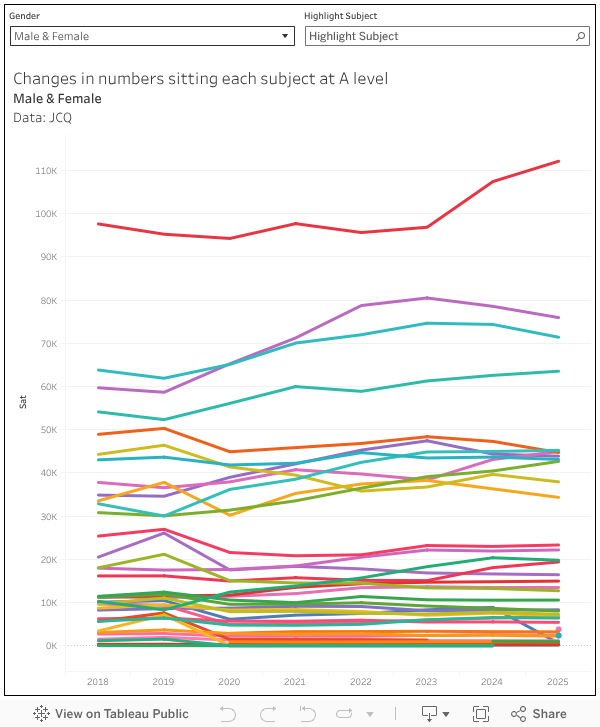
Law still remains moderately popular (there were just under 15,000 entries in 2025, up 1 per cent on last year) but is a long way behind the “big four”: maths (112,000, 4.4 per cent), psychology (76,000, down 3.3 per cent), biology (71,000, down 4 per cent), and chemistry (63,500, up 1.5 per cent).
What of the more than 250,000 level 3 vocational and technical qualifications awarded by JCQ today? The majority of these are what JCQ call “applied generals” (BTECs and the like) – there were 220,553 awarded, compared to 12,000 T levels.
Business and social policy qualifications are the dominant subject groups here (both had around 44,000 entries each). For the (most popular) medium sized qualifications – worth one-and-a-half A levels – 80 per cent achieved a Merit or above, and (for those graded A* to E) 75 per cent achieved a C above.
This is the fourth year of T levels, the new style of vocational and technical level 3 qualification invented by the last government and available in England only – there are now 18 subject routes available. Of the 12,000 or so taking T levels, some 65 per cent achieved a Merit or above, 91 per cent achieved a Pass or above. The numbers are small but growing rapidly, making year on year comparisons tricky – DfE has published some data on these results that goes into a little more depth.
The Ofqual release shows, once again, that independent and selective school settings have seen the highest proportions of top A level grades, with further education colleges seeing the lowest proportions. As usual, there is no data (or seemingly, interest) in performance at special schools – and neither the main release nor the analytics dashboard feel like special needs status is worth reporting on.
In the murky world of political nonprofits and student organizations, foreign influence is often subtle—but sometimes the signs are hard to ignore. Turning Point USA (TPUSA), the high-profile conservative nonprofit mobilizing students across the United States, has come under our scrutiny for potential infiltration by individuals with Kremlin connections.
Central to this story is Alexandra Hollenbeck, a former student journalist and TPUSA associate whose activities raise questions about Russian influence in American student politics. While much of the information has been scrubbed from the Internet, we still hold considerable evidence.
Hollenbeck’s Background and Unusual Affiliations
Alexandra Hollenbeck has contributed to conservative publications such as The Post Millennial, Washington Examiner, and TurningPoint.News. Her work includes coverage of pro-Trump narratives, student activism, and international affairs.
In a 2017 article for TPUSA’s Student Action Summit, Hollenbeck reported on former Trump strategist Sebastian Gorka’s speech, highlighting his devotion to combating jihadists and supporting Trump’s agenda. Gorka’s talk drew historical parallels, beginning with the story of Paul, a 15-year-old boy walking through post-war Budapest, emphasizing that “liberty is as precious as it is fragile.”
Hollenbeck’s prominence within TPUSA circles became more conspicuous after she was photographed at the Kremlin during a pro-Putin rally—a rare and striking connection for a U.S.-based political journalist.
Attempts at Federal Oversight and Silence
Inquiries to the FBI regarding Hollenbeck’s activities yielded no response. TPUSA also never responded to our questions.
Why TPUSA Could Be Vulnerable
TPUSA operates extensive student networks and organizes high-profile events that attract donors, media, and political figures. While the organization is influential within U.S. conservative circles, its internal vetting procedures for affiliates and journalists are less transparent. This opacity creates opportunities for individuals to gain access to sensitive networks, messaging, and potentially student data.
Hollenbeck’s activities—her Kremlin presence, her coverage of pro-Trump events, and her involvement in TPUSA events—illustrate why external scrutiny is warranted. While no definitive proof of espionage or formal Russian affiliation has been established, the pattern of her engagements suggests a potential risk of foreign influence.
Implications for Student Organizations
Hollenbeck’s case highlights broader vulnerabilities. U.S. student political organizations, particularly those with ideological missions and national reach, can be attractive targets for foreign influence. The combination of access to young adults, credibility on campuses, and ties to political figures creates strategic opportunities for external actors.
Even the perception of foreign infiltration can damage trust, complicate fundraising, and raise national security concerns, particularly when student data or organizational communications could be exposed.
Vigilance and Transparency Are Essential
While no concrete evidence has emerged proving that Hollenbeck acted on behalf of the Russian government, her Kremlin connections, TPUSA involvement, and early work covering ideologically charged events like Gorka’s summit illustrate a cautionary tale. Student organizations, nonprofits, and journalists must remain alert to potential foreign influence and implement safeguards to protect institutional integrity.
For TPUSA, this means auditing affiliations, reviewing internal vetting procedures, and ensuring participants act in the organization’s and public’s best interests. For journalists and watchdogs, it underscores the importance of persistent investigation into intersections between U.S.-based political networks and foreign actors.
The case of Alexandra Hollenbeck demonstrates that in today’s political environment, the lines between ideology, influence, and infiltration are increasingly blurred—and the stakes for student organizations and U.S. democracy are higher than ever.
As K-12 leaders look for ways to strengthen trust, engagement, and belonging, a growing number of districts are turning to a key partner in the work: their students.
A new national report from the National School Public Relations Association (NSPRA) and SchoolStatus reveals that districts that incorporate student voice into their communication strategies–through videos, messaging, and peer-created content–are seeing real results: stronger family engagement, increased student confidence, and more authentic school-community connection.
The report, Elevating Student Voice in School Communications: A Data-Informed Look at Emerging Practices in School PR, is based on a spring 2025 survey, which received 185 responses from K-12 communications professionals. It includes real-world examples from school districts to explore how student perspectives are being incorporated into communication strategies. It highlights the growing use of first-person student storytelling, direct-to-student messaging, and student internships as strategies to build trust, improve engagement, and strengthen school-community relationships.
“School communicators do more than share information. They help build connection, trust, and belonging in our communities,” said Barbara M. Hunter, APR, Executive Director of NSPRA. “Elevating student voice is not just a feel-good initiative. It is a powerful strategy to engage families, strengthen relationships, and improve student outcomes.”
Key findings include:
Video storytelling leads the way: 81 percent of districts using student voice strategies rely on video as their primary format.
Direct communication with students is growing, but there is room for improvement in this area: 65 percent of districts report at least some direct communication with students about matters that are also shared with families, such as academic updates, behavioral expectations or attendance
However, just 39 percent of districts copy students on email messages to families, and just 37 percent include students in family-teacher conferences, allowing them to be active participants
Internships on the rise: 30 percent of districts now involve students as interns or communication ambassadors, helping create content and amplify student perspectives
Equity efforts around student storytelling vary significantly. While some districts say they intentionally recruit students with diverse perspectives, fewer encourage multilingual storytelling or provide structured support to help students share their stories
Early results are promising: Districts report improved engagement, stronger student confidence, and more authentic communication when students are involved.
61 percent of districts that track comparisons report student-led content generates higher engagement than staff-created communications
80 percent of respondents observe that student voice positively impacts family engagement
A majority (55 percent) said direct communication with students improves academic outcomes
Building Inclusive Student Voice Strategies The report outlines a three-part approach for districts to strengthen student voice efforts:
Start with student presence by incorporating quotes, videos, and creative work into everyday communications to build trust and visibility
Develop shared ownership through internships, ambassador programs, and student participation in content creation and feedback
Build sustainable systems by aligning student voice efforts with district communications plans and regularly tracking engagement
The report also highlights inclusive practices, such as prioritizing student consent, offering mentorship and support for underrepresented students, featuring diverse stories, involving student panels in review processes and expanding multilingual and accessible communications.
“When districts invite students to take an active role in communication, it helps create stronger connections across the entire school community,” said Dr. Kara Stern, Director of Education for SchoolStatus. “This research shows the value of giving students meaningful opportunities to share their experiences in ways that build trust and engagement.”
The report also explores common challenges, including limited staff time and capacity, privacy considerations and hesitancy around addressing sensitive topics. To address these barriers and others, it offers practical strategies and scalable examples to help districts start or expand student voice initiatives, regardless of size or resources.
eSchool Media staff cover education technology in all its aspects–from legislation and litigation, to best practices, to lessons learned and new products. First published in March of 1998 as a monthly print and digital newspaper, eSchool Media provides the news and information necessary to help K-20 decision-makers successfully use technology and innovation to transform schools and colleges and achieve their educational goals.
Austin Independent School District in Texas is weighing school consolidations that could go into effect as soon as the 2026-27 school year, amid challenges with prolonged declining enrollment, Superintendent Matias Segura told families in a letter this week.
The district also released a data rubric scoring each of its schools based on size, condition, student enrollment and operational costs. The scores will help inform any changes that might be necessary, including boundary adjustments, transfer policies, or school closures and consolidations, according to the district.
Austin ISD lost over 10,000 students within the past decade — resulting in about 21,000 empty seats districtwide. And it’s likely that enrollment will continue to decrease, the district said.
Dive Insight:
“Right now, we’re serving fewer students than we did nearly 30 years ago, but we’re operating more schools than ever. That spreads us too thin and limits what we can offer each campus,” Segura said in the Aug. 11 letter to families.
“Consolidation is one piece of a bigger plan to reinvest in what matters most — strong academic programs, outstanding teachers, modern facilities and the wraparound supports that help every student succeed,” the superintendent said.
District officials said they would make a draft plan available to the community before presenting proposed changes to the board of trustees on Oct. 9. The board is then to vote on a final consolidation plan on Nov. 20.
The rubric released Monday measures how aligned a school building is in serving students’ needs. It is not, however, a list of schools that are closing, Segura told families.
The district said on its consolidation planning website that it will aim to minimize impact on students and families, balance enrollment among the remaining schools, create clear feeder patterns as students move from elementary to middle to high school, and focus on long-term stability for the district.
During the 2024-25 school year, Austin ISD enrolled 72,700 students across 113 schools, according to district data.
Austin ISD’s planning reflects a broader national trend as many districts reckon with declining enrollment, straining already uncertain school budgets.
The Austin announcement follows similar news from other large urban districts.
Last week, Atlanta Public Schools said it was in the early stages of looking at school consolidation and merger plans in the face of significant enrollment drops. Additionally, St. Louis Public Schools in July proposed shuttering over half, or 37 of its 68 schools, within the next two school years due to declining enrollment and buildings running under capacity.
Researchers foresee districts having to close and consolidate more schools in the coming months and years, with student enrollment unlikely to rebound. A recent analysis from Bellwether, an education nonprofit, estimates declining enrollment may have cost the nation’s 100 largest districts $5.2 billion in total lost revenue based on 2023-24 enrollment.
Public school enrollment changes nationally seemed to have persisted after the COVID-19 pandemic when parents increasingly explored alternatives to the traditional public school model and pivoted to private schools and homeschooling, according to a July study by Education Next.
Moving forward, public schools will need to continue navigating not only those shifts, but also declining birth rates and expanding school choice policies at both the state and federal levels.
Climate change has begun to have immediate effects, with increasing natural disasters disrupting communities and infrastructure. Reduced environmental regulations have intensified these risks, disproportionately affecting vulnerable populations and increasing economic costs.
The rollback of regulatory protections in finance, environment, and education has allowed risky practices to grow while reducing oversight. This shift has raised the chances of economic shocks and deepened social inequalities.
Trade disputes and reduced international cooperation have weakened key economic and diplomatic relationships. At the same time, BRICS countries are expanding their influence, altering the global economic landscape in ways that require careful attention.
The expansion of surveillance programs and strict immigration enforcement have raised concerns about civil liberties and community trust. These pressures threaten the social cohesion needed to address larger systemic issues.
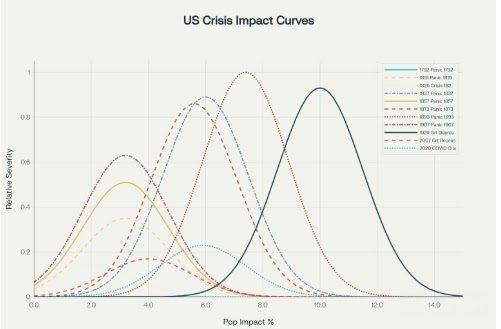
Recent reporting by the Higher Education Inquirer shows that the student debt crisis and speculative financial pressures in higher education mirror and magnify these broader challenges. The sector’s increasing reliance on debt financing not only affects students but also contributes to wider economic fragility (HEI 2025).
Earlier analysis emphasized that these trends were predictable outcomes of longstanding policy decisions and economic structures (HEI 2020).
[Analysis of US Economic Downturns for duration and population impact]
Preventing a serious downturn requires coordinated action on multiple fronts. Strengthening regulations is necessary to reduce financial risks and protect consumers. Effective climate policies are essential, particularly those focused on vulnerable communities. Reforming higher education financing to reduce unsustainable debt burdens can ease economic pressures. Restoring international cooperation and fair trade practices will help rebuild economic and diplomatic relationships. Protecting civil rights and fostering social trust are crucial to maintaining social cohesion.
These issues are deeply interconnected and require comprehensive approaches.
The Office for Civil Rights handles complaints concerning discrimination in federally funded education institutions.
Saul Loeb/AFP via Getty Images
A federal district court judge refused the Trump administration’s request to vacate a previous ruling that prohibited the Department of Education from laying off nearly half its Office for Civil Rights staff.
The decision was made by Massachusetts judge Myong Joun on Wednesday and involved the case Victim Rights Law Center v. Department of Education. It comes just a month after the Supreme Court reversed a preliminary injunction in a similar case, New York v. McMahon, which Joun also oversaw.
In the new order, the district court judge argues that the cases, and therefore their related rulings, are separate.
The New York case, which was filed by multiple state attorneys general, addressed the reduction in force more broadly, Joun said. By comparison, the Victim Rights Law Center case more specifically addresses the RIF at OCR and how it may hold the office back from completing its statutory mandate of protecting students from discrimination.
So, although the Supreme Court allowed the Trump administration to continue with the reduction in force broadly, Joun argues, it does not mean the enjoinment of layoffs within OCR is no longer applicable.
Trump officials “present two arguments for why vacatur or a stay are appropriate: first, that the Supreme Court granted the stay in a related case, and second, that the two related cases are ‘indistinguishable in all pertinent respects.’ I am unconvinced by either argument,” Joun wrote. “Although this case and New York are related, I issued a separate Preliminary Injunction Order to address the unique harms that Plaintiffs alleged arose from their reliance on the OCR.”
He also noted that even though the high court judges reversed one preliminary injunction, that does not mean they have made a final ruling on the merit of the RIF.
Finally, Joun went on to say that the defendants’ motion for stay has little standing, as “they have not substantially complied with the preliminary injunction order” in the first place. Reporting from The 74 backs this up, showing that none of the 276 fired OCR employees have been reinstated.
President Trump first issued the executive action Aug. 7 mandating colleges and universities submit data to verify that they are not unlawfully considering race in admissions.
A draft of the proposal, which will officially be published Friday on the Federal Register, states that certain institutions will be required to collect and report comprehensive data about their admissions decisions going back five years. It must be broken down by race and sex and include students’ high school GPA, test scores, time of application (early decision, early access or regular decision) and financial aid status, among other things.
However, the new survey component, which the Department of Education is calling the Admissions and Consumer Transparency Supplement, will not affect all colleges and universities—just four-year institutions that use “selective college admissions,” as they “have an elevated risk of noncompliance with the civil rights laws,” officials wrote in the notice.
(The document does not say anything about reporting data on legacy admissions, another practice that, like affirmative action, has received public pushback in recent years.)
Members of the public will have 60 days to comment on the notice. Among other things, the department wants feedback on what institutions should be subject to the new reporting requirements as well as the anticipated burden the request will place on university staff.
Some higher education scholars and officials are already chiming in with their concerns informally.
University of Tennessee higher education professor Robert Kelchen wrote in a post on LinkedIn that not only will the request be a “substantial lift” for colleges, but also for staff at the department who run the Integrated Postsecondary Education Data System and will manage the data on the back end.
The Department of Education laid off nearly half its staff—including most of the employees at the National Center for Education Statistics, which would collect and analyze the data—in March.
“I’d love to see the survey form where all of this data would be collected—because after years of sitting in [meetings] where we figured these things out, the sheer number of variables/elements and the lack of any definition around the vagueness of them demonstrates the loss of the knowledgeable NCES staff they lost,” wrote Carolyn Mata, a consultant who works in institutional research, in a response to Kelchen’s post. “This is a case of throwing everything possible at the wall.”
Growing public skepticism in higher education has fueled a number of polls and surveys aimed at understanding how families, students and taxpayers perceive the value of a college degree.
For instance, a majority of Americans believe at least one type of postsecondary credential holds value, according to a 2025 study by Gallup, and most parents want their kids to attend college. But few of those studies have looked at how colleges and universities see themselves improving students’ lives.
A new survey by Tyton Partners released Thursday found three in four college stakeholders strongly believe their institution’s education is worth the cost of tuition. However, two-year institutions were more likely to say this is true, compared to private universities.
Only 28 percent of administrators and support staff working at private four-year institutions strongly agree that their institution’s education is worth the cost, compared to 68 percent of community colleges. The survey, fielded in late June and early July, includes responses from more than 1,600 stakeholders at 825 institutions.
The sector breakdown wasn’t a surprise to Catherine Shaw, Tyton’s managing director, in part because of how the vocational missions of two-year colleges to prepare the local workforce compare to four-year private institutions that focus more on holistic student development.
“That part of it was so squarely within the value proposition of the reasons we have two-year degrees,” Shaw said.
For students, there’s a direct relationship between those who say their college is worth the cost and those who think the college prepares students well for jobs and careers. Among the 792 student respondents who do believe their college is worth the cost, 95 percent believe college is preparing them well for jobs and careers. Inversely, fewer than half (48 percent) of students who don’t see the value of their degree believe college is preparing them well for a career.
“In short, perceptions of value hinge on whether institutions effectively prepare students for the workforce,” the report states. This was true regardless of an institution’s sector, size, selectivity or demographic makeup.
This was the first time Tyton’s survey has asked respondents about perceived value, which Shaw said was in part because of larger national studies gauging perceived value among individuals in the U.S.
“It was interesting that there wasn’t the institutional perspective captured at scale [in previous surveys],” Shaw said. “We wanted to contextualize [the conversation] and see if our institutional stakeholders and our students are asking themselves the same questions and how they feel relevant, because they’ve got skin in the game.”
What Creates Value
More than a quarter of all institutions pointed to career readiness as a top college outcome beyond earning a credential, but two-year colleges were most likely to say this was the top outcome (37 percent). In comparison, the most popular outcome among four-year public and private institutions was critical thinking skills (41 percent and 36 percent, respectively).
Faculty members were most likely to say critical thinking skills were a top college outcome, which Shaw said makes sense given their role in higher education. Administrators and advisers were more likely to point to career readiness as a top outcome for students.
Tyton’s survey also asked administrators, support staff and faculty members which support services improve students’ value of education. Academic and career advising rose to the top, with over half of respondents in all roles ranking these services higher than tutoring, financial aid counseling or mental health counseling.
How institutions deliver high-impact career preparation varied based on institution type. Thirty-eight percent of community colleges said apprenticeships were the most meaningful measures to improve student employment metrics, followed by career pathways at 35 percent.
In comparison, embedded career exploration ranked highest among four-year institutions (54 percent of public universities, 50 percent of private) as did guaranteed internships for all students (31 percent of four-year public institutions) and experiential learning coursework (33 percent of four-year privates).
Student awareness of these opportunities is the greatest barrier to career readiness, according to career services professionals (45 percent), followed by limited capacity (17 percent) and a lack of consistent programming throughout the year (13 percent). Fewer than half of surveyed students (42 percent) said they were aware of career services available to them.
“This focus is especially timely as institutions prepare for increased scrutiny under new federal measures, such as the earnings accountability test,” the report states. “Programs that do not result in gainful employment risk losing eligibility for federal aid. Embedding career readiness across offerings isn’t just about boosting ROI: It’s fast becoming essential for institutional viability.”





 Latest posts by eSchool News Staff (see all)