Blog

  • What today’s report on living costs means for students, universities and parents – and policymakers

    What today’s report on living costs means for students, universities and parents – and policymakers

    • HEPI Director, Nick Hillman OBE, takes a look at why today’s landmark report on student maintenance from HEPI, TechnologyOne and the Centre for Research in Social Policy at Loughborough University is so important.
    • Later today, HEPI will be hosting a free webinar with UCAS on this year’s admissions round – see here for details and to register for a free place.

    A recent Wonkhe article by Will Yates of Public First noted, ‘It really was not that long ago that maintenance grants were the norm and student life was cheap and cheerful.’ We probably all know what he means.

    When I went to the University of Manchester 35 years ago, I had no tuition fees and got to collect a grant cheque even though my parents were in secure middle-class jobs. Since then, life has become harder financially for students. Costs have gone up and grants have disappeared (in England). Meanwhile, the student body has diversified to include more people from disadvantaged backgrounds.

    As if battling with the impact of COVID on their secondary schooling was not enough, today’s students face big financial obstacles. During my nine years as a Trustee of the University of Manchester (which sadly came to an end last month), I regularly ascended those same stairs I used to climb to collect my physical grant cheque in order to attend Board meetings at which we would discuss student poverty and its impact.

    Will Yates’s conclusion needs qualifying of course. Just as it is true that there are today many poor pensioners alongside all the well-off ones who have cleaned up thanks to intergenerational inequities, so there have always been some students who struggled to survive on the maintenance support they received. I recently stumbled across the following exchange in Hansard from 1969, for example, on whether parents were making up the income of their student offspring in the way they have long been supposed to:

    Mrs. Shirley Williams: I appreciate that students who do not receive the full parental contribution often suffer hardship. My Department recently wrote to local education authorities asking them to ensure that parents were made aware of the importance of making up the student’s grant. But I do not think it would be desirable or practicable to impose a legal obligation on parents to make their contributions. (Source: Hansard, 30 January 1969)

    Plus ça change… Aside from the reference to local education authorities (which no longer have a role in student maintenance), the answer could have come from pretty much any one of the last seven decades.

    These issues are topical in part because the threshold at which parents are expected to start contributing to their adult student offspring’s living costs has not increased for over 15 years – it was set at £25,000 for England by Gordon Brown (six Prime Ministers ago…). So parents in English households on just over £25,000 a year are expected to cough up – the situation is even worse elsewhere (just over £19,000 in Northern Ireland).

    The recent HEPI / Advance HE Student Academic Experience Survey shows over two-thirds of full-time undergraduates now do paid work during term time, and often at a dangerous number of hours (‘dangerous’ in the sense of impacting their academic work). So what has changed is the proportion of students who feel wickedly under-resourced financially.

    The biggest lie told about students today is that they are pathetic ‘snowflakes’ who melt on contact with real life; in fact, when financially challenged, they tend to confront the problem head on by going out and finding paid work. Norman Tebbit would have been proud.

    While my generation of students were debating or politicking or going to gigs, today’s students are more often serving those who do have the money to go out. In the UPP Foundation / Public First research that Will Yates was writing about, the students said they thought ‘it was them (rather than the university, the government, the OfS or any other body) who took responsibility for ensuring that they could afford to study and socialise.’

    In my view, one of the very best projects we do at HEPI is the HEPI / TechnologyOne Minimum Income Standard. This is completely different to the student money surveys that ask students what their income is and how they spend it. Those are useful but only up to a point because what if the income is not enough? Knowing I have X pounds and spend X pounds is only of modest value if I actually need 2X pounds in order to afford the bus to campus, join my favourite student society and buy personal healthcare items (on this, see HEPI’s recent report by Rose Stephenson on menstruation and learning).

    So the Minimum Income Standard starts with a blank sheet of paper plus a tried-and-tested methodology developed by the Centre for Research in Social Policy at Loughborough University to consider how much students really need to live with dignity – the calculation is not for a plush lifestyle nor a monastic one, but rather for a fairly basic-but-safe one and is based on the extensive experience of the research team as well as detailed focus groups with multiple students around the UK.

    This year, the second such study dwells upon first-year students in Purpose-Built Student Accommodation (university halls and privately-owned student accommodation blocks). So it supplements last year’s study of second and third-years in shared ‘off-street’ housing. (In my view, it should really be called ‘on-street’ housing as it tends to be on normal residential streets, but I digress.)

    While TechnologyOne have generously funded this vitally important work, I must stress that neither they nor HEPI have had any editorial control over the core central numbers, which are entirely Loughborough’s work and based on what students have told them. HEPI’s input has included feeding in supplementary figures for accommodation costs , with the help of Student Crowd and Students, and thinking through the possible policy consequences of the research.

    The top-level finding is that first-year students living in halls need £418 a week – over £20,000 a year and double the maximum maintenance support package in England. Even if a student (in England, living away from home and studying outside London) is in receipt of the maximum maintenance loan, they need to work 20 hours a week throughout the year to earn enough money to hit the Minimum Income Standard. Remember, these are people on full-time courses. As a society, we are now expecting people to do full-time study and half-time paid work and then we wonder why young students struggle to feel a sense of belonging to their institution…

    People should look carefully at the methodology and conclusions to see if they agree with them. As a think tank, our job is to make people think; we can identify the main challenges and propose solutions but we are not a lobby group, so we would never claim we have all the answers. There may be elements of the Minimum Income Standard for Students that people want to pore over, challenge and improve.

    Some of the issues people may want to consider on the back of the MISS include:

    1. As the report makes clear, student life is generally a temporary phase that lasts no more than three or four years. So is it reasonable to apply the same methodology as is used for defining the basic minimum income for someone in work or in retirement? It is valid, in my view, because three years still represents a substantial proportion of a young person’s life up to that point and undergraduate study is often the first period of real independence for people – plus some other phases of life for which the minimum income methodology has been applied are also not always very long term. For example, someone on a ‘living wage’ is likely to hope to rise above it in due course as they gain experience. Besides, in one sense, no phase of life is permanent.
    2. A second important question is whether letting students define their own minimum standard of living via focus groups will always tend towards larger monetary sums. The Minimum Income Standard for Students assumes students are likely to have gym membership, a short UK holiday and other costs (like wireless headphones, a modest alcohol budget and food for takeaways) that some people may deem to be non-essentials or at least not things that should be subsidised by taxpayer-funded income-contingent student loans (though, on the other hand, we only include very small sums for study-related costs). The MISS also includes some costs than some people might deem relevant only to a minority of students (such as paying to store items between terms). But the MISS is about having enough money for every student to live reasonably, with dignity and safety; it is not designed to be a ‘bare minimum’ or to represent the lifestyle of an ascetic. This is one of a number of reasons, further explored below, why we studiously avoid ever saying we think the Government should automatically set the maximum maintenance package at exactly (or even roughly) the level of the MISS. Moreover, students are not spendthrift – one interesting change this year compared to last, for example, is that they no longer deem a TV Licence as a must-have item so it has been removed from the calculation.
    3. What we call a ‘minimum’ is also an ’average’; some cities are notably more expensive than others – London aside, we generally ignore this in the calculation and so the MISS might look too high or too low depending on where someone is studying and their own personal circumstances. For example, this means some of the freebies – such as prescriptions and bus travel – enjoyed by many Scottish students are ignored.
    4. Should we be looking to reduce costs by giving applicants and students better information? A modest amount of the first-year premium (the extra costs that first-years seem to accrue) comes from being unused to budgeting and feeding themselves. The MISS for first-year students even includes a small additional sum for the first 12 weeks while students settle down and get used to things like eating up food before it goes off. Would better information of the students are crying out for fix at least some of the need for this? Similarly, would better information on the different consequences of different accommodation preferences shape better decisions, which in turn could shape the supply of student accommodation, and lead to a reduction in the MISS?
    5. One particular policy challenge is explaining how any extra student maintenance support that could be offered now or later is likely to be spent in practice. Ministers will be less likely to give students improved maintenance packages if they think they will be entirely swallowed up by higher rent levels. One real challenge here, as so often, is that student accommodation tends to fall through the cracks in Whitehall, so it is not always clear who should be approached for these conversations.

    Above all, HEPI is a policy body so for us the key question is always: what are the possible policy ramifications? On this, and notwithstanding the important fact that the report gives a clear indication of a preferred direction of travel, we are still working them out.

    For example, the report concludes that the maximum maintenance package is only half of what students need to live. It clearly needs to be higher and available to more people. It would be absurd (literally absurd) to think parents could easily fill in the gap from their take-home pay unless they are on very good salaries indeed. It is similarly absurd, however, to think the Government can easily fill the whole gap, given the fiscal situation and the much larger number of students than in the past.

    So what level of paid employment is it reasonable to assume students might do (and in holidays or term-time or both)? Or should students opt for a more basic standard of living (no en suite perhaps or more shared rooms, as in the United States)? Or should more students live at home as commuter students but at the cost of experiencing a full traditional student experience? These are difficult questions and, again, the answers will be different in different cases. Nonetheless, we welcome all thoughts in response.

    As I sometimes say when speaking in schools, if and when it comes to my own children going to higher education, I will tell them three things:

    1. good social spaces are more important than things like en suite facilities – if you are living a full student lifestyle, you may spend less time in your room than you originally expected;
    2. taking a temporary full-time job in the holidays is generally preferable to doing a high number of hours of paid employment during term time, if you’re lucky enough to have the choice; and
    3. in general, it tends to be better not to be a commuter student, unless there are specific individual reasons for being one.

    Yet like most parents, I will also have to accept they will take what I say with a large pinch of salt and then find their own way.
    Source link

  • How one state revamped high school to reflect that not everyone goes to college

    How one state revamped high school to reflect that not everyone goes to college

    This story is part of Hechinger’s ongoing coverage about rethinking high school. Read about high school apprenticeships in Indiana, a new diploma in Alabama that trades chemistry for carpentry, and “career education for all” in Kentucky.

    ELKHART, Ind. — The numbers were discouraging, and in some cases getting worse. Nearly 30 percent of Indiana’s high schoolers were chronically absent in 2022. Only about 52 percent of students in the state enrolled in college in 2023, a 12-percentage-point drop in seven years. Fewer students were pursuing other paths, too: The share of students enlisting in the military, for example, declined by 41 percent from 2018 to 2022.

    When Katie Jenner toured the state after becoming education secretary in 2021, she heard from many students who said they simply didn’t value high school or see how it would help them. “That was really hard to hear,” Jenner said. “We had to look in the mirror and say, ‘OK, this is the reality. Let’s do better.’”   

    Jenner and her team began redesigning what high school looks like in Indiana, in an effort to make it more relevant to young people’s futures and help them gain a better grasp of career paths. For too long, she and others argued, kids had been pushed to plan for four-year college, yet only about half of seniors actually enrolled, and those who did go often dropped out before graduating. 

    When a draft of the plan was released in early 2024, it drew fierce protest from many parents and educators who worried the state was prioritizing workforce learning over academics. Jenner and her staff reworked the proposal, eventually crafting a plan that alleviated some, though not all, of the concerns. 

    The “New Indiana Diploma” — which was signed into law in April and goes into effect for all incoming first-year students this academic year — gives students the option to earn different “seals” in addition to a basic diploma, depending on whether they plan to attend college, go straight to work or serve in the military. Jenner describes it as an effort to tailor the diploma to students’ interests, expose students to careers and recognize different forms of student achievement. 

    Experts said the template is something of a model nationally, at a time when more states are reconsidering how to help students prepare for careers and the federal government is also pushing alternatives to four-year college. Elements of that effort have earned bipartisan support: Presidents from both parties have advocated for expanding work-based learning, and President Donald Trump recently called for the creation of 1 million new apprenticeships.  

    “The basic architecture of American high school is being questioned and challenged,” said Timothy Knowles, president of the Carnegie Foundation.* Indiana is at the forefront of an effort to incorporate more experiential learning instead of restricting education to school buildings, he said: “Indiana is really breaking ground.” 

    Related: A lot goes on in classrooms from kindergarten to high school. Keep up with our free weekly newsletter on K-12 education.

    The initial proposal Jenner’s agency drafted would have created two high school diplomas, “Graduates Prepared to Succeed” and “Graduates Prepared to Succeed Plus.” Both would have scaled back math and science requirements and loosened recommendations for world languages and other electives. Meanwhile, they would have encouraged all students to participate in work-based learning in apprenticeships, internships or job shadowing, with at least 75 hours in such activities required for the “plus” diploma. 

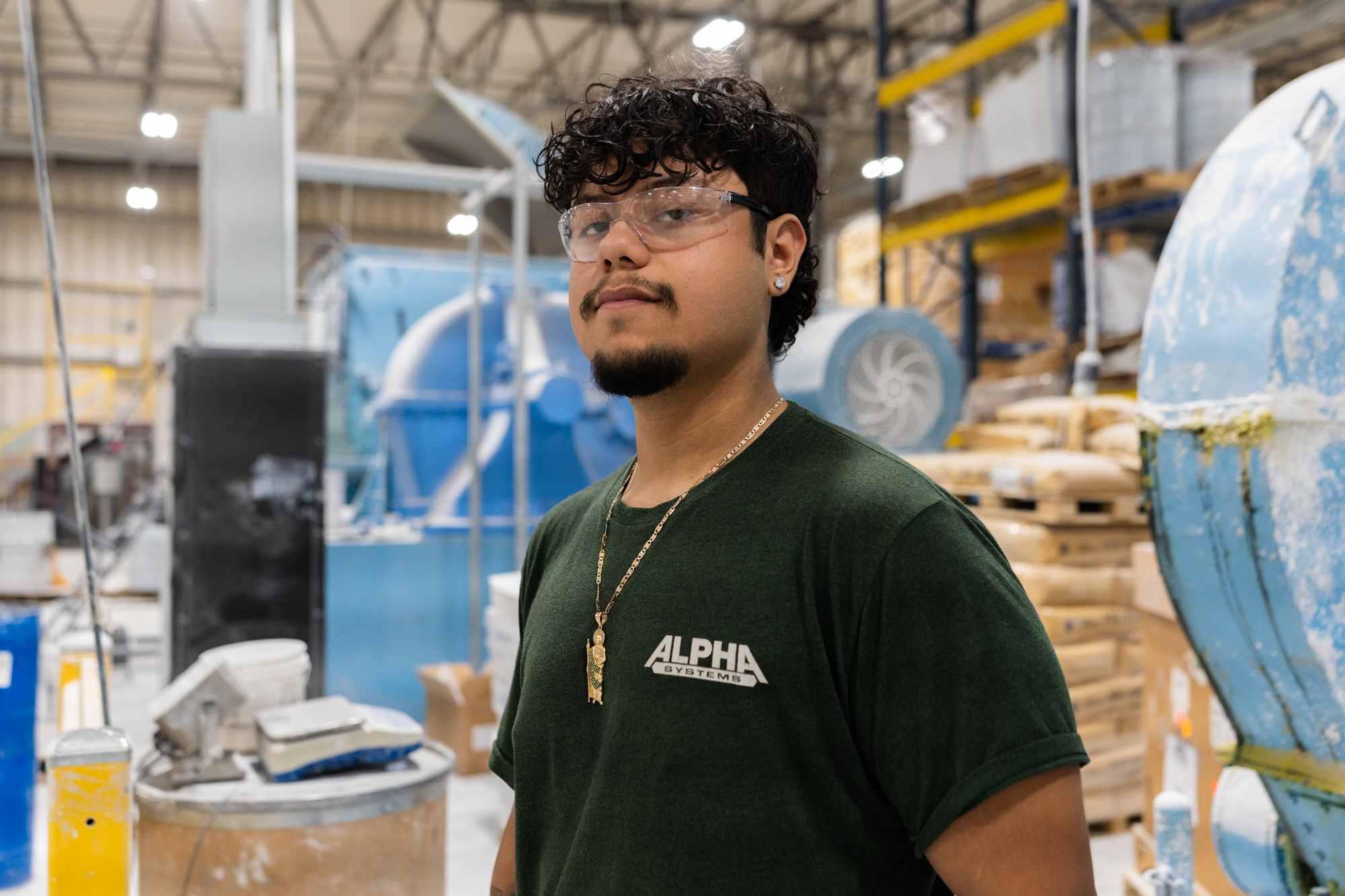
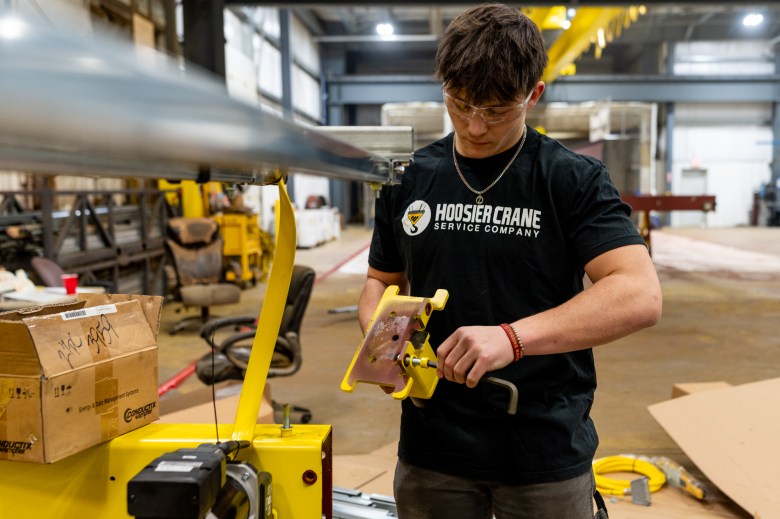
    Indiana hopes that work-based learning opportunities at companies like Alpha Systems and Hoosier Crane Service Company, in Elkhart, Indiana, can flourish under the new diploma system. Credit: Camilla Forte/The Hechinger Report

    In 2024, the state board of education held dozens of meetings to gather feedback on the proposal for the revamped diplomas — and the backlash was intense. Leaders of higher education institutions, including the state’s flagship schools, Indiana and Purdue universities, said students graduating under the new system would not meet minimum requirements for admission. Purdue’s president, Mung Chiang, wrote a letter to Jenner showing that the proposed diploma system required too few credits in every subject except English.   

    Hoosier parents were furious that their children might have to sacrifice more challenging courses to fulfill the mandatory work experience requirement under the “plus” option. At an Indiana Department of Education hearing in June 2024, parent Michelae Hill was among dozens who criticized the proposal, calling it “intentionally dumbing down our population” and warning that “what will happen is that we are ensuring a permanent underclass, we are ensuring cheap workers.” There were also questions about the logistics of workplace learning, including transportation and possible safety issues on job sites. 

    State education policy makers went back to the drawing board. The revised version, adopted last December, establishes one basic diploma that all graduates earn, plus the seals students can pursue depending on their post-high-school plans. Even within each seal, students have several ways of meeting the requirements.  

    For example, to receive the “enrollment” seal — meant primarily for college-bound students — high schoolers can choose from more advanced classes in math, science, social studies and world languages, and may earn additional credits in Advanced Placement, International Baccalaureate or other such college-level courses. An “enrollment honors plus” seal requires that students concurrently obtain a credential such as an associate’s degree or technical certificate and complete 75 hours of work-based learning in apprenticeships, internships or other such programs. 

    “We wanted rigor and flexibility and less cookie cutter,” said Jenner.  

    Related: Apprenticeships for high schoolers are touted as the next big thing. One state leads the way

    Even the updated system has critics, though. For the basic diploma, students must earn a minimum of 42 credits, two more than before. But how students reach that threshold is different: Economics, geometry and Algebra II are no longer required, while courses in financial literacy and communication are. Physical education is one credit instead of two, and world languages and fine arts are no longer recommended electives.

    Professor Michael Hicks, who runs the Center for Business and Economic Research at Ball State University in Indiana, said he worries about the reduced mathematics rigor in particular. While most states do not require Algebra II for graduation, the class is often seen as a necessity for admission to selective colleges and for certain careers. Hicks said high-achieving, well-resourced students may benefit from the flexibility of the new diploma, as could students committed to the military. But many other students could be harmed, he said, if they are left with the impression that the basic diploma alone will prepare them well for college when it does not. 

    “It is essentially funneling children away from academic opportunity very early at a time when we really needed to have more kids pushed into the academic options that would get them into college,” he said, arguing that people with college degrees outearn those with only a high school education and have also fueled the state’s and country’s economic growth of the past several decades. “This curriculum will cause the Indiana economy to stall and potentially go into reverse.” 

    At public meetings last winter, some parents and educators raised concerns that the new system amounted to an unfunded mandate for school districts and would put a huge burden in particular on counselors, who would be working closely with students to help chart their diploma paths. Critics also objected to the de-emphasis of other classes like music and foreign languages. Megan Worcester, the president of the Indiana Foreign Language Teachers Association, said the reduced emphasis on foreign language would hurt the state’s economy; she cited a study in which nearly 1 in 4 employers surveyed said they had lost or couldn’t pursue a business opportunity because of language barriers. 

    Jenner, a former high school teacher, said the new diploma allows students greater flexibility to choose electives depending on their goals, which could include language and music study. While Algebra II is no longer required, students must take four math credits beyond the required Algebra I and personal finance, she said. Jenner also said the state had allocated a portion of $50 million in discretionary funding to train counselors in helping students navigate the new diploma system. In addition, it dedicated up to $10 million in grants to help students pay for transportation, equipment and certifications related to work-based learning, and also provided financial assistance to companies that take on apprentices. Each school that offers work-based learning will receive an extra $500 per participating student.

    The new plan eventually quieted the concerns of many education leaders. Several universities, including Indiana and Purdue, released letters of support. “We appreciate the thoughtful adjustments to the work based learning requirements, AP testing and transferability of dual credits,” wrote Pamela Whitten, president of Indiana University. (Neither university agreed to an interview with its leaders.) All major education groups in the state, including the Indiana State Teachers Association, Indiana School Boards Association and the Indiana Association of Public School Superintendents, endorsed the plan. 

    Ty Zartman, a student apprentice at Hoosier Crane Service Company in Elkhart, Indiana, decided to go straight to work after graduating high school, despite being a straight A student. Parents and educators objected to Indiana’s first proposal for a new high school diploma system, arguing that the emphasis on workplace experience would crowd out academic learning. Credit: Camilla Forte/The Hechinger Report

    In April, Gov. Mike Braun announced that beginning this year, students who earn the state’s “enrollment honors plus” seal will be automatically accepted into the state’s public colleges and universities, including Purdue and Indiana, potentially persuading more students to enroll. 

    Parent Chantee Eldridge said she believes the new diploma will make higher education more affordable and help students sharpen their career plans at an earlier age. Her son, Micah, is a 16-year-old senior at Brownsburg High School, near Indianapolis, and has already taken dual credit courses through a partnership with Vincennes University. College credits can be expensive, she said, so earning them at no cost in high school can be a big money saver. 

    Micah, who has a 3.7 GPA and plays semi pro soccer, said he’s always enjoyed challenging classes and plans to go to college. “When things get repeated, that’s when I get bored and start to tap out mentally,” he said. In college, he anticipates studying psychology — a surprise to his mother, who expected him to pursue math or physics, two topics he’s always excelled in. She likes the idea of him doing an internship with a psychologist, so he can learn more about the field and gain practical work experience before he goes to college; that’s the sort of opportunity that will become more common under this new diploma system. 

    “Very rarely do you know exactly what you want to do between 16 and 18,” Eldridge said. “That will help students and their families make an informed decision.”  

    Related: Schools push career education ‘for all,’ even kids heading to college 

    For students who want to go straight into the workforce, the employment seals are designed to provide exposure to career options and work experience that boost students more quickly into higher-paying roles. Under the “employment honors” seal, students must: take coursework or earn a credential aligned to a specific occupation; complete 150 hours of work-based learning; and demonstrate communication, collaboration and work ethic skills. The “employment honors plus” seal requires that students also earn an associate’s degree or advanced industry certificate and complete 650 hours of work-based learning.

    Matt Mindrum, president and CEO of the Indy Chamber, said that most of the 150,000 vacant jobs in Indiana right now don’t require a four-year degree. “And yet 100 percent of our high school students are pushed through a college preparatory path. That makes no sense,” he said. He believes an alternate path is critical for driving economic growth in the state, by helping to fill existing jobs and attract new businesses. 

    Edgar Soto, a senior at Concord High School in Elkhart, is the kind of student Mindrum has in mind. Soto said he has never wanted to attend a four-year college. To get workforce experience, he enrolled in an apprenticeship through his school and is up before dawn each morning to start work with manufacturing technology company Alpha Systems. “It’s something new every day. I love it,” he said. He earns $17 an hour and gives half his paycheck to his mom for family expenses. When school is in session, he spends his afternoons taking classes back at Concord High. 

    Indiana’s Elkhart County has been at the forefront of expanding apprenticeships to high schoolers, but it’s had trouble recruiting companies — a challenge for the state as it tries to expand work-based learning. Credit: Camilla Forte/The Hechinger Report

    Working has motivated him to study harder at school, he said; he’s never cared for math, but when he realized it was important for his job, he began asking his teacher for extra help. “I got a taste of the real world and I want to be that type of person who does things right,” he said. 

    Alpha Systems pays for him to take classes in industrial systems through the state community college system, Ivy Tech, and has promised to pay for any further postsecondary education if he stays with the company. In just a few years, company executives said, he could easily make more than $40 an hour, approximately $80,000 a year. 

    Mindrum is working with employers around the state to try to increase work-based learning opportunities so they match student demand, a particular challenge in rural areas. Communities that have already made a commitment to work-based learning have had trouble recruiting enough employers: For example, in Elkhart County, only 1 in 3 high schoolers who apply for an apprenticeship gets one. Schools will also have to reorganize class schedules and overcome transportation challenges to ensure students can complete the necessary work-based learning under the various seals. The state has a goal of 50,000 apprenticeships by 2030. “It’s an aggressive but achievable target,” Mindrum said. 

    Related: A new kind of high school diploma trades chemistry for carpentry 

    Supporters hope the revamped diploma will also encourage more students to enlist in military service. Nationally, the military is struggling to recruit, and according to Army data, just 23 percent of 17- to 24-year-olds who apply to the U.S. military meet its medical fitness and academic requirements. In Indiana, the number of students enlisting in the National Guard dropped by 38 percent between 2018 and 2022, the sharpest decline of any state. 

    Retired Maj. Gen. Dale Lyles, who led the Indiana National Guard and helped create the “enlistment” seal criteria, said students often don’t know much about enlisting and the benefits of military service. In Indiana, for example, serving in the National Guard unlocks free tuition to state colleges.

    The new diploma options are meant to fix that: Students in the “enlistment honors” and “enlistment honors plus” seals are taught about each branch of service, what it means to swear an oath to your country and the many different job opportunities available. They also must take a public service course or complete a year of Junior ROTC and receive a certain score on the military’s aptitude test, the Armed Services Vocational Aptitude Battery, among other requirements. Students can receive coaching for the test and have the opportunity to visit Camp Atterbury-Muskatatuck, a nearly 35,000-acre military post, for hands-on learning opportunities.

    “Today’s military is much different than it was even five years ago, just because of the high degree of technology,” said Lyles, citing the Indiana National Guard’s platoon that flies automated aerial drones and its cyber warfare battalion. “We are in a battle for talent.” He added that the pathway emphasizes that there are other ways to serve, including as a firefighter, as a police officer or in the Department of Homeland Security. 

    Nicholas Purdy, a 17-year-old from Marion, has three grandparents who served in the military and said he’s always been interested in enlisting. In his first year of high school, he signed up for JROTC, and he said he loves traveling to other states for competitions and leadership camps where students participate in activities such as rappelling, water operations and land navigation. “It doesn’t matter what your background is, how much money you have, your looks,” he said of the experience. “The only thing that matters is your character.” 

    His mother, Stephanie Purdy, said she’s seen his confidence deepen as a result of his experiences with JROTC. Nicolas has won ribbons and pins for marksmanship and leadership that he wears on his uniform, and he likes the idea that under the new seals, those accomplishments would be reflected on his high school transcript. Nicholas wants to become a combat medic in the army. “The training set me up for really good opportunities, and it’s all paid for,” he said. 

    Jenner’s work continues — with a pressing deadline, as schools roll out these changes for first-year students this year. Her office is working on an online advising tool, a pilot program to help communities identify solutions to transportation challenges, guidance for educators on the new diploma options and courses, and incentives for school districts to measure skills like communication, collaboration and work ethic, not just academic outcomes.   

    It’s a big task. “This is new terrain for our country when you think about the level of scale we’re trying to accomplish,” said Jenner. “We don’t have a model to just copy and paste, so we’re going to learn some lessons along the way.” 

    *Due to an editing error, an earlier version of this story included an inaccurate description of the Carnegie Foundation.

    Contact editor Caroline Preston at 212-870-8965, via Signal at CarolineP.83 or on email at [email protected]

    This story about work-based learning was produced by The Hechinger Report, a nonprofit, independent news organization focused on inequality and innovation in education. Sign up for the Hechinger newsletter.

    The Hechinger Report provides in-depth, fact-based, unbiased reporting on education that is free to all readers. But that doesn’t mean it’s free to produce. Our work keeps educators and the public informed about pressing issues at schools and on campuses throughout the country. We tell the whole story, even when the details are inconvenient. Help us keep doing that.

    Join us today.

    Source link

  • Tutoring provides a much-needed on-ramp into the teaching profession. School districts should pay attention.

    Tutoring provides a much-needed on-ramp into the teaching profession. School districts should pay attention.

    After graduating from Knox College in Illinois with a bachelor’s degree, Stephanie Martinez-Calderon’s plans were upended by the pandemic. She hadn’t planned on becoming a teacher but found an opportunity to tutor remotely for the year after college. 

    Tutoring helped her build confidence and develop instructional skills, and today she’s a middle school teacher in the Washoe County School District in Nevada. 

    Tutoring can be a powerful training ground for future educators, providing hands-on experience, confidence and a bridge into the classroom. And what might begin as a temporary opportunity can become a career path at a time when teachers are needed more than ever: A recent report noted that nearly one in five K-12 teachers plan to leave teaching or are unsure if they’ll stay. 

    Turnover remains a crisis in many districts, one that can be solved by a ready-made pipeline of young future educators with instructional experience and relationship-building skills they’ve gained from tutoring.  

    Related: A lot goes on in classrooms from kindergarten to high school. Keep up with our free weekly newsletter on K-12 education. 

    How school districts think about tutoring should evolve. Rather than seeing it as a short-term response to pandemic-interrupted learning, they should view it as part of the fabric of school design and future educator development. This requires including tutoring in strategic plans, forming community partnerships and creating a structure to sustain programs that cultivate tutors for careers in education. To fund these programs and pay tutors, districts can redirect Title I funds, use federal work-study and create apprenticeship programs.  

    Starting as a tutor allows aspiring educators to build core teaching skills in a supportive, lower-stakes environment. Tutors learn to navigate student relationships and adapt lessons to individual needs. Without having to manage an entire classroom, they can practice asking questions that get students thinking and selecting problems to help students learn. This early practice eases the transition into teaching. 

    Tutors from Generation Z, born between 1996 and 2012, often bring fresh energy to the profession. As digital natives, they are reimagining how to engage and inspire students, leverage technology and foster creativity and new approaches to learning. 

    They are also the most ethnically and racially diverse generation yet: Many come from backgrounds historically underrepresented in the teaching force; over half of undergraduates identify as first-generation college students. Their engagement broadens the prospects for a more diverse teacher pipeline. 

    Tutor recruiters have noticed that Gen Z workers don’t just want a job — they want roles committed to social impact, professional growth and sustainable work-life balance

    Gen Z’s emphasis on flexibility and remote opportunities is one of the most significant workforce changes since the pandemic. They value mental health, stability and mission-driven work. Part-time, hybrid and wellness benefits help recruit young talent. 

    At our nonprofit, recruiters hear from education candidates that Gen Z appreciates the chance to try out industries, and that tutoring provides them with a window into the world of teaching. 

    Public schools could better meet the evolving needs of young professionals entering education by reimagining tutor roles to include hybrid options, mental health supports and collaborative teaching pathways for professional growth. For instance, a tutor might start off working in a part-time online tutoring role, but after interacting with students virtually and gaining more experience, they may be more excited to take on a full-time teaching role on-site.  

    For school districts, tutoring programs can serve as effective recruitment pipelines. By offering recent graduates a low-barrier entry point into education — one that doesn’t require immediate certification — districts can spark interest in teaching among candidates who may not have previously considered it. 

    Amid ongoing hiring challenges, particularly mid-year vacancies, tutors can offer timely solutions.  

    When tutors step into teaching roles, they bring valuable continuity — familiarity with the students and insight into progress and school culture. This seamless transition supports both student learning and district staffing needs. 

    Related: PROOF POINTS: Taking stock of tutoring 

    The idea that tutoring should be built into future educator pipelines is spreading. For example, since the launch of its Ignite Fellowship in 2020, Teach for America says that 550 of its former tutors have become full-time teachers. The program has proven to be especially effective at drawing in nontraditional candidates — those who may not have initially envisioned themselves in the classroom. In Washington, D.C., the school district launched a tutor-to-teacher apprenticeship program after success with high-impact tutoring. In Texas, teacher residents are required to work as tutors and in other support roles while co-teaching with a mentor. 

    By offering flexible, purpose-driven opportunities, districts can attract Gen Z professionals and give them a meaningful entry point into teaching. And tutoring programs can become more than academic support — they can serve as strategic talent pipelines that strengthen the future of the teaching workforce. 

    Alan Safran is co-founder, CEO and chair of the board of Saga Education; Halley Bowman is senior director of academics. 

    Contact the opinion editor at [email protected]. 

    This story about tutoring was produced by The Hechinger Report, a nonprofit, independent news organization focused on inequality and innovation in education. Sign up for Hechinger’s weekly newsletter.  

    The Hechinger Report provides in-depth, fact-based, unbiased reporting on education that is free to all readers. But that doesn’t mean it’s free to produce. Our work keeps educators and the public informed about pressing issues at schools and on campuses throughout the country. We tell the whole story, even when the details are inconvenient. Help us keep doing that.

    Join us today.

    Source link

  • Student veterans, advisers say VA cuts are derailing their educations

    Student veterans, advisers say VA cuts are derailing their educations

    As the spring semester got under way in January at the University of Colorado at Colorado Springs, a dozen military veterans waited for their GI Bill student benefit checks to show up.

    Then they waited, and waited some more, until the money finally arrived — in April.

    By that time, three had left.

    Getting GI Bill benefits from the Veterans Administration, which student veterans use to pay for their tuition, textbooks and housing, already took weeks. Since federal government staffing cuts since President Donald Trump took office, it’s been taking at least three times longer, said Jeff Deickman, assistant director for veteran and military affairs at the student veteran center on that campus.

    Deickman’s counterparts at other colleges say the VA’s paperwork often has errors, causing further delays. They say some student veterans are dropping out.

    “I can spend, on bad days, three hours on the phone with the VA,” said Deickman, himself a 20-year Army veteran and a doctoral student. “They’ll only answer questions about one student at a time, so I have to hang up and start over again.”

    Nearly 600,000 veterans received a total of about $10 billion worth of GI Bill benefits last year, according to the VA.

    The start of the new administration brought big personnel cuts to both the VA and the U.S. Department of Education, which manages some student aid for veterans. Now, advocacy groups and universities and colleges that enroll large numbers of veterans are bracing for the planned layoffs and departures of nearly 30,000 VA employees and additional cuts at the Department of Education.

    Many are also concerned about the potential for reduced scrutiny of the for-profit college sector, which critics contend has taken advantage of veterans’ tuition payments without providing the promised educational benefits.

    Related: Interested in innovations in higher education? Subscribe to our free biweekly higher education newsletter.

    Veterans who are just starting to feel the effects of federal cuts, and organizations that support them, worry things will only get worse, said Barmak Nassirian, vice president for higher education policy at the advocacy group Veterans Education Success. The nonprofit has been getting calls from students anxious about confusing information they’re receiving from federal agencies, he said, and it’s been hard to get answers from the government.

    “Part of the challenge of wrapping our arms around this is the opaqueness of the whole thing. We’re sort of feeling our way around the impact,” Nassirian said.

    “The whole process” has become a mess, said one 33-year-old Navy vet in Colorado, who used a more colorful term common in the military and asked that his name not be disclosed for fear of reprisal. “It’s making a lot of us anxious.”

    Social media lays bare that anxiety — and frustration. In posts, veterans complain about stalled benefits and mistakes.

    “I just wish I could speak to someone who could help but all of the reps seem to be unable to assist and simply tell me to reapply, which I have 4x, just for another denial,” wrote one on Reddit, about attempts to have a student loan forgiven.

    Related: How Trump is changing higher education: The view from 4 campuses

    “Complete nightmare,” another Reddit poster wrote about the same process. “Delays, errors, and employees that don’t know anything. No one knows anything right now.”

    Federal law guarantees that disabled vets’ student loans will be forgiven, for instance, but veterans with total permanent disabilities have reported that their applications for their loans to be discharged were denied. One said the Department of Education followed up with a letter saying the denial was a mistake, but the agency hasn’t explained how to correct it.

    The Education Department did not respond to an interview request. The VA declined to answer even general questions about benefit delays unless provided with the names of veterans and colleges that reported problems.

    A VA spokesman, Gary Kunich, said no one had been laid off from the agency, which in fact cut 1,000 probationary employees in January and another 1,400 workers in February, though some were temporarily reinstated by a judge. It has announced plans to lay off 30,000 more by the end of September.

    Such cuts threaten to “disrupt access to veterans’ education benefits, just as even more veterans and service members may be turning to higher education and career training,” top officials at the American Council on Education, or ACE — the nation’s largest association of colleges and universities — wrote in June.

    That’s on top of existing frustrations. Veterans already struggle to get the benefits they’ve earned, college administrators and students say.

    Related: Veterans are tangled in red tape trying to get their student loans canceled as promised

    Many colleges and even some prominent veterans’ advocacy groups didn’t want to talk about this. Student Veterans of America, one of the largest advocacy groups for veteran students, did not respond to repeated interview requests. Ten of the colleges and universities that boast large veteran enrollments — including San Diego State, Georgia State, Angelo State, Arizona State and Syracuse — also did not respond or declined to answer questions.

    Veterans and advocates are concerned that ongoing Education Department cuts will erode oversight of education institutions that take GI Bill benefits but leave veterans with little in return — primarily for-profit colleges that were found guilty of, and have been punished repeatedly for, defrauding students. In some cases, those colleges suddenly closed before students could finish their degrees, but kept their tuition while leaving them with useless credits or credentials.

    Veterans are already twice as likely as other students to attend for-profit colleges, according to the Postsecondary National Policy Institute.

    While it might take years until the effects of weakened scrutiny are fully visible, Nassirian said, it already appears that staffing cuts at the divisions within the Education Department that kept an eye on for-profit colleges have led those schools to start targeting veterans again.

    “Without a doubt it is now easier for schools that want to push the envelope to get away with it,” he said. “When you have fewer cops on the beat you’re going to see higher crime. And we’re still just a nanosecond into this new environment.”

    Veterans can lose their GI Bill benefits even when a college defrauds them.

    The risk is particularly high for low-income veterans and those from diverse backgrounds, said Lindsay Church, executive director of Minority Veterans of America. Those student veterans are less likely to have parents who have experience with higher education, Church said, making them more vulnerable to fraud.

    But the most immediate problems with staffing cuts are payment delays and paperwork errors, student veterans and their advisers said.

    At Pikes Peak State College, a community college in Colorado Springs, some veterans still hadn’t received their GI Bill benefits as the semester wound down in May, said Paul DeCecco, the college’s director of military and veteran programs. Because of trouble reaching counselors at the VA, others were never able to enroll in the first place, DeCecco said.

    “Counselors are just overwhelmed and not able to respond to students in a timely manner,” he said. “Students are missing semesters as a result.”

    Related: Behind the turmoil of federal attacks on colleges, some states are going after tenure

    In the military city of San Diego, where thousands of former and current service members go to college, student veterans at Miramar College this year waited months to hear about VA work-study contracts. Previously approved within days, those contracts allow students to get paid for veteran-related jobs while attending school, said LaChaune DuHart, the school’s director of veterans affairs and military education.

    Other veterans went weeks without textbooks because of delayed VA payments, DuHart said.

    “A lot of students can’t afford to lose those benefits,” she said, describing the “rage” many student veterans expressed over the long wait times this year. “A lot of times it’s that emotional reaction that causes these students not to come back to an institution,” she said.

    Colleges routinely see student veterans quit because of benefit delays, numerous experts and administrators said, something that has gotten worse this year. Several recounted stories of veterans without degrees choosing to look for work rather than continue their education because of frustration with the VA — even though studies show that graduating from college can dramatically increase future earnings.

    Those who stayed have faced the added stress of waiting for their benefits, or not being able to get their questions answered.

    “We always tell them to be prepared for delays,” said Phillip Morris, an associate professor of education research and leadership at the University of Colorado at Colorado Springs who studies student veterans. “But if you can’t pay your rent because your benefits are not flowing the way you’re expecting them to, that’s increasing anxiety and stress that translates to the classroom.”

    Contact editor Jon Marcus at 212-678-7556 or [email protected].

    This story about student veterans was produced by The Hechinger Report, a nonprofit, independent news organization focused on inequality and innovation in education. Sign up for our higher education newsletter. Listen to our higher education podcast.

    The Hechinger Report provides in-depth, fact-based, unbiased reporting on education that is free to all readers. But that doesn’t mean it’s free to produce. Our work keeps educators and the public informed about pressing issues at schools and on campuses throughout the country. We tell the whole story, even when the details are inconvenient. Help us keep doing that.

    Join us today.

    Source link

  • How to Be A Great Podcast Guest with Cheryl Lau

    How to Be A Great Podcast Guest with Cheryl Lau

    Academic voices should be heard. Are you open to sharing yours? This episode of The Social Academic is about podcasting. Podcast host, coach, and producer, Cheryl Lau joins me to talk about podcasting for academics like you.

    Have you been a guest on a podcast? Have you thought about starting your own podcast as an academic? Much of this conversation is advice for people who want to be guests on the show.

    Cheryl Lau shares great advice toward the end specific for those of you dreaming about having your own podcast. What else do you dream about for your online presence, academics?

    Cheryl Lau is the host of the EDIT HISTORY podcast, podcast content strategist, and podcast producer.

    Cheryl started her own podcast in 2020. Her show was shortlisted for the 2024 Asia Podcast Awards (by Radioinfo Asia) in the “Best Money and Business Podcast” category and won the 2023 Golden Crane Award (by the Asian American Podcasters Association) in the “Best Entrepreneur/Solopreneur Podcast” category.

    Today, she helps business owners, consultants, and creators build a podcast content strategy that resonates with their audience, differentiates their brand, and establishes their position in the industry.

    She also works with organizations and established shows through podcast production. From ideation and guest prep to editing, publishing, and promotion, Cheryl oversees every stage of podcast production.

    Source link

  • The maintenance loan now covers only half of students’ costs

    The maintenance loan now covers only half of students’ costs

    I’m in two minds over whether it was a curse or a blessing – and I may be retrospectively overstating its impact.

    But when I sat down to watch a bit of telly back on Tuesday 13th May 2003, I had no real sense of the extent to which it would end up causing me lost sleep over silos.

    The Day Britain Stopped was a BBC1 docudrama, set in the near future, that explored how a devastating chain of events could leave the country completely paralysed.

    First, a national rail strike pushes huge volumes of passengers and freight onto the roads, overwhelming the motorway network.

    Then the M25 becomes jammed after multiple accidents, including one on the Dartford Crossing. Poor coordination between highways management, police, and emergency services slows response times, and conflicting rerouting decisions worsen the congestion, leaving rescue crews unable to reach incidents.

    Then severe delays ripple through the air transport system, compounded by diverted flights and congested airports. And these all lead to a mid-air collision between two aircraft near Heathrow – killing hundreds – as communication and coordination systems fail under strain.

    Gridlock

    I was thinking about The Day Britain Stopped on a campus a few weeks ago. Student leaders were explaining a proposal from their university to take 30 ECTS credits or so of most degrees (ie a semester) and turn them into a compulsory placement.

    A “mini sandwich” is not, all things considered, a terrible idea. Students would gain valuable work experience – which we know helps with graduate outcomes – and in aggregate there would end up being a moderate reduction in teaching and assessment costs.

    But on the assumption that it would often be unpaid, given the maximum maintenance loan is now significantly below the National Minimum Wage (when chunked out at 30 weeks for 35 hours a week), working full-time for a semester would pretty much prohibit students from earning the extra that many need to now.

    Just like the two teams each re-routing traffic down the same country lanes around the M25, it’s a classic case of not seeing the full picture – and when combined with the HE sector’s preference for policy over scenario planning, potentially disastrous. But nothing like that could be coming in the year ahead, surely?

    Britain’s best days are ahead

    This does nothing for my doom-mongering street cred, but back in May 2024 – when HEPI and TechnologyOne published work from Loughborough University on a Minimum Income for Students (MIS) – I allowed myself a little optimism.

    In a sea of information that seemed to be designed to entice participation rather than be realistic about the costs of it, I imagined that the headline figure – that students need £18,632 per year outside of London to achieve a baseline student experience – would start to adorn .ac.uk cost of living webpages offering budgeting advice to students.

    Given the methodology for calculating the MIS was close to that used by the Living Wage Foundation, and given the Westminster government’s intent to ask the Low Pay Commission to (to all intents and purposes) replicate that methodology for the National Living Wage, I even allowed myself to imagine for a few moments that government might commit to closing the gap between available support and liveable income. It surely wouldn’t be committed to a liveable income for work but not one for study?

    Alas, it wasn’t to be. Vanishingly few of the universities that offer “typical” or “sample” student budgets quote anything like that figure – and that’s if they offer one at all. International students are still misled into thinking that the maximum maintenance loan will cover their costs, parents are still completely in the dark about what they’ll really need to contribute, and many of the survival stories that I’m told by new student leaders every summer have gone from amusing to heartbreaking.

    The MIS report even recommended that when students apply to higher education, UCAS could compare the support available from the student’s home UK nation with their expected living costs. But at the time of writing, the admissions service’s webpage on budgeting instead offers “average” spend figures from 2020, and somehow omits the £2,110 that the source study found students spending when preparing for higher education.

    Governments, meanwhile, did little. This coming September, Scotland is offering up a freeze (real terms cut) on maintenance support, Northern Ireland has an increase that still falls significantly short, and both Wales and England are increasing the maximum by 3.1 per cent. A frozen means test threshold means even fewer will get that max in England – and right now both RPI inflation and CPI inflation are in fact running at 4.1 per cent.

    Update: It’s all worse

    As such, if last year’s report was like a warming sign, the 2025 update to the MIS report ought to be like a fire alarm. The update expands on the 2024 research by examining first-year students and those living in halls for the first time – and through focus groups across five UK cities, researchers found that first-year students face the highest costs of any student group – £418 per week including rent to reach a minimum acceptable standard of living.

    This represents a “first-year premium” of around £14-20 more per week than continuing students, driven by both “setting-up” costs (laptops, kitchen equipment, bedding) and “settling-in” costs (freshers week activities, food wastage while learning to budget, and higher social spending to establish friendships).

    The financial pressure on students has intensified dramatically across all UK nations. In England, even students receiving maximum maintenance support can only cover half (50 per cent) of their actual living costs, forcing them to work over 20 hours per week at minimum wage to make ends meet.

    That, I add in passing, is 20 hours more a week than most politicians’ alma mater allows students to work to have a fulfilling student experience:

    Studying at Oxford is an exciting experience with plenty of opportunities and a high number of contact hours. For this reason, paid term-time employment is not permitted except under exceptional circumstances and in consultation with your Tutor and the Senior Tutor.

    Students from different UK nations face different circumstances – Welsh students have 63 per cent of their costs covered by maintenance support, while those from Northern Ireland receive support covering just 42 per cent of their needs. The gap between what students need and what they receive has created what the researchers term a “hidden parental contribution” – one that now exceeds £10,000 annually for English families.

    I still regularly encounter those who expect to see mass dropouts as a result of the growing gap – but anyone that works closely with students will tell you that it’s a slow participation implosion that we’re seeing rather than a non-continuation explosion.

    Two-thirds of students now work during term time, the highest on record – pressure that is squeezing out various aspects of university life, as students report less time for independent study, fewer opportunities to join activities, and increased commuting distances. Many are experiencing a fundamentally different university experience than they expected, with a third having less disposable income than planned, and 1 in 5 buying fewer books or course materials.

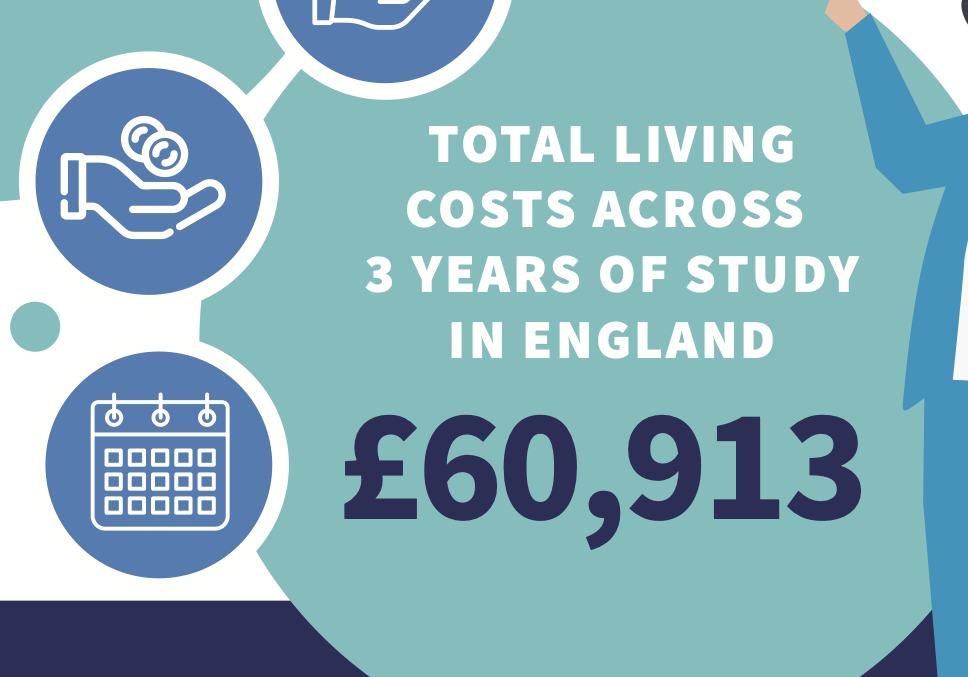
    Over a three-year degree, the total cost of reaching minimum living standards ranges from approximately £59,000 in Wales to £77,000 in London, excluding tuition fees. And these figures are what students need not for luxury, but simply to participate fully in university life with dignity. Even living in accommodation that is “purpose built” for students, while providing important social opportunities, is typically more expensive than shared private housing – with rent making up to 47 per cent of total living costs in London.

    Thanks to Terry Nutkins, Gordon Banks and Let Loose

    One particularly pleasing aspect of the report is the “surprising” costs that so many miss when casting round the marcomms office for a couple of student ambassadors to cobble up a budget.

    Practical necessities include storage costs between academic years when halls contracts end, insurance for phones and laptops used outside accommodation, and mattress protectors for the “really cheap and uncomfortable” beds typically provided.

    First-year students face particular financial pressures during their settling-in period, wasting money on food while learning to shop and cook independently, plus ongoing laundry costs in halls that can reach £5 weekly for basic washing needs.

    Academic periods bring additional expenses, from extra food costs during exam sessions when students spend long hours in libraries, to transport costs for third-year students attending job interviews and graduate recruitment events.

    Basic costs related to social participation and mental health are also included. They include individual crockery and cutlery in halls to avoid hygiene issues when sharing with strangers, a £20 (!) annual personalisation budget for room decoration that prevents students feeling like they’re “in prison,” and £50 annually for clothing required for university social events and society activities.

    They are seemingly minor expenses – but they all add up, and they highlight how the “minimum” standard isn’t about luxury, but about enabling students to participate fully in university life, maintain their mental health, and avoid social exclusion.

    There’s also dehumidifier packs to combat poor ventilation and condensation from drying clothes, tabletop ironing boards to fit cramped spaces, and overdoor hooks because standard furniture is insufficient for storing belongings across shared living arrangements.

    Technical necessities include extension leads for inadequate electrical outlets and Wi-Fi boosters for poor connectivity, while protective measures like upholstery and carpet cleaners become crucial for avoiding deposit losses. Even basic items like door mats for communal cleanliness and shower caddies for bathroom storage represent additional shared costs when five people live together.

    Beyond accommodation, students face numerous individual costs related to campus life and practical necessities that all accumulate quickly. They include water bottles and Tupperware containers for daily campus use and food storage, delivery and returns costs reflecting modern shopping patterns, and small airers for bedroom clothes drying when shared facilities are limited.

    Admin costs like provisional driving licences at £34 become the most practical form of student ID, cheaper and more portable than passports. And there’s eye tests every two years with potential glasses purchases, and a small budget for everyday medicines and a couple of prescriptions annually – along with significant variations in personal care costs, the report particularly noting “the higher cost of hairdressing for afro hair in particular,” while emphasising that regular haircuts are deemed essential for being “presentable” and maintaining “self-respect”. Luxuries these are not.

    Parental contribution

    The report repeats last year’s calls for urgent, system-wide reform based on five principles: simplicity, transparency, independence, sufficiency, and fiscal neutrality. Key recommendations include increasing maintenance support so students can reach minimum living standards through a combination of government support and reasonable part-time work, providing a “first-year boost” to help new students establish themselves, and raising parental contribution thresholds so families only contribute when they themselves have achieved minimum living standards.

    The researchers argue reforms could be implemented without additional government spending – although the proposal is to reintroduce much-maligned but fairly progressive real interest rates on student loans, ensuring those who benefit most from higher education contribute accordingly. Sadly, they’re usually the loudest too.

    Without reforms, they warn of three critical risks – increasingly unequal access to higher education, declining quality of student experience, and threats to sector sustainability as students struggle to afford university attendance.

    But forgive me for the doom. Any or all of that will have to wait until at least September 2026, and even then is looking increasingly unlikely, given that the Treasury is said to be staring at a £41bn hole in its budget, and is currently borrowing the money on the bond markets to lend to students at an interest rate of 4.5 per cent – a far cry from 0.5 per cent nine years ago.

    And it could all be about to get much much worse.

    Basket cases

    Whether you use RPI or CPI is almost immaterial – it’s the basket of goods that matters, and neither basket captures the basket of a student typified in the MIS. Students spend more on food than the average consumer, and in that basket they’re less able to “trade down” through the brands.

    The Bank of England expects food inflation to be around 5 per cent Q3, rising to 5.5 per cent by the end of the year – higher global commodity prices, higher labour costs and Extended Producer Responsibility regulations that come into effect from October of this year all driving the change.

    In June, Beef and Butter were up at 20 per cent, Coffee was at 12.5 per cent and Chocolate was running at 16 per cent. Decent rent data is hard to come by – but it always seems to increase by more than inflation. If not included in their rent, energy prices have shifted from being a drag on inflation to providing a boost – Ofgem’s price cap for households is £1,720 for July-September 2025, almost 10 per cent higher than the same period last year.

    And the BoE’s key mitigation measure – to cut the Bank Rate by 0.25 percentage points to 4 per cent at its August meeting – might be helping students’ landlords, but it won’t be impacting student budgets.

    Meanwhile, if students have been steadily increasing their term-time work (both in numbers of students and hours worked), that could be a coming problem too. Employment growth has stagnated, and job vacancies have fallen significantly. And while two-thirds of students say they’ve been in work during term time, 89 per cent of applicants are now expecting to find work – rising to 93 per cent of care leavers, 94 per cent of international students and 96 per cent of estranged students.

    Either there’s lots of spare jobs going, or the UK may be about to run out of part-time work for students. That’s a problem few will see coming, will be almost certainly be worse in some cities than in others, and would be exacerbated if the usual ratio of students spending in businesses v those working in those businesses shifts significantly – both having grown gently in tandem as student numbers have grown. The need to convert more jobs on campus to those that students can do has never been greater – even if they sound like the first to have gone as teams have contracted in recent years.

    Some will find work that’s further and further away from campus, some will find work that’s more and more punishing on them both mentally and physically, and some simply won’t find it at all. Many – like the international student leader I met last week – will find themselves working for less than minimum wage just to pay their fees, in a country that couldn’t seem less interested in those sorts of labour market abuses if it tried.

    God forbid a student has a setback, an accident or a costly health problem. Or happens to be a student in a year when if nothing else, there will be major and un-modelled impacts on student housing supply as a result of dramatic reforms to the way that an already scandalously poor rental market is regulated.

    Implosions v explosions

    Maybe a crisis is coming – the classic unplanned-for crisis of the sort in The Day Britain Stopped, when various factors conspire in a single period to multiply each other into something that few saw coming. But even if it isn’t an explosion and we see non-continuation rates fall off a cliff, we can see what’s coming – students choosing to stay at home just as their local university closes courses, students choosing against the extracurriculars that would make up for the skills their course supplies but are no longer needed.

    Students breathing in the spores of black mould as they literally choose between heating, and eating.

    In the 2024 MIS report, the authors warned against any increases to maintenance support that would come at the cost of lower participation in higher education, “for example if an increase could only be paid for by capping the number of students who can study in higher education”. The kneejerk makes sense – neither governments, universities nor students are ever keen on measures that might limit opportunity.

    But offering students a loan that only covers half of their basic living costs, and then asking them to work a minimum 20 hours a week during term-time isn’t “opportunity”, it’s a scam – one that sells “student life” but for those on low incomes offers the kind of experience associated with labour market outcomes they’re less likely to achieve anyway, and one that allows lots of people to pat themselves on the participation back while plunging unsuspecting students into poverty.

    If the country really can’t afford mass participation in higher education, and students can’t afford to be students, the only morally right thing to do is admit it. And if telling students they need £21,126 per year to live on might put some of them off, then maybe it should.

    Source link

  • The Value of Higher Education: An Unexpected Partisan Agreement

    The Value of Higher Education: An Unexpected Partisan Agreement

    Title: Varying Degrees 2025: Americans Find Common Ground in Higher Education

    Authors: Sophie Nguyen, Olivia Sawyer, Olivia Cheche

    Source: New America

    New America’s ninth annual survey on higher education in America found that despite the politicization and polarization of higher education, Americans are united in their understanding of the importance and value of a college degree.

    Varying Degrees 2025: Americans Find Common Ground in Higher Education report found more agreements than differences between Democrats and Republicans.

    Key report findings include:

    • Nine out of ten Americans believe colleges are responsible for equipping students for career success. Americans widely agree colleges are also responsible for bolstering a student’s writing and communication skills.
    • While about 40 percent of Americans believe the state of education is fine how it is, there are partisan differences across those who report seeing positive effects. Nearly three-fourths (74 percent) of Democrats see positive effects of higher education, in contrast with only 39 percent of Republicans.
    • Seventy-three percent of Americans believe college is worth the investment and needed to be successful in life. However, this belief in return on investment changes greatly depending on the type of college discussed. Many Americans think highly of community colleges, a majority think public colleges and universities are worth the investment, and significantly less believe in the cost of private colleges – especially private for-profit institutions. Regardless of degree type, two in three Americans believe it is easier to find a well-paying job with some college education.
    • Half of Americans surveyed believe college is unaffordable. The report finds that both Democrats and Republicans believe the cost of college is a major issue. Both parties identify the cost of college as one of the main reasons students choose not to enroll in postsecondary education.
    • Over 70 percent of Americans believe the government should invest more tax dollars on postsecondary education. Although there is a larger partisan divide on this belief – most Democrats (91 percent) and Republicans (58 percent) agree in the federal government’s responsibility to make higher education more affordable.

    Varying Degrees 2025 concludes that despite unprecedented legislation effecting higher education, targeted attacks on institutions of higher education from the White House, and media polarization of postsecondary education – Americans largely believe in the value of a college education.

    Read the full report here.

    —Harper Davis


    If you have any questions or comments about this blog post, please contact us.

    Source link

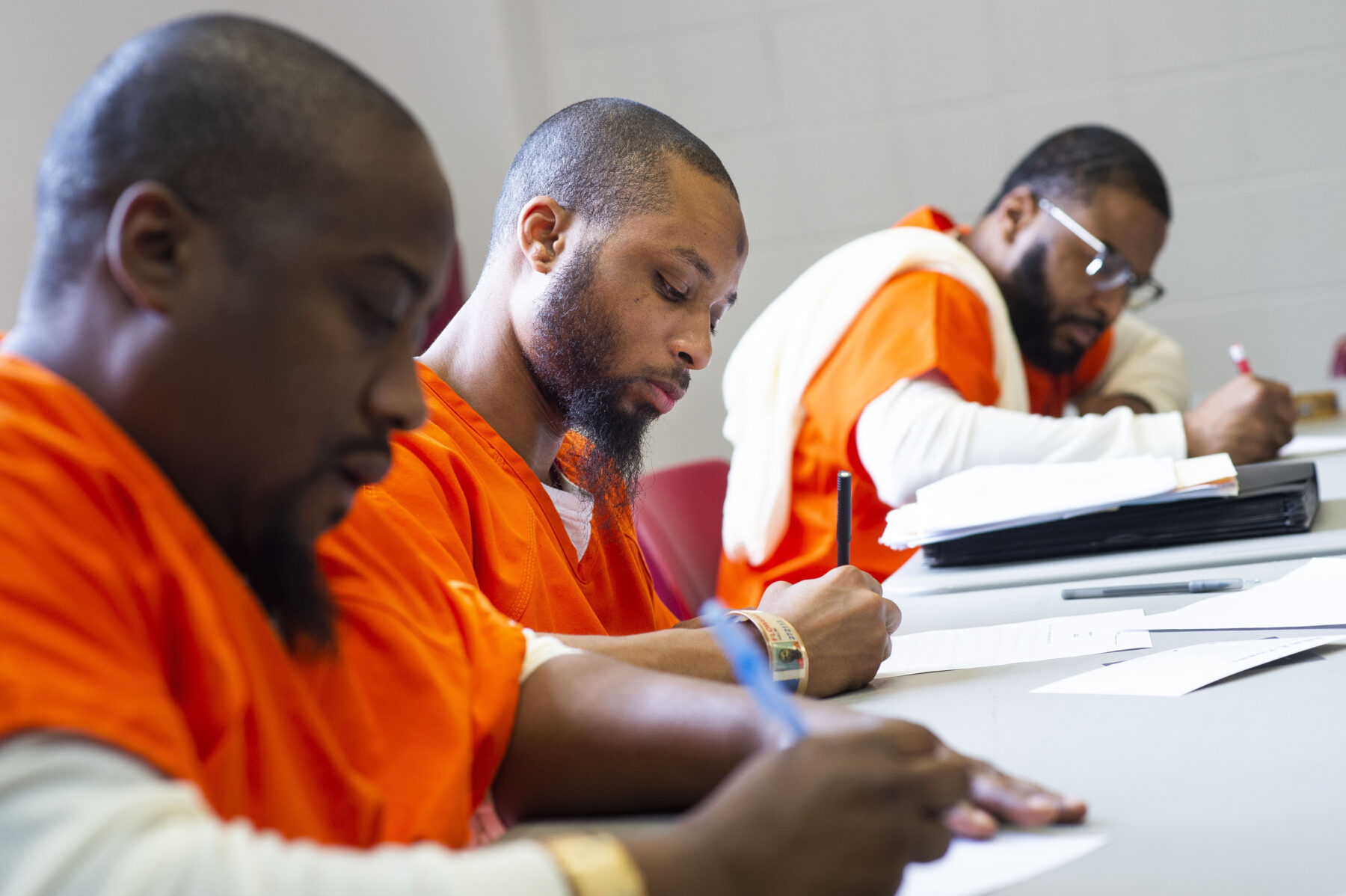
  • Investing in Prison Education Saves Taxpayer Dollars

    Investing in Prison Education Saves Taxpayer Dollars

    Title: Policymakers Role in Expanding Prison Education Access

    Authors: Jennifer Thomsen and Shytance Wren

    Source: Education Commission of the States

    A June 2025 report from the Education Commission of the States outlined ways in which state policy actors can expand access to prison education and therefore reduce likelihood for recidivism and incarceration costs.

    Policymakers’ Role in Expanding Prison Education Access summarized findings from an 18-month long community of practice which included stakeholders representing state education policy leaders, leaders from corrections departments, higher education prison program directors, policy leaders, and researchers. The community of practice highlighted key barriers faced by incarcerated learners and produced policy suggestions to remediate these barriers to education.

    Among the report’s key findings:

    • Prison education is a cost-saving measure. Every one dollar spent on prison education saves four to five dollars in incarceration costs.
    • Inefficient governance in prison education programs creates a lack of access for incarcerated learners and a lack of data for policymakers to improve programs. A key consideration in addressing this issue is to review what level of governance the best policies would come from (i.e.: from the governor by executive order).
    • Access to financial aid is often limited for incarcerated individuals. One way to mitigate this barrier is to review existing state financial aid programs that prohibit incarcerated individuals from receiving aid.
    • Inconsistency in access to student support prevents continued learning. A consideration for state leaders to address this inconsistency is to strengthen partnerships with community colleges and job training programs to ensure adequate reentry guidance for incarcerated learners.

    The report concludes that expanding access to prison education is most efficient when state policymakers address governance, financial aid access, and student supports for incarcerated learners.

    Read the full report here.

    —Harper Davis


    If you have any questions or comments about this blog post, please contact us.

    Source link

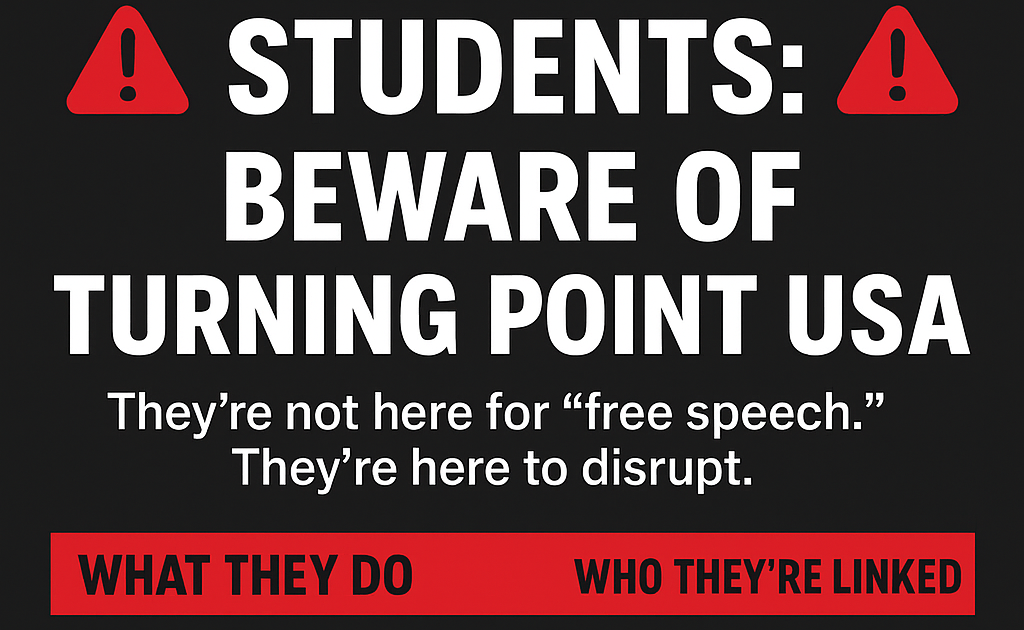
  • Avoid Contact with Turning Point USA

    Avoid Contact with Turning Point USA

    Turning Point USA (TPUSA) brands itself as a conservative youth movement dedicated to free markets and limited government. In reality, a growing body of investigative reporting, watchdog research, and student testimony reveals an organization built on intimidation, manipulation, and close ties to extremists. Students should be aware of the risks before engaging with TPUSA in any capacity.

    From its inception, TPUSA has sought to be confrontational. One of its most notorious tools, the Professor Watchlist, publishes the names, photos, and alleged offenses of professors the group deems “anti-conservative.” This public shaming campaign has been condemned by educators and civil liberties advocates as a threat to academic freedom and personal safety. In more recent years, TPUSA has expanded its targets beyond individual professors, with initiatives like the School Board Watchlist, designed to stir distrust of public education and stoke fear around diversity, equity, and inclusion initiatives.

    These campaigns are paired with questionable political tactics. Investigations have shown that TPUSA has engaged in covert influence efforts on college campuses, including secretly funding student government elections and running coordinated online disinformation campaigns. Their political arm, Turning Point Action, has been compared to a troll farm for its use of deceptive social media operations.

    The group’s leadership and chapters have repeatedly been linked to white supremacist and far-right extremist figures. TPUSA events have hosted or associated with members of Nick Fuentes’ “Groyper” movement, Holocaust deniers, and other alt-right personalities. The Southern Poverty Law Center, Anti-Defamation League, and multiple journalists have documented these associations, which TPUSA leaders routinely downplay. Internal communications and leaked chapter messages have exposed racist, homophobic, and Islamophobic rhetoric from members. Charlie Kirk, TPUSA’s founder, once falsely claimed that a Black woman had “taken his place” at West Point, a statement criticized as both untrue and racially inflammatory.

    TPUSA’s messaging also extends beyond politics into science denial. The group has repeatedly dismissed the scientific consensus on climate change, framing environmental concerns as a hoax or left-wing scare tactic, and hosting events that platform climate change skeptics over credible experts. TPUSA has received significant funding from fossil fuel interests, including Koch network-affiliated donors, and from political megadonors such as Foster Friess and Rebekah Mercer, who are known for underwriting climate denial campaigns. Other key allies include right-wing think tanks like the Heritage Foundation and media figures such as Tucker Carlson, who have amplified TPUSA’s messaging to broader audiences. The organization has also benefitted from support by religious nationalist groups and political operatives who share its hardline positions on education, race, and gender.

    TPUSA’s confrontational model often invites chaos. At UC Davis, a TPUSA-sponsored event erupted into physical clashes involving Proud Boys. Across campuses, students and faculty report that TPUSA representatives deliberately provoke heated exchanges, record them, and circulate the footage to mobilize their base and fundraise off manufactured outrage. Former members have confirmed that such confrontations are not accidental, but rather part of the playbook.

    While TPUSA presents itself as a mainstream conservative voice, the evidence paints a darker picture: an organization willing to distort, harass, and align with extremists to achieve its goals. Students seeking honest political debate should look for groups that engage in respectful dialogue, value truth over theatrics, and reject intimidation as a tool.

    Sources:

    Southern Poverty Law Center – Turning Point USA: Case Study in the Hard Right

    Media Matters – Turning Point USA’s History of Racism and White Nationalist Ties

    The New Yorker – A Conservative Nonprofit That Seeks to Transform College Campuses Faces Allegations of Racial Bias and Illegal Campaign Activity

    Anti-Defamation League – Extremism in American Politics: Turning Point USA

    Wired – How Charlie Kirk Plans to Discredit Martin Luther King Jr. and the Civil Rights Act

    Chron – Texas A&M Turning Point Chat Exposes Racist and Homophobic Comments

    The Guardian – What I Learned When Turning Point USA Came to My Campus

    OpenSecrets – Turning Point USA Donors and Political Funding

    DeSmog – Turning Point USA and Fossil Fuel Industry Influence

    Source link

  • Higher Education Leadership in Times of Crisis – Edu Alliance Journal

    Higher Education Leadership in Times of Crisis – Edu Alliance Journal

    First in Leadership Series by Barry Ryan, PhD, JD August 11, 2025

    It is hard to think of a time when higher education was swimming in a pool filled with a greater number of shark-like threats than at present.

    Some of these were predictable (in hindsight), some not so much. Let’s set aside blame, however, on either an institutional level or on a more global basis. The vital thing now is for genuine leaders to help chart courses that will lead higher education, not just to mere survival, but to new and meaningful purposes that will benefit this generation and the next.

    When situations are “normal,” we may be tempted to imagine that we need leadership that can keep the legacy intact, turn the crank, not rock the boat. But normal no longer exists, does it?

    I remember a senior university leader, who admonished me, as I began a new presidency: “everything’s going great—just don’t mess it up” (using slightly more colorful language). One year later, seismic changes in higher ed created an unexpected crisis and necessitated major changes in the institution. Almost everything that had contributed to its prior success turned, overnight, into a liability.

    There is, of course, more than one crisis in which higher ed is being buffeted. The sheer number of colleges and universities that have ceased to exist at all, or have been merged to various extents with others, or are currently teetering on the brink, appears in news stories almost every day. The root causes are legion and often woven together: financial shortfalls, a shrinking number of students, reductions in state and federal support, the disappearance of many international students, families, and prospective students increasingly unable to justify the cost of a degree, the “value” of which is seriously questioned. The list goes on.

    Of the three large “types” of higher education in the United States—public (state) colleges and universities, private not-for-profit colleges and universities, and for-profit entities—the vast majority are struggling in meaningful ways.

    If you find yourself in a leadership role in this age of crisis, what are some key things you can do to keep becoming a better leader and more effectively serve your institution and your colleagues? Here are three suggestions that you may find helpful.

    First, don’t panic.

    And even if you do feel panic welling up inside you, do your best to keep it from becoming obvious. Phil Slott, who was involved in the Dry Idea marketing campaign in the 1980s, seems to have coined a relevant phrase: “Never let them see you sweat.” It just stresses you out more and does little to inspire confidence in those who are looking to you for leadership.

    Once you’ve steadied yourself, the next critical realization is that leadership in crisis cannot be solitary work.

    Second, remember every day, you can’t do this alone.

    A 19th-century lawyer by the name of Abe Lincoln is credited with the adage: “A person who represents himself in court has a fool for a client.” That rings true for any leader who tries to do everything and assumes they have sufficient knowledge (or wisdom or experience or insight) to solve every problem on their own. No one does—no matter how experienced.

    So where do you turn for help? The answer is two-fold: internally and externally. You need to draw on both circles and find confidential, experienced, and reliable counsel.

    Choose very carefully with whom you share the issues internally. Depending on the nature of the problem you’re trying to address, success might well be thwarted if there is a lapse of absolute confidentiality. At the starting point of the process, you need to be able to rely on one other person, or perhaps a very small circle, with which you will be able to expand bit by bit as the timeline moves along.

    There are difficult audiences and stakeholders in the life of an academic institution, and ultimately, all must be included in the process of working through a crisis. The sequencing of sharing information and inviting input, though, must be very carefully structured. If you’re a president, oftentimes the first person you seek is a senior member of the administration—a provost, vice president, or someone in a similar position. At times, it could be the chair of the board or a wise and thoughtful alum. But whoever the person(s) may be, the timing of sharing the situation and seeking input for solutions is everything.

    It’s very important not to neglect external assistance as well. It is all but impossible to generate a sufficient perspective on a crisis from only one (your) vantage point, or even from that of your small, trustworthy group. You’re very likely not the first institution to face these problems, and consulting with trusted external leaders can provide not only perspective but also ideas you may not have thought of on your own.

    Some of these leaders may be in academic institutions, but not necessarily. It is always helpful to have relationships with leaders in other professional fields as well, who may be particularly helpful in providing fresh perspectives and ideas. For example, in my own experience, I’ve found such people in leadership of non-profit organizations or boards, key corporate positions, government at various levels, and experienced friends with whom I served long ago, and could provide input on both my institution’s situation and also my own strengths and weaknesses. In addition, external folks don’t have the same emotional investment as someone internal, so the chances of a more neutral observation point are increased significantly.

    There is a temptation—and often a prudent one—to seek external input from lawyers. There are, of course, a fair number of attorneys and firms with expertise in higher education, which can be a plus. Higher education is a very specialized field, and, frankly, most lawyers have a huge knowledge deficit in terms of the operational realities of a college or university. Their tendency is to think, “Well, I know higher ed—after all, I went to college and law school” (or maybe even taught a course or two). Beware the well-intentioned lawyer who does not have directly relevant practice experience.

    This, of course, does not at all preclude seeking competent legal advice for certain aspects of the problems you may be facing. For example, most institutions have or will need counsel in employment matters. Even if not the center of your challenge, these issues will likely arise as part of the need for a solution to your challenges. If it appears you will have to make difficult financial decisions that might impact faculty or staff, you should seek excellent employment counsel much sooner rather than later. With students, Title IX requirements, for example, may dictate the need for specialized counsel, as might certain types of accreditation issues.

    Third, leadership is not “one size fits all.”

    Every leader has different abilities and personalities. Even though many institutions experience similar types of crises, the circumstances of each call for a bespoke solution.

    However, some very important leadership characteristics can increase the probability of success in these situations. In part two, we’ll examine these and how to cultivate them.


    Dr. Barry Ryan invested the first half of his career in higher education in teaching and the second half in administration. During that same timeframe, he pursued a parallel career in law and legal education. He​ served as the Supreme Court Fellow in the chambers of Chief Justice William H. Rehnquist and is a​ member of numerous federal and state bars. He has been appointed as the president of five universities and provost and chief of staff at three others. Among the institutions he served have been state, private non-profit, and private for-profit universities. Included in his academic experience were two terms as a Commissioner of the regional accreditor WASC​ (WSCUC).

    He has been appointed as the president of five universities and provost and chief of staff at three others. Among the institutions he served have been state, private non-profit, and private for-profit universities. Included in his academic experience were two terms as a Commissioner of the regional accreditor WASC​ (WSCUC). Dr. Ryan has led institutions through mergers, acquisitions, and affiliations that have preserved academic​ quality, expanded access, and strengthened long-term viability. His leadership has been marked by​ transparency, shared governance, and a commitment to stakeholder engagement at every stage of these processes.

    He earned his Ph.D. from the University of California, Santa Barbara, his J.D. from the University of​ California, Berkeley, and his Dipl.GB in international business from the University of Oxford.


    Edu Alliance Journal provides expert commentary and practical insights on U.S. and international higher education, focusing on innovation, policy, and institutional growth. Published by Edu Alliance, a consulting firm with offices in the United States and the United Arab Emirates, the Journal reflects the organization’s mission to help colleges, universities, and educational organizations achieve sustainable success through strategic partnerships, market intelligence, and program development.

    Source link