Blog

  • Students Increasingly Rely on Chatbots, but at What Cost? – The 74

    Students Increasingly Rely on Chatbots, but at What Cost? – The 74


    Get stories like this delivered straight to your inbox. Sign up for The 74 Newsletter

    Students don’t have the same incentives to talk to their professors — or even their classmates — anymore. Chatbots like ChatGPT, Gemini and Claude have given them a new path to self-sufficiency. Instead of asking a professor for help on a paper topic, students can go to a chatbot. Instead of forming a study group, students can ask AI for help. These chatbots give them quick responses, on their own timeline.

    For students juggling school, work and family responsibilities, that ease can seem like a lifesaver. And maybe turning to a chatbot for homework help here and there isn’t such a big deal in isolation. But every time a student decides to ask a question of a chatbot instead of a professor or peer or tutor, that’s one fewer opportunity to build or strengthen a relationship, and the human connections students make on campus are among the most important benefits of college.

    Julia Freeland-Fisher studies how technology can help or hinder student success at the Clayton Christensen Institute. She said the consequences of turning to chatbots for help can compound.

    “Over time, that means students have fewer and fewer people in their corner who can help them in other moments of struggle, who can help them in ways a bot might not be capable of,” she said.

    As colleges further embed ChatGPT and other chatbots into campus life, Freeland-Fisher warns lost relationships may become a devastating unintended consequence.

    Asking for help

    Christian Alba said he has never turned in an AI-written assignment. Alba, 20, attends College of the Canyons, a large community college north of Los Angeles, where he is studying business and history. And while he hasn’t asked ChatGPT to write any papers for him, he has turned to the technology when a blank page and a blinking cursor seemed overwhelming. He has asked for an outline. He has asked for ideas to get him started on an introduction. He has asked for advice about what to prioritize first.

    “It’s kind of hard to just start something fresh off your mind,” Alba said. “I won’t lie. It’s a helpful tool.” Alba has wondered, though, whether turning to ChatGPT with these sorts of questions represents an overreliance on AI. But Alba, like many others in higher education, worries primarily about AI use as it relates to academic integrity, not social capital. And that’s a problem.

    Jean Rhodes, a psychology professor at the University of Massachusetts Boston, has spent decades studying the way college students seek help on campus and how the relationships formed during those interactions end up benefitting the students long-term. Rhodes doesn’t begrudge students integrating chatbots into their workflows, as many of their professors have, but she worries that students will get inferior answers to even simple-sounding questions, like, “how do I change my major?”

    A chatbot might point a student to the registrar’s office, Rhodes said, but had a student asked the question of an advisor, that person may have asked important follow-up questions — why the student wants the change, for example, which could lead to a deeper conversation about a student’s goals and roadblocks.

    “We understand the broader context of students’ lives,” Rhodes said. “They’re smart but they’re not wise, these tools.”

    Rhodes and one of her former doctoral students, Sarah Schwartz, created a program called Connected Scholars to help students understand why it’s valuable to talk to professors and have mentors. The program helped them hone their networking skills and understand what people get out of their networks over the course of their lives — namely, social capital.

    Connected Scholars is offered as a semester-long course at U Mass Boston, and a forthcoming paper examines outcomes over the last decade, finding students who take the course are three times more likely to graduate. Over time, Rhodes and her colleagues discovered that the key to the program’s success is getting students past an aversion to asking others for help.

    Students will make a plethora of excuses to avoid asking for help, Rhodes said, ticking off a list of them: “‘I don’t want to stand out,’ ‘I don’t want people to realize I don’t fit in here,’ ‘My culture values independence,’ ‘I shouldn’t reach out,’ ‘I’ll get anxious,’ ‘This person won’t respond.’ If you can get past that and get them to recognize the value of reaching out, it’s pretty amazing what happens.”

    Connections are key

    Seeking human help doesn’t only leave students with the resolution to a single problem, it gives them a connection to another person. And that person, down the line could become a friend, a mentor or a business partner — a “strong tie,” as social scientists describe their centrality to a person’s network. They could also become a “weak tie” who a student may not see often, but could, importantly, still offer a job lead or crucial social support one day.

    Daniel Chambliss, a retired sociologist from Hamilton College, emphasized the value of relationships in his 2014 book, “How College Works,” co-authored with Christopher Takacs. Over the course of their research, the pair found that the key to a successful college experience boiled down to relationships, specifically two or three close friends and one or two trusted adults. Hamilton College goes out of its way to make sure students can form those relationships, structuring work-study to get students into campus offices and around faculty and staff, making room for students of varying athletic abilities on sports teams, and more.

    Chambliss worries that AI-driven chatbots make it too easy to avoid interactions that can lead to important relationships. “We’re suffering epidemic levels of loneliness in America,” he said. “It’s a really major problem, historically speaking. It’s very unusual, and it’s profoundly bad for people.”

    As students increasingly turn to artificial intelligence for help and even casual conversation, Chambliss predicted it will make people even more isolated: “It’s one more place where they won’t have a personal relationship.”

    In fact, a recent study by researchers at the MIT Media Lab and OpenAI found that the most frequent users of ChatGPT — power users — were more likely to be lonely and isolated from human interaction.

    “What scares me about that is that Big Tech would like all of us to be power users,” said Freeland-Fisher. “That’s in the fabric of the business model of a technology company.”

    Yesenia Pacheco is preparing to re-enroll in Long Beach City College for her final semester after more than a year off. Last time she was on campus, ChatGPT existed, but it wasn’t widely used. Now she knows she’s returning to a college where ChatGPT is deeply embedded in students’ as well as faculty and staff’s lives, but Pacheco expects she’ll go back to her old habits — going to her professors’ office hours and sticking around after class to ask them questions. She sees the value.

    She understands why others might not. Today’s high schoolers, she has noticed, are not used to talking to adults or building mentor-style relationships. At 24, she knows why they matter.

    “A chatbot,” she said, “isn’t going to give you a letter of recommendation.”

    This article was originally published on CalMatters and was republished under the Creative Commons Attribution-NonCommercial-NoDerivatives license.


    Get stories like these delivered straight to your inbox. Sign up for The 74 Newsletter
    Source link

  • Announcing a Special Small College America Webinar – Edu Alliance Journal

    Announcing a Special Small College America Webinar – Edu Alliance Journal

    “Guiding Through Change: How Small Colleges Are Responding to New Realities”: A Live Conversation with Three Small College Presidents

    August 2, 2025, by Dean Hoke: Over the past several months, higher education has experienced an unprecedented wave of transformation. The elimination or curtailment of Diversity, Equity, and Inclusion (DEI) initiatives, shifting federal financial aid policies, declining enrollment in traditional undergraduate programs, and heightened visa scrutiny and geopolitical tensions pose potential risks to international student enrollment, an area of growing importance for many small colleges.

    Dr. Chet Haskell, in a recent piece for the Edu Alliance Journal, captured the mood succinctly: “The headlines are full of uncertainty for American higher education. ‘Crisis’ is a common descriptor. Federal investigations of major institutions are underway. Severe cuts to university research funding have been announced. The elimination of the Department of Education is moving ahead. Revisions to accreditation processes are being floated. Reductions in student support for educational grants and loans are now law. International students are being restricted. These uncertainties and pressures affect all higher education, not just targeted elite institutions. In particular, they are likely to exacerbate the fragility of smaller, independent non-profit institutions already under enormous stress.”

    Small colleges—often mission-driven, community-centered, and tuition-dependent—are feeling these disruptions acutely.

    As we enter the third season of Small College America, a podcast series that spotlights the powerful impact of small colleges across the nation, my co-host Kent Barnds and I wanted to mark the moment with something special. Rather than recording a typical podcast episode, we’re hosting a live webinar to engage in a timely and candid discussion with three dynamic presidents of small colleges.

    Join us for a special Small College America webinar:

    “Guiding Through Change: How Small Colleges Are Responding to New Realities”

    Wednesday, August 27, 1:00 PM – 2:00 PM Eastern

    Our panelists bring deep experience, insight, and a strong commitment to the mission of small colleges:

    • Dr. Andrea Talentino is the president of Augustana College in Rock Island, Illinois. She previously served as provost at Nazareth College in Rochester, N.Y., and Dean of the College of Liberal Arts at Norwich University in Northfield, Vermont. In her administrative work, she has focused on building strong teams and developing a positive organizational culture.
    • Dr. Tarek Sobh is the President of Lawrence Technological University. A distinguished academic leader, he previously served as Provost at LTU and as Executive VP at the University of Bridgeport. An expert in robotics, AI, and STEM education, Dr. Sobh has published extensively and presented internationally. He is passionate about aligning academic programs with workforce needs.
    • Dr. Anita Gustafson, President of Presbyterian College, is a historian and long-time faculty leader who assumed the presidency in 2023. She has been a strong advocate for the value of the liberal arts and the importance of community engagement. Dr. Gustafson returned to PC after seven years as the dean of the College of Liberal Arts and Sciences and a professor of history at Mercer University in Macon, Ga.

    This one-hour webinar will explore how small private colleges are navigating today’s evolving environment and planning strategically for the future.

    Who Should Attend:

    • Institutional Leaders and Academic Faculty
    • Trustees and Advisory Members
    • Donors and Corporate Supporters
    • Alumni of Small Colleges
    • Community Leaders and Advocates

    👉 Click Here to Register

    There is no charge to attend—secure your spot today!

    We hope you’ll join us for this thoughtful and timely conversation.

    Source link

  • Undocumented Kids Face Narrowed Pathways, Stifled Futures – The 74

    Undocumented Kids Face Narrowed Pathways, Stifled Futures – The 74

    School (in)Security is our biweekly briefing on the latest school safety news, vetted by Mark KeierleberSubscribe here.

    In a battle over undocumented students’ access to public schooling — and, frankly, their futures — the Trump administration agreed this week to pause new federal rules designed to bar immigrants from Head Start and other education programs. 

    My colleague Jo Napolitano reports the reprieve, through Sept. 3, applies in 20 states and Washington, D.C., after state attorneys general sued to stop new rules designed to give undocumented preschoolers and other immigrant students the boot.

    Health and Human Services Secretary Robert. F. Kennedy Jr. visits a Head Start program on May 21 to promote healthy eating. On July 10, he issued a directive barring undocumented students from the federally funded early education program. (Facebook/HeadStart.gov)

    Those regulations could end up restricting educational opportunities for the youngest learners. But as Jo explains in her newest analysis, it’s just one part of a multifaceted approach to bar undocumented students from learning from cradle to career. 

    Read Jo’s full analysis — and learn how the changes could undercut the chance immigrant youth get for a better life. 


    In the news

    More on Trump’s immigration crackdown: In Arizona, unaccompanied minors are facing immigration judges alone — without help from lawyers — after the administration cut off access to funding for their defense. A court order has restored the money temporarily through September. | Arizona Republic

    • The Trump administration instructed federal agents to give detained migrant teenagers the option of voluntarily returning to their home countries instead of being confined in government-overseen shelters. | CBS News
    • Attorneys for immigrant children say youth and families are being detained in “prison-like” facilities even as the administration seeks to terminate rules that mandate basic safety and sanitary conditions for children. | CBS News
    • The Denver school district says fear of federal immigration enforcement led to a surge in student absences. A review of attendance data by The Denver Gazette suggests a more nuanced picture. | The Denver Gazette
    • Undocumented students who attended K-12 schools in the U.S. last year before getting deported share their stories. | USA Today
    Sign-up for the School (in)Security newsletter.

    Get the most critical news and information about students’ rights, safety and well-being delivered straight to your inbox.

    Penny Schwinn, who was in line to be the Education Department’s second in command, has dropped out of consideration following critiques of her conservative bona fides, including for past support of campus equity initiatives. | The 74

    ‘Trampling upon women’s rights’: The Oregon Department of Education is the latest agency to come under federal investigation over allegations the state allows transgender students to compete in women’s sports. | Oregon Public Broadcasting

    New Education Department guidance encourages the use of federal money to expand artificial intelligence in classrooms, which the agency said has “the potential to revolutionize” schools. | Education Week 

    • The Trump administration’s “AI Action Plan” comes after the Senate failed to pass rules in the “big, beautiful” tax-and-spending bill designed to prevent states from regulating AI. Instead, Trump’s guidance directs the Federal Communications Commission to evaluate state regulations and block any “AI-related federal funding” to any states with rules deemed “burdensome.” | The White House

    How a 45-second TikTok video portraying a campus shooting — created by middle school cheerleaders — led to criminal charges. | ProPublica

    A phishing campaign has taken advantage of mass layoffs at the Education Department by mimicking a portal maintained by the agency to manage grants and federal education funding. | DarkReading

    Drones are being pitched as the next big thing to thwart school shootings — but district leaders are balking at the million-dollar price tag. | WCTV

    ‘Critical gaps’: An inspector general report in Washington, D.C., uncovered flaws in the city school system’s gun violence prevention efforts, including a backlog on repairs to security equipment. | The Washington Post

    Wisconsin schools are installing controversial license plate readers that have been used by law enforcement to track down undocumented immigrants. | Milwaukee Journal Sentinel


    ICYMI @The74

    Sierra Rios and her daughter Nevaeh (Sierra Rios)

    For Decades, the Feds Were the Last, Best Hope for Special Ed Kids. What Happens Now?

    A Student’s View: Cell Phone Bans Won’t Fix Education

    Report: ‘A Mixed Picture’ in Pandemic Recovery for American Children


    Emotional Support

    Chompers gonna chomp. Photo credit: Bev Weintraub


    Get stories like these delivered straight to your inbox. Sign up for The 74 Newsletter

    Source link

  • Weekend Reading: Rethinking the Role of Place in UK Higher Education Policy

    Weekend Reading: Rethinking the Role of Place in UK Higher Education Policy

    • This HEPI guest blog was kindly authored by John Goddard OBE, Emeritus Professor of Regional Development Studies at Newcastle University.

    In a HEPI note prompted by a Centre for Skills, Knowledge and Organisational Performance (SKOPE) conference, Nick Hillman asked: Should the seminal Robbins report inform the forthcoming post-16 strategy? He referenced the point made by Professor Robson of SKOPE about the need ‘to encourage place-based approaches … and replace competition with coordination.’ As Nick points out, the challenge of place and coordination are not new, but as I will argue, these are not being confronted by policymakers right now.

    The Robbins’ report led to new universities being established. But these were in county towns and as we observe in our volume on The University and the City, overlook the growing urban crisis of that period. The Education Reform Act of 1988 severed the link between polytechnics and local government. The Further and Higher Education Act 1992, which allowed polytechnics to apply for university status, had the Government’s desired impact of reducing the unit cost of higher education and moving the UK instantly up the OECD rankings in terms of participation in higher education. But it also signalled a further disconnection with cities. The creation of new universities in the 1970s to meet a 50% participation rate was also unplanned in geographical terms. So, unlike many countries, the UK has not had a plan for the geography of higher let alone further education.

    Indeed, UK higher education policy and practice has ignored the lessons of history as well as being geographically blind. It has not been sensitive to the different local contexts where universities operate and the evolution of these institutions and places through time.

    It is important to remember that locally endowed proto-universities like Newcastle, Sheffield and Birmingham supported late 19th-century urban industrialisation and the health of the workforce. They also played a role in building local soft infrastructure, including facilitating discourse around the role of science and the arts in business and society. This was also a time in which new municipal government structures were being formed. In short, universities helped build the local state and create what the British Academy now calls social and cultural infrastructure, in which universities play a key role

    These founding principles became embedded in the DNA of some institutions. For example, in 1943, the Earl Grey Memorial lecturer in King’s College Newcastle noted,

    Ideal Universities… should be an organic part of regional existence in its public aspects, and a pervading influence in its private life. …Universities to be thus integrated in the community, must be sensitive to what is going on in the realm of business and industry, of practical local affairs, of social adaptation and development, as well as in the realm of speculative thought and abstract research.

    In the later 20th century, most so-called redbrick universities turned their back on place as the central state took on direct funding of higher education and research and did not prioritise the local role of universities. But this was challenged by the Royal Commission on the Future of Higher Education in 1997, chaired by Lord Dearing. He noted that: ‘As part of the compact we envisage between HE and society, each institution should be clear about its mission in relation to local communities and regions.’ For him, this ‘compact’ was wide-ranging, had a strong local dimension and was one where the university’s contribution to ‘the economy’ could not be separated from the wider society in which it was embedded.

    Many of Dearing’s ideas were subsequently incorporated into the work of Regional Development Agencies (RDAs) that were established in 1989 to promote economic development and regeneration, improve business competitiveness, and reduce regional disparities. This included investment, (matched by European regional funds ) into university-related research and cultural facilities. These capital and recurrent investments contributed to ‘place making’ and university links with business and the arts. For example, the former Newcastle brewery site was purchased by Newcastle University, Newcastle City Council and RDA, which they named ‘Science Central’. The partnership was incorporated as Newcastle Science City Ltd., a company limited by guarantee with its own CEO and independent board. The organisation’s portfolio included:

    Support for business, facilitating the creation of new enterprises drawing on the scientific capabilities of the region’s universities and work with local schools and communities, particularly focussed on promoting science education in deprived areas.

    The initiatives recognised the role that universities could play in their places by building ‘quadruple helix partnerships’ between universities, business, local and central government and the community and voluntary sectors.

    But from 2008, with the onset of public austerity, a focus on national competitiveness and a rolling back of the boundaries of the state, we saw the abolition of the RDAs in 2012, the creation of Local Enterprise Partnerships with more limited powers and resources and a cutting back on non-statutory local government activities, notably for economic development. My 2009 NESTA provocation Reinventing the Civic University was a reminder that universities had to go back to their roots and challenge broader geo-political trends, including globalisation and the creation of university research excellence hierarchies that mirrored city hierarchies.

    Marketisation was subsequently embedded into law in the 2017 Higher Education Act. This abolished the Higher Education Funding Council for England and its network of regional consultants working with formal university associations. The act unleashed competition regulated via the Office for Students (OfS) and supported by an enhanced discipline-based research excellence funding scheme. Both were place blind. Some of us raised the possibility of the financial collapse of universities in less prosperous places where they were so-called ‘anchor institutions’

    It was a recognition of this place blindness that contributed to the case for the establishment of the Civic University Commission, chaired by the late Lord Kerslake. The Commission argued that the public – nationally and locally – needed to understand better the specific benefits that universities can bring in response to the question: ‘We have a university here, but what is it doing for us? Institutions that were ultimately publicly funded needed to be locally accountable given our place-based system of governance – parliamentary constituencies and local authorities.

    For the Commission, accountability meant something different from a top-down compliance regime. Rather, sensitive and voluntary commitments made between a diverse set of actors to one another, whose collective powers and resources could impact local economic and social deficiencies

    The Commission therefore proposed that universities wishing to play a civic role should prepare Civic University Agreements, co-created and signed by other key partners and embracing local accountability. Strategic analysis to shape agreements should lead to a financial plan that brings together locally the many top-down and geographically blind funding streams that universities receive from across Whitehall – for quality research, for health and wellbeing, for business support, for higher-level skills and for culture.

    Some of these national funds now need to be ring-fenced to help universities work with partners to meet local needs and opportunities, including building capacity for collaborative working within an area. As the Secretary of State for Education has suggested in her letter to VCs, this might include a slice of core formulaic Quality Research (QR) funding. Such processes would be preferable to the ad-hoc interventions that have hitherto failed to establish long-term trust between universities and the community. At the same time, a place dimension could be included in the regulation of the domestic student marketplace. This could all form part of a compact or contract between universities and the state which enshrined a responsibility to serve the local public good.

    Going forward, I would argue that the coincidence of multiple crises across the world has far-reaching implications that universities cannot ignore. Indeed, if they do not step up to the plate and assert their civic role as anchor institutions in their places, their very existence may be at stake. The issues are well set out in this Learning Planet Institute Manifesto for the Planetary Mission of the University.

    Reading this Manifesto should help policy makers and institutional leaders in the UK recognise that the current financial crisis facing universities is an outward and visible sign of deeper threats, not least those arising from popularism and being fanned by Donald Trump. And popularism has its roots in the experience of people in left behind places.

    Therefore, Government support for the role of universities in their communities is not only beneficial to them but also to society at large. To respect institutional autonomy, this requires the right incentives (sticks and carrots). For example, universities throughout England could be required to support the Government’s plans for devolution as part of the compact I suggest. Questions to be answered by the Departments for Education; for Housing, Communities and Local Government and for Science, Innovation and Technology working TOGETHER could include:

    • What structures need to be put in place inside and outside of universities to facilitate joint working between universities and Mayoral Combined Authorities (MCAs)?
    • How should universities be included in upcoming Devolution Deals?
    • How might these differ between MCAs at different stages of development and different levels of prosperity?
    • How should universities link their work with business, with the community and the priorities of MCAs for inclusive growth and with the Industrial Strategy White paper?
    • How should Combined Authorities work with different universities and colleges in their area to meet skills gaps?
    • How can areas without MCAs work with universities to deliver equivalent outcomes?

    In summary, universities must recognise that they are part of the problem identified by populism, but can contribute to solutions through purposive local actions supported by the government.

    Source link

  • “We Can’t Make It Here Anymore” Still Rings True

    “We Can’t Make It Here Anymore” Still Rings True

    More than twenty years after James McMurtry released We Can’t Make It Here Anymore, the song’s haunting verses continue to echo across the American landscape. Originally written during the early 2000s under the weight of offshoring, union busting, and post-9/11 disillusionment, McMurtry’s protest ballad has aged not with irrelevance but with renewed urgency.

    McMurtry wrote about Vietnam veterans pushed aside by a society eager to forget its mistakes. Today, those veterans have been replaced by men and women who served in Iraq and Afghanistan—some with missing limbs, some with invisible wounds, many with few job prospects. The system still tells them “thanks for your service” while it sends their factories overseas, their benefits into the shredder, and their children into debt servitude at for-profit colleges or underfunded public universities.

    The song’s refrain—“And the banks run the loan game, and the dollar jumps the track”—has only deepened in meaning in the era of trillion-dollar student loan burdens and the financialization of everything from housing to higher education. Entire zip codes have been gutted by opioid overdoses, job loss, and rising suicide rates. The technology is flashier now, but the despair McMurtry chronicled feels even more entrenched. The “big boys” still “don’t like to lose,” and the factories are still “boarded up,” not just in Michigan and West Virginia, but now in the shadows of elite universities, where campuses flourish while surrounding communities falter.

    Higher education, the supposed equalizer, has played its own part in this disillusionment. Where once it held the promise of upward mobility, it now too often offers low-wage adjunct jobs, debt without degrees, and institutions more concerned with branding and endowments than student welfare. McMurtry sings, “The doctor can’t be reached, he has moved back to LA,” and in 2025, that’s still true—except now the doctor’s been replaced by a telehealth AI, and the local hospital has been bought out by a hedge fund.

    We Can’t Make It Here Anymore is not nostalgia. It is indictment. It is reportage. It is prophecy. And like Woody Guthrie before him, McMurtry tells a story corporate media would rather ignore.

    The song’s last verse ends not with hope, but with observation:

    “Will work for food, will die for oil, will kill for power and to us the spoils.”

    Two decades later, the empire has not changed course. It has just changed spokespeople.

    The names may change—NAFTA to USMCA, Halliburton to BlackRock—but the machinery grinds on. And McMurtry’s anthem remains a soundtrack for those who never made it out of the wreckage, for the veterans of war and labor still trying to make it here.

    Sources

    • James McMurtry, We Can’t Make It Here Anymore, 2004

    • U.S. Department of Labor, Bureau of Labor Statistics

    • U.S. Department of Veterans Affairs

    • National Student Legal Defense Network

    • Higher Education Inquirer archives

    Source link

  • Massachusetts governor pitches $400M to support research funding

    Massachusetts governor pitches $400M to support research funding

    This audio is auto-generated. Please let us know if you have feedback.

    Dive Brief: 

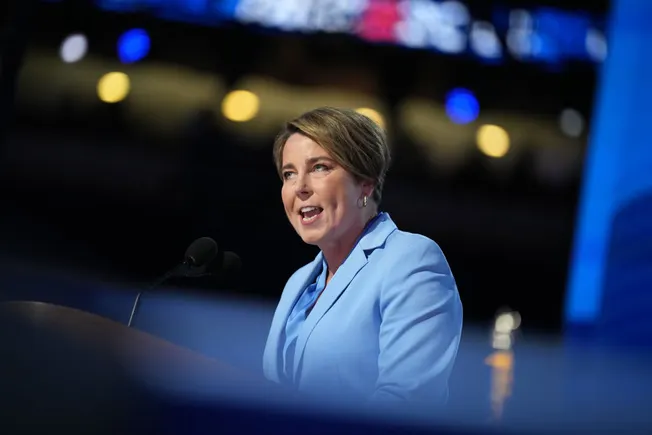
    • Massachusetts Gov. Maura Healey has announced plans to propose legislation that would devote $400 million to support research across the state amid federal funding uncertainty
    • The money would be split evenly across two funds: a multiyear research funding pool to support projects at universities, hospitals and research institutions, and an additional funding reserve to support research and jobs at the state’s public colleges. 
    • “In the face of uncertainty from the federal government, this is about protecting one of the things that makes Massachusetts so special — our global leadership in health care and helping families across the world,” Healey said in the Thursday announcement. 

    Dive Insight: 

    Healey’s proposal comes as the Trump administration freezes and terminates research grants at universities in its crosshairs to pressure them into making policy changes, along with cutting funding more broadly across major scientific agencies. 

    In Massachusetts alone, the Trump administration has terminated research grants valued at nearly $583 million, according to a recent analysis from the Center for American Progress, a liberal think tank. When they were canceled, the grants had $252 million left to be paid out. 

    Overall, the Trump administration has terminated research awards valued at roughly $6.9 billion across the U.S., the analysis found. Of that, $3.3 billion of the canceled funding hadn’t yet been disbursed. The analysis did not account for frozen research grants, suggesting the level of hampered research funding across the nation may rise even higher. 

    Healey’s announcement pointed to the state’s economic reliance on federal research funding. The state received nearly $8.6 billion in federal research funding in fiscal year 2024, which supported roughly 81,000 jobs and $7.8 billion in household income, recent findings from the University of Massachusetts Amherst found. 

    Moreover, Massachusetts accounts for 1 in 10 research and development jobs in the U.S., according to the announcement. 

    Half of the $400 million would go toward a one-time funding pool to help pay for projects at universities, hospitals and research institutions. This pool would also support a one-year fellowship program for early-career researchers, the announcement said. 

    That pot of money would be housed at MassDevelopment, the state’s development finance agency, and Massachusetts would use interest from its state stabilization fund to finance it. 

    The other half of the $400 million would be housed in a bridge funding reserve for the state’s public colleges. That funding would support research costs, partnerships and jobs, including positions for graduate and postdoctorate students. 

    That fund would be paid for from revenue from Massachusetts’ Fair Share, which adds a 4% tax on those with incomes above $1 million. 

    Several university leaders in the state praised the proposal. They include the president of the University of Massachusetts, the state’s public university system, as well as leaders of private institutions including Boston University, Northeastern University and the Massachusetts Institute of Technology. 

    “Advances that spring from our universities, hospitals and laboratories benefit all Americans; if we see these institutions diminished or compromised, all Americans stand to lose,” MIT President Sally Kornbluth said in a statement on Thursday. 

    However, Kornbluth noted that “no other source can replace federal funding for sheer scale.”

    MIT has seen over $6 million worth of federal grants terminated, according to Center for American Progress data. 

    Massachusetts is also home to Harvard University, which the Trump administration has cut off from all future federal research funding. Earlier this month, Harvard officials said the Trump administration’s actions combined with recent congressional moves, such as raising the endowment tax wealthy institutions pay, could cost the university $1 billion a year.

    Source link

  • California Increased Paid Family Leave Payments. Now More Parents Are Taking Advantage – The 74

    California Increased Paid Family Leave Payments. Now More Parents Are Taking Advantage – The 74


    Get stories like this delivered straight to your inbox. Sign up for The 74 Newsletter
    More Californians are using paid family leave benefits to care for a child after a new state law that increased payments for parents went into effect in January, according to new state data.

    Claims in the first two quarters this year were up about 16%, compared with the same time period last year, according to data provided to LAist from the California Employment Development Department.

    Anne Chapuis, public information officer for EDD, said several factors contributed to the uptick.

    “The January 2025 benefit rate adjustment has led to higher benefit amounts for eligible customers. Also, we typically see a higher seasonal number of claims submitted near the end of each calendar year,” Chapuis said in an email.

    While claims tend to tick up at the beginning of every calendar year, the uptick in the first quarter of 2025 was nearly 25% higher than the same period last year.

    Before this year’s change, most workers got up to 60% of their income when they took time off to care for a new baby. Now, many workers can get up to 90% of their wages.

    The changes stemmed from legislation in 2022 that aimed to allow more families to be able to take leave, especially low-income workers. Prior analysis showed that higher-income workers were using paid family leave benefits at much higher rates than workers making less than $20,000 a year.

    For those making under $20,000, claims were up about 2%, while claims for those making under $60,000 were up 17%.

    How paid family leave works

    Currently, moms and dads can get up to eight weeks of paid family leave to bond with a new child. That’s in addition to the paid time off pregnant people get before and after giving birth to a child.

    The paid family leave program in California is funded through the State Disability Insurance program, which covers about 18 million employees in the state. Workers pay into this fund with 1.2% taken out of their paychecks (it usually shows up on paystubs as “CASDI”).

    Workers who make less than $63,000 a year can get up to 90% pay — workers who make above that get 70%.


    Get stories like these delivered straight to your inbox. Sign up for The 74 Newsletter

    Source link

  • Research Funding Starts to Flow Back to Columbia, Brown

    Research Funding Starts to Flow Back to Columbia, Brown

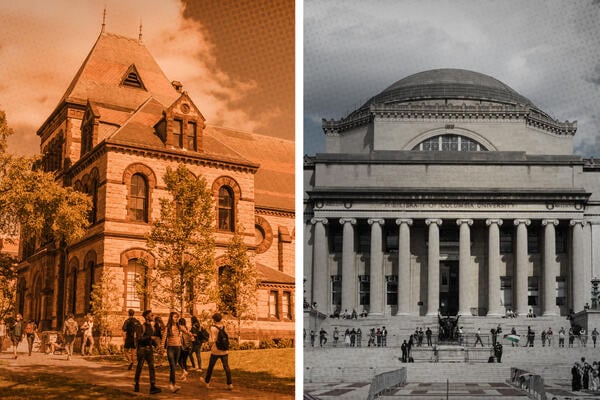
    Photo illustration by Justin Morrison/Inside Higher Ed | Wolterk/iStock/Getty Images | Alex Kent/Getty Images

    Days after reaching deals with the Trump administration, Columbia and Brown Universities say the government has already initiated the process of restoring hundreds of millions in federal research dollars it terminated earlier this year in retaliation for their alleged failures to address antisemitism on campus. 

    Many of those grants came from the National Institutes of Health, which is overseen by the Department of Health and Human Services, and funded medical research, including time-sensitive clinical trials.  

    “The agreement finalized this week restored all National Institutes of Health grants to Brown researchers that had been terminated,” Brian Clark, a Brown spokesperson, wrote in an email to Inside Higher Ed Thursday evening. “We started to see that formalized in award letters today and expect in the coming days and weeks to see this across all of these grants.” 

    In April, the administration blocked $510 million in federal grants and contracts for Brown. But under the terms of the agreement the government and university finalized Wednesday, Clark said, “Any payments should resume within 30 days,” which applies to both “the restoration of specific grants that had been terminated, and also to active (non-terminated) grants for which Brown had not been reimbursed.”

    If you had a grant frozen because of the Trump administration’s investigations, we want to hear about your experience and whether you’ve received your funding. Email [email protected] to share more.

    The Brown deal came about a week after Columbia agreed to pay the government $221 million in addition to changing its admissions policies, disciplinary processes and academic programs in order to restore about $400 million in federal funding the administration canceled in March.

    According to Columbia’s website, “Funding and reimbursement payments have already begun to flow.”

    “One week later, more than half of the terminated grants have been restored, and we expect the others to be reinstated promptly,” the website says. “Renewals and continuations that were frozen are also coming in on non-terminated grants.”

    The university wrote that it’s “reviewing all grants that were terminated or suspended over the last months to identify those that were specifically directed at Columbia” and expects “the fair treatment of Columbia grants and ability to compete to be honored by all federal agencies.”

    The university noted that the agreement only applies to HHS and NIH grants that the administration canceled as part of its targeted pressure campaign on Columbia. 

    Faculty who asked to remain anonymous told Inside Higher Ed that either the university or NIH has told them that some grants are being reinstated or renewed. But it was unclear to them whether actual dollars have resumed flowing, and how many.

    Since Trump took office in January, numerous federal agencies, including the NIH, the National Science Foundation and Education Department, have terminated thousands of other research grants at institutions across the country that don’t align with their ideological priorities. In particular, many grants that focused on transgender health, vaccine hesitancy, climate change and racial disparities have been canceled. 

    Columbia researchers whose grants were terminated as part of that sweep should not expect to see their funding restored as part of this deal, the university wrote on its website. 

    “Some of these grants were terminated or suspended across the board for all institutions, and have nothing specific to do with Columbia,” the webpage said. “To the extent that the federal government has made the decision not to fund certain types of projects at any institution, those grants will not be coming back to Columbia.”

    Columbia and Brown are just two of numerous Ivy League Institutions that the Trump administration has targeted by threatening federal funding. 

    The administration was also holding up $175 million at the University of Pennsylvania in retaliation for the university allowing a transgender athlete to compete on its swim team. Last month, the university reached a deal with the government, which has said it will restore the funding

    The administration is also blocking $2.2 billion at Harvard University$202 million at Princeton University and $1 billion at Cornell University. However, those institutions have yet to reach agreements with the government that could result in restoration of their federal funding.

    So far, the administration has frozen nearly $5.9 billion across eight universities, including Brown, Columbia and Penn. Most of the funding freezes started in March, but in the last week, the administration resumed blocking funds at institutions under investigation. First, it put about $108 million on hold at Duke University, and then officials suspended an unspecified number of grants at the University of California, Los Angeles.

    Ryan Quinn contributed to this report.

    Source link

  • GMU President Keeps Job Amid Tensions

    GMU President Keeps Job Amid Tensions

    Embattled George Mason University president Gregory Washington remains on the job despite concerns that GMU’s Board of Visitors would fire him amid multiple federal investigations into alleged racial discrimination, antisemitism and other matters, which he has publicly pushed back on.

    GMU’s Board of Visitors met Friday to review Washington’s performance and to consult with legal counsel on “actual or probable litigation,” according to the board agenda. While specific legal matters were not detailed in the agenda, GMU is facing investigations from both the U.S. Department of Education and the Department of Justice over alleged discrimination in hiring practices and antisemitism. The DOJ also launched a highly unusual investigation into GMU’s Faculty Senate after it approved a resolution in support of Washington’s leadership.

    The Trump administration seized on remarks made by Washington following the 2020 murder of George Floyd. Washington, as noted in a letter from the DOJ to the university, expressed the need to hire diverse faculty members, promised to advance an antiracist agenda and threw his support behind GMU’s diversity, equity and inclusion initiatives.

    Washington denied engaging in what the Trump administration labeled “illegal DEI” efforts.

    On Friday, he defended both GMU and his own performance, noting he arrived on campus in 2020 when tensions were high and racial strife was still simmering over Floyd’s murder. Adding to the pressure, students, faculty members and others demanded he tear down a statue of university founder George Mason, who was a slave owner. 

    “Despite the commentary that you might hear, this institution is doing extraordinarily well,” Washington told board members on Friday in the open session portion of the meeting, during which he touted GMU’s rise in various university rankings as well as an increase in state funding.

    But many community members feared that Washington, GMU’s first Black president, would lose this job as a result of the investigations. They worried that the inquiries give the Board of Visitors—which is stocked with conservative political activists and former GOP officials—the pretext to remove him. Multiple speakers and attendees at a Friday rally held in support of Washington pointed to other campus leaders recently pushed out. That includes Jim Ryan at the University of Virginia, who resigned under pressure from the DOJ over DEI programs, and Cedric Wins, superintendent of Virginia Military Institute, whose contract was not renewed this spring amid alumni complaints about DEI. One rally organizer had referred to the Friday meeting as “high noon at the OK Corral.”

    Instead, after roughly three hours in closed session, the board emerged with one action item: approval of a 1.5 percent raise for Washington, which members unanimously signed off on. Board members did not discuss their review of his performance conducted behind closed doors.

    That means despite faculty concerns Washington will keep his job—at least for now.

    Support for Washington

    As faculty, students and local lawmakers gathered Friday, they had a clear message for the Board of Visitors: Support Washington and push back on federal investigations they deemed both illegitimate and a broadside against academic freedom at GMU. They also called on the board to protect DEI at GMU, which is Virginia’s most diverse university. However, the board defied that demand by passing a resolution Friday to end race-conscious hiring, scholarships, graduation ceremonies and other initiatives.

    While Washington’s fate was unknown during the rally, speakers urged attendees to push on.

    “We’ve got to keep fighting. No matter what happens today, this is still our university,” said Bethany Letiecq, chair of GMU’s chapter of the American Association of University Professors. Letiecq also referenced personal safety concerns, arguing, “Faculty are being harassed and threatened.” (She previously told Inside Higher Ed she has been subject to two death threats.)

    Bethany Letiecq was one of several speakers to voice support for GMU president Gregory Washington at a Friday rally.

    Former Board of Visitors member Bob Witeck, who served on the search committee that hired Washington in 2020, said he “could not believe our luck” in selecting the president from a pool of nearly 200 candidates and praised his “character, intellect and honesty.” Witeck also warned about threats to both academic freedom and the inclusive nature of GMU, stating, “Discrimination cannot find a home here, nor should political interference or baseless investigations.”

    Another speaker was supportive of Washington while also critical.

    Ellie Fox, a GMU student and president of its Jewish Voices for Peace chapter, was critical of Washington for allegedly repressing “pro-Palestinian speech in the name of Jewish safety.” Fox added that he was “reluctant to resist Trump and conservatives and their attack” on GMU but urged Washington to defy calls to resign from his position and work “toward a better future.”

    Other rally speakers included Fairfax mayor Catherine Read and State Senator Saddam Salim, both GMU graduates and Democrats, who threw their support behind the university and Washington and expressed concerns about the investigations and other attacks on higher education.

    Board-Faculty Tensions

    Although the board did not make any public announcement about the items they discussed in closed session, beyond approving a raise for Washington, an exchange between one member and a GMU professor highlighted the tensions at play.

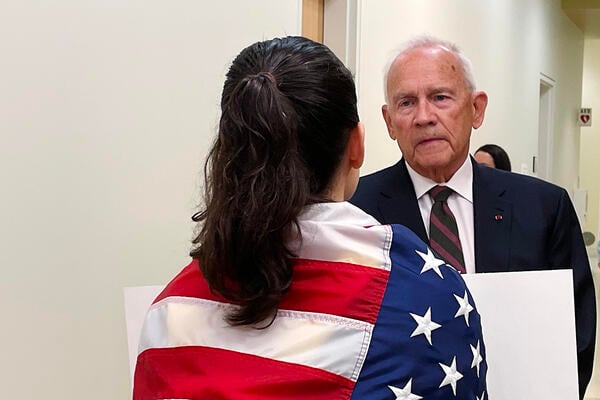
    Robert Pence, a former ambassador to Finland appointed during President Donald Trump’s first term, took issue with a faculty member’s protest sign when he encountered her in a hallway outside the board’s meeting room during a break. Tehama Lopez, a professor in the Jimmy and Rosalynn Carter School for Peace and Conflict Resolution, held a sign calling on the board to support Washington and uphold the First Amendment, academic freedom and due process.

    “You’re suggesting that Bob Pence—Robert Pence—does not support the First Amendment,” he told Lopez before shifting his attention to her call for board members to support Washington.

    Pence then asked Lopez, “If you got a lot of facts and you became convinced that he was engaged in conduct that is deleterious to the university, would you then fire [Washington]? If he meets the standard—whatever the standard is for discharge—would you be willing to fire him?”

    Lopez responded, “Who is being deleterious to the university?” Pence fired back, “You won’t answer the question” and “I’m not playing that game” before walking away from the exchange to return to the meeting.

    A photo of Robert Pence and Tehama Lopez in conversation. She has her back to the camera and an American flag wrapped around her shoulders.

    Board member Robert Pence clashed with a faculty member outside of Friday’s meeting.

    In a brief interview following that conversation, Lopez said that she wanted to see the board uphold its fiduciary duties as GMU faces multiple investigations, which she called “politically motivated.” Given the stakes, she wants to make sure the Board of Visitors protects the university rather than enacting a political agenda pushed by the Trump administration.

    But Lopez appeared uncertain of which path the board will take.

    “Their job on the Board of Visitors is to do the work of protecting the school and the school’s interest, and it’s very unclear whose bidding they’re doing,” Lopez said.

    Source link

  • These 6 guidelines can improve equity in literacy, report says

    These 6 guidelines can improve equity in literacy, report says

    Giving students equitable access to high-quality instruction and resources for becoming proficient readers will help inspire a love of reading and give them ownership in their own literacy development, according to a report from EdTrust. 

    States are making progress in promoting evidence-based reading, but more needs to be done for all students to become skilled and engaged readers, said Shayna Levitan, a P-12 policy analyst at EdTrust and author of the report. EdTrust is a nonprofit that promotes educational equity for students of color and students from low-income families.

    “Every student has the right to read and to learn to read using rigorous, diverse instructional materials and the most effective instruction,” said Levitan in a July 29 statement.

    Disappointing reading proficiency in recent years — as measured by exams like the National Assessment of Educational Progress — has led to many states adopting evidence-based reading policies such as science of reading frameworks. According to the Council of Chief State School Officers, most states had some type of law or policy addressing pre-K-12 literacy initiatives as of March 2024.

    U.S. Education Secretary Linda McMahon has said literacy education is her No. 1 priority. 

    The EdTrust report recommends these six principles for states to advance equity in literacy:

    • Ensure instruction and curricula are evidenced-based. State literacy policies and implementation efforts should support schools with the adoption, implementation and continuation of evidence-based and culturally affirming instructional practices.
    • Have materials that connect to students’ identities and interests. Students who don’t see themselves authentically portrayed in learning materials are less likely to feel engaged and motivated to read, which can hinder their development of complex reading skills. 
      EdTrust points out that efforts at the state and federal levels to restrict literature that reflects a variety of student cultures and experiences is “undercutting access to high-quality education, to the detriment of students’ literacy development.”
    • Tailor supports to students’ unique needs. Schools should provide early, targeted and differentiated interventions to students who require additional supports. Resources and interventions from qualified educators should be focused on multilingual learners, students with dyslexia and struggling older readers.
    • Begin literacy education at birth. States need to invest in high-quality and culturally responsive early education and family literacy programs. These supports can help young children gain pre-literacy skills.
    • Put resources toward supporting teachers. Teachers should have strong educator preparation supports, continuing professional development and on-the-job assistance so they are able to use evidence-based literacy instruction and interventions.
    • Don’t sideline families. Partnering with families can benefit students’ literacy skills development. This includes providing families accurate information about their child’s reading progress.

    Source link