This HEPI guest blog was kindly authored by Cheryl Watson, VP of Education, UK at TechnologyOne.
Rising costs are now a defining feature of the student experience in the UK. What once felt like an educational ‘coming of age’ for young people is, for many, becoming a difficult balancing act between academic ambition and financial survival.
From housing and transport to food and essential tech, students today face relentless financial pressures just to participate in university life. For institutional leaders, the evidence is clear: the financial landscape is changing, and approaches to student engagement and support must change with it.
A growing financial gap in UK higher education
Financial pressures on students are not new but are growing in scale and complexity. The joint Minimum Income Standard for Students (MISS) 2024 research with HEPI and the Centre for Research in Social Policy (CRSP) at Loughborough University found that a typical full-time student living away from home needs around £244 per week to maintain a minimum standard of living. Yet, most face a significant shortfall even with part-time work and maintenance support.
One student from the recent MISS focus groups summed up the reality:
Even [like] knowing that I’m in my overdraft…I know it’s interest-free and stuff, but having to rely on it is not ideal, and I want to work to try and get out of it, but also like I can’t afford to.”
It’s a cycle, and you constantly max it out every year, and then you’re constantly working to pay it back.
This financial tightrope is increasingly common.
How student life is being redefined by cost pressures
Students are making tough choices daily between travel, food, work, and study. Financial stress is changing not just what students can afford, but also how they experience university life on a day-to-day basis.
While pressures vary, the underlying theme remains consistent: rising costs are reshaping the student experience in real-time.
The new commuter reality
Many universities still operate around the traditional student living on campus, but according to the Sutton Trust, over 50% of UK students go to university where they grew up and students from poorer backgrounds are three times more likely to commute from home.
For many, this is often because they cannot afford to live near campus. This has real academic consequences, with many students missing classes due to travel costs and disconnected timetables.
I live in Sheffield but a lot of the people in my class seem to commute and there’ll be times where like most of the class don’t turn up for a certain seminar and it’s because… it just wouldn’t make sense to pay all that money to come for an hour and a half and then just leave again.
Without more flexible, student-aware scheduling and targeted support, commuter students risk being structurally disadvantaged.
Technology isn’t optional
Access to digital tools is now essential for participation in academic life. From lecture recordings to online submissions, students are expected to stay constantly connected and equipped.
You definitely need a laptop as well because although the University library provides computers, especially during exam season, you have to book them in advance, and they’ve already been taken up.
For many, the cost of keeping up with technology adds to financial pressures, creating further barriers to participation.
Living with financial stress
Financial pressure is a constant presence for many students. Overdrafts are used regularly, part-time work is essential, and mismatches between payment schedules and bills force difficult choices.
In 2023, HEPI found that more than a quarter of universities operate food banks to support students, while rising rent costs leave little left for essentials.
The difference between first year and second year is that you have that comfort blanket of it, but by the time you get into second year, you’ve already used it, and you’ve got nothing to help you anymore.”
These aren’t one-off lapses in budgeting. They’re the result of an unsynchronised system that does not reflect the financial reality students are working within.
Missing out on student life
Financial pressures also limit participation in the social and community aspects of university life that are vital for wellbeing and development.
Especially in the SU, it’s not ideal because lots of societies will do socials there so if you can’t afford that… It might seem silly, but if you’re part of a sports society then there is some sort of expectation to go to Sports Night on a Wednesday most weeks so that obviously adds up if you’re going most weeks.
Opting out is often the only option, but it comes at a cost to confidence and connection
Why this matters for universities and policymakers
Financial stress is no longer a fringe issue in UK higher education. When 30% of students are taking on extra debt just to cover essentials, and many are skipping classes or missing out on key experiences, the impacts on retention, well-being, and academic outcomes cannot be ignored.
The disconnect between what students need and what current funding models assume continues to grow. Part-time work and family contributions are often treated as standard, despite being unrealistic for many students.
What’s next: Building an evidence base for change
If the Minimum Income Standard for Students 2024 brought much-needed clarity to the financial pressures facing undergraduates, this year’s follow-up takes that work a step further.
The upcoming report, Minimum Income Standard for Students 2025 (MISS25), focuses specifically on first-year students living in purpose-built accommodation, offering the most detailed insight yet into the cost of starting university life in the UK.
The findings are stark. Those on minimum support face a funding gap that must be filled by family or debt. The report also reveals a growing mismatch between student needs and how maintenance systems are designed, particularly for those without access to parental support.
For institutional leaders, policymakers and student advocates, we encourage you to read closely, and to consider how your planning, funding and engagement strategies can respond to what today’s students are telling us.
Click the link below to sign up for a copy of the MISS25 report when it’s ready.
TechnologyOne is a partner of HEPI. TechnologyOne is a global Software as a Service (SaaS) company. Their enterprise SaaS solution transforms business and makes life simple for universities by providing powerful, deeply integrated enterprise software that is incredibly easy to use. The company takes complete responsibility to market, sell, implement, support and run solutions for customers, which reduce time, cost and risk.
ALBUQUERQUE, N.M. — La casa de Maggi, situada en un barrio residencial de esta ciudad, es un refugio para las familias locales. Es un lugar donde, tras solo unas semanas en el programa de cuidado infantil familiar de Maggi esta primavera, un niño en edad preescolar empezó a llamarla “mamá” y a su marido “papá”. Los niños que han terminado el programa de Maggi siguen rogando a sus padres que los lleven a su casa en lugar ir de al colegio.
En los últimos meses, cada vez son menos las familias que acuden a la guardería: se han intensificado las medidas de control de la inmigración y las políticas migratorias han cambiado rápidamente. Tanto Maggi como las familias que dependen de ella, algunas de las cuales son inmigrantes, ya no se sienten seguras.
“Hay mucho miedo en la comunidad latina, y todos ellos son buenas personas, gente buena y trabajadora”, dijo Maggi, de 47 años, en español a través de un intérprete una mañana reciente, mientras observaba a un recién nacido dormir en lo que solía ser su sala de estar. Desde que comenzó su propio negocio de cuidado infantil hace dos años, ha dedicado casi cada centímetro de su espacio común a crear un oasis colorido y lleno de juguetes para los niños. Maggi no entiende por qué tantos inmigrantes corren ahora el riesgo de ser deportados. “Llevamos aquí mucho tiempo”, dijo. “Hemos estado trabajando honestamente”.
Los inmigrantes como Maggi desempeñan un papel crucial en el cuidado infantil en el hogar, así como en el sistema de cuidado infantil más amplio de Estados Unidos, que cuenta con más de 2 millones de trabajadores, en su mayoría mujeres. (The Hechinger Report no utiliza el apellido de Maggi por motivos de seguridad, tanto para ella como para las familias que utilizan sus servicios). Es muy difícil encontrar y retener a los cuidadores, no solo porque el trabajo es duro, sino también por los salarios bajos y las prestaciones limitadas. A nivel nacional, los inmigrantes representan casi el 20 % de la mano de obra dedicada al cuidado infantil. En la ciudad de Nueva York, los inmigrantes representan más del 40 % de la mano de obra dedicada al cuidado infantil. En Los Ángeles, casi el 50 %.
Maggi juega con una de sus pupilas en el patio trasero de su guardería. Maggi dirige una de las pocas guarderías que ofrecen atención las 24 horas del día, los 7 días de la semana, en su ciudad. Credit: Jackie Mader/The Hechinger Report
La guerra de largo alcance de la administración Trump contra la inmigración, que incluye cuotas diarias para la detención de inmigrantes, nuevas restricciones a los permisos de trabajo y la detención de residentes legales, amenaza el ya frágil sistema de cuidado infantil de Estados Unidos. Los proveedores inmigrantes, especialmente aquellos que atienden a familias inmigrantes, se han visto especialmente afectados. Al igual que Maggi, los proveedores de cuidado infantil de todo el país están viendo cómo las familias desaparecen de su cuidado, lo que amenaza la viabilidad de esos negocios. En Estados Unidos, uno de cada cuatro niños menores de seis años tiene al menos un progenitor nacido en el extranjero. Algunos niños que podrían beneficiarse de cuidadores experimentados se encuentran ahora en casa con hermanos mayores o parientes ancianos, perdiéndose la socialización y la preparación para el jardín de infancia que los centros de cuidado proveen. Algunos trabajadores inmigrantes, independientemente de su situación, tienen demasiado miedo para ir a trabajar, lo que agrava la escasez de personal. Recientemente, la administración anunció que prohibiría el acceso de los niños indocumentados a Head Start, el programa de cuidado infantil financiado por el gobierno federal para niños de familias con bajos ingresos.
Relacionado: Los niños pequeños tienen necesidades únicas y proporcionarles los cuidados adecuados puede ser un reto. Nuestro boletín gratuitosobre educación infantil hace un seguimiento de estos temas.
“Las políticas antiinmigrantes pueden y van a debilitar toda nuestra infraestructura de cuidado infantil”, afirmó Karla Coleman-Castillo, analista política sénior del Centro Nacional de Derecho de la Mujer. Los programas domiciliarios, en particular, se verán afectados, ya que suelen atender a más familias inmigrantes. “Cualquier cosa que amenace la estabilidad de la capacidad y la comodidad de las familias para acceder a la educación infantil, y la comodidad de los educadores para incorporarse o permanecer en el mercado laboral, va a afectar a un sector ya de por sí precario”.
Para Maggi, las consecuencias no se han hecho esperar. En febrero, solo unas semanas después de que se anunciaran los primeros cambios, su matrícula pasó de 15 niños al día a siete. Algunas familias regresaron a México. Otras se pusieron tan nerviosas que no se atrevían a desviarse de sus rutas de trabajo ni siquiera para dejar a sus hijos rápidamente. Algunas ya no querían dar su información al estado para obtener ayuda para pagar la guardería.
En mayo, solo dos niños, un bebé y un niño de 4 años, estaban matriculados a tiempo completo, junto con seis niños que acudían a la guardería antes o después del colegio. Maggi acepta a niños que pagan de forma privada y a aquellos que pagan con subsidios de cuidado infantil a través del programa estatal para niños de bajos ingresos. Gana unos 2.000 dólares al mes por el bebé y el niño en edad preescolar, y unos doscientos más cada semana por el cuidado después de la escuela, lo que supone una reducción significativa con respecto a los 9.000 o 10.000 dólares de finales de 2024. Para los padres que no reciben subsidios estatales, mantiene sus tarifas bajas: menos de 7 dólares la hora. “Me dicen que soy barata”, dice Maggi con una leve sonrisa. Pero ella no está dispuesta a subir sus tarifas. “Yo era madre soltera”, dijo. “Recuerdo que me costaba mucho encontrar a alguien que cuidara de mis hijos cuando tenía que trabajar”.
Como muchos proveedores de cuidado infantil que emigraron a Estados Unidos siendo adultos, Maggi comenzó su carrera en un campo completamente diferente. Cuando era una joven madre, Maggi se licenció en Derecho en una universidad de México y trabajó en la fiscalía del estado de Coahuila, en el norte del país. Su trabajo le obligaba a trabajar muchos fines de semana y hasta altas horas de la noche, haciendole difícil cumplir con sus obligaciones como madre soltera. “Me siento muy mal por no haber podido pasar más tiempo con mis hijas”, añade. “Me perdí gran parte de su infancia”.
Durante un año, cuando sus hijas estaban en la escuela primaria, Maggi las matriculó en un internado, las dejaba allí los domingos por la noche y las recogía los viernes por la tarde. Algunos fines de semana, se llevaba a las niñas a su oficina, aunque sabía que no era un lugar adecuado para ellas. Maggi anhelaba un trabajo diferente en el que pudiera pasar más tiempo con ellas.
Hace unos 15 años, cuando la violencia se recrudeció en México, Maggi empezó a pensar seriamente en emigrar. Su primo fue secuestrado y los policías con los que trabajaba fueron asesinados. Maggi recibió amenazas de muerte de los delincuentes a los que había ayudado a procesar. Entonces, un día, unos hombres la detuvieron y le dijeron que sabían dónde vivía y que tenía hijas. “Fue entonces cuando dije: esto no es seguro para mí”.
En 2011, Maggi y las niñas emigraron a Estados Unidos, llevándose todo lo que cupo en cuatro maletas. Terminaron en El Paso, Texas, donde Maggi vendía gelatina y tamales para ganarse la vida. Tres años más tarde, se mudaron a Albuquerque. Maggi conoció a su marido, se casaron y poco después dieron la bienvenida a un hijo, su cuarto hijo.
En Albuquerque, Maggi se estableció en una vida dedicada al cuidado infantil profesional, lo que le resultó natural y le permitió pasar más tiempo con su familia que lo que había podido en México. Ella y su marido se sometieron a un intenso proceso de selección y se convirtieron en padres de acogida. (Nuevo México no exige que las personas tengan un estatus migratorio legal para ser padres de acogida). Maggi matriculó a su hijo menor en un centro Head Start, donde los administradores la animaron a empezar a trabajar como voluntaria. Le encantaba estar en el aula con los niños, pero sin permiso de trabajo no podía convertirse en profesora de Head Start. En su lugar, después de que su hijo empezara la escuela primaria, empezó a ofrecer cuidados infantiles de manera informal a familias que conocía. Maggi obtuvo la licencia del estado hace dos años, tras un largo proceso que incluyó varias inspecciones, una verificación de antecedentes y una formación obligatoria en RCP y principios de cuidado infantil.
Maggi no tardó en crear un negocio muy respetado que cubría una necesidad acuciante en Albuquerque. El suyo es uno de los pocos programas de cuidado infantil de la zona que ofrece atención las 24 horas del día, los 7 días de la semana, algo poco habitual en el sector a pesar de la gran necesidad que existe. Los padres que confían en ella son profesores, cuidadores de personas mayores y personas que atienden llamadas al 911.
En la sala de estar de Maggi, los niños se mueven libremente entre áreas de aprendizaje cuidadosamente seleccionadas con estanterías repletas de juguetes de colores, materiales de arte colocados en una mesa en miniatura y filas de libros. Los pósters educativos de sus paredes refuerzan los colores, los números y las formas. Le encanta exponer a los niños a nuevas experiencias, y con frecuencia los lleva de excursión a tiendas de comestibles o restaurantes. Es cariñosa, pero tiene grandes expectativas para los niños, insistiendo en que recojan lo que ensucian, sigan las instrucciones y digan “por favor” y “gracias”.
“Quiero que tengan valores”, dijo Maggi. “Les enseñamos a respetar a los animales, a las personas y a los demás”.
A finales de 2024, el negocio de Maggi estaba floreciendo y ella esperaba seguir creciendo.
Aún no se han publicado datos sobre hasta qué punto las políticas de inmigración de la actual administración han afectado a la disponibilidad de servicios de cuidado infantil. Pero las entrevistas con los proveedores de cuidado infantil y las investigaciones apuntan a lo que puede suceder en el futuro, y que ya está sucediendo.
Después de que una política de 2008 permitiera al Servicio de Inmigración y Control de Aduanas verificar el estatus migratorio de las personas detenidas por la policía local, se produjo un marcado descenso en la matriculación en guarderías tanto de niños inmigrantes como no inmigrantes. También se produjo una disminución en la oferta de trabajadores de guarderías. Aunque las mujeres eran una minoría entre los deportados, los investigadores descubrieron que la política provocó temor en las comunidades de inmigrantes y muchos abandonaron sus rutinas normales.
En el sector del cuidado infantil, eso es problemático, según los expertos. Los inmigrantes que trabajan en este sector suelen tener un alto nivel de formación y están muy capacitados para interactuar positivamente con los niños, incluso más que los trabajadores nativos. Si una parte cualificada de la mano de obra es esencialmente “purgada” porque tiene demasiado miedo de ir a trabajar, eso reducirá la calidad del cuidado infantil, afirma Chris Herbst, profesor asociado de la Universidad Estatal de Arizona que ha estudiado el efecto de la política de inmigración en el cuidado infantil. “Como resultado, los niños recibirán un servicio deficiente”.
Los programas domiciliarios como el de Maggi se encuentran entre los más vulnerables. Los hijos de inmigrantes son más propensos a estar en esos entornos de cuidado infantil. Sin embargo, en la década anterior a la pandemia, el número de programas domiciliarios disminuyó en un 25 % en todo el país, en parte debido a las dificultades financieras para mantener este tipo de negocios.
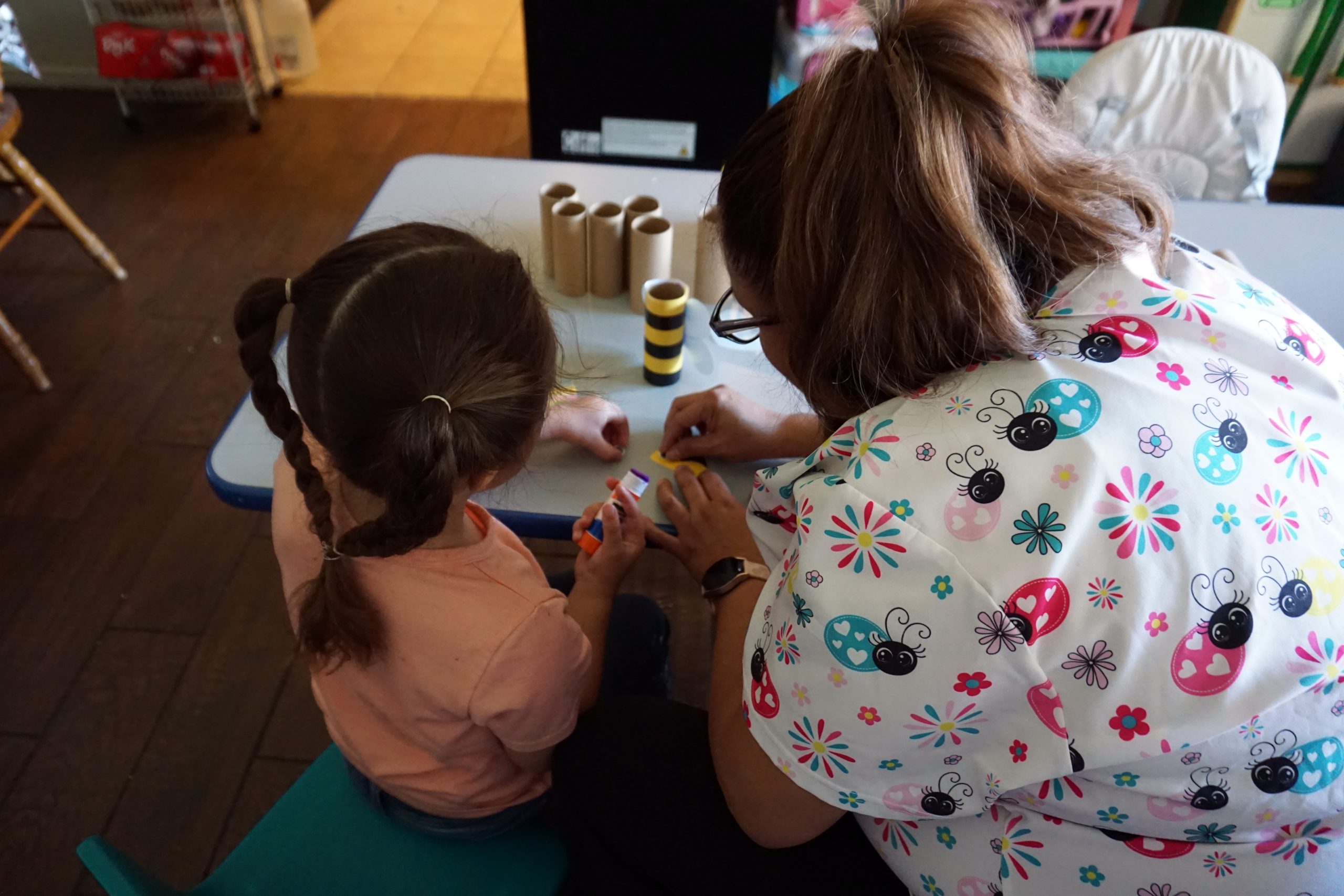
Una mañana reciente, Maggi estaba de pie en su sala de estar, vestida con una bata blanca adornada con coloridas mariquitas de dibujos animados. El año pasado, la sala habría estado llena de niños. Ahora está en silencio, salvo por la charla de Kay, la única niña en edad preescolar a la que cuida cada día. (The Hechinger Report no utiliza el nombre completo de Kay para proteger su privacidad). Mientras la pequeña se sentaba en una de las mesitas a hacer una manualidad, Maggi acunaba al bebé, que acababa de despertarse de la siesta. Los ojos del bebé se fijaron en el rostro de Maggi mientras ella lo mimaba.
“¡Hola, chiquito!”, le dijo en español. Él esbozó una sonrisa y el rostro de Maggi se iluminó.
Mientras una de sus hijas se encargaba de alimentar al recién nacido, Maggi siguió a Kay al exterior. La niña de preescolar saltaba del arenero a los columpios y a la casita de juegos, con Maggi siguiéndola diligentemente y jugando a su lado.
Los defensores y expertos afirman que el aumento de las medidas de control de la inmigración puede causar estrés y traumas a los niños pequeños. En Estados Unidos, uno de cada cuatro niños menores de seis años tiene al menos un progenitor nacido en el extranjero. Credit: Jackie Mader/The Hechinger Report
Finalmente, Kay se detuvo y apoyó la cabeza en la cadera de Maggi. Maggi le acarició suavemente la cabeza y le preguntó si estaba lista para mostrar sus habilidades preescolares. Las dos se sentaron en una mesita a la sombra y Kay observó con entusiasmo mientras Maggi sacaba pequeños juguetes de plástico. Kay apiló tres tortugas de plástico. “¡Mamá, mira! ¡Son amigas!”, dijo Kay, riendo.
Kay llegó al programa de Maggi después de que su madre la sacara de otro programa en el que sentía que no la trataban bien. Aquí, Kay es tan feliz que se esconde cuando su madre viene a recogerla. Sin embargo, a Kay le falta un aspecto clave de la experiencia del cuidado infantil. Normalmente, la niña tendría varios amigos de su edad con los que jugar. Ahora, cuando le preguntan quiénes son sus amigos, nombra a las hijas adultas de Maggi.
A Maggi le preocupan aún más los niños que ya no ve. La mayoría están ahora al cuidado de sus abuelos, pero es poco probable que esos familiares sepan cómo estimular el desarrollo y la educación de los niños, dijo Maggi. Muchos no pueden correr con los niños como ella lo hace, y es más probable que recurran a las tabletas o la televisión para entretenerlos.
Ha visto los efectos en los niños que abandonan su programa y regresan más tarde habiendo retrocedido. “Algunos de ellos están haciendo bien las cosas conmigo, y luego, cuando regresan, se han quedado atrás”, dijo. Por ejemplo, un niño al que Maggi solía cuidar acababa de empezar a caminar cuando su madre lo sacó de la guardería a principios de este año, al comienzo de la campaña de represión de la inmigración. Al estar al cuidado de un familiar, Maggi descubrió que ahora pasan gran parte del día sentados en casa.
Antes de que comenzara la segunda administración Trump, el panorama de la atención infantil parecía prometedor en Nuevo México, un estado con una tasa de pobreza infantil crónicamente alta. En 2022, Nuevo México comenzó a implementar una serie de cambios en las políticas de atención infantil. Los votantes aprobaron una enmienda constitucional que garantiza el derecho a la educación infantil temprana, con financiación sostenida para apoyarla. El estado ahora permite que las familias que ganan hasta el 400 % del nivel federal de pobreza, o casi 125.000 dólares al año, puedan optar a la guardería gratuita. Eso incluye a la mayoría de los hogares del estado. Entre otros cambios está que ahora se paga más a los proveedores por los niños que inscriben a través del programa de asistencia del estado.
El aumento ha sido útil para muchos proveedores, incluida Maggi. Antes de la pandemia, recibía unos 490 dólares al mes del estado por cada niño en edad preescolar inscrito en su programa, frente a los 870 dólares al mes que recibe ahora. Si inscribe a bebés que cumplen los requisitos para recibir asistencia para el cuidado infantil, recibe 1.100 dólares al mes, casi 400 dólares más que antes de la pandemia. Sin embargo, necesita que los niños estén inscritos para recibir los pagos. El hecho de que su programa funcione las 24 horas del día, los siete días de la semana, le ayuda. Gana dinero extra del estado cuando cuida a los niños por las tardes y los fines de semana, y recibe una mensualidad para cubrir los gastos de los niños en acogida que recibe.
Los defensores del cuidado infantil en Nuevo México están preocupados porque la política de inmigración afectará al progreso del sector. “Me preocupa que podamos perder centros de educación infantil que podrían ayudar a las familias trabajadoras”, afirmó Maty Miranda, organizadora de OLÉ Nuevo México, una organización sin ánimo de lucro dedicada a la defensa de los derechos. “Podríamos perder a valiosos profesores y los niños perderían esos fuertes vínculos”. Las medidas de control de la inmigración han tenido “un enorme impacto emocional” en los proveedores del estado, añadió.
Las autoridades estatales no respondieron a una solicitud de datos sobre cuántos proveedores de cuidado infantil son inmigrantes. En todo el estado, los inmigrantes representan alrededor del 13 % de la población activa total.
Muchos educadores locales de la primera infancia están asustados debido a la aplicación más extrema de las leyes de inmigración, al igual que lo están los niños a su cargo, dijo Miranda. “A pesar del miedo, los maestros me dicen que cuando entran en sus aulas, intentan olvidar lo que está pasando fuera”, añadió. “Son profesionales que intentan continuar con su trabajo”.
Maggi dijo que está tan ocupada con los niños que permanecen a su cuidado que no tiene tiempo extra para trabajar en otro empleo y obtener más ingresos. No especula sobre cuánto tiempo podrá sobrevivir su familia, sino que prefiere centrarse en la esperanza de que las cosas mejoren.
El mayor temor de Maggi en este momento es el bienestar de los hijos de los inmigrantes a los que ella y tantos otros proveedores de servicios a domicilio atienden. Sabe que algunos de sus niños y familias corren el riesgo de ser detenidos por el ICE, y que ese tipo de interacciones, para los niños, pueden provocar trastornos de estrés postraumático, alteraciones en el desarrollo cerebral y cambios de comportamiento. Algunos de los padres de Maggi le han dejado números de emergencia por si son detenidos por los funcionarios de inmigración.
Muchos de los niños a los que Maggi cuida después de la escuela tienen la edad suficiente para comprender que la deportación es una amenaza. “Muestran miedo, porque sus padres están asustados”, dijo Maggi. “Los niños están empezando a vivir con eso”.
En medio de los vertiginosos cambios políticos, Maggi intenta seguir mirando hacia adelante. Está trabajando para mejorar sus habilidades en inglés. Su marido está obteniendo una credencial para poder ayudarla más en su programa. Sus tres hijas están estudiando para convertirse en educadoras de la primera infancia, con el objetivo de unirse al negocio familiar. Con el tiempo, quiere atender a niños de preescolar inscritos en el programa estatal, lo que le proporcionará una fuente de ingresos estable.
A pesar de toda la incertidumbre, Maggi dice que la sostiene un propósito mayor. “Quiero que disfruten de su infancia”, dijo en una tarde soleada, mirando con cariño a Kay mientras la niña dejaba sus pequeños zapatos rosas a un lado y saltaba a un arenero. Es el tipo de infancia que Maggi recuerda en México. Kay se rió encantada cuando Maggi se agachó y vertió arena fresca sobre los pies de la pequeña. “Una vez que creces, no hay vuelta atrás”.
The Hechinger Report provides in-depth, fact-based, unbiased reporting on education that is free to all readers. But that doesn’t mean it’s free to produce. Our work keeps educators and the public informed about pressing issues at schools and on campuses throughout the country. We tell the whole story, even when the details are inconvenient. Help us keep doing that.
Not because parents don’t matter – they do. In fact, my wife, a primary school teacher, often talks about how parental engagement is one of the strongest predictors of a child’s development. So, when I hear that parents are stepping up to help their children navigate the world of work, that’s no bad thing.
But with more graduates returning to the parental home after university, we need fresh policy approaches to support their early careers and ensure talent isn’t lost from regional economies.
Place-based
Regional graduate schemes offer a promising solution. Initiatives like those in West Yorkshire and Sheffield connect skilled graduates with local SMEs, which often struggle to compete with larger employers for talent. These schemes create new pathways for graduates to stay and thrive in the regions where they studied or grew up, while helping employers fill critical skills gaps. Crucially, they also act as a focal point for collaboration between local authorities, businesses, and training providers (including universities) to drive inclusive regional growth.
Expanding these kinds of initiatives also helps signal to policy makers that higher education has a key role to play in the skills discussion, which too often gets overlooked, leading to fragmented policy making. The formation of Skills England has the potential to address this, provided they properly recognise the contribution of higher education.
University careers services hold a huge reservoir of expertise in supporting graduate transitions. With the right backing, they could play a much greater role in driving regional employability initiatives. The potential is there; it just needs the support and opportunity to be fully unlocked.
Worth it
Part of the solution is for the sector to get better at articulating impact, so we can challenge the lazy characterisations you sometimes see in the media about degrees not being worth it, despite much evidence to the contrary.
What’s perhaps less widely understood is just how far university careers services have come in recent years. They’ve shifted from being a niche student support team at the edge of campus life to playing a central role in institutional strategy. In an era where graduate outcomes are a key metric for regulators, rankings, and reputation, careers services have massively upped their game.
Most universities now offer at least two years of careers support after graduation, and lifetime access is rapidly becoming the norm (our latest sector benchmarking report based on responses from 112 Heads of Careers found 41 per cen of careers services now offer lifetime support to alumni). But how many graduates know this? And more importantly, how many are using it? The support is there – from trained, experienced professionals – but we need to do a better job of shouting about it.
Practicality
And careers services today are doing far more than CV checks and advice appointments. They’re innovating to meet students’ real-world needs. Nottingham Trent University, for example, have set up a Professional Student Wardrobe, helping level the playing field by providing smart clothes for interviews and professional workplaces. And most institutions are also experimenting with AI-powered tools to increase efficiency and scale up support.
Innovative practices are also coming out of Kingston University, which runs simulated assessment centres for all second years to help them understand their skills and get the chance to experience graduate recruitment processes before hitting the real thing after graduation. This initiative has been welcomed by employers and Kingston University recently picked up two accolades at the Institute of Student Employers Awards as a result.
Careers services do a fantastic job of providing tailored support for individual students, but scaling impact is no small feat when the average staff-to-student ratio in careers services is around 1:1,080. However, careers services have found one of the best ways of scaling impact across the institution is to proactively work with academics to embed employability in the curriculum. I like to think of it as yeast in a loaf of bread – invisible, but transformative.
Cause for celebration
We need to get better at celebrating the work of careers services because they’re not just a nice extra; they’re fundamental to helping students succeed and universities thrive. Working at AGCAS, we benefit from seeing the global picture, and it’s clear that institutions in the UK and Ireland really are world leading when it comes to employability. It’s time to recognise that, champion it, and make sure careers teams get the visibility and support they need to keep making such a difference. As a first step, we should all work to increase visibility of careers services to parents, so they can better signpost the support that is available.
The inaugural Academic Employability Awards are a sign that the tide is turning. We’re seeing deeper collaboration between careers teams and academic departments, embedding employability into course design, assessment, and pedagogy.
So, is it parents or careers services that help graduates find jobs? Well, it’s both.
Parents know their child better than anyone and may be able to offer networks, but there’s also a huge amount that careers and employability teams do that really moves the dial for students and graduates.
As a writer, Jo Davis is used to sharing through her online presence. In this episode of The Social Academic, we talk about her life online such as her digital portfolio. And, offline through the coloring books she designed, the Starseed Panic Pages, and journaling. What does it mean to be intentional about your digital and analog life as an academic? We talk about focus and what it can do for your brain to be on paper.
I’ve admired Jo Davis’ writing for years. I followed her on X after reading one of her movie critiques. When she shared a recent podcast appearance on the Moments that Define Us, I thought she was perfect to come on The Social Academic to talk about her life online and on paper. And, what it means to be her authentic self.
Jo Davis is a professor, author, freelance writer, film critic, artist, and a beacon of creativity. She teaches writing and rhetoric at the University of Denver.
[For my good friend, a higher education executive who has seen it all, and suggested that all of us pause, take a look back, and think.]
Neil Postman first gained national attention in 1969 with Teaching as a Subversive Activity, co-authored with Charles Weingartner. In a period marked by war, civil unrest, and cultural transformation, Postman offered a bold challenge to the status quo of American education. Schools, he argued, were failing not because they lacked resources or rigor, but because they had lost sight of their deeper purpose. Instead of fostering critical thinking and civic engagement, they were manufacturing conformity through standardized tests, textbooks, and passive learning. Postman envisioned classrooms without fixed curricula, where teachers would become co-learners and facilitators, helping students develop the tools of inquiry and what he memorably called “crap detection.” It was a radical vision: education as an act of democratic resistance.
By the early 1980s, Postman had turned his attention to how media was shaping society—and deforming education. In The Disappearance of Childhood (1982), he claimed that television was dissolving the cultural boundaries between children and adults. Television, unlike print, made no distinction in content delivery; it treated all viewers as equal consumers of images and sensation. The consequences, he warned, were profound: children were becoming prematurely cynical while adults increasingly behaved like children. The medium, he believed, flattened developmental distinctions and eroded the cultural function of school as a place for guided maturation and ethical formation.
Then came Amusing Ourselves to Death in 1985, Postman’s most widely read and enduring work. Written during the ascendancy of television and Reagan-era consumer culture, the book argued that television had transformed public discourse into entertainment. It was not merely the content of television that disturbed him, but its form—its bias toward speed, simplification, and emotional stimulation. In such a media environment, serious discussion of politics, education, science, or religion could not survive. News became performance, candidates became celebrities, and education was increasingly judged by its entertainment value. Postman lamented the way Sesame Street, often hailed as educational television, conditioned children to love television itself—not learning, not schools, not the slow, difficult process of study.
As the decade progressed, Postman began articulating a broader cultural critique that culminated in Technopoly: The Surrender of Culture to Technology (1992). In this work, he defined technopoly as a society that not only uses technology but is dominated by it—a culture that believes technology is the solution to all problems, and that all values should be reshaped in its image. Postman acknowledged that tools and machines had always altered human life, but in a technopoly, technology becomes self-justifying. It no longer asks what human purpose it serves. Postman noted that schools were being wired with computers, not because it improved learning—there was no solid evidence of that—but because it seemed modern, inevitable, and profitable. His question—“What is the problem to which this is the solution?”—was a challenge not just to education reformers, but to an entire ideology of progress.
In The End of Education (1995), Postman returned to the question that haunted all his work: what is school for? He argued that American education had lost its narrative. Without compelling guiding stories—what he called “gods”—schools could not inspire loyalty, discipline, or moral development. In place of narratives about democracy, stewardship, public participation, and truth-seeking, schools now told the story of market utility. They trained students for jobs, not for life. They emphasized performance metrics over philosophical inquiry, and they treated students as customers in a credential economy. Education, he warned, was becoming just another mass medium, modeled increasingly after television and later the internet, with predictable results: shallowness, fragmentation, and disengagement.
By the time Postman died in 2003, the world he had warned about was rapidly taking shape. Facebook had not yet launched. Smartphones had not yet arrived. Generative AI was decades from the mainstream. But already, education was being reshaped by branding, performance metrics, digital delivery, and venture capital. The university was becoming a platform. The classroom was being converted into content. Students were treated not as citizens in formation, but as users to be optimized. The language of education—once rooted in moral philosophy and civic purpose—had begun to sound more like business strategy. Postman would have heard the rise of terms like “learning outcomes,” “human capital development,” and “scalable solutions” as evidence of a culture that had surrendered judgment to systems, wisdom to code, and meaning to metrics.
Postman’s refusal to embrace digital culture made him easy to ignore in the years that followed. He never gave a TED Talk. He didn’t blog. He didn’t build a brand. He never even used a typewriter. He wrote every word by hand. In a world of media influencers, LinkedIn thought leaders, and edtech evangelists, Postman’s ideas didn’t fit. But the deeper reason we forgot him is more unsettling.
Remembering Postman would require a painful reckoning with how far higher education has drifted from its public mission and democratic roots. It would mean admitting that education has been refashioned not as a sacred civic institution but as a delivery mechanism for marketable credentials. It would mean asking questions we’ve tried hard to bury.
What is higher education for? What kind of people does it produce? Who decides its purpose? What stories do our schools still tell—and whose interests do those stories serve?
Postman would not call for banning screens or abolishing online learning. He was not nostalgic for chalkboards or print for their own sake. But he would demand that we pause, reflect, and resist. He would ask us to think about what kind of citizens our institutions are shaping, and whether the systems we’ve built still serve a human purpose. He would remind us that information is not wisdom, and that no innovation can substitute for meaning.
As the Higher Education Inquirer continues its investigations into the commercialization of academia, the credentialing economy, and the collapse of higher ed’s public trust, we find Postman’s voice echoing—uninvited but indispensable. His critiques were not popular in his time, and they are even less welcome now. But they are truer than ever.
We may have forgotten him. But we are living in the world he tried to warn us about.
Sources
Neil Postman and Charles Weingartner, Teaching as a Subversive Activity (1969)
Neil Postman, Amusing Ourselves to Death (1985)
Neil Postman, Technopoly: The Surrender of Culture to Technology (1992)
Neil Postman, The End of Education: Redefining the Value of School (1995)
Join the Contingency Taskforce (CTF) of Higher Ed Labor United (HELU) for an urgent strategy discussion of how we can build campus solidarity among faculty and other higher ed workers, across job ranks, in light of the severe threats we now face. How can we organize broadly to defend the most vulnerable members of our communities? How can we help people overcome isolation and fear, discovering new courage and power by connecting with others? How can we raise up the voices and needs of historically marginalized workers and students within the broader fight to defend higher ed? Register here.
Attacks from the Trump administration are putting international students and workers in our campuses at risk. Mass SEVIS terminations, cancellations of Visa appointments, targeted attacks against Chinese nationals, ICE detentions and threats of raids in our campuses are making our jobs, our livelihoods, and the mission of our institutions unsafe. These actions follow the same pattern: attacking those who are in the most vulnerable positions to create a chilling effect on the rest of us. We demand action from colleges and universities now! Join us on Zoom August 4th at 2pm ET/1pm CT/12pm MT/11am PT to plan next steps and organizing strategies. Register here.
HELU Open House Thursday, August 14 at 6 pm ET/5 pm CT/4 pm MT/3 pm PT
HELU has been organizing since 2021 and is growing. On Thursday, August 14, at 6pm ET/5pm CT/4pm MT/3pm PT we will be hosting another HELU Open House, designed to welcome folks into the national higher ed organizing space and help everyone find a way to plug in. Join HELU on Thursday, August 14th, at 6pm ET/5pm CT/4pm MT/3pm PT. Register here.
On August 20, 2025, HELU is bringing together higher ed library workers across the country to strategize against threats to our livelihoods and profession. We will come together to meet and set our agenda, then we will break into small groups to discuss crises in academic freedom, disparities between library staff categorizations, labor organizing, austerity, and more. Our goal is to develop a platform for library worker protections to advocate for and implement across the country. Register here.
Why Centralized Marketing Matters for Online Programs in Higher Ed
At Archer, we’ve onboarded hundreds of institutional partners to help them grow their online programs. And while every partner is unique, there’s one pain point we encounter time and again: decentralized school-level marketing that creates more friction than momentum.
In many institutions, individual colleges or schools manage their own marketing campaigns, budgets, and creative direction. While this siloed approach offers an initial promise of agility and autonomy, it often leads to deeper problems in the market, such as:
Fragmented messaging
Inconsistent branding
Internal competition
Wasted spend as schools bid against each other
Missed opportunities for reach and impact at the brand and portfolio level
The result? Confused students consuming competing voices from the same institution, and internal marketing teams scrambling to scale best practices and measure impact — often without apples-to-apples data and reporting for performance comparisons.
Universities need an integrated marketing strategy that balances a holistic brand and portfolio-level approach with maintaining individual school-level autonomy for certain decisions and activities. This hybrid model unlocks collaboration, reduces conflict, and lifts visibility for all programs within a portfolio.
With shared goals, aligned messaging, and coordinated tactics across all of their schools, universities can amplify their brand and stretch their budgets further — delivering clear, compelling stories across myriad channels to prospective students.
Risks of Decentralized Marketing
In some models of governance, decentralization can be a strength — empowering local leadership and ensuring responsiveness to specific community needs. But when it comes to marketing online university programs in a highly competitive environment, decentralization alone as a strategy is more often a liability than an asset.
Having different departments, schools, or programs run their own campaigns and technology stacks may seem like a way to move faster, but in practice, it creates challenges that can hinder online program growth. Let’s explore some examples.
Brand Confusion
As prospective students evaluate your institution’s online offerings, they are not concerned with the internal structures of your institution. They expect clarity and consistency in the information you provide. When each college or division presents a different tone, design style, and creative messaging approach, you’re left with a weakened institutional brand.
Mixed marketing across digital ads, program pages, email drips, and even tuition and scholarship messaging can erode the trust and credibility you’ve been building with prospective students. For example, inconsistent explanations of scholarships or conflicting tuition information (e.g., on program pages and via tuition calculators) can trigger frustration or skepticism.
In short: Your audience — the prospective student — sees one university. If your university is in conflict with its own marketing, the brand loses power.
Inefficiency and Internal Competition
Without centralized marketing oversight, different teams often end up targeting the same audiences with overlapping campaigns — sometimes even bidding against each other in paid channels. This dilutes your paid marketing efficacy by driving up your cost per lead, wasting precious budget dollars, and undermining the collective impact of your institution’s marketing investments.
Inconsistent Student Experience and Success Metrics
Perhaps the most concerning result of decentralized marketing is a fragmented and uneven student journey. One program might offer seamless inquiry-to-enrollment processes, while another loses momentum after the application process due to poor follow-up and disconnected systems.
When your programs use different customer relationship management (CRM) platforms, it becomes difficult to track leads accurately and measure outcomes with consistency. Reporting becomes murky. Success metrics vary. Problems get misdiagnosed.
Instead of addressing the root causes of problems, your teams might blame each other (e.g., the marketing team and the admissions team) for the other’s perceived performance issues, when the real problem is systemic disconnection.
The Case for Centralized Marketing
Centralization doesn’t mean turning every school or program into a cookie-cutter version of the institution’s mission statement, and it doesn’t mean taking any team’s autonomy away. It’s about aligning around a shared strategy — one that empowers individual teams to execute effectively within a cohesive, coordinated framework.
Unified Brand Messaging
A strong, centralized brand platform allows your university to speak with one clear voice about its online programs, telling the story of:
What your programs offer
Who your programs serve
Why your programs matter
This shared narrative should be rooted in your institution’s values and designed to build trust with prospective students. When every program draws from the same story and messaging pillars, it strengthens your presence across every touchpoint — from digital ads and landing pages to nurture emails and program brochures. Each program’s value propositions may differ, but the institution’s story endures.
Additionally, a unified approach enables your institution to leverage the brand and portfolio-level marketing that raises visibility across all your programs. For example, some institutions have an integrated marketing program for their undergraduate experience but lack a cohesive approach for their online graduate programs. This is a missed opportunity to build a portfolio-level branded presence through channels that individual schools may not be able to afford on their own.
A robust YouTube presence that highlights the benefits of your online graduate education experience (program agnostic), showcases your alumni and graduate education outcomes, and forefronts your strategic organizational partnerships that span individual schools and programs increases the impact for the entire institution with one investment.
Integrated Campaign Planning
Centralized marketing brings together your paid media, content marketing, email strategy, and organic social media into one master plan.
Gone are the days of multiple teams across your institution launching disconnected campaigns, as central calendars and shared audience strategies help ensure each tactic contributes to every team’s strategic goals. This means reduced duplication, avoidance of internal bidding wars, and maximization of every marketing dollar.
However, your individual schools can and should have decision-making authority over the key value proposition definitions, target personas, and positioning of programs within their fields. This requires a collaborative conversation in an integrated campaign-planning scenario.
And schools should continue to develop campaigns where the impact is greatest for them — for example, hosting prospective student events and webinars, offering ambassador programs for prospective student questions, and attending events meaningful to their specific program field, such as at conferences and exhibit halls.
Shared Data and Measurement
In a world of data, perhaps the greatest and most immediate impact of centralized marketing will be felt in how your institution tracks performance holistically. With unified key performance indicators (KPIs) and shared access to insights, marketing teams at all levels — central and within academic schools — can identify what’s working for them, pivot when needed, and scale successful tactics across programs.
Teams can review where the branded portfolio-level efforts are causing the greatest lift in impressions and leads and determine together how school-level marketing activities can make the most impactful use of funds.
What Centralized Marketing Looks Like in Practice
At Archer, we’ve seen institutions achieve dramatic improvements simply by unifying their marketing strategy — even if execution remains shared and distributed. With a strong central foundation in place, teams tap into shared creative resources, coordinate campaigns across programs, and drive stronger performance through unified media buying and consistent messaging.
At its best, centralized marketing can:
Empower programs to amplify one another rather than compete
Allow creative strategy to be produced once then repurposed widely
Create paid efforts that are smarter, more cost effective, and better targeted
In sum, when your institution implements an integrated marketing model that fosters collaboration among academic schools, it can result in performance that is greater than the sum of its parts.
Archer Education knows what it takes to bring siloed departments together. Our unique partnership-based approach allows us to truly understand your institution, then implement efficiencies to ignite your online programs’ potential through a centralized marketing strategy that is balanced with school autonomy and meaningful participation. Contact us today to learn more.
EducationDynamics Transforms Insights into Action for Higher Ed Leaders
The higher education landscape is in constant motion. To truly thrive, institutions committed to student success must not just keep pace but anticipate what’s next. The National Student Clearinghouse (NSC) recently released two crucial reports in June 2025—one on “some college, no credential” (SCNC) undergraduates and another on overall undergraduate student retention and persistence. These aren’t just statistics. They are the roadmap for strategic action.
At EducationDynamics, we don’t merely react to these insights. We proactively integrate them into data-driven solutions that empower our partners to excel. Our deep understanding of the higher education market, sharpened by years of proprietary research, allows us to translate these macro trends into micro-level strategies that deliver tangible results for your institution.
Strategic Implications from the NSC June Update
The latest NSC findings highlight several critical areas demanding immediate attention from higher education leaders:
Persistence and Retention Gaps
While overall persistence is at 78% and retention at 70%, a significant disparity exists. Bachelor’s and certificate-seeking students show much higher rates than those pursuing associate degrees. Generalized support isn’t enough. Tailored academic and financial aid advising, particularly for associate-degree pathways, is essential to prevent attrition at critical junctures.
The Part-Time Student Paradox
Persistence and retention rates for part-time students are a staggering 30% lower than their full-time peers. Part-time learners often juggle work and family. Institutions must design flexible and accessible support systems, including asynchronous learning, evening/weekend advising, and re-evaluating traditional program structures.
Sectoral Disparities
For-profit institutions demonstrate significantly lower retention and persistence rates compared to not-for-profit counterparts. Regardless of sector, consistent and proactive communication focused on evolving student needs is crucial. This means dedicated engagement strategies, not just reactive responses.
Equity in Outcomes
White and Asian students continue to exhibit the highest persistence and retention rates. Achieving equitable outcomes demands meticulously analyzing data by affinity group, identifying specific barriers faced by underserved populations, and then designing targeted, culturally competent support programs.
The Power of Re-Engagement
The share of re-enrollees earning a credential in their first year has increased by nearly five percent, with students who have at least two full years of credits being most likely to re-enroll and persist. Notably, 36% re-enroll at the same school. Your “stopped out” student population is a goldmine for re-enrollment. Proactive, personalized outreach, highlighting clear paths to completion, is a win-win for both institutions seeking to boost enrollment and students aiming to achieve their academic aspirations.
The Online Advantage
In almost all cases, a plurality of re-enrolling students chose primarily online schools. Even if your institution isn’t primarily online, a robust and well-promoted suite of online program options is vital. Flexibility in format and delivery is critical to meet the diverse needs of today’s learners.
Certificate Pathways as Catalysts
Nearly half of re-enrolled SCNC students who earned a credential in their first year attained an undergraduate certificate. Expanding and actively promoting undergraduate certificate programs, especially those aligning with in-demand skills or acting as stepping stones to degrees, can significantly boost completion rates among the SCNC population.
How EducationDynamics Turns Insights into Action for Our Partners
Tailored Support for the Modern Learner
We partner with institutions to develop AI-powered communication workflows and personalized engagement platforms that proactively address the specific needs of part-time, non-traditional, and diverse student populations. For instance, our work with one regional university saw a 15% increase in part-time student retention within two semesters by implementing automated check-ins and flexible advising scheduling based on our Engaging the Modern Learner report findings.
Optimizing Re-Engagement Pipelines
Our “Education Reengagement Report: Inspiring Reenrollment in Some College No Credential Students” anticipated the NSC’s findings on the SCNC population. We’ve since refined our “Lost Student Analysis” methodology, which identifies high-potential stopped-out students and crafts targeted re-enrollment campaigns. For a recent partner, this resulted in re-enrolling over 200 SCNC students in a single academic year, directly contributing to enrollment growth.
Strategic Program Portfolio Development
Understanding the demand for online and certificate options, we guide institutions in developing and promoting flexible program offerings. This includes comprehensive market research to identify in-demand certificate programs and optimizing their visibility through targeted marketing. Our expertise helps institutions strategically align their offerings with what NSC data shows students are seeking.
Equity-Driven Enrollment & Retention
We help institutions implement data segmentation and predictive analytics to identify students at risk of stopping out based on various demographic and academic factors. This enables early intervention and the allocation of resources to underserved groups, fostering a more equitable and supportive learning environment.
Proactive Market Intelligence
Our partners gain an unparalleled advantage with early access to our market research reports and bespoke analyses. These reports, often preceding or complementing national findings like the NSC’s, provide actionable recommendations that allow institutions to adapt their strategies ahead of the curve, rather than playing catch-up.
Your Partner in Data-Driven Student Success
EducationDynamics is more than a service provider. We are a strategic partner dedicated to empowering higher education leaders with the insights and tools needed to navigate an evolving landscape and maximize student success. We combine cutting-edge market intelligence with proven strategies, transforming data into actionable plans that boost retention, drive re-enrollment and foster a truly student-centric institution.
July 28, 2025, by Dr. Chet Haskell: The headlines are full of uncertainty for American higher education. “Crisis” is a common descriptor. Federal investigations of major institutions are underway. Severe cuts to university research funding have been announced. The elimination of the Department of Education is moving ahead. Revisions to accreditation processes are being floated. Reductions in student support for educational grants and loans are now law. International students are being restricted.
These uncertainties and pressures affect all higher education, not just targeted elite institutions. In particular, they are likely to exacerbate the fragility of smaller, independent non-profit institutions already under enormous stress. Such institutions, some well-known, others known only locally, will be hard hit particularly hard by the combination of Trump Administration pressures and the developing national demographic decline for traditional-age students.(https://www.highereddive.com/news/decline-high-school-graduates-demographic-cliff-wiche-charts/738281/) These small colleges have been a key element of the American higher education scene, as well as for numerous local communities, for many decades.
It is widely understood that the vibrancy of American higher education comes, in part, from the diversity of its institutions and educational goals. The rich mixture of American colleges and universities is a strength that many other nations lack. Students have opportunities to start and stop their educations, to change directions and academic goals, to move among different types of institutions.
Smaller undergraduate colleges play important roles in this non-systemic system. They provide focused educational opportunities for younger adults, where they can build their lives on broad principles. Impressively large percentages of small college graduates go on to graduate education for various professions. Small colleges provide large numbers of graduates who enter PhD programs and eventually enter the professorate.
There are approximately 1179 accredited private institutions with enrollments of fewer than 3000 students. Of these, 185 have between 3000 and 2000 students. Another 329 have enrollments below 2000 but above 1000. A final 650 institutions have enrollments below 1000. These 1179 institutions students include few wealthy colleges such as Williams, Amherst, Carleton or Pomona, as well as numerous struggling, relatively unknowns.
A basic problem is one of scale. In the absence of significant endowments or other external support, it is very difficult to manage small institutions in a cost effective manner. Institutions with enrollments below 1000 are particularly challenged in this regard. The fundamental economics of small institutions are always challenging, as most are almost completely dependent on student enrollments, a situation getting worse with the coming decline of traditional college age students. There are limited options available to offset this decline. Renewed attention to student retention is one. Another is adding limited graduate programs. However, both take investment, appropriate faculty and staff capacity and time, all of which are often scarce.
These institutions have small endowments measured either in total or per student value. Of the 1179. There are only 80 with total endowments in excess of $200 million. While a handful have per student endowments that rival the largest private universities, (Williams, Amherst and Pomona all have per student endowments in excess of $1.8 million), the vast majority have per student endowments in the $40,000 range and many far less.
Most of these schools have high tuition discount rates, often over 50%, so their net tuition revenue is a fraction of posted expense. They are all limited by size – economies of scale are difficult to achieve. And most operate in highly competitive markets, where the competition is not only other small schools, but also a range of public institutions.
So, what is the underendowed, under resourced small college to do?
The most common initiatives designed to address these sorts of challenges are consortia, collaborative arrangements among institutions designed to increase student options and to share expenses. There are numerous such arrangements, examples being the Colleges of the Fenway in Boston, the Five Colleges of Western Massachusetts, the Washington DC Metropolitan Area Consortium, and the Claremont Colleges in California, among others.
The particulars of each of these groups differ, but there are commonalities. Most are geographically oriented, seeking to take advantage from being near each other. Typically, these groups want to provide more opportunities for students through allowing cross-registrations, sharing certain academic programs or joint student activities. They usually have arrangements for cost-sharing or cost reductions through shared services for costs like security services, IT, HR, risk management options, pooled purchasing and the like. In other cases (like the Claremont Consortium) they may share libraries or student athletic facilities. Done well, these arrangements can indeed reduce costs while also attracting potential students through wider access to academic options.
However, it is unlikely that such initiatives, no matter how successful, can fundamentally change the basic financial situation of an independent small college. Such shared services savings are necessary and useful, but usually not sufficient to offset the basic enrollment challenge. The financial impact of most consortia is at the margins.
Furthermore, participating institutions have to be on a solid enough financial basis to take part in the first place. Indeed, a consortium like Claremont is based on financial strength. Two of the members have endowments in excess of $1.2 billion (Pomona’s is $2.8 billion.) The endowments of the others range from a low of $67 million (Keck Graduate with 617 students) to Scripps with $460 million for 1100 students.) The Consortium is of clear value to its members, but none of these institutions is on the brink of failure. Rather, all have strong reputations, a fact that provides another important enrollment advantage.
One important factor in these consortia arrangements is that the participating institutions do not have to give up their independence or modify their missions. Their finances, alumni and accreditation are separate. And while the nature of the arrangement indicates certain levels of compromise and collaboration, their governance remains basically unchanged with independent fiduciary boards.
At the other end of the spectrum are two radically different situations. One is merging with or being acquired by another institution. Prep Scholar counts 33 such events since 2015. (https://blog.prepscholar.com/permanently-closed-colleges-list). Lacking the resources for financial sustainability, many colleges have had no choice but to take such steps.
Merging or being acquired by a financially stronger institution has many advantages. Faculty and staff jobs may be protected. Students can continue with their studies. The institution being acquired may be able to provide continuity in some fashion within the care of the new owner. Endowed funds may continue. The institution’s name may continue as part of an “institute” or “center” within the new owner’s structure. Alumni records can be maintained. Real estate can be transferred. Debts may be paid off and so forth. There are multiple examples of the acquiring institution doing everything possible along these lines.
But some things end. Independent governance and accreditation cease as those functions are subsumed by the acquiring institution. Administrative and admissions staffs are integrated and some programs, people and activities are shed. Operational leadership changes. And over time, what was once a beloved independent institution may well fade away.
The end of a college is a very sad thing for all involved and, indeed, for society in general. Often a college is an anchor institution in a small community and the loss is felt widely. The closure of a college is akin to the closure of a local factory. As Dean Hoke and others have noted, this is a particular problem for rural communities.
Are there other possible avenues, something between a consortium and a merger or outright closure?
One relatively new model has been organized by two quite different independent institutions, Otterbein University and Antioch University, that came together in 2022 to create the Coalition for the Common Good. Designed to be more than a simple bilateral partnership, the vision of the Coalition is eventually to include several institutions in different locations linked by a common mission and the capacity to grow collective enrollments.
At its core, the Coalition is based on academic symbiosis. Otterbein is a good example of the high-quality traditional undergraduate residential liberal arts institution. It has been well-run and has modest financial resources. Facing the demographic challenges noted earlier (in a state like Ohio that boasts dozens of such institutions), it developed a set of well-regarded graduate programs, notably in nursing and health-related fields, along with locally based teacher education programs and an MBA. However, despite modest success, they faced the limitations of adult programs largely offered in an on-campus model. Regardless of quality, they lacked the capacity to expand such programs beyond Central Ohio.
Antioch University, originally based in Ohio, had evolved over the past 40 years into a more national institution with locations in California, Washington State and New Hampshire offering a set of graduate professional programs to older adults mostly through distance modalities in hybrid or low-residency forms. Antioch, however, was hampered by limited resources including a very small endowment. It had demonstrated the capacity to offer new programs in different areas and fields but lacked the funds necessary for investment to do so.
Within the Coalition, the fundamental arrangement is for Antioch to take over Otterbein’s graduate programs and, with Otterbein financial support, to expand them in other parts of the country. The goal is significant aggregate enrollment growth and sharing of new revenues. While they plan a shared services operation to improve efficiencies and organizational effectiveness, their primary objective is growth. Antioch seeks to build on Otterbein’s successes, particularly with nursing programs. It already has considerable experience in managing academic programs at a distance, a fact that will be central as it develops the Otterbein nursing and health care programs in a new Antioch Graduate School of Nursing and Health Professions.
It is assumed that additional new members of the Coalition will resemble Otterbein in form, thus further increasing opportunities for growth through enhanced reach and greater scale. New members in other geographic locations will provide additional opportunities for expansion. One early success of the Coalition has been the capacity to offer existing Antioch programs in Central Ohio, including joint partnerships with local organizations, health care and educational systems. Crucially, both institutions remain separately accredited with separate governance and leadership under a Coalition joint “umbrella” structure.
This is not to assert that this model would work for many other institutions. First, many schools with limited graduate programs will be reluctant to “give up” some or all these programs to another partner in the same fashion as Otterbein has with Antioch. Others may not fit geographically, being too remote for expansion of existing programs. Still others may not wish to join a group with an avowed social justice mission. Finally, as with some consortia, the Coalition arrangement assumes a certain degree of institutional financial stability – it cannot work for institutions on the brink of financial disaster, lest the weakest institution drag down the others.
Are there other organizational variants that are more integrated than consortia, but allow the retention of their independence in ways impossible in a merger or acquisition model? What can be learned from the Coalition initiative that might help others? How might such middle-ground collaboration models be encouraged and supported?
How can philanthropy help?
This is an opportunity for the segments of the philanthropic world to consider possible new initiatives to support the small college elements of the education sector. While there will always be efforts to gain foundation support for individual colleges, there will never be enough money to buttress even a small portion of deserving institutions that face the financial troubles discussed above
Philanthropy should take a sectoral perspective. One key goal should be to find ways to support smaller institutions in general. Instead of focusing on gifts to particular institutions, those interested in supporting higher education should look at the multiple opportunities for forms of collaborative or collective action. Central to this effort should be exploration of ways of supporting diverse collaborative initiatives. One example would be to provide sufficient backing to a struggling HBCU or women’s college to enable it to be sufficiently stable to participate in a multi-institutional partnership.
As noted, institutional consortia are well established as one avenue for such collaboration. Consortia have existed for many years. There are consortia-based associations that encourage and support consortia efforts. However, every consortium is unique in its own ways, as participating institutions have crafted a specific initiative of a general model to meet their particular situations and need. Consortia can be important structures for many institutions and should be encouraged.
But there is a large middle ground between consortia arrangements and mergers and acquisitions. The Coalition for the Common Good is but one such arrangement and it is still in its early stages. What has been learned from the experience thus far that might be of use to other institutions and groups? How might this middle ground be explored further for the benefit of other institutions?
One thing learned from the Coalition is the complexity of developing a new model for collective action. Antioch and Otterbein separately pursued individual explorations of options for two or more years before determining that their partnership together should move forward. It then took a full year to get to the point of announcing their plans and another year to complete negotiations and sign completed legal documents and to obtain the necessary accreditor, regulator and Department of Education approvals. The actual implementation of their plans is still in a relatively early stage. In short, it takes time.
It also takes tremendous effort by leadership on both sides, as they must work closely together while continuing to address the daily challenges of their separate institutions. Everyone ends up with at least two major jobs. Communication is vital. Boards must continue to be supportive. The engagement of faculty and staff takes time and can be costly.
What is often referred to as “fit” – the melding of cultures and attitudes at both the institutional and individual levels – is essential. People must be able to work together for shared goals. The burdens of accreditation, while necessary, are time-consuming and multifaceted. There are many things that can go wrong. Indeed, there are examples of planned and announced mergers or collaborations that fall apart before completion.
Philanthropic institutions could support this work in numerous ways, first for specific initiatives and then for the sector, by providing funding and expertise to facilitate new forms of coalitions. These could include:
Providing financial support for the collaborative entity. While participating institutions eventually share the costs of creating the new arrangement, modest dedicated support funding could be immensely useful for mitigating the impact of legal expenses, due diligence requirements, initial management of shared efforts and expanded websites.
Providing support for expert advice. The leaders of two institutions seeking partnership need objective counsel on matters financial, legal, organizational, accreditation and more. Provision of expertise for distance education models is often a high priority, since many small colleges have limited experience with these.
Funding research. There are multiple opportunities for research and its dissemination. What works? What does not? How can lessons learned by disseminated?
Supporting communication through publications, workshops, conferences and other venues.
Developing training workshops for boards, leadership, staff and faculty in institutions considering collaborations.
Crafting a series of institutional incentives through seed grant awards to provide support for institutions just beginning to consider these options.
These types of initiatives might be separate, or they might be clustered into a national center to support and promote collaboration.
These and other ideas could be most helpful to many institutions exploring collaboration. Above all, it is important to undertake such explorations before it is too late, before the financial situation becomes so dire that there are few, if any, choices.
Conclusions
This middle ground is not a panacea. The harsh reality is that not all institutions can be saved. It takes a certain degree of stability and a sufficient financial base to even consider consortia or middle ground arrangements like the Coalition for the Common Good. Merging with or being acquired by stronger institutions is not a worst-case scenario – there are often plenty of reasons, not just financial, that this form of change makes great sense for a smaller, weaker institution.
It is also important for almost all institutions, even those with significant endowment resources, to be thinking about possible options. The stronger the institution, the stronger the resistance to such perspectives is likely to be. There are examples of wealthy undergraduate institutions with $1 billion endowments that are losing significant sums annually in their operating budgets. Such endowments often act like a giant pillow, absorbing the institutional challenges and preventing boards and leaders from facing difficult decisions until it may be too late. Every board should be considering possible future options.
In the face of likely government rollbacks of support, the ongoing demographic challenges for smaller institutions and the general uncertainties in some circle about the importance of higher education itself, independent private higher education must be more creative and assertive about its future. Also, it is essential to remember that the existential financial challenges facing these institutions predate the current Presidential Administration and certainly will remain once it has passed into history.
Just trying to compete more effectively for enrollments will not be sufficient. Neither will simply reducing expense budgets. New collaborative models are needed. Consortia have roles to play. The example of the Coalition for the Common Good may show new directions forward. Anyone who supports the diversity of American higher education institutions should work to find new ways of assuring financial stability while adhering to academic principles and core missions.
Chet Haskell is an independent higher education consultant. Most recently, he was Vice Chancellor for Academic Affairs and University Provost at Antioch University and Vice President for Graduate Programs of the Coalition for the Common Good.
One of the oldest and most respected liberal arts institutions in America, Haverford College has a long history of principled protest — from its abolitionist Quaker founders to the anti-Vietnam War movement of the 20th century. In recent years, that tradition has sadly curdled into a culture of censorship. But a new free-speech committee plans to restore this lost legacy.
But Haverford has in recent years developed one of the most restrictive campus speech climates in the country. The college has plummeted in FIRE’s College Free Speech Rankings, landing 220th out of 251 schools in terms of how comfortable students are in expressing their ideas. Making matters worse, Haverford has taken the radical step of codifying its own decline. In a 2021 overhaul of its Honor Code, the college allowed the Honor Council to put students on trial for their political opinions. FIRE named it “Speech Code of the Month” and urged President Wendy Raymond to reject the changes. She did not.
Four years later, the tide is finally turning.
On July 9, 2025, Haverford’s Ad Hoc Committee on Freedom of Expression, Learning, and Community publicly released its final report, marking a pivotal course correction. The committee said the school’s Social Honor Code “is overly proscriptive and therefore restricts expressive freedom,” inferring that, when the code was written, “students were trying to legislate power dynamics between individuals based on a broader perception of societal imbalances and pursuit of social justice.” The committee criticized the code’s intrusion into interpersonal relationships and enforcement of ideological conformity, contributing to “a climate of silencing non-dominant viewpoints” and stifling “deeper learning and dialogue.”
The committee got it exactly right.
At Haverford — where liberals currently outnumber conservatives six-to-one — social justice is a broadly shared value. In 2021, that value motivated an egregiously censorious speech code. Now, nudged by news headlines in which the federal government has sought to effectively nationalize a private university and routinelyunderminesthe First Amendment, Haverford seems to have rediscovered the importance of free speech.
As former ACLU Executive Director Ira Glasser famously warned, “Speech restrictions are like poison gas. You see a bad speaker out there, and you don’t wanna listen to him or her anymore. So you got this poison gas and you say, ‘I’m gonna spray him with it!’ And then the wind shifts. And pretty soon, the gas blows back on you.”
Glasser added: “And so, free speech is a kind of insurance policy. And the price you pay for that insurance policy is you gotta listen to bad people.”
Haverford’s committee deserves credit for recognizing the absolute necessity of a strong free speech culture to a liberal arts education. Notably, the committee affirmed the importance of an open marketplace of ideas in carrying out Haverford’s educational mission, called on President Raymond to adopt an institutional statement supporting free expression, and recommended greater schoolwide investment in civil discourse programming. Perhaps most significantly, the committee called for revisions to the Social Honor Code. These changes could improve Haverford’s “red light” rating in FIRE’s Spotlight Database of speech codes as well as raise the college’s standing in our College Free Speech Rankings.
The world is better when we embrace the humility of uncertainty — when we are willing to listen to others, debate them, work to understand them — no matter how immovable our current beliefs feel.
Last December, FIRE sent the committee a letter offering resources and support as they reviewed Haverford’s speech climate and policies. The committee subsequently cited FIRE’s publicly available policy guidance on acceptable time, place, and manner restrictions in its final report. And the college’s new “Interim Policy on Expressive Freedom and Responsibility” passed our Policy Reform team’s review with flying colors. We encourage Haverford to make this policy permanent.
In addition to harnessing FIRE’s insights, the committee turned to students, faculty, staff, and alumni for feedback. And even before the committee was formed, a group of students and alumni made their concerns clear with The New Kronstadt (an online magazine I created through FIRE’s Campus Scholars Program), named after the Kronstadt Rebellion in which socialist sailors in the early Soviet Union demanded free speech and other civil liberties. Vladimir Lenin didn’t take kindly to these demands and ordered the sailors slaughtered. Soviet troops massacred the rebels, illustrating how sometimes the most brutal form of censorship comes from within shared communities.
Sounding the FIRE alarm at Haverford College
Despite its proud history at my school, it is clear that free speech is not fully valued at Haverford College today.
Quite often, movements rooted in moral causes attract idealists, and idealists tend to crave clarity. Demanding conformity then becomes a way of reducing ambiguity in a morally messy world. But as Haverford alumnus and aspiring archivist Nicholas Lasinsky wrote in an op-ed for TheNew Kronstadt, “The world is better when we embrace the humility of uncertainty — when we are willing to listen to others, debate them, work to understand them — no matter how immovable our current beliefs feel. This is a fundamental step in any journey to understanding a topic, and a fundamental step of education.”
Haverford seems poised to take that step again. As a Haverford alum and FIRE staffer, I’m proud to see my alma mater return to its pro-free speech roots. The work I do every day to defend free expression is shaped by the values, people, and intellectual traditions I came to know at Haverford.
This summer, I attended the Colorado Conference on Civic Discourse to facilitate a workshop titled “Let’s Talk: Student Civil Discourse.” The keynote conversation featured Cornel West, a visiting professor at Haverford in the late 1970s and early 1980s and a frequent guest speaker on campus ever since. After watching West, a prominent left-wing defender of free thought and expression, engage in civil discourse with his friend and longtime sparring partner, the conservative legal scholar Robert P. George, I had a chance to speak with West. His face lit up when he heard I’d studied at Haverford. He remembered my old English professor and Haverford’s former president, Kimberly Benston, as a brilliant scholar of the often-censored writers Ralph Ellison and Amiri Baraka. Reflecting on how those authors shaped us, we lingered on the final line of Ellison’s Invisible Man: “Who knows but that, on the lower frequencies, I speak for you?”
When any honest, unfiltered voice is heard, it can speak beyond identity and viewpoint, breaking a silence we may not know we shared. Finding the courage to speak is our shared human condition.
On a deeper level, Ellison’s Invisible Man is not only the story of one nameless black man navigating 1940s America, but a meditation on the universal struggle for self-definition and human dignity — and the necessity of free speech to achieve it. For when any honest, unfiltered voice is heard, it can speak beyond identity and viewpoint, breaking a silence we may not know we shared. Finding the courage to speak is our shared human condition.
This month, Haverford found its voice again — and called for its administrators to reaffirm the right of its community to speak freely. Now, college leadership must answer. President Raymond must ensure the committee’s words do not ring hollow and take action to ensure the Social Honor Code is revised to permit free speech. The college should also adopt an institutional statement on free expression and implement the cultural investments and pedagogical programming the committee prescribed. If the committee’s recommendations take hold, a frequent Quaker refrain and campus ideal can resonate with renewed promise: “Let your life speak.”