The Trump administration threw its hat in the ring Thursday amid growing debates over how best to manage compensation for college athletes, issuing an executive order titled Saving College Sports.
It comes just over 24 hours after House Republicans in two separate committees advanced legislation concerning the same topic.
“The future of college sports is under unprecedented threat,” the order stated. “A national solution is urgently needed to prevent this situation from deteriorating beyond repair and to protect non-revenue sports, including many women’s sports, that comprise the backbone of intercollegiate athletics, drive American superiority at the Olympics … and catalyze hundreds of thousands of student-athletes to fuel American success in myriad ways.”
Ever since legal challenges and new state laws drove the National Collegiate Athletic Association to allow student-athletes to profit off their own name, image and likeness in 2021, America has entered a new era that many refer to as the wild west of college sports.
Lawmakers have long scrutinized this unregulated market, arguing that it allows the wealthiest colleges to buy the best players. But a recent settlement, finalized in June, granted colleges the power to directly pay their athletes, elevating the dispute to a new level. Many fear that disproportionate revenue-sharing among the most watched sports, namely men’s football and basketball, will hurt women’s athletics and Olympic sports including soccer and track and field.
By directing colleges to preserve and expand scholarships for those sports and provide the maximum number of roster spots permitted under NCAA rules, the Trump administration hopes to prevent such a monopolization.
The order also disallows third-party, pay-for-play compensation that has become common among the wealthiest institutions and booster clubs, and mandates that any revenue-sharing permitted between universities and collegiate athletes should be implemented in a manner that protects women’s and nonrevenue sports.
Many sports law experts are skeptical about the order, suggesting it’s unlikely to move the needle and might create new legal challenges instead.
However, Representative Tim Walberg, a Michigan Republican and chair of the Education and Workforce Committee, thanked the president for his commitment to supporting student-athletes and strengthening college athletics.
“The SCORE Act, led by our three committees, will complement the President’s executive order,” Walberg said. “We look forward to working with all of our colleagues in Congress to build a stronger and more durable college sports environment.”
The University of North Carolina System’s Board of Governors issued a memorandum requiring each of the system’s 17 campuses to develop a subcommittee to evaluate the campus’s compliance with the system’s anti-diversity, equity and inclusion policy, The Assembly reported.
They have until Sept. 1 to show how they have complied with the policy, which cancelled previous DEI guidance and mandated neutrality from administrators on political and social issues. As a result of that policy, UNC campuses reported that they laid off dozens of staffers, moved 131 people to new positions, and redirected $16 million in DEI spending to student success and wellbeing programs.
According to the memo, the reviews should include briefings with chancellors about employees whose jobs were changed as a result of the DEI ban.
“These confidential reviews should compare an individual’s prior position to his or her new responsibilities, including how the employee’s performance in that role has changed, and what safeguards exist to ensure an employee’s previous responsibilities do not continue in the present role,” the memo states. “Confidential briefings from the chancellor on any disciplinary action taken against personnel should occur at this time as well.”
The memo comes after four UNC employees were secretly filmed by a conservative nonprofit discussing circumventing DEI restrictions; three of those employees are no longer employed by their universities.
Johns Hopkins University Press (JHUP) is the latest academic publisher to announce plans to license its books to train proprietary large language models. According to an email JHUP sent to authors Tuesday, those who want to opt out of the licensing agreement have until Aug. 31 to sign an addendum to their contracts; otherwise their work is fair game.
The move comes as Johns Hopkins University—the nation’s largest spender on university-based research and development—is facing big budget holes created by the Trump administration’s sweeping cuts to federal grants.
“While we do not anticipate huge financial gain for individual books, the cumulative revenue [from LLM licensing deals] would be meaningful for Johns Hopkins University Press and our mission,” read the email sent to authors. “As we anticipate contraction in the higher-education market, these funds can help to sustain our important work as a non-profit publisher.”
While JHUP is not currently operating at a deficit, its executive director, Barbara Kline Pope, said in an email to Inside Higher Ed that the publisher is “exploring how our financial model may need to evolve over the coming years.” Pope did not answer Inside Higher Ed’s specific questions about which company or companies it plans to license book content to, but said that it’s “currently exploring partnerships with both general AI companies and those focused on specialized content and inference models like Retrieval-Augmented Generation,” which can incorporate external information sources to enhance the authority of an LLM’s response.
The press maintains a backlist of about 3,000 titles and publishes roughly 150 new books a year by faculty and other experts in fields such as public health, science, higher education and the humanities. It told authors that they can expect to receive “modest” returns of less than $100 per title per license.
While JHUP did not provide a specific dollar figure for how much revenue it expects to generate from the licensing agreement, some of the biggest scholarly publishers have already proven that there’s money to be made in licensing content to AI companies.
In the two-plus years since generative artificial intelligence tools have gone mainstream, major for-profit academic publishers, including Wiley and Informa (Taylor & Francis’s parent company), have signed agreements with AI companies. While some optimistic authors and observers have said such deals mean well-researched, accurate data will be used to train AI models, others have pushed back. Last summer, authors were outraged after Taylor & Francis failed to notify them before selling their work to Microsoft for $10 million. By the end of 2024, Taylor & Francis reported a $75 million profit as a result of the sale, which boosted its underlying revenue growth from 3 percent to 15 percent in one year, according to Bloomberg.
In addition to JHUP, other nonprofit publishers are jumping on the AI bandwagon—or at least thinking about it. Last year, Oxford University Press confirmed it was working with AI companies to develop LLMs, while the university itself launched a five-year partnership with OpenAI this past spring. Cambridge University Press is still in the process of weighing AI licensing agreements, though it’s also given authors the opportunity to opt out of any future AI-related aggregation efforts. Massachusetts Institute of Technology Press said in November that multiple AI companies have approached about a licensing agreement; it responded by asking authors for their input and has not publicly announced a deal.
In its notice to authors this week, JHUP said it spent the last year weighing the possibility of licensing its works to train LLMs. In addition to potential financial gain, the press explained that it is deciding to move forward now because an LLM licensing agreement would make authors’ work more discoverable by their intended readers, create some guardrails around content use amid increasing concerns that major LLM companies are already scraping pirated versions of JHUP’s book content, and make a stronger legal case that such companies should be required to pay for access to the publisher’s content.
Sharon Ann Murphy, a history and classics professor at Providence College in Rhode Island who signed two contracts with JHUP long before the rise of LLMs, said she was not surprised—but nonetheless upset—by the notice from JHUP, which includes language from the opt-out addendum. It requires authors who don’t want to license their work to acknowledge that in addition to not receiving any AI-related royalties, “the sales and reach of the Work may suffer as a result of or in relation to the fact that Hopkins Press will not exercise AI Rights with respect to the Work.”
Murphy said she interpreted JHUP’s opt-out clause to mean that authors “are agreeing that they’re going to lose revenue because of this and Hopkins has no responsibility to protect us.”
Murphy is also skeptical of JHUP’s claims in its email to authors that if LLMs adopt technologies that credit the sources of AI-generated response, it will give readers the ability “to identify and click through to the original source” and is “the best way to continue to engage with readers and disseminate (authors’) work widely.”
“They’re saying that somehow this will promote our work, but that’s a specious argument. That’s not how AI models work,” Murphy said. “Academic presses are operating on shoestring budgets, but this seems really short-sighted. Academic presses are in the business of creating real knowledge, but AI is in the business of hallucinating and making stuff up.”
Annette Windhorn, a spokesperson for the Association of University Presses, wrote in an email to Inside Higher Ed that she’s not sure just how many academic presses have agreed to license their content to AI companies.
“An internal query to member presses more than a year ago did reveal that a number of presses had been approached by a variety of companies, but almost none were at that time actually considering an agreement and many presses were deferring initial decision points to university counsel,” she wrote. “Our members are following developments closely, but moving with caution in areas that may impact their authors’, their institutions’, or their own rights and responsibilities.”
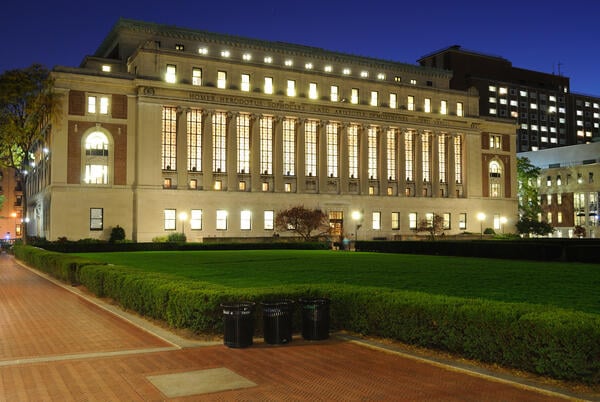
The disastrous deal between Columbia and the federal government only strengthens illiberal rule behind a façade of liberal values, Austin Sarat writes.
A majority of students say they interned to gain skills for career advancement in their desired field or role.
Frazao Studio Latino/E+/Getty Images
Employers, college leaders and policymakers have shown growing interest in skills-based hiring for college graduates, and in considering students’ demonstrated learning rather than their major program or degree. This trend signals a need for more hands-on or experiential learning before a student graduates, rather than on-the-job training.
A recent report from Strada shows that students also see this gap; a majority of those surveyed opted to participate in work-based learning to prepare them for a chosen profession or improve their odds as a job candidate.
Report authors also note opportunities for institutions to enhance on-campus experiences to better equip students for the world of work, such as providing professional networking, soft skill development and mentorship.
State of play: Increasingly, employers are emphasizing skills learned in higher education over content, citing a need for students to be adaptable and responsive to the evolving workplace. The drive toward skills-based hiring also stems in part from degree inflation and a re-leveling of jobs that actually require postsecondary education.
For students, this means a smaller share of entry-level positions require a bachelor’s degree. But some employers still screen by demonstrated skills, such as those gained through internships, rather than grades.
Not every student is able to participate in an internship. A 2025 survey from Handshake found that 12 percent of students have not participated in an internship and do not expect to do so before they graduate. Barriers to participation include caregiving responsibilities, limited access to internship opportunities or needing to work for pay. A 2024 report from the Business-Higher Education Forum found that students of color, first-generation students and community college students were less likely than their peers to secure an internship.
The National Association of Colleges and Employers (NACE) published research in May pointing to the benefit of experiential learning for early career outcomes; students who engaged in work-based learning were more likely to say they had better-than-expected career progress, higher salaries and greater general career satisfaction, compared to their peers who lacked an internship.
Methodology
Strada’s National Survey of Work-based Learning includes 2,000 responses from seniors at four-year colleges and universities in the U.S. The study was fielded between October and December 2024.
The study: Strada’s survey found that 65 percent of students participate in work-based learning to gain experience or skills in a specific career or their chosen profession. This echoes Handshake’s survey from early this year, which found that 87 percent of students pursue internships to build valuable skills.
“Today’s students are much more likely to view their experiences as instrumental rather than exploratory,” according to the Strada report.
Thirteen percent said they selected work-based learning experiences as an exploration of work, and approximately 8 percent said their main purpose was to land a job at their host organization.
Students saw paid internships and undergraduate research as most valuable for improving their standing as candidates for future jobs. Practicums were also rated highly, which could include clinical experiences in the health professions or student-teaching roles. Unpaid internships, project-based learning, on-campus jobs and off-campus jobs were seen as less valuable.
Among students who participated in multiple experiential learning opportunities, 81 percent ranked their most valuable experience as at least a seven out of 10. One in four respondents gave that experience a 10 out of 10.
Students who rated their experiences highly were also more likely to say they expanded their professional networking as participants. Students who worked as paid interns or unpaid interns were most likely to say they expanded their professional network.
Practicum participants were most likely to say they gained technical skills relevant to their career goals, followed by project-based learning participants and paid interns. Those working on- or off-campus jobs were least likely to report technical skill development.
On- and off-campus job experiences were rated lowest among respondents for a variety of factors, including value added to their persona as a job applicant, increased technical or durable skills, professional networking and mentorship.
Role of higher ed: Past surveys have shown that students believe their institution has a role to play in giving them internship experience.
A winter 2023 survey from Inside Higher Ed and College Pulse found that 62 percent of students believe their career center should help them get an internship. A 2024 Student Voice survey found that 48 percent of respondents think their institution should focus on helping students find internships and jobs, and 38 percent believe colleges should focus more on helping students prepare for internship and career success.
Students say faculty should also help in this process; one in five Student Voice respondents indicated professors are at least partially responsible for helping students find internships.
Strada’s report includes recommendations for colleges and universities such as:
Set a goal for each student to have at least one work-based learning experience while enrolled.
Integrate more work-based learning into the classroom and on-campus jobs.
Leverage employer feedback to create skill development opportunities in on-campus opportunities, such as courses and projects.
Establish spaces to introduce students to employers or other professionals who can add to their professional network.
How does your college or university prepare students for the world of work? Tell us more.
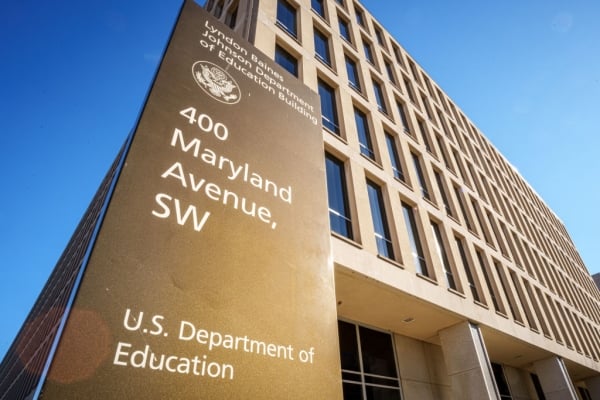
The agency announced Thursday that it will convene two advisory committees to weigh in on changes to the rules and regulations for the federal student loan program, institutional and programmatic accountability, and the Pell Grant program. Officials wrote in the announcement that this round of rule-making was necessary to implement the changes in the One Big Beautiful Bill as well as “other administration priorities.”
Many of the higher ed provisions in the legislation take effect July 1, 2026, and several experts have raised concerns about whether that’s enough time for the department to put in place the necessary regulations and guidance. Among other changes, the law ends the Graduate PLUS loan program, caps loans for graduate and professional students, and expands the Pell Grant to workforce training programs that run between eight and 15 weeks.
To revise the regulations, the department is following its lengthy and complicated process known as negotiated rule making, which involves bringing together stakeholders to review proposed changes and then listening to public comment on the plan.
One group, which the department is calling the Reimagining and Improving Student Education (RISE) Committee, will focus on the student loan regulations, including creating new repayment plans and giving colleges the ability to limit how much students can borrow. The RISE Committee will meet twice in September and November for week-long sessions to negotiate policy revisions. If the committee doesn’t reach a consensus, the department is free to move forward with its own proposal, which would still be subject to public comment.
The other policy changes in the law will fall to the other panel, known as the Accountability in Higher Education and Access through Demand-driven Workforce Pell (AHEAD) Committee. That includes implementing the new earnings test, which requires programs to prove their graduates earn more than an adult with a high school diploma or risk losing their access to student loans, as well as revising the eligibility criteria for Pell grants to exclude students who get a full ride. The AHEAD committee will meet in December and January for week-long sessions.
Both committees will include student borrowers, legal assistance organizations and representatives from various types of institutions, among other stakeholder groups. None specifically include the financial aid administrations who will play a key role in rolling out these changes on college campuses.
To kick off the rule-making process, the department will hold a virtual public hearing from 9 a.m. to 4 p.m. Aug. 7. More information is available on the department’s website.
It is already 93 degrees, but temperatures are rising further outside the Tampa Convention Center—especially for the young man dressed in a dinosaur costume. Also sporting a Tom Brady Tampa Bay Buccaneers jersey, he is loudly debating immigration with another young man in a smart suit on the pavement. Across the street, a handful of protesters face off against a growing number of right-wing influencers with cameras.
Inside the building, political strategist Steve Bannon is denouncing billionaire Elon Musk as “evil” while filming a live TV broadcast. Thousands of young college students cheer when border czar Tom Homan threatens to beat up a heckler in the crowd. And a YouTuber leads the audience in a mass “Trump dance party” to the tune of YMCA.
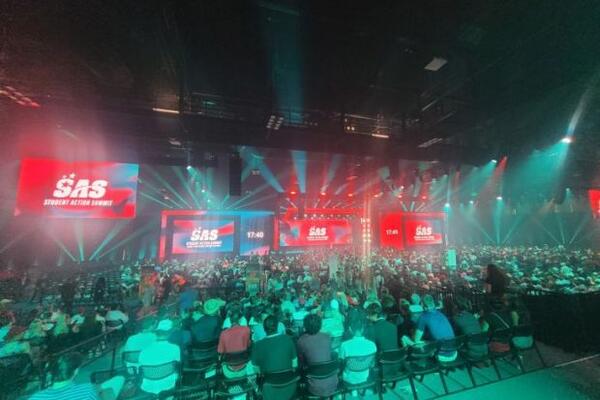
Welcome to the Student Action Summit 2025. Organized by youth activist organization Turning Point USA (TPUSA), the three-day annual conference is billed as the premier event for conservative college students to debate ideas, network and hear from top Republicans. They include Tucker Carlson, Donald Trump Jr. and, of course, Charlie Kirk, who founded the movement as an 18-year-old college dropout.
More than 5,000 people attended this year’s event in Florida, held July 11–13, and Times Higher Education was there to learn what matters to college conservatives today, what issues are dividing this branch of the MAGA movement, and whether this youthful “red wave” can reshape U.S. electoral politics.
As a countdown clock ticks down to zero, a DJ pumps up the well-dressed young crowd—advised to style themselves after Donald Trump’s permanently besuited youngest son Barron—with Rednex’s Cotton Eye Joe and The Killers’ Mr. Brightside. Along with the big hitters, students also hear from Happy Gilmore actor Rob Schneider, founder of the Dark Web marketplace Silk Road, Ross Ulbricht, and fitness trainer Jillian Michaels across an eclectic and often bizarre three days.
Kirk’s fingerprints are all over the summit. Owing to the slightly chaotic nature of the schedule, he is often timetabled to appear in two places at the same time—particularly tricky given that, as the podcaster Dan Nunn puts it, “Charlie can’t even walk around: he’s like a rock star.”
He kicks off the summit on the vast East Hall stage by hitting some issues that Republicans of all ages can agree on—namely, religion and immigration. The 31-year-old activist and podcaster praises the audience for helping reverse decades of declining church attendance (many of them attend a service in the Convention Center on Sunday morning) and for helping TPUSA fight the “spiritual sickness throughout the West.” Talks are regularly interrupted by football-style chants of “Christ is King” or “God is great.”
Kirk also gets loud acclaim when he says that no foreigner should be allowed to own a home or get a job before a U.S. citizen, and draws an even bigger cheer when he mentions President Trump’s plans for mass deportation of illegal migrants. Even legal migration comes under fire over the convention weekend, and Homan, the former chief of Immigration and Customs Enforcement (ICE), is treated like a rock star, his frequent mentions of buzz phrases such as “send them home” chanted back to him from the floor.
Abortion is mentioned on stage, as one might expect. Riley Gaines, a former college swimmer who became an activist after finishing tied for fifth in a race with a trans woman, praised Trump as the most pro-life president in modern history. And the issue is brought up repeatedly in interviews with THE—often by young men.
Many speakers are also very keen to stress the importance of reproduction and “traditional” families. Michael Knowles, a political commentator and YouTuber, calls falling birth rates in the U.S. an “existential crisis.” He welcomes the “trad wife” trend on social media—right-wing women promoting their role as stay-at-home moms—and praises young women for rejecting the corporate rat race, “to the horror of the feminists.” A middle-aged audience member, who gets a massive round of applause when he reveals he has 12 children, wants to help convince the college generation of the “beauty of big families.”
Kirk also ploughs that furrow. He tells the audience that the real threat to the U.S. is not racism or environmentalism, but low birth rate. And he tells those listening online what they are missing out on by not being there in person. “If you want to find your future husband or wife … you should be here in Tampa, Florida, because there’s a lot of eligible bachelors and bachelorettes here.”
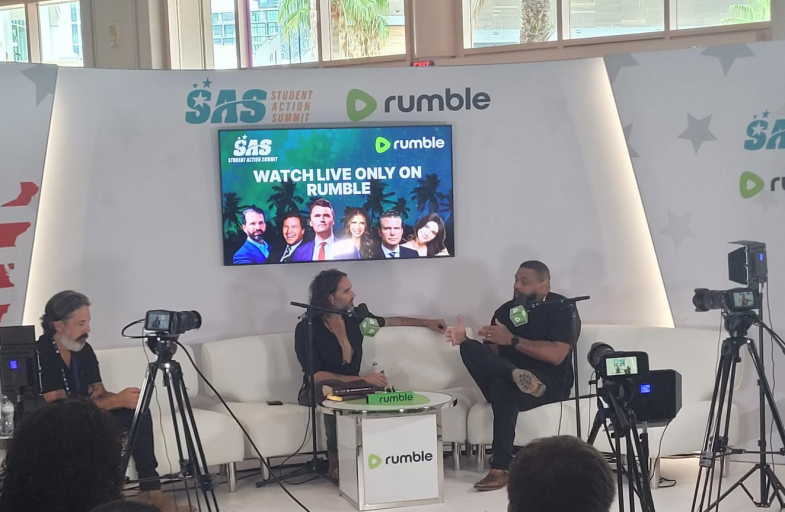
Equally, however, conservative attitudes to dating and sex are evident. Brandon Tatum, a former college football player, police officer and now online activist, advises against “hooking up with people and doing all this crazy stuff.” Brett Cooper, a child actor turned online activist, warns delegates not to party too much or waste time playing video games. And comedian Russell Brand, currently awaiting trial in the U.K. for rape, sexual assault and indecent assault (he has pleaded not guilty), also praises family values and religion while denouncing pornography and claiming that Jesus was opposed to bad government. During his strange 20-minute speech-cum-rap in front of one of the largest audiences of the weekend, Brand explains how he turned to God following a life of crack and heroin addiction, a “pursuit of carnality” and an “all-you-can-eat buffet” of hedonism.
Source: Patrick Jack
Russell Brand (center) at the Turning Point USA Student Action Summit 2025
Away from the main hall lies the exhibition floor. Here, students can take selfies with political consultant Roger Stone—pardoned by Trump in 2020 after being convicted of lying to Congress, obstruction of justice and witness tampering relating to a Congressional inquiry into Russian attempts to boost Trump’s 2016 election campaign. They can also pick up free copies of a book on the “untold story behind the Vatican’s rising influence in America,” challenge their friends to a pull-up contest or play cornhole.
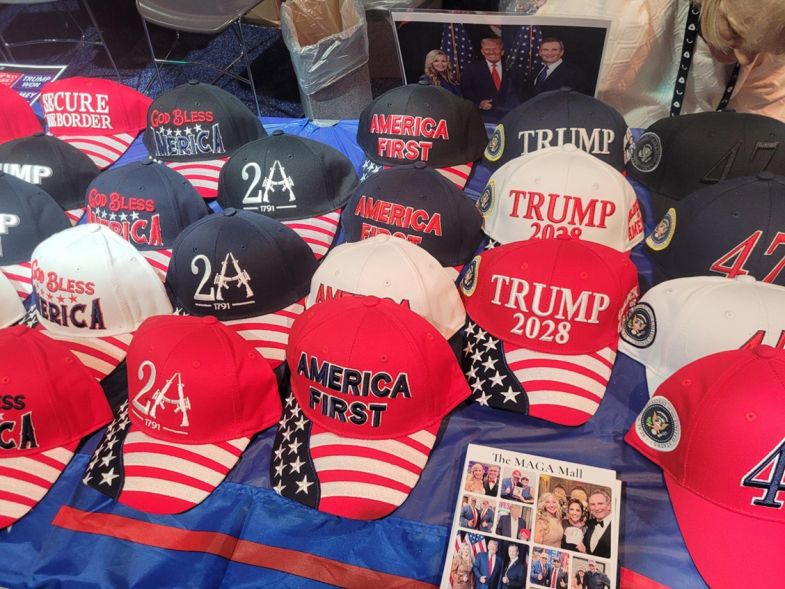
You can also buy just about anything—provided it has some red, white and blue on it. There’s a stall to “Make Coffee Great Again,” “Trump 2028” hats are on sale for $30 (£23), and there are even cool pads to keep your head cool under them—as well as vibration plates for “advanced whole-body vibration therapy.”
Attendees can also hear from a wide range of fringe groups. A “Blexit” stall promotes “free thinking and empowerment” at historically black colleges and universities and is dedicated to bringing “traditional American principles to urban communities.” Wilbur Sims, strategic manager of student movement at Blexit, said, “We’re trying to educate people …and get away from a victimhood mentality within the black community.”
A surprisingly large number of families, many with young children, mingle with the students, as do some retirees. Steve, a 75-year-old lifelong Republican from Florida, hopes that TPUSA can help ensure the Democrats never get back into power. But there are a few signs of a divide between the younger and older generations.
Guns, which receive very few mentions from the stage, are one. Gun ownership has, for generations, been a mainstay of right-wing identity, but two lonely young men at the National Rifle Association stall express concern that their classmates are not interested in the Second Amendment (the right to bear arms).
The other dividing line is Israel. The most prominent stall on the exhibition floor is that of the International Fellowship of Christians and Jews (IFCJ), featuring hundreds of Israeli flags. Some college students nearby pose for pictures with a giant cardboard cut-out of Israeli prime minister Benjamin Netanyahu, but when Michele Bachmann, a former member of Congress and board member of the IFCJ, begins to discuss the “unprecedented” amount of antisemitism on college campuses, the hall empties out. And during a debate on day three, Dave Smith, a comedian and regular guest on the popular Joe Rogan podcast, warns of the “tremendous” influence of Israel in U.S. politics. And in the wake of the U.S. attack on Iran during Israel’s recent 12-day assault on the country, Smith elicits cheers when he criticizes “neoconservatives” for starting foreign wars—in contravention of the isolationism typically adopted by “America First” advocates. One young man and woman express their skepticism of the U.S.–Israel alliance and are convinced that convicted sex offender Jeffrey Epstein was a Mossad agent.
Epstein may have died by suicide in 2019, but his presence is keenly felt at the convention. The event occurs amid the MAGA backlash to attorney general Pam Bondi’s comment that the sex trafficker’s “client list”—which, according to Musk, includes Donald Trump, but which right-wing figures are convinced contains prominent Hollywood stars and Democratic politicians—does not, in fact, exist. Despite saying that homes and jobs are more important, Kirk admits the Epstein issue still matters. And in conversation with him, journalist Megyn Kelly calls it a “scandal of the right’s making.” When she asks the audience how many of them think it is an important story, everyone puts their hand up.
Hours later, media personality Tucker Carlson devotes almost his entire 30-minute speech to the issue, while Bannon sees it as symptomatic of the problems with the “deep state.” Even former college athletes Gaines and Tatum devote considerable time to talking about Epstein—with vocal prompting from the crowd.
The TPUSA president at the University of Alabama believes the issue is so important for this crowd because Bondi’s decision not to publish any of the Justice Department’s files on Epstein fits in with their skeptical worldview and their concern that they are being “lied to,” he said.
That sense also permeates the MAGA view of COVID-19. Bannon is cheered when he claims the pandemic originated from a “Chinese Communist Party bioweapon dropped in Wuhan.” There are frequent references over the weekend to the supposedly nefarious “mask mandates,” cancelled proms and young adults’ lost years—for which Kirk calls for a national apology.
“Nobody likes being lied to, and [young people] lived through COVID in a way that adults did not,” according to Nunn, host of the America First and the constitutionalist Nunn Report podcast. “They got their social lives shut down, they got their schools shut down, and then they found out it was all bullshit.” Since they blamed the Democrats for that, he believes that universities became less efficient “leftist breeding grounds” when that cohort arrived on campus.
Chase, a student from Florida, says COVID was a big factor in pushing his generation to the right. “So many people were lied to during that period of time and it definitely brought to light the corruption in the Democratic Party,” he tells THE. TPUSA is important because it helps students learn that they cannot trust mainstream media and must “seek out your own truth.”
The pandemic is clearly still an issue for Owen, a student in Michigan, where Democratic governor Gretchen Whitmer was caught breaking public health protocols at a restaurant in 2021. “I don’t really think that what the left was pushing made rational sense to the youth vote at the time, and it still doesn’t make sense now,” he said. “It’s just the hypocrisy of it all—you’re telling me not to leave my house, yet you’re going out and having parties without wearing masks closer than six feet.” Source: Patrick Jack
A striking omission from the stages of a conference targeted at students is higher education itself—despite the fact that Trump’s crackdown on prominent universities’ funding and autonomy has previously been cheered by many figures on the right. When prompted, however, delegates express universal scorn for universities.
John Paul Leon, TPUSA chapter president at University of California, Berkeley, tells THE he is becoming increasingly worried by academia’s left-wing consensus and “moral superiority,” particularly around “discriminatory” diversity, equity and inclusion (DEI) measures. David Goodwin, president of the Association of Classical Christian Schools and co-author of Battle for the American Mind with defense secretary Pete Hegseth, says higher education is a “mess”; and while institutions should be free to do whatever they want, he believes that they should expect to forgo government funds if they choose to defy the administration’s policies in areas such as DEI or choice of research topics. And Owen, who attends a private college, welcomes Trump’s attacks on universities because they are “indoctrinating students with wrong ideas.” International students, particularly “military-age males,” should be sent home, he adds.
Carol Swain, a retired professor of political science and law at Vanderbilt University and one of the few academics at the event, also welcomes Trump’s fight with Harvard because universities have “lost sight of the original purpose” of the sector, which was to educate minds by exposing individuals to divergent viewpoints. “Now the Ivy League has lost some of its allure, I believe there’s an opportunity for some state colleges and universities and some universities that were considered less prestigious to rise just by doing what the Ivy League hasn’t done, which is educate and create an environment where you have free speech, are following the Constitution, creating opportunities, [and] not practicing discrimination,” she said.
As for the effects of research funding cuts on the academic strength of the U.S., Swain says most papers in recent decades have been “garbage.” The “people that have pushed the beliefs that minorities have been discriminated against … lowered the standards in certain fields, and the emphasis on lived experience as opposed to research and data … has hurt academic research.”
But Jennifer Burns, director of academics at Turning Point Education, does not believe universities are solely to blame, claiming that grade schools are failing to prepare students properly: “If you’re building a house and your foundation is sinking and cracking, then the frame of the house is going to be cracked. It’s not the fault of the carpenters who put up the beams, it’s the cement layers. [Students] are not trained in how to think, so they’re going into college at the whim of a radical college professor and they’re soaking that up.”
TPUSA advocates for a “classical Christian education,” and some attendees propose private, conservative Christian liberal arts colleges such as Hillsdale in Michigan, or New Saint Andrews in Idaho, as exemplars of what higher education should be. Lennox Kalifungwa, digital engagement officer at New Saint Andrews, expresses the view that “the only true education is a Christian education because Christianity has the exclusive when it comes to truth and freedom.”
“Woke” students and academics, meanwhile, are a reoccurring punching bag on the convention floor—particularly those with a specific hair color. Kirk, who rose to fame through viral videos debating with left-wing students, calls them “purple-haired jihadis,” Homan bemoans “people with purple hair and nose rings,” Tatum deplores “liberal non-binaries” and Trump Jr. condemns “raging libtards.”
Such critiques are also usually tied up with anti-trans and anti-gay language. Trump Jr., a long-time ally of Kirk, whose daughter, Kai, is a college-level golfer at the University of Miami, proudly boasts of having been anti-trans since 2017 and sees it as being a “losing issue” for the Democrats. One student tells THE that drag queens reading children stories cause “horrible developmental issues” and contribute to rising suicide rates. Knowles celebrates the Trump-imposed end of the “preposterous ideology” of trans people, calling it “deader than disco,” the cancellation of LGBTQ+ pride parades due to lack of attendance and pop musician Jojo Siwa’s announcement that she no longer identifies as a lesbian. “Nature is healing,” he says with a laugh.
A lone protester who interrupts Homan is called a “loser,” a “moron,” an “asshole” and someone who “sits down when he pees”—to huge chants of “U-S-A.” Homan, who says he “wake[s] up like a kid in a candy shop every day” as border czar, offers to fight the man before his speech is over.
Outside are a few more dissenters. A handful of middle-aged Floridians, who fear TPUSA is “indoctrinating the youth,” hold a sign that says “MAGA—Movement Against Genuine Academics”—perhaps in reference to Kirk’s creation of the Professor Watchlist, which lists scholars who “discriminate against conservative students and advance leftist propaganda.” They are soon joined by a rag-tag group of a few dozen young students, some dressed as characters from the dystopian TV show TheHandmaid’s Tale and others wearing the Guy Fawkes masks popularized by the hacker collective Anonymous. Vicky Tong, spokesperson for the Tampa Bay Students for a Democratic Society, says they want to show that not everyone in Florida supports the “sexist, homophobic, anti-trans, anti-immigrant” agenda of TPUSA.
Back inside the hall, speakers emphasize that while right-wingers are in the majority here, they are “outnumbered” on campus. Many express fear of being accused of sexual harassment or being cancelled for using the wrong pronoun. Kirk calls them “warriors” and praises them for putting up with threats and intimidation. “What they’re doing is one of the hardest things to do in the United States of America. They are deciding to be less popular on campus,” he says.
Source: Justin Sullivan/Getty Images
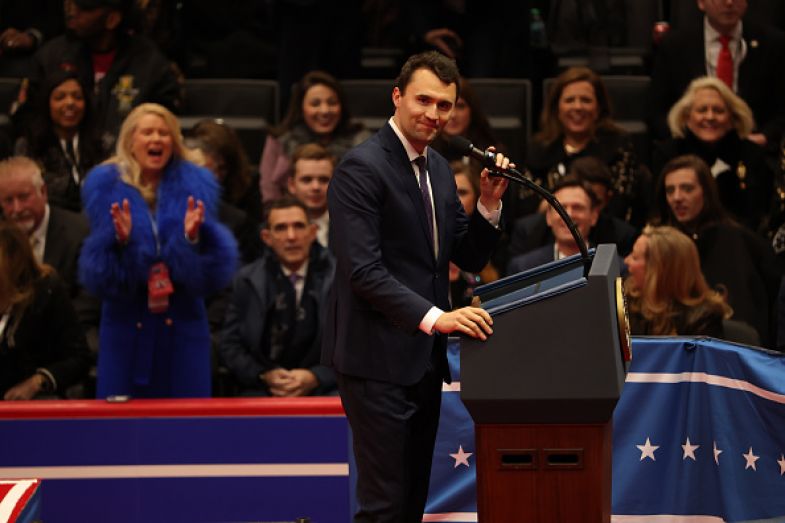
Charlie Kirk speaks at Donald Trump’s inauguration on 20 January 2025
Some of the big names can sympathize. Trump Jr. used to attend “every cool person party” in New York before his father became involved in politics and the invites dried up. “These people that I thought were friends for decades, they don’t call any more.” He encourages students to “feed off the hate,” while Kelly urges them not to be “sheep” and follow along with what their left-wing professors say just to get good grades. “Don’t call yourself a feminist because your teacher will give you pats on the head. Stand up for what you really believe in, and that’s how we spread the good word,” she said.
Fox News host Greg Gutfeld, who has come under fire for attempting to “reclaim” the word “Nazi,” complains that “left-wingers were the cool kids” when he was young. And that sense of not fitting in on campus is clearly a big reason that some of the attendees are here—many of them thanks to a TPUSA stipend (the organization is largely funded by donations). Leon, who studies in the “belly of the [progressive] beast” at Berkeley and went viral for a video where he confronts a liberal student, says he is called a fascist daily, but at TPUSA “you can find life-long friends, your forever friends, or maybe you can find your wife too.” Dylan Seiter, president of TPUSA at Texas A&M University, told students during a breakout session that “the libs want to drag us down to their level and make us seem like we’re some nasty, hateful people, but in reality, we’re not. And it’s our duty and our jobs to prove them wrong.”
Indeed, some delegates confess that they are only here to hang out and socialize, and nearby bars such as Harpoon Harry’s Crab House are packed with older students before the day’s events are even over. But this social element is not just for fun, it is also for networking. As Kirk puts it: “Marriages will happen this weekend. Lifetime friendships will happen this weekend. Careers will start this weekend.” And as well as selling “I survived college without becoming a liberal” T-shirts, the TPUSA Alumni Association is consciously attempting to replicate the college networks of Ivy League schools to help get MAGA graduates into top jobs. TPUSA also tries to persuade students to work on the “front lines” of the culture war. One recruitment video urges young people not to become doctors or lawyers, but to get a job with “real impact.”
Many speakers are convinced that they are already having an impact, crediting a “red wave” of students with delivering Trump’s landslide victory in 2024, a “shot heard around the world.” Bannon thanks them for being “the hardest core of the hardcore” and the “tip of the tip of the spear” in “winning” the 2016 and 2020 elections as well.
“This is the greatest generational realignment since Woodstock,” says Kirk. “We have never seen a generation move so quickly and so fast, and you guys are making all the liberals confused.” Accordingly, Republican Party luminaries show up in force. Michael Whatley, chair of the Republican National Committee, shakes hands on the exhibition floor and multiple members of Trump’s top team—including director of national intelligence Tulsi Gabbard and homeland security secretary Kristi Noem—deliver speeches. However, these politicians generate far less buzz than social media stars such as Gaines and Cooper.
Still, Kirk warns that Washington is taking right-wing students for granted and “messing up” a once-in-a-generation opportunity to deliver a “death blow” to the Democratic Party by failing to fully deliver on their promises—such as by publishing the Epstein list. And Swain agreed. “If these [elected] officials compromise and they prove themselves to be no different than the politicians they replaced, it’s going to be harder for [young] people to stay enthusiastic,” he said.
As one attendee puts it, conservative students have been “lurking in the shadows” for decades. Kirk has successfully dragged them out into the sunlight. The challenge he and Trump now face is one that will be familiar to the “radical left”— keeping momentum, holding the various factions together in the face of political realities, and delivering on their promises.
An Idaho judge Wednesday sentenced the murderer of four University of Idaho students to life in prison without possibility of parole, various mediaoutlets reported.
Judge Steven Hippler of the state’s 4th Judicial District sentenced Bryan Kohberger to four consecutive life sentences.
Kohberger pleaded guilty June 30 to the 2022 killings of seniors Kaylee Goncalves and Madison Mogen, both 21; junior Xana Kernodle, 20; and freshman Ethan Chapin, 20. As part of Kohberger’s plea deal, prosecutors agreed to not pursue the death penalty.
Authorities said the four University of Idaho students were sleeping at an off-campus home in Moscow, Idaho, when Kohberger—then a criminology graduate student at nearby Washington State University—stabbed them to death. He declined to speak during his sentencing hearing, and his motive remains unknown.
Education technology as a whole is an academic freedom issue, unfortunately, the encroachment of technological systems which shape (and in some cases even determine) pedagogy, research and governance have been left in the hands of others, with faculty required to capitulate to a system designed and controlled by others.
AI is here, rather suddenly, pretty disruptively, and in a big way. Different institutions are adopting different stances and much of the adaptation is falling on faculty, in some cases with minimal guidance. While considering how these tools impact what’s happening at the level of course and pedagogy is a necessity, it also seems clear that faculty concerned about preserving their own rights should be considering some of the institutional/structural issues.
Personally, I have more questions than answers at this time, but there’s a handful of recent readings that I want to recommend to others to help ground thinking that may lead to better questions and actionable answers.
A report, Artificial Intelligence and the Academic Professions, just released by the AAUP, should be at the top of anyone’s list. Based on a national survey, the report examines a number of big-picture categories, all of which have a direct relationship to issues of academic freedom.
Improving Professional Development Regarding AI and Technology Harms
Implementing Shared Governance Policies and Professional Oversight
Improving Working and Learning Conditions
Demanding Transparency and the Ability to Opt Out
Protecting Faculty Members and Other Academic Workers.
The report both summarizes faculty concerns as expressed in the survey and offers recommendations for actions that will protect faculty rights and autonomy. Having read the report, in some cases the recommendations initially seem frustratingly vague but looked at in total, they are essentially a call for active faculty involvement in considering the implications of the intersection of this technology (and the companies developing it) with educational institutions.
In a way, the report highlights, in hindsight, how truly absent faculty have been as existing educational technology has been woven into the fabric of our institutions, and that it would be a disaster for that absence to be perpetuated when it comes to AI.
After checking out the AAUP report, move on to Matt Seybold’s, How Venture Capitalists Built A For-Profit “Micro-University” Inside Our Public Flagships, published at his newsletter, The American Vandal. It’s a long and complicated story about the ways outside service providers conceived in venture capital/private equity have insinuated themselves into our universities in ways that undermine faculty roles and educational quality.
It would take a full column to do Seybold’s piece justice, but here are two quotes that I hope induce you to go consider his full argument.
Here Seybold pulls the lid back on what it means for these third-party provider offerings to exist under a university brand “powered by” the third-party provider:
The “powered by model” is a truly absurdist role reversal. A private, unaccredited company founded and run by sales and marketing professionals is responsible for the (pseudo)educational coursework, while the accredited university is employed only for its sales and marketing functions, getting paid by commission on the headcount of students who enroll from their branded portal. University partners are incentivized to flex their brand power and use their proprietary data, advertising budgets, and sales forces to maximize this commission, while Ziplines provides cookie-cutter landing pages and highly reproducible microdegrees, the content of which is largely created by gigworkers.
And here, Seybold pinpoints the downstream effect of these kinds of “partnerships.”
EdTech is not only always a Trojan horse for elite capture of public resources; it is also always a project in delegitimizing the project of public education itself.
The applicability of Seybold’s analysis to the “AI partnerships” many institutions are busy signing should be clear.
As another thought experiment exercise, I recommend making your way through a Hollis Robbins’s piece at her Anecdotal website, How to Deliver CSU’s Gen Ed with AI.
Robbins, a former university dean, perhaps intends this more as a provocation than an actionable proposal but, as a proposal, it is a comprehensive vision for replacing human labor with AI instruction that relies on a series of interwoven tech applications where humans are “in the loop,” but which largely run autonomously.
If realized, this sort of vision would obviate academic freedom on two fronts:
The curriculum would be codified and assessed according to a rigid standard and then be delivered primarily through AI.
Faculty would barely exist.
I read it as a surveillance-driven dystopia from which I would either have to opt-out (if allowed), or more likely have to flee, but you can check the comments to the post itself and find some early enthusiasts. The complexity of the technological vision suggests that such a vision would be difficult to impossible to realize, but the underlying values of increased efficiency, decreased cost and increased standardization are consistent with the direction educational systems have been going for decades.
Many of the factors that have eroded faculty rights and left institutions vulnerable to the attacks that have been coming were, indeed, foreseeable. Adjunctification is at the top of my list.
When it comes to technology and the university, we’ve seen this play before. If faculty aren’t prepared to assert their rights and exercise their power, you won’t see me writing the kinds of lamentations I’ve offered about tenure over the years because there won’t be enough faculty left to worry about such things.
Dr. William Casey Boland A lawsuit challenging Hispanic-Serving Institution (HSI) federal funding represents another figurative bomb lobbed in the current war on U.S. higher education. Galvanized by the President’s blitzkrieg on social funding and education, this assault on the alleged reverse racism of HSI funding reflects the ugly political tenor of the times in the U.S. It also conveniently ignores the evidence of the positive impact of such governmental support.
l’ll acknowledge my bias: I teach at a large urban college that recently received an HSI grant. Nearly all my students are students of color, with roughly half being Hispanic. Many are the first in their families to enroll in college. Most of their parents were not born in the U.S. We are amongst the 20% of all colleges in the U.S. that are eligible to apply for an HSI grant, which are made available through the Higher Education Act of 1965 (Title III and Title V).
Why did we apply for this grant? State funding per student to public HSIs is $6,396.59 compared to $15,526.13 for non-HSIs. The ongoing disparities in postsecondary educational attainment based on race and ethnicity reveal more about a deficit in public policy to address the equitable distribution of resources and less about the ability of students of color to obtain a college degree. Despite modest gains over time, gaps in attainment continue. 28% of the Hispanic population in the U.S. received an associate degree or higher compared to 48% of the white population. The average graduation rate in four-year postsecondary institutions was 52% for Hispanic students compared to 65% for white students. HSI grants are made available in part to narrow this gap in college outcomes amongst Hispanic students.
What is my college doing with its HSI grant? To advance retention, persistence, and specific course completion, the grant will improve the First Year Seminar, provide professional develop with a focus on culturally responsive pedagogy, integrate tutoring, peer mentoring, academic and career coaching, and target intervention in gateway courses.
Many HSI-eligible colleges look like mine, but not all. They are two and four-year public and private non-profit institutions that are under-resourced, become eligible to apply when their undergraduate enrollment reaches 25% Hispanicand at minimum 50% receive some form of financial aid. The rising number of colleges eligible for HSI grants reflects the growth of the Hispanic population in the U.S. Between 2010 and 2022, the Hispanic population accounted for 34 percent of the overall increase in the U.S. population. Hispanic participation in colleges and universities rose from 14 percent in 2010 to 20 percent in 2022.
Several characteristics are common across institutions designated as HSIs. First, Hispanics tend to enroll in HSI-designated colleges more than non-HSIs. This is largely due to Hispanic students wanting to enroll in a college close to their community. Second, Hispanic students attending HSIs are often the first in their family to seek a college degree. Third, Hispanic students enrolled in HSIs on average graduated from high schools with large classroom sizes, disproportionate levels of racially minoritized student populations, and lower standardized test scores. Many argue that HSIs offer such students an opportunity to participate in postsecondary education that they would not otherwise have.
Evidence-based research demonstrates the ROI on the federal government’s investment in HSIs. When colleges receive HSI grants, there is a positive effect on Hispanic students. I found that grant receipt increases Hispanic bachelor’s degree completion by nearly 30 percent and associate degrees by almost 25 percent. In another study, we found a 10% increase in Hispanic students obtaining STEM associate’s degrees. We also found benefits for non-Hispanic students, with an 11% increase in the number of those students receiving STEM associate’s degrees. This echoes another study focusing on the initial year HSI STEM grants were awarded with the authors finding HSI STEM grant receipt directly led to an 8% increase in Hispanic students receiving such degrees in community colleges.
I doubt the architects of this recent lawsuit challenging HSI funding have ever spoken to someone who graduated from an HSI. I teach a graduate course on minority serving institutions (MSIs). Nearly all my students are students of color from the New York City metropolitan area. Most attended different MSIs as undergraduates. While experiences vary, most extol the virtues of having attended an MSI. They speak to the level of support they received, the power of being surrounded my others who shared their background, the willingness of HSIs and other MSIs to welcome students’ families and community to campus, amongst many other characteristics that made them glad they chose an HSI or MSI over a PWI.
It is important to evaluate the effectiveness of postsecondary programs funded through tax-payer dollars. Yet recent political antagonism directed towards higher education looks more like red meat being tossed to appease the red base as opposed to thoughtful, evidence-based decision-making. Acknowledging the effectiveness of HSI funding and similar efforts would weaken the core animating principle of the current Republican mission to decimate political support for such programs and reduce the existence of government more broadly.
Dr. William Casey Boland is an assistant professor in the Marxe School of Public and International Affairs at Baruch College-City University of New York.




 Source: Patrick Jack
 Source: Patrick Jack
  Source: Justin Sullivan/Getty Images