Dr. William Casey Boland A lawsuit challenging Hispanic-Serving Institution (HSI) federal funding represents another figurative bomb lobbed in the current war on U.S. higher education. Galvanized by the President’s blitzkrieg on social funding and education, this assault on the alleged reverse racism of HSI funding reflects the ugly political tenor of the times in the U.S. It also conveniently ignores the evidence of the positive impact of such governmental support.
l’ll acknowledge my bias: I teach at a large urban college that recently received an HSI grant. Nearly all my students are students of color, with roughly half being Hispanic. Many are the first in their families to enroll in college. Most of their parents were not born in the U.S. We are amongst the 20% of all colleges in the U.S. that are eligible to apply for an HSI grant, which are made available through the Higher Education Act of 1965 (Title III and Title V).
Why did we apply for this grant? State funding per student to public HSIs is $6,396.59 compared to $15,526.13 for non-HSIs. The ongoing disparities in postsecondary educational attainment based on race and ethnicity reveal more about a deficit in public policy to address the equitable distribution of resources and less about the ability of students of color to obtain a college degree. Despite modest gains over time, gaps in attainment continue. 28% of the Hispanic population in the U.S. received an associate degree or higher compared to 48% of the white population. The average graduation rate in four-year postsecondary institutions was 52% for Hispanic students compared to 65% for white students. HSI grants are made available in part to narrow this gap in college outcomes amongst Hispanic students.
What is my college doing with its HSI grant? To advance retention, persistence, and specific course completion, the grant will improve the First Year Seminar, provide professional develop with a focus on culturally responsive pedagogy, integrate tutoring, peer mentoring, academic and career coaching, and target intervention in gateway courses.
Many HSI-eligible colleges look like mine, but not all. They are two and four-year public and private non-profit institutions that are under-resourced, become eligible to apply when their undergraduate enrollment reaches 25% Hispanicand at minimum 50% receive some form of financial aid. The rising number of colleges eligible for HSI grants reflects the growth of the Hispanic population in the U.S. Between 2010 and 2022, the Hispanic population accounted for 34 percent of the overall increase in the U.S. population. Hispanic participation in colleges and universities rose from 14 percent in 2010 to 20 percent in 2022.
Several characteristics are common across institutions designated as HSIs. First, Hispanics tend to enroll in HSI-designated colleges more than non-HSIs. This is largely due to Hispanic students wanting to enroll in a college close to their community. Second, Hispanic students attending HSIs are often the first in their family to seek a college degree. Third, Hispanic students enrolled in HSIs on average graduated from high schools with large classroom sizes, disproportionate levels of racially minoritized student populations, and lower standardized test scores. Many argue that HSIs offer such students an opportunity to participate in postsecondary education that they would not otherwise have.
Evidence-based research demonstrates the ROI on the federal government’s investment in HSIs. When colleges receive HSI grants, there is a positive effect on Hispanic students. I found that grant receipt increases Hispanic bachelor’s degree completion by nearly 30 percent and associate degrees by almost 25 percent. In another study, we found a 10% increase in Hispanic students obtaining STEM associate’s degrees. We also found benefits for non-Hispanic students, with an 11% increase in the number of those students receiving STEM associate’s degrees. This echoes another study focusing on the initial year HSI STEM grants were awarded with the authors finding HSI STEM grant receipt directly led to an 8% increase in Hispanic students receiving such degrees in community colleges.
I doubt the architects of this recent lawsuit challenging HSI funding have ever spoken to someone who graduated from an HSI. I teach a graduate course on minority serving institutions (MSIs). Nearly all my students are students of color from the New York City metropolitan area. Most attended different MSIs as undergraduates. While experiences vary, most extol the virtues of having attended an MSI. They speak to the level of support they received, the power of being surrounded my others who shared their background, the willingness of HSIs and other MSIs to welcome students’ families and community to campus, amongst many other characteristics that made them glad they chose an HSI or MSI over a PWI.
It is important to evaluate the effectiveness of postsecondary programs funded through tax-payer dollars. Yet recent political antagonism directed towards higher education looks more like red meat being tossed to appease the red base as opposed to thoughtful, evidence-based decision-making. Acknowledging the effectiveness of HSI funding and similar efforts would weaken the core animating principle of the current Republican mission to decimate political support for such programs and reduce the existence of government more broadly.
Dr. William Casey Boland is an assistant professor in the Marxe School of Public and International Affairs at Baruch College-City University of New York.
Louisiana Governor Jeff LandryLouisiana Governor Jeff Landry announced that his state will join six other Southern university systems in creating an alternative accrediting body, marking a significant departure from established higher education standards. Through an executive order, Louisiana becomes the seventh state to participate in the Commission for Public Higher Education, which launched in June with university systems from Florida, Georgia, North Carolina, South Carolina, Tennessee and Texas.
The new commission is currently seeking expedited approval from the U.S. Department of Education to serve as an official accreditor responsible for maintaining quality standards at colleges and universities. This development represents a direct challenge to the Southern Association of Colleges and Schools Commission on Colleges, the traditional accrediting body that currently evaluates institutions across Louisiana and ten other Southern states including Alabama, Florida, Georgia, Kentucky, Mississippi, North Carolina, South Carolina, Tennessee, Texas and Virginia.
The formation of this alternative accrediting body stems from growing tensions between conservative politicians and established accreditors. These conflicts have centered on traditional accreditors’ standards related to diversity, equity and inclusion initiatives, as well as their requirements for safeguards designed to limit external political influence in public higher education governance.
Landry’s executive order establishes a Task Force on Public Higher Education Reform charged with developing recommendations for implementing the new commission. The task force will specifically focus on creating a pilot program for dual accreditation, allowing Louisiana schools to maintain authorization from both the new commission and the Southern Association simultaneously.
The governor highlighted the ideological motivations behind the move in his announcement.
“This task force will ensure Louisiana’s public universities move away from DEI-driven mandates and toward a system rooted in merit-based achievement,” Landry said.
Florida Governor Ron DeSantis, who helped launch the original commission, articulated similar sentiments when announcing the new accreditor in June.
“[The Commission for Public Higher Education] will upend the monopoly of the woke accreditation cartels, and it will provide institutions with an alternative that focuses on student achievement, rather than the ideological fads that have so permeated those accrediting bodies over the years,” DeSantis declared.
The practical implementation of this new accrediting system faces a significant hurdle, as U.S. Department of Education approval is mandatory before any institution accredited solely by the new commission can receive federal financial aid. This requirement could potentially affect students’ access to federal funding programs if the transition is not handled carefully.
The composition of Louisiana’s new task force reflects the governor’s significant influence over the state’s higher education leadership structure. With the exception of Commissioner of Higher Education Kim Hunter Reed, every task force member has been directly appointed by Landry or his conservative legislative allies. The task force includes Board of Regents Chairwoman Misti Cordell, University of Louisiana System Board Chairman Mark Romero, LSU System Board Chairman Scott Ballard, Southern University System Board Chairman Tony Clayton, Louisiana Community and Technical College Systems Chairman Tim Hardy, Senate Education Committee Chairman Sen. Rick Edmonds, and House Education Committee Chairwoman Rep. Laurie Schlegel.
Additionally, Landry has appointed his executive counsel Angelique Freel and Commissioner of Administration Taylor Barras to the task force, with the option for them to send designees in their place. The governor retains the authority to select three additional task force members, further consolidating his influence over the group’s composition and direction.
This level of gubernatorial control over higher education governance represents a recent shift in Louisiana’s political landscape. Last year, Landry successfully advocated for legislative changes that granted him direct appointment power over the chairs of the state’s five higher education boards, positions that were previously elected from within the boards’ memberships. An earlier version of this legislation would have extended Landry’s authority to include direct hiring of university system presidents, but this provision was ultimately removed due to concerns that such concentration of political power could jeopardize existing accreditation status.
The task force operates under a compressed timeline that reflects the urgency Landry places on this initiative. The group must convene its inaugural meeting no later than August 31 and maintain a regular schedule with meetings occurring at least once every two months. The task force faces a deadline of January 30, 2026, to submit its comprehensive recommendations for implementing the new accrediting system in Louisiana.
Senator Bernie SandersSenator Bernie Sanders introduced legislation last Thursday requiring all public school teachers to earn at least $60,000 annually, calling America’s teacher pay crisis a “national emergency” during a Capitol Hill town hall with more than 200 educators.
The Pay Teachers Act, co-sponsored by eight Democratic senators including Elizabeth Warren and Ed Markey, would establish the first federal mandate for teacher salaries and represents the most ambitious federal intervention in educator compensation in decades.
“Just four hedge fund managers on Wall Street make more money in a single year than every kindergarten teacher in America combined—over 120,000 teachers,” Sanders said. “No public school teacher in America should make less than $60,000 a year.”
The legislation comes as schools nationwide face unprecedented staffing shortages, with nearly 200,000 teaching positions either vacant or filled by underqualified educators. According to the bill’s findings, 38% of teachers nationwide earn less than $60,000 annually, with starting teachers averaging $44,530.
Maria Gonzalez, a third-grade teacher from Arizona who testified at the town hall, said she drives for Uber on weekends and tutors after school to pay rent.
“My students ask why I look tired. How do I tell them their teacher can’t afford to live in the community where she teaches?”
The crisis extends beyond low pay. Twenty-one percent of elementary and middle school teachers’ families rely on public assistance programs including Medicaid, food stamps, and the Earned Income Tax Credit, according to a University of California, Berkeley study cited in the legislation. Additionally, 44% of public school teachers quit within five years, and 17% worked multiple jobs during the 2020-2021 school year.
The comprehensive bill would cost approximately $400 billion over five years, funded through mandatory appropriations. Beyond the $60,000 minimum salary requirement, the legislation would triple Title I funding, provide teachers with at least $1,000 annually for classroom supplies, and mandate that paraprofessionals and education support staff earn at least $45,000 annually or $30 per hour.
States would have four years to implement the salary requirements, with extended timelines available for states demonstrating substantial financial need. The bill also includes $50 billion annually for career ladder programs allowing teachers to advance without leaving the classroom.
The teacher shortage disproportionately affects schools serving students of color and low-income communities, which are four times more likely to employ uncertified teachers than schools with low minority enrollment, according to federal civil rights data cited in the legislation.
James Williams, a high school mathematics teacher from North Carolina, told the town hall that his salary purchased “a decent life” 15 years ago but now forces him to choose between car repairs and classroom supplies.
The legislation faces significant political obstacles with Republicans controlling the House. GOP lawmakers have criticized the massive federal spending, while some education policy experts question federal involvement in traditionally state and local compensation decisions.
Major education unions endorsed the proposal. American Federation of Teachers President Randi Weingarten called it “a crucial federal investment to help sustain the teaching profession,” while National Education Association Vice President Princess Moss praised it as legislation that “invests in our students, educators, and public schools.”
Sanders criticized recent Republican legislation that he said provides “$900 billion in tax cuts to large, profitable corporations and a $1 trillion tax cut to the top 1%” while cutting over $300 billion in education funding. The Trump administration is also withholding nearly $5.5 billion in congressionally appropriated education funding, according to Sanders and his colleagues.
“If we can provide over a trillion dollars in tax breaks to the top 1% and large corporations, please don’t tell me that we cannot afford to make sure that every teacher in America is paid at least $60,000 a year,” Sanders said.
This blog was kindly authored by Dr Anna Anthony, director of HEAT. HEAT provides a collaborative data service enabling higher education providers, Uni Connect partnerships and Third Sector Organisations to show the impact of their equality of opportunity delivery through a shared, standardised data system. By aggregating data from across the membership, HEAT can publish national-level impact reports for the sector.
It has never been more important for providers across the sector to show that access and participation activities have an impact. With resources stretched, we need to know the work we are doing is making a measurable difference. New research from HEAT reveals a series of powerful findings:
Intensive outreach boosts HE entry by up to 29% – Students who received at least 11 hours of intensive outreach were up to 29% more likely to enter higher education (HE) than matched peers receiving minimal support.
Disadvantaged students see the biggest gains – Free school meal (FSM) eligible students were up to 48% more likely to progress to HE when engaged in intensive outreach.
Uni Connect makes a difference – The largest relative increases in HE entry were observed in FSM-eligible students who participated in Uni Connect-funded activities, further demonstrating the importance of impartial outreach delivered collaboratively.
Access to selective universities improves – Intensive outreach from high-tariff providers increased the chance of progressing to a high-tariff university by 19%.
Sustained support across Key Stages is vital – Outreach delivered across both Key Stages 4 and 5 had the greatest impact, highlighting the need for long-term, multi-stage interventionsthroughout secondary education.
These findings provide compelling evidence that the work being done across the sector to widen participation is not only reaching the right students but changing trajectories at scale. Crucially, this latest research includes previously unavailable controls for student-level prior attainment — adding new rigour to our understanding of outreach impact. You can read the full report on our website.
What’s next for national-level research?
Our ability to generate this kind of national evidence is set to improve even further thanks a successful bid to the Office for Students (OfS) Innovation Fund. Through a collaboration with academics at the Centre for Education Policy and Equalising Opportunities (CEPEO) at the UCL Institute of Education, HEAT will lead on the development and piloting of a pioneering new Outreach Metric, measuring providers’ broader contribution to reducing socio-economic gaps in HE participation. More details about this project can be found here, and we look forward to sharing early findings with the sector in 2026.
Local-level evaluation is just as important
While national analyses like these are essential to understanding the big picture, the OfS rightly continues to require providers to evaluate their own delivery. Local evaluations are critical for testing specific interventions, understanding how programmes work in different contexts, and learning how to adapt practice to improve outcomes. Yet robust evaluation is often resource-intensive and can be out of reach for smaller teams.
This is where use of a sector-wide system for evaluation helps – shared systems like HEAT provide the infrastructure to track student engagement and outcomes at a fraction of the cost of building bespoke systems. Thanks to a decade of collaboration, we now have a system which the sector designed and built together, and which provides the tools necessaryto deliver the evaluation that the OfS require providers to publish as part of their Access and Participation Plans (APP).
We’re also continuing to improve our infrastructure. Thanks to a second successful bid to the OfS Innovation Fund we are building system functionality to support providers to use their tracking data when evaluating their APP interventions. This includes an ‘automated comparator group tool’ that will streamline the process of identifying matched participant and non-participant groups based on confounding variables. By reducing the need for manual data work, the tool will make it easier to apply quasi-experimental designs and generate more robust evidence of impact.
Next steps – sharing through publication
With all these tools at their disposal, the next step is to support the sector to publish their evaluation. We need shared learning to avoid duplication and siloed working. HEAT is currently collaborating with TASO to deliver the Higher Education Evaluation Library (HEEL), which will collect, and share, intervention-level evaluation reports in one accessible place for the first time. By collating this evidence, the HEEL will help practitioners and policymakers alike to see what works, what doesn’t, and where we can improve together.
If we want to continue delivering meaningful progress on access and participation, we need both meaningful, critical local evaluation and powerful national insights. Centralised data tracking infrastructure can give the sector the tools it needs to do both.
The increasing internationalization of higher education does not automatically lead to global knowledge and skill exchange in the classroom. Hierarchical barriers in pedagogy and classroom geography impede peer-to-peer learning. This article outlines the benefits of using a community cultural wealth approach – with an example – to disrupt academic and cultural hierarchies by drawing on the multiplicity of students’ assets, skills, and knowledge bases within international cohorts. Such a method enables international students to share their diverse expertise and breakdown assumptions about where and in whom relevant knowledge and information lies.
The Challenge of Hierarchy
I have been asking myself the following questions with increasing frequency as I grapple with teaching international cohorts of learners:
How can I move away from being considered the sole source of knowledge in the classroom?
How can I enable my international students to benefit from each other’s knowledge and insights?
How can I support students to co-construct their learning?
As an educator, working out how to center students in the process of learning remains an ongoing challenge, whether working with international or domestic students. For international students, their diverse expertise and experiences add significant value to the learning community. Yet, many of these students have experienced the banking model (Freire 1996) in their previous educational experience, where they were likely considered empty vessels to be filled with information by their instructors. Thus, when confronted with the liberal expectations of a Western education, where students are expected to engage with new people and evaluate and apply new knowledge, many feel underequipped to succeed, as they wrongly assume they have nothing to contribute. This fear of lack may further drive international students to remain in cultural enclaves within the classroom, to mask their concerns. In the grips of this fear, the benefits of an international education are not immediately granted by proximity in the classroom space.
A community cultural wealth model may help to overcome these challenges. This model, developed by Yosso (2005), foregrounds other than academic assets that students possess, including linguistic, familial, navigational, cultural, resistant, and community “capitals”.
This model disrupts the banking model of education as students are affirmed as arriving replete with assets and releases students from their fears by affirming a diverse array of expertise and in whom this expertise may reside. As social theory arises from daily life (hooks, 1994), in response to the circumstances of one’s existence and its connection to history, politics, and power, the community cultural wealth model enables students to connect their life experiences with their learning. Not only does this model transform student-to-student learning, but it also transforms instructor-to-student learning, upending the classroom hierarchy around who in the room holds relevant and useful information (Schoen 1991), and reducing reliance on the instructor as the arbitral of knowledge.
Asset Recognition and Intercultural Exchange
In both the USA and the UK, I have taught Master level courses in public health ethics. In these courses, I help the students to consider ethics applying theory and using evaluation tools to assess degrees of harm or benefit a given policy might cause. Regardless of country, Master’s cohorts consist of students from India, Bangladesh, Nepal, Nigeria, Ghana, Kenya, and Uganda, in varying proportions. Most of these students have trained as clinicians or hold degrees in the hard sciences.
One semester, Indian students were in the majority. I shared a case that helped students to consider the impacts of Indian government policy, Janani Suraksha Yojana (JSY), which provides financial incentives for poorer, rural Indian women to give birth in a hospital. The case, developed by D. K. Bhati (2016, section 4.12, case 4), highlights the clash between traditional birth practices and hospital birth incentivization and the various challenges it poses, amid the benefits. Underpinning information in the case included cultural nuances around marriage migration to the husband’s region, traditional practices of returning to the wife’s homestead to deliver, maternal consent, maternal control over financial resources, as well as logistical issues around lack of continuous emergency care for obstetrics and the exclusion of private health care provision from the program.
My intention was to explore the risks and benefits of incentivization through a case that would foreground the strengths of Indian cultural expertise. I gave each student a number from one to five to allocate them away from their comfort situations into ones in which each group formed a diverse assemblage of backgrounds. There, they were to discuss the case, by working through a set of questions. These included questions Bhati (2016) provided in the case:
Who are the various stakeholders involved and what are their values and perspectives?
What are the pros and cons of using cash incentives for a public health program?
Given her status as poor, young, married, and pregnant, how could the young wife’s autonomy have been upheld?
Should there be different notions of autonomy depending on context – individualist (Euro-American) sensibilities or interdependent (non-individualist, non-Euro-American) sensibilities?
To these, I added the following questions:
Given her lack of status societally, how might the cash incentive remain in the mother’s care?
The JSY policy recommends that fathers or mothers be sterilized to prevent future pregnancies; should this be incentivized with cash? Is this a just incentivization? Explain.
As anticipated, some Indian students were able to provide context for the case and speak from a place of knowing, about rural birthing practices, marriage migration, lack of health literacy, and power imbalances between husbands and wives and their respective families. Unexpected outcomes, which arose in the dialogues, were supplemental knowledge from across the cohort. These included familiarity with other governments’ policies on maternal health, similar situations involving poor rural women in other geographical locations, related experiences from those practicing obstetrics, and insights from the academic theory. Further unexpected outcomes arose through students’ recognition of their educational and social differences between those represented in the case, and themselves, revealing gaps that the ‘cultural experts’ could not fully broker. Interestingly, the recognition of this gap increased senses of connection across the cohort, as the students realized that amid their differences of language, culture, and nation, they shared class, wealth, and education-based assets.
I highlight this example as a watershed moment. Following these intercultural conversations, students’ confidence increased over their capacity to understand, to integrate different voices, and to use and critique evidence, exemplified in their individual coursework. Throughout the semester, students more readily reorganized themselves into small groups, without my explicit directing, suggesting that once nudged across boundaries, the benefits of learning to and from one another outweighed emotional resistance. Informally, students expressed their appreciation of learning together and further related that this approach would support them as public health practitioners, where they would need to connect to, communicate with, and learn from people different from themselves. The community cultural wealth approach further enabled me as instructor to overcome my internalized hierarchies of knowledge creation by allowing learning to unfold in accordance with the various skills in the room, and to arrive at unanticipated and novel outcomes.
By breaking down academic and cultural hierarchies in the international classroom, both the students and instructors can acknowledge and advance diverse understandings and harness the richness of an international cultural, professional, and educational encounter.
Julie Botticello holds a PhD in Anthropology and has taught in the UK and the USA for the past 20 years, predominately to diverse and international cohorts of students, on subjects relevant to the social sciences and to public health. Julie holds a teaching fellowship at the University of New Haven on inclusive pedagogy, teaches a group of incarcerated women at a Federal Prison, and serves as the program director for the undergraduate Health Sciences BS degree.
References
Bhati, D. K. 2016. Case 4: Decoding Public Health Ethics and Inequity in India: A Conditional Cash Incentive Scheme—Janani Suraksha Yojana,in H. Barrett, D. W. Ortmann L, Dawson A, et al., editors. Public Health Ethics: Cases Spanning the Globe. PubMed. Cham (CH): Springer. https://www.ncbi.nlm.nih.gov/books/NBK435775/#ch4.Sec21
Freire, P. 1996 [1970]. Pedagogy of the Oppressed, Hammondsworth: Penguin.
Hooks, Bell. 1994. Teaching to Transgress: Education as the Practice of Freedom. New York: Routledge.
Schön, D. 1991 [1983]. The Reflective Practitioner, How Professionals Think in Action, Aldershot: Ashgate Publishing.
Yosso, Tara J. 2005. “Whose Culture Has Capital? A Critical Race Theory Discussion of Community Cultural Wealth.” Race Ethnicity and Education 8 (1): 69–91. https://doi.org/10.1080/1361332052000341006.
The increasing internationalization of higher education does not automatically lead to global knowledge and skill exchange in the classroom. Hierarchical barriers in pedagogy and classroom geography impede peer-to-peer learning. This article outlines the benefits of using a community cultural wealth approach – with an example – to disrupt academic and cultural hierarchies by drawing on the multiplicity of students’ assets, skills, and knowledge bases within international cohorts. Such a method enables international students to share their diverse expertise and breakdown assumptions about where and in whom relevant knowledge and information lies.
The Challenge of Hierarchy
I have been asking myself the following questions with increasing frequency as I grapple with teaching international cohorts of learners:
How can I move away from being considered the sole source of knowledge in the classroom?
How can I enable my international students to benefit from each other’s knowledge and insights?
How can I support students to co-construct their learning?
As an educator, working out how to center students in the process of learning remains an ongoing challenge, whether working with international or domestic students. For international students, their diverse expertise and experiences add significant value to the learning community. Yet, many of these students have experienced the banking model (Freire 1996) in their previous educational experience, where they were likely considered empty vessels to be filled with information by their instructors. Thus, when confronted with the liberal expectations of a Western education, where students are expected to engage with new people and evaluate and apply new knowledge, many feel underequipped to succeed, as they wrongly assume they have nothing to contribute. This fear of lack may further drive international students to remain in cultural enclaves within the classroom, to mask their concerns. In the grips of this fear, the benefits of an international education are not immediately granted by proximity in the classroom space.
A community cultural wealth model may help to overcome these challenges. This model, developed by Yosso (2005), foregrounds other than academic assets that students possess, including linguistic, familial, navigational, cultural, resistant, and community “capitals”.
This model disrupts the banking model of education as students are affirmed as arriving replete with assets and releases students from their fears by affirming a diverse array of expertise and in whom this expertise may reside. As social theory arises from daily life (hooks, 1994), in response to the circumstances of one’s existence and its connection to history, politics, and power, the community cultural wealth model enables students to connect their life experiences with their learning. Not only does this model transform student-to-student learning, but it also transforms instructor-to-student learning, upending the classroom hierarchy around who in the room holds relevant and useful information (Schoen 1991), and reducing reliance on the instructor as the arbitral of knowledge.
Asset Recognition and Intercultural Exchange
In both the USA and the UK, I have taught Master level courses in public health ethics. In these courses, I help the students to consider ethics applying theory and using evaluation tools to assess degrees of harm or benefit a given policy might cause. Regardless of country, Master’s cohorts consist of students from India, Bangladesh, Nepal, Nigeria, Ghana, Kenya, and Uganda, in varying proportions. Most of these students have trained as clinicians or hold degrees in the hard sciences.
One semester, Indian students were in the majority. I shared a case that helped students to consider the impacts of Indian government policy, Janani Suraksha Yojana (JSY), which provides financial incentives for poorer, rural Indian women to give birth in a hospital. The case, developed by D. K. Bhati (2016, section 4.12, case 4), highlights the clash between traditional birth practices and hospital birth incentivization and the various challenges it poses, amid the benefits. Underpinning information in the case included cultural nuances around marriage migration to the husband’s region, traditional practices of returning to the wife’s homestead to deliver, maternal consent, maternal control over financial resources, as well as logistical issues around lack of continuous emergency care for obstetrics and the exclusion of private health care provision from the program.
My intention was to explore the risks and benefits of incentivization through a case that would foreground the strengths of Indian cultural expertise. I gave each student a number from one to five to allocate them away from their comfort situations into ones in which each group formed a diverse assemblage of backgrounds. There, they were to discuss the case, by working through a set of questions. These included questions Bhati (2016) provided in the case:
Who are the various stakeholders involved and what are their values and perspectives?
What are the pros and cons of using cash incentives for a public health program?
Given her status as poor, young, married, and pregnant, how could the young wife’s autonomy have been upheld?
Should there be different notions of autonomy depending on context – individualist (Euro-American) sensibilities or interdependent (non-individualist, non-Euro-American) sensibilities?
To these, I added the following questions:
Given her lack of status societally, how might the cash incentive remain in the mother’s care?
The JSY policy recommends that fathers or mothers be sterilized to prevent future pregnancies; should this be incentivized with cash? Is this a just incentivization? Explain.
As anticipated, some Indian students were able to provide context for the case and speak from a place of knowing, about rural birthing practices, marriage migration, lack of health literacy, and power imbalances between husbands and wives and their respective families. Unexpected outcomes, which arose in the dialogues, were supplemental knowledge from across the cohort. These included familiarity with other governments’ policies on maternal health, similar situations involving poor rural women in other geographical locations, related experiences from those practicing obstetrics, and insights from the academic theory. Further unexpected outcomes arose through students’ recognition of their educational and social differences between those represented in the case, and themselves, revealing gaps that the ‘cultural experts’ could not fully broker. Interestingly, the recognition of this gap increased senses of connection across the cohort, as the students realized that amid their differences of language, culture, and nation, they shared class, wealth, and education-based assets.
I highlight this example as a watershed moment. Following these intercultural conversations, students’ confidence increased over their capacity to understand, to integrate different voices, and to use and critique evidence, exemplified in their individual coursework. Throughout the semester, students more readily reorganized themselves into small groups, without my explicit directing, suggesting that once nudged across boundaries, the benefits of learning to and from one another outweighed emotional resistance. Informally, students expressed their appreciation of learning together and further related that this approach would support them as public health practitioners, where they would need to connect to, communicate with, and learn from people different from themselves. The community cultural wealth approach further enabled me as instructor to overcome my internalized hierarchies of knowledge creation by allowing learning to unfold in accordance with the various skills in the room, and to arrive at unanticipated and novel outcomes.
By breaking down academic and cultural hierarchies in the international classroom, both the students and instructors can acknowledge and advance diverse understandings and harness the richness of an international cultural, professional, and educational encounter.
Julie Botticello holds a PhD in Anthropology and has taught in the UK and the USA for the past 20 years, predominately to diverse and international cohorts of students, on subjects relevant to the social sciences and to public health. Julie holds a teaching fellowship at the University of New Haven on inclusive pedagogy, teaches a group of incarcerated women at a Federal Prison, and serves as the program director for the undergraduate Health Sciences BS degree.
References
Bhati, D. K. 2016. Case 4: Decoding Public Health Ethics and Inequity in India: A Conditional Cash Incentive Scheme—Janani Suraksha Yojana,in H. Barrett, D. W. Ortmann L, Dawson A, et al., editors. Public Health Ethics: Cases Spanning the Globe. PubMed. Cham (CH): Springer. https://www.ncbi.nlm.nih.gov/books/NBK435775/#ch4.Sec21
Freire, P. 1996 [1970]. Pedagogy of the Oppressed, Hammondsworth: Penguin.
Hooks, Bell. 1994. Teaching to Transgress: Education as the Practice of Freedom. New York: Routledge.
Schön, D. 1991 [1983]. The Reflective Practitioner, How Professionals Think in Action, Aldershot: Ashgate Publishing.
Yosso, Tara J. 2005. “Whose Culture Has Capital? A Critical Race Theory Discussion of Community Cultural Wealth.” Race Ethnicity and Education 8 (1): 69–91. https://doi.org/10.1080/1361332052000341006.
Sometimes you walk through a city and the city changes around you.
There’s a subtle modulation in feel – the style and tenor of the place is renewed, the rhythm of green spaces shifts, the architectural language expands. Statements made in concrete, brick, limestone, and plate glass are more assertive.
And a new form of power and control begins to be felt. You see what look like guard posts, staffed by a private police force. Gates and passes dictate where you can and cannot go. Parking a car holds a byzantine mystery of its own. Signs are branded, sometimes incomprehensibly, for the attention of an elite you suddenly feel you are not part of.
And who runs these places? Well, you don’t get to choose. What do they do? You don’t get a say. This part of your city is not your city.
If you like, a university is a freeport – where the goods coming in and out are ideas. It is, to be clear, absolutely a part of a nation state – but it is a separate polity – designed and separated for a purpose. Individually these areas are tiny, but when you start adding things together it gets interesting.
The total population (the FTE of every staff member and student that could be counted as a “citizen” of our higher education zones) is 2.4 million – that’s around the size of Slovenia or Latvia. Staff FTE is closer to 396,000 – larger than the population of Iceland.
University sites extend across 12,887 hectares of land in the UK – that’s more space than Bristol (the unitary authority area), and larger than Jersey. But for the number of people involved that isn’t a lot of space: the population density (again, using FTE here) is 0.02 FTE/m2 (behind only Macau and Monaco in global terms).
Financially, we are looking at £48bn in income and £39bn in expenditure (these as reported in the Estates dataset, not the Finances dataset, giving us a positive (if weak) balance of trade. Gross national income per FTE (if we use staff only) is £12,192 (that’s 16,518 USD at current prices, a higher equivalent GNI per capita than Russia!)
Land management
According to the Association of University Directors of Estates (AUDE, using last year’s data) our hypothetical micronation spends around £200m on defence (or security if you’d rather) each year. If you include maintenance and repair – another essential way to protect the value of your estates assets, we’re pushing our total up beyond £1bn. And if you factor in all spending on premises (cost centre 205, which includes things like taxes, rental payments, energy, and insurance) – we are talking in the region of £6bn.
This spending covers a lot of work. Higher education involves the use of just under 16,000 buildings – everything from student accommodation and office blocks, from nuclear reactors to wind tunnels, from listed buildings to literal pigsties. It isn’t published in the open data, but last year AUDE tells us the proportion of buildings rated as being in condition C (operational but major repair or replacement needed in the short to medium-term) and D (inoperable or serious risk of major failure or breakdown) was 23.8 per cent – the building stock is deteriorating, year on year, as repair and maintenance backlogs grow.
What we do see in published data is display energy certificates (DEC) and and energy performance (EPC) certificates, two broadly comparable ways of rating the environmental performance of buildings. It’s not a direct line that can be drawn, but a well maintained estate (or an estate where old buildings are replaced with new) is likely to become more energy efficient over time and a poorly maintained estate will tend to lose efficiency. This year 28.21 per cent of sector non-residential estates were in categories E, F, or G – broadly the same as last year, for a larger estate that still includes a number of older buildings that are never going to reach modern efficiency standards, but still a concern.
Though higher education involves the creation of intangible assets (everything from intellectual property to the future value of graduates in wider society), the estate represents the sector’s tangible assets. Should we lose a provider to the financial storms the sector faces, it is to the estate that creditors (or potential buyers) might look to release funds.
Zero and below
The UK’s COP29 pledges – in the service of a global “net zero” carbon in 2050 – have become increasingly politically controversial as the costs of doing pretty much anything have risen (due to a range of geopolitical factors far too well-known and tedious to go into here having an impact on supply chains and labour availability).
In our hypothetical UK higher education micronation – given what is popularly imagined to be a progressive, science-informed, population – you would expect an element of leadership in sustainability and decarbonisation. And indeed, this has been the case. But this stuff comes at a cost.
The affordability of necessary estate maintenance and development and the significant cost of investment needed to reduce carbon emissions as part of providers’ commitments to achieve net zero.
A year later, the mention of net zero had been scrubbed entirely:
the significant cost of investment needed to reduce carbon emissions as part of a commitment to tackling environmental sustainability
Despite governments having an interest in the improving the sustainability of, and reducing emission from campuses (for example the education system sustainability and climate change strategy, first published by DfE in 2021 under the auspices of noted doyenne of woke activism Nadhim Zahawi) there is no statutory energy and carbon reporting route in English higher education(as there is for FE colleges and schools). The closest OfS gets is to gently ask those bidding for historically tiny amounts of capital to offer “assurance that providers have considered practical solutions towards achieving environmental sustainability as part of their bid”.
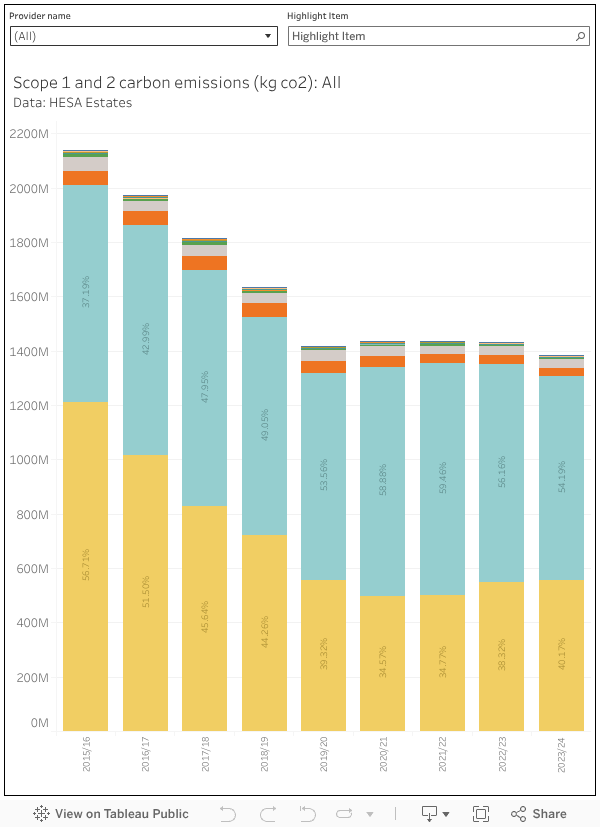
Our UK HE micronation, as well as being a good global citizen, also has an interest in driving down long-term costs. Fossil fuels are only going to get more expensive in the long run, switching to alternatives and moving to greater efficiency makes business sense even if there are initial costs. There has been some progress with scope 1 and 2 emissions (another fall last year), though this is limited compared to what could be achieved last decade: much of the “easy” work has already been done. That said, we’re still talking about 1.4m tonnes of carbon a year, equivalent to a small African country (Eswatini, formerly Swaziland, is a decent comparator) – and this is only scope 1 and 2 (direct) emissions, factoring in the supply chains and travel within scope 3 is another matter.
So, while it is undeniably fun to see UK higher education at the scale of a small country, it still remains firmly rooted in the four home nations. But the exercise prompted me to think – are there other zones within the UK that have been designed to optimise specific benefits for the areas and nations around them?
These days its all industrial strategy zones, but in terms people may recognise we might think about enterprise zones designed to stimulate economic growth by offering incentives to business – there are 48 in England. We have the internationally focused freeports, of course – 12 of them in the UK, and 7 investment zones (to date) that aim to unlock opportunities for business. In each of these examples the actual zones are quite small (almost like campuses, in fact) but the focus is on the impact on a wider local area (where workers may commute from, for example).
Zones like this reflect a global trend towards special economic zones (SEZs) which disapply national rules (around tax, customs, state aid, planning and so on – in some international examples we get as far as labour laws and immigration rules) in the interests of commercial activity. The wilder fringes of policies like this are pretty terrifying, but the UK does appear to be open to paddling in the shallower waters.
Which prompts the question – if universities are like freeports (better than freeports, in fact, as they have a proven track record of providing local benefits) why not offer the relaxation of some national regulations to encourage them to expand and develop in the areas that we want them to? Perhaps it should be easier for UK higher education to recruit international staff – perhaps there should be reductions of employer national contributions with respect to UK staff. Perhaps planning could be easier around established campuses? Perhaps it should be easier to unlock state investment to improve estates without triggering the rules that would drag us into the public sector? Perhaps we could unlock investment and incentives for clean electricity generation and area heating systems?
In the absence of an increase in tuition fees or income from OfS, a special economic zone (or zones) for higher education might be a way forward. The ideas of universities as largely self-administrating state-like entities within a country is an old one (the early days of Oxford featured a parallel judicial system, that ended up provoking riots and the foundation of Cambridge!) and perhaps worth revisiting.
The apprentice-student is changing higher education – from curriculum to culture. It’s time we stopped treating them like traditional undergraduates.
Degree apprenticeships (DAs) are not just reshaping the student experience – they’re redesigning the university itself. As the Office for Students (OfS) emphasises outcomes, progression, and employer engagement, and as Skills England continues to define standards for higher-level technical education, DAs are becoming a proving ground for some of higher education’s most urgent policy challenges.
Yet they are often marginalised in strategic thinking, treated as vocational bolt-ons or niche offerings rather than core to institutional purpose. That’s a mistake. DAs demand that we think differently about curriculum, assessment, and academic infrastructure. Quietly but decisively, they are exposing the limitations of legacy systems, and pointing the way to a more integrated, future-facing university model.
Different learners, different accountability
Degree apprentices are full-time employees and students, legally entitled to spend 20 per cent of their working time on off-the-job learning. This is not simply “study leave” – it encompasses formal teaching, applied projects, reflective practice, and continuous professional development.
This dual status creates a distinctive learner profile, and a distinctive teaching challenge. In designing a level 6 accounting and finance manager degree apprenticeship, we couldn’t simply repackage existing content. We had to co-develop new modules that satisfied two sets of demands: the academic rigour expected by the university and the occupational standards defined by the Institute for Apprenticeships and Technical Education (IfATE). These must also align with professional accounting syllabi from bodies such as CIMA, ACCA and ICAEW.
This triple mapping – to university, regulatory, and professional standards – creates what might be called multi-stakeholder accountability. It requires curriculum teams to work in ways that are more agile, responsive, and externally engaged than many traditional degree programmes.
Rethinking assessment
If OfS regulation is pushing universities toward more transparent, outcomes-focused assessment practices, DAs offer a blueprint for how that can work in practice. Assessment in degree apprenticeships is not an end-of-module activity; it’s a longitudinal, triangulated process involving the learner, the employer, and the academic team. Learners are required to build portfolios of evidence, reflect on their practice, and complete an end-point assessment, which is externally quality-assured.
In our programme, this means apprentices must show how they’ve applied ESG frameworks to real reporting challenges or used digital tools to improve efficiency. These are not hypothetical case studies, they’re deliverables with real organisational impact.
This demands a fundamental shift in how we understand assessment. It moves from a one-directional judgement to a co-produced, real-world demonstration of competence and critical thinking. It also raises practical challenges: how do we ensure equity, consistency, and academic standards in these shared spaces?
Practice must evolve too. Assessment boards and quality teams need confidence in workplace-verified evidence and dialogic tools like professional discussions. Regulations may need adjusting to formally recognise these approaches as valid and rigorous. Co-created assessment models will only work if they’re institutionally supported, not just permitted.
Institutional systems still speak undergraduate
Despite their growth – and repeated nods in policy papers from DfE, OfS, and IfATE (now Skills England) – DAs still struggle to integrate fully into institutional structures designed around traditional undergraduates.
Timetabling, academic calendars, support services, and digital access systems are still largely predicated on a three-year, 18- to 21-year-old, campus-based model. Degree apprentices, who may study in blocks, access learning from workplaces, and require hybrid delivery modes, often fall through the gaps.
This institutional lag risks positioning apprenticeships as peripheral rather than core to university provision, and undermines the very work-based, flexible, lifelong learning that national policy increasingly promotes.
To move beyond legacy assumptions, institutional systems must adapt. Timetabling and delivery planning should treat block teaching as core, not marginal. Learner support must accommodate hybrid work-study lives with flexible pastoral care and digital access. Even workload models and quality assurance processes may need tailoring to reflect co-delivery demands
If we are serious about the Lifelong Learning Entitlement, future modularity, and widening participation, DAs are not just a test case, they are the early evidence base.
Who owns the curriculum?
DAs also reconfigure academic authority. In designing the our degree apprenticeship programme, we co-developed curriculum with employers, professional bodies, and regulators. At its best, this is collaborative innovation. At its most complex, it’s curriculum by committee.
Some employers overestimate their control over content or underestimate their responsibilities around mentoring and assessment. Professional bodies may be supportive in principle, but slow to recognise apprenticeship pathways in formal qualifications. The university becomes a mediator, balancing academic integrity, regulatory compliance, and employer priorities.
This is delicate, sometimes frustrating work. But it also shifts the purpose of curriculum design, from academic transmission to negotiated, contextualised learning and demands that academic teams are supported to work across professional and regulatory boundaries without compromising standards
What universities can learn
DAs are more than a niche. They’re a stress test, revealing how well universities are equipped to deliver flexible, employer-engaged, outcome-driven learning.
They challenge traditional pedagogies, reward authentic assessment, and open up new relationships between knowledge and practice. They also model the kinds of teaching and learning the sector is being increasingly nudged toward by policy: modular, flexible, accountable, and co-created with employers.
This is not an argument for turning every degree into an apprenticeship. But it is a call to stop treating DAs as bolt-ons or exceptions. If we take seriously the structural and pedagogical shifts they demand, we may find in them a pathway to broader institutional transformation.
In a higher education landscape increasingly shaped by regulation, scrutiny, digital disruption and workforce change, the apprentice-student may not just be part of the future – they may be leading it.
With a 22-page document and $221 million fine, Columbia University ended its months-long battle with the Trump administration that included accusations of civil rights violations, an accreditation review and a funding freeze that disrupted research and forced layoffs.
The settlement agreement, announced Wednesday night, will force changes to admissions, disciplinary processes and academic programs. In exchange, Columbia should get about $400 million in federal research funding back. The seemingly unprecedented deal will also see the federal government close investigations into alleged failures to police antisemitism on campus. (Despite the settlement, Columbia has not admitted to any allegations of wrongdoing but has acknowledged reforms were needed.)
Critics have decried the agreement as a concession to authoritarian demands imposed for political control, while supporters have argued reforms are necessary at Columbia after a pro-Palestinian encampment in spring 2024 and subsequent protests disrupted campus life.
Although Trump officials purportedly began their crusade against Columbia in an effort to address campus antisemitism, officials’ comments indicate that conservative politics also factored into the settlement.
“This is a monumental victory for conservatives who wanted to do things on these elite campuses for a long time because we had such far left-leaning professors,” Education Secretary Linda McMahon said in a FOX Business interview following the settlement announcement.
The Trump administration has made clear that this agreement will serve as a roadmap for its dealings with other universities, including Harvard. Much of the agreement reflects what the administration had demanded of Columbia in March, but other provisions—such as a requirement to turn over admissions data and scrutinize international student enrollment—are new and reflect demands sent to other universities.
Here’s what is in the agreement and what it means for Columbia.
Funding Streams Restored
Columbia will see at least a partial restoration of federal research funds.
The federal government will restore grants terminated by the Department of Health and Human Services and National Institutes of Health. However, grants terminated by the Department of Education “and other terminated contracts are excluded from this provision,” according to the agreement.
Columbia will be eligible for future grants, contracts, and awards “without disfavored treatment.”
Columbia acting president Claire Shipman emphasized that the agreement was about much more than $400 million, telling CNN on Thursday that federal scrutiny imperiled $1.3 billion a year.
“There are many headlines about $400 million dollars. This is really access to billions of dollars in future funding. And it’s not just money for Columbia. I mean, this is about science. It’s about curing cancer. Cutting edge, boundary breaking science that actually benefits the country and humanity,” she said, emphasizing the deal “reset” Columbia’s relationship with the government.
Closure of Investigations
The agreement will close pending investigations or compliance reviews related to potential violations of Title VI of the Civil Rights Act of 1964, which prohibits discrimination based on race or national origin. That includes a probe by the U.S. Equal Employment Opportunity Commission into the treatment of Jewish employees at Columbia. Of the $221 million settlement, $21 million will go toward the EEOC complaint.
However, the Trump administration noted in the agreement that the deal does not affect “in any way EEOC’s right to bring, process, investigate, litigate, or otherwise seek relief in any charge filed by individual charging parties or third parties that may later be filed against Columbia.”
Protest Restrictions
Columbia will maintain policies announced in March that deem protests inside of academic buildings and related spaces to be a “direct impediment” to the university’s academic mission.
“Such protests in academic buildings, and other places necessary for the conduct of University activities, are not acceptable under the Rules of University Conduct because of the likelihood of disrupting academic activities,” part of Columbia’s settlement with the federal government reads. All protest activity will be subject to university anti-discrimination and anti-harassment policies.
Prohibitions on masks announced in March will also remain in place.
Education Secretary Linda McMahon has said Columbia’s “unlawful encampments and demonstrations” deprived Jewish students of learning opportunities.
Mary Altaffer-Pool/Getty Images
Student Life Changes
The agreement codifies changes to disciplinary processes announced in March, such as placing the University Judicial Board under the Office of the Provost who reports to the president. Students previously served on the board, but now, it will be restricted to faculty and staff members.
The university president will make the final determinations on appeals cases.
Columbia will also add a student liaison “to further support Jewish life and the wellbeing of Jewish students on campus” who will advise administrations on issues such as antisemitism.
DEI Ban
Diversity, equity and inclusion initiatives, a frequent target of the Trump administration, are also included in the agreement. The deal bars Columbia from maintaining “programs that promote unlawful efforts to achieve race-based outcomes, quotas, diversity targets, or similar efforts.”
Per the agreement, Columbia will be required to provide reports “summarizing its compliance with this obligation” and to ensure that university programs do not “promote unlawful DEI goals.”
Changes to Admissions
The agreement emphasizes merit-based admissions and bars Columbia from giving preference to applicants due to “race, color, or national origin.” It also prevents Columbia from using personal statements, diversity narratives or references to race “to introduce or justify discrimination.”
Columbia will also be required to submit admissions data to the federal government on both rejected and admitted students, including demographic details and standardized test scores.
International applicants at Columbia will also be subject to additional scrutiny with the agreement dictating that the university “undertake a comprehensive review of its international admissions processes and policies.” That review is designed to ensure those applicants are “asked questions designed to elicit their reasons for wishing to study in the United States.”
Columbia is also required to provide details of “all disciplinary actions involving student visa-holders resulting in expulsions or suspensions, and arrest records that Columbia is aware of” to the extent that is permissible under the Family Educational Rights and Privacy Act.
Columbia also agreed to examine its business practices and decrease its financial dependence on international students.
CHUYN/iStock Unreleased/Getty
Program Reviews
Maintaining a senior vice provost to provide greater administrative oversight of Middle East studies (and other regional programs), as initially announced in March, is also part of the agreement.
That official will conduct reviews of programs such as the Institute for Israel and Jewish Studies; Middle Eastern, South Asian, and African Studies; the Middle East Institute; and various other programs, according to the agreement. Those reviews are intended to ensure programs are “comprehensive and balanced” and include “all aspects of leadership and curriculum.”
But some faculty members have expressed skepticism about additional administrative scrutiny.
Michael Thaddeus, president of the Columbia chapter of the American Association of University Professors, wrote in an emailed statement that the agreement poses threats to academic freedom at U.S. universities.
“Columbia’s insistence that it will not allow the government to interfere in appointments, admissions, or curriculum is welcome. Yet the creation of a monitor, charged with scrutinizing our admissions data and our Middle Eastern studies department, opens the door to just such interference,” Thaddeus said.
Resolution Monitor
As part of the deal, a third-party resolution monitor will police the agreement.
Bart Schwartz, co-founder of Guidepost Solutions and former Chief of the Criminal Division of the United States Attorney’s Office for the Southern District of New York, will serve in that role.
The agreement will allow the resolution monitor to access campus for assessment purposes.
Asked if Columbia believed the Trump administration would live up to its side of the agreement and if it had obtained any assurances, a university spokesperson did not provide a statement but instead pointed Inside Higher Ed to language in the agreement on dispute resolution.
That section noted opportunities for arbitration “if either party reasonably believes that the other is in violation of the terms of this agreement,” including reporting obligations outlined in the deal.
Hiring Requirements
The deal also places restrictions on university hiring processes.
Columbia’s agreement will bar the use of “personal statements, diversity narratives, or any applicant reference to racial identity as a means to introduce or justify discriminatory practices in hiring or promotion.” Other unspecified “indirect methods or criteria that serve as a substitute for race conscious hiring or promotion practices” are also prohibited per the deal.
Columbia is required to submit data on hiring and promotion practices to the resolution monitor.
Codifying and Introducing Changes
While some elements of the agreement are new, other parts simply codify prior changes. For example, changes to disciplinary processes, and greater administrative oversight of Middle East studies (and other regional programs) already announced in March are now codified in the deal.
David Pozen, a Columbia law professor who has argued that “the agreement gives legal form to an extortion scheme,” noted while some of the deal was foreshadowed, other parts go beyond what was previously announced.
Some provisions “are novel and don’t track what was already said in March,” Pozen said. “There’s language, for example, about all-female locker rooms and sports teams in paragraph 20. I don’t believe that has any antecedent and just seems like a new anti-trans provision. So, it’s a mix of memorialization, extension and innovation in what Columbia has conceded.”
Just 3% of non-Jewish faculty members hold views about Israel that would fit definitions of antisemitism put forward by Jewish groups, according toa spring survey of over 2,300 faculty members at 146 research universities released by Brandeis University in July.
Less than 10% of faculty reported actively teaching about the Israel-Palestine conflict. Despite widespread media attention to campus protests and targeted attacks on universities by the Trump administration over allegations of antisemitism, more than three-fourths said the Israel-Palestine conflict never came up in class discussions.
Only a minority of faculty were politically active or posted on social media about major current issues, including the Israel-Palestine conflict, racism in America, climate change and President Donald Trump’s impact on American democracy, the survey found.
Dive Insight:
The new study comes at a time of roiling political tensions around college campuses.
On the campaign trail, Trump described colleges as being “dominated by Marxist maniacs and lunatics.” Since taking office in January, his administration has launched investigations and pulled research funding from major institutions — Columbia and Harvard universities, among others — over claims of rampant antisemitism on campus.
The administration has also sought to impose “intellectual diversity” on college faculties, including through an executive order on accreditation and in its dealings with individual universities.
While the Brandeis study found that nearly three-quarters of faculty — 72% — identify as liberal, they also hold “a wide range of views on controversial political issues,” the researchers wrote.
For instance, when looking at the intensity of opinions, over 60% said they “strongly” believed that climate change was a crisis requiring immediate attention and that Trump represented a threat to democracy.
But only 33% expressed strong belief that racism was widespread in America and 14% that Israel is an apartheid state. (Overall, a majority of faculty backed those statements, including only those who somewhat agreed, with a much larger majority agreeing with the racism statement.)
That said, activism around any of those topics was relatively scant. With the Israel-Palestine conflict, 78% of faculty reported no activism at all, including on social media. Around two-thirds reported no activism around racism or climate change.
When it comes to teaching, a majority of faculty said they would present a variety of perspectives on those news topics, with the exception of climate change. Only 45% of faculty said they would present a variety of perspectives on climate change while another 40% said they would do so but with some perspectives “more justified than others.”
When it came to the Middle East conflict, even among the 14% of faculty who said they strongly believed Israel to be an apartheid state, a majority (56%) said they would present a variety of perspectives when teaching about the issue.
The researchers posed questions intended to study when faculty views of Israel veered into antisemitism as defined by Jewish groups, including the International Holocaust Remembrance Alliance, and that Jewish students frequently agree are antisemitic. They also used the definition by the Jerusalem Declaration on Antisemitism, which has accused the IHRA’s version of blurring the line between antisemitism and criticism of Israel.
The researchers asked whether survey respondents agreed with statements such as “Israel does not have the right to exist,” “all Israeli civilians should be considered legitimate targets for Hamas,” and “I wouldn’t want to collaborate with a scholar who supports the existence of Israel as a Jewish state.”
Large majorities strongly disagreed with those statements, and fewer than 10% agreed with them with any intensity. Those who did were more likely to identify as liberal.
Likewise, a small minority of non-Jewish faculty — 7% — expressed views considered antisemitic about Jewish people as a group rather than Israel. Those faculty were more likely to be politically conservative, according to the study.
Amid the Trump administration’s attacks on colleges, close to half (46%) of faculty and a majority of those identifying as liberals expressed serious concerns about being targeted by the federal government for their political views, the study found.