Blog

  • Bridging the Gap: How Smart Technology Can Align University Programmes with Real-World Skills

    Bridging the Gap: How Smart Technology Can Align University Programmes with Real-World Skills

    • By Pete Moss, Business Development Director at Ellucian.

    Pouvez-vous s’il vous plaît me dire où se trouve la gare?’ – this is the extent that a colleague of mine can remember from his Introductory French module that he completed as part of a computing degree in the late 90s.  That institution’s attempt at the time to embed flexibility and cross-curriculum choice to help students develop skills out of their discipline to help with employability.  ‘It was easier to pass than the programming courses’  was the authentic feedback that my colleague gave in retrospect, but they did at least have the choice to expand their learning experience and gain some broader foundational skills.  That institution, however, has long abandoned much of that flexibility, largely due to the apparent complexity of administration.

    That is not to say that there are not fantastic examples of employability related skills initiatives across the sector, but the recent policy landscape (not least the Skills England Sector evidence on the growth and skills offer) and ever-present national growth agenda are now firmly putting the spotlight on the role of HE in this area.  The if element of HE holding that key role in the skills agenda is widely held, but now the thorny problem of how must be addressed.  Technology advancements, specifically AI, will play a contributory factor in how institutions can remove barriers that caused institutions to reduce flexibility in the past, but what of the wider considerations?

    To explore this topic further I asked Ben Rodgers, an experienced academic registrar and AHEP consultant, for his views on the topic:

    In today’s fast-moving global economy, the value of a university education is increasingly measured not just by academic achievement, but by the employability of graduates. Employers are no longer looking solely for degrees, they’re looking for skills: digital fluency, critical thinking, communication, and technical know-how that align with the needs of their industries. Meanwhile, universities are under pressure to demonstrate that their programmes deliver real-world value. The challenge is clear: how do we bridge the gap between what is taught and what is needed?

    This is where technology can make a transformative difference. At the forefront of this change is a new wave of AI-powered innovation designed to bridge the gap between academic programmes and real-world skill demands. These emerging technologies can analyse curricula, extracting the skills embedded within them and mapping those against labour market data to identify areas of alignment and gaps.

    Crucially, they work in both directions; institutions can see what skills a course develops, while students or employers can start with a desired competency like coding or digital marketing and trace back to the programmes that build those capabilities.

    It is the kind of innovation that higher education has long needed. For too long, the link between the classroom and the workplace has been inconsistent or poorly articulated. Universities may know they are delivering valuable learning, but haven’t always had the means to evidence that value in terms that resonate with employers and prospective students. These technologies bring much-needed clarity, offering structured and data-informed ways to demonstrate how academic learning contributes directly to employment readiness.

    A Game-Changer for the Lifelong Learning Entitlement (LLE)

    This kind of technology becomes even more important as the UK rolls out the Lifelong Learning Entitlement (LLE). The LLE is set to reshape the educational landscape by allowing individuals to access student finance for short courses, modular learning and skills-based development over the course of their lives. This shift away from traditional three-year degrees opens new possibilities, but also new challenges.

    How will learners know which modules to pick? How will they know what skills they need for the job they want or even the job they haven’t yet imagined? With the support of emerging AI-driven tools, learners can begin to reverse-engineer their career goals. Want to become a Data Scientist? These systems can help identify which combinations of modules across a university lead to that destination. Interested in project management? The technology can pinpoint where those skills are taught, and which courses offer them. It’s like having a careers advisor, curriculum guide, and labour market analyst all in one—offering personalised insights that connect educational choices with professional ambitions.

    This sort of capability is vital if LLE is to be more than just a funding mechanism. It needs to be supported by intelligent infrastructure that empowers learners to make informed choices. Otherwise, there’s a risk that modular study becomes a confusing patchwork of disconnected learning.

    Towards a Shared, Inter-University Skills Ecosystem

    Now imagine if we took this even further. What if a skills platform were adopted not just by individual institutions but as a shared framework across regions or even nationally? In this model, students in Glasgow, Cardiff, Birmingham, or Belfast could see the skills they need for local job markets and be directed to the institutions offering them. This would create a more agile, responsive, and learner-centred education system. Universities wouldn’t just be competing with each other; they’d be collaborating to build a broader skills ecosystem.

    The scale of opportunity here is significant and growing fast. Consider this: if every individual in the workforce has access to around £1,800 in personal development funding each year, the cumulative potential across a university’s learner base is vast. Multiply that by hundreds or thousands of learners, and you’re looking at a transformative funding stream that’s currently underutilised.

    This is not just an opportunity for students, it’s a strategic imperative for institutions. By enabling individuals to build relevant, targeted skills, universities position themselves as essential engines of workforce development, driving economic resilience at local, regional, and national levels. It’s a win-win: empowered learners, future-ready graduates, and sustainable new revenue for the sector.

    Of course, this requires a shift in thinking from institutional autonomy to inter-institutional alignment. But the benefits are compelling: more efficient use of public funding, stronger regional economies, and better outcomes for students.

    Making Programme Design More Purposeful

    Beyond helping students choose what to study, this technology also has the power to influence what universities choose to offer. If data consistently shows that a particular programme has little connection to current or emerging job markets, it is worth investigating. It does not mean the course should be cut. There may be academic or social reasons to preserve it, but it does mean the institution is equipped with the intelligence needed to make informed decisions.

    It also invites a more purposeful approach to curriculum design. Are we including this module because it is pedagogically valuable, or because it’s always been there? Are we assessing this way because it builds a skill, or because it is the easiest to administer? When you can map outcomes to employment skills, these questions become easier to answer.

    Moreover, it provides a compelling framework for conversations with students, parents, and policy-makers about the value of university education. It shows that we are listening to what the world needs and responding with academic rigour and strategic intent.

    Global Potential, Local Application

    The skills gap is not just a UK issue; it’s a global one. The World Economic Forum reports that nearly half of all workers (66 per cent) will need reskilling by 2030. Universities worldwide are grappling with how to stay relevant in an era of automation, AI and constant disruption. Emerging AI tools offer the potential for a globally shared skills taxonomy that could, with appropriate localisation, apply anywhere.

    Conclusion

    As universities continue to evolve, their role as engines of economic and social mobility becomes more important than ever. To fulfil that role, we must ensure that what we teach aligns with what the world needs. That does not mean turning every degree into job training, but it does mean being thoughtful, strategic, and transparent about the skills our programmes provide.

    Emerging technologies offer an exciting glimpse into a more connected, skills-aware future. They empower students to take greater control of their learning, help universities refine and align their programmes and ensure that the promise of Higher Education translates into meaningful, real-world opportunities.

    After all, education is a journey. It’s time the map caught up.

    Source link

  • Look to Your Culture (American Indian College Fund)

    Look to Your Culture (American Indian College Fund)

    Cheryl Crazy Bull, President and CEO of the American Indian College Fund, was the 2025 keynote speaker for Oglala Lakota College’s graduation ceremony. She acknowledges the difficulties Native communities are facing with the new administration’s budgets. Native experiences in the sixties and seventies led to a renaissance in Native communities and education and she cites the lessons they provide, based on Lakota culture, for surviving and thriving.

    Source link

  • Universities should face the consequences for misleading students over the cost of living

    Universities should face the consequences for misleading students over the cost of living

    Why do students run out of money? And is it their mistake?

    It’s partly because student maintenance support has not kept pace with the cost of living.

    Last year, the Centre for Research in Social Policy (CRSP) at Loughborough University calculated that students need £18,632 a year outside London (and £21,774 a year in London) to have a minimum acceptable standard of living.

    But if you’re living away from home in England, the maximum maintenance loan is £10,227 – and it’s less than that once your parents earn over £25,000.

    And if you’re an international student, the Home Office’s “proof of funds” figure – the money you need to show you have in the bank to cover your living costs – has been (un)helpfully aligned to that inadequate figure.

    In that scenario, you’d need help with budgeting – especially if you’ve never lived away from home before, if you’ve not participated in higher education before, or if you’ve never lived in the UK before.

    You’d want to know, for example, how much a TV license costs. The good news is that your chosen university has a guide to student living costs, and it lists the license as costing £159 per year.

    The problem? £159 was the 2021 rate – a TV licence now costs £174.50. Still, one little mistake like that isn’t going to break the bank, surely?

    Delay repay

    Over the past few years I’ve whiled away some of my train delays surfing around university websites looking at what the sector says about student cost of living.

    I’ve found marketing boasts dressed up as money advice, sample student budgets that feature decades old estimates, and reassuringly precise figures that turn out to be thumbs in the air from the ambassadors in the office.

    Often, I find webpages that say things like this:

    The problem is that the “fact” turns out to be from 2023, the source on the “lowest rents” claim turns out to be “not yet reliable”, and the “one of the cheapest pints in the country” claim has its source this story in the Independent. From 2019.

    That’s also a webpage that says you can get a bus to the seaside and back for £4.30 (it’s currently £12), a ferry to Bruges for £50 (the route was withdrawn in 2020), and a train to London for “for just over a tenner” – when even with a railcard, the lowest fare you’ll find is £22.66.

    Campus gym prices are listed as less than £20 a month (it’s actually from £22.95 for students), rent for a one-bed city flat is listed as £572 (the source actually says £623.57), and you’re even told that you can head to a “legendary” local nightclub to “down a double” for £1.90.

    Sadly, even Spiders Nightclub is having to cover “the increasing cost of basic overheads” and “the ongoing inflationary cost of purchasing stock”. The current price is £2.50.

    Those were the days

    Sometimes, I find tables like this – where the costs listed appear to be exactly the same as when the webpage was updated in 2022.

    HERTS 1

    Actually, that’s not quite true. Someone has bothered to update the lower rent estimate up to £500 a month since then – leaving all of the other figures unchanged.

    Archive.org allows me to see all sorts of moments when someone, somewhere, has performed an update. Of sorts.

    Here’s one where food and rent have gone up, but everything else is as it was in 2022. The main difference is that the “Yearly costs for students” lines in the table have been deleted – presumably because they would stretch credibility.

    Not every university has a run at listing costs. Many (over 30 at the time of typing) refer their readers to the Which? Student Budget Calculator.

    The Which? Student budget calculator was deleted in 2022 – and even when it was live, its underpinning figures were last updated in 2019.

    Sometimes the google search takes you to undated slide decks and PDFs. This metadata suggests that this one is from 2023 – although the figures in it look suspiciously similar to the numbers in the UG prospectus in 2015.

    To be fair, that’s a university that has at least got an updated chart showing sample costs in its international arrival guide – with a reassuring note that average costs are correct as of March. You’d perhaps be less reassured to find that those average costs – other than the cost of (university) accommodation – have remained exactly as they were since last year.

    Sometimes, a picture is painted of painstaking research carried out by dedicated money advisors. Here’s a table that says the minimum costs have been estimated by the university’s support teams:

    How lucky students in that city are, given that the only things that have increased over the past year are accommodation and rent:

    Actually, tell a lie. Many of the costs seem to be identical to those in 2020:

    Save us from your information

    Lost of the sample budgets and costs are unsourced – but not all of them. A large number quote figures from Save the Student’s student money survey – which last year used responses from 1,010 university students in the UK to calculate the results.

    Even if that was a dataset that could be relied upon at provider or city level, that was a survey that found 67 per cent of students skipping meals to save money, 1 in 10 using food banks and 60 per cent with money related mental health problems. Not a great basis on which to budget, that.

    Others quote their costs from the NatWest Student Living Index – which for reasons I’ve explained in 2024, 2023 and 2022, isn’t an approach that I think comes close to being morally sound.

    Plenty of universities don’t list costs at all, but imply to international students that the “proof of funds” figure has been calculated by Home Office officials as enough to live on:

    It has, of course, just been copied across from DfE’s maximum maintenance loan – a figure widely believed to be wholly inadequate as an estimate of living costs for students.

    Sometimes you find things like this, a set of costs “based on feedback from our current international undergraduate and master’s students”. Someone has gone in and updated the costs for university halls – but hasn’t updated anything else, and nor have they updated the estimate for total monthly living expenses:

    Sometimes you find things like this – costs that haven’t changed in two years contained in an official looking document called “Student Regulations and Policies: Standard Additional Costs”:

    And sometimes you find miracles. Here’s a university where most of the costs haven’t increased in 18 months, and the cost of clothing has fallen dramatically – despite ONS calculating that clothing inflation is currently 5.9 per cent.

    Then there’s charts like this that are “subject to change” – although no change since last summer:

    Or unsourced tables like this, where somehow student costs have started to fall. I want to move there!

    2024. Here’s 2025:

    The long arm

    The good news for prospective students – and the bad news for universities – is that this is all now going to have to change.

    Looking at all of this through the lens of the new Digital Markets, Competition and Consumers (DMCC) Act, it’s hard to avoid the conclusion that universities have been sailing remarkably close to the wind – and that the wind direction has now changed dramatically.

    Under DMCC, the systematic provision of outdated cost-of-living information would likely constitute a serious breach of consumer protection law. The Act makes it automatically unfair to omit material information from invitations to purchase – and there’s little doubt that accurate living costs are material information for prospective students making decisions about whether and where to study.

    Crucially, there’s no longer any need to prove that students were actually misled by the information, or that it influenced their decision-making. The omission itself is the problem.

    The legal framework has fundamentally shifted in universities’ disfavour. The scope of what counts as material information has expanded beyond those categories defined by EU obligations, while misleading actions are no longer restricted to predefined “features” of a product or service.

    Instead, any information relevant to a student’s decision can now trigger a breach – meaning universities can no longer rely on narrow, checklist-based approaches to compliance. Outdated transport costs, inflated claims about local entertainment prices, or misleading accommodation estimates all fall squarely within this expanded scope, even though they might previously have been considered peripheral to the core “product” of education.

    The Act has also lowered the threshold for proving breaches of professional diligence. Previously, universities might have argued that minor cost discrepancies didn’t cause “material distortion” of student decision-making. Now, practices need only be “likely to cause” a different decision – shifting the focus from proving impact to ensuring accurate practice from the outset.

    The Act explicitly recognises that certain groups of consumers are particularly vulnerable, and that practices which might not affect others can cause disproportionate harm to those groups.

    International students – who rely heavily on university cost estimates for visa applications and have limited ability to verify information independently – are a textbook example of vulnerable consumers. So too are first-generation university students, those from lower-income families, and young people making major financial commitments for the first time. The Act requires universities to proactively identify and mitigate risks to these vulnerable groups as part of their duty of care.

    The Competition and Markets Authority now has significant new enforcement powers, including the ability to impose civil penalties of up to 10 per cent of an organisation’s turnover and to hold corporate officers personally liable where they have consented to or negligently allowed breaches to occur.

    Given the sector-wide nature of these problems, and the ease with which accurate cost information could be obtained and maintained, it would be difficult for universities to argue that continued reliance on years-old estimates meets the standard of professional diligence now required by law.

    The sector has had years to get this right voluntarily. With enhanced legal obligations, fundamentally expanded definitions of what constitutes actionable information, lowered thresholds for proving breaches, and much sharper enforcement teeth now imminent, universities that continue to present outdated or inaccurate living costs as current information may find that their casual approach to accuracy has become a rather expensive mistake. Their mistake.

    Source link

  • Temple University to lay off 50 employees

    Temple University to lay off 50 employees

    This audio is auto-generated. Please let us know if you have feedback.

    Dive Brief:

    • Temple University in Philadelphia plans to lay off about 50 staff members as it looks to cut a budget deficit previously forecasted at $60 million down to $27 million, according to a community message Friday from university President John Fry. 
    • The layoffs — amounting to nearly 1% of Temple’s workforce are part of a larger reduction of 190 positions across the university, the majority of which were eliminated via attrition, retirement or cutting vacant roles. None of the layoffs impact faculty members, a spokesperson said Monday.
    • Temple is also “closely monitoring” the potential impacts of changes to the federal student loan and Pell Grant programs set to start in the 2026-27 academic year following the implementation of Republicans’ massive new spending bill, Fry said.

    Dive Insight:

    Temple leaders signaled in June that job cuts were likely as officials tried to reduce the university’s structural budget. At the time, Fry pointed to a long-term dip in enrollment, specifically a decline of 10,000 students since 2017, with much of the loss coming during the pandemic. As of fall 2023, Temple had just over 30,200 students.

    However, the public university just logged its highest-ever number of first-year student deposits — 6,313 — indicating a second year of growth in Temple’s first-year class on top of a projected overall enrollment increase of roughly 200 students, according to Fry’s announcement. That would mark the first time the university’s student body has grown since 2017.  

    But for Temple, the historic enrollment decline has meant a drop of $200 million in tuition revenue, putting pressure on the university to reduce its expenses — the large majority of which are tied to employee compensation and benefits. And so to cut the university’s deficit, leaders have looked to its workforce.

    Of the coming layoffs, Fry said “considerable efforts were made to ensure that the reduction to our current workforce was as minimal as possible.”

    “It is my promise that care will be taken to ensure that any employee’s separation from the university will be handled as equitably and compassionately as possible,” he added.

    In his message, Fry described “significant financial challenges” facing Temple, stemming from both its structural deficit as well as “uncertainty at the federal level.”

    Fry highlighted the changes set for the federal student aid program without elaborating on their potential impact on Temple. Those changes include new limits on Pell Grant eligibility, caps on student and parent borrowing, and an elimination of Grad PLUS loans, which allow graduate students to take out loans up to their cost of attendance. 

    He also announced the roster of a 13-member university advisory group made up of faculty, students and staff to, as he put it, “help us navigate this complex and evolving environment.”

    Wide swaths of the higher education world are making workforce and spending cuts as the Trump administration takes a hatchet to the federal research funding system. Colleges are also bracing for further financial impacts from other federal policy changes in Republicans’ spending and tax bill, including an increased endowment tax and Medicaid cuts that will land hard on many university hospital systems.

    Source link

  • 20 states sue over immigration restrictions for Head Start, other programs

    20 states sue over immigration restrictions for Head Start, other programs

    Dive Brief:

    • Twenty states and the District of Columbia sued the Trump administration Monday afternoon, challenging the administration’s decision earlier this month to restrict publicly funded programs — including those related to education — based on immigration status.
    • The lawsuit, led by New York, argues that the restrictions to previously inclusive programs like Head Start will hurt low-income families and lead to the “collapse of some of the nation’s most vital public programs.”
    • Seeking to block the changes in the short and long term, the states allege the U.S. Department of Education and three other federal agencies did not follow the required rulemaking process in issuing new immigration verification requirements.

    Dive Insight:

    In July 10 announcements, the Education Department said it will require immigration status verification for adult education services like dual enrollment and career training programs, while the U.S. Department of Health and Human Services mandated such verification for participation in Head Start programs.

    HHS said at the time that Head Start would be “reserved for American citizens from now on.″ An HHS spokesperson clarified to K-12 Dive on July 10 that children of green card holders will remain eligible for the program and said Head Start agencies will determine eligibility based on the immigration status of the child. Head Start has heretofore been open to any child eligible based on their age or their family’s low-income status, regardless of immigration status.

    However, the lawsuit filed Monday alleges that the policy changes will impact not only undocumented immigrants, but also people holding legal status, such as temporary workers, exchange visitors and those with student visas. The suit was filed in federal district court in the U.S. District Court for the District of Rhode Island.

    The state attorneys general filing the lawsuit also warned that even U.S. citizens and lawful residents could be denied services, since many low-income individuals lack government-issued identification.

    “For decades, states like New York have built health, education, and family support systems that serve anyone in need,” said New York Attorney General Letitia James in a press statement on Monday. “Now, the federal government is pulling that foundation out from under us overnight, jeopardizing cancer screenings, early childhood education, primary care, and so much more.”

    James and the coalition filing the lawsuit said the policies are already “causing significant disruption” as state programs are expected to comply immediately without the infrastructure they say is necessary to do so.

    “Some longstanding providers, including those serving children, pregnant patients, refugees, and other vulnerable populations, will not be able to comply under any timeline and are already facing the risk of closure,” James’ statement said.

    These changes have alarmed civil rights advocates — who say the changes will harm the very low-income children Head Start is intended to serve. The National Head Start Association, which represents Head Start workers, meanwhile, has said the Head Start Act has never required them to check the citizenship or immigration status of children prior to their enrollment in the 60 years of the program’s existence.

    Upon release of the policy change on July 10, the American Civil Liberties Union immediately threatened to expand an existing lawsuit over the Trump administration’s actions vis-a-vis Head Start to include “this new attack on Head Start.” In April, the ACLU filed a lawsuit challenging the administration’s moves to gut Head Start by shuttering half of the regional Office of Head Start offices and laying off much of the federal offices’ staff.

    Plaintiffs in that lawsuit, filed in U.S. District Court in Washington state, include parent groups and the Head Start associations of Washington, Illinois, Pennsylvania and Wisconsin.

    “Implementation of this directive will create fear and confusion for immigrant families about enrolling their children in Head Start regardless of what their legal status may be. This will harm children and destabilize Head Start programs,” said Lori Rifkin, litigation director at the Impact Fund, in a statement on July 10. The Impact Fund, a public interest law group, is representing plaintiffs in the Head Start lawsuit alongside ACLU.

    “If the administration moves forward with publication of this notice, we will take legal action,” RIfkin said at the time.

    The Department of Education has not specified an implementation date for the new restrictions, but has said it “generally” wouldn’t be enforcing them before Aug. 9. HHS said its changes were effective immediately in its July 10 announcement.

    Source link

  • El Paso Community College Helps Design State Program for Adults Without High School Diplomas – The 74

    El Paso Community College Helps Design State Program for Adults Without High School Diplomas – The 74


    Get stories like this delivered straight to your inbox. Sign up for The 74 Newsletter

    Kurt Micklo lost interest in academics after he failed to make the basketball team as a sophomore at Chapin High School. Soon after, he fathered a son and began to work full time, which put him further behind in his studies.

    A counselor finally advised him during his junior year that he should withdraw and try to earn a GED. He dropped out and – through hard work – found professional success as a general manager of a subcontracting logistics company. However, the lack of a high school diploma haunted him. He wants one to give his family – especially his mother – another reason to be proud of him.

    A busy work and family schedule have kept him from returning to school, but the flexibility of a new state program aimed at people aged 18 and older without a high school diploma will allow him to earn a diploma and a college career and technical education, or CTE, credential for programs such as health care, welding or computer science at the same time.

    The concept of Opportunity High School Diploma was part of House Bill 8, which the state Legislature passed in 2023. The state funneled about $2 million into this program to help the approximately 4.3 million Texans as of 2023, including about 30,000 adult El Pasoans, without a diploma to earn the academic credits most of them will need to acquire higher-paying jobs. The program is scheduled to launch in spring 2026.

    “If I could juggle it, I’d be pretty interested” in the program, said 34-year-old Micklo, a father of three ages 15, 10 and 5. He is the general manager of three warehouses, two in El Paso and one in Laredo, Texas, as well as four sites near the international ports of entry with Mexico in El Paso, Tornillo and Santa Teresa, New Mexico, were commodities are offloaded.. “It would make my stepfather (a retired educator) and my mother happy if I earned my high school diploma.”

    El Paso Community College is one of five community college districts in the state selected for the design and implementation phases of this program. The other institutions in the design phase are Alamo Colleges District, Austin Community College, Dallas College and San Jacinto College near Houston.

    They work under the direction of the Texas Higher Education Coordinating Board. The board will review the instructional outcomes and performance expectations that the college collaborators created during an October meeting. Once finalized, the college faculty will begin to work with school districts to design the curriculum.

    The program is flexible for students who probably work full time and have family obligations. Courses would have suggested timelines, but students would turn in assignments as their schedule allowed through the end of the term.

    Micklo, a Northeast resident, said the promised flexibility is the only reason he might consider the program. As for his credential, he said he would need to review EPCC’s career and technical education options. The college offers more than 100 career programs such as HVAC, or heating, ventilation and air conditioning, and electrical, automotive or diesel technologies.

    Students will be co-enrolled in competency-based high school curriculum such as math, civics, sciences and communication, and a career and technical workforce program. Competency based courses are focused more on a students’ mastery of a skill or subject than the amount of time spent in a classroom.

    Isela Castañón Williams

    Isela Castañón Williams, professor and coordinator of EPCC’s teacher preparation programs, is in charge of the college’s 13-member team. She called the project a “monumental task” because of its scope and uniqueness. She said her team, and its counterparts, played a critical role in the design phase.

    “Faculty at EPCC are very innovative,” she said. “I think that my colleagues have approached this process with a great deal of enthusiasm. We’re always looking to provide better services and educational experiences to the community we serve.”

    EPCC faculty advocated for the program to be designed to accommodate English Second Language and English Language Learner populations, a THECB spokesman said in a July 1 statement. He said last year that the board selected EPCC for the project’s design phase because of its border insights, and because its CTE degrees and credentials are in line with the program.

    While the state wants to attract students aged 18 and older, EPCC officials will aim for people 25 and older so as to not compete with K-12 school districts that have their own dropout recovery programs. EPCC, which will offer the program at its five campuses, expects some of the program’s younger students to come from rural areas outside El Paso.

    Steven E. Smith

    Steven E. Smith, vice president of Instruction and Workforce Education at EPCC, said the state will provide funds to the colleges to cover tuition for initial cohorts. He expects the first groups will range from 30 to 50 students and scale up from there.

    “We think this is a big market in El Paso, and I think once the word starts to get out, that will grow tremendously,” Smith said.

    The administrator said that he would work on ways to market the program later this month with the college’s External Relations, Communication & Development Division. He said the college would work with school district partners to build lists of potential OHSD students.

    “As you might imagine, that is a pretty difficult population to identify and reach out to because they are not in the system anymore,” Smith said.

    This article first appeared on El Paso Matters and is republished here under a Creative Commons Attribution-NoDerivatives 4.0 International License.


    Get stories like these delivered straight to your inbox. Sign up for The 74 Newsletter

    Source link

  • Career Growth Series Cancellation Form

    Career Growth Series Cancellation Form

    Career Growth Series

    2025 Career Growth Series Cancellations

    Use this form to cancel your registration for one of more of the Career Growth Series virtual workshops.

    The post Career Growth Series Cancellation Form appeared first on CUPA-HR.

    Source link

  • The Unignorable Data on AI in Higher Ed Marketing and Enrollment Management

    The Unignorable Data on AI in Higher Ed Marketing and Enrollment Management

    Just a few years ago, AI in higher education was largely a topic for innovation labs and speculative white papers. Today, it has moved from the periphery to the absolute core of institutional viability, particularly in the critical areas of marketing and enrollment management. Leaders who still view AI as a future investment, rather than an immediate operational imperative, risk being outmaneuvered by a competitive landscape that is already embracing this transformative power.

    The global AI software market is projected to hit an astounding $126 billion by the end of 2025. From healthcare to transportation AI is now an integral part of daily operations, with a significant 78% of organizations reporting AI usage in 2024—a sharp increase from 55% in 2023. Generative AI specifically saw its usage in at least one business function jump from 33% in 2023 to a staggering 71% in 2024.

    The critical question is no longer if AI should be used, but how quickly institutions can integrate it to avoid not just falling behind but becoming irrelevant in a rapidly evolving landscape. The recent Marketing and Enrollment Management AI Readiness Report 2025, produced by UPCEA, the Online and Professional Education Association, and EducationDynamics, the only higher education agency building revenue and reputation that drives results, provides an in-depth look at institutional perceptions and AI readiness.

    Here’s the uncomfortable truth: while your most proactive staff are already leveraging AI to drive results, many institutions are held back by analysis paralysis and strategic inaction. This is a direct threat to talent retention and competitive advantage.

    While the general sentiment toward AI is increasingly positive, the report highlights that individual university staff are often far more receptive to using emerging technologies than their institutions. This leads to a significant gap between receptivity to AI in marketing and enrollment management and organization-changing operationalization of AI at an institutional level.

    In 2025, 65% of survey respondents reported actively using emerging technologies like AI in their marketing and enrollment efforts, a substantial increase from 40% in 2024. However, this leaves over one-third of higher education marketing and enrollment management professionals on the outside of the AI revolution, falling further behind by the day. More troubling, only 61% indicated their institution is open to using these technologies. While the evidence suggests a growing openness to adopting critical technology, only 56 percent of institutions have a plan for upskilling staff in AI-driven tools.

    Many respondents recognize a gap in their institutional AI readiness. A striking 56% of respondents don’t consider their institution a leader in implementing AI for marketing and enrollment management functions. When compared to peer institutions, 38% felt they were on pace, but 36% believed they were behind, with only 21% considering themselves ahead. This sentiment underscores a growing urgency to adopt AI, coupled with a pervasive feeling of being “behind the curve.”

    AI is a core component embedded directly in the recruitment, engagement and conversion platforms institutions already rely on. This widespread integration is transforming daily operations, as the 2025 survey highlights:

    • Nearly two-thirds (65%) of institutions utilize AI-enhanced creative and design tools.
    • Over half (51%) use social media management tools with embedded AI.
    • Customer relationship management (CRM) systems and data analytics platforms with AI features are used by 31% of institutions respectively.

    The perceived effectiveness of these AI-powered tools is on the rise. Content generation, the most widely used AI application, was rated most effective, with 47% deeming it “very effective” or “effective.” Other applications like content optimization (41% effective) and customized ad and message delivery (39% effective) also showed strong results.

    Moving beyond perceived effectiveness, AI integration is yielding direct, quantifiable improvements across marketing and enrollment operations:

    • 69% of respondents reported improved efficiency in their workflows due to AI.
    • More than half (52%) observed an increase in the quality of their work.
    • Nearly half (48%) believe AI tool integration has positively impacted their enrollment funnel.

    The study identified key areas where AI is delivering the strongest return on investment (ROI) including customized ad messaging, lead generation and creative content development. Content optimization also stood out, with 36% of respondents noting a “very high” or “high” ROI. If nearly 70% see efficiency gains and almost half see a positive impact on enrollment, why aren’t more institutions fully embracing this?

    Student engagement is AI-dependent. For Modern Learners artificial intelligence is a fundamental tool in their college search, essential for information discovery. This profound shift in how the next generation interacts with information demands institutions meet this baseline expectation. Otherwise, they risk being perceived as outdated, irrelevant or having their reputation pre-determined by AI itself.

    Modern Learners are using AI to seek information on:

    • Tuition fees (57%)
    • Course offerings (51%)
    • Admission requirements (43%)
    • Campus facilities (37%)
    • Student reviews (35%)

    This highlights the imperative for institutions to ensure their AI-accessible content, whether via chatbots or search optimization, directly aligns with what students are actively seeking.

    Looking ahead, institutional leaders envision even greater potential for AI-driven tools. Within the next two years, innovations such as:

    …are expected to have a significant transformative impact on higher education marketing and enrollment management. These tools promise to address persistent challenges like the need for personalized outreach, improved insights into student behaviors and increased efficiency with limited resources.

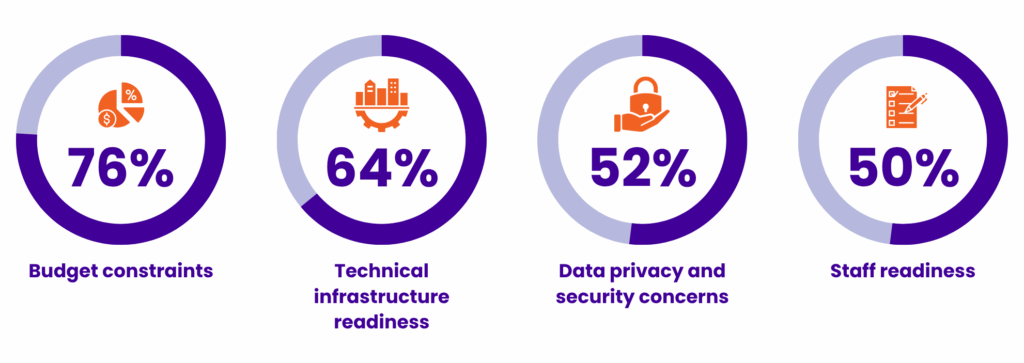
    Despite the growing enthusiasm and proven benefits, institutions continue to face significant barriers to full AI integration. The top challenges cited by respondents include:

    • Budget constraints (76%)
    • Technical infrastructure readiness (64%)
    • Data privacy and security concerns (52%)
    • Staff readiness (50%)

    Notably, these barriers have become even more pronounced since 2024, underscoring the urgent need for strategic investment and institutional alignment. Alarmingly, 44% of respondents reported their institution lacks a plan to upskill or support staff in adopting AI-driven technologies. This is a leadership failure, not a staff deficiency. Your most valuable asset, your people, are signaling a readiness for growth, yet nearly half of institutions are failing to provide the essential support.

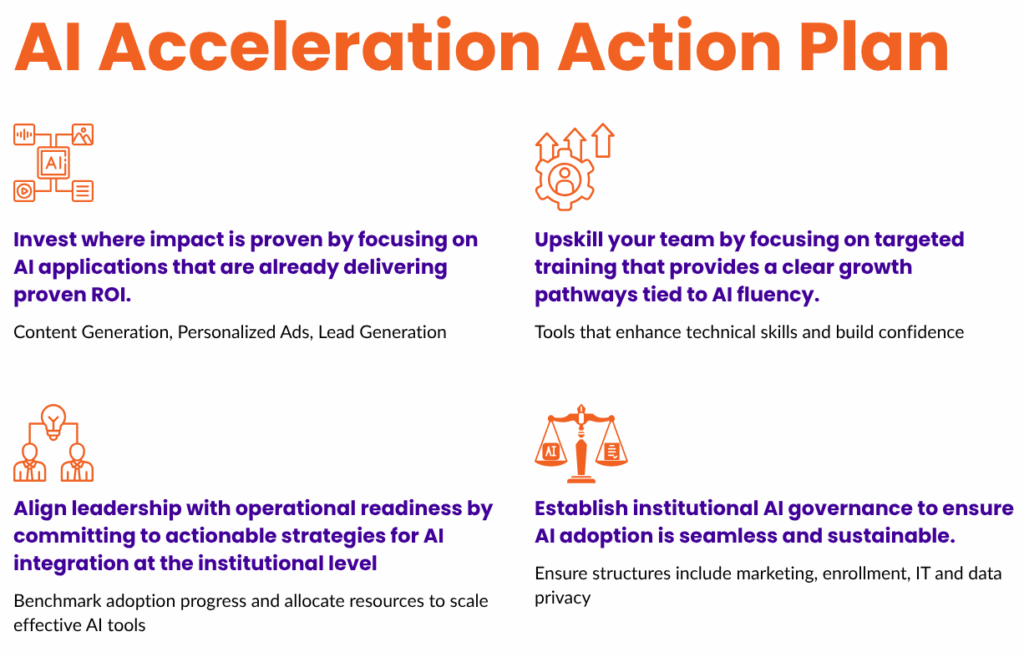
    The findings from the UPCEA and EducationDynamics study present clear implications for higher education leaders. The time for passive observation is over. Decisive action is required.

    • Invest Where Impact Is Proven
      Focus resources on AI applications already delivering proven ROI, starting with content creation, personalized ads and lead generation. Maximize every dollar in a constrained environment and accelerate returns and free up capacity for further innovation by allocating strategically.
    • Upskill Teams
      Invest in targeted training for both technical skills and change management is crucial to empower staff to effectively use AI tools and build confidence. Providing clear growth pathways tied to AI fluency can significantly improve staff engagement and retention, especially given that 34% of staff now report that their institution’s stance on AI impacts their likelihood of staying at that institution—a dramatic jump from just 1% in 2024. Furthermore, 90% of respondents view AI as a useful tool for their own professional growth. Failing to invest in AI fluency for your teams is effectively disarming them in a rapidly escalating competitive battle.
    • Align Leadership with Operational Readiness
      The nearly doubling of “lack of alignment with strategic priorities” as a major barrier (from 18% in 2024 to 33% in 2025) is an indictment of existing leadership structures. Institutional leaders must move beyond passive support and commit to actionable strategies for AI integration at an institutional level. This involves benchmarking adoption progress, embedding AI into strategic plans and allocating necessary resources to scale effective tools.
    • Establish Institutional AI Governance
      Without robust governance, AI adoption will be chaotic, risky and unsustainable. Creating governance structures that include marketing, enrollment, IT and data privacy leaders is essential. These groups should collaborate to develop responsible AI use policies, establish ethical guidelines and transparently communicate data privacy practices to prospective students. Only 49% of institutions currently have measures in place for ensuring student data security and privacy when using AI tools, though this is an improvement from 30% in 2024. Protect your institution’s reputation, ensuring ethical practice and safeguarding student data in an increasingly scrutinized environment.

    The 2025 study is a revelation of present realities. AI is the operational backbone of competitive higher education marketing and enrollment management. Institutions that have adopted AI are reporting measurable gains in effectiveness efficiency and ROI. The report unequivocally reinforces that delaying implementation means facing the significant risk of falling permanently behind, not only compared to AI-embracing peers but also in meeting the evolving expectations of students and staff.

    For higher education, the challenge now lies in converting receptivity into decisive action, and scattered AI adoption into a cohesive institutional strategy. EducationDynamics provides the expertise, data-driven strategies and solutions to help institutions navigate the complexities of AI integration, meet the expectations of Modern Learners and secure a competitive edge in marketing and enrollment management. The future of higher education is AI-expected, and with EducationDynamics, your institution can lead the charge.

    Source link

  • Sharing is good, except when it isn’t

    Sharing is good, except when it isn’t

    In the wake of the floods in the U.S. state of Texas earlier this month news circulated on social media of two girls being rescued. One of the first posts sharing the story included a screenshot of a post to social media that read:

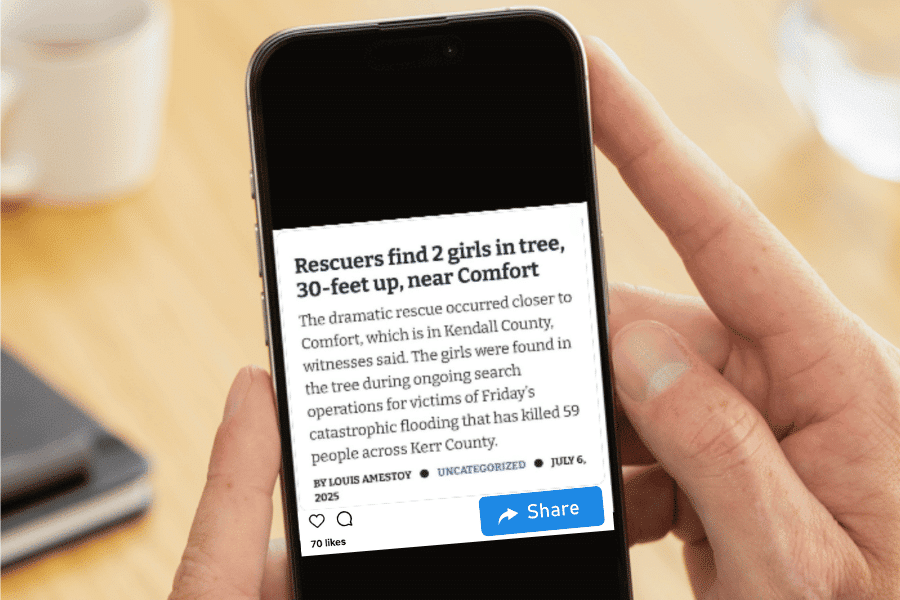
    Rescuers find 2 girls in tree, 30-feet up, near Comfort

    The dramatic rescue occurred closer to Comfort, which is in Kendall County, witnesses said. The girls were found in the tree during ongoing search operations for victims of Friday’s catastrophic flooding that has killed 59 people across Kerr County.

    A Facebook search of the post’s keywords returned dozens of identical or similarly-worded posts retelling the harrowing rescue. Other versions of the story were also shared across social media platforms like Instagram Threads, as well as in now-deleted articles across various news outlets

    But the story was fabricated. 

    It was a prime example of a type of misinformation known as “copypasta.” 

    Inciting fear

    Social media posts that utilize copypasta — a portmanteau of “copy” and “paste” — are often used to incite fear or evoke emotions, prompting users to like and share the content. These posts are used for various reasons, whether to polarize different political groups further or to attract a broader audience and spread misinformation. 

    Alex Kasprak is an investigative journalist who reported for the digital fact-checking website Snopes for nearly a decade. In his experience, Kasprak says copypasta plays a central role in online misinformation. (For more on Snopes’ take on copypasta, head to this link.) 

    “The simplest way to put it, is that copypasta is a text that you see that is identical or nearly identical posted either with somebody’s name as an author or without it in an identical form on multiple posts such that it’s clear that whoever is posting it copied it from somewhere else,” said Kasprak. 

    “What you end up getting in that sort of phenomenon is a game of telephone.”  

    Copypasta serves as a new-age version of chainmail, seen in the early days of email, which promised good luck for forwarding a message or foretold misinformation if you let the email sit in an inbox. 

    Lacking credibility

    In the case of copypasta, social media users are encouraged to comment, share or tag their friends in a post to boost engagement. Such emotion-evoking messages can serve as an entry point into more polarizing content, which is often rife with false information. 

    To identify copypasta, look for signs of vague or generic information that lacks a credible source or call to action. The way a post is written can also serve as an indication that it may be a copy-and-paste text. 

    “With copypasta, everything generally kind of travels forward, including errors in grammar or mistranslations,” Kasprak said. “If there are weird sentences that just kind of end or don’t fully make grammatical sense, that is an indicator that the tone of the message doesn’t match.”

    If the post is shared by someone that you know on your feed, but the tone is different than how they usually post or talk, the content likely originated from another source — credible or not, Kasprak said. 

    In addition to spreading false information, copypasta can be used as part of bigger campaigns to push particular sentiments or ideologies. For example, back in 2017, U.S. government officials found evidence that Russian “trolls” took to social media and also deployed social media campaigns to connect certain users to various organizations or movements.

    Danger to the infosphere

    During these online campaigns, nefarious actors meddled in the election by posting emotional content to get users to engage, gradually bringing them down a digital rabbit hole of more polarizing issues.

    Kasprak adds that copypasta content also harms the “infosphere,” or public knowledge otherwise rooted in fact. When copypasta becomes widespread and is presented as a “pseudofact,” people begin to cite it as common knowledge. A commonly held belief that many people cite as fact, for example, is that a mother bird will abandon its offspring if a human touches it. Experts agree that this notion is not true. 

    Another tactic behind those who post copypasta is to poison AI models in a similar way that fake news websites do. When enough content on the internet makes a particular claim, AI technologies may focus on this noise and refer to it as fact. In this way, AI programs are “trained” to focus and “believe” those posts over other sources of information.

    Emotion-evoking posts may also fall into the copypasta category if they are not rooted in unbiased facts. If emotional language used in the post immediately sparks anger, sadness or another strong emotion, it may be a fake post. 

    “In general, the big thing to watch out for is if something fits perfectly into your notion of how the world works,” said Kasprak. Posts that validate a person’s view of the world or evoke strong emotions in a positive or negative way are more likely to be a red flag. 

    Kasprak advises users to check their biases when reading potential copypasta content; if something makes you angry or sad, double-check its source and legitimacy. 

    “Pause if you feel strongly about wanting to share something, because those posts are the ones where the risk of copypasta is higher,” said Kasprak. When he comes across a post he believes to be copypasta, Kasprak says that he tries to “tear apart” the argument, primarily if it supports his beliefs, until it dissolves. 

    “Check your blind spots and be vigilant in checking your work,” said Kasprak. 

    When in doubt, don’t share.


    Questions to consider:

    1. What is meant by “copypasta”?

    2. How can something false become part of commonly believed?

    3. Can you remember the last thing you reposted on social media? What kind of things do you share with your network?


    Source link

  • America First Legal Urges DOJ to Investigate Hopkins for DEI

    America First Legal Urges DOJ to Investigate Hopkins for DEI

    America First Legal has called on the U.S. Department of Justice to investigate the Johns Hopkins University School of Medicine for alleged racial discrimination, according to The Baltimore Banner.

    In a 133-page complaint filed Thursday, the conservative legal group, run by President Trump’s deputy chief of staff, Stephen Miller, urged the DOJ to investigate Johns Hopkins “for its systemic, intentional, and ongoing discrimination within its School of Medicine on the basis of race, sex, ethnicity, national origin, and other impermissible, immutable characteristics under the pretext of ‘diversity, equity, and inclusion’ (‘DEI’) in open defiance” of civil rights laws, Supreme Court precedent and presidential executive orders.

    “Johns Hopkins has not merely preserved its discriminatory DEI framework—it has entrenched, expanded, and openly celebrated it as a cornerstone of its institutional identity,” the complaint reads, adding that identity-based preferences are “embedded” in the medical school’s curriculum, admissions processes, clinical practices and administrative operations.

    The America First Legal complaint singles out certain medical school divisions and programs for seeking to recruit a “diverse applicant pool,” including residency programs in gynecology and obstetrics, emergency medicine, dermatology, anesthesiology and critical care.

    But the complaint leaves room for attacks beyond the medical school, noting that DEI practices “are part of a comprehensive, university-wide regime of racial engineering.”

    Johns Hopkins has not responded to America First Legal’s complaint.

    But the university has lately taken pains to address what critics have called a lack of viewpoint diversity on campus, engaging in civic education initiatives and partnering with the conservative American Enterprise Institute to “convey the importance of rooting teaching and research with implications for the nation’s common life in a broad range of points of view,” according to the university.

    Source link