Blog

  • Energy Department delays multiple rules after public pushback

    Energy Department delays multiple rules after public pushback

    This audio is auto-generated. Please let us know if you have feedback.

    The U.S. Department of Energy delayed implementation of multiple rules that it had quietly set to go into effect this week for schools that receive funding from the agency. The move comes in response to public pushback to proposed policy changes.

    The department said it was extending the effective dates for several direct final rules from July 15 to Sept. 12, 2025. The proposals would have undone some student protections related to sex discrimination under Title IX, disability discrimination under Section 504, and racial discrimination under Title VI. 

    One direct final rule, for example, would have no longer required schools to offer girls tryouts for boys’ teams in noncontact sports if the school didn’t have an equivalent girls’ team. Another would have removed protections allowing gender-conscious after-school programs or college initiatives to provide women and girls opportunities they have historically been denied, such as in STEM fields or in technical training.   

    Had the public not responded to the direct final rules with “significant adverse comments,” the rules would have undone such protections within a 30-day period — a much shorter timeline than the typical rulemaking process, which requires federal agencies to consider public feedback and make changes to their policy proposals accordingly. 

    The Trump administration’s decision to undo civil rights protections for students using expedited rulemaking — a process usually reserved for rules agencies expect to be uncontroversial — alarmed many civil rights organizations.

    Kel O’Hara, senior attorney for policy and education equity at Equal Rights Advocate, called the move a “backdoor elimination of student protections.”

    “The Trump Administration tried to exploit an obscure regulatory loophole meant only for minor administrative updates to gut fundamental protections for female athletes and transgender students,” O’Hara said in a Wednesday statement.

    Typical rulemaking would require a public notice and comment period, and a second version of the rule that takes into consideration changes based on public feedback. That process also gives school districts more time to prepare for policy changes. 

    The rules were also atypical in that they were released by the Energy Department rather than the U.S. Department of Education — meaning only schools receiving Energy Department funding would have been impacted by this set of changes. The Energy Department gave 28 schools just over $160 million in fiscal year 2025, and provides over $2.5 billion annually to more than 300 colleges and universities to fund research.

    However, had significant adverse comments not been received and delayed these rules’ implementation, and had the Energy Department been successful in its approach, the administration could have replicated the expedited method through other federal agencies to set education policies in many more schools, education policy experts predicted. 

    “This is a paradigm shift on the part of how the federal government articulates and connects some of these tools to their education priorities,” said Kenneth Wong, a professor of education policy at Brown University, when the direct final rules were announced. “Basically every single school, in practically every single school district, has some grants from one of the many agencies in the federal government.” 

    Most schools receive K-12 funding from multiple agencies, such as the Energy Department and the U.S. Department of Agriculture. 

    Because of the opposition to the rules, the Energy Department must now either withdraw them entirely or issue new final rules by September 12 that take the comments into account. 

    The Energy Department did not respond to a request for comment in time for publication.

    Source link

  • What’s New With Top Hat?

    What’s New With Top Hat?

    As you gear up for a new term, we’re excited to share some of Top Hat’s latest features—along with practical resources to help you engage students, streamline your teaching and set your course up for success.

    Affordable Learning Just Got Active 

    Interactive OpenStax Textbooks

    We’ve brought a curated selection of OpenStax textbooks into the Top Hat platform—at no extra cost to you or your students. These peer-reviewed, open-license texts are enriched with embedded assessments, accessibility upgrades and seamless integration into your course. It’s a powerful way to meet affordability goals while offering interactive, customizable materials that improve learning. Browse the OpenStax catalog.

    Making Teaching Easier and More Engaging

    Guest Mode for Presentations

    Engage any audience! Guest Mode makes it easy to use Top Hat outside the classroom, such as during conference talks, public lectures, or internal training sessions. Participants can join via QR code or session link—no login or student account needed. The perfect solution for one-time or public-facing presentations where simplicity and speed matter most. Learn more.

    Ace: AI-Powered Example Generator

    Help students see the ‘why’ behind what they’re learning. With a single highlight, you can ask Ace to generate a career-relevant or real-life scenario to bring a course concept to life. Whether you’re teaching accounting, anatomy, or sociology, Ace can tailor examples to match your students’ goals—helping them better connect with and retain the material.

    Preview New Builder Questions (Expected July)

    A new “preview” button in questions created with the new question builder allows instructors to view and interact with question content as it appears to students. You can interact with and submit responses to questions in preview mode to test things out before going live. Just note that these responses will not be saved.

    Live reactions (Expected August)

    Enable students to send real-time emoji reactions to presentation content throughout the lecture, providing even more opportunities for interactivity in class. This feature will be released first for guest mode sessions and then for regular classroom use.

    New Join Screen for Classroom Sessions (Expected July)

    We’re reducing friction even further by allowing students to join classroom sessions simply by scanning a QR code on the join screen.

    Easier In-Course Content Search

    Quickly find the materials you need, when you need them. Need to locate a quiz question, a specific slide, or an assignment from earlier in the term? Our upgraded content search lets you filter by type and keyword within your course, saving time and reducing prep friction. Learn more.

    Helpful Resources to Start the Term

    Student Engagement Toolkit

    This toolkit offers ready-to-use activities, templates, and low-stakes assessment ideas grounded in learning science to energize the classroom experience. View the Toolkit!

    Teaching with Top Hat Toolkit

    Everything you need to become a Top Hat pro. Whether you’re new to the platform or looking to level up, this toolkit walks you through the essentials—from setup and grading to extending learning outside class. Includes step-by-step tutorials, sample activities and instructional design tips. Access the Toolkit!

    Interested in learning more about Top Hat? Click here to book a platform overview.

    Source link

  • AI and Art Collide in This Engineering Course That Puts Human Creativity First – The 74

    AI and Art Collide in This Engineering Course That Puts Human Creativity First – The 74

    I see many students viewing artificial intelligence as humanlike simply because it can write essays, do complex math or answer questions. AI can mimic human behavior but lacks meaningful engagement with the world.

    This disconnect inspired my course “Art and Generative AI,” which was shaped by the ideas of 20th-century German philosopher Martin Heidegger. His work highlights how we are deeply connected and present in the world. We find meaning through action, care and relationships. Human creativity and mastery come from this intuitive connection with the world. Modern AI, by contrast, simulates intelligence by processing symbols and patterns without understanding or care.

    In this course, we reject the illusion that machines fully master everything and put student expression first. In doing so, we value uncertainty, mistakes and imperfection as essential to the creative process.

    This vision expands beyond the classroom. In the 2025-26 academic year, the course will include a new community-based learning collaboration with Atlanta’s art communities. Local artists will co-teach with me to integrate artistic practice and AI.

    The course builds on my 2018 class, Art and Geometry, which I co-taught with local artists. The course explored Picasso’s cubism, which depicted reality as fractured from multiple perspectives; it also looked at Einstein’s relativity, the idea that time and space are not absolute and distinct but part of the same fabric.

    What does the course explore?

    We begin with exploring the first mathematical model of a neuron, the perceptron. Then, we study the Hopfield network, which mimics how our brain can remember a song from just listening to a few notes by filling in the rest. Next, we look at Hinton’s Boltzmann Machine, a generative model that can also imagine and create new, similar songs. Finally, we study today’s deep neural networks and transformers, AI models that mimic how the brain learns to recognize images, speech or text. Transformers are especially well suited for understanding sentences and conversations, and they power technologies such as ChatGPT.

    In addition to AI, we integrate artistic practice into the coursework. This approach broadens students’ perspectives on science and engineering through the lens of an artist. The first offering of the course in spring 2025 was co-taught with Mark Leibert, an artist and professor of the practice at Georgia Tech. His expertise is in art, AI and digital technologies. He taught students fundamentals of various artistic media, including charcoal drawing and oil painting. Students used these principles to create art using AI ethically and creatively. They critically examined the source of training data and ensured that their work respects authorship and originality.

    Students also learn to record brain activity using electroencephalography – EEG – headsets. Through AI models, they then learn to transform neural signals into music, images and storytelling. This work inspired performances where dancers improvised in response to AI-generated music.

    The Improv AI performance at Georgia Institute of Technology on April 15, 2025. Dancers improvised to music generated by AI from brain waves and sonified black hole data.

    Why is this course relevant now?

    AI entered our lives so rapidly that many people don’t fully grasp how it works, why it works, when it fails or what its mission is.

    In creating this course, the aim is to empower students by filling that gap. Whether they are new to AI or not, the goal is to make its inner algorithms clear, approachable and honest. We focus on what these tools actually do and how they can go wrong.

    We place students and their creativity first. We reject the illusion of a perfect machine, but we provoke the AI algorithm to confuse and hallucinate, when it generates inaccurate or nonsensical responses. To do so, we deliberately use a small dataset, reduce the model size or limit training. It’s in these flawed states of AI that students step in as conscious co-creators. The students are the missing algorithm that takes back control of the creative process. Their creations do not obey AI but reimagine it by the human hand. The artwork is rescued from automation.

    What’s a critical lesson from the course?

    Students learn to recognize AI’s limitations and harness its failures to reclaim creative authorship. The artwork isn’t generated by AI, but it’s reimagined by students.

    Students learn chatbot queries have an environmental cost because large AI models use a lot of power. They avoid unnecessary iterations when designing prompts or using AI. This helps reducing carbon emissions.

    The Improv AI performance on April 15, 2025, featured dancer Bekah Crosby responding to AI-generated music from brain waves.

    The course prepares students to think like artists. Through abstraction and imagination they gain the confidence to tackle the engineering challenges of the 21st century. These include protecting the environment, building resilient cities and improving health.

    Students also realize that while AI has vast engineering and scientific applications, ethical implementation is crucial. Understanding the type and quality of training data that AI uses is essential. Without it, AI systems risk producing biased or flawed predictions.

    Uncommon Courses is an occasional series from The Conversation U.S. highlighting unconventional approaches to teaching.

    This article is republished from The Conversation under a Creative Commons license. Read the original article.

    Source link

  • NZ’s new study visa rules strike chord with Australian sector

    NZ’s new study visa rules strike chord with Australian sector

    The New Zealand government announced earlier this week that, from November, Immigration New Zealand (INZ) will increase permitted work hours for study visa holders, extend work rights to all tertiary students on exchange or study abroad programs. It may also introduce a short-term work visa of up to six months for graduates not eligible for a post-study work visa.

    While the relaxations are a key part of New Zealand’s push to boost international student numbers by over 40% by 2034, INZ has also clarified that students who change their education provider or lower their study level will need to apply for a new visa, rather than simply requesting a variation of conditions on their existing one.

    The mandate has struck a chord with Australia’s international education sector, where some individuals and associations have been calling for an overhaul of the study visa system, specifically on linking study visas to the institution of initial enrolment.

    Commenting on New Zealand’s recent changes, Ravi Lochan Singh, managing director, Global Reach, wrote in a LinkedIn post that instead of banning agent commissions for onshore student transfers to address attrition, Australia could “just copy” the neighbouring country’s approach. 

    “Australia is currently facing a significant issue where students use higher ranked or low-risk universities (as categorised by Home Affairs) to secure their student visas easily and then after the first semester of studies, the students get moved to private colleges offering higher education degrees,” Singh told The PIE News. 

    According to Singh, while such moves, often made by Indian or Nepali students with the help of onshore immigration agents, may be genuine, they “waste” the efforts of offshore education agents and universities that initially recruited the students.

    “Some policy makers feel that students have a right to choose the correct education provider and if they feel that what they desire as a customer can be met at private colleges, they should be allowed to move,” stated Singh. 

    “However, we also have the situation where students have demonstrated their available funds through an education loan which is issued in the name of a particular university,” he added. If the student does move institutions, the education loan is not valid as a demonstration of funds and thus the argument that the students should be asked to apply for a fresh student visa.”

    According to Singh, many international students, particularly from South Asia, who arrive in Australia on education loans often find themselves without “available” or “accessible” funds when they switch providers and are required to show new financial evidence.

    It would appear that three modern advanced economies who have championed consumer protections and who have established international study destinations believe this measure is not contrary to ‘consumer choice’
    Gareth Lewis, Western Sydney University

    Moreover, a recent report by Allianz Partners Australia revealed that over 61% of international students found daily life in the country “significantly more expensive than expected”, with more than a quarter considering withdrawing from their studies due to financial woes. 

    “While we are discussing attrition and student movements once the student is onshore, we also need to acknowledge that university fees have been increasing and students are beginning to question ROI. Thus there is an argument for more student visa grants for higher education degrees at TAFE and private providers,” said Singh. 

    “The fees of such programs is much lower to what is charged at the universities. If this happens, the students who are more price sensitive will join the TAFE and private providers right in the beginning and universities will have only those students who can afford the degree and likely to complete them at the university itself.”

    While Australia’s Ministerial Direction 111, which replaced MD 107, provides immigration case officers stricter guidance on assessing the Genuine Student requirement, and introduces a two-tier visa processing system that prioritises institutions with strong compliance records and low visa risks, it influences the decision-making process, not the entire visa mechanism unlike New Zealand’s recent move. 

    However, New Zealand is not the only model Australia could look to, according to stakeholders.

    A recent submission by the Association of Australian Education Representatives in India (AAERI) to the ministers for education and home affairs in Australia pointed to examples from the UK and Canada, where students must obtain a new Confirmation of Acceptance for Studies (CAS) and a new study permit, respectively, if they wish to change institutions.

    “Australia’s recent reforms, such as closing the concurrent CoE loophole and requiring CoEs for onshore visa applications, are steps in a similar direction but do not go far enough to address the core issue of unethical student poaching, misuse of student visa and provider switching,” stated AAERI in its submission in May to the Labor government. 

    After New Zealand’s changes were announced, regional director, Western Sydney University, Gareth Lewis also echoed a similar opinion on Australia’s reluctance to do what New Zealand, the UK, and Canada have done. 

    “It would appear that three modern advanced economies who have championed consumer protections and who have established international study destinations believe this measure is not contrary to ‘consumer choice’,” read Lewis’s LinkedIn post

    “Unfortunately Australia believes it is. This needs to change.” 

    Find out more about how Australia can improve its visa system at The PIE Live Asia Pacific 2025 on July 30, during the session “Visa status: MD111 and MD106 mapping – is the current visa system working?”, which will explore the impact of current visa policies on HE, VET, and ELICOS sectors, covering genuine student assessments, onshore switching, and ways to improve the operating environment. Check out more details here – PLAP 2025 agenda.

    Source link

  • Organization of Educational Historians National Conference, September 26-27th Online

    Organization of Educational Historians National Conference, September 26-27th Online

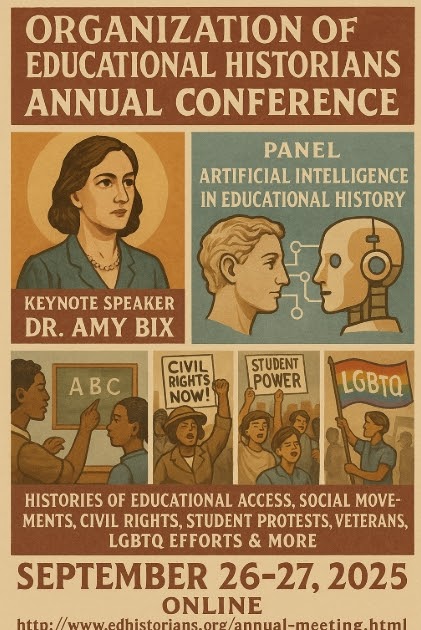
    Save the date – September 26-27! As a non-profit educational organization, we hope you will join us at our annual conference! If you are looking for a conference that includes sharing histories of education to help define present processes and inform the development of future responses, we hope you will join us and attend our annual conference. This year’s conference will include at least one panel on aspects of how artificial intelligence will impact educational history, but there will be many other panels. While the final conference schedule is still in development, this poster features examples of previous topics at the annual conference, so we can’t guarantee sessions on all these topics yet, but they demonstrate our past conference topics and may be indicative of what will be in this year’s conference. Our conference being offered online ensures low cost as we seek to invite many scholars into the organization by keeping travel costs low – and a full year’s membership, complete with the journal and attendance at the conference, remains affordable with a student rate ($60) and a regular rate (non-student) ($120)! With a peer-reviewed journal, an annual conference attendance complete with a noted keynote speaker, and a membership, we are dedicated to ensuring as many people as are interested can attend our conference. As you look to the fall, save the date and register here to attend: http://www.edhistorians.org/annual-meeting.html

    Source link

  • Graduate Outcomes, 2022-23 graduating year

    Graduate Outcomes, 2022-23 graduating year

    The headline numbers from this year’s graduate outcomes data – which represents the activities and experiences of the cohort that graduated in 2022-23 around 15 months after graduation look, on the face of it, disappointing.

    There’s a bunch of things to bear in mind before we join the chorus claiming to perceive the end of graduate employment as a benefit of higher education due to some mixture (dilute to preference) of generative AI, the skills revolution, and wokeness.

    We are coming off an exceptional year both for graduate numbers and graduate recruitment – as the pandemic shock dissipates numbers will be returning to normal: viewed in isolation this looks like failure. It isn’t.

    But we’ve something even more fundamental to think about first.

    Before we start

    We’re currently living in a world in which HESA’s Graduate Outcomes data represents the UK’s only comprehensive official statistics dealing with employment.

    If you’ve not been following the travails of the ONS Labour Force Survey (the July overview is just out) large parts of the reported results are currently designated “official statistics in development” and thus not really usable for policy purposes – the response rate is currently around 20 per cent after some very hard work by the transformation team, having been hovering in the mid-teens for a good while.

    Because this is Wonkhe we’re going to do things properly and start with looking at response rates and sample quality for Graduate Outcomes, so strap in. We’ll get to graduate activities in a bit. But this stuff is important.

    Response rates and sample quality

    Declining survey response rates are a huge problem all over the place – and one that should concern anyone who uses survey data to make policy or support the delivery of services. If you are reading or drawing any actionable conclusions from a survey you should have the response rate and sample quality front and centre.

    The overall completion rate for the 2022-23 cohort for Graduate Outcomes was 35 per cent, which you can bump up to 39 per cent if you include partial completions (when someone started on the form but gave up half-way through). This is down substantially from 48 per cent fully completing in 2019-20, 43 per cent in 2020-21, and 40 per cent in 2021-22.

    There’s a lot of variation underneath that: but provider, level of previous study (undergraduate responses are stronger than postgraduate responses), and permanent address all have an impact. If you are wondering about sampling errors (and you’d be right to be at these response rates!) work done by HESA and others assures us that there has been no evidence of a problem outside of very small sub-samples.

    Here’s a plot of the provider level variation. I’ve included a filter to let you remove very small providers from the view based on the number of graduates for the year in question – by default you see nothing with less than 250 graduates.

    [Full screen]

    What do graduates do?

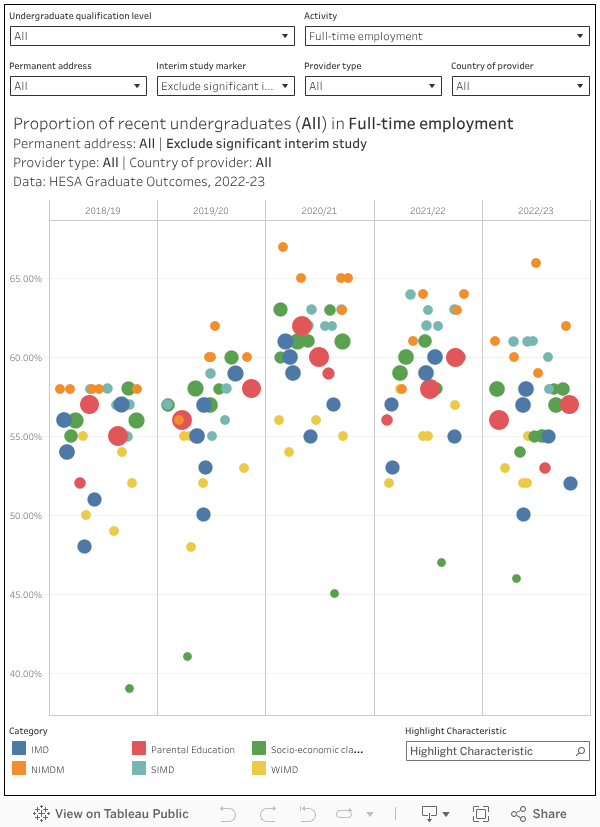
    As above, the headlines are slightly disappointing – 88 per cent of graduates from 2022-23 who responded to the survey reported that they were in work or further study, a single percentage point drop on last year. The 59 per cent in full-time employment is down from 61 per cent last year, while the proportion in unemployment is up a percentage point.

    However, if you believe that (on top of the general economic malaise) that generative AI is rendering entry level graduate jobs obsolete (a theme I will return to) you will be pleasantly surprised by how well employment is holding up. The graduate job market is difficult, but there is no evidence that it is out of the ordinary for this part of the economic cycle. Indeed, as Charlie Ball notes, we don’t see the counter-cyclical growth in further study that would suggest a full-blown downturn.

    There are factors that influence graduate activities – and we see a huge variation by provider. I’ve also included a filter here to let you investigate the impact of age: older graduates (particularly those who studied at a postgraduate level) are more likely to return to previous employment, which flatters the numbers for those who recruit more mature students.

    [Full screen]

    One thing to note in this chart is that the bar graph at the bottom shows proportions of all graduates, not the proportions of graduates with known destinations as we see at the top. I’ve done this to help put these results into context: though the sample may be representative it is not (as is frequently suggested) really a population level finding. The huge grey box at the top of each bar represents graduates that have not completed the survey.

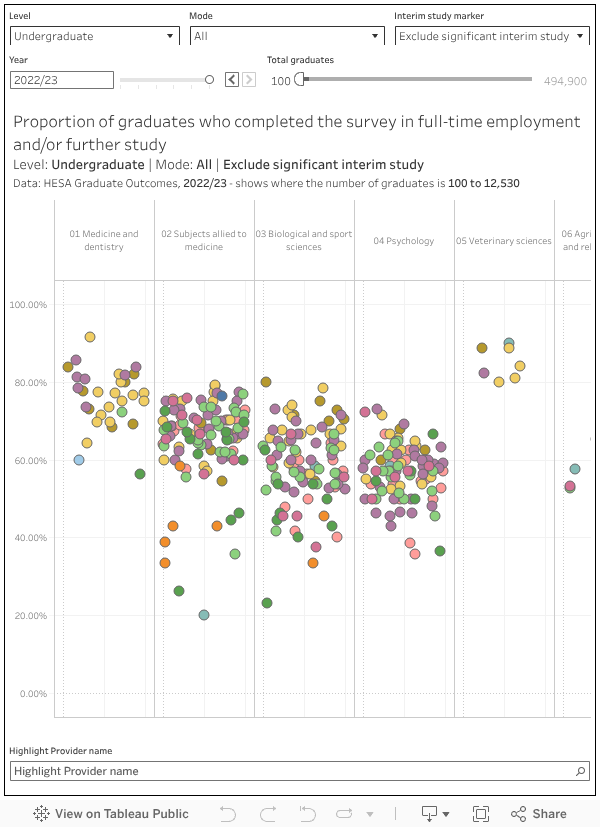
    A lot of the time we focus on graduates in full-time employment and/or further study – this alternative plot looks at this by provider and subject. It’s genuinely fascinating: if you or someone you know is thinking about undergraduate law with a view to progressing a career there are some big surprises!

    [Full screen]

    Again, this chart shows the proportion of graduates with a known destination (ie those who responded to the Graduate Outcomes survey in some way), while the size filter refers to the total number of graduates.

    Industrial patterns

    There’s been a year-on-year decline in the proportion of graduates from UG courses in paid employment in professional services – that is the destination of just 11.92 per cent of them this year, the lowest on record. Industries that have seen growth include public administration, wholesale and retail, and health and social care.

    There’s been a two percentage point drop in the proportion of PG level graduates working in education – a lot of this could realistically put down to higher education providers recruiting fewer early-career staff. This is a huge concern, as it means a lot of very capable potential academics are not getting the first jobs they need to keep them in the sector.

    And if you’ve an eye on the impact of generative AI on early career employment, you’d be advised to keep an eye on the information and communication sector – currently machine generated slop is somehow deemed acceptable for many industrial applications (and indeed employment applications themselves, a whole other can of worms: AI has wrecked the usual application processes of most large graduate employers) in PR, media, and journalism. The proportion of recent undergraduates in paid employment in the sector has fallen from nearly 8 per cent in 2020-21 to just 4.86 per cent over the last two years. Again, this should be of national concern – the UK punches well above its weight in these sectors, and if we are not bringing in talented new professionals to gain experience and enhance profiles then we will lose that edge.

    [Full screen]

    To be clear, there is limited evidence that AI is taking anyone’s jobs, and you would be advised to take the rather breathless media coverage with a very large pinch of salt.

    Under occupation

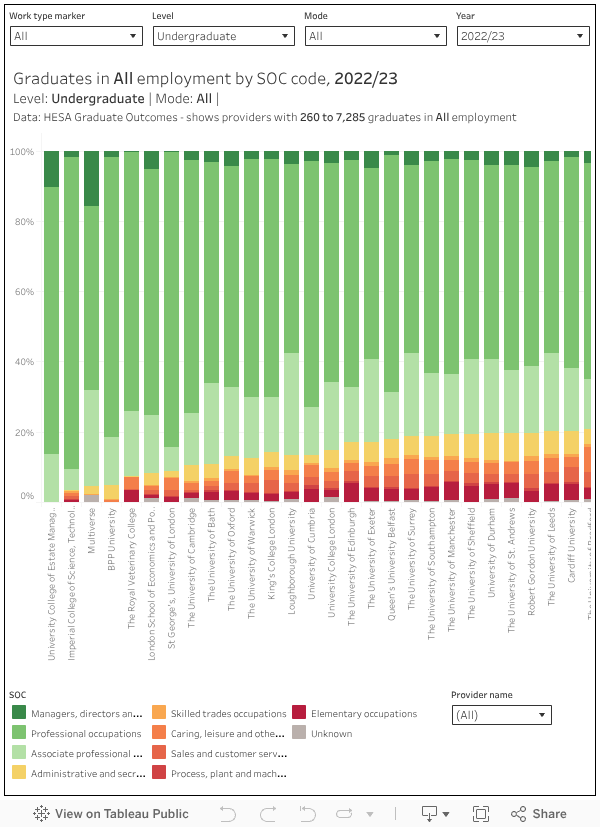
    Providers in England will have an eye on the proportion of those in employment in the top three SOC codes, as this is a key part of the Office for Students progression measure. Here’s a handy chart to get you started with that, showing by default providers with 250 or more graduates in employment, and sorted by the proportion in the top three SOC categories (broadly managers and directors, professionals, and associate professionals).

    [Full screen]

    This is not a direct proxy for a “graduate job”, but it seems to be what the government and sector have defaulted to using instead of getting into the weeds of job descriptions. Again, you can see huge differences across the sector – but do remember subject mix and the likely areas in which graduates are working (along with the pre-existing social capital of said graduates) will have an impact on this. Maybe one day OfS will control for these factors in regulatory measures – we can but hope.

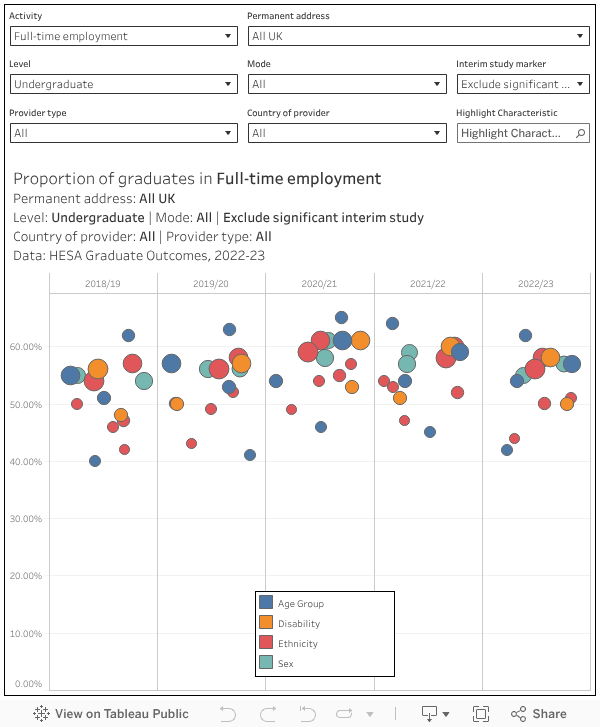
    Here’s a plot of how a bunch of other personal characteristics (age of graduates, ethnicity, disability, sex) can affect graduate activities, alongside information on deprivation, parental education, and socio-economic class for undergraduates. The idea of higher education somehow levelling out structural inequalities in the employment market completely was a fashionable stick to beat the sector with under the last government.

    [Full screen]

    [Full screen]

    Everything else

    That’s a lot of charts and a lot of information to scratch the surface of what’s in the updated graduate outcomes tables. I had hoped to see the HESA “quality of work” measure join the collection – maybe next year – so I will do a proxy version of that at some point over the summer. There’s also data on wellbeing which looks interesting, and a bunch of stuff on salaries which really doesn’t (even though it is better than LEO in that it reflects salaries rather than the more nebulous “earnings”) There’s information on the impact of degree classifications on activity, and more detail around the impact of subjects.

    Look out for more – but do bear in mind the caveats above.

    Source link

  • Deborah F. Rutter | Diverse: Issues In Higher Education

    Deborah F. Rutter | Diverse: Issues In Higher Education

    Deborah F. RutterDeborah F. Rutter, the former president of the John F. Kennedy Center for the Performing Arts in Washington, D.C., has been appointed vice provost for the arts at Duke University.

    From 2014 to 2025, Rutter was the first woman to serve as president of the Kennedy Center, the nation’s cultural center and living memorial to President Kennedy. Under Rutter’s leadership, the center experienced a period of transformative programmatic growth; opened the REACH, a physical expansion of the campus; and strengthened its financial position through increases in its endowment and working capital reserves.

    Rutter is a graduate of Stanford University, where she majored in music and German, and earned an MBA from the University of Southern California. Trained in piano and violin, she previously served as president of the Chicago Symphony Orchestra Association and executive director of the Seattle Symphony Orchestra. She also held executive leadership roles with the Los Angeles Chamber Orchestra and the Los Angeles Philharmonic.

    Rutter received an honorary Doctor of Arts degree from Duke in 2023.

    Source link

  • Exploring the diversity of people the world over

    Exploring the diversity of people the world over

    At the age of 9, Hannah Choo found herself shuttled across the Pacific Ocean from California to Seongnam, South Korea. She found herself living in a city, about an hour from Seoul, where everything from language to climate was different.

    She’d grown up in sunny, suburban, slow-paced Pasadena in Southern California and wasn’t happy at first about the move.

    “When I first arrived, the honking of cars at night was so loud that I couldn’t fall asleep,” Choo said. 

    But now, seven years later, she realizes that the experience of living in two starkly different cities has given her a better understanding of people. And this is important because Choo wants to be a journalist. 

    She has joined News Decoder as a summer intern, bringing with her an interest in communities and how they collectivize and support themselves. 

    “Korea has made me look deeper into how people differ experientially, not just in terms of surface factors like race or ethnicity or where they’re from,” she said. “I think there’s a lot of diversity in Korea with what people go through in their lives.”

    Appreciating cultural differences

    The homogenous culture of South Korea gives Choo a strong sense of community and has helped her realise that people’s differences are not defined by where they come from.

    For News Decoder, Choo brings the perspective of a young person, which is valuable to an organization devoted to helping youth process global events and the confusing digital world that consumes them.

    Consider her work with Amina McCauley, who leads News Decoder’s EYES program — Empowering Youth Through Environmental Storytelling —  a two-year project to create a climate change curriculum that can be implemented in schools across the globe. 

    “Hannah has been helping me critique News Decoder’s climate journalism educational materials,” McCauley said. “As the EYES project enters its phase of dissemination, Hannah’s curiosity and understanding of depth is helping the curriculum to become stronger and more relevant for the young people of today.”

    McCauley said that Choo is thoughtful and critical, but that it is her way of interacting with others that is her best asset.

    “She brings me trust in future generations,” McCauley said. 

    Working with News Decoder

    Choo said she wanted to work with News Decoder because of the way it spotlights the human side of news, and how lives are impacted by everyday events. 

    “I feel like News Decoder aims to really empower students to not just write a story in general, but also how to incorporate their own voice into that while sticking with the rules of journalism,” Choo said.

    Choo will also help News Decoder bolster its social media. In the coming weeks, she will be working with News Decoder’s Program and Communication Manager Cathal O’Luanaigh on her own series of posts on News Decoder’s social media pages and working with its Educational News Director Marcy Burstiner on articles related to climate change, people and culture.

    Burstiner said that when Choo first came to News Decoder it was as if she knew exactly what was wanted of her. “She has a great instinct for news, for seeing the story that hasn’t been told and that needs to be told,” Burstiner said. “For News Decoder, South Korea is a country that has been underreported. I’m really looking forward to her stories.”

    Ultimately, Choo hopes to tell stories about people in many different places. 

    “I see myself travelling the world and visiting different communities and really hearing their stories, and being able to present it in a way that’s authentic to them,” she said. “And showing that to the rest of the world and allowing other people to also see all of these unique parts of a global culture that you never really get a spotlight on.” 

    Telling global stories

    What she has learned so far in her travels from California to South Korea is that there is great satisfaction in adapting to a new culture. 

    While there was no language barrier for Choo when she moved to Seongnam, having spoken Korean with her parents since she was a child, the noise and way of living there needed some getting used to. But what she at first found so different, she now finds comfort in. 

    Everything she needs outside of her apartment complex, which is wrapped by four different roads, is just a short subway, drive or walk away. And with community comes safety. 

    “I always tell people that you could leave your laptop on top of a coffee shop table and expect to find it there again an hour later,” Choo said. 

    There are still challenges. 

    Korean schools are hyper competitive and getting into a prestigious university is important. This means that in high school, students are so focused on getting good grades that their mental health often suffers.

    Young people prioritise studying for tests over sleep and a social life. They compare themselves to each other and base their self worth on academic performance. 

    “That creates pretty toxic dynamics between people,” she said. “Beating out the competition, I think, is a huge narrative here.”

    This also means that school and learning is centred on grades, so that critical thinking and interest is of much lower importance.

    “Studying in any school in Korea, even if international, means you’re still affected by the culture,” Choo said.

    Source link

  • Digital learning is different

    Digital learning is different

    Key points:

    In the animated film Up, the character Dug is a talking dog with an interesting mannerism. Each time he sees a movement off to the side, he stops whatever he is doing, stares off in that direction and shouts, “Squirrel!” I feel that this is a perfect representation of how schools often deal with new and emerging technologies. They can be working hard to provide the best instruction for their students but become immediately distracted anytime a new technology is introduced.

    From the internet and computers to cell phones and artificial intelligence, schools continue to invest a lot of time and money into figuring out how best to use these new technologies. Overall, schools have done a good job adapting to the numerous digital tools introduced in classrooms and offices–and often, these tools are introduced as standalone initiatives. Why do school districts feel the need to ‘reinvent the wheel’ every time a new technology is released? Instead of looking at each new technology as a tool that must be integrated in the curriculum, why not determine what is missing from current instruction and identify what prevents integration from occurring naturally?

    Schools need to recognize that it is not just learning how to use these new digital tools that is important. They must learn how to interpret and use the incredible variety of resources that accompany these tools–resources that provide perspectives that students would never have access to when using physical resources.

    Digital is different

    For centuries, learning material has come from a variety of physical resources. These include human-made items (i.e. textbooks, documents, paintings, audio recordings, and movies) as well as one of the most commonly used physical resources: teachers. In traditional instruction, teachers spend a great deal of class time teaching students information from these physical resources. But the physical nature of these resources limits their availability to students. To ensure that students have long-term access to the information provided by these physical resources, most traditional instruction emphasizes memorization, summarizing, and note taking. 

    With digital resources, students can access information at any time from anywhere, which means learning how to retain information is less important than learning how to effectively find credible information. The authenticity of the information is important because the same tools that are used to access digital resources can just as easily be used to create new digital resources. This means there is a lot of misinformation available online, often consisting of nothing more than personal opinions. Students need to not only be able to search for information online, but they also need to be able to verify the authenticity of online information. The ability to identify misleading or false information is a skill that will benefit them in their personal and academic lives.

    Learning

    While it is fairly easy to find information online, especially with the inclusion of AI in search engines, there are some search techniques that will reduce the amount of misinformation found in simple search requests. By teaching students how to refine their searches and discussing the impact of these search skills, students will be more discerning when it comes to reviewing search results. They need to be aware that the most helpful sites do not always appear at the top of the search list. Some sites are sponsored and thus automatically placed at the beginning of the search list. Other sites will tweak their web search parameters to ensure a higher priority in the search list.  A better understanding of how online searching works will result in more effective searches. 

    Once information is found, the authenticity of the resource and the information itself needs to be established. Fortunately, there are standard practices that can be utilized to teach verification. In the early 2000’s, a popular checklist method called CRAAP (Currency [timeliness], Relevance, Authority, Accuracy, Purpose) emerged. While this method was effective in evaluating the authenticity of the website, it did not ensure the accuracy of the information on the website. In 2019, the SIFT (Stop, Investigate, Find confirming resources, and Trace claims) methodology was introduced.  This methodology focuses on determining if online content is credible. These are not the only tools available to teachers. Librarians and media specialists are a good place to start when determining age-appropriate lessons and material to teach verification.

    Students need to have access to some high-quality digital resources starting in elementary school. Teaching website verification at an early age will help students understand, from the beginning, that there is a lot of misinformation available online. At the same time, schools need to ensure that they provide access to digital resources that are age appropriate. Today’s network technology provides many ways for schools to monitor and control what information or sites are available to students at different grade levels. While these network tools are effective, they should be used in conjunction with well-trained teachers who understand how to safely navigate digital resources and students who are expected to practice responsible internet behavior. Introducing a select number of digital resources in elementary classes is the first step toward creating discerning researchers who will gain the ability to effectively judge a website’s appropriateness and usefulness.

    Teaching

    In order to create opportunities for students to experience learning with digital resources, instructional practices need to be less reliant on teacher-directed instruction. The use of physical resources requires the teacher to be the primary distributor of the information. Typically, this is done through lecture or whole-class presentations. With digital resources, students have direct access to the information, so whole-class distribution is not necessary. Instead, instructional practices need to provide lessons that emphasize finding and verifying information, which can be done by shifting to a learner-centered instructional model. In a learner-centered lesson, the onus falls on the student to determine what information is needed, and if the found information is credible for a given task. The class time that previously would have been spent on lecture becomes time for students to practice finding and authenticating online information. Initially, these learning experiences would be designed as guided practice for finding specific information. As students become more proficient with their search skills, the lesson can shift toward project-based lessons.

    Project-based lessons will help students learn how to apply the information they find, as well as determine what unknown information they need to complete the work. Unlike lesson design for practicing information searching and verification, project-based lessons provide opportunities for students to decide what information is needed and how best to use it. Instead of directing the student’s information-gathering, the teacher provides guidance to ensure they are accessing information that will allow the students to complete the project.

    This shift in instruction does not necessarily mean there will be a significant curricular change. The curricular content will remain the same, but the resources could be different. Because students control what resources they use, it is possible that they could find resources different from the ones specified in the curriculum. Teachers will need to be aware of the resources students are using and may have to spend time checking the credibility of the resource. Given the varying formats (text, audio, video, graphic) available with digital resources, students will be able to determine which format(s) best supports their learning style. Because most digital tools utilize the same digital resources and formats, teaching students how to learn with digital resources will prepare them for adapting to the next new digital tool. It is simply a matter of learning how to use the tool–after all, they already know how to use the resource.

    When creating units of study, teachers should consider the type of resources students will be using. To simplify matters, some units should be designed to utilize digital resources only and include lessons that teach students how to find and verify information. Students still need to develop skills to work with physical resources as well. It may be helpful to start off with units that utilize only physical or digital resources. That way teachers can focus on the specific skills needed for each type of resource. As students gain proficiency with these skills, they will learn to use the appropriate skills for the given resources.

    The amount of information available to the public today is staggering. Unfortunately, too much of it is unverified and even purposely misleading. Trying to stop misinformation from being created and distributed is not realistic. But teaching students how to validate online information can make the distribution of and exposure to misinformation much less impactful. The open nature of the internet allows for many divergent opinions and perspectives. We need to ensure that when students graduate, they have the skills necessary to determine the authenticity of online information and to be able to determine its merit.

    Teaching and learning with digital resources is different, and traditional instruction does not meet the learning needs of today’s students. Giving students the opportunity to master learning with digital resources will prepare them for the next technology “squirrel” and will enable them to determine how best to use it on their own.

    Latest posts by eSchool Media Contributors (see all)

    Source link

  • Centralized IT governance helps improve learning outcomes

    Centralized IT governance helps improve learning outcomes

    Key points:

    As school districts continue to seek new ways to enhance learning outcomes, Madison County School District represents an outstanding case study of the next-level success that may be attained by centralizing IT governance and formalizing procedures.

    When Isaac Goyette joined MCSD approximately seven years ago, he saw an opportunity to use his role as Coordinator of Information Technology to make a positive impact on the most important mission of any district: student learning. The district, located in northern Florida and serving approximately 2,700 students, had made strides towards achieving a 1:1 device ratio, but there was a need for centralized IT governance to fully realize its vision.

    Goyette’s arrival is noted for marking the beginning of a new era, bringing innovation, uniformity, and central control to the district’s technology infrastructure.  His team aimed to ensure that every school was using the same systems and processes, thereby advancing the students’ access to technology.

    Every step of the way, Goyette counted on the support of district leadership, who recognized the need for optimizing IT governance. Major projects were funded through E-rate, grants, and COVID relief funds, enabling the district to replace outdated systems without burdening the general fund.  MCSD’s principals and staff have embraced the IT team’s efforts to standardize technology across the district, leading to a successful implementation. Auto rostering and single sign-on have made processes easier for everyone, and the benefits of a cohesive, cross-department approach are now widely recognized.

    To successfully support and enable centralization efforts, Goyette recognized the need to build a strong underlying infrastructure. One of the key milestones in MCSD’s technology journey was the complete overhaul of its network infrastructure. The existing network was unreliable and fragmented in design. Goyette and his team rebuilt the network from the ground up, addressing connectivity issues, upgrading equipment, and logically redoing district systems and processes, such as the district’s IP network addressing scheme. This transformation has had a positive impact on student learning and engagement. With reliable connectivity, students no longer face disruptions.

    The implementation of an enterprise-grade managed WAN solution has further transformed the educational experience for MCSD’s students and educators, serving as the backbone for all other technologies. Goyette’s innovative co-management approach, coupled with his deep understanding of network topology, has enabled him to optimize the resources of an experienced K-12 service provider while retaining control and visibility over the district’s network.

    New School Safety Resources

    Another significant milestone MCSD has achieved is the successful deployment of the district’s voice system. This reliable phone system is crucial for ensuring that MCSD’s schools, staff, and parents remain seamlessly connected, enhancing communication and safety across the district.

    Goyette’s innovative leadership extends to his strategies for integrating technology in the district. He and his team work closely with the district’s curriculum team to ensure that technology initiatives align with educational goals. By acting as facilitators for educational technology, his team prevents app sprawl and ensures that new tools are truly needed and effective.

    “Having ongoing conversations with our principals and curriculum team regarding digital learning tools has been critical for us, ensuring we all remain aligned and on the same page,” said Goyette. “There are so many new apps available, and many of them are great. However, we must ask ourselves: If we already have two apps that accomplish the same goal or objective, why do we need a third? Asking those questions and fostering that interdepartmental dialogue ensures everyone has a voice, while preventing the headaches and consequences of everyone doing their own thing.”   

    MCSD’s IT transformation has had a profound impact on student learning and engagement. With reliable connectivity and ample bandwidth, students no longer face disruptions, and processes like single sign-on and auto account provisioning have streamlined their access to educational resources. The district’s centralization efforts have not only improved the educational experience for students and educators but have also positioned Madison County School District as a model of success and innovation.

                                                                                                                ###

    Latest posts by eSchool Media Contributors (see all)

    Source link