By Michael Grove, Professor of Mathematics and Mathematics Education and Deputy Pro-Vice-Chancellor (Education Policy and Academic Standards) at the University of Birmingham.
We are well beyond the tipping point. Students are using generative AI – at scale. According to HEPI’s Student Generative AI Survey 2025, 92% of undergraduates report using AI tools, and 88% say they’ve used them in assessments. Yet only a third say their institution has supported them to use these tools well. For many, the message appears to be: “you’re on your own”.
The sector’s focus has largely been on mitigating risk: rewriting assessment guidance, updating misconduct policies, and publishing tool-specific statements. These are necessary steps, but alone they’re not enough.
Students use generative AI not to cheat, but to learn. But this use is uneven. Some know how to prompt effectively, evaluate outputs, and integrate AI into their learning with confidence and control. Others don’t. Confidence, access, and prior exposure all vary, by discipline, gender, and background. If left unaddressed, these disparities risk becoming embedded. The answer is not restriction, but thoughtful design that helps all students develop the skills to use AI critically, ethically, and with growing independence.
If generative AI is already reshaping how students learn, we must design for that reality and start treating it as a literacy to be developed. This means moving beyond module-level inconsistency and toward programme-level curriculum thinking. Not everywhere, not all at once – but with intent, clarity, and care.
We need programme-level thinking, not piecemeal policy
Most universities now have institutional policies on AI use, and many have updated assessment regulations. But module-by-module variation remains the norm. Students report receiving mixed messages – encouraged to use AI in one context, forbidden in another, ignored in a third, and unsure in a fourth. This inconsistency leads to uncertainty and undermines both engagement and academic integrity.
A more sustainable approach requires programme-level design. This means mapping where and how generative AI is used across a degree, setting consistent expectations and providing scaffolded opportunities for students to understand how these tools work, including how to use them ethically and responsibly. One practical method is to adopt a ‘traffic light’ or five-level framework to indicate what kinds of AI use are acceptable for each assessment – for example, preparing, editing, or co-creating content. These frameworks need not be rigid, but they must be clear and transparent for all.
Such frameworks can provide consistency, but they are no silver bullet. In practice, students may interpret guidance differently or misjudge the boundaries between levels. A traffic-light system risks oversimplifying a complex space, particularly when ‘amber’ spans such a broad and subjective spectrum. Though helpful for transparency, they cannot reliably show whether guidance has been followed. Their value lies in prompting discussion and supporting reflective use.
Design matters more than detection
Rather than relying on unreliable detection tools or vague prohibitions, we must design assessments and learning experiences that either incorporate AI intentionally or make its misuse educationally irrelevant.
This doesn’t mean lowering standards. It means doubling down on what matters in a higher education learning experience: critical thinking, explanation, problem-solving, and the ability to apply knowledge in unfamiliar contexts. In my own discipline of mathematics, students might critique AI-generated proofs, identify errors, or reflect on how AI tools influenced their thinking. In other disciplines, students might compare AI outputs with academic sources, or use AI to explore ideas before developing their own arguments.
We must also protect space for unaided work. One model is to designate a proportion of each programme as ‘Assured’ – learning and assessment designed to demonstrate independent capability, through in-person, oral, or carefully structured formats. While some may raise concerns that this conflicts with the sector’s move toward more authentic, applied assessment, these approaches are not mutually exclusive. The challenge is to balance assured tasks with more flexible, creative, or AI-enabled formats. The rest of the curriculum can then be ‘Exploratory’, allowing students to explore AI more openly, and in doing so, broaden their skills and graduate attributes.
Curriculum design should reflect disciplinary values
Not all uses of AI are appropriate for all subjects. In mathematics, symbolic reasoning and proof can’t simply be outsourced. But that should not mean AI has no role. It can help students build glossaries, explore variants of standard problems, or compare different solution strategies. It can provoke discussion, encourage more interactive forms of learning, and surface misconceptions.
These are not abstract concerns; they are design-led questions. Every discipline must ask:
What kind of skills, thinking and communication do we value?
How might AI support, or undermine, those aims?
How can we help students understand the difference?
These reflections play out differently across subject areas. As recent contributions by Nick Hillman and Josh Freeman underline, generative AI is prompting us to reconsider not just how students learn, but what now actually counts as knowledge, memory, or understanding.
Without a design-led approach, AI use will default to convenience, putting the depth, rigour, and authenticity of the higher education learning experience at risk for all.
Students need to be partners in shaping this future. Many already have deep, practical experience with generative AI and can offer valuable insight into how these tools support, or disrupt, real learning. Involving students in curriculum design, guidance, and assessment policy will help ensure our responses are relevant, authentic, and grounded in the realities of how they now learn.
A call to action
The presence of generative AI in higher education is not a future scenario, it is the present reality. Students are already using these tools, for better and for worse. If we leave them to navigate this alone, we risk widening divides, losing trust, and missing the opportunity to improve how we teach, assess, and support student learning.
What’s needed now is a shift in narrative:
From panic to pedagogy
From detection to design
From institutional policy to consistent programme-level practice.
Generative AI won’t replace teaching. But it will reshape how students learn. It’s now time we help them do so with confidence and purpose, through thoughtful programme-level design.
ALBUQUERQUE, N.M. — Maggi’s home in a suburban neighborhood here is a haven for local families. It’s a place where after just a few weeks in Maggi’s family-run child care program this spring, one preschooler started calling Maggi “mama” and Maggi’s husband “papa.” Children who have graduated from Maggi’s program still beg their parents to take them to her home instead of school.
Over the past few months, fewer families are showing up for care: Immigration enforcement has ramped up and immigration policies have rapidly changed. Both Maggi and the families who rely on her — some of whom are immigrants — no longer feel safe.
“There’s a lot of fear going on within the Latino community, and all of these are good people — good, hard-working people,” Maggi, 47, said in Spanish through an interpreter on a recent morning as she watched a newborn sleep in what used to be her living room. Since she started her own child care business two years ago, she has dedicated nearly every inch of her common space to creating a colorful, toy-filled oasis for children. Maggi doesn’t understand why so many immigrants are now at risk of deportation. “We’ve been here a long time,” she said. “We’ve been doing honest work.”
Immigrants like Maggi play a crucial role in home-based child care, as well as America’s broader child care system of more than 2 million predominantly female workers. (The Hechinger Report is not using Maggi’s last name out of concern for her safety and that of the families using her care.) Caregivers are notoriously difficult to find and keep, not only because the work is difficult, but because of poverty-level wages and limited benefits. Nationwide, immigrants make up nearly 20 percent of the child care workforce. In New York City, immigrants make up more than 40 percent of the child care workforce. In Los Angeles, it’s nearly 50 percent.
The Trump administration’s far-reaching war on immigration, which includes daily quotas for immigrant arrests, new restrictions on work permits and detainment of legal residents, threatens America’s already-fragile child care system. Immigrant providers, especially those who serve immigrant families, have been hit especially hard. Just like at Maggi’s, child care providers nationwide are watching families disappear from their care, threatening the viability of those businesses. In America, 1 in 4 children under the age of 6 has at least one foreign-born parent. Some kids who could benefit from experienced caregivers are now instead at home with older siblings or elderly relatives, losing out on socialization and kindergarten preparation. Some immigrant workers, regardless of status, are too scared to come to work, exacerbating staffing shortages. And in recent days, the administration announced that it would bar undocumented children from Head Start, the federally funded child care program for children from low-income families.
Related: Young children have unique needs and providing the right care can be a challenge. Our free early childhood education newsletter tracks the issues.
“Anti-immigrant policy can and will weaken our entire caregiving infrastructure,” said Karla Coleman-Castillo, senior policy analyst at the National Women’s Law Center. Home-based programs in particular will feel the squeeze, she said, since they tend to serve more immigrant families. “Anything that threatens the stability of families’ ability and comfort accessing early childhood education — and educators’ comfort entering or remaining in the workforce — is going to impact an already precarious sector.”
For Maggi, the fallout has been swift. In February, just a few weeks after the first changes were announced, her enrollment dropped from as many as 15 children each day to seven. Some families returned to Mexico. Others became too nervous to stray from their work routes for even a quick drop off. Some no longer wanted to give their information to the state to get help paying for care.
Maggi plays with a child in the back yard of her child care program. Maggi runs one of a few child care programs that provides 24/7 care in her town. Credit: Jackie Mader/The Hechinger Report
By May, only two children, an infant and a 4-year-old, were enrolled full time, along with six kids who came for before- or after-school care. She accepts children who pay privately and those who pay with child care subsidies through the state program for low-income children. She brings in about $2,000 a month for the infant and preschooler, and a couple hundred more each week for after-school care — down significantly from the $9,000 to $10,000 of late 2024. For parents who don’t receive a state subsidy, she keeps her rates low: less than $7 an hour. “They tell me that I’m cheap,” Maggi said with a slight smile. But she isn’t willing to raise her rates. “I was a single mom,” she said. “I remember struggling to find someone to care for my children when I had to work.”
Like many child care providers who emigrated to the United States as adults, Maggi started her career in an entirely different field. As a young mother, Maggi earned a law degree from a college in Mexico and worked in the prosecutor’s office in the northern Mexico state of Coahuila. Her job required working many weekends and late evenings, which took a toll on her parenting as a single mother. “I really feel bad that I was not able to spend more time with my daughters,” she added. “I missed a lot of their childhood.”
For a year when her girls were in elementary school, Maggi enrolled them in a boarding school, dropping them off Sunday nights and picking them up Friday afternoons. On some weekends, she took the girls to her office, even though she knew it wasn’t a place for children. Maggi longed for a different job where she could spend more time with them.
She started thinking seriously of emigrating about 15 years ago, as violence escalated. Her cousin was kidnapped and police officers she worked with were killed. Maggi received death threats from criminals she helped prosecute. Then one day, she was stopped by men who told her they knew where she lived and that she had daughters. “That’s when I said, this is not safe for me.”
In 2011, Maggi and the girls emigrated to America, bringing whatever they could fit into four suitcases. They ended up in El Paso, Texas, where Maggi sold Jell-O and tamales to make ends meet. Three years later, they moved here to Albuquerque. Maggi met her husband and they married, welcoming a son, her fourth child, shortly after.
In Albuquerque, Maggi settled into a life of professional caregiving, which came naturally and allowed her to spend more time with her family than she had in Mexico. She and her husband went through an intensive screening process and became foster parents. (New Mexico does not require individuals to have lawful immigration status to foster.) Maggi enrolled her youngest in a Head Start center, where administrators encouraged her to start volunteering. She loved being in the classroom with children, but without a work permit could not become a Head Start teacher. Instead, after her son started elementary school, she started offering child care informally to families she knew. Maggi became licensed by the state two years ago after a lengthy process involving several inspections, a background check and mandatory training in CPR and tenets of early childhood care.
It didn’t take long for Maggi to build up a well-respected business serving an acute need in Albuquerque. Hers is one of few child care programs in the area that offers 24/7 care, a rarity in the industry despite the desperate need. The parents who rely on her are teachers, caregivers for the elderly and people answering 911 calls.
In Maggi’s living room, carefully curated areas allow children to move freely between overflowing shelves of colorful toys, art supplies parked on a miniature table and rows of books. Educational posters on her walls reinforce colors, numbers and shapes. She delights in exposing the children to new experiences, frequently taking them on trips to grocery stores or restaurants. She is warm, but has high expectations for the children, insisting they clean up after themselves, follow directions and say “please” and “thank you.”
“I want them to have values,” Maggi said. “We teach them respect toward animals, people and each other.”
By the end of 2024, Maggi’s business was flourishing, and she looked forward to continued growth.
Data has yet to be released about the extent to which the current administration’s immigration policies have affected the availability of child care. But interviews with child care providers and research hint at what may lie ahead — and is already happening.
After a 2008 policy allowed Immigration and Customs Enforcement to check the immigration status of people taken into custody by local police, there was a marked decline in enrollment in child care among both immigrant and non-immigrant children. There was also a decrease in the supply of child care workers. Even though women were the minority of those deported, researchers found the policy sparked fear in immigrant communities, and many pulled back from their normal routines.
In the child care sector, that’s problematic, experts say. Immigrants in the industry tend to be highly educated and skilled at interacting with children positively, more so even than native workers. If a skilled portion of the workforce is essentially “purged” because they’re too afraid to go to work, that will lower the quality of child care, said Chris Herbst, an associate professor at Arizona State University who has studied immigration policy’s effect on child care. “Kids will be ill-served as a result.”
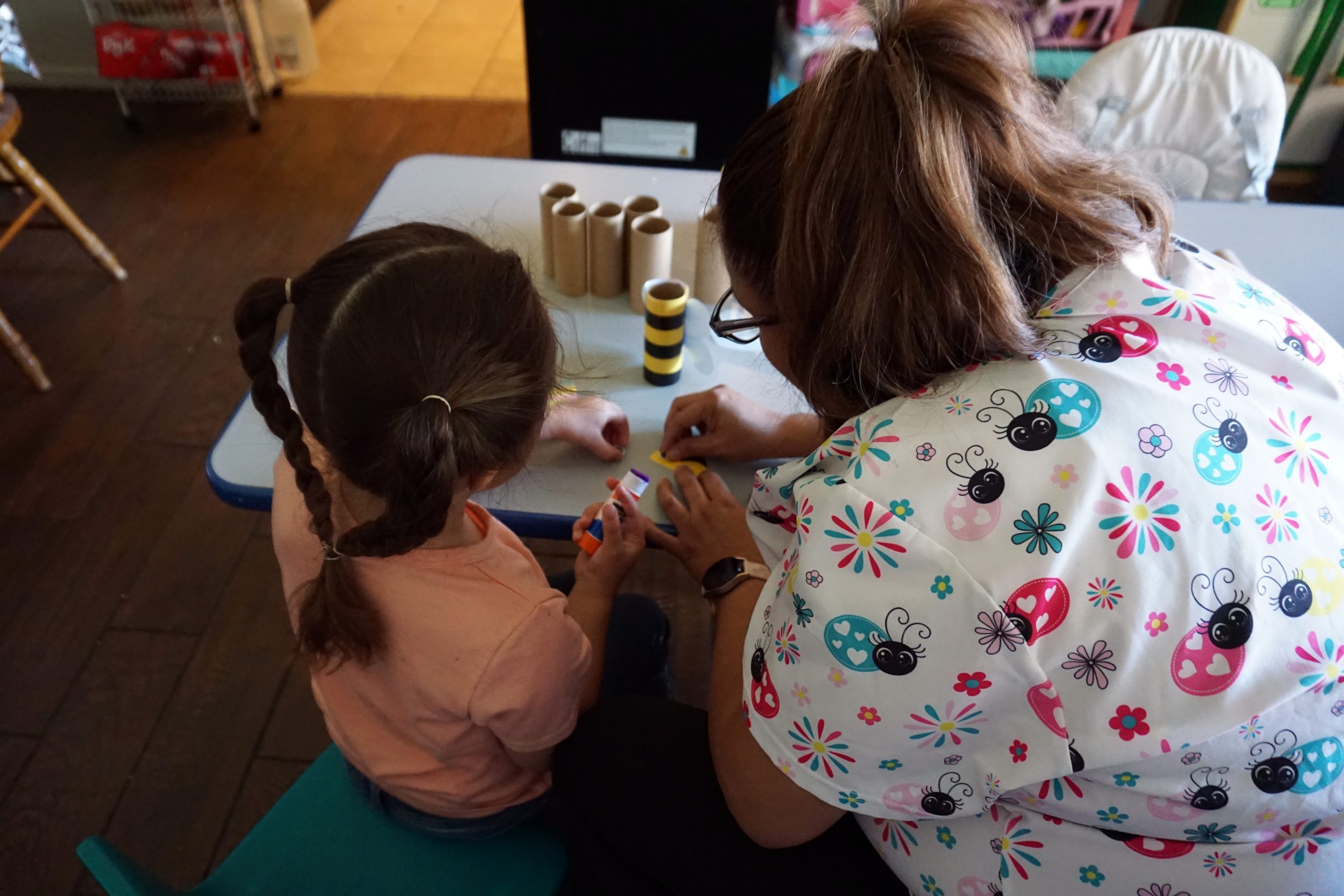
On a recent morning, Maggi stood in her living room, wearing white scrubs adorned with colorful cartoon ladybugs. Last year, the room would have been buzzing with children. Now, it’s quiet, save for chatter from Kay, the sole preschooler in her care each day. (The Hechinger Report is not using Kay’s full name to protect her privacy.) While Kay sat at a table working on a craft, Maggi cradled the infant, who had just woken up from a nap. The baby’s eyes were latched onto Maggi’s face as she fawned over him.
“Hello little one!” she cooed in Spanish. He cracked a smile and Maggi’s face lit up.
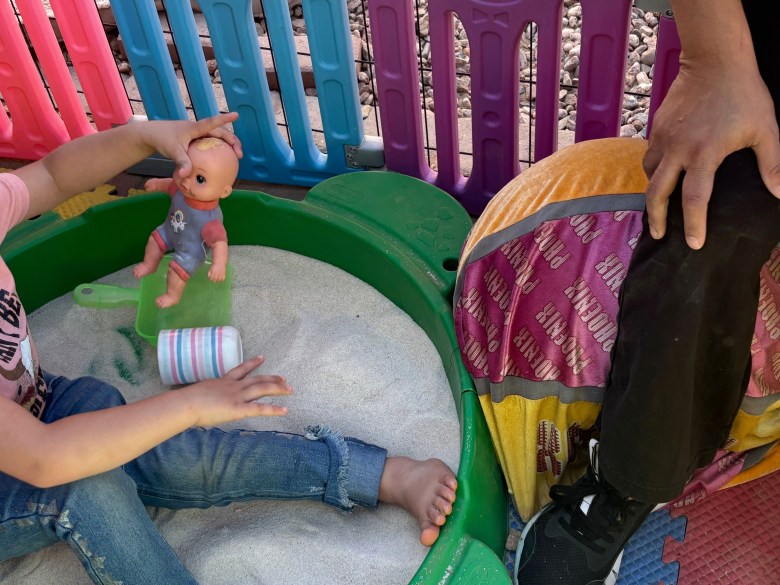
As one of her daughters took over to feed the newborn, Maggi followed Kay outside. The preschooler bounced around from the sandbox to the swings to a playhouse, with Maggi diligently following and playing alongside her.
Advocates and experts say upticks in immigration enforcement can cause stress and trauma for young children. In America, 1 in 4 children under the age of 6 has at least one foreign-born parent. Credit: Jackie Mader/The Hechinger Report
Finally Kay came to a standstill, resting her head against Maggi’s hip. Maggi gently patted her head and asked if she was ready to show off her pre-kindergarten skills. The pair sat down at a small table in the shade and Kay watched eagerly as Maggi poured out small plastic trinkets. Kay pulled three plastic toy turtles into a pile. “Mama, look! They’re friends!” Kay said, giggling.
Kay came to Maggi’s program after her mother pulled her out of another program where she felt the girl wasn’t treated well. Here, Kay is so happy, she hides when her mom comes back to get her. Still, a key aspect of the child care experience is missing for Kay. Normally, the girl would have several friends her own age to play with. Now when she is asked who her friends are, she names Maggi’s adult daughters.
Maggi worries even more about the children she doesn’t see anymore. Most are cared for by grandparents now, but those relatives are unlikely to know how to support child development and education, Maggi said. Many are unable to run around with the children like she does, and are more likely to turn to tablets or televisions for them.
She has seen the effects in children who leave her program and come back later having regressed. “Some of them are doing things well with me, and then when they come back, they have fallen behind,” she said. One child Maggi used to care for, for example, had just started to walk when the mother pulled them out of full-time care earlier this year, at the start of the immigration crackdown. In the care of a relative, Maggi found out they now spend much of the day sitting at home.
Before the second Trump administration began, the child care landscape looked bright in New Mexico, a state with a chronically high child poverty rate. In 2022, New Mexico started rolling out a host of child care policy changes. Voters approved a constitutional amendment guaranteeing a right to early childhood education, with sustained funding to support it. The state now allows families earning up to 400 percent of the federal poverty level, or nearly $125,000 a year, to qualify for free child care. That includes the majority of households in the state. Among the other changes: Providers are now paid more for children they enroll via the state’s assistance program.
The increase has been helpful for many providers, including Maggi. Before the pandemic, she received about $490 a month from the state for each preschooler enrolled in her program, compared to $870 a month now. If she enrolls infants who qualify for child care assistance, she gets paid $1,100 a month, nearly $400 more than pre-pandemic. She needs children enrolled to get the payments, however. Running her program 24 hours a day, seven days a week helps. She earns extra money from the state when caring for children evenings and weekends, and she is paid monthly to cover the cost of housing foster children.
Child care advocates in New Mexico are concerned that immigration policy will affect the industry’s progress. “I am worried because we could be losing early childhood centers that could help working families,” said Maty Miranda, an organizer for OLÉ New Mexico, a nonprofit advocacy organization. “We could lose valuable teachers and children will lose those strong connections.” Immigration crackdowns have had “a huge impact emotionally” on providers in the state, she added.
State officials did not respond to a request for data on how many child care providers are immigrants. Across the state, immigrants account for about 13 percent of the entire workforce.
Many local early educators are scared due to more extreme immigration enforcement, as are the children in their care, Miranda said. They are trying to work regardless. “Even with the fear, the teachers are telling me that when they go into their classrooms, they try to forget what’s going on outside,” she added. “They are professionals who are trying to continue with their work.”
Maggi said she’s so busy with the children who remain in her care that there is no extra time to work an additional job and bring in more income. She won’t speculate on how long her family can survive, instead choosing to focus on the hope that things will improve.
Maggi’s biggest fear at the moment is the well-being of the children of immigrants she and so many other home-based providers serve. She knows some of her kids and families are at risk of being detained by ICE, and that interactions like that, for kids, can lead to post-traumatic stress disorder, disrupted brain development and behavior changes. Some of Maggi’s parents have left her with emergency numbers in case they are detained by immigration officials.
Many of the children Maggi cares for after school are old enough to understand that deportation is a threat. “They show fear, because their parents are scared,” Maggi said. “Children are starting to live with that.”
Amid the dizzying policy changes, Maggi is trying to keep looking forward. She is working on improving her English skills. Her husband is pursuing a credential to be able to help more in her program. All three of her daughters are studying to become early childhood educators, with the goal to join the family business. Eventually, she wants to serve pre-K children enrolled in the state’s program, which will provide a steady stream of income.
In spite of all the uncertainty, Maggi said she is sustained by a bigger purpose. “I want them to enjoy their childhood,” she said on a sunny afternoon, looking fondly at Kay as the girl flung her tiny pink shoes aside and hopped into a sandbox. It’s the type of childhood Maggi remembers from her earliest days in Mexico. Kay giggled with delight as Maggi crouched down and poured cool sand over the little girl’s feet. “Once you grow up, there’s no going back.”
The Hechinger Report provides in-depth, fact-based, unbiased reporting on education that is free to all readers. But that doesn’t mean it’s free to produce. Our work keeps educators and the public informed about pressing issues at schools and on campuses throughout the country. We tell the whole story, even when the details are inconvenient. Help us keep doing that.
Inclusivity and feelings of psychological safety in the classroom should not be reserved solely for K-12 learning environments. Students in higher education also deserve nurturing spaces that focus on utilizing their personalized strengths and needs to foster increased academic and social development. A costly misconception is that pedagogical approaches in higher education must be lecture-based and teacher-led. Instead, it is an educator’s responsibility to design cooperative learning structures that facilitate comfort and collaboration regardless of grade level. These practical techniques will develop critical thinking and problem-solving abilities by creating intentional opportunities to enhance social and communication skills. The fundamental question becomes: How can educators plan for and deliver instructional content that is relatable and meaningful?
According to a recent survey by Salesforce (2022), just 12% of college students felt a strong sense of belonging in their institutions. Feelings of disconnection from their peers and institutions persisted after students returned to campus from remote learning during the COVID-19 pandemic. To address this dismal response to education, we must promote inclusive and respectful learning environments that foster engagement, motivation, and active discourse.
Purposeful Application to Teamwork
A practical and successful strategy is to design performance tasks using cooperative learning structures deliberately. Aside from promoting positive interdependence and individual accountability, students participate equally through simultaneous interactions. These actionable, collaborative strategies help educators navigate their role as facilitators, guiding and responding rather than lecturing and directing.
In an undergraduate education course, I establish a positive tone by holding morning meetings at the start of every class. The intention is to incorporate short, structured routines that foster community, address social-emotional needs, and transition students to the day’s lesson. Purposefully, I provide opportunities for students to connect and practice the social skills necessary to participate in rigorous critical thinking and problem-solving tasks. The goal is to elicit positive peer interactions and foster a sense of belonging and trust where students consider multiple perspectives and actively engage in an inclusive and receptive learning environment.
To enrich their classroom experience, I align cooperative learning structures with the lesson outcomes, ensuring that 21st-century, real-world content tasks are purposeful and authentic. Motivated by intentional opportunities for collaboration, students actively process information in favorable conditions that are both supportive and stimulating.
Unlike group work, cooperative learning activities are highly structured, with defined roles, steps, and time limits. With transparent directions, every student knows exactly what to do. Another key difference is that these structures promote built-in accountability and equal participation, requiring everyone to contribute through regular interaction and processing.
When considering a teacher’s pedagogical content knowledge, eliciting student feedback is paramount. Responding to end of course surveys, student reflections highlight the importance of the affective domain through several emerging pivotal themes. Students emphasized the significance of engaging, inclusive, and supportive learning environments. This aligns with findings from the literature, which posits that allowing students to apply course content in innovative and engaging ways fosters a deeper understanding and a heightened sense of ownership in learning (Singha & Singha, 2024). Given these findings, creating a classroom community through collaboration increases motivation and encourages students to develop their critical thinking skills and analyze problems more effectively.
Some students conveyed appreciation for interactive, relational, and consistently structured learning experiences. One student communicated, “I felt heard, valued, and important in this class… everyone truly has the opportunity to openly share without judgment.” These emotional and interpersonal experiences support long-term learning and boost goal-directed behaviors.
Another key theme was the acknowledgment of active, collaborative, and applied learning activities. One student articulated the need for relatable, real-world, authentic tasks, stating, “My favorite activity was creating videos to connect with the assignments in class.” This reflection highlights the notion that students in higher education value opportunities that enable them to transition from passive consumers of information to active participants in the learning process (Ribeiro-Silva et al., 2022). Moreover, recent research supports the implementation of faculty professional development programs focused on active learning instruction and engaging students in college classrooms (Park & Xu, 2024).
Implications for Faculty
To design assignments that work and adopt a reflective framework in your own instruction, consider implementing the following practices:
Set Clear Learning Objectives: Ensure students understand what they are expected to accomplish during collaboration. Cooperative learning is most effective when aligned with specific outcomes, especially those that require higher-order thinking (analysis, synthesis, and application). Identify what students should know, do, or beabletoexplain by the end of the activity.
Design Purposeful and Flexible Groups: Keep it interesting and diversify student groups. Avoid simple tasks that can be done individually—design work that fosters interdependence and leverages diverse perspectives. Create tasks that are complex enough to require collaboration (e.g., solving a case study, evaluating evidence, or designing a project).
Structure Group Roles and Expectations: Assign roles based on instructional content to ensure equal participation and engagement among group members. Structured roles promote engagement and accountability. Rotate roles to ensure individual accountability and contribution.
Monitor and Support Groups in Real Time: Circulate during group work, check for understanding, and intervene as needed to guide discussion or clarify misconceptions. Guide communication, active listening, respectful disagreement, and group decision-making. Active monitoring shows students their work matters and allows faculty to model and scaffold skills often.
Encourage Metacognition: Provide opportunities for students to reflect on their group work experiences and the processes involved. Reflection reinforces academic content and collaboration skills.
By implementing collaborative techniques, faculty can motivate students to apply content knowledge that will prepare their future success in relatable, real-world contexts and encourage the development and maintenance of the interpersonal skills necessary for lifelong learning. Furthermore, by refining our pedagogical practices, we can foster a more robust society with confident, culturally competent, and self-aware leaders of tomorrow.
Final Reflections
Former U.S. Secretary of Education Miguel Cardona quoted the African proverb, “If you want to go fast, go alone. If you want to go far, go together.” University settings often overlook effective pedagogical approaches that incorporate collaboration, limiting opportunities for meaningful learning experiences that enhance understanding, sustain motivation, and spark intellectual curiosity. By designing, facilitating, monitoring, and evaluating inclusive learning spaces, we can contribute to a sense of belonging and bring joy back into the classroom.
Dr. Ana Figueroa is an assistant professor of education at the University of Tampa and the Lead Instructor of the Education Foundations and Human Exceptionalities courses in the undergraduate program. Her research interests include differentiated instruction, progress monitoring, teacher mindset, and highly effective instructional strategies. She champions equitable instruction for all learners.
References
Kagan, Spencer, and Miguel Kagan. Kagan Cooperative Learning. San Clemente, CA: Kagan Publishing, 2021.
Park, Elizabeth S., and Di Xu. “The Effect of Active Learning Professional Development Training on College Students’ Academic Outcomes.” Journal of Research on Educational Effectiveness 17, no. 1 (December 20, 2024): 43–64. https://doi.org/10.1080/19345747.2022.2151954.
Ribeiro-Silva, Elsa, Catarina Amorim, José Luis Aparicio-Herguedas, and Paula Batista. “Trends of Active Learning in Higher Education and Students’ Well-Being: A Literature Review.” Frontiers in Psychology 13 (April 18, 2022). https://doi.org/10.3389/fpsyg.2022.844236.
Singha, Ranjit, and Surjit Singha. “Educational Innovation Transforming Higher Education for Workforce Readiness.” Advances in Higher Education and Professional Development, January 29, 2024, 37–55. https://doi.org/10.4018/979-8-3693-0517-1.ch003.
Inclusivity and feelings of psychological safety in the classroom should not be reserved solely for K-12 learning environments. Students in higher education also deserve nurturing spaces that focus on utilizing their personalized strengths and needs to foster increased academic and social development. A costly misconception is that pedagogical approaches in higher education must be lecture-based and teacher-led. Instead, it is an educator’s responsibility to design cooperative learning structures that facilitate comfort and collaboration regardless of grade level. These practical techniques will develop critical thinking and problem-solving abilities by creating intentional opportunities to enhance social and communication skills. The fundamental question becomes: How can educators plan for and deliver instructional content that is relatable and meaningful?
According to a recent survey by Salesforce (2022), just 12% of college students felt a strong sense of belonging in their institutions. Feelings of disconnection from their peers and institutions persisted after students returned to campus from remote learning during the COVID-19 pandemic. To address this dismal response to education, we must promote inclusive and respectful learning environments that foster engagement, motivation, and active discourse.
Purposeful Application to Teamwork
A practical and successful strategy is to design performance tasks using cooperative learning structures deliberately. Aside from promoting positive interdependence and individual accountability, students participate equally through simultaneous interactions. These actionable, collaborative strategies help educators navigate their role as facilitators, guiding and responding rather than lecturing and directing.
In an undergraduate education course, I establish a positive tone by holding morning meetings at the start of every class. The intention is to incorporate short, structured routines that foster community, address social-emotional needs, and transition students to the day’s lesson. Purposefully, I provide opportunities for students to connect and practice the social skills necessary to participate in rigorous critical thinking and problem-solving tasks. The goal is to elicit positive peer interactions and foster a sense of belonging and trust where students consider multiple perspectives and actively engage in an inclusive and receptive learning environment.
To enrich their classroom experience, I align cooperative learning structures with the lesson outcomes, ensuring that 21st-century, real-world content tasks are purposeful and authentic. Motivated by intentional opportunities for collaboration, students actively process information in favorable conditions that are both supportive and stimulating.
Unlike group work, cooperative learning activities are highly structured, with defined roles, steps, and time limits. With transparent directions, every student knows exactly what to do. Another key difference is that these structures promote built-in accountability and equal participation, requiring everyone to contribute through regular interaction and processing.
When considering a teacher’s pedagogical content knowledge, eliciting student feedback is paramount. Responding to end of course surveys, student reflections highlight the importance of the affective domain through several emerging pivotal themes. Students emphasized the significance of engaging, inclusive, and supportive learning environments. This aligns with findings from the literature, which posits that allowing students to apply course content in innovative and engaging ways fosters a deeper understanding and a heightened sense of ownership in learning (Singha & Singha, 2024). Given these findings, creating a classroom community through collaboration increases motivation and encourages students to develop their critical thinking skills and analyze problems more effectively.
Some students conveyed appreciation for interactive, relational, and consistently structured learning experiences. One student communicated, “I felt heard, valued, and important in this class… everyone truly has the opportunity to openly share without judgment.” These emotional and interpersonal experiences support long-term learning and boost goal-directed behaviors.
Another key theme was the acknowledgment of active, collaborative, and applied learning activities. One student articulated the need for relatable, real-world, authentic tasks, stating, “My favorite activity was creating videos to connect with the assignments in class.” This reflection highlights the notion that students in higher education value opportunities that enable them to transition from passive consumers of information to active participants in the learning process (Ribeiro-Silva et al., 2022). Moreover, recent research supports the implementation of faculty professional development programs focused on active learning instruction and engaging students in college classrooms (Park & Xu, 2024).
Implications for Faculty
To design assignments that work and adopt a reflective framework in your own instruction, consider implementing the following practices:
Set Clear Learning Objectives: Ensure students understand what they are expected to accomplish during collaboration. Cooperative learning is most effective when aligned with specific outcomes, especially those that require higher-order thinking (analysis, synthesis, and application). Identify what students should know, do, or beabletoexplain by the end of the activity.
Design Purposeful and Flexible Groups: Keep it interesting and diversify student groups. Avoid simple tasks that can be done individually—design work that fosters interdependence and leverages diverse perspectives. Create tasks that are complex enough to require collaboration (e.g., solving a case study, evaluating evidence, or designing a project).
Structure Group Roles and Expectations: Assign roles based on instructional content to ensure equal participation and engagement among group members. Structured roles promote engagement and accountability. Rotate roles to ensure individual accountability and contribution.
Monitor and Support Groups in Real Time: Circulate during group work, check for understanding, and intervene as needed to guide discussion or clarify misconceptions. Guide communication, active listening, respectful disagreement, and group decision-making. Active monitoring shows students their work matters and allows faculty to model and scaffold skills often.
Encourage Metacognition: Provide opportunities for students to reflect on their group work experiences and the processes involved. Reflection reinforces academic content and collaboration skills.
By implementing collaborative techniques, faculty can motivate students to apply content knowledge that will prepare their future success in relatable, real-world contexts and encourage the development and maintenance of the interpersonal skills necessary for lifelong learning. Furthermore, by refining our pedagogical practices, we can foster a more robust society with confident, culturally competent, and self-aware leaders of tomorrow.
Final Reflections
Former U.S. Secretary of Education Miguel Cardona quoted the African proverb, “If you want to go fast, go alone. If you want to go far, go together.” University settings often overlook effective pedagogical approaches that incorporate collaboration, limiting opportunities for meaningful learning experiences that enhance understanding, sustain motivation, and spark intellectual curiosity. By designing, facilitating, monitoring, and evaluating inclusive learning spaces, we can contribute to a sense of belonging and bring joy back into the classroom.
Dr. Ana Figueroa is an assistant professor of education at the University of Tampa and the Lead Instructor of the Education Foundations and Human Exceptionalities courses in the undergraduate program. Her research interests include differentiated instruction, progress monitoring, teacher mindset, and highly effective instructional strategies. She champions equitable instruction for all learners.
References
Kagan, Spencer, and Miguel Kagan. Kagan Cooperative Learning. San Clemente, CA: Kagan Publishing, 2021.
Park, Elizabeth S., and Di Xu. “The Effect of Active Learning Professional Development Training on College Students’ Academic Outcomes.” Journal of Research on Educational Effectiveness 17, no. 1 (December 20, 2024): 43–64. https://doi.org/10.1080/19345747.2022.2151954.
Ribeiro-Silva, Elsa, Catarina Amorim, José Luis Aparicio-Herguedas, and Paula Batista. “Trends of Active Learning in Higher Education and Students’ Well-Being: A Literature Review.” Frontiers in Psychology 13 (April 18, 2022). https://doi.org/10.3389/fpsyg.2022.844236.
Singha, Ranjit, and Surjit Singha. “Educational Innovation Transforming Higher Education for Workforce Readiness.” Advances in Higher Education and Professional Development, January 29, 2024, 37–55. https://doi.org/10.4018/979-8-3693-0517-1.ch003.
Big changes are coming to how families pay for college — and some colleges will need to get creative. New Parent PLUS loan caps ($20K/year, $65K total) mean schools where parents used to borrow six figures, or 50%+ of families relied on these loans will need to rethink their financial strategies. That includes several art schools and HBCUs — institutions that have long opened doors for talented students. While the full impact is still unfolding, this could spark new conversations about affordability, access, and better support for families. Change is never easy — but it can lead to smarter, more sustainable solutions for students and schools alike.
University Chancellors Council Convenor John Pollaers. Picture: Newswire
The University Chancellors Council (UCC) on Tuesday said the Commonwealth Remuneration Tribunal should advise on vice-chancellor pay packages, some of which are exceeding $1 million per year.
Please login below to view content or subscribe now.
NTEU president Alison Barnes. Picture: James Croucher
The sector union has once again called for transparency in university governing bodies after staff reported a culture of secrecy, bullying and intimidation in university councils and senates.
Please login below to view content or subscribe now.
Virtual reality (VR) isn’t a silver bullet replacement for lectures or labs, but it is the most practical method to support higher education to deliver immersive learning more effectively at-scale.
Please login below to view content or subscribe now.
“An
exciting and hilarious heist novel that centers down-on-their-luck older
millennials who are riddled with debt and decide to take matters into their own
hands to dismantle the system. Timely and witty, Cauley’s plotting, prose, and
character development will keep you hooked from start to finish.” —Morgan
Jerkins, New York Times bestselling author of This Will Be Undoing
“In
an Afrofuturist world of barbaric debt police and an absurd heist to bring it
all down, The Payback is a delightfully dark comedy of three
coworkers-turned-conspirators hell-bent on revenge. This trio of Robin Hoods
taking matters into their own hands out of grief and desperation will have you
alternating between raucous laughs and fear for their safety. California strip
malls, 80s fashion, punk and hacker culture, all combine in a tenacious
cocktail of sweet justice shared by all.” —Xochitl
Gonzalez, New York Times bestselling author of Olga Dies Dreaming
and Anita de Monte Laughs Last
“Like Ocean’s Eleven but no one’s
famous. The Payback is a love letter to the American mall, the revenge
of the break room, and a laugh-cry of the gods of retail. The result is
obsessive truth-telling fun, with zingers, dishy thrills, bodysuits, and a few
wigs that have seen better days but are hoping to have the best one yet.” —Alexander Chee, author of How to Write an
Autobiographical Novel
The Payback
A Novel
Kashana Cauley
ON SALE JULY 15, 2025 FROM ATRIA BOOKS
_______________________________________________
In
the second novel from television writer and author of the “lethally witty” (The
New York Times Book Review) The Survivalists, a retail worker is
relentlessly pursued by the Debt Police and forced to take down her student
loan company with the help of two mall coworkers.The
Payback is a razor-sharp and hilarious dissection of
race and capitalism from one of the most original and exciting writers at work
today.
Jada
Williams is good at judging people by their looks. From across the mall, she
can tell not only someone’s inseam and pants size, but exactly what style they
need to transform their life. Too bad she’s no longer using this superpower as
a wardrobe designer to Hollywood stars, but for minimum wage plus commission at
the Glendale mall.
When Jada is fired yet again, she is forced to outrun the newly instated Debt
Police who are out for blood. But Jada, like any great antihero, is not going
to wait for the cops to come kick her around. With the help of two other
debt-burdened mall coworkers, she hatches a plan for revenge. Together the
three women plan a heist to erase their student loans forever and get back at
the system that promised them everything and then tried to take it back.
About
Kashana Cauley
Kashana
Cauley is the author of The Payback and The
Survivalists, which was named a best book of 2023 by the BBC, Today, Vogue,
and more. Cauley is also a television writer, having worked on The
Great North, Pod Save America on HBO, and The
Daily Show with Trevor Noah. Her writing has also appeared in The
New York Times, The Atlantic, Esquire, Rolling
Stone, The New Yorker, and more. Find out more at
KashanaCauley.com.
MORE
PRAISE FOR THE PAYBACK
“A
stylish, blazingly original take on the heist novel, The Payback is both
a whip-smart critique of contemporary capitalism and a moving character study
of the workers most often caught in its clutches.” —Grace
D. Li, New York Times bestselling author of Portrait of a Thief
“A
novel of great fun and unforgettable fury, The Payback sharply questions
the punitive systems we live within, the contradiction between social wellbeing
and individual wellness, and what it means to work toward a decent life.” —Megha
Majumdar, bestselling author of A Burning
“Smart,
socio-politically astute, and sidesplitting hilarious, The Payback‘s
inventive wit solidifies Kashana Cauley’s place among our most entertaining
social critics and novelists.” —Camille
Perri, author of The Assistants and When Katie Met Cassidy
About the Book
The Payback A Novel by Kashana Cauley on-sale: July 15, 2025 Atria Books ISBN 9781668075531 Price: $27.99 eISBN 9781668075555 Price: $14.99
When the franchising scandal first broke, many thought it was going to be a flash in the pan, an airing of the darkest depths of the sector but something that didn’t really impact the mainstream.
That hasn’t been the case.
The more it digs, the more concerned the government seems to get, and the proposed reforms to register the largest delivery partners seem unlikely to mark the end of its attention.
Last orders
The sector would be foolish to wait for the Government’s response to its consultation, or for the Office for Students to come knocking. Subcontracted provision in England has increased 358 per cent over the past five years: and, for some providers this provision significantly outnumbers the students they teach directly themselves. Franchised business and management provision has grown by 44 per cent, and the number of students from IMD quintile 1 (the most deprived) taught via these arrangements have increased 31 per cent, compared to an overall rise in student numbers of 15 per cent.
The sector talks a big game about institutional autonomy – and they’re right to do so; it is a vital attribute of the UK sector. But it shouldn’t be taken for granted, and that means demonstrating clear action when practices are scrutinised.
Front foot
So today, QAA has released new comprehensive guidance (part of a suite sitting underneath the UK Quality Code) to help the sector get on the front foot. For the first time since the franchising scandal broke, experts from across the UK sector have developed a toolkit for anyone working in partnerships to know what good practice can look like, what questions they should be asking themselves, and how their own provision stacks up against what others are doing.
The guidance is framed around three discrete principles: all partnerships should add direct value to the staff and student experience and widen learning opportunities; academic standards and the quality of the student experience should not be compromised; and oversight should be as rigorous, secure and open to scrutiny as the provision delivered by a single provider. All partners share responsibility for the student learning experience and the academic standards students are held to, but it is the awarding partner who is ultimately accountable for awards offered in its name.
If you’re working in partnership management and are concerned about how your institution should be responding to the increased scrutiny coming from government, the guidance talks you through each stage of the partnership lifecycle, with reflective questions and scenarios to prompt consideration of your own practice. And as providers put the guidance and its recommendations into practice, they will be able to tell a more convincing and reassuring story about how they work with their partners to deliver a high quality experience.
Starter for five
But the sector getting its house in order will only quell concerns if those scrutinising feel assured of provider action. So for anyone concerned, we’ve distilled five starter questions from the guidance that we’d expect any provider to be able to answer about their partnerships.
Are there clear and shared academic standards? Providers should be able to provide agreed terms on academic standards and quality assurance and plans for continuous improvement.
Is oversight tailored to risk? Providers who have a large portfolio should be able to demonstrate how they take an agile, proportionate approach to each partnership.
What are the formal governance and accountability mechanisms? A provider’s governors or board should be able to tell you what decisions have been made and why.
How is data used to drive performance and mitigate risk? Providers should be able to tell you what data they have and what it tells them about their partnerships and the students’ experience, and any actions they plan to take.
And finally, how does your relationship enable challenge and improvement? Providers should be able to tell you when they last spoke to each of their partners, what topics were discussed and lead providers should be able to detail what mechanisms they use to hold their partners to account when issues arise.
Integrity and responsibility
The government has a duty to prevent misuse of public money and to ensure the integrity of a system that receives significant amounts of it. The regulator has a responsibility to investigate where it suspects there is poor practice and to act accordingly. But the sector has a responsibility – both to its students and, also, to itself – to respond to the legitimate concerns raised around partnership provision and to demonstrate it’s taking action. This lever is just as, if not more, important, because government and regulatory action becomes more necessary and more stringent if we don’t get this right.
The sector cannot afford not to grasp the nettle on this. Public trust, the sector’s reputation and, most importantly, the learning experience students deserve, are all on the line.
QAA’s guidance is practical, expert-informed and rooted in shared principles to help providers not only meet expectations but lead the way in restoring confidence. Because if the sector doesn’t demonstrate its commitment to action on this, the government and the regulator surely will.