As financial and regulatory pressures on higher education intensify, the once-hypothetical risk of a large-scale provider exiting the market is becoming increasingly likely.
For government, regulators, providers, and students alike, the implications are far-reaching – and the sector needs to be better prepared.
The risk is growing
Following our previous reflections on this issue we received many messages of interest and support for doing some further work in this area. We also felt there was an opportunity to bring together the experiences of colleagues we have worked with on closures and mergers, and to capture the perspectives of receiving providers and learn from their experiences.
SUMS Consulting reached out to us, offering to support a new project on a pro bono basis. Their expertise in supporting student services and change management, combined with the OIA’s experience of student complaints during provider exits, created a unique opportunity to look at the problem from both a practical and student-centred perspective. We also asked the Committee of University Chairs (CUC) to join the project’s steering group, ensuring governance perspectives were built into the work from the outset.
The risks we highlighted last year have only intensified for students. At the OIA we have seen further complaints from students at smaller providers which have closed in recent months. In these scenarios we see staff working quickly to try to support students at both closing and receiving providers, but there is little legal scaffolding to protect students caught in these situations often leaving them with limited redress.
Lessons from experience
Whilst we recognise that there has been significant positive engagement, discussion and reports in this space, the SUMS and OIA report – Putting Students First – Managing the impact of higher education provider closure– focuses on mitigating the impact on students and specifically learning from the closures and cases the OIA has been involved in. If we don’t take these examples seriously, we risk missing a crucial opportunity to improve outcomes for students.
Over the course of the project, there has been increasing discussion about these policy issues and a ‘playbook’ for market exit is frequently suggested. Whilst neither the SUMS nor the OIA has the expertise or role to produce something quite this detailed and comprehensive, SUMS have gathered insights from university leaders, students’ unions, experts, and those who have dealt directly with closures.
Part one of our report provides the context for the study and collates findings on lessons and effective practice for the sector derived from all the research and information gathering for this study. SUMS also provide some conclusions on the gaps identified by the research and make a series of recommendations for Government, regulators and sector bodies and providers to consider to better support providers navigate exit and help mitigate the impact of future closures on students.
Part two is a separately appended framework (in MS Excel format), which is a summary of the key lessons learnt from the study. The framework is not intended as a comprehensive guide for good institutional governance or achieving financial sustainability. Rather it is intended to provide a checklist of key actions that might be taken by providers to mitigate the risk of exit and, if exit is unavoidable, to help prepare for a managed exit.
Several consistent themes emerged across our discussions – notably the practical disconnects between the current legal, regulatory, financial, and student protection processes. What’s clear is the value of early engagement – acting early and being transparent can reduce the impact on students – but we recognise this is difficult when reputational and commercial pressures are in play. Also it is apparent that receiving providers and students’ unions often play a vital role but aren’t always given the resources or support they need.
We found that student protection is too often treated as a compliance task. If the sector is to avoid repeating past mistakes, this mindset must change.
Moving the conversation forward
This report is not the final word. We see it as a starting point — a resource that will grow over time, as more providers engage with it and share their own experiences. We hope that going forward the framework will continue to evolve – helping shape a more student-centred response. We also hope it will support other initiatives in this space, such as the forthcoming updates to the CUC Governance Code.
Above all, we want to encourage providers, governors, and policymakers to engage in open and honest conversations about the risk of market exit — before it becomes an emergency. Used early, the framework can help institutions strengthen their preparedness, build resilience, and ultimately safeguard the student experience.
What happens next?
We encourage providers and others to review the framework and checklist with leadership and governance teams, integrate its guidance into risk and student protection planning, share feedback to help develop the next iteration of the work.
We hope that this work will help enable honest and open conversations about exit, both within and between providers. We all need to understand that student protection isn’t just a compliance issue – it has a very direct impact on the experiences of students in the system, and we must all be ready.
Ultimately, we need a more collaborative whole sector approach – because when a large-scale provider exits the market suddenly, the impact isn’t isolated – it becomes a sector-wide challenge. Ensuring students are protected must be a shared sector priority.
RESTON, Va.(GLOBE NEWSWIRE) — K12, a portfolio brand of Stride, Inc. has been recognized for its steadfast commitment to quality education. In a recent review by Cognia, a global nonprofit that accredits schools, K12 earned an impressive Index of Education Quality (IEQ) score of 327, well above the global average of 296. Cognia praised K12 for creating supportive environments where students are encouraged to learn and grow in ways that work best for them.
For over 25 years, K12 has been a pioneer in online public education, delivering flexible, high-quality learning experiences to families across the country. Having served more than 3 million students, K12 has helped shape the future of personalized learning. This long-standing presence in the field reflects a deep understanding of what families need from a modern education partner. The recent Cognia review further validates K12’s role as a trusted provider, recognizing the strength of its learning environments and its commitment to serving all students.
“What stood out in this review is how clearly our learning environments are working for students,” said Niyoka McCoy, Chief Learning Officer at Stride, Inc. “From personalized graduation plans to real-time feedback tools and expanded course options, the Cognia team saw what we see every day, which is students being supported in ways that help them grow, stay engaged, and take ownership of their learning.”
K12’s impact extends well beyond the virtual classroom. In 2025, the organization was honored with two Gold Stevie® Awards for Innovation in Education and recognized at the Digital Education Awards for its excellence in digital learning. These awards highlight K12’s continued leadership in delivering meaningful, future-focused education. What sets K12-powered online public schools apart is a curriculum that goes beyond the basics, offering students access to STEM, Advanced Placement, dual-credit, industry certifications, and gamified learning experiences. K12’s program is designed to spark curiosity, build confidence, and help students thrive in college, careers, and life.
Through student-centered instruction and personalized support, K12 is leading the way in modern education. As the learning landscape evolves, K12 adapts alongside it, meeting the needs of today’s students while shaping the future of education.
To learn more about K12 and its accredited programs, visit k12.com.
About Stride, Inc.
Stride Inc. (LRN) is redefining lifelong learning with innovative, high-quality education solutions. Serving learners in primary, secondary, and postsecondary settings, Stride provides a wide range of services including K-12 education, career learning, professional skills training, and talent development. Stride reaches learners in all 50 states and over 100 countries. Learn more at Stridelearning.com.
eSchool Media staff cover education technology in all its aspects–from legislation and litigation, to best practices, to lessons learned and new products. First published in March of 1998 as a monthly print and digital newspaper, eSchool Media provides the news and information necessary to help K-20 decision-makers successfully use technology and innovation to transform schools and colleges and achieve their educational goals.
This story was produced by The 19th and reprinted with permission.
On July 4, Nory Sontay Ramos stepped off a flight from San Antonio into a country she hardly recognized: Guatemala.
The summer wasn’t supposed to start this way. The 17-year-old had plans. In early June, she wrapped up 11th grade on a high note, having made the honor roll and represented her Los Angeles high school in the city finals for track. With track season over, she turned her attention to cross-country, showing up to campus for practice after the school year ended.
Everything changed when she and her mother, Estela Ramos — both undocumented — appeared at what they thought was a standard check-in visit with immigration officials on June 30.
“ICE took us to a room, and they ended up telling my mom, ‘Your case is over, so we have to take you guys with us,’” Sontay Ramos told The 19th. Over the objections of their attorney, federal agents led them away.
The next day, she and her mother were shipped to Texas. And by July 4, they were on a plane to Guatemala, a country where neither of them have lived for over a decade. On Independence Day — an occasion associated with freedom, with hope — their American dream shattered. Sontay Ramos has no idea what will become of the friends, family members and school community her deportation forced her to leave behind in Los Angeles.
A lawyer hired after she and her mother were detained said Monday that a motion to reopen the case has been filed with the Board of Immigration Appeals but provided no other information to The 19th.
A year shy of becoming a high school graduate in the United States, the teen’s life — and opportunities — completely changed in the span of five days.
“I’m confused,” Sontay Ramos said, her voice breaking. “I don’t know. I’m just really sad about everything.”
President Donald Trump campaigned for a return to office with the promise of mass deportations, characterizing undocumented immigrants as criminals and threats to women and girls. But as his administration has ramped up enforcement of his policy priority, undocumented people with no criminal backgrounds have made up the largest share of immigrants targeted. Those who are pursuing legal status through the proper channels have also become vulnerable — showing up to check-ins, like Sontay Ramos and her mother — only to be detained. These developments, recent polls reveal, have led to public disapproval of the Trump administration’s strategies.
Civil liberties and advocacy groups have raised concerns that undocumented immigrants are being removed so quickly they have been denied the right to due process. With Trump’s One Big Beautiful Bill Act directing $150 billion more toward mass deportations, expedited removals of undocumented immigrants will almost certainly increase — and those immigrants who arrived in the United States as children like Sontay Ramos stand to get caught in the middle.
The Trump administration deported more than 93,800 people from January 20 to June 11, with ICE more than doubling its arrests compared with the same period in 2024, revealed an analysis by the Washington Post based on information from the Deportation Data Project. (The data does not reflect arrest and removal numbers from Customs and Border Protection.) Of those, 61 percent did not have criminal records and almost 90 percent were men, underscoring how relatively uncommon it is for a mother and daughter to be removed.
The Trump administration has not provided a tally of how many minors have been deported this year, but The 19th’s review of figures from the Deportation Data Project found that only about 3 percent of removals involved children. When ICE targets juveniles, the incidents often make national headlines, such as when a 9-year-old boy and his father living in Torrance, California, were detained in May and swiftly deported to Honduras. In states including Michigan, Massachusetts and New York, the detainment of teenagers, including those who are technically legal adults, have also garnered widespread media attention this year.
But when Sontay Ramos and her mother exited their Guatemala-bound flight on Friday, they weren’t met with fanfare. None of their family members in the Central American nation knew to expect them. With the help of an internet connection, they managed to contact one of Sontay Ramos’ older sisters, with whom they’re now living. The teenager isn’t sure which part of Guatemala she’s in, though she describes the area as rural.
Just six when she left Guatemala, Sontay Ramos struggles to recall what life there was like. But she remembers the emotion she felt as a small child: fear.
“I was scared because there’s gangsters here, and they tried to kill my mom,” she said. A family member involved in a gang threatened her mother, once attacking her so badly she needed to be hospitalized, she said. “My mom was scared.”
A research study exploring the root causes of immigration from Guatemala from 2012 to 2019 found violence, poverty, climate change and corruption to be among the driving factors and that many such migrants hail from rural parts of the country.
“The two major reasons, especially if we look at families, have to do with violence and drought,” said David Leblang, a coauthor of that study and politics professor at the University of Virginia. “It has been drought and then flood, hurricane and then drought that has just decreased the ability for families to put food on the table, so you see a combination of economic insecurity, but more so for families, food insecurity — because when you can’t feed your kids, that’s when families are going to pick up and they’re going to move first to more urban areas and then out of the country.”
About 11 years ago, Sontay Ramos and her mother headed by car to the United States in search of safety and opportunity. There, other family members awaited them and they hoped to be granted asylum, she said.
The transition was not easy. They left behind three of Sontay Ramos’ older siblings who did not want to come to the United States, she said. Her father remained in Guatemala, too. His death from illness shortly after she moved away was devastating.
“Unfortunately, her dad passed away at a young age, just like two weeks after her arrival to the States,” recalled Jennifer Ramos, Sontay Ramos’ 22-year-old cousin who lives in Los Angeles. “She grew up with her dad, so that also hit her at such a young age, just coming to a new country at six years old and not knowing the language here and losing her father. It was definitely hard for her.”
Getting accustomed to life in Los Angeles also wasn’t easy. Sontay Ramos and her mother are Indigenous Guatemalans, fluent in K’iche’. Few resources in their native tongue made assimilation more challenging in a city where English and Spanish are the primary languages.
Jennifer Ramos helped her little cousin learn to speak English. “She would come over, and I would help her with her homework. When she first came to the States, my younger sister was kind of her only friend in school because she didn’t know anybody and, again, the language barrier. She actually does struggle speaking Spanish.”
In time, Sontay Ramos and her mother adjusted to life in California. Her mother ultimately became a garment worker, employed as a seamstress until physical setbacks — illness and surgery — sidelined her earlier this year. Her deportation has separated her from her life partner, with whom she and her daughter shared an apartment in the Westlake District of Los Angeles, the neighborhood where an ICE raid at a Home Depot close to an elementary school in June panicked families, and days of demonstrations in nearby downtown escalated after Trump deployed 4,000 National Guard troops and 700 Marines.
Los Angeles is a deeply blue city in a liberal state, with the nation’s highest concentration of immigrants — a place that the president has made ground zero for his immigration raids. In November, the City Council voted unanimously to make L.A. a sanctuary city, which bars it from using resources for immigration enforcement. Last week, the Trump administration filed suit, challenging the law. Meanwhile, advocacy groups including the American Civil Liberties Union of Southern California and Public Counsel are suing the Trump administration for what it describes as a pattern of federal violations during immigration raids in Greater Los Angeles.
Before Trump’s immigration policies roiled her neighborhood and upended her life, Sontay Ramos was indistinguishable from her peers born in the United States. She grew up on the Netflix shows “Stranger Things” and “Cobra Kai,” enjoys the music of Lana Del Rey and The Weeknd and dotes on her cat, Max, who turned one on May 15. He is black — one of her two favorite colors. In her spare time, Sontay Ramos practices taekwondo, which she’s been learning for nearly four years.
“I just liked it,” she said of the martial art. Knowing how to fight, she added, helps her feel protected.
Sontay Ramos never sensed she was in danger before the immigration check-in that would push her out of the United States.
But her cousin Jennifer Ramos worried. The night before, Ramos’ father invited the family over to have Sunday dinner with his wife and three daughters. The evening was largely festive. Her father made shrimp ceviche and was eager for his family to enjoy the tangy, citrusy dish — especially Estela Ramos, who had just celebrated her 45th birthday. But when Estela mentioned that she and her daughter had an immigration check-in scheduled, everyone fell quiet.
“We were kind of scared,” Jennifer Ramos said. “We were like, ‘Are you sure you should go?’”
Estela Ramos poses for a picture with Jennifer Ramos at her quinceanera in 2017. Credit: COURTESY OF JENNIFER RAMOS
But her aunt tried to reassure them by letting them know their lawyer said it would be fine. After all, they had shown up for previous check-ins without incident, and if they didn’t appear, immigration officials would just find them at home.
Now, Jennifer Ramos doesn’t know when she’ll see her aunt and cousin again.
“It is unfair that a young student like her has been detained,” she said. “She’s the most deserving person. This should be the least of her worries.”
Sontay Ramos couldn’t help but tear up when she described what she was looking forward to about senior year — graduation, her friends, track-and-field and cross-country.
Although excited to reunite with family members they hadn’t seen in years, she and her mother have been weeping off and on since they arrived in Guatemala.
“I was happy, but I was expecting to see them in another way,” she said of her relatives. “Not like this.”
Sleeping and eating have been tough as has the constant feeling of disorientation. She doesn’t know where she is. In K’iche’, she asked her mother for the name of the town they’re in, but it didn’t register.
She also continues to feel blindsided about why she and her mother were deported at all. She doesn’t understand how or why their case was closed.
Recent polls, particularly those conducted after the immigration raids in Los Angeles, reveal that the Trump’s administration’s immigration crackdowns may be unpopular with the majority of the public. A PBS News/NPR/Marist poll released July 1 found that just 43 percent of Americans support Trump’s tactics.
Sixty-four percent of registered voters support giving most undocumented immigrants in the United States a pathway to legal status, with 31 percent preferring deportation for most of them, according to a Quinnipiac University national poll released June 26. Six months ago, only 55 percent of voters supported giving unauthorized immigrants a path to legal status, while 36 percent backed deportation.
Leblang, the politics professor, said that ultimately the economy will sway the public to take a stand on immigration.
“All of those people who are being deported, they’re consuming goods that are produced by natives,” he said. “So, what the evidence suggests is that’s going to affect native workers’ wages, so across the board, this is going to have a negative effect on the economy.”
For Manuel Guevara — a physical education teacher and coach at the Miguel Contreras Learning Complex, where Sontay Ramos is enrolled as a student — immigration isn’t an economic issue but a personal one. He came to the United States at 11 months in the mid-1980s amid El Salvador’s horrific 12-year civil war, becoming a citizen as a teenager. He fears that more deportations of youth from his school are imminent. He knows some families skipped school graduations in the area due to their concerns over raids. Some are so worried they refuse to let their children attend football practice. He’s heard that other families intend to self deport.
“This is not normal,” Guevara said. “Our whole community is beyond vulnerable. A lot of their [students’] parents, sad to say, don’t know how to read and write. Their kids need to do that for them. If they’re presented with [immigration] paperwork, they might not even be able to read it because that’s not their primary language.”
Before her deportation, Nory Sontay Ramos was recognized at school for her academic and athletic achievements. Credit: COURTESY OF JENNIFER RAMOS
He can hardly believe that Sontay Ramos, whom he taught for most of her high school years, is gone.
“She was smiling, happy-go-lucky,” Guevara said. He’s astounded that she was detained and deported in less than a week. “Nory is going into her senior year, which is another thing that’s just killing me. She was going into her senior year with all this momentum.”
Guevara fondly recalled the teen’s high-pitched voice that gets even higher when she’s excited.
“You could tell when she’s coming from down the hallway, for sure,” he said. But her trademark voice is now subdued due to her deportation ordeal. Through tears, she expressed gratitude for how her teachers, classmates and other supporters have donated nearly $7,000 to her GoFundMe campaign.
“I just want to thank everybody for the support and tell them to just be safe out there and be strong no matter what’s going to happen,” she said.
If she can’t return to the United States, she will figure out how to finish her education in Guatemala, Sontay Ramos said.
Guevara is certain she has the aptitude for greatness. Her academics and extracurricular activities are just hints of what she’s capable of, he said.
“She was about to reach cruising altitude,” he said. “Some of our students are capable of reaching the clouds up there and doing some great things. And I really believe that she was on her way.”
The Hechinger Report provides in-depth, fact-based, unbiased reporting on education that is free to all readers. But that doesn’t mean it’s free to produce. Our work keeps educators and the public informed about pressing issues at schools and on campuses throughout the country. We tell the whole story, even when the details are inconvenient. Help us keep doing that.
The Higher Education Inquirer has filed 34 Freedom of Information requests with the US Department of Education over the last two years. The documents that we receive have been essential ingredients in the legitimacy of our articles. We also submit FOIA requests to the Federal Trade Commission, the Department of Veterans Affairs, and the Department of Defense, as well as media requests with the State Department and Securities and Exchange Commission. As a public service, we also provide the documents, in digital form, at no cost to those who request them.
A conservative think tank called on President Trump Tuesday to “draft a new contract” that universities must follow or face “revocation of all public benefit.” Among other things, institutions would have to end “their direct participation in social and political activism,” abolish “DEI bureaucracies,” and publish “complete data on race, admissions, and class rank,” according to the statement put out by the Manhattan Institute.
“The Manhattan Statement on Higher Education” also says universities must deliver “swift and significant penalties, including suspension and expulsion, for anyone who would disrupt speakers, vandalize property, occupy buildings, call for violence, or interrupt the operations of the university.”
“Beginning with the George Floyd riots and culminating in the celebration of the Hamas terror campaign, the institutions of higher education finally ripped off the mask and revealed their animating spirit: racialism, ideology, chaos,” the statement says.
“The universities have contributed to a new kind of tyranny, with publicly funded initiatives designed to advance the cause of digital censorship, public health lockdowns, child sex-trait modification, race-based redistribution, and other infringements on America’s long-standing rights,” it says.
Among the 44 signatories are:
Christopher Rufo, an anti-DEI activist, member of the New College of Florida Board of Trustees and Manhattan Institute senior fellow;
Virginia Foxx, a Republican U.S. representative from North Carolina who chaired the House Education and the Workforce Committee;
Jordan Peterson, a University of Toronto professor emeritus and Daily Wire contributor;
Ben Shapiro, a podcaster and Daily Wire co-founder;
Scott Yenor, a Claremont Institute fellow and Boise State University professor who resigned from the University of West Florida Board of Trustees after implying only straight white men should be in political leadership;
Peter Wood, president of the National Association of Scholars; and
Mark Bauerlein, an Emory University professor emeritus and member of the New College of Florida Board of Trustees.
In an email to Inside Higher Ed, Rufo wrote, “The American people have reached a decision point: to continue subsidizing the corruption of the universities, or to demand sensible, popular, and targeted reforms.”
In a post on X Tuesday, Education Secretary Linda McMahon congratulated Rufo and the Manhattan Institute for “envisioning a compelling roadmap to restore integrity and rigor to the American academy!” But Education Department spokespeople didn’t specifically say whether the federal government would take action on the proposed contract.
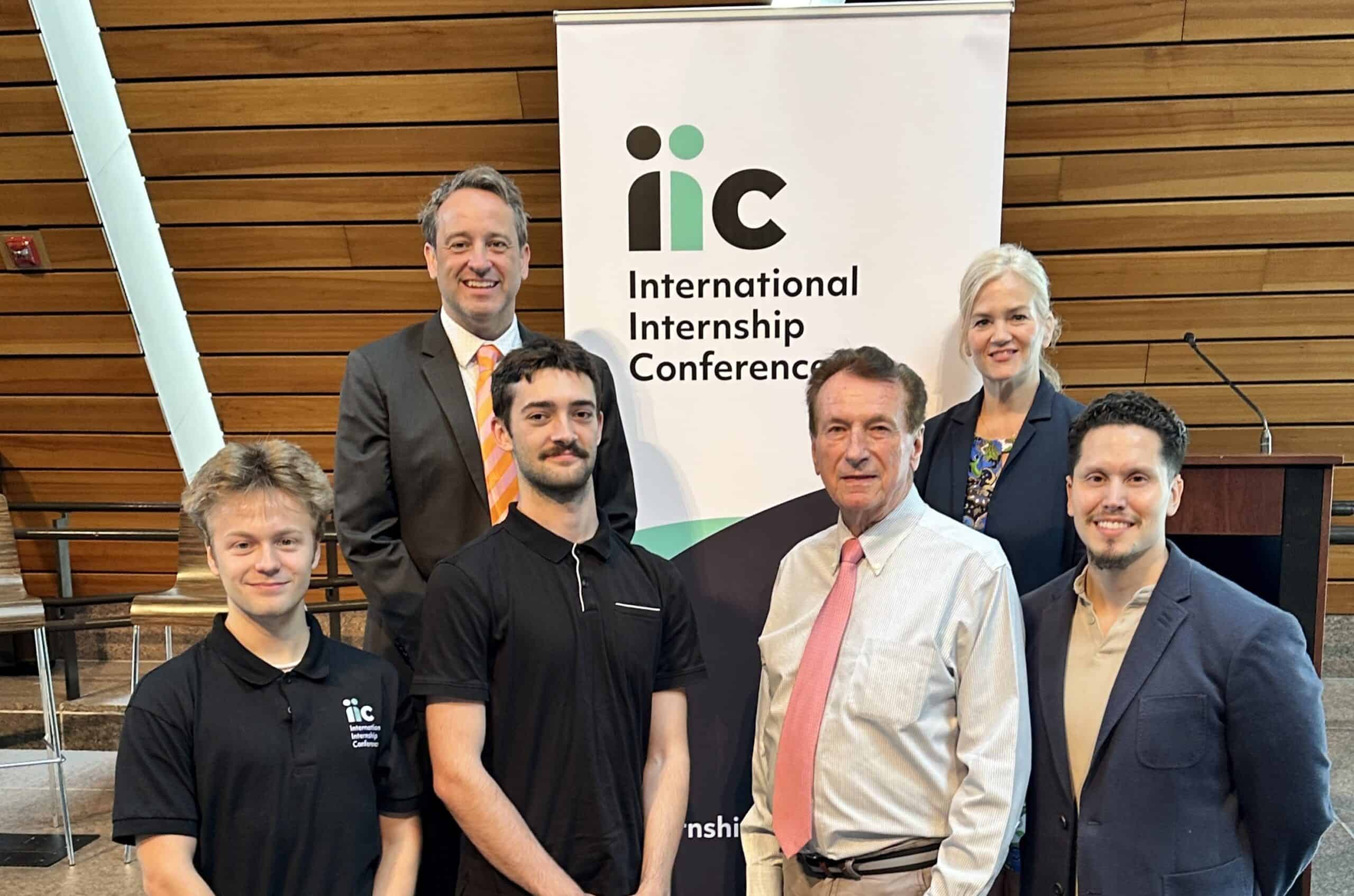
Welcoming delegates with a lyric from Minnesotan, Bob Dylan, International Internship Network founder and conference organiser, Matt Byrnes, set a reflective tone: “Come in… I’ll give you shelter from the storm.”
“We’re in the midst of a storm in post-secondary education,” explained Byrnes, who believes that IIC can offer colleagues a refuge from the onsalught on recent policy decisions that are impacting international education globally.
“IIC fosters an environment of tranquillity and confidence, where attendees explore study abroad solutions and partnerships that benefit their institutions and students,” he said.
Attendees from across the globe gathered to engage in sessions that ranged from employer site visits to focused panels and social receptions. Delegates included international internship providers, faculty, government representatives, employers, and students.
Central to the program was the conference’s annual debate. This year’s square off was entitled ‘Man vs Machine’ and tackled questions surrounding AI’s role in internship design and delivery. Moderated by The PIE‘s Maureen Manning, the session featured Kate Moore, principal and co-founder of the Global Career Center (GCC), Balaji Krishnan, vice provost at the University of Memphis, Greg Holz, assistant director for global engagement at the Univerity of Central Missouri, and Rishab Malhotra, founder and CEO of AIDO.
The panellists brought diverse perspectives, from AI ethics and corporate supervision to startup innovation and campus life. They debated how technology can support rather than supplant the human experience in relation to international expeiences.
Krishnan emphasised the importance of ethical frameworks in guiding AI development, warning against unchecked reliance on algorithmic tools without human oversight. Malhotra noted that while artificial intelligence can optimise logistics and placement processes, it cannot replicate human empathy or intercultural sensitivity – qualities central to global internships. Meanwhile, Holz offered a perspective from the corporate side, suggesting that when used thoughtfully, AI can streamline operations and free up supervisors to provide more meaningful mentorships. Moore closed by framing technology as an enabler rather than a replacement; a tool, not a teacher.
These discussions reflected a core concern echoed throughout the conference: how to maintain the integrity and purpose of internships while leveraging digital tools to scale access and impact.
Byrnes commented on the relevance of the conference’s direction: “IIC’s focus on the future of internships and technology is on point. At a time when academia is pivoting to prepare students for how AI is transforming the workplace, IIC attendees return to their campuses with much more knowledge about emerging technologies and how they can evolve internship programs to meet the needs of their students.”
The event also highlighted the important role of government partnerships in advancing work-integrated learning. International Experience Canada (IEC), one of the central partners of the conference, stated: “We congratulate IIC for its role as a leading organisation in advancing dialogue and partnerships on international experiential education, work-integrated learning and internships, and as one of IEC’s newest recognised organisation partners.”
Tech knowledge alone is not enough. We must support students to think critically, navigate complexity, and adapt with agility Maria Angeles Fernandes Lopez, Universidad de Camilo Jose Cela
Throughout the three-day event, many delegates indicated to the PIE that it is not a question of whether technology will shape the future of internships, but rather how to ensure that these tools enhance, not eclipse, the human dimensions of learning: mentorship, reflection, and cross-cultural understanding.
“Tech knowledge alone is not enough. We must support students to think critically, navigate complexity, and adapt with agility,” asserted Maria Angeles Fernandes Lopez, vice rector at Universidad de Camilo Jose Cela, the host institution for the IIC in 2026. At the passing of the torch ceremony at the conclusion of the conference, Byrnes and Lopez indicated their hope to build on the momentum and dialogue sparked in Minneapolis on the intersection between technology and humanity.
On this week’s episode of Economic Update, Professor Wolff provides updates on Medicare advantage and “pre-authorization” as a way to reduce Medicare payments, liberals and radicals split over Mamdani, Trump’s current budget further deepens the inequality of wealth across the US, and Mexico attends the BRICS meeting in Rio de Janeiro. In the second part of today’s show, Professor Wolff interviews Professor Henry Giroux from McMaster University, Canada, on capitalism, culture, and fascism in the U.S. today.
Wake Forest’s online offerings, now delivered in collaboration with Kaplan, are dressed in glowing promotional language. Prospective students are promised access to “a global network of 80,000+ alumni,” “1-on-1 guidance from a dedicated Student Success Manager,” and a curriculum shaped by “a Program Advisory Board of diverse business leaders.” The university assures working professionals that they can “earn a 100% online master’s degree or graduate certificate” on their own terms, with a “streamlined admissions process” and “flexible courses.”
But strip away the buzzwords and what’s left is a degree-granting operation outsourced to a for-profit education company with a controversial legacy. Kaplan, now owned by Graham Holdings (formerly the parent company of The Washington Post), has been at the center of lawsuits, regulatory scrutiny, and allegations of exploitative practices in its higher ed ventures—including its role in managing Purdue Global, formerly Kaplan University. The company has a long history of targeting vulnerable populations—especially working-class adults—with high-cost, low-value credentials that often don’t lead to the promised career outcomes.
So why is Wake Forest—an elite university with a storied reputation—collaborating with Kaplan?
The answer is simple: profit and scale.
In an era when even wealthy private universities are looking to expand their revenue streams, online education has become a lucrative frontier. But building and managing online degree programs in-house requires serious investment, time, and expertise. Enter Kaplan, which provides the infrastructure, marketing, enrollment management, and student support—all in exchange for a share of the revenue.
What does this mean for students?
It means that Wake Forest’s name is now being used to sell online degrees to mid-career professionals under the promise of prestige, convenience, and upward mobility—without the full intellectual, cultural, or communal experience that Wake Forest once symbolized. The degrees may bear the Wake Forest seal, but they are increasingly indistinguishable from the mass-produced credentials churned out by dozens of other universities that have sold access to their brands through partnerships with Online Program Managers (OPMs) like Kaplan, 2U, Wiley, and Coursera.
The “1-on-1 Student Success Manager” may sound supportive, but in practice these positions are often little more than call center roles staffed by Kaplan employees trained to ensure retention and upsell future courses—not to engage in meaningful academic mentorship.
The curriculum may be “developed and led by recognized faculty and industry experts,” but in many cases these are adjunct instructors or contract workers who have limited interaction with students and little say in the structure or pedagogy of the courses. This model contributes to the broader exploitation of contingent academic labor—an issue Wake Forest, like many elite universities, prefers not to discuss.
And the promise of becoming a leader “from anywhere” with a Wake Forest SPS degree? That too should be questioned. These degrees exist in an increasingly saturated credential market where employers are skeptical, return on investment is uncertain, and students often find themselves saddled with debt and disappointment.
If Wake Forest were truly committed to ethical leadership, it would take a hard look at the implications of commodifying its brand through a partnership with a company like Kaplan. Instead, it has chosen to chase market share and tuition revenue at the expense of its academic credibility—and at the risk of misleading students who believe they’re buying into the full Wake Forest experience.
The truth is this: Wake Forest is selling the illusion of prestige, wrapped in a glossy brochure of online convenience and corporate optimism. In reality, it’s another cog in a profit-driven machine that markets higher education as a product rather than a public good. And that’s not transformative change. That’s business as usual in the credential economy.
Texas state representative Brian Harrison has asked the U.S. Department of Health and Human Services to investigate his alma mater, Texas A&M University, for allegedly engaging in “discriminatory” student recruiting practices,The Dallas Express reported.
“In the state of Texas, government entities … should not be treating people differently based on anything other than merit,” Harrison told the outlet. “We have got to bring back a focus on meritocracy. And the president of Texas A&M brags about the fact that he’s doing it.”
According to a May letter to HHS acting general counsel Brian Keveney that Harrison posted on X, Texas A&M president Mark Welsh had sent him a letter “admitting @TAMU is still engaged in DEI courses and discriminatory ‘targeted recruiting’ practices.”
Welsh’s letter, which Harrison also included, criticizes the lawmaker for posting a video and other content online accusing the TAMU president of flouting the law.
“Your comments accompanying the video imply that the university is doing something illegal by engaging in ‘targeted’ student recruitment efforts,” Welsh’s letter says. “You’ve also posted about student groups and academic courses, which, like recruiting activities, are specifically exempted in the bill. Since you voted in favor of the law, you must also be aware of those exemptions.”
In his letter to Keveney, Harrison called Welsh’s defense—that Texas law does not explicitly ban targeted recruiting—“preposterous.” He asked HHS to “take any action[s] you or President Trump’s Task Force deem appropriate to ensure that Texas universities receiving federal funds are complying with the U.S. Constitution.”
Harrison told The Dallas Express that HHS had received his letter and is “taking it and handling it appropriately.”