Blog

  • Higher Education, High Hopes, and Heavy Bureaucracy

    Higher Education, High Hopes, and Heavy Bureaucracy

    by Phil Power-Mason and Helen Charlton

    UK higher education is pulled between its lofty ambitions for transformative learning and the managerialism that sometimes constrains their realisation. This tension defines the contemporary Higher Education workplace, where the mantras of “more with less” and “highly regulated freedom” collide with the desire for rich, personalised student experiences amidst fiscal belt-tightening, quantification, and standardisation. Bubbling through the cracks in any long-term political or economic vision for the sector is a professional identity steeped in ambivalence of purpose and position, one whose contradictions are nowhere rendered more vividly than in England’s higher and degree apprenticeships (HDAs). Conceived to braid university learning with workplace productivity, HDAs promise the best of both worlds yet must be delivered within one of the most prescriptive funding and inspection regimes in UK higher education. This provision also sits amidst a precarious and volatile political landscape, with continuous changes to funding rules, age limits and eligibility of different levels of study, and ‘fit’ within a still poorly defined skills and lifelong learning landscape.  

    At the heart of this ongoing policy experiment stands an until-recently invisible workforce:  Higher Education Tripartite Practitioners (HETP). These quiet actors emerged as a series of pragmatic institution level responses to the Education and Skills Funding Agency (ESFA, now subsumed into the Department of Education) related to progress reviews involving the provider, apprentice, and employer. Yet, as we argued in our paper at the SRHE International Conference in December last year, they have evolved into nuanced, often misunderstood boundary-spanners who simultaneously inhabit academia, industry, and compliance. Part coach, part conduit, part compliance specialist, they facilitate developmental conversations, broker cultural differences, and ensure every clause of the ESFA rulebook is honoured. The quality of this brokerage is decisive; without it even the most carefully designed apprenticeship fractures under audit pressure.

    Consider the core activities of HETPs. Much of their time is spent in close personal engagement with apprentices – fostering professional growth, guiding reflective practice, and offering pastoral support traditionally associated with mentoring. They encourage apprentices to think holistically, integrate theory with workplace reality, and map long-term career aspirations. Almost simultaneously, they must document progress reviews, monitor the evidence of every single hour of learning, and tick every regulatory box along a journey from initial skills analysis through to end point assessment.

    This duality produces a daily oscillation between inspiring conversations and tedious paperwork. The tension is palpable and exhausting, revealing a deeper struggle between two visions of education: one expansive, transformative, and relational; the other restrictive, measurable, and dominated by compliance. Fuller and Unwin’s expansive–restrictive continuum maps neatly onto this predicament, underscoring how universities are urged by policymakers to deliver high-skilled graduates for economic growth while simultaneously squeezed by intensifying regulation and managerial oversight.

    Little wonder, then, that HETPs describe their roles with the language of complexity, ambiguity, and invisibility. They are neither purely academic nor purely administrative. Instead, they occupy a liminal institutional space, mediating competing demands from employers, regulators, apprentices, and colleagues. Esmond captures the resulting “subaltern” status of these practitioners, whose contributions remain undervalued even as they shoulder the brunt of institutional attempts to innovate without overhauling legacy systems.

    Their experiences lay bare the contradictions of contemporary university innovation. Institutions routinely trumpet responsiveness to labour-market need yet bolt new programmes onto structures optimised for conventional classroom delivery, leaving HETPs to reconcile expansive educational ideals with restrictive managerial realities. The role becomes a flashpoint: universities ask boundary-spanners to maintain quality, build relationships, and inspire learners within systems designed for something else entirely.

    Yet amidst these tensions lies opportunity. The very ambiguity of the HETP role highlights the limits of existing support systems and points towards new professional identities and career pathways. Formal recognition of boundary-spanning expertise – relationship-building, negotiation, adaptability – would allow practitioners to progress without abandoning what makes their contribution distinctive. Communities of practice could break the apprenticeship echo-chamber and enrich the wider HE ecosystem, while institutional investment in bespoke professional development would equip practitioners to navigate the inherent tensions of their work.

    Senior leadership must also acknowledge the strategic value of these hidden roles, reframing them not as incidental administrative burdens but as essential catalysts for integrated educational practice. Making such roles visible and valued would help universities reconcile expansive aspirations with regulatory realities and signal genuine commitment to reshaping education for contemporary challenges.

    Policymakers and regulators, too, have lessons to learn. While accountability has its place, overly rigid compliance frameworks risk stifling innovation. Trust-based, proportionate regulation – emphasising quality, transparency, and developmental outcomes – would free practitioners to focus on learning rather than bureaucratic survival. The current neo-liberal distrust that imagines only regulation can safeguard public value inflates compliance costs and undermines the very economic ambitions it seeks to serve.

    Ultimately, the emergence of HETPs challenges HE institutions to decide how serious they are about bridging academic learning and workplace practice. Recognising and empowering these quiet brokers would signal a genuine commitment to integrated, expansive education – an education capable of meeting economic demands without losing sight of deeper human and intellectual aspirations. HETPs are far more than practitioners managing checklists; they are a critical juncture at which universities must choose either to treat boundary-spanning labour as a stop-gap or to embrace the complexity and potential it represents.

    Dr Phil Power-Mason is Head of Department for Strategic Management at Hertfordshire Business School, University of Hertfordshire, where he leads a diverse portfolio spanning executive education, apprenticeships and professional doctorates. A practice-focussed academic with a passion for innovative workforce development, Phil has overseen significant growth in the school’s business apprenticeships, MBA, and generalist provision, while nurturing cross-sector partnerships and embedding work-aligned learning at every level. With a research background in educational governance and strategy, he is a Senior Fellow of Advance HE and co-convenor of national apprenticeship knowledge networks. Phil’s research and sector leadership focus on emerging pedagogic and HE workforce practices, driving collaborative solutions that meet employer, learner and university needs. An invited speaker at national forums and a frequent contributor to sector conferences and publications, he remains committed to transforming vocational and work-ready learning practice for the future. (herts.ac.uk)

    Dr Helen Charlton is Associate Professor of Work Aligned Learning and Head of Executive Education at Newcastle Business School, Northumbria University, where she leads the school’s business apprenticeships, executive CPD and distance-learning programmes. After almost a decade steering apprenticeship design and compliance, she stays keenly attuned to each fresh regulatory tweak – and the learning opportunities it provides. A former senior HR manager in the arts and not-for-profit sectors, Helen holds a Doctorate in Education and an MSc in Human Resource Management, is a Senior Fellow of Advance HE, a Chartered MCIPD, and a Chartered Manager and Fellow of the CMI. Her research examines how learners, employers and universities negotiate the tripartite realities of degree apprenticeships. (northumbria.ac.uk)


    Author: SRHE News Blog

    An international learned society, concerned with supporting research and researchers into Higher Education

    Source link

  • Top Tips: Take photos that stand out

    Top Tips: Take photos that stand out

    You want to know what it’s like being a photojournalist? Do you need to take photos to illustrate an article for school publication? We asked Simone Åbacka, a photojournalist for Vasabladet in Finland, to tell us how to get inspired and make sure your photos stand out.

    “Photos nowadays are quick and easy to make, but to get a picture that really captures your audience and the viewer, that will require a bit more from you as a photographer,” Åbacka said.

    She said that photojournalists have to be out where the action is, she said.

    “So if you’re interested in a certain person, you can follow them along for a day or find a street market or a protest or something happening in your area,” Åbacka said. “So look for something that interests you and go and shoot that.”

    When you have already done a story or you are asked to provide photos for a story that has already been done, try taking a photo yourself instead of trying to find one online.

    If the story is about traffic jams, for example, go out and take a photo of the chaos and the moving cars.

    “You want your photos to get attention and be seen,” she said.

    Åbacka’s five tips for stand out photos

             1. Move around and try different kinds of angles.

    2. Look for emotion

    3. Look for good lighting

    4. Use your environment to tell viewers more about the subject

    5. Use a clean background for your subject.

    You don’t need a professional camera to take stunning photos, a phone will do. But know its limits, Åbacka said. “It can’t do everything,” she said.

    This video was produced as part of News Decoder’s partner project Mobile Stories. Mobile Stories is a publishing tool for young people. It provides guidance on how to create trustworthy news content while upholding journalist ethics.

    Watch Simone Åbacka’s video here: 

    At News Decoder, our editors, educators and correspondents guide students through the journalistic writing process to help them get a first-hand understanding of big global issues and connect across borders. From finding a story to interviewing to editing, we work closely with students to develop their skills using our Pitch-Report-Draft-Revise technique. Student stories are published on our website, social media and in our Educators’ Catalog alongside the work of professional journalists and industry experts.

    If you’re an educator looking to engage your students in media literacy programmes, a teacher in need of interesting resources or a writer looking for an outlet, find out more and get in touch at news-decoder.com


    Questions to consider:

    1. Why would a photo you take be better than one you can find online?

    2. What kind of emotion could you capture in a photograph?

    3. How can you use your environment to tell viewers more about the subject?


    Source link

  • Fahmi Quadir, Adtalem, and the High-Stakes Ethics of Short-Selling

    Fahmi Quadir, Adtalem, and the High-Stakes Ethics of Short-Selling

    In the realm of Wall Street, few figures challenge the system from within quite like Fahmi Quadir. Known in financial circles as “The Assassin,” Quadir has made a name—and a mission—for herself by exposing fraud and predatory behavior in publicly traded companies. But unlike most short-sellers chasing profits on volatility, Quadir brings a moral clarity to her work, emphasizing that short-selling can be an instrument of justice when practiced with rigor, purpose, and transparency. Her recent campaign against Adtalem Global Education, a for-profit college conglomerate, underscores the power—and danger—of this approach.

    Fahmi Quadir is the founder and Chief Investment Officer of Safkhet Capital, a short-only hedge fund she launched in 2017 at the age of 26. Safkhet is not your typical Wall Street operation. Built on deep forensic research and a mission to hold corporations accountable, the firm takes bold, high-conviction positions against companies it believes are engaged in deception, exploitation, or fraud.

    Quadir’s career trajectory is as unlikely as it is impressive. She originally planned to pursue a PhD in mathematics, but a series of encounters at New York’s National Museum of Mathematics—funded by quantitative finance giants like Renaissance Technologies—introduced her to a world where market dynamics and moral imperatives could collide. She quickly realized that capital markets held not just monetary power, but the potential to drive social change. With no formal finance background, she was identified by hedge fund insiders as a natural fit for short-selling. She dove in, eventually appearing in the 2018 Netflix documentary Dirty Money, which chronicled her pivotal role in the takedown of Valeant Pharmaceuticals.

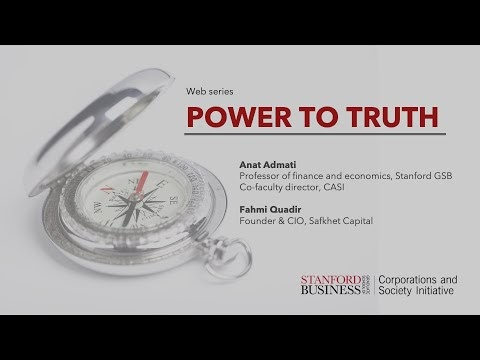
    In February 2024, Quadir spoke at Stanford’s Graduate School of Business during an event hosted by the Corporations and Society Initiative (CASI). In a conversation moderated by JD/MBA student Thomas Newcomb, she unpacked her approach to short-selling—one defined by intellectual rigor, emotional resilience, and moral conviction.

    “Short selling means you borrow shares from your bank, sell them, and hope the price drops so you can buy them back at a lower price and pocket the difference,” Quadir explained. “But prices can go up infinitely. The potential losses on a short are also infinite.”

    That risk, she emphasized, is not theoretical—it’s lived. “You need to withstand a lot of pain,” she said. “Short-selling isn’t for everyone. It’s about doing uncomfortable work, challenging popular narratives, and being willing to look like a fool—until you’re proven right.”

    And yet, in Quadir’s view, this discomfort is necessary. “Shorting is important for the functioning of our markets. It provides liquidity and price discovery. But in a tiny corner of the market, there are those of us who are using short selling as a way to expose injustice and correct bad capital market behavior.”

    Quadir focuses on companies she believes are harming customers or committing fraud, rather than chasing momentum or hype. “We avoid situations of mass delusion,” she noted, “because mass delusion can stay delusional forever.”

    Her most famous case remains the takedown of Wirecard AG, a German electronic payments firm that collapsed in 2020 amid massive accounting fraud. Safkhet’s 25% short position on Wirecard was the culmination of years of research and collaboration with whistleblowers and law enforcement. It was a textbook example of what Quadir calls “story-driven” short-selling—piecing together a company’s past to uncover the rot at its core.

    She recounted a chilling origin story involving Wirecard’s founders, Markus Braun and Jan Marsalek—who is now a confirmed Russian agent—and an Austrian billionaire with ties to adult entertainment who allegedly used intimidation tactics to force a takeover. “When that’s part of your origin story,” she said, “whatever comes after is going to be epic.”

    But Quadir’s sights have recently turned toward a different kind of fraud—one operating under the guise of education. In January 2024, Safkhet Capital released a detailed short report on Adtalem Global Education, labeling it a “toxic byproduct of an imperfect higher education system.” The report highlighted Adtalem’s dependence on federal student aid—more than 70% of its revenue—and exposed dismal outcomes at its institutions, including Walden and Chamberlain universities, both of which serve a disproportionately high number of Black and working-class women.

    The report also noted a financial responsibility score of 0.2 out of 3.0—far below the threshold used by the U.S. Department of Education to flag institutions at risk of mismanaging federal funds. In Quadir’s view, Adtalem wasn’t just financially shaky—it was “completely uninvestable.”

    The market agreed. Following Safkhet’s report, Adtalem’s stock dropped 19% in a single day, with further losses in the days that followed. The company attempted to halt trading and accused Quadir of “short and distort” tactics—a claim that fell flat. “It was very satisfying after that hold was released to see the market validate our thesis,” she said. “Their strategy backfired.”

    At Stanford, Quadir reflected on why she made the Adtalem report public: “There was an informational vacuum around this company. The shareholder base was largely passive. No one was doing the kind of research or analysis we were doing.”

    But Quadir is quick to point out that short-sellers alone cannot fix a broken system. “Nothing is going to change if there isn’t enforcement,” she said. “We need to have some high-profile cases where people go to jail. These characters continue to get away with it or settle, and what happens? Their stocks go up.”

    She remains hopeful, however, that markets—if given the right incentives—can self-correct. “I think the greatest believers in market efficiency have to be short sellers. I believe capital markets can correct bad behavior, and that benefits all of us.”

    Short-selling, when practiced ethically, is not about sabotage. It is about storytelling, investigation, and risk—a lot of risk. Quadir’s approach requires patience, emotional stamina, and intellectual courage. It is not for the faint of heart. But in a world where regulators are often captured and media attention can be fleeting, short-sellers like Quadir play an essential, if controversial, role.

    Her work against Adtalem is not just a case study in financial activism. It is a call to reexamine how markets reward failure, how federal funds prop up predatory institutions, and how silence—especially in higher education—can be bought. As Quadir puts it, “We have the power to affect change. We just have to be willing to take the hits.”

    Sources

    This article draws significantly from the February 2024 Stanford Graduate School of Business event, A Conversation with Fahmi Quadir, Wall Street’s Fearless Short Seller, hosted by the Corporations and Society Initiative (CASI). The event transcript and summary are available at https://casi.stanford.edu/news/conversation-fahmi-quadir-wall-streets-fearless-short-seller.

    Additional information was compiled from the Safkhet Capital short report on Adtalem Global Education (January 2024), publicly available statements by Adtalem Global Education, coverage of Adtalem’s stock movement by MarketWatch and Bloomberg, investigations into Wirecard by the Financial Times, and Quadir’s portrayal in the 2018 Netflix documentary Dirty Money.

    Legal responses to Safkhet’s report were also noted from Pomerantz LLP and Block & Leviton, which opened shareholder investigations into Adtalem in January 2024. Data from the U.S. Department of Education regarding Title IV funding and financial responsibility scores was used to contextualize Adtalem’s regulatory risk.

    For further background on short-selling’s role in price discovery and enforcement gaps in higher education, see related coverage in The Wall Street Journal, The Chronicle of Higher Education, and Inside Higher Ed.

    Source link

  • Prabhas Moghe, Rutgers University – The PIE News

    Prabhas Moghe, Rutgers University – The PIE News

    Introduce yourself in three words or phrases.

    I am an educator, an innovator, and a scholar.

    What do you like most about your job?

    Oh gosh, I love my job. I think what I really enjoy is the expanse, the scope, the landscape, it’s huge. I love that we are not just solving problems, we are actually defining them.

    Best work trip/Worst work trip?

    The best work trip? I have had so many good ones. This (APAIE 2025, Delhi, and overall India tour) has been a great work trip.

    But I also had a fantastic trip to London with my foundation president. We went together and ran a workshop on “friend-raising”, instead of just fundraising, the idea is to build genuine relationships. UK universities were trying to learn it, and since US universities are a bit ahead in that area, we worked with them. That was really fun.

    I also went to South Korea on a work trip. I love South Koreans, and I love the country, but they made me work so hard. The person who planned the trip, god bless her, packed the schedule so tight that I did not get even one hour of sightseeing.

    It was a 14–15 hour flight to Seoul, and the trip ended up being the kind of hard work that South Koreans put in every single day.

    If you could learn a language instantly, which would you pick and why?

    Definitely Mandarin and Spanish. I was foolish enough to promise a class at the University of Puerto Rico that, “next time I visit, I promise I will give you the lecture in Spanish”, so it ain’t happening. But I do take pride in speaking multiple languages, I would say I am fluent in at least five. I even started learning Mandarin with Rosetta Stone (language learning software). I didn’t get too far, but I absolutely love how the language sounds.

    What makes you get up in the morning?

    I think what drives me is a genuine passion for the work. There’s just so much to be done.

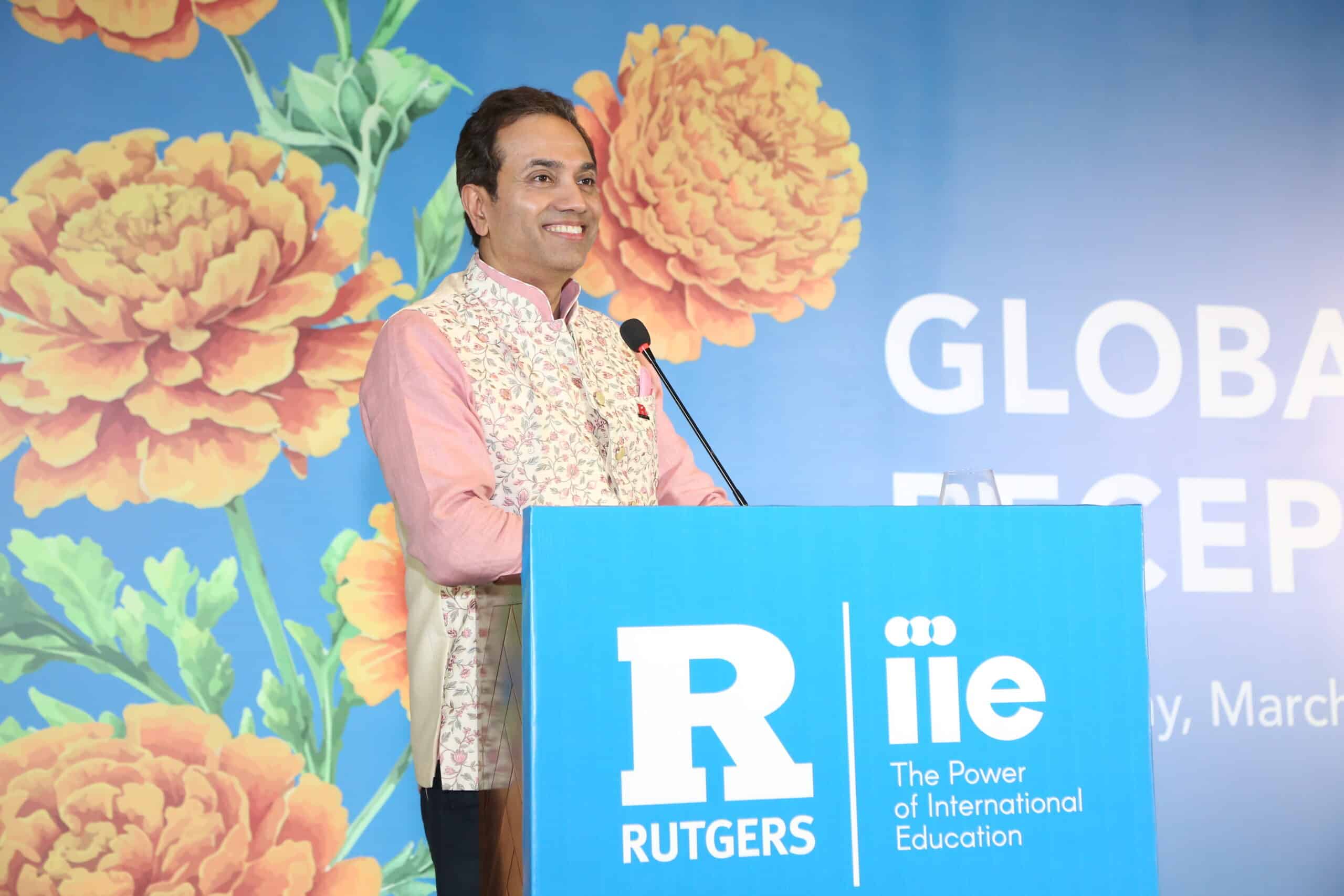
    As the chief academic officer at Rutgers, my role is about having a deep, self-aware understanding of the institution, in ways that few others might. While everyone else is focused on their specific responsibilities, I am constantly looking at the institution as a whole.

    How do we stay true to our mission? How do we improve? How do we gain recognition? And how do we move the needle on our academic standing?

    These are broad, complex challenges, but that’s what makes the work so meaningful.

    Champion/cheerleader which we should all follow and why?

    There are so many influential people now, and they each teach you something different. I have learned a lot from Kailash Satyarthi, Nobel Peace Prize winner, especially his approach to life.

    For instance, I was really impressed by Jennifer Doudna after reading her biography, The Code Breaker, which is written by Walter Isaacson.

    I am actually very intrigued by Isaacson himself, someone who writes about others so insightfully. He’s also written about Steve Jobs. The way he pieces together these stories is fascinating.

    In The Code Breaker, what struck me was how science and research are portrayed as incredibly competitive fields. And yet, the breakthroughs often come in these magical, nonlinear moments, when the right people come together with the right tools, and suddenly, something clicks.

    That idea of serendipity, of miraculous intersections, it really resonated with me. No one creates miracles alone; you need a village.

    The book also shows how intensely competitive some of these research groups can be.

    But more than anything, what stood out was the brilliance, the hard work, and the value of good observers, people who can see the bigger picture. I think we need more of those champions.

    Best international ed conference and why

    I think this is a very cool conference (APAIE 2025). I was walking around the booths, and was at a roundtable with several presidents and vice-chancellors. It’s really exciting because this is not what higher education looked like 20 or 30 years ago.

    What you see here today is different countries like Canada, Hong Kong, Malaysia, the UK coming together. It’s like the whole world is showing up and saying, Come be a part of us”.

    Worst conference food/beverage experience

    I was at a meeting at the World Biomaterials Congress, I think it was in Chengdu, China.

    We went out to eat, and let’s just say where we ate you’re pretty much eating reasonably raw food. That was pretty challenging.

    I mean I love Chinese food, I love Sichuan food, but that was challenging.

    Book or podcast recommendation for others in the sector?

    Definitely The Code Breaker by Isaacson, I would recommend that to people. I think it’s a pretty interesting book. If you are looking for something educationally oriented, then there’s Building Research Universities in India by Pankaj Jalote.

    I’m very impressed with how he’s drawn on the research in terms of how things have changed over the last hundred years, how India’s research landscape has changed.

    I am listening to a whole bunch of podcasts. Dementia Matters, a podcast about Alzheimer’s disease and other causes of dementia, is something I am really liking.

    Source link

  • Common Sense Media releases AI toolkit for school districts

    Common Sense Media releases AI toolkit for school districts

    Key points:

    Common Sense Media has released its first AI Toolkit for School Districts, which gives districts of all sizes a structured, action-oriented guide for implementing AI safely, responsibly, and effectively.

    Common Sense Media research shows that 7 in 10 teens have used AI. As kids and teens increasingly use the technology for schoolwork, teachers and school district leaders have made it clear that they need practical, easy-to-use tools that support thoughtful AI planning, decision-making, and implementation.

    Common Sense Media developed the AI Toolkit, which is available to educators free of charge, in direct response to district needs.

    “As more and more kids use AI for everything from math homework to essays, they’re often doing so without clear expectations, safeguards, or support from educators,” said Yvette Renteria, Chief Program Officer of Common Sense Media.

    “Our research shows that schools are struggling to keep up with the rise of AI–6 in 10 kids say their schools either lack clear AI rules or are unsure what those rules are. But schools shouldn’t have to navigate the AI paradigm shift on their own. Our AI Toolkit for School Districts will make sure every district has the guidance it needs to implement AI in a way that works best for its schools.”

    The toolkit emphasizes practical tools, including templates, implementation guides, and customizable resources to support districts at various stages of AI exploration and adoption. These resources are designed to be flexible to ensure that each district can develop AI strategies that align with their unique missions, visions, and priorities.

    In addition, the toolkit stresses the importance of a community-driven approach, recognizing that AI exploration and decision-making require input from all of the stakeholders in a school community.

    By encouraging districts to give teachers, students, parents, and more a seat at the table, Common Sense Media’s new resources ensure that schools’ AI plans meet the needs of families and educators alike.

    This press release originally appeared online.

    eSchool News Staff
    Latest posts by eSchool News Staff (see all)

    Source link

  • Test yourself on this week’s K-12 news

    Test yourself on this week’s K-12 news

    From the “One Big, Beautiful Bill” to notable achievement gains in young students, what did you learn from our recent stories?

    Source link

  • Michigan district agrees to reform seclusion and restraint policies

    Michigan district agrees to reform seclusion and restraint policies

    This audio is auto-generated. Please let us know if you have feedback.

    Dive Brief:

    • Michigan’s Montcalm Area Intermediate School District is ending the practice of secluding students, reforming its restraint policies and making other improvements to special education services, according to an agreement between the school system and the U.S. Department of Justice.
    • DOJ, in a July 3 statement, said the district “used seclusion and restraint improperly, including using emergency crisis responses as punishment for normal classroom discipline issues,” leading to a violation of Title II of the Americans with Disabilities Act. The district, in a June 27 statement, said it had begun taking steps to improve its restraint and seclusion practices prior to the agreement.  
    • Federal investigations into schools’ restraint and seclusion practices over the past few years have led to reforms across the country as school systems work to balance student safety with their civil rights protections.

    Dive Insight:

    Montcalm Area ISD is an educational service agency that includes seven local districts, a public school academy and one virtual school. It serves about 12,000 students collectively, including about 1,800 students with disabilities.

    DOJ’s investigation found that students with disabilities in the district were restrained or secluded more than 2,400 times between the 2020-21 and 2022-23 school years.

    Under the agreement, the district will:

    • End seclusion for addressing student behaviors.
    • Halt the use of school rooms or other facilities for seclusion purposes.
    • Appoint a district-level intervention coordinator as a liaison between school principals and the superintendent, among other duties.
    • Create classroomwide behavior management plans for all classrooms in the district’s special education program to document consistent and developmentally appropriate rules, routines and techniques.
    • Ensure that restraint is only used to protect staff and students and only after all appropriate de-escalation techniques have failed.
    • Review whether students who were restrained or secluded are eligible for compensatory services and counseling.

    “Students with disabilities should never be discriminated against by experiencing the trauma of seclusion or improper restraint,” said Harmeet Dhillon, assistant attorney general of DOJ’s Civil Rights Division, in the July 3 statement.

    The week before, in a June 27 statement, Katie Flynn, superintendent of Montcalm Area ISD, said the district is “committed to providing a safe, nurturing, and welcoming learning environment.”

    According to the U.S. Department of Education’s Civil Rights Data Collection, about 105,700 public school students were physically restrained, mechanically restrained or placed in seclusion at schools across the country during the 2021-22 school year, the most recent year for which national data is available.

    Nationally, students with disabilities are disproportionally restrained and secluded in schools. Although students who qualify for special education services under the Individuals with Disabilities Education Act comprised 14% of the K-12 student enrollment in 2021-22, they represent 28% of students who were mechanically restrained, 68% of those who were secluded, and 76% who were physically restrained, according to the CRDC.

    Guidance issued in 2016 by the Education Department emphasizes that schools should never use restraint or seclusion for disciplinary purposes and that the practices should only be used if there is “imminent danger of serious physical harm to self or others.”

    The guidance also said if a student’s behavioral challenges lead to an emergency use of restraint or seclusion, it could be a sign of a disability that is interfering with the student’s progress in school, and therefore they should be evaluated to see if they qualify for special education services.

    Additional guidance issued earlier this year by the Education Department urged districts to take a more proactive approach to student behaviors by supporting students’ social, emotional, physical and mental health needs through multi-tiered systems of support that provide individualized interventions based on students’ needs for students with and without disabilities.

    Source link

  • Moody’s: Trump’s tough international student policies could hit some colleges hard

    Moody’s: Trump’s tough international student policies could hit some colleges hard

    This audio is auto-generated. Please let us know if you have feedback.

    Dive Brief:

    • The Trump administration’s restrictive policies for international students present a financial risk for many U.S. colleges by potentially deterring them from enrolling, Moody’s analysts said in a recent report. 
    • Analysts pointed to visa disruptions, increased scrutiny of social media accounts, changes to deportation rules, and recent travel bans and restrictions to the U.S. from 19 countries. The Trump administration has also created confusion around visas for Chinese students, who account for nearly a quarter of international students.
    • While the impact on upcoming academic terms remains unclear, the changing policies are “diminishing the perception of the US as a prime destination for higher education,” the analysts said.

    Dive Insight:

    Colleges have been bracing for potential revenue and enrollment hits since the second Trump administration quickly struck an aggressive approach to immigration and international students. 

    When the administration moved to bar Harvard University from enrolling international students, the private institution sought and won a court order temporarily blocking the move the next day

    The ongoing legal spat underscores just how critical international enrollment is for the Ivy League university. In the 2024-25 academic year, Harvard’s roughly 6,800 foreign students made up 27.2% of the university’s total student body.  

    And just this week, George Washington University cited, among other federal moves, a slowdown in visa processing and President Donald Trump’s travel bans when explaining the need for painful budget measures, including possible layoffs. 

    International students make up over 20% of enrollment at 11% of the colleges rated by Moody’s. But that figure may understate the financial impact of lower international enrollment. 

    Foreign students typically pay full tuition and fees at colleges, noted Moody’s analysts Debra Roane, vice president and senior credit officer, and Emily Raimes, associate managing director. And they do so at a time when the ranks of traditional-age college students are projected to decline significantly in the coming years. 

    “Universities intending to fill the gap with more international students may fall short,” Roane and Raimes said in the report. 

    The analysts ran a stress test on colleges rated by Moody’s to look at the financial impact of international student enrollment declines. Given a 10% drop in international enrollment, 54 out 392 institutions would suffer a hit to a measure of their operating performance of at least half a percentage point. Seven of those colleges would see those margins decrease by two to eight percentage points. 

    With a 20% drop in international enrollment, 130 colleges would lose at least half a percentage point from their margins, and 18 among them would lose two to eight points. Those with already low margins could face “significant financial stress,” Roane and Raimes said. 

    The analysts noted, however, that highly selective colleges or those with considerable financial reserves might “better absorb the impacts by adjusting operations or increasing domestic enrollment.” Other prominent colleges might be able to mitigate international student declines through alternative revenue sources like fundraising and endowment spending.

    But others could have a much tougher time. Roane and Raimes pointed to specialty institutions, such as arts colleges — which are already facing a tough environment — whose student bodies can be over 30% international.

    Source link

  • A Viral Wake-Up Call—Or CCP Propaganda?

    A Viral Wake-Up Call—Or CCP Propaganda?

    In a clip that’s rapidly gone viral among both left-leaning critics of neoliberalism and right-wing populists, a young Chinese TikTok influencer delivers a searing indictment of American economic decline. Fluent in English and confident in tone, the speaker lays bare what many struggling Americans already feel: that they’ve been conned by their own elites.

    “They robbed you blind and you thank them for it. That’s a tragedy. That’s a scam,” the young man declares, addressing the American people directly.

    The video, played and discussed on Judging Freedom with Judge Andrew Napolitano and Professor John Mearsheimer, has sparked praise—and suspicion. While the message resonates with a growing number of Americans disillusioned by the bipartisan political establishment, some are asking: Who is behind this message?

     
    A Sharp Critique of American Oligarchy

    In his 90-second monologue, the influencer claims U.S. oligarchs offshored manufacturing to China for profit—not diplomacy—gutting the middle class, crashing the working class, and leaving Americans with stagnating wages, unaffordable healthcare, mass addiction, and what he calls “flag-waving poverty made in China.” Meanwhile, he says, China reinvested its profits into its people, raising living standards and building infrastructure.

    “What did your oligarchs do? They bought yachts, private jets, and mansions… You get stagnated wages, crippling healthcare costs, cheap dopamine, debt, and flag-waving poverty made in China.”

    He ends with a provocative call: “You don’t need another tariff. You need to wake up… You need a revolution.”

    It’s a blistering populist critique—and one that finds unexpected agreement from Mearsheimer, who said on the show, “I basically agree with him. I think he’s correct.”
    A Message That Cuts Across Party Lines

    The critique echoes themes found in Donald Trump’s early campaign rhetoric, as well as long-standing leftist arguments about neoliberal betrayal, corporate offshoring, and elite impunity. It’s the kind of message that unites the American underclass in its many forms—service workers, laid-off factory employees, disillusioned veterans, and student debtors alike.

    Mearsheimer went on to argue that the U.S. national security establishment itself was compromised—that its consultants and former officials had deep financial ties to China, making them unwilling to confront the geopolitical risks of China’s rise. According to him, elites were more invested in their own gain than in the national interest.

    But that raises an even more complicated question.

     
    Is This an Authentic Voice—or a CCP Production?

    The most provocative—and potentially overlooked—aspect of this story is the medium itself: TikTok, which is owned by ByteDance, a company under heavy scrutiny for its ties to the Chinese Communist Party (CCP). Could this slick, emotionally resonant video be part of a broader soft-power campaign?

    The Chinese government has invested heavily in media operations that shape global narratives. While the content of the message may be factually accurate or emotionally true for many Americans, it’s not hard to imagine the CCP welcoming—if not engineering—videos that sow further division and distrust within the United States.

    The video’s flawless production, powerful rhetoric, and clever framing—presenting China as the responsible partner and the U.S. as self-destructive—align closely with Beijing’s global messaging. Add to this the timing, with U.S.-China tensions running high over tariffs, Taiwan, and global power shifts, and the question becomes unavoidable:

    Is this sincere grassroots criticism… or a polished psychological operation?

    The answer may be both. It’s entirely possible that the young man believes everything he’s saying. But it’s also likely that content like this is algorithmically favored—or even quietly encouraged—by a platform closely tied to a government with every incentive to highlight American decline.
    Weaponized Truth?

    This is not a new tactic. During the Cold War, both the U.S. and the USSR employed truth-tellers and defectors to criticize their adversaries. But in today’s digital landscape, the boundaries between propaganda, whistleblowing, and legitimate dissent are more porous than ever.

    The Higher Education Inquirer has reported extensively on how American elites—across both political parties—have betrayed working people, including within the halls of higher education. That doesn’t mean we should ignore where a message comes from, or what strategic purpose it might serve.

    The danger is not just foreign interference. The greater danger may be that such foreign-origin messages ring so true for so many Americans.
    A Closing Thought: Listen Carefully, Then Ask Why

    The influencer says:

    “You let the oligarchs feed your lies while they made you fat, poor, and addicted… I don’t think you need another tariff. You need to wake up.”

    He’s not wrong to say Americans have been exploited. But if the message is being boosted by a rival authoritarian state, it’s worth asking why.

    America’s problems are real. Its discontent is justified. But as in all revolutions, the question is not only what we’re overthrowing—but what might take its place.

    Sources:

    Judging Freedom – Judge Andrew Napolitano and Professor John Mearsheimer

    TikTok (ByteDance) ownership and CCP ties – Reuters, The New York Times, Wall Street Journal

    The Higher Education Inquirer archives on student debt, adjunct labor, and corporate-academic complicity

    Pew Research Center – Views of China, U.S. Public Opinion

    Congressional hearings on TikTok and national security, 2023–2024

    Source link

  • Why English language testing matters for UK higher education

    Why English language testing matters for UK higher education

    The UK is at a pivotal moment when it comes to the English language tests it uses to help decide who can enter the country to study, work, invest and innovate.  

    The government’s new industrial strategy offers a vision for supporting high-value and high-growth sectors. These sectors – from advanced manufacturing and creative industries, to life sciences, clean energy and digital – will fuel the UK’s future growth and productivity. All of them need to attract global talent, and to have a strong talent pipeline, particularly from UK universities. 

    This summer’s immigration white paper set out plans for new English language requirements across a broader range of immigration routes. It comes as the Home Office intends to introduce a new English language test to provide a secure and robust assessment of the skills of those seeking to study and work in the UK.  

    In this context, the UK faces a challenge: can we choose to raise standards and security in English tests while removing barriers for innovators? 

    The answer has to be ‘yes’. To achieve, as the industrial strategy puts it, “the security the country needs… while shaping markets for innovation,” will take vision. That clearly needs government, universities and employers to align security and growth. There are no short-cuts if we are serious about both.  

    The sectors that will power the industrial strategy – most notably in higher education, research and innovation – are also those most boxed in by competing pressures. These pressures include the imperative to attract world-class talent and the need to show that those they help bring to the country are well-qualified.  

    But these pressures do not have to box us in. We need not compromise on security or growth. We can achieve both.   

    Getting English testing right is a critical part of the solution. That means putting quality and integrity first. We should demand world-class security and safeguards – drawing on the most sophisticated combination of human and artificial intelligence. It also means deploying proven innovations – those that have been shown to work in other countries, like Australia and Canada, that have adjusted their immigration requirements while achieving talent-led growth.   

    Decision-making around English language testing needs to be driven by evidence – especially at a time of flux. And findings from multiple studies tells us that those students who take high-quality and in-depth tests demonstrate greater academic resilience and performance. When it comes to high-stake exams, we should be setting the highest expectations for test-takers so they can thrive in the rapidly changing economy that the country is aspiring to build.  

    The government and high-growth sectors, including higher education, have an opportunity to grow public confidence, prioritise quality and attain sustainable growth if we get this right.  

    Decision-making around English language testing needs to be driven by evidence – especially at a time of flux

    International students at UK universities contribute £42 billion a year to the economy. (As an aside, the English language teaching sector – a thriving British export industry – is worth an additional £2 billion a year, supporting 40,000 jobs.) Almost one-in-five NHS staff come from outside the UK. 

    More than a third of the UK’s fastest-growing startups have at least one immigrant co-founder. Such contributions from overseas talent are indispensable to the country’s future success – and the industrial strategy’s “focus on getting the world’s brightest minds to relocate to the UK” is smart.  

    At Cambridge, we help deliver IELTS, the world’s most trusted English test. Over the decades, we’ve learned that quality, security and innovation reinforce one another. It’s why we draw on our constantly evolving knowledge of linguistics to make sure our tests assess the real-life language skills people use in actual academic and professional environments. 

    Technological innovations and human intelligence must be central to the test-taking experience: from content creation to exam supervision to results delivery. Having one without the other would be reckless.    

    We should deploy the latest data science and AI advances to spot risks, pinpoint potential fraud, and act intelligently to guarantee a system that’s fair for all. IELTS draws on proven AI and data science developments to prevent fraud and improve the information available to institutions like universities, businesses and UKVI.  

    As the government takes its industrial strategy, immigration reforms and English testing changes forward, it’s vital that departments coordinate on the shared opportunities, and tap into the best evidence available.  

    This is complex work. It requires a collaborative spirit, creative thinking and deep expertise. Fortunately, the UK has plenty of that. 

    About the author: Pamela Baxter is managing director, IELTS at Cambridge University Press & Assessment

    Source link