A group of Texas law school deans is urging the state Supreme Court to uphold American Bar Association accreditation standards for public law schools. The state’s highest court announced in April that it was considering dropping the ABA requirement for licensure, opening a public comment period on the matter that closed July 1.
“We strongly support continued reliance on ABA accreditation for Texas law schools and licensure eligibility,” the deans of eight of the state’s 10 ABA-accredited law schools wrote in a letter to the Texas Supreme Court. “ABA accreditation provides a nationally recognized framework for quality assurance and transparency; portability of licensure through recognition of ABA accreditation by all 50 states, which is critical for graduates’ career flexibility; consumer protections and public accountability through disclosure standards; and a baseline of educational quality that correlates with higher bar passage rates and better employment outcomes.”
Though the Texas justices did not say why they were reviewing ABA accreditation, the law deans’ letter noted that the body has already suspended its DEI standards—a move it announced in February and then extended in May through Aug. 31, 2026. That means “the language of the Standard can be revised in accordance with federal constitutional law and Texas state law that bar certain diversity, equity and inclusion practices at state universities,” the deans wrote.
Of the state’s ABA-accredited law schools’ deans, only Robert Chesney of the University of Texas and Robert Ahdieh of Texas A&M didn’t sign the letter, Reuters reported.
In his own nine-page letter to the state Supreme Court, Chesney urged the justices to look at “alternative” pathways for ensuring law school standards “to help pave the way for innovative, lower-cost approaches to legal education.”
Ahdieh told Reuters that whatever the court decides about ABA accreditation, it’s “critical” that law degrees earned in Texas remain portable.
Speaking at the Metascience 2025 conference in London, Maria Leptin said such data is in a “very precarious” position. Since Donald Trump began his second term as U.S. president, researchers have raced to archive or preserve access to U.S.-hosted data sets and other resources at risk of being taken down as the administration targets research areas including public health, climate and fields considered to be related to diversity.
“We’ve heard the situation from the U.S. where some data are disappearing, where databases are being stopped, and this is really a wake-up call that we as a community need to do more about this and Europe needs to do more about it,” Leptin said.
The ERC president highlighted the Global Biodata Coalition, which aims to “safeguard the world’s open life science, biological and biomedical reference data in perpetuity,” noting that the European Commission recently published a call to support the initiative.
“Medical research critically depends on the maintenance and the availability of core data resources, and that is currently at risk. Some of these resources may disappear,” she said. “I really encourage all policymakers and funders to join the coalition.”
“Right now is the worst time to not have access to data in view of the power of AI and the advances in computing, large language models, et cetera,” Leptin told the conference, noting that the Trump administration is not the only threat to accessible data. “The value of the data that are held across Europe is unfortunately massively reduced because of fragmentation, siloing, and uneven access.”
A recent ERC workshop involving researchers, policymakers, industry representatives and start-ups raised some “shocking” concerns about health data, she added. “Even in the same town where researchers wanted to access the huge numbers of data that the hospitals in that town had, it was impossible because the hospitals couldn’t even share data with each other, because they used totally different data formats.”
Boosting access to data will require “a huge effort,” Leptin acknowledged. “We of course need technical, legal and financial frameworks that make this possible and practical, [as well as] interoperable formats and common standards.”
While not a data infrastructure in itself, the ERC “has a role to play” in improving accessibility, she said. “What we try to do is to set expectations around good data practices.”
“We do need European-level solutions,” Leptin stressed. “The scientific questions we face, whether in climate or health or technology or [other fields], don’t stop at national borders—in fact, they are global.”
The Trump administration is holding up hundreds of millions of dollars slated for adult education programs as part of a review of education spending.
The roughly $716 million was supposed to be disbursed to states July 1 and then divvied up among their adult education providers, such as community colleges. But the funding for high school equivalency classes, English as a second language programs and other adult education services never arrived. The news comes as the Trump administration continues to withhold $7 billion from states for K–12 education, including ESL classes and after-school programs, which includes the adult education money.
The freeze is part of a broader “ongoing programmatic review of education funding,” an unnamed spokesperson for the Office of Management and Budget wrote in a statement to Inside Higher Ed.
“Initial findings show that many of these grant programs have been grossly misused to subsidize a radical leftwing agenda,” wrote the OMB spokesperson, citing examples of states and schools using the money to support students in the country without proper documentation as well as for a seminar on “queer resistance in the arts,” though the statement made no mention of adult ed programs.
The fate of the withheld funding remains unclear. “No decisions have been made yet,” the spokesperson said.
Now states and their community colleges, which offer a significant share of adult education programs, are scrambling to figure out how to continue providing adult education services despite staggering funding shortfalls.
“If funding is not provided, there are nothing but bad options for institutions,” said David Baime, senior vice president for government relations for the American Association of Community Colleges. He predicts community colleges would have to reduce adult education services, lay off personnel and vie for funds to fill in the gap from states and other sources. But even so, “the funding is so substantial in a number of places that there’s no immediate source of replacing that money.”
He emphasized that adult education programs have received “broad support from both parties for decades”—and they were already underfunded relative to student need.
Adult basic education is “a core function and a core part of the mission of community colleges across the country,” he said.
Adult education is one of several programs on the chopping back in the Education Department’s proposed budget for fiscal year 2026. Officials wrote in budget documents that states and localities are “best suited to determine whether to support the activities authorized under this program or similar activities within their own budgets and without unnecessary administrative burden imposed by the federal government.”
Higher ed advocates worry other programs like the Child Care Access Means Parents in School program that are on the chopping block could suffer a similar fate.
Concerns Across the Country
Community colleges in red and blue states alike are anxiously waiting for the adult education funds to come through.
Heather Morgan, executive director of the Kansas Association of Community Colleges, said if the pause persists beyond two months with no alternative funding, Kansas’s 19 community colleges will have to make “tough decisions” about laying off or furloughing staff.
She added that college leaders were given no notice, leaving them with no time to prepare.
“Situations where funding doesn’t come as expected are real hardships on small colleges and really leave staff in a position of wondering and not knowing what’s coming next,” she said.
Joe Schaffer, president of Laramie County Community College in Wyoming, said the withheld funds risk hurting high-demand, successful adult education programs in the state.
He noted that, historically, the coal and oil industries in the state offered well-paying jobs that didn’t necessarily require a high school diploma. But now, because of changes in technology and the state’s diversifying economy, many jobs do require at least a high school education. Wyoming workers hit with that realization are coming to adult education programs later in life to earn high school equivalency certificates, commonly referred to as the GED.
And the programs work. Roughly 80 percent of Wyoming adult basic education students get a job or enroll in college after their programs, and 84 percent earn a credential beyond a GED. These programs graduate more people with a high school equivalency than any one high school in the state, making the programs arguably Wyoming’s “largest high school,” he said.
Because the state funds half of these programs, he believes Laramie County Community College can make do without the federal funds and continue to offer these programs for another year, with some belt-tightening measures.
But still, the move to withhold federal funds risks “reducing the flow of high school graduates at a time when the workforce pipeline, the talent pipeline, is a concern of everybody across the nation,” Schaffer said.
Morgan agreed that state economies would suffer if adult education programs took a permanent funding hit.
For many Kansans, “this is their option to get out of poverty and to get into a higher-paying job,” she said. “The ability for them to get skilled up is important, and we have to have the resources to do that, and the uncertainty that’s been injected into the system is not helpful in trying to meet our mission, which is to prepare citizens for the Kansas economy.”
Research shows that adults often enter college with a goal in mind, such as a career pivot, additional education in their current industry or completion of a degree they previously started. But returning to the classroom can be challenging, particularly for first-generation students or those who haven’t been in school for a while.
In 2024, Wichita State University launched a college bridge program, the Adult Learner Community and Connections Program, to ease the transition for adult and online learners. The program, part of the university’s Shocker Preseason series, offers eight modules of self-paced online content designed to assist them in their first term at the university.
In the most recent episode of Voices of Student Success, host Ashley Mowreader speaks with Brett Bruner, assistant vice president for student success and persistence at Wichita State, about adult learner pedagogy and lessons learned in the first year.
An edited version of the podcast appears below.
Q: Can you introduce us to your adult learner population? Whom do you serve and how does their makeup change how you serve them?
Brett Bruner, assistant vice president for student success and persistence
A: At Wichita State University, our adult learners come from various backgrounds. We know that two-thirds of our adult learners are first-generation college students. And when we think about being the first age friendly [University Global Network]–designated university in the state of Kansas, I think we’re really focused on how do we support learners of all ages, including adult learners of all ages?
When we think about the more than 2,200 adult learners and more than 1,600 online learners at Wichita State, our adult learners are enrolled in on-campus programs and fully online programs. We always approach our adult learners with that mindset of, how do we center this through our first-generation lens, recognizing that two-thirds of them will be first in their families to graduate from college?
Q: I’m also thinking about your orientation program focused on adult learners. I wonder if you can give us some background on, what does a Shocker Preseason look like across the board? And how does this look different for your adult learner populations, given all the backgrounds that you mentioned—first generation, online learners, et cetera.
A: Our Shocker Preseason programs were created from a university standpoint to really focus on building academic resource awareness, providing all our students with the academic skills they need to be successful and helping students make connections with each other. Our Shocker Preseason programs were also created as part of our strategic enrollment management plan, as well as one of our student success priorities.
We’ve grown [the program]; this fall, we’ll now have 20 different Shocker Preseason programs.
Q: Wow.
A: I know, it’s amazing to see growth from even just when I started here two years ago, from six programs now to 20. I think the beauty of our Shocker Preseason programs is this differentiated care. We talk about differentiated care at WSU from a student success standpoint, but it means the program modality—on campus versus online—program length, content, is really driven by each of the individual units that are designing their programs.
In spring of 2024, as the Office of Online and Adult Learning that I get the privilege of working with sat down to really look at career congruence of our adult learners’ transitions, health and well-being emerged as a topic, but really that overall support of, how do we form connections? Because so many times adult learners in the research cite that they aren’t finding peers, they aren’t finding friends, because they feel that they are the one and only older student, returning student or student who didn’t come fresh out of high school to college.
I’m so proud of our team, who said, “Let’s design a Shocker Preseason program, but let’s make it look different to meet the needs of our students.” And so as they rolled out this online format for our Adult Learner Community and Connections program, they really rooted it in health and well-being, because they were able to do that in meaningful ways that may look different from how we talk about health and well-being for an 18- to 22-year-old, but then also building in community and connection opportunities in different ways. Maybe they’re more likely to lean into conversations about how the Ulrich Museum of Art on campus can provide a means for social connection, and maybe that will resonate with our adult learners.
Q: I love that you’re focusing on community and that sense of belonging and engagement on campus. Because I think when we consider online learners’ needs, or adult learners’ needs, oftentimes we think it’s providing services expeditiously. We want them to get through their degree program, we want to get them into a job, which are great priorities to have. But students also want a college experience, and they do want to engage with their peers. And so I wonder if you can speak to that dimension of this, that it’s not just getting them to timely degree completion, but everything else as well.
A: It’s all about finding their people, helping them realize that with 2,200 adult learners across campus, you’re not the only one. So how can we connect you with others who are experiencing similar transitional pieces?
We think about the 83 students who engaged in our optional program last year, but then also the eight peer ambassadors that we hired who had lived these experiences and can bring some insight when we talk about social wellness and why it’s an important part of thriving in college as an adult learner, or financial wellness, or whatever dimension of wellness.
I think that’s the important part, because we’re seeing then these connections continue beyond just this orientation and transition experience. We’re seeing friendships bloom. We’re seeing opportunities to make connections in the classroom. After year one of the program, specifically related to the social wellness connection, students were saying, “I appreciated what you shared about how to make connections, but I want more. I want more about how to build my network. How do I invite people to my network and grow my network?”
And I don’t think that was something that we were intentionally designing. So as we think about the 2.0 version of this program, we’re really deepening the content about networking. Because I think we’re all always striving to build and grow our networks as we move throughout life. That desire for connections, that community, that sense of belonging, was clearly, clearly articulated in our postprogram surveys from the first year of the program.
Q: Can we talk about how the program works logistically for people who might not be familiar and how it’s scaffolded?
A: Our program is designed around the eight dimensions of wellness, and it is an online program. We built it in our learning management system so that it mirrors a lot of the other classes that an adult student is taking, whether they’re taking an online class or an in-person class that has the learning management system component to it. So they’re also getting access to the technology upskilling that we so often see in research about what adult learners want as they transition into college.
They move through the eight modules, which are all rooted in the eight dimensions of wellness. The beauty of the program is it’s self-directed and self-paced, so it doesn’t necessarily build upon one another. We’ve had some adult learners who are like, “I really want to jump in and dive into module five and start talking about physical wellness, or module eight and talking about occupational wellness.” So they can do that, or they can sequentially go module by module.
As a student completes each module, there is an incentive that was provided through the Urban Adult Learner Institute, [Wichita State] being the inaugural winners of an Accelerate Pitch Competition that funded a lot of these incentives. But one of the things that we learned in year one is that incentives are not a motivating factor for our adult learners. We know that adult learners are intrinsically motivated, and so a lot of times we had the extra incentives that they didn’t strive to pick up, but they were completing the modules.
We’ve got campus partners who provide content for the modules. Our Shocker Career Accelerator office is providing content for the module about occupational wellness. And Shocker Financial Wellness staff are providing content for the module about financial wellness. So each module connects individuals to campus resources. It’s providing some actual content and then some reflective experience. The modules open Aug. 1 and they close in December.
So students can move throughout that time however quickly they want, or maybe they just want to complete one module, whatever it may be. And then if they complete all eight modules, we’re able to provide an overall incentive with some merchandise from our Shocker store.
Q: You mentioned it’s self-motivated, and students can really opt in to which sections speak to them. I think it’s interesting that you’ve all chosen to make this optional. It’s an orientation program, but it’s something that they can do throughout their first term. Can you talk a little bit about that decision? Because I think some people might say, “No, you have to make it mandatory and make this something that they must complete before they start classes, because we know that this will be good for them.” What’s that balance of ensuring students are getting this information but letting them do it at their own pace and timing?
A: This program doesn’t replace our in-person or online adult learner orientation, but I think, as someone who spent 10 years as a new student orientation director before moving up, sometimes people say, “We can solve all the world’s problems just by adding five minutes in orientation.” And I like to say, “Sometimes orientation is like drinking from a fire hose,” there’s so much information. And it also doesn’t relate to three words: time, place and manner.
When we think about orientation, we have to know, what do we share with individuals? When do we share it, and especially with our adult learners, as we dive into andragogy [adult learner pedagogy]? And what we know from Malcolm Knowles in 1985, when he developed the six tenets of andragogy, is adult learners need to know what they need to know when they need to know it.
If we’re sharing resources about knowing your values and what’s your why, and we’re sharing that on June 13, when they’re on campus for adult learning orientation, is it really going to sink in and resonate with them versus in August or September, when they’re knee-deep in the semester? Or when we’re talking about intellectual wellness and we’re sharing all of the resources from our 13 different tutoring centers across campus—that may go in one ear and out the other ear in July when they’re here, but maybe they’re going to need it in week five or six, when they’re struggling with a certain class and trying to figure out “where do I go to get connected?”
Our team wanted to keep it optional, much like that kind of aligns with all of our Shocker Preseason programs, because the Shocker Preseason programs never take the place of orientation. They’re an additional element in a student’s transition. But as we lean into some of those core elements of andragogy, we lean into the need to know, and we lean into the readiness to learn that students—adult learners, specifically—when they see a need, that’s when they’re going to be ready to learn. We wanted to provide that in an asynchronous format, but they can still come back to and access those resources throughout the duration of that critical first semester at WSU.
Q: You’ve obviously rooted this program in pedagogy and the best understanding we have of adult learners, but I wonder how you’ve incorporated the student voice from this first season of the Shocker Preseason program and how you’re incorporating it into version two?
A: As we dug into assessment feedback from version one, not only looking at completion rates by each module, we definitely know 86 percent of all students who registered [for the program] and did something completed social wellness. That’s great. Is that because of the concept, is that because it was the first module? We don’t necessarily know.
As we look at the qualitative feedback, I think that’s been the most interesting thing. From the social wellness piece and students saying they appreciate it, but they want to know more about how to network. We think about the intellectual wellness model, and some of the feedback that we receive from that is … “Give us more information, we want all the additional apps, all the additional resources beyond basic technology. What are those apps or things that I need to do to succeed academically?” So we’re diving deep into that.
One of the most interesting things that caught us off guard, in a good way, was that the most popular session by students [who provided qualitative feedback] was the spiritual wellness module, because it was really rooted in helping students articulate, “What is your why?” Whether you’re coming back to school because you’re a career changer, you’re switching career paths in life or you want to finish a degree because you want to climb higher into the occupation that you’re in, but then also, then connecting that why to their values and continuing to drive that forward as a motivation factor.
Then I think we’re also taking some of the other elements of the areas and growth of opportunity. For example, when we think about occupational wellness and adult learners, we learned that we’re serving two very different groups within the adult learner piece: the career changers and the career climbers. And so we need to know, how do we go about approaching occupational wellness from both an individual who’s saying, “I’m going from industry to being a teacher at the age of 50” or “I need a degree to move up in this career path that I’ve been doing for quite some time”? So we have to almost take the differentiated care approach, if that makes sense, especially in that.
Or financial wellness, that was probably one of the most, I wouldn’t say, polarizing, but one we need to think a little bit more about. We got great opportunity for growth feedback that said, “I’ve been doing finances for quite some time” and recognizing the experiences, but the piece of finances that many adult learners said is, “Can you help me figure out where can I find additional scholarships? Where can I find additional ways to pay for all of my educational expenses?” So we need to focus a little bit more on scholarship resources rather than just maybe the general how to budget, how to manage finances that we may think about … our 18- to 22-year-old population.
Q: I think it’s interesting that the feedback you received, it seems to fall into a few categories, like, one, help me navigate the institution better, but two, help me navigate myself as a student better.
It seems like they know how to be an adult, and they know how to manage their own budgets or engage with one another on a social level. But when it comes to that professional networking, or when it comes to understanding what tools they might need to be a learner, again, that’s the piece where they’re really asking for feedback. And I think that’s so unique to our adult learner population at large. It might be our 18-year-olds who need more help figuring themselves out as people, but our adult learners need help figuring themselves out as students.
A: In version 2.0 we’re also trying to be much more intentional about providing some extended podcasts with campus partners. So someone who really wants to embrace the concept of social wellness and wants to engage in a podcast with our Student Engagement and Belonging Team or our Ulrich Museum of Art and really dive deep into those, we’re connecting this to various podcast episodes from our Shockers Learning Out Loud podcast series. It’s been around for quite some time. So how are we just connecting the pieces of the puzzle for students who want to deep dive a little bit more, recognizing that, once again, what we know about adult learners is they’re very problem-focused. And how can we provide those additional asynchronous resources for them to dive much deeper into the concept?
Q: I mean, I think podcasts are the best format ever.
When you talk to your peers in this space, because I know you’ve presented on this topic at conferences and really shared this with others who are working in similar roles, what are you hearing from them? What other ideas are you getting? Or what are some opportunities that you see for others to engage in this work as well?
A: I think the biggest piece that I’ve heard from others is this whole notion of differentiated care, and how can campuses lean in and not just replicate a transition experience that they may have for an 18- to 22-year-old, but they’re recognizing the needs of our adult learners, and we’re centering some of those elements. Adult learners bring a lot of experiences, so how do we harness that? How do we name that? How do we give them the opportunity to own that space and bring that into whatever content we design, whether it’s from a well-being [or] from a career standpoint, bring that into that space and recognize that that looks different? You can’t just copy and paste. You can’t just lift what we’re doing from a first-year, first-time-in-college student and apply that, because that’s doing a major disservice.
I think the other piece that I’m hearing from colleagues as we’re doing this is leveraging and leaning into making this a virtual space, because the lives of an adult learner look very different. You may be an adult learner that’s also a caregiver, and you may only have evenings to hop on and learn, or dive deep because you’re working full-time, trying to go to school full-time, maybe giving care to parents, to children, to partners, to spouses, etc. Or we’ve had some students who are adult learners who are working third shift. You may be available during the workday, but you may have just got off work at 8 a.m., so how are we leveraging technology in new ways? Because going back to that research, one of the biggest pieces that adult learners want in their transition and want from colleges universities is to help them upskill with the technology that they’re going to need to be successful.
I think those two pieces of really leaning into the adult learner needs, leveraging technology and leaning into this notion of differentiated care is needed and is the easy way to start thinking about, how do I take something like this and apply it to the adult learners on my own campus?
Q: As we think about the new age of college students or today’s learners, and how we’re seeing a larger population of adult learners, or more high school students are considering taking a break before going to college, I think this is going to be even more applicable, maybe for a 20-year-old who took a break and was working for a few years, and not just our traditional 25-, 35-year-old who’s coming back to school.
A: Absolutely. I think there are elements of this that can be applied to many facets of today’s learner.
Q: So what’s next for you all as you’re considering launching for the fall?
A: We have been taking all the feedback in from version 1.0 [and] we’re redesigning some of our modules. We’re bringing in new campus partners, which I think has been super exciting.
We’re leaning into this well-being concept, and we know health and well-being is important for all of today’s college learners. You can’t read any article, have a conversation at a conference or go to a meeting on your own campus where the concept of health and well-being of today’s college students is not at the forefront. I think as I’ve continued to share this data, we’ve gained lots of support from various entities across campus, especially those who really are approaching it from a health and well-being lens.
But we’re just really excited as we launch version 2.0 and engage some of those completers of version 1.0 in various peer ambassador roles to support the next generation of ALCC participants.
Q: Can you talk about how this program transitions into larger support on campus and making sure that students aren’t just getting these modules online, but that they’re translating it to in-person experiences or online experiences as it’s relevant?
A: Our peer ambassadors, I think, are great representatives of the Office of Online and Adult Learning, and so they have been a great resource to connect individuals in their small groups to our associate director of student engagement in the Office of Online and Adult Learning or online and adult learning retention specialist who’s providing some additional follow-up pieces. So I think the peer ambassadors have been great representatives to connect the students who are going through this experience with the amazing support staff and the network of individuals through our Office of Online and Adult Learning and across campus who are here to help them be successful, because we want all of our adult learners to successfully complete their first year, that first milestone, and then ultimately graduate with their degree from WSU.
Get more content like this directly to your inbox. Subscribe here.
Each summer I make a point of stopping by a first-year orientation session at the University of Virginia, where I have been a professor in the music department for 18 years. The sessions take place in the historic concert hall on the floor below my office. On June 30, members of the Class of 2029 danced their arrival wearing the university’s colors of blue and orange.
Usually, the raw enthusiasm and promise of the students reminds me why, on many days, I love my job. It didn’t work this time. I just couldn’t resolve the dissonance between the fantasy and the reality. The fantasy was of a college education these young people worked so hard to land. In real life, the Department of Justice had just pressured our president, Jim Ryan, into quitting, demanding his resignation to supposedly resolve an investigation into the university’s diversity, equity and inclusion programs.
This is almost old news by now. But it shouldn’t be. There is a direct line between the Jan. 6 insurrection and the 2017 Unite the Right march, when, just days before first-year students started school, a few hundred white nationalists emboldened by the first Trump presidency marched across campus with their torches, chanting, “Jews will not replace us.” The legal historian Farah Peterson, who used to teach here, writes that “an embrace of violence to assert constitutional claims” is baked into our history and that the founders understood violence as a way of making legal arguments.
The charge against UVA by the Department of Justice is being led by two UVA alums. One of them, Harmeet Dhillon, an assistant attorney general who overlapped with Jim Ryan at UVA law school, served as co-chair in 2020 of Lawyers for Trump, which challenged the presidential election results, and represented Trump in a defamation suit involving Stormy Daniels.
The ousting of Jim Ryan was not a surprise. But even after the Trump administration’s relentless siege on universities, it was a gut punch. Those of us who teach here have predicted for months that the Board of Visitors would try to fire Ryan this July, when all of its appointed members would be Gov. Glenn Youngkin’s appointees. We’ve been through that before. In 2012, when the Board of Visitors fired then-president Teresa Sullivan, faculty, students and alumni stood up to resist corporate America infringing on the educational mission of the university, and the board reinstated her.
Youngkin’s newest appointees to UVA’s board include the controversial Ken Cuccinelli, who, when he was the state attorney general, led an assault on academic freedom in the form of a civil investigation targeting five grants held by climate scientist Michael Mann. Youngkin, for his part, has long intended to purge the state’s education system of “divisive concepts”—things like acknowledging the fact that the buildings of Jefferson’s “Academical Village” were built by the enslaved. When the Board of Visitors banned DEI in March of this year, Youngkin gleefully stated, “DEI is done at the University of Virginia. We stand for the universal truth that everyone is created equal, and opportunity is at the heart of Virginians’ and Americans’ future.”
I think we know whom he means by “everyone.”
Beloved by many here, including me, Ryan is perhaps a once-in-a-generation leader. Still, he is so very far from “woke.” As the student satire magazine put it, “Fly high Jim, we’ll never forget the early mornings, late nights, and also the several hundred state troopers you sent to attack students for peacefully protesting.” In May 2024, Ryan did not hesitate to crack down on a very small pro-Palestine encampment. No one at the university cracked down on those tiki torch–bearing white nationalists.
Here is what we are guilty of: believing that our professional duty requires us to openly reflect on our individual and collective responsibilities in a democracy. We do think it’s our job to give our students tools to respond to the world they will inherit. If we were guilty of or capable of “left-wing indoctrination,” I suspect we would have a different governor and maybe different other things, too. Almost 70 percent of our students are from Virginia.
Because we are guilty of believing that history matters, we can’t ignore the wicked irony of a federal and state government killing diversity-related programs and forcing out a president in part by leveraging the equal protection clause of the 14th Amendment, ratified in1868. This amendment, which mandated equal protection for all humans, is now weaponized to protect only white people. The Civil Rights Act of 1964 outlawed discrimination based on race, religion, sex or national origin. It has been similarly weaponized.
Meanwhile, our history also includes these facts: The UVA biology department taught eugenics until 1953. Not only was the institution built by enslaved laborers, but by 1829 it had its very own slave patrol. Indeed, Thomas Jefferson wanted to establish a University of Virginia in part because too many young men went north and learned the evils of abolition. Such thinking amounted to a canker “eating on the vitals of our existence, and if not arrested at once will be beyond remedy.” More recently, the Office for Civil Rights did not approve the commonwealth of Virginia’s plan for desegregating higher education until 1982.
My current and former students have been texting from all over the world since Ryan’s June 27 resignation announcement. Mostly they want to know: Why UVA? Virginia is arguably ground zero for reckoning with the chattel slave system and its intertwining with a flailing fantasy of democracy. “The 1619 Project” made front-page news of it. But you don’t have to go back that far.
Thanks to the summer of 2017, for many Charlottesville now conjures images of burning torches and Nazi slogans. Over the weekend of Aug. 11 and 12, 2017, the sleeping dogs of America’s nasty history rose up from the evidently not dead. Richard Spencer (UVA, Class of 2001) helped orchestrate a torchlit nighttime march across our campus, the marchers barking, “Blood and soil” and “Jews will not replace us.” The university let this happen. In her book about the weekend of Unite the Right and the ideology that inspired it, Deborah Baker writes, “The nature of this awakening appeared to go to the core of who we are and the myths and folklore that have sustained us as a nation.”
Also that weekend of Unite the Right, a young woman was murdered and dozens were injured when a neo-Nazi drove a car into a group of counterprotesters. While the city was still reeling, Trump went on television and claimed there had been “very fine people on both sides.” There was an uproar and a backlash then. And in September 2017, the president had no choice but to sign a congressional joint resolution condemning the violence and domestic terrorist attack in Charlottesville. It is clear that no such condemnation would be forthcoming today.
This administration will not stop with Jim Ryan, and they will not stop with UVA. The miraculous dean who got those first-year students to dance on a hot June day in 2025 will get them dancing at their graduation in May of 2029. But I am very afraid of what this university, and other institutions of higher learning across the country, will look and feel like by then.
Bonnie Gordon is a professor of music at the University of Virginia and vice president of the American Musicological Society.
We’ve all been there: sitting on a search committee, sifting through credentials, interview notes and teaching demos, trying to decide whom to bring into our academic community. We talk about fit, collegiality and the balance between teaching and research. We refer to the rubric, the required qualifications and the preferred ones. We weigh experiences, diversity, alignment with the mission and potential.
And sometimes, quietly and without warning, we feel that small, subtle shift in our gut that says something doesn’t align.
For me, it happened during a campus interview years ago. The candidate had strong materials, solid experience and a warm, engaging manner. Throughout the formal interview, they said all the right things. Faculty were cautiously optimistic. But as I drove the candidate to the airport at the end of the visit, something changed. They relaxed, as anyone would, and for a brief second, I saw something in their eyes. A flash of disdain, maybe. Something sharper than the persona we had seen earlier. It was a shift in energy. A flicker of incongruence between how they had presented themselves and how they now carried themselves.
I put the feeling aside. After all, it was just a second. A moment. Something I couldn’t explain. Was I reading too much into it? Was I being unfair?
Later, I reflected on smaller details from their candidacy that had already made me pause. Their responses to scheduling emails had been brief and slow, lacking the warmth or curiosity I’d seen from other candidates. These weren’t red flags on their own, but together they created a subtle unease.
At the time, I was a relatively new assistant professor. I didn’t have the language or the authority to raise what I sensed in a meaningful way. And so, I said nothing.
Looking back, I now realize I could have simply asked a question like, “Did anyone else notice anything that felt a little different or off in our less formal moments with the candidate?” or “How did the candidate’s tone and energy feel during the downtimes between scheduled sessions?” These aren’t accusations—they’re openings for reflection. Questions like these can invite others to surface what they might have noticed but hadn’t yet verbalized.
Gut Feeling Meets Emotional Intelligence
Intuition doesn’t have to be the enemy of process. In fact, it can be part of an emotionally intelligent hiring culture—one that’s reflective, discerning and transparent. Emotional intelligence in this context is about being attuned to the human elements of a candidate’s fit. When we notice a gut reaction—whether it’s a spark of enthusiasm or a twinge of concern—it often stems from that attunement. What we call a “gut feeling” is frequently our mind’s quick synthesis of subtle cues, from body language to tone, guided by our own experiences and values.
Emotional intelligence in faculty hiring begins with self-awareness: tuning in to how a candidate’s presence affects you—whether through curiosity, ease or discomfort—and asking what your reactions might be signaling. It includes social awareness, noticing how others respond in informal moments and whether the candidate engages in ways that feel consistent with your department’s values.
Emotionally intelligent hiring also requires self-regulation—the discipline to slow down, hold back from snap judgments and lean into questions rather than assumptions. It thrives on relational transparency, where committee members can share subtle impressions without fear of being dismissed as merely “subjective.” And it rests on ethical discernment: the ability to examine whether those impressions are connected to job-relevant behaviors, not unconscious biases.
Testing What We Feel
Intuition shouldn’t be used to override policy or protocol. It should be used to sharpen it. When something feels off, ask yourself,
Am I noticing a misalignment between the candidate’s stated values and their interpersonal behavior?
Have others noted something similar?
Is there a way to probe deeper in follow-up interviews?
Can references offer insight into what I’m sensing?
Is what I’m noticing connected to the job’s required competencies, or is it something unrelated?
If the answer to that last question is unclear, slow down. Revisit the evaluation criteria. Look for patterns. Talk with colleagues. Our job isn’t to be mind readers—it’s to be community stewards.
When Intuition Becomes Wisdom
We often think of emotional intelligence as something soft and interpersonal. But it’s also rigorous. It requires noticing your own biases, resisting overconfidence and attending to the full emotional ecology of a hiring process.
The truth is, faculty hires change departments. They shape culture, morale, collaboration and stability. We owe it to our institutions and ourselves to trust what we notice and to reflect on it with care.
Sometimes the most important insights don’t shout—they whisper. When we honor our instincts enough to examine them, and then ground them in facts, we hire with both head and gut. That practice doesn’t just avoid heartbreaks, mismatches and regrets—it builds stronger hires and healthier departments.
When we talk openly about what we sense—not just what we score—we build departments rooted in both discernment and trust.
Treavor Bogard is a department chair and associate professor of teacher education at the University of Dayton. He writes about emotionally intelligent leadership in higher education and is the author of The Emotionally Intelligent Chair, a Substack newsletter exploring the inner work of leading academic departments with purpose, reflection and care.
This blog is by Rod Bristow is CEO of College Online which provides access to lifelong learning, Chair of Council at the University of Bradford, Visiting Professor at the UCL Institute of Education, Chair of the Kortext Academic Advisory Board and former President at Pearson.
I am an advocate for education technology. It is a growing force for good, providing great solutions to real problems:
Reducing teacher workload through lesson planning, curriculum development, homework submission and marking, formative assessments, course management systems and more;
Improving learning outcomes through engaging, immersive experiences, adaptive assessments and the generation of rich data about learning;
Widening access to content and tools through aggregation platforms across thousands of publishers and millions of textbooks; and
Widening access to courses and qualifications for the purpose of lifelong learning using online and blended modes of delivery.
Products and services that solve these problems will continue to take root.
All that said, we have not seen the widespread transformation in education that technology promised to deliver, and investors have had their fingers burned. We could argue this results from unrealistic expectations rather than poor achievement, but there are lessons to be learned.
According to HolonIQ:
2024 saw $2.4 billion of EdTech Venture Capital, representing the lowest level of investment since 2015. The hype of 2021 is well and truly over, with investors seeking fundamentals over ‘fluff’.
The chart says it all. Steady growth in investment over the last decade culminated in a huge peak during Covid. Hype and ‘fluff’ overtook rational thinking, and several superficially attractive businesses spiked and then plummeted in value. In education, details and evidence of impact (or efficacy) matter. Without them, lasting scale is much harder to achieve.
The pendulum has now swung the other way, with investors harder to convince. Investors and entrepreneurs need to ask the question, ‘Does it work?’ before considering how it scales. If they do, they will see plenty of applications that both work and scale, and better-educated investors will be good for the sector.
One of the biggest barriers to scale is the complexity of implementation with teachers, without whom there is little impact. Without getting into the debate about teacher autonomy, most teachers like to do their own thing. And products which bypass teachers, marketed directly to consumers, often struggle to show as much impact and financial return.
Will things be different with AI? The technology, being many times more powerful, will handle much greater flexibility of implementation for teachers than we have seen so far. AI has even greater potential to solve real problems: widening access to learning, saving time for teachers and engaging learners through adaptive digital formative assessment and deeply immersive learning experiences through augmented reality.
But risks of ‘over-selling’ the benefits of AI technologies are potentially heightened by its very power. AI can generate mind-boggling ‘solutions’ for learners which dramatically reduce workload. Some of these are good in making learning more efficient, but questions of efficacy remain. Learning intrinsically requires work: it is done by you, not to you. Technology should not try to make learning easy, but to make hard work stimulating and productive if it is to sustain over the long term.
There is a clear and present danger that AI will undermine learning if high-stakes assessments relying on coursework do not keep pace with the reality of AI. This is a risk yet to be gripped by regulators. There is also little evidence that, for example, AI will ever replace the inspiration of human teachers, and those saying their solutions will do so must make a very strong case. Technology companies can help, but they can also do harm.
New technologies must be grounded in what improves learning, especially when unleashing the power of AI. This is entirely possible.
There are many areas of great promise, but none more so than the enormous expansion in online access to lifelong learning for working people who are otherwise denied the education they need. There are now eight million people (mainly adults) studying for degrees online and tens of millions of people taking shorter online skills courses. Opening access to lifelong learning to everyone remains education’s biggest unmet need and opportunity. Education technologies can be ‘designed in’ to the entire learning experience from the beginning, rather than retrofitted by overworked teachers. Widening access to lifelong learning could deliver a greater transformation to the economy and society than we have seen in 100 years.
Learning tools and platforms are one thing, but what do people need to learn in a world changed by AI? Much has been written about the potential for technology and especially AI to change what people need to learn. A popular narrative is that skills will be more important than knowledge; that knowledge can be so easily searched through the internet or created with AI, there is no need for it to be learned.
Skills do matter, but these statements are wrong. We should not choose between skills and knowledge. Skills are a representation of knowledge. With no knowledge or expertise, there is no skill. More than that, in a world in which AI will have an unimaginable impact on society, we should remember that knowledge provides the very basis of our ability to think and that human memory is the residue of thought.
Only a deeper understanding of learning and the real problems we need to solve will unleash the huge potential for technology to unlock wider access, a better learning experience and higher outcomes. To simultaneously hold the benefits and the risks of AI in a firm embrace, we will need courage, imagination and clarity about the problems to be solved before we get swept up in the hype and fluff. The opportunity is too big to put at risk.
PITTSBURGH — Stephen Wells was trained in the Air Force to work on F-16 fighter jets, including critical radar, navigation and weapons systems whose proper functioning meant life or death for pilots.
Yet when he left the service and tried to apply that expertise toward an education at Pittsburgh’s Community College of Allegheny County, or CCAC, he was given just three credits toward a required class in physical education.
Wells moved forward anyway, going on to get his bachelor’s and doctoral degrees. Now he’s CCAC’s provost and involved in a citywide project to help other people transform their military and work experience into academic credit.
What’s happening in Pittsburgh is part of growing national momentum behind letting students — especially the increasing number who started but never completed a degree — cash in their life skills toward finally getting one, saving them time and money.
Colleges and universities have long purported to provide what’s known in higher education as credit for prior learning. But they have made the process so complex, slow and expensive that only about 1 in 10 students actually completes it.
Many students don’t even try, especially low-income learners who could benefit the most, according to a study by the Western Interstate Commission for Higher Education and the Council for Adult and Experiential Learning, or CAEL.
“It drives me nuts” that this promise has historically proven so elusive, Wells said, in his college’s new Center for Education, Innovation & Training.
Stephen Wells, provost at the Community College of Allegheny County in Pittsburgh. An Air Force veteran, Wells got only a handful of academic credits for his military experience. Now he’s part of an effort to expand that opportunity for other students. Credit: Nancy Andrews for The Hechinger Report
That appears to be changing. Nearly half of institutions surveyed last year by the American Association of Collegiate Registrars and Admissions Officers, or AACRAO, said they have added more ways for students to receive these credits — electricians, for example, who can apply some of their training toward academic courses in electrical engineering, and daycare workers who can use their experience to earn degrees in teaching.
Related: Interested in innovations in higher education? Subscribe to our free biweekly higher education newsletter.
The reason universities and colleges are doing this is simple: Nearly 38 million working-age Americans have spent some time in college but never finished, according to the National Student Clearinghouse Research Center. Getting at least some of them to come back has become essential to these higher education institutions at a time when changing demographics mean that the number of 18-year-old high school graduates is falling.
“When higher education institutions are fat and happy, nobody looks for these things. Only when those traditional pipelines dry up do we start looking for other potential populations,” said Jeffrey Harmon, vice provost for strategic initiatives and institutional effectiveness at Thomas Edison State University in New Jersey, which has long given adult learners credit for the skills they bring.
Being able to get credit for prior learning is a huge potential recruiting tool. Eighty-four percent of adults who are leaning toward going back to college say it would have “a strong influence” on their decision, according to research by CAEL, the Strada Education Foundation and Hanover Research. (Strada is among the funders of The Hechinger Report, which produced this story.)
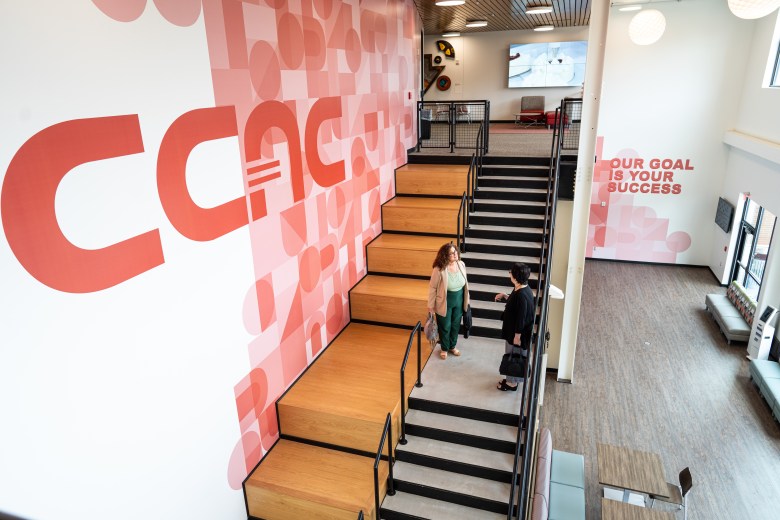
The Center for Education, Innovation & Training at the Community College of Allegheny County in Pittsburgh. The college is part of a citywide effort to give academic credit for older students’ life experiences. Credit: Nancy Andrews for The Hechinger Report
When Melissa DiMatteo, 38, decided to get an associate degree at CCAC to go further in her job, she got six credits for her previous training in Microsoft Office and her work experience as everything from a receptionist to a supervisor. That spared her from having to take two required courses in computer information and technology and — since she’s going to school part time and taking one course per semester — saved her a year.
“Taking those classes would have been a complete waste of my time,” DiMatteo said. “These are things that I do every day. I supervise other people and train them on how to do this work.”
On average, students who get credit for prior learning save between $1,500 and $10,200 apiece and nearly seven months off the time it takes to earn a bachelor’s degree, the nonprofit advocacy group Higher Learning Advocates calculates. The likelihood that they will graduate is 17 percent higher, the organization finds.
Justin Hand dropped out of college because of the cost, and became a largely self-taught information technology manager before he decided to go back and get an associate and then a bachelor’s degree so he could move up in his career.
He got 15 credits — a full semester’s worth — through a program at the University of Memphis for which he wrote essays to prove he had already mastered software development, database management, computer networking and other skills.
“These were all the things I do on a daily basis,” said Hand, of Memphis, who is 50 and married, with a teenage son. “And I didn’t want to have to prolong college any more than I needed to.”
Meanwhile, employers and policymakers are pushing colleges to speed up the output of graduates with skills required in the workforce, including by giving more students credit for their prior learning. And online behemoths Western Governors University and Southern New Hampshire University, with which brick-and-mortar colleges compete, are way ahead of them in conferring credit for past experience.
“They’ve mastered this and used it as a marketing tool,” said Kristen Vanselow, assistant vice president of innovative education and partnerships at Florida Gulf Coast University, which has expanded its awarding of credit for prior learning. “More traditional higher education institutions have been slower to adapt.”
It’s also gotten easier to evaluate how skills that someone learns in life equate to academic courses or programs. This has traditionally required students to submit portfolios, take tests or write essays, as Hand did, and faculty to subjectively and individually assess them.
Now some institutions, states, systems and independent companies are standardizing this work or using artificial intelligence to do it. The growth of certifications from professional organizations such as Amazon Web Services and the Computing Technology Industry Association, or CompTIA, has helped, too.
“You literally punch [an industry certification] into our database and it tells you what credit you can get,” said Philip Giarraffa, executive director of articulation and academic pathways at Miami Dade College. “When I started here, that could take anywhere from two weeks to three months.”
Data provided by Miami Dade shows it has septupled the number of credits for prior learning awarded since 2020, from 1,197 then to 7,805 last year.
“These are students that most likely would have looked elsewhere, whether to the [online] University of Phoenix or University of Maryland Global [Campus]” or other big competitors, Giarraffa said.
Fifteen percent of undergraduates enrolled in higher education full time and 40 percent enrolled part time are 25 or older, federal data show — including people who delayed college to serve in the military, volunteer or do other work that could translate into academic credit.
“Nobody wants to sit in a class where they already have all this knowledge,” Giarraffa said.
At Thomas Edison, police academy graduates qualify for up to 30 credits toward associate degrees. Carpenters who have completed apprenticeships can get as many as 74 credits in subjects including math, management and safety training. Bachelor’s degrees are often a prerequisite for promotion for people in professions such as these, or who hope to start their own companies.
The University of Memphis works with FedEx, headquartered nearby, to give employees with supervisory training academic credit they can use toward a degree in organizational leadership, helping them move up in the company.
The University of North Carolina System last year launched its Military Equivalency System, which lets active-duty and former military service members find out almost instantly, before applying for admission, if their training could be used for academic credit. That had previously required contacting admissions offices, registrars or department chairs.
Among the reasons for this reform was that so many of these prospective students — and the federal education benefits they get — were ending up at out-of-state universities, the UNC System’s strategic plan notes.
“We’re trying to change that,” said Kathie Sidner, the system’s director of workforce and partnerships. It’s not only for the sake of enrollment and revenue, Sidner said. “From a workforce standpoint, these individuals have tremendous skill sets and we want to retain them as opposed to them moving somewhere else.”
California’s community colleges are also expanding their credit for prior learning programs as part of a plan to increase the proportion of the population with educations beyond high school.
“How many people do you know who say, ‘College isn’t for me?’ ” asked Sam Lee, senior advisor to the system’s chancellor for credit for prior learning. “It makes a huge difference when you say to them that what they’ve been doing is equivalent to college coursework already.”
In Pittsburgh, the Regional Upskilling Alliance — of which CCAC is a part — is connecting job centers, community groups, businesses and educational institutions to create comprehensive education and employment records so more workers can get credit for skills they already have.
That can provide a big push, “especially if you’re talking about parents who think, ‘I’ll never be able to go to school,’ ” said Sabrina Saunders Mosby, president and CEO of the nonprofit Vibrant Pittsburgh, a coalition of business and civic leaders involved in the effort.
“Our members are companies that need talent,” Mosby said.
There’s one group that has historically pushed back against awarding credit for prior learning: university and college faculty concerned it might affect enrollment in their courses or unconvinced that training provided elsewhere is of comparable quality. Institutions have worried about the loss of revenue from awarding credits for which students would otherwise have had to pay.
That also appears to be changing, as universities leverage credit for prior learning to recruit more students and keep them enrolled for longer, resulting in more revenue — not less.
“That monetary factor was something of a myth,” said Beth Doyle, chief of strategy at CAEL.
Faculty have increasingly come around, too. That’s sometimes because they like having experienced students in their classrooms, Florida Gulf Coast’s Vanselow said.
Still, while many recognize it as a recruiting incentive, most public universities and colleges have had to be ordered to confer more credits for prior learning by legislatures or governing boards. Private, nonprofit colleges remain stubbornly less likely to give it.
More than two-thirds charge a fee for evaluating whether other kinds of learning can be transformed into academic credit, an expense that isn’t covered by financial aid. Roughly one in 12 charge the same as it would cost to take the course for which the credits are awarded.
Debra Roach, vice president for workforce development at the Community College of Allegheny County in Pittsburgh. The college is working on giving academic credit to students for their military, work and other life experience. Credit: Nancy Andrews for The Hechinger Report
There are other confounding roadblocks and seemingly self-defeating policies. CCAC runs a noncredit program to train paramedics, for example, but won’t give people who complete it credits toward its for-credit nursing degree. Many leave and go across town to a private university that will. The college is working on fixing this, said Debra Roach, its vice president of workforce development.
It’s important to see this from the students’ point of view, said Tracy Robinson, executive director of the University of Memphis Center for Regional Economic Enrichment.
“Credit for prior learning is a way for us to say, ‘We want you back. We value what you’ve been doing since you’ve been gone,’ ” Robinson said. “And that is a total game changer.”
Contact writer Jon Marcus at 212-678-7556, [email protected]orjpm.82 on Signal.
The Hechinger Report provides in-depth, fact-based, unbiased reporting on education that is free to all readers. But that doesn’t mean it’s free to produce. Our work keeps educators and the public informed about pressing issues at schools and on campuses throughout the country. We tell the whole story, even when the details are inconvenient. Help us keep doing that.
Higher education stands at an unprecedented inflection point. After decades of incremental change, universities worldwide are grappling with converging forces that are fundamentally reshaping what it means to deliver truly connected digital experiences to students, faculty, and staff.
This disconnect reveals the challenge: traditional approaches to digital transformation in universities focused on digitising existing processes rather than reimagining the entire student experience.
According to Paul Towers, country manager for Liferay Australia, “there’s a clear mismatch between how fast student expectations are evolving and how slow institutions are responding. The next generation of learners have higher expectations than ever for what an optimal student experience looks like.”
Today, four powerful forces are converging to redefine what “connected” truly means in the university context.
Force 1: The consumer-grade expectations revolution
Today’s students are digital natives who don’t differentiate between university services and the consumer applications they use daily. They expect the same personalisation they get from Netflix, the same convenience they experience with Amazon, and the same responsiveness they receive from their banking app.
This convergence of financial pressure, everyday student challenges, and digital nativity creates unprecedented expectations. Universities must deliver consumer-grade personalisation while addressing the complex, multifaceted nature of student success.
It’s no longer enough to have separate portals for academics, student services, and campus life, students expect one unified experience that understands their complete journey and responds to their changing needs.
Force 2: The everything online imperative
The second force reshaping university digital experiences is students’ expectation that anything they can do on campus, they should be able to do online – efficiently and intuitively.
However, recent research reveals an important nuance – while students want digital convenience for routine transactions, they increasingly value in-person interactions for complex, collaborative activities.
“Students don’t think in terms of departments or administrative offices, they think in terms of outcomes. If your digital experience adds friction, you’re making student success harder than it needs to be,” Mr Towers said.
Leading universities embrace ‘digital-first, human-when-it-matters’ models – removing friction from routine tasks while preserving meaningful human connection.
Force 3: The AI acceleration effect
Perhaps no force is reshaping university digital experiences as rapidly as artificial intelligence. The statistics are staggering: 92 per cent of students now use AI in some form, with 88 per cent having used generative AI for assessments.
“AI is no longer a future trend – it’s a present reality in student workflows,” Mr Towers said.
Universities that proactively integrate AI into their connected digital experiences can deliver unprecedented personalisation and support. Leading institutions envision AI-powered learning analytics and improved accessibility for both students and faculty.
The AI revolution in university digital experiences isn’t about replacing human connection – it’s about augmenting it. AI handles routine tasks, supports 24/7, and predicts student challenges early. This frees human staff to focus on the complex, empathetic, relationship-building activities that truly matter in education.
Force 4: Real-time connected experience
These three forces are converging toward a vision of truly connected digital experiences that goes far beyond current university technology implementations. The future of a real-time connected experience includes:
Predictive intelligence: Systems that anticipate student needs before they arise, identifying at-risk students early and proactively connecting them with appropriate support services.
Hyper-personalisation: Modern learners expect flexible, personalised study paths that align with their commitments.
Seamless integration: Rather than forcing students to navigate separate systems for academics, student services, career development, and campus life, connected experiences will provide a unified platform with a single source of truth about each student’s complete university journey.
Accessibility excellence: Universities recognise that AI tools can significantly improve accessibility, creating more inclusive experiences for students with diverse needs and learning preferences.
As Mr Towers outlines, “this future for students is not just digital. It’s intelligent, integrated and deeply personalised. And more importantly it will become what students expect by default.”
What this means for universities
The convergence of these forces is redefining what “connected” means in university digital experiences. It’s no longer sufficient to simply digitise existing processes or provide students with access to multiple systems. True connection requires:
Ecosystem thinking: View university experiences as a unified whole.
Student-centric design: Design around student journeys, not silos.
Proactive engagement: Anticipate needs with data and AI.
Human-digital balance:Use tech to enhance human interaction.
Universities that embrace these principles and invest in truly connected digital experience platforms will be positioned to thrive in an increasingly competitive landscape. Those that continue with fragmented, process-centric approaches risk falling behind as student expectations continue to evolve.
The question isn’t whether these forces will reshape higher education – they already have. The question is how quickly and strategically institutions will adapt to serve their students in this new reality.
The universities that get this right won’t just improve their digital offerings; they’ll transform their ability to support student success at scale while maintaining the human connections that make higher education transformational.
With the AI education market projected to reach $20 billion by 2027, the investment and innovation in this space will only accelerate. The time for universities to reimagine their digital experiences isn’t tomorrow – it’s today.
Universities like Queensland and George Washington are already moving from fragmented systems to unified digital experiences that meet evolving student expectations.
If you’re exploring how to unify your university’s digital ecosystem and create more responsive student experiences, Liferay has the expertise and platform to support your journey.
If you still imagined that the Lifelong Learning Entitlement (LLE) would mean that a student studying any module from any course would be eligible for 30 credits of funding, it’s long past time to disabuse yourself of that notion.
Under the latest plans, eligibility only extends to short courses dealing with those subjects identified as national priorities – via a somewhat tenuous link to the industrial strategy – along with HTQ modules. Everything else in higher education will be funded by year of study, as is currently the case.
If you were thinking that this latest round of changes – taking us even further away from the initial dreams of Boris Johnson (or even Philip Augar) – completes the long gestation of the LLE in full detail you will be disappointed. For instance, the credit transfer nettle has yet to be grasped – with a consultation due in early 2026, not far in advance of the September 2026 soft launch. And there are, as we shall see, a number of other issues still dangling.
It’s a continuation of DfE’s gradual retreat from a universal system of funding that was supposed to transform the higher education landscape. No variable intensity, a vast reduction in modular availability – it just allows some of the short courses that universities and colleges already offer to be funded via the loan system (a measure, lest we forget, of dubious attractiveness to learners).
A bridge to nowhere
The Lifelong Learning Entitlement (originally known as the Lifelong Loan Entitlement) was announced by Prime Minister Boris Johnson on 29 September 2020, as a part of the government’s lifetime skills guarantee:
we’ll expand and transform the funding system so it’s as easy to get a loan for a higher technical course as for a university degree, and we’ll enable FE colleges to access funding on the same terms as our most famous universities; and we’ll give everyone a flexible lifelong loan entitlement to four years of post-18 education – so adults will be able to retrain with high level technical courses, instead of being trapped in unemployment.
Like most of Boris’ wheezes it was originally somebody else’s idea – in this case Philip Augar. He had a few more specifics:
The government should introduce a single lifelong learning loan allowance for tuition loans at Levels 4, 5 and 6, available for adults aged 18 or over, without a publicly funded degree. This should be set, as it is now, as a financial amount equivalent to four years’ fulltime undergraduate degree funding. Learners should be able to access student finance for tuition fee and maintenance support for modules of credit-based Level 4, 5 and 6 qualifications. ELQ rules should be scrapped for those taking out loans for Levels 4, 5 and 6.
But it makes more sense to think of the idea as being 100 per cent Boris in that it was a massive infrastructure initiative that he had no clue how to actually deliver (in all honesty, not much of Augar was deliverable either – perhaps that was the attraction). As has proved to be the case.
As you were
Let’s start by looking at what’s unchanged, following the latest revisions. The timeline for getting started remains as was: applications from September 2026 for courses and modules starting in January 2027. This still feels extremely optimistic. Plus – as has been the case for a while – a staggered rollout of standalone modules is planned, rather than an enormous platter of bitesize options spread out to pick from come next September.
The use of the current plan 5 student loan model, with its 40-year term and nine per cent repayment rate above what is currently around minimum wage, is still there – with all the peculiarities this will inevitably engender. If anyone was expecting a large scale shake-up of the student finance system any time soon, this should serve as an enormous hint that no radically new model is arriving in the short to medium term.
Also retained from DfE’s planning under the Conservatives is the system of “residual eligibility”, meaning how much loan is available to those who have already, for example, studied one undergraduate degree. You still get the equivalent of four years overall, though with lots of wrinkles.
The aspiration for each member of the public to have an LLE personal account continues – this will still include, in theory, information on one’s loan balances, an application tracker, and advice and guidance on career planning.
And in broad strokes the government’s rationale for the LLE persists: more flexible routes through tertiary education, support for upskilling and retraining throughout one’s career, and the promise of more learner mobility between institutions.
Picking winners
The LLE is replacing England’s entire student funding system, and so funding for full years of study at levels 4 to 6 – such as degrees or higher technical qualifications – will flow through it. In many cases, though, this is just a shift on paper.
What’s always been the more significant change is how it will bring the funding of individual modules into scope, along with the resulting interplay between single modular courses and larger programmes of study in a learner’s lifelong journey.
Modular provision that would be eligible had previously been defined as “modules of technical courses of clear value to employers” – this is now rejigged to:
modules of higher technical qualifications, and level 4, 5 and 6 modules from full level 6 qualifications, in subject groups that address priority skills gaps and align with the government’s industrial strategy.
We flagged this link between the LLE and the industrial strategy priority areas when the latter was published last month – and the updated LLE policy paper does say that DfE has worked with Skills England to assess skills priorities, though there is no detail on this.
What we very much don’t get is a mapping between LLE subjects and the industrial strategy sectors (the IS-8), or the priority sub-sectors and their corresponding links to certain regions or clusters which is, y’know, what the industrial strategy is all about. Arguably the main bone thrown to the industrial strategy is the concept of the government “picking winners” – but note there is no stumping up of public funds to support this.
So we get a list of which subject groups will be in scope for modular study:
computing
engineering
architecture, building and planning, excluding the landscape gardening subgroup
physics and astronomy
mathematical sciences
nursing and midwifery
allied health
chemistry
economics
health and social care.
Common Academic Hierarchy (CAH) fans will be delighted to spot that this appears to have been done (with the curious landscape gardening exception) at the very top level. These are very broad subject groups, which will contain multiple subjects with questionable relevance to the industrial strategy.
While on the face of it there is some ambiguity about whether this subject list refers to only level 6 qualifications, or to these and higher technical qualifications (HTQs), the accompanying provider preparation guide makes clear that the subject groups here are for level 6 qualifications only – and provision via HTQ modules covers many other subject areas, which in some cases overlap. This currently includes subjects such as business and administration, education and early years, legal and accounting, and many others – but these will need to go through the HTQ approval route.
The provider preparation guide suggests that institutions should be looking at their current degree provision, working out where it aligns to the priority skills gaps areas that DfE has identified, and then proceeding from there in thinking about what could be modularised. All modular study, remember, needs to form part of an existing designated full course which the provider delivers – we’re a long way from some of the previous visions of universities coming up with new stand-alone bitesize offers.
All the other funding eligibility rules for modular provision remain – they must have a single qualification level at level 4, 5 or 6, they must be at least 30 credits (though bundling up modules to meet that minimum is allowed), and a standardised transcript of some form to be determined must be delivered upon completion, to facilitate credit transfer.
But there is one change to eligibility rules – modular provision must not be delivered through franchised arrangements. This had always sounded like a recipe for disaster. The government has been gradually setting its face against a lot of existing franchising activity, given concerns about quality and reports of fraud.
Getting approved
The previous plan for approving modules (outside of HTQs) for LLE eligibility was what was being labelled a “qualifications gateway”, which the Institute for Apprenticeships and Technical Education consulted on last January. This terminology has been scrubbed entirely out of the policy paper now, with just a note that “we will set out details on how level 4 to 6 Ofqual regulated qualifications could enter the market and access LLE funding.”
But there’s a new approval process in town – providers who are interested in delivering modular provision from January 2027 will need to submit an expression of interest, from this month.
This process will involve an “assurance check” – seemingly run centrally by DfE, rather than Skills England as might have previously been expected. There’s a wonderful flowchart in the provider guide, which you may or may not be able to read depending on how enormous your screen is:
That’s right – TEF! Providers with gold or silver will have access to a “simpler and quicker approval process” for modular provision. Those who do not will be asked to provide additional information around “readiness, capability and successful delivery of the parent course.”
Hang on, you cry, doesn’t the fact a provider is registered with the Office for Students demonstrate that it has “readiness” and “capability” to deliver courses of any type? Well, yes, it does. It is possible that DfE simply doesn’t trust OfS to make this kind of judgement – which would point to a rather larger issue with higher education regulation – or it could be that this is a last gasp attempt to give TEF awards some regulatory relevance.
This is also the case for those rated “good” or “outstanding” for Ofsted provision – and if Ofsted inspects your skills provision and you have a TEF award, they both need to make the grade. Now headline Ofsted assessments were supposed to disappear from September 2025, which makes this all a bit confusing.
If you don’t deliver HTQs or appropriate level 6 qualifications, it’s noted that modular provision is anticipated to “gradually expand when appropriate to do so” and so you may, one day, come in line for eligibility.
Regulatory issues
One of the areas the previous version of the policy paper promised was further information on the regulation of modular funding. This, rather oddly, is no longer listed under “next steps”, given that the update we do get is relatively slim.
What we might have expected was a follow-up to the Office for Students’ call for evidence on positive outcomes for students studying on a modular basis – a call for evidence which closed in November 2023, and we’ve heard little of since. As DK set out at the time, the quasi-consultation asked how things like the B3 conditions could apply to individual modules, and the regulator’s initial thinking seemed to be that completion would still be a valuable metric for regulation, as would progression – though exactly how progression was assessed would need to be refined.
There’s still no news on this complicated issue. The new section of regulation focuses more on registration categories, while noting that DfE “will refine the existing regulatory framework to ensure it is proportionate, is targeted [and] supports a high quality, flexible system.” If you were thinking that a whole new approach to learning would need a new oversight framework, the direction of travel suggests not.
The bigger regulatory news is that, likely to the surprise of few, the idea of having a third registration category for smaller providers offering level 4 and 5 qualifications has been scrapped. Instead the government will extend the current system of advanced learner loan funding for levels 4 to 6 until the end of summer 2030. This will give unregistered providers more time to apply for OfS registration in one of the two existing categories, though OfS is scheduled to consult in autumn 2025 on proposals to disapply some conditions of registration for providers in the further education statutory sector (which already has a regulator looking after most of this stuff).
Maintenance chunks
As expected, student maintenance support will be available on a pro-rata basis (depending on course, location, and personal circumstances) in an equivalent way to the existing undergraduate offer. Because this support is intended to deal with “living costs”, DfE has decided to continue to restrict availability to students attending in person – there’s nothing for online or distance learning.
Additional targeted grants (most likely this just refers to existing disabled students’ allowance and such like) will still be available – but there’s more to come on this later this year, alongside more guidance on maintenance generally. We can perhaps hope that a forthcoming announcement modifying the decades-old system (or even just the parental income thresholds) is playing a part in this delay.
That feeling of entitlements
Another area where things have mostly stayed the same is the personal entitlement for tuition fee funding equivalent to four full-time years (480 credits, currently £38,140) of traditional study – with the welcome clarification that where a provider charges less than the maximum the cash value rather than the credit value will be deducted from the total. Maximum borrowing is for 180 credits a year (which would just about cover a year of an accelerated degree). And for existing graduates (with the frankly wild caveats as before) there will be an entitlement to funding equivalent to unused residual credits.
But what happens when your balance reaches £0? No more learning for you? Not quite – a “priority additional entitlement” may be available (fees plus maintenance) in order to complete a full course in a small number of subjects (medicine, dentistry, nursing and midwifery, allied health professions, initial teacher training, social work).
For those who follow career paths that require five years or more of study (veterinary surgery, architecture part 2, an integrated masters in Scotland) there will be a “special additional entitlement” of up to two years, again covering fees and maintenance. There’s also additional entitlements for those who take foundation years, placement years, or study abroad years. It’s by-and-large a smoothing-out of some of the unintended consequences with existing provision where representations had been made.
Plus, importantly, the government will now play a part in mitigating circumstances – if you are resitting a year because of “compelling personal reasons” (illness, bereavement) you will have the costs of your study covered. And resits on longer courses will be covered anyway.
The credit transfer question
“The LLE and modular provision will provide a pathway to strengthen opportunities for credit transfer and learner mobility,” the new version of the paper states. While no-one would deny that the LLE could be a “pathway to strengthen opportunities,” especially given how tepid the phrasing is, there has still been essentially no progress on the thorny question of credit transfer.
The largely new section on “recognition of prior learning, credit transfer, and record of learning” sets out aspirational areas where the government thinks it can work collaboratively with the sector – to promote pathways between providers, to improve guidance for both incoming and outgoing learners, and to generally square the recognition of prior learning circle despite all the intractable problems therein.
Interestingly, DfE also wants institutions to embed all this into “broader strategies for widening access”. It’s not immediately clear how this will come off – but we get the note that this year will bring an update on “proposed changes that will start to embed this flexibility and greater learner mobility across LLE funded provision.” This might be a reference to the post-16 education and skills white paper.
To facilitate all this flexibility, DfE had previously said it would be introducing a “standardised transcript template.” Tellingly, this has now been revised down to “a standardised transcript as part of modular funding designation.” So it appears the plan is now to look at enforcing this standardisation for the (potentially scant) modular provision that the LLE will generate, while sidestepping the much bigger question of how portability between modules and larger qualifications including degrees will work. This is a substantial scaling down in ambition – and yet it’s still a complicated thing to get agreed implemented in little over a year.
What’s next
As is probably coming across, there is still an awful lot yet to be confirmed. Secondary legislation to implement the LLE fee limits and funding system still needs to be laid. Fee loan limits for non-fee capped provision are pending confirmation. The Student Loans Company needs to get its systems ready.
There will be another consultation too, in addition to OfS’ further education one. While it’s not mentioned in the updated policy paper, the accompanying provider preparation guide reveals that the Department for Education will consult on “learner mobility across LLE-funded provision in early 2026” (maybe this will be the moment when credit transfer finally gets sorted out once and for all). Opening a consultation in early 2026 when big chunks of the whole shebang are supposed to be ready to go that September does not necessarily inspire confidence.
And the drip-by-drip announcements about the policy plumbing of the LLE mean that it’s a long time since the government has really restated its belief that there is demand out there for modular provision, or committed to working to drum some up. Really it’s baffling why this week’s announcements haven’t been packaged up with the skills white paper, as surely they must form part of a wider vision. Some clarity within this about overlaps and interplay with the apprenticeship levy would have been welcome too.
The provider preparation guide entreats institutions to start thinking about how they will market modular provision, which is a tricky question given the absence of demand that pilots have demonstrated. But one of the examples given is particularly problematic:
if you seek to target mature students, do you need to start building relationships with local employers and/or recruitment agents, rather than only relying on existing recruitment channels?
This isn’t a new addition to the guidance – but since the last update, Bridget Phillipson has told Parliament that the government will “take immediate action on the use of agents to recruit students,” adding that “the government can see no legitimate role for domestic agents in the recruitment of UK students,” following the Sunday Times franchising investigation fallout. So DfE is at the same time banning the use of domestic agents – or at least it said it would – while acknowledging that recruitment to modular provision might be tricky without them.
It’s of a piece with much of the preparation guide – the responsibility to iron out the holes in the LLE’s business case is being passed onto providers. Supposedly over the rest of the year universities and colleges should be reviewing everything from accommodation to wrap-around support, while building up relationships with employers and potentially rewriting their academic regulations. All while plenty remains unclear at the sector level. It would be unsurprising to see providers reluctant to leap into the approvals process right away, and instead assess how others fare.
Given all this, it’s perhaps unsurprising that the ambition of the LLE has diminished a little bit each time the policies around it have been updated. We’re a long way from where we started.
Probably the most damning assessment you could make is that, were Labour to have opted to cancel the whole LLE and just allow students to take out loans for a handful of higher education short courses tenuously linked to industrial strategy priorities, the sector would be in a very similar situation to the one it is in now. And – given clear indications of lack of student demand, and common sense assessments of the general public’s appetite for more tuition fee debt wrapped up in confusing bitesize-but-lifelong repayment obligations – few would think it was a good idea.